Thematic Apperception TesT
 WHAT IS TAT?
 It is a projective test consisting of a series of pictures in which
the examinee is requested to create a story about the picture.
 method of revealing to the trained interpreter some of the
dominant drives, emotions, sentiments, complexes and
conflicts of personality.
 Apperception – refer to the process of projecting fantasy
imaginary onto an objective stimuli.
HISTORY:
Conceptualized by Henry Murray and Christina Morgan on 1935.
 Henry Murray
 Born on May 13, 1893, into a wealthy family.
 Has a good relationship with his father but a poor one with his
mother, which results in him feeling depressed.
 Christina Morgan
- Born in Boston on October 6, 1887
- Had a lot of health problems.
- Drowned herself on March 14, 1967 at the Virgin
Islands
 Morgan – Murray Thematic apperception Test
 the original name of the TAT but later on Murray is given primary credit for
the test, along with the staff of Harvard Psychological Clinic.
 1938 the year that Tat was established in Harvard Psychological
Clinic
 Explorations in Personality in which the description of TAT was
included.
 Murray’s Theory of Personality
The TAT is so integrally involved with Murray’s concept
of personality that a survey and knowledge of his basic
theoretical components is important. In constructing the
theory, Murray emphasizes the biological basis as well as the
social and environmental determinants of behavior. He is also
consistently aware of how individuals interact with their
environment.
 1960 – Mrs. Uma Coudhary developed Indian Adoption of
TAT
 Human Potential Movement
 Encouraged psychologists to use TAT to help their clients
understand themselves better and stimulate personal growth.
GENERAL CONDITIONS:
 To be administered in an interpersonal setting.
 The Indian version of TAT materials consists of 13 cards on
which ambiguous pictures are presented.
 During administration, the subject should be seated beside
the examiner with his or her chair turned away
INSTRUCTIONS:
 The examiner will show some pictures one at a time, and the
subject will be making up as dramatic a story as he/she can
for each picture card. 50 minutes for 10 pictures. The
following story structure must be obtained:
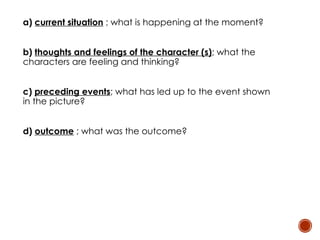
a) current situation ; what is happening at the moment?
b) thoughts and feelings of the character (s); what the
characters are feeling and thinking?
c) preceding events; what has led up to the event shown
in the picture?
d) outcome ; what was the outcome?
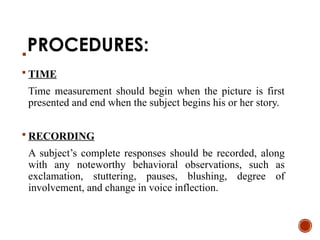
PROCEDURES:

 TIME
Time measurement should begin when the picture is first
presented and end when the subject begins his or her story.
 RECORDING
A subject’s complete responses should be recorded, along
with any noteworthy behavioral observations, such as
exclamation, stuttering, pauses, blushing, degree of
involvement, and change in voice inflection.
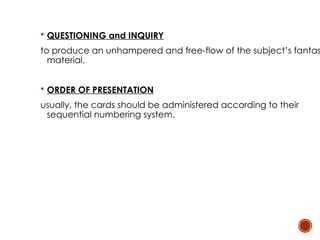
 QUESTIONING and INQUIRY
to produce an unhampered and free-flow of the subject’s fantas
material.
 ORDER OF PRESENTATION
usually, the cards should be administered according to their
sequential numbering system.
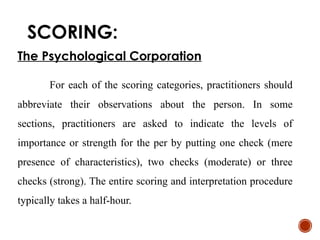
SCORING:
The Psychological Corporation
For each of the scoring categories, practitioners should
abbreviate their observations about the person. In some
sections, practitioners are asked to indicate the levels of
importance or strength for the per by putting one check (mere
presence of characteristics), two checks (moderate) or three
checks (strong). The entire scoring and interpretation procedure
typically takes a half-hour.
 H.A Murray, 1943 scoring the TAT involves evaluating
the following five different aspects of the stories:
 The Hero. Scoring for the hero involves identifying who is
central character(s) in the story
 Need of the Hero. For Murray, it was also critical to identify
the needs, motives and desire of the hero.
 Identifying the presses. A press refer to any important
environmental factor that may influence or interfere with the
need of the hero.
Example: (parents or boss), (the lock on the door is broken)
 Scoring for themes. Scoring for themes in TAT stories involves
noting the nature of the interplay and conflict between the needs and
presses, the types of emotion elicited by this conflict, and the way the
conflict is resolved.
 Scoring for outcome. Scoring for the outcome of the story involves
analyzing how the stories end by noting a happy versus unhappy
ending and assessing the extent to which the ending is controlled by
the strengths of the hero and forces in the environment.
INTERPRETATION:
 Nomethetic and Idiogrphic.
1. Nomothethic Interpretation refers to the practice of establishing
norms for answer from subjects in specific age, gender, racial, or
educational level groups and then measuring a given subject’s
responses against those norms.
2. Idiographic Interpretation refers to evaluating the unique features
of the subject’s view of the world and relationships.
Most psychologists would classify the TAT is better suited to
idiographic than nomothethic interpretations
 In interpreting the responses of the TAT, the examiners typically
focus their attention on one of the three (3) areas:
•The content of the stories that the subject tells;
•The feeling or the tone of the stories;
•The subject’s behavior apart from responses.
These behavior may include: Verbal Remarks (e.g. comments about
feeling stressed by situation or not being good story teller) as well as
Nonverbal Actions or Signs (e.g. blushing stammering, fidgeting in
the chair, difficulties making an eye contact with the examiner, etc.)
 The story content usually reveals the subject’s attitudes,
fantasies, wishes, inner conflicts, and view of the outside world.
 The story structure typically reflects the subject’s feelings,
assumptions about the world, and an underlying attitude of
optimism or pessimism.
The 3 Levels of Interpretations suggest by Bellak & Abram, 1997 are:
•Descriptive Level- it is the mere repeat of the story
•Interpretative Level- It extends the descriptive level by an
alteration of it [if one does the X, then the outcome will be Y.].
•Diagnostic Level- It is the further extension I that an
interference is made about the client.
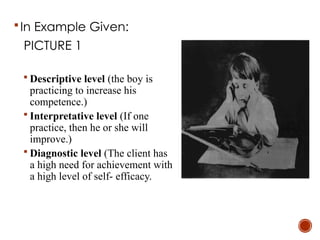
In Example Given:
PICTURE 1
 Descriptive level (the boy is
practicing to increase his
competence.)
 Interpretative level (If one
practice, then he or she will
improve.)
 Diagnostic level (The client has
a high need for achievement with
a high level of self- efficacy.
RESULTS:
 The results of the TAT must be interpreted in the context of the
subject’s personal history, age, sex, level of education,
occupation, racial or ethnic identification first language, and
other characteristics that may be important.
 The results of the Thematic Apperception Test are difficult to
generalize. The results are often subjective and do not use any
formal type of scoring system. However, a close analysis of the
stories told by the subject normally gives the tester a decent
idea of the traits mentioned above (personality, emotional
control, and attitudes towards aspects of everyday life).
 Thematic Apperception Tests are less beneficial to
individuals. However, individuals can use the results to
determine if an industry or company is right for them. The
results can also help the person understand their unconscious
self, which can help them find ways to successfully increase
their productivity and efficacy on the job. A true
understanding of one self can provide over your co-workers
and competitors.
THEMATIC APPERCEPTION
TEST (TAT)
Picture 1:
A boy is sitting and
looking at a Tanpura
placed in front of
him.
PERSONALITY CHARACTERISTICS
 As per description of the subject following traits may be traced
 Creativity
 Imagination ability
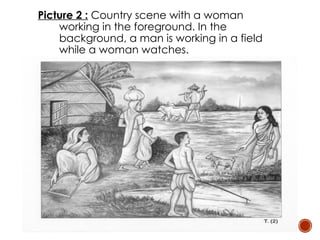
Picture 2 : Country scene with a woman
working in the foreground. In the
background, a man is working in a field
while a woman watches.
GENERAL DISCUSSION
This is the card in the series that presents the group scene
and gives information relating to how the individual deals
with the challenge of people living together.
PERSONALITY CHARACTERISTICS
 As per description of the subject following traits may be traced
 Imagination power
 Nature loving
 Aesthetic sense
 Attitude towards life of different workers
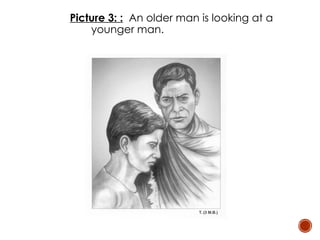
Picture 3: : An older man is looking at a
younger man.
GENERAL DISCUSSION
 This card is extremely useful in obtaining
information about the authority figures
and, more specifically the subjects own
father. The picture deals with hierarchical
Personal relationships and usually takes
the form of an older, more experienced
man interacting with the younger, less
experienced one.. Thus, the card can
clearly show how the subject deals with
external demands and attitudes toward
authority.
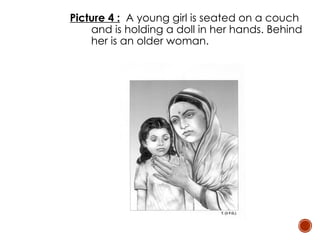
Picture 4 : A young girl is seated on a couch
and is holding a doll in her hands. Behind
her is an older woman.
GENERAL DISCUSSION
The intention here is to bring out the style and
manner of mother-child interaction. When the
older women are the subjects, the picture often
elicits feelings and attitudes toward children.
Because both figures are looking away, either
figure is sometimes perceived as rejecting the other.
This, the card draws out negative feeling and
interactions, and it is important to note how these
feelings are resolved, expressed, or avoided.
Sometimes the older woman is described as reading
a fairy story to the younger girl.
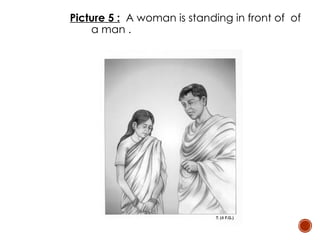
Picture 5 : A woman is standing in front of of
a man .
GENERAL DISCUSSION
 This picture typically elicits a good deal of information relating to
the feelings and attitudes surrounding male-female relationship.
PERSONALITY CHARACTERISTICS
 Attitude towards male – female relationship
 Attitude of male towards female and vice versa
 Capacity for mutual respect
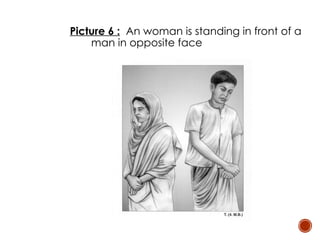
Picture 6 : An woman is standing in front of a
man in opposite face
 Attitude towards male – female relationship
 Information about Emotional aspects
 Information about Social relationship
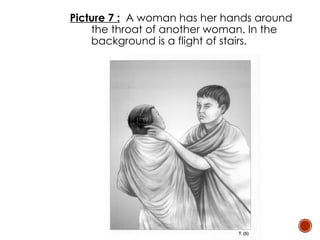
Picture 7 : A woman has her hands around
the throat of another woman. In the
background is a flight of stairs.
GENERAL DISCUSSION
The manner in which the subject handles aggressive,
hostile relationships with the other women is primary type
of information this picture elicits. Particular note should
be made of what types of events trigger this
aggressiveness, and of the manner in which the conflict is
or is not resolved
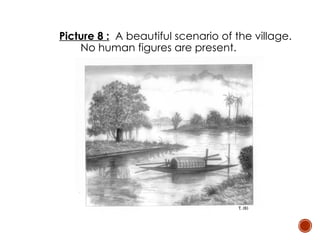
Picture 8 : A beautiful scenario of the village.
No human figures are present.
 The picture is describing the nature and so it is good test of
the subjects’ imaginative abilities.
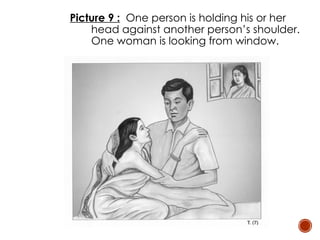
Picture 9 : One person is holding his or her
head against another person’s shoulder.
One woman is looking from window.
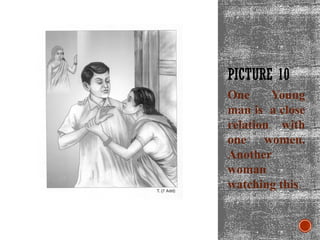
PICTURE 10
One Young
man is a close
relation with
one women.
Another
woman
watching this.
GENERAL DISCUSSION
 This card often gives useful information regarding how the subject
perceives male-female relationship, particularly those involving
some degree of closeness and intimacy. It might be helpful to notice
the relative degree of comfort or discomfort evoked by emotional
closeness. A story of departure or of termination of the relationship
may be reflective of either overt or denied hostility on the part of
the subject.
GENERAL DISCUSSION
 These card also deals with female peer relations and is
important in elaborating on the issues such as conflict
resolution, jealousy, sibling rivalry, and competitiveness.
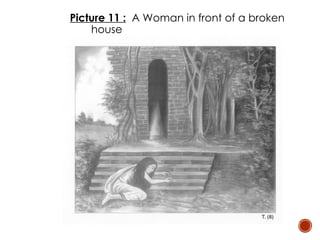
Picture 11 : A Woman in front of a broken
house
GENERAL DISCUSSION
The picture often elicits information regarding a subject’s attitudes
toward loneliness, darkness, and uncertainty. Fears may be stated
explicitly through gangster stories. As with Picture, the method of
handling these fears and the examinee’s response to physical danger
should be noted.
GENERAL DISCUSSION
 With suicidal or depressed subjects, there may be an elaboration of
feelings of abandonment and isolation), for example: someone has
been lost or has been fallen from a boat. More stable and adjusted
subjects are likely to discuss the peace of being alone in the woods
and perhaps of fishing or having gone fishing further down the
stream.
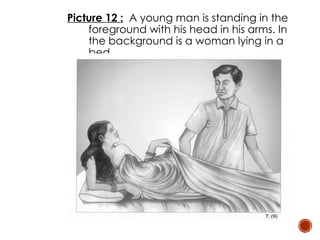
Picture 12 : A young man is standing in the
foreground with his head in his arms. In
the background is a woman lying in a
bed.
GENERAL DISCUSSION
This picture is often helpful in revealing sexual
conflicts. In a general way, it provides information on
the subject’s attitudes and feelings toward his or her
partner, in particularly attitudes just before and
immediately following the sexual relation. Stories in
which there are overt expressions of aggression or
revulsion are significant variations and should be
noted as relatively unusual. In particular, the relation
between a subject’s aggressive and sexual feelings
is frequently portrayed.
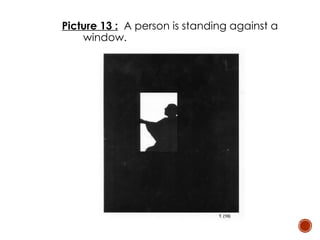
Picture 13 : A person is standing against a
window.
GENERAL DISCUSSION
 If a subject’s presenting problem is depression, especially
if there is evidence of suicidal ideation, this card along
with Picture . This type of subject often describes the
figure in the picture and, more importantly discusses the
events, feeling, and attitudes that led up to the current self-
destructive behavior. It becomes important to investigate,
during the inquiry phase of examination, the particular
methods and styles of problem solving that the story
character has attempted or is attempting
This picture may also reveal the subject’s aesthetics
interest and personal philosophical beliefs or wish
fulfillments.

Thematic Appreciation Test.presentaion PPT

  • 1.
  • 2.
     WHAT ISTAT?  It is a projective test consisting of a series of pictures in which the examinee is requested to create a story about the picture.  method of revealing to the trained interpreter some of the dominant drives, emotions, sentiments, complexes and conflicts of personality.  Apperception – refer to the process of projecting fantasy imaginary onto an objective stimuli.
  • 3.
    HISTORY: Conceptualized by HenryMurray and Christina Morgan on 1935.  Henry Murray  Born on May 13, 1893, into a wealthy family.  Has a good relationship with his father but a poor one with his mother, which results in him feeling depressed.
  • 4.
     Christina Morgan -Born in Boston on October 6, 1887 - Had a lot of health problems. - Drowned herself on March 14, 1967 at the Virgin Islands
  • 5.
     Morgan –Murray Thematic apperception Test  the original name of the TAT but later on Murray is given primary credit for the test, along with the staff of Harvard Psychological Clinic.  1938 the year that Tat was established in Harvard Psychological Clinic  Explorations in Personality in which the description of TAT was included.
  • 6.
     Murray’s Theoryof Personality The TAT is so integrally involved with Murray’s concept of personality that a survey and knowledge of his basic theoretical components is important. In constructing the theory, Murray emphasizes the biological basis as well as the social and environmental determinants of behavior. He is also consistently aware of how individuals interact with their environment.
  • 7.
     1960 –Mrs. Uma Coudhary developed Indian Adoption of TAT  Human Potential Movement  Encouraged psychologists to use TAT to help their clients understand themselves better and stimulate personal growth.
  • 8.
    GENERAL CONDITIONS:  Tobe administered in an interpersonal setting.  The Indian version of TAT materials consists of 13 cards on which ambiguous pictures are presented.  During administration, the subject should be seated beside the examiner with his or her chair turned away
  • 9.
    INSTRUCTIONS:  The examinerwill show some pictures one at a time, and the subject will be making up as dramatic a story as he/she can for each picture card. 50 minutes for 10 pictures. The following story structure must be obtained:
  • 10.
    a) current situation; what is happening at the moment? b) thoughts and feelings of the character (s); what the characters are feeling and thinking? c) preceding events; what has led up to the event shown in the picture? d) outcome ; what was the outcome?
  • 11.
    PROCEDURES:   TIME Time measurementshould begin when the picture is first presented and end when the subject begins his or her story.  RECORDING A subject’s complete responses should be recorded, along with any noteworthy behavioral observations, such as exclamation, stuttering, pauses, blushing, degree of involvement, and change in voice inflection.
  • 12.
     QUESTIONING andINQUIRY to produce an unhampered and free-flow of the subject’s fantas material.  ORDER OF PRESENTATION usually, the cards should be administered according to their sequential numbering system.
  • 13.
    SCORING: The Psychological Corporation Foreach of the scoring categories, practitioners should abbreviate their observations about the person. In some sections, practitioners are asked to indicate the levels of importance or strength for the per by putting one check (mere presence of characteristics), two checks (moderate) or three checks (strong). The entire scoring and interpretation procedure typically takes a half-hour.
  • 14.
     H.A Murray,1943 scoring the TAT involves evaluating the following five different aspects of the stories:  The Hero. Scoring for the hero involves identifying who is central character(s) in the story  Need of the Hero. For Murray, it was also critical to identify the needs, motives and desire of the hero.  Identifying the presses. A press refer to any important environmental factor that may influence or interfere with the need of the hero. Example: (parents or boss), (the lock on the door is broken)
  • 15.
     Scoring forthemes. Scoring for themes in TAT stories involves noting the nature of the interplay and conflict between the needs and presses, the types of emotion elicited by this conflict, and the way the conflict is resolved.  Scoring for outcome. Scoring for the outcome of the story involves analyzing how the stories end by noting a happy versus unhappy ending and assessing the extent to which the ending is controlled by the strengths of the hero and forces in the environment.
  • 16.
    INTERPRETATION:  Nomethetic andIdiogrphic. 1. Nomothethic Interpretation refers to the practice of establishing norms for answer from subjects in specific age, gender, racial, or educational level groups and then measuring a given subject’s responses against those norms. 2. Idiographic Interpretation refers to evaluating the unique features of the subject’s view of the world and relationships. Most psychologists would classify the TAT is better suited to idiographic than nomothethic interpretations
  • 17.
     In interpretingthe responses of the TAT, the examiners typically focus their attention on one of the three (3) areas: •The content of the stories that the subject tells; •The feeling or the tone of the stories; •The subject’s behavior apart from responses. These behavior may include: Verbal Remarks (e.g. comments about feeling stressed by situation or not being good story teller) as well as Nonverbal Actions or Signs (e.g. blushing stammering, fidgeting in the chair, difficulties making an eye contact with the examiner, etc.)
  • 18.
     The storycontent usually reveals the subject’s attitudes, fantasies, wishes, inner conflicts, and view of the outside world.  The story structure typically reflects the subject’s feelings, assumptions about the world, and an underlying attitude of optimism or pessimism.
  • 19.
    The 3 Levelsof Interpretations suggest by Bellak & Abram, 1997 are: •Descriptive Level- it is the mere repeat of the story •Interpretative Level- It extends the descriptive level by an alteration of it [if one does the X, then the outcome will be Y.]. •Diagnostic Level- It is the further extension I that an interference is made about the client.
  • 20.
    In Example Given: PICTURE1  Descriptive level (the boy is practicing to increase his competence.)  Interpretative level (If one practice, then he or she will improve.)  Diagnostic level (The client has a high need for achievement with a high level of self- efficacy.
  • 21.
    RESULTS:  The resultsof the TAT must be interpreted in the context of the subject’s personal history, age, sex, level of education, occupation, racial or ethnic identification first language, and other characteristics that may be important.  The results of the Thematic Apperception Test are difficult to generalize. The results are often subjective and do not use any formal type of scoring system. However, a close analysis of the stories told by the subject normally gives the tester a decent idea of the traits mentioned above (personality, emotional control, and attitudes towards aspects of everyday life).
  • 22.
     Thematic ApperceptionTests are less beneficial to individuals. However, individuals can use the results to determine if an industry or company is right for them. The results can also help the person understand their unconscious self, which can help them find ways to successfully increase their productivity and efficacy on the job. A true understanding of one self can provide over your co-workers and competitors.
  • 23.
    THEMATIC APPERCEPTION TEST (TAT) Picture1: A boy is sitting and looking at a Tanpura placed in front of him.
  • 24.
    PERSONALITY CHARACTERISTICS  Asper description of the subject following traits may be traced  Creativity  Imagination ability
  • 25.
    Picture 2 :Country scene with a woman working in the foreground. In the background, a man is working in a field while a woman watches.
  • 26.
    GENERAL DISCUSSION This isthe card in the series that presents the group scene and gives information relating to how the individual deals with the challenge of people living together.
  • 27.
    PERSONALITY CHARACTERISTICS  Asper description of the subject following traits may be traced  Imagination power  Nature loving  Aesthetic sense  Attitude towards life of different workers
  • 28.
    Picture 3: :An older man is looking at a younger man.
  • 29.
    GENERAL DISCUSSION  Thiscard is extremely useful in obtaining information about the authority figures and, more specifically the subjects own father. The picture deals with hierarchical Personal relationships and usually takes the form of an older, more experienced man interacting with the younger, less experienced one.. Thus, the card can clearly show how the subject deals with external demands and attitudes toward authority.
  • 30.
    Picture 4 :A young girl is seated on a couch and is holding a doll in her hands. Behind her is an older woman.
  • 31.
    GENERAL DISCUSSION The intentionhere is to bring out the style and manner of mother-child interaction. When the older women are the subjects, the picture often elicits feelings and attitudes toward children. Because both figures are looking away, either figure is sometimes perceived as rejecting the other. This, the card draws out negative feeling and interactions, and it is important to note how these feelings are resolved, expressed, or avoided. Sometimes the older woman is described as reading a fairy story to the younger girl.
  • 32.
    Picture 5 :A woman is standing in front of of a man .
  • 33.
    GENERAL DISCUSSION  Thispicture typically elicits a good deal of information relating to the feelings and attitudes surrounding male-female relationship.
  • 34.
    PERSONALITY CHARACTERISTICS  Attitudetowards male – female relationship  Attitude of male towards female and vice versa  Capacity for mutual respect
  • 35.
    Picture 6 :An woman is standing in front of a man in opposite face
  • 36.
     Attitude towardsmale – female relationship  Information about Emotional aspects  Information about Social relationship
  • 37.
    Picture 7 :A woman has her hands around the throat of another woman. In the background is a flight of stairs.
  • 38.
    GENERAL DISCUSSION The mannerin which the subject handles aggressive, hostile relationships with the other women is primary type of information this picture elicits. Particular note should be made of what types of events trigger this aggressiveness, and of the manner in which the conflict is or is not resolved
  • 39.
    Picture 8 :A beautiful scenario of the village. No human figures are present.
  • 40.
     The pictureis describing the nature and so it is good test of the subjects’ imaginative abilities.
  • 41.
    Picture 9 :One person is holding his or her head against another person’s shoulder. One woman is looking from window.
  • 42.
    PICTURE 10 One Young manis a close relation with one women. Another woman watching this.
  • 43.
    GENERAL DISCUSSION  Thiscard often gives useful information regarding how the subject perceives male-female relationship, particularly those involving some degree of closeness and intimacy. It might be helpful to notice the relative degree of comfort or discomfort evoked by emotional closeness. A story of departure or of termination of the relationship may be reflective of either overt or denied hostility on the part of the subject.
  • 44.
    GENERAL DISCUSSION  Thesecard also deals with female peer relations and is important in elaborating on the issues such as conflict resolution, jealousy, sibling rivalry, and competitiveness.
  • 45.
    Picture 11 :A Woman in front of a broken house
  • 46.
    GENERAL DISCUSSION The pictureoften elicits information regarding a subject’s attitudes toward loneliness, darkness, and uncertainty. Fears may be stated explicitly through gangster stories. As with Picture, the method of handling these fears and the examinee’s response to physical danger should be noted.
  • 47.
    GENERAL DISCUSSION  Withsuicidal or depressed subjects, there may be an elaboration of feelings of abandonment and isolation), for example: someone has been lost or has been fallen from a boat. More stable and adjusted subjects are likely to discuss the peace of being alone in the woods and perhaps of fishing or having gone fishing further down the stream.
  • 48.
    Picture 12 :A young man is standing in the foreground with his head in his arms. In the background is a woman lying in a bed.
  • 49.
    GENERAL DISCUSSION This pictureis often helpful in revealing sexual conflicts. In a general way, it provides information on the subject’s attitudes and feelings toward his or her partner, in particularly attitudes just before and immediately following the sexual relation. Stories in which there are overt expressions of aggression or revulsion are significant variations and should be noted as relatively unusual. In particular, the relation between a subject’s aggressive and sexual feelings is frequently portrayed.
  • 50.
    Picture 13 :A person is standing against a window.
  • 51.
    GENERAL DISCUSSION  Ifa subject’s presenting problem is depression, especially if there is evidence of suicidal ideation, this card along with Picture . This type of subject often describes the figure in the picture and, more importantly discusses the events, feeling, and attitudes that led up to the current self- destructive behavior. It becomes important to investigate, during the inquiry phase of examination, the particular methods and styles of problem solving that the story character has attempted or is attempting This picture may also reveal the subject’s aesthetics interest and personal philosophical beliefs or wish fulfillments.