COGNITIVE
MODEL
IN ABNORMAL PSYCHOLOGY
WHA
T IS COGNITION?
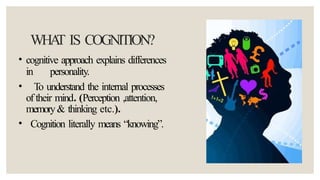
• cognitive approach explains differences
in personality.
• To understand the internal processes
of their mind. (Perception ,attention,
memory& thinking etc.).
• Cognition literally means “knowing”.
COGNITVE MODEL:
The model describes how people’s perception,
or spontaneous thoughts about a certain situation
influence their emotional, behavioral (and often
physiological) reactions. Cognitive model tend to be
focused on a single cognitive phenomenon or process,
and how two or more processes interact to make
behavioral predictions for aspecific task or tool.
Application of Cognitive model
to Abnormal psychology
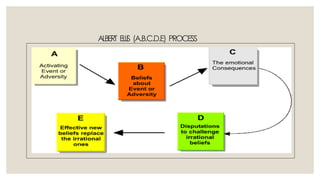
• who developed (REBT).According to Ellis, people
become depressed, anxious, upset because of
faulty reasoning and a reliance on irrational
beliefs and that people do not respond
emotionally to events in the world but to their
‘beliefs’ about those events. Ellis described this
as an A-B-C process.
ALBERT E
L
L
I
S (A.B.C.D.E) PROCESS
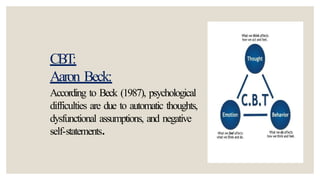
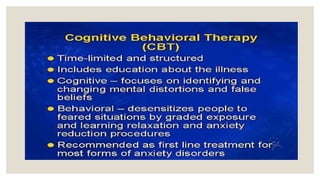
CBT:
Aaron Beck:
According to Beck (1987), psychological
difficulties are due to automatic thoughts,
dysfunctional assumptions, and negative
self-statements.
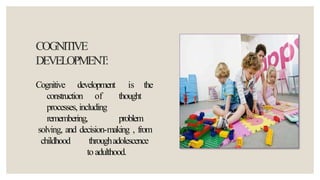
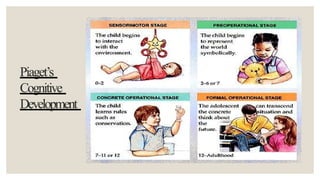
COGNITIVE
DEVELOPMENT:
Cognitive development is the
construction of thought
processes, including
remembering, problem
solving, and decision-making , from
childhood throughadolescence
to adulthood.
Piaget’s
Cognitive
Development
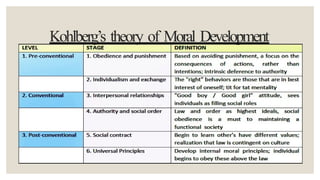
Kohlberg’s theory of Moral Development
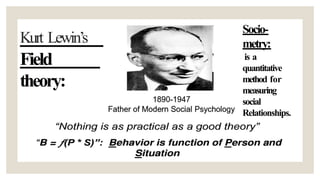
Kurt Lewin’s
Field
theory:
Socio-
metry:
is a
quantitative
method for
measuring
social
Relationships.
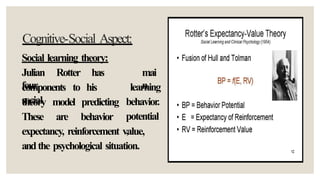
Cognitive-Social Aspect:
Social learning theory:
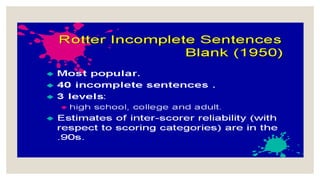
Julian Rotter has
four
mai
n
components to his
social
theory
These
model
are
predicting
behavior
learning
behavior.
potential
,
expectancy, reinforcement value,
andthe psychological situation.
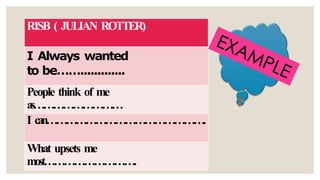
RISB ( JULIAN ROTTER)
I Always wanted
to be…….............
People think of me
as………………………
I can………………………………………….
What upsets me
most……………………….
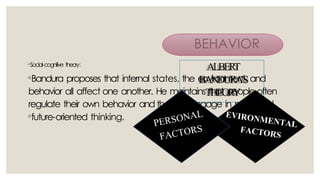
BEHAVIOR
◦Social-cognitive theory:
◦Bandura proposes that internal states, the environment, and
behavior all affect one another. He maintains that people often
regulate their own behavior and that we engage in purposeful,
◦future-oriented thinking.
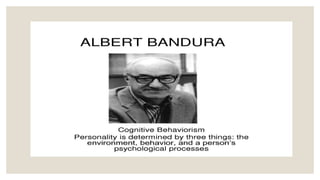
ALBERT
BANDURA
’S
THEORY
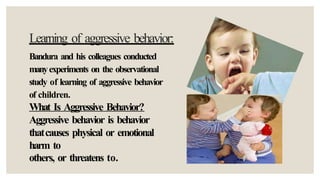
Learning of aggressive behavior:
Bandura and his colleagues conducted
manyexperiments on the observational
study of learning of aggressive behavior
of children.
What Is Aggressive Behavior?
Aggressive behavior is behavior
thatcauses physical or emotional
harm to
others, or threatens to.
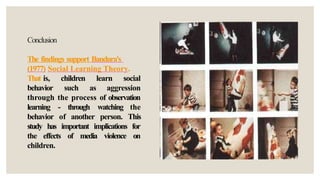
Conclusion
The findings support Bandura's
(1977) Social Learning Theory.
That is, children learn social
behavior such as aggression
through the process of observation
learning - through watching the
behavior of another person. This
study has important implications for
the effects of media violence on
children.
COGNITIVE-SOCIAL
(ONE PERSON INTRACT W
I
T
H
OTHERS)
"Thus the study of the processes involved
in perceiving each other and coming to "know
what we know" about the people in our world is
essentially aquestion not only of what behavior we
have seen, but of our cognition as individual
perceivers-our social cognition. Social cognition,
therefore, is the study of the mental processes
involved in perceiving, attending to, remembering,
thinking about, and making sense of the people in
our social world."
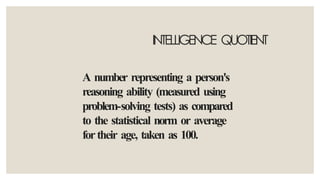
INTELLIGENCE QUOTIENT
A number representing a person's
reasoning ability (measured using
problem-solving tests) as compared
to the statistical norm or average
fortheir age, taken as 100.
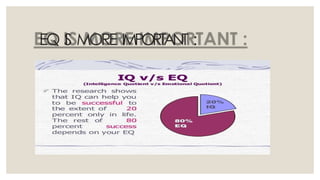
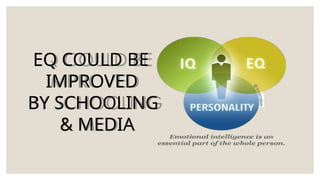
EQ I
S MORE IMPORTANT :
EQ COULD BE
IMPROVED
BY SCHOOLING
& MEDIA
cognition-150114095847-conversion-gate02.pptx

cognition-150114095847-conversion-gate02.pptx

  • 1.
  • 2.
    WHA T IS COGNITION? •cognitive approach explains differences in personality. • To understand the internal processes of their mind. (Perception ,attention, memory& thinking etc.). • Cognition literally means “knowing”.
  • 3.
    COGNITVE MODEL: The modeldescribes how people’s perception, or spontaneous thoughts about a certain situation influence their emotional, behavioral (and often physiological) reactions. Cognitive model tend to be focused on a single cognitive phenomenon or process, and how two or more processes interact to make behavioral predictions for aspecific task or tool.
  • 4.
    Application of Cognitivemodel to Abnormal psychology • who developed (REBT).According to Ellis, people become depressed, anxious, upset because of faulty reasoning and a reliance on irrational beliefs and that people do not respond emotionally to events in the world but to their ‘beliefs’ about those events. Ellis described this as an A-B-C process.
  • 5.
  • 6.
    CBT: Aaron Beck: According toBeck (1987), psychological difficulties are due to automatic thoughts, dysfunctional assumptions, and negative self-statements.
  • 8.
    COGNITIVE DEVELOPMENT: Cognitive development isthe construction of thought processes, including remembering, problem solving, and decision-making , from childhood throughadolescence to adulthood.
  • 9.
  • 10.
    Kohlberg’s theory ofMoral Development
  • 11.
  • 12.
    Cognitive-Social Aspect: Social learningtheory: Julian Rotter has four mai n components to his social theory These model are predicting behavior learning behavior. potential , expectancy, reinforcement value, andthe psychological situation.
  • 14.
    RISB ( JULIANROTTER) I Always wanted to be……............. People think of me as……………………… I can…………………………………………. What upsets me most……………………….
  • 15.
    BEHAVIOR ◦Social-cognitive theory: ◦Bandura proposesthat internal states, the environment, and behavior all affect one another. He maintains that people often regulate their own behavior and that we engage in purposeful, ◦future-oriented thinking. ALBERT BANDURA ’S THEORY
  • 17.
    Learning of aggressivebehavior: Bandura and his colleagues conducted manyexperiments on the observational study of learning of aggressive behavior of children. What Is Aggressive Behavior? Aggressive behavior is behavior thatcauses physical or emotional harm to others, or threatens to.
  • 19.
    Conclusion The findings supportBandura's (1977) Social Learning Theory. That is, children learn social behavior such as aggression through the process of observation learning - through watching the behavior of another person. This study has important implications for the effects of media violence on children.
  • 20.
    COGNITIVE-SOCIAL (ONE PERSON INTRACTW I T H OTHERS) "Thus the study of the processes involved in perceiving each other and coming to "know what we know" about the people in our world is essentially aquestion not only of what behavior we have seen, but of our cognition as individual perceivers-our social cognition. Social cognition, therefore, is the study of the mental processes involved in perceiving, attending to, remembering, thinking about, and making sense of the people in our social world."
  • 22.
    INTELLIGENCE QUOTIENT A numberrepresenting a person's reasoning ability (measured using problem-solving tests) as compared to the statistical norm or average fortheir age, taken as 100.
  • 24.
    EQ I S MOREIMPORTANT :
  • 25.
    EQ COULD BE IMPROVED BYSCHOOLING & MEDIA