



Let us begin by putting
 ourselves in the most Holy
 Presence of our Lord, a in
 the name of the Father, and
 of the Son, and of the Holy
 Spirit. Amen.
   "During this whole period, I expect you to
    observe silence, raise your hands and be
    recognized before you start speaking, and state
    your family name before answering questions. I
    also expect you to respect each other's opinions
    and listen to what each person has to say."

    “Without discipline there is
          no life at all”
5
4
3
2
1
0
Lesson 10 THEATER
The art of staging a play or drama is called
THEATER ART. Theater also refers to the
building designed to hold plays or dramatic
performances. Theater has changed
throughout its history. The changes reflect
the growth and change of drama. All the arts
are found in theater such as singing, music,
acting, painting, dance and the literature of
drama.
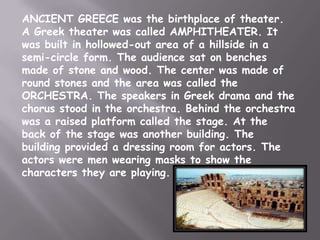
ANCIENT GREECE was the birthplace of theater.
A Greek theater was called AMPHITHEATER. It
was built in hollowed-out area of a hillside in a
semi-circle form. The audience sat on benches
made of stone and wood. The center was made of
round stones and the area was called the
ORCHESTRA. The speakers in Greek drama and the
chorus stood in the orchestra. Behind the orchestra
was a raised platform called the stage. At the
back of the stage was another building. The
building provided a dressing room for actors. The
actors were men wearing masks to show the
characters they are playing.
The three famous Greek dramatist are SOPHOCLES,
EURIPIDES, and ARISTOPHANES. Sophocles and
Euripides wrote tragedies. TRAGEDY is a play with sad
endings. Contrary to tragedies, Aristophanes wrote
comedies to mock the leaders during his time. The
works of the three famous dramatist inspire many
playwrights even during modern days.
William Shakespeare (26 April 1564 (baptised) –
                 23 April 1616) was an English poet and
                 playwright, widely regarded as the greatest writer
                 in the English language and the world's pre-
                 eminent dramatist. He is often called England's
                 national poet and the "Bard of Avon". His
                 surviving works, including some collaborations,
                 consist of about 38 plays, 154 sonnets, two long
                 narrative poems, two epitaphs on a man named
                 John Combe, one epitaph on Elias James, and
                 several other poems. His plays have been
                 translated into every major living language and
                 are performed more often than those of any other
                 playwright.


The development of theater in other countries
continued. In England, William Shakespeare
was known to be the greatest English writer
and playwright of all time.
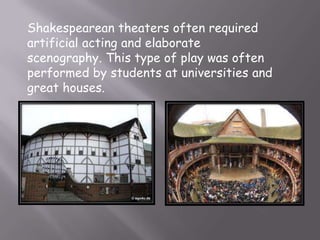
Shakespearean theaters often required
artificial acting and elaborate
scenography. This type of play was often
performed by students at universities and
great houses.
The Lord Chamberlain’s Men and the Kings
Men were the most notable sought- after
theater companies during the early 17th
century. They were the same companies
where William Shakespeare gained his
extensive experience in theater, both as an
actor and a playwright. The Blackfriars
theater was the first private indoor theater
where the Lord’s Chamberlain’s Men and
King’s Men performed on a regular basis. The
theater was known to have a high admission
charges to assure of more select and
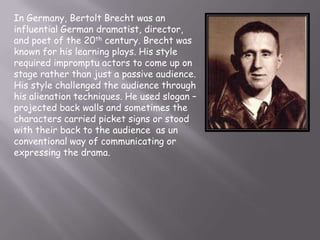
In Germany, Bertolt Brecht was an
influential German dramatist, director,
and poet of the 20th century. Brecht was
known for his learning plays. His style
required impromptu actors to come up on
stage rather than just a passive audience.
His style challenged the audience through
his alienation techniques. He used slogan –
projected back walls and sometimes the
characters carried picket signs or stood
with their back to the audience as un
conventional way of communicating or
expressing the drama.
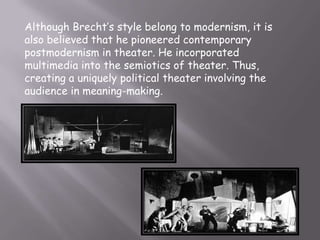
Although Brecht’s style belong to modernism, it is
also believed that he pioneered contemporary
postmodernism in theater. He incorporated
multimedia into the semiotics of theater. Thus,
creating a uniquely political theater involving the
audience in meaning-making.
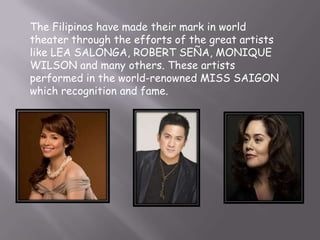
The Filipinos have made their mark in world
theater through the efforts of the great artists
like LEA SALONGA, ROBERT SEÑA, MONIQUE
WILSON and many others. These artists
performed in the world-renowned MISS SAIGON
which recognition and fame.
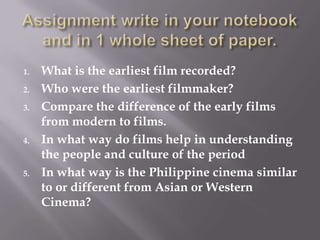
1.   What is the earliest film recorded?
2.   Who were the earliest filmmaker?
3.   Compare the difference of the early films
     from modern to films.
4.   In what way do films help in understanding
     the people and culture of the period
5.   In what way is the Philippine cinema similar
     to or different from Asian or Western
     Cinema?

Theater

  • 1.
    Let us beginby putting ourselves in the most Holy Presence of our Lord, a in the name of the Father, and of the Son, and of the Holy Spirit. Amen.
  • 3.
    "During this whole period, I expect you to observe silence, raise your hands and be recognized before you start speaking, and state your family name before answering questions. I also expect you to respect each other's opinions and listen to what each person has to say." “Without discipline there is no life at all”
  • 5.
  • 6.
  • 7.
  • 8.
  • 9.
  • 10.
  • 11.
  • 12.
    The art ofstaging a play or drama is called THEATER ART. Theater also refers to the building designed to hold plays or dramatic performances. Theater has changed throughout its history. The changes reflect the growth and change of drama. All the arts are found in theater such as singing, music, acting, painting, dance and the literature of drama.
  • 13.
    ANCIENT GREECE wasthe birthplace of theater. A Greek theater was called AMPHITHEATER. It was built in hollowed-out area of a hillside in a semi-circle form. The audience sat on benches made of stone and wood. The center was made of round stones and the area was called the ORCHESTRA. The speakers in Greek drama and the chorus stood in the orchestra. Behind the orchestra was a raised platform called the stage. At the back of the stage was another building. The building provided a dressing room for actors. The actors were men wearing masks to show the characters they are playing.
  • 15.
    The three famousGreek dramatist are SOPHOCLES, EURIPIDES, and ARISTOPHANES. Sophocles and Euripides wrote tragedies. TRAGEDY is a play with sad endings. Contrary to tragedies, Aristophanes wrote comedies to mock the leaders during his time. The works of the three famous dramatist inspire many playwrights even during modern days.
  • 16.
    William Shakespeare (26April 1564 (baptised) – 23 April 1616) was an English poet and playwright, widely regarded as the greatest writer in the English language and the world's pre- eminent dramatist. He is often called England's national poet and the "Bard of Avon". His surviving works, including some collaborations, consist of about 38 plays, 154 sonnets, two long narrative poems, two epitaphs on a man named John Combe, one epitaph on Elias James, and several other poems. His plays have been translated into every major living language and are performed more often than those of any other playwright. The development of theater in other countries continued. In England, William Shakespeare was known to be the greatest English writer and playwright of all time.
  • 17.
    Shakespearean theaters oftenrequired artificial acting and elaborate scenography. This type of play was often performed by students at universities and great houses.
  • 18.
    The Lord Chamberlain’sMen and the Kings Men were the most notable sought- after theater companies during the early 17th century. They were the same companies where William Shakespeare gained his extensive experience in theater, both as an actor and a playwright. The Blackfriars theater was the first private indoor theater where the Lord’s Chamberlain’s Men and King’s Men performed on a regular basis. The theater was known to have a high admission charges to assure of more select and
  • 19.
    In Germany, BertoltBrecht was an influential German dramatist, director, and poet of the 20th century. Brecht was known for his learning plays. His style required impromptu actors to come up on stage rather than just a passive audience. His style challenged the audience through his alienation techniques. He used slogan – projected back walls and sometimes the characters carried picket signs or stood with their back to the audience as un conventional way of communicating or expressing the drama.
  • 20.
    Although Brecht’s stylebelong to modernism, it is also believed that he pioneered contemporary postmodernism in theater. He incorporated multimedia into the semiotics of theater. Thus, creating a uniquely political theater involving the audience in meaning-making.
  • 21.
    The Filipinos havemade their mark in world theater through the efforts of the great artists like LEA SALONGA, ROBERT SEÑA, MONIQUE WILSON and many others. These artists performed in the world-renowned MISS SAIGON which recognition and fame.
  • 24.
    1. What is the earliest film recorded? 2. Who were the earliest filmmaker? 3. Compare the difference of the early films from modern to films. 4. In what way do films help in understanding the people and culture of the period 5. In what way is the Philippine cinema similar to or different from Asian or Western Cinema?