Recall where the origins of Choirs are from…
Characteristics of
Gregorian Chant
 the simplest of textures, consisting
of melody without
accompanying harmony. This may
be realized as just one note at a
time, or with the same note
duplicated at the octave (such as
often when men and women
 sing together).
• The sound of music stayed close to its Gregorian roots for
nearly 700 years. Although the subject matter and focus of
the music changed little, the monophonic nature of
Gregorian Chants did give way to polyphony, first with a
row of young boys, then several rows in the choirs, then
the composer Perotin’s polyphonic 3-part choral pieces,
and finally Cassandra of Constantinople’s experiments with
quick changes and multi-timbre voices.
• Beginning around the year 1000, secular music began to
find a more stable foothold in Catholic Europe. Folk stories
and songs began to mesh to create a tradition of musical
story-telling.
TROUBADOUR
was a composer and
performer of lyric
poetry during the High
Middle Ages (1100–1350)
Their praise of the ideal
of physical love & women
stood in direct contrast to
Christian morality
By the Renaissance Secular
Vocal music was sky-rocketing
• The Madrigal mixed words from poetry, rich, expressive
polyphonic music, and was sung in the native language
Pop Music 1,000 years ago?!?
• After the popularity of the Madrigal, secular vocal options
began to expand. Secular music then usually reflected
popular, traditional folk songs and themes. In many ways
it was the very first Pop Music!!
• The rise in this type of music form that blended voice,
music, and drama led to the development of basic opera.
As opera gained popularity and was supported by the
nobility, more composers began to create more and more
complex productions mixing stage drama and music.
Monteverdi
1st Successful Opera Composer
• Madrigal Musician and Composer, Monteverdi was
not the very first composer of Opera, but his
transition from writing Madrigals into writing full
operas is important because his operas became the
turning point in which opera became wildly popular!!
Madrigals were a type of “Pop Music” during the
Renaissance, so it was an easy transition for people
then to accept the type of singing used in opera. The
music in opera is supporting the main purpose of the
opera, which is the drama!
Laaa, laaaa, loooo, laaaa
Siiinging opera in my native
Language is soooooo
Aweeesomeee & accessible!
Let me tell you all about it…

Monteverdi’s “Orfeo” was a BIG hit
with the public in 1607!
Impact of Opera
Opera Blended Classical Music Forms, Tradition Drama, and Vocal & Choral
Music to create a “complete” experience
It draws its roots from sacred plays performed on Holy Days (Holidays) used
to entertain the people. After the Protestant Reformation the range of non-
religious music (Secular music) expanded incredibly fast!
Because it was sung in the language of the intended audience
(Italian Seria, Buffa, German Singspiel) the stories often reflected tradition
motifs, and drew content from folk stories, culture, and plays from the
country.
Opera began a long-standing tradition into what we now know as Musicals.
DuringtheProtestantReformation
MartinLutherchanged3thingsinSacredMusic
1. He switched the language of Mass as well as Hymns to be in the
language of the audience.
2. Choral singing began its tradition – “Choral” singing originally meant
hymns & sacred music included the CONGREGATION.
1. Hymns began to use music from regional Folk Music to create a more
accessible format for congregations. It also allowed Choral singing
(singing including CONGREGATION) to feel more natural and enjoyable
to Christians who had always known Hymns to be in Latin and
traditional sacred music backing.
Italian Opera Seria
Opera Seria was based on
subject matter that was
“seria”ous
• Opera seria had to return to
basics
• All elements must be
subservient to the overriding
drama
• Strove to achieve simplicity
• Orfeo ed Euridice (1762)
http://www.youtube.com/watc
h?v=C1B85UQT4AY
Italian Opera Buffa
Opera Buffa focused on life-like situations, and usually incorporated
comical situations.
• Was sung in a language of the audience.
• Was based on daily life situations.
• Watch segment 10:
http://digital.films.com.ezproxy.vccs.edu:2048/PortalViewVideo.aspx?
xtid=722&psid=0&sid=0&State=&title=Vienna&IsSearch=N&parentSeri
esID=#
• Presence of buffo – a bass voice character.
• http://www.youtube.com/watch?v=e9gyecxdyhI
• Examples
• W. A. Mozart, “Marriage of Figaro” (1786)
• G. Rossini, “The Barber of Seville” (1816)
http://www.youtube.com/watch?v=7qHZkkgowdY
German Singspiel
Spoken dialogue alternated with ensembles, songs, ballads, and
arias. This was the first example of how modern musicals are sung.
Examples:
• W. A. Mozart, “The Abduction from the Seraglio” (1782)
http://www.youtube.com/watch?v=Tw84smtNE1Q
Watch segments 5 and 16:
http://digital.films.com.ezproxy.vccs.edu:2048/PortalViewVideo.aspx?
xtid=11865&psid=0&sid=0&State=&title=The%20Abduction%20from%
20the%20Seraglio:%20Mozart%20in%20Turkey&IsSearch=N&parentSe
riesID=#
• W. A. Mozart, “The Magic Flute” (1791)
http://www.youtube.com/watch?v=RwSK_wZX8Uc
http://www.youtube.com/watch?v=hqBwe9BCj4A
Opera Sacred Forms
• Opera composers also relied on and revived Sacred Vocal &
Choral traditions.
• Mass
• W. A. Mozart, “Great Mass in C Minor” (1783)
• Requiem Mass—a Mass for the Dead
• W. A. Mozart, “Requiem” (1791)
http://www.youtube.com/watch?v=ia8ceqIDSJw
• Oratorio
• J. Haydn, “The Creation” (1798)
http://www.youtube.com/watch?v=S03cwGuw43s
Opera’s Extreme Costuming and Sets
• Beginning with Italian Opera Seria, due to the focus on the over-riding
drama, set design and costuming begins to become highly stylized and.
• Composers over time begin to employ or request/demand well known
designers
• Extreme cost of Opera production pushes Opera further outside normal
production budgets and towards patronage by nobility.
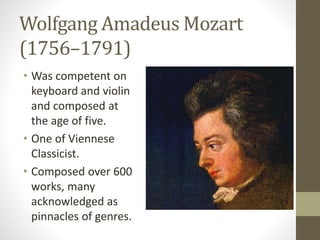
Wolfgang Amadeus Mozart
(1756–1791)
• Was competent on
keyboard and violin
and composed at
the age of five.
• One of Viennese
Classicist.
• Composed over 600
works, many
acknowledged as
pinnacles of genres.
Major Compositions
• Operas:
• “Lucio Silla,” “The Marriage of Figaro,” “Don Giovanni,”
“The Magic Flute,” and others
• Vocal:
• Requiem, Oratories, and Cantatas
• For Orchestra:
• Symphonies, Serenades, and Divertimentos
• Concertos For Different Instruments and Orchestra:
• More that 30 for Piano and Orchestra
• 5 for Violin and Orchestra
• 4 for Horn and Orchestra
• Chamber Music:
• 6 String Quintets, more that 20 String Quartets, more than
30 Sonatas for Violin and Piano, Trios, Variations, Minuets,
Rondos, Fantasias, and many other works
Early Life
• Father Leopold Mozart
was a musician and an
experienced violin
teacher.
• Sister Nannerl was a
pianist and the family
made several European
journeys in which
children performed as
prodigies.
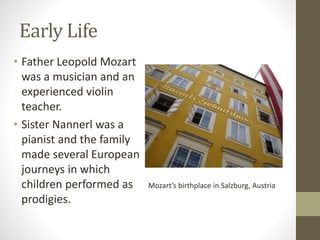
Mozart’s birthplace in Salzburg, Austria
The Paris Journey (1777–78), Vienna
• Visited Augsburg, Mannheim, Paris, and Munich.
• Settled in Vienna as a freelance performer and composer.
• Married Constanze Weber in 1782. Had six children, two
of whom survived infancy.
• Became a Freemason in 1784.
• Composed operas.
• In 1787 obtained a part-time post of chamber composer
under aristocratic patronage of Emperor Joseph II.
Later Years
http://digital.films.com.ezproxy.vccs.edu:2048/PortalViewVideo.aspx?xtid=7
22&psid=0&sid=0&State=&title=Vienna&IsSearch=N&parentSeriesID=#
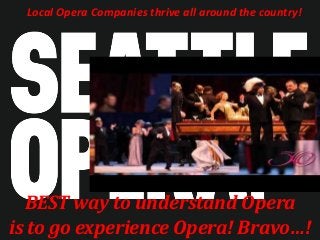
BEST way to understand Opera
is to go experience Opera! Bravo…!
Local Opera Companies thrive all around the country!
Video Assignment
Please watch this video and take notes. You will be asked to reflect on
Mozart’s life and legacy using this knowledge.
http://digital.films.com.ezproxy.vccs.edu:2048/PortalViewVideo.aspx?xtid=2
9999&psid=0&sid=0&State=&title=Wolfgang%20Amadeus%20Mozart&IsSea
rch=N&parentSeriesID=
Optional Video Assignments
http://digital.films.com.ezproxy.vccs.edu:2048/PortalViewVideo.aspx?
xtid=42108&psid=0&sid=0&State=&title=Le%20Nozze%20di%20Figaro
-
From%20the%20Royal%20Opera%20House&IsSearch=N&parentSeries
ID=
http://www.youtube.com/watch?v=ia8ceqIDSJw
http://digital.films.com.ezproxy.vccs.edu:2048/PortalViewVideo.aspx?
xtid=11865&psid=0&sid=0&State=&title=The%20Abduction%20from%
20the%20Seraglio:%20Mozart%20in%20Turkey&IsSearch=N&parentSe
riesID=#
http://digital.films.com.ezproxy.vccs.edu:2048/PortalViewVideo.aspx?
xtid=722&psid=0&sid=0&State=&title=Vienna&IsSearch=N&parentSeri
esID=#
Suggested Readings:
• http://en.wikipedia.org/wiki/Opera
• https://en.wikipedia.org/wiki/Ballad_opera
• http://en.wikipedia.org/wiki/Opéra_comique
• http://en.wikipedia.org/wiki/Mozart

Evolution of Opera & Western Vocal Music

  • 2.
    Recall where theorigins of Choirs are from…
  • 3.
  • 4.
     the simplestof textures, consisting of melody without accompanying harmony. This may be realized as just one note at a time, or with the same note duplicated at the octave (such as often when men and women  sing together).
  • 5.
    • The soundof music stayed close to its Gregorian roots for nearly 700 years. Although the subject matter and focus of the music changed little, the monophonic nature of Gregorian Chants did give way to polyphony, first with a row of young boys, then several rows in the choirs, then the composer Perotin’s polyphonic 3-part choral pieces, and finally Cassandra of Constantinople’s experiments with quick changes and multi-timbre voices. • Beginning around the year 1000, secular music began to find a more stable foothold in Catholic Europe. Folk stories and songs began to mesh to create a tradition of musical story-telling.
  • 6.
    TROUBADOUR was a composerand performer of lyric poetry during the High Middle Ages (1100–1350) Their praise of the ideal of physical love & women stood in direct contrast to Christian morality
  • 7.
    By the RenaissanceSecular Vocal music was sky-rocketing • The Madrigal mixed words from poetry, rich, expressive polyphonic music, and was sung in the native language
  • 8.
    Pop Music 1,000years ago?!? • After the popularity of the Madrigal, secular vocal options began to expand. Secular music then usually reflected popular, traditional folk songs and themes. In many ways it was the very first Pop Music!! • The rise in this type of music form that blended voice, music, and drama led to the development of basic opera. As opera gained popularity and was supported by the nobility, more composers began to create more and more complex productions mixing stage drama and music.
  • 9.
    Monteverdi 1st Successful OperaComposer • Madrigal Musician and Composer, Monteverdi was not the very first composer of Opera, but his transition from writing Madrigals into writing full operas is important because his operas became the turning point in which opera became wildly popular!! Madrigals were a type of “Pop Music” during the Renaissance, so it was an easy transition for people then to accept the type of singing used in opera. The music in opera is supporting the main purpose of the opera, which is the drama!
  • 10.
    Laaa, laaaa, loooo,laaaa Siiinging opera in my native Language is soooooo Aweeesomeee & accessible! Let me tell you all about it… 
  • 11.
    Monteverdi’s “Orfeo” wasa BIG hit with the public in 1607!
  • 13.
    Impact of Opera OperaBlended Classical Music Forms, Tradition Drama, and Vocal & Choral Music to create a “complete” experience It draws its roots from sacred plays performed on Holy Days (Holidays) used to entertain the people. After the Protestant Reformation the range of non- religious music (Secular music) expanded incredibly fast! Because it was sung in the language of the intended audience (Italian Seria, Buffa, German Singspiel) the stories often reflected tradition motifs, and drew content from folk stories, culture, and plays from the country. Opera began a long-standing tradition into what we now know as Musicals.
  • 14.
    DuringtheProtestantReformation MartinLutherchanged3thingsinSacredMusic 1. He switchedthe language of Mass as well as Hymns to be in the language of the audience. 2. Choral singing began its tradition – “Choral” singing originally meant hymns & sacred music included the CONGREGATION. 1. Hymns began to use music from regional Folk Music to create a more accessible format for congregations. It also allowed Choral singing (singing including CONGREGATION) to feel more natural and enjoyable to Christians who had always known Hymns to be in Latin and traditional sacred music backing.
  • 15.
    Italian Opera Seria OperaSeria was based on subject matter that was “seria”ous • Opera seria had to return to basics • All elements must be subservient to the overriding drama • Strove to achieve simplicity • Orfeo ed Euridice (1762) http://www.youtube.com/watc h?v=C1B85UQT4AY
  • 16.
    Italian Opera Buffa OperaBuffa focused on life-like situations, and usually incorporated comical situations. • Was sung in a language of the audience. • Was based on daily life situations. • Watch segment 10: http://digital.films.com.ezproxy.vccs.edu:2048/PortalViewVideo.aspx? xtid=722&psid=0&sid=0&State=&title=Vienna&IsSearch=N&parentSeri esID=# • Presence of buffo – a bass voice character. • http://www.youtube.com/watch?v=e9gyecxdyhI • Examples • W. A. Mozart, “Marriage of Figaro” (1786) • G. Rossini, “The Barber of Seville” (1816) http://www.youtube.com/watch?v=7qHZkkgowdY
  • 17.
    German Singspiel Spoken dialoguealternated with ensembles, songs, ballads, and arias. This was the first example of how modern musicals are sung. Examples: • W. A. Mozart, “The Abduction from the Seraglio” (1782) http://www.youtube.com/watch?v=Tw84smtNE1Q Watch segments 5 and 16: http://digital.films.com.ezproxy.vccs.edu:2048/PortalViewVideo.aspx? xtid=11865&psid=0&sid=0&State=&title=The%20Abduction%20from% 20the%20Seraglio:%20Mozart%20in%20Turkey&IsSearch=N&parentSe riesID=# • W. A. Mozart, “The Magic Flute” (1791) http://www.youtube.com/watch?v=RwSK_wZX8Uc http://www.youtube.com/watch?v=hqBwe9BCj4A
  • 18.
    Opera Sacred Forms •Opera composers also relied on and revived Sacred Vocal & Choral traditions. • Mass • W. A. Mozart, “Great Mass in C Minor” (1783) • Requiem Mass—a Mass for the Dead • W. A. Mozart, “Requiem” (1791) http://www.youtube.com/watch?v=ia8ceqIDSJw • Oratorio • J. Haydn, “The Creation” (1798) http://www.youtube.com/watch?v=S03cwGuw43s
  • 19.
    Opera’s Extreme Costumingand Sets • Beginning with Italian Opera Seria, due to the focus on the over-riding drama, set design and costuming begins to become highly stylized and. • Composers over time begin to employ or request/demand well known designers • Extreme cost of Opera production pushes Opera further outside normal production budgets and towards patronage by nobility.
  • 20.
    Wolfgang Amadeus Mozart (1756–1791) •Was competent on keyboard and violin and composed at the age of five. • One of Viennese Classicist. • Composed over 600 works, many acknowledged as pinnacles of genres.
  • 21.
    Major Compositions • Operas: •“Lucio Silla,” “The Marriage of Figaro,” “Don Giovanni,” “The Magic Flute,” and others • Vocal: • Requiem, Oratories, and Cantatas • For Orchestra: • Symphonies, Serenades, and Divertimentos • Concertos For Different Instruments and Orchestra: • More that 30 for Piano and Orchestra • 5 for Violin and Orchestra • 4 for Horn and Orchestra • Chamber Music: • 6 String Quintets, more that 20 String Quartets, more than 30 Sonatas for Violin and Piano, Trios, Variations, Minuets, Rondos, Fantasias, and many other works
  • 22.
    Early Life • FatherLeopold Mozart was a musician and an experienced violin teacher. • Sister Nannerl was a pianist and the family made several European journeys in which children performed as prodigies. Mozart’s birthplace in Salzburg, Austria
  • 23.
    The Paris Journey(1777–78), Vienna • Visited Augsburg, Mannheim, Paris, and Munich. • Settled in Vienna as a freelance performer and composer. • Married Constanze Weber in 1782. Had six children, two of whom survived infancy. • Became a Freemason in 1784. • Composed operas. • In 1787 obtained a part-time post of chamber composer under aristocratic patronage of Emperor Joseph II.
  • 24.
  • 25.
    BEST way tounderstand Opera is to go experience Opera! Bravo…! Local Opera Companies thrive all around the country!
  • 26.
    Video Assignment Please watchthis video and take notes. You will be asked to reflect on Mozart’s life and legacy using this knowledge. http://digital.films.com.ezproxy.vccs.edu:2048/PortalViewVideo.aspx?xtid=2 9999&psid=0&sid=0&State=&title=Wolfgang%20Amadeus%20Mozart&IsSea rch=N&parentSeriesID=
  • 27.
  • 28.
    Suggested Readings: • http://en.wikipedia.org/wiki/Opera •https://en.wikipedia.org/wiki/Ballad_opera • http://en.wikipedia.org/wiki/Opéra_comique • http://en.wikipedia.org/wiki/Mozart

Editor's Notes

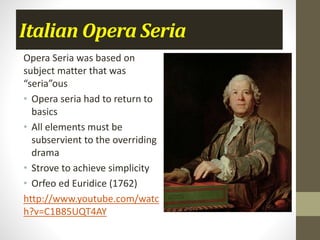
  • #16 Portrait of Christoph Willibald von Gluck. Authored by: Joseph-Siffrein Duplessis . Located at: https://en.wikipedia.org/wiki/File:Joseph-Sifr%C3%A8de_Duplessis_001.jpg. License: Public Domain
  • #21 Mozart (unfinished). Authored by: Joseph Lange. Located at: https://commons.wikimedia.org/wiki/File:Mozart_(unfinished)_by_Lange_1782.jpg. License: Public Domain
  • #23 Mozart's birthplace. Authored by: Jonathan White. Located at: https://en.wikipedia.org/wiki/File:Mozart_(5).JPG. License: Public Domain