Animal Behavior
2012-13
Behavior- an action carried out by muscles or glands under
the control of the nervous system in response to an
environmental cue or a stimulus
Example behaviors: courtship dance, aggressive posture,
chemical communication (marking a territory) & learning
Behavioral Ecology: study of behavior in an evolutionary
context
● Proximate questions concern the immediate reason for
a behavior ie how it is triggered by the stimuli
● Ultimate questions why a particular behavior occurs ie
evolutionary explanations
Innate behaviors are behaviors that are
inherited same for all individuals of a species
●Fixed Action Patterns (FAPs) unchangeable
series of actions triggered by a specific stimulus
where once they are initiated the sequenced is
preformed in its entirety regardless of any
changes
● Graylag goose tucks eggs
● http://www.youtube.com/watch?v=vUNZv-ByPkU
● Baby birds stretch out necks
● Male Stickle back fish
Sign stimulus
experiment: figure out
what is causing one
male fish to attack
another male “fish”
(fakes) video
male stickleback fish
attack other male
stickleback fish-- in
response to the red
sign stimulus (they
don’t attack females,
which do not have
red bellies, and they
do not attack “fake”
fish with no red on
the belly)
Response to
question about
the behavior
(cause/effect,
how, etc.)
Response to
evolutionary
significance of
the behavior
Nature vs Nurture
genetic vs environmental
●Cross fostering
experiment with
rats
● Conclusion:
evidence that
behavior is the
product of both
genetic &
environmental
factors
Learning: modification of behavior
as a result of specific experiences
●7 types
● Habituation
● Imprinting
● Spatial learning
● Cognitive mapping
● Associate learning
● Social learning
● Problem solving
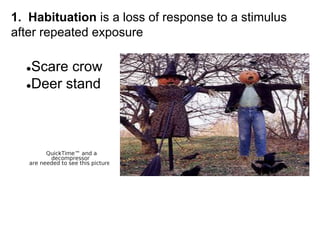
1. Habituation is a loss of response to a stimulus
after repeated exposure
●Scare crow
●Deer stand
2. Imprinting is learning that is irreversible and
limited to a sensitive time period in an animals life
●Geese (1.5 min)
●http://www.youtube.com/watch?v=2UIU9XH-mUI
●Salmon (1.5 min)
●http://www.youtube.com/watch?v=0NcJ_63z-mA
●Song
●Some innate & some learned components
3. Spatial learning is use of landmarks
to learn the spatial structure of the
environment
●Classic example
nest locating
behavior of the
digger wasp
4. Cognative mapping is an internal
representation of the spatial relationships
among objects in the environment
●Migration
patterns
●Crow food
caches
5. Associate Learning is behavioral change based
on linking a stimulus or behavior with a reward or
punishment; includes trial and error
● Classical conditioning:
associating an arbitrary
stimulus with a reward
or punishment
(generally involuntary
responses)
● Pavlov’s dog
● Operant conditioning:
trial-and-error learning,
or repeating or avoiding a
behavior depending on if
it resulted in reward or
punishment (generally
voluntary actions)
● Skinner Rats
● Porcupine Quills
7. Problem solving is
inventive behavior that
arises in response to a
new situation
●Raven string food
●Chimp crush food
tools
●Otter
http://www.youtube.co
m/watch?v=sc99_FarC
NM (2 min)
6. Social learning is learning by
observing and mimicking others
●Vervet monkeys
alarm calls
●http://www.youtube.com/wat
ch?v=3lsF83rHKFc&feature=r
elated 3.5 min
●http://www.youtube.com/wat
ch?v=BM7IoMcNj2k&feature
=related 1.5 min
● Different sounds for
the following images
young learn by
copying and then
perfecting the sounds
● Eagle
● Leopard
● Snake
Survival & Reproductive Success
●Animal movements
● Kinesis random animal
movement in response to
a stimulus (ie stopping,
starting, changing speed,
and or direction)
● Taxis movement towards
or away from a stimulus
Survival & Reproductive Success
●Animal foraging (food obtaining behavior) Includes
not only eating, but searching for, recognizing and
capturing food items
● Generalists eat just about anything
● Specialists picky eaters
● http://www.youtube.com/watch?v=cMIRwCNvI94&NR=1&featur
e=endscreen (4 min new babies)
● http://www.youtube.com/watch?v=wMjalAElFXw (foraging &
babysitting)
●Optimal foraging theory an animals feeding
behavior should provide maximal energy gain with
minimal energy expense and minimal risk of being
eaten while foraging
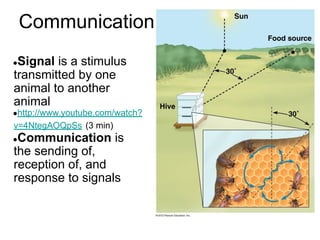
Communication
●Signal is a stimulus
transmitted by one
animal to another
animal
●http://www.youtube.com/watch?
v=4NtegAOQpSs (3 min)
●Communication is
the sending of,
reception of, and
response to signals
Types of Signals
●Animals use visual, tactile, electrical and
chemical signals to communicate and produce a
change in behavior of other organisms
●Ex bee dances, bird songs, territorial marking,
pack behavior, herd/flock/school behavior,
predator warning, colony and swarming
behavior, and coloration
Social behavior as any kind of
communication interaction between 2 or
more animals, usually of the same
species
●Courtship
●Aggression
●Cooperation
●Migration
●Feeding/foraging
Courtship rituals are a special, sometimes
ritualized, set of behaviors which some animals
perform as part of courtship. Courtship behaviors
can include special calls, postures, and
movements, and may involve special plumage,
bright colors or other ornamentation.
●http://www.youtube.com/watch?v=4e3PKm1Z2
9g grebes
●http://www.youtube.com/watch?v=1NAKg46s1D
A&feature=related 1.5 min blue
●http://www.youtube.com/watch?v=L54bxmZy_N
E 2 min bird para
Mating systems & Parental Care
●Promiscuous: no strong pair bonds or
lasting relationships
● Female raises young alone
●Monogamous: a bond between one
male and one female
● Both Parents investment time & energy
●Polygamous: an individual of one sex
mating with several of the other
● Cheating…..hummmm….
Communication Behavior
●Agnostic Behavior: conflicts that arise
over limited resources …sometimes fights
to the death
●http://www.youtube.com/watch?v=HE92_
PE9ZjQ Elk fighting for mates
●http://www.youtube.com/watch?v=iSPKY
AIMm_k Lions fight over meal
Communication Behavior
●Dominance hierarchy: ranking of
individuals
● Alpha’s
● food 1st
● mates
● nesting
Communication Behavior
●Altruism: a behavior that reduces an individual’s
fitness (survival & ability to reproduce) while
increasing the fitness (survival) of others
●ALARM CALLS
●http://www.youtube.com/watch?v=N6dTU7KVpsg (8
min)
● Inclusive Fitness: describes an individuals success at
perpetuating its genes by producing its own offspring and
helping close relatives who likely share many of those
genes to produce
● Kin selection: natural selection that favors altuistic
behavior that benefits relatives
Territory is an area usually fixed in location, that
individuals defend and from which other
members of the same species are usually
excluded
●Provides resources
●Used for feeding,
mating, rearing
young
●Marked
●http://www.youtube.c
om/watch?v=NvoyMq
84GO0&feature=relat
ed Lions fight for
territory
Response
●Animals respond or some animal
behaviors are triggered by
environmental cues and are vital
reproduction, natural selection and
survival
●Ex Hibernation, Estivation,
Migration & Courtship.
Response
●Animals response to information and
communication of information is critical to both
natural selection and evolution
●FITNESS: an organisms ability to survive and
reproduce
Uniqueness
●Variations in
behavioral traits such
as personality,
temperament, talents,
and intellectual
abilities make each
individual unique
In closing…
●Innate behaviors are behaviors that are
inherited.
●Learning occurs through interactions with the
environment and other organisms and memory
is key
Animal
Emotions
●When Elephants Weep
●by Jeffrey Moussaieff Masson
and Susan McCarthy (1995)
●This national bestseller exploring
the complex emotional lives of
animals.
●http://www.youtube.com/watch?v
=kZuW7M4VbDs&feature=related
Pod cast reviews
http://www.youtube.com/watch?v=6hREwakXmAo
10 min Bozeman Animal Behavior

Animal Behavior.ppt.pdf...................

  • 1.
  • 2.
    Behavior- an actioncarried out by muscles or glands under the control of the nervous system in response to an environmental cue or a stimulus Example behaviors: courtship dance, aggressive posture, chemical communication (marking a territory) & learning Behavioral Ecology: study of behavior in an evolutionary context ● Proximate questions concern the immediate reason for a behavior ie how it is triggered by the stimuli ● Ultimate questions why a particular behavior occurs ie evolutionary explanations
  • 3.
    Innate behaviors arebehaviors that are inherited same for all individuals of a species ●Fixed Action Patterns (FAPs) unchangeable series of actions triggered by a specific stimulus where once they are initiated the sequenced is preformed in its entirety regardless of any changes ● Graylag goose tucks eggs ● http://www.youtube.com/watch?v=vUNZv-ByPkU ● Baby birds stretch out necks ● Male Stickle back fish
  • 4.
    Sign stimulus experiment: figureout what is causing one male fish to attack another male “fish” (fakes) video male stickleback fish attack other male stickleback fish-- in response to the red sign stimulus (they don’t attack females, which do not have red bellies, and they do not attack “fake” fish with no red on the belly)
  • 5.
    Response to question about thebehavior (cause/effect, how, etc.) Response to evolutionary significance of the behavior
  • 6.
    Nature vs Nurture geneticvs environmental ●Cross fostering experiment with rats ● Conclusion: evidence that behavior is the product of both genetic & environmental factors
  • 7.
    Learning: modification ofbehavior as a result of specific experiences ●7 types ● Habituation ● Imprinting ● Spatial learning ● Cognitive mapping ● Associate learning ● Social learning ● Problem solving
  • 8.
    1. Habituation isa loss of response to a stimulus after repeated exposure ●Scare crow ●Deer stand
  • 9.
    2. Imprinting islearning that is irreversible and limited to a sensitive time period in an animals life ●Geese (1.5 min) ●http://www.youtube.com/watch?v=2UIU9XH-mUI ●Salmon (1.5 min) ●http://www.youtube.com/watch?v=0NcJ_63z-mA ●Song ●Some innate & some learned components
  • 10.
    3. Spatial learningis use of landmarks to learn the spatial structure of the environment ●Classic example nest locating behavior of the digger wasp
  • 11.
    4. Cognative mappingis an internal representation of the spatial relationships among objects in the environment ●Migration patterns ●Crow food caches
  • 12.
    5. Associate Learningis behavioral change based on linking a stimulus or behavior with a reward or punishment; includes trial and error ● Classical conditioning: associating an arbitrary stimulus with a reward or punishment (generally involuntary responses) ● Pavlov’s dog ● Operant conditioning: trial-and-error learning, or repeating or avoiding a behavior depending on if it resulted in reward or punishment (generally voluntary actions) ● Skinner Rats ● Porcupine Quills
  • 13.
    7. Problem solvingis inventive behavior that arises in response to a new situation ●Raven string food ●Chimp crush food tools ●Otter http://www.youtube.co m/watch?v=sc99_FarC NM (2 min)
  • 14.
    6. Social learningis learning by observing and mimicking others ●Vervet monkeys alarm calls ●http://www.youtube.com/wat ch?v=3lsF83rHKFc&feature=r elated 3.5 min ●http://www.youtube.com/wat ch?v=BM7IoMcNj2k&feature =related 1.5 min ● Different sounds for the following images young learn by copying and then perfecting the sounds ● Eagle ● Leopard ● Snake
  • 15.
    Survival & ReproductiveSuccess ●Animal movements ● Kinesis random animal movement in response to a stimulus (ie stopping, starting, changing speed, and or direction) ● Taxis movement towards or away from a stimulus
  • 16.
    Survival & ReproductiveSuccess ●Animal foraging (food obtaining behavior) Includes not only eating, but searching for, recognizing and capturing food items ● Generalists eat just about anything ● Specialists picky eaters ● http://www.youtube.com/watch?v=cMIRwCNvI94&NR=1&featur e=endscreen (4 min new babies) ● http://www.youtube.com/watch?v=wMjalAElFXw (foraging & babysitting) ●Optimal foraging theory an animals feeding behavior should provide maximal energy gain with minimal energy expense and minimal risk of being eaten while foraging
  • 17.
    Communication ●Signal is astimulus transmitted by one animal to another animal ●http://www.youtube.com/watch? v=4NtegAOQpSs (3 min) ●Communication is the sending of, reception of, and response to signals
  • 18.
    Types of Signals ●Animalsuse visual, tactile, electrical and chemical signals to communicate and produce a change in behavior of other organisms ●Ex bee dances, bird songs, territorial marking, pack behavior, herd/flock/school behavior, predator warning, colony and swarming behavior, and coloration
  • 19.
    Social behavior asany kind of communication interaction between 2 or more animals, usually of the same species ●Courtship ●Aggression ●Cooperation ●Migration ●Feeding/foraging
  • 20.
    Courtship rituals area special, sometimes ritualized, set of behaviors which some animals perform as part of courtship. Courtship behaviors can include special calls, postures, and movements, and may involve special plumage, bright colors or other ornamentation. ●http://www.youtube.com/watch?v=4e3PKm1Z2 9g grebes ●http://www.youtube.com/watch?v=1NAKg46s1D A&feature=related 1.5 min blue ●http://www.youtube.com/watch?v=L54bxmZy_N E 2 min bird para
  • 21.
    Mating systems &Parental Care ●Promiscuous: no strong pair bonds or lasting relationships ● Female raises young alone ●Monogamous: a bond between one male and one female ● Both Parents investment time & energy ●Polygamous: an individual of one sex mating with several of the other ● Cheating…..hummmm….
  • 22.
    Communication Behavior ●Agnostic Behavior:conflicts that arise over limited resources …sometimes fights to the death ●http://www.youtube.com/watch?v=HE92_ PE9ZjQ Elk fighting for mates ●http://www.youtube.com/watch?v=iSPKY AIMm_k Lions fight over meal
  • 23.
    Communication Behavior ●Dominance hierarchy:ranking of individuals ● Alpha’s ● food 1st ● mates ● nesting
  • 24.
    Communication Behavior ●Altruism: abehavior that reduces an individual’s fitness (survival & ability to reproduce) while increasing the fitness (survival) of others ●ALARM CALLS ●http://www.youtube.com/watch?v=N6dTU7KVpsg (8 min) ● Inclusive Fitness: describes an individuals success at perpetuating its genes by producing its own offspring and helping close relatives who likely share many of those genes to produce ● Kin selection: natural selection that favors altuistic behavior that benefits relatives
  • 25.
    Territory is anarea usually fixed in location, that individuals defend and from which other members of the same species are usually excluded ●Provides resources ●Used for feeding, mating, rearing young ●Marked ●http://www.youtube.c om/watch?v=NvoyMq 84GO0&feature=relat ed Lions fight for territory
  • 26.
    Response ●Animals respond orsome animal behaviors are triggered by environmental cues and are vital reproduction, natural selection and survival ●Ex Hibernation, Estivation, Migration & Courtship.
  • 27.
    Response ●Animals response toinformation and communication of information is critical to both natural selection and evolution ●FITNESS: an organisms ability to survive and reproduce
  • 28.
    Uniqueness ●Variations in behavioral traitssuch as personality, temperament, talents, and intellectual abilities make each individual unique
  • 29.
    In closing… ●Innate behaviorsare behaviors that are inherited. ●Learning occurs through interactions with the environment and other organisms and memory is key
  • 30.
    Animal Emotions ●When Elephants Weep ●byJeffrey Moussaieff Masson and Susan McCarthy (1995) ●This national bestseller exploring the complex emotional lives of animals. ●http://www.youtube.com/watch?v =kZuW7M4VbDs&feature=related
  • 31.