The Digital Divide EM590:  Salinee Kuakiatwong
Introduction The digital divide is the gap between those people, communities, or schools with access to information technologies and those without it. The gaps between developed and undeveloped countries The gaps among various population groups within the country
Digital Divided by  Demographic Factors A Nation online (NTIA, 2002) found computer and Internet use correlate with family income, employment status, and educational attainment. In particular, digital divide is usually found among the groups that are limited to access technology because of different geographies, socioeconomics, races, literacy and physical capacities.
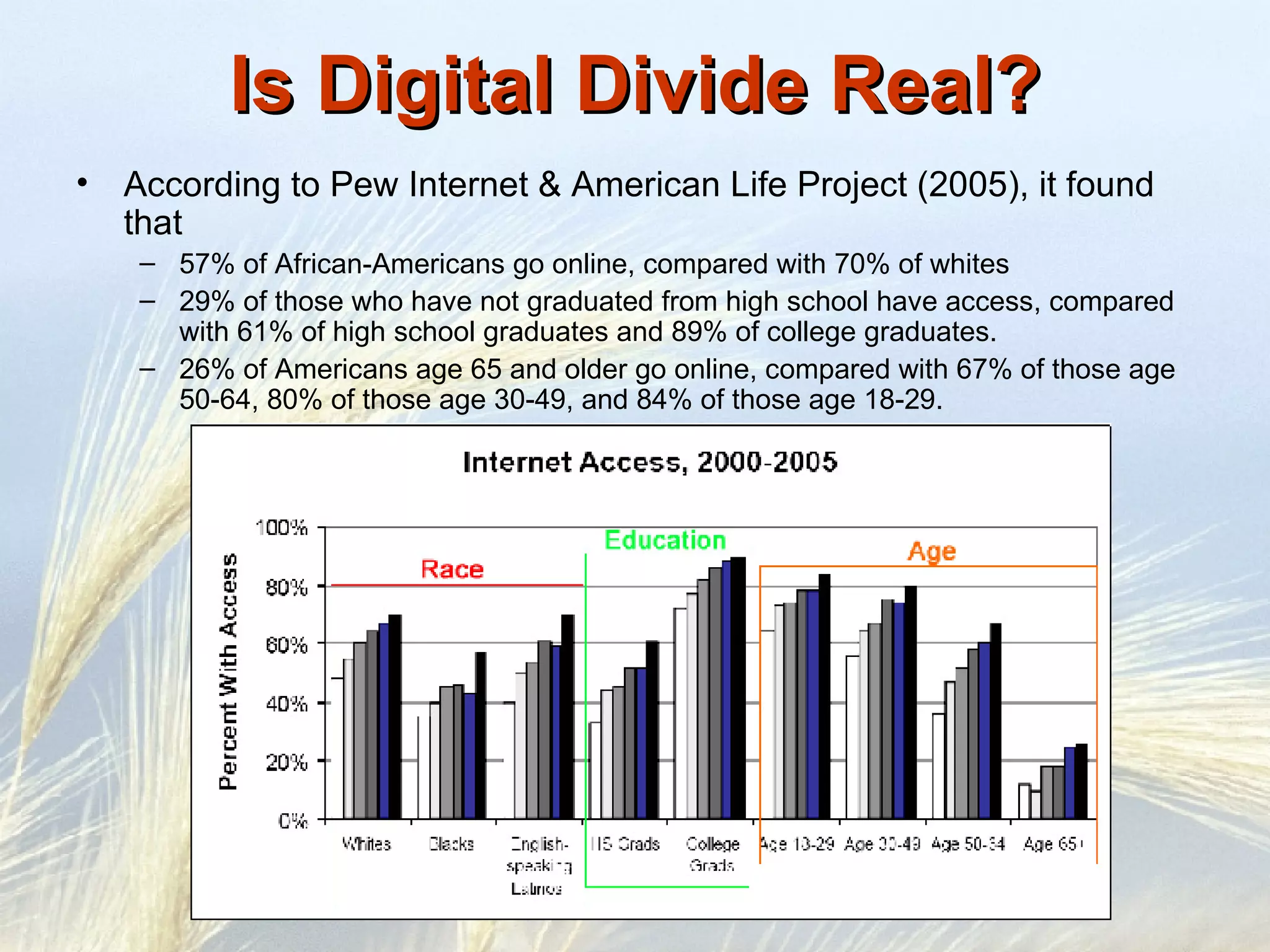
Is Digital Divide Real? According to Pew Internet & American Life Project (2005), it found that  57% of African-Americans go online, compared with 70% of whites 29% of those who have not graduated from high school have access, compared with 61% of high school graduates and 89% of college graduates. 26% of Americans age 65 and older go online, compared with 67% of those age 50-64, 80% of those age 30-49, and 84% of those age 18-29.
Is Digital Divide Real? (Cont.) According to A Nation Online Report (2004), the report shows that 72.8% of urban respondents without disability and 46.4% with disability have a computer at home. 67% of rural respondents without disability and 40% with disability have a computer at home. 52.4% of urban respondents without disability and 45% with disability have Internet access at home. 25.5% of rural respondents without disability and 21.5% with disability have Internet access at home. Has Computer at Home  Has Internet Access at Home
According to U.S. Department of Commerce (2004), the survey of “Main Reasons for No High-Speed Internet Use at Home” shows that 22.1% indicating the service unavailable in the rural area, compared to 4.7% in urban area.  Is Digital Divide Real? (Cont.)
Digital Divide among Schools In 2001, 34.3 percent of children ages 10-17 from the lowest-income group accessed the Internet at school verses 63 percent of children from the highest-income families. (DOC, 2002) A 2002 study revealed that 33 percent of high-poverty schools classified a majority of their teachers as beginners in using technology for low-poverty schools, the percentage was 18 percent. (Market Data Retrieval, 2002).   61 percent of schools needing improvement (NLB) report that more than a majority of their teachers use the Internet for instruction and 79 percent report a majority of their teachers use a computer.  For all schools 74 percent report that a majority of teachers use the Internet for instruction and 84 percent report that a majority of teachers use a computer (Market Data Retrieval, 2003).  During 2002, only 53 percent of public schools with access to the Internet made computers available to students outside of regular school day hours.  Less than half (43 percent) of all K-12 schools own laptop computers (Market Data Retrieval, 2003). Very few lend them to students.  During 2002, 8 percent of public schools lent laptop computers to students.  The median number of laptops lent was 7 computers, or 1 per 16 students (Kleiner and Lewis, 2003).  In 2001 school enrollment among children Ages 16-18 without access to a home computer was 85.4 percent.  The rate for those with access was 96.2 percent.
Recommendations for schools Fund programs to train Teachers, Parent and Caregivers about accessible computer technology so that it can be used to it’s fullest extent Support research to determine which applications are most effective for children with disabilities and promote them. Open schools to make computers accessible to parents and students before and after school hours. Make laptops available for students to use at home. Form partnerships with businesses,  organizations, institutions and communities for computer and Internet access
Recommendation for software designers Develop guidelines for accessibility. Ensure that Web technologies support accessibility. Research how to best incorporate difference and choice into design. Interagency collaboration on planning, funding, selecting, and supporting assistive technology should be fostered to ensure continuous technology access  Students with disabilities should be included at all stages of technology selection, support, and use, so that they learn to self-advocate regarding their needs for accessible technology in the classroom and workplace.
References Associate Director for Research Pew Internet and American Life Project Washington DC. Retrieved July 26, 2007 from http://www.pewinternet.org/ Levy, K.K. et al. (2002).  A nation online: How Americans are expanding their use of the Internet . Washington, DC: NTIA. Retrieved July 26, 2007, from  http:// www.ntia.doc.gov/ntiahome/dn/html/EXECSUM.htm .  Kleiner, Anne, and Lewis, Laurie. "Internet Access in U.S. Public Schools and Classrooms: 1994-2002." Washington, DC: U. S. Department of Education. National Center for Education Statistics. 2003. Available [online]:  http:// nces.ed.gov/pubsearch/pubsinfo.asp?pubid =2004011 . Market Data Retrieval, "Technology in Education," 2003. Available [online]:  http:// www.schooldata.com/mdrtechhilites.asp . Market Data Retrieval, "Technology in Education," 2002. Home Broadband Adoption 2006: Pew Internet & American Life Project John B. Horrigan. Retrieved July 26, 2007, from  www.pewinternet.org/pdfs/PIP_ Broadband _trends 2006 .pdf   US Dept of Commerce National Telecommunications and Information Administration. A nation online: entering the broadband age. September 2004. United States. U.S. Department of Commerce. Economics and Statistic Administration. National Telecommunications and Information Administration. (2002, February).  A Nation Online: How Americans Are Expanding Their Use of the Internet." Report.  Retrieved July 27, 2007 From  www.ntia.doc.gov/ntiahome/dn/nationonline_020502.htm United States. U.S. Department of Commerce. Economics and Statistic Administration. National Telecommunications and Information Administration. (2004, September).  A Nation Online: Entering the Broadband Age." Report.  Retrieved July 27, 2007 From  www.ntia.doc.gov/ntiahome/dn/nationonline_020502.htm

The%20 Digital%20 Divide Sanny

  • 1.
    The Digital DivideEM590: Salinee Kuakiatwong
  • 2.
    Introduction The digitaldivide is the gap between those people, communities, or schools with access to information technologies and those without it. The gaps between developed and undeveloped countries The gaps among various population groups within the country
  • 3.
    Digital Divided by Demographic Factors A Nation online (NTIA, 2002) found computer and Internet use correlate with family income, employment status, and educational attainment. In particular, digital divide is usually found among the groups that are limited to access technology because of different geographies, socioeconomics, races, literacy and physical capacities.
  • 4.
    Is Digital DivideReal? According to Pew Internet & American Life Project (2005), it found that 57% of African-Americans go online, compared with 70% of whites 29% of those who have not graduated from high school have access, compared with 61% of high school graduates and 89% of college graduates. 26% of Americans age 65 and older go online, compared with 67% of those age 50-64, 80% of those age 30-49, and 84% of those age 18-29.
  • 5.
    Is Digital DivideReal? (Cont.) According to A Nation Online Report (2004), the report shows that 72.8% of urban respondents without disability and 46.4% with disability have a computer at home. 67% of rural respondents without disability and 40% with disability have a computer at home. 52.4% of urban respondents without disability and 45% with disability have Internet access at home. 25.5% of rural respondents without disability and 21.5% with disability have Internet access at home. Has Computer at Home Has Internet Access at Home
  • 6.
    According to U.S.Department of Commerce (2004), the survey of “Main Reasons for No High-Speed Internet Use at Home” shows that 22.1% indicating the service unavailable in the rural area, compared to 4.7% in urban area. Is Digital Divide Real? (Cont.)
  • 7.
    Digital Divide amongSchools In 2001, 34.3 percent of children ages 10-17 from the lowest-income group accessed the Internet at school verses 63 percent of children from the highest-income families. (DOC, 2002) A 2002 study revealed that 33 percent of high-poverty schools classified a majority of their teachers as beginners in using technology for low-poverty schools, the percentage was 18 percent. (Market Data Retrieval, 2002). 61 percent of schools needing improvement (NLB) report that more than a majority of their teachers use the Internet for instruction and 79 percent report a majority of their teachers use a computer. For all schools 74 percent report that a majority of teachers use the Internet for instruction and 84 percent report that a majority of teachers use a computer (Market Data Retrieval, 2003). During 2002, only 53 percent of public schools with access to the Internet made computers available to students outside of regular school day hours. Less than half (43 percent) of all K-12 schools own laptop computers (Market Data Retrieval, 2003). Very few lend them to students. During 2002, 8 percent of public schools lent laptop computers to students. The median number of laptops lent was 7 computers, or 1 per 16 students (Kleiner and Lewis, 2003). In 2001 school enrollment among children Ages 16-18 without access to a home computer was 85.4 percent. The rate for those with access was 96.2 percent.
  • 8.
    Recommendations for schoolsFund programs to train Teachers, Parent and Caregivers about accessible computer technology so that it can be used to it’s fullest extent Support research to determine which applications are most effective for children with disabilities and promote them. Open schools to make computers accessible to parents and students before and after school hours. Make laptops available for students to use at home. Form partnerships with businesses, organizations, institutions and communities for computer and Internet access
  • 9.
    Recommendation for softwaredesigners Develop guidelines for accessibility. Ensure that Web technologies support accessibility. Research how to best incorporate difference and choice into design. Interagency collaboration on planning, funding, selecting, and supporting assistive technology should be fostered to ensure continuous technology access Students with disabilities should be included at all stages of technology selection, support, and use, so that they learn to self-advocate regarding their needs for accessible technology in the classroom and workplace.
  • 10.
    References Associate Directorfor Research Pew Internet and American Life Project Washington DC. Retrieved July 26, 2007 from http://www.pewinternet.org/ Levy, K.K. et al. (2002). A nation online: How Americans are expanding their use of the Internet . Washington, DC: NTIA. Retrieved July 26, 2007, from http:// www.ntia.doc.gov/ntiahome/dn/html/EXECSUM.htm . Kleiner, Anne, and Lewis, Laurie. "Internet Access in U.S. Public Schools and Classrooms: 1994-2002." Washington, DC: U. S. Department of Education. National Center for Education Statistics. 2003. Available [online]: http:// nces.ed.gov/pubsearch/pubsinfo.asp?pubid =2004011 . Market Data Retrieval, "Technology in Education," 2003. Available [online]: http:// www.schooldata.com/mdrtechhilites.asp . Market Data Retrieval, "Technology in Education," 2002. Home Broadband Adoption 2006: Pew Internet & American Life Project John B. Horrigan. Retrieved July 26, 2007, from www.pewinternet.org/pdfs/PIP_ Broadband _trends 2006 .pdf US Dept of Commerce National Telecommunications and Information Administration. A nation online: entering the broadband age. September 2004. United States. U.S. Department of Commerce. Economics and Statistic Administration. National Telecommunications and Information Administration. (2002, February). A Nation Online: How Americans Are Expanding Their Use of the Internet." Report. Retrieved July 27, 2007 From www.ntia.doc.gov/ntiahome/dn/nationonline_020502.htm United States. U.S. Department of Commerce. Economics and Statistic Administration. National Telecommunications and Information Administration. (2004, September). A Nation Online: Entering the Broadband Age." Report. Retrieved July 27, 2007 From www.ntia.doc.gov/ntiahome/dn/nationonline_020502.htm