"digital divide‘ lack  of information technology (IT)  between individuals who have and do not have access to IT.  D.D. reflects “existing patterns of social stratification in the United States”  Mary Keegan Eamon
Lack of software  Lack of technical ability to upgrade services  Lack of monetary resources to upgrade software  Ability and means to learn new skills.    Teacher Librarian  32.2 (Dec 2004): p34(1).   Quality of Access
@ Home Limited number of computers  @  Public Libraries  @  Schools Limited hours of operation  In public spaces  Lack of affordability Lack of Basic Access
Involved for longer periods of time  in the workforce They are not societies primary care  .givers for  .Children .Elderly .ill or injured family members  Mary Keegan Eamon steered toward science and technological fields of study
Periodically leave the work force to Act as  primary  family care givers for Maternity leave  Children Elderly ill or injured family members  Mary Keegan Eamon Women are not steered toward science  and technological fields of study.
Ninety-one percent of both female and male students use computers  ( Andrew Trotter  ) Gender Grade level % use  a computer % Have Internet Access Female K-12 91 61 Male K-12 91 58
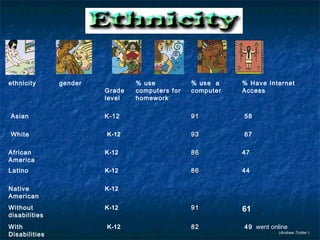
( Andrew Trotter  ) ethnicity gender Grade level % use computers for homework  % use  a computer % Have Internet Access   Asian   K-12   91    58    White     K-12   93   67  African America  K-12 86  47  Latino K-12 86  44  Native American K-12 Without disabilities K-12 91 61   With Disabilities      K-12   82   49   went online
 
   Men  Caucasians  married Individuals  well-educated individuals  Mary Keegan Eamon
4 Million Public Library Users Technological instruction on emerging products   Free Computer Literacy Instruction Up to date software and hardware
 
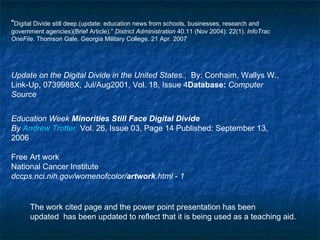
  " Digital Divide still deep.(update: education news from schools, businesses, research and government agencies)(Brief Article)."  District Administration  40.11 (Nov 2004): 22(1).  InfoTrac OneFile . Thomson Gale. Georgia Military College. 21 Apr. 2007   Update on the Digital Divide in the United States. ,  By: Conhaim, Wallys W., Link-Up, 0739988X, Jul/Aug2001, Vol. 18, Issue 4 Database:  Computer Source Education Week  Minorities Still Face Digital Divide  By  Andrew Trotter   Vol. 26, Issue 03, Page 14 Published: September 13, 2006  Free Art work  National Cancer Institute  dccps.nci.nih.gov/womenofcolor/ artwork .html  -  1   The work cited page and the power point presentation has been  updated  has been updated to reflect that it is being used as a teaching aid.

The Digital Divide

  • 1.
  • 2.
    "digital divide‘ lack of information technology (IT) between individuals who have and do not have access to IT. D.D. reflects “existing patterns of social stratification in the United States” Mary Keegan Eamon
  • 3.
    Lack of software Lack of technical ability to upgrade services Lack of monetary resources to upgrade software Ability and means to learn new skills.   Teacher Librarian  32.2 (Dec 2004): p34(1).  Quality of Access
  • 4.
    @ Home Limitednumber of computers @ Public Libraries @ Schools Limited hours of operation In public spaces Lack of affordability Lack of Basic Access
  • 5.
    Involved for longerperiods of time in the workforce They are not societies primary care .givers for .Children .Elderly .ill or injured family members Mary Keegan Eamon steered toward science and technological fields of study
  • 6.
    Periodically leave thework force to Act as primary family care givers for Maternity leave Children Elderly ill or injured family members Mary Keegan Eamon Women are not steered toward science and technological fields of study.
  • 7.
    Ninety-one percent ofboth female and male students use computers ( Andrew Trotter ) Gender Grade level % use a computer % Have Internet Access Female K-12 91 61 Male K-12 91 58
  • 8.
    ( Andrew Trotter ) ethnicity gender Grade level % use computers for homework % use a computer % Have Internet Access   Asian   K-12   91   58   White     K-12   93   67 African America K-12 86 47 Latino K-12 86 44 Native American K-12 Without disabilities K-12 91 61 With Disabilities     K-12   82   49 went online
  • 9.
  • 10.
      Men Caucasians married Individuals well-educated individuals Mary Keegan Eamon
  • 11.
    4 Million PublicLibrary Users Technological instruction on emerging products Free Computer Literacy Instruction Up to date software and hardware
  • 12.
  • 13.
      " DigitalDivide still deep.(update: education news from schools, businesses, research and government agencies)(Brief Article)."  District Administration  40.11 (Nov 2004): 22(1).  InfoTrac OneFile . Thomson Gale. Georgia Military College. 21 Apr. 2007  Update on the Digital Divide in the United States. ,  By: Conhaim, Wallys W., Link-Up, 0739988X, Jul/Aug2001, Vol. 18, Issue 4 Database: Computer Source Education Week Minorities Still Face Digital Divide By Andrew Trotter Vol. 26, Issue 03, Page 14 Published: September 13, 2006 Free Art work National Cancer Institute dccps.nci.nih.gov/womenofcolor/ artwork .html - 1 The work cited page and the power point presentation has been updated has been updated to reflect that it is being used as a teaching aid.