The Whitsun Weddings 
By, 
Philip Larkin
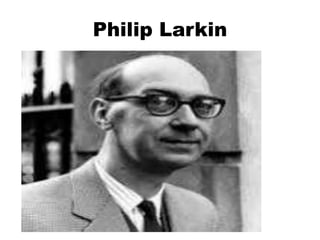
Philip Larkin
Philip Larkin 
 Philip Larkin was born in 1922 August 9 in the place Coventry . 
 Philip Larkin is a major British poet and typical representative of a new movement 
in English poetry . 
 His early poems shows the influence of W.B.Yeats . 
 Larkin and other poets of the new movement repeat the intellectual poetry of Ezra 
Pound and W.H.Auden . 
 Larkin’s poetry is distinguished for its final sense of form , clarity of expression , 
intelligent craftsman ship and thoughtful realism . 
 His Notable works include “The Whitsun Weddings (1964), High Windows 
(1974)”etc.
Poem
About the poem 
 Larkin describes a stopping-train journey southwards from Paragon Station, 
Kingston upon Hull, where Larkin was a librarian at the university, on a hot 
Whitsun Saturday afternoon. 
 It has always been supposed the poem was based on an actual train journey Larkin 
made in 1955 on Whitsun Saturday, a day which was popular for weddings at that 
time though since there was a rail strike on that weekend Larkin scholar John 
Osborne now thinks the journey an unlikely one to have taken place. 
 Larkin's letters mention two journeys, one to Grantham (not at Whit, some 
weddings), and one to London (not at Whit, no weddings), that may have been 
conflated in the poem.
The technical brilliance of Larkin 
 ‘The Whitsun Weddings’ is technically perfect . 
 The poem takes us through the English country side to the urban landscapes . 
 The very movement is that of a leisurely journey , the lines frequently pausing as 
if at so many stations . 
 Just as a train halts and proceeds the verse also shows enjoyment , the 
continuation of sense without a pause beyond the end of the line . 
 The rhyme scheme is ab ab cde cde . 
 The rhyming scheme helps to link beginnings to end and end to beginnings, 
suggesting the jaults and movement of a slow train . 
 After the first two stanzas the poem proceeds through interconnected stanzas, 
just like the compartments of a train . 
 The descriptions are highly realistic , there is a logical development of ideas and a 
regular stanza structure .
THEME AND LANGUAGE OF THE POEM 
Thematically also the poem is important . The three most important aspects of human 
life are birth , population and death according to T.S. Eliot . The poet invests the 
railway journey with importance by peopling it with marriage parties . A marriage can 
be successful or a total failure. Whatever the outcome the participants are changed 
forever. While the couples are totally absorbed in the landscape , Larkin sits looking at 
them thinking about the future of their married life . Then the train stops and a sense 
of decline and doom comes to the poet . There is the inevitable sense of falling as 
arrows fall . The rain means dampness and cold . The images of arrows and rain also 
suggest the vigor of the couples . Rain is the symbol of fertility also . That life is a 
progression , toward decay and destruction is recurring theme in Larkin’s poem . Here 
, it is mixed with happiness and the sense of doom , the sense of alienation is also 
brought out well in the poem . The poems greatness lies in the way in which seeing 
and understanding the actions of the different couples harmonizes their various 
experiences into a unified impression .
language 
The description in the poem is graphic as is always the case with the imagery in 
Larkin’s poems . The poet saw the backs of the houses on the way , the rivers broad and 
level , wide farms , the cattle casting shadows on the ground canals with ‘industrial froth ‘ 
and ‘acres of dismantled cars’ . The poem also contains a graphic description of the people 
on the railway platforms and the people getting into the train . The girls are described as 
‘pomaded’, the fathers with ‘seamy foreheads’ , the mothers ‘loud and fat’ and an uncle 
‘shouting's smut’. The references to the newly married couples are also interesting . The 
poem is full of chronical and satirical phrases. Marriage described not only as a joyful 
occasion but also as a ‘happy funeral’ and a ‘religious wounding’. 
When the train finally stops , there is a sense of decline and doom to the poet . Like 
the train which stops at the terminus , with passengers lacking bonds of love, going their 
separate ways , there is the note of inevitable dissolution . The poem ends on a note of 
happiness and the sense of doom on the part of the poet. The speeding arrow symbolizes 
the train. It falls somewhere, there is rain germination , energy of life. When the train 
comes to a halt , life also grinds to a halt . There is the inevitable sense of falling and 
dissolution both in the trains journey and in life . Thus the sense of alienation in the 
modern world . It is also brought out well in the poem .
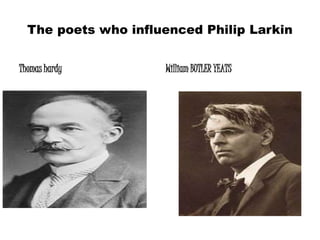
The poets who influenced Philip Larkin 
Thomas hardy William BUTLER YEATS
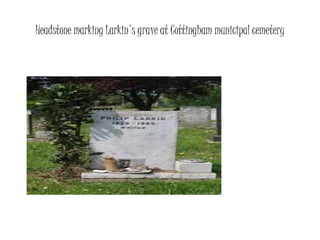
Headstone marking Larkin's grave at Cottingham municipal cemetery
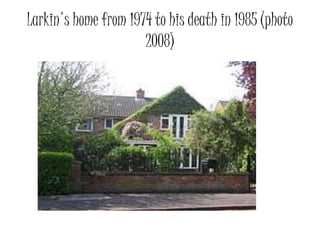
Larkin's home from 1974 to his death in 1985 (photo 
2008)
The whitsun weddings

The whitsun weddings

  • 1.
    The Whitsun Weddings By, Philip Larkin
  • 2.
  • 3.
    Philip Larkin Philip Larkin was born in 1922 August 9 in the place Coventry .  Philip Larkin is a major British poet and typical representative of a new movement in English poetry .  His early poems shows the influence of W.B.Yeats .  Larkin and other poets of the new movement repeat the intellectual poetry of Ezra Pound and W.H.Auden .  Larkin’s poetry is distinguished for its final sense of form , clarity of expression , intelligent craftsman ship and thoughtful realism .  His Notable works include “The Whitsun Weddings (1964), High Windows (1974)”etc.
  • 4.
  • 5.
    About the poem  Larkin describes a stopping-train journey southwards from Paragon Station, Kingston upon Hull, where Larkin was a librarian at the university, on a hot Whitsun Saturday afternoon.  It has always been supposed the poem was based on an actual train journey Larkin made in 1955 on Whitsun Saturday, a day which was popular for weddings at that time though since there was a rail strike on that weekend Larkin scholar John Osborne now thinks the journey an unlikely one to have taken place.  Larkin's letters mention two journeys, one to Grantham (not at Whit, some weddings), and one to London (not at Whit, no weddings), that may have been conflated in the poem.
  • 6.
    The technical brillianceof Larkin  ‘The Whitsun Weddings’ is technically perfect .  The poem takes us through the English country side to the urban landscapes .  The very movement is that of a leisurely journey , the lines frequently pausing as if at so many stations .  Just as a train halts and proceeds the verse also shows enjoyment , the continuation of sense without a pause beyond the end of the line .  The rhyme scheme is ab ab cde cde .  The rhyming scheme helps to link beginnings to end and end to beginnings, suggesting the jaults and movement of a slow train .  After the first two stanzas the poem proceeds through interconnected stanzas, just like the compartments of a train .  The descriptions are highly realistic , there is a logical development of ideas and a regular stanza structure .
  • 7.
    THEME AND LANGUAGEOF THE POEM Thematically also the poem is important . The three most important aspects of human life are birth , population and death according to T.S. Eliot . The poet invests the railway journey with importance by peopling it with marriage parties . A marriage can be successful or a total failure. Whatever the outcome the participants are changed forever. While the couples are totally absorbed in the landscape , Larkin sits looking at them thinking about the future of their married life . Then the train stops and a sense of decline and doom comes to the poet . There is the inevitable sense of falling as arrows fall . The rain means dampness and cold . The images of arrows and rain also suggest the vigor of the couples . Rain is the symbol of fertility also . That life is a progression , toward decay and destruction is recurring theme in Larkin’s poem . Here , it is mixed with happiness and the sense of doom , the sense of alienation is also brought out well in the poem . The poems greatness lies in the way in which seeing and understanding the actions of the different couples harmonizes their various experiences into a unified impression .
  • 8.
    language The descriptionin the poem is graphic as is always the case with the imagery in Larkin’s poems . The poet saw the backs of the houses on the way , the rivers broad and level , wide farms , the cattle casting shadows on the ground canals with ‘industrial froth ‘ and ‘acres of dismantled cars’ . The poem also contains a graphic description of the people on the railway platforms and the people getting into the train . The girls are described as ‘pomaded’, the fathers with ‘seamy foreheads’ , the mothers ‘loud and fat’ and an uncle ‘shouting's smut’. The references to the newly married couples are also interesting . The poem is full of chronical and satirical phrases. Marriage described not only as a joyful occasion but also as a ‘happy funeral’ and a ‘religious wounding’. When the train finally stops , there is a sense of decline and doom to the poet . Like the train which stops at the terminus , with passengers lacking bonds of love, going their separate ways , there is the note of inevitable dissolution . The poem ends on a note of happiness and the sense of doom on the part of the poet. The speeding arrow symbolizes the train. It falls somewhere, there is rain germination , energy of life. When the train comes to a halt , life also grinds to a halt . There is the inevitable sense of falling and dissolution both in the trains journey and in life . Thus the sense of alienation in the modern world . It is also brought out well in the poem .
  • 9.
    The poets whoinfluenced Philip Larkin Thomas hardy William BUTLER YEATS
  • 10.
    Headstone marking Larkin'sgrave at Cottingham municipal cemetery
  • 11.
    Larkin's home from1974 to his death in 1985 (photo 2008)