By
Muhammad Ashraf
M.A English 2nd
NUML Faisalabad
Walter Pater’s Life Span(4 Aug 1839- 30 July
1894)
Walter Pater’s complete name was Walter Horatio
Pater.
He was born at Shadwell in England in 1839
As a school boy, he was a coy and sober boy
He is acknowledged as a prominent art critic.
He was a fellow of Brasennose.
He was critic of late Victorian age and beginner of
Modern age.
He believed in principle of Art for Art’s Sake
rather than Art for Life’s Sake.
He was aesthetic critic (His Focus is on enjoyment
of beauty just like john Keats “ Beauty is truth
and truth beauty”
His famous work was
“Studies in the History of Renaissance” ( 1873) it
is a collection of essays on Renaissance.
It subsequently came out in the form
“ The Renaissance: Studies in Art and Poetry”
These are important essays by him in this
collection.
Collection:
1
Leonardo The Vinci ( 1869),
Sandro Betticee (1970),
Michangelo (1871).
These essays appeared in “Fortnightly Review”.
2. Appreciations (1889)
3. Plato And Platonism (1893)
4. Besides his critical essays, he gave a new
direction to English Prose writing in his work “
Imaginary Portraits”.
5. In 1895 Shadwell published his scattered
essays in under the little “Miscellaneous
Essays”.
According to Walter Pater art is there for art’s sake: it
is not for the sake of any utility of society. Utility
of art is art itself because it is a thing of beauty
whether it is a painting, sculpture, literature or any
work of art.
An artist’s main task and duty is to test, commend
and recommend the work of art what is most
beautiful and appreciable. Human life is short and
time given by God must be devoted to accumulate
art and literature. Beauty is gifted by God and it is
identical to truth. Art elates human spirit.
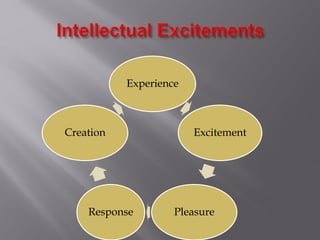
He has emphasized on the concept of “ intellectual
excitement” and “ desire for beauty”.
Pater reconstructs the lives and works of French, Italian,
and German painters.
In his renaissance book he promotes impressionistic
theory of art. He says that it is the responsibility of an
aesthetic critic to realize and pour out the distinctive
features of a work of art. Impressionistic theory creates
a different impression, art has got a vision and that
vision is conveyed. Art is not the appreciation of the
object only but the realization of beauty. Because
appreciation can be biased butr realization of beauty is
truth.
Realization of beauty is an absolute phenomenon.
Beauty is related to human experiences.
Experience decides whether it is a thing of beauty or not.
For example, if any thing of beauty hurts you or gives you
pain, troubles then that is not a thing of beauty for you.
Beauty is not the thing which can be seen by eyes,
actually it is felt and experiences but impressions.
Beauty thing gives you its impression and we then
decide whether it is a thing of beauty or not. Everyone
has his personal experience and impression. A thing of
beauty can be pleasurable and joyful for one person
but not same for the other. It varies from person to
person.
In terms of poetry or any literary creation Walter Pater
says that every creation of literature, even by an
intellectual or witty person, cannot be a thing of
beauty.
“The Conclusion” of the studies in the history of
Renaissance is a significant document of Walter Pater
to expose the various dimensions of his critical
perceptions. Change is the eternal thing that is
permanent. Everything is subject to change. Nothing is
permanent in this world.
Experience
Excitement
Pleasure
Response
Creation
Experience
Excitement
PleasureResponse
Creation
Art means not giving any lesson of morality;
Art to give pleasure through beauty.
But actually, The Aesthetic Movement was not
very successful in that time because of world
war-1 and lack of practical use of that concept
in real life. At that time of crises people were
not living a peaceful life and no one paid
attention to Art for Art’s Sake and to beauty
cult.
This movement was carried on by Oscar Wilde.
He believed that art does not follow nature rather
nature follows art.
“ On Style” is his essay. In this essay he has told
his literary art, style of writing and diction.
He had no fixed rules or principles to judge
any work of art. He judged it as a work of
beauty. He had not any parameter to criticize
any literary work.
Important discussion-on-works-of-walter-pater

Important discussion-on-works-of-walter-pater

  • 1.
    By Muhammad Ashraf M.A English2nd NUML Faisalabad
  • 2.
    Walter Pater’s LifeSpan(4 Aug 1839- 30 July 1894) Walter Pater’s complete name was Walter Horatio Pater. He was born at Shadwell in England in 1839 As a school boy, he was a coy and sober boy He is acknowledged as a prominent art critic. He was a fellow of Brasennose.
  • 3.
    He was criticof late Victorian age and beginner of Modern age. He believed in principle of Art for Art’s Sake rather than Art for Life’s Sake. He was aesthetic critic (His Focus is on enjoyment of beauty just like john Keats “ Beauty is truth and truth beauty”
  • 4.
    His famous workwas “Studies in the History of Renaissance” ( 1873) it is a collection of essays on Renaissance. It subsequently came out in the form “ The Renaissance: Studies in Art and Poetry” These are important essays by him in this collection.
  • 5.
    Collection: 1 Leonardo The Vinci( 1869), Sandro Betticee (1970), Michangelo (1871). These essays appeared in “Fortnightly Review”.
  • 6.
    2. Appreciations (1889) 3.Plato And Platonism (1893) 4. Besides his critical essays, he gave a new direction to English Prose writing in his work “ Imaginary Portraits”. 5. In 1895 Shadwell published his scattered essays in under the little “Miscellaneous Essays”.
  • 7.
    According to WalterPater art is there for art’s sake: it is not for the sake of any utility of society. Utility of art is art itself because it is a thing of beauty whether it is a painting, sculpture, literature or any work of art. An artist’s main task and duty is to test, commend and recommend the work of art what is most beautiful and appreciable. Human life is short and time given by God must be devoted to accumulate art and literature. Beauty is gifted by God and it is identical to truth. Art elates human spirit.
  • 8.
    He has emphasizedon the concept of “ intellectual excitement” and “ desire for beauty”. Pater reconstructs the lives and works of French, Italian, and German painters. In his renaissance book he promotes impressionistic theory of art. He says that it is the responsibility of an aesthetic critic to realize and pour out the distinctive features of a work of art. Impressionistic theory creates a different impression, art has got a vision and that vision is conveyed. Art is not the appreciation of the object only but the realization of beauty. Because appreciation can be biased butr realization of beauty is truth.
  • 9.
    Realization of beautyis an absolute phenomenon. Beauty is related to human experiences. Experience decides whether it is a thing of beauty or not. For example, if any thing of beauty hurts you or gives you pain, troubles then that is not a thing of beauty for you. Beauty is not the thing which can be seen by eyes, actually it is felt and experiences but impressions. Beauty thing gives you its impression and we then decide whether it is a thing of beauty or not. Everyone has his personal experience and impression. A thing of beauty can be pleasurable and joyful for one person but not same for the other. It varies from person to person.
  • 10.
    In terms ofpoetry or any literary creation Walter Pater says that every creation of literature, even by an intellectual or witty person, cannot be a thing of beauty.
  • 11.
    “The Conclusion” ofthe studies in the history of Renaissance is a significant document of Walter Pater to expose the various dimensions of his critical perceptions. Change is the eternal thing that is permanent. Everything is subject to change. Nothing is permanent in this world.
  • 12.
  • 13.
  • 14.
    Art means notgiving any lesson of morality; Art to give pleasure through beauty. But actually, The Aesthetic Movement was not very successful in that time because of world war-1 and lack of practical use of that concept in real life. At that time of crises people were not living a peaceful life and no one paid attention to Art for Art’s Sake and to beauty cult.
  • 15.
    This movement wascarried on by Oscar Wilde. He believed that art does not follow nature rather nature follows art. “ On Style” is his essay. In this essay he has told his literary art, style of writing and diction.
  • 16.
    He had nofixed rules or principles to judge any work of art. He judged it as a work of beauty. He had not any parameter to criticize any literary work.