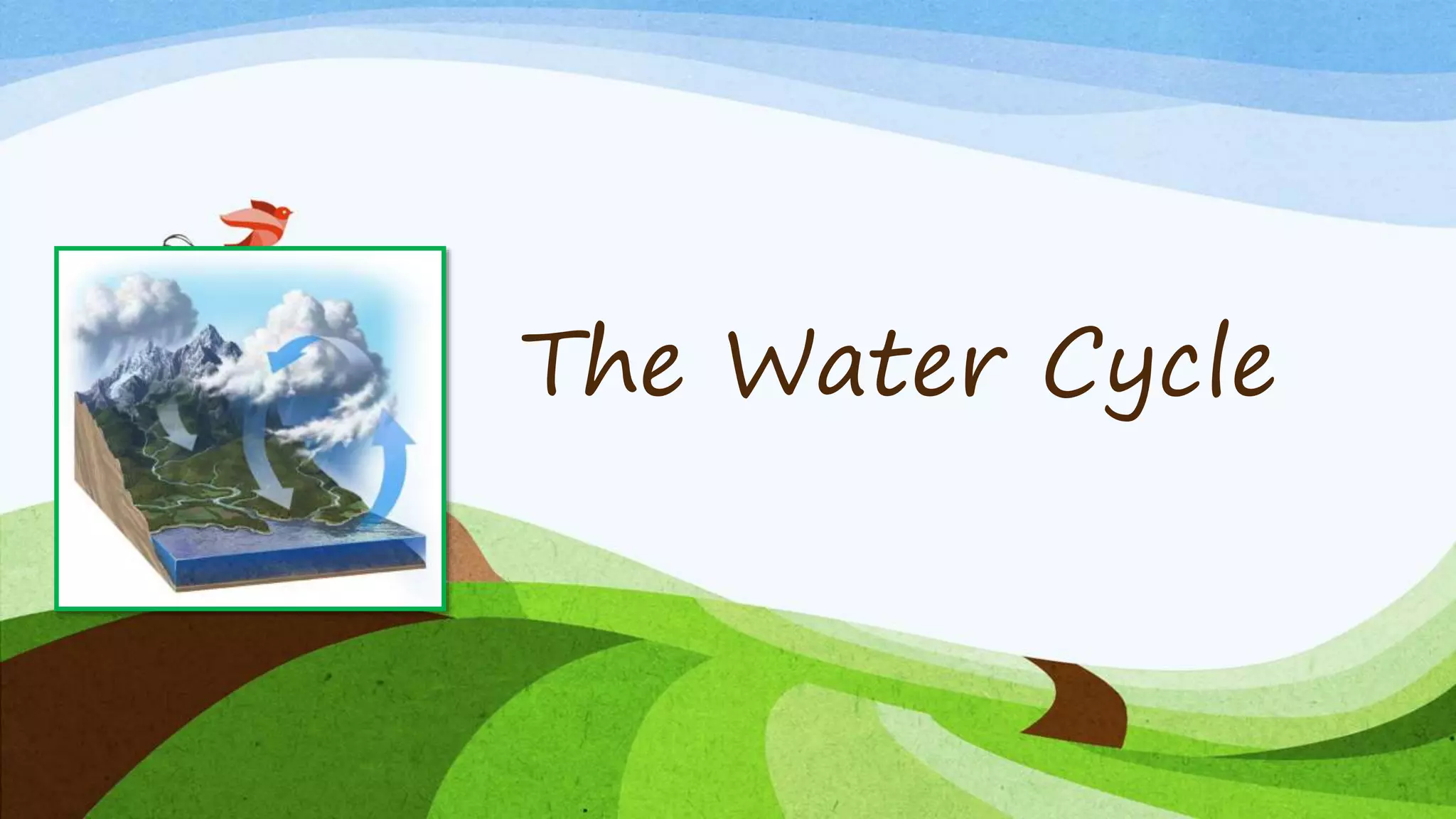
The Water Cycle
What is this “Water Cycle”?
• The water cycle, also known as
the hydrological cycle or the,
describes the continuous
movement of water on, above
and below the surface of the
Earth.
What Drives the Water Cycle?
• The Sun is what drives the
water cycle due to its
release of heat making
water all over the world
evaporate , and thus ,
repeating the water cycle
over and over again.
Let’s Play a Game!
YOU GET TO GUESS THE SCRAMBLED
WORDS
•NVAPOARIOTE
Guessing Game
ESDNNAOCOITN
Guessing Game
PRAIINOTSNRAT
Guessing Game
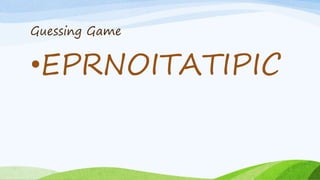
•EPRNOITATIPIC
Let’s continue
the lesson
Thanks for your cooperation
The Water Cycle : How It Works
• Now we know that the Sun is
what makes the Water Cycle work
and continue to repeat over and
over again. But is it really just
evaporation responsible for the
water cycle?
The Water Cycle : How it Works
• Actually , there are 3 more
processes involved in the Water
Cycle , and they are :
• Condensation
• Precipitation
The Water Cycle : How It Works
• Now we know the four
processes of the Water Cycle.
• But do we know what do
these processes do?
• Shall we find out?
The Processes of the
Water Cycle
Evaporation
>Transpiration
Condensation
Precipitation
Evaporation
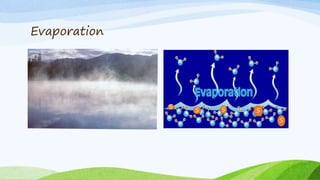
• Evaporation is a type of vaporization of a liquid that occurs
from the surface of a liquid into a gaseous phase that is not
saturated with the evaporating substance.
• In other words , Evaporation is when the water “Dries Up”
and turns it water vapor in the form a gas. Since pure
water is almost the only substance that can evaporate , the
solutes are always left behind.
• For example , the Dead Sea is so dense that you’ll naturally
float on it. That is because of the high concentration of
sunlight in the area and that is the reason so many salt
particles are left behind.
Evaporation
S
S S S
S
Transpiration
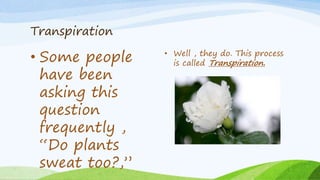
• Some people
have been
asking this
question
frequently ,
“Do plants
sweat too?,”
• Well , they do. This process
is called Transpiration.
Transpiration
• Plants absorb water from
the soil. Each plant will use
the water that it needs to
help it grow. As extra
water travels through the
plant and to its leaves, it is
pulled out and evaporated
into the air. This process is
called transpiration
• Transpiration is the process
by which moisture is carried
through plants from roots
to small pores on the
underside of leaves, where it
changes to vapor and is
released to the atmosphere.
• Transpiration is a sub-
process of Evaporation
Transpiration
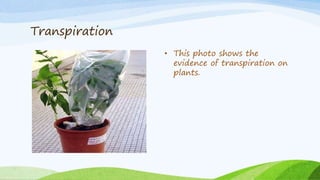
• This photo shows the
evidence of transpiration on
plants.
Condensation
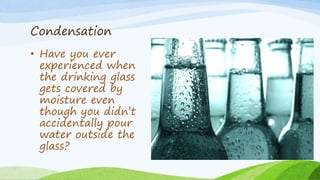
• Have you ever
experienced when
the drinking glass
gets covered by
moisture even
though you didn’t
accidentally pour
water outside the
glass?
Condensation
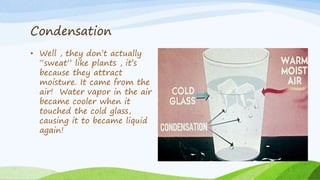
• Well , they don’t actually
“sweat” like plants , it’s
because they attract
moisture. It came from the
air! Water vapor in the air
became cooler when it
touched the cold glass,
causing it to became liquid
again!
Condensation
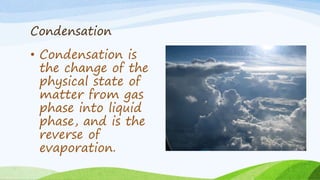
• Condensation is
the change of the
physical state of
matter from gas
phase into liquid
phase, and is the
reverse of
evaporation.
Precipitation
• Somethings are
just really hard
to hold on ,
right?
• Well , that’s why
we need to let
go.
Precipitation
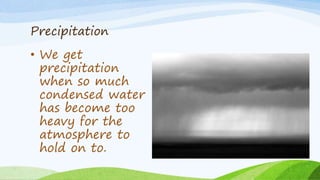
• We get
precipitation
when so much
condensed water
has become too
heavy for the
atmosphere to
hold on to.
Precipitation
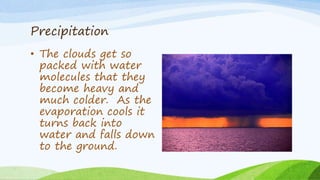
• The clouds get so
packed with water
molecules that they
become heavy and
much colder. As the
evaporation cools it
turns back into
water and falls down
to the ground.
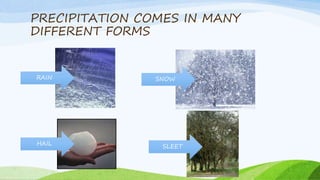
PRECIPITATION COMES IN MANY
DIFFERENT FORMS
RAIN SNOW
HAIL SLEET
Let’s Test Your Knowledge
•1. What are the 3
main processes of
the Water Cycle?
•2. What process of
the Water Cycle
involves the water
“Drying Up”
•3.What process of the
Water Cycle is the
opposite of
Evaporation?
•4. What are the
four types of
precipitation?
•5. It Drives
the Water
Cycle

The water cycle

  • 1.
  • 2.
    What is this“Water Cycle”? • The water cycle, also known as the hydrological cycle or the, describes the continuous movement of water on, above and below the surface of the Earth.
  • 3.
    What Drives theWater Cycle? • The Sun is what drives the water cycle due to its release of heat making water all over the world evaporate , and thus , repeating the water cycle over and over again.
  • 4.
    Let’s Play aGame! YOU GET TO GUESS THE SCRAMBLED WORDS •NVAPOARIOTE
  • 5.
  • 6.
  • 7.
  • 8.
  • 9.
    The Water Cycle: How It Works • Now we know that the Sun is what makes the Water Cycle work and continue to repeat over and over again. But is it really just evaporation responsible for the water cycle?
  • 10.
    The Water Cycle: How it Works • Actually , there are 3 more processes involved in the Water Cycle , and they are : • Condensation • Precipitation
  • 11.
    The Water Cycle: How It Works • Now we know the four processes of the Water Cycle. • But do we know what do these processes do? • Shall we find out?
  • 12.
    The Processes ofthe Water Cycle Evaporation >Transpiration Condensation Precipitation
  • 13.
    Evaporation • Evaporation isa type of vaporization of a liquid that occurs from the surface of a liquid into a gaseous phase that is not saturated with the evaporating substance. • In other words , Evaporation is when the water “Dries Up” and turns it water vapor in the form a gas. Since pure water is almost the only substance that can evaporate , the solutes are always left behind. • For example , the Dead Sea is so dense that you’ll naturally float on it. That is because of the high concentration of sunlight in the area and that is the reason so many salt particles are left behind.
  • 14.
  • 15.
    Transpiration • Some people havebeen asking this question frequently , “Do plants sweat too?,” • Well , they do. This process is called Transpiration.
  • 16.
    Transpiration • Plants absorbwater from the soil. Each plant will use the water that it needs to help it grow. As extra water travels through the plant and to its leaves, it is pulled out and evaporated into the air. This process is called transpiration • Transpiration is the process by which moisture is carried through plants from roots to small pores on the underside of leaves, where it changes to vapor and is released to the atmosphere. • Transpiration is a sub- process of Evaporation
  • 17.
    Transpiration • This photoshows the evidence of transpiration on plants.
  • 18.
    Condensation • Have youever experienced when the drinking glass gets covered by moisture even though you didn’t accidentally pour water outside the glass?
  • 19.
    Condensation • Well ,they don’t actually “sweat” like plants , it’s because they attract moisture. It came from the air! Water vapor in the air became cooler when it touched the cold glass, causing it to became liquid again!
  • 20.
    Condensation • Condensation is thechange of the physical state of matter from gas phase into liquid phase, and is the reverse of evaporation.
  • 21.
    Precipitation • Somethings are justreally hard to hold on , right? • Well , that’s why we need to let go.
  • 22.
    Precipitation • We get precipitation whenso much condensed water has become too heavy for the atmosphere to hold on to.
  • 23.
    Precipitation • The cloudsget so packed with water molecules that they become heavy and much colder. As the evaporation cools it turns back into water and falls down to the ground.
  • 24.
    PRECIPITATION COMES INMANY DIFFERENT FORMS RAIN SNOW HAIL SLEET
  • 25.
    Let’s Test YourKnowledge •1. What are the 3 main processes of the Water Cycle?
  • 26.
    •2. What processof the Water Cycle involves the water “Drying Up”
  • 27.
    •3.What process ofthe Water Cycle is the opposite of Evaporation?
  • 28.
    •4. What arethe four types of precipitation?
  • 29.