OUR UNIVERSE
A GREAT MISTERY FOR ALL OF US
Our Universe is the whole space
 and time, all forms of matter,
  energy and time, laws and
physical constants that control
             them.
   Universe is something totally unknown to mankind.
    We don’t know it certainly. We only know very little
    data about this, it is said there are different universes,
    but we know that there are structures added to
    universe, some are as follows:
    1.Satellites      6.Stars                 11.Black holes
    2.Planets          7.Constellations        12.Blazars
    3.Asteroids       8.Supernovae             13.Quasars
    4.Meteorites      9.Nebulae               14.Dark
    materia
    5.Comets           10.Dark nebulae
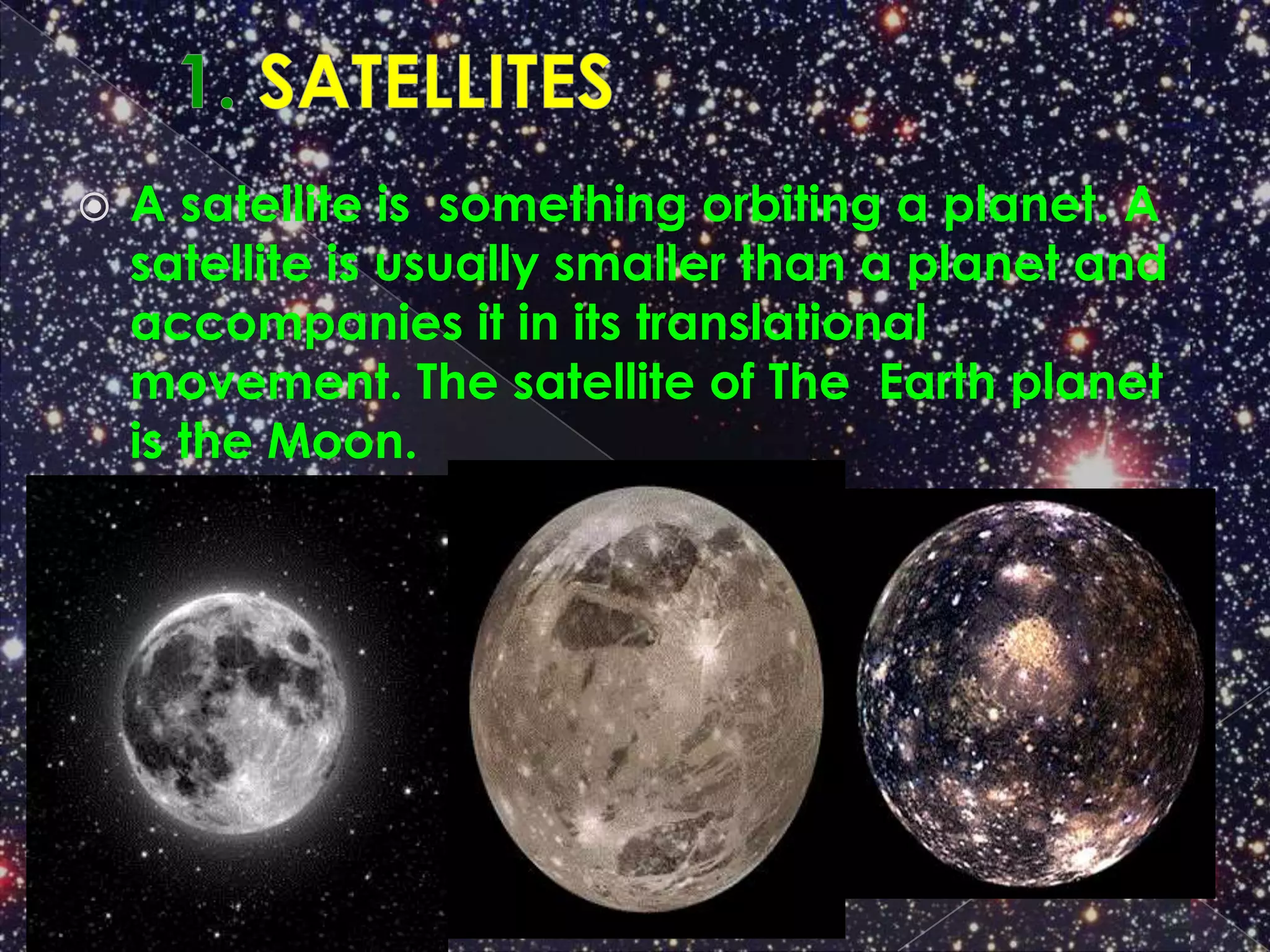
   A satellite is something orbiting a planet. A
    satellite is usually smaller than a planet and
    accompanies it in its translational
    movement. The satellite of The Earth planet
    is the Moon.
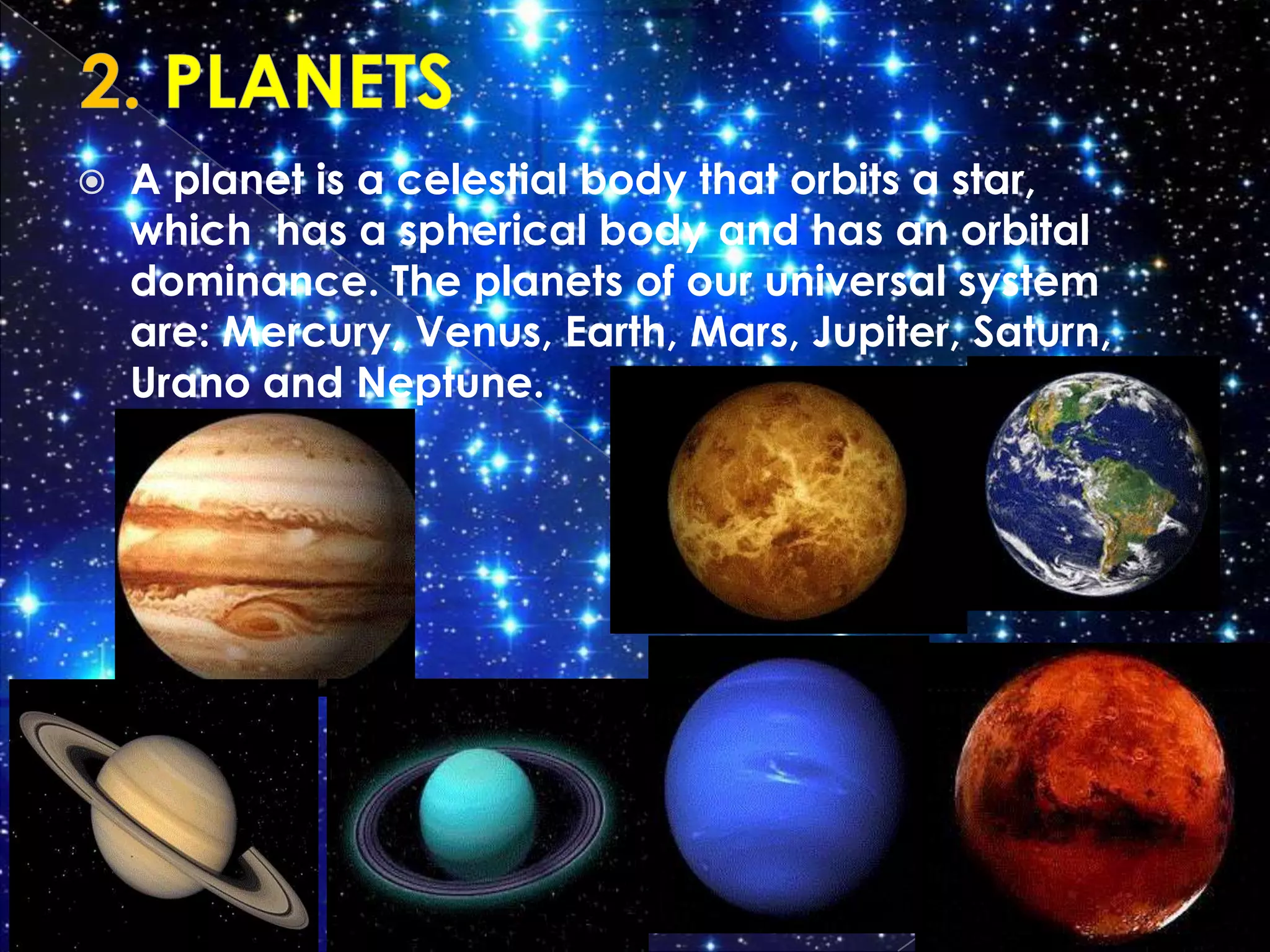
   A planet is a celestial body that orbits a star,
    which has a spherical body and has an orbital
    dominance. The planets of our universal system
    are: Mercury, Venus, Earth, Mars, Jupiter, Saturn,
    Urano and Neptune.
   An asteroid is a chondrite or metallic rock .
    Asteroids are also called planetoids or minor
    planets, which include them in the same category
    with the comets and those trans-Neptunian bodies.
•   A meteoroid is a sand to boulder -sized particle
    of debris in the Solar System. The visible path of
    a meteoroid that enters Earth’s (or another
    body's) atmosphere is called a meteor, or
    colloquially a shooting star or falling star. If a
    meteoroid reaches the ground and survives
    impact, then it is called a meteorite. Many
    meteors appearing seconds or minutes apart
    are called a meteor shower. The root word
    meteor comes from the Greek meteo¯ros,
    meaning "high in the air". "a solid object
    moving in interplanetary space, of a size
    considerably smaller than an asteroid and
    considerably larger than an atom".
    A meteorite goes
    towards and
    crushes against
    the surface a
    planet and it can
    be disintegrated
    completely

                        The brightnes s is called a
                        meteor.
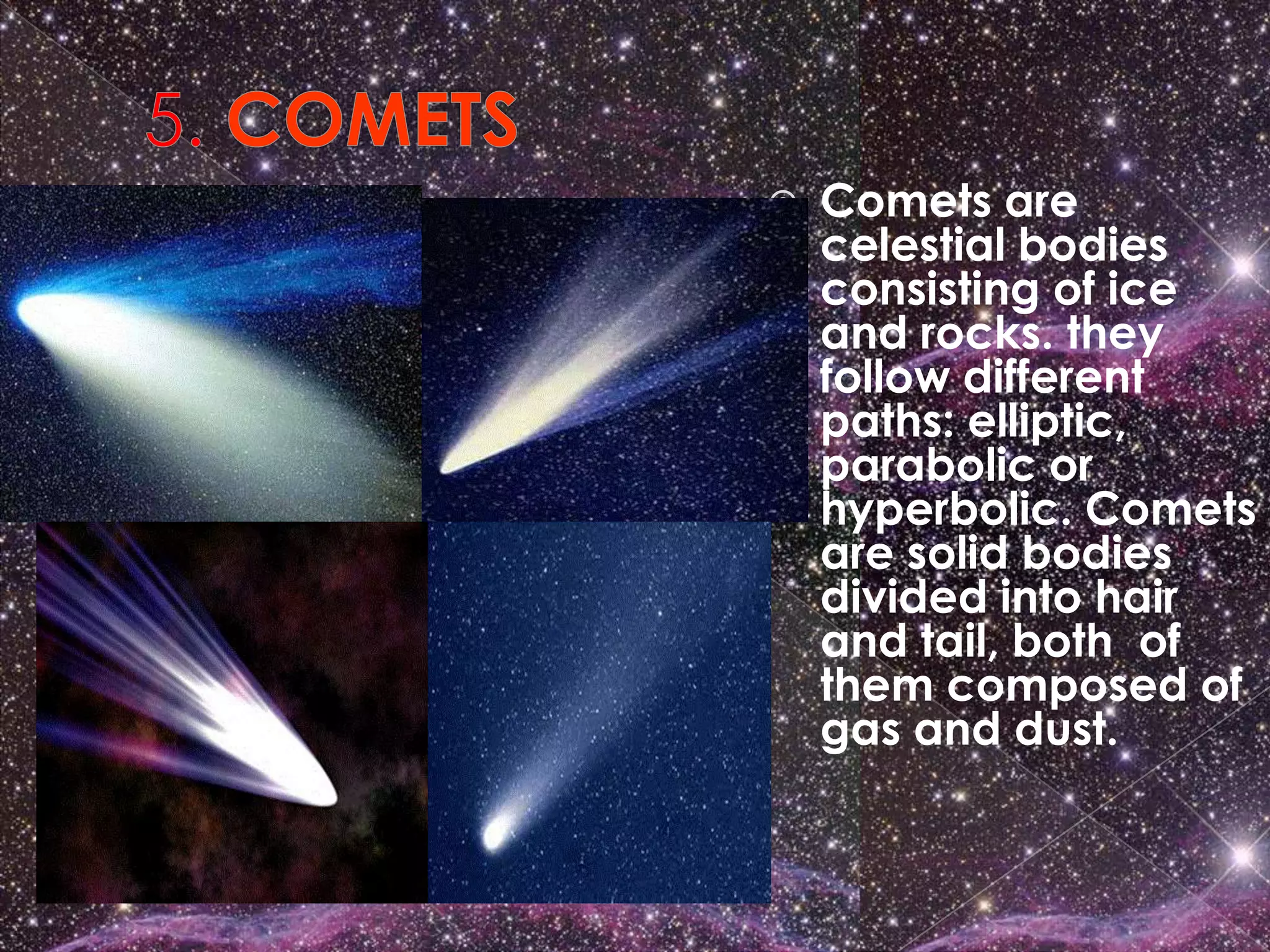
   Comets are
    celestial bodies
    consisting of ice
    and rocks. they
    follow different
    paths: elliptic,
    parabolic or
    hyperbolic. Comets
    are solid bodies
    divided into hair
    and tail, both of
    them composed of
    gas and dust.
•   A star is a celestial body that emits light itself. They
    are objects of huge masses. The radio, temperature
    and luminosity of a star can be related through
    their approximation to blackbody.
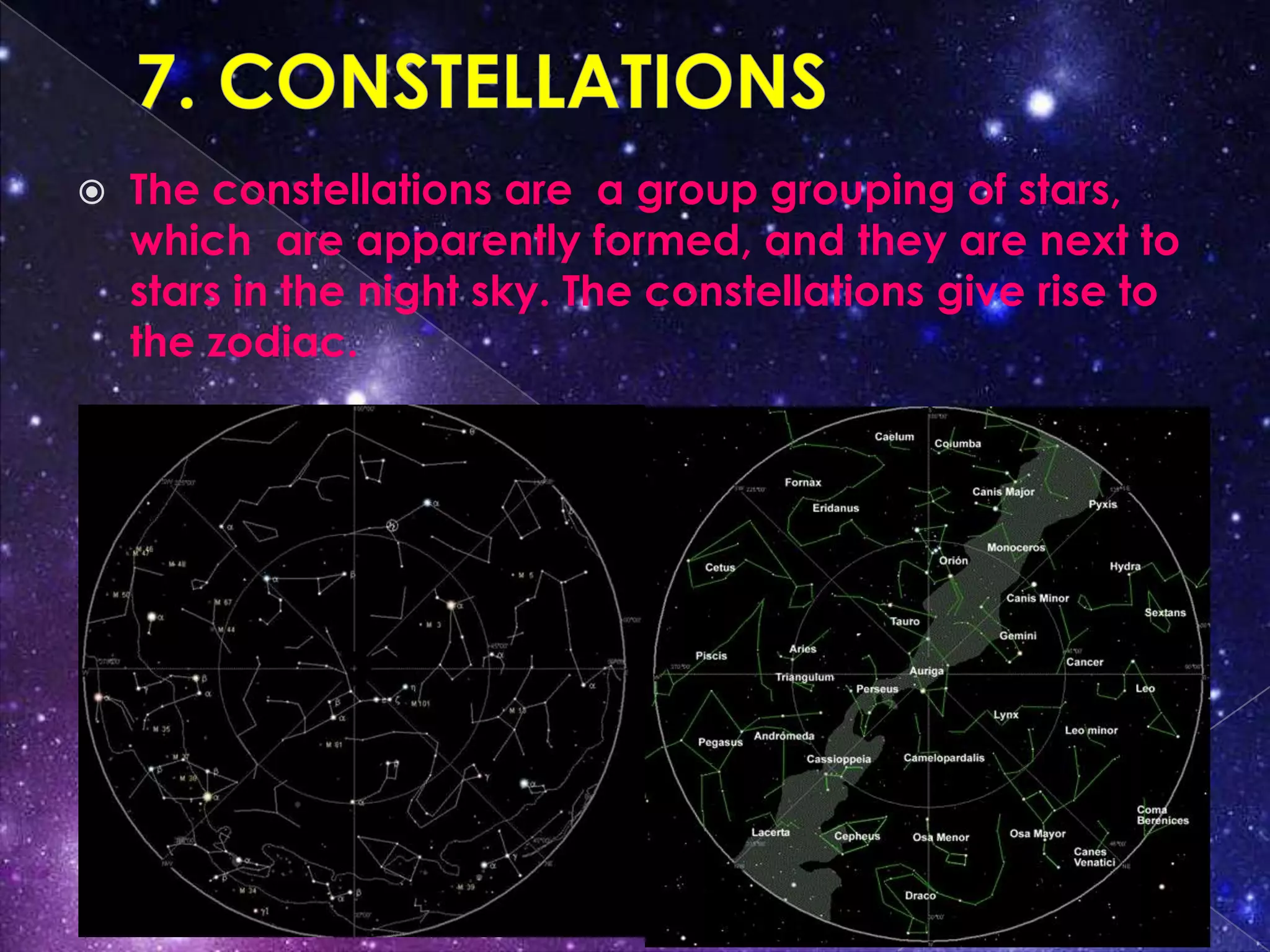
   The constellations are a group grouping of stars,
    which are apparently formed, and they are next to
    stars in the night sky. The constellations give rise to
    the zodiac.
   A supernova is a stellar explosion that can be seen
    very significantly, even to our eyes. They are
    massive stars that cannot develop thermonuclear
    reactions in their core.
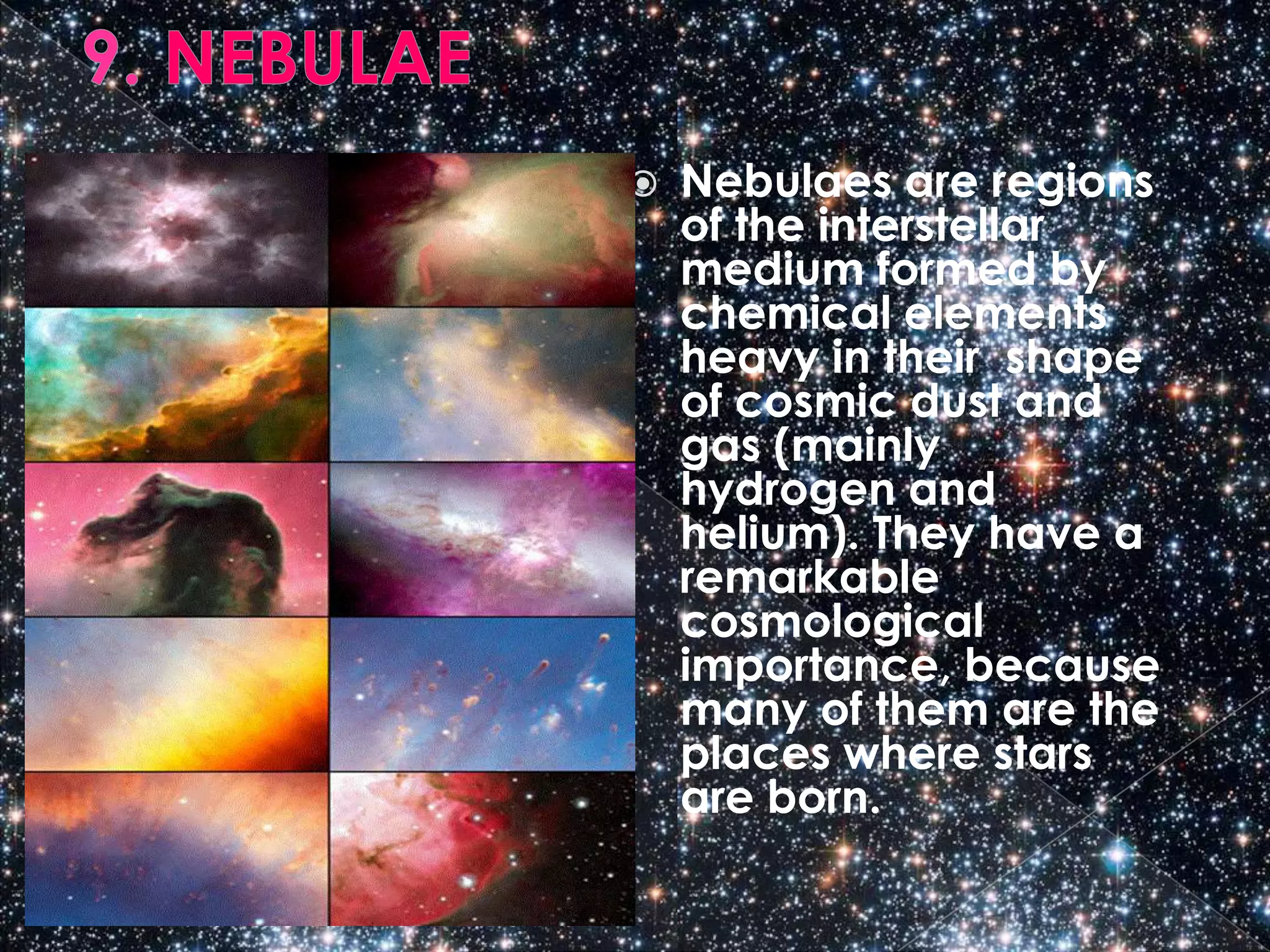
   Nebulaes are regions
    of the interstellar
    medium formed by
    chemical elements
    heavy in their shape
    of cosmic dust and
    gas (mainly
    hydrogen and
    helium). They have a
    remarkable
    cosmological
    importance, because
    many of them are the
    places where stars
    are born.
   A dark Nebula an accumulation of gas and
    interstellar dust are not related to any Star or away
    from these, so they do not receive their energy, by
    which its presence only is noticed by contrast to a
    more distant than the Nebula populated star Fund.
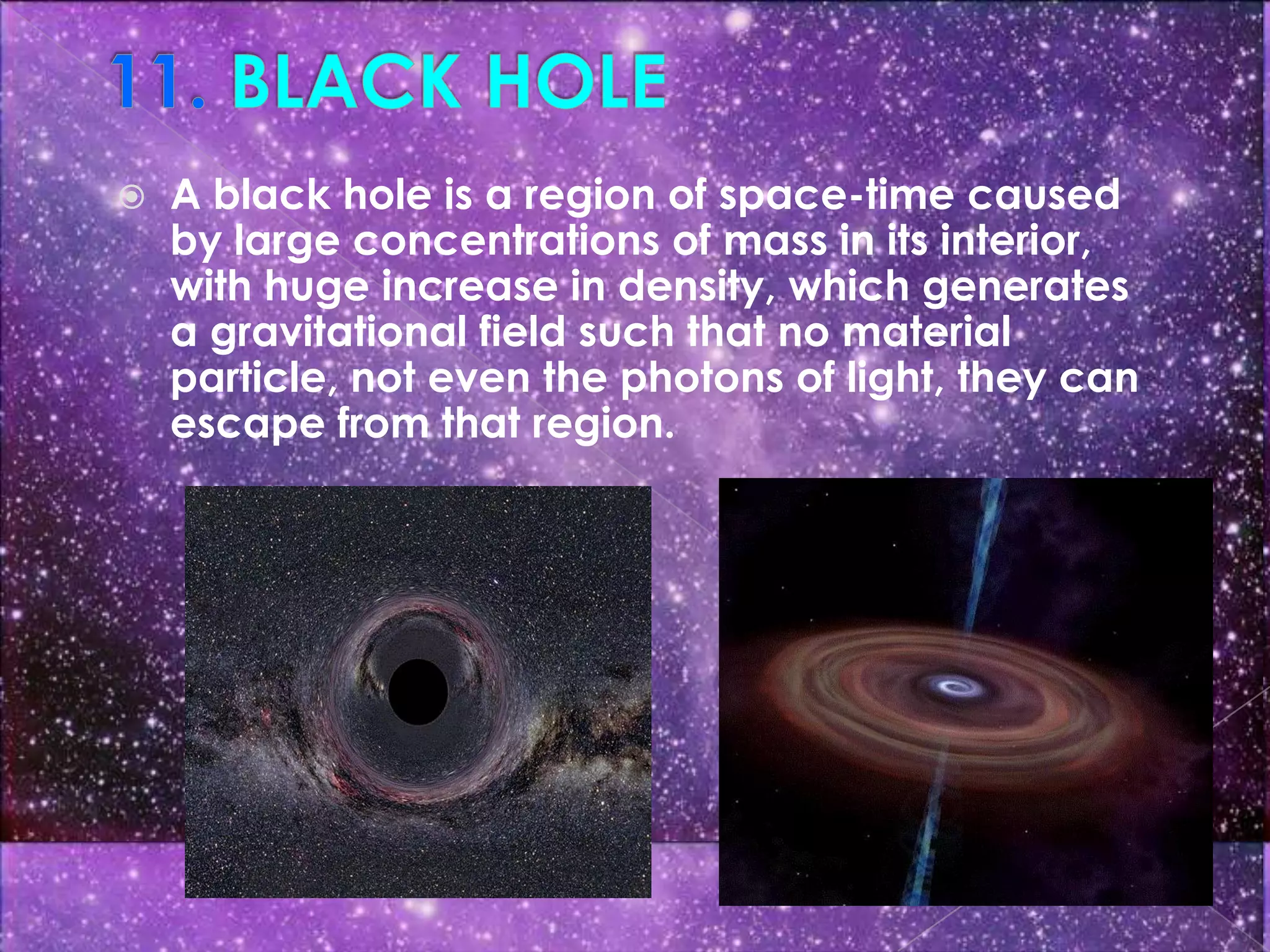
   A black hole is a region of space-time caused
    by large concentrations of mass in its interior,
    with huge increase in density, which generates
    a gravitational field such that no material
    particle, not even the photons of light, they can
    escape from that region.
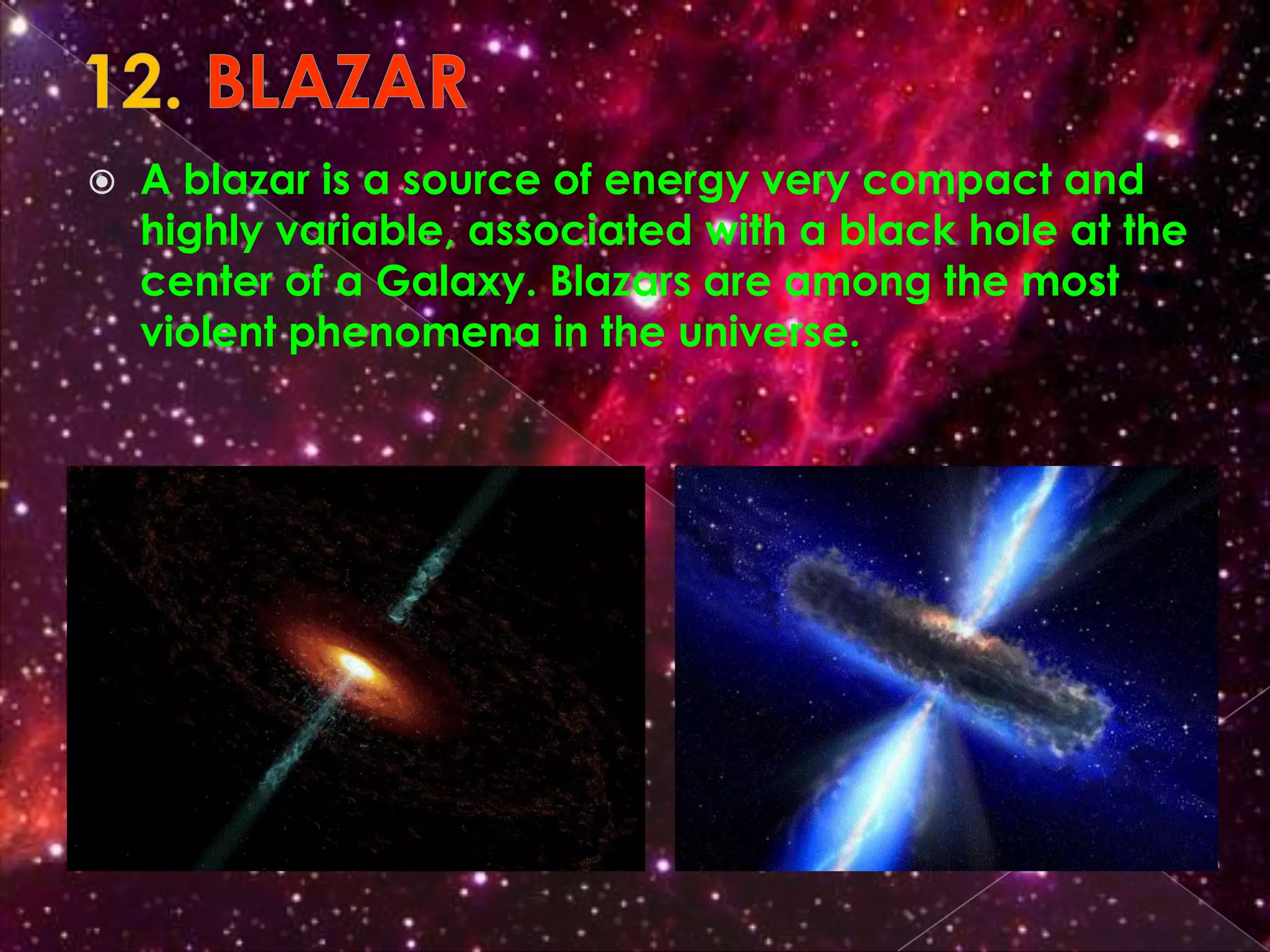
   A blazar is a source of energy very compact and
    highly variable, associated with a black hole at the
    center of a Galaxy. Blazars are among the most
    violent phenomena in the universe.
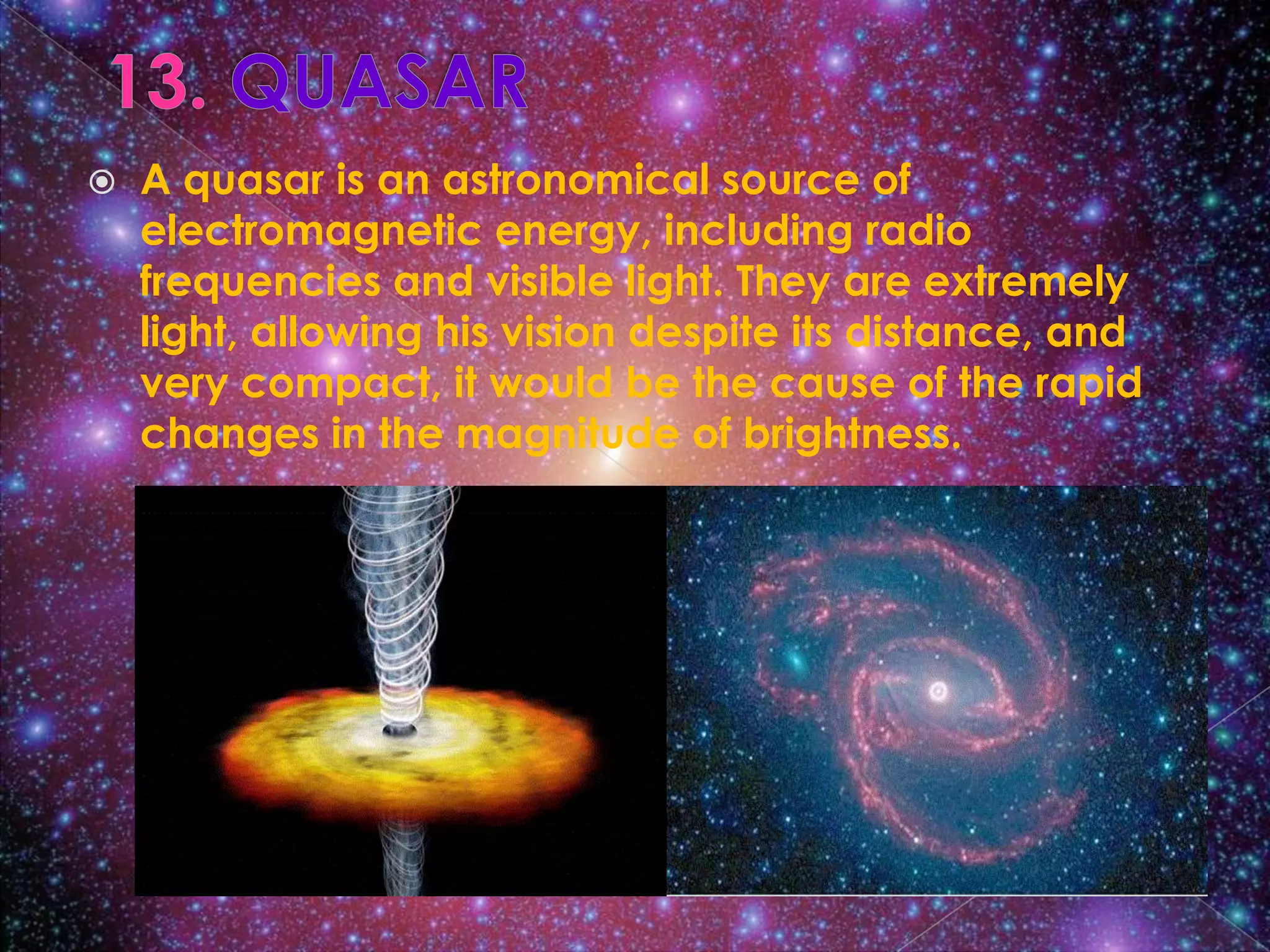
   A quasar is an astronomical source of
    electromagnetic energy, including radio
    frequencies and visible light. They are extremely
    light, allowing his vision despite its distance, and
    very compact, it would be the cause of the rapid
    changes in the magnitude of brightness.
   Dark matter that does not emit electromagnetic
    radiation enough to be detected with current
    technology, but its existence can be inferred from
    gravitational effects that cause the visible matter.
    Dark matter should not be confused with dark
    energy
The Universe - a great mystery

The Universe - a great mystery

  • 1.
    OUR UNIVERSE A GREATMISTERY FOR ALL OF US Our Universe is the whole space and time, all forms of matter, energy and time, laws and physical constants that control them.
  • 2.
    Universe is something totally unknown to mankind. We don’t know it certainly. We only know very little data about this, it is said there are different universes, but we know that there are structures added to universe, some are as follows: 1.Satellites 6.Stars 11.Black holes 2.Planets 7.Constellations 12.Blazars 3.Asteroids 8.Supernovae 13.Quasars 4.Meteorites 9.Nebulae 14.Dark materia 5.Comets 10.Dark nebulae
  • 3.
    A satellite is something orbiting a planet. A satellite is usually smaller than a planet and accompanies it in its translational movement. The satellite of The Earth planet is the Moon.
  • 4.
    A planet is a celestial body that orbits a star, which has a spherical body and has an orbital dominance. The planets of our universal system are: Mercury, Venus, Earth, Mars, Jupiter, Saturn, Urano and Neptune.
  • 5.
    An asteroid is a chondrite or metallic rock . Asteroids are also called planetoids or minor planets, which include them in the same category with the comets and those trans-Neptunian bodies.
  • 6.
    A meteoroid is a sand to boulder -sized particle of debris in the Solar System. The visible path of a meteoroid that enters Earth’s (or another body's) atmosphere is called a meteor, or colloquially a shooting star or falling star. If a meteoroid reaches the ground and survives impact, then it is called a meteorite. Many meteors appearing seconds or minutes apart are called a meteor shower. The root word meteor comes from the Greek meteo¯ros, meaning "high in the air". "a solid object moving in interplanetary space, of a size considerably smaller than an asteroid and considerably larger than an atom".
  • 7.
    A meteorite goes towards and crushes against the surface a planet and it can be disintegrated completely The brightnes s is called a meteor.
  • 8.
    Comets are celestial bodies consisting of ice and rocks. they follow different paths: elliptic, parabolic or hyperbolic. Comets are solid bodies divided into hair and tail, both of them composed of gas and dust.
  • 9.
    A star is a celestial body that emits light itself. They are objects of huge masses. The radio, temperature and luminosity of a star can be related through their approximation to blackbody.
  • 10.
    The constellations are a group grouping of stars, which are apparently formed, and they are next to stars in the night sky. The constellations give rise to the zodiac.
  • 12.
    A supernova is a stellar explosion that can be seen very significantly, even to our eyes. They are massive stars that cannot develop thermonuclear reactions in their core.
  • 13.
    Nebulaes are regions of the interstellar medium formed by chemical elements heavy in their shape of cosmic dust and gas (mainly hydrogen and helium). They have a remarkable cosmological importance, because many of them are the places where stars are born.
  • 14.
    A dark Nebula an accumulation of gas and interstellar dust are not related to any Star or away from these, so they do not receive their energy, by which its presence only is noticed by contrast to a more distant than the Nebula populated star Fund.
  • 15.
    A black hole is a region of space-time caused by large concentrations of mass in its interior, with huge increase in density, which generates a gravitational field such that no material particle, not even the photons of light, they can escape from that region.
  • 16.
    A blazar is a source of energy very compact and highly variable, associated with a black hole at the center of a Galaxy. Blazars are among the most violent phenomena in the universe.
  • 17.
    A quasar is an astronomical source of electromagnetic energy, including radio frequencies and visible light. They are extremely light, allowing his vision despite its distance, and very compact, it would be the cause of the rapid changes in the magnitude of brightness.
  • 18.
    Dark matter that does not emit electromagnetic radiation enough to be detected with current technology, but its existence can be inferred from gravitational effects that cause the visible matter. Dark matter should not be confused with dark energy