

By
Mariam
Hantera
THE DEFNETION OF
Universe
The Universe is commonly defined as
the totality of existence, including
planets, stars, galaxies. Definitions and
usage vary and similar terms include
the universe, the world and nature.
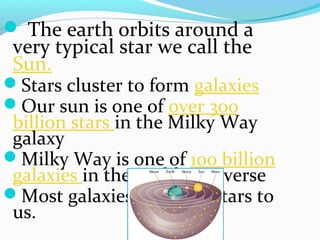
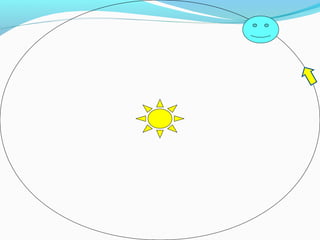
 The earth orbits around a
very typical star we call the
Sun.
Stars cluster to form galaxies
Our sun is one of over 300
billion stars in the Milky Way
galaxy
Milky Way is one of 100 billion
galaxies in the visible Universe
Most galaxies look like stars to
us.
MERCURY
Mercury is the closest planet to the
sun.
It is very hot.
It has a liquid outer core.
It has an extremely thin atmosphere
Venus
Venus is the second closest planet to the Sun.
Venus is the sixth largest planet in the Solar System
Planet Venus is named after the Roman goddess of
love and beauty.
Similar in size, density, and mass, Venus and
Earth often referred to as sister planets.
Earth
Our Place in the Universe , We live on
a (rather small) planet called Earth.
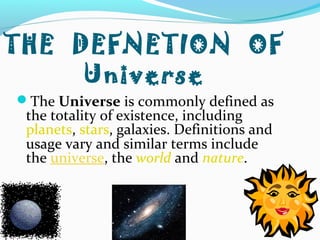
 Earth and 7 other planets in solar
system
Mars
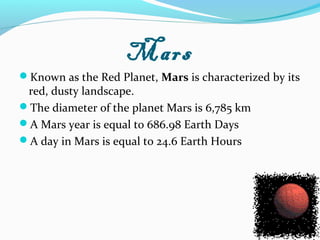
Known as the Red Planet, Mars is characterized by its
red, dusty landscape.
The diameter of the planet Mars is 6,785 km
A Mars year is equal to 686.98 Earth Days
A day in Mars is equal to 24.6 Earth Hours
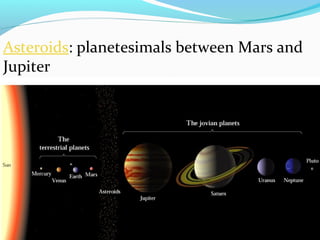
Asteroids: planetesimals between Mars and
Jupiter
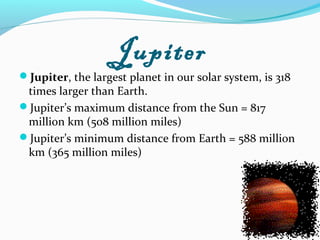
Jupiter
Jupiter, the largest planet in our solar system, is 318
times larger than Earth.
Jupiter’s maximum distance from the Sun = 817
million km (508 million miles)
Jupiter’s minimum distance from Earth = 588 million
km (365 million miles)
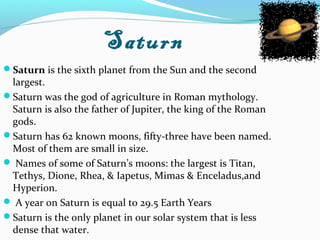
Saturn
Saturn is the sixth planet from the Sun and the second
largest.
Saturn was the god of agriculture in Roman mythology.
Saturn is also the father of Jupiter, the king of the Roman
gods.
Saturn has 62 known moons, fifty-three have been named.
Most of them are small in size.
 Names of some of Saturn’s moons: the largest is Titan,
Tethys, Dione, Rhea, & Iapetus, Mimas & Enceladus,and
Hyperion.
 A year on Saturn is equal to 29.5 Earth Years
Saturn is the only planet in our solar system that is less
dense that water.
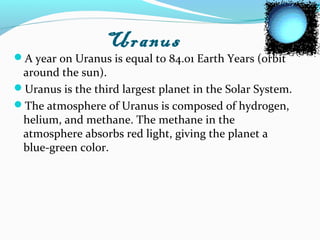
Uranus
A year on Uranus is equal to 84.01 Earth Years (orbit
around the sun).
Uranus is the third largest planet in the Solar System.
The atmosphere of Uranus is composed of hydrogen,
helium, and methane. The methane in the
atmosphere absorbs red light, giving the planet a
blue-green color.
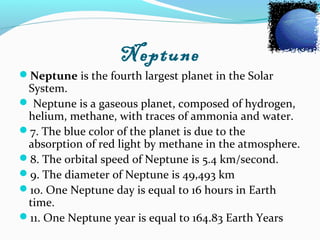
Neptune
Neptune is the fourth largest planet in the Solar
System.
 Neptune is a gaseous planet, composed of hydrogen,
helium, methane, with traces of ammonia and water.
7. The blue color of the planet is due to the
absorption of red light by methane in the atmosphere.
8. The orbital speed of Neptune is 5.4 km/second.
9. The diameter of Neptune is 49,493 km
10. One Neptune day is equal to 16 hours in Earth
time.
11. One Neptune year is equal to 164.83 Earth Years
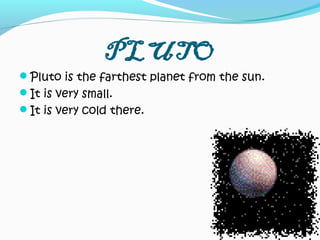
PLUTO
Pluto is the farthest planet from the sun.
It is very small.
It is very cold there.
The Stars
The number of stars in the universe
today is approximately equal to the
number of grains of sand on all the
beaches of Earth!!
Scientific Observation
Scientific observation of the Universe, the
observable part of which is about 93 billion
light years in diameter,has led to inferences
of its earlier stages. These observations
suggest that the Universe has been
governed by the same physical laws and
constants throughout most of its extent and
history.
THE BIG BANG THEORY
The Big Bang theory is the common
or the current cosmological (study of
the origin and structure of the
universe) model that describes the
early development of the Universe,
which in physical cosmology is
believed to have occurred about 13.77
billion years ago.
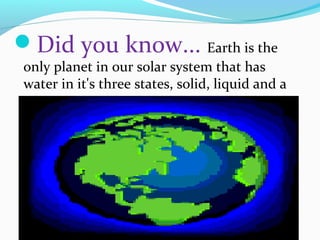
Did you know... Earth is the
only planet in our solar system that has
water in it's three states, solid, liquid and a
gas.
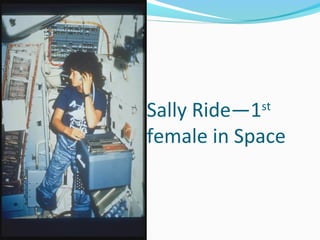
Sally Ride—1st
female in Space
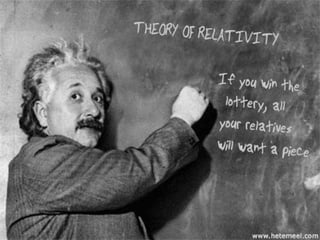
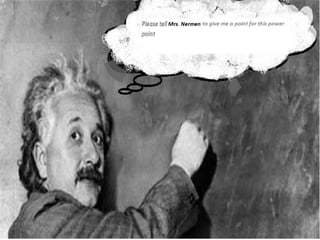
The theory of relativity was developed
by Albert Einstein in the early 1900s.
There are two theories of relativity.
The first is special relativity and the
second is general relativity. Both are
based on the principle of relativity,
which was created by Galileo Galilei in
the 1600s.
The universe
The universe

The universe

  • 1.
  • 2.
    THE DEFNETION OF Universe TheUniverse is commonly defined as the totality of existence, including planets, stars, galaxies. Definitions and usage vary and similar terms include the universe, the world and nature.
  • 3.
     The earthorbits around a very typical star we call the Sun. Stars cluster to form galaxies Our sun is one of over 300 billion stars in the Milky Way galaxy Milky Way is one of 100 billion galaxies in the visible Universe Most galaxies look like stars to us.
  • 5.
    MERCURY Mercury is theclosest planet to the sun. It is very hot. It has a liquid outer core. It has an extremely thin atmosphere
  • 6.
    Venus Venus is thesecond closest planet to the Sun. Venus is the sixth largest planet in the Solar System Planet Venus is named after the Roman goddess of love and beauty. Similar in size, density, and mass, Venus and Earth often referred to as sister planets.
  • 7.
    Earth Our Place inthe Universe , We live on a (rather small) planet called Earth.  Earth and 7 other planets in solar system
  • 8.
    Mars Known as theRed Planet, Mars is characterized by its red, dusty landscape. The diameter of the planet Mars is 6,785 km A Mars year is equal to 686.98 Earth Days A day in Mars is equal to 24.6 Earth Hours
  • 9.
  • 12.
    Jupiter Jupiter, the largestplanet in our solar system, is 318 times larger than Earth. Jupiter’s maximum distance from the Sun = 817 million km (508 million miles) Jupiter’s minimum distance from Earth = 588 million km (365 million miles)
  • 13.
    Saturn Saturn is thesixth planet from the Sun and the second largest. Saturn was the god of agriculture in Roman mythology. Saturn is also the father of Jupiter, the king of the Roman gods. Saturn has 62 known moons, fifty-three have been named. Most of them are small in size.  Names of some of Saturn’s moons: the largest is Titan, Tethys, Dione, Rhea, & Iapetus, Mimas & Enceladus,and Hyperion.  A year on Saturn is equal to 29.5 Earth Years Saturn is the only planet in our solar system that is less dense that water.
  • 14.
    Uranus A year onUranus is equal to 84.01 Earth Years (orbit around the sun). Uranus is the third largest planet in the Solar System. The atmosphere of Uranus is composed of hydrogen, helium, and methane. The methane in the atmosphere absorbs red light, giving the planet a blue-green color.
  • 15.
    Neptune Neptune is thefourth largest planet in the Solar System.  Neptune is a gaseous planet, composed of hydrogen, helium, methane, with traces of ammonia and water. 7. The blue color of the planet is due to the absorption of red light by methane in the atmosphere. 8. The orbital speed of Neptune is 5.4 km/second. 9. The diameter of Neptune is 49,493 km 10. One Neptune day is equal to 16 hours in Earth time. 11. One Neptune year is equal to 164.83 Earth Years
  • 16.
    PLUTO Pluto is thefarthest planet from the sun. It is very small. It is very cold there.
  • 17.
    The Stars The numberof stars in the universe today is approximately equal to the number of grains of sand on all the beaches of Earth!!
  • 19.
    Scientific Observation Scientific observationof the Universe, the observable part of which is about 93 billion light years in diameter,has led to inferences of its earlier stages. These observations suggest that the Universe has been governed by the same physical laws and constants throughout most of its extent and history.
  • 20.
    THE BIG BANGTHEORY The Big Bang theory is the common or the current cosmological (study of the origin and structure of the universe) model that describes the early development of the Universe, which in physical cosmology is believed to have occurred about 13.77 billion years ago.
  • 21.
    Did you know...Earth is the only planet in our solar system that has water in it's three states, solid, liquid and a gas.
  • 23.
  • 25.
    The theory ofrelativity was developed by Albert Einstein in the early 1900s. There are two theories of relativity. The first is special relativity and the second is general relativity. Both are based on the principle of relativity, which was created by Galileo Galilei in the 1600s.