Technical Translation
Idioms are a key part of language. They are little nuggets of poetry in a paragraph of prose. But,
if truth be told, they can be a real thorn in the side of translators. In this Ultimate Guide to
Translating Idioms, Lucy explains what an idiom is, why they are the cause of such misery for
translators and how to actually translate the pesky blighters. So, let’s cut to the chase…
What is an idiom?
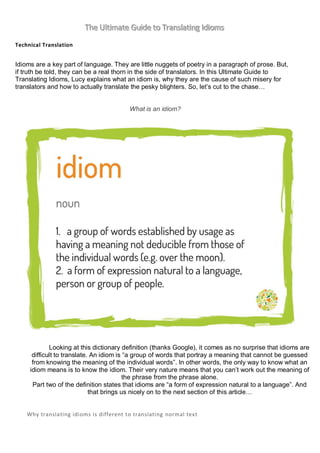
Looking at this dictionary definition (thanks Google), it comes as no surprise that idioms are
difficult to translate. An idiom is “a group of words that portray a meaning that cannot be guessed
from knowing the meaning of the individual words”. In other words, the only way to know what an
idiom means is to know the idiom. Their very nature means that you can’t work out the meaning of
the phrase from the phrase alone.
Part two of the definition states that idioms are “a form of expression natural to a language”. And
that brings us nicely on to the next section of this article…
Why translating idioms is different to translating normal text
There are two different ways of translating text:
Method A
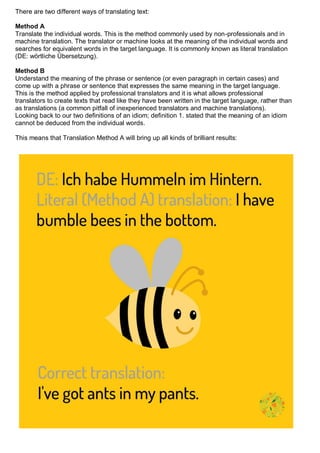
Translate the individual words. This is the method commonly used by non-professionals and in
machine translation. The translator or machine looks at the meaning of the individual words and
searches for equivalent words in the target language. It is commonly known as literal translation
(DE: wörtliche Übersetzung).
Method B
Understand the meaning of the phrase or sentence (or even paragraph in certain cases) and
come up with a phrase or sentence that expresses the same meaning in the target language.
This is the method applied by professional translators and it is what allows professional
translators to create texts that read like they have been written in the target language, rather than
as translations (a common pitfall of inexperienced translators and machine translations).
Looking back to our two definitions of an idiom; definition 1. stated that the meaning of an idiom
cannot be deduced from the individual words.
This means that Translation Method A will bring up all kinds of brilliant results:
If you translate literally, you have literally no chance when it comes to idioms.
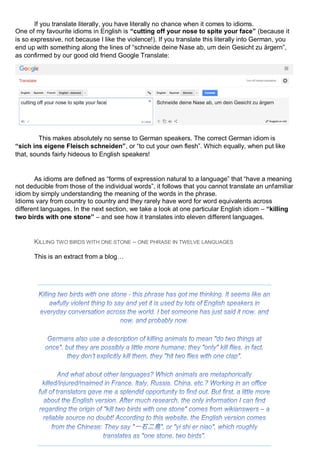
One of my favourite idioms in English is “cutting off your nose to spite your face” (because it
is so expressive, not because I like the violence!). If you translate this literally into German, you
end up with something along the lines of “schneide deine Nase ab, um dein Gesicht zu ärgern”,
as confirmed by our good old friend Google Translate:
This makes absolutely no sense to German speakers. The correct German idiom is
“sich ins eigene Fleisch schneiden”, or “to cut your own flesh”. Which equally, when put like
that, sounds fairly hideous to English speakers!
As idioms are defined as “forms of expression natural to a language” that “have a meaning
not deducible from those of the individual words”, it follows that you cannot translate an unfamiliar
idiom by simply understanding the meaning of the words in the phrase.
Idioms vary from country to country and they rarely have word for word equivalents across
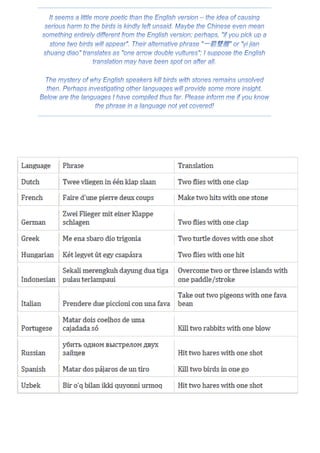
different languages. In the next section, we take a look at one particular English idiom – “killing
two birds with one stone” – and see how it translates into eleven different languages.
KILLING TWO BIRDS WITH ONE STONE – ONE PHRASE IN TWELVE LANGUAGES
This is an extract from a blog…
The ultimate guide to translating idioms

The ultimate guide to translating idioms

  • 1.
    Technical Translation Idioms area key part of language. They are little nuggets of poetry in a paragraph of prose. But, if truth be told, they can be a real thorn in the side of translators. In this Ultimate Guide to Translating Idioms, Lucy explains what an idiom is, why they are the cause of such misery for translators and how to actually translate the pesky blighters. So, let’s cut to the chase… What is an idiom? Looking at this dictionary definition (thanks Google), it comes as no surprise that idioms are difficult to translate. An idiom is “a group of words that portray a meaning that cannot be guessed from knowing the meaning of the individual words”. In other words, the only way to know what an idiom means is to know the idiom. Their very nature means that you can’t work out the meaning of the phrase from the phrase alone. Part two of the definition states that idioms are “a form of expression natural to a language”. And that brings us nicely on to the next section of this article… Why translating idioms is different to translating normal text
  • 2.
    There are twodifferent ways of translating text: Method A Translate the individual words. This is the method commonly used by non-professionals and in machine translation. The translator or machine looks at the meaning of the individual words and searches for equivalent words in the target language. It is commonly known as literal translation (DE: wörtliche Übersetzung). Method B Understand the meaning of the phrase or sentence (or even paragraph in certain cases) and come up with a phrase or sentence that expresses the same meaning in the target language. This is the method applied by professional translators and it is what allows professional translators to create texts that read like they have been written in the target language, rather than as translations (a common pitfall of inexperienced translators and machine translations). Looking back to our two definitions of an idiom; definition 1. stated that the meaning of an idiom cannot be deduced from the individual words. This means that Translation Method A will bring up all kinds of brilliant results:
  • 3.
    If you translateliterally, you have literally no chance when it comes to idioms. One of my favourite idioms in English is “cutting off your nose to spite your face” (because it is so expressive, not because I like the violence!). If you translate this literally into German, you end up with something along the lines of “schneide deine Nase ab, um dein Gesicht zu ärgern”, as confirmed by our good old friend Google Translate: This makes absolutely no sense to German speakers. The correct German idiom is “sich ins eigene Fleisch schneiden”, or “to cut your own flesh”. Which equally, when put like that, sounds fairly hideous to English speakers! As idioms are defined as “forms of expression natural to a language” that “have a meaning not deducible from those of the individual words”, it follows that you cannot translate an unfamiliar idiom by simply understanding the meaning of the words in the phrase. Idioms vary from country to country and they rarely have word for word equivalents across different languages. In the next section, we take a look at one particular English idiom – “killing two birds with one stone” – and see how it translates into eleven different languages. KILLING TWO BIRDS WITH ONE STONE – ONE PHRASE IN TWELVE LANGUAGES This is an extract from a blog…