1
The Transitive Verb
K. CHANDRA SEKHARA RAO,
LECTURER IN ENGLISH,
GOVT.DEGREE COLLEGE for Women , Chirala
( Presentedatthe National Seminar on Dialectics of Language and Literature From03-11-14 to 04-11-14 , VSU, Nellore)
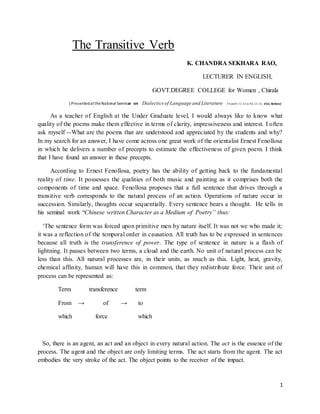
As a teacher of English at the Under Graduate level, I would always like to know what
quality of the poems make them effective in terms of clarity, impressiveness and interest. I often
ask myself --What are the poems that are understood and appreciated by the students and why?
In my search for an answer, I have come across one great work of the orientalist Ernest Fenollosa
in which he delivers a number of precepts to estimate the effectiveness of given poem. I think
that I have found an answer in these precepts.
According to Ernest Fenollosa, poetry has the ability of getting back to the fundamental
reality of time. It possesses the qualities of both music and painting as it comprises both the
components of time and space. Fenollosa proposes that a full sentence that drives through a
transitive verb corresponds to the natural process of an action. Operations of nature occur in
succession. Similarly, thoughts occur sequentially. Every sentence bears a thought. He tells in
his seminal work “Chinese written Character as a Medium of Poetry” thus:
‘The sentence form was forced upon primitive men by nature itself. It was not we who made it;
it was a reflection of the temporal order in causation. All truth has to be expressed in sentences
because all truth is the transference of power. The type of sentence in nature is a flash of
lightning. It passes between two terms, a cloud and the earth. No unit of natural process can be
less than this. All natural processes are, in their units, as much as this. Light, heat, gravity,
chemical affinity, human will have this in common, that they redistribute force. Their unit of
process can be represented as:
Term transference term
From → of → to
which force which
So, there is an agent, an act and an object in every natural action. The act is the essence of the
process. The agent and the object are only limiting terms. The act starts from the agent. The act
embodies the very stroke of the act. The object points to the receiver of the impact.
2
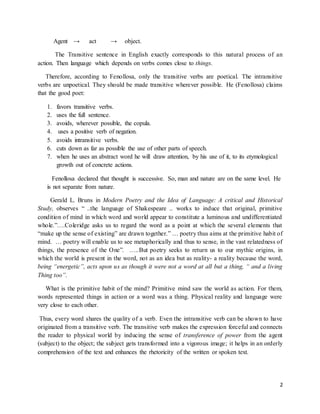
Agent → act → object.
The Transitive sentence in English exactly corresponds to this natural process of an
action. Then language which depends on verbs comes close to things.
Therefore, according to Fenollosa, only the transitive verbs are poetical. The intransitive
verbs are unpoetical. They should be made transitive wherever possible. He (Fenollosa) claims
that the good poet:
1. favors transitive verbs.
2. uses the full sentence.
3. avoids, wherever possible, the copula.
4. uses a positive verb of negation.
5. avoids intransitive verbs.
6. cuts down as far as possible the use of other parts of speech.
7. when he uses an abstract word he will draw attention, by his use of it, to its etymological
growth out of concrete actions.
Fenollosa declared that thought is successive. So, man and nature are on the same level. He
is not separate from nature.
Gerald L. Bruns in Modern Poetry and the Idea of Language: A critical and Historical
Study, observes “ ..the language of Shakespeare .. works to induce that original, primitive
condition of mind in which word and world appear to constitute a luminous and undifferentiated
whole.”….Coleridge asks us to regard the word as a point at which the several elements that
“make up the sense of existing” are drawn together.” … poetry thus aims at the primitive habit of
mind. … poetry will enable us to see metaphorically and thus to sense, in the vast relatedness of
things, the presence of the One”. …..But poetry seeks to return us to our mythic origins, in
which the world is present in the word, not as an idea but as reality- a reality because the word,
being “energetic”, acts upon us as though it were not a word at all but a thing, “ and a living
Thing too”.
What is the primitive habit of the mind? Primitive mind saw the world as action. For them,
words represented things in action or a word was a thing. Physical reality and language were
very close to each other.
Thus, every word shares the quality of a verb. Even the intransitive verb can be shown to have
originated from a transitive verb. The transitive verb makes the expression forceful and connects
the reader to physical world by inducing the sense of transference of power from the agent
(subject) to the object; the subject gets transformed into a vigorous image; it helps in an orderly
comprehension of the text and enhances the rhetoricity of the written or spoken text.
3
With this insight into the role of the transitive verb in poetry, I would like to present my study
of the poems prescribed for the UG students of VSU in the light of Fenollosa’s precepts. In
order to understand the effectiveness of a poem, one has to read the poem keeping these
injunctions of Fenollosa in mind.
The poems prescribed for the first year UG students are :
1. The Dover Beach written by Mathew Arnold,
2. Insensibility written by Wilfred Owen
3. Song 36 from Gitanjali by Tagore
4. From Homecoming by R.Parthasarathy
When we apply the precepts of Fenollosa to the first poem The Dover Beach, we find that the
poem has not been built upon the solid base of transitive verbs. It presents a kind of painting
rather than dynamic phenomena. The reader does not see much action. He feels a weak sense of
transference of power. The poem has full sentences which, however, add to its effectiveness.
The first line of the poem ‘The sea is calm to-night’ reports no action. It does not give any
sense of expending energy. It presents a static picture. The sentence tells that the sea is not
turbulent. A copula connects the subject with the predicative expression. It identifies the subject
with the predicate. It does not conduct the transference of power from the subject to the object.
The second sentence contains many clauses none of which has a transitive verb. ‘The tide is full,
the moon lies fair on the straits;--on the French coast the light/Gleams and is gone; the cliffs of
England stand,/Glimmering and vast, out in the tranquil bay.’ This sentence too presents a static
picture. The next line consists of two independent clauses. One of them asks the companion to
‘come to the window’ and the other exclaims that the night-air is sweet. Imperatives and
exclamations too do not imitate the natural process of an action. The verbs do not transfer any
energy.
In the next sentence, we have the verb ‘meet’. From now onwards, the reader experiences
movement. He ‘hears’ the grating roar of pebbles which the waves draw back and fling. Five
verse lines make one sentence here. The reader experiences the force of the verbs. The sentence
imitates the natural process of action (Agent→Act→Object). The nouns like spray, roar, waves,
return and cadence possess the force of a verb. The transitive verbs meet, hear, draw back , fling
and bring along with other words which have the force of a verb make picture rather dynamic.
The next five lines make one full sentence containing three independent clauses. All the
clauses have transitive verbs- ‘heard’, ‘brought’ ‘find’. Here again, the reader feels the
dynamism of the narration. This sentence refers to Sophocles, the Greek tragedian. This long
narrative sentence takes the reader back to the time of ancient Greece. It covers a vast span of
time and a long distance from the Aegean sea to the northern sea.
4
The first full sentence of the third stanza contains three verse lines and two independent
clauses. We can clearly understand static nature of the picture due to the use of a copula and an
intransitive verb. The second full sentence has five verse lines with a number of phrases. But this
sentence describes the retreating sea of faith away from the shores of humanity. The stanza
presents an abstract image of faith as a sea surrounding the human world.
The last stanza begins with an imperative sentence. Then, the remaining eight verse lines
make the last full sentence of the poem. In these eight lines, the reader finds one copula and one
transitive verb and two intransitive verbs. The reader does not feel the force of verbs. The
sentence imitates no action. The stanza presents a static picture just like the first half of the first
stanza. It contains a number of abstract ideas of joy, love, certitude, peace and help.
From this study, one can understand the effectiveness of the poem in terms imitating the
process of an action in nature. On the whole, one does not find much action in the poem. The
poem offers a picture of static rather than dynamic nature.
This way of understanding the poem by means of the types of verbs used in the poem helps
the teacher approach teaching with at least one way of decoding it for the students/learners. The
method can be applied to all other poems in the text book to gain a special kind of insight into
each of poems.
Conclusion:
The teacher of English language and literature needs various techniques to teach poetry
effectively. A transitive sentence imitates the natural process of an action. The transitive verb
conducts transference of power from the subject (agent) to the object. Poetry possesses the
qualities of music and painting as it possesses the components of space and time. Every action in
nature follows a sequence in time. The operations of nature take place sequentially. Transitive
verbs make a sentence imitate nature. It makes the poem poetic. A good poet uses transitive
verbs and avoids the use of the copula and the intransitive verb. The teacher can take the help of
these proposals and approach a poem. He can estimate the effectiveness of a poem upon the
students. For example, the study of the poem ‘Dover Beach’ keeping these ideas in mind,
reveals that the poem does not present much action. It presents more static images than dynamic
ones. The reader finds not much movement. One can conclude that the poem can be moderately
effective in the class room. This technique works with most of the poems. It enables the teacher
to know where to focus his attention.
(An effort has been made to use only Transitive verbs throughout the essay, wherever possible)
National Seminar on Dialecticsof Language and Literature From03-11-14 to 04-11-14 , VSU, Nellore
5
Reference
1. Bruns, Gerald.L. Modern Poetry and the Idea of Language: A critical and Historical
Study,Yale University Press, London, 1975
2. Olsen, Flemming. Ernest Fenollosa, the Chinese Written Character as a Medium for
Poetry: Ars Poetica Or the Roots of Poetic Creation?, Sussex Academic Press,
Eastbourne, UK , 2011
3. Quirk, Rndolph and Greenbaum, Sidney. A University Grammar of English, Dorling
Kindersley (India) Pvt. Ltd., Noida, 2012
4. Davie, Donald. Articulate Energy: An Enquiry into the Syntax of English Poetry
Routledge and Kegan Paul Ltd., London, 1995.
5. Scott-James,R.A. : The Making of Literature, Kalyani Publishers, Noida, 2005.
6. Jewinski,Ed. TroubledJoy:Style and Syntax in Glassco's Poetry http://www.uwo.ca/english
/canadianpoetry/cpjrn/vol13/jewinski.htm, down loaded on 5- 10-2014
NationalSeminar on Dialecticsof Language and Literature From03-11-14 to 04-11-14 , VSU, Nellore

The transitive verb

  • 1.
    1 The Transitive Verb K.CHANDRA SEKHARA RAO, LECTURER IN ENGLISH, GOVT.DEGREE COLLEGE for Women , Chirala ( Presentedatthe National Seminar on Dialectics of Language and Literature From03-11-14 to 04-11-14 , VSU, Nellore) As a teacher of English at the Under Graduate level, I would always like to know what quality of the poems make them effective in terms of clarity, impressiveness and interest. I often ask myself --What are the poems that are understood and appreciated by the students and why? In my search for an answer, I have come across one great work of the orientalist Ernest Fenollosa in which he delivers a number of precepts to estimate the effectiveness of given poem. I think that I have found an answer in these precepts. According to Ernest Fenollosa, poetry has the ability of getting back to the fundamental reality of time. It possesses the qualities of both music and painting as it comprises both the components of time and space. Fenollosa proposes that a full sentence that drives through a transitive verb corresponds to the natural process of an action. Operations of nature occur in succession. Similarly, thoughts occur sequentially. Every sentence bears a thought. He tells in his seminal work “Chinese written Character as a Medium of Poetry” thus: ‘The sentence form was forced upon primitive men by nature itself. It was not we who made it; it was a reflection of the temporal order in causation. All truth has to be expressed in sentences because all truth is the transference of power. The type of sentence in nature is a flash of lightning. It passes between two terms, a cloud and the earth. No unit of natural process can be less than this. All natural processes are, in their units, as much as this. Light, heat, gravity, chemical affinity, human will have this in common, that they redistribute force. Their unit of process can be represented as: Term transference term From → of → to which force which So, there is an agent, an act and an object in every natural action. The act is the essence of the process. The agent and the object are only limiting terms. The act starts from the agent. The act embodies the very stroke of the act. The object points to the receiver of the impact.
  • 2.
    2 Agent → act→ object. The Transitive sentence in English exactly corresponds to this natural process of an action. Then language which depends on verbs comes close to things. Therefore, according to Fenollosa, only the transitive verbs are poetical. The intransitive verbs are unpoetical. They should be made transitive wherever possible. He (Fenollosa) claims that the good poet: 1. favors transitive verbs. 2. uses the full sentence. 3. avoids, wherever possible, the copula. 4. uses a positive verb of negation. 5. avoids intransitive verbs. 6. cuts down as far as possible the use of other parts of speech. 7. when he uses an abstract word he will draw attention, by his use of it, to its etymological growth out of concrete actions. Fenollosa declared that thought is successive. So, man and nature are on the same level. He is not separate from nature. Gerald L. Bruns in Modern Poetry and the Idea of Language: A critical and Historical Study, observes “ ..the language of Shakespeare .. works to induce that original, primitive condition of mind in which word and world appear to constitute a luminous and undifferentiated whole.”….Coleridge asks us to regard the word as a point at which the several elements that “make up the sense of existing” are drawn together.” … poetry thus aims at the primitive habit of mind. … poetry will enable us to see metaphorically and thus to sense, in the vast relatedness of things, the presence of the One”. …..But poetry seeks to return us to our mythic origins, in which the world is present in the word, not as an idea but as reality- a reality because the word, being “energetic”, acts upon us as though it were not a word at all but a thing, “ and a living Thing too”. What is the primitive habit of the mind? Primitive mind saw the world as action. For them, words represented things in action or a word was a thing. Physical reality and language were very close to each other. Thus, every word shares the quality of a verb. Even the intransitive verb can be shown to have originated from a transitive verb. The transitive verb makes the expression forceful and connects the reader to physical world by inducing the sense of transference of power from the agent (subject) to the object; the subject gets transformed into a vigorous image; it helps in an orderly comprehension of the text and enhances the rhetoricity of the written or spoken text.
  • 3.
    3 With this insightinto the role of the transitive verb in poetry, I would like to present my study of the poems prescribed for the UG students of VSU in the light of Fenollosa’s precepts. In order to understand the effectiveness of a poem, one has to read the poem keeping these injunctions of Fenollosa in mind. The poems prescribed for the first year UG students are : 1. The Dover Beach written by Mathew Arnold, 2. Insensibility written by Wilfred Owen 3. Song 36 from Gitanjali by Tagore 4. From Homecoming by R.Parthasarathy When we apply the precepts of Fenollosa to the first poem The Dover Beach, we find that the poem has not been built upon the solid base of transitive verbs. It presents a kind of painting rather than dynamic phenomena. The reader does not see much action. He feels a weak sense of transference of power. The poem has full sentences which, however, add to its effectiveness. The first line of the poem ‘The sea is calm to-night’ reports no action. It does not give any sense of expending energy. It presents a static picture. The sentence tells that the sea is not turbulent. A copula connects the subject with the predicative expression. It identifies the subject with the predicate. It does not conduct the transference of power from the subject to the object. The second sentence contains many clauses none of which has a transitive verb. ‘The tide is full, the moon lies fair on the straits;--on the French coast the light/Gleams and is gone; the cliffs of England stand,/Glimmering and vast, out in the tranquil bay.’ This sentence too presents a static picture. The next line consists of two independent clauses. One of them asks the companion to ‘come to the window’ and the other exclaims that the night-air is sweet. Imperatives and exclamations too do not imitate the natural process of an action. The verbs do not transfer any energy. In the next sentence, we have the verb ‘meet’. From now onwards, the reader experiences movement. He ‘hears’ the grating roar of pebbles which the waves draw back and fling. Five verse lines make one sentence here. The reader experiences the force of the verbs. The sentence imitates the natural process of action (Agent→Act→Object). The nouns like spray, roar, waves, return and cadence possess the force of a verb. The transitive verbs meet, hear, draw back , fling and bring along with other words which have the force of a verb make picture rather dynamic. The next five lines make one full sentence containing three independent clauses. All the clauses have transitive verbs- ‘heard’, ‘brought’ ‘find’. Here again, the reader feels the dynamism of the narration. This sentence refers to Sophocles, the Greek tragedian. This long narrative sentence takes the reader back to the time of ancient Greece. It covers a vast span of time and a long distance from the Aegean sea to the northern sea.
  • 4.
    4 The first fullsentence of the third stanza contains three verse lines and two independent clauses. We can clearly understand static nature of the picture due to the use of a copula and an intransitive verb. The second full sentence has five verse lines with a number of phrases. But this sentence describes the retreating sea of faith away from the shores of humanity. The stanza presents an abstract image of faith as a sea surrounding the human world. The last stanza begins with an imperative sentence. Then, the remaining eight verse lines make the last full sentence of the poem. In these eight lines, the reader finds one copula and one transitive verb and two intransitive verbs. The reader does not feel the force of verbs. The sentence imitates no action. The stanza presents a static picture just like the first half of the first stanza. It contains a number of abstract ideas of joy, love, certitude, peace and help. From this study, one can understand the effectiveness of the poem in terms imitating the process of an action in nature. On the whole, one does not find much action in the poem. The poem offers a picture of static rather than dynamic nature. This way of understanding the poem by means of the types of verbs used in the poem helps the teacher approach teaching with at least one way of decoding it for the students/learners. The method can be applied to all other poems in the text book to gain a special kind of insight into each of poems. Conclusion: The teacher of English language and literature needs various techniques to teach poetry effectively. A transitive sentence imitates the natural process of an action. The transitive verb conducts transference of power from the subject (agent) to the object. Poetry possesses the qualities of music and painting as it possesses the components of space and time. Every action in nature follows a sequence in time. The operations of nature take place sequentially. Transitive verbs make a sentence imitate nature. It makes the poem poetic. A good poet uses transitive verbs and avoids the use of the copula and the intransitive verb. The teacher can take the help of these proposals and approach a poem. He can estimate the effectiveness of a poem upon the students. For example, the study of the poem ‘Dover Beach’ keeping these ideas in mind, reveals that the poem does not present much action. It presents more static images than dynamic ones. The reader finds not much movement. One can conclude that the poem can be moderately effective in the class room. This technique works with most of the poems. It enables the teacher to know where to focus his attention. (An effort has been made to use only Transitive verbs throughout the essay, wherever possible) National Seminar on Dialecticsof Language and Literature From03-11-14 to 04-11-14 , VSU, Nellore
  • 5.
    5 Reference 1. Bruns, Gerald.L.Modern Poetry and the Idea of Language: A critical and Historical Study,Yale University Press, London, 1975 2. Olsen, Flemming. Ernest Fenollosa, the Chinese Written Character as a Medium for Poetry: Ars Poetica Or the Roots of Poetic Creation?, Sussex Academic Press, Eastbourne, UK , 2011 3. Quirk, Rndolph and Greenbaum, Sidney. A University Grammar of English, Dorling Kindersley (India) Pvt. Ltd., Noida, 2012 4. Davie, Donald. Articulate Energy: An Enquiry into the Syntax of English Poetry Routledge and Kegan Paul Ltd., London, 1995. 5. Scott-James,R.A. : The Making of Literature, Kalyani Publishers, Noida, 2005. 6. Jewinski,Ed. TroubledJoy:Style and Syntax in Glassco's Poetry http://www.uwo.ca/english /canadianpoetry/cpjrn/vol13/jewinski.htm, down loaded on 5- 10-2014 NationalSeminar on Dialecticsof Language and Literature From03-11-14 to 04-11-14 , VSU, Nellore