The Teaching Portfolio
Best Reflective Practices

By Doug Strahler
Overview







What is a teaching portfolio?
What is reflective practice?
Why have a teaching portfolio?
What should portfolios demonstrate?
Electronic teaching portfolios
Sample Teaching Portfolios
How many of you have a teaching
portfolio?


Please put up a green check if you do
Definition of a Teaching Portfolio


“A teaching portfolio is a coherent set of materials,
including work samples and reflective commentary on
them, complied by a faculty member to inquire into and
represent his or her teaching practice as related to
student learning and development”

Center for Teaching Excellence, Duquesne University, n.d.
What is a Teaching Portfolio?
Process








Reflection
Narrative
Analysis
Goals
Revisions
Mentoring (Collaboration)
Improvement

Zubizarreta, 1995

Product






Evidence-based
Selective Information
Representative Data
Appendix Materials
Assessment/Evaluation
What is reflection?


“Reflection occurs when learners look back on their
performance in a situation and compare their
performance with some set of standards or with other
performances, such as their own previous performances
and those of experts”

Collins & Halverson, 2009
Critical Component: Reflection Process
Reflection as a whole

Reflection

Reflection

Reflection

Reflection

Reflection

Reflection

Reflection

Reflection
David Kolb’s Learning Cycle

The University of Iowa Center for Teaching, n.d.
Three Forms of Reflection
1.
2.
3.

Reflection on your process
Comparison of your performance with the
performance of experts
Comparison of your performance with a set of criteria
for evaluating performance

Collins & Halverson, 2009
What should portfolios include?




Information from oneself
Information from others
Products or outcomes of student learning
Duquesne University Center for
Teaching Excellence


The Teaching Portfolio






Statement of teaching philosophy
Student evaluation summary
A curriculum vitae
A list of post-secondary courses taught
Sample course materials








Syllabi
Assignments and Grading Guide
Student Paper with Comments (with statement of student permission)
Lesson Plan
Exam or quiz
Description of semester-long project
Course website excerpts
Duquesne University Center for
Teaching Excellence


The Teaching Portfolio (cont.)





List of professional interactions about teaching
Documentation of classroom observation by a faculty member

Writing Reflections on Teaching Materials
What should portfolios demonstrate?









Responsibilities
Philosophy
Methodologies
Materials
Student ratings
Peer reviews
Efforts to improve teaching
Goals
Electronic Portfolios
Traditional Portfolio






Collecting
Selecting
Reflecting
Projecting
Celebrating

Barrett, 2005

Technology allows






Archiving
Linking/Thinking
Storytelling
Collaborating
Publishing
Technology Tools for Reflection






Blogs (Reflective journal)
Wikis (Collaborative Web Pages)
Multimedia (Digital stories & Podcasts)
Interactive micro-blogging (Twitter)
Social Networking

Barrett & Richter, n.d.
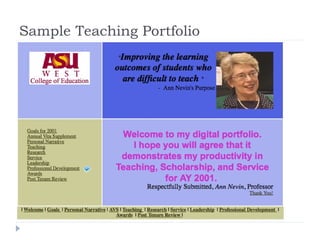
Sample Teaching Portfolio
Final remarks





This is not a one-time collection of documents, but a
process that will continue over time
Reflect & Revise (Add/Subtract/Edit)
Demonstrates growth & development
Become a reflective practitioner
References
Barrett, H. C. (2005). Researching Electronic Portfolios and Learner Engagement [White
paper]. Retrieved from http://www.taskstream.com/reflect/whitepaper.pdf
Barrett, H. C., & Richter, J. (n.d.). Technology Tools for Reflection. Retrieved from
http://sites.google.com/site/reflection4learning/technology-tools-for-reflection
Center for Teaching Excellence, Duquesne University (n.d.). The Teaching Portfolio.
Retrieved from http://www.duq.edu/cte/academic-careers/teaching-portfolio.cfm
Collins, A., & Halverson, R. (2009). Rethinking education in the age of technology. New
York, NY: Teachers College Press.
Harvard University Office of Career Services. (2010). Teaching Portfolios. Retrieved
from http://bokcenter.harvard.edu/icb/icb.do?
keyword=k1985&pageid=icb.page29708
The University of Iowa Center for Teaching (n.d.). David Kolb’s Learning Cycle.
Retrieved from http://centeach.uiowa.edu/documents/DavidKolb.pdf
Zubizarreta, J. (1995). The Teaching Portfolio: Reflective Practice for Improvement and
Assessment of Teaching [White paper]. Retrieved from
http://www.slideshare.net/WSSU_CETL/tp-workshop-handout-1

The Teaching Portfolio: Best Reflective Practices

  • 1.
    The Teaching Portfolio BestReflective Practices By Doug Strahler
  • 2.
    Overview       What is ateaching portfolio? What is reflective practice? Why have a teaching portfolio? What should portfolios demonstrate? Electronic teaching portfolios Sample Teaching Portfolios
  • 3.
    How many ofyou have a teaching portfolio?  Please put up a green check if you do
  • 4.
    Definition of aTeaching Portfolio  “A teaching portfolio is a coherent set of materials, including work samples and reflective commentary on them, complied by a faculty member to inquire into and represent his or her teaching practice as related to student learning and development” Center for Teaching Excellence, Duquesne University, n.d.
  • 5.
    What is aTeaching Portfolio? Process        Reflection Narrative Analysis Goals Revisions Mentoring (Collaboration) Improvement Zubizarreta, 1995 Product      Evidence-based Selective Information Representative Data Appendix Materials Assessment/Evaluation
  • 6.
    What is reflection?  “Reflectionoccurs when learners look back on their performance in a situation and compare their performance with some set of standards or with other performances, such as their own previous performances and those of experts” Collins & Halverson, 2009
  • 7.
    Critical Component: ReflectionProcess Reflection as a whole Reflection Reflection Reflection Reflection Reflection Reflection Reflection Reflection
  • 8.
    David Kolb’s LearningCycle The University of Iowa Center for Teaching, n.d.
  • 9.
    Three Forms ofReflection 1. 2. 3. Reflection on your process Comparison of your performance with the performance of experts Comparison of your performance with a set of criteria for evaluating performance Collins & Halverson, 2009
  • 10.
    What should portfoliosinclude?    Information from oneself Information from others Products or outcomes of student learning
  • 11.
    Duquesne University Centerfor Teaching Excellence  The Teaching Portfolio      Statement of teaching philosophy Student evaluation summary A curriculum vitae A list of post-secondary courses taught Sample course materials        Syllabi Assignments and Grading Guide Student Paper with Comments (with statement of student permission) Lesson Plan Exam or quiz Description of semester-long project Course website excerpts
  • 12.
    Duquesne University Centerfor Teaching Excellence  The Teaching Portfolio (cont.)    List of professional interactions about teaching Documentation of classroom observation by a faculty member Writing Reflections on Teaching Materials
  • 13.
    What should portfoliosdemonstrate?         Responsibilities Philosophy Methodologies Materials Student ratings Peer reviews Efforts to improve teaching Goals
  • 14.
    Electronic Portfolios Traditional Portfolio      Collecting Selecting Reflecting Projecting Celebrating Barrett,2005 Technology allows      Archiving Linking/Thinking Storytelling Collaborating Publishing
  • 15.
    Technology Tools forReflection      Blogs (Reflective journal) Wikis (Collaborative Web Pages) Multimedia (Digital stories & Podcasts) Interactive micro-blogging (Twitter) Social Networking Barrett & Richter, n.d.
  • 16.
  • 17.
    Final remarks     This isnot a one-time collection of documents, but a process that will continue over time Reflect & Revise (Add/Subtract/Edit) Demonstrates growth & development Become a reflective practitioner
  • 18.
    References Barrett, H. C.(2005). Researching Electronic Portfolios and Learner Engagement [White paper]. Retrieved from http://www.taskstream.com/reflect/whitepaper.pdf Barrett, H. C., & Richter, J. (n.d.). Technology Tools for Reflection. Retrieved from http://sites.google.com/site/reflection4learning/technology-tools-for-reflection Center for Teaching Excellence, Duquesne University (n.d.). The Teaching Portfolio. Retrieved from http://www.duq.edu/cte/academic-careers/teaching-portfolio.cfm Collins, A., & Halverson, R. (2009). Rethinking education in the age of technology. New York, NY: Teachers College Press. Harvard University Office of Career Services. (2010). Teaching Portfolios. Retrieved from http://bokcenter.harvard.edu/icb/icb.do? keyword=k1985&pageid=icb.page29708 The University of Iowa Center for Teaching (n.d.). David Kolb’s Learning Cycle. Retrieved from http://centeach.uiowa.edu/documents/DavidKolb.pdf Zubizarreta, J. (1995). The Teaching Portfolio: Reflective Practice for Improvement and Assessment of Teaching [White paper]. Retrieved from http://www.slideshare.net/WSSU_CETL/tp-workshop-handout-1