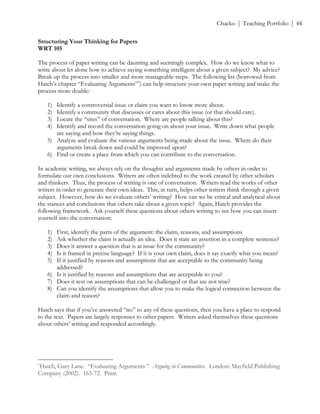
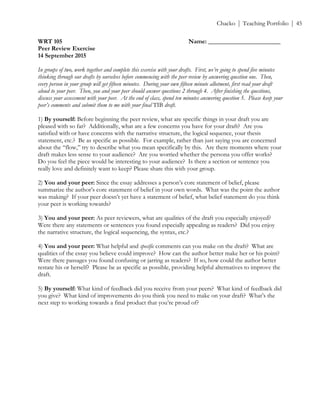
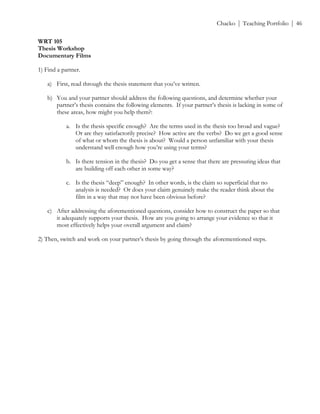
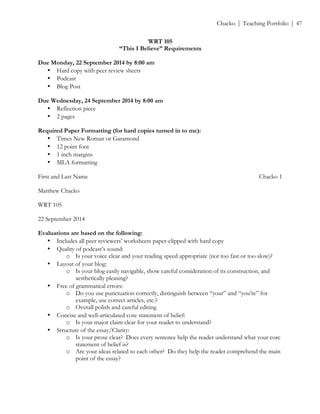
Matthew W. Chacko
2016 Teaching Portfolio
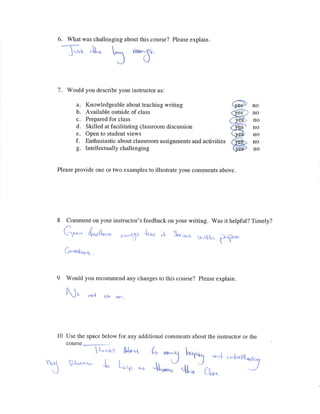
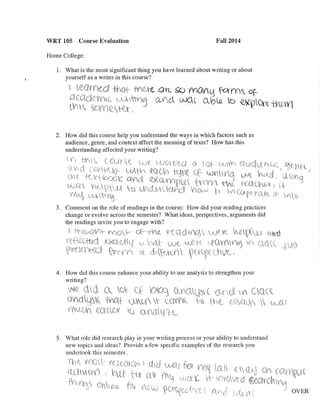
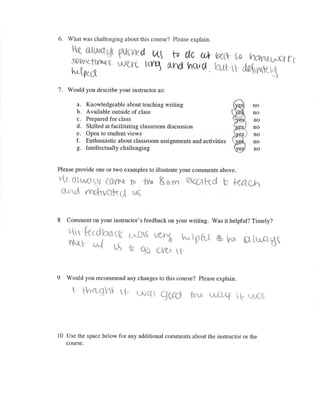
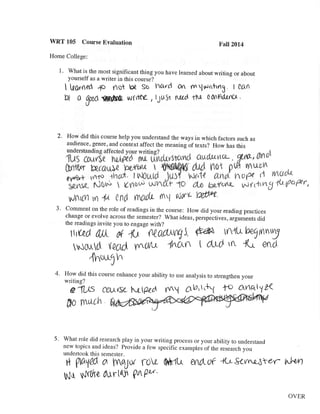
M.A. Student, Department of English
Teaching Assistant, Writing Program
Syracuse University
Table of Contents
I. Personal Statement…………………………………………………………3
II. Teaching Philosophy……………………………………………………….5
III. Curriculum Vitae…………………………………………………………...7
IV. Observations………………………………………………………………10
V. WRT 105: Practices of Academic Writing (Falls 2014, 2015)
a. Summary of Teaching Experiences…………………………………13
b. Syllabi………………………………………………………………14
c. Unit Assignments…………………………………………………...31
d. Sample Lesson Plans………………………………………………..36
e. Heuristics/Handouts………………………………………………..44
f. Examples of feedback on Student Assignments……………………..51
VI. WRT 205: Critical Research and Writing (Springs 2015, 2016)
a. Summary of Teaching Experiences………………………………….55
b. Syllabi……………………………………………………………….56
c. Unit Assignments……………………………………………………67
! Chacko | Teaching Portfolio | 2
d. Sample Lesson Plans……………………………………………….73
e. Heuristics/Handouts………………………………………………80
f. Example of feedback on Student Assignments…………………….91
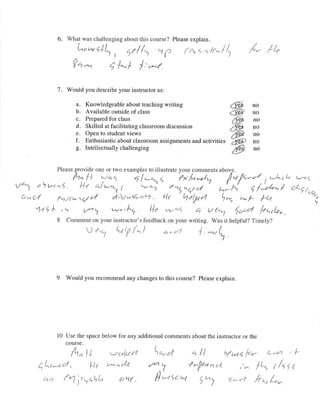
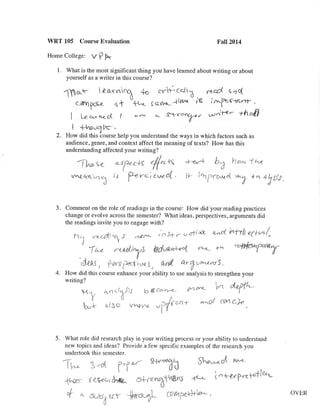
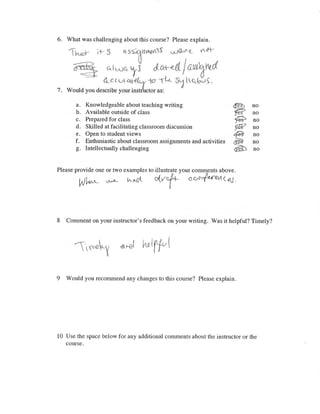
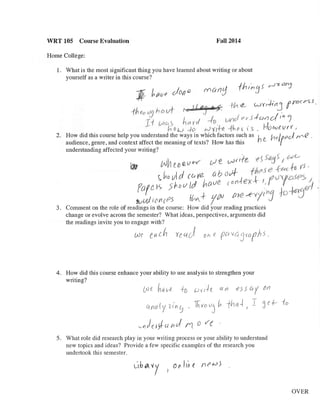
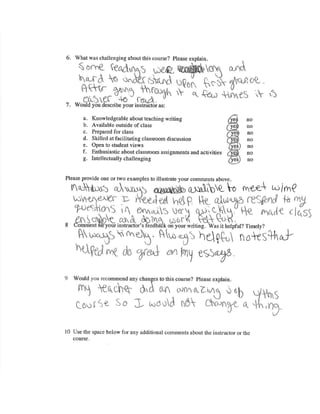
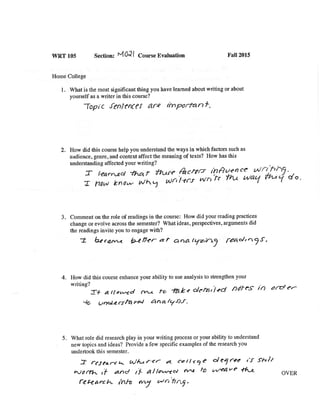
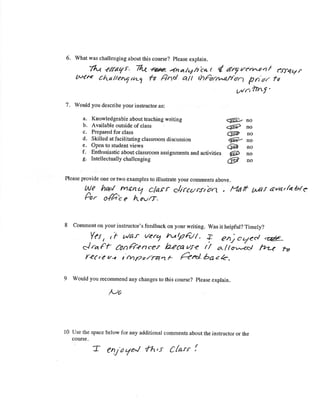
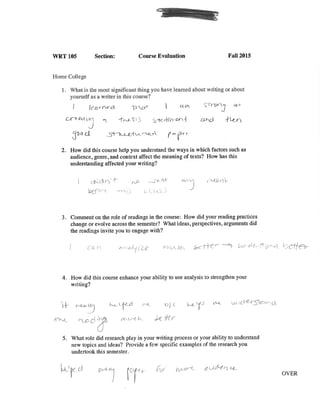
VII. Student Evaluations………………………………………………………97
!
!
!
!
!
! Chacko | Teaching Portfolio | 3
26 February 2016
Award Selection Committee
The Graduate School
212 Bowne Hall
Syracuse University
Syracuse, NY 13244
Dear Members of the Outstanding Teaching Assistant Award Selection Committee:
I write to thank you for considering me for the Outstanding Teaching Assistant Award. It truly is a
huge honor to be nominated. The following portfolio outlines my pedagogical growth, scholarly
interests, and experiences as a teacher.
I am currently finishing up my final semester of my master’s program in the English Department.
One of the advantages of my MA experience was the amount of composition instruction I have
done in a relatively short, two-year program for the Writing Department. I have taught three
sections of WRT105 and two sections of WRT205, teaching eighty-six students in total.
Additionally, I worked as a tutor in the Writing Center where I helped many individual students
perfect their writing. That time was immensely crucial because it helped further cement my
understanding of writing mechanics and pedagogy. Because I teach composition (WRT105 and
WRT205), I serve as primary instructor and thus fully determine students’ grades. This pedagogical
agency that the Writing Program affords has accelerated my own progression as a teacher, and for
that I am grateful. Furthermore, my nomination as an English MA student is unusual since most
nominees are PhD students.
While graduate school has been a challenging and intellectually rewarding process, I have really
relished my opportunities as an instructor in the classroom. The classroom is a space where I see
my own intellectual growth as a graduate student impact and help further my own students’
maturation as thinkers. The things I have learned in graduate seminars translate to my own
teaching. Much of my research in graduate school deals with power inequity and the systemic social
injustices that minority groups deal with and navigate through. These are themes that I readily
incorporate into my own instruction. I am grateful for my own professors in the Department of
English whose persistence and intellectual acumen have challenged me to be more articulate,
rigorous, and intellectually curious. Through their seminars, I developed an even greater
appreciation for the intellectual life, and I seek to instill that in my own students. I am also deeply
indebted to the patient guidance of Jonna Gilfus and Anne Fitzsimmons in the Writing Program
whose intelligence, generosity, affirmation, and pedagogical creativity really inspire my own teaching.
! Chacko | Teaching Portfolio | 4
They were instrumental in providing the necessary feedback and support I needed as a beginning
instructor.
It is because of my experience as an instructor at Syracuse that I seek to continue teaching at the
secondary level. I am currently applying to high school positions, where I hope to continue
inspiring students to be critically engaged, to develop their literacy and rhetorical skills, and most
importantly to mature into conscientious and thinking adults.
Thank you for considering my nomination and for giving me the opportunity to share my teaching
portfolio with you.
Sincerely,
Matthew Chacko
Matthew W. Chacko
M.A. Student, Department of English
Teaching Assistant, Writing Program
Syracuse University, HBC 018
mwchacko@syr.edu
! Chacko | Teaching Portfolio | 5
Teaching Philosophy
Over the past two years, I have had the privilege of teaching freshman- and sophomore-level writing
courses. While I push my students to become better thinkers, teaching also provides me the
challenge of embodying many of the same principles I seek to instill in my classes. In other words, I
have found that if I desire my students’ improvement, then I must continually refine and push
myself further. I want my students to leave my courses better writers, feeling empowered and
equipped to handle the different types of writing they will encounter in their academic and
professional careers.
A recurring concern in both my WRT105 and WRT205 classes is social inequity, an issue that my
students engage with through composition. My students and I interrogate entrenched notions and
stereotypes about race, gender, class, ethnicity, and sexuality. While maintaining a fidelity to the
hallmarks of composition studies, some of which include the notion of writing as a process,
reflection and self assessment, and advancing effective arguments, I also seek to engender in my
students a heightened awareness of and compassion for others. My inquiry in WRT 205 is entitled
The Comedian’s Role in Society where my class investigates how comedy relates to larger matters of
social injustice, particularly how comedy critiques social systems that perpetuate harmful discourses
about and further promote the marginalization of minority groups. In my course, we spend
considerable energy thinking about the rhetoric of a given comedic text and simultaneously consider
its politics. A key concept in my class is how comedy elucidates and often critiques stereotypes. For
example, my class and I have been investigating the ways in which media discourses devalue and
limit female politicians. We consider this by examining Tina Fey and Amy Poehler’s impersonations
of Sarah Palin and Hillary Clinton, respectively. We both deconstruct the political assumptions in
the sketch while also noting its rhetorical features, and how it seeks to engage with an audience.
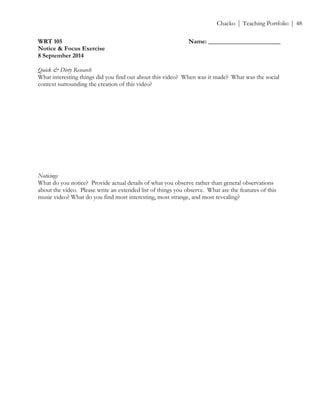
One strategy I use with my students when dealing with a text is “notice-and-focus,” a type of close
reading practice that forces my students to take extremely detailed notes over a video, story, or
article. I emphasize that writing down anything they observe is completely valid, and paying
attention to seemingly insignificant details can nuance their analyses in interesting and often
unexpected ways. Through this simple practice, my students are positioned to make intelligent and
nuanced claims about a text, and countless times they’ve taught me new ways of interpreting. In this
way, my courses prompt rhetorical analysis while also questioning my students’ own assumptions
and presuppositions about race, gender, class, and sexuality. Through these examinations, I hope to
foster in my students an embrace for difference that results in a greater awareness of and empathy
for others, to instill in them a desire for intellectual inquiry, and finally to develop a heightened
consciousness of the societal issues that they are a part of.
Because my students’ intellectual growth is enhanced with a strong emphasis on composition, I
strive to incorporate various writing assignments and composition tutorials into my daily lesson
plans. I spend considerable time modeling good writing practices to my students and, in turn,
allowing them to practice these skills. Pedagogically, I capitalize on a combination of lecture, class
discussion, and individual guidance. Lectures prompt fruitful class discussions of texts by providing
contextual material that allows for students to engage in the material. Since I view class as a
collaborative space, discussions also provide students the opportunity to practice articulating and
refining their ideas in a safe, public environment. I also scaffold my assignments, meaning that my
students understand that every assignment is directed towards a culminating, thesis-driven paper that
thoroughly investigates an issue and also demonstrates their critical thinking and analytical skills.
For example, I assign my students an abstract assignment to help propel their thinking for their final
! Chacko | Teaching Portfolio | 6
papers. This process also forces them to practice consolidating their argument into a few hundred
words or less, a crucial writing skill for their future graduate and professional lives. I have also
developed numerous heuristics, or in-class teaching models, that develop good writing habits. One
heuristic I find to be very successful is one on synthesis, the ability to place different articles and
sources “in conversation” with each other. Thus, students gain an awareness of writing as a social
act—that all writing and ideas stem from others’ ideas and thoughts. Additionally, students are
better able to see how different ideas from various articles intersect, parallel, and contradict each
other, and they are thus better positioned to formulate a thesis as a result. My courses and heurstics
also revise my students’ assumptions about writing by encouraging them to think of composition as
a practice of intellectual discovery rather than a static and facile presupposition. Through my
heuristic of “the evolving thesis,” my students begin to understand writing as a dynamic process that
unfolds over time, never completely perfect but always becoming more interesting and complex.
My classes tend to be very structured so that students feel guided and supported through every part
of the writing process. To ensure students have a clear understanding of class requirements, I
consider it helpful to provide an outline of objectives each class period, devoting attention to
potential issues on assignments, and giving helpful tips like annotation strategies or structuring an
argument. Furthermore, I aim to use a method of transparent assessment, which ensures that
students recognize my evaluative criteria. In addition, I value individual guidance. Before every
paper, I hold thirty-minute draft conferences with each of my students. I find these times to be
extremely productive because my students and I can address issues particular to their own writing
practices.
I aim to create an atmosphere where students develop intellectually, departing class well equipped to
utilize analytical skills that critically engage the world. To foster successfully this ethos of inquiry
and competence, I desire to provide a dependable structure within which students can grow in their
thinking. I provide students every possibility to succeed yet still maintain the high standards
necessary for optimal intellectual growth. In short, students should leave my classroom with a sense
of the beauty of writing, the ability to scrutinize texts thoughtfully, and the proficiency to participate
in discourse responsibly.
! Chacko | Teaching Portfolio | 7
Matthew W. Chacko
Syracuse University
Curriculum Vitae
1402 Ivy Ridge Road Email: mwchacko@syr.edu
Apt. 12 Phone: (316) 706-7079
Syracuse, NY 13210
EDUCATION
M.A., English Literature (2014 to present)
Syracuse University, Syracuse, NY
B.S., Biology; B.A., English
Minor in Chemistry
Andrews University, Berrien Springs, MI
• Summa Cum Laude
• Senior Honors Thesis: “A Mathematical Model Describing the Dynamics of HIV Virions
and CD4+
T cells in the Human Immune System”
TEACHING EXPERIENCE
Teaching Assistant (2014 to 2016)
Writing Program, Syracuse University
Writing Consultant (2015)
Writing Program, Syracuse University
Student Assistant (2013-2014)
J.N. Andrews Honors Program, Andrews University
Teaching Assistant, Foundations of Biology (2009-2013)
Department of Biology, Andrews University
Head Teaching Assistant, Systems Physiology (2012)
Department of Biology, Andrews University
Volunteer Instructor (2011-2012)
Mwami Adventist Hospital, Chipata, Zambia
! Chacko | Teaching Portfolio | 8
MEMBERSHIPS
Beta Beta Beta
J.N. Andrews Honors Society
Phi Kappa Phi
Sigma Tau Delta
HONORS AND AWARDS
Teaching Assistantship (2014 to present)
Earhart Foundation Emerging Scholarship (2014)
Undergraduate Research Scholarships (2013)
Dorothy and Harold Heidtke Award (2013)
Flo Ryden Award (2011)
Dorothy and Harold Heidtke Award (2010)
National Science Foundation Grant (2010)
Flo Ryden Award (2009)
SCHOLARSHIP
Articles
“A Method for Predicting Harbor Seal (Phoca Vitulina) Haulout and Monitoring Long-term
Population Trends without Telemetry.” Natural Resource Modeling, Andrews University,
Berrien Springs, MI, 2013.
Conference Presentations
“Cavendish And…: Critical Receptions of ‘Mad Madge’ in the 17th
and 21st
Centuries and the
Problem of Historiography and Temporality.” Attending to Early Modern Women.
Milwaukee, Wisconsin, June 2015. Organized with Lee Emrich and Samantha Snively.
“‘She has a hidden strength’: Virtue and Reason in Milton’s Comus.” Negotiations. Syracuse, NY,
April 2015.
“Theatrical and Empirical Identity in Coriolanus.” Sigma Tau Delta Convention. Savannah, Georgia,
February 2014.
Thesis Presentations
“A Mathematical Model Describing the Dynamics of HIV Virions and CD4+
T cells in
the Human Immune System.” Spring Honors Thesis Symposium, J.N. Andrews Honors
Program, Andrews University, Berrien Springs, MI, April 2013.
! Chacko | Teaching Portfolio | 9
“A Mathematical Model Describing the Dynamics of HIV Virions and CD4+
T cells in
the Human Immune System.” Honors Scholars and Undergraduate Researchers Poster
Symposium, J.N. Andrews Honors Program, Andrews University, Berrien Springs, MI,
March 2013.
COURSES TAUGHT
WRT 205: Critical Research and Inquiry, Syracuse University
WRT 105: Practices of Academic Writing, Syracuse University
Anatomy and Physiology, Mwami Adventist Hospital School of Nursing
Introduction to Psychology, Mwami Adventist Hospital School of Nursing
SERVICE
Agenda Committee Representative, English Graduate Organization (2015-Present), Syracuse
University, NY
First-Year Representative, English Graduate Organization (2014-2015), Syracuse University,
NY
Arts & Entertainment Editor, The Student Movement (2013-2014), Andrews University, Berrien
Springs, MI
Treasurer, Nu Sigma (2013-2014), Andrews University, Berrien Springs, MI
Volunteer Instructor (2011-2012), Mwami Adventist Hospital, Zambia
Andrews University Ambassador (2009-2011), Andrews University, Berrien Springs, MI
Social Vice-President, Village Green Preservation Society (2009-2010), Andrews University, Berrien
Springs, MI
AUSA Senator (2009-2010), Andrews University, Berrien Springs, MI
! Chacko | Teaching Portfolio | 10
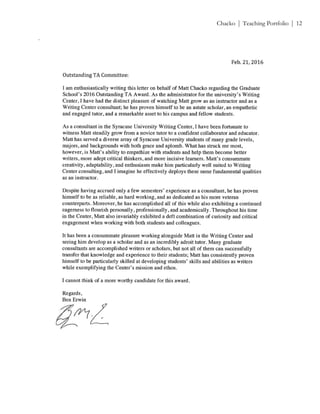
Matt Chacko
Teaching Observation
Observer: Dr. Jonna Gilfus, Senior Lecturer
As part of the teacher training team in the Writing Program, I have had the opportunity to visit
Matt’s classroom on two separate occasions. Matt is the kind of teacher who inspires students to be
their best. In both classes I visited, I was immediately impressed with the moves he made as a
teacher-- pedagogical choices and approaches that usually take a great deal of time and experience to
develop. He once told me that teaching was the best part of his day. “I love the planning, and get
excited about trying out the plans in class,” he told me. “I love the interaction with students, and
watching them learn.” Matt’s classroom is a space where students are encouraged to write, think, and
collaborate in meaningful ways. He creates a learning climate that feels inviting, but he does not miss
opportunities to challenge students to think more, to examine other views, and to expand their ideas.
One of the classes I observed was his WRT 105, a first-year required writing class that explored
literacy and its relationship to cultures and communities of writers. The class began at 8 a.m., and all
20 students were in attendance. The students in Matt’s class were just finishing up their first unit
projects—essays they had written that would be posted to their Expressions sites, along with an
accompanying podcast of their work.
The plan for the day was to peer workshop the students’ drafts. This kind of writing workshop is
common in many writing studios, and although the teacher is not the center of attention for this
kind of teaching, it takes very careful planning to make these workshops productive and useful for
students. The success of Matt’s class is a direct result of his interest and willingness to do the hard
work of carefully preparing and developing plans that create a climate and structure where students
take themselves and their writing seriously.
Matt started out by asking students about their experiences with the homework he had emailed
them—instructions for creating a site on SU’s Expressions. He answered questions and clarified the
reasons for using the public sites for the work. He carefully and explicitly connected the activities of
the class and their homework back to larger learning goals for the course.
Next, he asked students to talk about their experiences with peer review. Several students provided
feedback about the things that had worked and not worked for them in peer review in other classes,
which he noted in the board. They decided together on some of the practices that made for
productive peer review, creating a shared sense of ownership and responsibility for the process.
With Matt’s guidance, they developed three specific questions to center the peer review around.
These questions created a focus for the small group work. During the peer review, Matt circulated
from group to group, making suggestions and helping students think through the drafts they were
working on.
I sat in with one of the small groups. The feedback they provided for one another was really
thoughtful. All the writers and responders were prepared with drafts, and gave thorough attention to
the work of the other writers. For example, one student responded to his group member by
explaining that he liked how passionate the writer was about the subject, but suggested that the
writer might zoom in on one specific example and try for more analysis.
! Chacko | Teaching Portfolio | 11
Near the end of class, Matt stopped to debrief, and asked several students to share their experiences
with class and the peer review. He reminded students about homework, and his availability during
office hours.
Matt Chacko’s enthusiasm and interest in both the subject matter and his students create a climate
where students take their writing seriously and show up to do work. Both of my observations were
in the morning, and both cases all students were present, prepared and enthusiastic about sharing
ideas and writing. He encourages them to take chances with new forms like the podcast, and by
making their writing public. Matt is a superb teacher, and his interest in feedback and willingness to
reflect on his teaching practices are the key to his continued success.
! Chacko | Teaching Portfolio | 12
`
! Chacko | Teaching Portfolio | 13
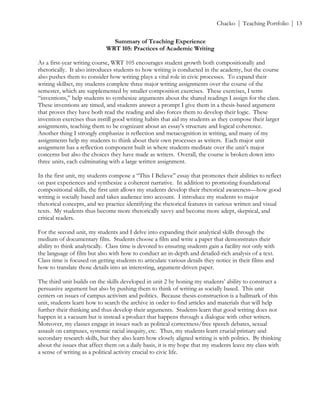
Summary of Teaching Experience
WRT 105: Practices of Academic Writing
As a first-year writing course, WRT 105 encourages student growth both compositionally and
rhetorically. It also introduces students to how writing is conducted in the academy, but the course
also pushes them to consider how writing plays a vital role in civic processes. To expand their
writing skillset, my students complete three major writing assignments over the course of the
semester, which are supplemented by smaller composition exercises. These exercises, I term
“inventions,” help students to synthesize arguments about the shared readings I assign for the class.
These inventions are timed, and students answer a prompt I give them in a thesis-based argument
that proves they have both read the reading and also forces them to develop their logic. These
invention exercises thus instill good writing habits that aid my students as they compose their larger
assignments, teaching them to be cognizant about an essay’s structure and logical coherence.
Another thing I strongly emphasize is reflection and metacognition in writing, and many of my
assignments help my students to think about their own processes as writers. Each major unit
assignment has a reflection component built in where students meditate over the unit’s major
concerns but also the choices they have made as writers. Overall, the course is broken down into
three units, each culminating with a large written assignment.
In the first unit, my students compose a “This I Believe” essay that promotes their abilities to reflect
on past experiences and synthesize a coherent narrative. In addition to promoting foundational
compositional skills, the first unit allows my students develop their rhetorical awareness—how good
writing is socially based and takes audience into account. I introduce my students to major
rhetorical concepts, and we practice identifying the rhetorical features in various written and visual
texts. My students thus become more rhetorically savvy and become more adept, skeptical, and
critical readers.
For the second unit, my students and I delve into expanding their analytical skills through the
medium of documentary film. Students choose a film and write a paper that demonstrates their
ability to think analytically. Class time is devoted to ensuring students gain a facility not only with
the language of film but also with how to conduct an in-depth and detailed-rich analysis of a text.
Class time is focused on getting students to articulate various details they notice in their films and
how to translate those details into an interesting, argument-driven paper.
The third unit builds on the skills developed in unit 2 by honing my students’ ability to construct a
persuasive argument but also by pushing them to think of writing as socially based. This unit
centers on issues of campus activism and politics. Because thesis-construction is a hallmark of this
unit, students learn how to search the archive in order to find articles and materials that will help
further their thinking and thus develop their arguments. Students learn that good writing does not
happen in a vacuum but is instead a product that happens through a dialogue with other writers.
Moreover, my classes engage in issues such as political correctness/free speech debates, sexual
assault on campuses, systemic racial inequity, etc. Thus, my students learn crucial primary and
secondary research skills, but they also learn how closely aligned writing is with politics. By thinking
about the issues that affect them on a daily basis, it is my hope that my students leave my class with
a sense of writing as a political activity crucial to civic life.
! Chacko | Teaching Portfolio | 14
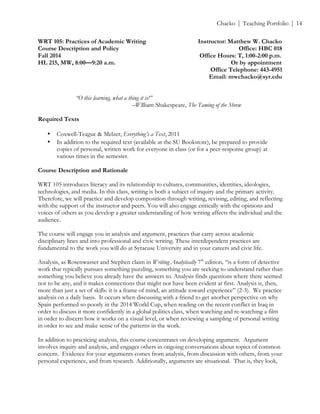
WRT 105: Practices of Academic Writing Instructor: Matthew W. Chacko
Course Description and Policy Office: HBC 018
Fall 2014 Office Hours: T, 1:00-2:00 p.m.
HL 215, MW, 8:00—9:20 a.m. Or by appointment
Office Telephone: 443-4951
Email: mwchacko@syr.edu
“O this learning, what a thing it is!”
–William Shakespeare, The Taming of the Shrew
Required Texts
• Coxwell-Teague & Melzer, Everything’s a Text, 2011
• In addition to the required text (available at the SU Bookstore), be prepared to provide
copies of personal, written work for everyone in class (or for a peer-response group) at
various times in the semester.
Course Description and Rationale
WRT 105 introduces literacy and its relationship to cultures, communities, identities, ideologies,
technologies, and media. In this class, writing is both a subject of inquiry and the primary activity.
Therefore, we will practice and develop composition through writing, revising, editing, and reflecting
with the support of the instructor and peers. You will also engage critically with the opinions and
voices of others as you develop a greater understanding of how writing affects the individual and the
audience.
The course will engage you in analysis and argument, practices that carry across academic
disciplinary lines and into professional and civic writing. These interdependent practices are
fundamental to the work you will do at Syracuse University and in your careers and civic life.
Analysis, as Rosenwasser and Stephen claim in Writing Analytically 7th
edition, “is a form of detective
work that typically pursues something puzzling, something you are seeking to understand rather than
something you believe you already have the answers to. Analysis finds questions where there seemed
not to be any, and it makes connections that might not have been evident at first. Analysis is, then,
more than just a set of skills: it is a frame of mind, an attitude toward experience” (2-3). We practice
analysis on a daily basis. It occurs when discussing with a friend to get another perspective on why
Spain performed so poorly in the 2014 World Cup, when reading on the recent conflict in Iraq in
order to discuss it more confidently in a global politics class, when watching and re-watching a film
in order to discern how it works on a visual level, or when reviewing a sampling of personal writing
in order to see and make sense of the patterns in the work.
In addition to practicing analysis, this course concentrates on developing argument. Argument
involves inquiry and analysis, and engages others in ongoing conversations about topics of common
concern. Evidence for your arguments comes from analysis, from discussion with others, from your
personal experience, and from research. Additionally, arguments are situational. That is, they look,
! Chacko | Teaching Portfolio | 15
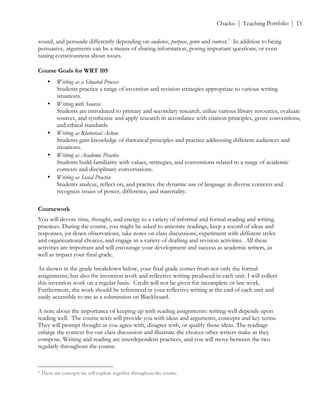
sound, and persuade differently depending on audience, purpose, genre and context.1
In addition to being
persuasive, arguments can be a means of sharing information, posing important questions, or even
raising consciousness about issues.
Course Goals for WRT 105
• Writing as a Situated Process
Students practice a range of invention and revision strategies appropriate to various writing
situations.
• Writing with Sources
Students are introduced to primary and secondary research, utilize various library resources, evaluate
sources, and synthesize and apply research in accordance with citation principles, genre conventions,
and ethical standards.
• Writing as Rhetorical Action
Students gain knowledge of rhetorical principles and practice addressing different audiences and
situations.
• Writing as Academic Practice
Students build familiarity with values, strategies, and conventions related to a range of academic
contexts and disciplinary conversations.
• Writing as Social Practice
Students analyze, reflect on, and practice the dynamic use of language in diverse contexts and
recognize issues of power, difference, and materiality.
Coursework
You will devote time, thought, and energy to a variety of informal and formal reading and writing
practices. During the course, you might be asked to annotate readings, keep a record of ideas and
responses, jot down observations, take notes on class discussions, experiment with different styles
and organizational choices, and engage in a variety of drafting and revision activities. All these
activities are important and will encourage your development and success as academic writers, as
well as impact your final grade.
As shown in the grade breakdown below, your final grade comes from not only the formal
assignments, but also the invention work and reflective writing produced in each unit. I will collect
this invention work on a regular basis. Credit will not be given for incomplete or late work.
Furthermore, the work should be referenced in your reflective writing at the end of each unit and
easily accessible to me as a submission on Blackboard.
A note about the importance of keeping up with reading assignments: writing well depends upon
reading well. The course texts will provide you with ideas and arguments, concepts and key terms.
They will prompt thought as you agree with, disagree with, or qualify those ideas. The readings
enlarge the context for our class discussion and illustrate the choices other writers make as they
compose. Writing and reading are interdependent practices, and you will move between the two
regularly throughout the course.!
!!!!!!!!!!!!!!!!!!!!!!!!!!!!!!!!!!!!!!!!!!!!!!!!!!!!!!!!
1!These are concepts we will explore together throughout the course.!
! Chacko | Teaching Portfolio | 16
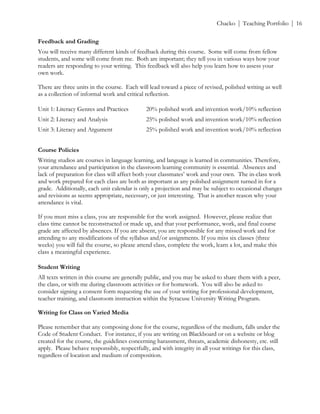
Feedback and Grading
You will receive many different kinds of feedback during this course. Some will come from fellow
students, and some will come from me. Both are important; they tell you in various ways how your
readers are responding to your writing. This feedback will also help you learn how to assess your
own work.
There are three units in the course. Each will lead toward a piece of revised, polished writing as well
as a collection of informal work and critical reflection.
Unit 1: Literacy Genres and Practices 20% polished work and invention work/10% reflection
Unit 2: Literacy and Analysis 25% polished work and invention work/10% reflection
Unit 3: Literacy and Argument 25% polished work and invention work/10% reflection
Course Policies
Writing studios are courses in language learning, and language is learned in communities. Therefore,
your attendance and participation in the classroom learning community is essential. Absences and
lack of preparation for class will affect both your classmates’ work and your own. The in-class work
and work prepared for each class are both as important as any polished assignment turned in for a
grade. Additionally, each unit calendar is only a projection and may be subject to occasional changes
and revisions as seems appropriate, necessary, or just interesting. That is another reason why your
attendance is vital.
If you must miss a class, you are responsible for the work assigned. However, please realize that
class time cannot be reconstructed or made up, and that your performance, work, and final course
grade are affected by absences. If you are absent, you are responsible for any missed work and for
attending to any modifications of the syllabus and/or assignments. If you miss six classes (three
weeks) you will fail the course, so please attend class, complete the work, learn a lot, and make this
class a meaningful experience.
Student Writing
All texts written in this course are generally public, and you may be asked to share them with a peer,
the class, or with me during classroom activities or for homework. You will also be asked to
consider signing a consent form requesting the use of your writing for professional development,
teacher training, and classroom instruction within the Syracuse University Writing Program.
Writing for Class on Varied Media
Please remember that any composing done for the course, regardless of the medium, falls under the
Code of Student Conduct. For instance, if you are writing on Blackboard or on a website or blog
created for the course, the guidelines concerning harassment, threats, academic dishonesty, etc. still
apply. Please behave responsibly, respectfully, and with integrity in all your writings for this class,
regardless of location and medium of composition.
! Chacko | Teaching Portfolio | 17
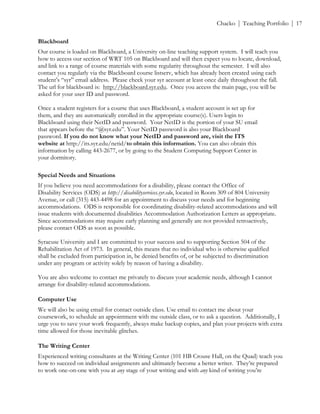
Blackboard
Our course is loaded on Blackboard, a University on-line teaching support system. I will teach you
how to access our section of WRT 105 on Blackboard and will then expect you to locate, download,
and link to a range of course materials with some regularity throughout the semester. I will also
contact you regularly via the Blackboard course listserv, which has already been created using each
student’s “syr” email address. Please check your syr account at least once daily throughout the fall.
The url for blackboard is: http://blackboard.syr.edu. Once you access the main page, you will be
asked for your user ID and password.
Once a student registers for a course that uses Blackboard, a student account is set up for
them, and they are automatically enrolled in the appropriate course(s). Users login to
Blackboard using their NetID and password. Your NetID is the portion of your SU email
that appears before the “@syr.edu”. Your NetID password is also your Blackboard
password. If you do not know what your NetID and password are, visit the ITS
website at http://its.syr.edu/netid/to obtain this information. You can also obtain this
information by calling 443-2677, or by going to the Student Computing Support Center in
your dormitory.
Special Needs and Situations
If you believe you need accommodations for a disability, please contact the Office of
Disability Services (ODS) at http://disabilityservices.syr.edu, located in Room 309 of 804 University
Avenue, or call (315) 443-4498 for an appointment to discuss your needs and for beginning
accommodations. ODS is responsible for coordinating disability-related accommodations and will
issue students with documented disabilities Accommodation Authorization Letters as appropriate.
Since accommodations may require early planning and generally are not provided retroactively,
please contact ODS as soon as possible.
Syracuse University and I are committed to your success and to supporting Section 504 of the
Rehabilitation Act of 1973. In general, this means that no individual who is otherwise qualified
shall be excluded from participation in, be denied benefits of, or be subjected to discrimination
under any program or activity solely by reason of having a disability.
You are also welcome to contact me privately to discuss your academic needs, although I cannot
arrange for disability-related accommodations.
Computer Use
We will also be using email for contact outside class. Use email to contact me about your
coursework, to schedule an appointment with me outside class, or to ask a question. Additionally, I
urge you to save your work frequently, always make backup copies, and plan your projects with extra
time allowed for those inevitable glitches.
The Writing Center
Experienced writing consultants at the Writing Center (101 HB Crouse Hall, on the Quad) teach you
how to succeed on individual assignments and ultimately become a better writer. They’re prepared
to work one-on-one with you at any stage of your writing and with any kind of writing you’re
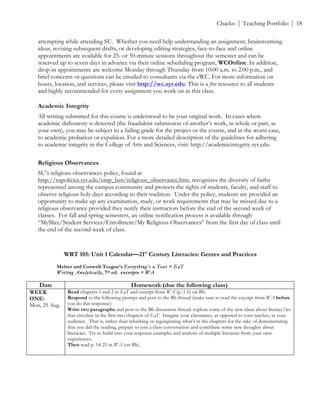
! Chacko | Teaching Portfolio | 18
attempting while attending SU. Whether you need help understanding an assignment, brainstorming
ideas, revising subsequent drafts, or developing editing strategies, face-to-face and online
appointments are available for 25- or 50-minute sessions throughout the semester and can be
reserved up to seven days in advance via their online scheduling program, WCOnline. In addition,
drop-in appointments are welcome Monday through Thursday from 10:00 a.m. to 2:00 p.m., and
brief concerns or questions can be emailed to consultants via the eWC. For more information on
hours, location, and services, please visit http://wc.syr.edu. This is a free resource to all students
and highly recommended for every assignment you work on in this class.
Academic Integrity
All writing submitted for this course is understood to be your original work. In cases where
academic dishonesty is detected (the fraudulent submission of another’s work, in whole or part, as
your own), you may be subject to a failing grade for the project or the course, and in the worst case,
to academic probation or expulsion. For a more detailed description of the guidelines for adhering
to academic integrity in the College of Arts and Sciences, visit: http://academicintegrity.syr.edu.
Religious Observances
SU’s religious observances policy, found at
http://supolicies.syr.edu/emp_ben/religious_observance.htm, recognizes the diversity of faiths
represented among the campus community and protects the rights of students, faculty, and staff to
observe religious holy days according to their tradition. Under the policy, students are provided an
opportunity to make up any examination, study, or work requirements that may be missed due to a
religious observance provided they notify their instructors before the end of the second week of
classes. For fall and spring semesters, an online notification process is available through
“MySlice/Student Services/Enrollment/My Religious Observances” from the first day of class until
the end of the second week of class.
!
!
WRT 105: Unit 1 Calendar—21st
Century Literacies: Genres and Practices
Melzer and Coxwell-Teague’s Everything’s a Text = EaT
Writing Analytically, 7th ed. excerpts = WA
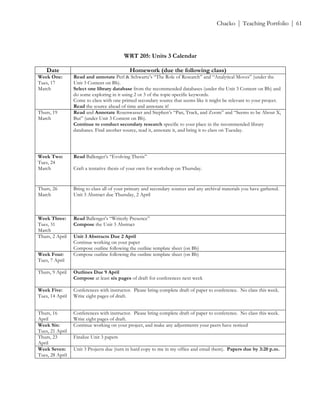
Date Homework (due the following class)
WEEK
ONE:
Mon, 25 Aug.
Read chapters 1 and 2 in EaT and excerpt from WA (p. 1-6) on Bb.
Respond to the following prompt and post to the Bb thread (make sure to read the excerpt from WA before
you do this response):
Write two paragraphs and post to the Bb discussion thread: explore some of the new ideas about literacy/ies
that circulate in the first two chapters of EaT. Imagine your classmates, as opposed to your teacher, as your
audience. That is, rather than rehashing or regurgitating what’s in the chapters for the sake of demonstrating
that you did the reading, prepare to join a class conversation and contribute some new thoughts about
literacies. Try to build into your response examples and analysis of multiple literacies from your own
experiences.
Then read p. 14-25 in WA (on Bb).
! Chacko | Teaching Portfolio | 19
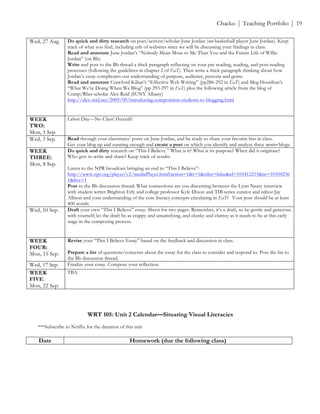
Wed, 27 Aug. Do quick and dirty research on poet/activist/scholar June Jordan (not basketball player June Jordan). Keep
track of what you find, including urls of websites since we will be discussing your findings in class.
Read and annotate June Jordan’s “Nobody Mean More to Me Than You and the Future Life of Willie
Jordan” (on Bb).
Write and post to the Bb thread a thick paragraph reflecting on your pre-reading, reading, and post-reading
processes (following the guidelines in chapter 2 of EaT). Then write a thick paragraph thinking about how
Jordan’s essay complicates our understanding of purpose, audience, persona and genre.
Read and annotate Crawford Kilian’s “Effective Web Writing” (pp286-292 in EaT) and Meg Hourihan’s
“What We’re Doing When We Blog” (pp 293-297 in EaT) plus the following article from the blog of
Comp/Rhet scholar Alex Reid (SUNY Albany)
http://alex-reid.net/2009/09/introducing-composition-students-to-blogging.html
WEEK
TWO:
Mon, 1 Sep.
Labor Day—No Class! Huzzah!
Wed, 3 Sep. Read through your classmates’ posts on June Jordan, and be ready to share your favorite bits in class.
Get your blog up and running enough and create a post on which you identify and analyze three mentor blogs.
WEEK
THREE:
Mon, 8 Sep.
Do quick and dirty research on “This I Believe.” What is it? What is its purpose? When did it originate?
Who gets to write and share? Keep track of results.
Listen to the NPR broadcast bringing an end to “This I Believe”:
http://www.npr.org/player/v2/mediaPlayer.html?action=1&t=1&islist=false&id=103412215&m=10350236
1&live=1
Post to the Bb discussion thread: What connections are you discerning between the Lynn Neary interview
with student writer Brighton Erly and college professor Kyle Dixon and TIB series curator and editor Jay
Allison and your understanding of the core literacy concepts circulating in EaT? Your post should be at least
400 words.
Wed, 10 Sep. Draft your own “This I Believe” essay. Shoot for two pages. Remember, it’s a draft, so be gentle and generous
with yourself; let the draft be as crappy and unsatisfying, and clunky and clumsy as it needs to be at this early
stage in the composing process.
WEEK
FOUR:
Mon, 15 Sep.
Revise your “This I Believe Essay” based on the feedback and discussion in class.
Prepare a list of questions/concerns about the essay for the class to consider and respond to. Post the list to
the Bb discussion thread.
Wed, 17 Sep. Finalize your essay. Compose your reflection.
WEEK
FIVE:
Mon, 22 Sep.
TBA
!
!
WRT 105: Unit 2 Calendar—Situating Visual Literacies
***Subscribe to Netflix for the duration of this unit
Date Homework (due the following class)
! Chacko | Teaching Portfolio | 20
Mon,
22 Sept
Read Pages 209-218 (Intro and Zemliansky) and pages 244-250 (Sturken & Cartwright) in chapter 5 of EaT.
On the Bb discussion thread: Write a post in which you revise or expand your initial ideas about visual
literacy in light of our work in class and the two essays in Everything’s a Text. Work with a flashpoint or
flashpoints!
Watch the film trailers for the following films (Who Killed Vincent Chin, Let the Fire Burn, Incident at Oglala, Three
Broken Cameras, Paris is Burning) and give me a list of your top 3 films in class on Wednesday.
Review two handouts under the unit 2 tab on Bb: “Analytical Moves” (only pp 14-18) and “Viewing
Documentary Films” and make sure you have them available in class.
Finish your Unit 1 Reflection prompt.
Wed,
24 Sept
Read and annotate Mark Strand’s “The Loneliness Factor” (pp. 257-260 in EaT). [the three Hopper
paintings Strand analyzes are in the chapter 5 glossy insert]
Respond to questions #4 and #5 on page 261. Choose one of the responses and post it to the Bb discussion
thread.
Watch your assigned film, and take good notes being mindful of the visual literacy concepts we have
explored so far.
Sun,
28 Sept
Special Event: 7:00 pm in Kittredge Auditorium: Documentary Film Analysis Workshop
Mon,
29 Sept
Upload your film trailer to your blog and in the same post analyze the rhetorical structure of the trailer:
i.e. how does the trailer attempt to persuade its viewers to go see the film? How does the trailer address its
viewer? How is it arranged? How does the trailer condense the film in terms of story, genre, argument? What
does it appropriate directly from the film itself and how does it reframe those fragments in the new context of
the trailer?
What are you learning about the genre of the film trailer? What are the conventions of the film trailer?
Make sure to have the Analytical Moves pdf available in class on Wednesday.
Wed,
1 Oct.
Work on presentations for class.
Mon,
6 Oct.
Rd pp 26-33 (“the method”) in the Writing Analytically “Analytical Moves” handout (unit 2 tab on Bb)
Download the Film Review Data Sheet (unit 2 tab on Bb)
Go into Netflix (or any other film site with members’ reviews, like amazon, or imdb, etc), and read a sample
of lay reviews (shoot for five if they’re long, or ten if they’re short) of your film.
Keep track of the patterns, trends, and anomalies in the reviews on the data sheet
Go online and find two published reviews [written by professional film critics] of your film.
Write a Bb post attending to the qualities of film review as a genre: what are you noticing? Is there a
difference between the lay reviews and the professional critic reviews? In what ways (if at all) are the
reviewers paying attention to the visual qualities of the film?
Wed,
8 Oct.
Compose and post your film review to a website by Sunday.
Post the same review to your blog, and then do a second post analyzing your choices in the review based on
an awareness of audience, persona, and medium.
Come to class with a short list of potential foci to guide your sustained visual analysis of your film.
Bring your observation notes to class. (Not doing any of this)
Instead, read pages 147-178 in WA and come to class with a tentative thesis statement
Mon,
13 Oct.
Create a “zero” draft of your unit writing. Shoot for two pages (500 wds). As with your unit 1 assignment,
remember that it’s a draft, so be gentle and generous with yourself; let the draft be as crappy and unsatisfying
as it needs to be at this early stage in the composing process.
Wed,
15 Oct.
Revise your documentary film analysis based on the feedback and discussion in class.
Post your thesis to the Bb discussion thread. Respond to two classmates’ theses by class time.
Prepare a list of questions/concerns about the essay for the class to consider and respond to. Post the list to
the Bb discussion thread.
Mon,
20 Oct.
Continue revising your essay. Compose your reflection. Read the drafts of the people in your group in
preparation for the meetings on Wednesday and Friday.
Wed,
22 Oct.
Draft conferences with Matt
Fri,
24 Oct.
Draft conferences with Matt; finalize your essay and reflection.
! Chacko | Teaching Portfolio | 21
Mon,
27 Oct.
Submit final essay and reflection.
WRT 105: Unit 3 Calendar—Campus Activism/Politics
Date Homework (due the following class)
Mon
27 Oct.
Read and annotate Hatch’s “Arguing in Communities” (pdf on Bb).
Then, do some QnD research to orient yourself to the issue of the closing of SU’s Advocacy Center.
Read Laura Cohen’s argument about the closing of SU’s Advocacy Center printed in the Huffington Post:
http://www.huffingtonpost.com/laura-cohen/syracuse-university-has-b_b_5668729.html
Respond to the following prompt and be prepared to write on this in class:
Use Hatch’s descriptions of ethos, pathos and logos (171-172) and the “Classical Appeals” handout (unit 3 tab
on Bb) to analyze Cohen’s argument. Comment, too, on Cohen’s persona, and the medium she chose for her
argument: given the situation, do you think her composing choices are effective?
Do some quick and dirty research to find an article or other source (any argument about campus sexual
assault—not just at SU and not just focused on the Advocacy Center) that presents another view and genre on
the issue presented by Cohen. Keep good track of how you went about your search (key words, etc). Bring
what you find to class, and be prepared to share what it seems to represent in the conversation.
Wed, Oct. 29 Read the articles below regarding the funding for SU’s Posse program being cut:
http://www.syracuse.com/news/index.ssf/2014/09/syracuse_university_minority_students_to_protest_schol
arship_cuts_other_issues.html
https://www.insidehighered.com/news/2014/09/23/syracuse-u-curbs-work-program-help-urban-youth-
attend-college
Respond to the following prompt, using the advice from Hatch:
• Identify an issue or claim regarding SU’s Posse program’s funding being cut that you want to know
more about
• Identify stakeholders that discuss or care about this issue.
• Do some quick & dirty research to identify and record “sites” of this conversation. Try to find
examples from various stakeholders.
• Analyze and evaluate some of the various arguments being made about the issue, paying particular
attention to the context and rhetorical features of the arguments.
Post your work to the Bb discussion thread before class, and be prepared to present your work to the class.
Include a discussion of what attitudes or values you already hold regarding the issue, and why it might be
important to think about this.
Interview an upperclassman, a TA, a professor, and administrator about their awareness of SU campus
activism. Come to class with a list of topics.
Mon, Nov. 3 Finalize your decision about the campus activism issue you will work with. Complete the “Argument
Proposal” on Bb and post this to Bb. Be prepared to present your ideas to the class.
Wed, Nov. 5 Continue your search for sources, and finalize your choice of three secondary sources for the argument.
Choose these very carefully. They should provide you with varied and diverse perspectives, genres and
approaches.
Mon, Nov. 10 Complete the rhetorical outline and post this Bb.
! Chacko | Teaching Portfolio | 22
Wed, Nov. 12 Create a “zero” draft of your unit writing. Shoot for two pages (500 wds). As with your unit 2 assignment,
remember that it’s a draft, so be gentle and generous with yourself; let the draft be as crappy and unsatisfying
as it needs to be at this early stage in the composing process.
Mon, Nov. 17 Draft Conferences
Wed, Nov. 19 Draft Conferences
Continue revising your essay. Compose your reflection.
Mon, Nov. 24
& Wed, Nov
26
Share your argument with 2-3 people from outside of the university, and make notes about their response.
Revise your argument blog post using the reader’s feedback.
Mon,
Dec. 1
Finalize your essay and reflection.
Wed, Dec. 3 TBA
! Chacko | Teaching Portfolio | 23
WRT 105 (M021): Practices of Academic Writing
Course Description and Policy Instructor: Matthew W. Chacko
Fall 2015 Office: HBC 018
Sims Hall 241 Office Hours: M, 10:30 a.m.-11:30 a.m.
M,W,F 9:30-10:25 p.m. Or by appointment
Telephone: 316-706-7079 Email: mwchacko@syr.edu
“I shall detain you now no longer in the demonstration of what we should not do, but straight
conduct you to a hillside where I will point ye out the right path of a virtuous and noble education;
laborious indeed at the first ascent, but else so smooth, so green, so full of goodly prospect and
melodious sounds on every side that the harp of Orpheus was not more charming.”
–John Milton, “Of Education”
Required Texts
• Various pdfs will be available on Blackboard.
• In addition to the required text (available at the SU Bookstore), be prepared to provide
copies of personal, written work for everyone in class (or for a peer-response group) at
various times in the semester.
Course Description and Rationale
WRT 105 introduces literacy and its relationship to cultures, communities, identities, ideologies,
technologies, and media. In this class, writing is both a subject of inquiry and the primary activity.
Therefore, we will practice and develop composition through writing, revising, editing, and reflecting
with the support of the instructor and peers. You will also engage critically with the opinions and
voices of others as you develop a greater understanding of how writing affects the individual and
audience.
The course will engage you in analysis and argument, practices that carry across academic
disciplinary lines and into professional and political writing. These interdependent practices are
fundamental to the work you will do at Syracuse University, in your careers, and in your civic life.
Analysis, as Rosenwasser and Stephen claim in Writing Analytically 7th
edition, “is a form of detective
work that typically pursues something puzzling, something you are seeking to understand rather than
something you believe you already have the answers to. Analysis finds questions where there seemed
not to be any, and it makes connections that might not have been evident at first. Analysis is, then,
more than just a set of skills: it is a frame of mind, an attitude toward experience” (2-3). We practice
analysis on a daily basis. It occurs when discussing with a friend to get another perspective on why
Spain performed so poorly in the 2014 World Cup, when reading on the recent conflict in Iraq in
order to discuss it more confidently in a global politics class, when watching and re-watching a film
in order to discern how it works on a visual level, or when reviewing a sampling of personal writing
in order to see and make sense of the patterns in the work.
In addition to practicing analysis, this course concentrates on developing argument. Argument
involves inquiry and analysis, and engages others in ongoing conversations about topics of common
! Chacko | Teaching Portfolio | 24
concern. Evidence for your arguments comes from analysis, from discussion with others, from your
personal experience, and from research. Additionally, arguments are situational. That is, they look,
sound, and persuade differently depending on audience, purpose, genre and context.2
In addition to being
persuasive, arguments can be a means of sharing information, posing important questions, or even
raising consciousness about issues.
Course Goals for WRT 105
• Writing as a Situated Process
Students practice a range of invention and revision strategies appropriate to various writing
situations.
• Writing with Sources
Students are introduced to primary and secondary research, utilize various library resources, evaluate
sources, and synthesize and apply research in accordance with citation principles, genre conventions,
and ethical standards.
• Writing as Rhetorical Action
Students gain knowledge of rhetorical principles and practice addressing different audiences and
situations.
• Writing as Academic Practice
Students build familiarity with values, strategies, and conventions related to a range of academic
contexts and disciplinary conversations.
• Writing as Social Practice
Students analyze, reflect on, and practice the dynamic use of language in diverse contexts and
recognize issues of power, difference, and materiality.
Coursework
You will devote time, thought, and energy to a variety of informal and formal reading and writing
practices. During the course, you might be asked to annotate readings, keep a record of ideas and
responses, jot down observations, take notes on class discussions, experiment with different styles
and organizational choices, and engage in a variety of drafting and revision activities. All these
activities are important and will encourage your development and success as academic writers, as
well as impact your final grade.
As shown in the grade breakdown below, your final grade comes from not only the formal
assignments, but also the invention work and reflective writing produced in each unit. I will collect
this invention work on a regular basis. Credit will not be given for incomplete or late work.
Furthermore, the work should be referenced in your reflective writing at the end of each unit and
easily accessible to me as a submission on Blackboard.
A note about the importance of keeping up with reading assignments: writing well depends upon
reading well. The course texts will provide you with ideas and arguments, concepts and key terms.
They will prompt thought as you agree with, disagree with, or qualify those ideas. The readings
enlarge the context for our class discussion and illustrate the choices other writers make as they
!!!!!!!!!!!!!!!!!!!!!!!!!!!!!!!!!!!!!!!!!!!!!!!!!!!!!!!!
2!These are concepts we will explore together throughout the course.!
! Chacko | Teaching Portfolio | 25
compose. Writing and reading are interdependent practices, and you will move between the two
regularly throughout the course.!
Feedback and Grading
You will receive many different kinds of feedback during this course. Some will come from fellow
students, and some will come from me. Both are important; they tell you in various ways how your
readers are responding to your writing. This feedback will also help you learn how to assess your
own work.
There are three units in the course. Each will lead toward a piece of revised, polished writing as well
as a collection of informal work and critical reflection.
Unit 1: Literacy Genres and Practices 20% polished work and invention work/10% reflection
Unit 2: Literacy and Analysis 25% polished work and invention work/10% reflection
Unit 3: Literacy and Argument 25% polished work and invention work/10% reflection
Course Policies
Writing studios are courses in language learning, and language is learned in communities. Therefore,
your attendance and participation in the classroom learning community is essential. Absences and
lack of preparation for class will affect both your classmates’ work and your own. The in-class work
and work prepared for each class are both as important as any polished assignment turned in for a
grade. Additionally, each unit calendar is only a projection and may be subject to occasional changes
and revisions as seems appropriate, necessary, or just interesting. That is another reason why your
attendance is vital.
If you must miss a class, you are responsible for the work assigned. However, please realize that
class time cannot be reconstructed or made up, and that your performance, work, and final course
grade are affected by absences. If you are absent, you are responsible for any missed work and for
attending to any modifications of the syllabus and/or assignments. If you miss six classes (three weeks)
you will fail the course, so please attend class, complete the work, learn a lot, and make this class a meaningful
experience.
If you are unable to attend class for whatever reason, please send me an email informing me of your
absence before class.
Student Writing
All texts written in this course are generally public, and you may be asked to share them with a peer,
the class, or with me during classroom activities or for homework. You will also be asked to
consider signing a consent form requesting the use of your writing for professional development,
teacher training, and classroom instruction within the Syracuse University Writing Program.
Writing for Class on Varied Media
Please remember that any composing done for the course, regardless of the medium, falls under the
! Chacko | Teaching Portfolio | 26
Code of Student Conduct. For instance, if you are writing on Blackboard or on a website or blog
created for the course, the guidelines concerning harassment, threats, academic dishonesty, etc. still
apply. Please behave responsibly, respectfully, and with integrity in all your writings for this class,
regardless of location and medium of composition.
Blackboard
Our course is loaded on Blackboard, a University on-line teaching support system. I will teach you
how to access our section of WRT 105 on Blackboard and will then expect you to locate, download,
and link to a range of course materials with some regularity throughout the semester. I will also
contact you regularly via the Blackboard course listserv, which has already been created using each
student’s “syr” email address. Please check your “syr” account at least once daily throughout the
fall. The url for blackboard is: http://blackboard.syr.edu. Once you access the main page, you will
be asked for your user ID and password.
Once a student registers for a course that uses Blackboard, a student account is set up for
them, and they are automatically enrolled in the appropriate course(s). Users login to
Blackboard using their NetID and password. Your NetID is the portion of your SU email
that appears before the “@syr.edu”. Your NetID password is also your Blackboard
password. If you do not know what your NetID and password are, visit the ITS
website at http://its.syr.edu/netid/to obtain this information. You can also obtain this
information by calling 443-2677, or by going to the Student Computing Support Center in
your dormitory.
Special Needs and Situations
If you believe you need accommodations for a disability, please contact the Office of
Disability Services (ODS) at http://disabilityservices.syr.edu, located in Room 309 of 804 University
Avenue, or call (315) 443-4498 for an appointment to discuss your needs and for beginning
accommodations. ODS is responsible for coordinating disability-related accommodations and will
issue students with documented disabilities Accommodation Authorization Letters as appropriate.
Since accommodations may require early planning and generally are not provided retroactively,
please contact ODS as soon as possible.
Syracuse University and I are committed to your success and to supporting Section 504 of the
Rehabilitation Act of 1973. In general, this means that no individual who is otherwise qualified
shall be excluded from participation in, be denied benefits of, or be subjected to discrimination
under any program or activity solely by reason of having a disability.
You are also welcome to contact me privately to discuss your academic needs, although I cannot
arrange for disability-related accommodations.
Computer Use
We will also be using email for contact outside class. Use email to contact me about your
coursework, to schedule an appointment with me outside class, or to ask a question. Additionally, I
urge you to save your work frequently, always make backup copies, and plan your projects with extra
time allowed for those inevitable glitches.
! Chacko | Teaching Portfolio | 27
The Writing Center
Experienced writing consultants at the Writing Center (101 HB Crouse Hall, on the Quad) teach you
how to succeed on individual assignments and ultimately become a better writer. They’re prepared
to work one-on-one with you at any stage of your writing and with any kind of writing you’re
attempting while attending SU. Whether you need help understanding an assignment, brainstorming
ideas, revising subsequent drafts, or developing editing strategies, face-to-face and online
appointments are available for 25- or 50-minute sessions throughout the semester and can be
reserved up to seven days in advance via their online scheduling program, WCOnline. In addition,
drop-in appointments are welcome Monday through Thursday from 10:00 a.m. to 2:00 p.m., and
brief concerns or questions can be emailed to consultants via the eWC. For more information on
hours, location, and services, please visit http://wc.syr.edu. This is a free resource to all students
and highly recommended for every assignment you work on in this class.
Academic Integrity
All writing submitted for this course is understood to be your original work. In cases where
academic dishonesty is detected (the fraudulent submission of another’s work, in whole or part, as
your own), you may be subject to a failing grade for the project or the course, and in the worst case,
to academic probation or expulsion. For a more detailed description of the guidelines for adhering
to academic integrity in the College of Arts and Sciences, visit: http://academicintegrity.syr.edu.
Religious Observances
SU’s religious observances policy, found at
http://supolicies.syr.edu/emp_ben/religious_observance.htm, recognizes the diversity of faiths
represented among the campus community and protects the rights of students, faculty, and staff to
observe religious holy days according to their tradition. Under the policy, students are provided an
opportunity to make up any examination, study, or work requirements that may be missed due to a
religious observance provided they notify their instructors before the end of the second week of
classes. For fall and spring semesters, an online notification process is available through
“MySlice/Student Services/Enrollment/My Religious Observances” from the first day of class until
the end of the second week of class.
WRT 105: Unit 1 Calendar—21st
Century Literacies: Genres and Practices
Melzer and Coxwell-Teague’s Everything’s a Text = EaT
Writing Analytically, 7th ed. excerpts = WA
Date Homework (due the following class)
WEEK ONE:
Mon, 31 Aug.
Read chapter 1 in EaT and excerpt from WA (p. 1-6) on Bb.
! Chacko | Teaching Portfolio | 28
Wed, 2 Sep. Read chapter 2 in EaT and pages 14-25 in WA (On Bb)
Come prepared to write the following prompt:
“Explore some of the new ideas about literacy/ies that circulate in the first two chapters of EaT. Imagine
your classmates, as opposed to your teacher, as your audience. That is, rather than rehashing or regurgitating
what’s in the chapters for the sake of demonstrating that you did the reading, prepare to join a class
conversation and contribute some new thoughts about literacies. Try to build into your response examples
and analysis of multiple literacies from your own experiences.”
Fri, 4 Sep. Do quick and dirty research on “This I Believe.” What is it? What is its purpose? When did it originate?
Who gets to write and share? Keep track of results.
Listen to the NPR broadcast bringing an end to “This I Believe”:
http://www.npr.org/player/v2/mediaPlayer.html?action=1&t=1&islist=false&id=103412215&m=10350236
1&live=1
Come prepared to write the following prompt:
“What connections are you discerning between the Lynn Neary interview with student writer Brighton Erly
and college professor Kyle Dixon and TIB series curator and editor Jay Allison and your understanding of the
core literacy concepts circulating in EaT?”
WEEK TWO:
Mon, 7 Sep.
Labor Day—No Class! Huzzah!
Wed, 9 Sep. Do quick and dirty research on poet/activist/scholar June Jordan (not basketball player June Jordan). Keep
track of what you find, including urls of websites since we will be discussing your findings in class.
Read and annotate June Jordan’s “Nobody Mean More to Me Than You and the Future Life of Willie
Jordan” (on Bb).
Fri, 11 Sep. Draft your own “This I Believe” essay. Shoot for two pages. Remember, it’s a draft, so be gentle and generous
with yourself; let the draft be as crappy and unsatisfying, and clunky and clumsy as it needs to be at this early
stage in the composing process.
WEEK
THREE:
Mon, 14 Sep.
Revise your “This I Believe Essay” based on the feedback and discussion in class.
Listen to and read the following “TIB” essays:
• http://www.npr.org/templates/story/story.php?storyId=101469307
• http://www.npr.org/player/v2/mediaPlayer.html?action=1&t=1&islist=false&id=103412215&m=
103502361&live=1
• http://www.npr.org/templates/story/story.php?storyId=97849881
As you listen and read, write down some of the conventions you’re noticing in the “TIB” essay genre. What
are things you’re noticing that are similar in each of the essays? What are the authors doing that qualifies each
of these essays as a “This I Believe” essay? Come prepared to talk about this in class.
Wed, 16 Sep. Continue revising your “This I Believe Essay” based on the feedback and discussion in class.
Fri, 18 Sep. Revise your “This I Believe Essay” based on the feedback and discussion in class. Write a complete draft of
your essay for the draft conferences next week.
WEEK
FOUR:
Mon, 21 Sep.
Draft Conferences
Revise your “This I Believe Essay” based on the feedback from the conference
Wed, 23 Sep. Draft Conferences
Revise your “This I Believe Essay” based on the feedback from the conference
Fri, 25 Sep. Turn in your “This I Believe Essay”
!
!
! Chacko | Teaching Portfolio | 29
WRT 105: Unit 2 Calendar—Situating Visual Literacies
Date Homework (due the following class)
Mon,
28 Sept
Read and annotate pages 14-26 in Writing Analytically. Bring your annotated reading to class on Wednesday.
Watch the trailers for the following films:
• Paris is Burning: https://www.youtube.com/watch?v=Fz5q1_ni8pA
• Nostalgia for the Light: https://www.youtube.com/watch?v=ok7f4MLL-Hk
• Miss Representation: http://www.imdb.com/title/tt1784538/
• Last Train Home: https://www.youtube.com/watch?v=0N6vDotVNDo
Wed,
30 Sept
Read Pages 209-218 (Intro and Zemliansky) and pages 244-250 (Sturken & Cartwright) in chapter 5 of EaT.
Review the handout “Viewing Documentary Films” and bring it to class.
Fri,
2 Oct
Read and annotate Mark Strand’s “The Loneliness Factor” (pp. 257-260 in EaT). [the three Hopper paintings
Strand analyzes are in the chapter 5 glossy insert]
Choose to respond to either question #4 or #5 on page 261 and an in-class invention.
Watch your assigned film, and take good notes being mindful of the visual literacy concepts we have explored
so far.
Mon,
5 Oct.
Find, read, and annotate three reviews of your film. Bring these in hardcopy to class. Consider the genre of
the film review. What are some of the commonalities that you’re noticing across each of the reviews? How do
the reviews help you understand your film better?
Wed,
7 Oct.
Come prepared to answer this invention prompt: “Analyze the rhetorical structure of the trailer of your
film: i.e. how does the trailer attempt to persuade its viewers to go see the film? How does the trailer address
its viewer? How is it arranged? How does the trailer condense the film in terms of story, genre, argument?
What does it appropriate directly from the film itself and how does it reframe those fragments in the new
context of the trailer?”
Make sure to have the “Writing Analytically_p.14-25” pdf available in class on Wednesday.
Fri,
9 Oct.
Rd pp 26-33 (“the method”) in the Writing Analytically “Analytical Moves” handout (unit 2 tab on Bb).
(Extra Credit: 5 points): Write down a list of things you’re noticing from your film. Then identify a subject,
issue, scene, or sequence that you find interesting or strange. Write down at least 30 details down from your
film. Please bring your findings to class on Monday.
Mon,
12 Oct.
Read pages 147-178 in WA and come to class with a tentative thesis statement.
Wed,
14 Oct.
Revise your thesis statement based on the feedback you received from class.
Fri,
16 Oct.
Create a “zero” draft of your unit writing. Shoot for two pages (500 wds). As with your unit 1 assignment,
remember that it’s a draft, so be gentle and generous with yourself; let the draft be as crappy and unsatisfying
as it needs to be at this early stage in the composing process. Revise your documentary film analysis based on
the feedback and discussion in class.
Mon,
19 Oct.
Continue revising your essay.
Wed,
21 Oct.
Fri,
23 Oct.
Draft conferences
Mon,
26 Oct.
Draft conferences
Wed,
28 Oct.
Draft conferences; finalize your essay and reflection.
Fri,
30 Oct.
Submit final essay.
! Chacko | Teaching Portfolio | 30
WRT 105: Unit 3 Calendar—Campus Action/Activism
Date Homework (due the following class)
Mon.,
2 Nov.
Read and annotate Hatch’s “Evaluating Arguments” (pdf on Bb).
Then, do some research and generate a list of various debates that are occurring on campuses currently or have
occurred recently. These debates can be happening on SU’s campus or on other campuses. Bring a list of at
least 3 debates. For each debate, provide at least 3 sentences briefly outlining what the debates are about and
what the sides of the debates entail. Who is debating and why do these debates matter.
Wed.,
4 Nov.
Read Laura Cohen’s argument about the closing of SU’s Advocacy Center printed in the Huffington Post:
http://www.huffingtonpost.com/laura-cohen/syracuse-university-has-b_b_5668729.html
Respond to the following prompt and be prepared to write on this in class for an invention on Friday:
“Use Hatch’s descriptions of ethos, pathos and logos (171-172) and the ‘Classical Appeals’ handout (unit 3 tab
on Bb) to analyze Cohen’s argument. Comment, too, on Cohen’s persona, and the medium she chose for her
argument: given the situation, do you think her composing choices are effective?”
Do some quick and dirty research to find an article or other source (any argument about campus sexual
assault—not just at SU and not just focused on the Advocacy Center) that presents another view and genre on
the issue presented by Cohen. Keep good track of how you went about your search (key words, etc). Bring
what you find to class, and be prepared to share what it seems to represent in the conversation.
Friday,
6 Nov.
Read the articles below regarding the funding for SU’s Posse program being cut:
http://www.syracuse.com/news/index.ssf/2014/09/syracuse_university_minority_students_to_protest_schol
arship_cuts_other_issues.html
https://www.insidehighered.com/news/2014/09/23/syracuse-u-curbs-work-program-help-urban-youth-
attend-college
Additionally, bring 3 potential topics you may want to write your final paper on.
Mon.,
9 Nov.
Read “The Coddling of the American Mind”: http://www.theatlantic.com/magazine/archive/2015/09/the-
coddling-of-the-american-mind/399356/
Come prepared to write an invention on Wednesday.
Wed.,
11 Nov.
Read the article “The Role of Research” on Blackboard.
Friday, 13 Nov. Read the article “Seems to be about X…” on Blackboard
Mon.,
16 Nov.
Finalize your decision about the campus activism issue you will work with. Complete the “Argument
Proposal” on Bb and turn this in next class. Be prepared to present your ideas to the class.
Wed.,
18 Nov.
Continue your search for sources, and finalize your choice of three secondary sources for the argument.
Choose these very carefully. They should provide you with varied and diverse perspectives, genres and
approaches.
Come prepared to write an invention on Friday.
Friday, 20 Nov. Compose a complete draft for the upcoming draft conferences!
23, 25, 27 Nov. No Class! Thanksgiving Break! Woohoo!
Mon.,
30 Nov.
Draft Conferences
Wed,
2 Dec.
Draft Conferences
Friday,
4 Dec.
Draft Conferences
Mon,
7 Dec.
Peer Review Day.
Wed,
9 Dec.
Essay due. I wish you the best on your final exams, and have a wonderful winter break! You all deserve
it!
! Chacko | Teaching Portfolio | 31
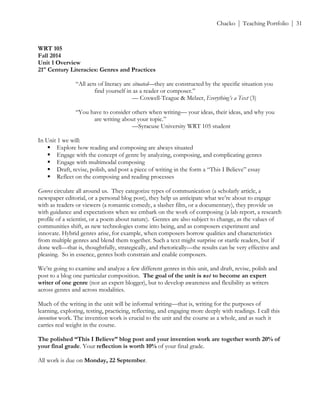
WRT 105
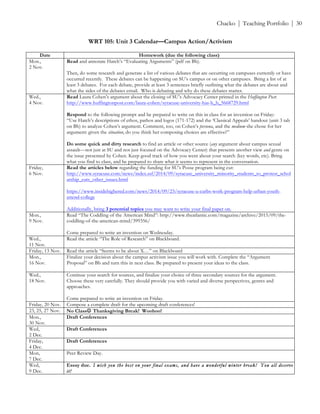
Fall 2014
Unit 1 Overview
21st
Century Literacies: Genres and Practices
“All acts of literacy are situated—they are constructed by the specific situation you
find yourself in as a reader or composer.”
— Coxwell-Teague & Melzer, Everything’s a Text (3)
“You have to consider others when writing— your ideas, their ideas, and why you
are writing about your topic.”
—Syracuse University WRT 105 student
In Unit 1 we will:
" Explore how reading and composing are always situated
" Engage with the concept of genre by analyzing, composing, and complicating genres
" Engage with multimodal composing
" Draft, revise, polish, and post a piece of writing in the form a “This I Believe” essay
" Reflect on the composing and reading processes
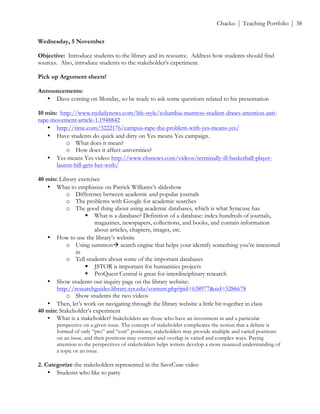
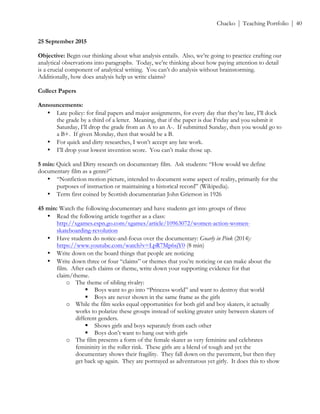
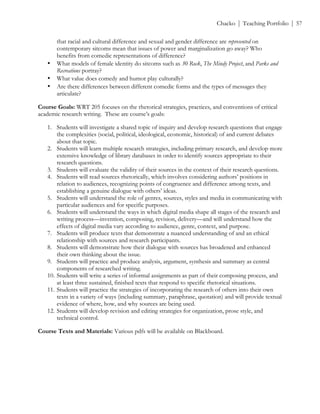
Genres circulate all around us. They categorize types of communication (a scholarly article, a
newspaper editorial, or a personal blog post), they help us anticipate what we’re about to engage
with as readers or viewers (a romantic comedy, a slasher film, or a documentary), they provide us
with guidance and expectations when we embark on the work of composing (a lab report, a research
profile of a scientist, or a poem about nature). Genres are also subject to change, as the values of
communities shift, as new technologies come into being, and as composers experiment and
innovate. Hybrid genres arise, for example, when composers borrow qualities and characteristics
from multiple genres and blend them together. Such a text might surprise or startle readers, but if
done well—that is, thoughtfully, strategically, and rhetorically—the results can be very effective and
pleasing. So in essence, genres both constrain and enable composers.
We’re going to examine and analyze a few different genres in this unit, and draft, revise, polish and
post to a blog one particular composition. The goal of the unit is not to become an expert
writer of one genre (nor an expert blogger), but to develop awareness and flexibility as writers
across genres and across modalities.
Much of the writing in the unit will be informal writing—that is, writing for the purposes of
learning, exploring, testing, practicing, reflecting, and engaging more deeply with readings. I call this
invention work. The invention work is crucial to the unit and the course as a whole, and as such it
carries real weight in the course.
The polished “This I Believe” blog post and your invention work are together worth 20% of
your final grade. Your reflection is worth 10% of your final grade.
All work is due on Monday, 22 September.
! Chacko | Teaching Portfolio | 32
WRT 105
Fall 2014
Unit 2 Overview
Situating Visual Literacies
“We must recognize that visual images do not simply represent ‘objective reality,’ but rather tell
stories and advance arguments, points of view, and agendas…We must recognize the power of
visual compositions to influence the thinking, behavior, and decision making of individuals, groups,
and whole societies.”
—Zemliansky in Everything’s a Text, 218
“Documentaries offer the sensuous experience of sounds and images organized to move us: they
activate feelings and emotions; they tap into values and beliefs, and, in doing so possess an
expressive value that equals or exceeds the printed word.”
—Nichols, Introduction to Documentary, 100
The Writing Situation
This unit is largely about disrupting the habit of naturalizing visual representations. Images make
arguments, sometimes explicitly but more often than not implicitly as well. And it’s not simply the
decisions made by legions of photographers, designers, advertisers, and editors that shape the way those
arguments are understood; the social, political, and cultural contexts in which those images are produced
and consumed also influences the way we make meaning of those images and arguments.
Over the next few weeks we will spend time analyzing documentary films as visual arguments and
considering the rhetorical choices made by their creators, and the intentional and unintentional
consequences those images have for their respective audiences and the society at large. We will raise
questions and make analytical claims about the implications of the films and their visual
representations—all in the hopes of “seeing” them more clearly.
You will choose one film to analyze, and your analysis will be enhanced by attending to the following:
• Provide specific context for the Film. Review p. 22-26 in Everything’s a Text and do some quick and
dirty research to discover when the film was released, what was happening in the country at the
time, any other films the director has made, and other relevant contextual information.
• Go Small. You cannot do justice to the scope and complexity of the entire film in one short-ish
essay, so zero in on one scene, or select a specific visual pattern to analyze. We will use the
concepts of “pan, track, and zoom” from Writing Analytically to help us narrow the focus of our
analyses.
• Attend Closely to Purpose, and to how the film persuades viewers. Think, for example, about the ways the
film adheres to generic conventions and also the ways it subverts conventions.
!
There are a few things you’ll be expected to include in your essay:
• Thoughtful, in-depth analysis of a select scene from your film or of a particular visual pattern in
your film.
• Explicit claims about what you are noticing—interpretations developed through your analysis.
• A clear sense of purpose for the writing that takes into account what’s at stake and the “so
what?” question a reader is likely to have.
! Chacko | Teaching Portfolio | 33
• Integration and synthesis of at least one of the readings we worked on together in the unit.
• Attention to style and arrangement of words, images, and ideas that invites your audience to see
something new through your analysis.
• A reflective memo describing the choices you made and your process as a writer.
Your audience for this writing is your fellow students and others interested in visual literacy. For
example, you might think of this writing as something that could be submitted to our own Syracuse
University undergraduate journal, Intertext ( http://wrt-intertext.syr.edu ), or an undergrad journal
more specifically examining these issues, such as Film Matters
(http://www.filmmattersmagazine.com/).
Your essay is due in hardcopy on Friday, 30 October. You will submit a hard copy of the essay.
! Chacko | Teaching Portfolio | 34
WRT 105
Fall 2014
Unit 3 Overview
Arguing in Communities: Campus Activism/Politics
In unit 2 we analyzed literacies and made interpretive claims based on our examination of specific
sites and texts. In unit 3 we will shift gears and practice strategically employing literacies by composing
arguments for specific audiences and situations.
Even though you are new to the academy, you likely have already been exposed to a range of
arguments in a range of disciplines; it’s also likely that you already recognize that academic
arguments look and sound different depending on the discipline within which they arise and on the
writer’s purpose and audience. Writing in and for the academy regularly involves “problem-posing,”
a concept Composition and Rhetoric scholar Fiona Glade borrows from Paulo Freire. “Problem-
posing,” writes Glade,
is particularly useful in helping us learn about the academic discourse communities in
which we’ll participate throughout our college careers because it provides a way to
help us read those communities. Different fields of study use writing differently. As
context differs, so do genre, medium, and other rhetorical concerns.
(“Writing Across the University: Academic Discourse as a
Conversation” in Everything’s a Text 403)
In this final unit of the course you are going to compose an argument that draws on some of the
conventions of academic writing in the humanities, a broad disciplinary community that we will
explore together. However, you are going to blur the boundaries of the academic and the public to
create a hybrid argument—one that satisfies the expectations of an academic audience but also
addresses a public audience.
Your central purpose in the essay you write for unit 3 will be to persuade your audience to adopt the
position that you recommend—a position you come to after involving yourself in all sorts of
invention activities: reading, researching, brainstorming, talking, etc.
To prepare for this task, you will identify a political, social, or popular controversy that is somehow
connected to or invested with questions of Campus Activism/Politics, and then spend some time
listening in on and analyzing the arguments that are embedded in the debate. Who is saying what?
What positions are the various participants taking? What are the ethical and social consequences of
those positions? What is the history of this issue? What kinds of arguments are being constructed
for what kinds of audiences? What seems to influence who takes what position? Which positions
seem to have the most credible arguments? Which positions seem to have the most power? You are
going to, more or less, map out the opinions and implications surrounding your issue as you prepare
to develop your own claims and firm up your own position.
As in the previous units, there is no predetermined formula to follow or structure to imitate as you
attempt to organize your essay, but your writing and critical thinking are bound to be more
successful if you adhere to the following principles and practices:
! Chacko | Teaching Portfolio | 35
• Make the purpose and objective of your argument explicit—what is it that you are
attempting to persuade audience/s to think, believe or do?
• Contextualize the debate and analyze the various perspectives within that debate, and be
ready to engage with the arguments of important stakeholders and participants.
• Demonstrate that you understand what your audience/s believe or assume about the issue
you are focusing on and about the connected issues and debates. To this end, use rhetorical
appeals and strategies appropriate for your rhetorical situation and anticipate counter-
arguments.
Thinking about methods and materials …
• Work toward an argumentative thesis that takes a position within the debate but that goes
beyond a simple pro/con stance to provide a more complicated and nuanced perspective.
• Draw on a small range of sources (secondary and primary). Select texts that push your
thinking in new directions, and that will play a role in the rhetorical effectiveness of your
argument.
• Develop good reasons and a range of evidence (concrete examples, facts, statistics,
anecdotes, supporting texts and authorities, interviews, observations, visuals, etc.) to support
your claims
• Make careful decisions about arrangement and organization (including where and how to
incorporate media).
The argument should be 6-8 pages long and is due, along with your final reflection, on 1 December.
!
!
!
!
! Chacko | Teaching Portfolio | 36
Monday, 15 September 2014
Day 5
Objective: To peer review TIB essays.
5 min: Arrange desks and take attendance
• Announce the following:
o Instructions for creating and uploading a podcast are on Blackboard under Unit One
materials.
o Final TIB essays due next Monday, 22 September by 8:00 am (I want a hard copy
with all the peer review papers attached to it as well as the finished blog with
podcast)
o Show class the proto-rubric
5 min: Ask students about their prior experiences with peer review. What has been most
useful/helpful? What kinds of pitfalls have they experienced in the process? As students share their
experiences, note the practices that were most helpful and benefited them as writers, and which were
less helpful. Emphasize that peer review is not about being the teacher or “fixing” someone else’s
writing, but rather providing a reader’s perspective on the writing. As readers, they can offer one
reader’s view to help the writer. Explain that the first time we do this, it may require a little set-up,
but I’d like for them to try out the process.
• Hand out Peer Review worksheet
5 min: (Have students write on worksheet their feedback.) Before beginning the peer review, what
are specific things in your draft are you pleased with so far? Additionally, what are a few concerns
you have for your draft? Are you satisfied with or have concerns with the narrative structure, the
logical sequence, your thesis statement, etc.? Be as specific as possible. For example, rather than
just saying you are concerned about the “flow”, try to describe what you mean specifically by this.
Are there moments where your draft makes less sense to your audience? Are you worried whether
the persona you offer works? Do you feel the piece would be interesting to your audience? Is there a
section or sentence you really love, and definitely want to keep? Please share with your group.
3 min: Count off by 5’s (form groups of 4). Find your group and re-introduce yourselves.
60 min: Each writer gets 15 minutes of the groups’ attention. Keep time!!
• Each writer should begin by telling the rest of the group about what they are pleased about,
and what their concerns are (using the writing they did). Ask the group to help with a couple
of specific things. Students should tell some of the things they wrote on the worksheet.
• Next, each writer reads their piece aloud to the group. (Note that it may feel awkward doing
this, but it’s actually a really great way to hear new things in your writing). The writer should
keep a pen in hand as he/she reads. Make note of places that you want to return to (a typo,
or awkward sentence, a place where you skipped something).
• After the author finishes her/his paper, the group members should fill out the rest of the
worksheet.
• When group members are finished with worksheet, the group members take turns providing
feedback about what they have heard. Be mindful of what the writer is most concerned with
! Chacko | Teaching Portfolio | 37
or appreciates, and try to be very specific. (i.e. “It’s good” is nice, but doesn’t help the reader
know what is good about it...)
• Even though the other group members have a draft, the writer should be the one taking
notes about the group’s feedback. If there are things you feel would be helpful for the writer
noted on the copy you have, you can give it to them, but it should be a conversation with the
writer, not a silent reading session.
5 min: Have the students write a note to you about the peer review session: Was the session useful?
Why or why not? What might make it better? Were there readers in your group who gave
particularly helpful feedback? Why was it useful? What do you plan to do next in your revision of
the piece? Hand notes in and review HW.
Homework/Final Remarks:
• Revise your TIB essay based on feedback and discussion in class.
• Prepare a list of questions/concerns about the essay for the class to consider and respond to.
Post this list to the Blackboard discussion thread. Due by Wednesday, 17 September at
midnight.
• All authors should keep their peer review papers and submit them to me on Monday
when turn in your final draft of the TIB essay.
! Chacko | Teaching Portfolio | 38
Wednesday, 5 November
Objective: Introduce students to the library and its resource. Address how students should find
sources. Also, introduce students to the stakeholder’s experiment.
Pick up Argument sheets!
Announcements:
• Dave coming on Monday, so be ready to ask some questions related to his presentation
10 min: http://www.nydailynews.com/life-style/columbia-mattress-student-draws-attention-anti-
rape-movement-article-1.1948842
• http://time.com/3222176/campus-rape-the-problem-with-yes-means-yes/
• Have students do quick and dirty on Yes means Yes campaign.
o What does it mean?
o How does it affect universities?
• Yes means Yes video: http://www.cbsnews.com/videos/terminally-ill-basketball-player-
lauren-hill-gets-her-wish/
40 min: Library exercises
• What to emphasize on Patrick Williams’s slideshow
o Difference between academic and popular journals
o The problems with Google for academic searches
o The good thing about using academic databases, which is what Syracuse has
" What is a database? Definition of a database: index hundreds of journals,
magazines, newspapers, collections, and books, and contain information
about articles, chapters, images, etc.
• How to use the library’s website
o Using summon# search engine that helps your identify something you’re interested
in
o Tell students about some of the important databases
" JSTOR is important for humanities projects
" ProQuest Central is great for interdisciplinary research
• Show students our inquiry page on the library website:
http://researchguides.library.syr.edu/content.php?pid=638977&sid=5286678
o Show students the two videos
• Then, let’s work on navigating through the library website a little bit together in class
40 min: Stakeholder’s experiment
• What is a stakeholder? Stakeholders are those who have an investment in and a particular
perspective on a given issue. The concept of stakeholder complicates the notion that a debate is
formed of only “pro” and “con” positions; stakeholders may provide multiple and varied positions
on an issue, and their positions may contrast and overlap in varied and complex ways. Paying
attention to the perspectives of stakeholders helps writers develop a more nuanced understanding of
a topic or an issue.
2. Categorize the stakeholders represented in the SaveCuse video
• Students who like to party
! Chacko | Teaching Portfolio | 39
• Parents of the students
• Students who don’t like to party and feel that Castle Court was a huge waste of time and
energy
• DPS (Campus security)
• Management of Castle Court
• School administration/Faculty
3. Form Groups
Put students into groups and assign each group one stakeholder position. Have them read the article
carefully, make note of details specific to their position, and compose a one paragraph statement in
defense of their position to be shared with the rest of the class, using the group objectives below as
guidelines. [Teachers might consider ramping up the rhetorical exigence of the exercise, and tell
students that the stakeholders are participating in a public forum on the issue].
4. After sharing positions out loud, have students go
back to their statements and solidify and strengthen
them, and then propose a solution.
• Make sure students really tune into what the
opposing side says; How do different claims
strengthen your own argument?
5. Ask students to be prepared to speak to their new
understanding of rhetoric and persuasion: specifically in
what ways did your sense of what was and wasn’t
persuasive in the original article, or your awareness of
what other stakeholders think and believe, impact your
rhetorical approach? In other words, how has your
position grown stronger by being mindful of other
perspectives?
Homework:
• Continue your search for sources, and finalize your choice of three secondary sources for the
argument. Choose these very carefully. They should provide you with varied and diverse
perspectives, genres and approaches.
• Come to class with a brief synopsis of each source (100 words). This synopsis should
paraphrase and summarize the article’s main argument, why it’s relevant to your argument,
and the credibility of your source.
• Please type this out and give it to me next class period
• Come up with two questions related to the Advocacy Center
Group Objectives
Plan how you will you convince others by…
• Explaining what you want, and why.
• Considering the ramifications of your
position.
• Considering ulterior motives of other
stakeholders.
• Discussing your options for persuading.!
! Chacko | Teaching Portfolio | 40
25 September 2015
Objective: Begin our thinking about what analysis entails. Also, we’re going to practice crafting our
analytical observations into paragraphs. Today, we’re thinking about how paying attention to detail
is a crucial component of analytical writing. You can’t do analysis without brainstorming.
Additionally, how does analysis help us write claims?
Collect Papers
Announcements:
• Late policy: for final papers and major assignments, for every day that they’re late, I’ll dock
the grade by a third of a letter. Meaning, that if the paper is due Friday and you submit it
Saturday, I’ll drop the grade from an A to an A-. If submitted Sunday, then you would go to
a B+. If given Monday, then that would be a B.
• For quick and dirty researches, I won’t accept any late work.
• I’ll drop your lowest invention score. You can’t make those up.
5 min: Quick and Dirty research on documentary film. Ask students: “How would we define
documentary film as a genre?”
• “Nonfiction motion picture, intended to document some aspect of reality, primarily for the
purposes of instruction or maintaining a historical record” (Wikipedia).
• Term first coined by Scottish documentarian John Grierson in 1926
45 min: Watch the following documentary and have students get into groups of three
• Read the following article together as a class:
http://xgames.espn.go.com/xgames/article/10963072/women-action-women-
skateboarding-revolution
• Have students do notice-and-focus over the documentary: Gnarly in Pink (2014):
https://www.youtube.com/watch?v=LpR7Mp6sjY0 (8 min)
• Write down on the board things that people are noticing
• Write down three or four “claims” or themes that you’re noticing or can make about the
film. After each claims or theme, write down your supporting evidence for that
claim/theme.
o The theme of sibling rivalry:
" Boys want to go into “Princess world” and want to destroy that world
" Boys are never shown in the same frame as the girls
o While the film seeks equal opportunities for both girl and boy skaters, it actually
works to polarize these groups instead of seeking greater unity between skaters of
different genders.
" Shows girls and boys separately from each other
" Boys don’t want to hang out with girls
o The film presents a form of the female skater as very feminine and celebrates
femininity in the roller rink. These girls are a blend of tough and yet the
documentary shows their fragility. They fall down on the pavement, but then they
get back up again. They are portrayed as adventurous yet girly. It does this to show
! Chacko | Teaching Portfolio | 41
us that the usual dichotomy of masculine and feminine isn’t quite so distinct as
imagined.
• Share your themes/claims with the class
NO HOMEWORK!
! Chacko | Teaching Portfolio | 42
2 October 2015
Objective: to understand better what visual literacy is, and why we should be invested in developing
our ability to be visually literate. How does visual literacy work with our understanding of being a
critical and engaged reader?
• Make them aware that today is going to entail some talking. We’re going to, through our
speaking, work our way through the concepts discussed in today’s readings.
• Sturken and Cartwright provide us with a lot of interesting things to talk about, but we might
wait until Monday to discuss them
Circle chairs
Fling for extra credit
Check for annotated texts for extra credit.
Freewrite: What does it mean to be visually literate, and why should we be visually literate? Also,
what are three questions you have about the texts? (5 min)
(16 min) Watch Brian Kennedy: https://www.youtube.com/watch?v=E91fk6D0nwM
Zemliansky:
• “images as acts of persuasion” (209).
• “The authors of the readings in this chapter will encourage you to be active and critical
readers of images, and you’ll practice active and critical visual literacy by examining the
images in this chapter as well as finding your own images to analyze” (209).
• “We must read images and other visual compositions in the same manner in which we read
verbal texts: Critically, actively, and thoroughly. We must recognize that visual messages do
not simply represent ‘objective reality,’ but rather tell stories and advance arguments, points
of view, and agendas. Finally, we must recognize the power of visual compositions to
influence the thinking, behavior, and decision-making of individuals, groups, and whole
societies” (218).
• “Remember, however, that the purpose of any critical reading is not to guess the author’s
intentions, but to create a reading which makes sense to the reader and which can be
supported by the evidence presented in the text” (215).
o Summarize this sentence in your own words. What is this sentence attempting to
convey?
• “Like all arguments, this one is, of course, open to debate and re-interpretation. It is not the
final answer to the meaning of the photograph, but only one of many possible readings of it”
(216).
o Summarize this sentence in your words. What is this sentence attempting to convey?
Brian Kennedy:
• Visual literacy: “the ability to construct meaning from images” (2.20)
o “a form of critical thinking that enhances your intellectual capacity” (2.39).
• He thinks its important because we live in a digital age
! Chacko | Teaching Portfolio | 43
• Everything’s a text versus everything’s an image!
• What does Kennedy say about images and texts? They are the same. “Everything’s a text
and everything’s an image” (5.45)
• A wink can have different meanings
• “Slow looking”# what does he mean?
o Looking, seeing, analyzing, and then interpret it (construct meaning from it)
o What does interpret mean?
o We need the alphabet and grammar of visual literacy
• “We need to train our ability to construct meaning from images”
For Discussion:
• What are your questions about visual literacy?
• What does it mean to be visually literate?
• Why is it important to be visually literate?
• How do we develop visual literacy?
• How does our thinking of images as rhetorical tools that persuade help us to develop visual
literacy?
• What are some the things that Zemliansky looks at when conducting a reading of a visual
text? What does he take note of in order to reach a claim about the picture? (page 214)
• What is Zemlianksy’s understanding of context? How does context help Zemliansky
comprehend the picture? How do we understand context? (216)
Homework
• Come prepared to think about the Sturken and Cartwright piece
• Read and annotate Mark Strand’s “The Loneliness Factor” (pp. 257-260 in EaT). [the three
Hopper paintings Strand analyzes are in the chapter 5 glossy insert]
• Choose to respond to either question #4 or #5 on page 261 and an in-class invention.
• Watch your assigned film, and take good notes being mindful of the visual literacy concepts
we have explored so far. As you watch your film, what things that you’re finding interesting,
compelling, or strange? What are the binaries, anomalies, and patterns you’re noticing?
!
! Chacko | Teaching Portfolio | 44
Structuring Your Thinking for Papers
WRT 105
The process of paper writing can be daunting and seemingly complex. How do we know what to
write about let alone how to achieve saying something intelligent about a given subject? My advice?
Break up the process into smaller and more manageable steps. The following list (borrowed from
Hatch’s chapter “Evaluating Arguments”3
) can help structure your own paper writing and make the
process more doable:
1) Identify a controversial issue or claim you want to know more about.
2) Identify a community that discusses or cares about this issue (or that should care).
3) Locate the “sites” of conversation. Where are people talking about this?
4) Identify and record the conversation going on about your issue. Write down what people
are saying and how they’re saying things.
5) Analyze and evaluate the various arguments being made about the issue. Where do their
arguments break down and could be improved upon?
6) Find or create a place from which you can contribute to the conversation.
In academic writing, we always rely on the thoughts and arguments made by others in order to
formulate our own conclusions. Writers are often indebted to the work created by other scholars
and thinkers. Thus, the process of writing is one of conversation. Writers read the works of other
writers in order to generate their own ideas. This, in turn, helps other writers think through a given
subject. However, how do we evaluate others’ writing? How can we be critical and analytical about
the stances and conclusions that others take about a given topic? Again, Hatch provides the
following framework. Ask yourself these questions about others writing to see how you can insert
yourself into the conversation:
1) First, identify the parts of the argument: the claim, reasons, and assumptions
2) Ask whether the claim is actually an idea. Does it state an assertion in a complete sentence?
3) Does it answer a question that is at issue for the community?
4) Is it framed in precise language? If it is your own claim, does it say exactly what you mean?
5) If it justified by reasons and assumptions that are acceptable to the community being
addressed?
6) Is it justified by reasons and assumptions that are acceptable to you?
7) Does it rest on assumptions that can be challenged or that are not true?
8) Can you identify the assumptions that allow you to make the logical connection between the
claim and reason?
Hatch says that if you’ve answered “no” to any of these questions, then you have a place to respond
to the text. Papers are largely responses to other papers. Writers asked themselves these questions
about others’ writing and responded accordingly.
!!!!!!!!!!!!!!!!!!!!!!!!!!!!!!!!!!!!!!!!!!!!!!!!!!!!!!!!
1
Hatch, Gary Lane. “Evaluating Arguments.” Arguing in Communities. London: Mayfield Publishing
Company (2002). 165-72. Print. !
! Chacko | Teaching Portfolio | 45
WRT 105 Name: _______________________
Peer Review Exercise
14 September 2015
In groups of two, work together and complete this exercise with your drafts. First, we’re going to spend five minutes
thinking through our drafts by ourselves before commencing with the peer review by answering question one. Then,
every person in your group will get fifteen minutes. During your own fifteen minute allotment, first read your draft
aloud to your peer. Then, you and your peer should answer questions 2 through 4. After finishing the questions,
discuss your assessment with your peer. At the end of class, spend ten minutes answering question 5. Please keep your
peer’s comments and submit them to me with your final TIB draft.
1) By yourself: Before beginning the peer review, what are specific things in your draft you are
pleased with so far? Additionally, what are a few concerns you have for your draft? Are you
satisfied with or have concerns with the narrative structure, the logical sequence, your thesis
statement, etc.? Be as specific as possible. For example, rather than just saying you are concerned
about the “flow,” try to describe what you mean specifically by this. Are there moments where your
draft makes less sense to your audience? Are you worried whether the persona you offer works?
Do you feel the piece would be interesting to your audience? Is there a section or sentence you
really love and definitely want to keep? Please share this with your group.
2) You and your peer: Since the essay addresses a person’s core statement of belief, please
summarize the author’s core statement of belief in your own words. What was the point the author
was making? If your peer doesn’t yet have a statement of belief, what belief statement do you think
your peer is working towards?
3) You and your peer: As peer reviewers, what are qualities of the draft you especially enjoyed?
Were there any statements or sentences you found especially appealing as readers? Did you enjoy
the narrative structure, the logical sequencing, the syntax, etc.?
4) You and your peer: What helpful and specific comments can you make on the draft? What are
qualities of the essay you believe could improve? How can the author better make her or his point?
Were there passages you found confusing or jarring as readers? If so, how could the author better
restate his or herself? Please be as specific as possible, providing helpful alternatives to improve the
draft.
5) By yourself: What kind of feedback did you receive from your peers? What kind of feedback did
you give? What kind of improvements do you think you need to make on your draft? What’s the
next step to working towards a final product that you’re proud of?
!
! Chacko | Teaching Portfolio | 46
WRT 105
Thesis Workshop
Documentary Films
1) Find a partner.
a) First, read through the thesis statement that you’ve written.
b) You and your partner should address the following questions, and determine whether your
partner’s thesis contains the following elements. If your partner’s thesis is lacking in some of
these areas, how might you help them?:
a. Is the thesis specific enough? Are the terms used in the thesis too broad and vague?
Or are they satisfactorily precise? How active are the verbs? Do we get a good sense
of what or whom the thesis is about? Would a person unfamiliar with your thesis
understand well enough how you’re using your terms?
b. Is there tension in the thesis? Do you get a sense that there are pressuring ideas that
are building off each other in some way?
c. Is the thesis “deep” enough? In other words, is the claim so superficial that no
analysis is needed? Or does your claim genuinely make the reader think about the
film in a way that may not have been obvious before?
c) After addressing the aforementioned questions, consider how to construct the paper so that
it adequately supports your thesis. How are you going to arrange your evidence so that it
most effectively helps your overall argument and claim?
2) Then, switch and work on your partner’s thesis by going through the aforementioned steps.
!
! Chacko | Teaching Portfolio | 47
WRT 105
“This I Believe” Requirements
Due Monday, 22 September 2014 by 8:00 am
• Hard copy with peer review sheets
• Podcast
• Blog Post
Due Wednesday, 24 September 2014 by 8:00 am
• Reflection piece
• 2 pages
Required Paper Formatting (for hard copies turned in to me):
• Times New Roman or Garamond
• 12 point font
• 1 inch margins
• MLA formatting
First and Last Name Chacko 1
Matthew Chacko
WRT 105
22 September 2014
Evaluations are based on the following:
• Includes all peer reviewers’ worksheets paper-clipped with hard copy
• Quality of podcast’s sound:
o Is your voice clear and your reading speed appropriate (not too fast or too slow)?
• Layout of your blog:
o Is your blog easily navigable, show careful consideration of its construction, and
aesthetically pleasing?
• Free of grammatical errors:
o Do you use punctuation correctly, distinguish between “your” and “you’re” for
example, use correct articles, etc.?
o Overall polish and careful editing
• Concise and well-articulated core statement of belief:
o Is your major claim clear for your reader to understand?
• Structure of the essay/Clarity:
o Is your prose clear? Does every sentence help the reader understand what your core
statement of belief is?
o Are your ideas related to each other? Do they help the reader comprehend the main
point of the essay?
! Chacko | Teaching Portfolio | 48
WRT 105 Name: _______________________
Notice & Focus Exercise
8 September 2014
!
Quick & Dirty Research
What interesting things did you find out about this video? When was it made? What was the social
context surrounding the creation of this video?
Noticings
What do you notice? Provide actual details of what you observe rather than general observations
about the video. Please write an extended list of things you observe. What are the features of this
music video? What do you find most interesting, most strange, and most revealing?
! Chacko | Teaching Portfolio | 49
Rank
What three details (specific features of the subject matter) are most interesting (or significant or
revealing or strange)? Stay away from considering things you liked or disliked. Rather, focus on
details you find anomalous or intriguing.
Why?
Why were the three things you selected the most interesting? Don’t worry about generalizing or
making judgments. Generate ideas about why you find this interesting.
! Chacko | Teaching Portfolio | 50
[Student’s Name Left Blank]:
I love how you engage with the key concepts of literacy, mode, medium, and genre. I can tell
you’ve thought about these ideas, and how you can apply them to your own writing practice.
Firstly, I enjoyed your blog. The website is navigable, uncluttered, and very aesthetically pleasing. I
love the title of your blog: “My Orange Journey: Massachusetts Born, Syracuse Living.” I love the
notion of journey inherent in your blog’s title. It’s compelling, authentic, and sincere. Your photo is
also very attractive!
I really enjoyed listening to your “This I Believe” essay. I love your emphasis on teamwork, and that
you highlight the importance of your teammates in a sport that is individualist by nature. I also
greatly enjoyed your concluding paragraph and how you connect it to your opening claim of “I
believe in the power of a team.” Additionally, your thesis claim is obviously, cogent, and effectively
gets your point across. I have a few suggestions for your “TIB” essay. I would encourage you to be
a little more specific in your narration. You discuss how a huge asset in your life was your coach
and how he was a great resource. I think this is a great way of building off your idea of teamwork,
but I think describing instances of your interactions with your coach would increase the emotional
draw of your essay. Do you have any specific stories?
For consideration:
• You make many generalized claims, but none of these claims are backed by any specific
evidence. You state that “One of the biggest values of a team is a coach,” but you don’t
provide any specific evidence. You tell the reader what’s important, but you don’t show the
reader. What are you thinking, and how are you reacting to situations?
• On your reflection, again what specific evidence do you provide? What are specific
examples that can substantiate your claims?
• Watch your grammar and syntax. This is very important!
I enjoyed reading your reflection and essay! Thanks!
This I Believe/Invention Work: B
Reflection: B+
! Chacko | Teaching Portfolio | 51
[Student’s Name Left Blank]:
Thank you so much for your essay. I found your thesis to be clear and concise, which is excellent! I
think the causal relation between the parents and children was a good idea to write on. Additionally,
I really appreciated your definitions of the various film terms you used. This was very helpful for
myself as the reader, and it shows your engagement with the language of filmmaking. Thanks for
taking the time to familiarize yourself with the terminology. Also, you provide ample amounts of
evidence from the film in your paper. By including the many, many quotes you did, you ensure that
your argument is rooted directly in the film. Nicely done!
Here are some ideas that might improve your essay. Firstly, I wasn’t entirely sure how your
paragraphs dealing with Suquin and Chinghua’s struggles were related to your thesis. After reading
through your paper in its entirety, why you chose to write about them became apparent. However,
those paragraphs lacked information relating to the thesis and why they were relevant. For your
next paper, really focus on how each component of your argument relates to the main claim in
general. Additionally, your introduction paragraph was a little sparse with contextual information.
Some historical and cultural information on China’s economy would have been very helpful as we
understand the relationship between Qin and her parents. You have a paragraph embedded in the
middle of your essay that begins with “Lixin Fan does not approach Qin’s position on remaining in
school versus becoming a migrant worker as her parents have…” This whole paragraph is a very
important piece of information for your argument, and I feel it would have served really well in the
introduction of your paper. Having robust introductory paragraphs allows the reader to understand
your paper’s structure and your rationale to organize the way in which you did. Finally, where was
your paper’s title? That’s so important in alerting the reader to the general subject matter of a paper.
Your reflection made some interesting points. However, there were many claims that were not
explained as sufficiently as I would have liked. Please look at my comments for some of the places I
found that could have used a bit more explication. I think your quote that “once I can educate
someone else on the content of that specific text, I believe I qualify as being visually literate” is
especially interesting. What are you implying there? Is visual literacy something you gain from
writing a paper once, or is it a developing process? That makes me consider what literacy means.
Additionally, your description of your composing process was very thorough. Nicely done! I would
have liked a bit more thoughts on our class activity. Did what we say in class help you with
becoming more literate?
Thanks again!
Unit 2 Paper: B+
Unit 2 Reflection: A-
! Chacko | Teaching Portfolio | 52
[Student’s Name Left Blank]:
Your essay was very engaging, thoughtful, and well-written. I think your writing has certainly
improved over the semester, so nicely done! I especially really appreciated how in-depth your
research was. You utilized a large number of sources that made your paper’s argument robust. I
also think you did a fine job logically tying your paragraphs together. As a reader, I found it very
easy to go from one paragraph to the next. That’s a great skill to have and to be conscious of.
Here are a few suggestions I have for you that I hope will serve you as you continue in English:
First, I think your thesis could be a bit more refined and less wordy. Make your prose as sharp and
clear as possible. Eliminate any unnecessary words, such as “acts as an odd against the mantra to
American capitalism.” I found that phrase to be distracting and actually took away from what you
were trying to argue. Your thesis is the most crucial component of your paper. Eliminate all
“fluffy” words you feel don’t add to the clarity of your claim. While some “fluff” is fine in other
parts of your paper, don’t have any in your thesis.
Second, avoid any overly-hyperbolic statements such as “Although there is a six-month grace period
after graduation, somehow debt catches up, creating a lifetime of money that needs to be
reimbursed” (3). While that may be true, I’d encourage you to tone your writing down a little more.
I even think a source to back up that claim would be great. For a claim that is that huge, I think a
source would be really excellent. You don’t want readers getting irritated at you for making, what
seems to be, a huge claim. If you have a source that backs up that idea, then use it. It takes the
pressure off of you and puts it on another person.
Third, always provide some context before and after quotations. On page 4, you included a very
smart quote that goes “There is a certain irony that those who were expected to benefit most from
expanded college access are also most vulnerable to the risks of carrying too much debt.” I think it
was very wise of you to include that point, and I understand why you placed it there. However,
always couch quotes with your own words before and after the quote that indicate why you included
the quote and why it’s relevant to your argument. Also, try and avoid ending paragraphs with
quotes. Try and end every paragraph with your own words.
Fourth, you include some great counter-arguments to your own. However, I didn’t see you
rebutting those claims. To make your paper as rhetorically sharp as possible, always make sure to
address those who oppose your side but then explain why those arguments aren’t valid.
Finally, and perhaps I didn’t explain this well enough in class, but always have a works cited page. If
I didn’t address this adequately during class time, then I apologize.
Thanks for a great semester! I always appreciate your smart comments in class. Keep up the good
work, and I wish you the best next semester! I hope my remarks are helpful for you as you continue
writing. Writing is a skill that we’re all improving and honing. I’m still learning so much myself.
Unit 3 Paper: A
Unit 3 Reflection: A
! Chacko | Teaching Portfolio | 53
[Student’s Name Left Blank]:
Thanks for your paper, which was successful in a number of ways. Here are some of your paper’s
strengths:
• Your thesis was strong and well-worded. I think it successfully gave me a roadmap of your
paper, and it was definitely something you could argue. You used especially strong verbs
(such as juxtapose), and it contained a lot of energy. Nicely done!
• Also, your prose is, for the most part, very clear and articulate. I didn’t notice too many
grammatical errors either. That’s very important!
• You use a lot of strong evidence.
• Your paper’s logical structure was also excellent!
Here are some things to improve:
• While you have pretty solid topic sentences, I think you could make some of them even
more explicit. Tell the reader what this paragraph is going to be about and be very up front
about it. Every paragraph should begin with a clearly sense of its own purpose and its
relation to your argument.
• Watch your personal pronoun usage. I would not use words such as “you,” “me,” “I,” or
“we” as much as you do. Personal pronouns should be used minimally, if used at all.
• Develop your “so what” answer a bit more. Why is your thinking about the text important
or relevant? What’s the significance of your paper? Why should the reader care? What are
the implications of a film that relies so heavily on gender stereotypes? Are there any
problems with that?
• At times, I felt like your analysis wandered a little bit from your topic sentences. For
example, I wasn’t entirely sure how your interest in the footage of gears and telescopes
related to your claim on the men’s profession. Remind your reader throughout your
paragraph how your evidence relates to your topic sentence or thesis in some way.
• Avoid using the same word in the same sentence. I noticed that a few times.
• At times, I felt you rushed through your logic and didn’t adequately explain how your
evidence related to your topic sentence. For example, on page four you talk about the
doctor who was imprisoned under Pinochet’s regime. However, I wasn’t entirely sure what
you were trying to tell the reader. What was the point of that paragraph?
• Also, the first full paragraph on page four seemed to contradict itself a little bit. You talk
about how the men and women are separate which supports your claims of the film
promoting gender stereotypes, but then you switch to talking about how the men and
women are connected in some ways, which undermines your claims. Make sure you don’t
contradict your claims. That destroys your credibility!
Overall, nicely done! You made some really smart claims and developed some excellent analytical
points!
Final Grade: A
! Chacko | Teaching Portfolio | 54
[Student’s Name Left Blank]:
Thanks for your paper. Here are some of the strengths I noticed in your writing:
• Your thesis was strong and well worded. I think it successfully gave me a roadmap of your
paper, and it was definitely something you could argue. Nicely done!
• I really like that you bring in the concept of codifying in your analysis. That was especially
useful for the reader, and it really helped advance your argument.
• There are some really fine moments of analysis in your writing. You really do a nice job at
explicating some of the meanings in the film. This is very helpful for the reader, so nicely
done.
• You also ground your analysis in the film’s specifics. You furnish your paper with a lot of
evidence from the film, which is great!
• You don’t use any large generalizations, and all of your claims are grounded in solid
evidence.
Here are some of the ways you can improve your writing:
• Italicize film titles
• Make sure your pronoun usage is very clear. I noticed that there were some parts where I
wasn’t sure whom or what your pronouns were referring to. Make sure that you’re also
using the proper noun at times to make sure everything is clear for the reader.
• Don’t repeat the same word in the same sentence or too closely in the same part of the
paper.
• Really, the biggest suggestion I have for you is some of your syntax. A few sentences were a
little confusing and jarring for the reader. I note those in your paper. In the future, ensure
that each sentence is completely readable. Perhaps read your draft aloud before submission.
This will help you to catch any sentence that jarring or confusing.
• While your paper makes good use of topic sentences in that help guide your reader in some
places, I sometimes felt that your paragraphs wandered away from the original topic
sentence.
• Ask yourself, “What is the point of the paragraph?” If you find that your ideas seem a bit
contradictory, then that’s a good indicator that some of those ideas that are contradictory
should be in a separate paragraph.
• I think you have some issues with commas. Let’s get that sorted out a bit better, shall we?
There are also ample resources on the internet that can help you. I can also help!
• Sometimes your paragraphs didn’t have a clear topic sentence. This indicates that you didn’t
know exactly what your paragraph was doing or trying to achieve. It also makes it more
challenging for the reader. Make sure that you have clear topic sentences. For example,
your middle paragraph on page four lacked a clear topic sentence. What do you want your
reader to take away from this paragraph?
Overall, nicely done! You really make some smart insights!
Final Grade: B+
! Chacko | Teaching Portfolio | 55
Summary of Teaching Experience
WRT 205: Critical Research and Inquiry
Building off many of the major writing concepts I introduce students to in WRT 105, WRT 205
develops students’ research skills by engaging with a particular subject of inquiry over the course of
a semester. My particular course inquiry is The Comedian’s Role in Society, where we explore the
relationship between comedy and culture. A major difference between WRT 205 and WRT 105 is
that students write one long, formal paper (instead of three smaller unit-specific papers in WRT 105)
over the course of the semester that reflects their long-term engagement with a particular comedic
text of their choice. The semester is still broken down into three units with a final project, but these
three unit projects are scaffolded, which means that concepts and skills developed in each unit are in
service of the final paper. The semester entrenches in my students the notion that writing is
process, that writers take long spans of time to develop interesting and meaningful ideas. We also
spend considerable time doing archival work, and the final paper indicates my students’ engagement
with other thinkers’ writing.
Unit one introduces my students to the archive and to the importance of critical engagement with
other scholarly sources. The unit ends with students writing four critical summaries, exercises that
demonstrate students’ ability to accurately paraphrase an argument, to think critically about the
strengths and weaknesses of an argument, and to forecast how such argument might be useful to
their own future work. Students also identify a comedic text they are interested in working on for
their final project. Class time and heuristics are developed towards promoting good summary and
paraphrasing skills.
The second unit picks up on unit one by forcing students to begin analyzing their chosen texts but
also to contextualize their analysis within a framework of sources. The final project is a formal
presentation that demonstrates students’ textual analysis, identifies what other people have said
about a given text, and addresses what they need to do next in their research process. Students
present their research “thus far” to their peers with PowerPoint and a handout, practicing
communicating their ideas in a public context.
In unit three, students focus on writing their final paper. We focus heavily on the mechanics of
good writing, such as active syntax and logical structuring. Students conduct several smaller written
assignments to prompt them to think about how to format their final paper. For example, I ask my
students to write an abstract where they are to condense their major claims in a few hundred words.
This forces them to write succinct, short versions of their final papers and also gain facility with the
genre of the abstract, an important skill in professional and academic writing. Additionally, students
write a topic-sentence outline of their paper in which they are forced to think about how each
paragraph functions as part of a larger argument.
! Chacko | Teaching Portfolio | 56
WRT 205: Critical Research and Inquiry
Provocation, Subversion, and Plain Old Funny: The Comedian’s Role in Society
Course Description and Policy Instructor: Matthew W. Chacko
Spring 2015 Office: HBC 018
Marshall Square Mall 205C Office Hours: T, 11:15 a.m.-12:15 p.m.
T/TH, 2:00-3:20 p.m. Or by appointment
Telephone: 316-706-7079 Email: mwchacko@syr.edu
“Comedy makes the subversion of the existing state of affairs possible.”—Dario Fo
“Comedy too can sometimes discern what is right. I shall not please, but I shall say what is true.”
—Dicaepolis, in Aristophanes’ Acharnians (l. 500-1)
Course Description: Welcome to WRT 205, a sophomore level writing course focusing on
methods of analysis, argumentation, and research as critical inquiry. A working premise for this
course is the recognition that we all now write or compose in a cultural environment saturated by an
unprecedented level of information—the so-called “data glut” of late capitalism. In order to succeed
as writers, thinkers, and engaged citizens in such an environment, it becomes important for us to
grow accustomed to locating, evaluating and processing reliable information. Part of this task
involves asking good questions—questions that trigger an active engagement with issues and
concepts. Over the next few weeks, we’ll learn to ask and pursue such questions. Reading,
understanding the composing process, and of course writing itself are all inseparable components of
this course. This means you will need to “unpack” texts, react to these texts in writing, and develop
your own writing around topics and subjects that are meaningful to you (and intersect with our
shared topic of inquiry). Throughout the course of the semester you will compose two shorter
papers (6 pages), one sustained argument essay (8 pages), and a final “translation project, as well as
completing a series of informal/invention writing assignments.
Introduction to Our Topic of Inquiry: Though we often think of comedy as simply
entertainment, humor also serves to make us consider larger issues in society and culture.
Specifically, this course examines how humor questions cultural inequality based on gender, sexual
orientation, and race. We will begin by thinking about the comedian’s role in society and the effects
of humor on the individual. Then we will examine contemporary comedic forms, considering how
modern comedians use humor to draw attention to social and philosophical problems. For instance,
we will examine how current television series such as The Mindy Project, 30 Rock, and Parks and
Recreation interrogate issues of racial and gender inequity. A course designed to heighten and refine
students’ analytical, writing, and research acumen, our classroom discussions, daily writing
assignments, and critical readings will culminate in an investigative paper that displays students’
semester-long engagement with primary and secondary research. In this course, we will ask the
following questions:
• What is the relationship between the comedian and society?!
• What kinds of issues does comedy address? !
• What is the purpose of humor? Does it humor extend beyond simply entertainment to
consider larger cultural and political questions? If so, how does it do that?!
• In what ways do modern sitcoms address issues of difference? For example, does the fact
! Chacko | Teaching Portfolio | 57
that racial and cultural difference and sexual and gender difference are represented on
contemporary sitcoms mean that issues of power and marginalization go away? Who
benefits from comedic representations of difference?!
• What models of female identity do sitcoms such as 30 Rock, The Mindy Project, and Parks and
Recreations portray?!
• What value does comedy and humor play culturally?!
• Are there differences between different comedic forms and the types of messages they
articulate?
Course Goals: WRT 205 focuses on the rhetorical strategies, practices, and conventions of critical
academic research writing. These are course’s goals:
1. Students will investigate a shared topic of inquiry and develop research questions that engage
the complexities (social, political, ideological, economic, historical) of and current debates
about that topic.
2. Students will learn multiple research strategies, including primary research, and develop more
extensive knowledge of library databases in order to identify sources appropriate to their
research questions.
3. Students will evaluate the validity of their sources in the context of their research questions.
4. Students will read sources rhetorically, which involves considering authors’ positions in
relation to audiences, recognizing points of congruence and difference among texts, and
establishing a genuine dialogue with others’ ideas.
5. Students will understand the role of genres, sources, styles and media in communicating with
particular audiences and for specific purposes.
6. Students will understand the ways in which digital media shape all stages of the research and
writing process—invention, composing, revision, delivery—and will understand how the
effects of digital media vary according to audience, genre, context, and purpose.
7. Students will produce texts that demonstrate a nuanced understanding of and an ethical
relationship with sources and research participants.
8. Students will demonstrate how their dialogue with sources has broadened and enhanced
their own thinking about the issue.
9. Students will practice and produce analysis, argument, synthesis and summary as central
components of researched writing.
10. Students will write a series of informal assignments as part of their composing process, and
at least three sustained, finished texts that respond to specific rhetorical situations.
11. Students will practice the strategies of incorporating the research of others into their own
texts in a variety of ways (including summary, paraphrase, quotation) and will provide textual
evidence of where, how, and why sources are being used.
12. Students will develop revision and editing strategies for organization, prose style, and
technical control.
Course Texts and Materials: Various pdfs will be available on Blackboard.
! Chacko | Teaching Portfolio | 58
Grading:
Unit 1:
Flashpoints
Portfolio
(20%)
You will compose critical summaries of four inquiry-specific readings and also
write an accompanying reflection.
Unit 2:
Primary
Research
Texts
(20%)
You will conduct two or three types of primary research specific to your research
question/project, and represent your research in appropriate forms.
Unit 3:
Synthesis
Essay
(30%)
You will compose an 8 page synthesis essay drawing on a small pool of secondary
sources and primary research. You will also determine an appropriate audience
and venue for your essay.
Unit 4:
Translation —
(10%)
You will translate your synthesis essay into a short public argument.
Culminating
Reflection
(10%)
You will compose a culminating reflection, looking back on the work of the
course and making claims about your engagement with the inquiry and your
identity as a writer, reader, and researcher.
Invention
Work (10%)
All of the informal work of the semester.
Attendance & Participation: Attendance and active engagement in the course is critical. Your
absences will affect your classmates’ work as well as your own. All the work is designed to develop
your research skills and will feed directly into your writing.
Each unit calendar will outline the following weeks’ assignments, but we may shift assignments
around or change direction occasionally as it seems appropriate, necessary, or interesting. If you
must miss a class, you are responsible for making up the work and getting yourself back on track.
Please realize that you cannot make up class time.
If you miss the equivalent of three weeks of classes or more without any official documented excuse
you will not be able to pass the course. I don’t anticipate any of you will be in that position.
However, let’s all agree to do the work, come to class, learn a lot, and make the course a meaningful
experience.
Student Writing: All texts written in this course are generally public. You may be asked to share
them with a peer, the class, or with me. It is understood that registration for and continued
enrollment in this course constitutes permission by the student for the instructor to use any work
resulting from the course.
The Writing Center: Experienced consultants at the Writing Center (101 HB Crouse Hall, on the
Quad) are available to work one-on-one with you at any stage of your writing process and with any
kind of writing you1re creating. Whether you need help understanding an assignment, brainstorming
ideas, revising subsequent drafts, or developing editing strategies, face-to-face and online chat
appointments are available for 25- or 50-minute sessions throughout the semester. Appointments
! Chacko | Teaching Portfolio | 59
can be reserved up to seven days in advance via their online scheduling program, WCOnline. In
addition, drop-in appointments are welcome Monday through Thursday from 10:00 a.m. to 2:00
p.m. and brief concerns or questions can be emailed to consultants via their eWC service. For more
information on hours, location and services, please visit http://wc.syr.edu. This is a free resource to
all students and highly recommended for every assignment you work on in this class.
Special Needs and Situations: If you believe that you need accommodations for a disability, please
contact the Office of Disability Services (ODS), http://disabilityservices.syr.edu, located in Room
309 of 804 University Avenue, or call (315) 443-4498 for an appointment to discuss your needs and
the process for requesting accommodations. ODS is responsible for coordinating disability-related
accommodations and will issue students with documented disabilities Accommodation
Authorization Letters, as appropriate. Since accommodations may require early planning and
generally are not provided retroactively, please contact ODS as soon as possible.
Syracuse University and I are committed to your success and to supporting Section 504 of the
Rehabilitation Act of 1973. This means that, in general, no individual who otherwise qualifies shall
be excluded from participation in, be denied benefits of, or be subjected to discrimination under any
program or activity, solely by reason of having a disability.
You are also welcome to contact me privately to discuss your academic needs although I cannot
arrange for disability-related accommodations.
Religious Observance: SU’s religious observances policy, found at
http://supolicies.syr.edu/emp_ben/religious_observance.htm, recognizes the diversity of faiths
represented among the campus community and protects the rights of students, faculty, and staff to
observe religious holy days according to their tradition. Under the policy, students are provided an
opportunity to make up any examination, study, or work requirements that may be missed due to a
religious observance provided they notify their instructors before the end of the second week of
classes. For fall and spring semesters, an online notification process is available through
MySlice/Student Services/Enrollment/My Religious Observances from the first day of class until
the end of the second week of class.
Academic Honesty: The academic community requires ethical behavior from all of its participants.
For writers, this means that the work we claim as ours must truly be ours. At the same time, we are
not always expected to come up with new ideas; we often build our thinking on the ideas of others.
We are expected, however, to credit others with their contributions and to clearly indicate the
boundaries of our own thinking. In cases where academic dishonesty is detected (the fraudulent
submission of another's work, in whole or part, as your own), you may be subject to a failing grade
for the project or the course, and in the worst case, to academic probation or expulsion. For a more
detailed description of the guidelines for adhering to academic honesty in the College of Arts and
Sciences, go to: http://academicintegrity.syr.edu.
WRT 205: Unit 1 Calendar
Date Homework (due the following class)
WEEK ONE:
Tues, 13 Jan.
Read and annotate chapter 1—“Coming to Terms”— in Harris, and “When the Truth Hurts, Tell a
Joke: Why America Needs Its Comedians” (http://www.humanityinaction.org/knowledgebase/174-
when-the-truth-hurts-tell-a-joke-why-america-needs-its-comedians). Read the Harris first, and then
! Chacko | Teaching Portfolio | 60
“When the Truth Hurts.”
Write down three “flashpoints” from “When the Truth Hurts” and be ready to account for why you
selected them. Also, write down some important words.
Download, read, and bring to class the unit 1 Flashpoints Portfolio assignment (on Bb).
Thurs, 15 Jan. Read and annotate “Just Joking? Taking Comedy Seriously” (http://rightnow.org.au/artwork/just-
joking-taking-comedy-seriously/) For each of the first two readings of the unit write one flashpoint
and a 250 word critical summary, once again drawing on the guidelines in Harris.
WEEK TWO:
Tues, 20 Jan.
Read and annotate “Funny Girl” (on Bb) and then…
Write a flashpoint and a 250 word critical summary, continuing to practice the critical reading
strategies in Harris.
Do some web searching using your keywords and see what comes up. Take good notes on anything
that strikes you as relevant and interesting.
Then search in the library databases listed in the handout (on Bb). Note other keywords that arise as
you search, and keep a list of interesting articles, being very attuned to the location of the source (where
it was originally published), whether it’s scholarly or non scholarly, and its date of publication.
Thurs, 22 Jan. Read, annotate, and write a critical summary of “Performing marginality: Comedy, identity, and
cultural critique” (on Bb).
Read the short Ballenger excerpt on good research questions (on Bb).
WEEK
THREE:
Tues, 27 Jan.
Draft your portfolio reflection and post to Bb by Sunday at 12:00 pm. Read and respond to one
classmate’s reflection (I’ll assign classmates on Thursday).
Thurs, 29 Jan. Revise and finalize your portfolio documents. Provide feedback to one peer’s reflection by Sunday
night.
WEEK
FOUR:
Tues, 3 Feb.
TBA
!
WRT 205: Unit 2 Calendar
Date Homework (due the following class)
Thurs, 5 Feb Read Lawrence E. Mintz’s article “Standup Comedy as Social and Cultural Mediation” and Ballenger’s
article “Narrowing the Subject” (both on Bb).
Begin considering your primary research proposals, which are due Tuesday, 17 February
WEEK FIVE:
Tues, 10 Feb
Read Michiko Kakutani’s “Is Jon Stewart the Most Trusted Man in America?”
(http://www.nytimes.com/2008/08/17/arts/television/17kaku.html?pagewanted=all&_r=0) and also
Ballenger’s article “Verbs” (on Bb).
Thurs, 12 Feb Begin planning your primary research presentations
Complete the primary research proposals
WEEK SIX:
Tues, 17 Feb
Research Proposals due;
Continue with your own research
Thurs, 19 Feb Compose your primary research presentations
WEEK
SEVEN:
Tues, 24 Feb
Peer-Review over presentations;
Revise your primary research products based on feedback.
Thurs, 26 Feb Final Presentations
WEEK
EIGHT:
Tues, 3 Mar
Final Presentations
Thurs, 5 Mar Final Reflections due
! Chacko | Teaching Portfolio | 61
!
WRT 205: Units 3 Calendar
Date Homework (due the following class)
Week One:
Tues, 17
March
Read and annotate Perl & Schwartz’s “The Role of Research” and “Analytical Moves” (under the
Unit 3 Content on Bb).
Select one library database from the recommended databases (under the Unit 3 Content on Bb) and
do some exploring in it using 2 or 3 of the topic-specific keywords.
Come to class with one printed secondary source that seems like it might be relevant to your project.
Read the source ahead of time and annotate it!
Thurs, 19
March
Read and Annotate Rosenwasser and Stephen’s “Pan, Track, and Zoom” and “Seems to be About X,
But” (under Unit 3 Content on Bb).
Continue to conduct secondary research specific to your place in the recommended library
databases. Find another source, read it, annotate it, and bring it to class on Tuesday.
Week Two:
Tues, 24
March
Read Ballenger’s “Evolving Thesis”
Craft a tentative thesis of your own for workshop on Thursday.
Thurs, 26
March
Bring to class all of your primary and secondary sources and any archival materials you have gathered.
Unit 3 Abstract due Thursday, 2 April
Week Three:
Tues, 31
March
Read Ballenger’s “Writerly Presence”
Compose the Unit 3 Abstract
Thurs, 2 April Unit 3 Abstracts Due 2 April
Continue working on your paper
Compose outline following the outline template sheet (on Bb)
Week Four:
Tues, 7 April
Compose outline following the outline template sheet (on Bb)
Thurs, 9 April Outlines Due 9 April
Compose at least six pages of draft for conferences next week
Week Five:
Tues, 14 April
Conferences with instructor. Please bring complete draft of paper to conference. No class this week.
Write eight pages of draft.
Thurs, 16
April
Conferences with instructor. Please bring complete draft of paper to conference. No class this week.
Write eight pages of draft.
Week Six:
Tues, 21 April
Continue working on your project, and make any adjustments your peers have noticed
Thurs, 23
April
Finalize Unit 3 papers
Week Seven:
Tues, 28 April
Unit 3 Projects due (turn in hard copy to me in my office and email them). Papers due by 3:20 p.m.
! Chacko | Teaching Portfolio | 62
WRT 205: Critical Research and Inquiry
Provocation, Subversion, and Plain Old Funny: The Comedian’s Role in Society
Course Description and Policy Instructor: Matthew W. Chacko
Spring 2016 Office: HBC 018
Life Science Building 300 Office Hours: M, 10:45-11:45
M,W,F 9:30-10:25 a.m. Or by appointment
Telephone: 316-706-7079 Email: mwchacko@syr.edu
“Comedy makes the subversion of the existing state of affairs possible.”—Dario Fo
“Comedy too can sometimes discern what is right. I shall not please, but I shall say what is true.”
—Dicaepolis, in Aristophanes’ Acharnians (l. 500-1)
Course Description: Welcome to WRT 205, a sophomore level writing course focusing on
methods of analysis, argumentation, and research as critical inquiry. A working premise for this
course is the recognition that we all now write or compose in a cultural environment saturated by an
unprecedented level of information—the so-called “data glut” of late capitalism. In order to succeed
as writers, thinkers, and engaged citizens in such an environment, it becomes important for us to
grow accustomed to locating, evaluating and processing reliable information. Part of this task
involves asking good questions—questions that trigger an active engagement with issues and
concepts. Over the next few weeks, we’ll learn to ask and pursue such questions. Reading,
understanding the composing process, and of course writing itself are all inseparable components of
this course. This means you will need to “unpack” texts, react to these texts in writing, and develop
your own writing around topics and subjects that are meaningful to you (and intersect with our
shared topic of inquiry). Throughout the course of the semester you will compose one short critical
summary assignment, an analysis/synthesis PowerPoint, one sustained argument essay (8 pages), as
well as completing a series of informal/invention writing assignments.
Introduction to Our Topic of Inquiry: Though we often think of comedy as simply
entertainment, humor also serves to make us consider larger issues in society and culture.
Specifically, this course examines how humor questions cultural inequality based on gender, sexual
orientation, and race. We will begin by thinking about the comedian’s role in society and the effects
of humor on the individual. Then we will examine contemporary comedic forms, considering how
modern comedians use humor to draw attention to social and philosophical problems. For instance,
we will examine how television series such as The Mindy Project, 30 Rock, and Parks and Recreation
interrogate issues of racial and gender inequity. A course designed to heighten and refine students’
analytical, writing, and research acumen, our classroom discussions, daily writing assignments, and
critical readings will culminate in an investigative paper that displays students’ semester-long
engagement with primary and secondary research. In this course, we will ask the following
questions:
• What is the relationship between the comedian and society?!
• What kinds of issues does comedy address? !
• What is the purpose of humor? Does it humor extend beyond simply entertainment to
consider larger cultural and political questions? If so, how does it do that?!
• In what ways do modern sitcoms address issues of difference? For example, does the fact
! Chacko | Teaching Portfolio | 63
that racial and cultural difference and sexual and gender difference are represented on
contemporary sitcoms mean that issues of power and marginalization go away? Who
benefits from comedic representations of difference?!
• What models of female identity do sitcoms such as 30 Rock, The Mindy Project, and Parks and
Recreations portray?!
• What value does comedy and humor play culturally?!
• Are there differences between different comedic forms and the types of messages they
articulate?
Course Goals: WRT 205 focuses on the rhetorical strategies, practices, and conventions of critical
academic research writing. These are course’s goals:
1. Research Writing as Situated Process
Students will recognize and act upon the ways research varies according to the situation.
2. Researching and Evaluating Sources Rhetorically
Students will develop reading strategies for invention, rhetorical engagement with sources, and
critical dialogue.
3. Research Writing Within and Across Genres
Students will recognize the role genre plays in determining research forms and practices.
4. Research and Writing as Rhetorical Action
Students will understand research as itself a rhetorical action.
5. Research Writing as Social Practice
Students will analyze, reflect on, and respond to the social nature and consequences of research
beyond the classroom.
Course Texts and Materials: Various pdfs will be available on Blackboard.
Grading:
Unit 1:
Flashpoints
Portfolio
(20%)
You will compose critical summaries of four inquiry-specific readings and also
write an accompanying reflection.
Unit 2:
Primary
Research
Texts
(20%)
You will conduct two or three types of primary research specific to your research
question/project, and represent your research in appropriate forms.
Unit 3:
Synthesis
Essay
(30%)
You will compose an 8 page synthesis essay drawing on a small pool of secondary
sources and primary research. You will also determine an appropriate audience
and venue for your essay.
Unit 4:
Translation —
(10%)
You will translate your synthesis essay into a short public argument.
! Chacko | Teaching Portfolio | 64
Culminating
Reflection
(10%)
You will compose a culminating reflection, looking back on the work of the
course and making claims about your engagement with the inquiry and your
identity as a writer, reader, and researcher.
Invention
Work (10%)
All of the informal work of the semester.
Attendance & Participation: Attendance and active engagement in the course is critical. Your
absences will affect your classmates’ work as well as your own. All the work is designed to develop
your research skills and will feed directly into your writing.
Each unit calendar will outline the following weeks’ assignments, but we may shift assignments
around or change direction occasionally as it seems appropriate, necessary, or interesting. If you
must miss a class, you are responsible for making up the work and getting yourself back on track.
Please realize that you cannot make up class time.
If you miss the equivalent of three weeks of classes or more without any official documented excuse
you will not be able to pass the course. I don’t anticipate any of you will be in that position.
However, let’s all agree to do the work, come to class, learn a lot, and make the course a meaningful
experience.
Student Writing: All texts written in this course are generally public. You may be asked to share
them with a peer, the class, or with me. It is understood that registration for and continued
enrollment in this course constitutes permission by the student for the instructor to use any work
resulting from the course.
The Writing Center: Experienced consultants at the Writing Center (101 HB Crouse Hall, on the
Quad) are available to work one-on-one with you at any stage of your writing process and with any
kind of writing you1re creating. Whether you need help understanding an assignment, brainstorming
ideas, revising subsequent drafts, or developing editing strategies, face-to-face and online chat
appointments are available for 25- or 50-minute sessions throughout the semester. Appointments
can be reserved up to seven days in advance via their online scheduling program, WCOnline. In
addition, drop-in appointments are welcome Monday through Thursday from 10:00 a.m. to 2:00
p.m. and brief concerns or questions can be emailed to consultants via their eWC service. For more
information on hours, location and services, please visit http://wc.syr.edu. This is a free resource to
all students and highly recommended for every assignment you work on in this class.
Special Needs and Situations: If you believe that you need accommodations for a disability, please
contact the Office of Disability Services (ODS), http://disabilityservices.syr.edu, located in Room
309 of 804 University Avenue, or call (315) 443-4498 for an appointment to discuss your needs and
the process for requesting accommodations. ODS is responsible for coordinating disability-related
accommodations and will issue students with documented disabilities Accommodation
Authorization Letters, as appropriate. Since accommodations may require early planning and
generally are not provided retroactively, please contact ODS as soon as possible.
Syracuse University and I are committed to your success and to supporting Section 504 of the
Rehabilitation Act of 1973. This means that, in general, no individual who otherwise qualifies shall
be excluded from participation in, be denied benefits of, or be subjected to discrimination under any
! Chacko | Teaching Portfolio | 65
program or activity, solely by reason of having a disability.
You are also welcome to contact me privately to discuss your academic needs although I cannot
arrange for disability-related accommodations.
Religious Observance: SU’s religious observances policy, found at
http://supolicies.syr.edu/emp_ben/religious_observance.htm, recognizes the diversity of faiths
represented among the campus community and protects the rights of students, faculty, and staff to
observe religious holy days according to their tradition. Under the policy, students are provided an
opportunity to make up any examination, study, or work requirements that may be missed due to a
religious observance provided they notify their instructors before the end of the second week of
classes. For fall and spring semesters, an online notification process is available through
MySlice/Student Services/Enrollment/My Religious Observances from the first day of class until
the end of the second week of class.
Academic Honesty: The academic community requires ethical behavior from all of its participants.
For writers, this means that the work we claim as ours must truly be ours. At the same time, we are
not always expected to come up with new ideas; we often build our thinking on the ideas of others.
We are expected, however, to credit others with their contributions and to clearly indicate the
boundaries of our own thinking. In cases where academic dishonesty is detected (the fraudulent
submission of another's work, in whole or part, as your own), you may be subject to a failing grade
for the project or the course, and in the worst case, to academic probation or expulsion. For a more
detailed description of the guidelines for adhering to academic honesty in the College of Arts and
Sciences, go to: http://academicintegrity.syr.edu.
Unit 1
Identifying a Topic and Handling Sources
Date Homework (due the following class)
Wed, 20
Jan.
Read and annotate chapter 1—“Coming to Terms”— in Harris.
Download, read, and bring to class the unit 1 Flashpoints Portfolio assignment (on Bb).
Fri, 22 Jan. Read and annotate “When the Truth Hurts, Tell a Joke: Why America Needs Its Comedians”
(http://www.humanityinaction.org/knowledgebase/174-when-the-truth-hurts-tell-a-joke-why-america-needs-
its-comedians).
Write down three “flashpoints” from “When the Truth Hurts” and be ready to account for why you selected
them. Also, jot down some of the important words in the text.
Mon, 25
Jan.
Read and annotate “Just Joking? Taking Comedy Seriously” (http://rightnow.org.au/artwork/just-joking-
taking-comedy-seriously/)
Start thinking about what text you’d like to work with for your final project. Identify a music video, sketch,
episode, graphic novel, etc. that you’d like to work with and write on.
Wed, 27
Jan.
Read and annotate “Funny Girl” (on Bb) and then…
Together we’ll practice constructing a critical summary together in class.
Fri, 29 Jan. Write a flashpoint and a 250 word critical summary over one of the shared articles we’ve read together so far,
continuing to practice the critical reading strategies in Harris. Please bring this to class.
Mon, 1
Feb.
Finalize your text selection and start sleuthing through the archive by attending to the following:
• Do some web searching using your keywords and see what articles come up. Take good notes on
anything that strikes you as relevant and interesting.
• Then search in the library databases listed in the handout (on Bb). Note other keywords that arise as
! Chacko | Teaching Portfolio | 66
you search, and keep a list of interesting articles, being very attuned to the location of the source
(where it was originally published), whether it’s scholarly or non scholarly, and its date of publication.
Bring this to class on Wednesday.
Wed, 3
Feb.
Read and annotate “Performing marginality: Comedy, identity, and cultural critique” (on Bb).
Select two articles that you want to use for your final paper.
Fri, 5 Feb. For student conferences on Monday (8 February), bring completed first draft to class.
Mon, 8
Feb.
Read the short Ballenger excerpt on good research questions (on Bb).
Complete portfolios
Wed, 10
Feb.
Final portfolio due today
!
WRT 205: Unit 2 Calendar
Primary Research: Comedy as Social Critique
Date Homework (due the following class)
Week 1
Wed, 17
Feb
Read Ballenger’s article “Narrowing the Subject” (on Bb).
Fri, 19 Feb Read Lawrence E. Mintz’s article “Standup Comedy as Social and Cultural Mediation” (on Bb).
Week 2
Mon, 22
Feb
Begin planning your primary research presentations
Read Michiko Kakutani’s “Is Jon Stewart the Most Trusted Man in America?”
(http://www.nytimes.com/2008/08/17/arts/television/17kaku.html?pagewanted=all&_r=0).
Wed, 24
Feb
Read Ballenger’s article “Verbs” (on Bb).
Fri, 26 Feb Read Miller’s “The Radical Queerness of Kate McKinnon’s Justin Bieber”:
http://www.theatlantic.com/entertainment/archive/2015/02/the-radical-queerness-of-kate-mckinnons-justin-
bieber/385567/.
Week 3
Mon, 29
Feb
Compose your primary research presentations
Wed, 2
March
Compose your primary research presentations
Fri, 4
March
Peer-Review over presentations;
Revise your primary research products based on feedback.
Week 4
Mon, 7
March
Final Presentations
Wed, 9
March
Final Presentations
Fri, 11
March
Final Presentations
!
!
!
!
!
!
!
! Chacko | Teaching Portfolio | 67
Flashpoints Portfolio
WRT 205 Unit 1 Assignment
!
“The best you can do as a reader is to try to show why you view a text in a certain way, both in terms
of the values you bring to the text and the moments you notice in it. Your readers can then point to
different values and different moments, and your ways of reading the text can then be contrasted
and argued for, if not resolved.
You can see quotations as flashpoints in a text, moments given a special intensity, made to stand
for key concepts and issues. A useful rule of thumb, then, is to quote only those phrases or passages
that you want to do further work with or bring pressure upon—whose particular implications and
resonances you want to analyze, elaborate, counter, revise, echo, or transform.” (22)
—Joseph Harris “Coming to Terms”
We will begin our semester of research writing by doing readings on comedy and society. We are
starting with readings, reading practices, and learning about the rhetorical aspects of a text because
strong writing starts with effective reading. In order to write effectively with sources, we need to be
able to talk about the nuances and specifics of each author’s arguments. Although summarizing a
text may seem like a simple task, being precise with how we talk and write about what a text does is
actually quite challenging.
In terms of our class’s trajectory for the semester, the Flashpoints Portfolio assignment sets you up
to start your own research project. Good research isn’t just about finding a few sources that
reinforce what we already think; rather, it’s about reading in a subject area with the intention of
finding out more, of complicating our assumptions and belief systems, and being generous with the
new ideas we encounter. Reading then is an important step in the development of a research project.
In fact, my hope with the Flashpoints Portfolio assignment is that you become an invested and
curious reader who tunes in to the conversations specific to comedy and society, and that you then
develop your own relevant, meaningful, researchable questions.
The Flashpoints Portfolio has 3 essential parts:
First: Summarize & Revise & Polish
Joe Harris explains that our summaries are never neutral and objective, that we always understand a
text’s project through our own interests and experiences. You will need to revise the summaries you
wrote for homework this unit so that they accurately and precisely represent each writer’s project and
your particular take on or curiosity about or investment in the project. Your understanding of the
unit texts is bound to deepen as you re-read them, as we discuss them in class, as we share our initial
summaries, and as we scrutinize our flashpoints. Your revising of the critical summaries, then, is
crucial; you want the summaries you turn in for a grade to reflect the newest, most updated, richest
engagement with the readings. You also want to be mindful of and attentive to the important
balance between the flashpoint that prefaces each summary and the summary itself; the one needs to
speak to or reference or interact with the other.
Second: Generate Keywords & Potential Research Foci
For the second part of the Flashpoint Portfolio you will collect keywords and concepts specific to
our course inquiry, and use your lexicon to do some preliminary searching on the web and in select
! Chacko | Teaching Portfolio | 68
library databases. The point is to see what sorts of research projects arise from comedy and society,
who’s pursuing these projects, and what disciplinary arenas are represented.
Third: Reflect & Ask Questions
The third part of the Flashpoint Portfolio will be a one page reflection on the collection of
flashpoint summaries and lexicon. Your reflection should begin to pinpoint your interests in comedy
and society and should function as a jumping off point for further research; in other words, what are
you interested enough in to keep researching, reading, and writing about? Include in the reflection 3-
4 researchable questions that these readings have led you to ask—and, that you might continue to
investigate during the rest of the semester.
Assignment Breakdown:
o 1 page summary on two of the shared readings; these should each be framed by one
crucial flashpoint from the text.
o 1 page summary on two articles you found related to your inquiry; these should each be
framed by one crucial flashpoint from the text.
o 1 page reflection on the shared readings that ends with a set of research questions you
might be interested in pursuing.
The Nitty Gritty:
The Unit 1 Flashpoint Portfolio should be five pages in length (four pages of summary, and one
page of reflection), no more than 12 pt. Times New Roman font, double-spaced, and formatted
according to MLA guidelines. The Portfolio should include a Works Cited page and an appropriate
title. The Unit 1 Flashpoint Portfolio and Reflection are due on Wednesday, 10 February in class.
This assignment will count as 20% of your final grade.
! Chacko | Teaching Portfolio | 69
WRT 205
Unit 2 Assignment
Primary Research
What can we do as researchers to make “comedy and society” come alive—for ourselves and for our
readers? How can we tackle our research foci with active, creative, intellectual, hands-on projects?
Primary research does all of those things, and more.
Here’s a reminder of the different forms research takes: secondary research brings you into contact
with the ideas, claims, theories, and research data of other writers; primary research brings you into
closer contact with a research focus, topic, or site and inspires you to generate your own ideas, claims,
theories, and data. In our inquiry, secondary research often represents the journal articles, magazine
essays, and papers that theorize and discuss some comedic form. On the other hand, primary
research encompasses your own considerations of the stand-up routines, shows, and/or comedians
you find interesting.
Think of the difference between primary and secondary research in terms of our shared inquiry:
comedy and society. Roger Cohen and Ryan Richards make claims about the relationship between
culture and comedy: “While comedians will make everyone uncomfortable at some point, good
comics are playing an important function in society by holding up a mirror and forcing us to
confront realities that we would often prefer to ignore.” This claim, among others, may help you
contemplate how a particular comedian or style of comedy operates as social critique. Cohen and
Richard’s claim would be, then, a secondary source. They have done an analysis that you could
“borrow” to help further your own thoughts about your particular interests. Additionally, primary
research could count as watching episodes of The Mindy Project, viewing clips of The Colbert Report, or
seeing a standup comedian at a comedy club. However, primary research is more than just
watching. Good research involves taking detailed notes of your viewings, conversations with peers
to help clarify your thoughts, and connecting your thoughts to the ideas you’ve encountered in
secondary readings.
Additionally, primary research might also help you narrow the focus of your research topic, or might
even inspire you to tweak or change your focus.
In unit 2 you will conduct primary research specific to one of the research foci, which will culminate
as a research presentation you give to your peers. These final presentations will exhibit your interest
in a particular text, film, or clip that relates to comedy as social commentary. These presentations
should total ten minutes with seven minutes devoted to your formal presentation to the class
and three minutes for questions and suggestions from your peers. In addition to the
PowerPoint, please provide a one-page handout for your peers that details your presentation. Your
presentations should address the following:
• Provide context. How is your text situated in a larger framework? For instance, if you’re
interested in an interview with a comedian, why is this interview being conducted? Or, if
you’re interested in a film, who’s directing, who’s starring, and why was it made?
• What interests you about the text? What things stand out to you as interesting, strange, or
compelling? For example, are there any contradictions inherent in the comedy, ideas, or
narrative of the text you’re interested in? Your interests will probably manifest as the “data”
or the material you will use to make bigger claims and draw conclusions from.
! Chacko | Teaching Portfolio | 70
• Make some analytical moves. Your presentation should begin to consider how you take the
“data” and draw larger conclusions from it. Start thinking about what’s interesting about the
things you’ve noticed, and why does it matter? I’m not expecting a thesis, but you need to
start moving in that direction.
• Identify what things you need to find out. What are the questions you have that still need to
be answered?
Here are some of the criteria I will use for grading your presentations:
• Neatness and cleanliness of the PowerPoint: is your slideshow professional, orderly, and
logically sequenced? Does it include the above-mentioned bullet points?
• Also, are you not just reading off your PowerPoint? Instead of looking at the screen and not
engaging with the class, write your thoughts on another paper or on a notecard. Your
PowerPoint should supplement your presentation and should not be the primary tool for your
presentation.
• Clarity of the handout: does the handout act as a supplement to your speaking? Is it easy to
follow and not distracting?
• Professional demeanor: are you taking this presentation seriously? Are you clearly prepared
and ready to speak to your colleagues? Is it evident you’ve practiced beforehand? Are you
taking ownership of this as your personal research project?
• Do you follow the time allotment? Since we don’t have too much time, please keep your
presentations within ten minutes.
You will also compose a two-page reflection in which you analyze how primary research has
impacted your understanding of and your relationship to your research focus. In addition, address
what the process of conducting primary research was like. What are things you need to find out for
your final paper? Also, how have your peers aided your understanding of your project? In your
reflection include what feedback, suggestions, and advice they gave you.
I will introduce you to a range of primary research options, and we will practice doing primary
research in class. For our purposes, primary research includes the following: YouTube clips, season
series, episodes, movies, books, articles, and going to standup comedy clubs. If you’re interested in
a text besides these listed, please let me know. We can figure it out together.
Your research presentations will be held on 26 February, 3 March, and 5 March. Your final
reflections are due on 5 March in hardcopy following MLA formatting.
! Chacko | Teaching Portfolio | 71
WRT 205
Unit 3 Assignment
Research Paper
“…academic writing responds to the texts and ideas of others… the goal of such writing is not to have the final word
on some subject, to bring the discussion to a close, but to push it forward, to say something new, something that seems
to call for further talk and writing.”—Joe Harris, Rewriting
The Writing
In unit 1 you read a small set of texts related to the broad topic of comedy and began to get a feel
for the concepts, issues, arguments, and history behind the role of the comedian and comedy’s
functioning in society. The purpose of that first portfolio was to practice reading texts—all different
genres of texts—and to situate yourself in the course inquiry. In unit 2 you selected a primary text
worthy of further exploration and pursued your primary research specific to your topic of interest.
In unit 3 you will write an eight-page research paper, drawing on the primary research and
secondary sources you find that address your topic of inquiry. This final paper will evidence your
engagement with secondary sources that inform your own thinking on your video clip. You will, in
essence, join a conversation. But unlike a face to face conversation, as Harris helpfully notes,
“academic writing is almost always intended for a third reader. One scholar will criticize the work of
another less in the hope of having her rival recant than in persuading other readers to see the good
sense of her… views” (36). This is essentially your task in the unit 3 project: you will make a case for
a particular way of seeing your place in relation to what other participants in the “conversation”
have to offer.
Your eight-page paper will follow MLA formatting and style guidelines. Everything should be in 12-
point font, Times New Roman or Garamond, and double-spaced. I will take format into
consideration when evaluating your final papers. Your paper should also include a “Works Cited”
page. A title page is not necessary.
The next weeks of the course are devoted to practicing how to analyze primary research applicable
to your film clip, how to engage critically and ethically with secondary sources, and how to
synthesize effectively. It is imperative, then, that you keep up with the homework and attend class. I
can’t possibly recreate the richness of class for you in a meeting or over email, and your classmates
will lose out on your perspectives and insights as well.
What is a Synthesis Essay?
A huge component of writing a successful research paper is having good synthesis. The main
purpose of a synthesis essay is to make insightful connections. Those connections can highlight the
relationship(s) between parts of a work or between two or more works. It is your job to explain why
those relationships are important. In order to write a successful synthesis essay, you must gather
research on your chosen topic, discover meaningful connections throughout your research, and
develop an interesting (and interested) perspective.
A synthesis is different from a summary. In a synthesis a writer creates new knowledge out of
already existing knowledge, i.e., other sources. A writer combines (i.e. “synthesizes”) the information
in sources in order to update, or complicate, or enrich her own perspective on a topic. The thesis of
a synthesis is essentially a claim that presents this updated and enriched perspective.
! Chacko | Teaching Portfolio | 72
* Source: Bellevue College WL
Source Requirements
Your paper should engage with four secondary sources that offer an interpretation or argument
about your primary text or issues related to your primary text. At least one of which must be a peer-
reviewed (scholarly) source.
Attention to Rhetorical Awareness
We will address rhetorical issues and deploy rhetorical awareness as we research and write our own
projects. Specifically, in class and in your paper I’ll expect you to:
• assert why your issue interests you or matters to you (and why it should interest and matter to
your readers) at this particular historical moment
• recognize and attend to what your readers will need in terms of explanation/preparation/
contextualization. Make sure to, among other things,
o define key terms and concepts,
o carefully introduce your sources,
o anticipate confusion or resistance,
o use rhetorical appeals and strategies appropriate for your rhetorical situation and
o anticipate counter-arguments.
• articulate a particular perspective; that is, be explicit about how your ideas fit into the ongoing
debate/conversation about comedy
Nitty Gritty
Your paper is due on Tuesday, 28 April both in hardcopy and through email. You will hand in
your papers to me at my office (HBC 018) by 3:20 p.m. Your project grade will be based on your
ability to construct a well-organized, rhetorically sensitive, coherent, thoughtful analysis of your
primary text.
! Chacko | Teaching Portfolio | 73
Thursday, 22 January 2015
Attendance
Announcements:
• Library Reference Site: http://researchguides.library.syr.edu/reference
o Great for preliminary research
o Link on Blackboard under “Library Reference Link”
• “Databases” that are inquiry-specific to comedy. You can use those sites to help you search
with keywords. Keep those keywords with you!
• Be looking at your calendars; your portfolios are due on 3 February
Invention (Closed Book): What connections can you find between the three articles we’ve read so
far (“Funny Girl”, “Coming to Terms”, and “Just Joking?”)? What ideas intersect and work
together? Are there places where you find disagreement? In what way do these essays dialogue or
converse with each other? Write one page in whole sentences and paragraphs, thinking of answering
this prompt in essay format. (15 min)
Discuss the prompt in the class. Talk about the Amy Schumer article and “Just Joking.” Also, what
keywords are you guys finding? (30 min)
• After having written your own summaries, how do you feel about your handle on the
articles? What has the process of summarizing done for you in terms of understanding and
“coming to terms” with these essays?
• Write on the whiteboard
Summary Workshop
• Have students bring hardcopies of each of their three summaries
• Find a partner and each of your read one of each others’ summaries
o Encourage students to use a pen to mark parts that are good and places that should
be tweaked
• Make sure to discuss with your partner what you thought about the summaries
• As readers, consider the following questions (Read with students):
o Does the author successfully paraphrase and explain things in her/his own words?
o Does the summary describe the article’s project? Is the summary concerned, not
only with condensing the article, but also with figuring out what the author is trying
to accomplish?
o Is the summary generous? Is it attempting to understand the article’s aims and
strategies?
o Does the summary engage adequately with the flashpoint? Does the summary
explain the significance of this quotation?
o Does the summary connect one claim to the next, building a sense of continuity and
flow?
o Is the summary concerned with the article’s limitations? Does it account for any
gaps or difficulties in perspective? Is there an idea of what the article isn’t doing?
• If the summary is deficient in some of these areas, what are ways you can help your peer
make the summary better?
• If you finish going over each other’s summaries, then switch partners
• (30 min)
Homework:
! Chacko | Teaching Portfolio | 74
• Read, annotate, and write a critical summary of “Performing marginality: Comedy,
identity, and cultural critique” (on Bb).
• Continue revising your other summaries
• NOT reading the Bellanger article yet…
For my consideration:
• How should I do the reflection? When should it be due? Why should students read each
others’ reflections? Ask Anne
• Announce next class about the Purdue OWL for MLA citation guides
! Chacko | Teaching Portfolio | 75
Thursday, 19 March 2015
Attendance
Short quiz (Read it to them) (5 min)
1) In the article “The Role of Research,” what genre of writing are Perl and Schwartz
specifically focusing on? Creative nonfiction
2) In a sentence or two, state the main claim of the article you found and read as part of your
secondary research.
3) Describe what your understanding of negative capability is. Willed tolerance of uncertainty
4) According to Perl and Schwartz, how many words count as plagiarism?
5) What are one of the “Five Analytical Moves” that are mentioned in “Analytical Moves?”
Suspend Judgment, Define significant parts and how they’re related, make the implicit explicit/So what?,
Look for repetition, contrast, anomalies, Keep reformulating questions/explanations
Discuss articles (10 min)
“Analytical Moves”
• Emphasize the Five Analytical Moves
• Make the implicit explicit. Why is this important? If it’s implied, then why should we even
bother about making it explicit?
o It’s good to make things explicit because everybody has a slightly different
interpretation. Just because you think something is an implicit doesn’t mean that
another person thinks the same thing. As a writer, you have to make things obvious
because your reader isn’t inside your head.
• A few prompts that are going to be really helpful for you as you move into claim-making:
o What do you find most interesting?
o What do you find most strange?
o What do you find most revealing?
o What do you notice?
• “To say that something is interesting is not the end but the beginning of analysis. If you
press yourself to explain why something is interesting, revealing, or strange, you will be
prompted to make an analytical move” (18).
• What’s the difference between inferring and implying?
Exploratory writing (20 min)
• Look at your data. Consider some of the things you’ve noticed and recorded and write
continuously (as far as possible) for twenty minutes. Don’t worry about whether your
writing sounds good. Write whatever you want regarding your primary text.
• Look at the articles during the exploratory writing
Jon Stewart, Bill O’Reilly, and White Privilege (30 min)
• Pull up the Jon Stewart Comedy Central Debate about White Privilege
• https://www.youtube.com/watch?v=8raaT7SRx18
• Especially have them think about the first two minutes of the clip and how Jon and Bill
invalidate each other’s credibility, as well as underscore how they lean politically. This serves
to indicate the persona of the argument even before it properly begins.
• Separate class into Jon Stewart and Bill O’Reilly sides—have them focus on the main
argument of each, while they watch the clip: the evidence they offer (logos), their credibility
(ethos), their emotional investment (pathos). Have them take detailed notes.
• When the clip is over, have each side articulate the claims of each
• Have them compose an opening statement and select a spokesperson to stand up and read it
! Chacko | Teaching Portfolio | 76
to the class.
• Then, have a free and open discussion (CIVIL!), with each side acting in the position of Jon
or Bill. Remind them they can make up their own arguments as long as it seems like
something Jon or Bill would say. Emphasize ideology, audience, argumentative style, etc.
Homework:
• Read and Annotate Rosenwasser and Stephen’s “Pan, Track, and Zoom” and “Seems to be
About X, But” (under Unit 3 Content on Bb).
• Continue to conduct secondary research specific to your place in the recommended
library databases.
! Chacko | Teaching Portfolio | 77
29 January 2016
Attendance
Announcements: I’ve changed the Unit 1 calendar a little bit and have uploaded the new one online
Collect ideas
Read the summary heuristic (on Blackboard) (5 minutes)
Read through the example summaries and evaluate them (20 minutes)
• How does each summary function?
• What are the differences between each summary? What are the similarities between each
summary?
• Are the summaries inadequate in some way?
• How do these summaries fail or satisfy the requirements of the heuristic sheet?
Have students begin working on their own summaries (30 minutes)
• 5 minutes: Write a one- or at the most two-sentence summary of one of the shared
readings, encapsulating what you think is the gist of the piece, including context (so-and-so is
writing in response to...) and the writer’s particular perspective or take on the issue.
• 15 minutes: Write a one-paragraph summary, expanding the scope of your references to the
text. Hit the main ideas (rather than just one main idea), and establish how those ideas are
related to one another. So, not a list of ideas or points, but a web of ideas or points that have
some logical connection to one another.
• 10 minutes: Share each of your summaries with peers, and get a sense of what your
classmates include or leave out, or focus on, or deem most significant.
Homework:
• Write a flashpoint and a 250 word critical summary over one of the shared articles we’ve
read together so far, continuing to practice the critical reading strategies in Harris. Please
bring this to class.
To Dos for Monday:
• Go over the archive and show students how to use the SU Library website
! Chacko | Teaching Portfolio | 78
7 February 2016
Attendance
Hand back Inventions and go over comments (5 minutes):
• Specificity: start off with a thesis that is specific and that tells me exactly what you’re trying
to argue in your paper.
• Don’t leave the reader hanging. If you see comments like, “What do you mean by this?”
then you need to go into greater detail so that the reader gets what you’re trying to convey.
• Sentence fragments# make sure that you are writing in whole sentences
• Evidence# don’t give a claim of sorts without providing any evidence to back it up
• Transitions: when you’re switching between ideas, make sure that you alert the reader.
Signal to your reader that you’re switching gears and are going to talk about something else.
Ballenger article discussion (5 minutes):
• Go over the idea of a researchable topic on page 29
o Not too big or too small# Going really small is a really good idea right now. Your final
papers aren’t too long, so you’re going to have to make sure that your topic is small
enough to fit within 8-10 pages. Making sure that your text is small is a great way to
make sure that your topic is small enough.
o It focuses on some aspect of a topic about which something has been said. # You are going to
have to formulate your thesis in relation to what other people have said.
o It interests the reader # You have to think that what you’re writing about is interesting
and worth the effort to say!
o Some people have a stake in the answer. It has something to do with how we might live or do live,
what we care about, or what might be important for other people to know. # Since you’re going
to tackling social issues, you should have an awareness of how the ideas you’re
talking about impact people’s actual lives.
o It implies an approach or various means of answering it. # You should plan on providing
something conclusive in your paper. You should have a takeaway.
o It raises more questions. The answer might not be simple.
Talk about the Reflection (5 minutes):
• This is what the Unit 1 Assignment says: Your reflection should begin to pinpoint your interests in
comedy and society and should function as a jumping off point for further research; in other words, what are
you interested enough in to keep researching, reading, and writing about? Include in the reflection 3-4
researchable questions that these readings have led you to ask—and, that you might continue to investigate
during the rest of the semester.
o I want you to reflect on the ideas we’ve talked about so far in class and use those
ideas as jumping off points for your future writing.
o This is a way for you to talk about what you’ve learned so far and how you might
meaningfully incorporate those ideas in your future writing.
Editing a Critical Summary (25 minutes):
“Some individual, group or institution is always the target of humor, especially marginal humor” (322).
! Chacko | Teaching Portfolio | 79
Joanne R. Gilbert talks about some of the many things that are affecting women in comedy and it
seems that she is really trying to prove a case about women who are trying to do comedy. She talks
about autobiography and comedy. Her main point is that she seems to be saying that self-
deprecatory humor isn’t just something that oppresses people, like so many other critics have said.
Instead self-deprecatory humor can be a valid form of cultural critique that works to eliminate
harmful gendered stereotypes. Gilbert basically points out a lot of critics who have done work with
comedy. Gilbert also talks a lot about two female comedians: Phyllis Diller and Roseanne Barr. She
says that Phyllis Diller is a whiner and that Roseanne Barr is a bitch. She says that the two of them
are funny but that they objectify themselves in order to gain there audiences attention. Their really
funny she says and they are also really cool feminist comedians. To talk about those two comedians,
Gilbert incorporates Diller’s standup routines and Barr’s interviews. Gilbert also talks a lot about
sterotypes and does something with subjects and objects and then she talks about what female
spectator is. In the end, she is talking about empowering women and making sure that more women
can be in comedy. Some questions I have are: why do some women want to do comedy? What are
the reasons that culture is so against women doing comedy?
Dave Chappell/White Supremacist sketch: https://www.youtube.com/watch?v=u__W0Qa8v0k
• Just screen it if there isn’t enough time.
Homework: Bring a complete portfolio draft to class on Wednesday. Bring all four of your
summaries to class.
! Chacko | Teaching Portfolio | 80
Matthew Chacko
January 2015
Example Critical Summary
Stein, Joel. “Funny Girl.” Time 29 Dec. 2014. 96-98. Print.
“Schumer’s comedy makes the argument that things might be unfair, they might be messed up, but as needy
egomaniacs, we’re all complicit” (98).
Amy Schumer’s comedy may not be kosher, but her comedy does have a point even if she
never originally intended that. So claims Time’s Joel Stein on the up-and-coming comedian and star
of 2015’s Trainwreck. In his article, Stein makes the assertion that the politics of Schumer’s comedy
are feminist, but that her deliveries are not preachy nor do they alienate her male audience. Though
she relies on jokes largely centered on women and the unique experiences they have, Schumer’s
comedy appeals to both male and female audiences as her popularity with a largely male viewership
on Comedy Central suggests. Though her humor is often characterized as feminist, Stein alleges
that she never went into the industry with that in mind. Instead, Stein claims that Schumer’s
comedy is largely about her life, but it’s her talking candidly about her own sexual experiences and
how she deals with gender that has generated a growing consensus about her feminism. Instead of
demeaning women, Schumer’s frank conversations about sexual experiences empowers them. Stein
also suggests that Schumer’s comedy points out how women and men are both complicit in
structures of gender inequity. In one sketch, Schumer plays a woman who simultaneously worries
that she is not considered attractive enough to be objectified by men but on the other hand is
furious when she actually is objectified. By portraying Schumer’s comedy as feminist, Stein’s article
taps into a larger conversation about the role comedy plays in providing social critique. Stein’s
article implies that Schumer’s provoking and even contentious comedic style investigates the
relationship between women and sexuality, challenging longstanding social taboos about the
impropriety of women talking openly about sex. Furthermore, Schumer leaves nobody out of her
comedy by claiming that every human being is responsible and participates in forms of oppression.
! Chacko | Teaching Portfolio | 81
Stein’s article does raise some really interesting points, and it made me think differently about what
feminist comedy looks like. However, Stein’s article is largely laudatory, but he does not critically
question the efficacy of Schumer’s politics. Though Schumer’s comedy does press boundaries, I’m
worried whether or not her comedy simply panders to a male audience. Since her comedy is not
divisive and actually attracts male viewers, does her comedy satisfactorily challenge assumptions and
stereotypes about gender? The article mentions how Schumer’s comedy has evolved more recently,
and for my project I would like to see Schumer’s most recent comedy and compare it to other
female comics who are notarized for their feminism, such as Roseanne, Amy Poehler, and Tina Fey.
! Chacko | Teaching Portfolio | 82
WRT 205 Formal Presentation Guidelines
Total: 100 points
Timing (20 points)
• 18-20/20: Student remains well within time limits (within 6-7 minutes), allowing for 3-4
minutes of classroom dialogue.
• 14-17/20: Student goes over 7 minutes, but doesn’t exceed the 10 minute total. Students
may be in this range if he/she gives a short presentation (5-6 minutes), leaving too much
time for questions.
• 10-13/20: Student runs over the 10 minute total and must be cut off by the instructor,
leaving no room for dialogue. Additionally, the student’s presentation lasts no longer than 5
minutes.
• Below 10/20: Student egregiously does not fit into time constraints by arriving late for class
and is unprepared to present. These delays of unpreparedness count against the student’s
time.
Content and Polish (40 points)
• 36-40/40: Student addresses fully the main points of the presentation as listed on the Unit 1
Assignment sheet. The student shows that he/she has practiced and should not overly
depend on the handout or PowerPoint to discuss topic at hand. Student is clear, logical, and
concise, and speaks with a normal speed. The student evidences mastery over his/her
research. The PowerPoint is logical, error free, and is easy to follow.
• 30-35/40: Student misses one of the main points on the Unit 1 Assignment. Student does
not appear organized and depends too much on PowerPoint or on the handout.
Furthermore, the student doesn’t appear like she/he practiced. The student rushes or goes
too slow in speaking.
• 25-30/40: Student fails to mention several of the main points on the Unit 1 Assignment.
Student doesn’t appear to have done adequate research and seems to not have thought
significantly about the research project.
• Below 25/40: Student “presents” with little or no preparation. The PowerPoint is illogical
and sloppily constructed. The student appears to have done little thought about research
project.
Handout (40 points)
• 36-40/40: Handout is clear, largely error free, and contains a thorough yet accessible
discussion of your research, as well as correctly cited bibliographic information. The
handout is easy to read and not overcrowded. This handout serves as a helpful supplement
to the speaker.
• 30-35/20: Handout is clear but contains errors and incorrect bibliographic information.
Furthermore, the handout may be difficult to read due to layout. The handout may also be
too crowded and contains too much information.
• 25-30/20: Handout is not informative and contains not enough information.
• Below 25/40: This handout is cursory and is not very helpful overall.
! Chacko | Teaching Portfolio | 83
WRT 205
Putting Sources in Conversation with Each Other
Part of your assignment in this unit involves a researched synthesis. A Michigan State University
website explains the purpose of the synthesis essay this way:
A synthesis is a written discussion that draws on one or more sources. It follows that
your ability to write syntheses depends on your ability to infer relationships among
sources - essays, articles, fiction, and also non-written sources, such as lectures,
interviews, observations. This process is nothing new for you, since you infer
relationships all the time - say, between something you've read in the newspaper and
something you've seen for yourself… In an academic synthesis, you make explicit the
relationships that you have inferred among separate sources…Because a synthesis is
based on two or more sources, you will need to be selective when choosing information
from each. It would be neither possible nor desirable, for instance, to discuss in a ten-
page paper on the battle of Wounded Knee every point that the authors of two books
make about their subject. What you as a writer must do is select the ideas and
information from each source that best allow you to achieve your purpose.
(https://www.msu.edu/~jdowell/135/Synthesis.html#whatis)
Sometimes the relationship between sources seems simple—sources agree with one another, or
contrast in view. But the trick is to look more closely at HOW the sources relate, and what YOU
want to do with them—to prepare to “recirculate” (36) the sources, as Harris puts it.
1) Summarize in your own words what synthesis means to you.
2) What is your subject of inquiry? What topic is your paper going to cover? Again, your topic is
more than just stating that you’re interested in “Parks and Recreation,” right? Your topic of inquiry
should be more focused, what subject matter you find interesting. For instance, your paper topic
could be how Leslie Knope embodies feminism in “Parks and Recreation.”
3) Look at source #1, and identify what this source says about your project’s topic. Summarize what
this source says in two or three sentences.
4) Look at source #2, and identify what this other says about your paper’s subject. Again,
summarize what this source says in two or three sentences.
5) Again, look at your third secondary article and do the same thing.
6) Synthesize one paragraph that puts all these sources in conversation with each other. Discuss in
detail how each of your sources talk about your subject matter. Where are points of similarity
between each article? Conversely, what different things are they saying about your subject matter?
What is the relationship between your sources?
Example: It seems that each of these articles deals, in some way, with female photojournalists and
what access they have to various situations and locations, and how that differs from their male
counterparts. Jenna McNeil claims, “Women don’t actually have different access to circumstances,
but rather they have different approaches.” McNeil’s comment makes it seem that men and women
! Chacko | Teaching Portfolio | 84
can enter into the same places and spaces, but what makes them distinct is that they conduct their
photojournalism differently. It’s almost as if men and different are constitutionally different which
shows up in their fieldwork. While that’s a provocative thing to say, Julia Ward’s work in the
Muslim domestic space articulates a different point of view on women and access. Ward says,
“Because of cultural stereotypes of women as less aggressive and threatening than men, I have been
able to witness the largely private experience of the Muslim home in war-torn Afghanistan.” Ward
goes on to say that because she is a woman, she is perceived as non-threatening in a way that male
photojournalists aren’t. “Men are at a disadvantage in these intimate spaces,” Ward says, “and my
gender allows me to tell a story that wouldn’t have been told before. Men can’t enter here.” Ward’s
story makes the point that gender does affect what spaces women can enter. Another writer,
Claudia Zhou, makes the point that women are often more able to cover stories of violence and
domestic abuse since they are better able to enter delicate situations and document these stories. All
these ideas counter, to a degree, McNeil’s first claim. From this, it seems that women
photojournalists do have access to a different array of situations than men. We shouldn’t argue that
women photojournalists should be the same as men, and I certainly don’t believe that women are
superior to men. Instead, women photojournalists offer a difference in perspective and access to
new spaces that should be celebrated.
7) Finally, does this change your thesis in any way? As you think through your secondary sources,
do you find that your thesis should evolve and transform?
!
! Chacko | Teaching Portfolio | 85
WRT 205
Abstract Assignment
An abstract serves multiple purposes. Not only is it an abbreviation of your longer paper to help
readers quickly identify what your project is about, but it also helps clarify your own logic and serves
as an instrumental part of your paper-writing process. Typically between 100 and 350 words,
abstracts help you and your reader identify the following components of your project’s logic and
aims:
• Purpose: What’s the point of your project? What is its scope and objective?
• Methods/Approach: What did you do to get your results?
• Results/Findings: What is your thesis?
• Conclusion/Implications: What are the implications behind your thinking?
In this case, your abstract is forecasting what your longer paper will be. As you begin writing your
abstract and formulating your ideas for your paper, give yourself flexibility. An abstract does not set
your thinking in stone. Rather, it should serve as a jumping point for your thinking to proceed. It
also acts as a guide and provides a tentative structure for your paper. Remember, your thoughts can
change and your thinking can evolve. The most important thing about writing an abstract is actually
writing it. Play with various ideas and start seeing how these ideas connect.
Your abstract should be between 150-200 words, and it should indicate what you plan your paper
will be about. Your abstract should include the following:
• A title
• Purpose
• Methods/Approach
• Results/Findings
• Conclusion/Implications
• Works Cited
• Follows MLA guidelines and citation format
Please submit your abstracts to me by Thursday, 2 April.
Here are a few sources that will help you write your abstract:
• http://theprofessorisin.com/2011/07/12/how-tosday-how-to-write-a-paper-abstract/
• http://writingcenter.unc.edu/handouts/abstracts/
• https://www.winthrop.edu/uploadedFiles/cas/english/AbstractTips.pdf
! Chacko | Teaching Portfolio | 86
WRT 205
Topic Sentence Outline
Outlines are extremely valuable in the writing process. Because we as writers tend to generate a lot
of ideas, outlines are useful in forcing us to arrange our thinking and eliminate ideas that aren’t as
important to our argument. Outlines help us hierarchize our thinking, making us prioritize what is
most pertinent to our thesis. Additionally, outlines help us to consider the relationships between
our thoughts, and they help us synthesize information in a way that is ultimately the most helpful for
our readers.
As we’ve talked about before, topic sentences are also incredibly useful to our writing as well as in
guiding our readers through our thinking. Not only do topic sentences state a paragraph’s
significance, but they also show how a specific paragraph relates to your paper’s main claim. These
sentences also serve as the “connective tissue” of your paper, linking your ideas in a logical and
comprehensible way. Usually placed at the paragraph’s beginning, topic sentences tell us what your
paragraph is about, how the paragraph fits in with your larger argument, and how your paragraph
relates to other paragraphs. Topic sentences clarify your own thinking as well as provide your reader
with something logical to grasp onto.
Concluding sentences are also very helpful for the reader as they reiterate what your paragraph was
attempting to do as well as logically springboard to your next paragraph. Again, topic and
concluding sentences provide transitions in your writing, the logical connections between the ideas
of one paragraph and the ideas of the next.
For this assignment, you will create an outline that uses topic and concluding sentences. This
assignment will make you start thinking about specific things you want to argue about and also
making sure your paragraphs precisely fit in with your paper’s larger claim and goals. Your outline
should approximate this format:
1) Introduction
a) Supporting Idea
b) Supporting Idea
c) Thesis
2) Body Paragraph 1: Write topic sentence here
a) Supporting Idea
b) Supporting Idea
c) Supporting Idea
d) Write concluding sentence here
3) Body Paragraph 2: Write topic sentence here
a) Supporting Idea
b) Supporting Idea
c) Supporting Idea
d) Write concluding sentence here
4) Body Paragraph 3: Write topic sentence here
a) Supporting Idea
b) Supporting Idea
c) Supporting Idea
d) Write concluding sentence here
! Chacko | Teaching Portfolio | 87
5) Body Paragraph 4: Write topic sentence here
a) Supporting Idea
b) Supporting Idea
c) Supporting Idea
d) Write concluding sentence here
6) Body Paragraph 5: Write topic sentence here
a) Supporting Idea
b) Supporting Idea
c) Supporting Idea
d) Write concluding sentence here
7) Conclusion: Write why this investigation matters.
a) Supporting Idea
b) Supporting Idea
Remember that you can be flexible in your topic sentence outline. I would like you to think
about and include at least five body paragraphs and their topic/concluding sentences.
Remember, it takes time to organize information and to figure out relationships, so don’t be last
minute. Also, the structure I gave you above is in no way definitive. If you need to include more
supporting ideas, please include more. You don’t have to follow exactly this outline as you start
drafting your paper, but it’s helpful to have some ideas assembled so the writing process is as
smooth and as hitch-free as possible.
The outline is due by Thursday, 9 April.
! Chacko | Teaching Portfolio | 88
WRT 205
Unit 3 Evaluation Criteria
Your essay will be evaluated based on the following:
1) Thesis: Is it characterized by specific language? Does it explicitly address an issue related to our
shared inquiry? Does it represent an evolving set of ideas as opposed to a static approach to the
topic? Is there a moment of exigence in your thesis, i.e. does your thesis reflect or respond to a
debate on your subject? Is there adequate tension in your thesis?
2) Source Selection: Is there evidence of careful choices made for the limited sources in the essay:
scholarly and nonscholarly, primary and secondary?
3) Synthesis: Is the writer truly “conversing” with sources—i.e. interacting with them in
appropriately academic ways. Do you introduce and contextualize them, interpret and respond to
them, find points of contact between them, and use them toward analysis and interpretation? Does
the writer use sources not as an end in themselves but as a way to develop her/his own ideas about
the topic?
4) Organization: Has the writer made good decisions about how to develop, sequence, and
organize material? Is there a logic to the development of the essay—some organizing principle that
reveals relationships among topics and ideas, or the relative weight or significance of topics and
ideas? Is the writer aware of an audience that needs signals and signs to indicate shifts in ideas and
topics? Does the writer include good topic and concluding sentences to orient the reader to each
paragraph’s function and purpose?
5) Rhetorical Awareness: Does the writer persuasively assert why the issue matters to him/her,
and why it matters to the reader? Does the writer employ persuasive rhetorical appeals? Does the
writer attend to reader’s needs by defining key terms, introducing sources, and anticipating
confusion/resistance?
6) Syntax/Diction/Style: Is it apparent that the writer is making decisions on the level of language
and sentence structure, e.g. choosing concrete words, varying sentences, and creating an engaging
style? Does the writer’s attention to sentence-level issues help him or her establish authority or
credibility on the issue? Does the author write in active sentences, not passive?
7) Title: Is it thoughtful, creative, and clever? Does it lead the reader into the text and provide
some insight into the issue?
8) Citation: Is the writer using proper MLA procedure to cite sources both within the essay and on
a Works Cited page? For more information on this, check the Purdue OWL online.
9) Formatting: Is the writer using 12-point, Times New Roman/Garamond font? Are the margins
one inch, and are there page numbers in the header?
! Chacko | Teaching Portfolio | 89
WRT 205
Peer Review Exercise
Spring 2015
1) Before beginning the peer review, what are specific things in your essay you are pleased with so
far? Additionally, what are a few concerns you have for your draft? Consider your writing process.
What things work well in your paper? Does your thesis contain tension and specificity? How is the
paper’s structure? Does your conclusion rearticulate your paper’s main claim and provide the reader
with a “so what?” nugget for further consideration? Please share this with your group.
2) Read your paper aloud. During the reading, your peers should read the copy you provide. As
peer reviewers, please engage actively with the paper. Write down concerns or questions you have
during the reading. Does a certain passage not make sense? Are their grammatical errors? Mark up
the draft with your ideas and comments so that your peers receive helpful feedback as they put the
final touches on their drafts. As the paper is read aloud, consider the following questions:
• Does the thesis contain tension and specificity?
• Is the thesis clear and easy to understand?
• Does the paper’s format follow the structure of the thesis? Does the thesis provide a good
framework for the paper’s logical sequencing?
• Does each paragraph contain topic sentences that alert the reader to the paragraph’s main
idea?
• Does each paragraph adequately buttress the thesis? Is it readily apparent how each
paragraph supports the main claim and how it fits in the larger context of the main
argument?
• Does the introduction adequately lead the reader to the thesis? Or does the writer simply
begin the essay with a thesis statement?
• Does each paragraph relate to each other?
• Does the conclusion address the “so what?” of the essay?
• Does the conclusion gesture back to the thesis?
• Does the paper’s format follow correct MLA guidelines? Is the font correct, margins the
right size, etc.?
• Does the writer include a works cited page?
• Is this draft free of most grammatical errors?
• Does the writer achieve the minimum page count?
• Are the sentences in active voice?
• Is there ample evidence for each claim made? Does the writer make huge generalizations or
does he/she couch each claim with support?
• Is the paper’s voice objective? Does the author refrain from using excessive personal
pronouns such as “I” and “me”?
• Does the paper engage adequately with the issue at hand? Is the writer thinking complexly?
3) After reading through the papers, please spend a few minutes reflecting on the essay and answer
the following questions:
• Think about the questions I pose in question 2. Is the paper failing to meet any of these
requirements?
! Chacko | Teaching Portfolio | 90
• As peer reviewers, what are qualities of the draft you especially enjoyed? Were there any
statements or sentences you found especially appealing as readers? Did you enjoy the
structure, the logical sequencing, the syntax, etc.?
• What helpful and specific comments can you make on the draft? What are qualities of the
essay you believe could improve? How can the author better make her or his point? Were
there passages you found confusing or jarring as readers? If so, how could the author better
restate his or herself? Please be as specific as possible, providing helpful alternatives to
improve the draft.
4) Please spend a few minutes to discuss with your peers any concerns with the paper and provide
helpful advice for improvement.
! Chacko | Teaching Portfolio | 91
[Student’s Name Removed]:
Thanks so much for your thoughtful and very articulate paper. I think you did a number of things
especially well, and I just wanted to mention them here:
• I think your thesis was quite successful. It contains good tension and it provides a good
framework for your paper’s logical structure. I really like how your paper makes me think
about how South Park’s characters still operate under white hegemony. Even though they
question white hegemony, they inadvertently maintain it to some extent by not showing
compassion and empathy to the immigrants. I think that demonstrates nuance in your
thinking, so nicely done!
• Your definition of white hegemony and how it constructs ideas of what is normal in
American society was incredibly helpful for me as the reader. I think this was a good
sentence: “A core principle to white hegemony is viewing the white actions and viewpoints
as the governing social norms of a society.” That was very much needed in order for me to
understand how you were thinking of South Parks’s characters still operating under a white
hegemonic ideology. Good job!
• Perhaps my favorite part of your paper was when you mention the lack of empathy any of
South Park’s characters give to any of the immigrants. This was an especially good sentence:
“While this is also a commentary on conservative views of immigration, underneath the
apparent topic is an underlying lack of empathy and compassion shown for the Goobacks
who are working equally as hard as the men they replaced but for completely different
means. Though the actions and dialogue of the show’s main characters, South Park is further
enforcing and exemplifying the white hegemonic society it intends to depict.” I think that
was a great reminder about how not to be oppressive. Show empathy to people! I’m so glad
that you capitalized on this!
• I love how you’re reacting to quotes, placing yourself in dialogue with various writers. That’s
a great skill you have and for you to keep developing. For example, this was a great
response: “While this quote discusses two parties in the South Park discourse, there should be
three…” That’s exactly the type of thinking to keep up! Keep responding to and furthering
other people’s ideas, showing your reader where they could be improved!
Here are a few ways I think your writing could improve:
• Make sure your sentences are absolutely clear. I noticed a few times where your sentence
structure was a little confusing or perhaps your idea was unfinished. Here’s one example I
found: “While the show mirrors a full spectrum of American viewpoints, South Park intends
to portray their audience.” What do you mean by that? It seems as if the next sentence after
this one will explain what you meant, but I don’t think it did. Make sure your sentences are
fully finished so you don’t leave your reader hanging.
• In your thesis, you mention how the show reinforces negative stereotypes. What kinds of
stereotypes? Make is a little more specific to the topics you’re addressing in the episode,
specifically immigrants and white conservatives/liberals.
• I think it would be helpful if you mentioned the connection between goobacks and wetbacks
and how the show is directly referencing actual immigrant stereotypes that are held.
• Make sure each and every quote is working to advance your argument in some way. For
example, your Chidester quote doesn’t seem especially helpful. Make sure that you elaborate
! Chacko | Teaching Portfolio | 92
a little bit on the quote so your reader has a definite sense as to why it’s important. I wasn’t
really sure how the Chidester quote was helping advance your claims.
• You talk at length about how the show mocks both conservative and liberal white
stereotypes. However, your paper’s main claim is that the show ultimately reinforces white
hegemony. To really support your thesis, you absolutely must refute how the show mocks
whiteness otherwise you go against your thesis. Provide some counterargument.
Thanks for an excellent semester. You are a smart, engaged, and committed student. It was fun
having you in class and hearing your perspective on everything. Thanks for being willing to
participate and make your voice heard. Keep up the good work! Have a great summer, and I’ll
probably see you around next year!
Unit 3 Essay: A
Final Grade: A
! Chacko | Teaching Portfolio | 93
[Student’s Name Removed]:
What an interesting paper! I love the complex thinking you show. You arrive at some really neat
and intelligent ideas. Your paper is thought provoking in a number of ways. I want to highlight
some of your paper’s biggest strengths:
• I love your thesis. Basically, it’s spot on and so smart. Over the semester, I have definitely
seen the transformation in your thinking. As we’ve met, you’re thoughts have definitely
progressed, and you have some really solid and intriguing thoughts in your final paper. I
would say your thinking over the course of the semester has evolved, and it shows in your
paper. Good job! Not only is your thesis interesting, but it contains some good tension.
Your verbs are active and contain lots of energy. Nicely done!
• I like that you capitalized on Avatar. That’s definitely not a connection I would have thought
of, but you thought about it well. I think it works well with your paper’s main argument
about America’s hypocrisy and its deluded sense of identity. You show sophistication in
your thinking!
• I also enjoyed your discussion of Borat at the end of your paper. Your quote you use that
begins with: “The movie isn’t showing Kazakhstan…” was an excellent rhetorical move on
your part. It definitely elevated your paper’s persuasiveness.
• Overall, I thought the components of the film that you chose to include were really good.
You selected really strong parts of the movie that made your analysis really persuasive.
Here are some ways to improve your paper:
• Your introduction could focus a little bit more on America and how it views itself and
others. Since your thesis is all about how The Dictator ridicules America’s assumptions of
itself, it would be helpful if your introduction begin thinking about the issue so it would lead
nicely to your thesis.
• I would definitely shorten the section on the movie’s criticism (pages 2-3) and instead focus
more of your energy on America’s views of itself. Focus more on America in your paper. I
think the movie’s critics could have been put into one paragraph. Also, make sure that you
don’t make really easy categories. On page 3, you mention that Americans found the movie
funny but non-Americans didn’t, “Most of the criticism about this movie came from
foreigners of the United States, while Americans loved it.” I don’t actually think this could
be true. There were numerous Americans that didn’t find the move hilarious, so make sure
your writing reflects that. Don’t lump people into big categories and assume those
categories hold true for everyone.
• You ask the reader many questions in your paper. A few are fine, but don’t depend too
much on asking questions. It’s distracting for the reader.
• Don’t address the audience too much. For example, you mention on page 3, “Yes, if you’re
an American, you may think the US government is the best and it shouldn’t be made fun
of.” Don’t rely too much on the use of “you” in your writing. The less you use “you” then
the better your academic writing will be.
• With your quote on pages 3-4, which is a great quote, I think you could definitely talk about
it more. Push your thinking a little more. Also, where is it coming from? You give no
citation, and I therefore don’t know what source you’re using. Always provide in-text
citations for your reader.
! Chacko | Teaching Portfolio | 94
• Work on your topic sentences a bit more. On page four, you do provide a topic sentence
for that middle paragraph, but I don’t think it’s sufficient. The point of the paragraph is that
the film criticizes dictators and not civilians. You should make that apparent in your
paragraph’s first sentence or two.
• Do significantly more with your analysis of the films. The helicopter scene was a great to
include, but I think you should think about it longer. Do more close reading and expand it.
Also, isn’t the helicopter scene partially about how Americans conflate different ethnicities
and nationalities into one? Part of the point of this scene is to show how Americans assume
that just because you’re brown, you must be Arab. However, this is clearly not the case as
the scene shows. It shows racial profiling even when the individual you’re profiling isn’t
even Arab.
Overall, your paper is very strong and interesting. There were many things I liked about it. You
show some interesting and complex thinking! Your topic was definitely one of the best ones I
found in all the papers I read. Clean up your writing a little bit more, and I think you could have an
A paper. Thanks for a great semester. I wish you the best this summer and as you begin your next
semester!
Unit 3 Essay: A-
Unit 3 Grade: B+
! Chacko | Teaching Portfolio | 95
[Student’s Name Removed]:
For the most part, I think you do a lovely job summarizing your articles. In most of them, I
identified your critical stances on the various issues and ideas presented by the authors. You
correctly identify the author’s aims, project, and main ideas. Here are some things I really enjoyed in
your writing:
• I love how identify the pros and cons of self-deprecation, especially when you state: “She
explores whether these jokes are a positive step for the minority groups because they entail
ownership of these stereotypes or if they are a step in the entirely wrong direction.” There
are no easy answers, and while humor can employ one type of comedic strategy to make a
point, there are always drawbacks too.
• I also enjoyed how you identified the tension that some comedians are under to provide
laughs and also say something meaningful about culture.
• Your questions were very good, and I think they could lead you to some interesting
conclusions!
Here are some things I identified that might help you in your future writing:
• Make sure that you vary your sentence structure. In the “Just Joking?” summary, I noticed
that you began multiple sentences with “she says” or “she speaks.” While this is a perfectly
acceptable way to begin a sentence, don’t begin every sentence the same way since it can be
monotonous for the reader.
• Watch for sentence clarity. For example, the sentence in your reflection “In another article,
the author pondered if simply because a woman was performing on a major outlet that it
was a feminist movement and that’s something that intrigues me,” is a bit confusing and
jarring for the reader. There are multiple ideas embedded in this sentence, so perhaps you
could make two sentences out of it for clarity’s sake. Can we tweak it to make it a bit more
readable?
• In the “Funny Girl” summary, I lost the sense of Stein’s project and the approaches he’s
using to convey his point. I understood the author’s project better in your other summaries,
but I wasn’t as sure in this one.
Overall, nicely done! I love how engaged you are in class, and you always have very intelligent and
insightful things to say. Keep up the good work, and I look forward to working with you the rest of
the semester!
Unit 1 Grade: A
! Chacko | Teaching Portfolio | 96
[Student’s Name Removed]:
Thanks for your portfolio, and there were many successful things I noticed in your writing. I just
wanted to point a few of those things out. Perhaps you can use them in your final paper somehow?:
• In the “Funny Girl” summary, I think you did a great job pointing out the irony between
Amy Schumer’s appearance and the content of her comedy. I like how you think about how
that allows her to talk about women’s equality. Nicely noticed!
• In the “Performing Marginality” summary, I think you nicely notice that not everyone will
interpret humor the same way, “By disguising the real problems with self-depreciative
humor, the deeper message can be missed, being eclipsed by the joke and leaving audiences
thinking about how a comedian like Barr is crazy and fat, rather than powerful, intelligent,
and brilliant.” I love how you’re noticing the unintentional side effects of a certain comedic
style. What are the dangers to performing a certain way? You always have to mindful of
your audience, and ultimately it’s the individual that interprets comedy as meaningful,
impactful, or just shallow.
• Here’s another nugget of smart insight I noticed from your “Just Joking?” summary: “When
someone uses the phrase ‘just joking it removes responsibility over whatever the person has
just said because they can conceal any ludicrous social beliefs of themselves or the culture
they live in by calling it a joke.” That was very smart, Matt! I hadn’t thought of it in those
terms as a way of evading responsibility.
Here are some ways to improve your writing:
• At times, I didn’t understand how you understood what the author of the article was
attempting to do. For example, in the “Funny Girl” summary, I lost the sense of Stein’s
project and the approaches he’s using to convey his point. I understood the author’s
project better in your other summaries, but I wasn’t as sure in this one.
• Watch making large generalizations, such as “Freedom of expression is one of the most
crucial components in the maintenance of a healthy democracy.” Instead of writing two
sentences on general subjects that your readers are probably aware of, I’d instead begin
immediately with the article and state what it’s attempting to do. Always ground your
writing in what the author of the article is trying to say and what you conclude from it. I
would have liked it better if you started each summary with the articles and what they are
doing. I hope that makes sense.
• While your prose is, for the most part, very clear and readable, there were a few sentences
that seemed a bit jarring. For example, “After reading several of these articles, there are
many interesting points about comedy, that might go over the heads of the people
consuming the humor, but these points subconsciously alter the views of that culture based
on the jokes being presented.” Can we reword this sentence and perhaps shorten it? It’s
very long, and I think we can make it more concise.
In general, you did a fine job articulating the main points of the articles. You also provided some
interesting insight on what these articles are doing, so nicely done!
Unit 1 Grade: A-
! Chacko | Teaching Portfolio | 97
Student Evaluations
You can find the evaluations in this order:
• WRT 105 (Fall 2014)
• WRT 105 (Fall 2015, two sections)
• WRT 205 (Spring 2015)
I am in the midst of teaching WRT 205 (Spring 2016) so I do not include those evaluations.
Teaching Portfolio_Chacko

Teaching Portfolio_Chacko

  • 1.
    Matthew W. Chacko 2016Teaching Portfolio M.A. Student, Department of English Teaching Assistant, Writing Program Syracuse University Table of Contents I. Personal Statement…………………………………………………………3 II. Teaching Philosophy……………………………………………………….5 III. Curriculum Vitae…………………………………………………………...7 IV. Observations………………………………………………………………10 V. WRT 105: Practices of Academic Writing (Falls 2014, 2015) a. Summary of Teaching Experiences…………………………………13 b. Syllabi………………………………………………………………14 c. Unit Assignments…………………………………………………...31 d. Sample Lesson Plans………………………………………………..36 e. Heuristics/Handouts………………………………………………..44 f. Examples of feedback on Student Assignments……………………..51 VI. WRT 205: Critical Research and Writing (Springs 2015, 2016) a. Summary of Teaching Experiences………………………………….55 b. Syllabi……………………………………………………………….56 c. Unit Assignments……………………………………………………67
  • 2.
    ! Chacko |Teaching Portfolio | 2 d. Sample Lesson Plans……………………………………………….73 e. Heuristics/Handouts………………………………………………80 f. Example of feedback on Student Assignments…………………….91 VII. Student Evaluations………………………………………………………97 ! ! ! ! !
  • 3.
    ! Chacko |Teaching Portfolio | 3 26 February 2016 Award Selection Committee The Graduate School 212 Bowne Hall Syracuse University Syracuse, NY 13244 Dear Members of the Outstanding Teaching Assistant Award Selection Committee: I write to thank you for considering me for the Outstanding Teaching Assistant Award. It truly is a huge honor to be nominated. The following portfolio outlines my pedagogical growth, scholarly interests, and experiences as a teacher. I am currently finishing up my final semester of my master’s program in the English Department. One of the advantages of my MA experience was the amount of composition instruction I have done in a relatively short, two-year program for the Writing Department. I have taught three sections of WRT105 and two sections of WRT205, teaching eighty-six students in total. Additionally, I worked as a tutor in the Writing Center where I helped many individual students perfect their writing. That time was immensely crucial because it helped further cement my understanding of writing mechanics and pedagogy. Because I teach composition (WRT105 and WRT205), I serve as primary instructor and thus fully determine students’ grades. This pedagogical agency that the Writing Program affords has accelerated my own progression as a teacher, and for that I am grateful. Furthermore, my nomination as an English MA student is unusual since most nominees are PhD students. While graduate school has been a challenging and intellectually rewarding process, I have really relished my opportunities as an instructor in the classroom. The classroom is a space where I see my own intellectual growth as a graduate student impact and help further my own students’ maturation as thinkers. The things I have learned in graduate seminars translate to my own teaching. Much of my research in graduate school deals with power inequity and the systemic social injustices that minority groups deal with and navigate through. These are themes that I readily incorporate into my own instruction. I am grateful for my own professors in the Department of English whose persistence and intellectual acumen have challenged me to be more articulate, rigorous, and intellectually curious. Through their seminars, I developed an even greater appreciation for the intellectual life, and I seek to instill that in my own students. I am also deeply indebted to the patient guidance of Jonna Gilfus and Anne Fitzsimmons in the Writing Program whose intelligence, generosity, affirmation, and pedagogical creativity really inspire my own teaching.
  • 4.
    ! Chacko |Teaching Portfolio | 4 They were instrumental in providing the necessary feedback and support I needed as a beginning instructor. It is because of my experience as an instructor at Syracuse that I seek to continue teaching at the secondary level. I am currently applying to high school positions, where I hope to continue inspiring students to be critically engaged, to develop their literacy and rhetorical skills, and most importantly to mature into conscientious and thinking adults. Thank you for considering my nomination and for giving me the opportunity to share my teaching portfolio with you. Sincerely, Matthew Chacko Matthew W. Chacko M.A. Student, Department of English Teaching Assistant, Writing Program Syracuse University, HBC 018 mwchacko@syr.edu
  • 5.
    ! Chacko |Teaching Portfolio | 5 Teaching Philosophy Over the past two years, I have had the privilege of teaching freshman- and sophomore-level writing courses. While I push my students to become better thinkers, teaching also provides me the challenge of embodying many of the same principles I seek to instill in my classes. In other words, I have found that if I desire my students’ improvement, then I must continually refine and push myself further. I want my students to leave my courses better writers, feeling empowered and equipped to handle the different types of writing they will encounter in their academic and professional careers. A recurring concern in both my WRT105 and WRT205 classes is social inequity, an issue that my students engage with through composition. My students and I interrogate entrenched notions and stereotypes about race, gender, class, ethnicity, and sexuality. While maintaining a fidelity to the hallmarks of composition studies, some of which include the notion of writing as a process, reflection and self assessment, and advancing effective arguments, I also seek to engender in my students a heightened awareness of and compassion for others. My inquiry in WRT 205 is entitled The Comedian’s Role in Society where my class investigates how comedy relates to larger matters of social injustice, particularly how comedy critiques social systems that perpetuate harmful discourses about and further promote the marginalization of minority groups. In my course, we spend considerable energy thinking about the rhetoric of a given comedic text and simultaneously consider its politics. A key concept in my class is how comedy elucidates and often critiques stereotypes. For example, my class and I have been investigating the ways in which media discourses devalue and limit female politicians. We consider this by examining Tina Fey and Amy Poehler’s impersonations of Sarah Palin and Hillary Clinton, respectively. We both deconstruct the political assumptions in the sketch while also noting its rhetorical features, and how it seeks to engage with an audience. One strategy I use with my students when dealing with a text is “notice-and-focus,” a type of close reading practice that forces my students to take extremely detailed notes over a video, story, or article. I emphasize that writing down anything they observe is completely valid, and paying attention to seemingly insignificant details can nuance their analyses in interesting and often unexpected ways. Through this simple practice, my students are positioned to make intelligent and nuanced claims about a text, and countless times they’ve taught me new ways of interpreting. In this way, my courses prompt rhetorical analysis while also questioning my students’ own assumptions and presuppositions about race, gender, class, and sexuality. Through these examinations, I hope to foster in my students an embrace for difference that results in a greater awareness of and empathy for others, to instill in them a desire for intellectual inquiry, and finally to develop a heightened consciousness of the societal issues that they are a part of. Because my students’ intellectual growth is enhanced with a strong emphasis on composition, I strive to incorporate various writing assignments and composition tutorials into my daily lesson plans. I spend considerable time modeling good writing practices to my students and, in turn, allowing them to practice these skills. Pedagogically, I capitalize on a combination of lecture, class discussion, and individual guidance. Lectures prompt fruitful class discussions of texts by providing contextual material that allows for students to engage in the material. Since I view class as a collaborative space, discussions also provide students the opportunity to practice articulating and refining their ideas in a safe, public environment. I also scaffold my assignments, meaning that my students understand that every assignment is directed towards a culminating, thesis-driven paper that thoroughly investigates an issue and also demonstrates their critical thinking and analytical skills. For example, I assign my students an abstract assignment to help propel their thinking for their final
  • 6.
    ! Chacko |Teaching Portfolio | 6 papers. This process also forces them to practice consolidating their argument into a few hundred words or less, a crucial writing skill for their future graduate and professional lives. I have also developed numerous heuristics, or in-class teaching models, that develop good writing habits. One heuristic I find to be very successful is one on synthesis, the ability to place different articles and sources “in conversation” with each other. Thus, students gain an awareness of writing as a social act—that all writing and ideas stem from others’ ideas and thoughts. Additionally, students are better able to see how different ideas from various articles intersect, parallel, and contradict each other, and they are thus better positioned to formulate a thesis as a result. My courses and heurstics also revise my students’ assumptions about writing by encouraging them to think of composition as a practice of intellectual discovery rather than a static and facile presupposition. Through my heuristic of “the evolving thesis,” my students begin to understand writing as a dynamic process that unfolds over time, never completely perfect but always becoming more interesting and complex. My classes tend to be very structured so that students feel guided and supported through every part of the writing process. To ensure students have a clear understanding of class requirements, I consider it helpful to provide an outline of objectives each class period, devoting attention to potential issues on assignments, and giving helpful tips like annotation strategies or structuring an argument. Furthermore, I aim to use a method of transparent assessment, which ensures that students recognize my evaluative criteria. In addition, I value individual guidance. Before every paper, I hold thirty-minute draft conferences with each of my students. I find these times to be extremely productive because my students and I can address issues particular to their own writing practices. I aim to create an atmosphere where students develop intellectually, departing class well equipped to utilize analytical skills that critically engage the world. To foster successfully this ethos of inquiry and competence, I desire to provide a dependable structure within which students can grow in their thinking. I provide students every possibility to succeed yet still maintain the high standards necessary for optimal intellectual growth. In short, students should leave my classroom with a sense of the beauty of writing, the ability to scrutinize texts thoughtfully, and the proficiency to participate in discourse responsibly.
  • 7.
    ! Chacko |Teaching Portfolio | 7 Matthew W. Chacko Syracuse University Curriculum Vitae 1402 Ivy Ridge Road Email: mwchacko@syr.edu Apt. 12 Phone: (316) 706-7079 Syracuse, NY 13210 EDUCATION M.A., English Literature (2014 to present) Syracuse University, Syracuse, NY B.S., Biology; B.A., English Minor in Chemistry Andrews University, Berrien Springs, MI • Summa Cum Laude • Senior Honors Thesis: “A Mathematical Model Describing the Dynamics of HIV Virions and CD4+ T cells in the Human Immune System” TEACHING EXPERIENCE Teaching Assistant (2014 to 2016) Writing Program, Syracuse University Writing Consultant (2015) Writing Program, Syracuse University Student Assistant (2013-2014) J.N. Andrews Honors Program, Andrews University Teaching Assistant, Foundations of Biology (2009-2013) Department of Biology, Andrews University Head Teaching Assistant, Systems Physiology (2012) Department of Biology, Andrews University Volunteer Instructor (2011-2012) Mwami Adventist Hospital, Chipata, Zambia
  • 8.
    ! Chacko |Teaching Portfolio | 8 MEMBERSHIPS Beta Beta Beta J.N. Andrews Honors Society Phi Kappa Phi Sigma Tau Delta HONORS AND AWARDS Teaching Assistantship (2014 to present) Earhart Foundation Emerging Scholarship (2014) Undergraduate Research Scholarships (2013) Dorothy and Harold Heidtke Award (2013) Flo Ryden Award (2011) Dorothy and Harold Heidtke Award (2010) National Science Foundation Grant (2010) Flo Ryden Award (2009) SCHOLARSHIP Articles “A Method for Predicting Harbor Seal (Phoca Vitulina) Haulout and Monitoring Long-term Population Trends without Telemetry.” Natural Resource Modeling, Andrews University, Berrien Springs, MI, 2013. Conference Presentations “Cavendish And…: Critical Receptions of ‘Mad Madge’ in the 17th and 21st Centuries and the Problem of Historiography and Temporality.” Attending to Early Modern Women. Milwaukee, Wisconsin, June 2015. Organized with Lee Emrich and Samantha Snively. “‘She has a hidden strength’: Virtue and Reason in Milton’s Comus.” Negotiations. Syracuse, NY, April 2015. “Theatrical and Empirical Identity in Coriolanus.” Sigma Tau Delta Convention. Savannah, Georgia, February 2014. Thesis Presentations “A Mathematical Model Describing the Dynamics of HIV Virions and CD4+ T cells in the Human Immune System.” Spring Honors Thesis Symposium, J.N. Andrews Honors Program, Andrews University, Berrien Springs, MI, April 2013.
  • 9.
    ! Chacko |Teaching Portfolio | 9 “A Mathematical Model Describing the Dynamics of HIV Virions and CD4+ T cells in the Human Immune System.” Honors Scholars and Undergraduate Researchers Poster Symposium, J.N. Andrews Honors Program, Andrews University, Berrien Springs, MI, March 2013. COURSES TAUGHT WRT 205: Critical Research and Inquiry, Syracuse University WRT 105: Practices of Academic Writing, Syracuse University Anatomy and Physiology, Mwami Adventist Hospital School of Nursing Introduction to Psychology, Mwami Adventist Hospital School of Nursing SERVICE Agenda Committee Representative, English Graduate Organization (2015-Present), Syracuse University, NY First-Year Representative, English Graduate Organization (2014-2015), Syracuse University, NY Arts & Entertainment Editor, The Student Movement (2013-2014), Andrews University, Berrien Springs, MI Treasurer, Nu Sigma (2013-2014), Andrews University, Berrien Springs, MI Volunteer Instructor (2011-2012), Mwami Adventist Hospital, Zambia Andrews University Ambassador (2009-2011), Andrews University, Berrien Springs, MI Social Vice-President, Village Green Preservation Society (2009-2010), Andrews University, Berrien Springs, MI AUSA Senator (2009-2010), Andrews University, Berrien Springs, MI
  • 10.
    ! Chacko |Teaching Portfolio | 10 Matt Chacko Teaching Observation Observer: Dr. Jonna Gilfus, Senior Lecturer As part of the teacher training team in the Writing Program, I have had the opportunity to visit Matt’s classroom on two separate occasions. Matt is the kind of teacher who inspires students to be their best. In both classes I visited, I was immediately impressed with the moves he made as a teacher-- pedagogical choices and approaches that usually take a great deal of time and experience to develop. He once told me that teaching was the best part of his day. “I love the planning, and get excited about trying out the plans in class,” he told me. “I love the interaction with students, and watching them learn.” Matt’s classroom is a space where students are encouraged to write, think, and collaborate in meaningful ways. He creates a learning climate that feels inviting, but he does not miss opportunities to challenge students to think more, to examine other views, and to expand their ideas. One of the classes I observed was his WRT 105, a first-year required writing class that explored literacy and its relationship to cultures and communities of writers. The class began at 8 a.m., and all 20 students were in attendance. The students in Matt’s class were just finishing up their first unit projects—essays they had written that would be posted to their Expressions sites, along with an accompanying podcast of their work. The plan for the day was to peer workshop the students’ drafts. This kind of writing workshop is common in many writing studios, and although the teacher is not the center of attention for this kind of teaching, it takes very careful planning to make these workshops productive and useful for students. The success of Matt’s class is a direct result of his interest and willingness to do the hard work of carefully preparing and developing plans that create a climate and structure where students take themselves and their writing seriously. Matt started out by asking students about their experiences with the homework he had emailed them—instructions for creating a site on SU’s Expressions. He answered questions and clarified the reasons for using the public sites for the work. He carefully and explicitly connected the activities of the class and their homework back to larger learning goals for the course. Next, he asked students to talk about their experiences with peer review. Several students provided feedback about the things that had worked and not worked for them in peer review in other classes, which he noted in the board. They decided together on some of the practices that made for productive peer review, creating a shared sense of ownership and responsibility for the process. With Matt’s guidance, they developed three specific questions to center the peer review around. These questions created a focus for the small group work. During the peer review, Matt circulated from group to group, making suggestions and helping students think through the drafts they were working on. I sat in with one of the small groups. The feedback they provided for one another was really thoughtful. All the writers and responders were prepared with drafts, and gave thorough attention to the work of the other writers. For example, one student responded to his group member by explaining that he liked how passionate the writer was about the subject, but suggested that the writer might zoom in on one specific example and try for more analysis.
  • 11.
    ! Chacko |Teaching Portfolio | 11 Near the end of class, Matt stopped to debrief, and asked several students to share their experiences with class and the peer review. He reminded students about homework, and his availability during office hours. Matt Chacko’s enthusiasm and interest in both the subject matter and his students create a climate where students take their writing seriously and show up to do work. Both of my observations were in the morning, and both cases all students were present, prepared and enthusiastic about sharing ideas and writing. He encourages them to take chances with new forms like the podcast, and by making their writing public. Matt is a superb teacher, and his interest in feedback and willingness to reflect on his teaching practices are the key to his continued success.
  • 12.
    ! Chacko |Teaching Portfolio | 12 `
  • 13.
    ! Chacko |Teaching Portfolio | 13 Summary of Teaching Experience WRT 105: Practices of Academic Writing As a first-year writing course, WRT 105 encourages student growth both compositionally and rhetorically. It also introduces students to how writing is conducted in the academy, but the course also pushes them to consider how writing plays a vital role in civic processes. To expand their writing skillset, my students complete three major writing assignments over the course of the semester, which are supplemented by smaller composition exercises. These exercises, I term “inventions,” help students to synthesize arguments about the shared readings I assign for the class. These inventions are timed, and students answer a prompt I give them in a thesis-based argument that proves they have both read the reading and also forces them to develop their logic. These invention exercises thus instill good writing habits that aid my students as they compose their larger assignments, teaching them to be cognizant about an essay’s structure and logical coherence. Another thing I strongly emphasize is reflection and metacognition in writing, and many of my assignments help my students to think about their own processes as writers. Each major unit assignment has a reflection component built in where students meditate over the unit’s major concerns but also the choices they have made as writers. Overall, the course is broken down into three units, each culminating with a large written assignment. In the first unit, my students compose a “This I Believe” essay that promotes their abilities to reflect on past experiences and synthesize a coherent narrative. In addition to promoting foundational compositional skills, the first unit allows my students develop their rhetorical awareness—how good writing is socially based and takes audience into account. I introduce my students to major rhetorical concepts, and we practice identifying the rhetorical features in various written and visual texts. My students thus become more rhetorically savvy and become more adept, skeptical, and critical readers. For the second unit, my students and I delve into expanding their analytical skills through the medium of documentary film. Students choose a film and write a paper that demonstrates their ability to think analytically. Class time is devoted to ensuring students gain a facility not only with the language of film but also with how to conduct an in-depth and detailed-rich analysis of a text. Class time is focused on getting students to articulate various details they notice in their films and how to translate those details into an interesting, argument-driven paper. The third unit builds on the skills developed in unit 2 by honing my students’ ability to construct a persuasive argument but also by pushing them to think of writing as socially based. This unit centers on issues of campus activism and politics. Because thesis-construction is a hallmark of this unit, students learn how to search the archive in order to find articles and materials that will help further their thinking and thus develop their arguments. Students learn that good writing does not happen in a vacuum but is instead a product that happens through a dialogue with other writers. Moreover, my classes engage in issues such as political correctness/free speech debates, sexual assault on campuses, systemic racial inequity, etc. Thus, my students learn crucial primary and secondary research skills, but they also learn how closely aligned writing is with politics. By thinking about the issues that affect them on a daily basis, it is my hope that my students leave my class with a sense of writing as a political activity crucial to civic life.
  • 14.
    ! Chacko |Teaching Portfolio | 14 WRT 105: Practices of Academic Writing Instructor: Matthew W. Chacko Course Description and Policy Office: HBC 018 Fall 2014 Office Hours: T, 1:00-2:00 p.m. HL 215, MW, 8:00—9:20 a.m. Or by appointment Office Telephone: 443-4951 Email: mwchacko@syr.edu “O this learning, what a thing it is!” –William Shakespeare, The Taming of the Shrew Required Texts • Coxwell-Teague & Melzer, Everything’s a Text, 2011 • In addition to the required text (available at the SU Bookstore), be prepared to provide copies of personal, written work for everyone in class (or for a peer-response group) at various times in the semester. Course Description and Rationale WRT 105 introduces literacy and its relationship to cultures, communities, identities, ideologies, technologies, and media. In this class, writing is both a subject of inquiry and the primary activity. Therefore, we will practice and develop composition through writing, revising, editing, and reflecting with the support of the instructor and peers. You will also engage critically with the opinions and voices of others as you develop a greater understanding of how writing affects the individual and the audience. The course will engage you in analysis and argument, practices that carry across academic disciplinary lines and into professional and civic writing. These interdependent practices are fundamental to the work you will do at Syracuse University and in your careers and civic life. Analysis, as Rosenwasser and Stephen claim in Writing Analytically 7th edition, “is a form of detective work that typically pursues something puzzling, something you are seeking to understand rather than something you believe you already have the answers to. Analysis finds questions where there seemed not to be any, and it makes connections that might not have been evident at first. Analysis is, then, more than just a set of skills: it is a frame of mind, an attitude toward experience” (2-3). We practice analysis on a daily basis. It occurs when discussing with a friend to get another perspective on why Spain performed so poorly in the 2014 World Cup, when reading on the recent conflict in Iraq in order to discuss it more confidently in a global politics class, when watching and re-watching a film in order to discern how it works on a visual level, or when reviewing a sampling of personal writing in order to see and make sense of the patterns in the work. In addition to practicing analysis, this course concentrates on developing argument. Argument involves inquiry and analysis, and engages others in ongoing conversations about topics of common concern. Evidence for your arguments comes from analysis, from discussion with others, from your personal experience, and from research. Additionally, arguments are situational. That is, they look,
  • 15.
    ! Chacko |Teaching Portfolio | 15 sound, and persuade differently depending on audience, purpose, genre and context.1 In addition to being persuasive, arguments can be a means of sharing information, posing important questions, or even raising consciousness about issues. Course Goals for WRT 105 • Writing as a Situated Process Students practice a range of invention and revision strategies appropriate to various writing situations. • Writing with Sources Students are introduced to primary and secondary research, utilize various library resources, evaluate sources, and synthesize and apply research in accordance with citation principles, genre conventions, and ethical standards. • Writing as Rhetorical Action Students gain knowledge of rhetorical principles and practice addressing different audiences and situations. • Writing as Academic Practice Students build familiarity with values, strategies, and conventions related to a range of academic contexts and disciplinary conversations. • Writing as Social Practice Students analyze, reflect on, and practice the dynamic use of language in diverse contexts and recognize issues of power, difference, and materiality. Coursework You will devote time, thought, and energy to a variety of informal and formal reading and writing practices. During the course, you might be asked to annotate readings, keep a record of ideas and responses, jot down observations, take notes on class discussions, experiment with different styles and organizational choices, and engage in a variety of drafting and revision activities. All these activities are important and will encourage your development and success as academic writers, as well as impact your final grade. As shown in the grade breakdown below, your final grade comes from not only the formal assignments, but also the invention work and reflective writing produced in each unit. I will collect this invention work on a regular basis. Credit will not be given for incomplete or late work. Furthermore, the work should be referenced in your reflective writing at the end of each unit and easily accessible to me as a submission on Blackboard. A note about the importance of keeping up with reading assignments: writing well depends upon reading well. The course texts will provide you with ideas and arguments, concepts and key terms. They will prompt thought as you agree with, disagree with, or qualify those ideas. The readings enlarge the context for our class discussion and illustrate the choices other writers make as they compose. Writing and reading are interdependent practices, and you will move between the two regularly throughout the course.! !!!!!!!!!!!!!!!!!!!!!!!!!!!!!!!!!!!!!!!!!!!!!!!!!!!!!!!! 1!These are concepts we will explore together throughout the course.!
  • 16.
    ! Chacko |Teaching Portfolio | 16 Feedback and Grading You will receive many different kinds of feedback during this course. Some will come from fellow students, and some will come from me. Both are important; they tell you in various ways how your readers are responding to your writing. This feedback will also help you learn how to assess your own work. There are three units in the course. Each will lead toward a piece of revised, polished writing as well as a collection of informal work and critical reflection. Unit 1: Literacy Genres and Practices 20% polished work and invention work/10% reflection Unit 2: Literacy and Analysis 25% polished work and invention work/10% reflection Unit 3: Literacy and Argument 25% polished work and invention work/10% reflection Course Policies Writing studios are courses in language learning, and language is learned in communities. Therefore, your attendance and participation in the classroom learning community is essential. Absences and lack of preparation for class will affect both your classmates’ work and your own. The in-class work and work prepared for each class are both as important as any polished assignment turned in for a grade. Additionally, each unit calendar is only a projection and may be subject to occasional changes and revisions as seems appropriate, necessary, or just interesting. That is another reason why your attendance is vital. If you must miss a class, you are responsible for the work assigned. However, please realize that class time cannot be reconstructed or made up, and that your performance, work, and final course grade are affected by absences. If you are absent, you are responsible for any missed work and for attending to any modifications of the syllabus and/or assignments. If you miss six classes (three weeks) you will fail the course, so please attend class, complete the work, learn a lot, and make this class a meaningful experience. Student Writing All texts written in this course are generally public, and you may be asked to share them with a peer, the class, or with me during classroom activities or for homework. You will also be asked to consider signing a consent form requesting the use of your writing for professional development, teacher training, and classroom instruction within the Syracuse University Writing Program. Writing for Class on Varied Media Please remember that any composing done for the course, regardless of the medium, falls under the Code of Student Conduct. For instance, if you are writing on Blackboard or on a website or blog created for the course, the guidelines concerning harassment, threats, academic dishonesty, etc. still apply. Please behave responsibly, respectfully, and with integrity in all your writings for this class, regardless of location and medium of composition.
  • 17.
    ! Chacko |Teaching Portfolio | 17 Blackboard Our course is loaded on Blackboard, a University on-line teaching support system. I will teach you how to access our section of WRT 105 on Blackboard and will then expect you to locate, download, and link to a range of course materials with some regularity throughout the semester. I will also contact you regularly via the Blackboard course listserv, which has already been created using each student’s “syr” email address. Please check your syr account at least once daily throughout the fall. The url for blackboard is: http://blackboard.syr.edu. Once you access the main page, you will be asked for your user ID and password. Once a student registers for a course that uses Blackboard, a student account is set up for them, and they are automatically enrolled in the appropriate course(s). Users login to Blackboard using their NetID and password. Your NetID is the portion of your SU email that appears before the “@syr.edu”. Your NetID password is also your Blackboard password. If you do not know what your NetID and password are, visit the ITS website at http://its.syr.edu/netid/to obtain this information. You can also obtain this information by calling 443-2677, or by going to the Student Computing Support Center in your dormitory. Special Needs and Situations If you believe you need accommodations for a disability, please contact the Office of Disability Services (ODS) at http://disabilityservices.syr.edu, located in Room 309 of 804 University Avenue, or call (315) 443-4498 for an appointment to discuss your needs and for beginning accommodations. ODS is responsible for coordinating disability-related accommodations and will issue students with documented disabilities Accommodation Authorization Letters as appropriate. Since accommodations may require early planning and generally are not provided retroactively, please contact ODS as soon as possible. Syracuse University and I are committed to your success and to supporting Section 504 of the Rehabilitation Act of 1973. In general, this means that no individual who is otherwise qualified shall be excluded from participation in, be denied benefits of, or be subjected to discrimination under any program or activity solely by reason of having a disability. You are also welcome to contact me privately to discuss your academic needs, although I cannot arrange for disability-related accommodations. Computer Use We will also be using email for contact outside class. Use email to contact me about your coursework, to schedule an appointment with me outside class, or to ask a question. Additionally, I urge you to save your work frequently, always make backup copies, and plan your projects with extra time allowed for those inevitable glitches. The Writing Center Experienced writing consultants at the Writing Center (101 HB Crouse Hall, on the Quad) teach you how to succeed on individual assignments and ultimately become a better writer. They’re prepared to work one-on-one with you at any stage of your writing and with any kind of writing you’re
  • 18.
    ! Chacko |Teaching Portfolio | 18 attempting while attending SU. Whether you need help understanding an assignment, brainstorming ideas, revising subsequent drafts, or developing editing strategies, face-to-face and online appointments are available for 25- or 50-minute sessions throughout the semester and can be reserved up to seven days in advance via their online scheduling program, WCOnline. In addition, drop-in appointments are welcome Monday through Thursday from 10:00 a.m. to 2:00 p.m., and brief concerns or questions can be emailed to consultants via the eWC. For more information on hours, location, and services, please visit http://wc.syr.edu. This is a free resource to all students and highly recommended for every assignment you work on in this class. Academic Integrity All writing submitted for this course is understood to be your original work. In cases where academic dishonesty is detected (the fraudulent submission of another’s work, in whole or part, as your own), you may be subject to a failing grade for the project or the course, and in the worst case, to academic probation or expulsion. For a more detailed description of the guidelines for adhering to academic integrity in the College of Arts and Sciences, visit: http://academicintegrity.syr.edu. Religious Observances SU’s religious observances policy, found at http://supolicies.syr.edu/emp_ben/religious_observance.htm, recognizes the diversity of faiths represented among the campus community and protects the rights of students, faculty, and staff to observe religious holy days according to their tradition. Under the policy, students are provided an opportunity to make up any examination, study, or work requirements that may be missed due to a religious observance provided they notify their instructors before the end of the second week of classes. For fall and spring semesters, an online notification process is available through “MySlice/Student Services/Enrollment/My Religious Observances” from the first day of class until the end of the second week of class. ! ! WRT 105: Unit 1 Calendar—21st Century Literacies: Genres and Practices Melzer and Coxwell-Teague’s Everything’s a Text = EaT Writing Analytically, 7th ed. excerpts = WA Date Homework (due the following class) WEEK ONE: Mon, 25 Aug. Read chapters 1 and 2 in EaT and excerpt from WA (p. 1-6) on Bb. Respond to the following prompt and post to the Bb thread (make sure to read the excerpt from WA before you do this response): Write two paragraphs and post to the Bb discussion thread: explore some of the new ideas about literacy/ies that circulate in the first two chapters of EaT. Imagine your classmates, as opposed to your teacher, as your audience. That is, rather than rehashing or regurgitating what’s in the chapters for the sake of demonstrating that you did the reading, prepare to join a class conversation and contribute some new thoughts about literacies. Try to build into your response examples and analysis of multiple literacies from your own experiences. Then read p. 14-25 in WA (on Bb).
  • 19.
    ! Chacko |Teaching Portfolio | 19 Wed, 27 Aug. Do quick and dirty research on poet/activist/scholar June Jordan (not basketball player June Jordan). Keep track of what you find, including urls of websites since we will be discussing your findings in class. Read and annotate June Jordan’s “Nobody Mean More to Me Than You and the Future Life of Willie Jordan” (on Bb). Write and post to the Bb thread a thick paragraph reflecting on your pre-reading, reading, and post-reading processes (following the guidelines in chapter 2 of EaT). Then write a thick paragraph thinking about how Jordan’s essay complicates our understanding of purpose, audience, persona and genre. Read and annotate Crawford Kilian’s “Effective Web Writing” (pp286-292 in EaT) and Meg Hourihan’s “What We’re Doing When We Blog” (pp 293-297 in EaT) plus the following article from the blog of Comp/Rhet scholar Alex Reid (SUNY Albany) http://alex-reid.net/2009/09/introducing-composition-students-to-blogging.html WEEK TWO: Mon, 1 Sep. Labor Day—No Class! Huzzah! Wed, 3 Sep. Read through your classmates’ posts on June Jordan, and be ready to share your favorite bits in class. Get your blog up and running enough and create a post on which you identify and analyze three mentor blogs. WEEK THREE: Mon, 8 Sep. Do quick and dirty research on “This I Believe.” What is it? What is its purpose? When did it originate? Who gets to write and share? Keep track of results. Listen to the NPR broadcast bringing an end to “This I Believe”: http://www.npr.org/player/v2/mediaPlayer.html?action=1&t=1&islist=false&id=103412215&m=10350236 1&live=1 Post to the Bb discussion thread: What connections are you discerning between the Lynn Neary interview with student writer Brighton Erly and college professor Kyle Dixon and TIB series curator and editor Jay Allison and your understanding of the core literacy concepts circulating in EaT? Your post should be at least 400 words. Wed, 10 Sep. Draft your own “This I Believe” essay. Shoot for two pages. Remember, it’s a draft, so be gentle and generous with yourself; let the draft be as crappy and unsatisfying, and clunky and clumsy as it needs to be at this early stage in the composing process. WEEK FOUR: Mon, 15 Sep. Revise your “This I Believe Essay” based on the feedback and discussion in class. Prepare a list of questions/concerns about the essay for the class to consider and respond to. Post the list to the Bb discussion thread. Wed, 17 Sep. Finalize your essay. Compose your reflection. WEEK FIVE: Mon, 22 Sep. TBA ! ! WRT 105: Unit 2 Calendar—Situating Visual Literacies ***Subscribe to Netflix for the duration of this unit Date Homework (due the following class)
  • 20.
    ! Chacko |Teaching Portfolio | 20 Mon, 22 Sept Read Pages 209-218 (Intro and Zemliansky) and pages 244-250 (Sturken & Cartwright) in chapter 5 of EaT. On the Bb discussion thread: Write a post in which you revise or expand your initial ideas about visual literacy in light of our work in class and the two essays in Everything’s a Text. Work with a flashpoint or flashpoints! Watch the film trailers for the following films (Who Killed Vincent Chin, Let the Fire Burn, Incident at Oglala, Three Broken Cameras, Paris is Burning) and give me a list of your top 3 films in class on Wednesday. Review two handouts under the unit 2 tab on Bb: “Analytical Moves” (only pp 14-18) and “Viewing Documentary Films” and make sure you have them available in class. Finish your Unit 1 Reflection prompt. Wed, 24 Sept Read and annotate Mark Strand’s “The Loneliness Factor” (pp. 257-260 in EaT). [the three Hopper paintings Strand analyzes are in the chapter 5 glossy insert] Respond to questions #4 and #5 on page 261. Choose one of the responses and post it to the Bb discussion thread. Watch your assigned film, and take good notes being mindful of the visual literacy concepts we have explored so far. Sun, 28 Sept Special Event: 7:00 pm in Kittredge Auditorium: Documentary Film Analysis Workshop Mon, 29 Sept Upload your film trailer to your blog and in the same post analyze the rhetorical structure of the trailer: i.e. how does the trailer attempt to persuade its viewers to go see the film? How does the trailer address its viewer? How is it arranged? How does the trailer condense the film in terms of story, genre, argument? What does it appropriate directly from the film itself and how does it reframe those fragments in the new context of the trailer? What are you learning about the genre of the film trailer? What are the conventions of the film trailer? Make sure to have the Analytical Moves pdf available in class on Wednesday. Wed, 1 Oct. Work on presentations for class. Mon, 6 Oct. Rd pp 26-33 (“the method”) in the Writing Analytically “Analytical Moves” handout (unit 2 tab on Bb) Download the Film Review Data Sheet (unit 2 tab on Bb) Go into Netflix (or any other film site with members’ reviews, like amazon, or imdb, etc), and read a sample of lay reviews (shoot for five if they’re long, or ten if they’re short) of your film. Keep track of the patterns, trends, and anomalies in the reviews on the data sheet Go online and find two published reviews [written by professional film critics] of your film. Write a Bb post attending to the qualities of film review as a genre: what are you noticing? Is there a difference between the lay reviews and the professional critic reviews? In what ways (if at all) are the reviewers paying attention to the visual qualities of the film? Wed, 8 Oct. Compose and post your film review to a website by Sunday. Post the same review to your blog, and then do a second post analyzing your choices in the review based on an awareness of audience, persona, and medium. Come to class with a short list of potential foci to guide your sustained visual analysis of your film. Bring your observation notes to class. (Not doing any of this) Instead, read pages 147-178 in WA and come to class with a tentative thesis statement Mon, 13 Oct. Create a “zero” draft of your unit writing. Shoot for two pages (500 wds). As with your unit 1 assignment, remember that it’s a draft, so be gentle and generous with yourself; let the draft be as crappy and unsatisfying as it needs to be at this early stage in the composing process. Wed, 15 Oct. Revise your documentary film analysis based on the feedback and discussion in class. Post your thesis to the Bb discussion thread. Respond to two classmates’ theses by class time. Prepare a list of questions/concerns about the essay for the class to consider and respond to. Post the list to the Bb discussion thread. Mon, 20 Oct. Continue revising your essay. Compose your reflection. Read the drafts of the people in your group in preparation for the meetings on Wednesday and Friday. Wed, 22 Oct. Draft conferences with Matt Fri, 24 Oct. Draft conferences with Matt; finalize your essay and reflection.
  • 21.
    ! Chacko |Teaching Portfolio | 21 Mon, 27 Oct. Submit final essay and reflection. WRT 105: Unit 3 Calendar—Campus Activism/Politics Date Homework (due the following class) Mon 27 Oct. Read and annotate Hatch’s “Arguing in Communities” (pdf on Bb). Then, do some QnD research to orient yourself to the issue of the closing of SU’s Advocacy Center. Read Laura Cohen’s argument about the closing of SU’s Advocacy Center printed in the Huffington Post: http://www.huffingtonpost.com/laura-cohen/syracuse-university-has-b_b_5668729.html Respond to the following prompt and be prepared to write on this in class: Use Hatch’s descriptions of ethos, pathos and logos (171-172) and the “Classical Appeals” handout (unit 3 tab on Bb) to analyze Cohen’s argument. Comment, too, on Cohen’s persona, and the medium she chose for her argument: given the situation, do you think her composing choices are effective? Do some quick and dirty research to find an article or other source (any argument about campus sexual assault—not just at SU and not just focused on the Advocacy Center) that presents another view and genre on the issue presented by Cohen. Keep good track of how you went about your search (key words, etc). Bring what you find to class, and be prepared to share what it seems to represent in the conversation. Wed, Oct. 29 Read the articles below regarding the funding for SU’s Posse program being cut: http://www.syracuse.com/news/index.ssf/2014/09/syracuse_university_minority_students_to_protest_schol arship_cuts_other_issues.html https://www.insidehighered.com/news/2014/09/23/syracuse-u-curbs-work-program-help-urban-youth- attend-college Respond to the following prompt, using the advice from Hatch: • Identify an issue or claim regarding SU’s Posse program’s funding being cut that you want to know more about • Identify stakeholders that discuss or care about this issue. • Do some quick & dirty research to identify and record “sites” of this conversation. Try to find examples from various stakeholders. • Analyze and evaluate some of the various arguments being made about the issue, paying particular attention to the context and rhetorical features of the arguments. Post your work to the Bb discussion thread before class, and be prepared to present your work to the class. Include a discussion of what attitudes or values you already hold regarding the issue, and why it might be important to think about this. Interview an upperclassman, a TA, a professor, and administrator about their awareness of SU campus activism. Come to class with a list of topics. Mon, Nov. 3 Finalize your decision about the campus activism issue you will work with. Complete the “Argument Proposal” on Bb and post this to Bb. Be prepared to present your ideas to the class. Wed, Nov. 5 Continue your search for sources, and finalize your choice of three secondary sources for the argument. Choose these very carefully. They should provide you with varied and diverse perspectives, genres and approaches. Mon, Nov. 10 Complete the rhetorical outline and post this Bb.
  • 22.
    ! Chacko |Teaching Portfolio | 22 Wed, Nov. 12 Create a “zero” draft of your unit writing. Shoot for two pages (500 wds). As with your unit 2 assignment, remember that it’s a draft, so be gentle and generous with yourself; let the draft be as crappy and unsatisfying as it needs to be at this early stage in the composing process. Mon, Nov. 17 Draft Conferences Wed, Nov. 19 Draft Conferences Continue revising your essay. Compose your reflection. Mon, Nov. 24 & Wed, Nov 26 Share your argument with 2-3 people from outside of the university, and make notes about their response. Revise your argument blog post using the reader’s feedback. Mon, Dec. 1 Finalize your essay and reflection. Wed, Dec. 3 TBA
  • 23.
    ! Chacko |Teaching Portfolio | 23 WRT 105 (M021): Practices of Academic Writing Course Description and Policy Instructor: Matthew W. Chacko Fall 2015 Office: HBC 018 Sims Hall 241 Office Hours: M, 10:30 a.m.-11:30 a.m. M,W,F 9:30-10:25 p.m. Or by appointment Telephone: 316-706-7079 Email: mwchacko@syr.edu “I shall detain you now no longer in the demonstration of what we should not do, but straight conduct you to a hillside where I will point ye out the right path of a virtuous and noble education; laborious indeed at the first ascent, but else so smooth, so green, so full of goodly prospect and melodious sounds on every side that the harp of Orpheus was not more charming.” –John Milton, “Of Education” Required Texts • Various pdfs will be available on Blackboard. • In addition to the required text (available at the SU Bookstore), be prepared to provide copies of personal, written work for everyone in class (or for a peer-response group) at various times in the semester. Course Description and Rationale WRT 105 introduces literacy and its relationship to cultures, communities, identities, ideologies, technologies, and media. In this class, writing is both a subject of inquiry and the primary activity. Therefore, we will practice and develop composition through writing, revising, editing, and reflecting with the support of the instructor and peers. You will also engage critically with the opinions and voices of others as you develop a greater understanding of how writing affects the individual and audience. The course will engage you in analysis and argument, practices that carry across academic disciplinary lines and into professional and political writing. These interdependent practices are fundamental to the work you will do at Syracuse University, in your careers, and in your civic life. Analysis, as Rosenwasser and Stephen claim in Writing Analytically 7th edition, “is a form of detective work that typically pursues something puzzling, something you are seeking to understand rather than something you believe you already have the answers to. Analysis finds questions where there seemed not to be any, and it makes connections that might not have been evident at first. Analysis is, then, more than just a set of skills: it is a frame of mind, an attitude toward experience” (2-3). We practice analysis on a daily basis. It occurs when discussing with a friend to get another perspective on why Spain performed so poorly in the 2014 World Cup, when reading on the recent conflict in Iraq in order to discuss it more confidently in a global politics class, when watching and re-watching a film in order to discern how it works on a visual level, or when reviewing a sampling of personal writing in order to see and make sense of the patterns in the work. In addition to practicing analysis, this course concentrates on developing argument. Argument involves inquiry and analysis, and engages others in ongoing conversations about topics of common
  • 24.
    ! Chacko |Teaching Portfolio | 24 concern. Evidence for your arguments comes from analysis, from discussion with others, from your personal experience, and from research. Additionally, arguments are situational. That is, they look, sound, and persuade differently depending on audience, purpose, genre and context.2 In addition to being persuasive, arguments can be a means of sharing information, posing important questions, or even raising consciousness about issues. Course Goals for WRT 105 • Writing as a Situated Process Students practice a range of invention and revision strategies appropriate to various writing situations. • Writing with Sources Students are introduced to primary and secondary research, utilize various library resources, evaluate sources, and synthesize and apply research in accordance with citation principles, genre conventions, and ethical standards. • Writing as Rhetorical Action Students gain knowledge of rhetorical principles and practice addressing different audiences and situations. • Writing as Academic Practice Students build familiarity with values, strategies, and conventions related to a range of academic contexts and disciplinary conversations. • Writing as Social Practice Students analyze, reflect on, and practice the dynamic use of language in diverse contexts and recognize issues of power, difference, and materiality. Coursework You will devote time, thought, and energy to a variety of informal and formal reading and writing practices. During the course, you might be asked to annotate readings, keep a record of ideas and responses, jot down observations, take notes on class discussions, experiment with different styles and organizational choices, and engage in a variety of drafting and revision activities. All these activities are important and will encourage your development and success as academic writers, as well as impact your final grade. As shown in the grade breakdown below, your final grade comes from not only the formal assignments, but also the invention work and reflective writing produced in each unit. I will collect this invention work on a regular basis. Credit will not be given for incomplete or late work. Furthermore, the work should be referenced in your reflective writing at the end of each unit and easily accessible to me as a submission on Blackboard. A note about the importance of keeping up with reading assignments: writing well depends upon reading well. The course texts will provide you with ideas and arguments, concepts and key terms. They will prompt thought as you agree with, disagree with, or qualify those ideas. The readings enlarge the context for our class discussion and illustrate the choices other writers make as they !!!!!!!!!!!!!!!!!!!!!!!!!!!!!!!!!!!!!!!!!!!!!!!!!!!!!!!! 2!These are concepts we will explore together throughout the course.!
  • 25.
    ! Chacko |Teaching Portfolio | 25 compose. Writing and reading are interdependent practices, and you will move between the two regularly throughout the course.! Feedback and Grading You will receive many different kinds of feedback during this course. Some will come from fellow students, and some will come from me. Both are important; they tell you in various ways how your readers are responding to your writing. This feedback will also help you learn how to assess your own work. There are three units in the course. Each will lead toward a piece of revised, polished writing as well as a collection of informal work and critical reflection. Unit 1: Literacy Genres and Practices 20% polished work and invention work/10% reflection Unit 2: Literacy and Analysis 25% polished work and invention work/10% reflection Unit 3: Literacy and Argument 25% polished work and invention work/10% reflection Course Policies Writing studios are courses in language learning, and language is learned in communities. Therefore, your attendance and participation in the classroom learning community is essential. Absences and lack of preparation for class will affect both your classmates’ work and your own. The in-class work and work prepared for each class are both as important as any polished assignment turned in for a grade. Additionally, each unit calendar is only a projection and may be subject to occasional changes and revisions as seems appropriate, necessary, or just interesting. That is another reason why your attendance is vital. If you must miss a class, you are responsible for the work assigned. However, please realize that class time cannot be reconstructed or made up, and that your performance, work, and final course grade are affected by absences. If you are absent, you are responsible for any missed work and for attending to any modifications of the syllabus and/or assignments. If you miss six classes (three weeks) you will fail the course, so please attend class, complete the work, learn a lot, and make this class a meaningful experience. If you are unable to attend class for whatever reason, please send me an email informing me of your absence before class. Student Writing All texts written in this course are generally public, and you may be asked to share them with a peer, the class, or with me during classroom activities or for homework. You will also be asked to consider signing a consent form requesting the use of your writing for professional development, teacher training, and classroom instruction within the Syracuse University Writing Program. Writing for Class on Varied Media Please remember that any composing done for the course, regardless of the medium, falls under the
  • 26.
    ! Chacko |Teaching Portfolio | 26 Code of Student Conduct. For instance, if you are writing on Blackboard or on a website or blog created for the course, the guidelines concerning harassment, threats, academic dishonesty, etc. still apply. Please behave responsibly, respectfully, and with integrity in all your writings for this class, regardless of location and medium of composition. Blackboard Our course is loaded on Blackboard, a University on-line teaching support system. I will teach you how to access our section of WRT 105 on Blackboard and will then expect you to locate, download, and link to a range of course materials with some regularity throughout the semester. I will also contact you regularly via the Blackboard course listserv, which has already been created using each student’s “syr” email address. Please check your “syr” account at least once daily throughout the fall. The url for blackboard is: http://blackboard.syr.edu. Once you access the main page, you will be asked for your user ID and password. Once a student registers for a course that uses Blackboard, a student account is set up for them, and they are automatically enrolled in the appropriate course(s). Users login to Blackboard using their NetID and password. Your NetID is the portion of your SU email that appears before the “@syr.edu”. Your NetID password is also your Blackboard password. If you do not know what your NetID and password are, visit the ITS website at http://its.syr.edu/netid/to obtain this information. You can also obtain this information by calling 443-2677, or by going to the Student Computing Support Center in your dormitory. Special Needs and Situations If you believe you need accommodations for a disability, please contact the Office of Disability Services (ODS) at http://disabilityservices.syr.edu, located in Room 309 of 804 University Avenue, or call (315) 443-4498 for an appointment to discuss your needs and for beginning accommodations. ODS is responsible for coordinating disability-related accommodations and will issue students with documented disabilities Accommodation Authorization Letters as appropriate. Since accommodations may require early planning and generally are not provided retroactively, please contact ODS as soon as possible. Syracuse University and I are committed to your success and to supporting Section 504 of the Rehabilitation Act of 1973. In general, this means that no individual who is otherwise qualified shall be excluded from participation in, be denied benefits of, or be subjected to discrimination under any program or activity solely by reason of having a disability. You are also welcome to contact me privately to discuss your academic needs, although I cannot arrange for disability-related accommodations. Computer Use We will also be using email for contact outside class. Use email to contact me about your coursework, to schedule an appointment with me outside class, or to ask a question. Additionally, I urge you to save your work frequently, always make backup copies, and plan your projects with extra time allowed for those inevitable glitches.
  • 27.
    ! Chacko |Teaching Portfolio | 27 The Writing Center Experienced writing consultants at the Writing Center (101 HB Crouse Hall, on the Quad) teach you how to succeed on individual assignments and ultimately become a better writer. They’re prepared to work one-on-one with you at any stage of your writing and with any kind of writing you’re attempting while attending SU. Whether you need help understanding an assignment, brainstorming ideas, revising subsequent drafts, or developing editing strategies, face-to-face and online appointments are available for 25- or 50-minute sessions throughout the semester and can be reserved up to seven days in advance via their online scheduling program, WCOnline. In addition, drop-in appointments are welcome Monday through Thursday from 10:00 a.m. to 2:00 p.m., and brief concerns or questions can be emailed to consultants via the eWC. For more information on hours, location, and services, please visit http://wc.syr.edu. This is a free resource to all students and highly recommended for every assignment you work on in this class. Academic Integrity All writing submitted for this course is understood to be your original work. In cases where academic dishonesty is detected (the fraudulent submission of another’s work, in whole or part, as your own), you may be subject to a failing grade for the project or the course, and in the worst case, to academic probation or expulsion. For a more detailed description of the guidelines for adhering to academic integrity in the College of Arts and Sciences, visit: http://academicintegrity.syr.edu. Religious Observances SU’s religious observances policy, found at http://supolicies.syr.edu/emp_ben/religious_observance.htm, recognizes the diversity of faiths represented among the campus community and protects the rights of students, faculty, and staff to observe religious holy days according to their tradition. Under the policy, students are provided an opportunity to make up any examination, study, or work requirements that may be missed due to a religious observance provided they notify their instructors before the end of the second week of classes. For fall and spring semesters, an online notification process is available through “MySlice/Student Services/Enrollment/My Religious Observances” from the first day of class until the end of the second week of class. WRT 105: Unit 1 Calendar—21st Century Literacies: Genres and Practices Melzer and Coxwell-Teague’s Everything’s a Text = EaT Writing Analytically, 7th ed. excerpts = WA Date Homework (due the following class) WEEK ONE: Mon, 31 Aug. Read chapter 1 in EaT and excerpt from WA (p. 1-6) on Bb.
  • 28.
    ! Chacko |Teaching Portfolio | 28 Wed, 2 Sep. Read chapter 2 in EaT and pages 14-25 in WA (On Bb) Come prepared to write the following prompt: “Explore some of the new ideas about literacy/ies that circulate in the first two chapters of EaT. Imagine your classmates, as opposed to your teacher, as your audience. That is, rather than rehashing or regurgitating what’s in the chapters for the sake of demonstrating that you did the reading, prepare to join a class conversation and contribute some new thoughts about literacies. Try to build into your response examples and analysis of multiple literacies from your own experiences.” Fri, 4 Sep. Do quick and dirty research on “This I Believe.” What is it? What is its purpose? When did it originate? Who gets to write and share? Keep track of results. Listen to the NPR broadcast bringing an end to “This I Believe”: http://www.npr.org/player/v2/mediaPlayer.html?action=1&t=1&islist=false&id=103412215&m=10350236 1&live=1 Come prepared to write the following prompt: “What connections are you discerning between the Lynn Neary interview with student writer Brighton Erly and college professor Kyle Dixon and TIB series curator and editor Jay Allison and your understanding of the core literacy concepts circulating in EaT?” WEEK TWO: Mon, 7 Sep. Labor Day—No Class! Huzzah! Wed, 9 Sep. Do quick and dirty research on poet/activist/scholar June Jordan (not basketball player June Jordan). Keep track of what you find, including urls of websites since we will be discussing your findings in class. Read and annotate June Jordan’s “Nobody Mean More to Me Than You and the Future Life of Willie Jordan” (on Bb). Fri, 11 Sep. Draft your own “This I Believe” essay. Shoot for two pages. Remember, it’s a draft, so be gentle and generous with yourself; let the draft be as crappy and unsatisfying, and clunky and clumsy as it needs to be at this early stage in the composing process. WEEK THREE: Mon, 14 Sep. Revise your “This I Believe Essay” based on the feedback and discussion in class. Listen to and read the following “TIB” essays: • http://www.npr.org/templates/story/story.php?storyId=101469307 • http://www.npr.org/player/v2/mediaPlayer.html?action=1&t=1&islist=false&id=103412215&m= 103502361&live=1 • http://www.npr.org/templates/story/story.php?storyId=97849881 As you listen and read, write down some of the conventions you’re noticing in the “TIB” essay genre. What are things you’re noticing that are similar in each of the essays? What are the authors doing that qualifies each of these essays as a “This I Believe” essay? Come prepared to talk about this in class. Wed, 16 Sep. Continue revising your “This I Believe Essay” based on the feedback and discussion in class. Fri, 18 Sep. Revise your “This I Believe Essay” based on the feedback and discussion in class. Write a complete draft of your essay for the draft conferences next week. WEEK FOUR: Mon, 21 Sep. Draft Conferences Revise your “This I Believe Essay” based on the feedback from the conference Wed, 23 Sep. Draft Conferences Revise your “This I Believe Essay” based on the feedback from the conference Fri, 25 Sep. Turn in your “This I Believe Essay” ! !
  • 29.
    ! Chacko |Teaching Portfolio | 29 WRT 105: Unit 2 Calendar—Situating Visual Literacies Date Homework (due the following class) Mon, 28 Sept Read and annotate pages 14-26 in Writing Analytically. Bring your annotated reading to class on Wednesday. Watch the trailers for the following films: • Paris is Burning: https://www.youtube.com/watch?v=Fz5q1_ni8pA • Nostalgia for the Light: https://www.youtube.com/watch?v=ok7f4MLL-Hk • Miss Representation: http://www.imdb.com/title/tt1784538/ • Last Train Home: https://www.youtube.com/watch?v=0N6vDotVNDo Wed, 30 Sept Read Pages 209-218 (Intro and Zemliansky) and pages 244-250 (Sturken & Cartwright) in chapter 5 of EaT. Review the handout “Viewing Documentary Films” and bring it to class. Fri, 2 Oct Read and annotate Mark Strand’s “The Loneliness Factor” (pp. 257-260 in EaT). [the three Hopper paintings Strand analyzes are in the chapter 5 glossy insert] Choose to respond to either question #4 or #5 on page 261 and an in-class invention. Watch your assigned film, and take good notes being mindful of the visual literacy concepts we have explored so far. Mon, 5 Oct. Find, read, and annotate three reviews of your film. Bring these in hardcopy to class. Consider the genre of the film review. What are some of the commonalities that you’re noticing across each of the reviews? How do the reviews help you understand your film better? Wed, 7 Oct. Come prepared to answer this invention prompt: “Analyze the rhetorical structure of the trailer of your film: i.e. how does the trailer attempt to persuade its viewers to go see the film? How does the trailer address its viewer? How is it arranged? How does the trailer condense the film in terms of story, genre, argument? What does it appropriate directly from the film itself and how does it reframe those fragments in the new context of the trailer?” Make sure to have the “Writing Analytically_p.14-25” pdf available in class on Wednesday. Fri, 9 Oct. Rd pp 26-33 (“the method”) in the Writing Analytically “Analytical Moves” handout (unit 2 tab on Bb). (Extra Credit: 5 points): Write down a list of things you’re noticing from your film. Then identify a subject, issue, scene, or sequence that you find interesting or strange. Write down at least 30 details down from your film. Please bring your findings to class on Monday. Mon, 12 Oct. Read pages 147-178 in WA and come to class with a tentative thesis statement. Wed, 14 Oct. Revise your thesis statement based on the feedback you received from class. Fri, 16 Oct. Create a “zero” draft of your unit writing. Shoot for two pages (500 wds). As with your unit 1 assignment, remember that it’s a draft, so be gentle and generous with yourself; let the draft be as crappy and unsatisfying as it needs to be at this early stage in the composing process. Revise your documentary film analysis based on the feedback and discussion in class. Mon, 19 Oct. Continue revising your essay. Wed, 21 Oct. Fri, 23 Oct. Draft conferences Mon, 26 Oct. Draft conferences Wed, 28 Oct. Draft conferences; finalize your essay and reflection. Fri, 30 Oct. Submit final essay.
  • 30.
    ! Chacko |Teaching Portfolio | 30 WRT 105: Unit 3 Calendar—Campus Action/Activism Date Homework (due the following class) Mon., 2 Nov. Read and annotate Hatch’s “Evaluating Arguments” (pdf on Bb). Then, do some research and generate a list of various debates that are occurring on campuses currently or have occurred recently. These debates can be happening on SU’s campus or on other campuses. Bring a list of at least 3 debates. For each debate, provide at least 3 sentences briefly outlining what the debates are about and what the sides of the debates entail. Who is debating and why do these debates matter. Wed., 4 Nov. Read Laura Cohen’s argument about the closing of SU’s Advocacy Center printed in the Huffington Post: http://www.huffingtonpost.com/laura-cohen/syracuse-university-has-b_b_5668729.html Respond to the following prompt and be prepared to write on this in class for an invention on Friday: “Use Hatch’s descriptions of ethos, pathos and logos (171-172) and the ‘Classical Appeals’ handout (unit 3 tab on Bb) to analyze Cohen’s argument. Comment, too, on Cohen’s persona, and the medium she chose for her argument: given the situation, do you think her composing choices are effective?” Do some quick and dirty research to find an article or other source (any argument about campus sexual assault—not just at SU and not just focused on the Advocacy Center) that presents another view and genre on the issue presented by Cohen. Keep good track of how you went about your search (key words, etc). Bring what you find to class, and be prepared to share what it seems to represent in the conversation. Friday, 6 Nov. Read the articles below regarding the funding for SU’s Posse program being cut: http://www.syracuse.com/news/index.ssf/2014/09/syracuse_university_minority_students_to_protest_schol arship_cuts_other_issues.html https://www.insidehighered.com/news/2014/09/23/syracuse-u-curbs-work-program-help-urban-youth- attend-college Additionally, bring 3 potential topics you may want to write your final paper on. Mon., 9 Nov. Read “The Coddling of the American Mind”: http://www.theatlantic.com/magazine/archive/2015/09/the- coddling-of-the-american-mind/399356/ Come prepared to write an invention on Wednesday. Wed., 11 Nov. Read the article “The Role of Research” on Blackboard. Friday, 13 Nov. Read the article “Seems to be about X…” on Blackboard Mon., 16 Nov. Finalize your decision about the campus activism issue you will work with. Complete the “Argument Proposal” on Bb and turn this in next class. Be prepared to present your ideas to the class. Wed., 18 Nov. Continue your search for sources, and finalize your choice of three secondary sources for the argument. Choose these very carefully. They should provide you with varied and diverse perspectives, genres and approaches. Come prepared to write an invention on Friday. Friday, 20 Nov. Compose a complete draft for the upcoming draft conferences! 23, 25, 27 Nov. No Class! Thanksgiving Break! Woohoo! Mon., 30 Nov. Draft Conferences Wed, 2 Dec. Draft Conferences Friday, 4 Dec. Draft Conferences Mon, 7 Dec. Peer Review Day. Wed, 9 Dec. Essay due. I wish you the best on your final exams, and have a wonderful winter break! You all deserve it!
  • 31.
    ! Chacko |Teaching Portfolio | 31 WRT 105 Fall 2014 Unit 1 Overview 21st Century Literacies: Genres and Practices “All acts of literacy are situated—they are constructed by the specific situation you find yourself in as a reader or composer.” — Coxwell-Teague & Melzer, Everything’s a Text (3) “You have to consider others when writing— your ideas, their ideas, and why you are writing about your topic.” —Syracuse University WRT 105 student In Unit 1 we will: " Explore how reading and composing are always situated " Engage with the concept of genre by analyzing, composing, and complicating genres " Engage with multimodal composing " Draft, revise, polish, and post a piece of writing in the form a “This I Believe” essay " Reflect on the composing and reading processes Genres circulate all around us. They categorize types of communication (a scholarly article, a newspaper editorial, or a personal blog post), they help us anticipate what we’re about to engage with as readers or viewers (a romantic comedy, a slasher film, or a documentary), they provide us with guidance and expectations when we embark on the work of composing (a lab report, a research profile of a scientist, or a poem about nature). Genres are also subject to change, as the values of communities shift, as new technologies come into being, and as composers experiment and innovate. Hybrid genres arise, for example, when composers borrow qualities and characteristics from multiple genres and blend them together. Such a text might surprise or startle readers, but if done well—that is, thoughtfully, strategically, and rhetorically—the results can be very effective and pleasing. So in essence, genres both constrain and enable composers. We’re going to examine and analyze a few different genres in this unit, and draft, revise, polish and post to a blog one particular composition. The goal of the unit is not to become an expert writer of one genre (nor an expert blogger), but to develop awareness and flexibility as writers across genres and across modalities. Much of the writing in the unit will be informal writing—that is, writing for the purposes of learning, exploring, testing, practicing, reflecting, and engaging more deeply with readings. I call this invention work. The invention work is crucial to the unit and the course as a whole, and as such it carries real weight in the course. The polished “This I Believe” blog post and your invention work are together worth 20% of your final grade. Your reflection is worth 10% of your final grade. All work is due on Monday, 22 September.
  • 32.
    ! Chacko |Teaching Portfolio | 32 WRT 105 Fall 2014 Unit 2 Overview Situating Visual Literacies “We must recognize that visual images do not simply represent ‘objective reality,’ but rather tell stories and advance arguments, points of view, and agendas…We must recognize the power of visual compositions to influence the thinking, behavior, and decision making of individuals, groups, and whole societies.” —Zemliansky in Everything’s a Text, 218 “Documentaries offer the sensuous experience of sounds and images organized to move us: they activate feelings and emotions; they tap into values and beliefs, and, in doing so possess an expressive value that equals or exceeds the printed word.” —Nichols, Introduction to Documentary, 100 The Writing Situation This unit is largely about disrupting the habit of naturalizing visual representations. Images make arguments, sometimes explicitly but more often than not implicitly as well. And it’s not simply the decisions made by legions of photographers, designers, advertisers, and editors that shape the way those arguments are understood; the social, political, and cultural contexts in which those images are produced and consumed also influences the way we make meaning of those images and arguments. Over the next few weeks we will spend time analyzing documentary films as visual arguments and considering the rhetorical choices made by their creators, and the intentional and unintentional consequences those images have for their respective audiences and the society at large. We will raise questions and make analytical claims about the implications of the films and their visual representations—all in the hopes of “seeing” them more clearly. You will choose one film to analyze, and your analysis will be enhanced by attending to the following: • Provide specific context for the Film. Review p. 22-26 in Everything’s a Text and do some quick and dirty research to discover when the film was released, what was happening in the country at the time, any other films the director has made, and other relevant contextual information. • Go Small. You cannot do justice to the scope and complexity of the entire film in one short-ish essay, so zero in on one scene, or select a specific visual pattern to analyze. We will use the concepts of “pan, track, and zoom” from Writing Analytically to help us narrow the focus of our analyses. • Attend Closely to Purpose, and to how the film persuades viewers. Think, for example, about the ways the film adheres to generic conventions and also the ways it subverts conventions. ! There are a few things you’ll be expected to include in your essay: • Thoughtful, in-depth analysis of a select scene from your film or of a particular visual pattern in your film. • Explicit claims about what you are noticing—interpretations developed through your analysis. • A clear sense of purpose for the writing that takes into account what’s at stake and the “so what?” question a reader is likely to have.
  • 33.
    ! Chacko |Teaching Portfolio | 33 • Integration and synthesis of at least one of the readings we worked on together in the unit. • Attention to style and arrangement of words, images, and ideas that invites your audience to see something new through your analysis. • A reflective memo describing the choices you made and your process as a writer. Your audience for this writing is your fellow students and others interested in visual literacy. For example, you might think of this writing as something that could be submitted to our own Syracuse University undergraduate journal, Intertext ( http://wrt-intertext.syr.edu ), or an undergrad journal more specifically examining these issues, such as Film Matters (http://www.filmmattersmagazine.com/). Your essay is due in hardcopy on Friday, 30 October. You will submit a hard copy of the essay.
  • 34.
    ! Chacko |Teaching Portfolio | 34 WRT 105 Fall 2014 Unit 3 Overview Arguing in Communities: Campus Activism/Politics In unit 2 we analyzed literacies and made interpretive claims based on our examination of specific sites and texts. In unit 3 we will shift gears and practice strategically employing literacies by composing arguments for specific audiences and situations. Even though you are new to the academy, you likely have already been exposed to a range of arguments in a range of disciplines; it’s also likely that you already recognize that academic arguments look and sound different depending on the discipline within which they arise and on the writer’s purpose and audience. Writing in and for the academy regularly involves “problem-posing,” a concept Composition and Rhetoric scholar Fiona Glade borrows from Paulo Freire. “Problem- posing,” writes Glade, is particularly useful in helping us learn about the academic discourse communities in which we’ll participate throughout our college careers because it provides a way to help us read those communities. Different fields of study use writing differently. As context differs, so do genre, medium, and other rhetorical concerns. (“Writing Across the University: Academic Discourse as a Conversation” in Everything’s a Text 403) In this final unit of the course you are going to compose an argument that draws on some of the conventions of academic writing in the humanities, a broad disciplinary community that we will explore together. However, you are going to blur the boundaries of the academic and the public to create a hybrid argument—one that satisfies the expectations of an academic audience but also addresses a public audience. Your central purpose in the essay you write for unit 3 will be to persuade your audience to adopt the position that you recommend—a position you come to after involving yourself in all sorts of invention activities: reading, researching, brainstorming, talking, etc. To prepare for this task, you will identify a political, social, or popular controversy that is somehow connected to or invested with questions of Campus Activism/Politics, and then spend some time listening in on and analyzing the arguments that are embedded in the debate. Who is saying what? What positions are the various participants taking? What are the ethical and social consequences of those positions? What is the history of this issue? What kinds of arguments are being constructed for what kinds of audiences? What seems to influence who takes what position? Which positions seem to have the most credible arguments? Which positions seem to have the most power? You are going to, more or less, map out the opinions and implications surrounding your issue as you prepare to develop your own claims and firm up your own position. As in the previous units, there is no predetermined formula to follow or structure to imitate as you attempt to organize your essay, but your writing and critical thinking are bound to be more successful if you adhere to the following principles and practices:
  • 35.
    ! Chacko |Teaching Portfolio | 35 • Make the purpose and objective of your argument explicit—what is it that you are attempting to persuade audience/s to think, believe or do? • Contextualize the debate and analyze the various perspectives within that debate, and be ready to engage with the arguments of important stakeholders and participants. • Demonstrate that you understand what your audience/s believe or assume about the issue you are focusing on and about the connected issues and debates. To this end, use rhetorical appeals and strategies appropriate for your rhetorical situation and anticipate counter- arguments. Thinking about methods and materials … • Work toward an argumentative thesis that takes a position within the debate but that goes beyond a simple pro/con stance to provide a more complicated and nuanced perspective. • Draw on a small range of sources (secondary and primary). Select texts that push your thinking in new directions, and that will play a role in the rhetorical effectiveness of your argument. • Develop good reasons and a range of evidence (concrete examples, facts, statistics, anecdotes, supporting texts and authorities, interviews, observations, visuals, etc.) to support your claims • Make careful decisions about arrangement and organization (including where and how to incorporate media). The argument should be 6-8 pages long and is due, along with your final reflection, on 1 December. ! ! ! !
  • 36.
    ! Chacko |Teaching Portfolio | 36 Monday, 15 September 2014 Day 5 Objective: To peer review TIB essays. 5 min: Arrange desks and take attendance • Announce the following: o Instructions for creating and uploading a podcast are on Blackboard under Unit One materials. o Final TIB essays due next Monday, 22 September by 8:00 am (I want a hard copy with all the peer review papers attached to it as well as the finished blog with podcast) o Show class the proto-rubric 5 min: Ask students about their prior experiences with peer review. What has been most useful/helpful? What kinds of pitfalls have they experienced in the process? As students share their experiences, note the practices that were most helpful and benefited them as writers, and which were less helpful. Emphasize that peer review is not about being the teacher or “fixing” someone else’s writing, but rather providing a reader’s perspective on the writing. As readers, they can offer one reader’s view to help the writer. Explain that the first time we do this, it may require a little set-up, but I’d like for them to try out the process. • Hand out Peer Review worksheet 5 min: (Have students write on worksheet their feedback.) Before beginning the peer review, what are specific things in your draft are you pleased with so far? Additionally, what are a few concerns you have for your draft? Are you satisfied with or have concerns with the narrative structure, the logical sequence, your thesis statement, etc.? Be as specific as possible. For example, rather than just saying you are concerned about the “flow”, try to describe what you mean specifically by this. Are there moments where your draft makes less sense to your audience? Are you worried whether the persona you offer works? Do you feel the piece would be interesting to your audience? Is there a section or sentence you really love, and definitely want to keep? Please share with your group. 3 min: Count off by 5’s (form groups of 4). Find your group and re-introduce yourselves. 60 min: Each writer gets 15 minutes of the groups’ attention. Keep time!! • Each writer should begin by telling the rest of the group about what they are pleased about, and what their concerns are (using the writing they did). Ask the group to help with a couple of specific things. Students should tell some of the things they wrote on the worksheet. • Next, each writer reads their piece aloud to the group. (Note that it may feel awkward doing this, but it’s actually a really great way to hear new things in your writing). The writer should keep a pen in hand as he/she reads. Make note of places that you want to return to (a typo, or awkward sentence, a place where you skipped something). • After the author finishes her/his paper, the group members should fill out the rest of the worksheet. • When group members are finished with worksheet, the group members take turns providing feedback about what they have heard. Be mindful of what the writer is most concerned with
  • 37.
    ! Chacko |Teaching Portfolio | 37 or appreciates, and try to be very specific. (i.e. “It’s good” is nice, but doesn’t help the reader know what is good about it...) • Even though the other group members have a draft, the writer should be the one taking notes about the group’s feedback. If there are things you feel would be helpful for the writer noted on the copy you have, you can give it to them, but it should be a conversation with the writer, not a silent reading session. 5 min: Have the students write a note to you about the peer review session: Was the session useful? Why or why not? What might make it better? Were there readers in your group who gave particularly helpful feedback? Why was it useful? What do you plan to do next in your revision of the piece? Hand notes in and review HW. Homework/Final Remarks: • Revise your TIB essay based on feedback and discussion in class. • Prepare a list of questions/concerns about the essay for the class to consider and respond to. Post this list to the Blackboard discussion thread. Due by Wednesday, 17 September at midnight. • All authors should keep their peer review papers and submit them to me on Monday when turn in your final draft of the TIB essay.
  • 38.
    ! Chacko |Teaching Portfolio | 38 Wednesday, 5 November Objective: Introduce students to the library and its resource. Address how students should find sources. Also, introduce students to the stakeholder’s experiment. Pick up Argument sheets! Announcements: • Dave coming on Monday, so be ready to ask some questions related to his presentation 10 min: http://www.nydailynews.com/life-style/columbia-mattress-student-draws-attention-anti- rape-movement-article-1.1948842 • http://time.com/3222176/campus-rape-the-problem-with-yes-means-yes/ • Have students do quick and dirty on Yes means Yes campaign. o What does it mean? o How does it affect universities? • Yes means Yes video: http://www.cbsnews.com/videos/terminally-ill-basketball-player- lauren-hill-gets-her-wish/ 40 min: Library exercises • What to emphasize on Patrick Williams’s slideshow o Difference between academic and popular journals o The problems with Google for academic searches o The good thing about using academic databases, which is what Syracuse has " What is a database? Definition of a database: index hundreds of journals, magazines, newspapers, collections, and books, and contain information about articles, chapters, images, etc. • How to use the library’s website o Using summon# search engine that helps your identify something you’re interested in o Tell students about some of the important databases " JSTOR is important for humanities projects " ProQuest Central is great for interdisciplinary research • Show students our inquiry page on the library website: http://researchguides.library.syr.edu/content.php?pid=638977&sid=5286678 o Show students the two videos • Then, let’s work on navigating through the library website a little bit together in class 40 min: Stakeholder’s experiment • What is a stakeholder? Stakeholders are those who have an investment in and a particular perspective on a given issue. The concept of stakeholder complicates the notion that a debate is formed of only “pro” and “con” positions; stakeholders may provide multiple and varied positions on an issue, and their positions may contrast and overlap in varied and complex ways. Paying attention to the perspectives of stakeholders helps writers develop a more nuanced understanding of a topic or an issue. 2. Categorize the stakeholders represented in the SaveCuse video • Students who like to party
  • 39.
    ! Chacko |Teaching Portfolio | 39 • Parents of the students • Students who don’t like to party and feel that Castle Court was a huge waste of time and energy • DPS (Campus security) • Management of Castle Court • School administration/Faculty 3. Form Groups Put students into groups and assign each group one stakeholder position. Have them read the article carefully, make note of details specific to their position, and compose a one paragraph statement in defense of their position to be shared with the rest of the class, using the group objectives below as guidelines. [Teachers might consider ramping up the rhetorical exigence of the exercise, and tell students that the stakeholders are participating in a public forum on the issue]. 4. After sharing positions out loud, have students go back to their statements and solidify and strengthen them, and then propose a solution. • Make sure students really tune into what the opposing side says; How do different claims strengthen your own argument? 5. Ask students to be prepared to speak to their new understanding of rhetoric and persuasion: specifically in what ways did your sense of what was and wasn’t persuasive in the original article, or your awareness of what other stakeholders think and believe, impact your rhetorical approach? In other words, how has your position grown stronger by being mindful of other perspectives? Homework: • Continue your search for sources, and finalize your choice of three secondary sources for the argument. Choose these very carefully. They should provide you with varied and diverse perspectives, genres and approaches. • Come to class with a brief synopsis of each source (100 words). This synopsis should paraphrase and summarize the article’s main argument, why it’s relevant to your argument, and the credibility of your source. • Please type this out and give it to me next class period • Come up with two questions related to the Advocacy Center Group Objectives Plan how you will you convince others by… • Explaining what you want, and why. • Considering the ramifications of your position. • Considering ulterior motives of other stakeholders. • Discussing your options for persuading.!
  • 40.
    ! Chacko |Teaching Portfolio | 40 25 September 2015 Objective: Begin our thinking about what analysis entails. Also, we’re going to practice crafting our analytical observations into paragraphs. Today, we’re thinking about how paying attention to detail is a crucial component of analytical writing. You can’t do analysis without brainstorming. Additionally, how does analysis help us write claims? Collect Papers Announcements: • Late policy: for final papers and major assignments, for every day that they’re late, I’ll dock the grade by a third of a letter. Meaning, that if the paper is due Friday and you submit it Saturday, I’ll drop the grade from an A to an A-. If submitted Sunday, then you would go to a B+. If given Monday, then that would be a B. • For quick and dirty researches, I won’t accept any late work. • I’ll drop your lowest invention score. You can’t make those up. 5 min: Quick and Dirty research on documentary film. Ask students: “How would we define documentary film as a genre?” • “Nonfiction motion picture, intended to document some aspect of reality, primarily for the purposes of instruction or maintaining a historical record” (Wikipedia). • Term first coined by Scottish documentarian John Grierson in 1926 45 min: Watch the following documentary and have students get into groups of three • Read the following article together as a class: http://xgames.espn.go.com/xgames/article/10963072/women-action-women- skateboarding-revolution • Have students do notice-and-focus over the documentary: Gnarly in Pink (2014): https://www.youtube.com/watch?v=LpR7Mp6sjY0 (8 min) • Write down on the board things that people are noticing • Write down three or four “claims” or themes that you’re noticing or can make about the film. After each claims or theme, write down your supporting evidence for that claim/theme. o The theme of sibling rivalry: " Boys want to go into “Princess world” and want to destroy that world " Boys are never shown in the same frame as the girls o While the film seeks equal opportunities for both girl and boy skaters, it actually works to polarize these groups instead of seeking greater unity between skaters of different genders. " Shows girls and boys separately from each other " Boys don’t want to hang out with girls o The film presents a form of the female skater as very feminine and celebrates femininity in the roller rink. These girls are a blend of tough and yet the documentary shows their fragility. They fall down on the pavement, but then they get back up again. They are portrayed as adventurous yet girly. It does this to show
  • 41.
    ! Chacko |Teaching Portfolio | 41 us that the usual dichotomy of masculine and feminine isn’t quite so distinct as imagined. • Share your themes/claims with the class NO HOMEWORK!
  • 42.
    ! Chacko |Teaching Portfolio | 42 2 October 2015 Objective: to understand better what visual literacy is, and why we should be invested in developing our ability to be visually literate. How does visual literacy work with our understanding of being a critical and engaged reader? • Make them aware that today is going to entail some talking. We’re going to, through our speaking, work our way through the concepts discussed in today’s readings. • Sturken and Cartwright provide us with a lot of interesting things to talk about, but we might wait until Monday to discuss them Circle chairs Fling for extra credit Check for annotated texts for extra credit. Freewrite: What does it mean to be visually literate, and why should we be visually literate? Also, what are three questions you have about the texts? (5 min) (16 min) Watch Brian Kennedy: https://www.youtube.com/watch?v=E91fk6D0nwM Zemliansky: • “images as acts of persuasion” (209). • “The authors of the readings in this chapter will encourage you to be active and critical readers of images, and you’ll practice active and critical visual literacy by examining the images in this chapter as well as finding your own images to analyze” (209). • “We must read images and other visual compositions in the same manner in which we read verbal texts: Critically, actively, and thoroughly. We must recognize that visual messages do not simply represent ‘objective reality,’ but rather tell stories and advance arguments, points of view, and agendas. Finally, we must recognize the power of visual compositions to influence the thinking, behavior, and decision-making of individuals, groups, and whole societies” (218). • “Remember, however, that the purpose of any critical reading is not to guess the author’s intentions, but to create a reading which makes sense to the reader and which can be supported by the evidence presented in the text” (215). o Summarize this sentence in your own words. What is this sentence attempting to convey? • “Like all arguments, this one is, of course, open to debate and re-interpretation. It is not the final answer to the meaning of the photograph, but only one of many possible readings of it” (216). o Summarize this sentence in your words. What is this sentence attempting to convey? Brian Kennedy: • Visual literacy: “the ability to construct meaning from images” (2.20) o “a form of critical thinking that enhances your intellectual capacity” (2.39). • He thinks its important because we live in a digital age
  • 43.
    ! Chacko |Teaching Portfolio | 43 • Everything’s a text versus everything’s an image! • What does Kennedy say about images and texts? They are the same. “Everything’s a text and everything’s an image” (5.45) • A wink can have different meanings • “Slow looking”# what does he mean? o Looking, seeing, analyzing, and then interpret it (construct meaning from it) o What does interpret mean? o We need the alphabet and grammar of visual literacy • “We need to train our ability to construct meaning from images” For Discussion: • What are your questions about visual literacy? • What does it mean to be visually literate? • Why is it important to be visually literate? • How do we develop visual literacy? • How does our thinking of images as rhetorical tools that persuade help us to develop visual literacy? • What are some the things that Zemliansky looks at when conducting a reading of a visual text? What does he take note of in order to reach a claim about the picture? (page 214) • What is Zemlianksy’s understanding of context? How does context help Zemliansky comprehend the picture? How do we understand context? (216) Homework • Come prepared to think about the Sturken and Cartwright piece • Read and annotate Mark Strand’s “The Loneliness Factor” (pp. 257-260 in EaT). [the three Hopper paintings Strand analyzes are in the chapter 5 glossy insert] • Choose to respond to either question #4 or #5 on page 261 and an in-class invention. • Watch your assigned film, and take good notes being mindful of the visual literacy concepts we have explored so far. As you watch your film, what things that you’re finding interesting, compelling, or strange? What are the binaries, anomalies, and patterns you’re noticing? !
  • 44.
    ! Chacko |Teaching Portfolio | 44 Structuring Your Thinking for Papers WRT 105 The process of paper writing can be daunting and seemingly complex. How do we know what to write about let alone how to achieve saying something intelligent about a given subject? My advice? Break up the process into smaller and more manageable steps. The following list (borrowed from Hatch’s chapter “Evaluating Arguments”3 ) can help structure your own paper writing and make the process more doable: 1) Identify a controversial issue or claim you want to know more about. 2) Identify a community that discusses or cares about this issue (or that should care). 3) Locate the “sites” of conversation. Where are people talking about this? 4) Identify and record the conversation going on about your issue. Write down what people are saying and how they’re saying things. 5) Analyze and evaluate the various arguments being made about the issue. Where do their arguments break down and could be improved upon? 6) Find or create a place from which you can contribute to the conversation. In academic writing, we always rely on the thoughts and arguments made by others in order to formulate our own conclusions. Writers are often indebted to the work created by other scholars and thinkers. Thus, the process of writing is one of conversation. Writers read the works of other writers in order to generate their own ideas. This, in turn, helps other writers think through a given subject. However, how do we evaluate others’ writing? How can we be critical and analytical about the stances and conclusions that others take about a given topic? Again, Hatch provides the following framework. Ask yourself these questions about others writing to see how you can insert yourself into the conversation: 1) First, identify the parts of the argument: the claim, reasons, and assumptions 2) Ask whether the claim is actually an idea. Does it state an assertion in a complete sentence? 3) Does it answer a question that is at issue for the community? 4) Is it framed in precise language? If it is your own claim, does it say exactly what you mean? 5) If it justified by reasons and assumptions that are acceptable to the community being addressed? 6) Is it justified by reasons and assumptions that are acceptable to you? 7) Does it rest on assumptions that can be challenged or that are not true? 8) Can you identify the assumptions that allow you to make the logical connection between the claim and reason? Hatch says that if you’ve answered “no” to any of these questions, then you have a place to respond to the text. Papers are largely responses to other papers. Writers asked themselves these questions about others’ writing and responded accordingly. !!!!!!!!!!!!!!!!!!!!!!!!!!!!!!!!!!!!!!!!!!!!!!!!!!!!!!!! 1 Hatch, Gary Lane. “Evaluating Arguments.” Arguing in Communities. London: Mayfield Publishing Company (2002). 165-72. Print. !
  • 45.
    ! Chacko |Teaching Portfolio | 45 WRT 105 Name: _______________________ Peer Review Exercise 14 September 2015 In groups of two, work together and complete this exercise with your drafts. First, we’re going to spend five minutes thinking through our drafts by ourselves before commencing with the peer review by answering question one. Then, every person in your group will get fifteen minutes. During your own fifteen minute allotment, first read your draft aloud to your peer. Then, you and your peer should answer questions 2 through 4. After finishing the questions, discuss your assessment with your peer. At the end of class, spend ten minutes answering question 5. Please keep your peer’s comments and submit them to me with your final TIB draft. 1) By yourself: Before beginning the peer review, what are specific things in your draft you are pleased with so far? Additionally, what are a few concerns you have for your draft? Are you satisfied with or have concerns with the narrative structure, the logical sequence, your thesis statement, etc.? Be as specific as possible. For example, rather than just saying you are concerned about the “flow,” try to describe what you mean specifically by this. Are there moments where your draft makes less sense to your audience? Are you worried whether the persona you offer works? Do you feel the piece would be interesting to your audience? Is there a section or sentence you really love and definitely want to keep? Please share this with your group. 2) You and your peer: Since the essay addresses a person’s core statement of belief, please summarize the author’s core statement of belief in your own words. What was the point the author was making? If your peer doesn’t yet have a statement of belief, what belief statement do you think your peer is working towards? 3) You and your peer: As peer reviewers, what are qualities of the draft you especially enjoyed? Were there any statements or sentences you found especially appealing as readers? Did you enjoy the narrative structure, the logical sequencing, the syntax, etc.? 4) You and your peer: What helpful and specific comments can you make on the draft? What are qualities of the essay you believe could improve? How can the author better make her or his point? Were there passages you found confusing or jarring as readers? If so, how could the author better restate his or herself? Please be as specific as possible, providing helpful alternatives to improve the draft. 5) By yourself: What kind of feedback did you receive from your peers? What kind of feedback did you give? What kind of improvements do you think you need to make on your draft? What’s the next step to working towards a final product that you’re proud of? !
  • 46.
    ! Chacko |Teaching Portfolio | 46 WRT 105 Thesis Workshop Documentary Films 1) Find a partner. a) First, read through the thesis statement that you’ve written. b) You and your partner should address the following questions, and determine whether your partner’s thesis contains the following elements. If your partner’s thesis is lacking in some of these areas, how might you help them?: a. Is the thesis specific enough? Are the terms used in the thesis too broad and vague? Or are they satisfactorily precise? How active are the verbs? Do we get a good sense of what or whom the thesis is about? Would a person unfamiliar with your thesis understand well enough how you’re using your terms? b. Is there tension in the thesis? Do you get a sense that there are pressuring ideas that are building off each other in some way? c. Is the thesis “deep” enough? In other words, is the claim so superficial that no analysis is needed? Or does your claim genuinely make the reader think about the film in a way that may not have been obvious before? c) After addressing the aforementioned questions, consider how to construct the paper so that it adequately supports your thesis. How are you going to arrange your evidence so that it most effectively helps your overall argument and claim? 2) Then, switch and work on your partner’s thesis by going through the aforementioned steps. !
  • 47.
    ! Chacko |Teaching Portfolio | 47 WRT 105 “This I Believe” Requirements Due Monday, 22 September 2014 by 8:00 am • Hard copy with peer review sheets • Podcast • Blog Post Due Wednesday, 24 September 2014 by 8:00 am • Reflection piece • 2 pages Required Paper Formatting (for hard copies turned in to me): • Times New Roman or Garamond • 12 point font • 1 inch margins • MLA formatting First and Last Name Chacko 1 Matthew Chacko WRT 105 22 September 2014 Evaluations are based on the following: • Includes all peer reviewers’ worksheets paper-clipped with hard copy • Quality of podcast’s sound: o Is your voice clear and your reading speed appropriate (not too fast or too slow)? • Layout of your blog: o Is your blog easily navigable, show careful consideration of its construction, and aesthetically pleasing? • Free of grammatical errors: o Do you use punctuation correctly, distinguish between “your” and “you’re” for example, use correct articles, etc.? o Overall polish and careful editing • Concise and well-articulated core statement of belief: o Is your major claim clear for your reader to understand? • Structure of the essay/Clarity: o Is your prose clear? Does every sentence help the reader understand what your core statement of belief is? o Are your ideas related to each other? Do they help the reader comprehend the main point of the essay?
  • 48.
    ! Chacko |Teaching Portfolio | 48 WRT 105 Name: _______________________ Notice & Focus Exercise 8 September 2014 ! Quick & Dirty Research What interesting things did you find out about this video? When was it made? What was the social context surrounding the creation of this video? Noticings What do you notice? Provide actual details of what you observe rather than general observations about the video. Please write an extended list of things you observe. What are the features of this music video? What do you find most interesting, most strange, and most revealing?
  • 49.
    ! Chacko |Teaching Portfolio | 49 Rank What three details (specific features of the subject matter) are most interesting (or significant or revealing or strange)? Stay away from considering things you liked or disliked. Rather, focus on details you find anomalous or intriguing. Why? Why were the three things you selected the most interesting? Don’t worry about generalizing or making judgments. Generate ideas about why you find this interesting.
  • 50.
    ! Chacko |Teaching Portfolio | 50 [Student’s Name Left Blank]: I love how you engage with the key concepts of literacy, mode, medium, and genre. I can tell you’ve thought about these ideas, and how you can apply them to your own writing practice. Firstly, I enjoyed your blog. The website is navigable, uncluttered, and very aesthetically pleasing. I love the title of your blog: “My Orange Journey: Massachusetts Born, Syracuse Living.” I love the notion of journey inherent in your blog’s title. It’s compelling, authentic, and sincere. Your photo is also very attractive! I really enjoyed listening to your “This I Believe” essay. I love your emphasis on teamwork, and that you highlight the importance of your teammates in a sport that is individualist by nature. I also greatly enjoyed your concluding paragraph and how you connect it to your opening claim of “I believe in the power of a team.” Additionally, your thesis claim is obviously, cogent, and effectively gets your point across. I have a few suggestions for your “TIB” essay. I would encourage you to be a little more specific in your narration. You discuss how a huge asset in your life was your coach and how he was a great resource. I think this is a great way of building off your idea of teamwork, but I think describing instances of your interactions with your coach would increase the emotional draw of your essay. Do you have any specific stories? For consideration: • You make many generalized claims, but none of these claims are backed by any specific evidence. You state that “One of the biggest values of a team is a coach,” but you don’t provide any specific evidence. You tell the reader what’s important, but you don’t show the reader. What are you thinking, and how are you reacting to situations? • On your reflection, again what specific evidence do you provide? What are specific examples that can substantiate your claims? • Watch your grammar and syntax. This is very important! I enjoyed reading your reflection and essay! Thanks! This I Believe/Invention Work: B Reflection: B+
  • 51.
    ! Chacko |Teaching Portfolio | 51 [Student’s Name Left Blank]: Thank you so much for your essay. I found your thesis to be clear and concise, which is excellent! I think the causal relation between the parents and children was a good idea to write on. Additionally, I really appreciated your definitions of the various film terms you used. This was very helpful for myself as the reader, and it shows your engagement with the language of filmmaking. Thanks for taking the time to familiarize yourself with the terminology. Also, you provide ample amounts of evidence from the film in your paper. By including the many, many quotes you did, you ensure that your argument is rooted directly in the film. Nicely done! Here are some ideas that might improve your essay. Firstly, I wasn’t entirely sure how your paragraphs dealing with Suquin and Chinghua’s struggles were related to your thesis. After reading through your paper in its entirety, why you chose to write about them became apparent. However, those paragraphs lacked information relating to the thesis and why they were relevant. For your next paper, really focus on how each component of your argument relates to the main claim in general. Additionally, your introduction paragraph was a little sparse with contextual information. Some historical and cultural information on China’s economy would have been very helpful as we understand the relationship between Qin and her parents. You have a paragraph embedded in the middle of your essay that begins with “Lixin Fan does not approach Qin’s position on remaining in school versus becoming a migrant worker as her parents have…” This whole paragraph is a very important piece of information for your argument, and I feel it would have served really well in the introduction of your paper. Having robust introductory paragraphs allows the reader to understand your paper’s structure and your rationale to organize the way in which you did. Finally, where was your paper’s title? That’s so important in alerting the reader to the general subject matter of a paper. Your reflection made some interesting points. However, there were many claims that were not explained as sufficiently as I would have liked. Please look at my comments for some of the places I found that could have used a bit more explication. I think your quote that “once I can educate someone else on the content of that specific text, I believe I qualify as being visually literate” is especially interesting. What are you implying there? Is visual literacy something you gain from writing a paper once, or is it a developing process? That makes me consider what literacy means. Additionally, your description of your composing process was very thorough. Nicely done! I would have liked a bit more thoughts on our class activity. Did what we say in class help you with becoming more literate? Thanks again! Unit 2 Paper: B+ Unit 2 Reflection: A-
  • 52.
    ! Chacko |Teaching Portfolio | 52 [Student’s Name Left Blank]: Your essay was very engaging, thoughtful, and well-written. I think your writing has certainly improved over the semester, so nicely done! I especially really appreciated how in-depth your research was. You utilized a large number of sources that made your paper’s argument robust. I also think you did a fine job logically tying your paragraphs together. As a reader, I found it very easy to go from one paragraph to the next. That’s a great skill to have and to be conscious of. Here are a few suggestions I have for you that I hope will serve you as you continue in English: First, I think your thesis could be a bit more refined and less wordy. Make your prose as sharp and clear as possible. Eliminate any unnecessary words, such as “acts as an odd against the mantra to American capitalism.” I found that phrase to be distracting and actually took away from what you were trying to argue. Your thesis is the most crucial component of your paper. Eliminate all “fluffy” words you feel don’t add to the clarity of your claim. While some “fluff” is fine in other parts of your paper, don’t have any in your thesis. Second, avoid any overly-hyperbolic statements such as “Although there is a six-month grace period after graduation, somehow debt catches up, creating a lifetime of money that needs to be reimbursed” (3). While that may be true, I’d encourage you to tone your writing down a little more. I even think a source to back up that claim would be great. For a claim that is that huge, I think a source would be really excellent. You don’t want readers getting irritated at you for making, what seems to be, a huge claim. If you have a source that backs up that idea, then use it. It takes the pressure off of you and puts it on another person. Third, always provide some context before and after quotations. On page 4, you included a very smart quote that goes “There is a certain irony that those who were expected to benefit most from expanded college access are also most vulnerable to the risks of carrying too much debt.” I think it was very wise of you to include that point, and I understand why you placed it there. However, always couch quotes with your own words before and after the quote that indicate why you included the quote and why it’s relevant to your argument. Also, try and avoid ending paragraphs with quotes. Try and end every paragraph with your own words. Fourth, you include some great counter-arguments to your own. However, I didn’t see you rebutting those claims. To make your paper as rhetorically sharp as possible, always make sure to address those who oppose your side but then explain why those arguments aren’t valid. Finally, and perhaps I didn’t explain this well enough in class, but always have a works cited page. If I didn’t address this adequately during class time, then I apologize. Thanks for a great semester! I always appreciate your smart comments in class. Keep up the good work, and I wish you the best next semester! I hope my remarks are helpful for you as you continue writing. Writing is a skill that we’re all improving and honing. I’m still learning so much myself. Unit 3 Paper: A Unit 3 Reflection: A
  • 53.
    ! Chacko |Teaching Portfolio | 53 [Student’s Name Left Blank]: Thanks for your paper, which was successful in a number of ways. Here are some of your paper’s strengths: • Your thesis was strong and well-worded. I think it successfully gave me a roadmap of your paper, and it was definitely something you could argue. You used especially strong verbs (such as juxtapose), and it contained a lot of energy. Nicely done! • Also, your prose is, for the most part, very clear and articulate. I didn’t notice too many grammatical errors either. That’s very important! • You use a lot of strong evidence. • Your paper’s logical structure was also excellent! Here are some things to improve: • While you have pretty solid topic sentences, I think you could make some of them even more explicit. Tell the reader what this paragraph is going to be about and be very up front about it. Every paragraph should begin with a clearly sense of its own purpose and its relation to your argument. • Watch your personal pronoun usage. I would not use words such as “you,” “me,” “I,” or “we” as much as you do. Personal pronouns should be used minimally, if used at all. • Develop your “so what” answer a bit more. Why is your thinking about the text important or relevant? What’s the significance of your paper? Why should the reader care? What are the implications of a film that relies so heavily on gender stereotypes? Are there any problems with that? • At times, I felt like your analysis wandered a little bit from your topic sentences. For example, I wasn’t entirely sure how your interest in the footage of gears and telescopes related to your claim on the men’s profession. Remind your reader throughout your paragraph how your evidence relates to your topic sentence or thesis in some way. • Avoid using the same word in the same sentence. I noticed that a few times. • At times, I felt you rushed through your logic and didn’t adequately explain how your evidence related to your topic sentence. For example, on page four you talk about the doctor who was imprisoned under Pinochet’s regime. However, I wasn’t entirely sure what you were trying to tell the reader. What was the point of that paragraph? • Also, the first full paragraph on page four seemed to contradict itself a little bit. You talk about how the men and women are separate which supports your claims of the film promoting gender stereotypes, but then you switch to talking about how the men and women are connected in some ways, which undermines your claims. Make sure you don’t contradict your claims. That destroys your credibility! Overall, nicely done! You made some really smart claims and developed some excellent analytical points! Final Grade: A
  • 54.
    ! Chacko |Teaching Portfolio | 54 [Student’s Name Left Blank]: Thanks for your paper. Here are some of the strengths I noticed in your writing: • Your thesis was strong and well worded. I think it successfully gave me a roadmap of your paper, and it was definitely something you could argue. Nicely done! • I really like that you bring in the concept of codifying in your analysis. That was especially useful for the reader, and it really helped advance your argument. • There are some really fine moments of analysis in your writing. You really do a nice job at explicating some of the meanings in the film. This is very helpful for the reader, so nicely done. • You also ground your analysis in the film’s specifics. You furnish your paper with a lot of evidence from the film, which is great! • You don’t use any large generalizations, and all of your claims are grounded in solid evidence. Here are some of the ways you can improve your writing: • Italicize film titles • Make sure your pronoun usage is very clear. I noticed that there were some parts where I wasn’t sure whom or what your pronouns were referring to. Make sure that you’re also using the proper noun at times to make sure everything is clear for the reader. • Don’t repeat the same word in the same sentence or too closely in the same part of the paper. • Really, the biggest suggestion I have for you is some of your syntax. A few sentences were a little confusing and jarring for the reader. I note those in your paper. In the future, ensure that each sentence is completely readable. Perhaps read your draft aloud before submission. This will help you to catch any sentence that jarring or confusing. • While your paper makes good use of topic sentences in that help guide your reader in some places, I sometimes felt that your paragraphs wandered away from the original topic sentence. • Ask yourself, “What is the point of the paragraph?” If you find that your ideas seem a bit contradictory, then that’s a good indicator that some of those ideas that are contradictory should be in a separate paragraph. • I think you have some issues with commas. Let’s get that sorted out a bit better, shall we? There are also ample resources on the internet that can help you. I can also help! • Sometimes your paragraphs didn’t have a clear topic sentence. This indicates that you didn’t know exactly what your paragraph was doing or trying to achieve. It also makes it more challenging for the reader. Make sure that you have clear topic sentences. For example, your middle paragraph on page four lacked a clear topic sentence. What do you want your reader to take away from this paragraph? Overall, nicely done! You really make some smart insights! Final Grade: B+
  • 55.
    ! Chacko |Teaching Portfolio | 55 Summary of Teaching Experience WRT 205: Critical Research and Inquiry Building off many of the major writing concepts I introduce students to in WRT 105, WRT 205 develops students’ research skills by engaging with a particular subject of inquiry over the course of a semester. My particular course inquiry is The Comedian’s Role in Society, where we explore the relationship between comedy and culture. A major difference between WRT 205 and WRT 105 is that students write one long, formal paper (instead of three smaller unit-specific papers in WRT 105) over the course of the semester that reflects their long-term engagement with a particular comedic text of their choice. The semester is still broken down into three units with a final project, but these three unit projects are scaffolded, which means that concepts and skills developed in each unit are in service of the final paper. The semester entrenches in my students the notion that writing is process, that writers take long spans of time to develop interesting and meaningful ideas. We also spend considerable time doing archival work, and the final paper indicates my students’ engagement with other thinkers’ writing. Unit one introduces my students to the archive and to the importance of critical engagement with other scholarly sources. The unit ends with students writing four critical summaries, exercises that demonstrate students’ ability to accurately paraphrase an argument, to think critically about the strengths and weaknesses of an argument, and to forecast how such argument might be useful to their own future work. Students also identify a comedic text they are interested in working on for their final project. Class time and heuristics are developed towards promoting good summary and paraphrasing skills. The second unit picks up on unit one by forcing students to begin analyzing their chosen texts but also to contextualize their analysis within a framework of sources. The final project is a formal presentation that demonstrates students’ textual analysis, identifies what other people have said about a given text, and addresses what they need to do next in their research process. Students present their research “thus far” to their peers with PowerPoint and a handout, practicing communicating their ideas in a public context. In unit three, students focus on writing their final paper. We focus heavily on the mechanics of good writing, such as active syntax and logical structuring. Students conduct several smaller written assignments to prompt them to think about how to format their final paper. For example, I ask my students to write an abstract where they are to condense their major claims in a few hundred words. This forces them to write succinct, short versions of their final papers and also gain facility with the genre of the abstract, an important skill in professional and academic writing. Additionally, students write a topic-sentence outline of their paper in which they are forced to think about how each paragraph functions as part of a larger argument.
  • 56.
    ! Chacko |Teaching Portfolio | 56 WRT 205: Critical Research and Inquiry Provocation, Subversion, and Plain Old Funny: The Comedian’s Role in Society Course Description and Policy Instructor: Matthew W. Chacko Spring 2015 Office: HBC 018 Marshall Square Mall 205C Office Hours: T, 11:15 a.m.-12:15 p.m. T/TH, 2:00-3:20 p.m. Or by appointment Telephone: 316-706-7079 Email: mwchacko@syr.edu “Comedy makes the subversion of the existing state of affairs possible.”—Dario Fo “Comedy too can sometimes discern what is right. I shall not please, but I shall say what is true.” —Dicaepolis, in Aristophanes’ Acharnians (l. 500-1) Course Description: Welcome to WRT 205, a sophomore level writing course focusing on methods of analysis, argumentation, and research as critical inquiry. A working premise for this course is the recognition that we all now write or compose in a cultural environment saturated by an unprecedented level of information—the so-called “data glut” of late capitalism. In order to succeed as writers, thinkers, and engaged citizens in such an environment, it becomes important for us to grow accustomed to locating, evaluating and processing reliable information. Part of this task involves asking good questions—questions that trigger an active engagement with issues and concepts. Over the next few weeks, we’ll learn to ask and pursue such questions. Reading, understanding the composing process, and of course writing itself are all inseparable components of this course. This means you will need to “unpack” texts, react to these texts in writing, and develop your own writing around topics and subjects that are meaningful to you (and intersect with our shared topic of inquiry). Throughout the course of the semester you will compose two shorter papers (6 pages), one sustained argument essay (8 pages), and a final “translation project, as well as completing a series of informal/invention writing assignments. Introduction to Our Topic of Inquiry: Though we often think of comedy as simply entertainment, humor also serves to make us consider larger issues in society and culture. Specifically, this course examines how humor questions cultural inequality based on gender, sexual orientation, and race. We will begin by thinking about the comedian’s role in society and the effects of humor on the individual. Then we will examine contemporary comedic forms, considering how modern comedians use humor to draw attention to social and philosophical problems. For instance, we will examine how current television series such as The Mindy Project, 30 Rock, and Parks and Recreation interrogate issues of racial and gender inequity. A course designed to heighten and refine students’ analytical, writing, and research acumen, our classroom discussions, daily writing assignments, and critical readings will culminate in an investigative paper that displays students’ semester-long engagement with primary and secondary research. In this course, we will ask the following questions: • What is the relationship between the comedian and society?! • What kinds of issues does comedy address? ! • What is the purpose of humor? Does it humor extend beyond simply entertainment to consider larger cultural and political questions? If so, how does it do that?! • In what ways do modern sitcoms address issues of difference? For example, does the fact
  • 57.
    ! Chacko |Teaching Portfolio | 57 that racial and cultural difference and sexual and gender difference are represented on contemporary sitcoms mean that issues of power and marginalization go away? Who benefits from comedic representations of difference?! • What models of female identity do sitcoms such as 30 Rock, The Mindy Project, and Parks and Recreations portray?! • What value does comedy and humor play culturally?! • Are there differences between different comedic forms and the types of messages they articulate? Course Goals: WRT 205 focuses on the rhetorical strategies, practices, and conventions of critical academic research writing. These are course’s goals: 1. Students will investigate a shared topic of inquiry and develop research questions that engage the complexities (social, political, ideological, economic, historical) of and current debates about that topic. 2. Students will learn multiple research strategies, including primary research, and develop more extensive knowledge of library databases in order to identify sources appropriate to their research questions. 3. Students will evaluate the validity of their sources in the context of their research questions. 4. Students will read sources rhetorically, which involves considering authors’ positions in relation to audiences, recognizing points of congruence and difference among texts, and establishing a genuine dialogue with others’ ideas. 5. Students will understand the role of genres, sources, styles and media in communicating with particular audiences and for specific purposes. 6. Students will understand the ways in which digital media shape all stages of the research and writing process—invention, composing, revision, delivery—and will understand how the effects of digital media vary according to audience, genre, context, and purpose. 7. Students will produce texts that demonstrate a nuanced understanding of and an ethical relationship with sources and research participants. 8. Students will demonstrate how their dialogue with sources has broadened and enhanced their own thinking about the issue. 9. Students will practice and produce analysis, argument, synthesis and summary as central components of researched writing. 10. Students will write a series of informal assignments as part of their composing process, and at least three sustained, finished texts that respond to specific rhetorical situations. 11. Students will practice the strategies of incorporating the research of others into their own texts in a variety of ways (including summary, paraphrase, quotation) and will provide textual evidence of where, how, and why sources are being used. 12. Students will develop revision and editing strategies for organization, prose style, and technical control. Course Texts and Materials: Various pdfs will be available on Blackboard.
  • 58.
    ! Chacko |Teaching Portfolio | 58 Grading: Unit 1: Flashpoints Portfolio (20%) You will compose critical summaries of four inquiry-specific readings and also write an accompanying reflection. Unit 2: Primary Research Texts (20%) You will conduct two or three types of primary research specific to your research question/project, and represent your research in appropriate forms. Unit 3: Synthesis Essay (30%) You will compose an 8 page synthesis essay drawing on a small pool of secondary sources and primary research. You will also determine an appropriate audience and venue for your essay. Unit 4: Translation — (10%) You will translate your synthesis essay into a short public argument. Culminating Reflection (10%) You will compose a culminating reflection, looking back on the work of the course and making claims about your engagement with the inquiry and your identity as a writer, reader, and researcher. Invention Work (10%) All of the informal work of the semester. Attendance & Participation: Attendance and active engagement in the course is critical. Your absences will affect your classmates’ work as well as your own. All the work is designed to develop your research skills and will feed directly into your writing. Each unit calendar will outline the following weeks’ assignments, but we may shift assignments around or change direction occasionally as it seems appropriate, necessary, or interesting. If you must miss a class, you are responsible for making up the work and getting yourself back on track. Please realize that you cannot make up class time. If you miss the equivalent of three weeks of classes or more without any official documented excuse you will not be able to pass the course. I don’t anticipate any of you will be in that position. However, let’s all agree to do the work, come to class, learn a lot, and make the course a meaningful experience. Student Writing: All texts written in this course are generally public. You may be asked to share them with a peer, the class, or with me. It is understood that registration for and continued enrollment in this course constitutes permission by the student for the instructor to use any work resulting from the course. The Writing Center: Experienced consultants at the Writing Center (101 HB Crouse Hall, on the Quad) are available to work one-on-one with you at any stage of your writing process and with any kind of writing you1re creating. Whether you need help understanding an assignment, brainstorming ideas, revising subsequent drafts, or developing editing strategies, face-to-face and online chat appointments are available for 25- or 50-minute sessions throughout the semester. Appointments
  • 59.
    ! Chacko |Teaching Portfolio | 59 can be reserved up to seven days in advance via their online scheduling program, WCOnline. In addition, drop-in appointments are welcome Monday through Thursday from 10:00 a.m. to 2:00 p.m. and brief concerns or questions can be emailed to consultants via their eWC service. For more information on hours, location and services, please visit http://wc.syr.edu. This is a free resource to all students and highly recommended for every assignment you work on in this class. Special Needs and Situations: If you believe that you need accommodations for a disability, please contact the Office of Disability Services (ODS), http://disabilityservices.syr.edu, located in Room 309 of 804 University Avenue, or call (315) 443-4498 for an appointment to discuss your needs and the process for requesting accommodations. ODS is responsible for coordinating disability-related accommodations and will issue students with documented disabilities Accommodation Authorization Letters, as appropriate. Since accommodations may require early planning and generally are not provided retroactively, please contact ODS as soon as possible. Syracuse University and I are committed to your success and to supporting Section 504 of the Rehabilitation Act of 1973. This means that, in general, no individual who otherwise qualifies shall be excluded from participation in, be denied benefits of, or be subjected to discrimination under any program or activity, solely by reason of having a disability. You are also welcome to contact me privately to discuss your academic needs although I cannot arrange for disability-related accommodations. Religious Observance: SU’s religious observances policy, found at http://supolicies.syr.edu/emp_ben/religious_observance.htm, recognizes the diversity of faiths represented among the campus community and protects the rights of students, faculty, and staff to observe religious holy days according to their tradition. Under the policy, students are provided an opportunity to make up any examination, study, or work requirements that may be missed due to a religious observance provided they notify their instructors before the end of the second week of classes. For fall and spring semesters, an online notification process is available through MySlice/Student Services/Enrollment/My Religious Observances from the first day of class until the end of the second week of class. Academic Honesty: The academic community requires ethical behavior from all of its participants. For writers, this means that the work we claim as ours must truly be ours. At the same time, we are not always expected to come up with new ideas; we often build our thinking on the ideas of others. We are expected, however, to credit others with their contributions and to clearly indicate the boundaries of our own thinking. In cases where academic dishonesty is detected (the fraudulent submission of another's work, in whole or part, as your own), you may be subject to a failing grade for the project or the course, and in the worst case, to academic probation or expulsion. For a more detailed description of the guidelines for adhering to academic honesty in the College of Arts and Sciences, go to: http://academicintegrity.syr.edu. WRT 205: Unit 1 Calendar Date Homework (due the following class) WEEK ONE: Tues, 13 Jan. Read and annotate chapter 1—“Coming to Terms”— in Harris, and “When the Truth Hurts, Tell a Joke: Why America Needs Its Comedians” (http://www.humanityinaction.org/knowledgebase/174- when-the-truth-hurts-tell-a-joke-why-america-needs-its-comedians). Read the Harris first, and then
  • 60.
    ! Chacko |Teaching Portfolio | 60 “When the Truth Hurts.” Write down three “flashpoints” from “When the Truth Hurts” and be ready to account for why you selected them. Also, write down some important words. Download, read, and bring to class the unit 1 Flashpoints Portfolio assignment (on Bb). Thurs, 15 Jan. Read and annotate “Just Joking? Taking Comedy Seriously” (http://rightnow.org.au/artwork/just- joking-taking-comedy-seriously/) For each of the first two readings of the unit write one flashpoint and a 250 word critical summary, once again drawing on the guidelines in Harris. WEEK TWO: Tues, 20 Jan. Read and annotate “Funny Girl” (on Bb) and then… Write a flashpoint and a 250 word critical summary, continuing to practice the critical reading strategies in Harris. Do some web searching using your keywords and see what comes up. Take good notes on anything that strikes you as relevant and interesting. Then search in the library databases listed in the handout (on Bb). Note other keywords that arise as you search, and keep a list of interesting articles, being very attuned to the location of the source (where it was originally published), whether it’s scholarly or non scholarly, and its date of publication. Thurs, 22 Jan. Read, annotate, and write a critical summary of “Performing marginality: Comedy, identity, and cultural critique” (on Bb). Read the short Ballenger excerpt on good research questions (on Bb). WEEK THREE: Tues, 27 Jan. Draft your portfolio reflection and post to Bb by Sunday at 12:00 pm. Read and respond to one classmate’s reflection (I’ll assign classmates on Thursday). Thurs, 29 Jan. Revise and finalize your portfolio documents. Provide feedback to one peer’s reflection by Sunday night. WEEK FOUR: Tues, 3 Feb. TBA ! WRT 205: Unit 2 Calendar Date Homework (due the following class) Thurs, 5 Feb Read Lawrence E. Mintz’s article “Standup Comedy as Social and Cultural Mediation” and Ballenger’s article “Narrowing the Subject” (both on Bb). Begin considering your primary research proposals, which are due Tuesday, 17 February WEEK FIVE: Tues, 10 Feb Read Michiko Kakutani’s “Is Jon Stewart the Most Trusted Man in America?” (http://www.nytimes.com/2008/08/17/arts/television/17kaku.html?pagewanted=all&_r=0) and also Ballenger’s article “Verbs” (on Bb). Thurs, 12 Feb Begin planning your primary research presentations Complete the primary research proposals WEEK SIX: Tues, 17 Feb Research Proposals due; Continue with your own research Thurs, 19 Feb Compose your primary research presentations WEEK SEVEN: Tues, 24 Feb Peer-Review over presentations; Revise your primary research products based on feedback. Thurs, 26 Feb Final Presentations WEEK EIGHT: Tues, 3 Mar Final Presentations Thurs, 5 Mar Final Reflections due
  • 61.
    ! Chacko |Teaching Portfolio | 61 ! WRT 205: Units 3 Calendar Date Homework (due the following class) Week One: Tues, 17 March Read and annotate Perl & Schwartz’s “The Role of Research” and “Analytical Moves” (under the Unit 3 Content on Bb). Select one library database from the recommended databases (under the Unit 3 Content on Bb) and do some exploring in it using 2 or 3 of the topic-specific keywords. Come to class with one printed secondary source that seems like it might be relevant to your project. Read the source ahead of time and annotate it! Thurs, 19 March Read and Annotate Rosenwasser and Stephen’s “Pan, Track, and Zoom” and “Seems to be About X, But” (under Unit 3 Content on Bb). Continue to conduct secondary research specific to your place in the recommended library databases. Find another source, read it, annotate it, and bring it to class on Tuesday. Week Two: Tues, 24 March Read Ballenger’s “Evolving Thesis” Craft a tentative thesis of your own for workshop on Thursday. Thurs, 26 March Bring to class all of your primary and secondary sources and any archival materials you have gathered. Unit 3 Abstract due Thursday, 2 April Week Three: Tues, 31 March Read Ballenger’s “Writerly Presence” Compose the Unit 3 Abstract Thurs, 2 April Unit 3 Abstracts Due 2 April Continue working on your paper Compose outline following the outline template sheet (on Bb) Week Four: Tues, 7 April Compose outline following the outline template sheet (on Bb) Thurs, 9 April Outlines Due 9 April Compose at least six pages of draft for conferences next week Week Five: Tues, 14 April Conferences with instructor. Please bring complete draft of paper to conference. No class this week. Write eight pages of draft. Thurs, 16 April Conferences with instructor. Please bring complete draft of paper to conference. No class this week. Write eight pages of draft. Week Six: Tues, 21 April Continue working on your project, and make any adjustments your peers have noticed Thurs, 23 April Finalize Unit 3 papers Week Seven: Tues, 28 April Unit 3 Projects due (turn in hard copy to me in my office and email them). Papers due by 3:20 p.m.
  • 62.
    ! Chacko |Teaching Portfolio | 62 WRT 205: Critical Research and Inquiry Provocation, Subversion, and Plain Old Funny: The Comedian’s Role in Society Course Description and Policy Instructor: Matthew W. Chacko Spring 2016 Office: HBC 018 Life Science Building 300 Office Hours: M, 10:45-11:45 M,W,F 9:30-10:25 a.m. Or by appointment Telephone: 316-706-7079 Email: mwchacko@syr.edu “Comedy makes the subversion of the existing state of affairs possible.”—Dario Fo “Comedy too can sometimes discern what is right. I shall not please, but I shall say what is true.” —Dicaepolis, in Aristophanes’ Acharnians (l. 500-1) Course Description: Welcome to WRT 205, a sophomore level writing course focusing on methods of analysis, argumentation, and research as critical inquiry. A working premise for this course is the recognition that we all now write or compose in a cultural environment saturated by an unprecedented level of information—the so-called “data glut” of late capitalism. In order to succeed as writers, thinkers, and engaged citizens in such an environment, it becomes important for us to grow accustomed to locating, evaluating and processing reliable information. Part of this task involves asking good questions—questions that trigger an active engagement with issues and concepts. Over the next few weeks, we’ll learn to ask and pursue such questions. Reading, understanding the composing process, and of course writing itself are all inseparable components of this course. This means you will need to “unpack” texts, react to these texts in writing, and develop your own writing around topics and subjects that are meaningful to you (and intersect with our shared topic of inquiry). Throughout the course of the semester you will compose one short critical summary assignment, an analysis/synthesis PowerPoint, one sustained argument essay (8 pages), as well as completing a series of informal/invention writing assignments. Introduction to Our Topic of Inquiry: Though we often think of comedy as simply entertainment, humor also serves to make us consider larger issues in society and culture. Specifically, this course examines how humor questions cultural inequality based on gender, sexual orientation, and race. We will begin by thinking about the comedian’s role in society and the effects of humor on the individual. Then we will examine contemporary comedic forms, considering how modern comedians use humor to draw attention to social and philosophical problems. For instance, we will examine how television series such as The Mindy Project, 30 Rock, and Parks and Recreation interrogate issues of racial and gender inequity. A course designed to heighten and refine students’ analytical, writing, and research acumen, our classroom discussions, daily writing assignments, and critical readings will culminate in an investigative paper that displays students’ semester-long engagement with primary and secondary research. In this course, we will ask the following questions: • What is the relationship between the comedian and society?! • What kinds of issues does comedy address? ! • What is the purpose of humor? Does it humor extend beyond simply entertainment to consider larger cultural and political questions? If so, how does it do that?! • In what ways do modern sitcoms address issues of difference? For example, does the fact
  • 63.
    ! Chacko |Teaching Portfolio | 63 that racial and cultural difference and sexual and gender difference are represented on contemporary sitcoms mean that issues of power and marginalization go away? Who benefits from comedic representations of difference?! • What models of female identity do sitcoms such as 30 Rock, The Mindy Project, and Parks and Recreations portray?! • What value does comedy and humor play culturally?! • Are there differences between different comedic forms and the types of messages they articulate? Course Goals: WRT 205 focuses on the rhetorical strategies, practices, and conventions of critical academic research writing. These are course’s goals: 1. Research Writing as Situated Process Students will recognize and act upon the ways research varies according to the situation. 2. Researching and Evaluating Sources Rhetorically Students will develop reading strategies for invention, rhetorical engagement with sources, and critical dialogue. 3. Research Writing Within and Across Genres Students will recognize the role genre plays in determining research forms and practices. 4. Research and Writing as Rhetorical Action Students will understand research as itself a rhetorical action. 5. Research Writing as Social Practice Students will analyze, reflect on, and respond to the social nature and consequences of research beyond the classroom. Course Texts and Materials: Various pdfs will be available on Blackboard. Grading: Unit 1: Flashpoints Portfolio (20%) You will compose critical summaries of four inquiry-specific readings and also write an accompanying reflection. Unit 2: Primary Research Texts (20%) You will conduct two or three types of primary research specific to your research question/project, and represent your research in appropriate forms. Unit 3: Synthesis Essay (30%) You will compose an 8 page synthesis essay drawing on a small pool of secondary sources and primary research. You will also determine an appropriate audience and venue for your essay. Unit 4: Translation — (10%) You will translate your synthesis essay into a short public argument.
  • 64.
    ! Chacko |Teaching Portfolio | 64 Culminating Reflection (10%) You will compose a culminating reflection, looking back on the work of the course and making claims about your engagement with the inquiry and your identity as a writer, reader, and researcher. Invention Work (10%) All of the informal work of the semester. Attendance & Participation: Attendance and active engagement in the course is critical. Your absences will affect your classmates’ work as well as your own. All the work is designed to develop your research skills and will feed directly into your writing. Each unit calendar will outline the following weeks’ assignments, but we may shift assignments around or change direction occasionally as it seems appropriate, necessary, or interesting. If you must miss a class, you are responsible for making up the work and getting yourself back on track. Please realize that you cannot make up class time. If you miss the equivalent of three weeks of classes or more without any official documented excuse you will not be able to pass the course. I don’t anticipate any of you will be in that position. However, let’s all agree to do the work, come to class, learn a lot, and make the course a meaningful experience. Student Writing: All texts written in this course are generally public. You may be asked to share them with a peer, the class, or with me. It is understood that registration for and continued enrollment in this course constitutes permission by the student for the instructor to use any work resulting from the course. The Writing Center: Experienced consultants at the Writing Center (101 HB Crouse Hall, on the Quad) are available to work one-on-one with you at any stage of your writing process and with any kind of writing you1re creating. Whether you need help understanding an assignment, brainstorming ideas, revising subsequent drafts, or developing editing strategies, face-to-face and online chat appointments are available for 25- or 50-minute sessions throughout the semester. Appointments can be reserved up to seven days in advance via their online scheduling program, WCOnline. In addition, drop-in appointments are welcome Monday through Thursday from 10:00 a.m. to 2:00 p.m. and brief concerns or questions can be emailed to consultants via their eWC service. For more information on hours, location and services, please visit http://wc.syr.edu. This is a free resource to all students and highly recommended for every assignment you work on in this class. Special Needs and Situations: If you believe that you need accommodations for a disability, please contact the Office of Disability Services (ODS), http://disabilityservices.syr.edu, located in Room 309 of 804 University Avenue, or call (315) 443-4498 for an appointment to discuss your needs and the process for requesting accommodations. ODS is responsible for coordinating disability-related accommodations and will issue students with documented disabilities Accommodation Authorization Letters, as appropriate. Since accommodations may require early planning and generally are not provided retroactively, please contact ODS as soon as possible. Syracuse University and I are committed to your success and to supporting Section 504 of the Rehabilitation Act of 1973. This means that, in general, no individual who otherwise qualifies shall be excluded from participation in, be denied benefits of, or be subjected to discrimination under any
  • 65.
    ! Chacko |Teaching Portfolio | 65 program or activity, solely by reason of having a disability. You are also welcome to contact me privately to discuss your academic needs although I cannot arrange for disability-related accommodations. Religious Observance: SU’s religious observances policy, found at http://supolicies.syr.edu/emp_ben/religious_observance.htm, recognizes the diversity of faiths represented among the campus community and protects the rights of students, faculty, and staff to observe religious holy days according to their tradition. Under the policy, students are provided an opportunity to make up any examination, study, or work requirements that may be missed due to a religious observance provided they notify their instructors before the end of the second week of classes. For fall and spring semesters, an online notification process is available through MySlice/Student Services/Enrollment/My Religious Observances from the first day of class until the end of the second week of class. Academic Honesty: The academic community requires ethical behavior from all of its participants. For writers, this means that the work we claim as ours must truly be ours. At the same time, we are not always expected to come up with new ideas; we often build our thinking on the ideas of others. We are expected, however, to credit others with their contributions and to clearly indicate the boundaries of our own thinking. In cases where academic dishonesty is detected (the fraudulent submission of another's work, in whole or part, as your own), you may be subject to a failing grade for the project or the course, and in the worst case, to academic probation or expulsion. For a more detailed description of the guidelines for adhering to academic honesty in the College of Arts and Sciences, go to: http://academicintegrity.syr.edu. Unit 1 Identifying a Topic and Handling Sources Date Homework (due the following class) Wed, 20 Jan. Read and annotate chapter 1—“Coming to Terms”— in Harris. Download, read, and bring to class the unit 1 Flashpoints Portfolio assignment (on Bb). Fri, 22 Jan. Read and annotate “When the Truth Hurts, Tell a Joke: Why America Needs Its Comedians” (http://www.humanityinaction.org/knowledgebase/174-when-the-truth-hurts-tell-a-joke-why-america-needs- its-comedians). Write down three “flashpoints” from “When the Truth Hurts” and be ready to account for why you selected them. Also, jot down some of the important words in the text. Mon, 25 Jan. Read and annotate “Just Joking? Taking Comedy Seriously” (http://rightnow.org.au/artwork/just-joking- taking-comedy-seriously/) Start thinking about what text you’d like to work with for your final project. Identify a music video, sketch, episode, graphic novel, etc. that you’d like to work with and write on. Wed, 27 Jan. Read and annotate “Funny Girl” (on Bb) and then… Together we’ll practice constructing a critical summary together in class. Fri, 29 Jan. Write a flashpoint and a 250 word critical summary over one of the shared articles we’ve read together so far, continuing to practice the critical reading strategies in Harris. Please bring this to class. Mon, 1 Feb. Finalize your text selection and start sleuthing through the archive by attending to the following: • Do some web searching using your keywords and see what articles come up. Take good notes on anything that strikes you as relevant and interesting. • Then search in the library databases listed in the handout (on Bb). Note other keywords that arise as
  • 66.
    ! Chacko |Teaching Portfolio | 66 you search, and keep a list of interesting articles, being very attuned to the location of the source (where it was originally published), whether it’s scholarly or non scholarly, and its date of publication. Bring this to class on Wednesday. Wed, 3 Feb. Read and annotate “Performing marginality: Comedy, identity, and cultural critique” (on Bb). Select two articles that you want to use for your final paper. Fri, 5 Feb. For student conferences on Monday (8 February), bring completed first draft to class. Mon, 8 Feb. Read the short Ballenger excerpt on good research questions (on Bb). Complete portfolios Wed, 10 Feb. Final portfolio due today ! WRT 205: Unit 2 Calendar Primary Research: Comedy as Social Critique Date Homework (due the following class) Week 1 Wed, 17 Feb Read Ballenger’s article “Narrowing the Subject” (on Bb). Fri, 19 Feb Read Lawrence E. Mintz’s article “Standup Comedy as Social and Cultural Mediation” (on Bb). Week 2 Mon, 22 Feb Begin planning your primary research presentations Read Michiko Kakutani’s “Is Jon Stewart the Most Trusted Man in America?” (http://www.nytimes.com/2008/08/17/arts/television/17kaku.html?pagewanted=all&_r=0). Wed, 24 Feb Read Ballenger’s article “Verbs” (on Bb). Fri, 26 Feb Read Miller’s “The Radical Queerness of Kate McKinnon’s Justin Bieber”: http://www.theatlantic.com/entertainment/archive/2015/02/the-radical-queerness-of-kate-mckinnons-justin- bieber/385567/. Week 3 Mon, 29 Feb Compose your primary research presentations Wed, 2 March Compose your primary research presentations Fri, 4 March Peer-Review over presentations; Revise your primary research products based on feedback. Week 4 Mon, 7 March Final Presentations Wed, 9 March Final Presentations Fri, 11 March Final Presentations ! ! ! ! ! ! !
  • 67.
    ! Chacko |Teaching Portfolio | 67 Flashpoints Portfolio WRT 205 Unit 1 Assignment ! “The best you can do as a reader is to try to show why you view a text in a certain way, both in terms of the values you bring to the text and the moments you notice in it. Your readers can then point to different values and different moments, and your ways of reading the text can then be contrasted and argued for, if not resolved. You can see quotations as flashpoints in a text, moments given a special intensity, made to stand for key concepts and issues. A useful rule of thumb, then, is to quote only those phrases or passages that you want to do further work with or bring pressure upon—whose particular implications and resonances you want to analyze, elaborate, counter, revise, echo, or transform.” (22) —Joseph Harris “Coming to Terms” We will begin our semester of research writing by doing readings on comedy and society. We are starting with readings, reading practices, and learning about the rhetorical aspects of a text because strong writing starts with effective reading. In order to write effectively with sources, we need to be able to talk about the nuances and specifics of each author’s arguments. Although summarizing a text may seem like a simple task, being precise with how we talk and write about what a text does is actually quite challenging. In terms of our class’s trajectory for the semester, the Flashpoints Portfolio assignment sets you up to start your own research project. Good research isn’t just about finding a few sources that reinforce what we already think; rather, it’s about reading in a subject area with the intention of finding out more, of complicating our assumptions and belief systems, and being generous with the new ideas we encounter. Reading then is an important step in the development of a research project. In fact, my hope with the Flashpoints Portfolio assignment is that you become an invested and curious reader who tunes in to the conversations specific to comedy and society, and that you then develop your own relevant, meaningful, researchable questions. The Flashpoints Portfolio has 3 essential parts: First: Summarize & Revise & Polish Joe Harris explains that our summaries are never neutral and objective, that we always understand a text’s project through our own interests and experiences. You will need to revise the summaries you wrote for homework this unit so that they accurately and precisely represent each writer’s project and your particular take on or curiosity about or investment in the project. Your understanding of the unit texts is bound to deepen as you re-read them, as we discuss them in class, as we share our initial summaries, and as we scrutinize our flashpoints. Your revising of the critical summaries, then, is crucial; you want the summaries you turn in for a grade to reflect the newest, most updated, richest engagement with the readings. You also want to be mindful of and attentive to the important balance between the flashpoint that prefaces each summary and the summary itself; the one needs to speak to or reference or interact with the other. Second: Generate Keywords & Potential Research Foci For the second part of the Flashpoint Portfolio you will collect keywords and concepts specific to our course inquiry, and use your lexicon to do some preliminary searching on the web and in select
  • 68.
    ! Chacko |Teaching Portfolio | 68 library databases. The point is to see what sorts of research projects arise from comedy and society, who’s pursuing these projects, and what disciplinary arenas are represented. Third: Reflect & Ask Questions The third part of the Flashpoint Portfolio will be a one page reflection on the collection of flashpoint summaries and lexicon. Your reflection should begin to pinpoint your interests in comedy and society and should function as a jumping off point for further research; in other words, what are you interested enough in to keep researching, reading, and writing about? Include in the reflection 3- 4 researchable questions that these readings have led you to ask—and, that you might continue to investigate during the rest of the semester. Assignment Breakdown: o 1 page summary on two of the shared readings; these should each be framed by one crucial flashpoint from the text. o 1 page summary on two articles you found related to your inquiry; these should each be framed by one crucial flashpoint from the text. o 1 page reflection on the shared readings that ends with a set of research questions you might be interested in pursuing. The Nitty Gritty: The Unit 1 Flashpoint Portfolio should be five pages in length (four pages of summary, and one page of reflection), no more than 12 pt. Times New Roman font, double-spaced, and formatted according to MLA guidelines. The Portfolio should include a Works Cited page and an appropriate title. The Unit 1 Flashpoint Portfolio and Reflection are due on Wednesday, 10 February in class. This assignment will count as 20% of your final grade.
  • 69.
    ! Chacko |Teaching Portfolio | 69 WRT 205 Unit 2 Assignment Primary Research What can we do as researchers to make “comedy and society” come alive—for ourselves and for our readers? How can we tackle our research foci with active, creative, intellectual, hands-on projects? Primary research does all of those things, and more. Here’s a reminder of the different forms research takes: secondary research brings you into contact with the ideas, claims, theories, and research data of other writers; primary research brings you into closer contact with a research focus, topic, or site and inspires you to generate your own ideas, claims, theories, and data. In our inquiry, secondary research often represents the journal articles, magazine essays, and papers that theorize and discuss some comedic form. On the other hand, primary research encompasses your own considerations of the stand-up routines, shows, and/or comedians you find interesting. Think of the difference between primary and secondary research in terms of our shared inquiry: comedy and society. Roger Cohen and Ryan Richards make claims about the relationship between culture and comedy: “While comedians will make everyone uncomfortable at some point, good comics are playing an important function in society by holding up a mirror and forcing us to confront realities that we would often prefer to ignore.” This claim, among others, may help you contemplate how a particular comedian or style of comedy operates as social critique. Cohen and Richard’s claim would be, then, a secondary source. They have done an analysis that you could “borrow” to help further your own thoughts about your particular interests. Additionally, primary research could count as watching episodes of The Mindy Project, viewing clips of The Colbert Report, or seeing a standup comedian at a comedy club. However, primary research is more than just watching. Good research involves taking detailed notes of your viewings, conversations with peers to help clarify your thoughts, and connecting your thoughts to the ideas you’ve encountered in secondary readings. Additionally, primary research might also help you narrow the focus of your research topic, or might even inspire you to tweak or change your focus. In unit 2 you will conduct primary research specific to one of the research foci, which will culminate as a research presentation you give to your peers. These final presentations will exhibit your interest in a particular text, film, or clip that relates to comedy as social commentary. These presentations should total ten minutes with seven minutes devoted to your formal presentation to the class and three minutes for questions and suggestions from your peers. In addition to the PowerPoint, please provide a one-page handout for your peers that details your presentation. Your presentations should address the following: • Provide context. How is your text situated in a larger framework? For instance, if you’re interested in an interview with a comedian, why is this interview being conducted? Or, if you’re interested in a film, who’s directing, who’s starring, and why was it made? • What interests you about the text? What things stand out to you as interesting, strange, or compelling? For example, are there any contradictions inherent in the comedy, ideas, or narrative of the text you’re interested in? Your interests will probably manifest as the “data” or the material you will use to make bigger claims and draw conclusions from.
  • 70.
    ! Chacko |Teaching Portfolio | 70 • Make some analytical moves. Your presentation should begin to consider how you take the “data” and draw larger conclusions from it. Start thinking about what’s interesting about the things you’ve noticed, and why does it matter? I’m not expecting a thesis, but you need to start moving in that direction. • Identify what things you need to find out. What are the questions you have that still need to be answered? Here are some of the criteria I will use for grading your presentations: • Neatness and cleanliness of the PowerPoint: is your slideshow professional, orderly, and logically sequenced? Does it include the above-mentioned bullet points? • Also, are you not just reading off your PowerPoint? Instead of looking at the screen and not engaging with the class, write your thoughts on another paper or on a notecard. Your PowerPoint should supplement your presentation and should not be the primary tool for your presentation. • Clarity of the handout: does the handout act as a supplement to your speaking? Is it easy to follow and not distracting? • Professional demeanor: are you taking this presentation seriously? Are you clearly prepared and ready to speak to your colleagues? Is it evident you’ve practiced beforehand? Are you taking ownership of this as your personal research project? • Do you follow the time allotment? Since we don’t have too much time, please keep your presentations within ten minutes. You will also compose a two-page reflection in which you analyze how primary research has impacted your understanding of and your relationship to your research focus. In addition, address what the process of conducting primary research was like. What are things you need to find out for your final paper? Also, how have your peers aided your understanding of your project? In your reflection include what feedback, suggestions, and advice they gave you. I will introduce you to a range of primary research options, and we will practice doing primary research in class. For our purposes, primary research includes the following: YouTube clips, season series, episodes, movies, books, articles, and going to standup comedy clubs. If you’re interested in a text besides these listed, please let me know. We can figure it out together. Your research presentations will be held on 26 February, 3 March, and 5 March. Your final reflections are due on 5 March in hardcopy following MLA formatting.
  • 71.
    ! Chacko |Teaching Portfolio | 71 WRT 205 Unit 3 Assignment Research Paper “…academic writing responds to the texts and ideas of others… the goal of such writing is not to have the final word on some subject, to bring the discussion to a close, but to push it forward, to say something new, something that seems to call for further talk and writing.”—Joe Harris, Rewriting The Writing In unit 1 you read a small set of texts related to the broad topic of comedy and began to get a feel for the concepts, issues, arguments, and history behind the role of the comedian and comedy’s functioning in society. The purpose of that first portfolio was to practice reading texts—all different genres of texts—and to situate yourself in the course inquiry. In unit 2 you selected a primary text worthy of further exploration and pursued your primary research specific to your topic of interest. In unit 3 you will write an eight-page research paper, drawing on the primary research and secondary sources you find that address your topic of inquiry. This final paper will evidence your engagement with secondary sources that inform your own thinking on your video clip. You will, in essence, join a conversation. But unlike a face to face conversation, as Harris helpfully notes, “academic writing is almost always intended for a third reader. One scholar will criticize the work of another less in the hope of having her rival recant than in persuading other readers to see the good sense of her… views” (36). This is essentially your task in the unit 3 project: you will make a case for a particular way of seeing your place in relation to what other participants in the “conversation” have to offer. Your eight-page paper will follow MLA formatting and style guidelines. Everything should be in 12- point font, Times New Roman or Garamond, and double-spaced. I will take format into consideration when evaluating your final papers. Your paper should also include a “Works Cited” page. A title page is not necessary. The next weeks of the course are devoted to practicing how to analyze primary research applicable to your film clip, how to engage critically and ethically with secondary sources, and how to synthesize effectively. It is imperative, then, that you keep up with the homework and attend class. I can’t possibly recreate the richness of class for you in a meeting or over email, and your classmates will lose out on your perspectives and insights as well. What is a Synthesis Essay? A huge component of writing a successful research paper is having good synthesis. The main purpose of a synthesis essay is to make insightful connections. Those connections can highlight the relationship(s) between parts of a work or between two or more works. It is your job to explain why those relationships are important. In order to write a successful synthesis essay, you must gather research on your chosen topic, discover meaningful connections throughout your research, and develop an interesting (and interested) perspective. A synthesis is different from a summary. In a synthesis a writer creates new knowledge out of already existing knowledge, i.e., other sources. A writer combines (i.e. “synthesizes”) the information in sources in order to update, or complicate, or enrich her own perspective on a topic. The thesis of a synthesis is essentially a claim that presents this updated and enriched perspective.
  • 72.
    ! Chacko |Teaching Portfolio | 72 * Source: Bellevue College WL Source Requirements Your paper should engage with four secondary sources that offer an interpretation or argument about your primary text or issues related to your primary text. At least one of which must be a peer- reviewed (scholarly) source. Attention to Rhetorical Awareness We will address rhetorical issues and deploy rhetorical awareness as we research and write our own projects. Specifically, in class and in your paper I’ll expect you to: • assert why your issue interests you or matters to you (and why it should interest and matter to your readers) at this particular historical moment • recognize and attend to what your readers will need in terms of explanation/preparation/ contextualization. Make sure to, among other things, o define key terms and concepts, o carefully introduce your sources, o anticipate confusion or resistance, o use rhetorical appeals and strategies appropriate for your rhetorical situation and o anticipate counter-arguments. • articulate a particular perspective; that is, be explicit about how your ideas fit into the ongoing debate/conversation about comedy Nitty Gritty Your paper is due on Tuesday, 28 April both in hardcopy and through email. You will hand in your papers to me at my office (HBC 018) by 3:20 p.m. Your project grade will be based on your ability to construct a well-organized, rhetorically sensitive, coherent, thoughtful analysis of your primary text.
  • 73.
    ! Chacko |Teaching Portfolio | 73 Thursday, 22 January 2015 Attendance Announcements: • Library Reference Site: http://researchguides.library.syr.edu/reference o Great for preliminary research o Link on Blackboard under “Library Reference Link” • “Databases” that are inquiry-specific to comedy. You can use those sites to help you search with keywords. Keep those keywords with you! • Be looking at your calendars; your portfolios are due on 3 February Invention (Closed Book): What connections can you find between the three articles we’ve read so far (“Funny Girl”, “Coming to Terms”, and “Just Joking?”)? What ideas intersect and work together? Are there places where you find disagreement? In what way do these essays dialogue or converse with each other? Write one page in whole sentences and paragraphs, thinking of answering this prompt in essay format. (15 min) Discuss the prompt in the class. Talk about the Amy Schumer article and “Just Joking.” Also, what keywords are you guys finding? (30 min) • After having written your own summaries, how do you feel about your handle on the articles? What has the process of summarizing done for you in terms of understanding and “coming to terms” with these essays? • Write on the whiteboard Summary Workshop • Have students bring hardcopies of each of their three summaries • Find a partner and each of your read one of each others’ summaries o Encourage students to use a pen to mark parts that are good and places that should be tweaked • Make sure to discuss with your partner what you thought about the summaries • As readers, consider the following questions (Read with students): o Does the author successfully paraphrase and explain things in her/his own words? o Does the summary describe the article’s project? Is the summary concerned, not only with condensing the article, but also with figuring out what the author is trying to accomplish? o Is the summary generous? Is it attempting to understand the article’s aims and strategies? o Does the summary engage adequately with the flashpoint? Does the summary explain the significance of this quotation? o Does the summary connect one claim to the next, building a sense of continuity and flow? o Is the summary concerned with the article’s limitations? Does it account for any gaps or difficulties in perspective? Is there an idea of what the article isn’t doing? • If the summary is deficient in some of these areas, what are ways you can help your peer make the summary better? • If you finish going over each other’s summaries, then switch partners • (30 min) Homework:
  • 74.
    ! Chacko |Teaching Portfolio | 74 • Read, annotate, and write a critical summary of “Performing marginality: Comedy, identity, and cultural critique” (on Bb). • Continue revising your other summaries • NOT reading the Bellanger article yet… For my consideration: • How should I do the reflection? When should it be due? Why should students read each others’ reflections? Ask Anne • Announce next class about the Purdue OWL for MLA citation guides
  • 75.
    ! Chacko |Teaching Portfolio | 75 Thursday, 19 March 2015 Attendance Short quiz (Read it to them) (5 min) 1) In the article “The Role of Research,” what genre of writing are Perl and Schwartz specifically focusing on? Creative nonfiction 2) In a sentence or two, state the main claim of the article you found and read as part of your secondary research. 3) Describe what your understanding of negative capability is. Willed tolerance of uncertainty 4) According to Perl and Schwartz, how many words count as plagiarism? 5) What are one of the “Five Analytical Moves” that are mentioned in “Analytical Moves?” Suspend Judgment, Define significant parts and how they’re related, make the implicit explicit/So what?, Look for repetition, contrast, anomalies, Keep reformulating questions/explanations Discuss articles (10 min) “Analytical Moves” • Emphasize the Five Analytical Moves • Make the implicit explicit. Why is this important? If it’s implied, then why should we even bother about making it explicit? o It’s good to make things explicit because everybody has a slightly different interpretation. Just because you think something is an implicit doesn’t mean that another person thinks the same thing. As a writer, you have to make things obvious because your reader isn’t inside your head. • A few prompts that are going to be really helpful for you as you move into claim-making: o What do you find most interesting? o What do you find most strange? o What do you find most revealing? o What do you notice? • “To say that something is interesting is not the end but the beginning of analysis. If you press yourself to explain why something is interesting, revealing, or strange, you will be prompted to make an analytical move” (18). • What’s the difference between inferring and implying? Exploratory writing (20 min) • Look at your data. Consider some of the things you’ve noticed and recorded and write continuously (as far as possible) for twenty minutes. Don’t worry about whether your writing sounds good. Write whatever you want regarding your primary text. • Look at the articles during the exploratory writing Jon Stewart, Bill O’Reilly, and White Privilege (30 min) • Pull up the Jon Stewart Comedy Central Debate about White Privilege • https://www.youtube.com/watch?v=8raaT7SRx18 • Especially have them think about the first two minutes of the clip and how Jon and Bill invalidate each other’s credibility, as well as underscore how they lean politically. This serves to indicate the persona of the argument even before it properly begins. • Separate class into Jon Stewart and Bill O’Reilly sides—have them focus on the main argument of each, while they watch the clip: the evidence they offer (logos), their credibility (ethos), their emotional investment (pathos). Have them take detailed notes. • When the clip is over, have each side articulate the claims of each • Have them compose an opening statement and select a spokesperson to stand up and read it
  • 76.
    ! Chacko |Teaching Portfolio | 76 to the class. • Then, have a free and open discussion (CIVIL!), with each side acting in the position of Jon or Bill. Remind them they can make up their own arguments as long as it seems like something Jon or Bill would say. Emphasize ideology, audience, argumentative style, etc. Homework: • Read and Annotate Rosenwasser and Stephen’s “Pan, Track, and Zoom” and “Seems to be About X, But” (under Unit 3 Content on Bb). • Continue to conduct secondary research specific to your place in the recommended library databases.
  • 77.
    ! Chacko |Teaching Portfolio | 77 29 January 2016 Attendance Announcements: I’ve changed the Unit 1 calendar a little bit and have uploaded the new one online Collect ideas Read the summary heuristic (on Blackboard) (5 minutes) Read through the example summaries and evaluate them (20 minutes) • How does each summary function? • What are the differences between each summary? What are the similarities between each summary? • Are the summaries inadequate in some way? • How do these summaries fail or satisfy the requirements of the heuristic sheet? Have students begin working on their own summaries (30 minutes) • 5 minutes: Write a one- or at the most two-sentence summary of one of the shared readings, encapsulating what you think is the gist of the piece, including context (so-and-so is writing in response to...) and the writer’s particular perspective or take on the issue. • 15 minutes: Write a one-paragraph summary, expanding the scope of your references to the text. Hit the main ideas (rather than just one main idea), and establish how those ideas are related to one another. So, not a list of ideas or points, but a web of ideas or points that have some logical connection to one another. • 10 minutes: Share each of your summaries with peers, and get a sense of what your classmates include or leave out, or focus on, or deem most significant. Homework: • Write a flashpoint and a 250 word critical summary over one of the shared articles we’ve read together so far, continuing to practice the critical reading strategies in Harris. Please bring this to class. To Dos for Monday: • Go over the archive and show students how to use the SU Library website
  • 78.
    ! Chacko |Teaching Portfolio | 78 7 February 2016 Attendance Hand back Inventions and go over comments (5 minutes): • Specificity: start off with a thesis that is specific and that tells me exactly what you’re trying to argue in your paper. • Don’t leave the reader hanging. If you see comments like, “What do you mean by this?” then you need to go into greater detail so that the reader gets what you’re trying to convey. • Sentence fragments# make sure that you are writing in whole sentences • Evidence# don’t give a claim of sorts without providing any evidence to back it up • Transitions: when you’re switching between ideas, make sure that you alert the reader. Signal to your reader that you’re switching gears and are going to talk about something else. Ballenger article discussion (5 minutes): • Go over the idea of a researchable topic on page 29 o Not too big or too small# Going really small is a really good idea right now. Your final papers aren’t too long, so you’re going to have to make sure that your topic is small enough to fit within 8-10 pages. Making sure that your text is small is a great way to make sure that your topic is small enough. o It focuses on some aspect of a topic about which something has been said. # You are going to have to formulate your thesis in relation to what other people have said. o It interests the reader # You have to think that what you’re writing about is interesting and worth the effort to say! o Some people have a stake in the answer. It has something to do with how we might live or do live, what we care about, or what might be important for other people to know. # Since you’re going to tackling social issues, you should have an awareness of how the ideas you’re talking about impact people’s actual lives. o It implies an approach or various means of answering it. # You should plan on providing something conclusive in your paper. You should have a takeaway. o It raises more questions. The answer might not be simple. Talk about the Reflection (5 minutes): • This is what the Unit 1 Assignment says: Your reflection should begin to pinpoint your interests in comedy and society and should function as a jumping off point for further research; in other words, what are you interested enough in to keep researching, reading, and writing about? Include in the reflection 3-4 researchable questions that these readings have led you to ask—and, that you might continue to investigate during the rest of the semester. o I want you to reflect on the ideas we’ve talked about so far in class and use those ideas as jumping off points for your future writing. o This is a way for you to talk about what you’ve learned so far and how you might meaningfully incorporate those ideas in your future writing. Editing a Critical Summary (25 minutes): “Some individual, group or institution is always the target of humor, especially marginal humor” (322).
  • 79.
    ! Chacko |Teaching Portfolio | 79 Joanne R. Gilbert talks about some of the many things that are affecting women in comedy and it seems that she is really trying to prove a case about women who are trying to do comedy. She talks about autobiography and comedy. Her main point is that she seems to be saying that self- deprecatory humor isn’t just something that oppresses people, like so many other critics have said. Instead self-deprecatory humor can be a valid form of cultural critique that works to eliminate harmful gendered stereotypes. Gilbert basically points out a lot of critics who have done work with comedy. Gilbert also talks a lot about two female comedians: Phyllis Diller and Roseanne Barr. She says that Phyllis Diller is a whiner and that Roseanne Barr is a bitch. She says that the two of them are funny but that they objectify themselves in order to gain there audiences attention. Their really funny she says and they are also really cool feminist comedians. To talk about those two comedians, Gilbert incorporates Diller’s standup routines and Barr’s interviews. Gilbert also talks a lot about sterotypes and does something with subjects and objects and then she talks about what female spectator is. In the end, she is talking about empowering women and making sure that more women can be in comedy. Some questions I have are: why do some women want to do comedy? What are the reasons that culture is so against women doing comedy? Dave Chappell/White Supremacist sketch: https://www.youtube.com/watch?v=u__W0Qa8v0k • Just screen it if there isn’t enough time. Homework: Bring a complete portfolio draft to class on Wednesday. Bring all four of your summaries to class.
  • 80.
    ! Chacko |Teaching Portfolio | 80 Matthew Chacko January 2015 Example Critical Summary Stein, Joel. “Funny Girl.” Time 29 Dec. 2014. 96-98. Print. “Schumer’s comedy makes the argument that things might be unfair, they might be messed up, but as needy egomaniacs, we’re all complicit” (98). Amy Schumer’s comedy may not be kosher, but her comedy does have a point even if she never originally intended that. So claims Time’s Joel Stein on the up-and-coming comedian and star of 2015’s Trainwreck. In his article, Stein makes the assertion that the politics of Schumer’s comedy are feminist, but that her deliveries are not preachy nor do they alienate her male audience. Though she relies on jokes largely centered on women and the unique experiences they have, Schumer’s comedy appeals to both male and female audiences as her popularity with a largely male viewership on Comedy Central suggests. Though her humor is often characterized as feminist, Stein alleges that she never went into the industry with that in mind. Instead, Stein claims that Schumer’s comedy is largely about her life, but it’s her talking candidly about her own sexual experiences and how she deals with gender that has generated a growing consensus about her feminism. Instead of demeaning women, Schumer’s frank conversations about sexual experiences empowers them. Stein also suggests that Schumer’s comedy points out how women and men are both complicit in structures of gender inequity. In one sketch, Schumer plays a woman who simultaneously worries that she is not considered attractive enough to be objectified by men but on the other hand is furious when she actually is objectified. By portraying Schumer’s comedy as feminist, Stein’s article taps into a larger conversation about the role comedy plays in providing social critique. Stein’s article implies that Schumer’s provoking and even contentious comedic style investigates the relationship between women and sexuality, challenging longstanding social taboos about the impropriety of women talking openly about sex. Furthermore, Schumer leaves nobody out of her comedy by claiming that every human being is responsible and participates in forms of oppression.
  • 81.
    ! Chacko |Teaching Portfolio | 81 Stein’s article does raise some really interesting points, and it made me think differently about what feminist comedy looks like. However, Stein’s article is largely laudatory, but he does not critically question the efficacy of Schumer’s politics. Though Schumer’s comedy does press boundaries, I’m worried whether or not her comedy simply panders to a male audience. Since her comedy is not divisive and actually attracts male viewers, does her comedy satisfactorily challenge assumptions and stereotypes about gender? The article mentions how Schumer’s comedy has evolved more recently, and for my project I would like to see Schumer’s most recent comedy and compare it to other female comics who are notarized for their feminism, such as Roseanne, Amy Poehler, and Tina Fey.
  • 82.
    ! Chacko |Teaching Portfolio | 82 WRT 205 Formal Presentation Guidelines Total: 100 points Timing (20 points) • 18-20/20: Student remains well within time limits (within 6-7 minutes), allowing for 3-4 minutes of classroom dialogue. • 14-17/20: Student goes over 7 minutes, but doesn’t exceed the 10 minute total. Students may be in this range if he/she gives a short presentation (5-6 minutes), leaving too much time for questions. • 10-13/20: Student runs over the 10 minute total and must be cut off by the instructor, leaving no room for dialogue. Additionally, the student’s presentation lasts no longer than 5 minutes. • Below 10/20: Student egregiously does not fit into time constraints by arriving late for class and is unprepared to present. These delays of unpreparedness count against the student’s time. Content and Polish (40 points) • 36-40/40: Student addresses fully the main points of the presentation as listed on the Unit 1 Assignment sheet. The student shows that he/she has practiced and should not overly depend on the handout or PowerPoint to discuss topic at hand. Student is clear, logical, and concise, and speaks with a normal speed. The student evidences mastery over his/her research. The PowerPoint is logical, error free, and is easy to follow. • 30-35/40: Student misses one of the main points on the Unit 1 Assignment. Student does not appear organized and depends too much on PowerPoint or on the handout. Furthermore, the student doesn’t appear like she/he practiced. The student rushes or goes too slow in speaking. • 25-30/40: Student fails to mention several of the main points on the Unit 1 Assignment. Student doesn’t appear to have done adequate research and seems to not have thought significantly about the research project. • Below 25/40: Student “presents” with little or no preparation. The PowerPoint is illogical and sloppily constructed. The student appears to have done little thought about research project. Handout (40 points) • 36-40/40: Handout is clear, largely error free, and contains a thorough yet accessible discussion of your research, as well as correctly cited bibliographic information. The handout is easy to read and not overcrowded. This handout serves as a helpful supplement to the speaker. • 30-35/20: Handout is clear but contains errors and incorrect bibliographic information. Furthermore, the handout may be difficult to read due to layout. The handout may also be too crowded and contains too much information. • 25-30/20: Handout is not informative and contains not enough information. • Below 25/40: This handout is cursory and is not very helpful overall.
  • 83.
    ! Chacko |Teaching Portfolio | 83 WRT 205 Putting Sources in Conversation with Each Other Part of your assignment in this unit involves a researched synthesis. A Michigan State University website explains the purpose of the synthesis essay this way: A synthesis is a written discussion that draws on one or more sources. It follows that your ability to write syntheses depends on your ability to infer relationships among sources - essays, articles, fiction, and also non-written sources, such as lectures, interviews, observations. This process is nothing new for you, since you infer relationships all the time - say, between something you've read in the newspaper and something you've seen for yourself… In an academic synthesis, you make explicit the relationships that you have inferred among separate sources…Because a synthesis is based on two or more sources, you will need to be selective when choosing information from each. It would be neither possible nor desirable, for instance, to discuss in a ten- page paper on the battle of Wounded Knee every point that the authors of two books make about their subject. What you as a writer must do is select the ideas and information from each source that best allow you to achieve your purpose. (https://www.msu.edu/~jdowell/135/Synthesis.html#whatis) Sometimes the relationship between sources seems simple—sources agree with one another, or contrast in view. But the trick is to look more closely at HOW the sources relate, and what YOU want to do with them—to prepare to “recirculate” (36) the sources, as Harris puts it. 1) Summarize in your own words what synthesis means to you. 2) What is your subject of inquiry? What topic is your paper going to cover? Again, your topic is more than just stating that you’re interested in “Parks and Recreation,” right? Your topic of inquiry should be more focused, what subject matter you find interesting. For instance, your paper topic could be how Leslie Knope embodies feminism in “Parks and Recreation.” 3) Look at source #1, and identify what this source says about your project’s topic. Summarize what this source says in two or three sentences. 4) Look at source #2, and identify what this other says about your paper’s subject. Again, summarize what this source says in two or three sentences. 5) Again, look at your third secondary article and do the same thing. 6) Synthesize one paragraph that puts all these sources in conversation with each other. Discuss in detail how each of your sources talk about your subject matter. Where are points of similarity between each article? Conversely, what different things are they saying about your subject matter? What is the relationship between your sources? Example: It seems that each of these articles deals, in some way, with female photojournalists and what access they have to various situations and locations, and how that differs from their male counterparts. Jenna McNeil claims, “Women don’t actually have different access to circumstances, but rather they have different approaches.” McNeil’s comment makes it seem that men and women
  • 84.
    ! Chacko |Teaching Portfolio | 84 can enter into the same places and spaces, but what makes them distinct is that they conduct their photojournalism differently. It’s almost as if men and different are constitutionally different which shows up in their fieldwork. While that’s a provocative thing to say, Julia Ward’s work in the Muslim domestic space articulates a different point of view on women and access. Ward says, “Because of cultural stereotypes of women as less aggressive and threatening than men, I have been able to witness the largely private experience of the Muslim home in war-torn Afghanistan.” Ward goes on to say that because she is a woman, she is perceived as non-threatening in a way that male photojournalists aren’t. “Men are at a disadvantage in these intimate spaces,” Ward says, “and my gender allows me to tell a story that wouldn’t have been told before. Men can’t enter here.” Ward’s story makes the point that gender does affect what spaces women can enter. Another writer, Claudia Zhou, makes the point that women are often more able to cover stories of violence and domestic abuse since they are better able to enter delicate situations and document these stories. All these ideas counter, to a degree, McNeil’s first claim. From this, it seems that women photojournalists do have access to a different array of situations than men. We shouldn’t argue that women photojournalists should be the same as men, and I certainly don’t believe that women are superior to men. Instead, women photojournalists offer a difference in perspective and access to new spaces that should be celebrated. 7) Finally, does this change your thesis in any way? As you think through your secondary sources, do you find that your thesis should evolve and transform? !
  • 85.
    ! Chacko |Teaching Portfolio | 85 WRT 205 Abstract Assignment An abstract serves multiple purposes. Not only is it an abbreviation of your longer paper to help readers quickly identify what your project is about, but it also helps clarify your own logic and serves as an instrumental part of your paper-writing process. Typically between 100 and 350 words, abstracts help you and your reader identify the following components of your project’s logic and aims: • Purpose: What’s the point of your project? What is its scope and objective? • Methods/Approach: What did you do to get your results? • Results/Findings: What is your thesis? • Conclusion/Implications: What are the implications behind your thinking? In this case, your abstract is forecasting what your longer paper will be. As you begin writing your abstract and formulating your ideas for your paper, give yourself flexibility. An abstract does not set your thinking in stone. Rather, it should serve as a jumping point for your thinking to proceed. It also acts as a guide and provides a tentative structure for your paper. Remember, your thoughts can change and your thinking can evolve. The most important thing about writing an abstract is actually writing it. Play with various ideas and start seeing how these ideas connect. Your abstract should be between 150-200 words, and it should indicate what you plan your paper will be about. Your abstract should include the following: • A title • Purpose • Methods/Approach • Results/Findings • Conclusion/Implications • Works Cited • Follows MLA guidelines and citation format Please submit your abstracts to me by Thursday, 2 April. Here are a few sources that will help you write your abstract: • http://theprofessorisin.com/2011/07/12/how-tosday-how-to-write-a-paper-abstract/ • http://writingcenter.unc.edu/handouts/abstracts/ • https://www.winthrop.edu/uploadedFiles/cas/english/AbstractTips.pdf
  • 86.
    ! Chacko |Teaching Portfolio | 86 WRT 205 Topic Sentence Outline Outlines are extremely valuable in the writing process. Because we as writers tend to generate a lot of ideas, outlines are useful in forcing us to arrange our thinking and eliminate ideas that aren’t as important to our argument. Outlines help us hierarchize our thinking, making us prioritize what is most pertinent to our thesis. Additionally, outlines help us to consider the relationships between our thoughts, and they help us synthesize information in a way that is ultimately the most helpful for our readers. As we’ve talked about before, topic sentences are also incredibly useful to our writing as well as in guiding our readers through our thinking. Not only do topic sentences state a paragraph’s significance, but they also show how a specific paragraph relates to your paper’s main claim. These sentences also serve as the “connective tissue” of your paper, linking your ideas in a logical and comprehensible way. Usually placed at the paragraph’s beginning, topic sentences tell us what your paragraph is about, how the paragraph fits in with your larger argument, and how your paragraph relates to other paragraphs. Topic sentences clarify your own thinking as well as provide your reader with something logical to grasp onto. Concluding sentences are also very helpful for the reader as they reiterate what your paragraph was attempting to do as well as logically springboard to your next paragraph. Again, topic and concluding sentences provide transitions in your writing, the logical connections between the ideas of one paragraph and the ideas of the next. For this assignment, you will create an outline that uses topic and concluding sentences. This assignment will make you start thinking about specific things you want to argue about and also making sure your paragraphs precisely fit in with your paper’s larger claim and goals. Your outline should approximate this format: 1) Introduction a) Supporting Idea b) Supporting Idea c) Thesis 2) Body Paragraph 1: Write topic sentence here a) Supporting Idea b) Supporting Idea c) Supporting Idea d) Write concluding sentence here 3) Body Paragraph 2: Write topic sentence here a) Supporting Idea b) Supporting Idea c) Supporting Idea d) Write concluding sentence here 4) Body Paragraph 3: Write topic sentence here a) Supporting Idea b) Supporting Idea c) Supporting Idea d) Write concluding sentence here
  • 87.
    ! Chacko |Teaching Portfolio | 87 5) Body Paragraph 4: Write topic sentence here a) Supporting Idea b) Supporting Idea c) Supporting Idea d) Write concluding sentence here 6) Body Paragraph 5: Write topic sentence here a) Supporting Idea b) Supporting Idea c) Supporting Idea d) Write concluding sentence here 7) Conclusion: Write why this investigation matters. a) Supporting Idea b) Supporting Idea Remember that you can be flexible in your topic sentence outline. I would like you to think about and include at least five body paragraphs and their topic/concluding sentences. Remember, it takes time to organize information and to figure out relationships, so don’t be last minute. Also, the structure I gave you above is in no way definitive. If you need to include more supporting ideas, please include more. You don’t have to follow exactly this outline as you start drafting your paper, but it’s helpful to have some ideas assembled so the writing process is as smooth and as hitch-free as possible. The outline is due by Thursday, 9 April.
  • 88.
    ! Chacko |Teaching Portfolio | 88 WRT 205 Unit 3 Evaluation Criteria Your essay will be evaluated based on the following: 1) Thesis: Is it characterized by specific language? Does it explicitly address an issue related to our shared inquiry? Does it represent an evolving set of ideas as opposed to a static approach to the topic? Is there a moment of exigence in your thesis, i.e. does your thesis reflect or respond to a debate on your subject? Is there adequate tension in your thesis? 2) Source Selection: Is there evidence of careful choices made for the limited sources in the essay: scholarly and nonscholarly, primary and secondary? 3) Synthesis: Is the writer truly “conversing” with sources—i.e. interacting with them in appropriately academic ways. Do you introduce and contextualize them, interpret and respond to them, find points of contact between them, and use them toward analysis and interpretation? Does the writer use sources not as an end in themselves but as a way to develop her/his own ideas about the topic? 4) Organization: Has the writer made good decisions about how to develop, sequence, and organize material? Is there a logic to the development of the essay—some organizing principle that reveals relationships among topics and ideas, or the relative weight or significance of topics and ideas? Is the writer aware of an audience that needs signals and signs to indicate shifts in ideas and topics? Does the writer include good topic and concluding sentences to orient the reader to each paragraph’s function and purpose? 5) Rhetorical Awareness: Does the writer persuasively assert why the issue matters to him/her, and why it matters to the reader? Does the writer employ persuasive rhetorical appeals? Does the writer attend to reader’s needs by defining key terms, introducing sources, and anticipating confusion/resistance? 6) Syntax/Diction/Style: Is it apparent that the writer is making decisions on the level of language and sentence structure, e.g. choosing concrete words, varying sentences, and creating an engaging style? Does the writer’s attention to sentence-level issues help him or her establish authority or credibility on the issue? Does the author write in active sentences, not passive? 7) Title: Is it thoughtful, creative, and clever? Does it lead the reader into the text and provide some insight into the issue? 8) Citation: Is the writer using proper MLA procedure to cite sources both within the essay and on a Works Cited page? For more information on this, check the Purdue OWL online. 9) Formatting: Is the writer using 12-point, Times New Roman/Garamond font? Are the margins one inch, and are there page numbers in the header?
  • 89.
    ! Chacko |Teaching Portfolio | 89 WRT 205 Peer Review Exercise Spring 2015 1) Before beginning the peer review, what are specific things in your essay you are pleased with so far? Additionally, what are a few concerns you have for your draft? Consider your writing process. What things work well in your paper? Does your thesis contain tension and specificity? How is the paper’s structure? Does your conclusion rearticulate your paper’s main claim and provide the reader with a “so what?” nugget for further consideration? Please share this with your group. 2) Read your paper aloud. During the reading, your peers should read the copy you provide. As peer reviewers, please engage actively with the paper. Write down concerns or questions you have during the reading. Does a certain passage not make sense? Are their grammatical errors? Mark up the draft with your ideas and comments so that your peers receive helpful feedback as they put the final touches on their drafts. As the paper is read aloud, consider the following questions: • Does the thesis contain tension and specificity? • Is the thesis clear and easy to understand? • Does the paper’s format follow the structure of the thesis? Does the thesis provide a good framework for the paper’s logical sequencing? • Does each paragraph contain topic sentences that alert the reader to the paragraph’s main idea? • Does each paragraph adequately buttress the thesis? Is it readily apparent how each paragraph supports the main claim and how it fits in the larger context of the main argument? • Does the introduction adequately lead the reader to the thesis? Or does the writer simply begin the essay with a thesis statement? • Does each paragraph relate to each other? • Does the conclusion address the “so what?” of the essay? • Does the conclusion gesture back to the thesis? • Does the paper’s format follow correct MLA guidelines? Is the font correct, margins the right size, etc.? • Does the writer include a works cited page? • Is this draft free of most grammatical errors? • Does the writer achieve the minimum page count? • Are the sentences in active voice? • Is there ample evidence for each claim made? Does the writer make huge generalizations or does he/she couch each claim with support? • Is the paper’s voice objective? Does the author refrain from using excessive personal pronouns such as “I” and “me”? • Does the paper engage adequately with the issue at hand? Is the writer thinking complexly? 3) After reading through the papers, please spend a few minutes reflecting on the essay and answer the following questions: • Think about the questions I pose in question 2. Is the paper failing to meet any of these requirements?
  • 90.
    ! Chacko |Teaching Portfolio | 90 • As peer reviewers, what are qualities of the draft you especially enjoyed? Were there any statements or sentences you found especially appealing as readers? Did you enjoy the structure, the logical sequencing, the syntax, etc.? • What helpful and specific comments can you make on the draft? What are qualities of the essay you believe could improve? How can the author better make her or his point? Were there passages you found confusing or jarring as readers? If so, how could the author better restate his or herself? Please be as specific as possible, providing helpful alternatives to improve the draft. 4) Please spend a few minutes to discuss with your peers any concerns with the paper and provide helpful advice for improvement.
  • 91.
    ! Chacko |Teaching Portfolio | 91 [Student’s Name Removed]: Thanks so much for your thoughtful and very articulate paper. I think you did a number of things especially well, and I just wanted to mention them here: • I think your thesis was quite successful. It contains good tension and it provides a good framework for your paper’s logical structure. I really like how your paper makes me think about how South Park’s characters still operate under white hegemony. Even though they question white hegemony, they inadvertently maintain it to some extent by not showing compassion and empathy to the immigrants. I think that demonstrates nuance in your thinking, so nicely done! • Your definition of white hegemony and how it constructs ideas of what is normal in American society was incredibly helpful for me as the reader. I think this was a good sentence: “A core principle to white hegemony is viewing the white actions and viewpoints as the governing social norms of a society.” That was very much needed in order for me to understand how you were thinking of South Parks’s characters still operating under a white hegemonic ideology. Good job! • Perhaps my favorite part of your paper was when you mention the lack of empathy any of South Park’s characters give to any of the immigrants. This was an especially good sentence: “While this is also a commentary on conservative views of immigration, underneath the apparent topic is an underlying lack of empathy and compassion shown for the Goobacks who are working equally as hard as the men they replaced but for completely different means. Though the actions and dialogue of the show’s main characters, South Park is further enforcing and exemplifying the white hegemonic society it intends to depict.” I think that was a great reminder about how not to be oppressive. Show empathy to people! I’m so glad that you capitalized on this! • I love how you’re reacting to quotes, placing yourself in dialogue with various writers. That’s a great skill you have and for you to keep developing. For example, this was a great response: “While this quote discusses two parties in the South Park discourse, there should be three…” That’s exactly the type of thinking to keep up! Keep responding to and furthering other people’s ideas, showing your reader where they could be improved! Here are a few ways I think your writing could improve: • Make sure your sentences are absolutely clear. I noticed a few times where your sentence structure was a little confusing or perhaps your idea was unfinished. Here’s one example I found: “While the show mirrors a full spectrum of American viewpoints, South Park intends to portray their audience.” What do you mean by that? It seems as if the next sentence after this one will explain what you meant, but I don’t think it did. Make sure your sentences are fully finished so you don’t leave your reader hanging. • In your thesis, you mention how the show reinforces negative stereotypes. What kinds of stereotypes? Make is a little more specific to the topics you’re addressing in the episode, specifically immigrants and white conservatives/liberals. • I think it would be helpful if you mentioned the connection between goobacks and wetbacks and how the show is directly referencing actual immigrant stereotypes that are held. • Make sure each and every quote is working to advance your argument in some way. For example, your Chidester quote doesn’t seem especially helpful. Make sure that you elaborate
  • 92.
    ! Chacko |Teaching Portfolio | 92 a little bit on the quote so your reader has a definite sense as to why it’s important. I wasn’t really sure how the Chidester quote was helping advance your claims. • You talk at length about how the show mocks both conservative and liberal white stereotypes. However, your paper’s main claim is that the show ultimately reinforces white hegemony. To really support your thesis, you absolutely must refute how the show mocks whiteness otherwise you go against your thesis. Provide some counterargument. Thanks for an excellent semester. You are a smart, engaged, and committed student. It was fun having you in class and hearing your perspective on everything. Thanks for being willing to participate and make your voice heard. Keep up the good work! Have a great summer, and I’ll probably see you around next year! Unit 3 Essay: A Final Grade: A
  • 93.
    ! Chacko |Teaching Portfolio | 93 [Student’s Name Removed]: What an interesting paper! I love the complex thinking you show. You arrive at some really neat and intelligent ideas. Your paper is thought provoking in a number of ways. I want to highlight some of your paper’s biggest strengths: • I love your thesis. Basically, it’s spot on and so smart. Over the semester, I have definitely seen the transformation in your thinking. As we’ve met, you’re thoughts have definitely progressed, and you have some really solid and intriguing thoughts in your final paper. I would say your thinking over the course of the semester has evolved, and it shows in your paper. Good job! Not only is your thesis interesting, but it contains some good tension. Your verbs are active and contain lots of energy. Nicely done! • I like that you capitalized on Avatar. That’s definitely not a connection I would have thought of, but you thought about it well. I think it works well with your paper’s main argument about America’s hypocrisy and its deluded sense of identity. You show sophistication in your thinking! • I also enjoyed your discussion of Borat at the end of your paper. Your quote you use that begins with: “The movie isn’t showing Kazakhstan…” was an excellent rhetorical move on your part. It definitely elevated your paper’s persuasiveness. • Overall, I thought the components of the film that you chose to include were really good. You selected really strong parts of the movie that made your analysis really persuasive. Here are some ways to improve your paper: • Your introduction could focus a little bit more on America and how it views itself and others. Since your thesis is all about how The Dictator ridicules America’s assumptions of itself, it would be helpful if your introduction begin thinking about the issue so it would lead nicely to your thesis. • I would definitely shorten the section on the movie’s criticism (pages 2-3) and instead focus more of your energy on America’s views of itself. Focus more on America in your paper. I think the movie’s critics could have been put into one paragraph. Also, make sure that you don’t make really easy categories. On page 3, you mention that Americans found the movie funny but non-Americans didn’t, “Most of the criticism about this movie came from foreigners of the United States, while Americans loved it.” I don’t actually think this could be true. There were numerous Americans that didn’t find the move hilarious, so make sure your writing reflects that. Don’t lump people into big categories and assume those categories hold true for everyone. • You ask the reader many questions in your paper. A few are fine, but don’t depend too much on asking questions. It’s distracting for the reader. • Don’t address the audience too much. For example, you mention on page 3, “Yes, if you’re an American, you may think the US government is the best and it shouldn’t be made fun of.” Don’t rely too much on the use of “you” in your writing. The less you use “you” then the better your academic writing will be. • With your quote on pages 3-4, which is a great quote, I think you could definitely talk about it more. Push your thinking a little more. Also, where is it coming from? You give no citation, and I therefore don’t know what source you’re using. Always provide in-text citations for your reader.
  • 94.
    ! Chacko |Teaching Portfolio | 94 • Work on your topic sentences a bit more. On page four, you do provide a topic sentence for that middle paragraph, but I don’t think it’s sufficient. The point of the paragraph is that the film criticizes dictators and not civilians. You should make that apparent in your paragraph’s first sentence or two. • Do significantly more with your analysis of the films. The helicopter scene was a great to include, but I think you should think about it longer. Do more close reading and expand it. Also, isn’t the helicopter scene partially about how Americans conflate different ethnicities and nationalities into one? Part of the point of this scene is to show how Americans assume that just because you’re brown, you must be Arab. However, this is clearly not the case as the scene shows. It shows racial profiling even when the individual you’re profiling isn’t even Arab. Overall, your paper is very strong and interesting. There were many things I liked about it. You show some interesting and complex thinking! Your topic was definitely one of the best ones I found in all the papers I read. Clean up your writing a little bit more, and I think you could have an A paper. Thanks for a great semester. I wish you the best this summer and as you begin your next semester! Unit 3 Essay: A- Unit 3 Grade: B+
  • 95.
    ! Chacko |Teaching Portfolio | 95 [Student’s Name Removed]: For the most part, I think you do a lovely job summarizing your articles. In most of them, I identified your critical stances on the various issues and ideas presented by the authors. You correctly identify the author’s aims, project, and main ideas. Here are some things I really enjoyed in your writing: • I love how identify the pros and cons of self-deprecation, especially when you state: “She explores whether these jokes are a positive step for the minority groups because they entail ownership of these stereotypes or if they are a step in the entirely wrong direction.” There are no easy answers, and while humor can employ one type of comedic strategy to make a point, there are always drawbacks too. • I also enjoyed how you identified the tension that some comedians are under to provide laughs and also say something meaningful about culture. • Your questions were very good, and I think they could lead you to some interesting conclusions! Here are some things I identified that might help you in your future writing: • Make sure that you vary your sentence structure. In the “Just Joking?” summary, I noticed that you began multiple sentences with “she says” or “she speaks.” While this is a perfectly acceptable way to begin a sentence, don’t begin every sentence the same way since it can be monotonous for the reader. • Watch for sentence clarity. For example, the sentence in your reflection “In another article, the author pondered if simply because a woman was performing on a major outlet that it was a feminist movement and that’s something that intrigues me,” is a bit confusing and jarring for the reader. There are multiple ideas embedded in this sentence, so perhaps you could make two sentences out of it for clarity’s sake. Can we tweak it to make it a bit more readable? • In the “Funny Girl” summary, I lost the sense of Stein’s project and the approaches he’s using to convey his point. I understood the author’s project better in your other summaries, but I wasn’t as sure in this one. Overall, nicely done! I love how engaged you are in class, and you always have very intelligent and insightful things to say. Keep up the good work, and I look forward to working with you the rest of the semester! Unit 1 Grade: A
  • 96.
    ! Chacko |Teaching Portfolio | 96 [Student’s Name Removed]: Thanks for your portfolio, and there were many successful things I noticed in your writing. I just wanted to point a few of those things out. Perhaps you can use them in your final paper somehow?: • In the “Funny Girl” summary, I think you did a great job pointing out the irony between Amy Schumer’s appearance and the content of her comedy. I like how you think about how that allows her to talk about women’s equality. Nicely noticed! • In the “Performing Marginality” summary, I think you nicely notice that not everyone will interpret humor the same way, “By disguising the real problems with self-depreciative humor, the deeper message can be missed, being eclipsed by the joke and leaving audiences thinking about how a comedian like Barr is crazy and fat, rather than powerful, intelligent, and brilliant.” I love how you’re noticing the unintentional side effects of a certain comedic style. What are the dangers to performing a certain way? You always have to mindful of your audience, and ultimately it’s the individual that interprets comedy as meaningful, impactful, or just shallow. • Here’s another nugget of smart insight I noticed from your “Just Joking?” summary: “When someone uses the phrase ‘just joking it removes responsibility over whatever the person has just said because they can conceal any ludicrous social beliefs of themselves or the culture they live in by calling it a joke.” That was very smart, Matt! I hadn’t thought of it in those terms as a way of evading responsibility. Here are some ways to improve your writing: • At times, I didn’t understand how you understood what the author of the article was attempting to do. For example, in the “Funny Girl” summary, I lost the sense of Stein’s project and the approaches he’s using to convey his point. I understood the author’s project better in your other summaries, but I wasn’t as sure in this one. • Watch making large generalizations, such as “Freedom of expression is one of the most crucial components in the maintenance of a healthy democracy.” Instead of writing two sentences on general subjects that your readers are probably aware of, I’d instead begin immediately with the article and state what it’s attempting to do. Always ground your writing in what the author of the article is trying to say and what you conclude from it. I would have liked it better if you started each summary with the articles and what they are doing. I hope that makes sense. • While your prose is, for the most part, very clear and readable, there were a few sentences that seemed a bit jarring. For example, “After reading several of these articles, there are many interesting points about comedy, that might go over the heads of the people consuming the humor, but these points subconsciously alter the views of that culture based on the jokes being presented.” Can we reword this sentence and perhaps shorten it? It’s very long, and I think we can make it more concise. In general, you did a fine job articulating the main points of the articles. You also provided some interesting insight on what these articles are doing, so nicely done! Unit 1 Grade: A-
  • 97.
    ! Chacko |Teaching Portfolio | 97 Student Evaluations You can find the evaluations in this order: • WRT 105 (Fall 2014) • WRT 105 (Fall 2015, two sections) • WRT 205 (Spring 2015) I am in the midst of teaching WRT 205 (Spring 2016) so I do not include those evaluations.