Teaching Portfolios FHIS TA Training Program Workshop March 12th, 2010 4-6pm Facilitators:  Roselynn Verwoord, Community of Practice Developer, TAG Catherine Paul, Community of Practice Facilitator, OLT
Questions about Portfolios What is a portfolio? What is a teaching portfolio? Do you know anyone who has a teaching portfolio?
Session Learning Objectives By the end of this lesson, you will be able to: Compare different types of portfolios and begin to determine what your own goals could be in relationship to teaching portfolios. Identify portfolio resources available on campus and beyond. Identify common components in a teaching portfolio and artifacts that you could include in your teaching portfolio Create an action plan for developing your own teaching portfolio
Kinds of Portfolios What kinds of portfolios (other than teaching portfolios) are there?
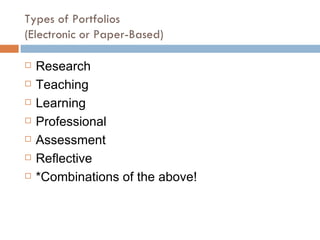
Types of Portfolios  (Electronic or Paper-Based) Research Teaching Learning Professional Assessment Reflective *Combinations of the above!
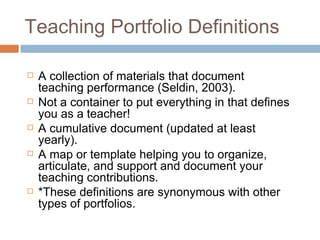
Teaching Portfolio Definitions A collection of materials that document teaching performance (Seldin, 2003).  Not a container to put everything in that defines you as a teacher! A cumulative document (updated at least yearly). A map or template helping you to organize, articulate, and support and document your teaching contributions. *These definitions are synonymous with other types of portfolios.
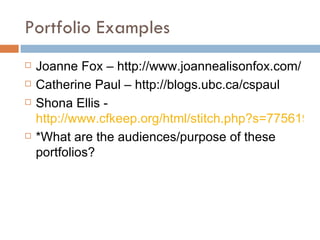
Portfolio Examples Joanne Fox – http://www.joannealisonfox.com/ Catherine Paul – http://blogs.ubc.ca/cspaul Shona Ellis -  http://www.cfkeep.org/html/stitch.php?s=77561976460332&id=94286895165487 *What are the audiences/purpose of these portfolios?
Examples As you review the following eportfolio sites please consider these questions:  What audience(s) do you think each portfolio is addressed to? How easily can you navigate the portfolio and find information you are looking for? What purposes do you think each portfolio could serve for each person? What do you like the most about each portfolio? Why? How could each portfolio be improved in terms of ease of navigation, clarity of purpose or depth of content?
Developing your Teaching Portfolio Question to ponder – WHO MIGHT MY AUDIENCE BE FOR MY TEACHING PORTFOLIO (be as specific as you can)? – Record your answer on your sheet.
Assembling a Portfolio: Before you Begin Understand the context – consult with your Dept., to determine the type of portfolio that suits your units needs. Know which teaching criteria your department and faculty use to assess instruction. Think about the content you will include and how your portfolio will be organized. Starting collecting info. pertaining to teaching NOW! Brevity is key – 5 to 8 pages (paper portfolio)  Questions to ponder – WHO CAN I TALK TO IN MY DEPARTMENT ABOUT DEVELOPING A TEACHING PORTFOLIO? WHAT INFORMATION DO I NEED TO KNOW BEFORE I GET STARTED?– Record your answers on your sheet.
Components of a Teaching Portfolio Philosophy Teaching Activities Providing Evidence of Student Learning Teaching Reflections
Philosophy: Tips for Development A statement about your goals and vision of teaching. Purpose: To introduce the reader to your views about teaching, learning, and students. Tips: Statement should be reflective and personal  Brief (few paragraphs to 1-2 pages) Use first person (narrative style) Avoid technical language – not everyone reading it will be an expert in your field! Questions to ponder – DO I HAVE A TEACHING PHILOSOPHY STATEMENT? WHAT ARE SOME OF MY GOALS/BELIEFS ABOUT TEACHING? – Record your answers on your sheet.
Philosophy Tips Continued Beginning Questions for Reflection Discipline and Classroom Approach (What is your greatest asset as a classroom teacher?) Instructor-Student Rapport (What is your primary goal with respect to your students?) Teaching Goals and Strategies (How does your teaching help students to master concepts and promote understanding of theory and practice?) Questions about Teaching (What is the one thing that you would like to change about your teaching? What have you done to change it?) Question to ponder – CHOOSE ONE QUESTION TO RESPOND TO FROM ABOVE, AND WRITE ONE SENTENCE OR SOME KEY WORDS IN RESPONSE.
Teaching Activities Teaching Responsibilities Supervising and Advising Students Activities Engaged In to Improve Teaching and Learning Committee Service (Teaching and Learning Issues) Publications and Professional Contributions Assessing and Reflecting Upon Teaching
Teaching Activities: Teaching Responsibilities Provide a brief summary of course types, class sizes, times, course goals (i.e. are you providing information, coaching, encouraging self-direction, etc.) Evidence: Teaching methods used in the classroom Titles and numbers of courses taught  Question to ponder – WHAT KINDS OF TEACHING RESPONSIBILITIES HAVE I HAD? (be as specific as possible)– Record your answer on your sheet
Teaching Activities: Activities Engaged In to Improve Teaching and Learning Your opportunity to focus on your efforts to improve the classroom climate, etc. and to summarize your attendance in teaching-related seminars, workshops, conferences, and how you used this new info. in your teaching List of activities Results of student ratings or questionnaires designed by you to solicit assessments on your teaching effectiveness Description of efforts made to improve the classroom climate or your teaching methods.  Question to ponder – WHAT KINDS OF ACTIVITIES TO IMPROVE TEACHING AND LEARNING HAVE I BEEN INVOLVED IN? (Suggestion – ISW should be on your list!). Record your answer on your sheet.
Teaching Activities: Committee Service (Teaching and Learning Issues) List of committee service that pertains to teaching and learning issues. Include details (names of committees, dates, and the nature of your contribution) Potential Service Teaching Assistant Professional Training Involvement in adjudicating or administering awards Organization of retreats and strategic planning sessions Development of department teaching resources Use of your teaching materials by instructors in other departments, faculties, colleges, etc.  Question to ponder – WHAT KINDS OF COMMITTEE SERVICE THAT RELATES TO TECHING AND LEARNING, HAVE I BEEN INVOLVED IN? – Record your answer on your sheet.
Teaching Activities: Publications and Professional Contributions (relating to Teaching and Learning) Discuss and provide supportive documentation about any involvement in developing and teaching seminars or workshops Examples Workshops and seminars about teaching that you designed and instructed Curriculum materials Funding related to teaching – internal and external teaching development grants, fellowships Question to ponder – WHAT PUBLICATIONS AND/OR PROFESSIONAL CONTRIBUTIONS RELATED TO TEACHING AND LEARNING, HAVE I BEEN INVOLVED IN? – Record your answer on your sheet.
Teaching Activities: Assessing and Reflecting Upon Teaching Include the ways that you monitor and evaluate your own teaching and reflect on what the evidence gathered tells you about your teaching. Ways to assess and reflect: Departmental teaching evaluations Peer evaluations or reviews Teaching awards received or nominated for Student-initiated feedback  Question to ponder – HOW DO I ASSESS AND REFLECT ON MY TEACHING? – Record your answer on your sheet.
Providing Evidence of Student Learning Discuss objective indicators of student progress (i.e. students’ standing on nation-wide tests)  Types of evidence of Student Learning Objective indicators of student progress  Feedback from supervisors or employers of graduates Questions to ponder –  DO I HAVE ANY EVIDENCE OF STUDENT LEARNING THAT I CAN INCLUDE? IF NOT, IS THERE A WAY THAT I COULD GET SOME?  – Record your answers on your sheet.
Teaching Reflections (in the body of the portfolio) Make some concluding remarks that tie together the philosophy, approaches, evidence, and evaluative sections.  Detail a plan for future actions, including your motivation and challenges and short and long-term teaching goals Questions to ponder – DO I HAVE ANY TEACHING RELATED REFLECTIONS THAT I COULD INCLUDE IN A PORFOLIO? IF NOT, WHAT KINDS OF TEACHING RELATED ACTIVITIES COULD I REFLECT ON? – Record your answers on your sheet.
Reflection: definitions Artifacts:    represent or symbolize what you know or can do artifacts as a "proof" examples could be a syllabus, picture, lesson plan...  Reflection :  reveals something about how you think says something about what you know and understand goes beyond statements like "I felt nervous when I taught my first class"
Reflection: The 4 Rs R eport : What is it? When was it created or used? Who was involved? Where was it used? R eflect : Why is it important? What did you learn from this sample? R elate : How could this sample inform practice? R evise : What feedback have you received? What have you (or might you) revise?   Source: Four Rs (Cloward, Hawkins, & Black, 2003)
Activity: Reflection Think of an artifact you would include in your portfolio. Complete the following reflection stems. WHAT:  Eg √  This example is… SO WHAT: Eg √  I was surprised to learn that… √ I learned that… √ I changed my mind about… NOW WHAT : √ A question I want to pursue as a result of this example…  Complete the following reflection stems about the sample: √  I am not satisfied with this example because… √  Something I would like others to notice about this example… √  A question I want to pursue as a result of this example… √  On the one hand… yet on the other hand… Reference: Rolheiser & Schwartz, 2001
Benefits of Creating a Teaching Portfolio?  
Benefits of Creating a Teaching Portfolio Reflect on your goals as a teacher Assess your teaching strengths and areas which need improvement Document your progress as a teacher Generate ideas for future teaching/course development Identify your personal teaching style Use elements of the portfolio to promote dialogue with fellow teachers Consider new ways of gathering student feedback Gather detailed data to support your goals Collect multiple sources of evidence that document the implementation of your teaching goals and their success. Question to ponder: WHY MIGHT YOU WANT TO CREATE A TEACHING PORTFOLIO? – Record your answer on your sheet.
Partner Activity With a partner, take turns sharing your teaching portfolio action plan sheet.  Highlight an area or aspect of your future teaching portfolio that you feel particularly interested in. Share what your next steps will be, in developing your teaching portfolio.  RECORD YOUR ANSWER ON YOUR SHEET. Share one thing you learned about teaching portfolios today. Large group debrief
Revisiting Learning Objectives How did we do regarding our learning objectives? Learning Objectives: Compare different types of portfolios and begin to determine what your own goals could be in relationship to teaching portfolios. Identify portfolio resources available on campus and beyond. Identify common components in a teaching portfolio and artifacts that you could include in your teaching portfolio. Create an action plan for developing your own teaching portfolio
Academic Resources on Developing Portfolios (available in the TAG Resource Room) Barrett, H. (2000). Electronic teaching portfolios: Multimedia skills and portfolio development = powerful professional development. In B. Cambridge (Ed.),  Electronic Portfolios  (pp. 110-116). Washington, DC: American Association for Higher Education.  Chism, N. V. N. (1998). Developing a philosophy of teaching statement.  Toward the Best in the Academy: Essays on Teaching Excellence , 9,  (3) . Professional and Organizational Development Network in Higher Education.  Seldin, P. (2004).  The teaching portfolio: A practical guide to improved performance and promotion/tenure decisions . Bolton, MA: Anker Publishing Co.
Portfolio Resources at TAG TAG – Resource Room (Library) – Irving K Barber Building (non-lending library) TAG Website  www.tag.ubc.ca  (search for Portfolios) TAG’s Portfolio Community of Practice – become a member through TAG’s website Workshop resources   http://wiki.ubc.ca/Portfolios  Portfolio CoP blog: http://blogs.ubc.ca/portfolios/
Questions? Contact:  Roselynn Verwoord,  [email_address] Catherine Paul, catherine.paul@ubc.ca

Introduction to Teaching Portfolios

  • 1.
    Teaching Portfolios FHISTA Training Program Workshop March 12th, 2010 4-6pm Facilitators: Roselynn Verwoord, Community of Practice Developer, TAG Catherine Paul, Community of Practice Facilitator, OLT
  • 2.
    Questions about PortfoliosWhat is a portfolio? What is a teaching portfolio? Do you know anyone who has a teaching portfolio?
  • 3.
    Session Learning ObjectivesBy the end of this lesson, you will be able to: Compare different types of portfolios and begin to determine what your own goals could be in relationship to teaching portfolios. Identify portfolio resources available on campus and beyond. Identify common components in a teaching portfolio and artifacts that you could include in your teaching portfolio Create an action plan for developing your own teaching portfolio
  • 4.
    Kinds of PortfoliosWhat kinds of portfolios (other than teaching portfolios) are there?
  • 5.
    Types of Portfolios (Electronic or Paper-Based) Research Teaching Learning Professional Assessment Reflective *Combinations of the above!
  • 6.
    Teaching Portfolio DefinitionsA collection of materials that document teaching performance (Seldin, 2003). Not a container to put everything in that defines you as a teacher! A cumulative document (updated at least yearly). A map or template helping you to organize, articulate, and support and document your teaching contributions. *These definitions are synonymous with other types of portfolios.
  • 7.
    Portfolio Examples JoanneFox – http://www.joannealisonfox.com/ Catherine Paul – http://blogs.ubc.ca/cspaul Shona Ellis - http://www.cfkeep.org/html/stitch.php?s=77561976460332&id=94286895165487 *What are the audiences/purpose of these portfolios?
  • 8.
    Examples As youreview the following eportfolio sites please consider these questions:  What audience(s) do you think each portfolio is addressed to? How easily can you navigate the portfolio and find information you are looking for? What purposes do you think each portfolio could serve for each person? What do you like the most about each portfolio? Why? How could each portfolio be improved in terms of ease of navigation, clarity of purpose or depth of content?
  • 9.
    Developing your TeachingPortfolio Question to ponder – WHO MIGHT MY AUDIENCE BE FOR MY TEACHING PORTFOLIO (be as specific as you can)? – Record your answer on your sheet.
  • 10.
    Assembling a Portfolio:Before you Begin Understand the context – consult with your Dept., to determine the type of portfolio that suits your units needs. Know which teaching criteria your department and faculty use to assess instruction. Think about the content you will include and how your portfolio will be organized. Starting collecting info. pertaining to teaching NOW! Brevity is key – 5 to 8 pages (paper portfolio) Questions to ponder – WHO CAN I TALK TO IN MY DEPARTMENT ABOUT DEVELOPING A TEACHING PORTFOLIO? WHAT INFORMATION DO I NEED TO KNOW BEFORE I GET STARTED?– Record your answers on your sheet.
  • 11.
    Components of aTeaching Portfolio Philosophy Teaching Activities Providing Evidence of Student Learning Teaching Reflections
  • 12.
    Philosophy: Tips forDevelopment A statement about your goals and vision of teaching. Purpose: To introduce the reader to your views about teaching, learning, and students. Tips: Statement should be reflective and personal Brief (few paragraphs to 1-2 pages) Use first person (narrative style) Avoid technical language – not everyone reading it will be an expert in your field! Questions to ponder – DO I HAVE A TEACHING PHILOSOPHY STATEMENT? WHAT ARE SOME OF MY GOALS/BELIEFS ABOUT TEACHING? – Record your answers on your sheet.
  • 13.
    Philosophy Tips ContinuedBeginning Questions for Reflection Discipline and Classroom Approach (What is your greatest asset as a classroom teacher?) Instructor-Student Rapport (What is your primary goal with respect to your students?) Teaching Goals and Strategies (How does your teaching help students to master concepts and promote understanding of theory and practice?) Questions about Teaching (What is the one thing that you would like to change about your teaching? What have you done to change it?) Question to ponder – CHOOSE ONE QUESTION TO RESPOND TO FROM ABOVE, AND WRITE ONE SENTENCE OR SOME KEY WORDS IN RESPONSE.
  • 14.
    Teaching Activities TeachingResponsibilities Supervising and Advising Students Activities Engaged In to Improve Teaching and Learning Committee Service (Teaching and Learning Issues) Publications and Professional Contributions Assessing and Reflecting Upon Teaching
  • 15.
    Teaching Activities: TeachingResponsibilities Provide a brief summary of course types, class sizes, times, course goals (i.e. are you providing information, coaching, encouraging self-direction, etc.) Evidence: Teaching methods used in the classroom Titles and numbers of courses taught Question to ponder – WHAT KINDS OF TEACHING RESPONSIBILITIES HAVE I HAD? (be as specific as possible)– Record your answer on your sheet
  • 16.
    Teaching Activities: ActivitiesEngaged In to Improve Teaching and Learning Your opportunity to focus on your efforts to improve the classroom climate, etc. and to summarize your attendance in teaching-related seminars, workshops, conferences, and how you used this new info. in your teaching List of activities Results of student ratings or questionnaires designed by you to solicit assessments on your teaching effectiveness Description of efforts made to improve the classroom climate or your teaching methods. Question to ponder – WHAT KINDS OF ACTIVITIES TO IMPROVE TEACHING AND LEARNING HAVE I BEEN INVOLVED IN? (Suggestion – ISW should be on your list!). Record your answer on your sheet.
  • 17.
    Teaching Activities: CommitteeService (Teaching and Learning Issues) List of committee service that pertains to teaching and learning issues. Include details (names of committees, dates, and the nature of your contribution) Potential Service Teaching Assistant Professional Training Involvement in adjudicating or administering awards Organization of retreats and strategic planning sessions Development of department teaching resources Use of your teaching materials by instructors in other departments, faculties, colleges, etc. Question to ponder – WHAT KINDS OF COMMITTEE SERVICE THAT RELATES TO TECHING AND LEARNING, HAVE I BEEN INVOLVED IN? – Record your answer on your sheet.
  • 18.
    Teaching Activities: Publicationsand Professional Contributions (relating to Teaching and Learning) Discuss and provide supportive documentation about any involvement in developing and teaching seminars or workshops Examples Workshops and seminars about teaching that you designed and instructed Curriculum materials Funding related to teaching – internal and external teaching development grants, fellowships Question to ponder – WHAT PUBLICATIONS AND/OR PROFESSIONAL CONTRIBUTIONS RELATED TO TEACHING AND LEARNING, HAVE I BEEN INVOLVED IN? – Record your answer on your sheet.
  • 19.
    Teaching Activities: Assessingand Reflecting Upon Teaching Include the ways that you monitor and evaluate your own teaching and reflect on what the evidence gathered tells you about your teaching. Ways to assess and reflect: Departmental teaching evaluations Peer evaluations or reviews Teaching awards received or nominated for Student-initiated feedback Question to ponder – HOW DO I ASSESS AND REFLECT ON MY TEACHING? – Record your answer on your sheet.
  • 20.
    Providing Evidence ofStudent Learning Discuss objective indicators of student progress (i.e. students’ standing on nation-wide tests) Types of evidence of Student Learning Objective indicators of student progress Feedback from supervisors or employers of graduates Questions to ponder – DO I HAVE ANY EVIDENCE OF STUDENT LEARNING THAT I CAN INCLUDE? IF NOT, IS THERE A WAY THAT I COULD GET SOME? – Record your answers on your sheet.
  • 21.
    Teaching Reflections (inthe body of the portfolio) Make some concluding remarks that tie together the philosophy, approaches, evidence, and evaluative sections. Detail a plan for future actions, including your motivation and challenges and short and long-term teaching goals Questions to ponder – DO I HAVE ANY TEACHING RELATED REFLECTIONS THAT I COULD INCLUDE IN A PORFOLIO? IF NOT, WHAT KINDS OF TEACHING RELATED ACTIVITIES COULD I REFLECT ON? – Record your answers on your sheet.
  • 22.
    Reflection: definitions Artifacts:   represent or symbolize what you know or can do artifacts as a "proof" examples could be a syllabus, picture, lesson plan... Reflection : reveals something about how you think says something about what you know and understand goes beyond statements like "I felt nervous when I taught my first class"
  • 23.
    Reflection: The 4Rs R eport : What is it? When was it created or used? Who was involved? Where was it used? R eflect : Why is it important? What did you learn from this sample? R elate : How could this sample inform practice? R evise : What feedback have you received? What have you (or might you) revise? Source: Four Rs (Cloward, Hawkins, & Black, 2003)
  • 24.
    Activity: Reflection Thinkof an artifact you would include in your portfolio. Complete the following reflection stems. WHAT: Eg √ This example is… SO WHAT: Eg √ I was surprised to learn that… √ I learned that… √ I changed my mind about… NOW WHAT : √ A question I want to pursue as a result of this example… Complete the following reflection stems about the sample: √ I am not satisfied with this example because… √ Something I would like others to notice about this example… √ A question I want to pursue as a result of this example… √ On the one hand… yet on the other hand… Reference: Rolheiser & Schwartz, 2001
  • 25.
    Benefits of Creatinga Teaching Portfolio?  
  • 26.
    Benefits of Creatinga Teaching Portfolio Reflect on your goals as a teacher Assess your teaching strengths and areas which need improvement Document your progress as a teacher Generate ideas for future teaching/course development Identify your personal teaching style Use elements of the portfolio to promote dialogue with fellow teachers Consider new ways of gathering student feedback Gather detailed data to support your goals Collect multiple sources of evidence that document the implementation of your teaching goals and their success. Question to ponder: WHY MIGHT YOU WANT TO CREATE A TEACHING PORTFOLIO? – Record your answer on your sheet.
  • 27.
    Partner Activity Witha partner, take turns sharing your teaching portfolio action plan sheet. Highlight an area or aspect of your future teaching portfolio that you feel particularly interested in. Share what your next steps will be, in developing your teaching portfolio. RECORD YOUR ANSWER ON YOUR SHEET. Share one thing you learned about teaching portfolios today. Large group debrief
  • 28.
    Revisiting Learning ObjectivesHow did we do regarding our learning objectives? Learning Objectives: Compare different types of portfolios and begin to determine what your own goals could be in relationship to teaching portfolios. Identify portfolio resources available on campus and beyond. Identify common components in a teaching portfolio and artifacts that you could include in your teaching portfolio. Create an action plan for developing your own teaching portfolio
  • 29.
    Academic Resources onDeveloping Portfolios (available in the TAG Resource Room) Barrett, H. (2000). Electronic teaching portfolios: Multimedia skills and portfolio development = powerful professional development. In B. Cambridge (Ed.), Electronic Portfolios (pp. 110-116). Washington, DC: American Association for Higher Education. Chism, N. V. N. (1998). Developing a philosophy of teaching statement. Toward the Best in the Academy: Essays on Teaching Excellence , 9, (3) . Professional and Organizational Development Network in Higher Education. Seldin, P. (2004). The teaching portfolio: A practical guide to improved performance and promotion/tenure decisions . Bolton, MA: Anker Publishing Co.
  • 30.
    Portfolio Resources atTAG TAG – Resource Room (Library) – Irving K Barber Building (non-lending library) TAG Website www.tag.ubc.ca (search for Portfolios) TAG’s Portfolio Community of Practice – become a member through TAG’s website Workshop resources   http://wiki.ubc.ca/Portfolios Portfolio CoP blog: http://blogs.ubc.ca/portfolios/
  • 31.
    Questions? Contact: Roselynn Verwoord, [email_address] Catherine Paul, catherine.paul@ubc.ca