SUN
our friend or enemy?
Source: https://en.wikipedia.org/wiki/Sunspot
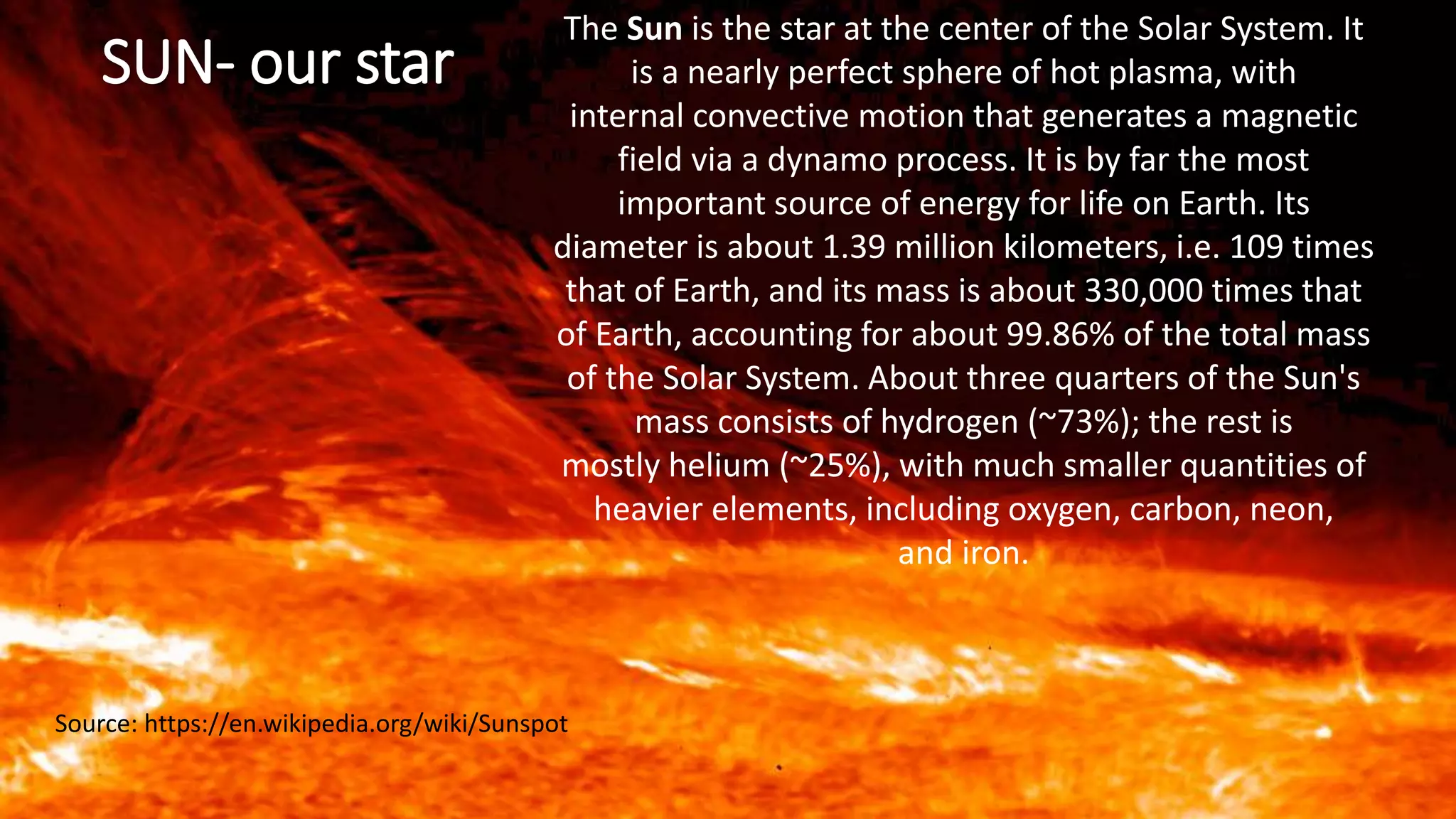
SUN- our star
The Sun is the star at the center of the Solar System. It
is a nearly perfect sphere of hot plasma, with
internal convective motion that generates a magnetic
field via a dynamo process. It is by far the most
important source of energy for life on Earth. Its
diameter is about 1.39 million kilometers, i.e. 109 times
that of Earth, and its mass is about 330,000 times that
of Earth, accounting for about 99.86% of the total mass
of the Solar System. About three quarters of the Sun's
mass consists of hydrogen (~73%); the rest is
mostly helium (~25%), with much smaller quantities of
heavier elements, including oxygen, carbon, neon,
and iron.
Source: https://en.wikipedia.org/wiki/Sunspot
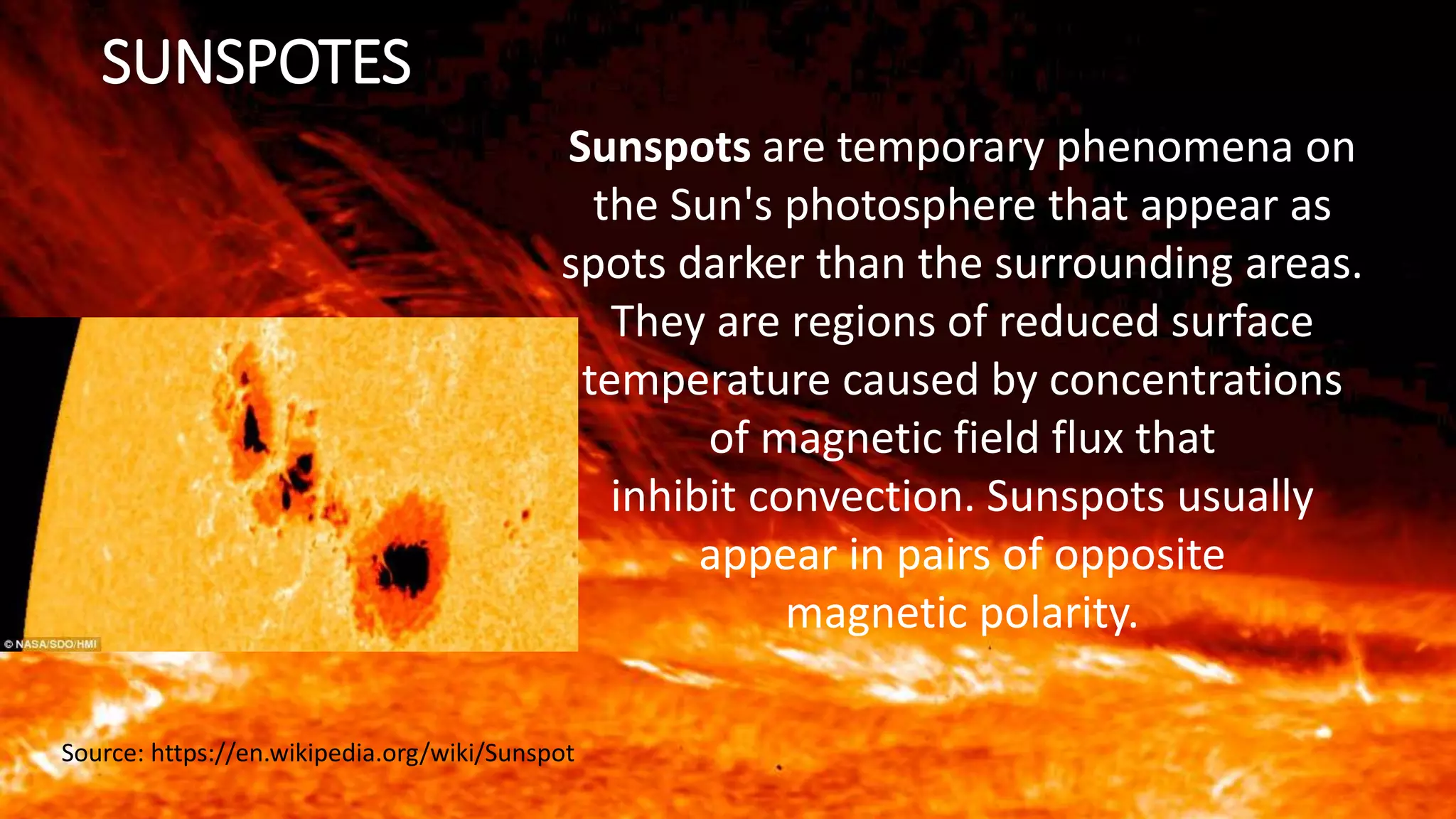
SUNSPOTES
Sunspots are temporary phenomena on
the Sun's photosphere that appear as
spots darker than the surrounding areas.
They are regions of reduced surface
temperature caused by concentrations
of magnetic field flux that
inhibit convection. Sunspots usually
appear in pairs of opposite
magnetic polarity.
Source: https://en.wikipedia.org/wiki/Sunspot
SUN- our friend or enemy?
Source:
https://pl.wikipedia.org/wiki/Plik:The_Earth_se
en_from_Apollo_17.jpg
SUN- our friend or enemy?
Source:
https://pl.wikipedia.org/wiki/Supe
rnowa#/media/File:Keplers_super
nova.jpg
SUNSPOTES- how to observet??
To obserwate sunspotes we must have a
special filter.
We can’t obserwate sun with normal
telescope ore binoculars becouse
threatens this demage eyesight.
SUNSPOTES- how we observet??
We have observet sun and sunspotes
with telescope with special filters for sun
observation.
SUN- the photography, without sunspots 
Unfortunate
ly, the
activity of
sunspots is
zero

Sun

  • 1.
    SUN our friend orenemy? Source: https://en.wikipedia.org/wiki/Sunspot
  • 2.
    SUN- our star TheSun is the star at the center of the Solar System. It is a nearly perfect sphere of hot plasma, with internal convective motion that generates a magnetic field via a dynamo process. It is by far the most important source of energy for life on Earth. Its diameter is about 1.39 million kilometers, i.e. 109 times that of Earth, and its mass is about 330,000 times that of Earth, accounting for about 99.86% of the total mass of the Solar System. About three quarters of the Sun's mass consists of hydrogen (~73%); the rest is mostly helium (~25%), with much smaller quantities of heavier elements, including oxygen, carbon, neon, and iron. Source: https://en.wikipedia.org/wiki/Sunspot
  • 3.
    SUNSPOTES Sunspots are temporaryphenomena on the Sun's photosphere that appear as spots darker than the surrounding areas. They are regions of reduced surface temperature caused by concentrations of magnetic field flux that inhibit convection. Sunspots usually appear in pairs of opposite magnetic polarity. Source: https://en.wikipedia.org/wiki/Sunspot
  • 4.
    SUN- our friendor enemy? Source: https://pl.wikipedia.org/wiki/Plik:The_Earth_se en_from_Apollo_17.jpg
  • 5.
    SUN- our friendor enemy? Source: https://pl.wikipedia.org/wiki/Supe rnowa#/media/File:Keplers_super nova.jpg
  • 6.
    SUNSPOTES- how toobservet?? To obserwate sunspotes we must have a special filter. We can’t obserwate sun with normal telescope ore binoculars becouse threatens this demage eyesight.
  • 7.
    SUNSPOTES- how weobservet?? We have observet sun and sunspotes with telescope with special filters for sun observation.
  • 8.
    SUN- the photography,without sunspots  Unfortunate ly, the activity of sunspots is zero