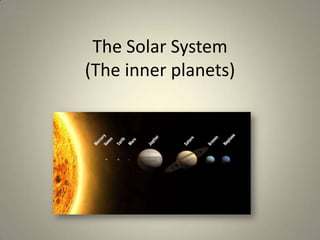
The Solar System
(The inner planets)
The Solar System
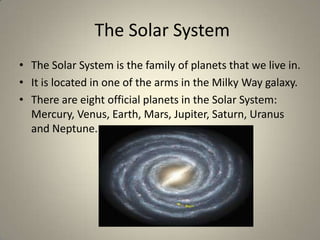
• The Solar System is the family of planets that we live in.
• It is located in one of the arms in the Milky Way galaxy.
• There are eight official planets in the Solar System:
Mercury, Venus, Earth, Mars, Jupiter, Saturn, Uranus
and Neptune.
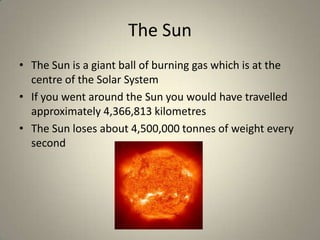
The Sun
• The Sun is a giant ball of burning gas which is at the
centre of the Solar System
• If you went around the Sun you would have travelled
approximately 4,366,813 kilometres
• The Sun loses about 4,500,000 tonnes of weight every
second
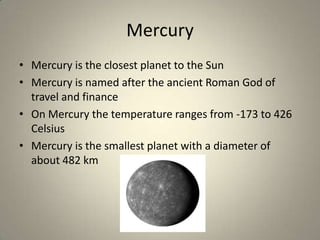
Mercury
• Mercury is the closest planet to the Sun
• Mercury is named after the ancient Roman God of
travel and finance
• On Mercury the temperature ranges from -173 to 426
Celsius
• Mercury is the smallest planet with a diameter of
about 482 km
Venus
• Venus is the hottest planet in the Solar System reaching a
temperature of 462 Celsius
• Venus is named after the ancient Roman Goddess of beauty
• Venus’ day (8 months) is longer than its year (7 ½ months)
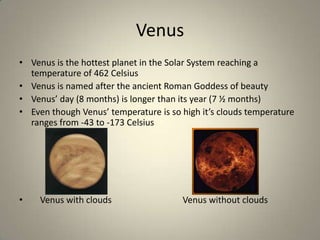
• Even though Venus’ temperature is so high it’s clouds temperature
ranges from -43 to -173 Celsius

•

Venus with clouds

Venus without clouds
Earth
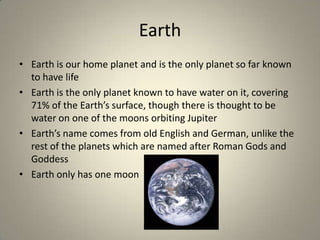
• Earth is our home planet and is the only planet so far known
to have life
• Earth is the only planet known to have water on it, covering
71% of the Earth’s surface, though there is thought to be
water on one of the moons orbiting Jupiter
• Earth’s name comes from old English and German, unlike the
rest of the planets which are named after Roman Gods and
Goddess
• Earth only has one moon
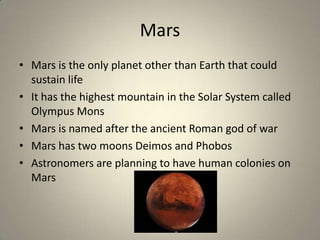
Mars
• Mars is the only planet other than Earth that could
sustain life
• It has the highest mountain in the Solar System called
Olympus Mons
• Mars is named after the ancient Roman god of war
• Mars has two moons Deimos and Phobos
• Astronomers are planning to have human colonies on
Mars
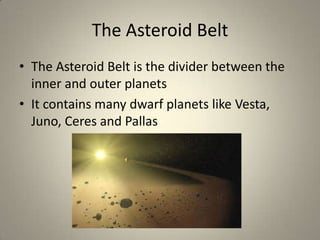
The Asteroid Belt
• The Asteroid Belt is the divider between the
inner and outer planets
• It contains many dwarf planets like Vesta,
Juno, Ceres and Pallas
The Solar System
(The Outer Planets)
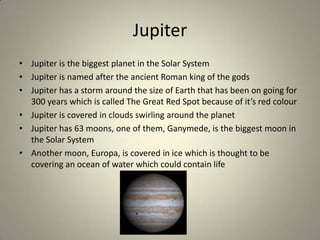
Jupiter
• Jupiter is the biggest planet in the Solar System
• Jupiter is named after the ancient Roman king of the gods
• Jupiter has a storm around the size of Earth that has been on going for
300 years which is called The Great Red Spot because of it’s red colour
• Jupiter is covered in clouds swirling around the planet
• Jupiter has 63 moons, one of them, Ganymede, is the biggest moon in
the Solar System
• Another moon, Europa, is covered in ice which is thought to be
covering an ocean of water which could contain life
Saturn
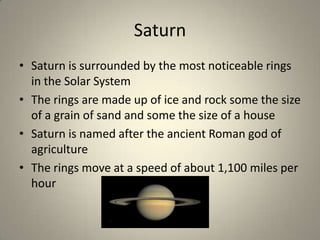
• Saturn is surrounded by the most noticeable rings
in the Solar System
• The rings are made up of ice and rock some the size
of a grain of sand and some the size of a house
• Saturn is named after the ancient Roman god of
agriculture
• The rings move at a speed of about 1,100 miles per
hour
Uranus
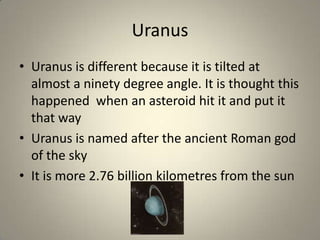
• Uranus is different because it is tilted at
almost a ninety degree angle. It is thought this
happened when an asteroid hit it and put it
that way
• Uranus is named after the ancient Roman god
of the sky
• It is more 2.76 billion kilometres from the sun
Neptune
• Neptune is the furthest planet from the Sun
• Neptune temperature reaches -218 Celsius
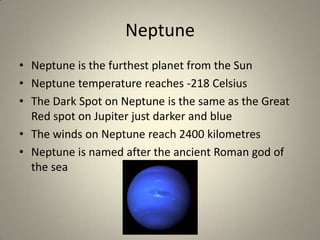
• The Dark Spot on Neptune is the same as the Great
Red spot on Jupiter just darker and blue
• The winds on Neptune reach 2400 kilometres
• Neptune is named after the ancient Roman god of
the sea
The Kuiper Belt
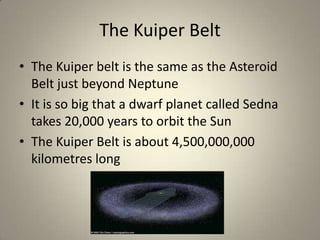
• The Kuiper belt is the same as the Asteroid
Belt just beyond Neptune
• It is so big that a dwarf planet called Sedna
takes 20,000 years to orbit the Sun
• The Kuiper Belt is about 4,500,000,000
kilometres long

The solar system

  • 1.
    The Solar System (Theinner planets)
  • 2.
    The Solar System •The Solar System is the family of planets that we live in. • It is located in one of the arms in the Milky Way galaxy. • There are eight official planets in the Solar System: Mercury, Venus, Earth, Mars, Jupiter, Saturn, Uranus and Neptune.
  • 3.
    The Sun • TheSun is a giant ball of burning gas which is at the centre of the Solar System • If you went around the Sun you would have travelled approximately 4,366,813 kilometres • The Sun loses about 4,500,000 tonnes of weight every second
  • 4.
    Mercury • Mercury isthe closest planet to the Sun • Mercury is named after the ancient Roman God of travel and finance • On Mercury the temperature ranges from -173 to 426 Celsius • Mercury is the smallest planet with a diameter of about 482 km
  • 5.
    Venus • Venus isthe hottest planet in the Solar System reaching a temperature of 462 Celsius • Venus is named after the ancient Roman Goddess of beauty • Venus’ day (8 months) is longer than its year (7 ½ months) • Even though Venus’ temperature is so high it’s clouds temperature ranges from -43 to -173 Celsius • Venus with clouds Venus without clouds
  • 6.
    Earth • Earth isour home planet and is the only planet so far known to have life • Earth is the only planet known to have water on it, covering 71% of the Earth’s surface, though there is thought to be water on one of the moons orbiting Jupiter • Earth’s name comes from old English and German, unlike the rest of the planets which are named after Roman Gods and Goddess • Earth only has one moon
  • 7.
    Mars • Mars isthe only planet other than Earth that could sustain life • It has the highest mountain in the Solar System called Olympus Mons • Mars is named after the ancient Roman god of war • Mars has two moons Deimos and Phobos • Astronomers are planning to have human colonies on Mars
  • 8.
    The Asteroid Belt •The Asteroid Belt is the divider between the inner and outer planets • It contains many dwarf planets like Vesta, Juno, Ceres and Pallas
  • 9.
    The Solar System (TheOuter Planets)
  • 10.
    Jupiter • Jupiter isthe biggest planet in the Solar System • Jupiter is named after the ancient Roman king of the gods • Jupiter has a storm around the size of Earth that has been on going for 300 years which is called The Great Red Spot because of it’s red colour • Jupiter is covered in clouds swirling around the planet • Jupiter has 63 moons, one of them, Ganymede, is the biggest moon in the Solar System • Another moon, Europa, is covered in ice which is thought to be covering an ocean of water which could contain life
  • 11.
    Saturn • Saturn issurrounded by the most noticeable rings in the Solar System • The rings are made up of ice and rock some the size of a grain of sand and some the size of a house • Saturn is named after the ancient Roman god of agriculture • The rings move at a speed of about 1,100 miles per hour
  • 12.
    Uranus • Uranus isdifferent because it is tilted at almost a ninety degree angle. It is thought this happened when an asteroid hit it and put it that way • Uranus is named after the ancient Roman god of the sky • It is more 2.76 billion kilometres from the sun
  • 13.
    Neptune • Neptune isthe furthest planet from the Sun • Neptune temperature reaches -218 Celsius • The Dark Spot on Neptune is the same as the Great Red spot on Jupiter just darker and blue • The winds on Neptune reach 2400 kilometres • Neptune is named after the ancient Roman god of the sea
  • 14.
    The Kuiper Belt •The Kuiper belt is the same as the Asteroid Belt just beyond Neptune • It is so big that a dwarf planet called Sedna takes 20,000 years to orbit the Sun • The Kuiper Belt is about 4,500,000,000 kilometres long