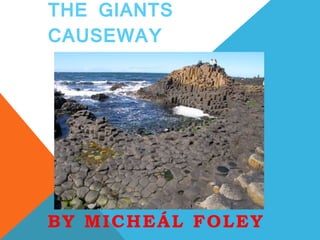
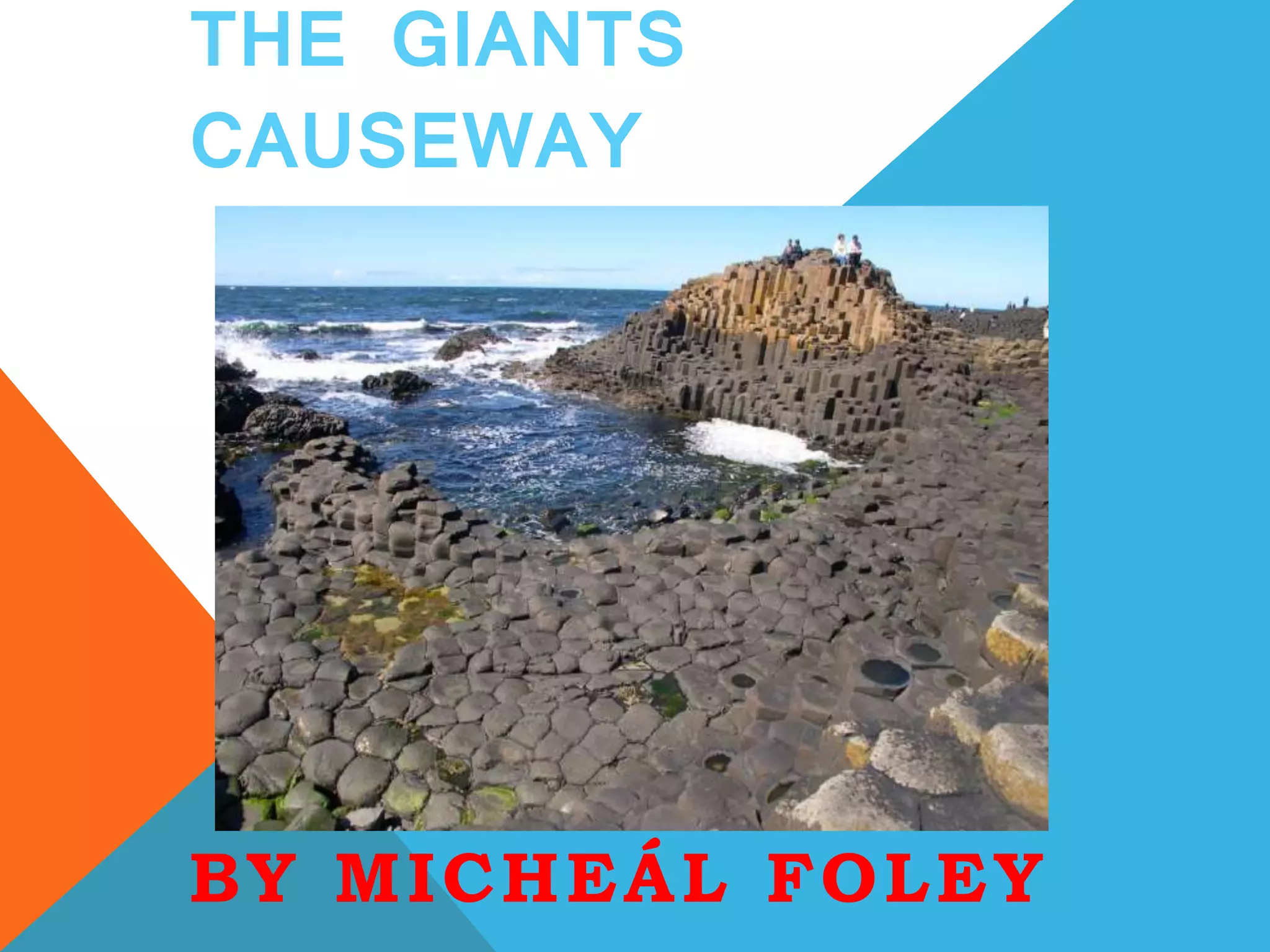
THE GIANTS 
CAUSEWAY 
BY MICHEÁL FOLEY
What is the giants causeway 
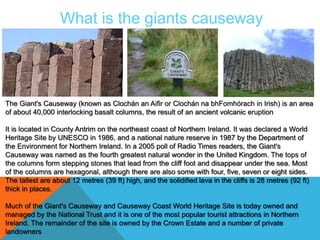
The Giant's Causeway (known as Clochán an Aifir or Clochán na bhFomhórach in Irish) is an area 
of about 40,000 interlocking basalt columns, the result of an ancient volcanic eruption 
It is located in County Antrim on the northeast coast of Northern Ireland. It was declared a World 
Heritage Site by UNESCO in 1986, and a national nature reserve in 1987 by the Department of 
the Environment for Northern Ireland. In a 2005 poll of Radio Times readers, the Giant's 
Causeway was named as the fourth greatest natural wonder in the United Kingdom. The tops of 
the columns form stepping stones that lead from the cliff foot and disappear under the sea. Most 
of the columns are hexagonal, although there are also some with four, five, seven or eight sides. 
The tallest are about 12 metres (39 ft) high, and the solidified lava in the cliffs is 28 metres (92 ft) 
thick in places. 
Much of the Giant's Causeway and Causeway Coast World Heritage Site is today owned and 
managed by the National Trust and it is one of the most popular tourist attractions in Northern 
Ireland. The remainder of the site is owned by the Crown Estate and a number of private 
landowners
THE FORMATION 
About 65 million years ago – after the dinosaurs but before man – the landscape was very 
different. Forests grew and rivers flowed on a land made of chalk. 
The chalk, or white limestone, can still be seen east and west of the Giant’s Causeway. 
At that time the continents we recognise today were joined in one huge landmass called 
Pangaea, sitting on great foundations known as plates. 
The North American plate and the Eurasian plate started to move apart, forming the Atlantic 
Ocean. 
This movement caused a period of intense volcanic activity which lasted for several million 
years. 
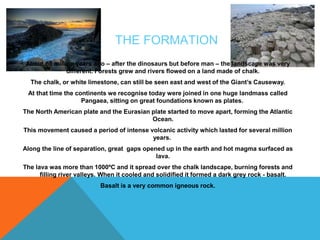
Along the line of separation, great gaps opened up in the earth and hot magma surfaced as 
lava. 
The lava was more than 1000ºC and it spread over the chalk landscape, burning forests and 
filling river valleys. When it cooled and solidified it formed a dark grey rock - basalt. 
Basalt is a very common igneous rock.
TOURISM 
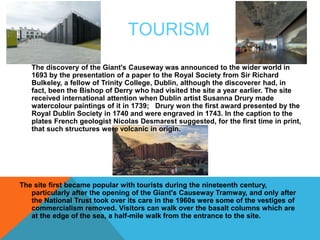
The discovery of the Giant's Causeway was announced to the wider world in 
1693 by the presentation of a paper to the Royal Society from Sir Richard 
Bulkeley, a fellow of Trinity College, Dublin, although the discoverer had, in 
fact, been the Bishop of Derry who had visited the site a year earlier. The site 
received international attention when Dublin artist Susanna Drury made 
watercolour paintings of it in 1739; Drury won the first award presented by the 
Royal Dublin Society in 1740 and were engraved in 1743. In the caption to the 
plates French geologist Nicolas Desmarest suggested, for the first time in print, 
that such structures were volcanic in origin. 
The site first became popular with tourists during the nineteenth century, 
particularly after the opening of the Giant's Causeway Tramway, and only after 
the National Trust took over its care in the 1960s were some of the vestiges of 
commercialism removed. Visitors can walk over the basalt columns which are 
at the edge of the sea, a half-mile walk from the entrance to the site.
WILDLIFE IN THE 
CAUSEWAY 
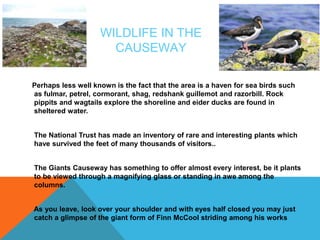
Perhaps less well known is the fact that the area is a haven for sea birds such 
as fulmar, petrel, cormorant, shag, redshank guillemot and razorbill. Rock 
pippits and wagtails explore the shoreline and eider ducks are found in 
sheltered water. 
The National Trust has made an inventory of rare and interesting plants which 
have survived the feet of many thousands of visitors.. 
The Giants Causeway has something to offer almost every interest, be it plants 
to be viewed through a magnifying glass or standing in awe among the 
columns. 
As you leave, look over your shoulder and with eyes half closed you may just 
catch a glimpse of the giant form of Finn McCool striding among his works

The Giants Causeway

  • 1.
    THE GIANTS CAUSEWAY BY MICHEÁL FOLEY
  • 2.
    What is thegiants causeway The Giant's Causeway (known as Clochán an Aifir or Clochán na bhFomhórach in Irish) is an area of about 40,000 interlocking basalt columns, the result of an ancient volcanic eruption It is located in County Antrim on the northeast coast of Northern Ireland. It was declared a World Heritage Site by UNESCO in 1986, and a national nature reserve in 1987 by the Department of the Environment for Northern Ireland. In a 2005 poll of Radio Times readers, the Giant's Causeway was named as the fourth greatest natural wonder in the United Kingdom. The tops of the columns form stepping stones that lead from the cliff foot and disappear under the sea. Most of the columns are hexagonal, although there are also some with four, five, seven or eight sides. The tallest are about 12 metres (39 ft) high, and the solidified lava in the cliffs is 28 metres (92 ft) thick in places. Much of the Giant's Causeway and Causeway Coast World Heritage Site is today owned and managed by the National Trust and it is one of the most popular tourist attractions in Northern Ireland. The remainder of the site is owned by the Crown Estate and a number of private landowners
  • 3.
    THE FORMATION About65 million years ago – after the dinosaurs but before man – the landscape was very different. Forests grew and rivers flowed on a land made of chalk. The chalk, or white limestone, can still be seen east and west of the Giant’s Causeway. At that time the continents we recognise today were joined in one huge landmass called Pangaea, sitting on great foundations known as plates. The North American plate and the Eurasian plate started to move apart, forming the Atlantic Ocean. This movement caused a period of intense volcanic activity which lasted for several million years. Along the line of separation, great gaps opened up in the earth and hot magma surfaced as lava. The lava was more than 1000ºC and it spread over the chalk landscape, burning forests and filling river valleys. When it cooled and solidified it formed a dark grey rock - basalt. Basalt is a very common igneous rock.
  • 4.
    TOURISM The discoveryof the Giant's Causeway was announced to the wider world in 1693 by the presentation of a paper to the Royal Society from Sir Richard Bulkeley, a fellow of Trinity College, Dublin, although the discoverer had, in fact, been the Bishop of Derry who had visited the site a year earlier. The site received international attention when Dublin artist Susanna Drury made watercolour paintings of it in 1739; Drury won the first award presented by the Royal Dublin Society in 1740 and were engraved in 1743. In the caption to the plates French geologist Nicolas Desmarest suggested, for the first time in print, that such structures were volcanic in origin. The site first became popular with tourists during the nineteenth century, particularly after the opening of the Giant's Causeway Tramway, and only after the National Trust took over its care in the 1960s were some of the vestiges of commercialism removed. Visitors can walk over the basalt columns which are at the edge of the sea, a half-mile walk from the entrance to the site.
  • 5.
    WILDLIFE IN THE CAUSEWAY Perhaps less well known is the fact that the area is a haven for sea birds such as fulmar, petrel, cormorant, shag, redshank guillemot and razorbill. Rock pippits and wagtails explore the shoreline and eider ducks are found in sheltered water. The National Trust has made an inventory of rare and interesting plants which have survived the feet of many thousands of visitors.. The Giants Causeway has something to offer almost every interest, be it plants to be viewed through a magnifying glass or standing in awe among the columns. As you leave, look over your shoulder and with eyes half closed you may just catch a glimpse of the giant form of Finn McCool striding among his works