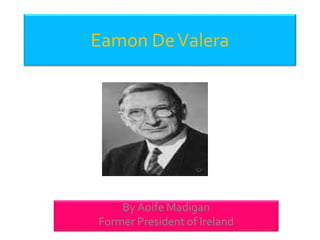
Eamon DeValera 
By Aoife Madigan 
Former President of Ireland
Fact File 
Eamon was born on October 14 1882 in New 
York. 
He died on 29 August 1975 at the age of 92. 
 He was buried in Glasnevin Cemetry after a state 
funeral. 
He had five sons Vivion ,Eamon, Brian, Ruaidhri, 
Terence(Terry) and two daughters Mairin and 
Emer. 
His parents were Juan Vivion De Valera and 
Catherine Coll.
His father was a Spaniard who had studied to be 
a sculptor but because of ill-health he was forced 
back to teaching music. In September 1881, his 
father married an Irish immigrant Kate Coll from 
Co. Limerick, in America. 
 His father died when de Valera was only two 
years old and his mother decided that her son 
would be better off at home in Ireland. She sent 
him to be reared by his grandmother, Elizabeth, 
who lived in a labourer’s cottage at Knockmore 
Co. Limerick.
Early Life 
 De Valera attended the national school at Bruree and 
from there went to the Christian Brother’s School at 
Charleville. 
 He walked the seven miles there and back everyday 
since the Coll’s could not afford a bicycle. 
 At 16, he won a scholarship to Blackrock College, Co. 
Dublin. He went on to become a professor of 
mathematics and lectured part-time at Maynooth and 
various Dublin colleges. At school ,and later he was a 
keen rugby player.
 In 1908, he joined the Gaelic League, the 
beginning of his life-long devotion to Ireland. 
 One of his teachers was Sinead Flanagan, 
herself a teacher and four years older than him. 
They fell in love and were married in January 
1910. 
 De Valera joined the Irish Volunteers at their 
first meeting in 1913. 
 He took part in the landing of guns from the 
Asgard in July 1914.These guns were to be 
used later in the 1916 rising.
o He commanded the Boland’s Mills garrison 
during the 1916 rising. After the surrender he 
was sentenced to death, but later it was 
decided to sentence him to life 
imprisonment instead. 
o De Valera was released from prison in June 
1917 and was elected Sinn Fein deputy for 
East Clare. At the Sinn Fein Ard-Fheis in 
October 1917, de Valera was elected 
President of the party and at the end of the 
same month he was elected President of the 
Irish Volunteers.
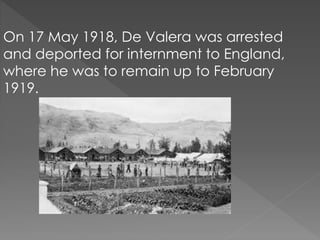
On 17 May 1918, De Valera was arrested 
and deported for internment to England, 
where he was to remain up to February 
1919.
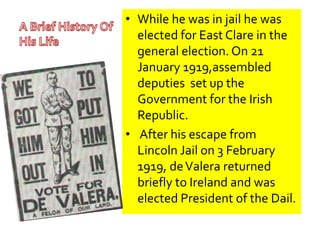
• While he was in jail he was 
elected for East Clare in the 
general election. On 21 
January 1919,assembled 
deputies set up the 
Government for the Irish 
Republic. 
• After his escape from 
Lincoln Jail on 3 February 
1919, de Valera returned 
briefly to Ireland and was 
elected President of the Dail.
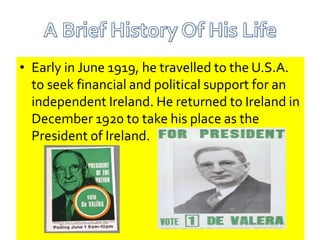
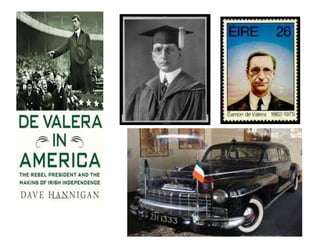
• Early in June 1919, he travelled to the U.S.A. 
to seek financial and political support for an 
independent Ireland. He returned to Ireland in 
December 1920 to take his place as the 
President of Ireland.
From the very start. The Dail had to face a number of serious 
problems like the lack of experience of the new government. 
The War of Independence was raging at this time.The regular 
British forces were being assisted by the “Black and Tans”. The 
“Black and Tans” were ex WW1 army men brought into Ireland 
to assist the existing British forces in the War of Independence. 
. A truce was declared on 11 July and negotiations were opened 
with the English Prime Minister, Lloyd George, and his 
government leading up to the signing of the Anglo-Irish Treaty 
on 6 December 1921. 
The Treaty was accepted in the Dail on 7 January 1922 with 64 
in favour and 57 against , because de Valera was against the 
treaty he resigned. Arthur Griffith was elected President in 
place of de Valera.
During the Irish Civil War of 1922-1923 between the pro-Treaty 
Provisional Government under Michael Collins and its opponents, de 
Valera supported the anti-Treaty Republicans. 
 An ‘Emergency Government’ was formed by the Republicans with de 
Valera as president. In May 1923 the Republicans called a cease fire and 
resistance ended. 
 De Valera was arrested on 15 August 1923, under the Public Safety Act, 
as he was about to make a speech at Ennis and was imprisoned until July 
1924. 
 Despite this, Clare elected de Valera top of the poll in the general 
election on 27 August 1923. De Valera continued to represent Clare for 
the rest of his active political career
As part of the Anglo-Irish Treaty which 
ended the War of Independence all members 
of the Oireachtas were obliged to take an 
oath of allegiance (swear loyalty) to the King 
of Great Britain. 
Towards the end of 1925, de Valera and the 
I.R.A. found that they were on opposite sides 
on this issue and Sinn Fein was split in two. 
De Valera had made remarks which 
suggested that if the oath were removed, he 
would sit in Dail Eireann. 
 In March 1926, he resigned as President of 
Sinn Fein over this issue and decided to 
launch a new party.
In May 1926 at a meeting in Dublin, de Valera founded a new 
political party called Fianna Fail. The aims of the party were: 
1. A united Ireland as a Republic. 
2. To restore the Irish Language and develop the Irish culture. 
3. To develop a social system where there is an equal 
opportunity for all. 
4. To have a fair system of land distribution in Ireland. 
5. To make Ireland as self-sufficient as possible, with a proper 
balance between agriculture and other industries.
 In November 1926 Fianna Fail held 
its first Ard- Fheis and de Valera 
was elected President of the new 
organisation. In the general 
election of June 1927, his party won 
44 seats and Cumann na 
nGaedhael won 47 seats which was 
a large drop for them. 
 When de Valera and his fellow 
Fianna Fail deputies arrived at 
Leinster House, they were refused 
permission to take their seats 
unless they first took the oath. 
They then retired and Cumann na 
nGaedhael formed the 
government. 
 Fianna Fail, however, continued to 
campaign for the removal of the 
Oath. In order to spread their ideas, 
the Fianna Fail party founded a daily 
newspaper, the Irish Press, in 
September 1931. 
 Fianna Fail, supported by the 
Labour Party, formed a 
Government in 1932, having earlier 
overcome their objections to the 
Oath by simply signing a book 
containing the oath, which they 
declared an “Empty Formula”. In 
office, the party finally removed 
the oath by legislation in 1933.
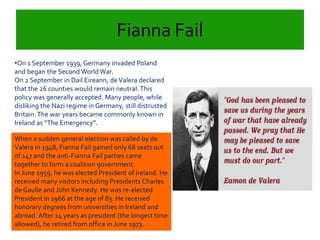
Fianna Fail 
•On 1 September 1939, Germany invaded Poland 
and began the Second World War. 
On 2 September in Dail Eireann, de Valera declared 
that the 26 counties would remain neutral. This 
policy was generally accepted. Many people, while 
disliking the Nazi regime in Germany, still distrusted 
Britain. The war years became commonly known in 
Ireland as “The Emergency”. 
When a sudden general election was called by de 
Valera in 1948, Fianna Fail gained only 68 seats out 
of 147 and the anti-Fianna Fail parties came 
together to form a coalition government. 
In June 1959, he was elected President of Ireland. He 
received many visitors including Presidents Charles 
de Gaulle and John Kennedy. He was re-elected 
President in 1966 at the age of 83. He received 
honorary degrees from universities in Ireland and 
abroad. After 14 years as president (the longest time 
allowed), he retired from office in June 1973.
Eamonn de valera

Eamonn de valera

  • 1.
    Eamon DeValera ByAoife Madigan Former President of Ireland
  • 2.
    Fact File Eamonwas born on October 14 1882 in New York. He died on 29 August 1975 at the age of 92.  He was buried in Glasnevin Cemetry after a state funeral. He had five sons Vivion ,Eamon, Brian, Ruaidhri, Terence(Terry) and two daughters Mairin and Emer. His parents were Juan Vivion De Valera and Catherine Coll.
  • 3.
    His father wasa Spaniard who had studied to be a sculptor but because of ill-health he was forced back to teaching music. In September 1881, his father married an Irish immigrant Kate Coll from Co. Limerick, in America.  His father died when de Valera was only two years old and his mother decided that her son would be better off at home in Ireland. She sent him to be reared by his grandmother, Elizabeth, who lived in a labourer’s cottage at Knockmore Co. Limerick.
  • 4.
    Early Life De Valera attended the national school at Bruree and from there went to the Christian Brother’s School at Charleville.  He walked the seven miles there and back everyday since the Coll’s could not afford a bicycle.  At 16, he won a scholarship to Blackrock College, Co. Dublin. He went on to become a professor of mathematics and lectured part-time at Maynooth and various Dublin colleges. At school ,and later he was a keen rugby player.
  • 5.
     In 1908,he joined the Gaelic League, the beginning of his life-long devotion to Ireland.  One of his teachers was Sinead Flanagan, herself a teacher and four years older than him. They fell in love and were married in January 1910.  De Valera joined the Irish Volunteers at their first meeting in 1913.  He took part in the landing of guns from the Asgard in July 1914.These guns were to be used later in the 1916 rising.
  • 6.
    o He commandedthe Boland’s Mills garrison during the 1916 rising. After the surrender he was sentenced to death, but later it was decided to sentence him to life imprisonment instead. o De Valera was released from prison in June 1917 and was elected Sinn Fein deputy for East Clare. At the Sinn Fein Ard-Fheis in October 1917, de Valera was elected President of the party and at the end of the same month he was elected President of the Irish Volunteers.
  • 7.
    On 17 May1918, De Valera was arrested and deported for internment to England, where he was to remain up to February 1919.
  • 8.
    • While hewas in jail he was elected for East Clare in the general election. On 21 January 1919,assembled deputies set up the Government for the Irish Republic. • After his escape from Lincoln Jail on 3 February 1919, de Valera returned briefly to Ireland and was elected President of the Dail.
  • 9.
    • Early inJune 1919, he travelled to the U.S.A. to seek financial and political support for an independent Ireland. He returned to Ireland in December 1920 to take his place as the President of Ireland.
  • 10.
    From the verystart. The Dail had to face a number of serious problems like the lack of experience of the new government. The War of Independence was raging at this time.The regular British forces were being assisted by the “Black and Tans”. The “Black and Tans” were ex WW1 army men brought into Ireland to assist the existing British forces in the War of Independence. . A truce was declared on 11 July and negotiations were opened with the English Prime Minister, Lloyd George, and his government leading up to the signing of the Anglo-Irish Treaty on 6 December 1921. The Treaty was accepted in the Dail on 7 January 1922 with 64 in favour and 57 against , because de Valera was against the treaty he resigned. Arthur Griffith was elected President in place of de Valera.
  • 11.
    During the IrishCivil War of 1922-1923 between the pro-Treaty Provisional Government under Michael Collins and its opponents, de Valera supported the anti-Treaty Republicans.  An ‘Emergency Government’ was formed by the Republicans with de Valera as president. In May 1923 the Republicans called a cease fire and resistance ended.  De Valera was arrested on 15 August 1923, under the Public Safety Act, as he was about to make a speech at Ennis and was imprisoned until July 1924.  Despite this, Clare elected de Valera top of the poll in the general election on 27 August 1923. De Valera continued to represent Clare for the rest of his active political career
  • 12.
    As part ofthe Anglo-Irish Treaty which ended the War of Independence all members of the Oireachtas were obliged to take an oath of allegiance (swear loyalty) to the King of Great Britain. Towards the end of 1925, de Valera and the I.R.A. found that they were on opposite sides on this issue and Sinn Fein was split in two. De Valera had made remarks which suggested that if the oath were removed, he would sit in Dail Eireann.  In March 1926, he resigned as President of Sinn Fein over this issue and decided to launch a new party.
  • 13.
    In May 1926at a meeting in Dublin, de Valera founded a new political party called Fianna Fail. The aims of the party were: 1. A united Ireland as a Republic. 2. To restore the Irish Language and develop the Irish culture. 3. To develop a social system where there is an equal opportunity for all. 4. To have a fair system of land distribution in Ireland. 5. To make Ireland as self-sufficient as possible, with a proper balance between agriculture and other industries.
  • 14.
     In November1926 Fianna Fail held its first Ard- Fheis and de Valera was elected President of the new organisation. In the general election of June 1927, his party won 44 seats and Cumann na nGaedhael won 47 seats which was a large drop for them.  When de Valera and his fellow Fianna Fail deputies arrived at Leinster House, they were refused permission to take their seats unless they first took the oath. They then retired and Cumann na nGaedhael formed the government.  Fianna Fail, however, continued to campaign for the removal of the Oath. In order to spread their ideas, the Fianna Fail party founded a daily newspaper, the Irish Press, in September 1931.  Fianna Fail, supported by the Labour Party, formed a Government in 1932, having earlier overcome their objections to the Oath by simply signing a book containing the oath, which they declared an “Empty Formula”. In office, the party finally removed the oath by legislation in 1933.
  • 15.
    Fianna Fail •On1 September 1939, Germany invaded Poland and began the Second World War. On 2 September in Dail Eireann, de Valera declared that the 26 counties would remain neutral. This policy was generally accepted. Many people, while disliking the Nazi regime in Germany, still distrusted Britain. The war years became commonly known in Ireland as “The Emergency”. When a sudden general election was called by de Valera in 1948, Fianna Fail gained only 68 seats out of 147 and the anti-Fianna Fail parties came together to form a coalition government. In June 1959, he was elected President of Ireland. He received many visitors including Presidents Charles de Gaulle and John Kennedy. He was re-elected President in 1966 at the age of 83. He received honorary degrees from universities in Ireland and abroad. After 14 years as president (the longest time allowed), he retired from office in June 1973.