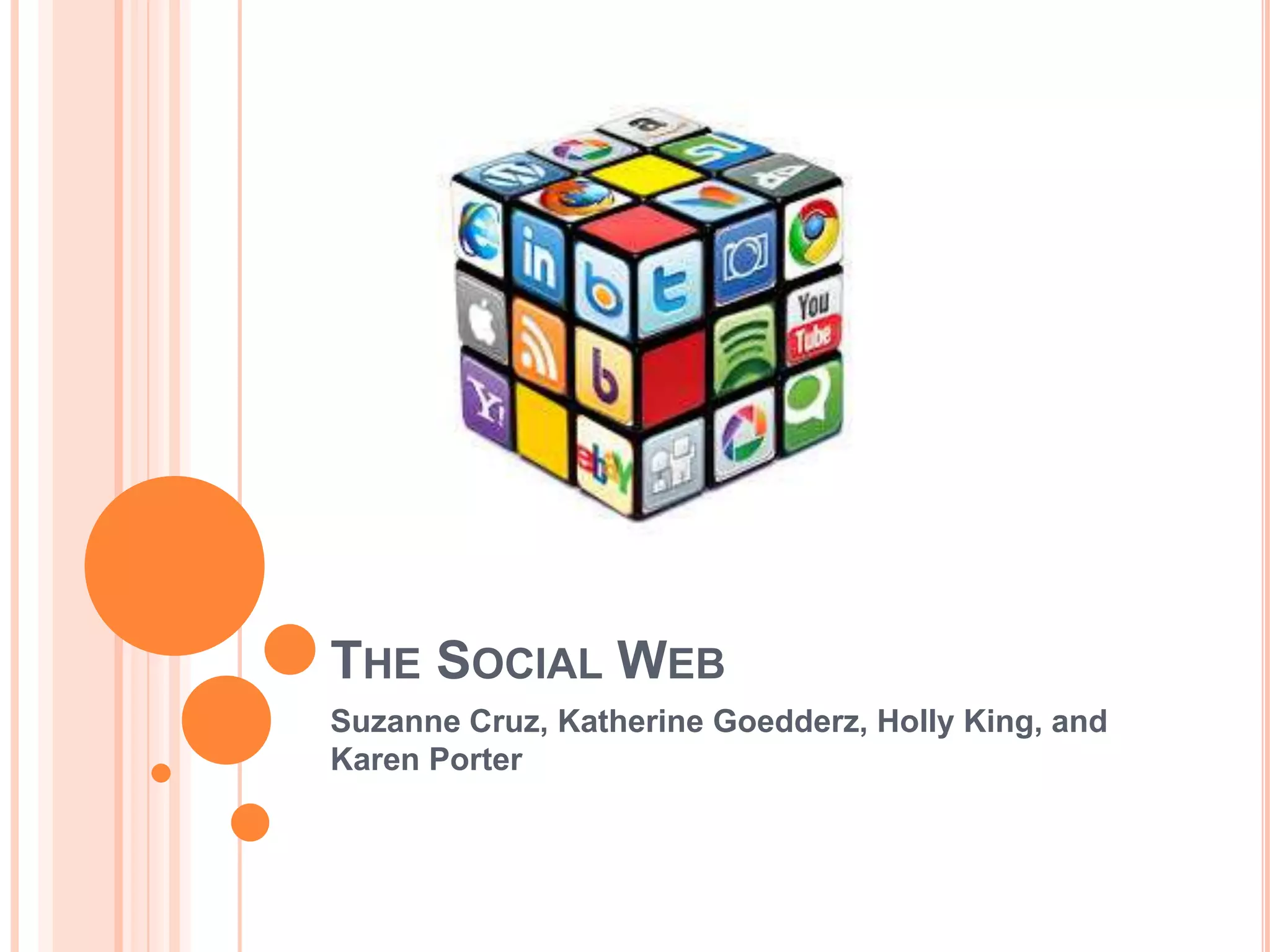
THE SOCIAL WEB
Suzanne Cruz, Katherine Goedderz, Holly King, and
Karen Porter
BENEFITS OF USING SOCIAL MEDIA IN THE
CLASSROOM


More and more teachers are now implementing social
media in the classroom with much success.






Teachers have been using
blogs, wikis, Twitter, Edmodo, Facebook, Vine, Ning, Pinterest
, and even Skype in their classrooms in order to engage their
students.

Social networking is something that most students are
familiar with. Yet, they often lack the skills to transfer
social networking into academic settings.
Digital natives want to learn this way! Here is a YouTube
video about the 21st Century Learning
Environments, and the importance of incorporating
technology in our classrooms.


The video also includes drawings from students‟ “ideal
classrooms.”
COLLABORATION BETWEEN TEACHER &
STUDENTS








Connection in the classroom is so important for teachers and
students, and social networks such as, Twitter, can provide an
immediate response from peers and teachers.
“Contact between students and faculty in and outside of class is
critical for student engagement because it influences student
motivation and involvement” (Dunlap &Lowenthal, p. 2).
Distance education online social networking tools are equally as
important. Brady, Holcomb & Smith stated that “Fostering a
sense of community is critically important, especially in an online
environment where students often do not get the opportunity to
meet face-to-face with other students or the instructor in the
course” (p. 152).
Teachers may use Twitter, Instagram, Facebook, and even
Edmodo in order to create a hash tag for their classes. Students
may use these sites to search for the hash tag and engage in
relevant discussion from home, or wherever they may be while
connected to the virtual world (Kist, 2013, p. 11).
IMPORTANCE OF INCORPORATING
TECHNOLOGY IN THE CLASSROOM


Kist (2013) advises us that the use of emerging
technologies and innovative methods should begin early
with teacher preparation programs.
“New technologies with social media as a vital and integral
component are breaking our education system out of a very
old paradigm of teaching and learning and engaging
students, educators, and parents to embrace the fact that
most human endeavors will be shaped by technology”
(Kist, 2013, p. 11).
“Social Networking Sites „afford students unprecedented
opportunities to share their ideas, celebrate their creativity and
receive immediate feedback from fellow‟ students”
(Brady, Holcomb & Smith, p. 154).
In the article, “Tweeting the Night Away,” a professor chose to
use Twitter with her online classes to connect students with their
peers and teachers. Some students may be introverted, and do
not like to talk in class. Social media and technology allow
students to express themselves in an alternative way.





USING EDMODO IN THE CLASSROOM
According to Wikipedia, "Edmodo is a social
learning platform for teachers, students, and
parents. It is commonly thought of as the Facebook
of schools, as called by pupils and teachers alike"
(2013, para.1).
 A page was created for two different courses, and
discussion questions, assignments, and
announcements were listed. Students have already
been actively participating! Please visit:
 Edmodo with Class One
 Edmodo with Class Two

#INSTAGRAM
Instagram is an application on a SmartPhone that
allows users to upload, edit, and choose filters for
pictures. When uploading the picture, users also
create a comment to accompany the picture, and
can include hashtags (#).
 A hashtag is a way for users to connect with others
who use similar terms.
 Suzanne went ahead and also introduced
Instagram to her class. She wanted the class to
upload pictures related to the class, or what they
were learning by inserting #professorcruz in the
comment box when uploading the picture.

ASSIGNMENT IDEAS


There were a few ideas taken from the article, “Class, Get
Ready to Tweet: Social Media in the Classroom,” where the
teacher uses social media in different lessons.
He uses a wiki to have students create their own textbook.
 The teacher also has the students interview community members
via Skype.
 Lastly, they research various locations using Google Earth.




Here is a YouTube video about the 21st Century Learning
Environments, and the importance of incorporating
technology in our classrooms.


The video also includes drawings from students‟ “ideal
classroom.”
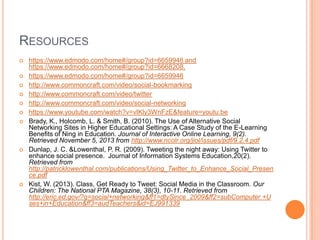
RESOURCES













https://www.edmodo.com/home#/group?id=6659946 and
https://www.edmodo.com/home#/group?id=6668208.
https://www.edmodo.com/home#/group?id=6659946
http://www.commoncraft.com/video/social-bookmarking
http://www.commoncraft.com/video/twitter
http://www.commoncraft.com/video/social-networking
https://www.youtube.com/watch?v=vIKly3WnFzE&feature=youtu.be
Brady, K., Holcomb, L. & Smith, B. (2010). The Use of Alternative Social
Networking Sites in Higher Educational Settings: A Case Study of the E-Learning
Benefits of Ning in Education. Journal of Interactive Online Learning, 9(2).
Retrieved November 5, 2013 from http://www.ncolr.org/jiol/issues/pdf/9.2.4.pdf
Dunlap, J. C. &Lowenthal, P. R. (2009). Tweeting the night away: Using Twitter to
enhance social presence. Journal of Information Systems Education,20(2).
Retrieved from
http://patricklowenthal.com/publications/Using_Twitter_to_Enhance_Social_Presen
ce.pdf
Kist, W. (2013). Class, Get Ready to Tweet: Social Media in the Classroom. Our
Children: The National PTA Magazine, 38(3), 10-11. Retrieved from
http://eric.ed.gov/?q=social+networking&ff1=dtySince_2009&ff2=subComputer +U
ses+in+Education&ff3=audTeachers&id=EJ991339

The Social Web

  • 1.
    THE SOCIAL WEB SuzanneCruz, Katherine Goedderz, Holly King, and Karen Porter
  • 2.
    BENEFITS OF USINGSOCIAL MEDIA IN THE CLASSROOM  More and more teachers are now implementing social media in the classroom with much success.    Teachers have been using blogs, wikis, Twitter, Edmodo, Facebook, Vine, Ning, Pinterest , and even Skype in their classrooms in order to engage their students. Social networking is something that most students are familiar with. Yet, they often lack the skills to transfer social networking into academic settings. Digital natives want to learn this way! Here is a YouTube video about the 21st Century Learning Environments, and the importance of incorporating technology in our classrooms.  The video also includes drawings from students‟ “ideal classrooms.”
  • 3.
    COLLABORATION BETWEEN TEACHER& STUDENTS     Connection in the classroom is so important for teachers and students, and social networks such as, Twitter, can provide an immediate response from peers and teachers. “Contact between students and faculty in and outside of class is critical for student engagement because it influences student motivation and involvement” (Dunlap &Lowenthal, p. 2). Distance education online social networking tools are equally as important. Brady, Holcomb & Smith stated that “Fostering a sense of community is critically important, especially in an online environment where students often do not get the opportunity to meet face-to-face with other students or the instructor in the course” (p. 152). Teachers may use Twitter, Instagram, Facebook, and even Edmodo in order to create a hash tag for their classes. Students may use these sites to search for the hash tag and engage in relevant discussion from home, or wherever they may be while connected to the virtual world (Kist, 2013, p. 11).
  • 4.
    IMPORTANCE OF INCORPORATING TECHNOLOGYIN THE CLASSROOM  Kist (2013) advises us that the use of emerging technologies and innovative methods should begin early with teacher preparation programs. “New technologies with social media as a vital and integral component are breaking our education system out of a very old paradigm of teaching and learning and engaging students, educators, and parents to embrace the fact that most human endeavors will be shaped by technology” (Kist, 2013, p. 11). “Social Networking Sites „afford students unprecedented opportunities to share their ideas, celebrate their creativity and receive immediate feedback from fellow‟ students” (Brady, Holcomb & Smith, p. 154). In the article, “Tweeting the Night Away,” a professor chose to use Twitter with her online classes to connect students with their peers and teachers. Some students may be introverted, and do not like to talk in class. Social media and technology allow students to express themselves in an alternative way.   
  • 5.
    USING EDMODO INTHE CLASSROOM According to Wikipedia, "Edmodo is a social learning platform for teachers, students, and parents. It is commonly thought of as the Facebook of schools, as called by pupils and teachers alike" (2013, para.1).  A page was created for two different courses, and discussion questions, assignments, and announcements were listed. Students have already been actively participating! Please visit:  Edmodo with Class One  Edmodo with Class Two 
  • 6.
    #INSTAGRAM Instagram is anapplication on a SmartPhone that allows users to upload, edit, and choose filters for pictures. When uploading the picture, users also create a comment to accompany the picture, and can include hashtags (#).  A hashtag is a way for users to connect with others who use similar terms.  Suzanne went ahead and also introduced Instagram to her class. She wanted the class to upload pictures related to the class, or what they were learning by inserting #professorcruz in the comment box when uploading the picture. 
  • 7.
    ASSIGNMENT IDEAS  There werea few ideas taken from the article, “Class, Get Ready to Tweet: Social Media in the Classroom,” where the teacher uses social media in different lessons. He uses a wiki to have students create their own textbook.  The teacher also has the students interview community members via Skype.  Lastly, they research various locations using Google Earth.   Here is a YouTube video about the 21st Century Learning Environments, and the importance of incorporating technology in our classrooms.  The video also includes drawings from students‟ “ideal classroom.”
  • 8.
    RESOURCES          https://www.edmodo.com/home#/group?id=6659946 and https://www.edmodo.com/home#/group?id=6668208. https://www.edmodo.com/home#/group?id=6659946 http://www.commoncraft.com/video/social-bookmarking http://www.commoncraft.com/video/twitter http://www.commoncraft.com/video/social-networking https://www.youtube.com/watch?v=vIKly3WnFzE&feature=youtu.be Brady, K.,Holcomb, L. & Smith, B. (2010). The Use of Alternative Social Networking Sites in Higher Educational Settings: A Case Study of the E-Learning Benefits of Ning in Education. Journal of Interactive Online Learning, 9(2). Retrieved November 5, 2013 from http://www.ncolr.org/jiol/issues/pdf/9.2.4.pdf Dunlap, J. C. &Lowenthal, P. R. (2009). Tweeting the night away: Using Twitter to enhance social presence. Journal of Information Systems Education,20(2). Retrieved from http://patricklowenthal.com/publications/Using_Twitter_to_Enhance_Social_Presen ce.pdf Kist, W. (2013). Class, Get Ready to Tweet: Social Media in the Classroom. Our Children: The National PTA Magazine, 38(3), 10-11. Retrieved from http://eric.ed.gov/?q=social+networking&ff1=dtySince_2009&ff2=subComputer +U ses+in+Education&ff3=audTeachers&id=EJ991339