1
International
ANNUAL REVIEW
// 2015
INDEPENDENCE, EQUALITY AND OPPORTUNITY
FOR DISABLED PEOPLE LIVING IN POVERTY.
Members of
2 3
Economic empowerment
18
Access to services
20
Equality for women and girls
22
Changing lives globally // 2015
24
At our core: capacity building 10
Activists: in their own words
12
Four areas of focus
14
Inclusive education
16
Our priorities // 2016
26
Welcome
4
Why disability? 6
What we do
8
WHY WE’RE HERE.
Imagine going to a clinic to be tested for
HIV. You are deaf and cannot read or
use formal Sign language. The doctor
gives you a thumbs-up. Does it mean
‘yes, you have HIV’ or ‘yes, you are okay’?
Disabled people are arguably the
world’s largest minority. Globally, one
person out of seven has a disability.
However, they still face significant
barriers – like going to a clinic for a
life-changing health problem and
being unable to access the appropriate
treatment or information.
For many, exclusion, discrimination and
even violence are experienced on a daily
basis and, in particular, women and
children with impairments often report
unimaginable levels of abuse.
This is why ADD International is here.
We work alongside disability activists
and their organisations locally and
globally, to fight for independence,
equality and opportunity for disabled
people living in poverty.
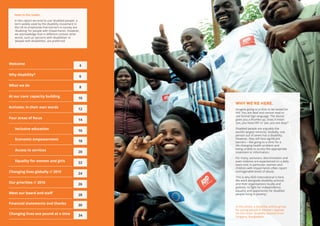
In this photo: a disability activist group
for young people in Western Uganda.
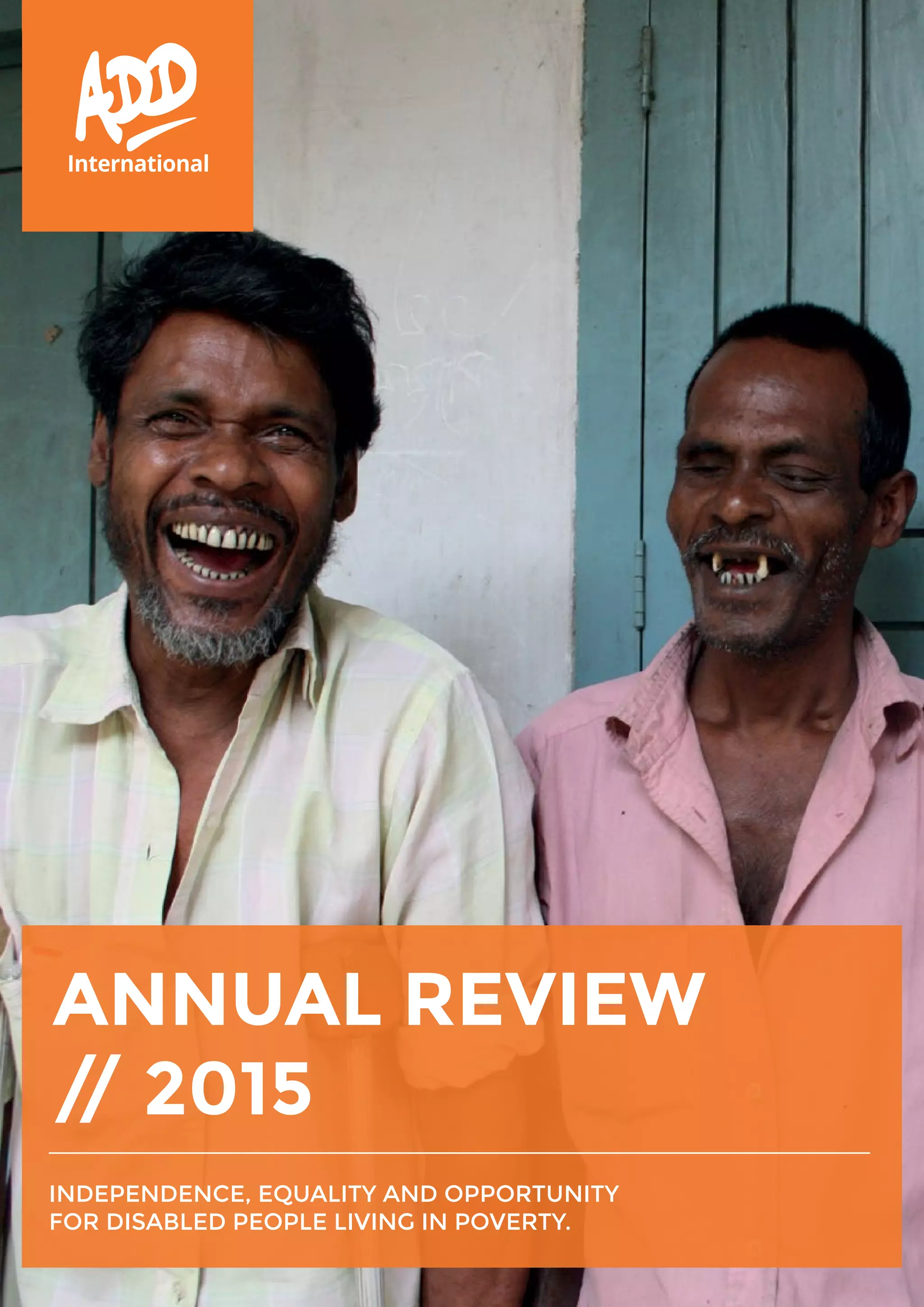
On the cover: disability activists from
Sirajgonj, Bangladesh.
Meet our board and staff
28
Financial statements and thanks
30
Changing lives one pound at a time
34
Note to the reader.
In this report we tend to use ‘disabled people’, a
term widely used by the disability movement in
the UK to emphasise that barriers in society are
‘disabling’ for people with impairments. However,
we acknowledge that in different context other
words, such as ‘persons with disabilities’ or
‘people with disabilities’, are preferred.
4 5
the maternity bed which was high and couldn’t be adjusted... Then
I was told to take the baby for immunisation but the distance was
far away.”
The inclusion of disability in the Sustainable Development Goals has
opened the door for us to work with major international development
organisations to ensure that disabled people are included in their
actions. Leaving no-one behind means ensuring that schools are fully
accessible, that education is inclusive, that HIV testing and information
is available to all and that, when an emergency strikes, the needs and
rights of all vulnerable people are considered in responses.
In 2015 we initiated new partnerships with world-leading organisations
such as the Rockefeller Foundation, the Institute of Development
Studies (IDS) and the Coady International Institute looking at
market based solutions through the lens of disability; and with local
organisations, such as the Ugandan National Youth Organization for
Development and the Cambodian Human Rights and Development
Association. In all this work, our aim is to ensure that our partners
include disabled people in all their actions and projects.
Sometimes development work doesn’t go as fast as we’d like. But
in recent years we have seen an amazing shift in how disability is
perceived and this is thanks to the many people across the world
who have campaigned for the inclusion of persons with disabilities in
development and in all aspects of society.
We, at ADD International, will continue reminding global leaders and
development organisations that we will only stand a chance of leaving
no-one behind if persons with disabilities from the South are involved
right from the start in plans to mainstream responses.
In 2016 we will be celebrating 30 years of ADD International, 30 years
of supporting disability activists worldwide to advocate for equal rights.
On behalf of all our staff and partners, thank you to everyone who has
supported our work during this time.
2015 was, without doubt, a historic year for the global disability
movement. The joint efforts of a relatively small group of organisations,
including ADD International, have culminated in the inclusion of
disability issues in the Sustainable Development Goals. This,
potentially marks the start of something transformational.
ADD International’s role in influencing this process should not be
underestimated. We worked on this, behind the scenes, over several
years along with a small number of other disability organisations
around the world including the International Disability Alliance
(IDA). We want to thank our long-standing supporters for believing that
shifting attitudes is necessary and possible.
Four years of influencing the UN and other power-holders culminated
in Barack Obama and the Pope both speaking about persons with
disabilities in front of world leaders at the New York summit to adopt
the Agenda. Mosharraf Hossain, our Head of Policy and Influencing
spoke on behalf of the global disability movement, at the same summit,
sitting on the platform with Bill and Melinda Gates.
Through the Sustainable Development Goals, in pledging to ‘leave
no-one behind’, global leaders hint at equality and empowerment for
disabled people. Now the world must deliver.
ADD International aims to be at the forefront of this. With the moral
weight of the Goals and the legal guide of the Convention on the
Rights of Persons with Disabilities (CRPD), we have the leverage
to ask national and local governments to ensure the participation of
disabled people in all levels of society.
The ‘My Story, My rights’ research project in Uganda is the first of
many actions to inform national and local governments about what
needs to be done in order to comply with the Goals and the Convention.
The project gave disabled people in Uganda a platform to tell their
stories and help identify ways to ensure their rights are respected.
We found out, for example, that 70% of the people we interviewed
as part of the project had negative experiences with the health-care
services, with many people encountering daily barriers in accessing
them. A lady we met told us,
“I am physically disabled. In 2010 I conceived and when time for
delivery came I went to hospital. I used a motorcycle for transport
but they would stop at the gate and I was supposed to proceed to
labour ward while walking. The pregnancy intercepted my mobility
and my legs were very weak…. Upon arrival, I was told to climb into
Tim Wainwright
Chief Executive
Saghir Alam
Chair of Trustees
WELCOME.
6 7
Disabled people have
the right to live their lives
as fully as they choose,
without the limitations
imposed by attitudes or by
social and physical barriers.
Disability is not inability
if disabled people are
given the right tools,
opportunities and
support.
WHY DISABILITY?
VIOLENCE.
Disabled people are disproportionately
vulnerable to abuse, with children and women
particularly affected.
DISCRIMINATION.
Disabled people face stigma and
discrimination in their families and
communities, mostly because of
misconceptions about disability.
EXCLUSION.
Disabled people often live in isolation and are
excluded from their communities, from the
education system, from health care and other
vital services. Sometimes, they’re even hidden
away by their families.
ONE BILLION PEOPLE WORLDWIDE ARE DISABLED.
80% OF THEM LIVE IN THE DEVELOPING WORLD.
The injustice disabled people face
often involves:
1
POVERTY.
People experiencing poverty are more likely to become disabled.
People in poverty have less access to healthcare and are more vulnerable to
malnutrition and preventable diseases. They are also more likely to live and work
in dangerous or polluted environments with low quality housing, reduced access
to safe drinking water and sanitation; or in areas which are prone to the effects of
natural disasters, dangerous traffic and higher rates of violence.
AND THIS IS WHY ADD INTERNATIONAL IS HERE.
WE BELIEVE:
21
Change comes when
preconceptions are
challenged. This happens
when disabled people are
empowered and come
together with a unified
voice.
3
80%
Disabled people living in
poverty are among the most
vulnerable, marginalised
and discriminated people on
earth.
Often, they have no
access to basic human
rights, education or the
opportunity to earn a living.
A STRONG LINK BETWEEN
POVERTY & DISABILITY.
WHY
2
DISABILITY.
People who are disabled are more likely to be poor.
Disabled people are more likely to be poor as they face multiple barriers to
securing their livelihoods. Negative attitudes often severely limit their education,
training, employment and income generation opportunities. Stigma and shame
lead to isolation, therefore disabled people are less likely to be members of self-
help groups, religious organisations or community initiatives.
WHY
8 9
WHAT
WE DO.
1. We support disability
activists.
We provide them with the tools and
the resources to help disabled people
achieve their full potential. We call
this capacity building.
2. We strengthen the
disability movement in
Africa and Asia.
We do this by supporting local groups
of disability activists to build strong
and sustainable organisations that
can have an ever increasing impact.
We then help these groups connect
with each other to build wider
movements and work with them
to promote the rights of disabled
people.
3. We influence.
We work with disability activists
and their organisations to influence
governments, international
development organisations and the
private sector to design policies and
services on a local and global scale
which take into account disabled
people and offer inclusive solutions.
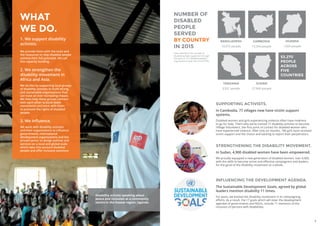
NUMBER OF
DISABLED
PEOPLE
SERVED
BY COUNTRY
IN 2015
BANGLADESH
10,072 people
CAMBODIA
10,394 people
TANZANIA
3,931 people
UGANDA
1,024 people
SUDAN
27,849 people
SUPPORTING ACTIVISTS.
In Cambodia, 77 villages now have victim support
systems.
Disabled women and girls experiencing violence often have nowhere
to go for help. That’s why we’ve trained 77 disability activists to become
‘Village Volunteers’, the first point of contact for disabled women who
have experienced violence. After only six months, 180 girls have received
victim support and the choice and backing to report their perpetrators.
STRENGTHENING THE DISABILITY MOVEMENT.
In Sudan, 4,900 disabled women have been empowered.
We proudly equipped a new generation of disabled women, over 4,900,
with the skills to become active and effective campaigners and leaders,
for the good of the disability movement as a whole.
INFLUENCING THE DEVELOPMENT AGENDA.
The Sustainable Development Goals, agreed by global
leaders mention disability 11 times.
For years, we backed the disability movement in its campaigning
efforts. As a result, the 17 goals which will steer the development
agendas of governments and NGOs, include 11 mentions of the
inclusion of persons with disabilities.
Disability activist speaking about
peace and inclusion at a community
centre in the Kasese region, Uganda.
53,270
PEOPLE
ACROSS
FIVE
COUNTRIES
Data relating to the number of
disabled people supported through
the work of 127 disabled people’s
organisations (year five of the PPA).
10 11
AT OUR CORE:
BUILDING
CAPACITY.
Capacity building means supporting disability activists’
organisations with tools, skills and resources that can enable them
to become functioning organisations and powerful movements for
change.
At present, we are supporting 127 groups of disability activists
worldwide.
Our capacity building support is specifically tailored to the needs
of each organisation. Activists in Tanzania wanting to lobby the
government to get more disabled children into school will need
different capacity building support than a group of female disability
activists in Cambodia who are forming to protect their rights.
Ultimately our purpose is to step away and leave behind disability
activists who are leading functioning and sustainable disabled
people’s organisations, and who are connected to the wider
disability movement.
THE RIPPLE EFFECT
OF OUR CAPACITY
BUILDING WORK.
A note from our International
Development team.
We know that you need a strong disability
movement to achieve lasting change for
disabled people. However, we have sometimes
found it difficult to describe the impact that
ADD International’s capacity building work
has had over time in strengthening those
movements.
So we commissioned an external evaluation of
our capacity building efforts in Bangladesh and
Cambodia to look at what we’ve achieved over
the past 5-10 years, compare approaches and
identify what we can do to reinforce our work.
The evaluators confirmed that capacity
building is ‘in ADD International’s DNA’ – at
the heart of everything we do. Together with
our influencing and learning work, it brings
about ‘real improvements in the lives of
individual persons with disabilities, as well
as contributing to achieving a more inclusive
society’.
The reports found that our success lies in being
responsive to the different needs of disabled
people’s organisations. Some need technical
and strategic support, others benefit from our
ability to link them up with power-holders;
and some disabled people’s organisations
simply benefit from working closely with us in
developing and implementing projects, and
‘learning-by-doing’.
The challenge now is to improve the way we
work with disabled people’s organisations,
and we are developing a new assessment
tool to help us to better plan and
evaluate this core part of our work in
the years to come.
Emma Cain
Learning  Accountability
Advisor
12 13
Kaddush Molla
Disability activist, Bangladesh
Today I went to the police station to
discuss one of our filed abuse cases. I was
firm in expressing my desire as to how the
police should perform the enquiry.
I can play my role of assertion because of my
strength. What strength? I have the support of a
large number of people behind me and this unity
brings courage. My group contains nearly 4,000
members.
I may be disabled, but I have the right to live
in this world. I wanted people to call me by my
beautiful name. These rights, being called by my
name, my survival rights, my education rights
are important to me. I missed this consciousness
earlier. ADD International has brought the
message of freedom, the message of rights for
the disabled, like me. ADD International has
given every support to make us learn and ensure
our rights.
”
Minnie Akter
Disability activist, Bangladesh
Disabled women are more vulnerable to
violence and abuse than disabled men.
We were trying to figure out something to do to
help. When we told ADD International our idea
they said, ‘you decide how you want to proceed
and we will help’.
We decided to form ‘Women’s Councils’ to tackle
the problem. I received trainings on account
management, office management, IT, advocacy.
I was ignorant about these things before.
Now I can use a computer, I can send email,
make plans, use Excel, PowerPoint. I lobby
different organisations at the government
and non-government level. I give trainings to
other grassroots organisations on account
management.
”
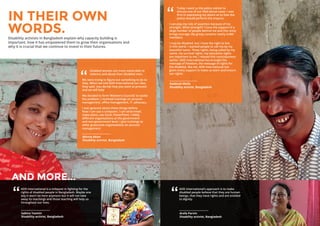
IN THEIR OWN
WORDS.Disability activists in Bangladesh explain why capacity building is
important, how it has empowered them to grow their organisations and
why it is crucial that we continue to invest in their futures.
Sabina Yasmin
Disability activist, Bangladesh
ADD International is a milepost in fighting for the
rights of disabled people in Bangladesh. Maybe one
day it won’t be here anymore but it will not take
away its teachings and those teaching will help us
throughout our lives.
”
Arefa Parvin
Disability activist, Bangladesh
ADD International’s approach is to make
disabled people believe that they are human
beings, that they have rights and are entitled
to dignity.
”
AND MORE...
14 15
4 AREAS
OF FOCUS.
We work with disability activists and their organisations to eradicate the
injustice and discrimination they face in the family, community and wider
society. In 2015, the actions and projects we undertook focused on:
INCLUSIVE EDUCATION.
The more disabled children enrol into school, the more attitudes
towards disability change. Going to school gives them the opportunity
to thrive. This tackles stigma in the family, in the school and in the
community. In turn, more families will begin enrolling their children
in the local schools and more teachers will advocate for inclusive
education.
ECONOMIC EMPOWERMENT.
Providing skills training and job opportunities build confidence
and give disabled people more independence. As a result,
they earn respect as valued members of their family and
communities.
ACCESS TO SERVICES.
Disabled people have the right to use and access
services without being subjected to disability
discrimination. This right is sanctioned by international
law as it provides equitable redistribution of wealth in
societies.
EQUALITY FOR WOMEN AND
GIRLS.
We tackle the double discrimination disabled
women face, discriminated for having an
impairment and for being women.
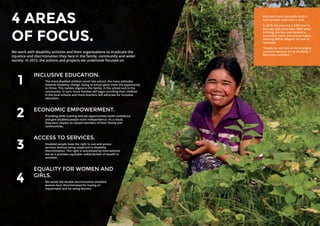
Keu Bech from Cambodia finds it
hard to walk, even with a stick.
In 2015 she received a $300 loan to
buy pigs and some feed. With some
training, she has now become a
successful rearer and a local expert,
advising fellow villagers on how to
raise pigs.
“People do not look at me strangely
anymore because of my disability. I
feel more confident.”
1
2
3
4
16 17
WHY EDUCATION?
Worldwide, 59 million children
are out of school. The situation is
especially grim for disabled children
living in extreme poverty, who are
disproportionately excluded from
schools. This particularly affects girls
with disabilities.
REACHING OUT.
Through local disability activists, we
reach out to disabled children and
we help their families to enrol them
in local schools.
We provide teachers with the right
training and materials to meet their
students’ needs, such as Braille
kits or Sign language training.
We campaign for the importance
of inclusive education with
schools, local authorities and key
institutions.
QUALITY EDUCATION.
THE KEY TO A BETTER
FUTURE.
When we first started working on the Inclusive
Education project, in the Sirajgonj region,
Bangladesh, parents and teachers were asking
us ‘how are these impaired children going
to learn how to read and write?’. Some had
cerebral palsy, some had speech and hearing
impairments, some even have multiple
impairments.
We explained there are ways, and convinced
them. For example, a visually impaired child
can read using Braille or, if they have low
vision, see through a magnifying glass.
But in many schools, teachers are still not
accepting students with disabilities as their
own. They avoid them tactfully. So we know
there’s still a lot of work to be done in terms of
training and advocacy. However, it’s important
to remember that at least we have begun. If
we had not trained the teachers through this
project, the education of many children would
come to a halt.
A disabled child in Bangladesh is generally
neglected in society. If they remain
uneducated then they will be neglected
more, they will be screened out. Education is
therefore of utmost importance and it should
be quality education. If we can achieve this,
the future prospects of these children will
change too.
Take Sabina for example; she is a girl who
moves around using her knees. Her body is
very lean. She was refused by the school at
first, but we talked to the school committee
and she was admitted. She worked hard
and gradually improved her performance,
particularly in science, which resulted in
her increased acceptance in the school.
She is now taking her exams and wants to
become a banker. How could Sabina find
her place in the society? It’s only thanks to
education.
Allama Iqbal
Program Officer for the Inclusive
Education project in Siranjgonj,
ADD International Bangladesh
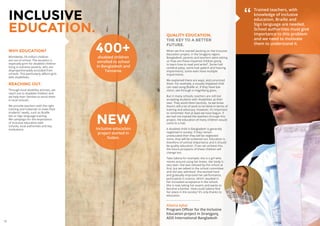
Trained teachers, with
knowledge of inclusive
education, Braille and
Sign language are needed.
School authorities must give
importance to this problem
and we need to motivate
them to understand it.
400+disabled children
enrolled to school
in Bangladesh and
Tanzania.
INCLUSIVE
EDUCATION.
NEWinclusive education
project started in
Sudan.
”
18 19
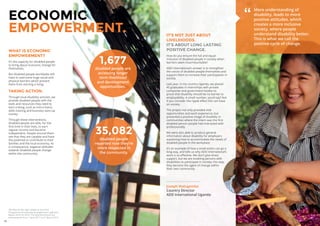
WHAT IS ECONOMIC
EMPOWERMENT?
It’s the capacity for disabled people
to bring about economic change for
themselves.
But disabled people worldwide still
have to overcome huge social and
physical barriers which prevent
them from earning a living.
TAKING ACTION.
Through local disability activists, we
provide disabled people with the
tools and resources they need to
earn a living, such as micro-loans,
skills training and business start-up
money.
Through these interventions,
disabled people are able, for the
first time in their lives, to earn
regular income and become
independent. People around them
see that they are capable and have
the potential to contribute to their
families and the local economy. As
a consequence, negative attitudes
towards disabled people change
within the community.
IT’S NOT JUST ABOUT
LIVELIHOODS.
IT’S ABOUT LONG LASTING
POSITIVE CHANGE.
How do you ensure the full and equal
inclusion of disabled people in society when
barriers seem insurmountable?
ADD International’s answer is to strengthen
the voices of disabled people themselves and
support them to increase their participation in
society.
Last year, in my country Uganda, we placed
45 graduates in internships with private
companies and government bodies to
prove that disability should be no barrier to
employability. A small number, you’d say? Not
if you consider the ripple effect this can have
on society.
The project not only provided vital
opportunities and work experience, but
presented a positive image of disability in
communities where the intern was the first
disabled person people had interacted with
professionally.
We were also able to produce general
information about disability for employers
explaining how to accommodate the needs of
disabled people in the workplace.
It’s an example of how a small action can go a
long way, and tells us why ADD International’s
work is so effective. We don’t give direct
support, but we are enabling persons with
disabilities to participate in society; this way,
they become the agent of change within
their own community.
Joseph Walugembe
Country Director
ADD International Uganda
More understanding of
disability, leads to more
positive attitudes, which
creates a more inclusive
society, where people
understand disability better.
This is what we call the
positive cycle of change.
1,677
disabled people are
accessing longer
term livelihood
and development
opportunities.
ECONOMIC
EMPOWERMENT.
35,082
disabled people
reported now they’re
more respected in
the community.
”
The data on the right relates to the 2016
‘Programme Partnership Arrangements’ Logframe
Report 2016 for DFID. The data documents our
achievements from 1 April 2011 to 31 March 2016.
20 21
ACCESS TO SERVICES
AS A HUMAN RIGHT?
Access to services is a critical
aspect of any drive to challenge
poverty and to reach a fairer, more
equitable society.
However, disabled people
worldwide still report huge barriers
in accessing health-care, public
transport, civil and criminal justice,
banking and even basic information.
In the long run, this creates huge
inequality gaps between those who
are disabled and those who aren’t.
BREAKING BARRIERS.
Negative attitudes, discrimination,
physical barriers and a lack of
adequate policies or legislation
are some of the barriers in society
which are limiting opportunities for
disabled people.
We support disability activists who
are challenging the status quo and
breaking those barriers.
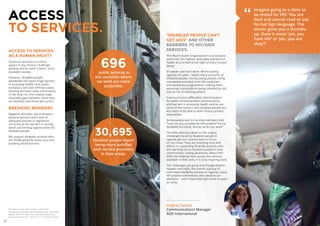
696public services in
the countries where
we work are more
accessible.
ACCESS
TO SERVICES.
30,695
disabled people report
being more satisfied
with service providers
in their areas.
“DISABLED PEOPLE CAN’T
GET AIDS” AND OTHER
BARRIERS TO HIV/AIDS
SERVICES.
The World Health Organisation’s Constitution
enshrines ‘the highest attainable standard of
health as a fundamental right of every human
being.’
It’s easier said than done. Whilst visiting
Uganda this year, I heard many accounts of
disabled people, mostly young people, being
completely excluded from HIV treatment
and awareness programmes, making them
extremely vulnerable to being infected by HIV,
and at risk of infecting others.
Communication difficulties, discrimination
by health service workers and educators,
and barriers in accessing health centres are
some of the reasons why disabled people are
less likely to be able to learn how to protect
themselves.
Some people said to me they had been told,
“how can you possibly be HIV positive? You’re
disabled! Go home, and let us do our work”.
The little attention given to the unique
challenges faced by disabled people in
Uganda got our country team to focus
on this issue. They are investing time and
efforts in supporting disability activists who
are reaching out to disabled people in their
communities, raising awareness about HIV/
AIDS and helping them access the services
available in their area. It is truly inspiring work.
The challenges are great and change doesn’t
happen overnight. But there’s a group of
committed disability activists in Uganda, many
HIV positive themselves, who deserve our
attention – and I hope they’ll get more in years
to come.
Virginia Tarozzi
Communications Manager
ADD International
Imagine going to a clinic to
be tested for HIV. You are
deaf and cannot read or use
formal Sign language. The
doctor gives you a thumbs-
up. Does it mean ‘yes, you
have HIV’ or ‘yes, you are
okay’?
”
The data on the right relates to the 2016
‘Programme Partnership Arrangements’ Logframe
Report 2016 for DFID. The data documents our
achievements from 1 April 2011 to 31 March 2016.
22 23
WHAT’S THE
SITUATION FOR
DISABLED WOMEN?
Women with disabilities are twice as
likely to experience violence in their
lifetime. Generally, perceived as
powerless, because they’re disabled
and because they’re women, they
often experience exceptional
levels of physical, sexual, and
psychological violence, for longer
periods of time and with worse
physical and mental outcomes. We
see this all the time.
TAKING ACTION.
We fund and work with disability
activists who understand the
unique challenges faced by women
and girls. They work with women
with disabilities, their families and
communities, the police, health
workers and governments to
address:
◊◊ Sexual and physical violence,
and the myths that uphold
such practices.
◊◊ Psychological violence, such
as threats, intimidation and
manipulation, humiliation,
mocking and controlling
behaviour.
◊◊ Chronic exclusion from
leadership, health-care
services, education, and
meaningful participation in
decision-making processes.
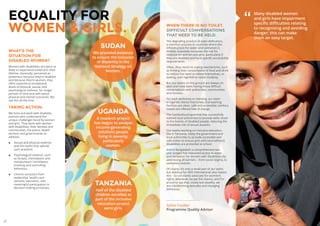
SUDAN
We provided evidence
to ensure the inclusion
of disability in the
National Strategy on
Women.
EQUALITY FOR
WOMEN  GIRLS. WHEN THERE IS NO TOILET.
DIFFICULT CONVERSATIONS
THAT NEED TO BE HELD.
The degrading practice of open defecation,
a common practice in countries where the
infrastructure for water and sanitation is
limited, massively increases the risk for
violence for women and girls, particularly if
they are disabled and have specific accessibility
requirements.
Often, they resort to coping mechanisms, such
as limiting their consumption of food and drink
to reduce the need to relieve themselves, or
waiting until nightfall to retain modesty.
But our teams on the ground are always on
alert and have been having those difficult
conversations with authorities, communities
and families.
For each workshop or meeting, our team
in Uganda checks that toilets and washing
facilities are clean, safe and accessible; sanitary
towels are offered free of charge.
The Cambodia programme has successfully
lobbied local authorities to provide wells closer
to the homes of disabled people, reducing the
immediate risk of sexual assaults.
Our teams working on inclusive education,
like in Tanzania, lobby the government and
local authorities to provide accessible and
safe toilets to ensure girls with (and without)
disabilities are protected at school.
And in Bangladesh a comprehensive two
year project has improved access to water
and sanitation for women with disabilities, by
addressing all barriers – from social stigma, to
sanitation policies.
Of course, it’s only a small part of our work;
but working for ADD International also means
this – to constantly advocate for women’s
rights, whenever we get the chance, and I’m
proud to say that, slowly but steadily, we
are transforming attitudes and changing
behaviour.
Sylvie Cordier
Programme Quality Advisor
Many disabled women
and girls have impairment
specific difficulties relating
to recognising and avoiding
danger; this can make
them an easy target.
”
UGANDA
A research project
has begun to analyse
income-generating
solutions people
living in poverty,
particularly
women.
TANZANIA
Half of the disabled
children enrolled as
part of the inclusive
education project
were girls.
24 25
Over the past 30 years, ADD International has
worked tirelessly to promote the inclusion of
disabled people in development programmes. So
the 11 explicit references of disability in the new
Sustainable Development Goals (SDGs), under the
overarching principle of ‘leave no-one behind’, didn’t
come as a surprise. It was the result of tireless
campaigning for the inclusion of disabled people in
the new Goals, from the early consultations through
to the final negotiations last year.
ADD International played a leading role in
supporting the disability movement to seal the deal.
In September, I was honoured to be invited to speak
at the United Nations Sustainable Development
Summit to mark this historic moment. On that
occasion, I spoke about the importance of the
inclusion and engagement of marginalised people
within the implementation of the SDGs, placing
particular value on the foundation of the disability
movement ‘nothing about us, without us.’
Now we are working closely with our country teams
to ensure that Agenda 2030’s commitments are
put into practice. 2015 was just the start of ADD
International’s SDG journey, but what a start it was!
JANUARY
We speak up for
disability inclusion
at the consultations
for the World Bank’s
Safeguard Policies.
LEAVE NO ONE BEHIND.
A TANGIBLE COMMITMENT.
A note from our Global Policy, Influencing  Research team.
Mosharraf Hossain
Director of Global Policy,
Influencing  Research
GLOSSARY
DFID = Department for International Development, the UK
government’s aid agency
UN = United Nations
SDGs = Sustainable Development Goals, i.e. a new, universal set
of goals that UN member states will use to frame their agendas
and political policies over the next 15 years.
CHANGING LIVES
GLOBALLY // 2015.
ADD International works with disability activists to influence governments,
international development actors and the private sector to design policies and
services at a local and global level which take into account the rights of disabled
people. Whether it’s enabling disabled people’s organisations to campaign more
effectively, or sharing their perspectives at the United Nations, our job is to ensure
the voices of disabled people are heard.
FEBRUARY
Together with
other civil society
organisations we talk to
the Minister, Baroness
Northover, about
implementing DFID’s
Disability Framework.
MARCH
We speak at key United
Nations negotiations
on the Sustainable
Development Goals.
APRIL
Our trustee AK Dube
speaks at the UN’s
hearings on financing
global development.
MAY
We advise DFID and the
Disasters Emergency
Committee on the
importance of working
with disability activists
in the aftermath of the
Nepal earthquake.
JUNE
We speak at the UN
Civil Society Global
Forum on disability
rights.
JULY
The Addis Ababa
Action Agenda on
financing global
development contains
explicit references
to accessibility and
inclusive education.
AUGUST
An active month
of campaigning for
disability to be included
in global statistics on
the SDGs.
SEPTEMBER
The SDGs are adopted,
a historic moment
for the disability
movement (see why in
the article on the other
side of this spread).
OCTOBER
At the UN, we press
global leaders to start
collecting data to
ensure the SDGs are
implemented and no-
one is left behind.
NOVEMBER
ADD International
adopts a new five year
strategy to ensure the
SDG commitments
on disability are
implemented in the
countries we work in.
DECEMBER
DFID launches the
latest Disability
Framework, clarifying
its commitment to
leave no-one behind.
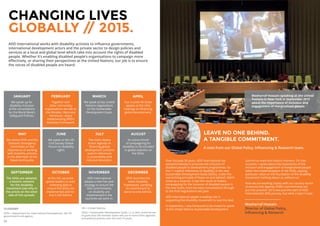
Mosharraf Hossain speaking at the United
Nations in New York in September 2015
about the importance of inclusion and
engagement of marginalised people.
26 27
With your help, we can continue
fighting for independence, equality and
opportunity for disabled people living in
poverty in Africa and Asia.
OUR PRIORITIES //2016
QUALITY  TARGETS.
Raise the quality of our work and continue
to deliver on targets. This includes bringing
positive change to over 34,000 people in
five countries by March 2016.
03
01
04
02
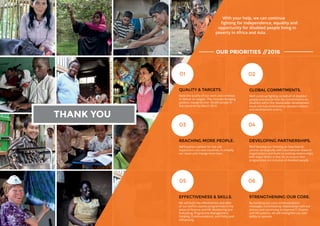
THANK YOU
05 06
GLOBAL COMMITMENTS.
We’ll continue fighting on behalf of disabled
people and ensure that the commitments on
disability within the Sustainable Development
Goals are fully embraced by decision-makers
and development actors.
REACHING MORE PEOPLE.
We’ll explore options for low risk
expansions into new countries, to amplify
our reach and change more lives.
DEVELOPING PARTNERSHIPS.
We’ll develop our thinking on how best to
partner strategically with international research
organisations and build on existing relationships
with major NGOs in the UK, to ensure their
programmes are inclusive of disabled people.
EFFECTIVENESS  SKILLS.
We will build the effectiveness and skills
of our staff in country programmes in the
areas of Finance and HR, Monitoring and
Evaluating, Programme Management,
Funding, Communications, and Policy and
Influencing.
STRENGTHENING OUR CORE.
By clarifying our core communications
messages, consolidating relationships with our
donors and continuing to improve IT, finance
and HR systems, we will strengthen our own
ability to operate.
28 29
TIM
WAINWRIGHT
ADD International
Chief Executive
Officer
MEET OUR
STAFF.
UK AND
OVERSEAS.
ADIL
SHAH
Director of Finance
 Operations
MOSHARRAF
HOSSAIN
Director of Global
Policy, Influencing 
Research
JASMINE
O’CONNOR OBE
Director of
International
Development
CLARE
MCKEOWN
Director of
Partnerships 
Funding
SHAFIQUL
ISLAM
Country Director,
Bangladesh
programme
KIERAN
BREEN
Interim Country
Director, Tanzania
programme
MAJZOUB
MOHAMED
Country Director,
Sudan
programme
VANTHON
SREY
Country Director,
Cambodia
programme
JOSEPH
WALUGEMBE
Country Director,
Uganda
programme
PASSION AND
EXPERTISE.
Disability rights advocates,
experts in policy-making and
fundraising, ADD International’s
governing board is made up of
incredibly passionate people,
working hard to make a real
change.
Trustees are recruited
internationally to reflect the
diversity of our stakeholders.
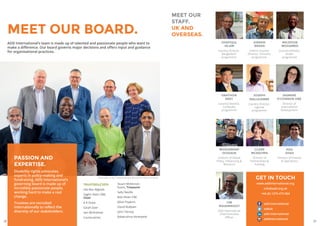
MEET OUR BOARD.
ADD International’s team is made up of talented and passionate people who want to
make a difference. Our board governs major decisions and offers input and guidance
for organisational practices.
TRUSTEES//2015
Ola Abu Alghaib
Saghir Alam OBE,
Chair
A K Dube
Sarah Dyer
Iain McAndrew
Louise James
Stuart McKinnon-
Evans, Treasurer
Sally Neville
Bob Niven CBE
Jillian Popkins
David Ruebain
John Tierney
Balakrishna Venkatesh
Photo taken at the Trustee meeting in May 2015 in Frome, Somerset
GET IN TOUCH
www.addinternational.org
Info@add.org.uk
+44 (0) 1373 473 064
add.international
adduk
add-international
addinternational
30 31
2015201520142014
££££
Fixed assets
17,34934,174Tangible fixed assets
Current assets
175,745142,386Debtors
1,844,1131,793,748Cash at bank and in hand
2,019,8581,936,134
)424,046()402,696(Creditors: amounts falling due within 1 year
1,595,8121,533,438Net current assets
1,613,1611,567,612Total assets less current liabilities
)203,077()214,822(Provisions
1,410,0841,352,790Total net assets
Represented by
The funds of the charity
Income funds
569,522536,461Restricted funds
Unrestricted funds
840,562816,329General funds
1,410,0841,352,790
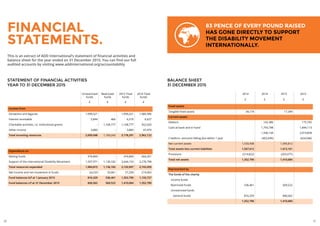
STATEMENT OF FINANCIAL ACTIVITIES
YEAR TO 31 DECEMBER 2015
BALANCE SHEET
31 DECEMBER 2015
83 PENCE OF EVERY POUND RAISED
HAS GONE DIRECTLY TO SUPPORT
THE DISABILITY MOVEMENT
INTERNATIONALLY.
This is an extract of ADD International’s statement of financial activities and
balance sheet for the year ended on 31 December 2015. You can find our full
audited accounts by visiting www.addinternational.org/accountability
FINANCIAL
STATEMENTS.
2014 Total
funds
2015 Total
funds
Restricted
funds
Unrestricted
funds
££££
Income from
1,985,9961,999,321-1,999,321Donations and legacies
6,6276,3104665,844Interest receivable
922,0201,168,7771,168,777-Charitable activities, i.e. institutional grants
47,4793,883-3,883Other income
2,962,1223,178,2911,169,2432,009,048Total incoming resources
Expenditure on
464,261476,844-476,844Raising funds
2,278,7982,644,1531,136,1821,507,971Support of the International Disability Movement
2,743,0593,120,9971,136,1821,984,815Total resources expended
219,06357,29433,06124,233Net income and net movement in funds
1,133,7271,352,790536,461816,329Fund balances b/f at 1 January 2015
1,352,7901,410,084569,522840,562Fund balances c/f at 31 December 2015
32 33
Thanks to you, we are supporting disability
activists and their organisations to bring
about social change. Whether you send
your donations every month, organise
events to raise money or fund specific
projects, you’re making a difference. A
special thank you goes to:
Asia Foundation
AusAID
CAFOD
Comic Relief
Commission for the European Communities
Cordaid
Department for International Development UK
Disability Rights Fund
DPA (Australian Embassy)
Light for the World
Manusher Jonno Foundation
National Children’s Bureau
Pro Victimis
Shiree
The Headley Trust
the innocent foundation
The James Tudor Foundation
The Rockefeller Foundation
The Vitol Foundation
USAID
Other anonymous grant-makers 
A SPECIAL THANK YOU
TO OUR DONORS.
OPERATIONAL HIGHLIGHTS.
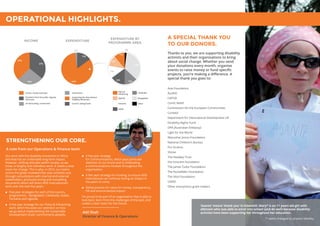
INCOME EXPENDITURE
EXPENDITURE BY
PROGRAMME AREA
Our work with the disability movement in Africa
and Asia has an undeniable long term impact.
However, shifting attitudes within society, as we
know, is lengthy and relentless work. It needs a clear
vision for change. This is why, in 2015, our teams
across the globe reviewed their past activities and,
through consultations with internal and external
stakeholders, produced strong and compelling
documents which will direct ADD International’s
work over the next five years:
◊◊ Five year strategies for each of the country
programmes – Bangladesh, Cambodia, Sudan,
Tanzania and Uganda.
◊◊ A five year strategy for our Policy  Influencing
work, which focusses our attention on how
we go about implementing the Sustainable
Development Goals’ commitments globally.
◊◊ A five year strategy
for Communications, which pays particular
attention to our brand and to embedding
a communications mindset throughout the
organisation.
◊◊ A five year strategy for Funding, to ensure ADD
International can continue having an impact in
the years to come.
◊◊ Global policies for value for money, transparency,
HR and environmental impact.
I’m proud to be part of an organisation that is able to
look back, learn from the challenges of the past, and
create a clear vision for the future.
STRENGTHENING OUR CORE.
A note from our Operations  Finance team.
Adil Shah
Director of Finance  Operations
‘Asante’ means ‘thank you’ in Kiswahili. Mary* is an 11 years old girl with
albinism who was able to enrol into school (and do well) because disability
activists have been supporting her throughout her education.
* name changed to protect identity
Grants, mostly restricted
Donations from the public, legacies
and trusts
UK Aid funding, unrestricted
27%
36%
37%
Policy 
Influencing
Uganda
Tanzania
Sudan
Cambodia
Bangladesh
Other
11%
2%
11%
13%
15%
13%
35%
Governance
Supporting the International
Disability Movement
Cost for raising funds
83%
15%
INCOME 2015
(FINALISED)
EXPENDITURE 2015
(FINALISED)
BREAKDOWN OF
EXPENDITURE 2015
(TO DO)
2%
A CHALLENGE, YOU SAY?
A note from our Partnerships  Funding team.
At the start of 2015, we knew
we were facing a challenge. The
disability activists that we work with
have the potential to increase their impact
exponentially but they need support. Yet in
2013/14, support from governments outside the
UK had dwindled.
We urgently needed to change this. With
commitment and passion, the Funding team
managed to get more institutional donors on
board and raised £1.7m in new contracts, well
above our set target. We also set ourselves an
objective of diversifying our funding base and
were delighted to secure, for the first time, funding
from USAID, to develop the emerging network of
federations which speak on behalf of all people
with disability, and the Rockefeller Foundation, for
a pioneering research project aimed at identifying
market-based solutions to extreme poverty.
But raising vital funds is also about building
£32 £430 £1,078
CHANGING LIVES.
ONE POUND AT A TIME.
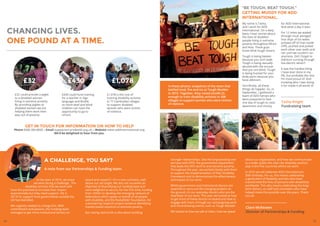
My name is Tasha,
and I work for ADD
International. On a daily
basis I hear stories about
the lives of disabled
people living in extreme
poverty throughout Africa
and Asia. These guys
know what tough means.
Tough is being beaten
because you can’t walk.
Tough is being sexually
abused with the excuse
that you are blind. Tough
is being hunted for your
body parts because you
have albinism.
Horrifically, all these
things do happen. So, in
September, I gathered a
team of ADD heroes who
were prepared to face
one day of tough to raise
awareness and money
for ADD International.
And what a day it was!
For 12 miles we waded
through mud, plunged
into skips of ice water,
jumped off of man-made
cliffs, pushed and pulled
each other over walls and
ran until we couldn’t run
anymore. Did I forget to
mention running through
live electric wires?!
It was the hardest thing
I have ever done in my
life, but probably the one
I’m most proud of. And
knowing who I was doing
it for made it all worth it!In these photos: snapshots of the team that
battled mud, fire and ice at Tough Mudder
in 2015. Together, they raised £4,649.22,
enough to train disability activists in 308
villages to support women who were victims
of violence.
“BE TOUGH, BEAT TOUGH.”
GETTING MUDDY FOR ADD
INTERNATIONAL.
stronger relationships. Like the long-standing one
we have with DFID, the government department
that leads the UK’s work to end extreme poverty.
Throughout the year, we worked closely with them
to support the implementation of their Disability
Framework and to demonstrate the effectiveness
and impact of our work.
Whilst government and institutional donors are
essential to carry out life-changing projects on
the ground, it’s our everyday donors who are the
heartbeat of our work. This year we looked at how
to get more of these donors on board and how to
engage with them, through our campaigning work
and mind-blowing events, such as Tough Mudder.
We looked at how we talk to them, how we speak
about our organisation, and how we communicate
to a wider public the vital role disability activists
play in the five countries where we work.
In 2016 we will celebrate ADD International’s
30th birthday. For us, this means celebrating
a generation of disability activists who have
transformed the lives of persons with disabilities
worldwide. This also means celebrating the long-
term donors, ex staff and volunteers who have
helped make this possible over the years. Thank
you all.
Clare McKeown
Director of Partnerships  Funding
£32 could provide a piglet
to a disabled woman
living in extreme poverty.
By providing piglets to
disabled women we are
helping them work their
way out of poverty.
£430 could fund training
for a teacher in Sign
language and Braille,
so more deaf and blind
children can have the
opportunity to go to
school.
£1,078 is the cost of
training disability activists
in 77 Cambodian villages
to support disabled
women who were victims
of violence.
GET IN TOUCH FOR INFORMATION ON HOW TO HELP
Phone 0300 303 8835 – Email supportercare@add.org.uk – Website www.addinternational.org
We’d be delighted to hear from you.
34 35
Tasha Knight
Fundraising team
36
International
WWW.ADDINTERNATIONAL.ORG
ADD International
The Old Church School
Butts Hill
BA11 1HR
Frome, Somerset
United Kingdom
+44 (0) 1373 473 064
info@add.org.uk
add.international
adduk
add-international
addinternational
ADD International. Registered in England and Wales as
Action on Disability and Development.
Company no. 2033925. Charity Commission no. 294860.
ADD International is a
disability rights organisation
with 30 years of experience in
supporting disability activists
in Africa and Asia to bring
about social change.
Working as an ally of the global
disability movement, we tackle
discrimination to ensure every
disabled person gets a fighting
chance at living their best life.

2015_ADD_International_Annual_Review

  • 1.
    1 International ANNUAL REVIEW // 2015 INDEPENDENCE,EQUALITY AND OPPORTUNITY FOR DISABLED PEOPLE LIVING IN POVERTY.
  • 2.
    Members of 2 3 Economicempowerment 18 Access to services 20 Equality for women and girls 22 Changing lives globally // 2015 24 At our core: capacity building 10 Activists: in their own words 12 Four areas of focus 14 Inclusive education 16 Our priorities // 2016 26 Welcome 4 Why disability? 6 What we do 8 WHY WE’RE HERE. Imagine going to a clinic to be tested for HIV. You are deaf and cannot read or use formal Sign language. The doctor gives you a thumbs-up. Does it mean ‘yes, you have HIV’ or ‘yes, you are okay’? Disabled people are arguably the world’s largest minority. Globally, one person out of seven has a disability. However, they still face significant barriers – like going to a clinic for a life-changing health problem and being unable to access the appropriate treatment or information. For many, exclusion, discrimination and even violence are experienced on a daily basis and, in particular, women and children with impairments often report unimaginable levels of abuse. This is why ADD International is here. We work alongside disability activists and their organisations locally and globally, to fight for independence, equality and opportunity for disabled people living in poverty. In this photo: a disability activist group for young people in Western Uganda. On the cover: disability activists from Sirajgonj, Bangladesh. Meet our board and staff 28 Financial statements and thanks 30 Changing lives one pound at a time 34 Note to the reader. In this report we tend to use ‘disabled people’, a term widely used by the disability movement in the UK to emphasise that barriers in society are ‘disabling’ for people with impairments. However, we acknowledge that in different context other words, such as ‘persons with disabilities’ or ‘people with disabilities’, are preferred.
  • 3.
    4 5 the maternitybed which was high and couldn’t be adjusted... Then I was told to take the baby for immunisation but the distance was far away.” The inclusion of disability in the Sustainable Development Goals has opened the door for us to work with major international development organisations to ensure that disabled people are included in their actions. Leaving no-one behind means ensuring that schools are fully accessible, that education is inclusive, that HIV testing and information is available to all and that, when an emergency strikes, the needs and rights of all vulnerable people are considered in responses. In 2015 we initiated new partnerships with world-leading organisations such as the Rockefeller Foundation, the Institute of Development Studies (IDS) and the Coady International Institute looking at market based solutions through the lens of disability; and with local organisations, such as the Ugandan National Youth Organization for Development and the Cambodian Human Rights and Development Association. In all this work, our aim is to ensure that our partners include disabled people in all their actions and projects. Sometimes development work doesn’t go as fast as we’d like. But in recent years we have seen an amazing shift in how disability is perceived and this is thanks to the many people across the world who have campaigned for the inclusion of persons with disabilities in development and in all aspects of society. We, at ADD International, will continue reminding global leaders and development organisations that we will only stand a chance of leaving no-one behind if persons with disabilities from the South are involved right from the start in plans to mainstream responses. In 2016 we will be celebrating 30 years of ADD International, 30 years of supporting disability activists worldwide to advocate for equal rights. On behalf of all our staff and partners, thank you to everyone who has supported our work during this time. 2015 was, without doubt, a historic year for the global disability movement. The joint efforts of a relatively small group of organisations, including ADD International, have culminated in the inclusion of disability issues in the Sustainable Development Goals. This, potentially marks the start of something transformational. ADD International’s role in influencing this process should not be underestimated. We worked on this, behind the scenes, over several years along with a small number of other disability organisations around the world including the International Disability Alliance (IDA). We want to thank our long-standing supporters for believing that shifting attitudes is necessary and possible. Four years of influencing the UN and other power-holders culminated in Barack Obama and the Pope both speaking about persons with disabilities in front of world leaders at the New York summit to adopt the Agenda. Mosharraf Hossain, our Head of Policy and Influencing spoke on behalf of the global disability movement, at the same summit, sitting on the platform with Bill and Melinda Gates. Through the Sustainable Development Goals, in pledging to ‘leave no-one behind’, global leaders hint at equality and empowerment for disabled people. Now the world must deliver. ADD International aims to be at the forefront of this. With the moral weight of the Goals and the legal guide of the Convention on the Rights of Persons with Disabilities (CRPD), we have the leverage to ask national and local governments to ensure the participation of disabled people in all levels of society. The ‘My Story, My rights’ research project in Uganda is the first of many actions to inform national and local governments about what needs to be done in order to comply with the Goals and the Convention. The project gave disabled people in Uganda a platform to tell their stories and help identify ways to ensure their rights are respected. We found out, for example, that 70% of the people we interviewed as part of the project had negative experiences with the health-care services, with many people encountering daily barriers in accessing them. A lady we met told us, “I am physically disabled. In 2010 I conceived and when time for delivery came I went to hospital. I used a motorcycle for transport but they would stop at the gate and I was supposed to proceed to labour ward while walking. The pregnancy intercepted my mobility and my legs were very weak…. Upon arrival, I was told to climb into Tim Wainwright Chief Executive Saghir Alam Chair of Trustees WELCOME.
  • 4.
    6 7 Disabled peoplehave the right to live their lives as fully as they choose, without the limitations imposed by attitudes or by social and physical barriers. Disability is not inability if disabled people are given the right tools, opportunities and support. WHY DISABILITY? VIOLENCE. Disabled people are disproportionately vulnerable to abuse, with children and women particularly affected. DISCRIMINATION. Disabled people face stigma and discrimination in their families and communities, mostly because of misconceptions about disability. EXCLUSION. Disabled people often live in isolation and are excluded from their communities, from the education system, from health care and other vital services. Sometimes, they’re even hidden away by their families. ONE BILLION PEOPLE WORLDWIDE ARE DISABLED. 80% OF THEM LIVE IN THE DEVELOPING WORLD. The injustice disabled people face often involves: 1 POVERTY. People experiencing poverty are more likely to become disabled. People in poverty have less access to healthcare and are more vulnerable to malnutrition and preventable diseases. They are also more likely to live and work in dangerous or polluted environments with low quality housing, reduced access to safe drinking water and sanitation; or in areas which are prone to the effects of natural disasters, dangerous traffic and higher rates of violence. AND THIS IS WHY ADD INTERNATIONAL IS HERE. WE BELIEVE: 21 Change comes when preconceptions are challenged. This happens when disabled people are empowered and come together with a unified voice. 3 80% Disabled people living in poverty are among the most vulnerable, marginalised and discriminated people on earth. Often, they have no access to basic human rights, education or the opportunity to earn a living. A STRONG LINK BETWEEN POVERTY & DISABILITY. WHY 2 DISABILITY. People who are disabled are more likely to be poor. Disabled people are more likely to be poor as they face multiple barriers to securing their livelihoods. Negative attitudes often severely limit their education, training, employment and income generation opportunities. Stigma and shame lead to isolation, therefore disabled people are less likely to be members of self- help groups, religious organisations or community initiatives. WHY
  • 5.
    8 9 WHAT WE DO. 1.We support disability activists. We provide them with the tools and the resources to help disabled people achieve their full potential. We call this capacity building. 2. We strengthen the disability movement in Africa and Asia. We do this by supporting local groups of disability activists to build strong and sustainable organisations that can have an ever increasing impact. We then help these groups connect with each other to build wider movements and work with them to promote the rights of disabled people. 3. We influence. We work with disability activists and their organisations to influence governments, international development organisations and the private sector to design policies and services on a local and global scale which take into account disabled people and offer inclusive solutions. NUMBER OF DISABLED PEOPLE SERVED BY COUNTRY IN 2015 BANGLADESH 10,072 people CAMBODIA 10,394 people TANZANIA 3,931 people UGANDA 1,024 people SUDAN 27,849 people SUPPORTING ACTIVISTS. In Cambodia, 77 villages now have victim support systems. Disabled women and girls experiencing violence often have nowhere to go for help. That’s why we’ve trained 77 disability activists to become ‘Village Volunteers’, the first point of contact for disabled women who have experienced violence. After only six months, 180 girls have received victim support and the choice and backing to report their perpetrators. STRENGTHENING THE DISABILITY MOVEMENT. In Sudan, 4,900 disabled women have been empowered. We proudly equipped a new generation of disabled women, over 4,900, with the skills to become active and effective campaigners and leaders, for the good of the disability movement as a whole. INFLUENCING THE DEVELOPMENT AGENDA. The Sustainable Development Goals, agreed by global leaders mention disability 11 times. For years, we backed the disability movement in its campaigning efforts. As a result, the 17 goals which will steer the development agendas of governments and NGOs, include 11 mentions of the inclusion of persons with disabilities. Disability activist speaking about peace and inclusion at a community centre in the Kasese region, Uganda. 53,270 PEOPLE ACROSS FIVE COUNTRIES Data relating to the number of disabled people supported through the work of 127 disabled people’s organisations (year five of the PPA).
  • 6.
    10 11 AT OURCORE: BUILDING CAPACITY. Capacity building means supporting disability activists’ organisations with tools, skills and resources that can enable them to become functioning organisations and powerful movements for change. At present, we are supporting 127 groups of disability activists worldwide. Our capacity building support is specifically tailored to the needs of each organisation. Activists in Tanzania wanting to lobby the government to get more disabled children into school will need different capacity building support than a group of female disability activists in Cambodia who are forming to protect their rights. Ultimately our purpose is to step away and leave behind disability activists who are leading functioning and sustainable disabled people’s organisations, and who are connected to the wider disability movement. THE RIPPLE EFFECT OF OUR CAPACITY BUILDING WORK. A note from our International Development team. We know that you need a strong disability movement to achieve lasting change for disabled people. However, we have sometimes found it difficult to describe the impact that ADD International’s capacity building work has had over time in strengthening those movements. So we commissioned an external evaluation of our capacity building efforts in Bangladesh and Cambodia to look at what we’ve achieved over the past 5-10 years, compare approaches and identify what we can do to reinforce our work. The evaluators confirmed that capacity building is ‘in ADD International’s DNA’ – at the heart of everything we do. Together with our influencing and learning work, it brings about ‘real improvements in the lives of individual persons with disabilities, as well as contributing to achieving a more inclusive society’. The reports found that our success lies in being responsive to the different needs of disabled people’s organisations. Some need technical and strategic support, others benefit from our ability to link them up with power-holders; and some disabled people’s organisations simply benefit from working closely with us in developing and implementing projects, and ‘learning-by-doing’. The challenge now is to improve the way we work with disabled people’s organisations, and we are developing a new assessment tool to help us to better plan and evaluate this core part of our work in the years to come. Emma Cain Learning Accountability Advisor
  • 7.
    12 13 Kaddush Molla Disabilityactivist, Bangladesh Today I went to the police station to discuss one of our filed abuse cases. I was firm in expressing my desire as to how the police should perform the enquiry. I can play my role of assertion because of my strength. What strength? I have the support of a large number of people behind me and this unity brings courage. My group contains nearly 4,000 members. I may be disabled, but I have the right to live in this world. I wanted people to call me by my beautiful name. These rights, being called by my name, my survival rights, my education rights are important to me. I missed this consciousness earlier. ADD International has brought the message of freedom, the message of rights for the disabled, like me. ADD International has given every support to make us learn and ensure our rights. ” Minnie Akter Disability activist, Bangladesh Disabled women are more vulnerable to violence and abuse than disabled men. We were trying to figure out something to do to help. When we told ADD International our idea they said, ‘you decide how you want to proceed and we will help’. We decided to form ‘Women’s Councils’ to tackle the problem. I received trainings on account management, office management, IT, advocacy. I was ignorant about these things before. Now I can use a computer, I can send email, make plans, use Excel, PowerPoint. I lobby different organisations at the government and non-government level. I give trainings to other grassroots organisations on account management. ” IN THEIR OWN WORDS.Disability activists in Bangladesh explain why capacity building is important, how it has empowered them to grow their organisations and why it is crucial that we continue to invest in their futures. Sabina Yasmin Disability activist, Bangladesh ADD International is a milepost in fighting for the rights of disabled people in Bangladesh. Maybe one day it won’t be here anymore but it will not take away its teachings and those teaching will help us throughout our lives. ” Arefa Parvin Disability activist, Bangladesh ADD International’s approach is to make disabled people believe that they are human beings, that they have rights and are entitled to dignity. ” AND MORE...
  • 8.
    14 15 4 AREAS OFFOCUS. We work with disability activists and their organisations to eradicate the injustice and discrimination they face in the family, community and wider society. In 2015, the actions and projects we undertook focused on: INCLUSIVE EDUCATION. The more disabled children enrol into school, the more attitudes towards disability change. Going to school gives them the opportunity to thrive. This tackles stigma in the family, in the school and in the community. In turn, more families will begin enrolling their children in the local schools and more teachers will advocate for inclusive education. ECONOMIC EMPOWERMENT. Providing skills training and job opportunities build confidence and give disabled people more independence. As a result, they earn respect as valued members of their family and communities. ACCESS TO SERVICES. Disabled people have the right to use and access services without being subjected to disability discrimination. This right is sanctioned by international law as it provides equitable redistribution of wealth in societies. EQUALITY FOR WOMEN AND GIRLS. We tackle the double discrimination disabled women face, discriminated for having an impairment and for being women. Keu Bech from Cambodia finds it hard to walk, even with a stick. In 2015 she received a $300 loan to buy pigs and some feed. With some training, she has now become a successful rearer and a local expert, advising fellow villagers on how to raise pigs. “People do not look at me strangely anymore because of my disability. I feel more confident.” 1 2 3 4
  • 9.
    16 17 WHY EDUCATION? Worldwide,59 million children are out of school. The situation is especially grim for disabled children living in extreme poverty, who are disproportionately excluded from schools. This particularly affects girls with disabilities. REACHING OUT. Through local disability activists, we reach out to disabled children and we help their families to enrol them in local schools. We provide teachers with the right training and materials to meet their students’ needs, such as Braille kits or Sign language training. We campaign for the importance of inclusive education with schools, local authorities and key institutions. QUALITY EDUCATION. THE KEY TO A BETTER FUTURE. When we first started working on the Inclusive Education project, in the Sirajgonj region, Bangladesh, parents and teachers were asking us ‘how are these impaired children going to learn how to read and write?’. Some had cerebral palsy, some had speech and hearing impairments, some even have multiple impairments. We explained there are ways, and convinced them. For example, a visually impaired child can read using Braille or, if they have low vision, see through a magnifying glass. But in many schools, teachers are still not accepting students with disabilities as their own. They avoid them tactfully. So we know there’s still a lot of work to be done in terms of training and advocacy. However, it’s important to remember that at least we have begun. If we had not trained the teachers through this project, the education of many children would come to a halt. A disabled child in Bangladesh is generally neglected in society. If they remain uneducated then they will be neglected more, they will be screened out. Education is therefore of utmost importance and it should be quality education. If we can achieve this, the future prospects of these children will change too. Take Sabina for example; she is a girl who moves around using her knees. Her body is very lean. She was refused by the school at first, but we talked to the school committee and she was admitted. She worked hard and gradually improved her performance, particularly in science, which resulted in her increased acceptance in the school. She is now taking her exams and wants to become a banker. How could Sabina find her place in the society? It’s only thanks to education. Allama Iqbal Program Officer for the Inclusive Education project in Siranjgonj, ADD International Bangladesh Trained teachers, with knowledge of inclusive education, Braille and Sign language are needed. School authorities must give importance to this problem and we need to motivate them to understand it. 400+disabled children enrolled to school in Bangladesh and Tanzania. INCLUSIVE EDUCATION. NEWinclusive education project started in Sudan. ”
  • 10.
    18 19 WHAT ISECONOMIC EMPOWERMENT? It’s the capacity for disabled people to bring about economic change for themselves. But disabled people worldwide still have to overcome huge social and physical barriers which prevent them from earning a living. TAKING ACTION. Through local disability activists, we provide disabled people with the tools and resources they need to earn a living, such as micro-loans, skills training and business start-up money. Through these interventions, disabled people are able, for the first time in their lives, to earn regular income and become independent. People around them see that they are capable and have the potential to contribute to their families and the local economy. As a consequence, negative attitudes towards disabled people change within the community. IT’S NOT JUST ABOUT LIVELIHOODS. IT’S ABOUT LONG LASTING POSITIVE CHANGE. How do you ensure the full and equal inclusion of disabled people in society when barriers seem insurmountable? ADD International’s answer is to strengthen the voices of disabled people themselves and support them to increase their participation in society. Last year, in my country Uganda, we placed 45 graduates in internships with private companies and government bodies to prove that disability should be no barrier to employability. A small number, you’d say? Not if you consider the ripple effect this can have on society. The project not only provided vital opportunities and work experience, but presented a positive image of disability in communities where the intern was the first disabled person people had interacted with professionally. We were also able to produce general information about disability for employers explaining how to accommodate the needs of disabled people in the workplace. It’s an example of how a small action can go a long way, and tells us why ADD International’s work is so effective. We don’t give direct support, but we are enabling persons with disabilities to participate in society; this way, they become the agent of change within their own community. Joseph Walugembe Country Director ADD International Uganda More understanding of disability, leads to more positive attitudes, which creates a more inclusive society, where people understand disability better. This is what we call the positive cycle of change. 1,677 disabled people are accessing longer term livelihood and development opportunities. ECONOMIC EMPOWERMENT. 35,082 disabled people reported now they’re more respected in the community. ” The data on the right relates to the 2016 ‘Programme Partnership Arrangements’ Logframe Report 2016 for DFID. The data documents our achievements from 1 April 2011 to 31 March 2016.
  • 11.
    20 21 ACCESS TOSERVICES AS A HUMAN RIGHT? Access to services is a critical aspect of any drive to challenge poverty and to reach a fairer, more equitable society. However, disabled people worldwide still report huge barriers in accessing health-care, public transport, civil and criminal justice, banking and even basic information. In the long run, this creates huge inequality gaps between those who are disabled and those who aren’t. BREAKING BARRIERS. Negative attitudes, discrimination, physical barriers and a lack of adequate policies or legislation are some of the barriers in society which are limiting opportunities for disabled people. We support disability activists who are challenging the status quo and breaking those barriers. 696public services in the countries where we work are more accessible. ACCESS TO SERVICES. 30,695 disabled people report being more satisfied with service providers in their areas. “DISABLED PEOPLE CAN’T GET AIDS” AND OTHER BARRIERS TO HIV/AIDS SERVICES. The World Health Organisation’s Constitution enshrines ‘the highest attainable standard of health as a fundamental right of every human being.’ It’s easier said than done. Whilst visiting Uganda this year, I heard many accounts of disabled people, mostly young people, being completely excluded from HIV treatment and awareness programmes, making them extremely vulnerable to being infected by HIV, and at risk of infecting others. Communication difficulties, discrimination by health service workers and educators, and barriers in accessing health centres are some of the reasons why disabled people are less likely to be able to learn how to protect themselves. Some people said to me they had been told, “how can you possibly be HIV positive? You’re disabled! Go home, and let us do our work”. The little attention given to the unique challenges faced by disabled people in Uganda got our country team to focus on this issue. They are investing time and efforts in supporting disability activists who are reaching out to disabled people in their communities, raising awareness about HIV/ AIDS and helping them access the services available in their area. It is truly inspiring work. The challenges are great and change doesn’t happen overnight. But there’s a group of committed disability activists in Uganda, many HIV positive themselves, who deserve our attention – and I hope they’ll get more in years to come. Virginia Tarozzi Communications Manager ADD International Imagine going to a clinic to be tested for HIV. You are deaf and cannot read or use formal Sign language. The doctor gives you a thumbs- up. Does it mean ‘yes, you have HIV’ or ‘yes, you are okay’? ” The data on the right relates to the 2016 ‘Programme Partnership Arrangements’ Logframe Report 2016 for DFID. The data documents our achievements from 1 April 2011 to 31 March 2016.
  • 12.
    22 23 WHAT’S THE SITUATIONFOR DISABLED WOMEN? Women with disabilities are twice as likely to experience violence in their lifetime. Generally, perceived as powerless, because they’re disabled and because they’re women, they often experience exceptional levels of physical, sexual, and psychological violence, for longer periods of time and with worse physical and mental outcomes. We see this all the time. TAKING ACTION. We fund and work with disability activists who understand the unique challenges faced by women and girls. They work with women with disabilities, their families and communities, the police, health workers and governments to address: ◊◊ Sexual and physical violence, and the myths that uphold such practices. ◊◊ Psychological violence, such as threats, intimidation and manipulation, humiliation, mocking and controlling behaviour. ◊◊ Chronic exclusion from leadership, health-care services, education, and meaningful participation in decision-making processes. SUDAN We provided evidence to ensure the inclusion of disability in the National Strategy on Women. EQUALITY FOR WOMEN GIRLS. WHEN THERE IS NO TOILET. DIFFICULT CONVERSATIONS THAT NEED TO BE HELD. The degrading practice of open defecation, a common practice in countries where the infrastructure for water and sanitation is limited, massively increases the risk for violence for women and girls, particularly if they are disabled and have specific accessibility requirements. Often, they resort to coping mechanisms, such as limiting their consumption of food and drink to reduce the need to relieve themselves, or waiting until nightfall to retain modesty. But our teams on the ground are always on alert and have been having those difficult conversations with authorities, communities and families. For each workshop or meeting, our team in Uganda checks that toilets and washing facilities are clean, safe and accessible; sanitary towels are offered free of charge. The Cambodia programme has successfully lobbied local authorities to provide wells closer to the homes of disabled people, reducing the immediate risk of sexual assaults. Our teams working on inclusive education, like in Tanzania, lobby the government and local authorities to provide accessible and safe toilets to ensure girls with (and without) disabilities are protected at school. And in Bangladesh a comprehensive two year project has improved access to water and sanitation for women with disabilities, by addressing all barriers – from social stigma, to sanitation policies. Of course, it’s only a small part of our work; but working for ADD International also means this – to constantly advocate for women’s rights, whenever we get the chance, and I’m proud to say that, slowly but steadily, we are transforming attitudes and changing behaviour. Sylvie Cordier Programme Quality Advisor Many disabled women and girls have impairment specific difficulties relating to recognising and avoiding danger; this can make them an easy target. ” UGANDA A research project has begun to analyse income-generating solutions people living in poverty, particularly women. TANZANIA Half of the disabled children enrolled as part of the inclusive education project were girls.
  • 13.
    24 25 Over thepast 30 years, ADD International has worked tirelessly to promote the inclusion of disabled people in development programmes. So the 11 explicit references of disability in the new Sustainable Development Goals (SDGs), under the overarching principle of ‘leave no-one behind’, didn’t come as a surprise. It was the result of tireless campaigning for the inclusion of disabled people in the new Goals, from the early consultations through to the final negotiations last year. ADD International played a leading role in supporting the disability movement to seal the deal. In September, I was honoured to be invited to speak at the United Nations Sustainable Development Summit to mark this historic moment. On that occasion, I spoke about the importance of the inclusion and engagement of marginalised people within the implementation of the SDGs, placing particular value on the foundation of the disability movement ‘nothing about us, without us.’ Now we are working closely with our country teams to ensure that Agenda 2030’s commitments are put into practice. 2015 was just the start of ADD International’s SDG journey, but what a start it was! JANUARY We speak up for disability inclusion at the consultations for the World Bank’s Safeguard Policies. LEAVE NO ONE BEHIND. A TANGIBLE COMMITMENT. A note from our Global Policy, Influencing Research team. Mosharraf Hossain Director of Global Policy, Influencing Research GLOSSARY DFID = Department for International Development, the UK government’s aid agency UN = United Nations SDGs = Sustainable Development Goals, i.e. a new, universal set of goals that UN member states will use to frame their agendas and political policies over the next 15 years. CHANGING LIVES GLOBALLY // 2015. ADD International works with disability activists to influence governments, international development actors and the private sector to design policies and services at a local and global level which take into account the rights of disabled people. Whether it’s enabling disabled people’s organisations to campaign more effectively, or sharing their perspectives at the United Nations, our job is to ensure the voices of disabled people are heard. FEBRUARY Together with other civil society organisations we talk to the Minister, Baroness Northover, about implementing DFID’s Disability Framework. MARCH We speak at key United Nations negotiations on the Sustainable Development Goals. APRIL Our trustee AK Dube speaks at the UN’s hearings on financing global development. MAY We advise DFID and the Disasters Emergency Committee on the importance of working with disability activists in the aftermath of the Nepal earthquake. JUNE We speak at the UN Civil Society Global Forum on disability rights. JULY The Addis Ababa Action Agenda on financing global development contains explicit references to accessibility and inclusive education. AUGUST An active month of campaigning for disability to be included in global statistics on the SDGs. SEPTEMBER The SDGs are adopted, a historic moment for the disability movement (see why in the article on the other side of this spread). OCTOBER At the UN, we press global leaders to start collecting data to ensure the SDGs are implemented and no- one is left behind. NOVEMBER ADD International adopts a new five year strategy to ensure the SDG commitments on disability are implemented in the countries we work in. DECEMBER DFID launches the latest Disability Framework, clarifying its commitment to leave no-one behind. Mosharraf Hossain speaking at the United Nations in New York in September 2015 about the importance of inclusion and engagement of marginalised people.
  • 14.
    26 27 With yourhelp, we can continue fighting for independence, equality and opportunity for disabled people living in poverty in Africa and Asia. OUR PRIORITIES //2016 QUALITY TARGETS. Raise the quality of our work and continue to deliver on targets. This includes bringing positive change to over 34,000 people in five countries by March 2016. 03 01 04 02 THANK YOU 05 06 GLOBAL COMMITMENTS. We’ll continue fighting on behalf of disabled people and ensure that the commitments on disability within the Sustainable Development Goals are fully embraced by decision-makers and development actors. REACHING MORE PEOPLE. We’ll explore options for low risk expansions into new countries, to amplify our reach and change more lives. DEVELOPING PARTNERSHIPS. We’ll develop our thinking on how best to partner strategically with international research organisations and build on existing relationships with major NGOs in the UK, to ensure their programmes are inclusive of disabled people. EFFECTIVENESS SKILLS. We will build the effectiveness and skills of our staff in country programmes in the areas of Finance and HR, Monitoring and Evaluating, Programme Management, Funding, Communications, and Policy and Influencing. STRENGTHENING OUR CORE. By clarifying our core communications messages, consolidating relationships with our donors and continuing to improve IT, finance and HR systems, we will strengthen our own ability to operate.
  • 15.
    28 29 TIM WAINWRIGHT ADD International ChiefExecutive Officer MEET OUR STAFF. UK AND OVERSEAS. ADIL SHAH Director of Finance Operations MOSHARRAF HOSSAIN Director of Global Policy, Influencing Research JASMINE O’CONNOR OBE Director of International Development CLARE MCKEOWN Director of Partnerships Funding SHAFIQUL ISLAM Country Director, Bangladesh programme KIERAN BREEN Interim Country Director, Tanzania programme MAJZOUB MOHAMED Country Director, Sudan programme VANTHON SREY Country Director, Cambodia programme JOSEPH WALUGEMBE Country Director, Uganda programme PASSION AND EXPERTISE. Disability rights advocates, experts in policy-making and fundraising, ADD International’s governing board is made up of incredibly passionate people, working hard to make a real change. Trustees are recruited internationally to reflect the diversity of our stakeholders. MEET OUR BOARD. ADD International’s team is made up of talented and passionate people who want to make a difference. Our board governs major decisions and offers input and guidance for organisational practices. TRUSTEES//2015 Ola Abu Alghaib Saghir Alam OBE, Chair A K Dube Sarah Dyer Iain McAndrew Louise James Stuart McKinnon- Evans, Treasurer Sally Neville Bob Niven CBE Jillian Popkins David Ruebain John Tierney Balakrishna Venkatesh Photo taken at the Trustee meeting in May 2015 in Frome, Somerset GET IN TOUCH www.addinternational.org Info@add.org.uk +44 (0) 1373 473 064 add.international adduk add-international addinternational
  • 16.
    30 31 2015201520142014 ££££ Fixed assets 17,34934,174Tangiblefixed assets Current assets 175,745142,386Debtors 1,844,1131,793,748Cash at bank and in hand 2,019,8581,936,134 )424,046()402,696(Creditors: amounts falling due within 1 year 1,595,8121,533,438Net current assets 1,613,1611,567,612Total assets less current liabilities )203,077()214,822(Provisions 1,410,0841,352,790Total net assets Represented by The funds of the charity Income funds 569,522536,461Restricted funds Unrestricted funds 840,562816,329General funds 1,410,0841,352,790 STATEMENT OF FINANCIAL ACTIVITIES YEAR TO 31 DECEMBER 2015 BALANCE SHEET 31 DECEMBER 2015 83 PENCE OF EVERY POUND RAISED HAS GONE DIRECTLY TO SUPPORT THE DISABILITY MOVEMENT INTERNATIONALLY. This is an extract of ADD International’s statement of financial activities and balance sheet for the year ended on 31 December 2015. You can find our full audited accounts by visiting www.addinternational.org/accountability FINANCIAL STATEMENTS. 2014 Total funds 2015 Total funds Restricted funds Unrestricted funds ££££ Income from 1,985,9961,999,321-1,999,321Donations and legacies 6,6276,3104665,844Interest receivable 922,0201,168,7771,168,777-Charitable activities, i.e. institutional grants 47,4793,883-3,883Other income 2,962,1223,178,2911,169,2432,009,048Total incoming resources Expenditure on 464,261476,844-476,844Raising funds 2,278,7982,644,1531,136,1821,507,971Support of the International Disability Movement 2,743,0593,120,9971,136,1821,984,815Total resources expended 219,06357,29433,06124,233Net income and net movement in funds 1,133,7271,352,790536,461816,329Fund balances b/f at 1 January 2015 1,352,7901,410,084569,522840,562Fund balances c/f at 31 December 2015
  • 17.
    32 33 Thanks toyou, we are supporting disability activists and their organisations to bring about social change. Whether you send your donations every month, organise events to raise money or fund specific projects, you’re making a difference. A special thank you goes to: Asia Foundation AusAID CAFOD Comic Relief Commission for the European Communities Cordaid Department for International Development UK Disability Rights Fund DPA (Australian Embassy) Light for the World Manusher Jonno Foundation National Children’s Bureau Pro Victimis Shiree The Headley Trust the innocent foundation The James Tudor Foundation The Rockefeller Foundation The Vitol Foundation USAID Other anonymous grant-makers  A SPECIAL THANK YOU TO OUR DONORS. OPERATIONAL HIGHLIGHTS. INCOME EXPENDITURE EXPENDITURE BY PROGRAMME AREA Our work with the disability movement in Africa and Asia has an undeniable long term impact. However, shifting attitudes within society, as we know, is lengthy and relentless work. It needs a clear vision for change. This is why, in 2015, our teams across the globe reviewed their past activities and, through consultations with internal and external stakeholders, produced strong and compelling documents which will direct ADD International’s work over the next five years: ◊◊ Five year strategies for each of the country programmes – Bangladesh, Cambodia, Sudan, Tanzania and Uganda. ◊◊ A five year strategy for our Policy Influencing work, which focusses our attention on how we go about implementing the Sustainable Development Goals’ commitments globally. ◊◊ A five year strategy for Communications, which pays particular attention to our brand and to embedding a communications mindset throughout the organisation. ◊◊ A five year strategy for Funding, to ensure ADD International can continue having an impact in the years to come. ◊◊ Global policies for value for money, transparency, HR and environmental impact. I’m proud to be part of an organisation that is able to look back, learn from the challenges of the past, and create a clear vision for the future. STRENGTHENING OUR CORE. A note from our Operations Finance team. Adil Shah Director of Finance Operations ‘Asante’ means ‘thank you’ in Kiswahili. Mary* is an 11 years old girl with albinism who was able to enrol into school (and do well) because disability activists have been supporting her throughout her education. * name changed to protect identity Grants, mostly restricted Donations from the public, legacies and trusts UK Aid funding, unrestricted 27% 36% 37% Policy Influencing Uganda Tanzania Sudan Cambodia Bangladesh Other 11% 2% 11% 13% 15% 13% 35% Governance Supporting the International Disability Movement Cost for raising funds 83% 15% INCOME 2015 (FINALISED) EXPENDITURE 2015 (FINALISED) BREAKDOWN OF EXPENDITURE 2015 (TO DO) 2%
  • 18.
    A CHALLENGE, YOUSAY? A note from our Partnerships Funding team. At the start of 2015, we knew we were facing a challenge. The disability activists that we work with have the potential to increase their impact exponentially but they need support. Yet in 2013/14, support from governments outside the UK had dwindled. We urgently needed to change this. With commitment and passion, the Funding team managed to get more institutional donors on board and raised £1.7m in new contracts, well above our set target. We also set ourselves an objective of diversifying our funding base and were delighted to secure, for the first time, funding from USAID, to develop the emerging network of federations which speak on behalf of all people with disability, and the Rockefeller Foundation, for a pioneering research project aimed at identifying market-based solutions to extreme poverty. But raising vital funds is also about building £32 £430 £1,078 CHANGING LIVES. ONE POUND AT A TIME. My name is Tasha, and I work for ADD International. On a daily basis I hear stories about the lives of disabled people living in extreme poverty throughout Africa and Asia. These guys know what tough means. Tough is being beaten because you can’t walk. Tough is being sexually abused with the excuse that you are blind. Tough is being hunted for your body parts because you have albinism. Horrifically, all these things do happen. So, in September, I gathered a team of ADD heroes who were prepared to face one day of tough to raise awareness and money for ADD International. And what a day it was! For 12 miles we waded through mud, plunged into skips of ice water, jumped off of man-made cliffs, pushed and pulled each other over walls and ran until we couldn’t run anymore. Did I forget to mention running through live electric wires?! It was the hardest thing I have ever done in my life, but probably the one I’m most proud of. And knowing who I was doing it for made it all worth it!In these photos: snapshots of the team that battled mud, fire and ice at Tough Mudder in 2015. Together, they raised £4,649.22, enough to train disability activists in 308 villages to support women who were victims of violence. “BE TOUGH, BEAT TOUGH.” GETTING MUDDY FOR ADD INTERNATIONAL. stronger relationships. Like the long-standing one we have with DFID, the government department that leads the UK’s work to end extreme poverty. Throughout the year, we worked closely with them to support the implementation of their Disability Framework and to demonstrate the effectiveness and impact of our work. Whilst government and institutional donors are essential to carry out life-changing projects on the ground, it’s our everyday donors who are the heartbeat of our work. This year we looked at how to get more of these donors on board and how to engage with them, through our campaigning work and mind-blowing events, such as Tough Mudder. We looked at how we talk to them, how we speak about our organisation, and how we communicate to a wider public the vital role disability activists play in the five countries where we work. In 2016 we will celebrate ADD International’s 30th birthday. For us, this means celebrating a generation of disability activists who have transformed the lives of persons with disabilities worldwide. This also means celebrating the long- term donors, ex staff and volunteers who have helped make this possible over the years. Thank you all. Clare McKeown Director of Partnerships Funding £32 could provide a piglet to a disabled woman living in extreme poverty. By providing piglets to disabled women we are helping them work their way out of poverty. £430 could fund training for a teacher in Sign language and Braille, so more deaf and blind children can have the opportunity to go to school. £1,078 is the cost of training disability activists in 77 Cambodian villages to support disabled women who were victims of violence. GET IN TOUCH FOR INFORMATION ON HOW TO HELP Phone 0300 303 8835 – Email supportercare@add.org.uk – Website www.addinternational.org We’d be delighted to hear from you. 34 35 Tasha Knight Fundraising team
  • 19.
    36 International WWW.ADDINTERNATIONAL.ORG ADD International The OldChurch School Butts Hill BA11 1HR Frome, Somerset United Kingdom +44 (0) 1373 473 064 info@add.org.uk add.international adduk add-international addinternational ADD International. Registered in England and Wales as Action on Disability and Development. Company no. 2033925. Charity Commission no. 294860. ADD International is a disability rights organisation with 30 years of experience in supporting disability activists in Africa and Asia to bring about social change. Working as an ally of the global disability movement, we tackle discrimination to ensure every disabled person gets a fighting chance at living their best life.