FORMULATION OF RISK-
INFORMED
COMPREHENSIVE
DEVELOPMENT PLAN
(CDP+)
ECOLOGICAL
PROFILING
Municipality of Sablan
October 4-6, 2022
SESSION OBJECTIVES
1
2
To provide an overview of
updated Ecological Profile
(EP)
To present the content and
process of preparing the
Ecological Profile
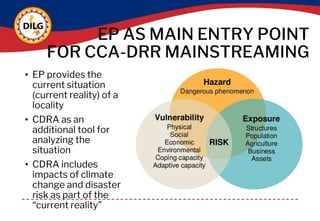
EP AS MAIN ENTRY POINT
FOR CCA-DRR MAINSTREAMING
• EP provides the
current situation
(current reality) of a
locality
• CDRA as an
additional tool for
analyzing the
situation
• CDRA includes
impacts of climate
change and disaster
risk as part of the
“current reality”
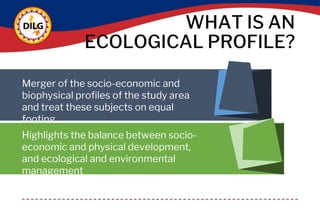
WHAT IS AN
ECOLOGICAL PROFILE?
Merger of the socio-economic and
biophysical profiles of the study area
and treat these subjects on equal
footing
Highlights the balance between socio-
economic and physical development,
and ecological and environmental
management
IMPORTANCE
ON PLANNING
1
Primary function is to provide an overall
picture of the current “reality” of the locality
2
Serves as an inventory of key baseline data
and
information of the locality
3 Determines current capacities (i.e. assets,
resources, institutional structures, etc.)
4 Facilitates an evidence-based approach in
identifying problems/issues
KEY ACTORS
All LGU
departments
/offices/units
Sectoral or
functional
committees in
providing data,
information and
statistics
pertaining to their
respective sectors
Civil Society
Organizations
and The
Academe
All
Barangays
within LGU
jurisdiction
National
government
agencies
operating within
the locality
ROLE OF
THE PROVINCE
01
02
03
04
Provide common sources, methodology,
format or templates for data gathering
Serve as the channel for cascading
information and technology (coming from
the national and provincial level)
Highlights role of each LGU in the
realization of provincial, regional and
national goals
Support LGUs to acquisition of modern
technology
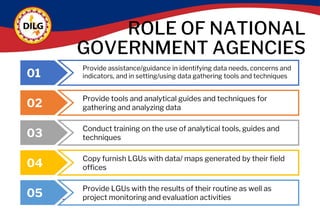
ROLE OF NATIONAL
GOVERNMENT AGENCIES
01
Provide assistance/guidance in identifying data needs, concerns and
indicators, and in setting/using data gathering tools and techniques
02
Provide tools and analytical guides and techniques for
gathering and analyzing data
03
Conduct training on the use of analytical tools, guides and
techniques
04
Copy furnish LGUs with data/ maps generated by their field
offices
05
Provide LGUs with the results of their routine as well as
project monitoring and evaluation activities
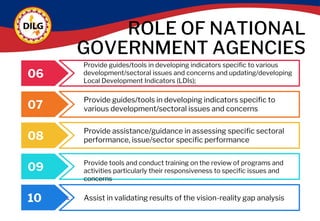
ROLE OF NATIONAL
GOVERNMENT AGENCIES
06
Provide guides/tools in developing indicators specific to various
development/sectoral issues and concerns and updating/developing
Local Development Indicators (LDIs);
07
Provide guides/tools in developing indicators specific to
various development/sectoral issues and concerns
08
Provide assistance/guidance in assessing specific sectoral
performance, issue/sector specific performance
09
Provide tools and conduct training on the review of programs and
activities particularly their responsiveness to specific issues and
concerns
10 Assist in validating results of the vision-reality gap analysis
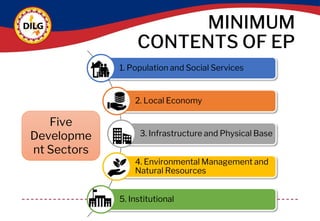
MINIMUM
CONTENTS OF EP
1. Population and Social Services
2. Local Economy
3. Infrastructure and Physical Base
4. Environmental Management and
Natural Resources
5. Institutional
Five
Developme
nt Sectors
POSSIBLE/SUGGESTED
SOURCES OF DATA
1. Day-to-day transactional and functional activities of the
LGUs/Barangays
2. Inventories
3. Surveys
4. Census
5. Community-based Monitoring System (CBMS)
6. Local Governance Performance Monitoring System (LGPMS)
7. Plan and Post-Project Monitoring and Evaluation (M & E) Results
8. Data Generated by Other LGU Offices/Departments and National
Government Agencies
9. Donor-funded Project Reports
10. Climate and Disaster Exposure Database
DATA PYRAMID
REFERENCES:
• EP Overview Powerpoint DILG
• Rationalizing the Local Planning System. DILG
BLGD. 2008
THANK YOU!

CDP Ecological Profile Overview.pptx

  • 1.
  • 2.
  • 3.
    SESSION OBJECTIVES 1 2 To providean overview of updated Ecological Profile (EP) To present the content and process of preparing the Ecological Profile
  • 5.
    EP AS MAINENTRY POINT FOR CCA-DRR MAINSTREAMING • EP provides the current situation (current reality) of a locality • CDRA as an additional tool for analyzing the situation • CDRA includes impacts of climate change and disaster risk as part of the “current reality”
  • 6.
    WHAT IS AN ECOLOGICALPROFILE? Merger of the socio-economic and biophysical profiles of the study area and treat these subjects on equal footing Highlights the balance between socio- economic and physical development, and ecological and environmental management
  • 7.
    IMPORTANCE ON PLANNING 1 Primary functionis to provide an overall picture of the current “reality” of the locality 2 Serves as an inventory of key baseline data and information of the locality 3 Determines current capacities (i.e. assets, resources, institutional structures, etc.) 4 Facilitates an evidence-based approach in identifying problems/issues
  • 8.
    KEY ACTORS All LGU departments /offices/units Sectoralor functional committees in providing data, information and statistics pertaining to their respective sectors Civil Society Organizations and The Academe All Barangays within LGU jurisdiction National government agencies operating within the locality
  • 9.
    ROLE OF THE PROVINCE 01 02 03 04 Providecommon sources, methodology, format or templates for data gathering Serve as the channel for cascading information and technology (coming from the national and provincial level) Highlights role of each LGU in the realization of provincial, regional and national goals Support LGUs to acquisition of modern technology
  • 10.
    ROLE OF NATIONAL GOVERNMENTAGENCIES 01 Provide assistance/guidance in identifying data needs, concerns and indicators, and in setting/using data gathering tools and techniques 02 Provide tools and analytical guides and techniques for gathering and analyzing data 03 Conduct training on the use of analytical tools, guides and techniques 04 Copy furnish LGUs with data/ maps generated by their field offices 05 Provide LGUs with the results of their routine as well as project monitoring and evaluation activities
  • 11.
    ROLE OF NATIONAL GOVERNMENTAGENCIES 06 Provide guides/tools in developing indicators specific to various development/sectoral issues and concerns and updating/developing Local Development Indicators (LDIs); 07 Provide guides/tools in developing indicators specific to various development/sectoral issues and concerns 08 Provide assistance/guidance in assessing specific sectoral performance, issue/sector specific performance 09 Provide tools and conduct training on the review of programs and activities particularly their responsiveness to specific issues and concerns 10 Assist in validating results of the vision-reality gap analysis
  • 12.
    MINIMUM CONTENTS OF EP 1.Population and Social Services 2. Local Economy 3. Infrastructure and Physical Base 4. Environmental Management and Natural Resources 5. Institutional Five Developme nt Sectors
  • 13.
    POSSIBLE/SUGGESTED SOURCES OF DATA 1.Day-to-day transactional and functional activities of the LGUs/Barangays 2. Inventories 3. Surveys 4. Census 5. Community-based Monitoring System (CBMS) 6. Local Governance Performance Monitoring System (LGPMS) 7. Plan and Post-Project Monitoring and Evaluation (M & E) Results 8. Data Generated by Other LGU Offices/Departments and National Government Agencies 9. Donor-funded Project Reports 10. Climate and Disaster Exposure Database
  • 14.
  • 15.
    REFERENCES: • EP OverviewPowerpoint DILG • Rationalizing the Local Planning System. DILG BLGD. 2008
  • 16.