Understanding
Open
Understanding
OpenSource
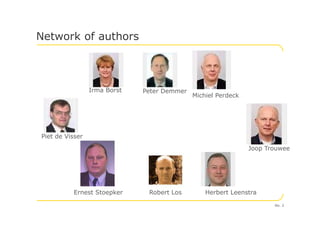
Network of authors
Peter Demmer
Michiel Perdeck
Irma Borst
Piet de Visser
Joop Trouwee
Herbert LeenstraRobert LosErnest Stoepker
No. 2
1. Open Source defined
Agenda
2. Some economics of Open Source
No. 3
1. Open source defined
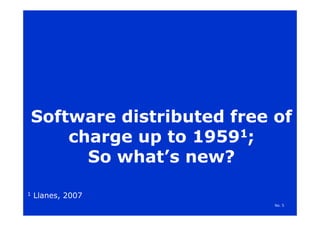
Software distributed free ofSoftware distributed free of
charge up to 19591;
So what’s new?
1 Llanes, 2007
No. 5
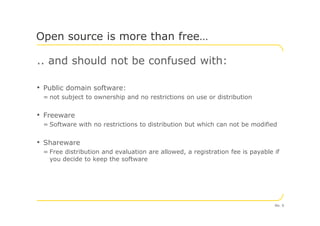
.. and should not be confused with:
• Public domain software:
= not subject to ownership and no restrictions on use or distribution
• Freeware
Open source is more than free…
• Freeware
= Software with no restrictions to distribution but which can not be modified
• Shareware
= Free distribution and evaluation are allowed, a registration fee is payable if
you decide to keep the software
No. 6
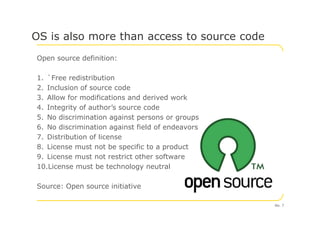
Open source definition:
1. `Free redistribution
2. Inclusion of source code
3. Allow for modifications and derived work
4. Integrity of author’s source code
5. No discrimination against persons or groups
OS is also more than access to source code
5. No discrimination against persons or groups
6. No discrimination against field of endeavors
7. Distribution of license
8. License must not be specific to a product
9. License must not restrict other software
10.License must be technology neutral
Source: Open source initiative
No. 7
Linux (Red Hat/IBM)
=5–6% of home and business PCs (Febr 2009)
=Over 90% of top 500 supercomputers (Nov 2011)
Wellknown examples
Firefox browser (Mozilla)
=150 million users, 15% of browser market (2008)
=Competitor of Microsoft Internet Explorer
=Financial model based on add revenues Google
=40% of the code developed by volunteers
No. 8
The Cathedral and the Bazaar (Raymond, 1999)
Differences in development
• No predefined plan and time schedule for development
• Voluntary non-paid software developers
• Open process for finding, tracking and correcting of bugs in the code
Traditional versus OS software
• Open process for finding, tracking and correcting of bugs in the code
• Early and frequent releases: Improvements in functionality are
incremental, allowing for rapid evolution
Differences in business model
• No license fees to be paid, other revenue models in place
• Liability is with supplier instead of developers
No. 9
Better, faster, cheaper, and with much wider acceptance, than
traditional top-down, command-and-control, closed-door
software development (Weber, 2004)
• Cost advantages
• Vendor neutral solution - avoids vendor lock-in
• Lesser bugs through community reviews software
Benefits of open source software
• Lesser bugs through community reviews software
= Code review reduces bug rates
= Correlation between low bug rates and open source development processes
• Unexpected extensions of software based on real user experiences
No. 10
OSS are engineers’ projects : Technically perfect BUT
= Utility problem: Not responding to demand of a broader group and
therefore in many cases not a revenue generator
= Usability problem: Not sufficient user-friendly and intuitive, only very
knowledgeable users can adopt the software
Critics on open source software
No. 11
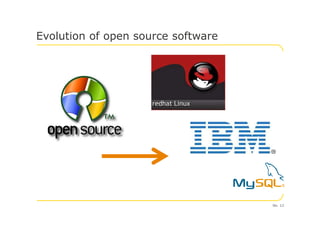
Evolution of open source software
No. 12
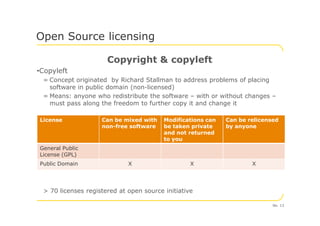
Copyright & copyleft
•Copyleft
= Concept originated by Richard Stallman to address problems of placing
software in public domain (non-licensed)
= Means: anyone who redistribute the software – with or without changes –
must pass along the freedom to further copy it and change it
Open Source licensing
> 70 licenses registered at open source initiative
License Can be mixed with
non-free software
Modifications can
be taken private
and not returned
to you
Can be relicensed
by anyone
General Public
License (GPL)
Public Domain X X X
No. 13
Question 1:
What is the value of OSS as percentage of total software and services
market in 2010?
Question 2:
Quizzzzzzz
Question 2:
Did this percentage increase, decrease or remain the same in the past
5 years?
No. 14
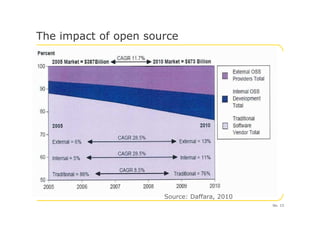
The impact of open source
No. 15
Source: Daffara, 2010
2. Some economics of Open Source
Analysis of 3149 projects (Ghosh and Prakash, 2000)
•~13,000 contributors
=75% provided only 1 contribution
=4% provided more than 5 contributions
=10% provided 72% of code
OSS contributions – key figures
=10% provided 72% of code
For every individual who contributes code,
five will simply report errors (Valloppillil, 1998)
No. 17
Motivations of OSS community members
• Social motivations:
=altruism, social belonging
• Intrinsic motivations:
=fun, challenge
Freely revealing
=fun, challenge
• Extrinsic motivations:
=reciprocity, peer & firm recognition, future benefits
such as career opportunities and options
Motivation and performance
Influence of rewards
No. 18
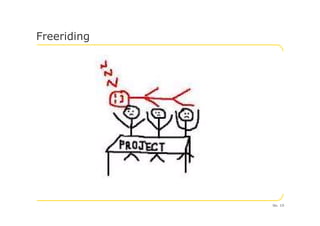
Freeriding
No. 19
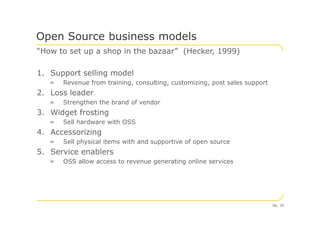
“How to set up a shop in the bazaar” (Hecker, 1999)
1. Support selling model
= Revenue from training, consulting, customizing, post sales support
2. Loss leader
= Strengthen the brand of vendor
3. Widget frosting
Open Source business models
3. Widget frosting
= Sell hardware with OSS
4. Accessorizing
= Sell physical items with and supportive of open source
5. Service enablers
= OSS allow access to revenue generating online services
No. 20
With compliments of
Logica’s OSS community,
dr. Irma Borst
w.a.m.borst@vu.nl
Logica’s OSS community,
Sheet 5
Gaston Llanes, Technology sharing in open source, Universidad Carlo
III de Madrid, December 2007
Sheet 6
Kim Johnson, Open-Source Software Development
http://users.ecs.soton.ac.uk/mrd/free/freetypes.html
Sheet 7
References - 1
Sheet 7
http://www.opensource.org/osd.html
Sheet 8
http://en.wikipedia.org/wiki/Usage_share_of_operating_systems
• share Linux on home and business pc’s: IBM estimate, February
2009
• share Linux on top 500 supercomputers: Top 500 project
Firefox case study, McKinsey Quarterly Jan 2008: Succeeding at open
source innovation: an interview with Mozilla’s Mitchelll Baker.
Sheet 9
Raymond, E. S., 1999, 'The Cathedral and the Bazaar',
http://firstmonday.org/htbin/cgiwrap/bin/ojs/index.php/fm/article/vie
wArticle/1472/1387
Sheet 10
Weber, S. 2004. The Success of Open Source. Harvard University
Press, Boston
References - 2
Press, Boston
Wheatly, M. 2004. The Myths of Open Source,
http://www.freeopen.org/ws_os5002/the_myths_of_open_source.pdf
Madey, G., Freeh, V., Tynan, R., 2002. Understanding OSS as a Self-
Organizing Process.
http://opensource.ucc.ie/icse2002/MadeyFreehTynan.pdf
Mishra, B., Prasad, A., Raghunathan, S., 2002. Quality and Profits
Under Open Source Versus Closed Source. ICIS 2002 Proceedings.
Paper 32.
Sheet 11
Z. Erlich, Z., Aviv, R. 2007. Open Source Software: Strengths and
Weaknesses. In: Handbook of research on open source software;
technological, economic and social perspectives. Edited by: St. Amant,
K., Still, B. Information Science References. London
Behlendorf, B., 1999. Open source as a business strategy. In: Open-
sources: Voices from the open source revolution. Edited by Dibona, C.,
Ockman, S., Stone, M. 140 – 170. O’Reilly, Sebastopol, CA
References - 3
Ockman, S., Stone, M. 140 – 170. O’Reilly, Sebastopol, CA
Raymond, E. S., 1999, 'The Cathedral and the Bazaar',
http://firstmonday.org/htbin/cgiwrap/bin/ojs/index.php/fm/article/vie
wArticle/1472/1387.
Sheet 13
Kim Johnson, Open-Source Software Development
http://users.ecs.soton.ac.uk/mrd/free/freetypes.html
Kennedy, D. 2001. A Primer on Open Source Licensing Legal Issues:
Copyright, Copyleft and Copyfuture. http://glotta.ntua.gr/IS-
Social/CopyRight/opensourcedmk.pdf.
http://www.opensource.org/licenses/alphabetical.
Sheet 15
Daffara, C. 2010. Open source business models: myths, realities,
practical examples.
http://www.linuxtag.org/2010/fileadmin/www.linuxtag.org/slides/Carlo
%20Daffara%20-%20Open%20Source%20Business%20Models.pdf
Sheet 17
R. Gosh, V. Prakash, 2000. The Oribiten Free Software Survey, May
2000.
References - 4
2000.
http://firstmonday.org/htbin/cgiwrap/bin/ojs/index.php/fm/article/vie
w/769/678
V. Valloppillil, 1998. Open Source Software: a (new?) development
methodology. A leaked document of an Microsoft employee, known as
Halloween I. In the meantime the number of Halloween documents,
describing the development of open source counts to 11.
J. Lerner, Tirole, J. 2002. Some simple economics of open source.
Journal of industrial economics. 50 (2) 197 – 234.
Sheet 18
Variety of references in:
Borst, I. 2010. Understanding Crowdsourcing; effects of motivation
and rewards on participation and performance in voluntary online
activities. PhD thesis, Rotterdam School of Management, Erasmus
University.
http://repub.eur.nl/res/pub/21914/EPS2010221LIS9789058922625.pd
f
References - 5
f
Sheet 19
von Hippel, E., von Krogh, G. 2003. Open source software and the
“Private-Collective” innovation model: Issues for organization science.
Organization Science 14(2), 209 - 223.
Baldwin, C., Clark, K. 2003. The architecture of cooperation: how code
architecture mitigates free riding in the open source development
model. Working Paper, Harvard Business School.
Sheet 20
von Hippel, E., von Krogh, G. 2003. Open source software and the
“Private-Collective” innovation model: Issues for organization science.
Organization Science 14(2), 209 - 223.
Hecker, F. 2000. Setting Up Shop: The Business of Open-Source
Software. http://www.hecker.org/writings/setting-up-shop.html
References - 6

IrmaBorst

  • 1.
  • 2.
    Network of authors PeterDemmer Michiel Perdeck Irma Borst Piet de Visser Joop Trouwee Herbert LeenstraRobert LosErnest Stoepker No. 2
  • 3.
    1. Open Sourcedefined Agenda 2. Some economics of Open Source No. 3
  • 4.
  • 5.
    Software distributed freeofSoftware distributed free of charge up to 19591; So what’s new? 1 Llanes, 2007 No. 5
  • 6.
    .. and shouldnot be confused with: • Public domain software: = not subject to ownership and no restrictions on use or distribution • Freeware Open source is more than free… • Freeware = Software with no restrictions to distribution but which can not be modified • Shareware = Free distribution and evaluation are allowed, a registration fee is payable if you decide to keep the software No. 6
  • 7.
    Open source definition: 1.`Free redistribution 2. Inclusion of source code 3. Allow for modifications and derived work 4. Integrity of author’s source code 5. No discrimination against persons or groups OS is also more than access to source code 5. No discrimination against persons or groups 6. No discrimination against field of endeavors 7. Distribution of license 8. License must not be specific to a product 9. License must not restrict other software 10.License must be technology neutral Source: Open source initiative No. 7
  • 8.
    Linux (Red Hat/IBM) =5–6%of home and business PCs (Febr 2009) =Over 90% of top 500 supercomputers (Nov 2011) Wellknown examples Firefox browser (Mozilla) =150 million users, 15% of browser market (2008) =Competitor of Microsoft Internet Explorer =Financial model based on add revenues Google =40% of the code developed by volunteers No. 8
  • 9.
    The Cathedral andthe Bazaar (Raymond, 1999) Differences in development • No predefined plan and time schedule for development • Voluntary non-paid software developers • Open process for finding, tracking and correcting of bugs in the code Traditional versus OS software • Open process for finding, tracking and correcting of bugs in the code • Early and frequent releases: Improvements in functionality are incremental, allowing for rapid evolution Differences in business model • No license fees to be paid, other revenue models in place • Liability is with supplier instead of developers No. 9
  • 10.
    Better, faster, cheaper,and with much wider acceptance, than traditional top-down, command-and-control, closed-door software development (Weber, 2004) • Cost advantages • Vendor neutral solution - avoids vendor lock-in • Lesser bugs through community reviews software Benefits of open source software • Lesser bugs through community reviews software = Code review reduces bug rates = Correlation between low bug rates and open source development processes • Unexpected extensions of software based on real user experiences No. 10
  • 11.
    OSS are engineers’projects : Technically perfect BUT = Utility problem: Not responding to demand of a broader group and therefore in many cases not a revenue generator = Usability problem: Not sufficient user-friendly and intuitive, only very knowledgeable users can adopt the software Critics on open source software No. 11
  • 12.
    Evolution of opensource software No. 12
  • 13.
    Copyright & copyleft •Copyleft =Concept originated by Richard Stallman to address problems of placing software in public domain (non-licensed) = Means: anyone who redistribute the software – with or without changes – must pass along the freedom to further copy it and change it Open Source licensing > 70 licenses registered at open source initiative License Can be mixed with non-free software Modifications can be taken private and not returned to you Can be relicensed by anyone General Public License (GPL) Public Domain X X X No. 13
  • 14.
    Question 1: What isthe value of OSS as percentage of total software and services market in 2010? Question 2: Quizzzzzzz Question 2: Did this percentage increase, decrease or remain the same in the past 5 years? No. 14
  • 15.
    The impact ofopen source No. 15 Source: Daffara, 2010
  • 16.
    2. Some economicsof Open Source
  • 17.
    Analysis of 3149projects (Ghosh and Prakash, 2000) •~13,000 contributors =75% provided only 1 contribution =4% provided more than 5 contributions =10% provided 72% of code OSS contributions – key figures =10% provided 72% of code For every individual who contributes code, five will simply report errors (Valloppillil, 1998) No. 17
  • 18.
    Motivations of OSScommunity members • Social motivations: =altruism, social belonging • Intrinsic motivations: =fun, challenge Freely revealing =fun, challenge • Extrinsic motivations: =reciprocity, peer & firm recognition, future benefits such as career opportunities and options Motivation and performance Influence of rewards No. 18
  • 19.
  • 20.
    “How to setup a shop in the bazaar” (Hecker, 1999) 1. Support selling model = Revenue from training, consulting, customizing, post sales support 2. Loss leader = Strengthen the brand of vendor 3. Widget frosting Open Source business models 3. Widget frosting = Sell hardware with OSS 4. Accessorizing = Sell physical items with and supportive of open source 5. Service enablers = OSS allow access to revenue generating online services No. 20
  • 21.
    With compliments of Logica’sOSS community, dr. Irma Borst w.a.m.borst@vu.nl Logica’s OSS community,
  • 22.
    Sheet 5 Gaston Llanes,Technology sharing in open source, Universidad Carlo III de Madrid, December 2007 Sheet 6 Kim Johnson, Open-Source Software Development http://users.ecs.soton.ac.uk/mrd/free/freetypes.html Sheet 7 References - 1 Sheet 7 http://www.opensource.org/osd.html Sheet 8 http://en.wikipedia.org/wiki/Usage_share_of_operating_systems • share Linux on home and business pc’s: IBM estimate, February 2009 • share Linux on top 500 supercomputers: Top 500 project Firefox case study, McKinsey Quarterly Jan 2008: Succeeding at open source innovation: an interview with Mozilla’s Mitchelll Baker.
  • 23.
    Sheet 9 Raymond, E.S., 1999, 'The Cathedral and the Bazaar', http://firstmonday.org/htbin/cgiwrap/bin/ojs/index.php/fm/article/vie wArticle/1472/1387 Sheet 10 Weber, S. 2004. The Success of Open Source. Harvard University Press, Boston References - 2 Press, Boston Wheatly, M. 2004. The Myths of Open Source, http://www.freeopen.org/ws_os5002/the_myths_of_open_source.pdf Madey, G., Freeh, V., Tynan, R., 2002. Understanding OSS as a Self- Organizing Process. http://opensource.ucc.ie/icse2002/MadeyFreehTynan.pdf Mishra, B., Prasad, A., Raghunathan, S., 2002. Quality and Profits Under Open Source Versus Closed Source. ICIS 2002 Proceedings. Paper 32.
  • 24.
    Sheet 11 Z. Erlich,Z., Aviv, R. 2007. Open Source Software: Strengths and Weaknesses. In: Handbook of research on open source software; technological, economic and social perspectives. Edited by: St. Amant, K., Still, B. Information Science References. London Behlendorf, B., 1999. Open source as a business strategy. In: Open- sources: Voices from the open source revolution. Edited by Dibona, C., Ockman, S., Stone, M. 140 – 170. O’Reilly, Sebastopol, CA References - 3 Ockman, S., Stone, M. 140 – 170. O’Reilly, Sebastopol, CA Raymond, E. S., 1999, 'The Cathedral and the Bazaar', http://firstmonday.org/htbin/cgiwrap/bin/ojs/index.php/fm/article/vie wArticle/1472/1387. Sheet 13 Kim Johnson, Open-Source Software Development http://users.ecs.soton.ac.uk/mrd/free/freetypes.html Kennedy, D. 2001. A Primer on Open Source Licensing Legal Issues: Copyright, Copyleft and Copyfuture. http://glotta.ntua.gr/IS- Social/CopyRight/opensourcedmk.pdf. http://www.opensource.org/licenses/alphabetical.
  • 25.
    Sheet 15 Daffara, C.2010. Open source business models: myths, realities, practical examples. http://www.linuxtag.org/2010/fileadmin/www.linuxtag.org/slides/Carlo %20Daffara%20-%20Open%20Source%20Business%20Models.pdf Sheet 17 R. Gosh, V. Prakash, 2000. The Oribiten Free Software Survey, May 2000. References - 4 2000. http://firstmonday.org/htbin/cgiwrap/bin/ojs/index.php/fm/article/vie w/769/678 V. Valloppillil, 1998. Open Source Software: a (new?) development methodology. A leaked document of an Microsoft employee, known as Halloween I. In the meantime the number of Halloween documents, describing the development of open source counts to 11. J. Lerner, Tirole, J. 2002. Some simple economics of open source. Journal of industrial economics. 50 (2) 197 – 234.
  • 26.
    Sheet 18 Variety ofreferences in: Borst, I. 2010. Understanding Crowdsourcing; effects of motivation and rewards on participation and performance in voluntary online activities. PhD thesis, Rotterdam School of Management, Erasmus University. http://repub.eur.nl/res/pub/21914/EPS2010221LIS9789058922625.pd f References - 5 f Sheet 19 von Hippel, E., von Krogh, G. 2003. Open source software and the “Private-Collective” innovation model: Issues for organization science. Organization Science 14(2), 209 - 223. Baldwin, C., Clark, K. 2003. The architecture of cooperation: how code architecture mitigates free riding in the open source development model. Working Paper, Harvard Business School.
  • 27.
    Sheet 20 von Hippel,E., von Krogh, G. 2003. Open source software and the “Private-Collective” innovation model: Issues for organization science. Organization Science 14(2), 209 - 223. Hecker, F. 2000. Setting Up Shop: The Business of Open-Source Software. http://www.hecker.org/writings/setting-up-shop.html References - 6