Liron Zighelnic
July 2013
Agenda
2
 Open Source (OS)
 Pros and cons for software developers
 Customers’ decision factors
 The market
 Business models
 Investments
 Dos and don’ts
 Switching from and to OS
Open Source (OS)
3
“open source is a philosophy which
promotes universal access via free
license to a product's design or
blueprint, and universal
redistribution of that design or
blueprint, including subsequent
improvements to it by anyone.”
Source: Wikipedia
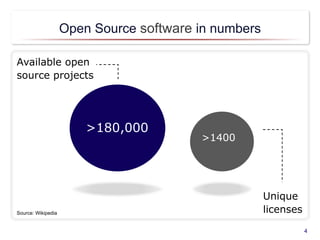
Open Source software in numbers
4
>180,000
>1400
Unique
licenses
Available open
source projects
Source: Wikipedia
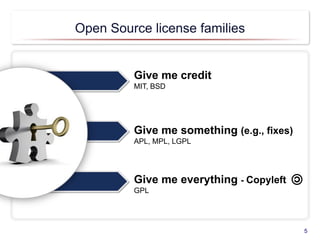
Open Source license families
5
Give me credit
MIT, BSD
Give me something (e.g., fixes)
APL, MPL, LGPL
Give me everything - Copyleft
GPL
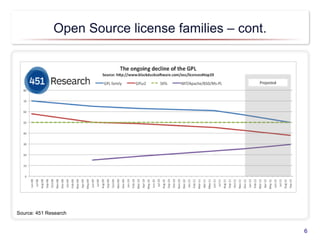
Open Source license families – cont.
6
Source: 451 Research
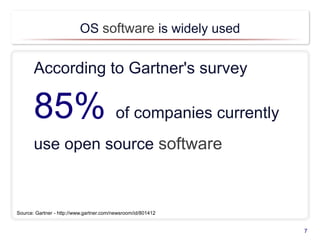
OS software is widely used
According to Gartner's survey
85% of companies currently
use open source software
7
Source: Gartner - http://www.gartner.com/newsroom/id/801412
Pros and Cons for Software
Developers
8
Pros for software developers
 Open platforms usually scale much more quickly
 “Free” marketing and greater penetration
 More likely to establish an industry standard and gain competitive
advantage (especially in infrastructure domains)
 Creates community (free testing, bug fixing, users’ feedback, etc.)
 Increases innovation - Joy’s Law - “no matter who you are, most of
the smartest people works for someone else” [1]
 Promotes the company's image and reliability including its
commercial products if exist.[2]
 Helps build developer loyalty as developers feel empowered and
have a sense of ownership of the end product.[3]
9
[1] Bill Joy, Sun Microsystems co-founder
[2] ,[3] Source: Wikipedia Open Source Software
Cons for software developers
 Complex business models
 It’s a “less paved” road
 The community as a double-edged sword
 Can we go back?
 Is it good for revenues?
 Is it good for M&A/IPO?
10
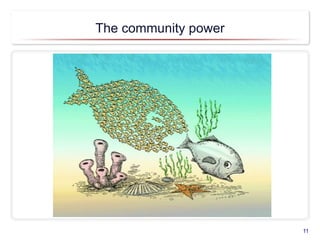
The community power
11
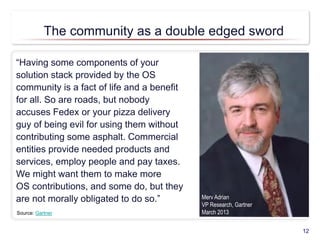
“Having some components of your
solution stack provided by the OS
community is a fact of life and a benefit
for all. So are roads, but nobody
accuses Fedex or your pizza delivery
guy of being evil for using them without
contributing some asphalt. Commercial
entities provide needed products and
services, employ people and pay taxes.
We might want them to make more
OS contributions, and some do, but they
are not morally obligated to do so.”
12
Source: Gartner
Merv Adrian
VP Research, Gartner
March 2013
The community as a double edged sword
Customers’ Decision Factors
13
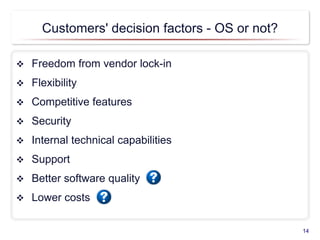
Customers' decision factors - OS or not?
 Freedom from vendor lock-in
 Flexibility
 Competitive features
 Security
 Internal technical capabilities
 Support
 Better software quality
 Lower costs
14
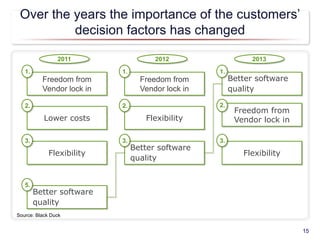
Over the years the importance of the customers’
decision factors has changed
15
Freedom from
Vendor lock in
1.
Better software
quality
5.
Flexibility
3.
Lower costs
2.
Freedom from
Vendor lock in
1.
Flexibility
2.
Better software
quality
3.
Freedom from
Vendor lock in
2.
Better software
quality
1.
Flexibility
3.
2011 2012 2013
Source: Black Duck
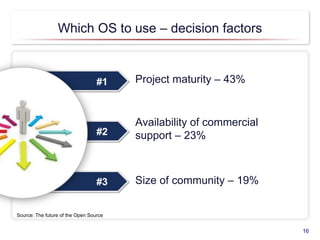
Which OS to use – decision factors
Project maturity – 43%
Availability of commercial
support – 23%
Size of community – 19%
16
#1
#2
#3
Source: The future of the Open Source
The Market
17
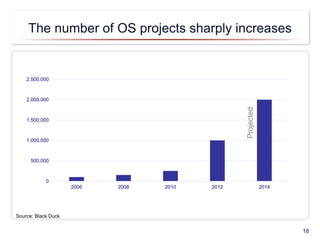
The number of OS projects sharply increases
Source: Black Duck
18
0
500,000
1,000,000
1,500,000
2,000,000
2,500,000
2006 2008 2010 2012 2014
Projected
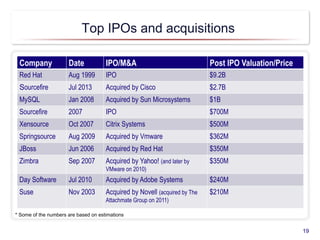
Top IPOs and acquisitions
Company Date IPO/M&A Post IPO Valuation/Price
Red Hat Aug 1999 IPO $9.2B
Sourcefire Jul 2013 Acquired by Cisco $2.7B
MySQL Jan 2008 Acquired by Sun Microsystems $1B
Sourcefire 2007 IPO $700M
Xensource Oct 2007 Citrix Systems $500M
Springsource Aug 2009 Acquired by Vmware $362M
JBoss Jun 2006 Acquired by Red Hat $350M
Zimbra Sep 2007 Acquired by Yahoo! (and later by
VMware on 2010)
$350M
Day Software Jul 2010 Acquired by Adobe Systems $240M
Suse Nov 2003 Acquired by Novell (acquired by The
Attachmate Group on 2011)
$210M
19
* Some of the numbers are based on estimations
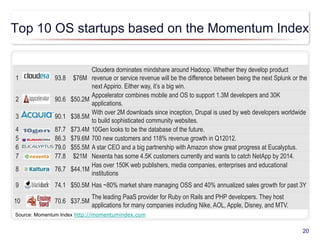
Top 10 OS startups based on the Momentum Index
1 93.8 $76M
Cloudera dominates mindshare around Hadoop. Whether they develop product
revenue or service revenue will be the difference between being the next Splunk or the
next Appirio. Either way, it’s a big win.
2 90.6 $50.2M
Appcelerator combines mobile and OS to support 1.3M developers and 30K
applications.
3 90.1 $38.5M
With over 2M downloads since inception, Drupal is used by web developers worldwide
to build sophisticated community websites.
4 87.7 $73.4M 10Gen looks to be the database of the future.
5 86.3 $79.6M 700 new customers and 118% revenue growth in Q12012.
6 79.0 $55.5M A star CEO and a big partnership with Amazon show great progress at Eucalyptus.
7 77.8 $21M Nexenta has some 4.5K customers currently and wants to catch NetApp by 2014.
8 76.7 $44.1M
Has over 150K web publishers, media companies, enterprises and educational
institutions
9 74.1 $50.5M Has ~80% market share managing OSS and 40% annualized sales growth for past 3Y
10 70.6 $37.5M
The leading PaaS provider for Ruby on Rails and PHP developers. They host
applications for many companies including Nike, AOL, Apple, Disney, and MTV.
20
Source: Momentum Index http://momentumindex.com
Business Models
21
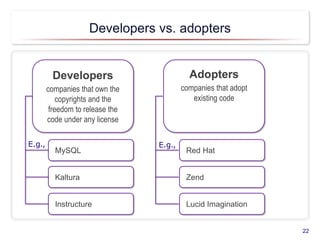
Developers vs. adopters
22
Developers
companies that own the
copyrights and the
freedom to release the
code under any license
Adopters
companies that adopt
existing code
MySQL
Kaltura
Instructure
Red Hat
Zend
Lucid Imagination
E.g., E.g.,
Business models & strategy
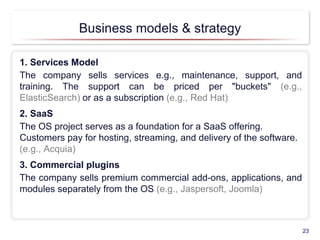
1. Services Model
The company sells services e.g., maintenance, support, and
training. The support can be priced per "buckets" (e.g.,
ElasticSearch) or as a subscription (e.g., Red Hat)
2. SaaS
The OS project serves as a foundation for a SaaS offering.
Customers pay for hosting, streaming, and delivery of the software.
(e.g., Acquia)
3. Commercial plugins
The company sells premium commercial add-ons, applications, and
modules separately from the OS (e.g., Jaspersoft, Joomla)
23
Business model & strategy – cont.
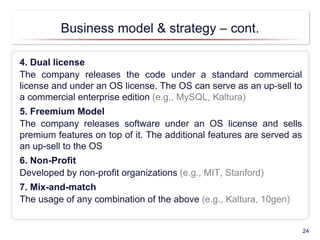
4. Dual license
The company releases the code under a standard commercial
license and under an OS license. The OS can serve as an up-sell to
a commercial enterprise edition (e.g., MySQL, Kaltura)
5. Freemium Model
The company releases software under an OS license and sells
premium features on top of it. The additional features are served as
an up-sell to the OS
6. Non-Profit
Developed by non-profit organizations (e.g., MIT, Stanford)
7. Mix-and-match
The usage of any combination of the above (e.g., Kaltura, 10gen)
24
Investments
25
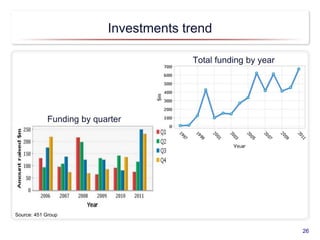
Investments trend
26
Source: 451 Group
Total funding by year
Funding by quarter
OS investment examples: Andreessen Horowitz
$100M - Jul 2012 – GitHub is a very successful
social network for programmers which allows
collaboration by forking projects, sending and
pulling requests, and monitoring development
$11.2M - Jul 2012 Meteor is an OS platform for
building web apps (round was led by A16Z)
Undisclosed Angel Round - Apr 2013.
OpenCoin develops an OS payment protocol
named Ripple
27
OS investment examples: GreyLock Partners
Cloudera, is the commercial Hadoop
company, which develops and distributes
Hadoop
Typesafe develops OS technologies to help
developers create rich, scalable, and
reactive web applications, including: the
Play web framework, Akka runtime, and
Scala programming language
28
OS investment examples: Accel Partners
Cloudera, is the commercial Hadoop
company, which develops and distributes
Hadoop
Couchbase document-oriented database
technology
ForgeRock offers open identity stack to
protect enterprise, cloud, social and mobile
applications at Internet scale
29
OS investment examples: Index Ventures
30
OS search and analytics engine which
makes real-time data exploration
OS ad server
Provides a spectrum of OS Business
Intelligence solutions
The PHP Company - the leading provider of
products and services for developing,
deploying, and managing PHP applications
OS investment examples: Intel Capital
 12 out of 311 of Intel Capital's portfolio companies are
OS companies, representing ~ 4% of its portfolio
 These companies are: Klarna, 10gen, Inc., Adaptive
Computing Enterprises Inc., Big Switch Networks, Inc.
Black Duck Software, Inc., CollabNet, Inc., Concursive
Corporation, Gengo, Inc., Zend Technologies, WSO2,
Inc, Sendmail, Inc., and Revolution Analytics
31
Source: Intel Capital
Dos and Don’ts
32
OS is a “closed cult” – you need to get in
33
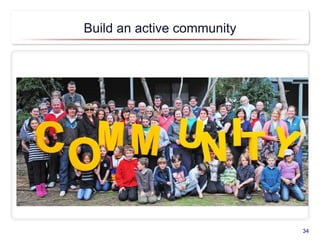
Build an active community
34
Work with the community
35
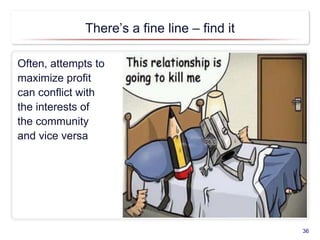
There’s a fine line – find it
Often, attempts to
maximize profit
can conflict with
the interests of
the community
and vice versa
36
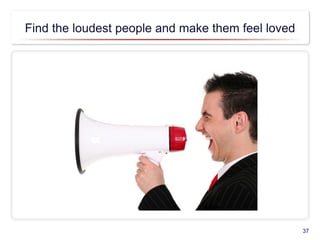
Find the loudest people and make them feel loved
37
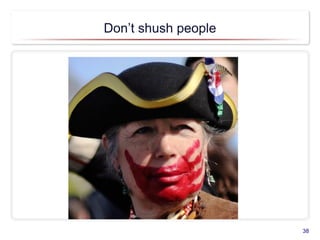
Don’t shush people
38
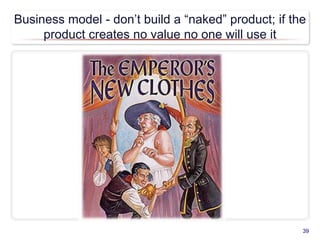
Business model - don’t build a “naked” product; if the
product creates no value no one will use it
39
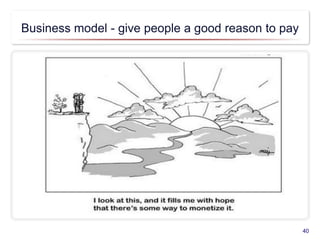
Business model - give people a good reason to pay
40
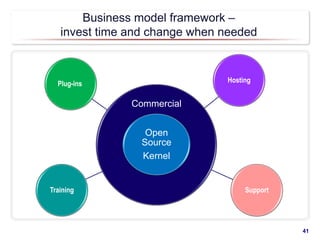
Support
Hosting
Training
Plug-ins
Business model framework –
invest time and change when needed
41
Commercial
Open
Source
Kernel
Be transparent - everyone can see everything anyway
Including
development
status, list of
features, road
map, version
control, and
bug tracker
42
Switching from and to OS
43
The easier direction: from closed to open
 Many examples exist
 E.g., Netscape
 In Feb 1998, Netscape re-licensed an existing closed source
project to OS and released the source code of Netscape
Communicator to the public
 The name given to the OS development project was Mozilla
44
From open to closed: the XandrOS case
 XandrOS was founded in 2001, with the goal of
making easy-to-use desktop Linux
 At the beginning, XandrOS had a dual license model
with a GP license, and a commercial license that did
not allow software redistribution without legal
permission
 In 2006 XandrOS stopped releasing the open source
version. This move was not a great success, and the
company was heavily criticized
45
Pulling Back from OS HW: the MakerBot case
 MakerBot and its CEO were considered shining lights
in the OS HW movement
 OS HW is HW whose design is made publicly available
so that anyone can modify, distribute, make, and sell
the design or HW based on that design
 MakerBot was a pioneer developer of OS 3D printers
 In September 2012 MakerBot decided to veer away
from OS
46
Source: CNET, MakerBot
Pulling Back from OS HW: the MakerBot case
 “We will not share the way the physical machine is
designed because we don't think carbon-copy cloning
is acceptable and carbon-copy clones undermine our
ability to pay people to do development.”
 In June 2013 MakerBot Maker was acquired by
Stratasys for $403M.
 It was founded in 2009, and had a total funding of
$10M
47
Source: CNET, MakerBot, CrunchBase
Q&A
48

Open Source

  • 1.
  • 2.
    Agenda 2  Open Source(OS)  Pros and cons for software developers  Customers’ decision factors  The market  Business models  Investments  Dos and don’ts  Switching from and to OS
  • 3.
    Open Source (OS) 3 “opensource is a philosophy which promotes universal access via free license to a product's design or blueprint, and universal redistribution of that design or blueprint, including subsequent improvements to it by anyone.” Source: Wikipedia
  • 4.
    Open Source softwarein numbers 4 >180,000 >1400 Unique licenses Available open source projects Source: Wikipedia
  • 5.
    Open Source licensefamilies 5 Give me credit MIT, BSD Give me something (e.g., fixes) APL, MPL, LGPL Give me everything - Copyleft GPL
  • 6.
    Open Source licensefamilies – cont. 6 Source: 451 Research
  • 7.
    OS software iswidely used According to Gartner's survey 85% of companies currently use open source software 7 Source: Gartner - http://www.gartner.com/newsroom/id/801412
  • 8.
    Pros and Consfor Software Developers 8
  • 9.
    Pros for softwaredevelopers  Open platforms usually scale much more quickly  “Free” marketing and greater penetration  More likely to establish an industry standard and gain competitive advantage (especially in infrastructure domains)  Creates community (free testing, bug fixing, users’ feedback, etc.)  Increases innovation - Joy’s Law - “no matter who you are, most of the smartest people works for someone else” [1]  Promotes the company's image and reliability including its commercial products if exist.[2]  Helps build developer loyalty as developers feel empowered and have a sense of ownership of the end product.[3] 9 [1] Bill Joy, Sun Microsystems co-founder [2] ,[3] Source: Wikipedia Open Source Software
  • 10.
    Cons for softwaredevelopers  Complex business models  It’s a “less paved” road  The community as a double-edged sword  Can we go back?  Is it good for revenues?  Is it good for M&A/IPO? 10
  • 11.
  • 12.
    “Having some componentsof your solution stack provided by the OS community is a fact of life and a benefit for all. So are roads, but nobody accuses Fedex or your pizza delivery guy of being evil for using them without contributing some asphalt. Commercial entities provide needed products and services, employ people and pay taxes. We might want them to make more OS contributions, and some do, but they are not morally obligated to do so.” 12 Source: Gartner Merv Adrian VP Research, Gartner March 2013 The community as a double edged sword
  • 13.
  • 14.
    Customers' decision factors- OS or not?  Freedom from vendor lock-in  Flexibility  Competitive features  Security  Internal technical capabilities  Support  Better software quality  Lower costs 14
  • 15.
    Over the yearsthe importance of the customers’ decision factors has changed 15 Freedom from Vendor lock in 1. Better software quality 5. Flexibility 3. Lower costs 2. Freedom from Vendor lock in 1. Flexibility 2. Better software quality 3. Freedom from Vendor lock in 2. Better software quality 1. Flexibility 3. 2011 2012 2013 Source: Black Duck
  • 16.
    Which OS touse – decision factors Project maturity – 43% Availability of commercial support – 23% Size of community – 19% 16 #1 #2 #3 Source: The future of the Open Source
  • 17.
  • 18.
    The number ofOS projects sharply increases Source: Black Duck 18 0 500,000 1,000,000 1,500,000 2,000,000 2,500,000 2006 2008 2010 2012 2014 Projected
  • 19.
    Top IPOs andacquisitions Company Date IPO/M&A Post IPO Valuation/Price Red Hat Aug 1999 IPO $9.2B Sourcefire Jul 2013 Acquired by Cisco $2.7B MySQL Jan 2008 Acquired by Sun Microsystems $1B Sourcefire 2007 IPO $700M Xensource Oct 2007 Citrix Systems $500M Springsource Aug 2009 Acquired by Vmware $362M JBoss Jun 2006 Acquired by Red Hat $350M Zimbra Sep 2007 Acquired by Yahoo! (and later by VMware on 2010) $350M Day Software Jul 2010 Acquired by Adobe Systems $240M Suse Nov 2003 Acquired by Novell (acquired by The Attachmate Group on 2011) $210M 19 * Some of the numbers are based on estimations
  • 20.
    Top 10 OSstartups based on the Momentum Index 1 93.8 $76M Cloudera dominates mindshare around Hadoop. Whether they develop product revenue or service revenue will be the difference between being the next Splunk or the next Appirio. Either way, it’s a big win. 2 90.6 $50.2M Appcelerator combines mobile and OS to support 1.3M developers and 30K applications. 3 90.1 $38.5M With over 2M downloads since inception, Drupal is used by web developers worldwide to build sophisticated community websites. 4 87.7 $73.4M 10Gen looks to be the database of the future. 5 86.3 $79.6M 700 new customers and 118% revenue growth in Q12012. 6 79.0 $55.5M A star CEO and a big partnership with Amazon show great progress at Eucalyptus. 7 77.8 $21M Nexenta has some 4.5K customers currently and wants to catch NetApp by 2014. 8 76.7 $44.1M Has over 150K web publishers, media companies, enterprises and educational institutions 9 74.1 $50.5M Has ~80% market share managing OSS and 40% annualized sales growth for past 3Y 10 70.6 $37.5M The leading PaaS provider for Ruby on Rails and PHP developers. They host applications for many companies including Nike, AOL, Apple, Disney, and MTV. 20 Source: Momentum Index http://momentumindex.com
  • 21.
  • 22.
    Developers vs. adopters 22 Developers companiesthat own the copyrights and the freedom to release the code under any license Adopters companies that adopt existing code MySQL Kaltura Instructure Red Hat Zend Lucid Imagination E.g., E.g.,
  • 23.
    Business models &strategy 1. Services Model The company sells services e.g., maintenance, support, and training. The support can be priced per "buckets" (e.g., ElasticSearch) or as a subscription (e.g., Red Hat) 2. SaaS The OS project serves as a foundation for a SaaS offering. Customers pay for hosting, streaming, and delivery of the software. (e.g., Acquia) 3. Commercial plugins The company sells premium commercial add-ons, applications, and modules separately from the OS (e.g., Jaspersoft, Joomla) 23
  • 24.
    Business model &strategy – cont. 4. Dual license The company releases the code under a standard commercial license and under an OS license. The OS can serve as an up-sell to a commercial enterprise edition (e.g., MySQL, Kaltura) 5. Freemium Model The company releases software under an OS license and sells premium features on top of it. The additional features are served as an up-sell to the OS 6. Non-Profit Developed by non-profit organizations (e.g., MIT, Stanford) 7. Mix-and-match The usage of any combination of the above (e.g., Kaltura, 10gen) 24
  • 25.
  • 26.
    Investments trend 26 Source: 451Group Total funding by year Funding by quarter
  • 27.
    OS investment examples:Andreessen Horowitz $100M - Jul 2012 – GitHub is a very successful social network for programmers which allows collaboration by forking projects, sending and pulling requests, and monitoring development $11.2M - Jul 2012 Meteor is an OS platform for building web apps (round was led by A16Z) Undisclosed Angel Round - Apr 2013. OpenCoin develops an OS payment protocol named Ripple 27
  • 28.
    OS investment examples:GreyLock Partners Cloudera, is the commercial Hadoop company, which develops and distributes Hadoop Typesafe develops OS technologies to help developers create rich, scalable, and reactive web applications, including: the Play web framework, Akka runtime, and Scala programming language 28
  • 29.
    OS investment examples:Accel Partners Cloudera, is the commercial Hadoop company, which develops and distributes Hadoop Couchbase document-oriented database technology ForgeRock offers open identity stack to protect enterprise, cloud, social and mobile applications at Internet scale 29
  • 30.
    OS investment examples:Index Ventures 30 OS search and analytics engine which makes real-time data exploration OS ad server Provides a spectrum of OS Business Intelligence solutions The PHP Company - the leading provider of products and services for developing, deploying, and managing PHP applications
  • 31.
    OS investment examples:Intel Capital  12 out of 311 of Intel Capital's portfolio companies are OS companies, representing ~ 4% of its portfolio  These companies are: Klarna, 10gen, Inc., Adaptive Computing Enterprises Inc., Big Switch Networks, Inc. Black Duck Software, Inc., CollabNet, Inc., Concursive Corporation, Gengo, Inc., Zend Technologies, WSO2, Inc, Sendmail, Inc., and Revolution Analytics 31 Source: Intel Capital
  • 32.
  • 33.
    OS is a“closed cult” – you need to get in 33
  • 34.
    Build an activecommunity 34
  • 35.
    Work with thecommunity 35
  • 36.
    There’s a fineline – find it Often, attempts to maximize profit can conflict with the interests of the community and vice versa 36
  • 37.
    Find the loudestpeople and make them feel loved 37
  • 38.
  • 39.
    Business model -don’t build a “naked” product; if the product creates no value no one will use it 39
  • 40.
    Business model -give people a good reason to pay 40
  • 41.
    Support Hosting Training Plug-ins Business model framework– invest time and change when needed 41 Commercial Open Source Kernel
  • 42.
    Be transparent -everyone can see everything anyway Including development status, list of features, road map, version control, and bug tracker 42
  • 43.
  • 44.
    The easier direction:from closed to open  Many examples exist  E.g., Netscape  In Feb 1998, Netscape re-licensed an existing closed source project to OS and released the source code of Netscape Communicator to the public  The name given to the OS development project was Mozilla 44
  • 45.
    From open toclosed: the XandrOS case  XandrOS was founded in 2001, with the goal of making easy-to-use desktop Linux  At the beginning, XandrOS had a dual license model with a GP license, and a commercial license that did not allow software redistribution without legal permission  In 2006 XandrOS stopped releasing the open source version. This move was not a great success, and the company was heavily criticized 45
  • 46.
    Pulling Back fromOS HW: the MakerBot case  MakerBot and its CEO were considered shining lights in the OS HW movement  OS HW is HW whose design is made publicly available so that anyone can modify, distribute, make, and sell the design or HW based on that design  MakerBot was a pioneer developer of OS 3D printers  In September 2012 MakerBot decided to veer away from OS 46 Source: CNET, MakerBot
  • 47.
    Pulling Back fromOS HW: the MakerBot case  “We will not share the way the physical machine is designed because we don't think carbon-copy cloning is acceptable and carbon-copy clones undermine our ability to pay people to do development.”  In June 2013 MakerBot Maker was acquired by Stratasys for $403M.  It was founded in 2009, and had a total funding of $10M 47 Source: CNET, MakerBot, CrunchBase
  • 48.