OPEN SOURCE
SOFTWARE
,
INTRODUCTION
 Open source refers to a program in which the source code is available to the general
public for use and/or modification from its original design. Open source code is
typically created as a collaborative effort in which programmers improve upon the
code and share the changes within the community.
 Open-source software (OSS) is computer software with its source code made
available and licensed with a license in which the copyright holder provides the rights
to study, change and distribute the software at no cost to anyone and for any
purpose. Open-source software is very often developed in a
public, collaborative manner
HISTORY
 In the beginning, there was only free software. Later on, proprietary software was
born, and it quickly dominated the software landscape, to the point that it is today
considered as the only possible model by many people. Only recently has the
software industry considered free software as an option again.
 In 1998, a group of individuals advocated that the term free software should be
replaced by open-source software (OSS) as an expression which is less ambiguous
and more comfortable for the corporate world.
 Software developers may want to publish their software with an open-source license,
so that anybody may also develop the same software or understand its internal
functioning.
 Scholars Casson and Ryan have pointed out several policy-based reasons for
adoption of open source in particular, the heightened value proposition from open
source
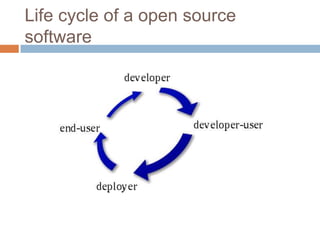
Life cycle of a open source
software
Funding
 Unlike proprietary off-the-shelf software, which comes with restrictive
copyright licenses, open source software can be given away for no charge.
This means that its creators cannot require each user to pay a license fee
to fund development.
 Many open source software projects have begun as research projects
within universities, as personal projects of students or professors, or as
tools to aid scientific research.
 Software can be developed as a consulting project for one or more
customers. The customers pay to direct the developer’s efforts.Companies
or independent consultants can also charge for training,
installation, technical support, or customization of the software.
 Another approach to funding is to provide the software freely, but sell
licenses to proprietary add-ons such as data libraries.
Non-software use
 The principles of open source have been
adapted for many forms of user-generated
content and technology, including Wikipedia,
and open-access publishing.
 Ex:Torrents websites,
 Audio Downloads,
 Wikipedia
Comparison with closed
source
The top four reasons individuals or organizations choose open
source software are:
 lower cost
 security,
 no vendor 'lock in',
 better quality.
A study of the Linux source code has 0.17 bugs per 1000 lines
of code while proprietary software generally scores 20–30 bugs
per 1000 lines.
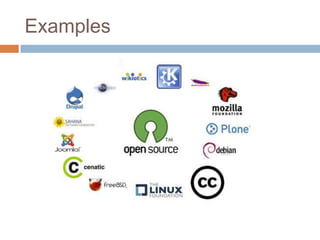
Examples
Widely used open-source
products
 Apache HTTP Server
 Mozilla Firefox
 LINUX,ANDRIOD
 E-commerce
 MYSQL
 JDK(Java Development Kit)
 Eclipse
Widely Used open-source
products
Apache HTTP Server:
The Apache HTTP Server Project is a collaborative software
development effort aimed at creating a robust, commercial-grade,
feature-rich and freely-available source code implementation of an
HTTP (Web) server. The project is jointly managed by a group of volunteers located
around the world, using the Internet and the Web to communicate, plan, and
develop the server and its related documentation. This project is part of the Apache
Software Foundation.
Mozilla Firefox:
Mozilla Firefox is a free and open source web browser developed for
Windows and Linux, with a mobile version for Android, by
Mozilla Foundation
Widely used open-source
products
LINUX:
The development of Linux is one of the most prominent examples of free and
open source software collaboration.
It is a leading operating system on servers and other systems such as
mainframe computers and supercomputers.
ANDRIOD:
Android is a operating system designed primarily for
touchscreen mobile devices such as smartphones and
tablet computers.
Android is open source and Google releases the code under
the Apache License. This open source code and permissive
licensing allows the software to be freely modified and
distributed by device manufacturers, wireless carriers and
enthusiast developers.
Widely used open-source
products
E-COMMERCE:
Electronic commerce, commonly known as e-commerce, is a type of industry where
buying and selling of product or service is conducted over electronic systems such as
the Internet and other computer networks.
MY-SQL:
MySQL ( also called "My Sequel") is an open source
relational database management system (RDBMS) that runs as a server providing multi-
user access to a number of databases.
Widely used open-source
products
JDK(Java Development Kit):
The Java Development Kit (JDK) is an implementation of
either one of the Java SE, Java EE or Java ME platforms
released by SUN MICROSYSTEMS.
The JDK includes the Java Runtime Environment, the Java compiler and the
Java APIs.
Eclipse:
Eclipse is a community for individuals and organizations who wish
to collaborate on commercially-friendly open source software.
Its projects are focused on building an open development platform
comprised of extensible frameworks, tools and runtimes for building,
deploying and managing software across the lifecycle
MILESTONE PROJECTS
 Collabative
 Facebook
 Whatsapp
 PHPCOLLAB
ORGANIZATIONS
 Apache Software Foundation.
 LINUX Foundation.
 Eclipse Foundation.
 SUN MICROSYSTEMS(ORACLE
CORPORATION).
 Mozilla Foundation.
 Open Handset Alliance.
 Google.
Arguments for OSS
 What belongs to everyone belongs to no one.
 Saving money.
 The Government is not interested in profit.
 Cross platform compatibility.
Arguments for OSS Cont…
 OSS people may only be interested in
upgrading for their own purposes
 Compatibility problems
 Some commercial companies may not be
interested in working with OSS
CONCLUSION
Open Source Software(OSS) is a community
where every user is interested in involving and
make use of the products from which there will
be a anonyms updation and make every thing
exposed, in terms of code and their efficiency.
Though this is a bitter bite for few proprietary
owned organizations where the products need to
be licensed and these organisations make
money out of them.
Bibliography
 http://en.wikipedia.org/wiki/Open-source_software#Licensing
 http://eu.conecta.it/paper/Contents.html
 http://scienceinafrica.com/old/index.php?q=2004/january/software.h
tm
 http://www.pcworld.com/article/209891/10_reasons_open_source_i
s_good_for_business.html
 http://www.slidesha re.net/jimjag/what-is-opensource
 http://www.authorstream.com/Presentation/elv_sun-1647676-6-
open-source-software-free/
Queries…

Open source

  • 1.
  • 2.
    INTRODUCTION  Open sourcerefers to a program in which the source code is available to the general public for use and/or modification from its original design. Open source code is typically created as a collaborative effort in which programmers improve upon the code and share the changes within the community.  Open-source software (OSS) is computer software with its source code made available and licensed with a license in which the copyright holder provides the rights to study, change and distribute the software at no cost to anyone and for any purpose. Open-source software is very often developed in a public, collaborative manner
  • 3.
    HISTORY  In thebeginning, there was only free software. Later on, proprietary software was born, and it quickly dominated the software landscape, to the point that it is today considered as the only possible model by many people. Only recently has the software industry considered free software as an option again.  In 1998, a group of individuals advocated that the term free software should be replaced by open-source software (OSS) as an expression which is less ambiguous and more comfortable for the corporate world.  Software developers may want to publish their software with an open-source license, so that anybody may also develop the same software or understand its internal functioning.  Scholars Casson and Ryan have pointed out several policy-based reasons for adoption of open source in particular, the heightened value proposition from open source
  • 4.
    Life cycle ofa open source software
  • 5.
    Funding  Unlike proprietaryoff-the-shelf software, which comes with restrictive copyright licenses, open source software can be given away for no charge. This means that its creators cannot require each user to pay a license fee to fund development.  Many open source software projects have begun as research projects within universities, as personal projects of students or professors, or as tools to aid scientific research.  Software can be developed as a consulting project for one or more customers. The customers pay to direct the developer’s efforts.Companies or independent consultants can also charge for training, installation, technical support, or customization of the software.  Another approach to funding is to provide the software freely, but sell licenses to proprietary add-ons such as data libraries.
  • 6.
    Non-software use  Theprinciples of open source have been adapted for many forms of user-generated content and technology, including Wikipedia, and open-access publishing.  Ex:Torrents websites,  Audio Downloads,  Wikipedia
  • 7.
    Comparison with closed source Thetop four reasons individuals or organizations choose open source software are:  lower cost  security,  no vendor 'lock in',  better quality. A study of the Linux source code has 0.17 bugs per 1000 lines of code while proprietary software generally scores 20–30 bugs per 1000 lines.
  • 8.
  • 9.
    Widely used open-source products Apache HTTP Server  Mozilla Firefox  LINUX,ANDRIOD  E-commerce  MYSQL  JDK(Java Development Kit)  Eclipse
  • 10.
    Widely Used open-source products ApacheHTTP Server: The Apache HTTP Server Project is a collaborative software development effort aimed at creating a robust, commercial-grade, feature-rich and freely-available source code implementation of an HTTP (Web) server. The project is jointly managed by a group of volunteers located around the world, using the Internet and the Web to communicate, plan, and develop the server and its related documentation. This project is part of the Apache Software Foundation. Mozilla Firefox: Mozilla Firefox is a free and open source web browser developed for Windows and Linux, with a mobile version for Android, by Mozilla Foundation
  • 11.
    Widely used open-source products LINUX: Thedevelopment of Linux is one of the most prominent examples of free and open source software collaboration. It is a leading operating system on servers and other systems such as mainframe computers and supercomputers. ANDRIOD: Android is a operating system designed primarily for touchscreen mobile devices such as smartphones and tablet computers. Android is open source and Google releases the code under the Apache License. This open source code and permissive licensing allows the software to be freely modified and distributed by device manufacturers, wireless carriers and enthusiast developers.
  • 12.
    Widely used open-source products E-COMMERCE: Electroniccommerce, commonly known as e-commerce, is a type of industry where buying and selling of product or service is conducted over electronic systems such as the Internet and other computer networks. MY-SQL: MySQL ( also called "My Sequel") is an open source relational database management system (RDBMS) that runs as a server providing multi- user access to a number of databases.
  • 13.
    Widely used open-source products JDK(JavaDevelopment Kit): The Java Development Kit (JDK) is an implementation of either one of the Java SE, Java EE or Java ME platforms released by SUN MICROSYSTEMS. The JDK includes the Java Runtime Environment, the Java compiler and the Java APIs. Eclipse: Eclipse is a community for individuals and organizations who wish to collaborate on commercially-friendly open source software. Its projects are focused on building an open development platform comprised of extensible frameworks, tools and runtimes for building, deploying and managing software across the lifecycle
  • 14.
    MILESTONE PROJECTS  Collabative Facebook  Whatsapp  PHPCOLLAB
  • 15.
    ORGANIZATIONS  Apache SoftwareFoundation.  LINUX Foundation.  Eclipse Foundation.  SUN MICROSYSTEMS(ORACLE CORPORATION).  Mozilla Foundation.  Open Handset Alliance.  Google.
  • 16.
    Arguments for OSS What belongs to everyone belongs to no one.  Saving money.  The Government is not interested in profit.  Cross platform compatibility.
  • 17.
    Arguments for OSSCont…  OSS people may only be interested in upgrading for their own purposes  Compatibility problems  Some commercial companies may not be interested in working with OSS
  • 18.
    CONCLUSION Open Source Software(OSS)is a community where every user is interested in involving and make use of the products from which there will be a anonyms updation and make every thing exposed, in terms of code and their efficiency. Though this is a bitter bite for few proprietary owned organizations where the products need to be licensed and these organisations make money out of them.
  • 19.
    Bibliography  http://en.wikipedia.org/wiki/Open-source_software#Licensing  http://eu.conecta.it/paper/Contents.html http://scienceinafrica.com/old/index.php?q=2004/january/software.h tm  http://www.pcworld.com/article/209891/10_reasons_open_source_i s_good_for_business.html  http://www.slidesha re.net/jimjag/what-is-opensource  http://www.authorstream.com/Presentation/elv_sun-1647676-6- open-source-software-free/
  • 21.