Ring Documentation, Release 1.3
RingVM_CFunctionsList() ---> List
Example:
See RingVM_CFunctionsList()
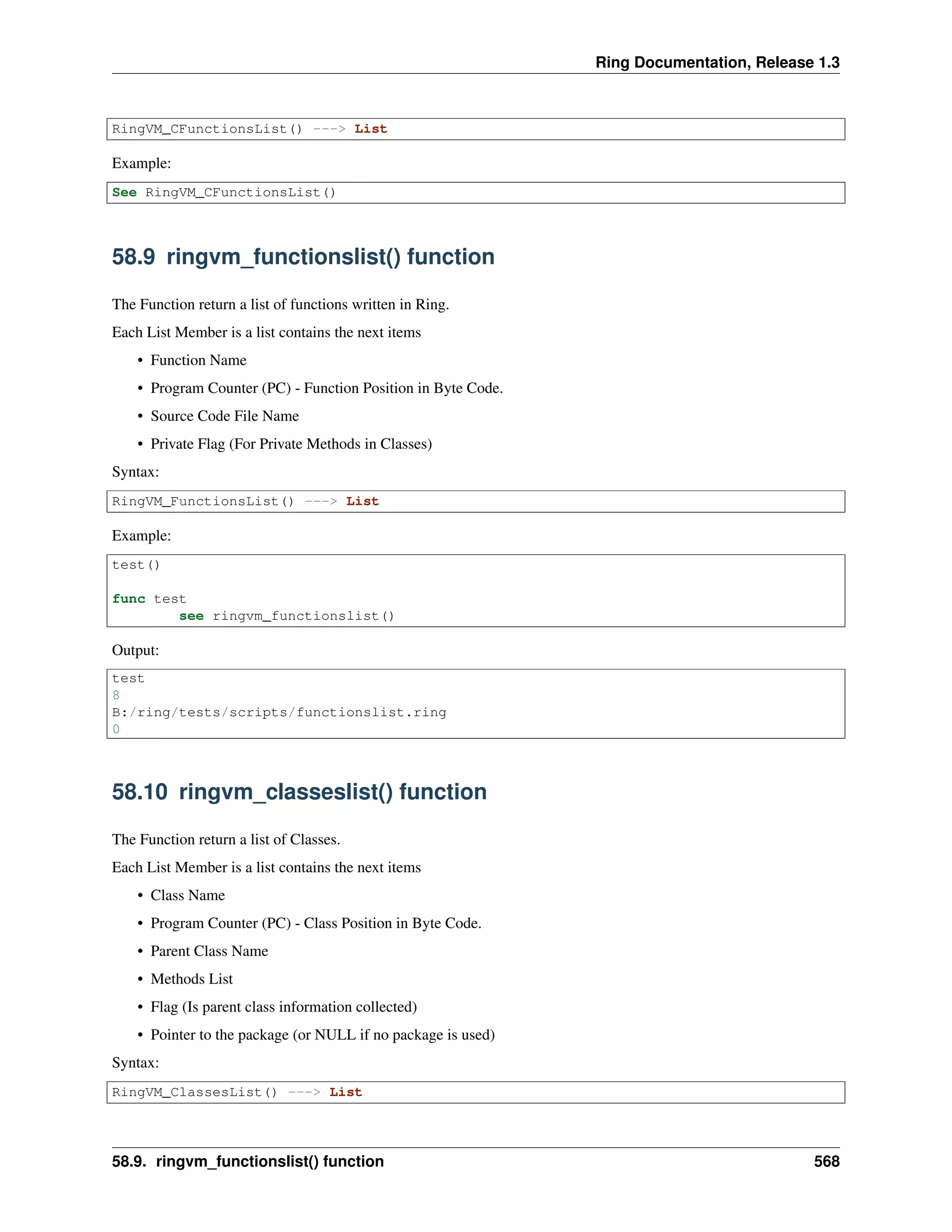
58.9 ringvm_functionslist() function
The Function return a list of functions written in Ring.
Each List Member is a list contains the next items
• Function Name
• Program Counter (PC) - Function Position in Byte Code.
• Source Code File Name
• Private Flag (For Private Methods in Classes)
Syntax:
RingVM_FunctionsList() ---> List
Example:
test()
func test
see ringvm_functionslist()
Output:
test
8
B:/ring/tests/scripts/functionslist.ring
0
58.10 ringvm_classeslist() function
The Function return a list of Classes.
Each List Member is a list contains the next items
• Class Name
• Program Counter (PC) - Class Position in Byte Code.
• Parent Class Name
• Methods List
• Flag (Is parent class information collected)
• Pointer to the package (or NULL if no package is used)
Syntax:
RingVM_ClassesList() ---> List
58.9. ringvm_functionslist() function 568
Ring Documentation, Release 1.3
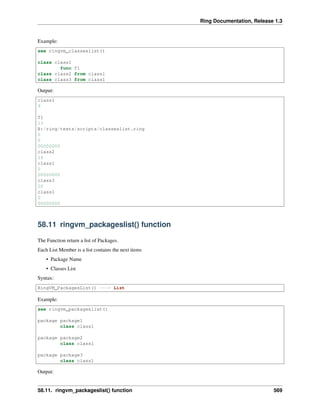
Example:
see ringvm_classeslist()
class class1
func f1
class class2 from class1
class class3 from class1
Output:
class1
9
f1
13
B:/ring/tests/scripts/classeslist.ring
0
0
00000000
class2
16
class1
0
00000000
class3
20
class1
0
00000000
58.11 ringvm_packageslist() function
The Function return a list of Packages.
Each List Member is a list contains the next items
• Package Name
• Classes List
Syntax:
RingVM_PackagesList() ---> List
Example:
see ringvm_packageslist()
package package1
class class1
package package2
class class1
package package3
class class1
Output:
58.11. ringvm_packageslist() function 569
Ring Documentation, Release 1.3
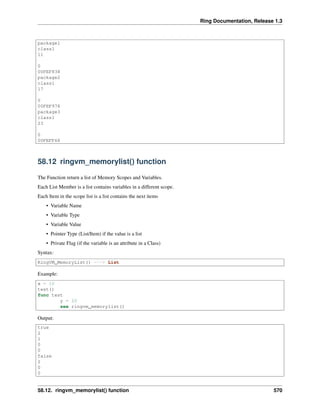
package1
class1
11
0
00FEF838
package2
class1
17
0
00FEF978
package3
class1
23
0
00FEFF68
58.12 ringvm_memorylist() function
The Function return a list of Memory Scopes and Variables.
Each List Member is a list contains variables in a different scope.
Each Item in the scope list is a list contains the next items
• Variable Name
• Variable Type
• Variable Value
• Pointer Type (List/Item) if the value is a list
• Private Flag (if the variable is an attribute in a Class)
Syntax:
RingVM_MemoryList() ---> List
Example:
x = 10
test()
func test
y = 20
see ringvm_memorylist()
Output:
true
2
1
0
0
false
2
0
0
58.12. ringvm_memorylist() function 570
Ring Documentation, Release 1.3
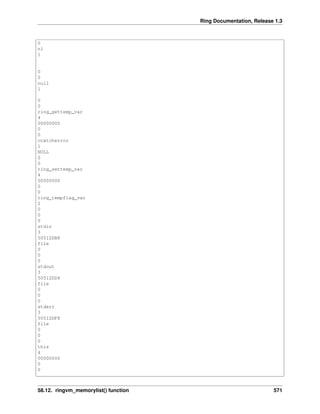
0
nl
1
0
0
null
1
0
0
ring_gettemp_var
4
00000000
0
0
ccatcherror
1
NULL
0
0
ring_settemp_var
4
00000000
0
0
ring_tempflag_var
2
0
0
0
stdin
3
50512DB8
file
0
0
0
stdout
3
50512DD8
file
0
0
0
stderr
3
50512DF8
file
0
0
0
this
4
00000000
0
0
58.12. ringvm_memorylist() function 571
Ring Documentation, Release 1.3
sysargv
3
B:ringbin/ring
B:/ring/tests/scripts/memorylist.ring
0
0
x
2
10
0
0
y
2
20
0
0
58.13 ringvm_calllist() function
The Function return a list of the functions call list.
Each List Member is a list contains the next items
• Function Type
• Function Name
• Program Counter (PC)
• Stack Pointer (SP)
• Temp. Memory List
• Method or Function Flag
• Caller PC
• FuncExec Flag
• ListStart Flag
• Nested Lists Pointer
• State List
Syntax:
RingVM_CallList() ---> List
Example:
hello()
func hello
test()
func test
mylist = ringvm_calllist()
for t in mylist see t[2] + nl next
Output:
58.13. ringvm_calllist() function 572
Ring Documentation, Release 1.3
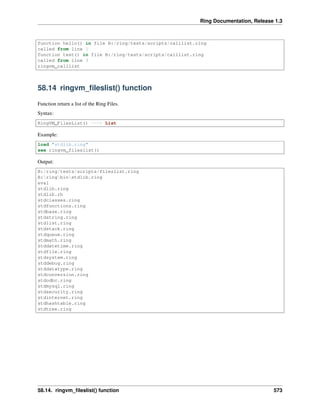
function hello() in file B:/ring/tests/scripts/calllist.ring
called from line 1
function test() in file B:/ring/tests/scripts/calllist.ring
called from line 3
ringvm_calllist
58.14 ringvm_fileslist() function
Function return a list of the Ring Files.
Syntax:
RingVM_FilesList() ---> List
Example:
load "stdlib.ring"
see ringvm_fileslist()
Output:
B:/ring/tests/scripts/fileslist.ring
B:ringbinstdlib.ring
eval
stdlib.ring
stdlib.rh
stdclasses.ring
stdfunctions.ring
stdbase.ring
stdstring.ring
stdlist.ring
stdstack.ring
stdqueue.ring
stdmath.ring
stddatetime.ring
stdfile.ring
stdsystem.ring
stddebug.ring
stddatatype.ring
stdconversion.ring
stdodbc.ring
stdmysql.ring
stdsecurity.ring
stdinternet.ring
stdhashtable.ring
stdtree.ring
58.14. ringvm_fileslist() function 573
CHAPTER
FIFTYNINE
INTRODUCTION
In this chapter we will learn about embedding Ring in Ring programs and applications.
59.1 Embedding Ring in Ring without sharing the State
From Ring 1.0 we already have functions for embedding Ring in the C language. Also we can execute Ring code
inside Ring programs using the eval() function. In this release we provide functions for embedding Ring in Ring
programs without sharing the state.
Advantages:
1. Quick integration for Ring programs and applications together without conflicts.
2. Execute and run Ring code in safe environments that we can trace.
Example:
pState = ring_state_init()
ring_state_runcode(pState,"See 'Hello, World!'+nl")
ring_state_runcode(pState,"x = 10")
pState2 = ring_state_init()
ring_state_runcode(pState2,"See 'Hello, World!'+nl")
ring_state_runcode(pState2,"x = 20")
ring_state_runcode(pState,"see x +nl")
ring_state_runcode(pState2,"see x +nl")
v1 = ring_state_findvar(pState,"x")
v2 = ring_state_findvar(pState2,"x")
see v1[3] + nl
see V2[3] + nl
ring_state_delete(pState)
ring_state_delete(pState2)
Output:
Hello, World!
Hello, World!
10
20
10
20
574
Ring Documentation, Release 1.3
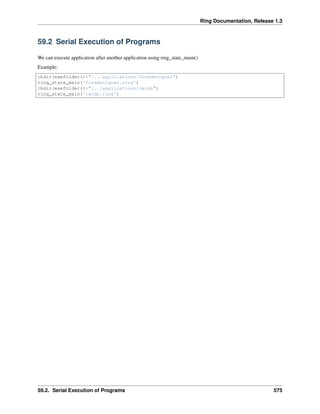
59.2 Serial Execution of Programs
We can execute application after another application using ring_state_main()
Example:
chdir(exefolder()+"/../applications/formdesigner")
ring_state_main('formdesigner.ring')
chdir(exefolder()+"/../applications/cards")
ring_state_main('cards.ring')
59.2. Serial Execution of Programs 575
CHAPTER
SIXTY
EXTENSION USING THE C/C++ LANGUAGES
We can extend the Ring Virtual Machine (RingVM) by adding new functions written in the C programming language
or C++. The RingVM comes with many functions written in C that we can call like any Ring function.
We can extend the language by writing new functions then rebuilding the RingVM again, or we can create shared
library (DLL/So) file to extend the RingVM without the need to rebuild it.
The Ring language source code comes with two files to add new modules to the RingVM, ring_ext.h and ring_ext.c
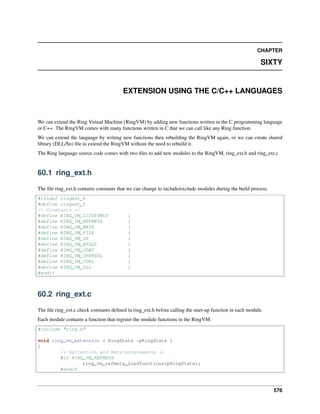
60.1 ring_ext.h
The file ring_ext.h contains constants that we can change to include/exclude modules during the build process.
#ifndef ringext_h
#define ringext_h
/* Constants */
#define RING_VM_LISTFUNCS 1
#define RING_VM_REFMETA 1
#define RING_VM_MATH 1
#define RING_VM_FILE 1
#define RING_VM_OS 1
#define RING_VM_MYSQL 1
#define RING_VM_ODBC 1
#define RING_VM_OPENSSL 1
#define RING_VM_CURL 1
#define RING_VM_DLL 1
#endif
60.2 ring_ext.c
The file ring_ext.c check constants defined in ring_ext.h before calling the start-up function in each module.
Each module contains a function that register the module functions in the RingVM.
#include "ring.h"
void ring_vm_extension ( RingState *pRingState )
{
/* Reflection and Meta-programming */
#if RING_VM_REFMETA
ring_vm_refmeta_loadfunctions(pRingState);
#endif
576
Ring Documentation, Release 1.3
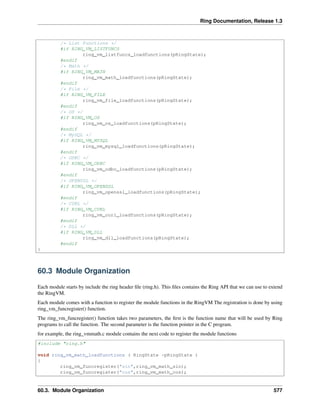
/* List Functions */
#if RING_VM_LISTFUNCS
ring_vm_listfuncs_loadfunctions(pRingState);
#endif
/* Math */
#if RING_VM_MATH
ring_vm_math_loadfunctions(pRingState);
#endif
/* File */
#if RING_VM_FILE
ring_vm_file_loadfunctions(pRingState);
#endif
/* OS */
#if RING_VM_OS
ring_vm_os_loadfunctions(pRingState);
#endif
/* MySQL */
#if RING_VM_MYSQL
ring_vm_mysql_loadfunctions(pRingState);
#endif
/* ODBC */
#if RING_VM_ODBC
ring_vm_odbc_loadfunctions(pRingState);
#endif
/* OPENSSL */
#if RING_VM_OPENSSL
ring_vm_openssl_loadfunctions(pRingState);
#endif
/* CURL */
#if RING_VM_CURL
ring_vm_curl_loadfunctions(pRingState);
#endif
/* DLL */
#if RING_VM_DLL
ring_vm_dll_loadfunctions(pRingState);
#endif
}
60.3 Module Organization
Each module starts by include the ring header file (ring.h). This files contains the Ring API that we can use to extend
the RingVM.
Each module comes with a function to register the module functions in the RingVM The registration is done by using
ring_vm_funcregister() function.
The ring_vm_funcregister() function takes two parameters, the first is the function name that will be used by Ring
programs to call the function. The second parameter is the function pointer in the C program.
for example, the ring_vmmath.c module contains the next code to register the module functions
#include "ring.h"
void ring_vm_math_loadfunctions ( RingState *pRingState )
{
ring_vm_funcregister("sin",ring_vm_math_sin);
ring_vm_funcregister("cos",ring_vm_math_cos);
60.3. Module Organization 577

The Ring programming language version 1.3 book - Part 60 of 88

  • 1.
    Ring Documentation, Release1.3 RingVM_CFunctionsList() ---> List Example: See RingVM_CFunctionsList() 58.9 ringvm_functionslist() function The Function return a list of functions written in Ring. Each List Member is a list contains the next items • Function Name • Program Counter (PC) - Function Position in Byte Code. • Source Code File Name • Private Flag (For Private Methods in Classes) Syntax: RingVM_FunctionsList() ---> List Example: test() func test see ringvm_functionslist() Output: test 8 B:/ring/tests/scripts/functionslist.ring 0 58.10 ringvm_classeslist() function The Function return a list of Classes. Each List Member is a list contains the next items • Class Name • Program Counter (PC) - Class Position in Byte Code. • Parent Class Name • Methods List • Flag (Is parent class information collected) • Pointer to the package (or NULL if no package is used) Syntax: RingVM_ClassesList() ---> List 58.9. ringvm_functionslist() function 568
  • 2.
    Ring Documentation, Release1.3 Example: see ringvm_classeslist() class class1 func f1 class class2 from class1 class class3 from class1 Output: class1 9 f1 13 B:/ring/tests/scripts/classeslist.ring 0 0 00000000 class2 16 class1 0 00000000 class3 20 class1 0 00000000 58.11 ringvm_packageslist() function The Function return a list of Packages. Each List Member is a list contains the next items • Package Name • Classes List Syntax: RingVM_PackagesList() ---> List Example: see ringvm_packageslist() package package1 class class1 package package2 class class1 package package3 class class1 Output: 58.11. ringvm_packageslist() function 569
  • 3.
    Ring Documentation, Release1.3 package1 class1 11 0 00FEF838 package2 class1 17 0 00FEF978 package3 class1 23 0 00FEFF68 58.12 ringvm_memorylist() function The Function return a list of Memory Scopes and Variables. Each List Member is a list contains variables in a different scope. Each Item in the scope list is a list contains the next items • Variable Name • Variable Type • Variable Value • Pointer Type (List/Item) if the value is a list • Private Flag (if the variable is an attribute in a Class) Syntax: RingVM_MemoryList() ---> List Example: x = 10 test() func test y = 20 see ringvm_memorylist() Output: true 2 1 0 0 false 2 0 0 58.12. ringvm_memorylist() function 570
  • 4.
    Ring Documentation, Release1.3 0 nl 1 0 0 null 1 0 0 ring_gettemp_var 4 00000000 0 0 ccatcherror 1 NULL 0 0 ring_settemp_var 4 00000000 0 0 ring_tempflag_var 2 0 0 0 stdin 3 50512DB8 file 0 0 0 stdout 3 50512DD8 file 0 0 0 stderr 3 50512DF8 file 0 0 0 this 4 00000000 0 0 58.12. ringvm_memorylist() function 571
  • 5.
    Ring Documentation, Release1.3 sysargv 3 B:ringbin/ring B:/ring/tests/scripts/memorylist.ring 0 0 x 2 10 0 0 y 2 20 0 0 58.13 ringvm_calllist() function The Function return a list of the functions call list. Each List Member is a list contains the next items • Function Type • Function Name • Program Counter (PC) • Stack Pointer (SP) • Temp. Memory List • Method or Function Flag • Caller PC • FuncExec Flag • ListStart Flag • Nested Lists Pointer • State List Syntax: RingVM_CallList() ---> List Example: hello() func hello test() func test mylist = ringvm_calllist() for t in mylist see t[2] + nl next Output: 58.13. ringvm_calllist() function 572
  • 6.
    Ring Documentation, Release1.3 function hello() in file B:/ring/tests/scripts/calllist.ring called from line 1 function test() in file B:/ring/tests/scripts/calllist.ring called from line 3 ringvm_calllist 58.14 ringvm_fileslist() function Function return a list of the Ring Files. Syntax: RingVM_FilesList() ---> List Example: load "stdlib.ring" see ringvm_fileslist() Output: B:/ring/tests/scripts/fileslist.ring B:ringbinstdlib.ring eval stdlib.ring stdlib.rh stdclasses.ring stdfunctions.ring stdbase.ring stdstring.ring stdlist.ring stdstack.ring stdqueue.ring stdmath.ring stddatetime.ring stdfile.ring stdsystem.ring stddebug.ring stddatatype.ring stdconversion.ring stdodbc.ring stdmysql.ring stdsecurity.ring stdinternet.ring stdhashtable.ring stdtree.ring 58.14. ringvm_fileslist() function 573
  • 7.
    CHAPTER FIFTYNINE INTRODUCTION In this chapterwe will learn about embedding Ring in Ring programs and applications. 59.1 Embedding Ring in Ring without sharing the State From Ring 1.0 we already have functions for embedding Ring in the C language. Also we can execute Ring code inside Ring programs using the eval() function. In this release we provide functions for embedding Ring in Ring programs without sharing the state. Advantages: 1. Quick integration for Ring programs and applications together without conflicts. 2. Execute and run Ring code in safe environments that we can trace. Example: pState = ring_state_init() ring_state_runcode(pState,"See 'Hello, World!'+nl") ring_state_runcode(pState,"x = 10") pState2 = ring_state_init() ring_state_runcode(pState2,"See 'Hello, World!'+nl") ring_state_runcode(pState2,"x = 20") ring_state_runcode(pState,"see x +nl") ring_state_runcode(pState2,"see x +nl") v1 = ring_state_findvar(pState,"x") v2 = ring_state_findvar(pState2,"x") see v1[3] + nl see V2[3] + nl ring_state_delete(pState) ring_state_delete(pState2) Output: Hello, World! Hello, World! 10 20 10 20 574
  • 8.
    Ring Documentation, Release1.3 59.2 Serial Execution of Programs We can execute application after another application using ring_state_main() Example: chdir(exefolder()+"/../applications/formdesigner") ring_state_main('formdesigner.ring') chdir(exefolder()+"/../applications/cards") ring_state_main('cards.ring') 59.2. Serial Execution of Programs 575
  • 9.
    CHAPTER SIXTY EXTENSION USING THEC/C++ LANGUAGES We can extend the Ring Virtual Machine (RingVM) by adding new functions written in the C programming language or C++. The RingVM comes with many functions written in C that we can call like any Ring function. We can extend the language by writing new functions then rebuilding the RingVM again, or we can create shared library (DLL/So) file to extend the RingVM without the need to rebuild it. The Ring language source code comes with two files to add new modules to the RingVM, ring_ext.h and ring_ext.c 60.1 ring_ext.h The file ring_ext.h contains constants that we can change to include/exclude modules during the build process. #ifndef ringext_h #define ringext_h /* Constants */ #define RING_VM_LISTFUNCS 1 #define RING_VM_REFMETA 1 #define RING_VM_MATH 1 #define RING_VM_FILE 1 #define RING_VM_OS 1 #define RING_VM_MYSQL 1 #define RING_VM_ODBC 1 #define RING_VM_OPENSSL 1 #define RING_VM_CURL 1 #define RING_VM_DLL 1 #endif 60.2 ring_ext.c The file ring_ext.c check constants defined in ring_ext.h before calling the start-up function in each module. Each module contains a function that register the module functions in the RingVM. #include "ring.h" void ring_vm_extension ( RingState *pRingState ) { /* Reflection and Meta-programming */ #if RING_VM_REFMETA ring_vm_refmeta_loadfunctions(pRingState); #endif 576
  • 10.
    Ring Documentation, Release1.3 /* List Functions */ #if RING_VM_LISTFUNCS ring_vm_listfuncs_loadfunctions(pRingState); #endif /* Math */ #if RING_VM_MATH ring_vm_math_loadfunctions(pRingState); #endif /* File */ #if RING_VM_FILE ring_vm_file_loadfunctions(pRingState); #endif /* OS */ #if RING_VM_OS ring_vm_os_loadfunctions(pRingState); #endif /* MySQL */ #if RING_VM_MYSQL ring_vm_mysql_loadfunctions(pRingState); #endif /* ODBC */ #if RING_VM_ODBC ring_vm_odbc_loadfunctions(pRingState); #endif /* OPENSSL */ #if RING_VM_OPENSSL ring_vm_openssl_loadfunctions(pRingState); #endif /* CURL */ #if RING_VM_CURL ring_vm_curl_loadfunctions(pRingState); #endif /* DLL */ #if RING_VM_DLL ring_vm_dll_loadfunctions(pRingState); #endif } 60.3 Module Organization Each module starts by include the ring header file (ring.h). This files contains the Ring API that we can use to extend the RingVM. Each module comes with a function to register the module functions in the RingVM The registration is done by using ring_vm_funcregister() function. The ring_vm_funcregister() function takes two parameters, the first is the function name that will be used by Ring programs to call the function. The second parameter is the function pointer in the C program. for example, the ring_vmmath.c module contains the next code to register the module functions #include "ring.h" void ring_vm_math_loadfunctions ( RingState *pRingState ) { ring_vm_funcregister("sin",ring_vm_math_sin); ring_vm_funcregister("cos",ring_vm_math_cos); 60.3. Module Organization 577