PhD Thesis presentation (Ring programming language and PWCT2)
1.
Dual-Language General-Purpose Self-Hosted
VisualLanguage and new Textual Programming
Language for Applications
Presented by:
Mahmoud Samir Fayed
Supervised by:
Dr. Yousef Ahmed Alohali
Kingdom of Saudi Arabia
King Saud University
Department of Computer Science
College of Computer and
Information Sciences
This relates to the dissertation submitted for the degree Doctor
of Philosophy in Computer Science, May 28, 2025
العامة لألغراض اللغة ثنائية اإلستضافة ذاتية مرئية لغة
للتطبيقات جديدة نصية برمجة ولغة
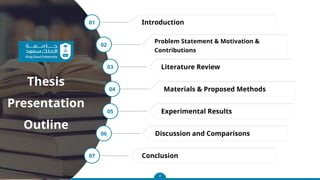
Introduction
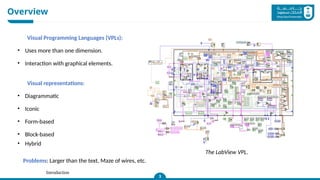
Overview
3
Visual Programming Languages(VPLs):
• Uses more than one dimension.
• Interaction with graphical elements.
Visual representations:
• Diagrammatic
• Iconic
• Form-based
• Block-based
• Hybrid
Problems: Larger than the text, Maze of wires, etc.
The LabView VPL.
4.
Introduction
Overview
4
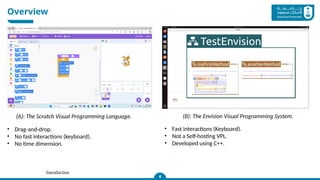
(A): The ScratchVisual Programming Language.
• Drag-and-drop.
• No fast interactions (keyboard).
• No time dimension.
(B): The Envision Visual Programming System.
• Fast interactions (Keyboard).
• Not a Self-hosting VPL.
• Developed using C++.
5.
Introduction
Overview
5
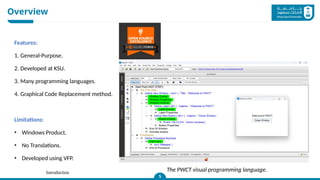
The PWCT visualprogramming language.
Features:
1. General-Purpose.
2. Developed at KSU.
3. Many programming languages.
4. Graphical Code Replacement method.
Limitations:
• Windows Product.
• No Translations.
• Developed using VFP.
Problem Statement
7
Problem Statement& Motivation & Contributions
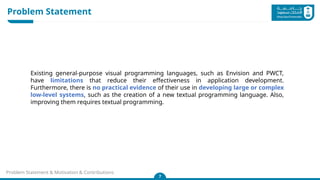
Existing general-purpose visual programming languages, such as Envision and PWCT,
have limitations that reduce their effectiveness in application development.
Furthermore, there is no practical evidence of their use in developing large or complex
low-level systems, such as the creation of a new textual programming language. Also,
improving them requires textual programming.
8.
Motivation
8
Problem Statement &Motivation & Contributions
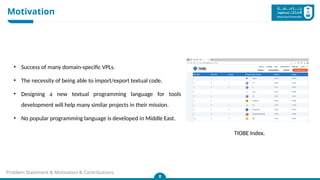
• Success of many domain-specific VPLs.
• The necessity of being able to import/export textual code.
• Designing a new textual programming language for tools
development will help many similar projects in their mission.
• No popular programming language is developed in Middle East.
TIOBE Index.
9.
Contributions
9
Problem Statement &Motivation & Contributions
• Using visual programming to develop/maintain a Compiler/Virtual Machine for many years.
• Dynamic language (lightweight implementation, rich features, Desktop/WebAsm/Microcontrollers/etc).
• Novel features that can extend the OOP paradigm (Develop DSL resemble CSS/Supernova).
• The research prototype PWCT2 (lower storage requirements, better performance, etc.).
• VPL that supports Ring language (394 visual components).
• Textual-to-visual code conversion tool (enables a self-hosting VPL based on Ring).
• Testing the feasibility of using the Ring language in the development of PWCT2.
• Arabic Translation for the PWCT2 Environment/Components.
Literature Review
Literature Review
11
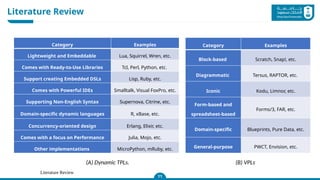
CategoryExamples
Lightweight and Embeddable Lua, Squirrel, Wren, etc.
Comes with Ready-to-Use Libraries Tcl, Perl, Python, etc.
Support creating Embedded DSLs Lisp, Ruby, etc.
Comes with Powerful IDEs Smalltalk, Visual FoxPro, etc.
Supporting Non-English Syntax Supernova, Citrine, etc.
Domain-specific dynamic languages R, xBase, etc.
Concurrency-oriented design Erlang, Elixir, etc.
Comes with a focus on Performance Julia, Mojo, etc.
Other implementations MicroPython, mRuby, etc.
Category Examples
Block-based Scratch, Snap!, etc.
Diagrammatic Tersus, RAPTOR, etc.
Iconic Kodu, Limnor, etc.
Form-based and
spreadsheet-based
Forms/3, FAR, etc.
Domain-specific Blueprints, Pure Data, etc.
General-purpose PWCT, Envision, etc.
(A) Dynamic TPLs. (B) VPLs
12.
Literature Review
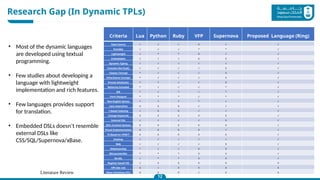
Research Gap(In Dynamic TPLs)
12
Criteria Lua Python Ruby VFP Supernova Proposed Language (Ring)
Open Source √ √ √ X √ √
Portable √ √ √ * * √
Lightweight √ * * X √ √
Embeddable √ √ √ X X √
Dynamic Typing √ √ √ √ √ √
Function like Eval() √ √ √ √ X √
Classes Concept * √ √ √ X √
Inheritance Concept * √ √ √ X √
Private Attributes * * √ √ X √
Batteries Included * √ √ √ * √
IDE * √ * √ * √
Form Designer * * * √ * √
Non-English Syntax * * * * √ √
Case insensitive X X X √ √ √
1-based indexing √ X X √ √ √
Change Keywords X X X X X √
Internal DSL √ √ √ √ X √
IDSL (Custom Syntax) X X X X X √
Visual Implementation X X X X √ √
VI Based on CPWCT X X X X X √
Desktop √ √ √ √ √ √
Web √ √ √ √ X √
WebAssembly * √ √ X X √
Microcontroller * * * X X √
No-GIL √ * * X X √
Register based VM √ X X X X X
Off-side rule X √ X X X X
xBase (Database DSL) X X X √ X X
• Most of the dynamic languages
are developed using textual
programming.
• Few studies about developing a
language with lightweight
implementation and rich features.
• Few languages provides support
for translation.
• Embedded DSLs doesn’t resemble
external DSLs like
CSS/SQL/Supernova/xBase.
13.
Literature Review
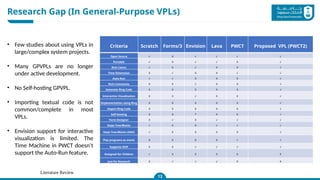
Research Gap(In General-Purpose VPLs)
13
Criteria Scratch Forms/3 Envision Lava PWCT Proposed VPL (PWCT2)
Open Source √ X √ √ √ √
Portable √ X √ √ X √
Rich Colors √ X √ X X √
Time Dimension X √ X X √ √
Auto-Run √ √ X X X √
Rich-Comments X X √ X X √
Generate Ring Code X X X X X √
Interactive Visualization X X √ X X √
Implementation using Ring X X X X X √
Import Ring Code X X X X X √
Self-hosting X X * X X √
Form Designer X √ X √ √ √
Steps Tree/Blocks √ X X √ √ √
Steps Tree/Blocks (DAD) √ X X X X √
Play programs as movie X X X X √ √
Supports OOP X X √ √ √ √
Designed for Children √ X X X X X
Just for Research X √ √ √ X X
• Few studies about using VPLs in
large/complex system projects.
• Many GPVPLs are no longer
under active development.
• No Self-hosting GPVPL.
• Importing textual code is not
common/complete in most
VPLs.
• Envision support for interactive
visualization is limited. The
Time Machine in PWCT doesn’t
support the Auto-Run feature.
Materials & ProposedMethods
Materials & Proposed Methods
15
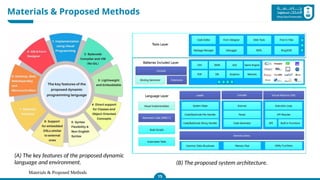
(A) The key features of the proposed dynamic
language and environment. (B) The proposed system architecture.
16.
Materials & ProposedMethods
Materials & Proposed Methods
16
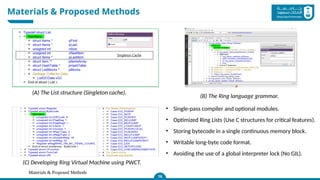
(A) The List structure (Singleton cache).
(B) The Ring language grammar.
(C) Developing Ring Virtual Machine using PWCT.
• Single-pass compiler and optional modules.
• Optimized Ring Lists (Use C structures for critical features).
• Storing bytecode in a single continuous memory block.
• Writable long-byte code format.
• Avoiding the use of a global interpreter lock (No GIL).
17.
Materials & ProposedMethods
Materials & Proposed Methods
17
Thus, it is necessary to process each slice
individually using four main components:
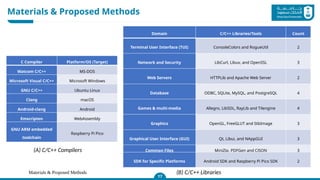
C Compiler Platform/OS (Target)
Watcom C/C++ MS-DOS
Microsoft Visual C/C++ Microsoft Windows
GNU C/C++ Ubuntu Linux
Clang macOS
Android-clang Android
Emscripten WebAssembly
GNU ARM embedded
toolchain
Raspberry Pi Pico
Domain C/C++ Libraries/Tools Count
Terminal User Interface (TUI) ConsoleColors and RogueUtil 2
Network and Security LibCurl, Libuv, and OpenSSL 3
Web Servers HTTPLib and Apache Web Server 2
Database ODBC, SQLite, MySQL, and PostgreSQL 4
Games & multi-media Allegro, LibSDL, RayLib and Tilengine 4
Graphics OpenGL, FreeGLUT and StbImage 3
Graphical User Interface (GUI) Qt, Libui, and NAppGUI 3
Common Files MiniZip, PDFGen and CJSON 3
SDK for Specific Platforms Android SDK and Raspberry Pi Pico SDK 2
(A) C/C++ Compilers
(B) C/C++ Libraries
18.
Materials & ProposedMethods
Materials & Proposed Methods
18
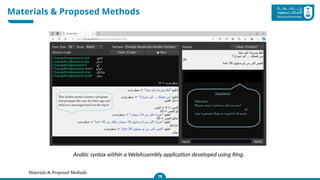
Arabic syntax within a WebAssembly application developed using Ring.
19.
Materials & ProposedMethods
Materials & Proposed Methods
19
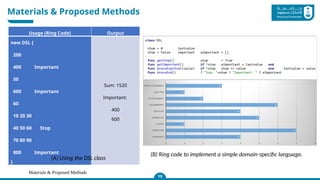
Usage (Ring Code) Output
new DSL {
200
400 Important
50
600 Important
60
10 20 30
40 50 60 Stop
70 80 90
800 Important
}
Sum: 1520
Important:
400
600
(B) Ring code to implement a simple domain-specific language.
(A) Using the DSL class
20.
Materials & ProposedMethods
Materials & Proposed Methods
20
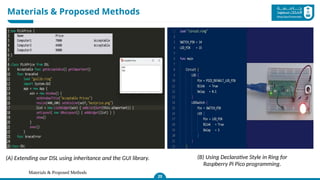
(A) Extending our DSL using inheritance and the GUI library. (B) Using Declarative Style in Ring for
Raspberry Pi Pico programming.
21.
Materials & ProposedMethods
Materials & Proposed Methods
21
Thus, it is necessary to process each slice
individually using four main components:
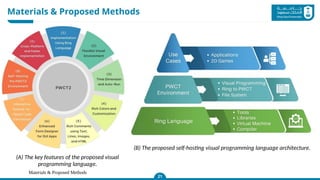
(A) The key features of the proposed visual
programming language.
(B) The proposed self-hosting visual programming language architecture.
22.
Materials & ProposedMethods
Materials & Proposed Methods
22
Thus, it is necessary to process each slice
individually using four main components:
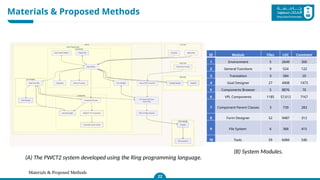
(A) The PWCT2 system developed using the Ring programming language.
ID Module Files LOC Comment
1 Environment 5 2649 300
2 General Functions 9 524 122
3 Translation 3 584 20
4 Goal Designer 27 4908 1473
5 Components Browser 5 8876 70
6 VPL Components 1185 57,612 7167
7 Component Parent Classes 3 739 283
8 Form Designer 52 9487 312
9 File System 6 368 415
10 Tools 59 6484 546
(B) System Modules.
23.
Materials & ProposedMethods
Materials & Proposed Methods
23
Thus, it is necessary to process each slice
individually using four main components:
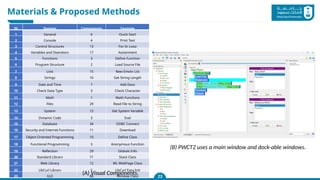
(B) PWCT2 uses a main window and dock-able windows.
ID Domain Components Example
1 General 6 Quick Start
2 Console 4 Print Text
3 Control Structures 13 For-In Loop
4 Variables and Operators 17 Assignment
5 Functions 3 Define Function
6 Program Structure 2 Load Source File
7 Lists 15 New Empty List
8 Strings 16 Get String Length
9 Date and Time 7 Add Days
10 Check Data Type 3 Check Character
11 Math 1 Math Functions
12 Files 29 Read File to String
13 System 12 Get System Variable
14 Dynamic Code 3 Eval
15 Database 34 ODBC Connect
16 Security and Internet Functions 11 Download
17 Object-Oriented Programming 10 Define Class
18 Functional Programming 3 Anonymous Function
19 Reflection 29 Globals Info
20 Standard Library 71 Stack Class
21 Web Library 12 WL WebPage Class
22 LibCurl Library 5 LibCurl Easy Init
23 GUI 88 Window Class
(A) Visual Components.
24.
Materials & ProposedMethods
Materials & Proposed Methods
24
Thus, it is necessary to process each slice
individually using four main components:
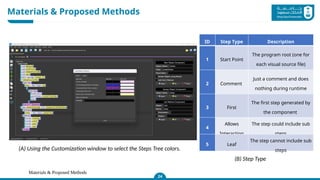
(A) Using the Customization window to select the Steps Tree colors.
ID Step Type Description
1 Start Point
The program root (one for
each visual source file)
2 Comment
Just a comment and does
nothing during runtime
3 First
The first step generated by
the component
4
Allows
Interaction
The step could include sub
steps
5 Leaf
The step cannot include sub
steps
(B) Step Type
25.
Materials & ProposedMethods
Materials & Proposed Methods
25
Thus, it is necessary to process each slice
individually using four main components:
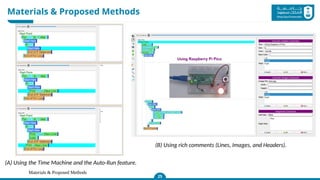
(A) Using the Time Machine and the Auto-Run feature.
(B) Using rich comments (Lines, Images, and Headers).
26.
Materials & ProposedMethods
Materials & Proposed Methods
26
Thus, it is necessary to process each slice
individually using four main components:
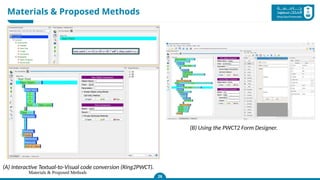
(B) Using the PWCT2 Form Designer.
(A) Interactive Textual-to-Visual code conversion (Ring2PWCT).
27.
Materials & ProposedMethods
Materials & Proposed Methods
27
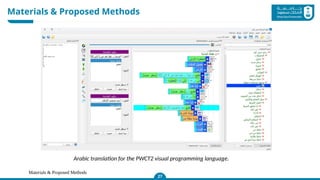
Arabic translation for the PWCT2 visual programming language.
Experimental Results
Experimental Results
29
(B)Early users and the language used.
(A) Ring Group
Downloads
0
10,000
20,000
30,000
40,000
50,000
60,000
47,779
6599
1283
6892
Windows Linux
Macintosh Other
(D) Ring downloads statistics
Variable Value
Male 70
Female 6
Completed less than two lessons 20
Completed more than one lesson 56
Completed the course 23
Contributors 2
(E) Ring Arabic Course (18 Lessons)
Ref. Type Domain
[166] Research Paper Front-end apps for ML Models
[167] Research Paper Front-end apps for ML Models
[91] Printed Book (USA) Games Development
[152] Steam Game Games Development
[168] Research Paper Text/Data Processing apps
[169] Printed Book (Egypt) Text/Data Processing apps
[170] YouTube Videos Desktop/Web development
[171] Research Paper LLMs Training
(C) Use-Cases
Experimental Results
Experimental Results
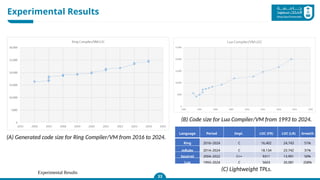
33
(A)Generated code size for Ring Compiler/VM from 2016 to 2024.
(B) Code size for Lua Compiler/VM from 1993 to 2024.
Language Period Impl. LOC (FR) LOC (LR) Growth
Ring 2016–2024 C 16,402 24,743 51%
mRuby 2014–2024 C 18,134 23,742 31%
Squirrel 2004–2022 C++ 9311 13,991 50%
Lua 1993–2024 C 5603 20,081 258%
(C) Lightweight TPLs.
34.
Experimental Results
Experimental Results
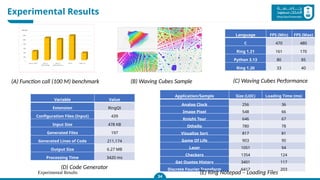
34
LanguageFPS (Min) FPS (Max)
C 470 480
Ring 1.21 161 170
Python 3.13 80 85
Ring 1.20 33 40
(A) Function call (100 M) benchmark
Variable Value
Extension RingQt
Configuration Files (Input) 439
Input Size 478 KB
Generated Files 197
Generated Lines of Code 211,174
Output Size 6.27 MB
Processing Time 3420 ms
Application/Sample Size (LOC) Loading Time (ms)
Analog Clock 256 36
Image Pixel 548 66
Knight Tour 646 67
Othello 780 78
Visualize Sort 817 81
Game Of Life 903 90
Laser 1051 94
Checkers 1354 124
Get Quotes History 3401 117
Discrete Fourier Transform 6417 203
(B) Waving Cubes Sample (C) Waving Cubes Performance
(D) Code Generator
(E) Ring Notepad – Loading Files
35.
Experimental Results
Experimental Results
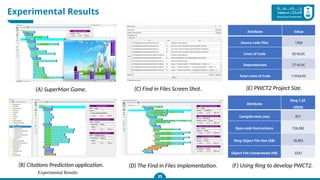
35
(A)SuperMan Game.
(B) Citations Prediction application. (D) The Find in Files implementation.
Attribute Value
Source code files 1354
Lines of Code 92 KLOC
Dependencies 27 KLOC
Total Lines of Code 119 KLOC
Attribute
Ring 1.22
(2024)
Compile-time (ms) 871
Byte-code Instructions 724,382
Ring Object File Size (KB) 18,952
Object File Compressed (KB) 2322
(E) PWCT2 Project Size.
(F) Using Ring to develop PWCT2.
(C) Find in Files Screen Shot.
36.
Experimental Results
Experimental Results
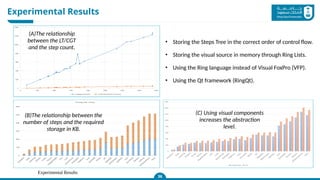
36
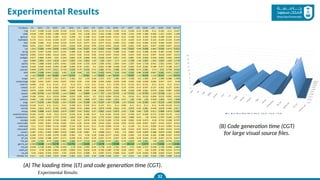
(B)Therelationship between the
number of steps and the required
storage in KB.
(C) Using visual components
increases the abstraction
level.
(A)The relationship
between the LT/CGT
and the step count.
• Storing the Steps Tree in the correct order of control flow.
• Storing the visual source in memory through Ring Lists.
• Using the Ring language instead of Visual FoxPro (VFP).
• Using the Qt framework (RingQt).
37.
Experimental Results
Experimental Results
37
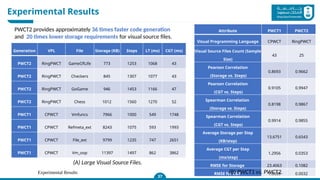
GenerationVPL File Storage (KB) Steps LT (ms) CGT (ms)
PWCT2 RingPWCT GameOfLife 773 1253 1068 43
PWCT2 RingPWCT Checkers 845 1307 1077 43
PWCT2 RingPWCT GoGame 946 1453 1166 47
PWCT2 RingPWCT Chess 1012 1560 1270 52
PWCT1 CPWCT Vmfuncs 7966 1000 549 1748
PWCT1 CPWCT Refmeta_ext 8243 1075 593 1993
PWCT1 CPWCT File_ext 9799 1235 747 2651
PWCT1 CPWCT Vm_oop 11397 1497 862 3862
Attribute PWCT1 PWCT2
Visual Programming Language CPWCT RingPWCT
Visual Source Files Count (Sample
Size)
43 25
Pearson Correlation
(Storage vs. Steps)
0.8693 0.9662
Pearson Correlation
(CGT vs. Steps)
0.9105 0.9947
Spearman Correlation
(Storage vs. Steps)
0.8198 0.9867
Spearman Correlation
(CGT vs. Steps)
0.9914 0.9855
Average Storage per Step
(KB/step)
13.6751 0.6543
Average CGT per Step
(ms/step)
1.2956 0.0353
RMSE for Storage 23.4063 0.1082
RMSE for CGT 1.0539 0.0032
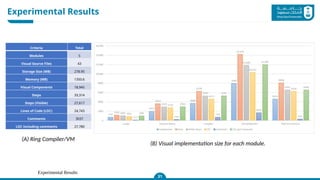
(A) Large Visual Source Files.
(B) PWCT1 vs. PWCT2.
PWCT2 provides approximately 36 times faster code generation
and 20 times lower storage requirements for visual source files.
38.
Experimental Results
Experimental Results
38
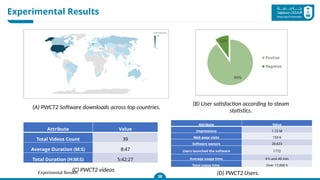
(B)User satisfaction according to steam
statistics.
(A) PWCT2 Software downloads across top countries.
Attribute Value
Total Videos Count 39
Average Duration (M:S) 8:47
Total Duration (H:M:S) 5:42:27
Attribute Value
Impressions 1.72 M
Web page visits 159 K
Software owners 20,623
Users launched the software 1772
Average usage time 9 h and 40 min
Total usage time Over 17,000 h
(C) PWCT2 videos
(D) PWCT2 Users.
Discussion and Comparisons
PWCTDisadvantages
40
40
40
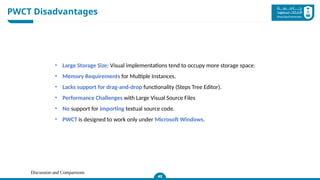
• Large Storage Size: Visual implementations tend to occupy more storage space.
• Memory Requirements for Multiple Instances.
• Lacks support for drag-and-drop functionality (Steps Tree Editor).
• Performance Challenges with Large Visual Source Files
• No support for importing textual source code.
• PWCT is designed to work only under Microsoft Windows.
41.
Discussion and Comparisons
Suggestionsto mitigate these challenges
41
41
41
• Separate the visual source into many files with clear names and purposes.
• Keep each visual source file to fewer than a few thousand steps.
• Open related visual source files according to the current task.
• External tools are needed when searching multiple generated source code files.
42.
Discussion and Comparisons
PWCT1vs. PWCT2
42
42
42
• PWCT2 supports only the Ring programming language
• PWCT1 provided visual components for various textual programming languages
• PWCT2 is not compatible with PWCT1 (visual component design/visual source file formats).
• PWCT2 is currently distributed as a desktop tool rather than a web-based application.
Conclusion
44
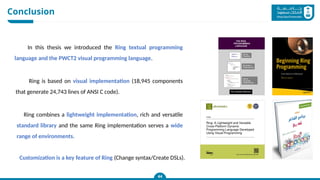
In this thesiswe introduced the Ring textual programming
language and the PWCT2 visual programming language.
Ring is based on visual implementation (18,945 components
that generate 24,743 lines of ANSI C code).
Ring combines a lightweight implementation, rich and versatile
standard library and the same Ring implementation serves a wide
range of environments.
Customization is a key feature of Ring (Change syntax/Create DSLs).
45.
Conclusion
45
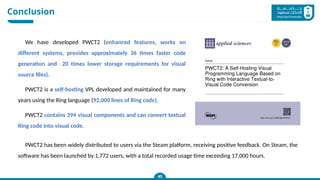
We have developedPWCT2 (enhanced features, works on
different systems, provides approximately 36 times faster code
generation and 20 times lower storage requirements for visual
source files).
PWCT2 is a self-hosting VPL developed and maintained for many
years using the Ring language (92,000 lines of Ring code).
PWCT2 contains 394 visual components and can convert textual
Ring code into visual code.
PWCT2 has been widely distributed to users via the Steam platform, receiving positive feedback. On Steam, the
software has been launched by 1,772 users, with a total recorded usage time exceeding 17,000 hours.
46.
Limitations
46
46
46
We demonstrated thegrowth of the Ring language over eight years; while being a lightweight language, we
noticed a growth in the implementation size from 16 KLOC in 2016 to 24 KLOC in 2024. This percentage of growth
(51%) requires attention.
We notice that the performance of the Ring programming language has improved over time, and it is now fast
enough for many use cases as a scripting language. However, improving Ring’s performance remains a challenge,
and we aim to provide optimizations and enhancements with each new release.
47.
Future Directions
47
In thefuture, we plan to build multiple projects on top of the Ring language
• Localization package for many human languages,
• Various domain-specific languages for different fields.
• Modern framework that includes many templates for database applications.
We aim to enhance the PWCT2 visual programming language
• Supporting additional textual programming languages such as C, Java, C# and Python.
• Improve the environment by offering translations in various human languages.
• Add more components that provide better support for Ring libraries.
![Experimental Results
Experimental Results
29
(B) Early users and the language used.
(A) Ring Group
Downloads
0
10,000
20,000
30,000
40,000
50,000
60,000
47,779
6599
1283
6892
Windows Linux
Macintosh Other
(D) Ring downloads statistics
Variable Value
Male 70
Female 6
Completed less than two lessons 20
Completed more than one lesson 56
Completed the course 23
Contributors 2
(E) Ring Arabic Course (18 Lessons)
Ref. Type Domain
[166] Research Paper Front-end apps for ML Models
[167] Research Paper Front-end apps for ML Models
[91] Printed Book (USA) Games Development
[152] Steam Game Games Development
[168] Research Paper Text/Data Processing apps
[169] Printed Book (Egypt) Text/Data Processing apps
[170] YouTube Videos Desktop/Web development
[171] Research Paper LLMs Training
(C) Use-Cases](https://image.slidesharecdn.com/thesispresentation-251011084903-80d1ea92/85/PhD-Thesis-presentation-Ring-programming-language-and-PWCT2-29-320.jpg)



![谷歌留痕技术教程[ 𝙩𝙤𝙥 𝟮𝟯𝟯. 𝙘 𝙤𝙢 ]](https://cdn.slidesharecdn.com/ss_thumbnails/top233-260130173900-2eb784f9-thumbnail.jpg?width=640&height=640&fit=bounds)


