


Designing,
Conducting and
Gathering
Information from
Surveys
The Various Kinds of Reports
Reports are more likely needed for
business, scientific and technical
subjects, and in the workplace. They
are of different types and they differ
in their aims and structures.
The Various Kinds of Reports
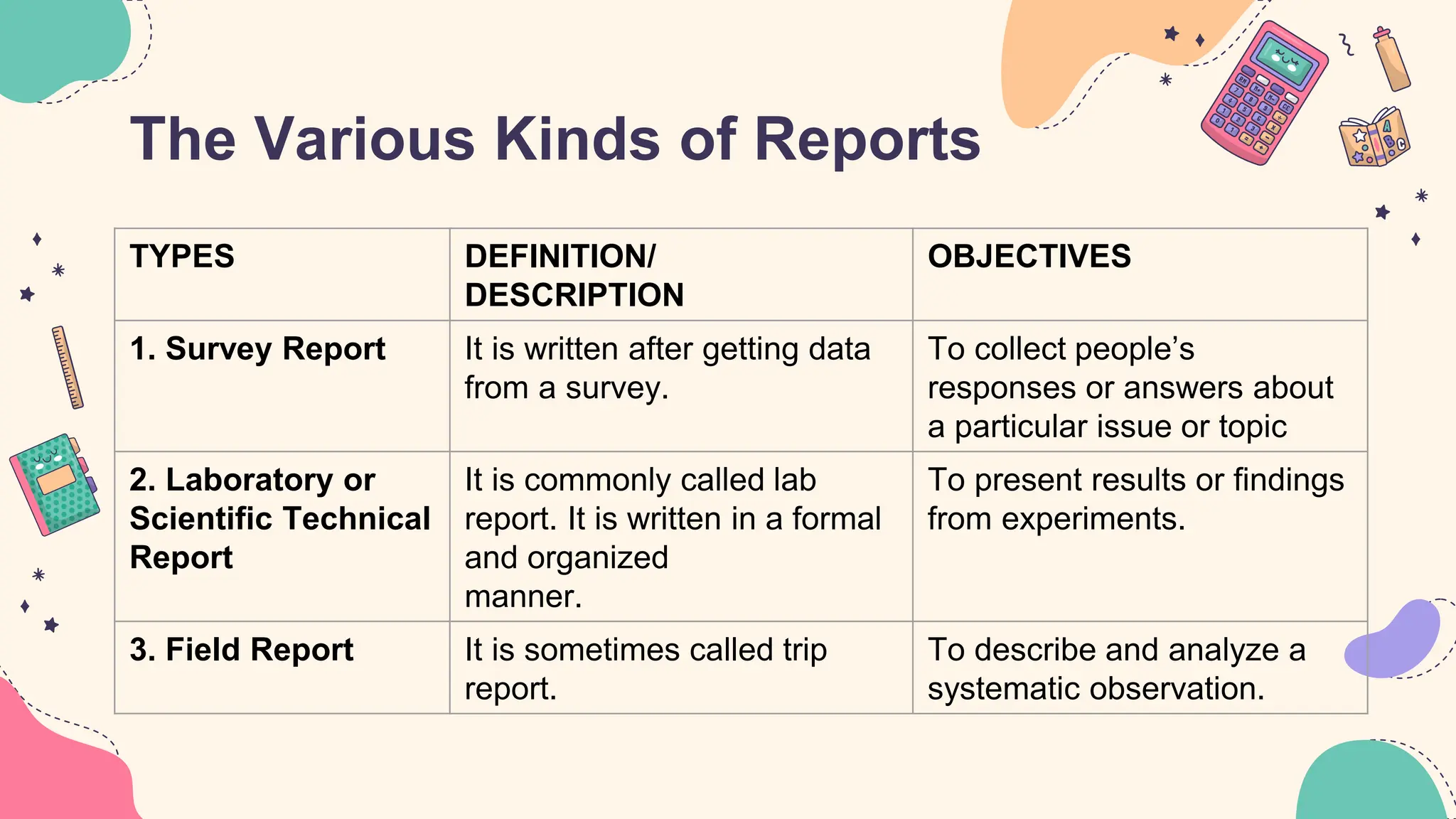
TYPES DEFINITION/
DESCRIPTION
OBJECTIVES
1. Survey Report It is written after getting data
from a survey.
To collect people’s
responses or answers about
a particular issue or topic
2. Laboratory or
Scientific Technical
Report
It is commonly called lab
report. It is written in a formal
and organized
manner.
To present results or findings
from experiments.
3. Field Report It is sometimes called trip
report.
To describe and analyze a
systematic observation.
The Various Kinds of Reports
Among the types of reports, survey
is the most popularly and widely
used as it is the easiest way to
gather information about any topic
or issue from a big number of
people or groups.
Designing,
Conducting and
Gathering
Information from
Surveys
Survey Questionnaire
It is a data gathering tool composed of a set of
questions used in a survey and is utilized in various
fields such as politics, research, marketing, media and
so on. It is intended to gather data, views, opinions
and others from individuals or a particular group of
people.
It is an important tool used in order to collect the
necessary information that will benefit the people and
the community.
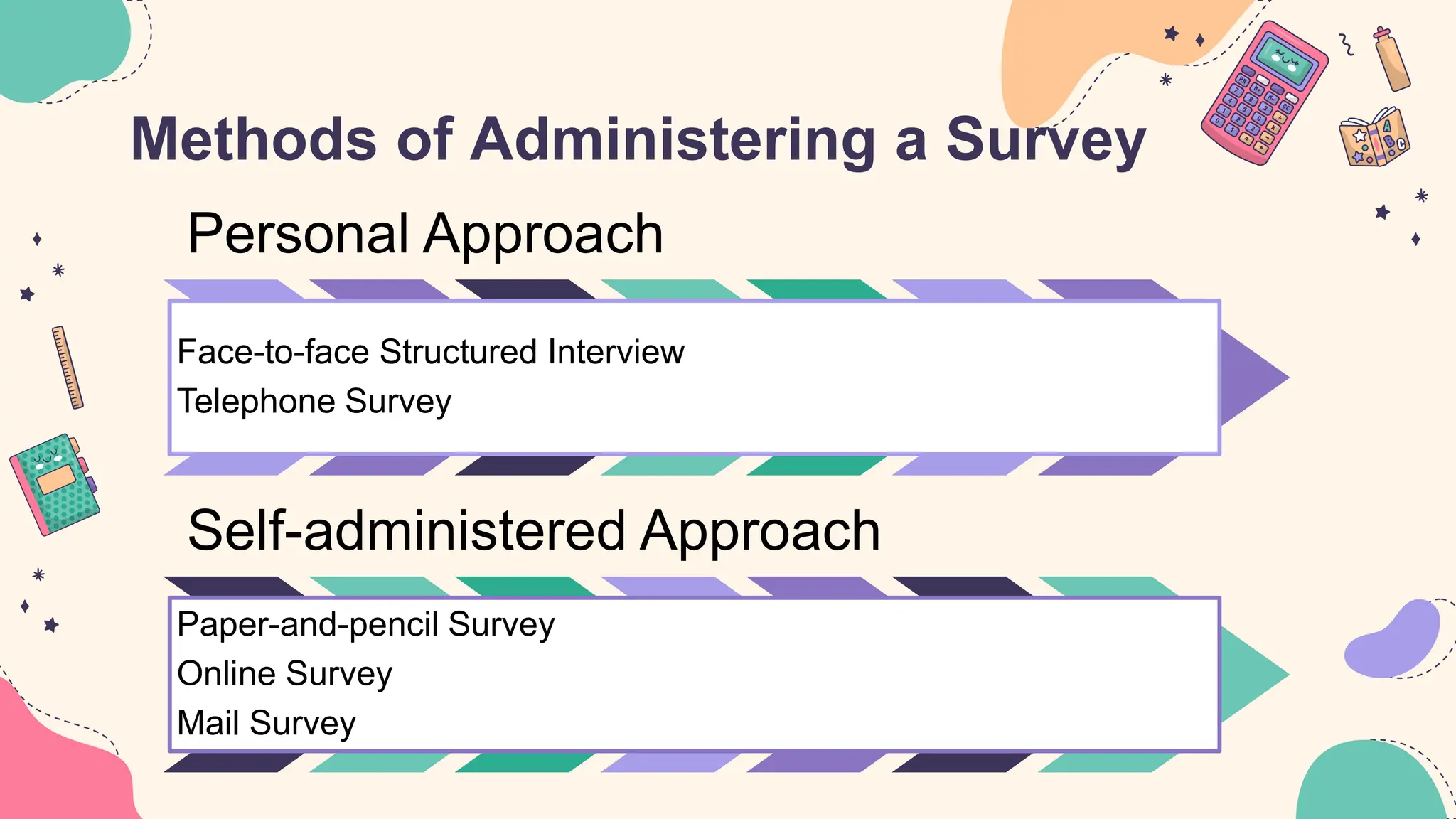
Methods of Administering a Survey
Personal Approach
Face-to-face Structured Interview
Telephone Survey
Self-administered Approach
Paper-and-pencil Survey
Online Survey
Mail Survey
Methods of Administering a Survey
1. Personal Approach
This process of conducting the survey
involves the researcher. It is used to
probe the answers of the respondents
and at the same time, to observe the
behavior of the respondents, either
individually or as a group.
Methods of Administering a Survey
a. Face-to-face Structured Interview
The interview is set personally, and the people
involved face each other in order to gather the
necessary information. Questions on the
survey are asked directly to the respondent by
the researcher.
Methods of Administering a Survey
b. Telephone Survey
The survey is done using telephone or cellular
phones. The calls are made to ask individuals
about certain questions. This method can be
used for asking consequential questions.
Methods of Administering a Survey
2. Self-administered Approach
In this type of approach, the survey is
administered without the actual
presence of the researcher and the
respondents are expected to accomplish
the survey independently.
Methods of Administering a Survey
a. Paper-and-pencil Survey
This is a traditional method of administering a
survey which entails that respondent be or are
accompanied by someone who is computer
literate.
Methods of Administering a Survey
b. Online Survey
This is a useful technique especially for
studies which include many respondents from
different locations. This is used to gather
information from respondents who live in
different areas. This enables all participants to
answer through different online platforms.
Methods of Administering a Survey
c. Mail Survey
This popular tool requires an easy-
administering of the survey where survey
questionnaires are mailed to individuals who
are given enough time to read and ponder on
the information asked.
“Let’s Complete It”
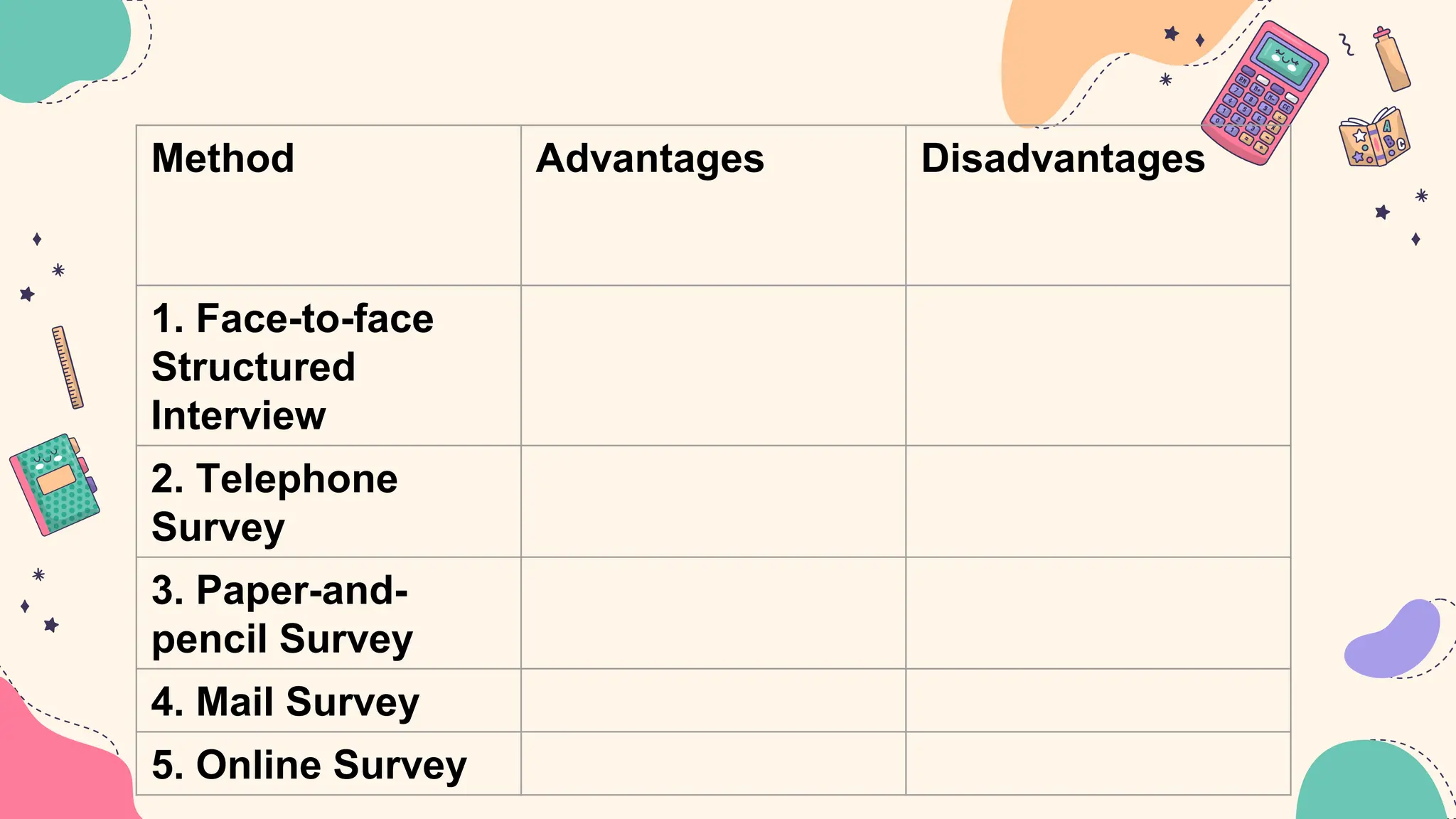
Directions: As you analyze the information above,
complete the given table with what you think are the
advantages and disadvantages of each method. Write
your answers on a one- whole sheet of paper.
Method Advantages Disadvantages
1. Face-to-face
Structured
Interview
2. Telephone
Survey
3. Paper-and-
pencil Survey
4. Mail Survey
5. Online Survey
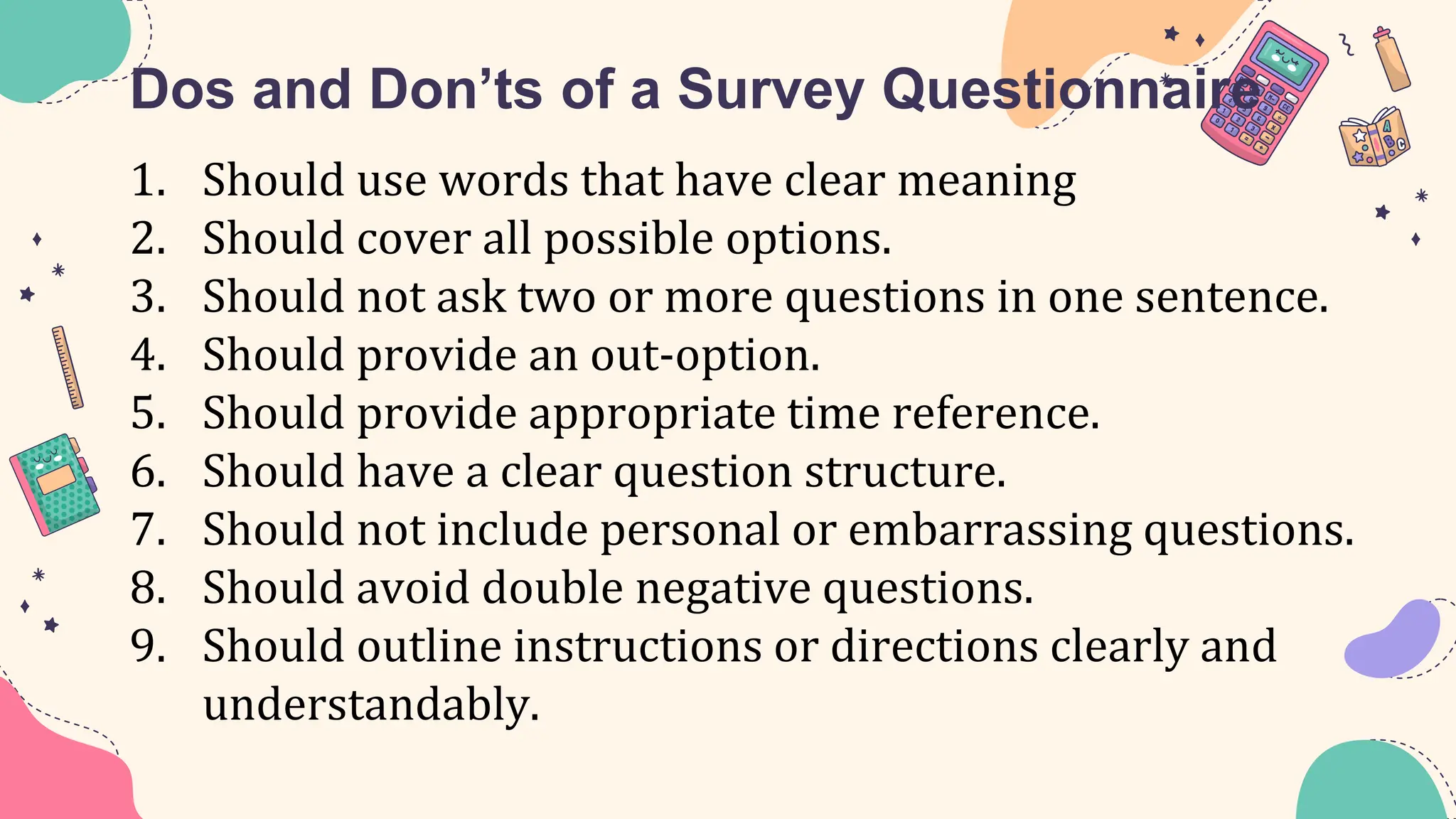
Dos and Don’ts of a Survey Questionnaire
1. Should use words that have clear meaning
2. Should cover all possible options.
3. Should not ask two or more questions in one sentence.
4. Should provide an out-option.
5. Should provide appropriate time reference.
6. Should have a clear question structure.
7. Should not include personal or embarrassing questions.
8. Should avoid double negative questions.
9. Should outline instructions or directions clearly and
understandably.
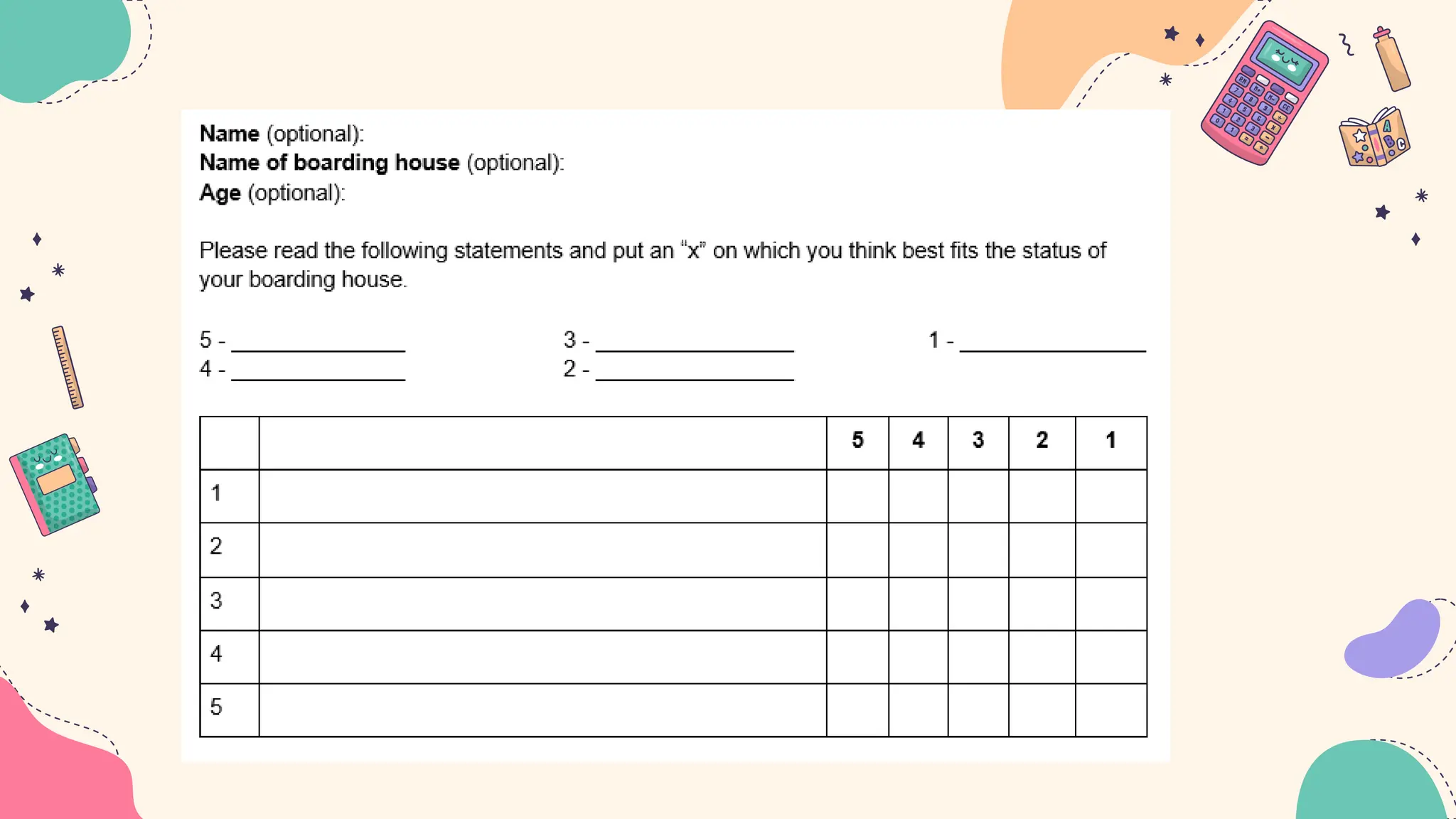
Quiz #3
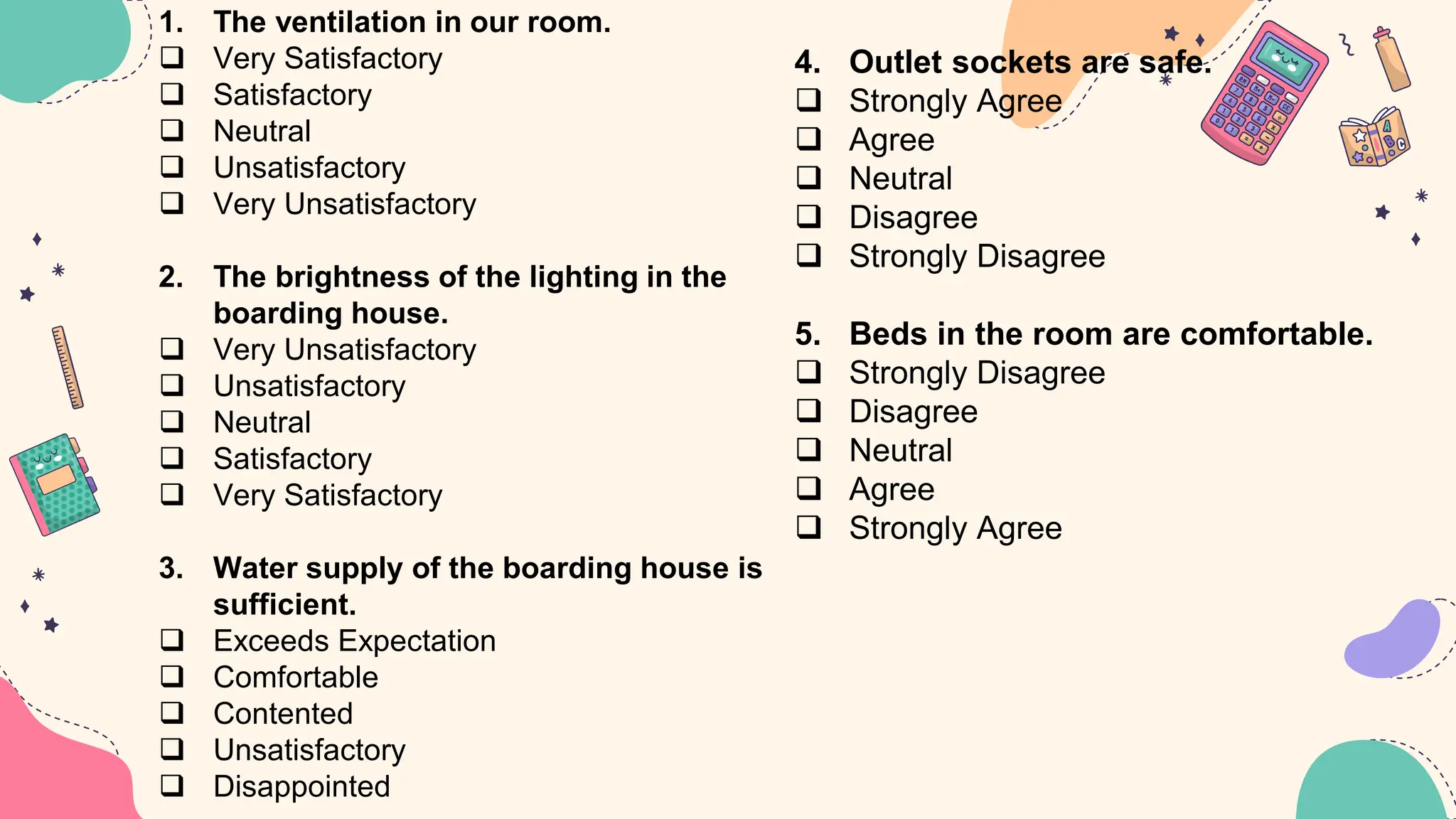
1. The ventilation in our room.
 Very Satisfactory
 Satisfactory
 Neutral
 Unsatisfactory
 Very Unsatisfactory
2. The brightness of the lighting in the
boarding house.
 Very Unsatisfactory
 Unsatisfactory
 Neutral
 Satisfactory
 Very Satisfactory
3. Water supply of the boarding house is
sufficient.
 Exceeds Expectation
 Comfortable
 Contented
 Unsatisfactory
 Disappointed
4. Outlet sockets are safe.
 Strongly Agree
 Agree
 Neutral
 Disagree
 Strongly Disagree
5. Beds in the room are comfortable.
 Strongly Disagree
 Disagree
 Neutral
 Agree
 Strongly Agree
CREDITS: This presentation template was
created by Slidesgo, including icons by
Flaticon, and infographics & images by
Freepik
Thanks!
Does anyone have any questions?
villalunakaireen@gmail.com

The Reports, Survey Questionnaire and Methods of Administering It.pptx

  • 1.
  • 2.
    The Various Kindsof Reports Reports are more likely needed for business, scientific and technical subjects, and in the workplace. They are of different types and they differ in their aims and structures.
  • 3.
    The Various Kindsof Reports TYPES DEFINITION/ DESCRIPTION OBJECTIVES 1. Survey Report It is written after getting data from a survey. To collect people’s responses or answers about a particular issue or topic 2. Laboratory or Scientific Technical Report It is commonly called lab report. It is written in a formal and organized manner. To present results or findings from experiments. 3. Field Report It is sometimes called trip report. To describe and analyze a systematic observation.
  • 4.
    The Various Kindsof Reports Among the types of reports, survey is the most popularly and widely used as it is the easiest way to gather information about any topic or issue from a big number of people or groups.
  • 5.
  • 6.
    Survey Questionnaire It isa data gathering tool composed of a set of questions used in a survey and is utilized in various fields such as politics, research, marketing, media and so on. It is intended to gather data, views, opinions and others from individuals or a particular group of people. It is an important tool used in order to collect the necessary information that will benefit the people and the community.
  • 7.
    Methods of Administeringa Survey Personal Approach Face-to-face Structured Interview Telephone Survey Self-administered Approach Paper-and-pencil Survey Online Survey Mail Survey
  • 8.
    Methods of Administeringa Survey 1. Personal Approach This process of conducting the survey involves the researcher. It is used to probe the answers of the respondents and at the same time, to observe the behavior of the respondents, either individually or as a group.
  • 9.
    Methods of Administeringa Survey a. Face-to-face Structured Interview The interview is set personally, and the people involved face each other in order to gather the necessary information. Questions on the survey are asked directly to the respondent by the researcher.
  • 10.
    Methods of Administeringa Survey b. Telephone Survey The survey is done using telephone or cellular phones. The calls are made to ask individuals about certain questions. This method can be used for asking consequential questions.
  • 11.
    Methods of Administeringa Survey 2. Self-administered Approach In this type of approach, the survey is administered without the actual presence of the researcher and the respondents are expected to accomplish the survey independently.
  • 12.
    Methods of Administeringa Survey a. Paper-and-pencil Survey This is a traditional method of administering a survey which entails that respondent be or are accompanied by someone who is computer literate.
  • 13.
    Methods of Administeringa Survey b. Online Survey This is a useful technique especially for studies which include many respondents from different locations. This is used to gather information from respondents who live in different areas. This enables all participants to answer through different online platforms.
  • 14.
    Methods of Administeringa Survey c. Mail Survey This popular tool requires an easy- administering of the survey where survey questionnaires are mailed to individuals who are given enough time to read and ponder on the information asked.
  • 15.
    “Let’s Complete It” Directions:As you analyze the information above, complete the given table with what you think are the advantages and disadvantages of each method. Write your answers on a one- whole sheet of paper.
  • 16.
    Method Advantages Disadvantages 1.Face-to-face Structured Interview 2. Telephone Survey 3. Paper-and- pencil Survey 4. Mail Survey 5. Online Survey
  • 17.
    Dos and Don’tsof a Survey Questionnaire 1. Should use words that have clear meaning 2. Should cover all possible options. 3. Should not ask two or more questions in one sentence. 4. Should provide an out-option. 5. Should provide appropriate time reference. 6. Should have a clear question structure. 7. Should not include personal or embarrassing questions. 8. Should avoid double negative questions. 9. Should outline instructions or directions clearly and understandably.
  • 18.
  • 19.
    1. The ventilationin our room.  Very Satisfactory  Satisfactory  Neutral  Unsatisfactory  Very Unsatisfactory 2. The brightness of the lighting in the boarding house.  Very Unsatisfactory  Unsatisfactory  Neutral  Satisfactory  Very Satisfactory 3. Water supply of the boarding house is sufficient.  Exceeds Expectation  Comfortable  Contented  Unsatisfactory  Disappointed 4. Outlet sockets are safe.  Strongly Agree  Agree  Neutral  Disagree  Strongly Disagree 5. Beds in the room are comfortable.  Strongly Disagree  Disagree  Neutral  Agree  Strongly Agree
  • 21.
    CREDITS: This presentationtemplate was created by Slidesgo, including icons by Flaticon, and infographics & images by Freepik Thanks! Does anyone have any questions? villalunakaireen@gmail.com