The red Ruffed lemurBy Daniel
Scientific ClassificationCommon Name:	Red Ruffed LemurKingdom:		AnimaliaPhylum:	   		ChordataClass:			MammaliaOrder:			PrimatesFamily:			LemuridaeGenus Species:	Vareciavariegataruba
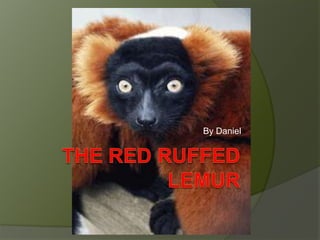
DescriptionSoft, thick, orange-red fur
DescriptionFox-like black head with bright yellow eyes
DescriptionA ruff of reddish fur around the neck
DescriptionNape of neck may have a patch of white fur
DescriptionBlack belly, hands, feet, and long bushy tail
DescriptionOne of the largest 	primates in MadagascarBetween 1.5 and 2 feet 	in lengthWeighs 7-10 poundsTail usually longer than 	the body
Usually 2-3 offspring at a timeCan have up to 6 offspringGestation is 90-102 daysYoung are left in a nest while parents find foodIf the Lemurs need to move nests, they carry the babies in their mouthSometimes the babies are each given a nestThe babies are born with fur and their eyes openSexual maturity is 20 monthsReproduction
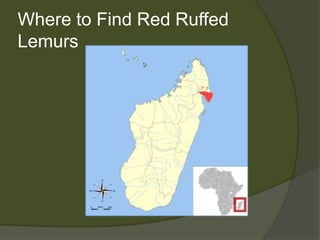
Where to Find Red Ruffed LemursLike all lemurs, found exclusively on the island of Madagascar off the east coast of Africa
Where to Find Red Ruffed Lemurs
Where to Find Red Ruffed LemursRestricted to the Masoala Peninsula.
Where to Find Red Ruffed Lemurs
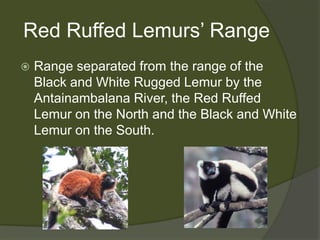
 Red Ruffed Lemurs’ RangeRange separated from the range of the Black and White Rugged Lemur by the Antainambalana River, the Red Ruffed Lemur on the North and the Black and White Lemur on the South.
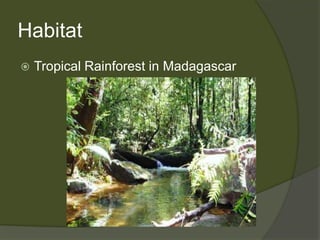
HabitatTropical Rainforest in Madagascar
HabitatArboreal forest dwellers
HabitatPrefers tall, thick, fruit-bearing trees
DietThe Red Ruffed Lemur is:a frugivore (eating fruits) a folivore (eating foliage)a nectivore (eating nectar)Fruit makes up 75% of their dietThey also eat leaves, shoots and seedsTheir diet varies depending on the seasonOne of their favorite fruits is figs and they travel the jungle to find themThey get water from eating fruit or climbing down to the ground to drink from streams
PredatorsBoa Constrictors
PredatorsEagles
PredatorsHawks
PredatorsFossa
Physical AdaptationsThick FurBenefit:  Protection from the elements
Physical AdaptationsLong, strong fingers and toesBenefit:  Good for climbing and hanging onto branches
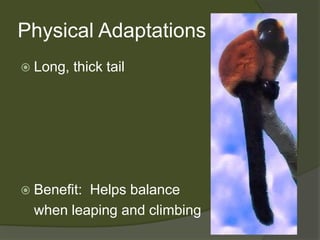
Physical AdaptationsLong, thick tailBenefit:  Helps balance 	when leaping and climbing
Physical AdaptationsMale and Female Scent GlandsBenefit:  Communication and territory marking
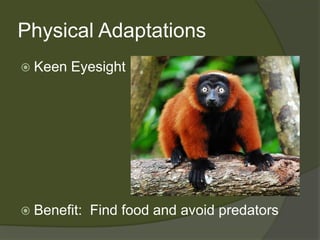
Physical AdaptationsKeen EyesightBenefit:  Find food and avoid predators
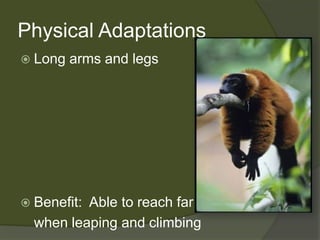
Physical AdaptationsLong arms and legsBenefit:  Able to reach far 	when leaping and climbing
Physical AdaptationsLong, pointed snoutBenefit:  Sipping nectar from flowers
Physical AdaptationsProtruding overbite and 	spaced lower six teethBenefit:  Creates a comb 	for grooming
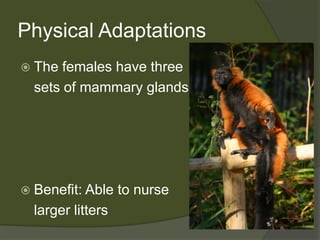
Physical AdaptationsThe females have three 	sets of mammary glandsBenefit: Able to nurse 	larger litters
Physical AdaptationsThe second claw on its hind legs are longer and thinner.Benefit:  Used for grooming
Behavioral AdaptationsSometimes hang by their 	feet on branchesBenefit:  Able to grab 	far away food
Behavioral AdaptationsVocalizes using 12 distinct callsBenefit:  Communication with other lemurs
Behavioral AdaptationsLive in family groups of two adults with offspringBenefit:  Protection, finding food and raising young
Crepuscular/DiurnalBenefit:  Able to find fruit and flowers in the daytime.  Finds food while predators may be sleepingBehavioral Adaptations
Usually stays in the treetopsBenefit:  Finds food in the canopy and avoids predatorsBehavioral Adaptations
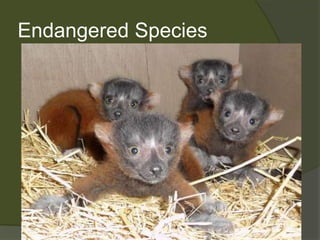
Endangered SpeciesOnly 1,000 to 10,000 remain in the wildOne of the most endangered species of lemur:Small geographic rangeHabitat destructionHunting and live capture for petsWhile doing my research I came across a site that was titled, “Red Ruffed Lemurs for Sale!” The Masaola National Park, established in 1997 offers hope for the continued survival of Red Ruffed Lemurs in Madagascar
Interesting FactsMadagascar separated from Africa over 160 million years agoLemurs developed only on MadagascarRed Ruffed Lemurs can travel through the treetops1200m a day in search of ripe fruitWhen Red Ruffed Lemurs live near Black and White Lemurs in zoos, they can understand each other’s calls even though these species don’t normally meet in the wild.
Zoo EnvironmentIndoorsEnclosed by glass and barsLots of concrete, like boxes to live inFour adult animals housed togetherLittle live vegetation2 rooms approximately 7ft wide and 8-9ft longSome rocks and ledgesRopes and logs to climb onPoop all over the groundWater bowls in floor of enclosure
Zoo Improvements	If I had the power to change the Red Ruffed Lemurs zoo habitat, this is what I would do.  I liked that there was some things to climb on but I think that to maintain the adaptation of having long arms and legs to climb higher we must give them more things to climb on.  I also think there should be more room for the Red Ruffed Lemurs because they are territorial and are adapted to traveling long distances to find food. I think there should be outside space to maintain the adaptation of having thick fur to withstand the elements.  I believe that to keep the adaptation of a long snout to reach into flowers to get nectar, we must give them real flowers to stick their muzzle in and get nectar.  I think that their habitat should be higher off the ground because they naturally like to stay higher in the trees than on the ground.  I also would have made the habitat have more live vegetation and less concrete because the Red Ruffed Lemur naturally lives in the rainforest.  I would also like to include running water to be more like the streams in their natural habitat. I liked a little about this habitat but I wanted to change a lot.
SourcesThe Wild Ones Animal IndexSan Francisco ZooBristol ZooWoodland Park ZooAnimal BytesGoogle ImagesConservation of lemurs in human-dominated landscapes by Barbara Martinez, PhD student

The red ruffed lemur[1]

  • 1.
    The red RuffedlemurBy Daniel
  • 2.
    Scientific ClassificationCommon Name: RedRuffed LemurKingdom: AnimaliaPhylum: ChordataClass: MammaliaOrder: PrimatesFamily: LemuridaeGenus Species: Vareciavariegataruba
  • 3.
  • 4.
    DescriptionFox-like black headwith bright yellow eyes
  • 5.
    DescriptionA ruff ofreddish fur around the neck
  • 6.
    DescriptionNape of neckmay have a patch of white fur
  • 7.
    DescriptionBlack belly, hands,feet, and long bushy tail
  • 8.
    DescriptionOne of thelargest primates in MadagascarBetween 1.5 and 2 feet in lengthWeighs 7-10 poundsTail usually longer than the body
  • 9.
    Usually 2-3 offspringat a timeCan have up to 6 offspringGestation is 90-102 daysYoung are left in a nest while parents find foodIf the Lemurs need to move nests, they carry the babies in their mouthSometimes the babies are each given a nestThe babies are born with fur and their eyes openSexual maturity is 20 monthsReproduction
  • 10.
    Where to FindRed Ruffed LemursLike all lemurs, found exclusively on the island of Madagascar off the east coast of Africa
  • 11.
    Where to FindRed Ruffed Lemurs
  • 12.
    Where to FindRed Ruffed LemursRestricted to the Masoala Peninsula.
  • 13.
    Where to FindRed Ruffed Lemurs
  • 14.
    Red RuffedLemurs’ RangeRange separated from the range of the Black and White Rugged Lemur by the Antainambalana River, the Red Ruffed Lemur on the North and the Black and White Lemur on the South.
  • 15.
  • 16.
  • 17.
    HabitatPrefers tall, thick,fruit-bearing trees
  • 18.
    DietThe Red RuffedLemur is:a frugivore (eating fruits) a folivore (eating foliage)a nectivore (eating nectar)Fruit makes up 75% of their dietThey also eat leaves, shoots and seedsTheir diet varies depending on the seasonOne of their favorite fruits is figs and they travel the jungle to find themThey get water from eating fruit or climbing down to the ground to drink from streams
  • 19.
  • 20.
  • 21.
  • 22.
  • 23.
    Physical AdaptationsThick FurBenefit: Protection from the elements
  • 24.
    Physical AdaptationsLong, strongfingers and toesBenefit: Good for climbing and hanging onto branches
  • 25.
    Physical AdaptationsLong, thicktailBenefit: Helps balance when leaping and climbing
  • 26.
    Physical AdaptationsMale andFemale Scent GlandsBenefit: Communication and territory marking
  • 27.
    Physical AdaptationsKeen EyesightBenefit: Find food and avoid predators
  • 28.
    Physical AdaptationsLong armsand legsBenefit: Able to reach far when leaping and climbing
  • 29.
    Physical AdaptationsLong, pointedsnoutBenefit: Sipping nectar from flowers
  • 30.
    Physical AdaptationsProtruding overbiteand spaced lower six teethBenefit: Creates a comb for grooming
  • 31.
    Physical AdaptationsThe femaleshave three sets of mammary glandsBenefit: Able to nurse larger litters
  • 32.
    Physical AdaptationsThe secondclaw on its hind legs are longer and thinner.Benefit: Used for grooming
  • 33.
    Behavioral AdaptationsSometimes hangby their feet on branchesBenefit: Able to grab far away food
  • 34.
    Behavioral AdaptationsVocalizes using12 distinct callsBenefit: Communication with other lemurs
  • 35.
    Behavioral AdaptationsLive infamily groups of two adults with offspringBenefit: Protection, finding food and raising young
  • 36.
    Crepuscular/DiurnalBenefit: Ableto find fruit and flowers in the daytime. Finds food while predators may be sleepingBehavioral Adaptations
  • 37.
    Usually stays inthe treetopsBenefit: Finds food in the canopy and avoids predatorsBehavioral Adaptations
  • 38.
    Endangered SpeciesOnly 1,000to 10,000 remain in the wildOne of the most endangered species of lemur:Small geographic rangeHabitat destructionHunting and live capture for petsWhile doing my research I came across a site that was titled, “Red Ruffed Lemurs for Sale!” The Masaola National Park, established in 1997 offers hope for the continued survival of Red Ruffed Lemurs in Madagascar
  • 39.
    Interesting FactsMadagascar separatedfrom Africa over 160 million years agoLemurs developed only on MadagascarRed Ruffed Lemurs can travel through the treetops1200m a day in search of ripe fruitWhen Red Ruffed Lemurs live near Black and White Lemurs in zoos, they can understand each other’s calls even though these species don’t normally meet in the wild.
  • 40.
    Zoo EnvironmentIndoorsEnclosed byglass and barsLots of concrete, like boxes to live inFour adult animals housed togetherLittle live vegetation2 rooms approximately 7ft wide and 8-9ft longSome rocks and ledgesRopes and logs to climb onPoop all over the groundWater bowls in floor of enclosure
  • 41.
    Zoo EnvironmentIndoorsEnclosed byglass and barsLots of concrete, like boxes to live inFour adult animals housed togetherLittle live vegetation2 rooms approximately 7ft wide and 8-9ft longSome rocks and ledgesRopes and logs to climb onPoop all over the groundWater bowls in floor of enclosure
  • 42.
    Zoo EnvironmentIndoorsEnclosed byglass and barsLots of concrete, like boxes to live inFour adult animals housed togetherLittle live vegetation2 rooms approximately 7ft wide and 8-9ft longSome rocks and ledgesRopes and logs to climb onPoop all over the groundWater bowls in floor of enclosure
  • 43.
    Zoo EnvironmentIndoorsEnclosed byglass and barsLots of concrete, like boxes to live inFour adult animals housed togetherLittle live vegetation2 rooms approximately 7ft wide and 8-9ft longSome rocks and ledgesRopes and logs to climb onPoop all over the groundWater bowls in floor of enclosure
  • 44.
    Zoo EnvironmentIndoorsEnclosed byglass and barsLots of concrete, like boxes to live inFour adult animals housed togetherLittle live vegetation2 rooms approximately 7ft wide and 8-9ft longSome rocks and ledgesRopes and logs to climb onPoop all over the groundWater bowls in floor of enclosure
  • 45.
    Zoo EnvironmentIndoorsEnclosed byglass and barsLots of concrete, like boxes to live inFour adult animals housed togetherLittle live vegetation2 rooms approximately 7ft wide and 8-9ft longSome rocks and ledgesRopes and logs to climb onPoop all over the groundWater bowls in floor of enclosure
  • 46.
    Zoo EnvironmentIndoorsEnclosed byglass and barsLots of concrete, like boxes to live inFour adult animals housed togetherLittle live vegetation2 rooms approximately 7ft wide and 8-9ft longSome rocks and ledgesRopes and logs to climb onPoop all over the groundWater bowls in floor of enclosure
  • 47.
    Zoo EnvironmentIndoorsEnclosed byglass and barsLots of concrete, like boxes to live inFour adult animals housed togetherLittle live vegetation2 rooms approximately 7ft wide and 8-9ft longSome rocks and ledgesRopes and logs to climb onPoop all over the groundWater bowls in floor of enclosure
  • 48.
    Zoo EnvironmentIndoorsEnclosed byglass and barsLots of concrete, like boxes to live inFour adult animals housed togetherLittle live vegetation2 rooms approximately 7ft wide and 8-9ft longSome rocks and ledgesRopes and logs to climb onPoop all over the groundWater bowls in floor of enclosure
  • 49.
    Zoo EnvironmentIndoorsEnclosed byglass and barsLots of concrete, like boxes to live inFour adult animals housed togetherLittle live vegetation2 rooms approximately 7ft wide and 8-9ft longSome rocks and ledgesRopes and logs to climb onPoop all over the groundWater bowls in floor of enclosure
  • 50.
    Zoo EnvironmentIndoorsEnclosed byglass and barsLots of concrete, like boxes to live inFour adult animals housed togetherLittle live vegetation2 rooms approximately 7ft wide and 8-9ft longSome rocks and ledgesRopes and logs to climb onPoop all over the groundWater bowls in floor of enclosure
  • 51.
    Zoo Improvements If Ihad the power to change the Red Ruffed Lemurs zoo habitat, this is what I would do. I liked that there was some things to climb on but I think that to maintain the adaptation of having long arms and legs to climb higher we must give them more things to climb on. I also think there should be more room for the Red Ruffed Lemurs because they are territorial and are adapted to traveling long distances to find food. I think there should be outside space to maintain the adaptation of having thick fur to withstand the elements. I believe that to keep the adaptation of a long snout to reach into flowers to get nectar, we must give them real flowers to stick their muzzle in and get nectar. I think that their habitat should be higher off the ground because they naturally like to stay higher in the trees than on the ground. I also would have made the habitat have more live vegetation and less concrete because the Red Ruffed Lemur naturally lives in the rainforest. I would also like to include running water to be more like the streams in their natural habitat. I liked a little about this habitat but I wanted to change a lot.
  • 52.
    SourcesThe Wild OnesAnimal IndexSan Francisco ZooBristol ZooWoodland Park ZooAnimal BytesGoogle ImagesConservation of lemurs in human-dominated landscapes by Barbara Martinez, PhD student