Behaviour (2015) DOI:10.1163/1568539X-00003267 brill.com/beh
An unusual case of affiliative association of a female
Lemur catta in a Hapalemur meridionalis social group
Timothy M. Eppley a,b,∗
, Katie Hall c,d
, Giuseppe Donati b
and
Jörg U. Ganzhorn a
a
Biozentrum Grindel, Department of Animal Ecology and Conservation,
University of Hamburg, Hamburg, Germany
b
Nocturnal Primate Research Group, Oxford Brookes University, Oxford, UK
c
Michale E. Keeling Center for Comparative Medicine and Research,
The University of Texas MD Anderson Cancer Center, Bastrop, TX, USA
d
Neuroscience Institute & Language Research Center,
Georgia State University, Atlanta, GA, USA
*Corresponding author’s e-mail address: eppleyti@gmail.com
Accepted 20 January 2014; published online ???
Abstract
Polyspecific associations are well documented, but have rarely been observed in strepsirrhines. In
this study we present a unique affiliative association between a female ring-tailed lemur (Lemur
catta) and a group of southern bamboo lemurs (Hapalemur meridionalis) in south-east Madagas-
car. Our main research focused on H. meridionalis; however, due to the presence of the L. catta we
treated her as a group member, including her in the focal sampling of Hapalemur social behaviour.
We also recorded ad libitum data on all food species/items and any unique events or occurrences.
Among observations, both species appeared to have a mutual understanding of vocalisations, be-
havioural synchronisation, dietary overlap, and possible service exchange, e.g., grooming. We also
observed the L. catta occasionally attending to the bamboo lemur infant. This included grooming,
baby-sitting, and even transporting the infant. The behavioural flexibility exhibited by both species
has allowed the successful integration of the female ring-tailed lemur.
Keywords
behavioural flexibility, heterospecific alloparental care, polyspecific association, ring-tailed
lemur, southern bamboo lemur.
1. Introduction
Polyspecific associations (also referred to as mixed-species groups) are de-
fined as associations between two or more different species that maintain
© Koninklijke Brill NV, Leiden, 2015 DOI 10.1163/1568539X-00003267
2 Behaviour (2015) DOI:10.1163/1568539X-00003267
a close proximity while communicating and coordinating their activities
over a prolonged period of time (Heymann, 2011). These associations are
well known among mammals (Stensland et al., 2003), particularly primates
(Cords, 1990a, 2000; Heymann & Buchanan-Smith, 2000; Heymann, 2011;
Cords & Würsig, 2014), and occasionally include association assemblages
with birds (Heymann & Hsia, 2014). They often involve behavioural changes
by at least one of the associated species (Cords & Würsig, 2014). Many the-
ories have been proposed to explain why mixed-species groups aggregate
(reviewed in Cords, 2000; Heymann & Buchanan-Smith, 2000; Heymann,
2011; Cords & Würsig, 2014); the best supported theories include more
efficient feeding and foraging, increased anti-predator vigilance/reduction
of predation risk, and enhanced social opportunities (e.g., mutual groom-
ing) (Gautier-Hion et al., 1983, 1997; Heymann & Sicchar Valdez, 1988;
Buchanan-Smith, 1990, 1999; Cords, 1990b; Mitani, 1991; Manohar &
Mathur, 1992; Peres, 1992; Chapman & Chapman, 1996, 2000; Höner et al.,
1997; Noë & Bshary, 1997; Wachter et al., 1997; McGraw & Bshary, 2001;
Porter, 2001; Bicca-Marques & Garber, 2003; Korstjens & Noë, 2004; Freed,
2006; Buzzard, 2010). On the other hand, mixed-species groups likely incur
some potential costs which limit the associations, for example, increased
feeding competition which may also increase energy expenditure (Heymann
& Buchanan-Smith, 2000; Rehg, 2006; Porter et al., 2007) and an increased
risk of predation through generating more noise from travelling in a large
group and contact calls (Heymann, 2011). In essence, species involved in
polyspecific associations must have a behavioural flexibility allowing an-
other species to follow and/or join their group, considering the potential
benefits versus costs associated with the inclusion of additional, heterospe-
cific individuals. Furthermore, this would require that the social group is
apathetic towards the newcomer(s) gaining access to resources that would
otherwise be theirs.
Studies on polyspecific associations in primates have shown that they
mostly occur when species congregate at food patches. In this way, primates
benefit by increasing their foraging efficiency and by increasing vigilance for
predators (Struhsaker, 1981; Terborgh, 1990; Heymann, 2000; Porter, 2001).
While these associations are indirectly beneficial to at least one species
(though they need not benefit both: Waser, 1982), affiliative behavioural in-
T.M. Eppley et al. / Behaviour (2015) 3
teractions such as grooming or play between species are rarely recorded (but
see Heymann & Sicchar Valdez, 1988; Fimbel, 1992).
While more commonly reported for New World monkeys (Haugaasen &
Peres, 2009) and Old World monkeys (Struhsaker, 1981), studies of polyspe-
cific association among lemurs are limited to Eulemur sanfordi and E. coro-
natus in northern Madagascar (Wilson et al., 1989; Freed, 2006). It was
communicated to us by Alison Jolly that temporary, attempted integration
associations of two E. collaris into a Lemur catta group at Berenty oc-
curred in the past; however, despite the E. collaris adapting their diet to
what the L. catta were feeding on, too many vocalization/communication
misunderstandings occurred between the two species and the associations
quickly dissolved. Additionally, Verreaux’s sifakas (Propithecus verreauxi)
and smaller troops of ring-tailed lemurs have been observed travelling and
foraging together (Sauther, 2002; Kelley et al., 2007), and it has been theo-
rized that this may be an anti-predator strategy during reproductive periods
(Sauther, 2002). Although infrequent, these polyspecific lemur observations
from the wild offer an account of behavioural flexibility that is often seen by
captive lemurs maintained in multi-species exhibits (Haring & Davis, 1998;
Veasey & Hammer, 2010).
In the Mandena littoral forest of southeast Madagascar, the first author
(TME) observed a ring-tailed lemur feeding and travelling with a group of
southern bamboo lemurs (Hapalemur meridionalis) in May 2008. A local
field guide (Robertin Ravelomanantsoa) explained that he had seen this L.
catta in the Mandena forest for a few years, but could not specify the exact
duration. While L. catta and H. meridionalis are sympatric in Kalambatritra
Reserve (Mittermeier et al., 2010) and Malahelo Forest (Ramanamanjato
et al., 2002) in southeast Madagascar, there are no reports of behavioural
associations between the two species at these sites. Furthermore, L. catta are
not native to the eastern humid forests and are not known to range historically
in the Mandena area (Ganzhorn et al., 2007).
Given the peculiar nature of this association, we sought to understand
the degree to which the L. catta associated with the H. meridionalis group.
Further, we explored this social affiliation in terms of the hypotheses put
forth for polyspecific associations among other primates, and whether this
descriptive account fulfils each.
4 Behaviour (2015) DOI:10.1163/1568539X-00003267
2. Material and methods
2.1. Study species
Southern bamboo lemurs (H. meridionalis) are medium-sized lemurs with
a mean ± SE body mass of 1.072 ± 0.107 kg (N = 15), and are charac-
terized as folivores (Eppley et al., 2011) and by female dominance (Eppley,
unpublished data) similar to congeners (Waeber & Hemelrijk, 2003). They
maintain small social groups with one or two adult males and one to two
breeding adult female(s) that are generally in constant daily contact with one
another. As these lemurs have an inter-birth interval of approximately one
year (Tan, 2006; Eppley, unpublished data), there are often juvenile and/or
infants within each group.
Similarly, ring-tailed lemurs (L. catta) are medium-sized, frugivorous–
folivorous lemurs that are also characterized by female dominance (Jolly,
1966; Gould et al., 2003; Jolly et al., 2006). However, female L. catta weigh
an average of 2.268 kg (Taylor & Schwitzer, 2012), making them nearly
twice the size as southern bamboo lemurs.
2.2. Study site
The study was conducted in the Mandena littoral forest (24°95 S, 46°99 E)
in southeast Madagascar, 10 km north of Fort-Dauphin (Tolagnaro). The
encompassing area is 148 ha of fragmented and degraded upland littoral
forest, including approximately 82 ha of interspersed seasonally-inundated
swamps that segregate the two upland forest areas (Ganzhorn et al., 2007).
Littoral forests are characterized as growing on sandy soils along the coast
and typically have a low canopy (Dumetz, 1999).
Ring-tailed lemurs are known to inhabit the nearby transitional littoral
forest of Petriky, approximately 15 km to the southwest of Mandena (Ra-
manamanjato et al., 2002; Ganzhorn et al., 2007), that maintains floristic
and structural characteristics that are a composite of both dry and humid
forests (Rabenantoandro et al., 2007). Yet, it is more likely that the female
ring-tailed lemur emigrated from the nearby (approx. 5 km) Nahampoana
Reserve, a local botanical garden and tourist site that hosts mostly non-
endemic (to the Anosy region) flora in addition to free-ranging groups of
provisioned L. catta and P. verreauxi. Over the years there have been reports
of ring-tailed lemurs occasionally dispersing from the reserve, but they are
usually captured and returned to the site. In this case, the female L. catta
T.M. Eppley et al. / Behaviour (2015) 5
likely dispersed and was not found or recaptured after seeking refuge in the
seasonally-inundated littoral swamps of Mandena.
2.3. Behavioural data
We collected data from the mixed-species group (M4) in which an adult fe-
male L. catta was observed within a H. meridionalis social unit. The group
consisted of seven individuals categorized by age/sex class: two adult fe-
males, two adult males, and three juveniles. In November 2013 both adult
females gave birth to infants; however, only one infant was observed in
December with the other presumed dead. Full-day focal follows were con-
ducted for approx. 50 h/month from January–December 2013. Broad-level
behavioural activity (i.e., rest, feed, travel, other, and not visible) were col-
lected via 5-min instantaneous point sampling, while also noting sub-activity
(such as ‘huddling behaviour’) where appropriate. Furthermore, we recorded
the nearest neighbour, noting the individual and distance (contact, arms’
reach, 1 m, 3 m, 6 m). Continuous sampling (recorded to the second)
was utilized for all grooming occurrences, noting the initiator, recipient, and
whether the interaction was unidirectional, i.e., one individual groomed the
other, or mutual, i.e., both individuals groomed each other during the bout.
Lastly, all agonistic behaviours (categorized as vocal threat, open mouth dis-
play, chase, hit/fight, and wound) were scored ad libitum while recording the
initiator, recipient, any submissive behaviours (whimper, avoid/reposition, or
flee), and the outcome of the event (Waeber & Hemelrijk, 2003).
As the primary focus of our research, our focal subjects were southern
bamboo lemurs. However, due to the consistent presence of the L. catta, we
treated this individual as an integral member of the social group, including it
in the nearest neighbour data and all grooming and agonistic interactions.
In addition to our continuous sampling of all food species/items that the
southern bamboo lemur fed on, we also recorded ad libitum all food species
and specific items that the ring-tailed lemur fed on, as well as noting any
unique events or occurrences. While data were collected in a systematic
manner, the small sample size limited our approach to a purely descriptive
report.
All research was carried out under the Accord de Collaboration among the
University of Antananarivo and the University of Hamburg. Research proto-
cols were approved and permits authorized by the Direction du Système des
Aires Protégées and the Ministère de l’Environnement, des Eaux et Forêts of
Madagascar, adhering to the legal requirements of Madagascar.
6 Behaviour (2015) DOI:10.1163/1568539X-00003267
3. Results
Focal observations of the polyspecific group were conducted for a total of
545:05 h from January–December 2013. As a large portion of their territory
included seasonally-inundated swamp, we were unable to follow this group
whenever they entered this habitat during the wet season (December–April).
Over the course of the year we observed the L. catta with the group of H.
meridionalis on 93% of days (N = 71). It was only on five of these days that
we did not observe the ring-tailed lemur among the group, none of which
constituted a full-day follow. This is not unexpected since H. meridionalis
occasionally break into smaller groups to forage and/or rest, therefore three
of these five days can be attributed to our following a sub-party that did not
include the L. catta.
3.1. Social behaviour
The L. catta was the nearest neighbour of an adult focal H. meridionalis
on 12.33% of all instantaneous samples (N = 6525). Additionally, proxim-
ity between the focal and L. catta were all within the range of the focal
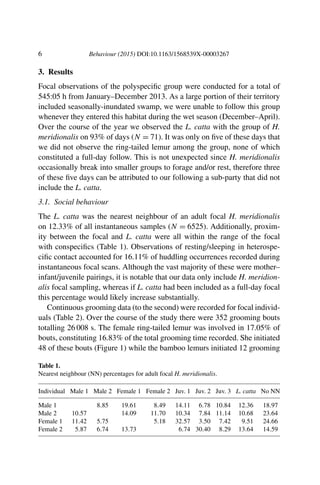
with conspecifics (Table 1). Observations of resting/sleeping in heterospe-
cific contact accounted for 16.11% of huddling occurrences recorded during
instantaneous focal scans. Although the vast majority of these were mother–
infant/juvenile pairings, it is notable that our data only include H. meridion-
alis focal sampling, whereas if L. catta had been included as a full-day focal
this percentage would likely increase substantially.
Continuous grooming data (to the second) were recorded for focal individ-
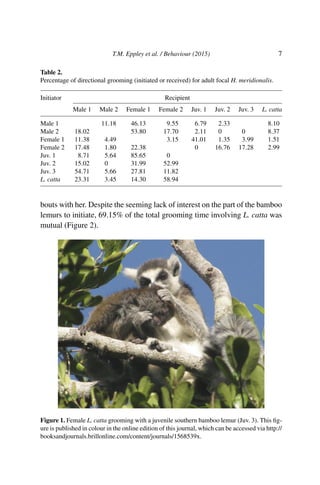
uals (Table 2). Over the course of the study there were 352 grooming bouts
totalling 26 008 s. The female ring-tailed lemur was involved in 17.05% of
bouts, constituting 16.83% of the total grooming time recorded. She initiated
48 of these bouts (Figure 1) while the bamboo lemurs initiated 12 grooming
Table 1.
Nearest neighbour (NN) percentages for adult focal H. meridionalis.
Individual Male 1 Male 2 Female 1 Female 2 Juv. 1 Juv. 2 Juv. 3 L. catta No NN
Male 1 8.85 19.61 8.49 14.11 6.78 10.84 12.36 18.97
Male 2 10.57 14.09 11.70 10.34 7.84 11.14 10.68 23.64
Female 1 11.42 5.75 5.18 32.57 3.50 7.42 9.51 24.66
Female 2 5.87 6.74 13.73 6.74 30.40 8.29 13.64 14.59
T.M. Eppley et al. / Behaviour (2015) 7
Table 2.
Percentage of directional grooming (initiated or received) for adult focal H. meridionalis.
Initiator Recipient
Male 1 Male 2 Female 1 Female 2 Juv. 1 Juv. 2 Juv. 3 L. catta
Male 1 11.18 46.13 9.55 6.79 2.33 8.10
Male 2 18.02 53.80 17.70 2.11 0 0 8.37
Female 1 11.38 4.49 3.15 41.01 1.35 3.99 1.51
Female 2 17.48 1.80 22.38 0 16.76 17.28 2.99
Juv. 1 8.71 5.64 85.65 0
Juv. 2 15.02 0 31.99 52.99
Juv. 3 54.71 5.66 27.81 11.82
L. catta 23.31 3.45 14.30 58.94
bouts with her. Despite the seeming lack of interest on the part of the bamboo
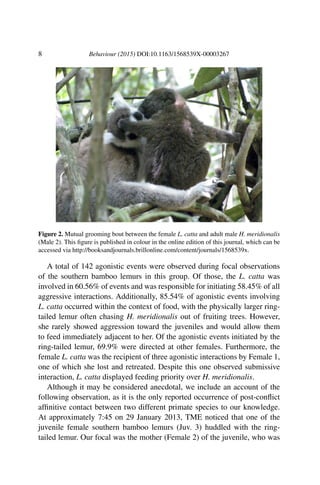
lemurs to initiate, 69.15% of the total grooming time involving L. catta was
mutual (Figure 2).
Figure 1. Female L. catta grooming with a juvenile southern bamboo lemur (Juv. 3). This fig-
ure is published in colour in the online edition of this journal, which can be accessed via http://
booksandjournals.brillonline.com/content/journals/1568539x.
8 Behaviour (2015) DOI:10.1163/1568539X-00003267
Figure 2. Mutual grooming bout between the female L. catta and adult male H. meridionalis
(Male 2). This figure is published in colour in the online edition of this journal, which can be
accessed via http://booksandjournals.brillonline.com/content/journals/1568539x.
A total of 142 agonistic events were observed during focal observations
of the southern bamboo lemurs in this group. Of those, the L. catta was
involved in 60.56% of events and was responsible for initiating 58.45% of all
aggressive interactions. Additionally, 85.54% of agonistic events involving
L. catta occurred within the context of food, with the physically larger ring-
tailed lemur often chasing H. meridionalis out of fruiting trees. However,
she rarely showed aggression toward the juveniles and would allow them
to feed immediately adjacent to her. Of the agonistic events initiated by the
ring-tailed lemur, 69.9% were directed at other females. Furthermore, the
female L. catta was the recipient of three agonistic interactions by Female 1,
one of which she lost and retreated. Despite this one observed submissive
interaction, L. catta displayed feeding priority over H. meridionalis.
Although it may be considered anecdotal, we include an account of the
following observation, as it is the only reported occurrence of post-conflict
affinitive contact between two different primate species to our knowledge.
At approximately 7:45 on 29 January 2013, TME noticed that one of the
juvenile female southern bamboo lemurs (Juv. 3) huddled with the ring-
tailed lemur. Our focal was the mother (Female 2) of the juvenile, who was
T.M. Eppley et al. / Behaviour (2015) 9
resting nearby, therefore allowing TME to observe both at ease. The bamboo
lemur and ring-tailed lemur remained in their resting huddle for approx.
45 min until a slight movement by the bamboo lemur resulted in the L. catta
vocalizing aggressively and then mildly hitting the juvenile. The bamboo
lemur fled immediately to a different branch where her mother and younger
sibling (Juv. 2) were huddled, possibly seeking third-party affiliation. After
45 s, the juvenile bamboo lemur cautiously returned to the ring-tailed lemur
and initiated a mutual grooming bout of 49 s, at which point any remaining
tension seemed to diminish. Despite the anecdotal nature of this observation,
it demonstrates the extent of the affiliation of the ring-tailed lemur within the
southern bamboo lemur group in Mandena.
Southern bamboo lemurs are known to utilize latrines (Eppley & Donati,
2010), a behaviour we witnessed the female L. catta include herself in. She
exhibited latrine behaviour (N = 3) by not only defecating with the bamboo
lemurs, but also by scent-marking the Uapaca spp. stilt-roots at the known
latrine site.
3.2. Foraging efficiency
Over the course of the year we observed this group of southern bamboo
lemurs feeding from 56 plant species, constituting 63 food items (including
soil and water). We recorded ad libitum the ring-tailed lemur feed from 45
plant species, 54 food items. Of food items selected by both lemur species,
there was an 83.3% overlap. In addition to ripe fruits, food selections of the L.
catta included various lianas and their leaves, as well as multiple graminoid
species, such as the soft piths of Cyperaceae (N = 3) and various terrestrial
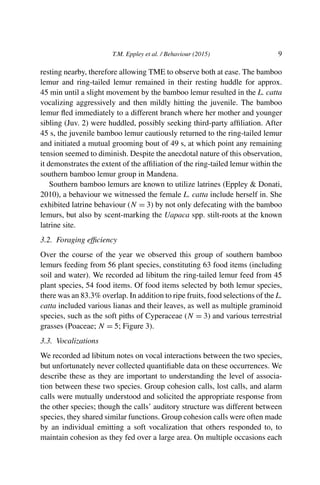
grasses (Poaceae; N = 5; Figure 3).
3.3. Vocalizations
We recorded ad libitum notes on vocal interactions between the two species,
but unfortunately never collected quantifiable data on these occurrences. We
describe these as they are important to understanding the level of associa-
tion between these two species. Group cohesion calls, lost calls, and alarm
calls were mutually understood and solicited the appropriate response from
the other species; though the calls’ auditory structure was different between
species, they shared similar functions. Group cohesion calls were often made
by an individual emitting a soft vocalization that others responded to, to
maintain cohesion as they fed over a large area. On multiple occasions each
10 Behaviour (2015) DOI:10.1163/1568539X-00003267
Figure 3. Female L. catta and adult H. meridionalis (Female 1) feeding in close proximity
on Panicum parvifolium grass in the Mandena littoral swamp. This figure is published in
colour in the online edition of this journal, which can be accessed via http://booksandjournals.
brillonline.com/content/journals/1568539x.
month, individuals (the ring-tailed lemur or a bamboo lemur) would become
separated from the group, at which point they would emit a ‘lost’ call, seek-
ing a response vocalization from a member of their group. Lastly, alarm calls
were emitted occasionally, and all group members joined in with the initia-
tor regardless of species. As an example, during our habituation phase in late
2012, H. meridionalis often emitted an alarm call upon first visual contact
with researchers, a vocalization that always prompted the L. catta to rush to
the nearest bamboo lemur who was vocalizing, and to join in directing her
alarm call at the observer(s).
On 16 December 2013, TME heard the infant of Female 2 alarm call
after falling out of the liana tangle in which it was ‘parked’, a vocalization
meant to draw the attention of its mother to the now potentially dangerous
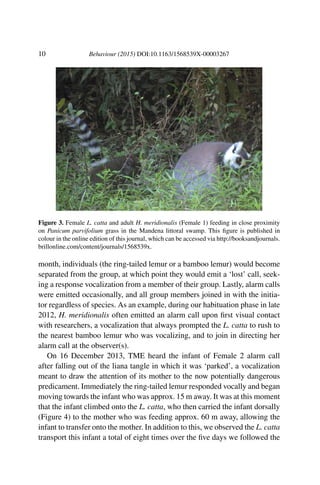
predicament. Immediately the ring-tailed lemur responded vocally and began
moving towards the infant who was approx. 15 m away. It was at this moment
that the infant climbed onto the L. catta, who then carried the infant dorsally
(Figure 4) to the mother who was feeding approx. 60 m away, allowing the
infant to transfer onto the mother. In addition to this, we observed the L. catta
transport this infant a total of eight times over the five days we followed the
T.M. Eppley et al. / Behaviour (2015) 11
Figure 4. Female L. catta transporting the H. meridionalis infant back to its mother (Fe-
male 2) after the infant fell from a liana tangle in which its mother ‘parked’ it. This figure
is published in colour in the online edition of this journal, which can be accessed via http://
booksandjournals.brillonline.com/content/journals/1568539x.
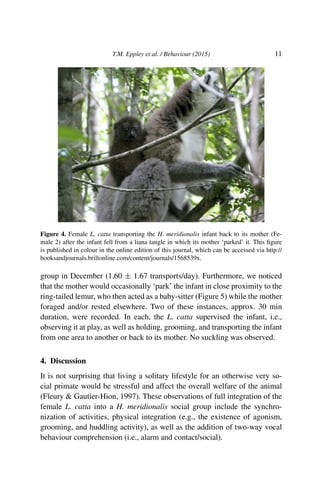
group in December (1.60 ± 1.67 transports/day). Furthermore, we noticed
that the mother would occasionally ‘park’ the infant in close proximity to the
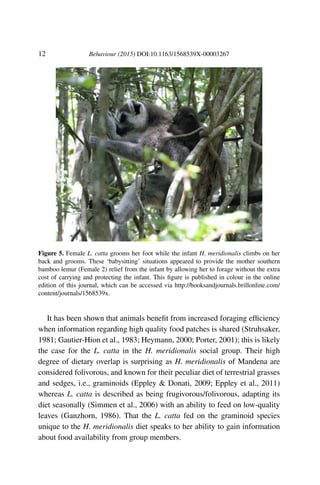
ring-tailed lemur, who then acted as a baby-sitter (Figure 5) while the mother
foraged and/or rested elsewhere. Two of these instances, approx. 30 min
duration, were recorded. In each, the L. catta supervised the infant, i.e.,
observing it at play, as well as holding, grooming, and transporting the infant
from one area to another or back to its mother. No suckling was observed.
4. Discussion
It is not surprising that living a solitary lifestyle for an otherwise very so-
cial primate would be stressful and affect the overall welfare of the animal
(Fleury & Gautier-Hion, 1997). These observations of full integration of the
female L. catta into a H. meridionalis social group include the synchro-
nization of activities, physical integration (e.g., the existence of agonism,
grooming, and huddling activity), as well as the addition of two-way vocal
behaviour comprehension (i.e., alarm and contact/social).
12 Behaviour (2015) DOI:10.1163/1568539X-00003267
Figure 5. Female L. catta grooms her foot while the infant H. meridionalis climbs on her
back and grooms. These ‘babysitting’ situations appeared to provide the mother southern
bamboo lemur (Female 2) relief from the infant by allowing her to forage without the extra
cost of carrying and protecting the infant. This figure is published in colour in the online
edition of this journal, which can be accessed via http://booksandjournals.brillonline.com/
content/journals/1568539x.
It has been shown that animals benefit from increased foraging efficiency
when information regarding high quality food patches is shared (Struhsaker,
1981; Gautier-Hion et al., 1983; Heymann, 2000; Porter, 2001); this is likely
the case for the L. catta in the H. meridionalis social group. Their high
degree of dietary overlap is surprising as H. meridionalis of Mandena are
considered folivorous, and known for their peculiar diet of terrestrial grasses
and sedges, i.e., graminoids (Eppley & Donati, 2009; Eppley et al., 2011)
whereas L. catta is described as being frugivorous/folivorous, adapting its
diet seasonally (Simmen et al., 2006) with an ability to feed on low-quality
leaves (Ganzhorn, 1986). That the L. catta fed on the graminoid species
unique to the H. meridionalis diet speaks to her ability to gain information
about food availability from group members.
T.M. Eppley et al. / Behaviour (2015) 13
Mixed-species groups benefit from increased vigilance for predators
(Struhsaker, 1981; Gautier-Hion et al., 1983; Terborgh, 1990; Heymann,
2000), and the occurrence of vocal alarms and their appropriate responses
between the two species has been shown to be indicative of shared com-
mon predators (Heymann & Buchanan-Smith, 2000; Eckardt & Zuberbühler,
2004). Although some primate species are known to associate more during
seasons when predation risks are higher (Noë & Bshary, 1997), we observed
these vocal interactions throughout the entire year. While our observations
of interspecific recognition of alarm calls are not the first to be documented
among lemurs (Seiler et al., 2013), the mutual understanding of responses
to calls initiated by both the L. catta and H. meridionalis demonstrates their
flexibility.
Lemurs are strongly olfactory-oriented (Schilling, 1979) and the close
phylogenetic-relatedness of these genera (Horvath et al., 2008) may allow
each species’ scent markings to be tolerated by the other. Latrine behaviour
has been postulated to play a role in territorial demarcation, and while fre-
quently observed among Hapalemur spp. (Irwin et al., 2004; Eppley &
Donati, 2010; Eppley, unpublished data), it is rarely reported for ring-tailed
lemurs (as reported in Irwin et al., 2004). Our observations of both species
defecating and scent-marking at the same latrines suggest the contribution of
the female L. catta towards territorial defence.
In terms of huddling and/or close contact sitting, the addition of an indi-
vidual that is twice as large in body mass may provide extra warmth during
the cold austral winter months. Although interspecific huddling may be po-
tentially advantageous, the overall size and conspicuous coloration of the
female L. catta may draw attention from potential predators.
Grooming is often used among primates to strengthen relationships be-
tween individuals (Seyfarth & Cheney, 1984; Port et al., 2009). Our obser-
vations of the ring-tailed lemur both initiating and being the recipient of
directional grooming, in addition to mutual-grooming bouts, likely cemented
her integration into this particular bamboo lemur group. Furthermore, coat
condition is widely recognized as a non-invasive indicator of the overall
health and well-being (Jolly, 2009). We noticed that the fur of the L. catta
was clean and full during the entire year despite seeing strong seasonal fluc-
tuations among certain H. meridionalis. At a minimum, this suggests that
the female ring-tailed lemur was healthy and not visibly stressed in spite of
living with zero conspecifics.
14 Behaviour (2015) DOI:10.1163/1568539X-00003267
Like most primates, reconciliation has been observed in some lemurs,
most notably among captive E. fulvus rufus (Kappeler, 1993), captive L.
catta (Palagi et al., 2005), and within wild P. verreauxi (Palagi et al., 2008)
and E. rufus × collaris at Berenty (Norscia & Palagi, 2011). While our data
collection did not include post conflict-matched control method (de Waal
& van Roosmalen, 1979) to scientifically demonstrate this phenomenon, we
did witness post-conflict affinitive contact between the two species possibly
suggesting the presence of a conciliatory pattern.
Similar to Hapalemur spp. (Waeber & Hemelrijk, 2003; Tan, 2006; Epp-
ley, unpublished data), ring-tailed lemurs are female dominated (Jolly, 1966)
with the majority of their agonistic encounters occurring in the context of
access to food (Sauther, 1993). Regarding dominance of H. meridionalis
within this group, Female 1 was dominant over Female 2 (Eppley, unpub-
lished data). Yet, it is interesting that 69.9% (N = 58) of the agonistic events
initiated by the L. catta were directed at the female bamboo lemurs, almost
exclusively in relation to food access. Although this is suggestive of the L.
catta being the alpha individual within this heterospecific social group, she
never initiated group travel, which is often included as a parameter for expli-
cating individual dominance (Waeber & Hemelrijk, 2003).
Allomaternal care is regularly exhibited in both Hapalemur and Lemur
(Wright, 1990; Gould, 1992; Haring & Davis, 1998; Gould et al., 2000;
Tecot et al., 2013), with the primary benefit being ‘mother relief’ which al-
lows the mother free time to forage, groom, and rest (Gray, 1985; Burton &
Chan, 1987). Tecot et al. (2013) organize allomaternal care among primates
into three major categories: infant transport (Goldizen, 1987), infant guard-
ing and/or babysitting, and energy transfer (i.e., food provisioning and/or
allomaternal nursing). Infant transport, while rare among mammals (Ross,
2001), is quite common among primates despite the energetic cost that comes
with carrying an infant (Schradin & Anzenberger, 2001). Hapalemur spp. are
known to carry infants orally when they are first born (and later they cling to
the mother’s fur) and ‘park’ them while the mother forages (Petter & Peyri-
eras, 1970; Wright, 1990). They are also known to exhibit allomaternal care,
with reports of males or non-breeding females transporting and/or babysit-
ting for infants within the group (Wright, 1990; Haring & Davis, 1998).
Among primates cross-species allomaternal care has been rarely observed,
except for among certain macaque associates (Burton & Chan, 1987). In a
T.M. Eppley et al. / Behaviour (2015) 15
case of inter-genus adoption and social integration, an infant marmoset (Cal-
lithrix jacchus) was adopted by a group of bearded capuchin monkeys (Cebus
libidinosus), a situation that displayed pronounced tolerance by all group
members (Izar et al., 2006). Ring-tailed lemurs often display allomaternal
care (Gould, 1992; Gould et al., 2000), yet they have also been observed
to leave their infants on the ground when potential danger is present, e.g.,
intergroup agonism (Jolly, 2004). Thus, our observations of inter-species al-
lomaternal care are perhaps more intriguing than those previous. While the
L. catta often transported the infant bamboo lemur, the attentive nature she
displayed when rushing to its aid after the infant fell from its ‘parked’ posi-
tion and alarm called demonstrates the exceptional degree to which she was
integrated into the bamboo lemur group.
The unique situation in Mandena offers an opportunity to further our
knowledge of lemur behavioural flexibility: the ring-tailed lemur and the
group of bamboo lemurs appear to communicate vocally amongst each other,
rest and travel together, and we present evidence that grooming, scent-
marking and alloparenting are part of a shared repertoire. It is likely that
one or both species may have had to learn from the other, or adjust their own
behaviour to better match the other’s, so as to be mutually beneficial. As
forests become further fragmented and the perilous situation in Madagascar
grows (Schwitzer et al., 2014), lemurs may end up seeking refuge in forests
that are out of their known population range, or in an entirely new habitat.
It will be important to document further cases of behavioural and ecological
flexibility among species.
Acknowledgements
This work was carried out under the Accord de Collaboration between the
University of Antananarivo and the University of Hamburg. We thank the
Direction du Système des Aires Protégées, and the Ministère de l’Environ-
nement, des Eaux et Forêts of Madagascar for granting permission to conduct
research. Special thanks to Jacques Rakotondranary and Tolona Andriana-
solo, for their logistical assistance and obtaining research permits, and to
Natalie Breden and Corey Tondreau for their assistance in the field. We also
thank the Environment Team at QMM Rio Tinto for their assistance and
provision of logistical support on-site and acknowledge their helpful staff,
especially Jean-Baptiste Ramanamanjato, Johny Rabenantoandro, Faly Ran-
driatafika, Laza Andriamandimbiarisoa, David Rabehevitra, Claude Soanary
16 Behaviour (2015) DOI:10.1163/1568539X-00003267
and Robertin Ravelomanantsoa. We are grateful for the generous financial
support and field gear provided by the American Society of Primatologists,
Conservation International’s Primate Action Fund, IDEAWILD, Mohamed
bin Zayed Species Conservation Fund (Project Number: 11253008), Primate
Conservation Inc. and the Primate Society of Great Britain/Knowsley Safari
Park.
References
Bicca-Marques, J.C. & Garber, P.A. (2003). Experimental field study of the relative costs and
benefits to wild tamarins (Saguinus imperator and S. fuscicollis) of exploiting contestable
food patches as single- and mixed-species troops. — Am. J. Primatol. 60: 139-153.
Buchanan-Smith, H.M. (1990). Polyspecific association of two tamarin species, Saguinus
labiatus and Saguinus fuscicollis, in Bolivia. — Am. J. Primatol. 22: 205-214.
Buchanan-Smith, H.M. (1999). Tamarin polyspecific associations, forest utilization and sta-
bility of mixed-species groups. — Primates 40: 233-247.
Burton, F.D. & Chan, L.K.W. (1987). Notes on the care of long-tail macaque (Macaca fasic-
ularis) infants by stump-tail (M. thibetana) females. — Can. J. Zool. 65: 752-755.
Buzzard, P.J. (2010). Polyspecific associations of Cercopithecus campbelli and C. petaurista
with C. diana: what are the costs and benefits? — Primates 51: 307-314.
Chapman, C.A. & Chapman, L.J. (1996). Mixed-species primate groups in the Kibale Forest:
ecological constraints on association. — Int. J. Primatol. 17: 31-50.
Chapman, C.A. & Chapman, L.J. (2000). Interdemic variation in mixed-species association
patterns: common diurnal primates of Kibale National Park, Uganda. — Behav. Ecol.
Sociobiol. 47: 129-139.
Cords, M. (1990a). Mixed-species associations of East African guenons: general patterns or
specific examples? — Am. J. Primatol. 21: 101-114.
Cords, M. (1990b). Vigilance and mixed species association in some East African forest
guenons. — Behav. Ecol. Sociobiol. 26: 297-300.
Cords, M. (2000). Mixed-species association and group movement. — In: On the move: how
and why animals travel in groups (Boinski, S. & Garber, P., eds). University of Chicago
Press, Chicago, IL, p. 73-99.
Cords, M. & Würsig, B. (2014). A mix of species: associations of heterospecifics among
primates and dolphins. — In: Primates and cetaceans (Yamagiwa, J. & Karczmarski, L.,
eds). Springer, Tokyo, p. 409-431.
de Waal, F.B.M. & van Roosmalen, A. (1979). Reconciliation and consolation among chim-
panzees. — Behav. Ecol. Sociobiol. 5: 55-66.
Dumetz, N. (1999). High plant diversity of lowland rainforest vestiges in eastern Madagascar.
— Biodivers. Conserv. 8: 273-315.
Eckardt, W. & Zuberbühler, K. (2004). Cooperation and competition in two forest monkeys.
— Behav. Ecol. Sociobiol. 15: 400-411.
T.M. Eppley et al. / Behaviour (2015) 17
Eppley, T.M. & Donati, G. (2009). Grazing lemurs: exhibition of terrestrial feeding by the
southern gentle lemur, Hapalemur meridionalis, in the Mandena littoral forest, southeast
Madagascar. — Lemur News 14: 16-20.
Eppley, T.M. & Donati, G. (2010). Observations of terrestrial latrine behaviour by the south-
ern gentle lemur Hapalemur meridionalis in the Mandena littoral forest, southeast Mada-
gascar. — Lemur News 15: 51-54.
Eppley, T.M., Verjans, E. & Donati, G. (2011). Coping with low-quality diets: a first account
of the feeding ecology of the southern gentle lemur, Hapalemur meridionalis, in the
Mandena littoral forest, southeast Madagascar. — Primates 52: 7-13.
Fimbel, C.C. (1992). Cross-species handling of colobine infants. — Primates 33: 545-549.
Fleury, M.C. & Gautier-Hion, A. (1997). Better to live with allogenerics than to live alone?
The case of a single male Cercopithecus pogonias in troops of Colobus satanus. — Int. J.
Primatol. 18: 967-974.
Freed, B.Z. (2006). Polyspecific associations of crowned lemurs and Sanford’s lemurs in
Madagascar. — In: Lemurs: ecology and adaptation (Gould, L. & Sauther, M.L., eds).
Springer, New York, NY, p. 111-131.
Ganzhorn, J.U. (1986). The influence of plant chemistry on food selection by Lemur catta
and Lemur fulvus. — In: Primate ecology and conservation (Else, J.G. & Lee, P.C., eds).
Cambridge University Press, Cambridge, p. 21-29.
Ganzhorn, J.U., Andrianasolo, T., Andrianjazalahatra, T., Donati, G., Fietz, J., Lahann,
P., Norscia, I., Rakotondranary, J., Rakotondratsima, B.M., Ralison, J., Ramarokoto,
R.E.A.F., Randriamanga, S., Rasarimanana, S., Rakotosamimanana, B., Ramanamanjato,
J.-B., Randria, G., Rasolofoharivelo, M.T., Razanahoera-Rakotomalala, M., Schmid, J.
& Sommer, S. (2007). Lemurs in evergreen littoral forest fragments. — In: Biodiver-
sity, ecology, and conservation of the littoral ecosystems in southeastern Madagascar,
Tolagnaro (Fort Dauphin) (Ganzhorn, J.U., Goodman, S.M. & Vincelette, M., eds). Smith-
sonian Institution Press, Washington, DC, p. 223-225.
Gautier-Hion, A., Quris, R. & Gautier, J.-P. (1983). Monospecific vs. polyspecific life: a com-
parative study of foraging and antipredatory tactics in a community of Cercopithecus
monkeys. — Behav. Ecol. Sociobiol. 12: 325-335.
Gautier-Hion, A., Gautier, J.-P. & Moungazi, A. (1997). Do black colobus in mixed species
groups benefit from increased foraging efficiency? — C. R. Acad. Sci. III 320: 67-71.
Goldizen, A.W. (1987). Facultative polyandry and the role of infant-carrying in wild saddle-
back tamarins (Saguinus fuscicollis). — Behav. Ecol. Sociobiol. 20: 99-109.
Gould, L. (1992). Alloparental care in free-ranging Lemur catta at Berenty Reserve, Mada-
gascar. — Folia Primatol. 58: 72-83.
Gould, L., Sauther, M.L. & Cameron, A. (2000). Adoption of a wild orphaned ringtailed
lemur infant by natal group members: adaptive explanations. — Primates 41: 413-419.
Gould, L., Sussman, R.W. & Sauther, M.L. (2003). Demographic and life-history patterns in
a population of ring-tailed lemurs (Lemur catta) at Beza Mahafaly Reserve, Madagascar:
a 15-year perspective. — Am. J. Phys. Anthropol. 120: 182-194.
Gray, J.P. (1985). Primate sociobiology. — HRAF Press, New Haven, CT.
18 Behaviour (2015) DOI:10.1163/1568539X-00003267
Haring, D. & Davis, K. (1998). Management of the grey gentle or Eastern lesser bamboo
lemur Hapalemur griseus griseus at Duke University Primate Center, Durham. — Int.
Zoo Yb. 36: 20-34.
Haugaasen, T. & Peres, C.A. (2009). Interspecific primate associations in Amazonian flooded
and unflooded forests. — Primates 50: 239-251.
Heymann, E.W. (2011). Coordination in primate mixed-species groups. — In: Coordination
in human and primate groups (Boos, M., Kolbe, M., Kappeler, P.M. & Ellwart, T., eds).
Springer, Heidelberg, p. 263-281.
Heymann, E.W. & Buchanan-Smith, H.M. (2000). The behavioural ecology of mixed-species
troops of callitrichine primates. — Biol. Rev. 75: 169-190.
Heymann, E.W. & Hsia, S.S. (2014). Unlike fellows — a review of primate–non-primate
associations. — Biol. Rev., in press, DOI:10.1111/brv.12101.
Heymann, E.W. & Sicchar Valdez, L.A. (1988). Interspecific social grooming in a mixed
troop of tamarins, Saginus mystax and Saginus fuscicollis (Platyrrhini: Callitrichidae), in
an outdoor enclosure. — Folia Primatol. 50: 221-225.
Höner, O.P., Leumann, L. & Noë, R. (1997). Dyadic associations of red colobus and diana
monkey groups in the Taï National Park, Ivory Coast. — Primates 38: 281-291.
Horvath, J.E., Weisrock, D.V., Embry, S.L., Fiorentino, I., Balhoff, J.P., Kappeler, P.M., Wray,
G.A., Willard, H.F. & Yoder, A.D. (2008). Development and application of a phyloge-
nomic toolkit: resolving the evolutionary history of Madagascar’s lemurs. — Genome
Res. 18: 489-499.
Irwin, M.T., Samonds, K.E., Raharison, J.-L. & Wright, P.C. (2004). Lemur latrines: ob-
servations of latrine behavior in wild primates and possible ecological significance. —
J. Mammal. 85: 420-427.
Izar, P., Verderane, M.P., Visalberghi, E., Ottoni, E.B., de Oliveira, M.G., Shirley, J. &
Fragaszy, D. (2006). Cross-genus adoption of a marmoset (Callithrix jacchus) by wild
capuchin monkeys (Cebus libidinosus): case report. — Am. J. Primatol. 68: 692-700.
Jolly, A. (1966). Lemur behavior. — University of Chicago Press, Chicago, IL.
Jolly, A. (2004). Lords and lemurs: mad scientists, kings with spears, and the survival of
diversity in Madagascar. — Houghton Mifflin, Boston, MA.
Jolly, A. (2009). Coat condition of ringtailed lemurs, Lemur catta at Berenty Reserve, Mada-
gascar: I. Differences by age, sex, density and tourism, 1996–2006. — Am. J. Primatol.
71: 191-198.
Jolly, A., Sussman, R.W., Koyama, N. & Rasamimanana, H. (2006). Ringtailed lemur biol-
ogy. — Springer, New York, NY.
Kappeler, P.M. (1993). Reconciliation and post-conflict behaviour in ringtailed lemurs, Lemur
catta, and red-fronted lemurs, Eulemur fulvus rufus. — Anim. Behav. 45: 901-915.
Kelley, E.A., Sussman, R.W. & Muldoon, K.M. (2007). The status of lemur species at Antser-
ananomby: an update. — Primat. Conserv. 22: 71-77.
Korstjens, A.H. & Noë, R. (2004). Mating system of an exceptional primate, the olive colobus
(Procolobus verus). — Am. J. Primatol. 62: 261-273.
T.M. Eppley et al. / Behaviour (2015) 19
Manohar, B.R. & Mathur, R. (1992). Interspecific play behaviour between Hanuman langur
Presbytis entellus and rhesus macaque Macaca mulatta. — J. Bombay Nat. Hist. Soc. 89:
114-115.
McGraw, W.S. & Bshary, R. (2001). Association of terrestrial mangabeys (Cercocebus atys)
with arboreal monkeys: experimental evidence for the effects of reduced ground predator
pressure on habitat use. — Int. J. Primatol. 23: 311-325.
Mitani, M. (1991). Niche overlap and polyspecific associations among sympatric cercopithe-
cids in the Campo Animal Reserve, southwestern Cameroon. — Primates 32: 137-151.
Mittermeier, R.A., Louis Jr., E.E., Richardson, M., Schwitzer, C., Langrand, O., Rylands, A.,
Hawkins, F., Rajaobelina, S., Ratsimbazafy, J., Roos, C., Kappeler, P.M. & MacKinnon, J.
(2010). Lemurs of Madagascar, 3rd edn. — Conservation International, Washington, DC.
Noë, R. & Bshary, R. (1997). The formation of red colobus–Diana monkey associations under
predation pressure from chimpanzees. — Proc. Roy. Soc. Lond. B: Biol. Sci. 264: 253-
259.
Norscia, I. & Palagi, E. (2011). Do wild brown lemurs reconcile? Not always. — J. Ethol. 29:
181-185.
Palagi, E., Antonacci, D. & Norscia, I. (2008). Peacemaking on treetops: first evidence of
reconciliation from a wild prosimian (Propithecus verreauxi). — Anim. Behav. 76: 737-
747.
Palagi, E., Paoli, T. & Tarli, S.B. (2005). Aggression and reconciliation in two captive groups
of Lemur catta. — Int. J. Primatol. 26: 279-294.
Peres, C.A. (1992). Prey-capture benefits in a mixed-species group of Amazonian tamarins,
Saguinus fuscicollis and S. mystax. — Behav. Ecol. Sociobiol. 31: 339-347.
Petter, J. & Peyrieras, A. (1970). Observations ecoethologiques sur les lemuriens malgaches
du genre Hapalemur. — Terre Vie 24: 356-382.
Port, M., Clough, D. & Kappeler, P.M. (2009). Market effects offset the reciprocation of
grooming in free-ranging redfronted lemurs, Eulemur fulvus rufus. — Anim. Behav. 77:
29-36.
Porter, L.M. (2001). Benefits of polyspecific associations for the Goeldi’s monkey (Callimico
goeldii). — Am. J. Primatol. 54: 143-158.
Porter, L.M., Sterr, S.M. & Garber, P.A. (2007). Habitat use and ranging behavior of Callim-
ico goeldi. — Int. J. Primatol. 28: 1035-1058.
Rabenantoandro, J., Randriatafika, F. & Lowry, P.P. (2007). Floristic and structural charac-
teristics of remnant littoral forest sites in the Tolagnaro area. — In: Biodiversity, ecology,
and conservation of the littoral ecosystems in southeastern Madagascar, Tolagnaro (Fort
Dauphin) (Ganzhorn, J.U., Goodman, S.M. & Vincelette, M., eds). Smithsonian Institu-
tion Press, Washington, DC, p. 223-225.
Ramanamanjato, J.-B., McIntyre, P.B. & Nussbaum, R.A. (2002). Reptile, amphibian, and
lemur diversity of the Malahelo Forest, a biogeographical transition zone in southeastern
Madagascar. — Biodivers. Conserv. 11: 1791-1807.
Rehg, J.A. (2006). Seasonal variation in polyspecific associations among Callimico goeldii,
Saguinus labiatus, and S. fuscicollis in Acre, Brazil. — Int. J. Primatol. 27: 1399-1428.
20 Behaviour (2015) DOI:10.1163/1568539X-00003267
Ross, C. (2001). Park or ride? Evolution of infant carrying in primates. — Int. J. Primatol.
22: 749-771.
Sauther, M.L. (1993). The dynamics of feeding competition in wild populations of ringtailed
lemurs (Lemur catta). — In: Lemur social systems and their ecological basis (Kappeler,
P.M. & Ganzhorn, J.U., eds). Plenum Press, New York, p. 135-152.
Sauther, M.L. (2002). Group size effects on predation sensitive foraging in wild Lemur catta.
— In: Eat or be eaten: predation sensitive foraging among primates (Miller, L.E., ed.).
Cambridge University Press, Cambridge, p. 107-125.
Schilling, A. (1979). Olfactory communication in prosimians. — In: The study of prosimian
behavior (Dole, G.A. & Martin, R.D., eds). Academic Press, New York, NY, p. 461-542.
Schradin, C. & Anzenberger, G. (2001). Costs of infant carrying in common marmosets,
Callithrix jacchus: an experimental analysis. — Anim. Behav. 62: 289-295.
Schwitzer, C., Mittermeier, R.A., Johnson, S.E., Donati, G., Irwin, M., Peacock, H., Ratsim-
bazafy, J., Razafindramanana, J., Louis Jr., E.E., Chikhi, L., Colquhoun, I.C., Tinsman, J.,
Dolch, R., LaFleur, M., Nash, S., Patel, E., Randrianambinina, B., Rasolofoharivelo, T.
& Wright, P.C. (2014). Averting lemur extinctions amid Madagascar’s political crisis. —
Science 343: 842-843.
Seiler, M., Schwitzer, C., Gamba, M. & Holderied, M.W. (2013). Interspecific semantic alarm
call recognition in the solitary Sahamalaza sportive lemur, Lepilemur sahamalazensis. —
PloS One 8: e67397.
Seyfarth, R. & Cheney, D. (1984). Grooming alliances and reciprocal altruism in vervet
monkeys. — Nature 308: 541-542.
Simmen, B., Sauther, M.L., Soma, T., Rasamimanana, H., Sussman, R.W., Jolly, A., Tarnaud,
L. & Hladik, A. (2006). Plant species fed on by Lemur catta in gallery forests of the
southern domain of Madagascar. — In: Ringtailed lemur biology (Jolly, A., Sussman,
R.W., Koyama, N. & Rasamimanana, H., eds). Springer, New York, NY, p. 55-68.
Stensland, E., Angerbjörna, A. & Berggren, P. (2003). Mixed species groups in mammals. —
Mammal Rev. 33: 205-223.
Struhsaker, T.T. (1981). Polyspecific associations among tropical rain-forest primates. —
Z. Tierpsychol. 57: 268-304.
Tan, C.L. (2006). Behavior and ecology of gentle lemurs (genus Hapalemur). — In: Lemurs:
ecology and adaptation (Gould, L. & Sauther, M.L., eds). Springer, New York, NY, p. 369-
381.
Taylor, L.A. & Schwitzer, C. (2012). Body masses of wild lemurs. — Lemur News 16: 34-40.
Tecot, S.R., Baden, A.L., Romine, N. & Kamilar, J.M. (2013). Reproductive strategies and
infant care in the Malagasy primates. — In: Building babies (Clancy, K.B.H., Hinde, K.
& Rutherford, J.N., eds). Springer, New York, NY, p. 321-359.
Terborgh, J. (1990). Mixed flocks and polyspecific associations: costs and benefits of mixed
groups to birds and monkeys. — Am. J. Primatol. 21: 87-100.
Veasey, J. & Hammer, G. (2010). Managing captive mammals in mixed-species communities.
— In: Wild mammals in captivity: principles and techniques (Kleiman, D.G., Thompson,
K.V. & Baer, C.K., eds). University of Chicago Press, Chicago, IL, p. 151-161.
T.M. Eppley et al. / Behaviour (2015) 21
Wachter, B., Schabel, M. & Noë, R. (1997). Diet overlap and polyspecific associations of red
colobus and Diana monkeys in Taï National Park, Ivory Coast. — Ethology 103: 514-526.
Waeber, P.O. & Hemelrijk, C.K. (2003). Female dominance and social structure in Alaotran
gentle lemurs. — Behaviour 140: 1235-1246.
Waser, P.M. (1982). Primate polyspecific associations: do they occur by chance? — Anim.
Behav. 30: 1-8.
Wilson, J.M., Stewart, P.D., Ramangason, G.S., Denning, A.M. & Hutchings, M.S. (1989).
Ecology and conservation of the crowned lemur, Lemur coronatus, at Ankarana, N. Mada-
gascar, with notes on Sanford’s lemur, other sympatric and subfossil lemurs. — Folia
Primatol. 52: 1-26.
Wright, P.C. (1990). Patterns of paternal care in primates. — Int. J. Primatol. 11: 89-101.

Eppley_etal_2015_Lemurcatta_Hapalemur

  • 1.
    Behaviour (2015) DOI:10.1163/1568539X-00003267brill.com/beh An unusual case of affiliative association of a female Lemur catta in a Hapalemur meridionalis social group Timothy M. Eppley a,b,∗ , Katie Hall c,d , Giuseppe Donati b and Jörg U. Ganzhorn a a Biozentrum Grindel, Department of Animal Ecology and Conservation, University of Hamburg, Hamburg, Germany b Nocturnal Primate Research Group, Oxford Brookes University, Oxford, UK c Michale E. Keeling Center for Comparative Medicine and Research, The University of Texas MD Anderson Cancer Center, Bastrop, TX, USA d Neuroscience Institute & Language Research Center, Georgia State University, Atlanta, GA, USA *Corresponding author’s e-mail address: eppleyti@gmail.com Accepted 20 January 2014; published online ??? Abstract Polyspecific associations are well documented, but have rarely been observed in strepsirrhines. In this study we present a unique affiliative association between a female ring-tailed lemur (Lemur catta) and a group of southern bamboo lemurs (Hapalemur meridionalis) in south-east Madagas- car. Our main research focused on H. meridionalis; however, due to the presence of the L. catta we treated her as a group member, including her in the focal sampling of Hapalemur social behaviour. We also recorded ad libitum data on all food species/items and any unique events or occurrences. Among observations, both species appeared to have a mutual understanding of vocalisations, be- havioural synchronisation, dietary overlap, and possible service exchange, e.g., grooming. We also observed the L. catta occasionally attending to the bamboo lemur infant. This included grooming, baby-sitting, and even transporting the infant. The behavioural flexibility exhibited by both species has allowed the successful integration of the female ring-tailed lemur. Keywords behavioural flexibility, heterospecific alloparental care, polyspecific association, ring-tailed lemur, southern bamboo lemur. 1. Introduction Polyspecific associations (also referred to as mixed-species groups) are de- fined as associations between two or more different species that maintain © Koninklijke Brill NV, Leiden, 2015 DOI 10.1163/1568539X-00003267
  • 2.
    2 Behaviour (2015)DOI:10.1163/1568539X-00003267 a close proximity while communicating and coordinating their activities over a prolonged period of time (Heymann, 2011). These associations are well known among mammals (Stensland et al., 2003), particularly primates (Cords, 1990a, 2000; Heymann & Buchanan-Smith, 2000; Heymann, 2011; Cords & Würsig, 2014), and occasionally include association assemblages with birds (Heymann & Hsia, 2014). They often involve behavioural changes by at least one of the associated species (Cords & Würsig, 2014). Many the- ories have been proposed to explain why mixed-species groups aggregate (reviewed in Cords, 2000; Heymann & Buchanan-Smith, 2000; Heymann, 2011; Cords & Würsig, 2014); the best supported theories include more efficient feeding and foraging, increased anti-predator vigilance/reduction of predation risk, and enhanced social opportunities (e.g., mutual groom- ing) (Gautier-Hion et al., 1983, 1997; Heymann & Sicchar Valdez, 1988; Buchanan-Smith, 1990, 1999; Cords, 1990b; Mitani, 1991; Manohar & Mathur, 1992; Peres, 1992; Chapman & Chapman, 1996, 2000; Höner et al., 1997; Noë & Bshary, 1997; Wachter et al., 1997; McGraw & Bshary, 2001; Porter, 2001; Bicca-Marques & Garber, 2003; Korstjens & Noë, 2004; Freed, 2006; Buzzard, 2010). On the other hand, mixed-species groups likely incur some potential costs which limit the associations, for example, increased feeding competition which may also increase energy expenditure (Heymann & Buchanan-Smith, 2000; Rehg, 2006; Porter et al., 2007) and an increased risk of predation through generating more noise from travelling in a large group and contact calls (Heymann, 2011). In essence, species involved in polyspecific associations must have a behavioural flexibility allowing an- other species to follow and/or join their group, considering the potential benefits versus costs associated with the inclusion of additional, heterospe- cific individuals. Furthermore, this would require that the social group is apathetic towards the newcomer(s) gaining access to resources that would otherwise be theirs. Studies on polyspecific associations in primates have shown that they mostly occur when species congregate at food patches. In this way, primates benefit by increasing their foraging efficiency and by increasing vigilance for predators (Struhsaker, 1981; Terborgh, 1990; Heymann, 2000; Porter, 2001). While these associations are indirectly beneficial to at least one species (though they need not benefit both: Waser, 1982), affiliative behavioural in-
  • 3.
    T.M. Eppley etal. / Behaviour (2015) 3 teractions such as grooming or play between species are rarely recorded (but see Heymann & Sicchar Valdez, 1988; Fimbel, 1992). While more commonly reported for New World monkeys (Haugaasen & Peres, 2009) and Old World monkeys (Struhsaker, 1981), studies of polyspe- cific association among lemurs are limited to Eulemur sanfordi and E. coro- natus in northern Madagascar (Wilson et al., 1989; Freed, 2006). It was communicated to us by Alison Jolly that temporary, attempted integration associations of two E. collaris into a Lemur catta group at Berenty oc- curred in the past; however, despite the E. collaris adapting their diet to what the L. catta were feeding on, too many vocalization/communication misunderstandings occurred between the two species and the associations quickly dissolved. Additionally, Verreaux’s sifakas (Propithecus verreauxi) and smaller troops of ring-tailed lemurs have been observed travelling and foraging together (Sauther, 2002; Kelley et al., 2007), and it has been theo- rized that this may be an anti-predator strategy during reproductive periods (Sauther, 2002). Although infrequent, these polyspecific lemur observations from the wild offer an account of behavioural flexibility that is often seen by captive lemurs maintained in multi-species exhibits (Haring & Davis, 1998; Veasey & Hammer, 2010). In the Mandena littoral forest of southeast Madagascar, the first author (TME) observed a ring-tailed lemur feeding and travelling with a group of southern bamboo lemurs (Hapalemur meridionalis) in May 2008. A local field guide (Robertin Ravelomanantsoa) explained that he had seen this L. catta in the Mandena forest for a few years, but could not specify the exact duration. While L. catta and H. meridionalis are sympatric in Kalambatritra Reserve (Mittermeier et al., 2010) and Malahelo Forest (Ramanamanjato et al., 2002) in southeast Madagascar, there are no reports of behavioural associations between the two species at these sites. Furthermore, L. catta are not native to the eastern humid forests and are not known to range historically in the Mandena area (Ganzhorn et al., 2007). Given the peculiar nature of this association, we sought to understand the degree to which the L. catta associated with the H. meridionalis group. Further, we explored this social affiliation in terms of the hypotheses put forth for polyspecific associations among other primates, and whether this descriptive account fulfils each.
  • 4.
    4 Behaviour (2015)DOI:10.1163/1568539X-00003267 2. Material and methods 2.1. Study species Southern bamboo lemurs (H. meridionalis) are medium-sized lemurs with a mean ± SE body mass of 1.072 ± 0.107 kg (N = 15), and are charac- terized as folivores (Eppley et al., 2011) and by female dominance (Eppley, unpublished data) similar to congeners (Waeber & Hemelrijk, 2003). They maintain small social groups with one or two adult males and one to two breeding adult female(s) that are generally in constant daily contact with one another. As these lemurs have an inter-birth interval of approximately one year (Tan, 2006; Eppley, unpublished data), there are often juvenile and/or infants within each group. Similarly, ring-tailed lemurs (L. catta) are medium-sized, frugivorous– folivorous lemurs that are also characterized by female dominance (Jolly, 1966; Gould et al., 2003; Jolly et al., 2006). However, female L. catta weigh an average of 2.268 kg (Taylor & Schwitzer, 2012), making them nearly twice the size as southern bamboo lemurs. 2.2. Study site The study was conducted in the Mandena littoral forest (24°95 S, 46°99 E) in southeast Madagascar, 10 km north of Fort-Dauphin (Tolagnaro). The encompassing area is 148 ha of fragmented and degraded upland littoral forest, including approximately 82 ha of interspersed seasonally-inundated swamps that segregate the two upland forest areas (Ganzhorn et al., 2007). Littoral forests are characterized as growing on sandy soils along the coast and typically have a low canopy (Dumetz, 1999). Ring-tailed lemurs are known to inhabit the nearby transitional littoral forest of Petriky, approximately 15 km to the southwest of Mandena (Ra- manamanjato et al., 2002; Ganzhorn et al., 2007), that maintains floristic and structural characteristics that are a composite of both dry and humid forests (Rabenantoandro et al., 2007). Yet, it is more likely that the female ring-tailed lemur emigrated from the nearby (approx. 5 km) Nahampoana Reserve, a local botanical garden and tourist site that hosts mostly non- endemic (to the Anosy region) flora in addition to free-ranging groups of provisioned L. catta and P. verreauxi. Over the years there have been reports of ring-tailed lemurs occasionally dispersing from the reserve, but they are usually captured and returned to the site. In this case, the female L. catta
  • 5.
    T.M. Eppley etal. / Behaviour (2015) 5 likely dispersed and was not found or recaptured after seeking refuge in the seasonally-inundated littoral swamps of Mandena. 2.3. Behavioural data We collected data from the mixed-species group (M4) in which an adult fe- male L. catta was observed within a H. meridionalis social unit. The group consisted of seven individuals categorized by age/sex class: two adult fe- males, two adult males, and three juveniles. In November 2013 both adult females gave birth to infants; however, only one infant was observed in December with the other presumed dead. Full-day focal follows were con- ducted for approx. 50 h/month from January–December 2013. Broad-level behavioural activity (i.e., rest, feed, travel, other, and not visible) were col- lected via 5-min instantaneous point sampling, while also noting sub-activity (such as ‘huddling behaviour’) where appropriate. Furthermore, we recorded the nearest neighbour, noting the individual and distance (contact, arms’ reach, 1 m, 3 m, 6 m). Continuous sampling (recorded to the second) was utilized for all grooming occurrences, noting the initiator, recipient, and whether the interaction was unidirectional, i.e., one individual groomed the other, or mutual, i.e., both individuals groomed each other during the bout. Lastly, all agonistic behaviours (categorized as vocal threat, open mouth dis- play, chase, hit/fight, and wound) were scored ad libitum while recording the initiator, recipient, any submissive behaviours (whimper, avoid/reposition, or flee), and the outcome of the event (Waeber & Hemelrijk, 2003). As the primary focus of our research, our focal subjects were southern bamboo lemurs. However, due to the consistent presence of the L. catta, we treated this individual as an integral member of the social group, including it in the nearest neighbour data and all grooming and agonistic interactions. In addition to our continuous sampling of all food species/items that the southern bamboo lemur fed on, we also recorded ad libitum all food species and specific items that the ring-tailed lemur fed on, as well as noting any unique events or occurrences. While data were collected in a systematic manner, the small sample size limited our approach to a purely descriptive report. All research was carried out under the Accord de Collaboration among the University of Antananarivo and the University of Hamburg. Research proto- cols were approved and permits authorized by the Direction du Système des Aires Protégées and the Ministère de l’Environnement, des Eaux et Forêts of Madagascar, adhering to the legal requirements of Madagascar.
  • 6.
    6 Behaviour (2015)DOI:10.1163/1568539X-00003267 3. Results Focal observations of the polyspecific group were conducted for a total of 545:05 h from January–December 2013. As a large portion of their territory included seasonally-inundated swamp, we were unable to follow this group whenever they entered this habitat during the wet season (December–April). Over the course of the year we observed the L. catta with the group of H. meridionalis on 93% of days (N = 71). It was only on five of these days that we did not observe the ring-tailed lemur among the group, none of which constituted a full-day follow. This is not unexpected since H. meridionalis occasionally break into smaller groups to forage and/or rest, therefore three of these five days can be attributed to our following a sub-party that did not include the L. catta. 3.1. Social behaviour The L. catta was the nearest neighbour of an adult focal H. meridionalis on 12.33% of all instantaneous samples (N = 6525). Additionally, proxim- ity between the focal and L. catta were all within the range of the focal with conspecifics (Table 1). Observations of resting/sleeping in heterospe- cific contact accounted for 16.11% of huddling occurrences recorded during instantaneous focal scans. Although the vast majority of these were mother– infant/juvenile pairings, it is notable that our data only include H. meridion- alis focal sampling, whereas if L. catta had been included as a full-day focal this percentage would likely increase substantially. Continuous grooming data (to the second) were recorded for focal individ- uals (Table 2). Over the course of the study there were 352 grooming bouts totalling 26 008 s. The female ring-tailed lemur was involved in 17.05% of bouts, constituting 16.83% of the total grooming time recorded. She initiated 48 of these bouts (Figure 1) while the bamboo lemurs initiated 12 grooming Table 1. Nearest neighbour (NN) percentages for adult focal H. meridionalis. Individual Male 1 Male 2 Female 1 Female 2 Juv. 1 Juv. 2 Juv. 3 L. catta No NN Male 1 8.85 19.61 8.49 14.11 6.78 10.84 12.36 18.97 Male 2 10.57 14.09 11.70 10.34 7.84 11.14 10.68 23.64 Female 1 11.42 5.75 5.18 32.57 3.50 7.42 9.51 24.66 Female 2 5.87 6.74 13.73 6.74 30.40 8.29 13.64 14.59
  • 7.
    T.M. Eppley etal. / Behaviour (2015) 7 Table 2. Percentage of directional grooming (initiated or received) for adult focal H. meridionalis. Initiator Recipient Male 1 Male 2 Female 1 Female 2 Juv. 1 Juv. 2 Juv. 3 L. catta Male 1 11.18 46.13 9.55 6.79 2.33 8.10 Male 2 18.02 53.80 17.70 2.11 0 0 8.37 Female 1 11.38 4.49 3.15 41.01 1.35 3.99 1.51 Female 2 17.48 1.80 22.38 0 16.76 17.28 2.99 Juv. 1 8.71 5.64 85.65 0 Juv. 2 15.02 0 31.99 52.99 Juv. 3 54.71 5.66 27.81 11.82 L. catta 23.31 3.45 14.30 58.94 bouts with her. Despite the seeming lack of interest on the part of the bamboo lemurs to initiate, 69.15% of the total grooming time involving L. catta was mutual (Figure 2). Figure 1. Female L. catta grooming with a juvenile southern bamboo lemur (Juv. 3). This fig- ure is published in colour in the online edition of this journal, which can be accessed via http:// booksandjournals.brillonline.com/content/journals/1568539x.
  • 8.
    8 Behaviour (2015)DOI:10.1163/1568539X-00003267 Figure 2. Mutual grooming bout between the female L. catta and adult male H. meridionalis (Male 2). This figure is published in colour in the online edition of this journal, which can be accessed via http://booksandjournals.brillonline.com/content/journals/1568539x. A total of 142 agonistic events were observed during focal observations of the southern bamboo lemurs in this group. Of those, the L. catta was involved in 60.56% of events and was responsible for initiating 58.45% of all aggressive interactions. Additionally, 85.54% of agonistic events involving L. catta occurred within the context of food, with the physically larger ring- tailed lemur often chasing H. meridionalis out of fruiting trees. However, she rarely showed aggression toward the juveniles and would allow them to feed immediately adjacent to her. Of the agonistic events initiated by the ring-tailed lemur, 69.9% were directed at other females. Furthermore, the female L. catta was the recipient of three agonistic interactions by Female 1, one of which she lost and retreated. Despite this one observed submissive interaction, L. catta displayed feeding priority over H. meridionalis. Although it may be considered anecdotal, we include an account of the following observation, as it is the only reported occurrence of post-conflict affinitive contact between two different primate species to our knowledge. At approximately 7:45 on 29 January 2013, TME noticed that one of the juvenile female southern bamboo lemurs (Juv. 3) huddled with the ring- tailed lemur. Our focal was the mother (Female 2) of the juvenile, who was
  • 9.
    T.M. Eppley etal. / Behaviour (2015) 9 resting nearby, therefore allowing TME to observe both at ease. The bamboo lemur and ring-tailed lemur remained in their resting huddle for approx. 45 min until a slight movement by the bamboo lemur resulted in the L. catta vocalizing aggressively and then mildly hitting the juvenile. The bamboo lemur fled immediately to a different branch where her mother and younger sibling (Juv. 2) were huddled, possibly seeking third-party affiliation. After 45 s, the juvenile bamboo lemur cautiously returned to the ring-tailed lemur and initiated a mutual grooming bout of 49 s, at which point any remaining tension seemed to diminish. Despite the anecdotal nature of this observation, it demonstrates the extent of the affiliation of the ring-tailed lemur within the southern bamboo lemur group in Mandena. Southern bamboo lemurs are known to utilize latrines (Eppley & Donati, 2010), a behaviour we witnessed the female L. catta include herself in. She exhibited latrine behaviour (N = 3) by not only defecating with the bamboo lemurs, but also by scent-marking the Uapaca spp. stilt-roots at the known latrine site. 3.2. Foraging efficiency Over the course of the year we observed this group of southern bamboo lemurs feeding from 56 plant species, constituting 63 food items (including soil and water). We recorded ad libitum the ring-tailed lemur feed from 45 plant species, 54 food items. Of food items selected by both lemur species, there was an 83.3% overlap. In addition to ripe fruits, food selections of the L. catta included various lianas and their leaves, as well as multiple graminoid species, such as the soft piths of Cyperaceae (N = 3) and various terrestrial grasses (Poaceae; N = 5; Figure 3). 3.3. Vocalizations We recorded ad libitum notes on vocal interactions between the two species, but unfortunately never collected quantifiable data on these occurrences. We describe these as they are important to understanding the level of associa- tion between these two species. Group cohesion calls, lost calls, and alarm calls were mutually understood and solicited the appropriate response from the other species; though the calls’ auditory structure was different between species, they shared similar functions. Group cohesion calls were often made by an individual emitting a soft vocalization that others responded to, to maintain cohesion as they fed over a large area. On multiple occasions each
  • 10.
    10 Behaviour (2015)DOI:10.1163/1568539X-00003267 Figure 3. Female L. catta and adult H. meridionalis (Female 1) feeding in close proximity on Panicum parvifolium grass in the Mandena littoral swamp. This figure is published in colour in the online edition of this journal, which can be accessed via http://booksandjournals. brillonline.com/content/journals/1568539x. month, individuals (the ring-tailed lemur or a bamboo lemur) would become separated from the group, at which point they would emit a ‘lost’ call, seek- ing a response vocalization from a member of their group. Lastly, alarm calls were emitted occasionally, and all group members joined in with the initia- tor regardless of species. As an example, during our habituation phase in late 2012, H. meridionalis often emitted an alarm call upon first visual contact with researchers, a vocalization that always prompted the L. catta to rush to the nearest bamboo lemur who was vocalizing, and to join in directing her alarm call at the observer(s). On 16 December 2013, TME heard the infant of Female 2 alarm call after falling out of the liana tangle in which it was ‘parked’, a vocalization meant to draw the attention of its mother to the now potentially dangerous predicament. Immediately the ring-tailed lemur responded vocally and began moving towards the infant who was approx. 15 m away. It was at this moment that the infant climbed onto the L. catta, who then carried the infant dorsally (Figure 4) to the mother who was feeding approx. 60 m away, allowing the infant to transfer onto the mother. In addition to this, we observed the L. catta transport this infant a total of eight times over the five days we followed the
  • 11.
    T.M. Eppley etal. / Behaviour (2015) 11 Figure 4. Female L. catta transporting the H. meridionalis infant back to its mother (Fe- male 2) after the infant fell from a liana tangle in which its mother ‘parked’ it. This figure is published in colour in the online edition of this journal, which can be accessed via http:// booksandjournals.brillonline.com/content/journals/1568539x. group in December (1.60 ± 1.67 transports/day). Furthermore, we noticed that the mother would occasionally ‘park’ the infant in close proximity to the ring-tailed lemur, who then acted as a baby-sitter (Figure 5) while the mother foraged and/or rested elsewhere. Two of these instances, approx. 30 min duration, were recorded. In each, the L. catta supervised the infant, i.e., observing it at play, as well as holding, grooming, and transporting the infant from one area to another or back to its mother. No suckling was observed. 4. Discussion It is not surprising that living a solitary lifestyle for an otherwise very so- cial primate would be stressful and affect the overall welfare of the animal (Fleury & Gautier-Hion, 1997). These observations of full integration of the female L. catta into a H. meridionalis social group include the synchro- nization of activities, physical integration (e.g., the existence of agonism, grooming, and huddling activity), as well as the addition of two-way vocal behaviour comprehension (i.e., alarm and contact/social).
  • 12.
    12 Behaviour (2015)DOI:10.1163/1568539X-00003267 Figure 5. Female L. catta grooms her foot while the infant H. meridionalis climbs on her back and grooms. These ‘babysitting’ situations appeared to provide the mother southern bamboo lemur (Female 2) relief from the infant by allowing her to forage without the extra cost of carrying and protecting the infant. This figure is published in colour in the online edition of this journal, which can be accessed via http://booksandjournals.brillonline.com/ content/journals/1568539x. It has been shown that animals benefit from increased foraging efficiency when information regarding high quality food patches is shared (Struhsaker, 1981; Gautier-Hion et al., 1983; Heymann, 2000; Porter, 2001); this is likely the case for the L. catta in the H. meridionalis social group. Their high degree of dietary overlap is surprising as H. meridionalis of Mandena are considered folivorous, and known for their peculiar diet of terrestrial grasses and sedges, i.e., graminoids (Eppley & Donati, 2009; Eppley et al., 2011) whereas L. catta is described as being frugivorous/folivorous, adapting its diet seasonally (Simmen et al., 2006) with an ability to feed on low-quality leaves (Ganzhorn, 1986). That the L. catta fed on the graminoid species unique to the H. meridionalis diet speaks to her ability to gain information about food availability from group members.
  • 13.
    T.M. Eppley etal. / Behaviour (2015) 13 Mixed-species groups benefit from increased vigilance for predators (Struhsaker, 1981; Gautier-Hion et al., 1983; Terborgh, 1990; Heymann, 2000), and the occurrence of vocal alarms and their appropriate responses between the two species has been shown to be indicative of shared com- mon predators (Heymann & Buchanan-Smith, 2000; Eckardt & Zuberbühler, 2004). Although some primate species are known to associate more during seasons when predation risks are higher (Noë & Bshary, 1997), we observed these vocal interactions throughout the entire year. While our observations of interspecific recognition of alarm calls are not the first to be documented among lemurs (Seiler et al., 2013), the mutual understanding of responses to calls initiated by both the L. catta and H. meridionalis demonstrates their flexibility. Lemurs are strongly olfactory-oriented (Schilling, 1979) and the close phylogenetic-relatedness of these genera (Horvath et al., 2008) may allow each species’ scent markings to be tolerated by the other. Latrine behaviour has been postulated to play a role in territorial demarcation, and while fre- quently observed among Hapalemur spp. (Irwin et al., 2004; Eppley & Donati, 2010; Eppley, unpublished data), it is rarely reported for ring-tailed lemurs (as reported in Irwin et al., 2004). Our observations of both species defecating and scent-marking at the same latrines suggest the contribution of the female L. catta towards territorial defence. In terms of huddling and/or close contact sitting, the addition of an indi- vidual that is twice as large in body mass may provide extra warmth during the cold austral winter months. Although interspecific huddling may be po- tentially advantageous, the overall size and conspicuous coloration of the female L. catta may draw attention from potential predators. Grooming is often used among primates to strengthen relationships be- tween individuals (Seyfarth & Cheney, 1984; Port et al., 2009). Our obser- vations of the ring-tailed lemur both initiating and being the recipient of directional grooming, in addition to mutual-grooming bouts, likely cemented her integration into this particular bamboo lemur group. Furthermore, coat condition is widely recognized as a non-invasive indicator of the overall health and well-being (Jolly, 2009). We noticed that the fur of the L. catta was clean and full during the entire year despite seeing strong seasonal fluc- tuations among certain H. meridionalis. At a minimum, this suggests that the female ring-tailed lemur was healthy and not visibly stressed in spite of living with zero conspecifics.
  • 14.
    14 Behaviour (2015)DOI:10.1163/1568539X-00003267 Like most primates, reconciliation has been observed in some lemurs, most notably among captive E. fulvus rufus (Kappeler, 1993), captive L. catta (Palagi et al., 2005), and within wild P. verreauxi (Palagi et al., 2008) and E. rufus × collaris at Berenty (Norscia & Palagi, 2011). While our data collection did not include post conflict-matched control method (de Waal & van Roosmalen, 1979) to scientifically demonstrate this phenomenon, we did witness post-conflict affinitive contact between the two species possibly suggesting the presence of a conciliatory pattern. Similar to Hapalemur spp. (Waeber & Hemelrijk, 2003; Tan, 2006; Epp- ley, unpublished data), ring-tailed lemurs are female dominated (Jolly, 1966) with the majority of their agonistic encounters occurring in the context of access to food (Sauther, 1993). Regarding dominance of H. meridionalis within this group, Female 1 was dominant over Female 2 (Eppley, unpub- lished data). Yet, it is interesting that 69.9% (N = 58) of the agonistic events initiated by the L. catta were directed at the female bamboo lemurs, almost exclusively in relation to food access. Although this is suggestive of the L. catta being the alpha individual within this heterospecific social group, she never initiated group travel, which is often included as a parameter for expli- cating individual dominance (Waeber & Hemelrijk, 2003). Allomaternal care is regularly exhibited in both Hapalemur and Lemur (Wright, 1990; Gould, 1992; Haring & Davis, 1998; Gould et al., 2000; Tecot et al., 2013), with the primary benefit being ‘mother relief’ which al- lows the mother free time to forage, groom, and rest (Gray, 1985; Burton & Chan, 1987). Tecot et al. (2013) organize allomaternal care among primates into three major categories: infant transport (Goldizen, 1987), infant guard- ing and/or babysitting, and energy transfer (i.e., food provisioning and/or allomaternal nursing). Infant transport, while rare among mammals (Ross, 2001), is quite common among primates despite the energetic cost that comes with carrying an infant (Schradin & Anzenberger, 2001). Hapalemur spp. are known to carry infants orally when they are first born (and later they cling to the mother’s fur) and ‘park’ them while the mother forages (Petter & Peyri- eras, 1970; Wright, 1990). They are also known to exhibit allomaternal care, with reports of males or non-breeding females transporting and/or babysit- ting for infants within the group (Wright, 1990; Haring & Davis, 1998). Among primates cross-species allomaternal care has been rarely observed, except for among certain macaque associates (Burton & Chan, 1987). In a
  • 15.
    T.M. Eppley etal. / Behaviour (2015) 15 case of inter-genus adoption and social integration, an infant marmoset (Cal- lithrix jacchus) was adopted by a group of bearded capuchin monkeys (Cebus libidinosus), a situation that displayed pronounced tolerance by all group members (Izar et al., 2006). Ring-tailed lemurs often display allomaternal care (Gould, 1992; Gould et al., 2000), yet they have also been observed to leave their infants on the ground when potential danger is present, e.g., intergroup agonism (Jolly, 2004). Thus, our observations of inter-species al- lomaternal care are perhaps more intriguing than those previous. While the L. catta often transported the infant bamboo lemur, the attentive nature she displayed when rushing to its aid after the infant fell from its ‘parked’ posi- tion and alarm called demonstrates the exceptional degree to which she was integrated into the bamboo lemur group. The unique situation in Mandena offers an opportunity to further our knowledge of lemur behavioural flexibility: the ring-tailed lemur and the group of bamboo lemurs appear to communicate vocally amongst each other, rest and travel together, and we present evidence that grooming, scent- marking and alloparenting are part of a shared repertoire. It is likely that one or both species may have had to learn from the other, or adjust their own behaviour to better match the other’s, so as to be mutually beneficial. As forests become further fragmented and the perilous situation in Madagascar grows (Schwitzer et al., 2014), lemurs may end up seeking refuge in forests that are out of their known population range, or in an entirely new habitat. It will be important to document further cases of behavioural and ecological flexibility among species. Acknowledgements This work was carried out under the Accord de Collaboration between the University of Antananarivo and the University of Hamburg. We thank the Direction du Système des Aires Protégées, and the Ministère de l’Environ- nement, des Eaux et Forêts of Madagascar for granting permission to conduct research. Special thanks to Jacques Rakotondranary and Tolona Andriana- solo, for their logistical assistance and obtaining research permits, and to Natalie Breden and Corey Tondreau for their assistance in the field. We also thank the Environment Team at QMM Rio Tinto for their assistance and provision of logistical support on-site and acknowledge their helpful staff, especially Jean-Baptiste Ramanamanjato, Johny Rabenantoandro, Faly Ran- driatafika, Laza Andriamandimbiarisoa, David Rabehevitra, Claude Soanary
  • 16.
    16 Behaviour (2015)DOI:10.1163/1568539X-00003267 and Robertin Ravelomanantsoa. We are grateful for the generous financial support and field gear provided by the American Society of Primatologists, Conservation International’s Primate Action Fund, IDEAWILD, Mohamed bin Zayed Species Conservation Fund (Project Number: 11253008), Primate Conservation Inc. and the Primate Society of Great Britain/Knowsley Safari Park. References Bicca-Marques, J.C. & Garber, P.A. (2003). Experimental field study of the relative costs and benefits to wild tamarins (Saguinus imperator and S. fuscicollis) of exploiting contestable food patches as single- and mixed-species troops. — Am. J. Primatol. 60: 139-153. Buchanan-Smith, H.M. (1990). Polyspecific association of two tamarin species, Saguinus labiatus and Saguinus fuscicollis, in Bolivia. — Am. J. Primatol. 22: 205-214. Buchanan-Smith, H.M. (1999). Tamarin polyspecific associations, forest utilization and sta- bility of mixed-species groups. — Primates 40: 233-247. Burton, F.D. & Chan, L.K.W. (1987). Notes on the care of long-tail macaque (Macaca fasic- ularis) infants by stump-tail (M. thibetana) females. — Can. J. Zool. 65: 752-755. Buzzard, P.J. (2010). Polyspecific associations of Cercopithecus campbelli and C. petaurista with C. diana: what are the costs and benefits? — Primates 51: 307-314. Chapman, C.A. & Chapman, L.J. (1996). Mixed-species primate groups in the Kibale Forest: ecological constraints on association. — Int. J. Primatol. 17: 31-50. Chapman, C.A. & Chapman, L.J. (2000). Interdemic variation in mixed-species association patterns: common diurnal primates of Kibale National Park, Uganda. — Behav. Ecol. Sociobiol. 47: 129-139. Cords, M. (1990a). Mixed-species associations of East African guenons: general patterns or specific examples? — Am. J. Primatol. 21: 101-114. Cords, M. (1990b). Vigilance and mixed species association in some East African forest guenons. — Behav. Ecol. Sociobiol. 26: 297-300. Cords, M. (2000). Mixed-species association and group movement. — In: On the move: how and why animals travel in groups (Boinski, S. & Garber, P., eds). University of Chicago Press, Chicago, IL, p. 73-99. Cords, M. & Würsig, B. (2014). A mix of species: associations of heterospecifics among primates and dolphins. — In: Primates and cetaceans (Yamagiwa, J. & Karczmarski, L., eds). Springer, Tokyo, p. 409-431. de Waal, F.B.M. & van Roosmalen, A. (1979). Reconciliation and consolation among chim- panzees. — Behav. Ecol. Sociobiol. 5: 55-66. Dumetz, N. (1999). High plant diversity of lowland rainforest vestiges in eastern Madagascar. — Biodivers. Conserv. 8: 273-315. Eckardt, W. & Zuberbühler, K. (2004). Cooperation and competition in two forest monkeys. — Behav. Ecol. Sociobiol. 15: 400-411.
  • 17.
    T.M. Eppley etal. / Behaviour (2015) 17 Eppley, T.M. & Donati, G. (2009). Grazing lemurs: exhibition of terrestrial feeding by the southern gentle lemur, Hapalemur meridionalis, in the Mandena littoral forest, southeast Madagascar. — Lemur News 14: 16-20. Eppley, T.M. & Donati, G. (2010). Observations of terrestrial latrine behaviour by the south- ern gentle lemur Hapalemur meridionalis in the Mandena littoral forest, southeast Mada- gascar. — Lemur News 15: 51-54. Eppley, T.M., Verjans, E. & Donati, G. (2011). Coping with low-quality diets: a first account of the feeding ecology of the southern gentle lemur, Hapalemur meridionalis, in the Mandena littoral forest, southeast Madagascar. — Primates 52: 7-13. Fimbel, C.C. (1992). Cross-species handling of colobine infants. — Primates 33: 545-549. Fleury, M.C. & Gautier-Hion, A. (1997). Better to live with allogenerics than to live alone? The case of a single male Cercopithecus pogonias in troops of Colobus satanus. — Int. J. Primatol. 18: 967-974. Freed, B.Z. (2006). Polyspecific associations of crowned lemurs and Sanford’s lemurs in Madagascar. — In: Lemurs: ecology and adaptation (Gould, L. & Sauther, M.L., eds). Springer, New York, NY, p. 111-131. Ganzhorn, J.U. (1986). The influence of plant chemistry on food selection by Lemur catta and Lemur fulvus. — In: Primate ecology and conservation (Else, J.G. & Lee, P.C., eds). Cambridge University Press, Cambridge, p. 21-29. Ganzhorn, J.U., Andrianasolo, T., Andrianjazalahatra, T., Donati, G., Fietz, J., Lahann, P., Norscia, I., Rakotondranary, J., Rakotondratsima, B.M., Ralison, J., Ramarokoto, R.E.A.F., Randriamanga, S., Rasarimanana, S., Rakotosamimanana, B., Ramanamanjato, J.-B., Randria, G., Rasolofoharivelo, M.T., Razanahoera-Rakotomalala, M., Schmid, J. & Sommer, S. (2007). Lemurs in evergreen littoral forest fragments. — In: Biodiver- sity, ecology, and conservation of the littoral ecosystems in southeastern Madagascar, Tolagnaro (Fort Dauphin) (Ganzhorn, J.U., Goodman, S.M. & Vincelette, M., eds). Smith- sonian Institution Press, Washington, DC, p. 223-225. Gautier-Hion, A., Quris, R. & Gautier, J.-P. (1983). Monospecific vs. polyspecific life: a com- parative study of foraging and antipredatory tactics in a community of Cercopithecus monkeys. — Behav. Ecol. Sociobiol. 12: 325-335. Gautier-Hion, A., Gautier, J.-P. & Moungazi, A. (1997). Do black colobus in mixed species groups benefit from increased foraging efficiency? — C. R. Acad. Sci. III 320: 67-71. Goldizen, A.W. (1987). Facultative polyandry and the role of infant-carrying in wild saddle- back tamarins (Saguinus fuscicollis). — Behav. Ecol. Sociobiol. 20: 99-109. Gould, L. (1992). Alloparental care in free-ranging Lemur catta at Berenty Reserve, Mada- gascar. — Folia Primatol. 58: 72-83. Gould, L., Sauther, M.L. & Cameron, A. (2000). Adoption of a wild orphaned ringtailed lemur infant by natal group members: adaptive explanations. — Primates 41: 413-419. Gould, L., Sussman, R.W. & Sauther, M.L. (2003). Demographic and life-history patterns in a population of ring-tailed lemurs (Lemur catta) at Beza Mahafaly Reserve, Madagascar: a 15-year perspective. — Am. J. Phys. Anthropol. 120: 182-194. Gray, J.P. (1985). Primate sociobiology. — HRAF Press, New Haven, CT.
  • 18.
    18 Behaviour (2015)DOI:10.1163/1568539X-00003267 Haring, D. & Davis, K. (1998). Management of the grey gentle or Eastern lesser bamboo lemur Hapalemur griseus griseus at Duke University Primate Center, Durham. — Int. Zoo Yb. 36: 20-34. Haugaasen, T. & Peres, C.A. (2009). Interspecific primate associations in Amazonian flooded and unflooded forests. — Primates 50: 239-251. Heymann, E.W. (2011). Coordination in primate mixed-species groups. — In: Coordination in human and primate groups (Boos, M., Kolbe, M., Kappeler, P.M. & Ellwart, T., eds). Springer, Heidelberg, p. 263-281. Heymann, E.W. & Buchanan-Smith, H.M. (2000). The behavioural ecology of mixed-species troops of callitrichine primates. — Biol. Rev. 75: 169-190. Heymann, E.W. & Hsia, S.S. (2014). Unlike fellows — a review of primate–non-primate associations. — Biol. Rev., in press, DOI:10.1111/brv.12101. Heymann, E.W. & Sicchar Valdez, L.A. (1988). Interspecific social grooming in a mixed troop of tamarins, Saginus mystax and Saginus fuscicollis (Platyrrhini: Callitrichidae), in an outdoor enclosure. — Folia Primatol. 50: 221-225. Höner, O.P., Leumann, L. & Noë, R. (1997). Dyadic associations of red colobus and diana monkey groups in the Taï National Park, Ivory Coast. — Primates 38: 281-291. Horvath, J.E., Weisrock, D.V., Embry, S.L., Fiorentino, I., Balhoff, J.P., Kappeler, P.M., Wray, G.A., Willard, H.F. & Yoder, A.D. (2008). Development and application of a phyloge- nomic toolkit: resolving the evolutionary history of Madagascar’s lemurs. — Genome Res. 18: 489-499. Irwin, M.T., Samonds, K.E., Raharison, J.-L. & Wright, P.C. (2004). Lemur latrines: ob- servations of latrine behavior in wild primates and possible ecological significance. — J. Mammal. 85: 420-427. Izar, P., Verderane, M.P., Visalberghi, E., Ottoni, E.B., de Oliveira, M.G., Shirley, J. & Fragaszy, D. (2006). Cross-genus adoption of a marmoset (Callithrix jacchus) by wild capuchin monkeys (Cebus libidinosus): case report. — Am. J. Primatol. 68: 692-700. Jolly, A. (1966). Lemur behavior. — University of Chicago Press, Chicago, IL. Jolly, A. (2004). Lords and lemurs: mad scientists, kings with spears, and the survival of diversity in Madagascar. — Houghton Mifflin, Boston, MA. Jolly, A. (2009). Coat condition of ringtailed lemurs, Lemur catta at Berenty Reserve, Mada- gascar: I. Differences by age, sex, density and tourism, 1996–2006. — Am. J. Primatol. 71: 191-198. Jolly, A., Sussman, R.W., Koyama, N. & Rasamimanana, H. (2006). Ringtailed lemur biol- ogy. — Springer, New York, NY. Kappeler, P.M. (1993). Reconciliation and post-conflict behaviour in ringtailed lemurs, Lemur catta, and red-fronted lemurs, Eulemur fulvus rufus. — Anim. Behav. 45: 901-915. Kelley, E.A., Sussman, R.W. & Muldoon, K.M. (2007). The status of lemur species at Antser- ananomby: an update. — Primat. Conserv. 22: 71-77. Korstjens, A.H. & Noë, R. (2004). Mating system of an exceptional primate, the olive colobus (Procolobus verus). — Am. J. Primatol. 62: 261-273.
  • 19.
    T.M. Eppley etal. / Behaviour (2015) 19 Manohar, B.R. & Mathur, R. (1992). Interspecific play behaviour between Hanuman langur Presbytis entellus and rhesus macaque Macaca mulatta. — J. Bombay Nat. Hist. Soc. 89: 114-115. McGraw, W.S. & Bshary, R. (2001). Association of terrestrial mangabeys (Cercocebus atys) with arboreal monkeys: experimental evidence for the effects of reduced ground predator pressure on habitat use. — Int. J. Primatol. 23: 311-325. Mitani, M. (1991). Niche overlap and polyspecific associations among sympatric cercopithe- cids in the Campo Animal Reserve, southwestern Cameroon. — Primates 32: 137-151. Mittermeier, R.A., Louis Jr., E.E., Richardson, M., Schwitzer, C., Langrand, O., Rylands, A., Hawkins, F., Rajaobelina, S., Ratsimbazafy, J., Roos, C., Kappeler, P.M. & MacKinnon, J. (2010). Lemurs of Madagascar, 3rd edn. — Conservation International, Washington, DC. Noë, R. & Bshary, R. (1997). The formation of red colobus–Diana monkey associations under predation pressure from chimpanzees. — Proc. Roy. Soc. Lond. B: Biol. Sci. 264: 253- 259. Norscia, I. & Palagi, E. (2011). Do wild brown lemurs reconcile? Not always. — J. Ethol. 29: 181-185. Palagi, E., Antonacci, D. & Norscia, I. (2008). Peacemaking on treetops: first evidence of reconciliation from a wild prosimian (Propithecus verreauxi). — Anim. Behav. 76: 737- 747. Palagi, E., Paoli, T. & Tarli, S.B. (2005). Aggression and reconciliation in two captive groups of Lemur catta. — Int. J. Primatol. 26: 279-294. Peres, C.A. (1992). Prey-capture benefits in a mixed-species group of Amazonian tamarins, Saguinus fuscicollis and S. mystax. — Behav. Ecol. Sociobiol. 31: 339-347. Petter, J. & Peyrieras, A. (1970). Observations ecoethologiques sur les lemuriens malgaches du genre Hapalemur. — Terre Vie 24: 356-382. Port, M., Clough, D. & Kappeler, P.M. (2009). Market effects offset the reciprocation of grooming in free-ranging redfronted lemurs, Eulemur fulvus rufus. — Anim. Behav. 77: 29-36. Porter, L.M. (2001). Benefits of polyspecific associations for the Goeldi’s monkey (Callimico goeldii). — Am. J. Primatol. 54: 143-158. Porter, L.M., Sterr, S.M. & Garber, P.A. (2007). Habitat use and ranging behavior of Callim- ico goeldi. — Int. J. Primatol. 28: 1035-1058. Rabenantoandro, J., Randriatafika, F. & Lowry, P.P. (2007). Floristic and structural charac- teristics of remnant littoral forest sites in the Tolagnaro area. — In: Biodiversity, ecology, and conservation of the littoral ecosystems in southeastern Madagascar, Tolagnaro (Fort Dauphin) (Ganzhorn, J.U., Goodman, S.M. & Vincelette, M., eds). Smithsonian Institu- tion Press, Washington, DC, p. 223-225. Ramanamanjato, J.-B., McIntyre, P.B. & Nussbaum, R.A. (2002). Reptile, amphibian, and lemur diversity of the Malahelo Forest, a biogeographical transition zone in southeastern Madagascar. — Biodivers. Conserv. 11: 1791-1807. Rehg, J.A. (2006). Seasonal variation in polyspecific associations among Callimico goeldii, Saguinus labiatus, and S. fuscicollis in Acre, Brazil. — Int. J. Primatol. 27: 1399-1428.
  • 20.
    20 Behaviour (2015)DOI:10.1163/1568539X-00003267 Ross, C. (2001). Park or ride? Evolution of infant carrying in primates. — Int. J. Primatol. 22: 749-771. Sauther, M.L. (1993). The dynamics of feeding competition in wild populations of ringtailed lemurs (Lemur catta). — In: Lemur social systems and their ecological basis (Kappeler, P.M. & Ganzhorn, J.U., eds). Plenum Press, New York, p. 135-152. Sauther, M.L. (2002). Group size effects on predation sensitive foraging in wild Lemur catta. — In: Eat or be eaten: predation sensitive foraging among primates (Miller, L.E., ed.). Cambridge University Press, Cambridge, p. 107-125. Schilling, A. (1979). Olfactory communication in prosimians. — In: The study of prosimian behavior (Dole, G.A. & Martin, R.D., eds). Academic Press, New York, NY, p. 461-542. Schradin, C. & Anzenberger, G. (2001). Costs of infant carrying in common marmosets, Callithrix jacchus: an experimental analysis. — Anim. Behav. 62: 289-295. Schwitzer, C., Mittermeier, R.A., Johnson, S.E., Donati, G., Irwin, M., Peacock, H., Ratsim- bazafy, J., Razafindramanana, J., Louis Jr., E.E., Chikhi, L., Colquhoun, I.C., Tinsman, J., Dolch, R., LaFleur, M., Nash, S., Patel, E., Randrianambinina, B., Rasolofoharivelo, T. & Wright, P.C. (2014). Averting lemur extinctions amid Madagascar’s political crisis. — Science 343: 842-843. Seiler, M., Schwitzer, C., Gamba, M. & Holderied, M.W. (2013). Interspecific semantic alarm call recognition in the solitary Sahamalaza sportive lemur, Lepilemur sahamalazensis. — PloS One 8: e67397. Seyfarth, R. & Cheney, D. (1984). Grooming alliances and reciprocal altruism in vervet monkeys. — Nature 308: 541-542. Simmen, B., Sauther, M.L., Soma, T., Rasamimanana, H., Sussman, R.W., Jolly, A., Tarnaud, L. & Hladik, A. (2006). Plant species fed on by Lemur catta in gallery forests of the southern domain of Madagascar. — In: Ringtailed lemur biology (Jolly, A., Sussman, R.W., Koyama, N. & Rasamimanana, H., eds). Springer, New York, NY, p. 55-68. Stensland, E., Angerbjörna, A. & Berggren, P. (2003). Mixed species groups in mammals. — Mammal Rev. 33: 205-223. Struhsaker, T.T. (1981). Polyspecific associations among tropical rain-forest primates. — Z. Tierpsychol. 57: 268-304. Tan, C.L. (2006). Behavior and ecology of gentle lemurs (genus Hapalemur). — In: Lemurs: ecology and adaptation (Gould, L. & Sauther, M.L., eds). Springer, New York, NY, p. 369- 381. Taylor, L.A. & Schwitzer, C. (2012). Body masses of wild lemurs. — Lemur News 16: 34-40. Tecot, S.R., Baden, A.L., Romine, N. & Kamilar, J.M. (2013). Reproductive strategies and infant care in the Malagasy primates. — In: Building babies (Clancy, K.B.H., Hinde, K. & Rutherford, J.N., eds). Springer, New York, NY, p. 321-359. Terborgh, J. (1990). Mixed flocks and polyspecific associations: costs and benefits of mixed groups to birds and monkeys. — Am. J. Primatol. 21: 87-100. Veasey, J. & Hammer, G. (2010). Managing captive mammals in mixed-species communities. — In: Wild mammals in captivity: principles and techniques (Kleiman, D.G., Thompson, K.V. & Baer, C.K., eds). University of Chicago Press, Chicago, IL, p. 151-161.
  • 21.
    T.M. Eppley etal. / Behaviour (2015) 21 Wachter, B., Schabel, M. & Noë, R. (1997). Diet overlap and polyspecific associations of red colobus and Diana monkeys in Taï National Park, Ivory Coast. — Ethology 103: 514-526. Waeber, P.O. & Hemelrijk, C.K. (2003). Female dominance and social structure in Alaotran gentle lemurs. — Behaviour 140: 1235-1246. Waser, P.M. (1982). Primate polyspecific associations: do they occur by chance? — Anim. Behav. 30: 1-8. Wilson, J.M., Stewart, P.D., Ramangason, G.S., Denning, A.M. & Hutchings, M.S. (1989). Ecology and conservation of the crowned lemur, Lemur coronatus, at Ankarana, N. Mada- gascar, with notes on Sanford’s lemur, other sympatric and subfossil lemurs. — Folia Primatol. 52: 1-26. Wright, P.C. (1990). Patterns of paternal care in primates. — Int. J. Primatol. 11: 89-101.