PRONOUN
BY
17-ME-36 17-ME-72
17-ME-96 17-ME-105
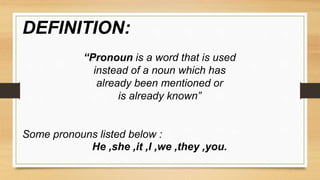
DEFINITION:
“Pronoun is a word that is used
instead of a noun which has
already been mentioned or
is already known”
Some pronouns listed below :
He ,she ,it ,I ,we ,they ,you.
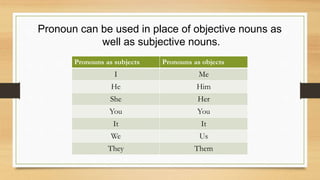
Pronoun can be used in place of objective nouns as
well as subjective nouns.
Pronouns as subjects Pronouns as objects
I Me
He Him
She Her
You You
It It
We Us
They Them
Kinds
Of
Pronouns
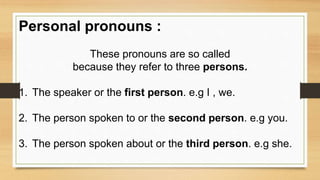
Personal pronouns :
These pronouns are so called
because they refer to three persons.
1. The speaker or the first person. e.g I , we.
2. The person spoken to or the second person. e.g you.
3. The person spoken about or the third person. e.g she.
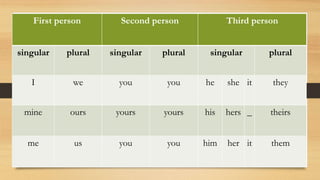
First person Second person Third person
singular plural singular plural singular plural
I we you you he she it they
mine ours yours yours his hers _ theirs
me us you you him her it them
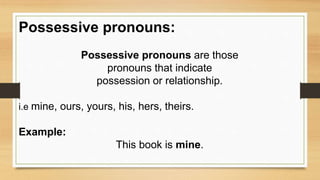
Possessive pronouns:
Possessive pronouns are those
pronouns that indicate
possession or relationship.
i.e mine, ours, yours, his, hers, theirs.
Example:
This book is mine.
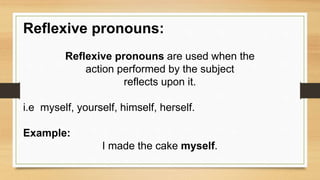
Reflexive pronouns:
Reflexive pronouns are used when the
action performed by the subject
reflects upon it.
i.e myself, yourself, himself, herself.
Example:
I made the cake myself.
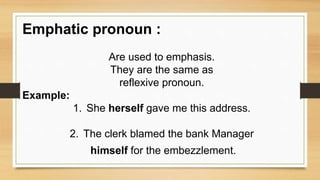
Emphatic pronoun :
Are used to emphasis.
They are the same as
reflexive pronoun.
Example:
1. She herself gave me this address.
2. The clerk blamed the bank Manager
himself for the embezzlement.
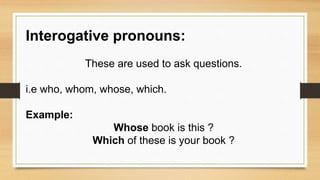
Interogative pronouns:
These are used to ask questions.
i.e who, whom, whose, which.
Example:
Whose book is this ?
Which of these is your book ?
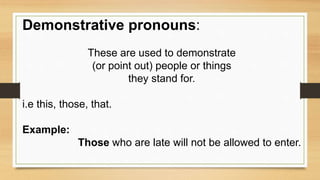
Demonstrative pronouns:
These are used to demonstrate
(or point out) people or things
they stand for.
i.e this, those, that.
Example:
Those who are late will not be allowed to enter.
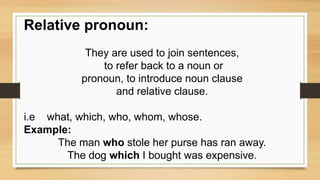
Relative pronoun:
They are used to join sentences,
to refer back to a noun or
pronoun, to introduce noun clause
and relative clause.
i.e what, which, who, whom, whose.
Example:
The man who stole her purse has ran away.
The dog which I bought was expensive.
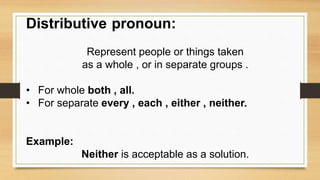
Distributive pronoun:
Represent people or things taken
as a whole , or in separate groups .
• For whole both , all.
• For separate every , each , either , neither.
Example:
Neither is acceptable as a solution.
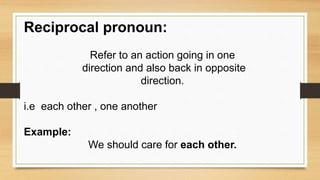
Reciprocal pronoun:
Refer to an action going in one
direction and also back in opposite
direction.
i.e each other , one another
Example:
We should care for each other.
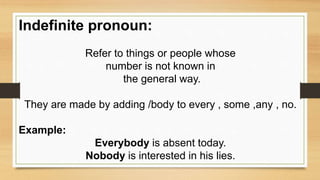
Indefinite pronoun:
Refer to things or people whose
number is not known in
the general way.
They are made by adding /body to every , some ,any , no.
Example:
Everybody is absent today.
Nobody is interested in his lies.
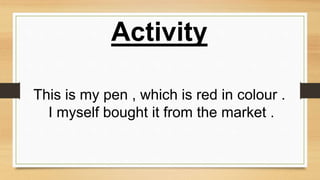
Activity
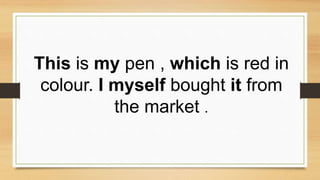
This is my pen , which is red in colour .
I myself bought it from the market .
This is my pen , which is red in
colour. I myself bought it from
the market .
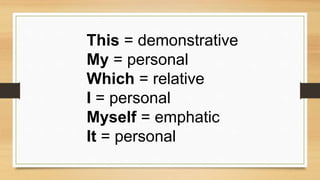
This = demonstrative
My = personal
Which = relative
I = personal
Myself = emphatic
It = personal
Any
Questions ?

Pronoun

  • 1.
  • 2.
    DEFINITION: “Pronoun is aword that is used instead of a noun which has already been mentioned or is already known” Some pronouns listed below : He ,she ,it ,I ,we ,they ,you.
  • 3.
    Pronoun can beused in place of objective nouns as well as subjective nouns. Pronouns as subjects Pronouns as objects I Me He Him She Her You You It It We Us They Them
  • 4.
  • 5.
    Personal pronouns : Thesepronouns are so called because they refer to three persons. 1. The speaker or the first person. e.g I , we. 2. The person spoken to or the second person. e.g you. 3. The person spoken about or the third person. e.g she.
  • 6.
    First person Secondperson Third person singular plural singular plural singular plural I we you you he she it they mine ours yours yours his hers _ theirs me us you you him her it them
  • 7.
    Possessive pronouns: Possessive pronounsare those pronouns that indicate possession or relationship. i.e mine, ours, yours, his, hers, theirs. Example: This book is mine.
  • 8.
    Reflexive pronouns: Reflexive pronounsare used when the action performed by the subject reflects upon it. i.e myself, yourself, himself, herself. Example: I made the cake myself.
  • 9.
    Emphatic pronoun : Areused to emphasis. They are the same as reflexive pronoun. Example: 1. She herself gave me this address. 2. The clerk blamed the bank Manager himself for the embezzlement.
  • 10.
    Interogative pronouns: These areused to ask questions. i.e who, whom, whose, which. Example: Whose book is this ? Which of these is your book ?
  • 11.
    Demonstrative pronouns: These areused to demonstrate (or point out) people or things they stand for. i.e this, those, that. Example: Those who are late will not be allowed to enter.
  • 12.
    Relative pronoun: They areused to join sentences, to refer back to a noun or pronoun, to introduce noun clause and relative clause. i.e what, which, who, whom, whose. Example: The man who stole her purse has ran away. The dog which I bought was expensive.
  • 13.
    Distributive pronoun: Represent peopleor things taken as a whole , or in separate groups . • For whole both , all. • For separate every , each , either , neither. Example: Neither is acceptable as a solution.
  • 14.
    Reciprocal pronoun: Refer toan action going in one direction and also back in opposite direction. i.e each other , one another Example: We should care for each other.
  • 15.
    Indefinite pronoun: Refer tothings or people whose number is not known in the general way. They are made by adding /body to every , some ,any , no. Example: Everybody is absent today. Nobody is interested in his lies.
  • 16.
    Activity This is mypen , which is red in colour . I myself bought it from the market .
  • 17.
    This is mypen , which is red in colour. I myself bought it from the market .
  • 18.
    This = demonstrative My= personal Which = relative I = personal Myself = emphatic It = personal
  • 19.