









3rd Edition
THE PROGRAMMATIC
JARGON BUSTER
Now with new App terms!
The Programmatic Jargon Buster
is a tool to help digital marketers cut through
the noise of our industry’s tough-to-decipher
acronyms and expressions, so they can
discover the true value behind the buzzwords.
* Please note that all definitions are specific to how these terms are used in the digital marketing industry.
News, case studies, whitepapers, tutorials & more!
www.sociomantic.com/resources/
1st Party Data
Information collected directly by an advertiser about its audience or
customers based on a direct relationship. This type of data is often
collected using browser cookies to measure on-website behaviors, but
it can also be combined with other types of online and offline data such
as website analytics, CRM profiles, business analytics, loyalty program
data, yield or revenue management data and more.
2nd Party Data
Data that is collected by an advertiser (which makes it that entity’s first-
party) and is then traded with other non-competitive advertisers.
Depending on how you view it, this data, when in the hands of a second
advertiser that did not collect it via a direct relationship, could also just
be considered third-party data.
3rd Party Data
Information that is collected by an entity that does not have a direct
relationship with the users about which the information is collected.
Third-party data is typically used when advertisers pay a data vendor to
help them reach users with specific characteristics.
Ad Fraud
Any type of illegal activity of online advertising including non-human
traffic, malware that redirects users to third party websites or multiple
ads placed on top of each other so that advertisers are charged for ad
placements that are never even visible to website visitors. Ad fraud is a
growing problem in the online advertising industry and organizations
like the Interactive Advertising Bureau (IAB) are working hard to reduce
the amount of ad fraud in the industry.
Ad Exchange
Digital marketplace that enables advertisers and
publishers to buy and sell advertising space, often
through real-time auctions.
Action
A measurable digital interaction, such as when the
user clicks on an ad, interacts with a landing page or
web form or completes a purchase. The measurability
of actions in digital has given rise to a wide range of
performance marketing channels. In the full-funnel
marketing model, it is the fourth stage in the customer
journey, after Desire and before Loyalty.
Acquisition
Act of getting new customers
Ad Network
Ad networks aggregate supply (inventory) and
demand (ads) and in most cases add their own
third-party data as well as targeting and optimization
technologies. Ad networks often monetize by
arbitraging through re-selling.
Ad Server
A server that stores advertisements for online
marketing and delivers them to website visitors.
Ad Impression
When an ad is displayed on a page, regardless of
whether the ad has been clicked on or not.
Advocacy
The sixth and final stage of the full-funnel marketing
model, following Loyalty, in which a customer
becomes brand advocate and convinces others to
purchase product.
Ad Space
Area of a website set aside for online advertisements.
Agency Trading Desk
A centralized, service-based organization that serves as
a managed service layer, typically on top of a licensed
demand-side platform (DSP) and other audience buying
technologies; manages programmatic, bid-based media
and audience buying. Works as an agency’s internal
tool for programmatic media buying. Often abbreviated
ATD.
App Analytics Tool
(AAT)
A tool to measure and analyze the traffic/user behaviors of
mobile apps. Most of the ATTs have their software
development kits (SDKs) integrated in the app of the client,
and in this way can measure third-party vendors, passing
user-level data back to the app owner.
App Re-engagement
Two out of three mobile apps are downloaded and never
opened. A re-engagement campaign is run with the intent of
driving in-app actions from app users who have already
have downloaded a mobile app.
App Funnel
A set of events that provides insight into how users
interact with a mobile app. App funnels allow tracking
of user behavior paths leading to in-app actions, such
as a purchase.
App Store Optimization
(ASO)
The process of adjusting the presentation of a
mobile app or its features in order to gain a higher
rank higher app store search results. The main
purpose of ASO is to increase visibility to potential
users. The practice includes optimization of
elements such as: title, keywords, description and
images/screenshots.
Application Programming
Interface (API)
A set of definitions, protocols and tools for building
software and applications. An API specifies how
software components should interact and APIs are used
when programming graphical user interface (GUI)
components. A good API makes it easier to develop a
program by providing all the building blocks. A
programmer then puts the blocks together.
Awareness
First stage of full-funnel marketing model, before
Interest, when a potential customer becomes aware of
the existence of a brand, product or service.
Average Revenue Per
User (ARPU)
A measure of the revenue that a business has from its
business activities divided by the number of
customers/users.
Banner Ad
Form of advertising on the World Wide Web delivered by an ad server.
This form of online advertising entails embedding an image-based
advertisement into a web page. It is intended to attract traffic to a
website by linking to the website of the advertiser.
Bid Request
When a user loads a web page and an ad server calls
the ad exchange for a given impression, it submits a
bid request to all eligible buyers. Buyers then assess
the value of the impression and submit bids in real-
time (in a matter of milliseconds) to compete for the
ad placement on this page.
Bid
With regards to real-time bidding (RTB), the bid is the
price offer put forward by an advertiser via a demand-
side platform for an ad impression that is put into the
real-time auction. In most RTB models, the winning
bidder pays one cent more than the second-highest
bid placed.
Cross-Device Recognition
Identifying a single user across multiple devices such as desktops,
tablets, mobile devices, even wearables. There are two main methods
of cross-device recognition: probabilistic (approximating a matched
identification) and deterministic (guaranteeing a matched identification).
AdSpace.
the area of a website or Web page dedicated to online
advertisements.
Advocacy.
the sixth (last) stage of full funnel marketing model
when a customer becomes brand advocate and
convinces other to purchase product.
Aquisition.
the act of getting new customers.
Bid.
a form of advertising on the World Wide Web delivered
by an ad server. This form of online advertising entails
embedding an advertisement into a web page. It is
intended to attract traffic to a website by linking to the
website of the advertiser.
Click-Through-Rate (CTR)
A measure of the share of ad impressions that leads
to a click.
Conversion
When someone clicks an ad and then completes a
pre-defined action, such as completion of a lead form
or online transaction.
Conversion Rate (CR)
A measure of the percentage of ad clicks that
resulted in conversions. It is calculated by dividing the
number of conversions by the number of clicks and
multiplying by 100.
AdSpace.
the area of a website or Web page dedicated to online
advertisements.
Advocacy.
the sixth (last) stage of full funnel marketing model
when a customer becomes brand advocate and
convinces other to purchase product.
Aquisition.
the act of getting new customers.
Bid.
a form of advertising on the World Wide Web delivered
by an ad server. This form of online advertising entails
embedding an advertisement into a web page. It is
intended to attract traffic to a website by linking to the
website of the advertiser.
Cookie
Small piece of data sent from a website that is stored
in a user's web browser while the user is browsing that
website.
Cost Per Action (CPA)
A pricing model for online advertising in which the
advertiser pays only for the completion of a specified
action, such as the completion of a lead form (contact
request, newsletter sign up, registration etc.), double
opt-in or purchase. Even when the pricing model for a
campaign is not CPA, a CPA target may set to measure
performance.
AdSpace.
the area of a website or Web page dedicated to online
advertisements.
Advocacy.
the sixth (last) stage of full funnel marketing model
when a customer becomes brand advocate and
convinces other to purchase product.
Aquisition.
the act of getting new customers.
Bid.
a form of advertising on the World Wide Web delivered
by an ad server. This form of online advertising entails
embedding an advertisement into a web page. It is
intended to attract traffic to a website by linking to the
website of the advertiser.
Cost Per Mille (CPM)
A pricing model for online advertising in which the
advertiser pays a given price for each 1000 ad
impressions. This was the standard pricing model
used in traditional print advertising and is one of the
oldest pricing models used in online today.
Cost Per Order (CPO)
Also sometimes CPP (cost per purchase), this is a
measure of the cost spent to generate an online
order or purchase.
Cost Per Click (CPC)
A pricing model for online advertising in which the
advertiser pays only when a user clicks the
advertisement.
Customer Lifetime Value
(CLV)
Prediction of the net profit attributed to the entire future
relationship with a customer. The prediction model can
have varying levels of sophistication and accuracy,
ranging from a crude heuristic to the use of complex
predictive analytics techniques.
Cross-selling
Action or practice of selling an additional product or
service to an existing customer, especially based on
previous purchases.
Daily Active Users
(DAU)
A measure of the average number of users who are active on a website or
mobile app during the period of one day.
Day N (dN)
A mobile marketing term used when measuring user
retention in mobile apps, where N refers to the
number of days before the user returns to the app
after installing. It’s often used to measure the quality
of the traffic source, to gauge the relative efficiency of
a channel in delivering active users. 	
  
Data Management
Platform (DMP)
DMPs enable companies to collect, store and sort large
amounts of complex first- or third- party data, often in
real-time. For publishers, DMPs are often used to store,
analyze and package audience data; marketers might
work with DMPs to help with using data for digital
advertising according to different CRM-related
taxonomies.
Desire
Third stage of full-funnel marketing model, after
Interest and before Action, when a potential customer
has intent to buy.
Demand-side Platform
(DSP)
A technology platform that allows buyers of digital
advertising inventory to manage multiple ad
exchange and data exchange accounts through one
interface. The key functionality is the ability to
purchase display advertising programmatically via
real-time bidding (RTB), using data to determine the
value of individual ad impressions in real-time.
	
  
Display
Graphical advertising on the World Wide Web that
appears next to content on web pages, IM
applications, email, etc. These ads, often referred to as
banners, come in standardized ad sizes, and can
include text, logos, pictures, or more recently, rich
media and video.
Dynamic Creative
Optimization (DCO)
The use of programmatic technologies to
automatically optimize the elements that appear in a
digital display banner. Examples of elements that can
be optimized on a per-user basis include products and
offers, call-to-action, promotions and discounts, the
colors or placement of button or other layers of the
banner, ad copy and more.
Effective CPA (eCPA)
A measure of the actual costs spent to generate a
pre-defined action. Whereas the CPA is usually a
target given before the start of a campaign, the
eCPA is the measure of the actual results of that
campaign. A comparison of the two can be a
measure of campaign success.
Event
Different kind of actions that a user takes in a
mobile application. Examples of events include app
downloads, app opens, in-app purchases and
more.
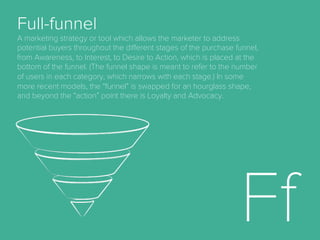
Full Funnel
A marketing strategy or tool which allows the marketer to address
potential buyers throughout the different stages of the purchase funnel,
from Awareness, to Interest, to Desire to Action, which is placed at the
bottom of the funnel. (The funnel shape is meant to refer to the number
of users in each category, which narrows with each stage.) In some
more recent models, the “funnel” is swapped for an hourglass shape,
and beyond the “action” point there is Loyalty and Advocacy.
Flash
Multimedia and software platform used for creating vector
graphics, animation, games and rich Internet applications
(RIAs) that can be viewed, played and executed in Adobe
Flash Player. In order for Flash files to play, even in online ads,
Adobe’s plugin must first be installed on the target browser.
Frequency Capping
Restricting the number of times a specific user is shown
advertising. A “universal frequency cap” refers to the ability of
a DSP to offer a comprehensive frequency cap number for its
entire range of inventory, rather than on a per-publisher or
per-network basis.
Geotargeting
Method of determining the approximate geolocation of a user and
delivering different content to that visitor based on his or her location,
such as country, region/state, city, zip code, organization, IP address,
ISP or other criteria.
HTML5
Core technology markup language of the Internet used for structuring
and presenting content for the World Wide Web. Unlike Flash, which
requires the installation of Adobe’s proprietary browser plugin, HTML5
is the one open, industry-standard, universal format for building dynamic
online creative.
In-App Advertising
Any advertising that is seen inside of a mobile application
(“app”) as opposed to a mobile web browser.
Interest
Second stage of the full-funnel marketing model, after
Awareness and before Desire, when a potential customer
has become more interested in a brand.
JavaScript
An object-oriented computer programming language commonly
used to create interactive effects within web browsers. In digital
advertising it is often used to create and implement tracking
codes for websites.
Key Performance Indicator (KPI)
Metric used to quantify objectives that reflect the strategic performance
of online marketing campaigns. Marketers use a range of use KPIs to
evaluate their success at reaching targets. Examples are Click-Through-
Rate, Conversion Rate, Return on (Marketing) Investment, Time on Site
and Bounce Rate.
Loyalty
Fifth stage of full funnel marketing model, after Action and before
Advocacy, in which a converted customer (someone who has already
made a purchase) returns to the brand to buy again.
Lead
When a user completes a sign-up or contact form or otherwise indicates
interest in an advertiser’s offer by offering contact details or other
personal information.
M-commerce
An abbreviation that stands for “mobile commerce” and
refers to electronic commerce (e-commerce) conducted
on mobile devices such as smartphones or tablets.
Monthly Active User
(MAU)
A measure of the average number of users who are active
on a website or mobile app during the period of one month.
Negative Retargeting
In a retargeting campaign, this is the practice of moving a user
into a new segment after conversion so that s/he will either not
be targeted any longer, not be targeted for a given period, or
be targeted with ads that do not display the same items or
services already purchased.
Native Advertising
For brand advertisers, native refers to creative that matches the
look and feel of a publisher’s content, in order to create
advertising that is less disruptive to the overall content
experience. The most prominent digital example is Facebook’s
Newsfeed advertising.
Omnichannel
A multichannel approach to sales that seeks to provide the customer
with a seamless shopping experience, whether the customer is shopping
online from a desktop or mobile device, by telephone, in a bricks and
mortar store or by any other means.
Opt-in
A user’s indication that they are willing to participate in a
given exchange. According to the online advertising
industry’s self-regulatory framework provided by the
EDAA (European Digital Advertising Alliance), an opt-in is
required in order to use any personally identifiable data
(PII) for online targeting or creative optimization.
Opt-out
A user’s indication that they would not like to participate,
for example when a user opts out of receiving emails or
receiving personalized advertising from an entity.
According to the online advertising industry’s self-
regulatory framework provided by the EDAA (European
Digital Advertising Alliance), advertisers and their partners
must provide an option for consumers to be able to opt-
out of behaviorally targeted advertising.
Open Exchange
Also known as open auction, an open exchange is a
public ad inventory auction place in which publishers
can sell individual ad impressions to all programmatic
buyers within a given supply-side platform or ad
exchange through real-time bidding.
Open RTB
A real-time bidding protocol created by a group of
technology companies in the programmatic industry
that sets a list of standards for real-time bidding. The
development of this protocol is overseen by the IAB.
http://www.iab.net/guidelines/rtbproject
Programmatic Direct Deal
A deal between a publisher and one or more select programmatic
buyers in which inventory is sold based on a pre-agreed floor price,
usually in absence of any guaranteed spends associated with it.
Page View
Number of times a web page is requested from a
server and displayed.
Programmatic
Digital advertising that is automatically triggered by
any type of event and deployed according to a set of
rules applied by software and algorithms. Human
skills are still needed in programmatic campaigns as
the campaigns and rules are planned beforehand and
established by marketers. Machine learning is very
often used in programmatic marketing to provide
automated optimization to pre-defined KPIs. Includes
but is not limited to advertising purchased via real-
time bidding.
Pre-Roll
Online video commercial that appears prior to an
online video, similar to a commercial break on TV. By
purchased pre-roll slots programmatically via RTB,
marketers can target individual users.
Preferred Deal
Google AdX defines a “preferred deal” as a buying
arrangement between one publisher and one
programmatic buyer with a fixed floor price. In order to
buy impressions, the buyer simply has to submit a bid
higher than the floor price, in which case the inventory
is always sold at the floor price. Usually, preferred
deals receive the highest priority within a supply-side
platform ad server chain.
Private Marketplace
(PMP)
A closed/controlled real-time bidding market place
that allows publishers to control which demand
partners, advertisers, agencies, and brands buy
specific parts of their inventory.
Price Floor
The lowest CPM price publishers are willing to sell
impressions to programmatic buyers in an auction.
Private Auction
In programmatic buying, a private auction works in much
the same way as open real-time bidding auction, except
that only select programmatic buyers are permitted to
bid against a pre-agreed minimum floor price.
Real-time Bidding (RTB)
Refers to the means by which ad inventory is bought and sold on a per-
impression basis, via a programmatic instantaneous auction, similar to
financial markets. With real-time bidding, advertising buyers bid on an
impression and, if the bid is won, the buyer’s ad is instantly displayed on
the publisher’s site.
Reach
In advertising, refers to the total number of different people
or households exposed, at least once, to a medium during a
given period. It can also be used as an adjective to describe
campaigns that are meant to increase awareness of a brand
rather than drive performance.
Retargeting
Form of online targeted advertising in which online
advertising is targeted to consumers based on their previous
Internet actions, in situations where these actions did not
result in a sale or conversion on an advertiser’s website.
Retention rate
In advertising, a measure of how much a brand
manages to keep existing customers, sometimes with
dimensions measuring customer activity levels. In app
marketing, retention rates have to do with how
frequently and recently a user has opened and
interacted with the app.
Return on Ad Spend
(ROAS)
A measure of the ratio of revenues generated as a
result of a particular marketing campaign relative to
advertising costs spent. (Revenue / Ad Spend) x 100
Rich Media
Type of online advertising that involves some kind of
user interaction. The initial load of a Rich Media ad is
40K or more. While text ads sell with words, and
display ads sell with pictures, Rich Media ads offer
more ways to involve an audience with an ad. The ad
can expand, float, peel down, etc. Sometimes video
advertising online is also treated as rich media.
Return on Investment (ROI)
A measure of the ratio of profits generated relative to
advertising costs spent. (Profit / Cost) x 100
Session
An occurrence of a user visiting a website or opening a mobile
app, often defined by a specific period of activity.
Software Development Kit
(SDK)
A set of tools that developers need to create applications.
The type of SDK varies depending on the software, for
example an iOS SDK is necessary for iOS apps, a java SDK
is required for Android apps, and so forth. In the case of
online advertising, an SDK can enable additional app
functionality such as in-app event tracking.
Session interval
A measure of the average of time between user sessions
(measure between active periods).
Session length
A measure of the average length of time the user spends active
on a website or app, typically counted from website/app open to
close (or a period of inactivity).
 
SSL Certificate
A data file that is installed on a web server in order to
create a secure connection to send data and personal
information over the web. Most often used for sensitive
information like log-in and credit card information.
Supply Side Platform
(SSP)
Technology platform that enables online publishers to
manage their advertising impression inventory and
maximize revenue from digital media.
Streaming CRM
A dynamic display advertising technology that allows
advertisers to combine real-time user data streamed from
their websites combined with historical user data from
CRM systems, to drive personalized online advertising
with programmatic buying and messaging solutions.
Targeting
Reaching specific consumer segments with advertising based on
various traits such as demographics, psychographics, interests,
behavioral variables (such as product purchase history or website
activity), etc., or the use of other indicators that serve as a proxy of
these desired traits.
Upselling
Action or practice of selling more expensive or higher-
margin items, upgrades or other add-ons to an existing
customer to increase revenues or profits.
Unique User (UU)
Also known as Unique Visitor, this essentially refers to the
cookie or other identifier used to identify a particular
browser, and serves as the key measure of website traffic
for websites. A single person may use more computers/
browsers or delete their cookies and thus be identified as
multiple “Unique Users.”
Viewability
A metric that refers to whether ad impressions are actually “in view” of
the user. According to IAB standards, at least 50% of the ad has to be
displayed on the screen for at least one second for it to be considered
viewed.
Vv
Weekly Active Users
(WAU)
A measure of the average number of users who are
active on a website or mobile app during the period
of one week.
World Wide Web
(WWW)
Information system of interlinked hypertext
documents that are accessed via the Internet. It has
also commonly become known simply as the Web.
XML
A data delivery language that is often used to deliver product feeds for
online shops.
Yield
The income return on an investment. Real-time bidding was introduced
as a way for both publishers and advertisers to better manage yield
associated with online advertising.
Zero Win Rate
In real-time bidding, zero win rate refers to the situation that no winning
bids are coming through from a particular buying partner, which usually
indicates an error.
About Sociomantic Labs
Sociomantic Labs, a dunnhumby company, provides personalized
display advertising solutions to reach people online, on mobile web
and in-app. The company’s proprietary Stream Platform enables the
world’s leading advertisers to harness the value of CRM and other
first-party data assets to deliver individually personalized, dynamic ads
for every stage of the customer lifecycle. This results in broader reach,
more new customers and increased loyalty of existing customers.
Sociomantic was founded in Berlin in 2009, and today serves
advertisers in more than 70 countries across six continents.

The Programmatic Jargon Buster, 3rd Edition

  • 1.
    3rd Edition THE PROGRAMMATIC JARGONBUSTER Now with new App terms!
  • 2.
    The Programmatic JargonBuster is a tool to help digital marketers cut through the noise of our industry’s tough-to-decipher acronyms and expressions, so they can discover the true value behind the buzzwords. * Please note that all definitions are specific to how these terms are used in the digital marketing industry.
  • 3.
    News, case studies,whitepapers, tutorials & more! www.sociomantic.com/resources/
  • 5.
    1st Party Data Informationcollected directly by an advertiser about its audience or customers based on a direct relationship. This type of data is often collected using browser cookies to measure on-website behaviors, but it can also be combined with other types of online and offline data such as website analytics, CRM profiles, business analytics, loyalty program data, yield or revenue management data and more.
  • 6.
    2nd Party Data Datathat is collected by an advertiser (which makes it that entity’s first- party) and is then traded with other non-competitive advertisers. Depending on how you view it, this data, when in the hands of a second advertiser that did not collect it via a direct relationship, could also just be considered third-party data.
  • 7.
    3rd Party Data Informationthat is collected by an entity that does not have a direct relationship with the users about which the information is collected. Third-party data is typically used when advertisers pay a data vendor to help them reach users with specific characteristics.
  • 8.
    Ad Fraud Any typeof illegal activity of online advertising including non-human traffic, malware that redirects users to third party websites or multiple ads placed on top of each other so that advertisers are charged for ad placements that are never even visible to website visitors. Ad fraud is a growing problem in the online advertising industry and organizations like the Interactive Advertising Bureau (IAB) are working hard to reduce the amount of ad fraud in the industry.
  • 9.
    Ad Exchange Digital marketplacethat enables advertisers and publishers to buy and sell advertising space, often through real-time auctions. Action A measurable digital interaction, such as when the user clicks on an ad, interacts with a landing page or web form or completes a purchase. The measurability of actions in digital has given rise to a wide range of performance marketing channels. In the full-funnel marketing model, it is the fourth stage in the customer journey, after Desire and before Loyalty. Acquisition Act of getting new customers
  • 10.
    Ad Network Ad networksaggregate supply (inventory) and demand (ads) and in most cases add their own third-party data as well as targeting and optimization technologies. Ad networks often monetize by arbitraging through re-selling. Ad Server A server that stores advertisements for online marketing and delivers them to website visitors. Ad Impression When an ad is displayed on a page, regardless of whether the ad has been clicked on or not.
  • 11.
    Advocacy The sixth andfinal stage of the full-funnel marketing model, following Loyalty, in which a customer becomes brand advocate and convinces others to purchase product. Ad Space Area of a website set aside for online advertisements. Agency Trading Desk A centralized, service-based organization that serves as a managed service layer, typically on top of a licensed demand-side platform (DSP) and other audience buying technologies; manages programmatic, bid-based media and audience buying. Works as an agency’s internal tool for programmatic media buying. Often abbreviated ATD.
  • 12.
    App Analytics Tool (AAT) Atool to measure and analyze the traffic/user behaviors of mobile apps. Most of the ATTs have their software development kits (SDKs) integrated in the app of the client, and in this way can measure third-party vendors, passing user-level data back to the app owner. App Re-engagement Two out of three mobile apps are downloaded and never opened. A re-engagement campaign is run with the intent of driving in-app actions from app users who have already have downloaded a mobile app. App Funnel A set of events that provides insight into how users interact with a mobile app. App funnels allow tracking of user behavior paths leading to in-app actions, such as a purchase.
  • 13.
    App Store Optimization (ASO) Theprocess of adjusting the presentation of a mobile app or its features in order to gain a higher rank higher app store search results. The main purpose of ASO is to increase visibility to potential users. The practice includes optimization of elements such as: title, keywords, description and images/screenshots. Application Programming Interface (API) A set of definitions, protocols and tools for building software and applications. An API specifies how software components should interact and APIs are used when programming graphical user interface (GUI) components. A good API makes it easier to develop a program by providing all the building blocks. A programmer then puts the blocks together.
  • 14.
    Awareness First stage offull-funnel marketing model, before Interest, when a potential customer becomes aware of the existence of a brand, product or service. Average Revenue Per User (ARPU) A measure of the revenue that a business has from its business activities divided by the number of customers/users.
  • 15.
    Banner Ad Form ofadvertising on the World Wide Web delivered by an ad server. This form of online advertising entails embedding an image-based advertisement into a web page. It is intended to attract traffic to a website by linking to the website of the advertiser.
  • 16.
    Bid Request When auser loads a web page and an ad server calls the ad exchange for a given impression, it submits a bid request to all eligible buyers. Buyers then assess the value of the impression and submit bids in real- time (in a matter of milliseconds) to compete for the ad placement on this page. Bid With regards to real-time bidding (RTB), the bid is the price offer put forward by an advertiser via a demand- side platform for an ad impression that is put into the real-time auction. In most RTB models, the winning bidder pays one cent more than the second-highest bid placed.
  • 17.
    Cross-Device Recognition Identifying asingle user across multiple devices such as desktops, tablets, mobile devices, even wearables. There are two main methods of cross-device recognition: probabilistic (approximating a matched identification) and deterministic (guaranteeing a matched identification).
  • 18.
    AdSpace. the area ofa website or Web page dedicated to online advertisements. Advocacy. the sixth (last) stage of full funnel marketing model when a customer becomes brand advocate and convinces other to purchase product. Aquisition. the act of getting new customers. Bid. a form of advertising on the World Wide Web delivered by an ad server. This form of online advertising entails embedding an advertisement into a web page. It is intended to attract traffic to a website by linking to the website of the advertiser. Click-Through-Rate (CTR) A measure of the share of ad impressions that leads to a click. Conversion When someone clicks an ad and then completes a pre-defined action, such as completion of a lead form or online transaction. Conversion Rate (CR) A measure of the percentage of ad clicks that resulted in conversions. It is calculated by dividing the number of conversions by the number of clicks and multiplying by 100.
  • 19.
    AdSpace. the area ofa website or Web page dedicated to online advertisements. Advocacy. the sixth (last) stage of full funnel marketing model when a customer becomes brand advocate and convinces other to purchase product. Aquisition. the act of getting new customers. Bid. a form of advertising on the World Wide Web delivered by an ad server. This form of online advertising entails embedding an advertisement into a web page. It is intended to attract traffic to a website by linking to the website of the advertiser. Cookie Small piece of data sent from a website that is stored in a user's web browser while the user is browsing that website. Cost Per Action (CPA) A pricing model for online advertising in which the advertiser pays only for the completion of a specified action, such as the completion of a lead form (contact request, newsletter sign up, registration etc.), double opt-in or purchase. Even when the pricing model for a campaign is not CPA, a CPA target may set to measure performance.
  • 20.
    AdSpace. the area ofa website or Web page dedicated to online advertisements. Advocacy. the sixth (last) stage of full funnel marketing model when a customer becomes brand advocate and convinces other to purchase product. Aquisition. the act of getting new customers. Bid. a form of advertising on the World Wide Web delivered by an ad server. This form of online advertising entails embedding an advertisement into a web page. It is intended to attract traffic to a website by linking to the website of the advertiser. Cost Per Mille (CPM) A pricing model for online advertising in which the advertiser pays a given price for each 1000 ad impressions. This was the standard pricing model used in traditional print advertising and is one of the oldest pricing models used in online today. Cost Per Order (CPO) Also sometimes CPP (cost per purchase), this is a measure of the cost spent to generate an online order or purchase. Cost Per Click (CPC) A pricing model for online advertising in which the advertiser pays only when a user clicks the advertisement.
  • 21.
    Customer Lifetime Value (CLV) Predictionof the net profit attributed to the entire future relationship with a customer. The prediction model can have varying levels of sophistication and accuracy, ranging from a crude heuristic to the use of complex predictive analytics techniques. Cross-selling Action or practice of selling an additional product or service to an existing customer, especially based on previous purchases.
  • 22.
    Daily Active Users (DAU) Ameasure of the average number of users who are active on a website or mobile app during the period of one day.
  • 23.
    Day N (dN) Amobile marketing term used when measuring user retention in mobile apps, where N refers to the number of days before the user returns to the app after installing. It’s often used to measure the quality of the traffic source, to gauge the relative efficiency of a channel in delivering active users.   Data Management Platform (DMP) DMPs enable companies to collect, store and sort large amounts of complex first- or third- party data, often in real-time. For publishers, DMPs are often used to store, analyze and package audience data; marketers might work with DMPs to help with using data for digital advertising according to different CRM-related taxonomies.
  • 24.
    Desire Third stage offull-funnel marketing model, after Interest and before Action, when a potential customer has intent to buy. Demand-side Platform (DSP) A technology platform that allows buyers of digital advertising inventory to manage multiple ad exchange and data exchange accounts through one interface. The key functionality is the ability to purchase display advertising programmatically via real-time bidding (RTB), using data to determine the value of individual ad impressions in real-time.  
  • 25.
    Display Graphical advertising onthe World Wide Web that appears next to content on web pages, IM applications, email, etc. These ads, often referred to as banners, come in standardized ad sizes, and can include text, logos, pictures, or more recently, rich media and video. Dynamic Creative Optimization (DCO) The use of programmatic technologies to automatically optimize the elements that appear in a digital display banner. Examples of elements that can be optimized on a per-user basis include products and offers, call-to-action, promotions and discounts, the colors or placement of button or other layers of the banner, ad copy and more.
  • 26.
    Effective CPA (eCPA) Ameasure of the actual costs spent to generate a pre-defined action. Whereas the CPA is usually a target given before the start of a campaign, the eCPA is the measure of the actual results of that campaign. A comparison of the two can be a measure of campaign success. Event Different kind of actions that a user takes in a mobile application. Examples of events include app downloads, app opens, in-app purchases and more.
  • 27.
    Full Funnel A marketingstrategy or tool which allows the marketer to address potential buyers throughout the different stages of the purchase funnel, from Awareness, to Interest, to Desire to Action, which is placed at the bottom of the funnel. (The funnel shape is meant to refer to the number of users in each category, which narrows with each stage.) In some more recent models, the “funnel” is swapped for an hourglass shape, and beyond the “action” point there is Loyalty and Advocacy.
  • 28.
    Flash Multimedia and softwareplatform used for creating vector graphics, animation, games and rich Internet applications (RIAs) that can be viewed, played and executed in Adobe Flash Player. In order for Flash files to play, even in online ads, Adobe’s plugin must first be installed on the target browser. Frequency Capping Restricting the number of times a specific user is shown advertising. A “universal frequency cap” refers to the ability of a DSP to offer a comprehensive frequency cap number for its entire range of inventory, rather than on a per-publisher or per-network basis.
  • 29.
    Geotargeting Method of determiningthe approximate geolocation of a user and delivering different content to that visitor based on his or her location, such as country, region/state, city, zip code, organization, IP address, ISP or other criteria.
  • 30.
    HTML5 Core technology markuplanguage of the Internet used for structuring and presenting content for the World Wide Web. Unlike Flash, which requires the installation of Adobe’s proprietary browser plugin, HTML5 is the one open, industry-standard, universal format for building dynamic online creative.
  • 31.
    In-App Advertising Any advertisingthat is seen inside of a mobile application (“app”) as opposed to a mobile web browser. Interest Second stage of the full-funnel marketing model, after Awareness and before Desire, when a potential customer has become more interested in a brand.
  • 32.
    JavaScript An object-oriented computerprogramming language commonly used to create interactive effects within web browsers. In digital advertising it is often used to create and implement tracking codes for websites.
  • 33.
    Key Performance Indicator(KPI) Metric used to quantify objectives that reflect the strategic performance of online marketing campaigns. Marketers use a range of use KPIs to evaluate their success at reaching targets. Examples are Click-Through- Rate, Conversion Rate, Return on (Marketing) Investment, Time on Site and Bounce Rate.
  • 34.
    Loyalty Fifth stage offull funnel marketing model, after Action and before Advocacy, in which a converted customer (someone who has already made a purchase) returns to the brand to buy again. Lead When a user completes a sign-up or contact form or otherwise indicates interest in an advertiser’s offer by offering contact details or other personal information.
  • 35.
    M-commerce An abbreviation thatstands for “mobile commerce” and refers to electronic commerce (e-commerce) conducted on mobile devices such as smartphones or tablets. Monthly Active User (MAU) A measure of the average number of users who are active on a website or mobile app during the period of one month.
  • 36.
    Negative Retargeting In aretargeting campaign, this is the practice of moving a user into a new segment after conversion so that s/he will either not be targeted any longer, not be targeted for a given period, or be targeted with ads that do not display the same items or services already purchased. Native Advertising For brand advertisers, native refers to creative that matches the look and feel of a publisher’s content, in order to create advertising that is less disruptive to the overall content experience. The most prominent digital example is Facebook’s Newsfeed advertising.
  • 37.
    Omnichannel A multichannel approachto sales that seeks to provide the customer with a seamless shopping experience, whether the customer is shopping online from a desktop or mobile device, by telephone, in a bricks and mortar store or by any other means.
  • 38.
    Opt-in A user’s indicationthat they are willing to participate in a given exchange. According to the online advertising industry’s self-regulatory framework provided by the EDAA (European Digital Advertising Alliance), an opt-in is required in order to use any personally identifiable data (PII) for online targeting or creative optimization. Opt-out A user’s indication that they would not like to participate, for example when a user opts out of receiving emails or receiving personalized advertising from an entity. According to the online advertising industry’s self- regulatory framework provided by the EDAA (European Digital Advertising Alliance), advertisers and their partners must provide an option for consumers to be able to opt- out of behaviorally targeted advertising.
  • 39.
    Open Exchange Also knownas open auction, an open exchange is a public ad inventory auction place in which publishers can sell individual ad impressions to all programmatic buyers within a given supply-side platform or ad exchange through real-time bidding. Open RTB A real-time bidding protocol created by a group of technology companies in the programmatic industry that sets a list of standards for real-time bidding. The development of this protocol is overseen by the IAB. http://www.iab.net/guidelines/rtbproject
  • 40.
    Programmatic Direct Deal Adeal between a publisher and one or more select programmatic buyers in which inventory is sold based on a pre-agreed floor price, usually in absence of any guaranteed spends associated with it.
  • 41.
    Page View Number oftimes a web page is requested from a server and displayed. Programmatic Digital advertising that is automatically triggered by any type of event and deployed according to a set of rules applied by software and algorithms. Human skills are still needed in programmatic campaigns as the campaigns and rules are planned beforehand and established by marketers. Machine learning is very often used in programmatic marketing to provide automated optimization to pre-defined KPIs. Includes but is not limited to advertising purchased via real- time bidding.
  • 42.
    Pre-Roll Online video commercialthat appears prior to an online video, similar to a commercial break on TV. By purchased pre-roll slots programmatically via RTB, marketers can target individual users. Preferred Deal Google AdX defines a “preferred deal” as a buying arrangement between one publisher and one programmatic buyer with a fixed floor price. In order to buy impressions, the buyer simply has to submit a bid higher than the floor price, in which case the inventory is always sold at the floor price. Usually, preferred deals receive the highest priority within a supply-side platform ad server chain.
  • 43.
    Private Marketplace (PMP) A closed/controlledreal-time bidding market place that allows publishers to control which demand partners, advertisers, agencies, and brands buy specific parts of their inventory. Price Floor The lowest CPM price publishers are willing to sell impressions to programmatic buyers in an auction. Private Auction In programmatic buying, a private auction works in much the same way as open real-time bidding auction, except that only select programmatic buyers are permitted to bid against a pre-agreed minimum floor price.
  • 44.
    Real-time Bidding (RTB) Refersto the means by which ad inventory is bought and sold on a per- impression basis, via a programmatic instantaneous auction, similar to financial markets. With real-time bidding, advertising buyers bid on an impression and, if the bid is won, the buyer’s ad is instantly displayed on the publisher’s site.
  • 45.
    Reach In advertising, refersto the total number of different people or households exposed, at least once, to a medium during a given period. It can also be used as an adjective to describe campaigns that are meant to increase awareness of a brand rather than drive performance. Retargeting Form of online targeted advertising in which online advertising is targeted to consumers based on their previous Internet actions, in situations where these actions did not result in a sale or conversion on an advertiser’s website.
  • 46.
    Retention rate In advertising,a measure of how much a brand manages to keep existing customers, sometimes with dimensions measuring customer activity levels. In app marketing, retention rates have to do with how frequently and recently a user has opened and interacted with the app. Return on Ad Spend (ROAS) A measure of the ratio of revenues generated as a result of a particular marketing campaign relative to advertising costs spent. (Revenue / Ad Spend) x 100
  • 47.
    Rich Media Type ofonline advertising that involves some kind of user interaction. The initial load of a Rich Media ad is 40K or more. While text ads sell with words, and display ads sell with pictures, Rich Media ads offer more ways to involve an audience with an ad. The ad can expand, float, peel down, etc. Sometimes video advertising online is also treated as rich media. Return on Investment (ROI) A measure of the ratio of profits generated relative to advertising costs spent. (Profit / Cost) x 100
  • 48.
    Session An occurrence ofa user visiting a website or opening a mobile app, often defined by a specific period of activity.
  • 49.
    Software Development Kit (SDK) Aset of tools that developers need to create applications. The type of SDK varies depending on the software, for example an iOS SDK is necessary for iOS apps, a java SDK is required for Android apps, and so forth. In the case of online advertising, an SDK can enable additional app functionality such as in-app event tracking. Session interval A measure of the average of time between user sessions (measure between active periods). Session length A measure of the average length of time the user spends active on a website or app, typically counted from website/app open to close (or a period of inactivity).  
  • 50.
    SSL Certificate A datafile that is installed on a web server in order to create a secure connection to send data and personal information over the web. Most often used for sensitive information like log-in and credit card information. Supply Side Platform (SSP) Technology platform that enables online publishers to manage their advertising impression inventory and maximize revenue from digital media. Streaming CRM A dynamic display advertising technology that allows advertisers to combine real-time user data streamed from their websites combined with historical user data from CRM systems, to drive personalized online advertising with programmatic buying and messaging solutions.
  • 51.
    Targeting Reaching specific consumersegments with advertising based on various traits such as demographics, psychographics, interests, behavioral variables (such as product purchase history or website activity), etc., or the use of other indicators that serve as a proxy of these desired traits.
  • 52.
    Upselling Action or practiceof selling more expensive or higher- margin items, upgrades or other add-ons to an existing customer to increase revenues or profits. Unique User (UU) Also known as Unique Visitor, this essentially refers to the cookie or other identifier used to identify a particular browser, and serves as the key measure of website traffic for websites. A single person may use more computers/ browsers or delete their cookies and thus be identified as multiple “Unique Users.”
  • 53.
    Viewability A metric thatrefers to whether ad impressions are actually “in view” of the user. According to IAB standards, at least 50% of the ad has to be displayed on the screen for at least one second for it to be considered viewed. Vv
  • 54.
    Weekly Active Users (WAU) Ameasure of the average number of users who are active on a website or mobile app during the period of one week. World Wide Web (WWW) Information system of interlinked hypertext documents that are accessed via the Internet. It has also commonly become known simply as the Web.
  • 55.
    XML A data deliverylanguage that is often used to deliver product feeds for online shops.
  • 56.
    Yield The income returnon an investment. Real-time bidding was introduced as a way for both publishers and advertisers to better manage yield associated with online advertising.
  • 57.
    Zero Win Rate Inreal-time bidding, zero win rate refers to the situation that no winning bids are coming through from a particular buying partner, which usually indicates an error.
  • 58.
    About Sociomantic Labs SociomanticLabs, a dunnhumby company, provides personalized display advertising solutions to reach people online, on mobile web and in-app. The company’s proprietary Stream Platform enables the world’s leading advertisers to harness the value of CRM and other first-party data assets to deliver individually personalized, dynamic ads for every stage of the customer lifecycle. This results in broader reach, more new customers and increased loyalty of existing customers. Sociomantic was founded in Berlin in 2009, and today serves advertisers in more than 70 countries across six continents.