Why CSE? Taking the first
Steps
Contents
• Background & Introduction to the Standard
• Key Concepts of CSE
• Overview of the Standard
• Assessment Process
• Next Steps
• Accredited Organisations
• Benefits of working with the Standard
• The Costs
Background & Introduction
• Standard has been in existence since 2008, replaced the Charter Mark
• Currently held by 2000 organisations
• Mainly public sector based organisations.
• Though produced with the active involvement of government, it is generic
by design and applicable to any sector organisation dealing with
customers.
Key Concepts in CSE
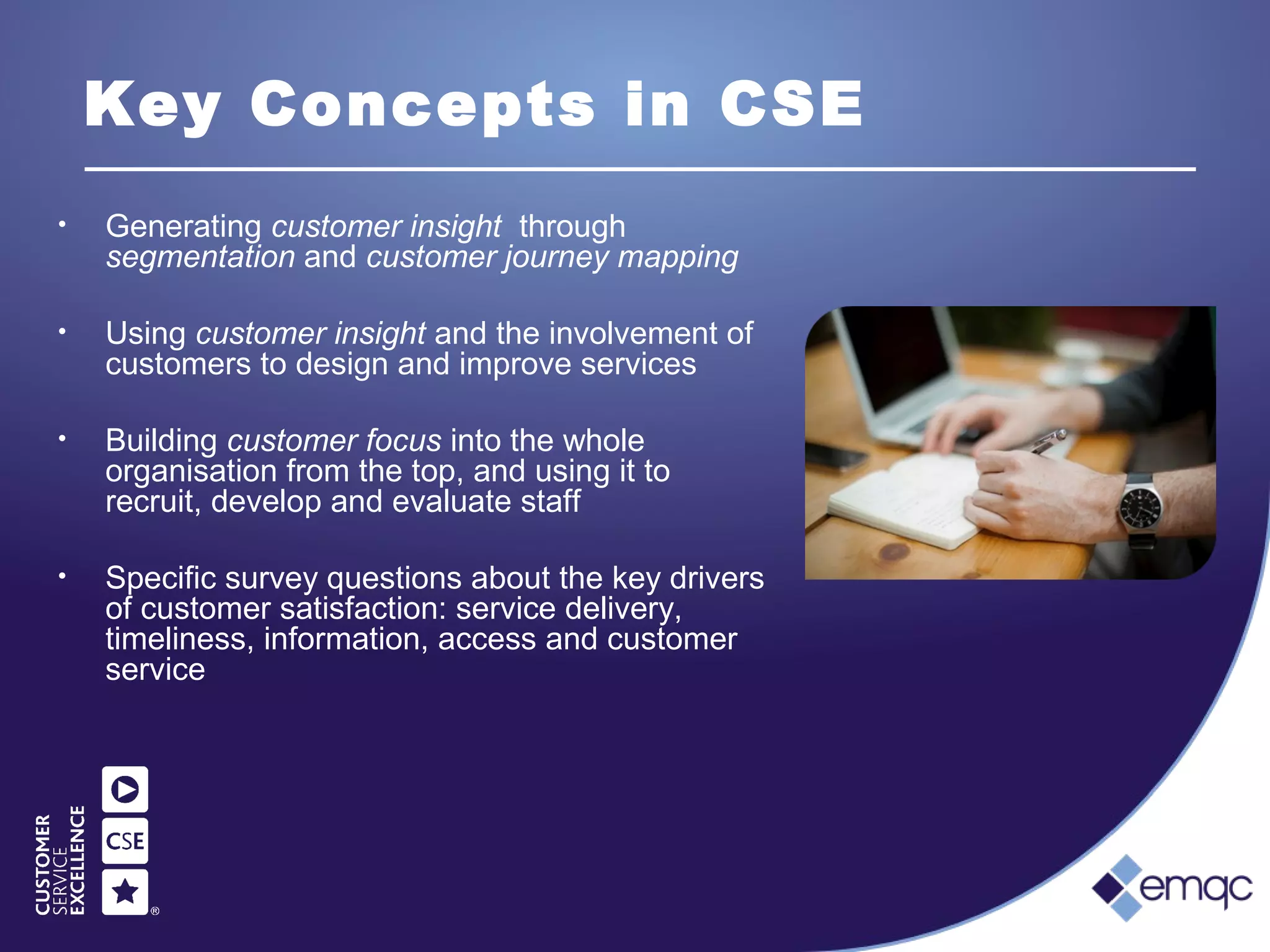
• Generating customer insight through
segmentation and customer journey mapping
• Using customer insight and the involvement of
customers to design and improve services
• Building customer focus into the whole
organisation from the top, and using it to
recruit, develop and evaluate staff
• Specific survey questions about the key drivers
of customer satisfaction: service delivery,
timeliness, information, access and customer
service
The CSE Standard
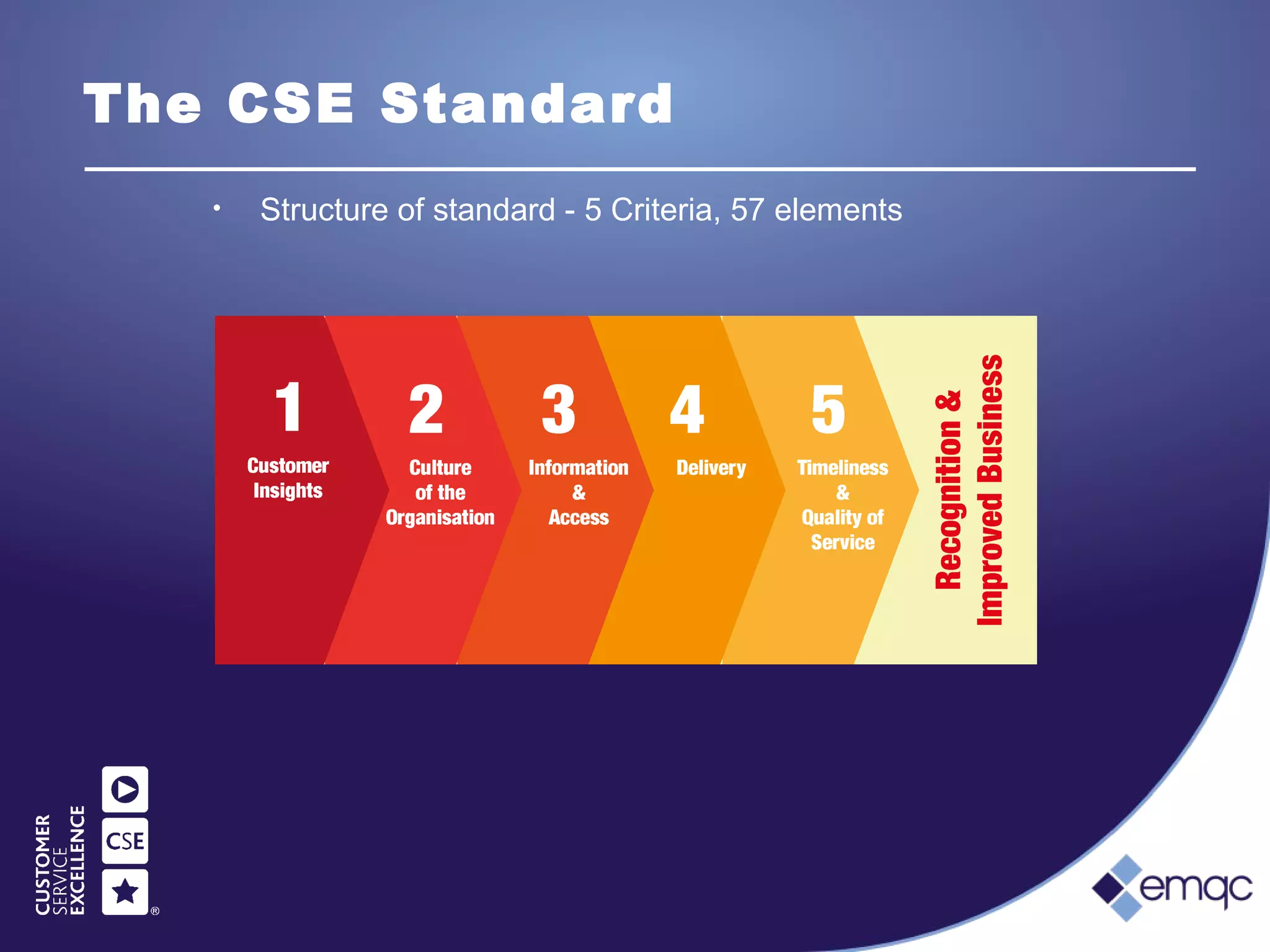
• Structure of standard - 5 Criteria, 57 elements
The Assessment Process -
your next steps…
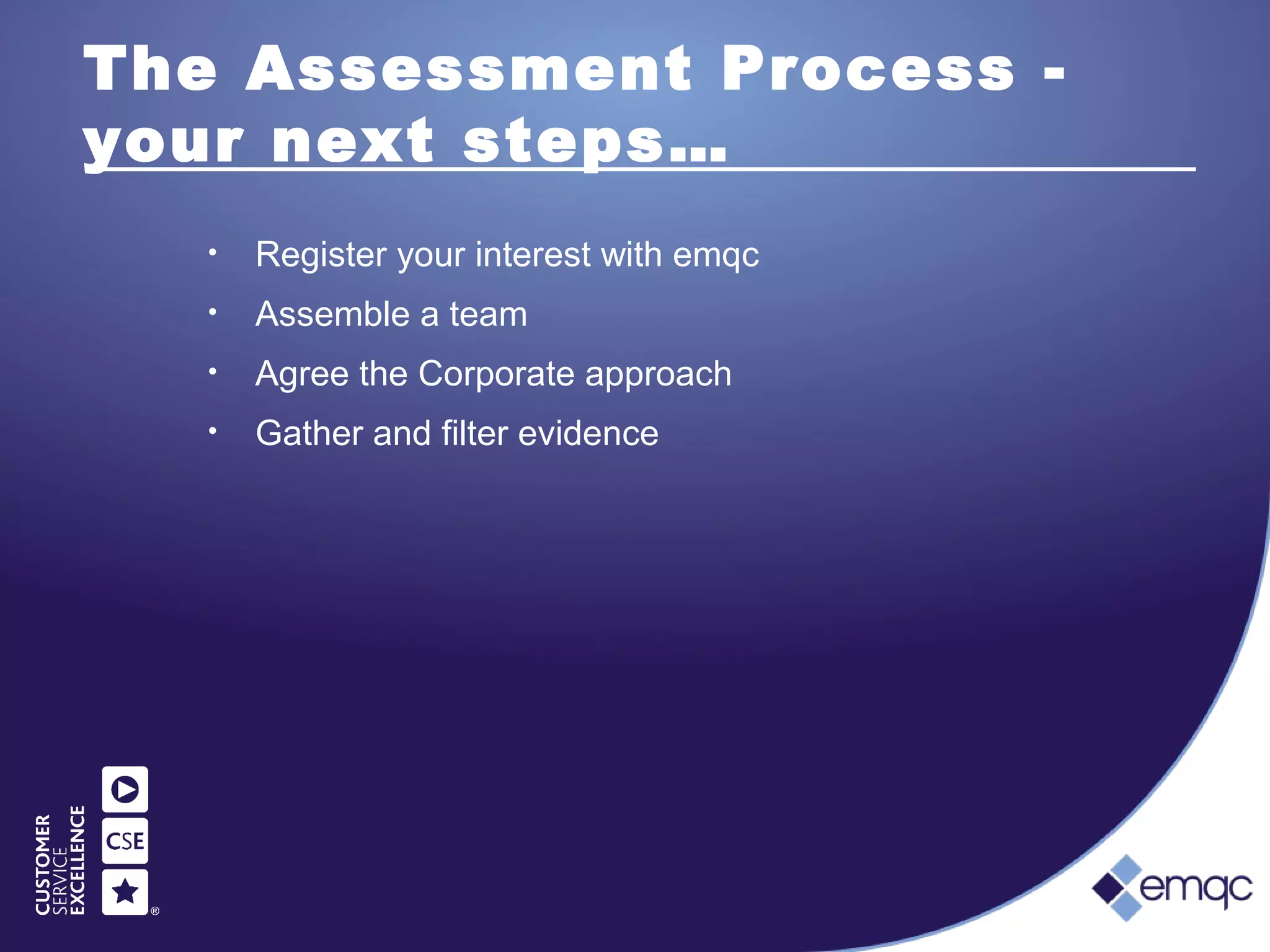
• Register your interest with emqc
• Assemble a team
• Agree the Corporate approach
• Gather and filter evidence
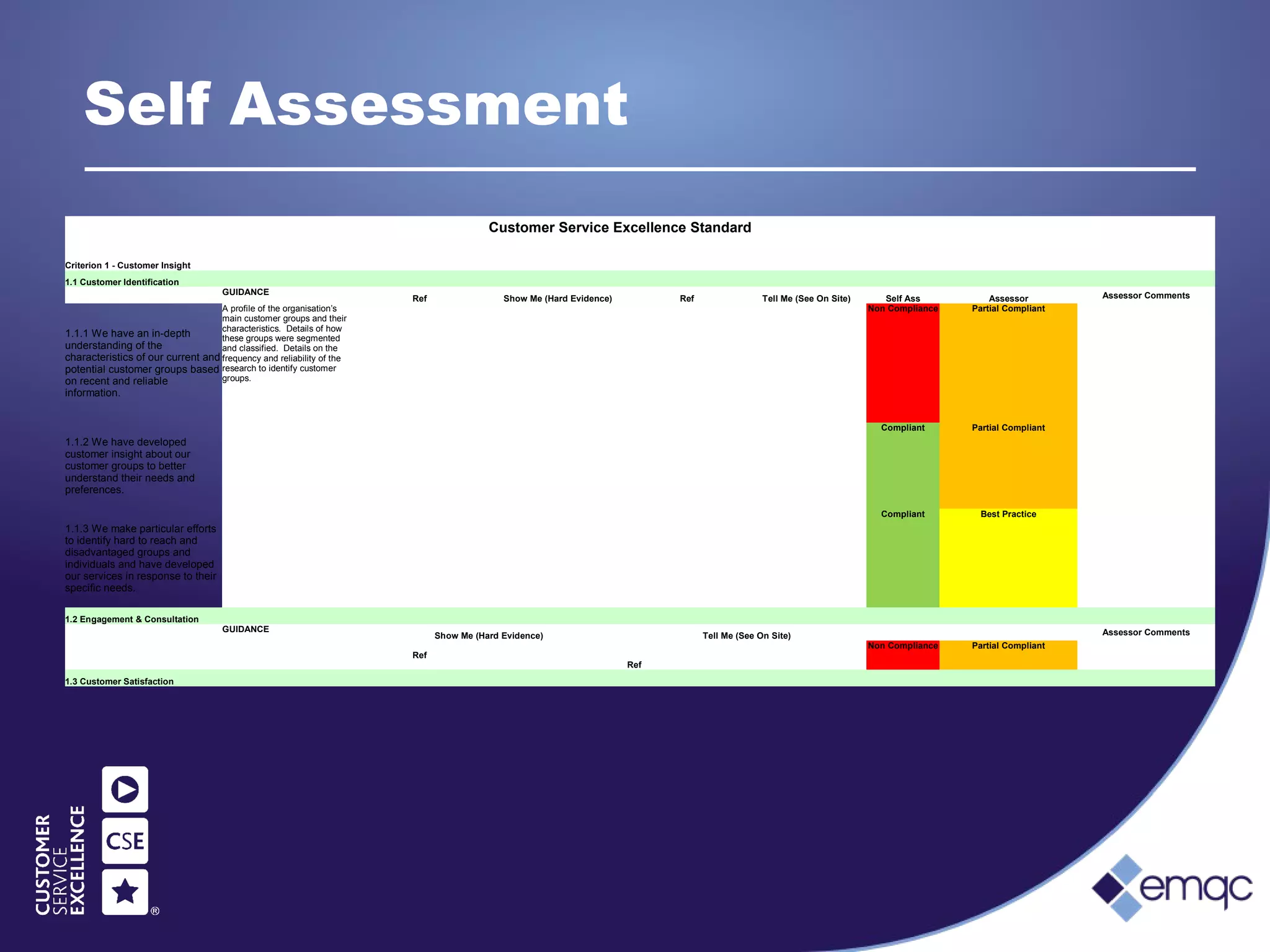
Self Assessment
Customer Service Excellence Standard
Criterion 1 - Customer Insight
1.1 Customer Identification
GUIDANCE
Ref Show Me (Hard Evidence) Ref Tell Me (See On Site) Self Ass Assessor Assessor Comments
1.1.1 We have an in-depth
understanding of the
characteristics of our current and
potential customer groups based
on recent and reliable
information.
A profile of the organisation’s
main customer groups and their
characteristics. Details of how
these groups were segmented
and classified. Details on the
frequency and reliability of the
research to identify customer
groups.
Non Compliance Partial Compliant
1.1.2 We have developed
customer insight about our
customer groups to better
understand their needs and
preferences.
Compliant Partial Compliant
1.1.3 We make particular efforts
to identify hard to reach and
disadvantaged groups and
individuals and have developed
our services in response to their
specific needs.
Compliant Best Practice
1.2 Engagement & Consultation
GUIDANCE
Show Me (Hard Evidence) Tell Me (See On Site) Assessor Comments
Ref
Ref
Non Compliance Partial Compliant
1.3 Customer Satisfaction
Pre-assessment
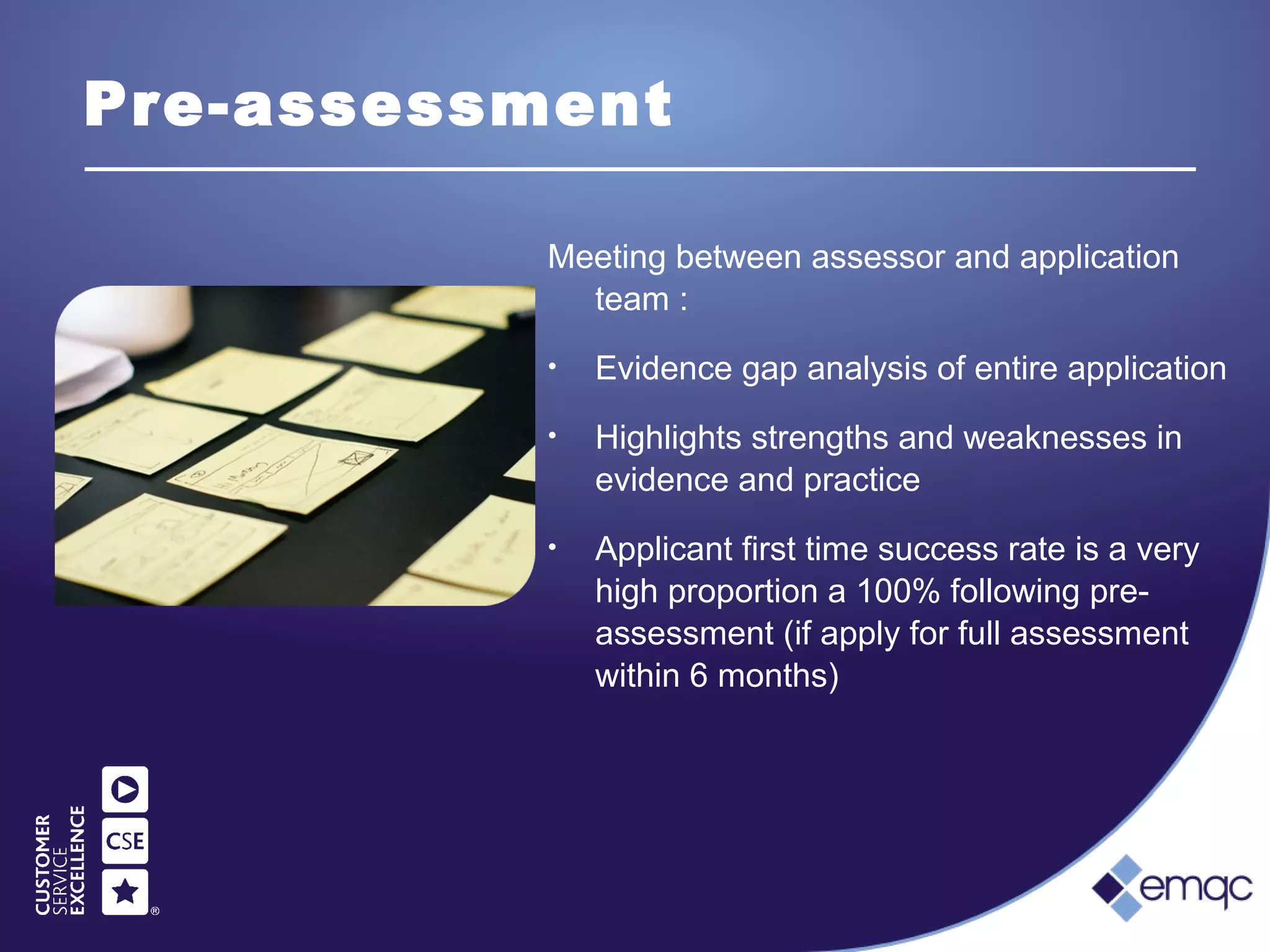
Meeting between assessor and application
team :
• Evidence gap analysis of entire application
• Highlights strengths and weaknesses in
evidence and practice
• Applicant first time success rate is a very
high proportion a 100% following pre-
assessment (if apply for full assessment
within 6 months)
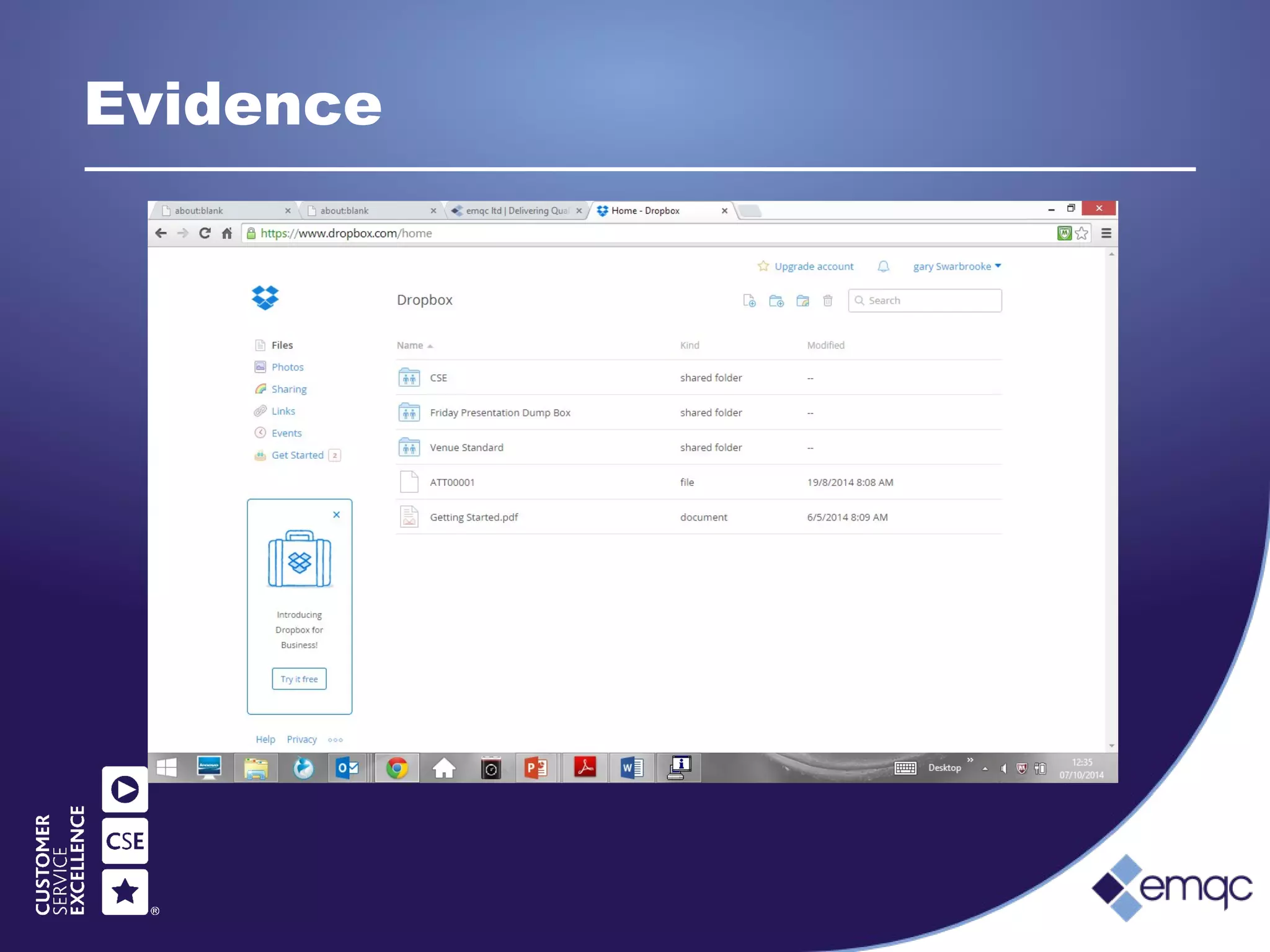
Evidence
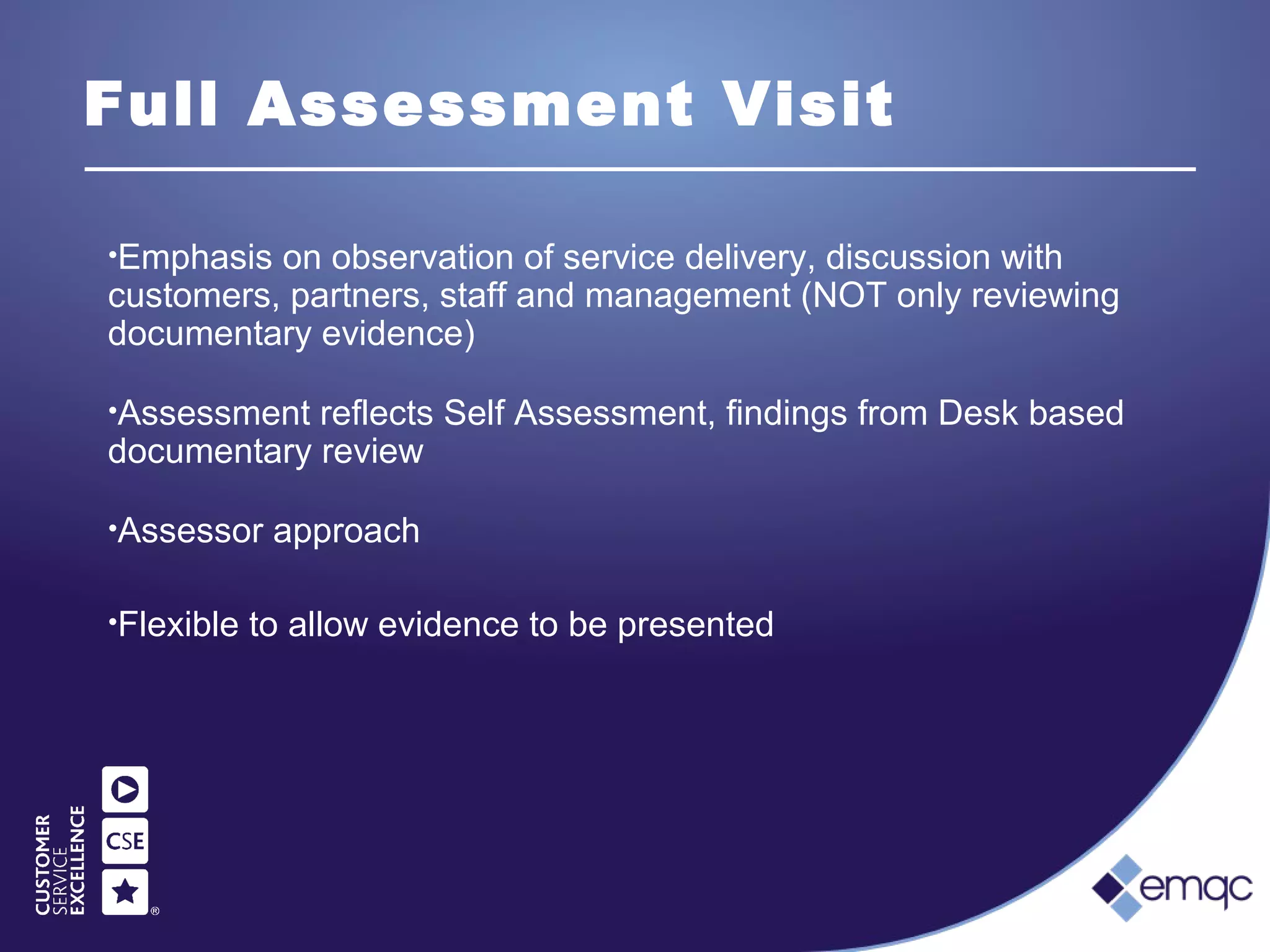
Full Assessment Visit
•Emphasis on observation of service delivery, discussion with
customers, partners, staff and management (NOT only reviewing
documentary evidence)
•Assessment reflects Self Assessment, findings from Desk based
documentary review
•Assessor approach
•Flexible to allow evidence to be presented
Feedback
• Full report with comments for each theme of each
element on:
• acceptability of evidence
• identification of where further evidence is
required for full compliance
• where fully compliant, pointers as to how to
improve further
Assessment feedback includes:-
Assessor recommendations
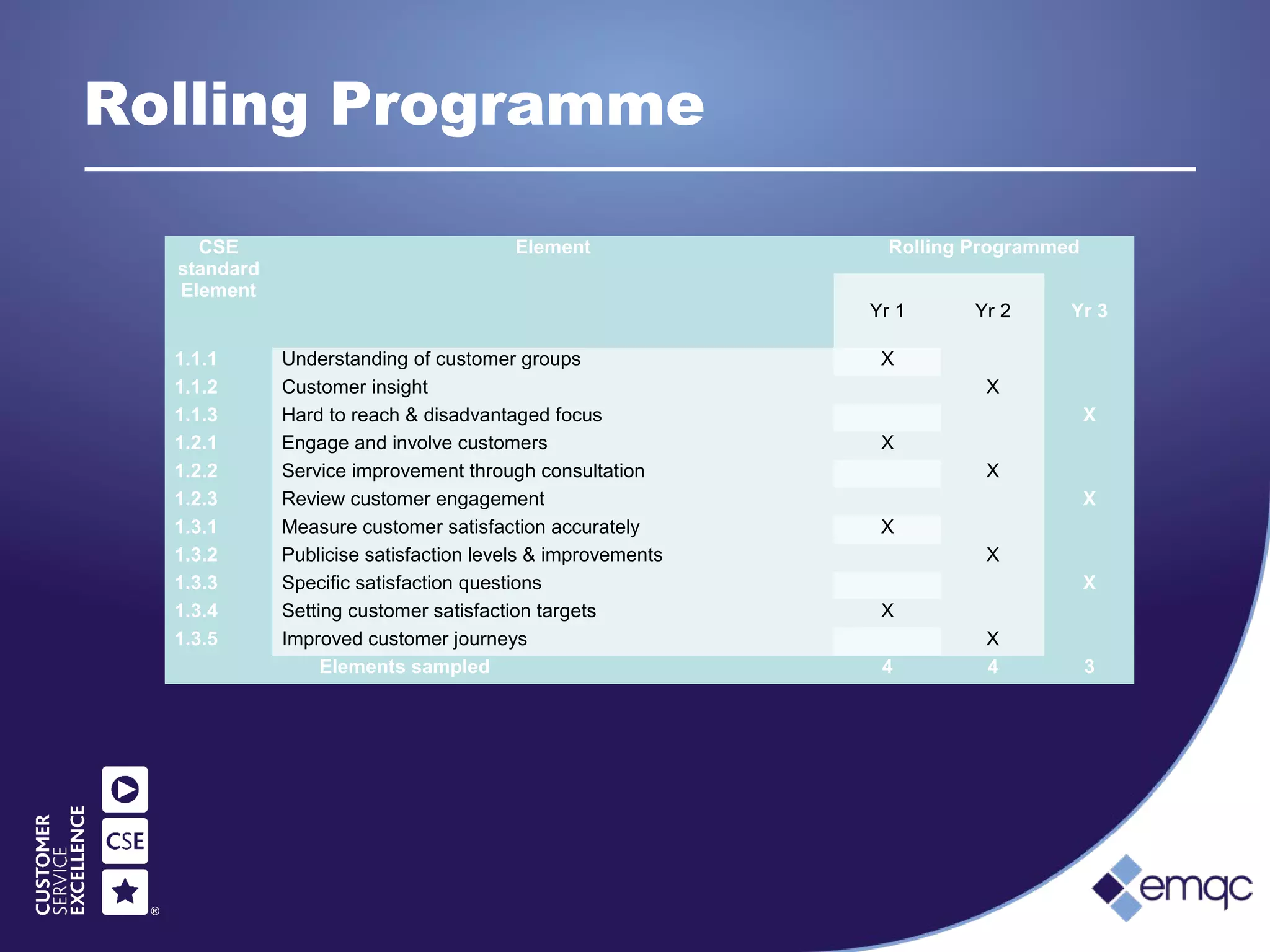
Rolling Programme
CSE
standard
Element
Element Rolling Programmed
Yr 1 Yr 2 Yr 3
1.1.1 Understanding of customer groups X
1.1.2 Customer insight X
1.1.3 Hard to reach & disadvantaged focus X
1.2.1 Engage and involve customers X
1.2.2 Service improvement through consultation X
1.2.3 Review customer engagement X
1.3.1 Measure customer satisfaction accurately X
1.3.2 Publicise satisfaction levels & improvements X
1.3.3 Specific satisfaction questions X
1.3.4 Setting customer satisfaction targets X
1.3.5 Improved customer journeys X
Elements sampled 4 4 3
The Cost
The cost for an assessment is determined on an individual basis.
It depends upon a number of factors including;
• The number of staff delivering services
• The number of sites that the delivery takes place over
• Client complexity
• Variation in the activities and working practices
Accredited Organisations
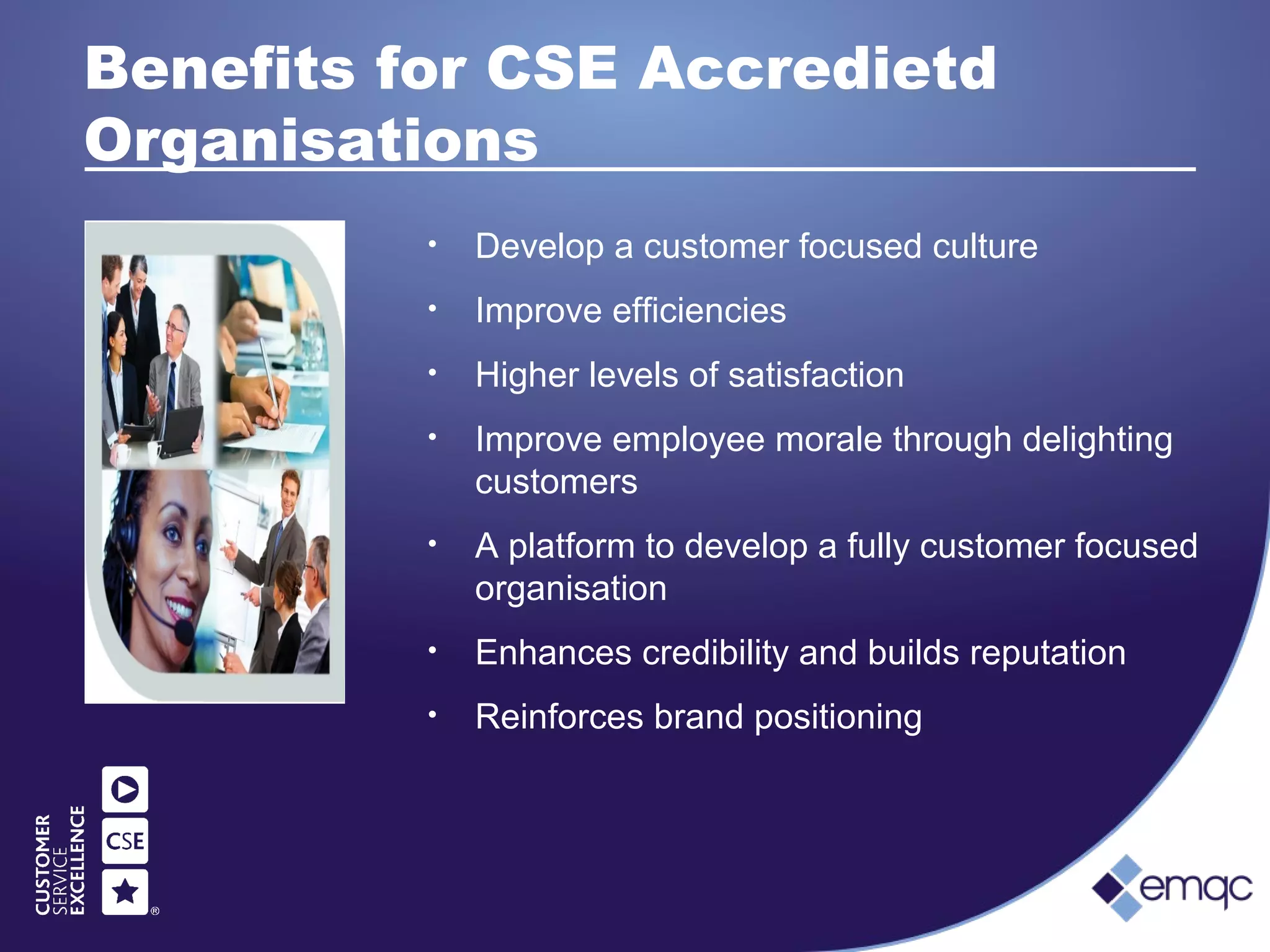
Benefits for CSE Accredietd
Organisations
• Develop a customer focused culture
• Improve efficiencies
• Higher levels of satisfaction
• Improve employee morale through delighting
customers
• A platform to develop a fully customer focused
organisation
• Enhances credibility and builds reputation
• Reinforces brand positioning
What accredited organisations say
• Executive Director “Customer Service Excellence certification provided a real
boost to the workforce. Our customers know what standards we aim to achieve and
our staff want to constantly exceed these standards”
• Head Teacher “The award acts as an independent benchmark against which we
can evaluate our service. It helps us better understand what we do, how we do it
and how we can be better”
• Head of Fire & Rescue Service “The process has led to significant improvements
to Increasing Customer Focus, improved consultation with users, improved staff
morale, developed better internal processes, developed a more effective service
delivery, improved complaints handling, delivered more cost effective services – the
culture of the service is now proactive, energetic and inspiring”
• Chief Executive “The confidence we have gained from the standard is infectious”
Contact Us
www.emqc.co.uk/cse
info@emqc.co.uk
0845 3048600

Customer Service Excellence

  • 1.
    Why CSE? Takingthe first Steps
  • 2.
    Contents • Background &Introduction to the Standard • Key Concepts of CSE • Overview of the Standard • Assessment Process • Next Steps • Accredited Organisations • Benefits of working with the Standard • The Costs
  • 3.
    Background & Introduction •Standard has been in existence since 2008, replaced the Charter Mark • Currently held by 2000 organisations • Mainly public sector based organisations. • Though produced with the active involvement of government, it is generic by design and applicable to any sector organisation dealing with customers.
  • 4.
    Key Concepts inCSE • Generating customer insight through segmentation and customer journey mapping • Using customer insight and the involvement of customers to design and improve services • Building customer focus into the whole organisation from the top, and using it to recruit, develop and evaluate staff • Specific survey questions about the key drivers of customer satisfaction: service delivery, timeliness, information, access and customer service
  • 5.
    The CSE Standard •Structure of standard - 5 Criteria, 57 elements
  • 6.
    The Assessment Process- your next steps… • Register your interest with emqc • Assemble a team • Agree the Corporate approach • Gather and filter evidence
  • 7.
    Self Assessment Customer ServiceExcellence Standard Criterion 1 - Customer Insight 1.1 Customer Identification GUIDANCE Ref Show Me (Hard Evidence) Ref Tell Me (See On Site) Self Ass Assessor Assessor Comments 1.1.1 We have an in-depth understanding of the characteristics of our current and potential customer groups based on recent and reliable information. A profile of the organisation’s main customer groups and their characteristics. Details of how these groups were segmented and classified. Details on the frequency and reliability of the research to identify customer groups. Non Compliance Partial Compliant 1.1.2 We have developed customer insight about our customer groups to better understand their needs and preferences. Compliant Partial Compliant 1.1.3 We make particular efforts to identify hard to reach and disadvantaged groups and individuals and have developed our services in response to their specific needs. Compliant Best Practice 1.2 Engagement & Consultation GUIDANCE Show Me (Hard Evidence) Tell Me (See On Site) Assessor Comments Ref Ref Non Compliance Partial Compliant 1.3 Customer Satisfaction
  • 8.
    Pre-assessment Meeting between assessorand application team : • Evidence gap analysis of entire application • Highlights strengths and weaknesses in evidence and practice • Applicant first time success rate is a very high proportion a 100% following pre- assessment (if apply for full assessment within 6 months)
  • 9.
  • 10.
    Full Assessment Visit •Emphasison observation of service delivery, discussion with customers, partners, staff and management (NOT only reviewing documentary evidence) •Assessment reflects Self Assessment, findings from Desk based documentary review •Assessor approach •Flexible to allow evidence to be presented
  • 11.
    Feedback • Full reportwith comments for each theme of each element on: • acceptability of evidence • identification of where further evidence is required for full compliance • where fully compliant, pointers as to how to improve further Assessment feedback includes:- Assessor recommendations
  • 12.
    Rolling Programme CSE standard Element Element RollingProgrammed Yr 1 Yr 2 Yr 3 1.1.1 Understanding of customer groups X 1.1.2 Customer insight X 1.1.3 Hard to reach & disadvantaged focus X 1.2.1 Engage and involve customers X 1.2.2 Service improvement through consultation X 1.2.3 Review customer engagement X 1.3.1 Measure customer satisfaction accurately X 1.3.2 Publicise satisfaction levels & improvements X 1.3.3 Specific satisfaction questions X 1.3.4 Setting customer satisfaction targets X 1.3.5 Improved customer journeys X Elements sampled 4 4 3
  • 13.
    The Cost The costfor an assessment is determined on an individual basis. It depends upon a number of factors including; • The number of staff delivering services • The number of sites that the delivery takes place over • Client complexity • Variation in the activities and working practices
  • 14.
  • 15.
    Benefits for CSEAccredietd Organisations • Develop a customer focused culture • Improve efficiencies • Higher levels of satisfaction • Improve employee morale through delighting customers • A platform to develop a fully customer focused organisation • Enhances credibility and builds reputation • Reinforces brand positioning
  • 16.
    What accredited organisationssay • Executive Director “Customer Service Excellence certification provided a real boost to the workforce. Our customers know what standards we aim to achieve and our staff want to constantly exceed these standards” • Head Teacher “The award acts as an independent benchmark against which we can evaluate our service. It helps us better understand what we do, how we do it and how we can be better” • Head of Fire & Rescue Service “The process has led to significant improvements to Increasing Customer Focus, improved consultation with users, improved staff morale, developed better internal processes, developed a more effective service delivery, improved complaints handling, delivered more cost effective services – the culture of the service is now proactive, energetic and inspiring” • Chief Executive “The confidence we have gained from the standard is infectious”
  • 17.

Editor's Notes

  • #2 NEED TO POP THE CSE LOGO ON HERE
  • #3 Good Morning and Welcome to this – our 1st CSE webinar. My name is XXXXX and I am XXXXX Mute etc etc We hope that you will find the webinar in identifying the next steps you will need to take as you begin your journey towards CSE accreditation. Questions ? In short our values are to develop organisations and make a positive difference, through the advisory and assessments we offer.
  • #4 The Charter Mark was an award demonstrating the achievement of national standard for excellence in customer service in United Kingdom public sector organisations. Introduced in 1991, it was replaced in 2008 by Customer Service Excellence standard, with the last issued Charter Marks expiring in 2011. The Charter Mark was one of the consequences of a political initiative, the Citizen's Charter, by Prime Minister John Major in 1991, to improve the face of government. Councils voluntary orgs, universities/college, housing associations, adopted by more private sector organizations, particularly those who do work for public bodies as a recognised standard which validates high levels of customer service excellence.
  • #5 Use CSE to generate customer insight, involve your customer in the journey to improve services and building a customer focused organisation throughout.
  • #6 TALK ABOUT THE STANDARD HERE IN MORE DETAIL – GIVE SOME EXAMPLES OF WHAT FITS WITHIN EACH CRITERIA The way CSE looks at the assessment is reviewing all the evidence provided, discussion with the your team and customers and then grades the information into the compliance terms and then comes out with a overall outcome. Scoring system – maximum 11 partials overall; in Criteria 1,2,3 & 5, max. 2 per Criterion; in Criterion 4, max 3 partials Compliance level 80% Assessment outcomes Accreditation Remedial action
  • #7 Register – assigned an assessor to work with you, both you and emqc put together a team As an organisation you will need to agree a corporate approach. Evidence will need to be gathered and filtered and will form part of Self assessment…..
  • #8 We don’t have on line assessment tool currently, we are in the process of developing one, to allow self assessment online, but we can provide some options to allow you to do pre assessment.
  • #9 We would recommend a Pre Assessment, although there are strict rules around pre assessment it allows a opportunity to work with the team and help give guidence around the gaps. Self-Assessment When ready, apply for pre-assessment When ready, apply for full assessment Agree date and programme with assessor (who remains your assessor) Once accredited, annual (lighter touch) surveillance
  • #10 Range of ways documentary evidence can be provided to the assessor, for those familiar with Dropbox, physical paper based, desk top review. Look at documentary evidence when on site – kept to minimum to allow the assessor on site to assess so they can concentrate on the gathering of evidence from you team.
  • #11 You would then decide when you want to go for full assessment, Choice of date and time Approach of assessors is important to emqc, robust but friendly in approach – ‘catch people in, not catch them out’ Build a schedule, submit finalised Self assessment, present evidence – next slide
  • #12 Assessor leave you with clear picture of what your org does well, hopefully compliance plus, areas that need further work on You will also receive a full report on the assessment, with indicators around the quality of evidence and where you can further improve. Summary of Compliance Open and Supportive - No Surprises !!
  • #13 The CSE standard then allows the organisation to hold the assessment for the 3 year period, with light touch assessment over the next 2 years called rolling programmes. Usually ½ day visit to site.
  • #14 Typically – an organisation of 80 staff based in 1 or 2 locations can achieve the standard for less than £1500 (1st year cost)
  • #16 What are your benefits in apply for CSE, improve customer focus, engage with customers, higher levels of satisfaction, improve staff morale through engagement and help put in place a platform through out the organisation to help achieve your vision.
  • #17 Some of our holders comments
  • #18 Some of our holders comments