E.M.G.YADAVA WOMEN’S COLLEGE, MADURAI-14.
(An Autonomous Institution – Affiliated to Madurai Kamaraj University)
Re-accredited (3rd Cycle) with Grade A+ & CGPA 3.51 by NAAC
DEPARTMENT OF COMPUTER SCIENCE
V – Semester
SOFTWARE ENGINEERING
Roger S. Pressman
7th Edition
Mrs. V. JAYAVANI, M.S (IT&M).,
Assistant Professor of Computer Science
UNIT – I (Cont…)
OUTLINE
• AGenericProcessModel
-DefiningaFrameworkActivity
-IdentifyingaTaskSet
-Processpattern
• ProcessAssessmentandImprovement
2.1.1 Defining a Framework Activity
There are five framework activities, they are
 Communication,
 Planning,
 Modeling,
 Construction, and
 Deployment
These five framework activities provide a basic
definition of Software Process. These Framework activities
provides basic information like What actions are
appropriate for a framework activity, given the nature of
the problem to be solved, the characteristics of the people
doing the work, and the stakeholders who are sponsoring
the project?
2.1.1 Defining a Framework Activity (Cont…)
1. Make contact with stakeholder via telephone.
2. Discuss requirements and take notes.
3. Organize notes in to a brief written statement of
requirements.
4. E-mail to stakeholder for review and approval.
If the project was considerably more complex with
many stakeholders, each with a different set of
requirements, the communication activity might have six
distinct actions: inception, elicitation, elaboration,
negotiation, specification, and validation. Each of these
software engineering actions would have many work tasks
and a number of distinct work products.
2.1.2 Identifying a Task Set
 Each software engineering action can be represented by a
number of different task sets-
 Each a collection of software engineering
 Work Tasks,
 Related Work Products,
 Quality Assurance Points, And
 Project Milestones.
 Choose a task set that best accommodates the needs of the
project and the characteristics of software team.
 This implies that a software engineering action can be
adapted to the specific needs of the software project and the
characteristics of the project team.
2.1.3 Process Patterns
 Every software team encounters problems as it moves
through the software process.
 It would be useful if proven solutions to these problems
were readily available to the team so that the problems
could be addressed and resolved quickly.
 A process pattern1 describes a process-related problem that
is encountered during software engineering work, identifies
the environment in which the problem has been
encountered, and suggests one or more proven solutions to
the problem.
 Stated in more general terms, a process pattern provides
you with a template a consistent method for describing
problem solutions within the context of the software
process.
2.1.3 Process Patterns (Cont…)
 By combining patterns, a software team can solve problems and
construct a process that best meets the needs of a project.
 Patterns can be defined at any level of abstraction.
 In some cases, a pattern might be used to describe a problem and
solution associated with a complete process model (e.g.,
prototyping).
 In other situations, patterns can be used to describe a problem
and solution associated with a framework activity (e.g., planning)
or an action within a framework activity (e.g., project estimating).
2.1.3 Process Patterns (Cont…)
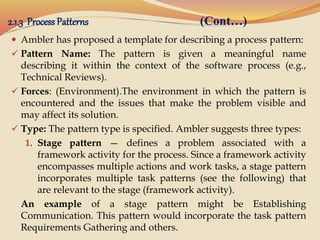
 Ambler has proposed a template for describing a process pattern:
 Pattern Name: The pattern is given a meaningful name
describing it within the context of the software process (e.g.,
Technical Reviews).
 Forces: (Environment).The environment in which the pattern is
encountered and the issues that make the problem visible and
may affect its solution.
 Type: The pattern type is specified. Ambler suggests three types:
1. Stage pattern — defines a problem associated with a
framework activity for the process. Since a framework activity
encompasses multiple actions and work tasks, a stage pattern
incorporates multiple task patterns (see the following) that
are relevant to the stage (framework activity).
An example of a stage pattern might be Establishing
Communication. This pattern would incorporate the task pattern
Requirements Gathering and others.
2.1.3 Process Patterns (Cont…)
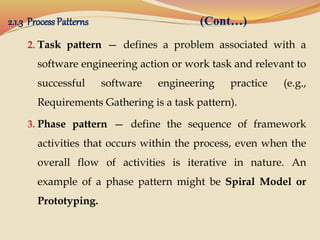
2. Task pattern — defines a problem associated with a
software engineering action or work task and relevant to
successful software engineering practice (e.g.,
Requirements Gathering is a task pattern).
3. Phase pattern — define the sequence of framework
activities that occurs within the process, even when the
overall flow of activities is iterative in nature. An
example of a phase pattern might be Spiral Model or
Prototyping.
2.1.3 Process Patterns (Cont…)
Initial context: Describes the conditions under which the
pattern applies. Prior to the initiation of the pattern:
(1) What organizational or team-related activities have
already occurred?
(2) What is the entry state for the process?
(3) What software engineering information or project
information already exists?
For example, the Planning pattern (a stage pattern) requires
that
(1) customers and software engineers have established a
collaborative communication;
(2) successful completion of a number of task patterns
[specified] for the communication pattern has occurred; and
(3) the project scope, basic business requirements, and
project constraints are known.
2.1.3 Process Patterns (Cont…)
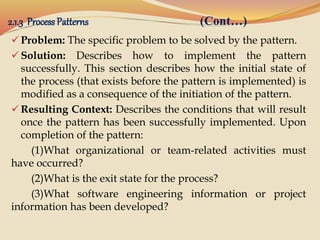
 Problem: The specific problem to be solved by the pattern.
 Solution: Describes how to implement the pattern
successfully. This section describes how the initial state of
the process (that exists before the pattern is implemented) is
modified as a consequence of the initiation of the pattern.
 Resulting Context: Describes the conditions that will result
once the pattern has been successfully implemented. Upon
completion of the pattern:
(1)What organizational or team-related activities must
have occurred?
(2)What is the exit state for the process?
(3)What software engineering information or project
information has been developed?
2.1.3 Process Patterns (Cont…)
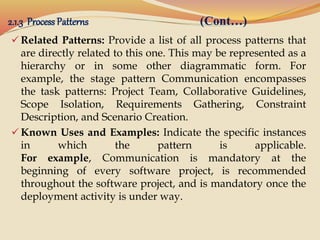
 Related Patterns: Provide a list of all process patterns that
are directly related to this one. This may be represented as a
hierarchy or in some other diagrammatic form. For
example, the stage pattern Communication encompasses
the task patterns: Project Team, Collaborative Guidelines,
Scope Isolation, Requirements Gathering, Constraint
Description, and Scenario Creation.
 Known Uses and Examples: Indicate the specific instances
in which the pattern is applicable.
For example, Communication is mandatory at the
beginning of every software project, is recommended
throughout the software project, and is mandatory once the
deployment activity is under way.
2.2 PROCESSASSESSMENTAND IMPROVEMENT
The existence of a software process is no guarantee that
software will be delivered on time, that it will meet the
customer’s needs.
Process patterns must be coupled with solid software
engineering practice
In addition, the process itself can be assessed to ensure that
it meets a set of basic process criteria that have been shown
to be essential for a successful software engineering.
A number of different approaches to software process
assessment and improvement have been proposed over the
past few decades:
1. Standard CMMI Assessment Method for Process
Improvement (SCAMPI) — provides a five-step process
assessment model that incorporates five phases: initiating,
diagnosing, establishing, acting, and learning. The SCAMPI
method uses the SEI CMMI as the basis for assessment.
2.2 PROCESSASSESSMENT AND IMPROVEMENT (Cont…)
2. CMM-Based Appraisal for Internal Process
Improvement (CBA IPI) — provides a diagnostic technique
for assessing the relative maturity of a software organization;
uses the SEI CMM as the basis for the assessment.
3. SPICE (ISO/IEC15504) — a standard that defines a set of
requirements for software process assessment. The intent of
the standard is to assist organizations in developing an
objective evaluation of the efficacy of any defined software
process.
4. ISO 9001:2000 for Software — a generic standard that
applies to any organization that wants to improve the overall
quality of the products, systems, or services that it provides.
Therefore, the standard is directly applicable to software
organizations and companies.
Software Engineering

Software Engineering

  • 1.
    E.M.G.YADAVA WOMEN’S COLLEGE,MADURAI-14. (An Autonomous Institution – Affiliated to Madurai Kamaraj University) Re-accredited (3rd Cycle) with Grade A+ & CGPA 3.51 by NAAC DEPARTMENT OF COMPUTER SCIENCE V – Semester SOFTWARE ENGINEERING Roger S. Pressman 7th Edition Mrs. V. JAYAVANI, M.S (IT&M)., Assistant Professor of Computer Science
  • 2.
    UNIT – I(Cont…) OUTLINE • AGenericProcessModel -DefiningaFrameworkActivity -IdentifyingaTaskSet -Processpattern • ProcessAssessmentandImprovement
  • 3.
    2.1.1 Defining aFramework Activity There are five framework activities, they are  Communication,  Planning,  Modeling,  Construction, and  Deployment These five framework activities provide a basic definition of Software Process. These Framework activities provides basic information like What actions are appropriate for a framework activity, given the nature of the problem to be solved, the characteristics of the people doing the work, and the stakeholders who are sponsoring the project?
  • 4.
    2.1.1 Defining aFramework Activity (Cont…) 1. Make contact with stakeholder via telephone. 2. Discuss requirements and take notes. 3. Organize notes in to a brief written statement of requirements. 4. E-mail to stakeholder for review and approval. If the project was considerably more complex with many stakeholders, each with a different set of requirements, the communication activity might have six distinct actions: inception, elicitation, elaboration, negotiation, specification, and validation. Each of these software engineering actions would have many work tasks and a number of distinct work products.
  • 5.
    2.1.2 Identifying aTask Set  Each software engineering action can be represented by a number of different task sets-  Each a collection of software engineering  Work Tasks,  Related Work Products,  Quality Assurance Points, And  Project Milestones.  Choose a task set that best accommodates the needs of the project and the characteristics of software team.  This implies that a software engineering action can be adapted to the specific needs of the software project and the characteristics of the project team.
  • 6.
    2.1.3 Process Patterns Every software team encounters problems as it moves through the software process.  It would be useful if proven solutions to these problems were readily available to the team so that the problems could be addressed and resolved quickly.  A process pattern1 describes a process-related problem that is encountered during software engineering work, identifies the environment in which the problem has been encountered, and suggests one or more proven solutions to the problem.  Stated in more general terms, a process pattern provides you with a template a consistent method for describing problem solutions within the context of the software process.
  • 7.
    2.1.3 Process Patterns(Cont…)  By combining patterns, a software team can solve problems and construct a process that best meets the needs of a project.  Patterns can be defined at any level of abstraction.  In some cases, a pattern might be used to describe a problem and solution associated with a complete process model (e.g., prototyping).  In other situations, patterns can be used to describe a problem and solution associated with a framework activity (e.g., planning) or an action within a framework activity (e.g., project estimating).
  • 8.
    2.1.3 Process Patterns(Cont…)  Ambler has proposed a template for describing a process pattern:  Pattern Name: The pattern is given a meaningful name describing it within the context of the software process (e.g., Technical Reviews).  Forces: (Environment).The environment in which the pattern is encountered and the issues that make the problem visible and may affect its solution.  Type: The pattern type is specified. Ambler suggests three types: 1. Stage pattern — defines a problem associated with a framework activity for the process. Since a framework activity encompasses multiple actions and work tasks, a stage pattern incorporates multiple task patterns (see the following) that are relevant to the stage (framework activity). An example of a stage pattern might be Establishing Communication. This pattern would incorporate the task pattern Requirements Gathering and others.
  • 9.
    2.1.3 Process Patterns(Cont…) 2. Task pattern — defines a problem associated with a software engineering action or work task and relevant to successful software engineering practice (e.g., Requirements Gathering is a task pattern). 3. Phase pattern — define the sequence of framework activities that occurs within the process, even when the overall flow of activities is iterative in nature. An example of a phase pattern might be Spiral Model or Prototyping.
  • 10.
    2.1.3 Process Patterns(Cont…) Initial context: Describes the conditions under which the pattern applies. Prior to the initiation of the pattern: (1) What organizational or team-related activities have already occurred? (2) What is the entry state for the process? (3) What software engineering information or project information already exists? For example, the Planning pattern (a stage pattern) requires that (1) customers and software engineers have established a collaborative communication; (2) successful completion of a number of task patterns [specified] for the communication pattern has occurred; and (3) the project scope, basic business requirements, and project constraints are known.
  • 11.
    2.1.3 Process Patterns(Cont…)  Problem: The specific problem to be solved by the pattern.  Solution: Describes how to implement the pattern successfully. This section describes how the initial state of the process (that exists before the pattern is implemented) is modified as a consequence of the initiation of the pattern.  Resulting Context: Describes the conditions that will result once the pattern has been successfully implemented. Upon completion of the pattern: (1)What organizational or team-related activities must have occurred? (2)What is the exit state for the process? (3)What software engineering information or project information has been developed?
  • 12.
    2.1.3 Process Patterns(Cont…)  Related Patterns: Provide a list of all process patterns that are directly related to this one. This may be represented as a hierarchy or in some other diagrammatic form. For example, the stage pattern Communication encompasses the task patterns: Project Team, Collaborative Guidelines, Scope Isolation, Requirements Gathering, Constraint Description, and Scenario Creation.  Known Uses and Examples: Indicate the specific instances in which the pattern is applicable. For example, Communication is mandatory at the beginning of every software project, is recommended throughout the software project, and is mandatory once the deployment activity is under way.
  • 13.
    2.2 PROCESSASSESSMENTAND IMPROVEMENT Theexistence of a software process is no guarantee that software will be delivered on time, that it will meet the customer’s needs. Process patterns must be coupled with solid software engineering practice In addition, the process itself can be assessed to ensure that it meets a set of basic process criteria that have been shown to be essential for a successful software engineering. A number of different approaches to software process assessment and improvement have been proposed over the past few decades: 1. Standard CMMI Assessment Method for Process Improvement (SCAMPI) — provides a five-step process assessment model that incorporates five phases: initiating, diagnosing, establishing, acting, and learning. The SCAMPI method uses the SEI CMMI as the basis for assessment.
  • 14.
    2.2 PROCESSASSESSMENT ANDIMPROVEMENT (Cont…) 2. CMM-Based Appraisal for Internal Process Improvement (CBA IPI) — provides a diagnostic technique for assessing the relative maturity of a software organization; uses the SEI CMM as the basis for the assessment. 3. SPICE (ISO/IEC15504) — a standard that defines a set of requirements for software process assessment. The intent of the standard is to assist organizations in developing an objective evaluation of the efficacy of any defined software process. 4. ISO 9001:2000 for Software — a generic standard that applies to any organization that wants to improve the overall quality of the products, systems, or services that it provides. Therefore, the standard is directly applicable to software organizations and companies.