t h e p r o d u c t m a n a g e m e n t a n d m a r k e t i n g a u t h o r i t y
winter 2013
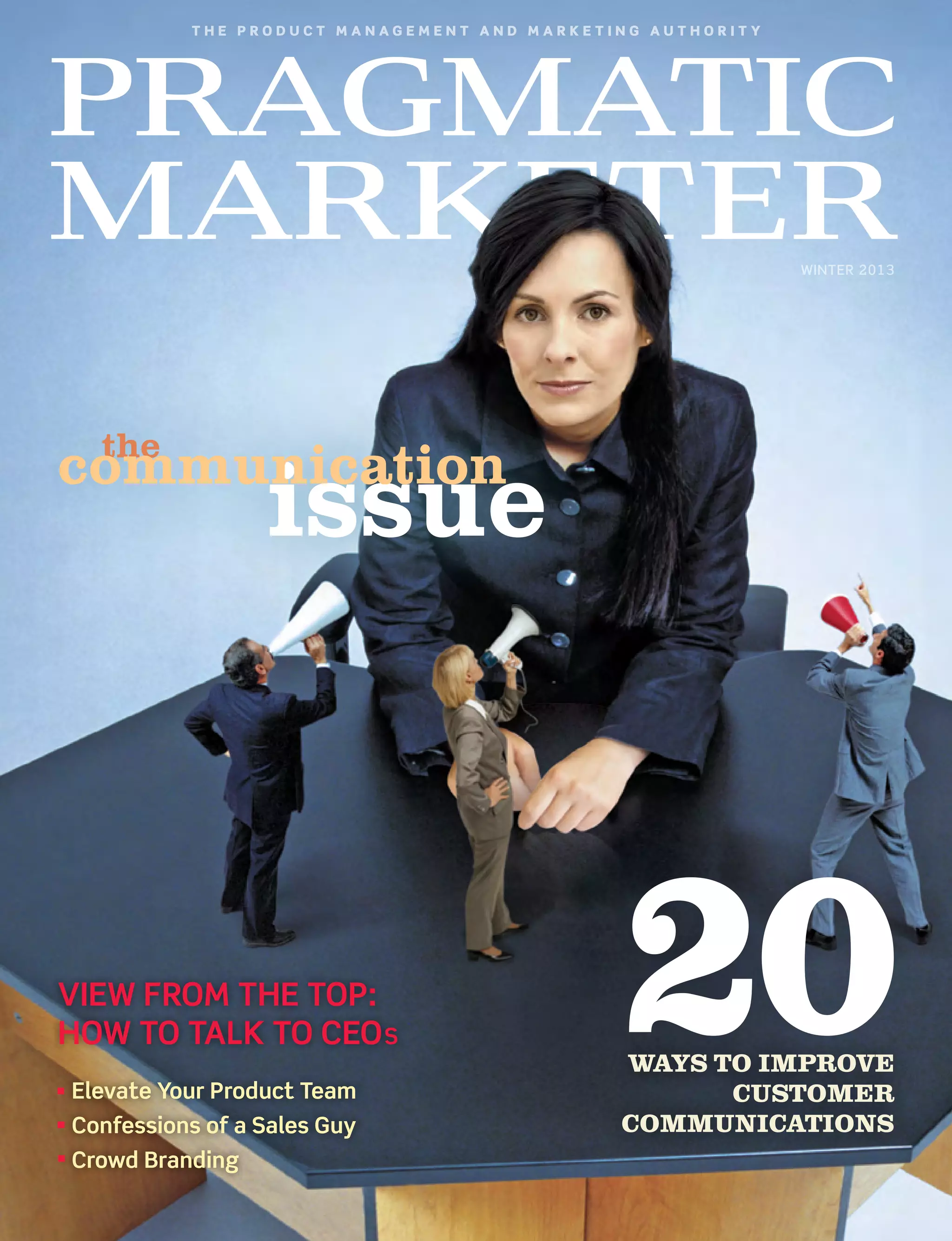
View from the top:
how to talk to ceos
elevate Your product team
confessions of a sales Guy
crowd Branding
20ways to improve
customer
communications
welcome
the product management
and marketing authority
Founder / ceo
Craig Stull
editoriAL director
Rebecca Kalogeris
editor
Linda Zid
designer
Norman Wong
speciAL projects
Sarah Mitchell
The Pragmatic Marketer™
8910 E. Raintree Drive, Scottsdale, AZ 85260
Interested in contributing an article?
PragmaticMarketing.com/submit
No part of this publication may be reproduced, stored in any
retrieval system, or transmitted, in any form or by any means,
electronic, mechanical photocopying, recording or otherwise,
without the prior written permission of the publisher. Other
product and/or company names mentioned in this magazine
may be trademarks or registered trademarks of their respective
companies and are the sole property of their respective owners.
The Pragmatic Marketer is a publication of Pragmatic Marketing,
Inc., and Pragmatic Marketing, Inc., shall not be liable regardless
of the cause, for any errors, inaccuracies, omissions, or other
defects in, or untimeliness or unauthenticity of, the information
contained within this magazine. Pragmatic Marketing makes
no representations, warranties, or guarantees as to the results
obtained from the use of this information and shall not be
liable for any third-party claims or losses of any kind, including
lost profits, and punitive damages. The Pragmatic Marketer is a
trademark of Pragmatic Marketing, Inc. Printed in the U.S.A. All
rights reserved.
ISSN 1938-9752 (Print) ISSN 1938-9760 (Online)
Since 1993, Pragmatic Marketing has conducted product
management and marketing training for 7,000 companies
on 6 continents. Our team of thought leaders produce blogs,
webinars, podcasts and publications that product profession-
als around the world turn to for industry insights.
chief’s
letter
W
elcome to the first issue of the relaunched
Pragmatic Marketer magazine.
Last year, the number of people who have taken
Pragmatic Marketing courses reached a milestone
85,000—demonstrating the growth of product management and
marketing as a field in the 20 years we’ve been around. And with
that rapid growth and constant evolution, industry professionals
need a centralized resource to turn to for best practices, case
studies and information about their roles. Our magazine had
already built a reputation as an industry resource, and we felt the
time was right to invest in relaunching it.
Our hope is that this magazine will get important
conversations started in the product management and marketing
community, so it seems fitting that
our inaugural issue focus on the
world of communicating.
We lead with an article about
a challenge everyone faces: how
to work more effectively with
customers. Cindy Alvarez offers you
20 ways to get the ball rolling. We
follow with tips and best practices
for communicating with everyone
from CEOs and shareholders to
finance executives and sales guys.
We’ve introduced three new
recurring sections—Build Better
Products, Sell More Stuff and Lead
Strategically—designed to offer best
practices to help you in your day-to-day roles and to address the
topics that you’ve told us matter most to you.
We hope you enjoy our magazine, and please feel free to
communicate with us at editor@pragmaticmarketing.com. We
welcome feedback, questions or ideas for what you’d like to see in
future issues of Pragmatic Marketer.
We want to be that trusted resource that you look forward to
every quarter.
Sincerely,
Craig Stull, Founder/CEO
features
departments
20 Ways to Improve Customer
Communications by Cindy Alvarez
Turn understanding the customer into
a competitive advantage
Confessions of a Sales Guy
by Steve Harper
An insider’s look at how product
management can work more
effectively with sales
Communicate by the Numbers
with CFOs by Marina Guzik
Three keys to turning the “purse
holders” into partners
View from the Top by Kent Petzold
Insights into how to communicate
effectively with CEOs
Bits & Pieces
Grow Your Influence/Resolutions
Roundtable/Travel Tips for Road
Warriors/Rules for Product Success
Ask the Experts
How do I start my new product role?
Build Better Products
Some Assembly Required by Rob Eddy
Getting the Price Right by Mark Stiving
Sell More Stuff
Crowd Branding by Zach Servideo
Lead Strategically
Earn Better Returns on Investor
Relationships by Mike Smart
Elevate Your Product Team
by Rich Nutinsky
A Pragmatic Approach
Put this issue’s ideas into action
3
7
26
33
36
40
10
18
21
23COnTEnTS | vOlumE 10 | ISSuE 1 | 2013
Sign up for your free
subscription, delivered quarterly via email, at
pragmaticmarketing.com/subscribe.
WINTEr 2013 pragmaticmarketing.com 1
Learn to manage the tactical
to make time for the strategic.
Pragmatic Marketing provides practical, actionable
training and a comprehensive toolset for product
management and marketing teams. You’ll learn how
to use market facts to drive strategic decisions and to
minimize the “fires” that can consume your day. All of
which means you can start making a bigger impact on
your business and your products immediately.
Don’t be trapped by tactical demands.
Learn how to get free at www.pragmaticmarketing.com
or by calling 480.515.1411.
BreAk
free.
Briefing Practical Product Management RequirementsThat Work Effective Product Marketing Product Launch Essentials Action
winter 2013 pragmaticmarketing.com 3
D
uring normal conversations,
either at home or at work, I often
find that the reply that comes
to mind is actually a quote from a movie.
And more often than not, that movie is
“The Princess Bride.”
You may have this experience
yourself. Perhaps in a meeting,
listening to the latest version of your
organization’s strategy, your buddy turns
to you and asks, “Think it will work?”
And all you can think is: “It would take
a miracle!”
Or your boss tells your team that the
organization must have “focus,” and you
think, “You keep using that word. I do not
think that word means what you think
it means.”
I’ve applied eight of my other
favorites to the product management
and marketing world. See if any of these
situations sound familiar to you:
1. “You rush a miracle man, you get
rotten miracles.” The lead engineer
says the product will miss the release
date by six months. You may want to
strangle this person, but keep this quote
in mind. You’ve got to collaborate with
your counterparts in development,
because what they do isn’t immediate.
It’s not throwing a light switch.
2. “We are men of action. Lies do not
become us.” Telling the truth, especially
when it’s not popular, is one of the most
challenging things to do in business or
at home. We know what we believe, but
do we have the courage to say it? Even
when the audience is the president of
the organization? It’s difficult to strike
that balance between telling the truth
and rocking the boat. At the end of the
day, though, you have to look yourself
in the eye and know you did what was
right, that you spoke what you believed
was true. And hopefully, you can make
it through without your boss saying, “Do
you want me to send you back to where
you were? Unemployed, in Greenland?”
3. “I wonder if he is using the same
wind we are using?” Competitive threat
is a constant part of any successful
business. If you are successful, there
is always someone trying to take your
market share away from you. You don’t
want to obsess about the competition
or build a product that mirrors what the
competition has. But by the same token,
you’ve got to pay attention to them.
You’ve got to make sure that if there is
a new wind out there, you get that in
your sails too.
4. “You know how much I love
watching you work, but I’ve got my
country’s 500th anniversary to plan,
my wedding to arrange, my wife to
murder and Guilder to frame for it.
I’m swamped.” Ever have one of those
days when you just cannot seem to get
all the work done? Product management
and marketing are jobs where you’re just
not going to finish everything. There are
no clear priorities, and you have got to
be really good at picking the things that
you’re going to work on and letting the
other ones hit the floor.
5. “Life is pain, Highness. Anyone
who says differently is selling
something.” Many years ago, I decided
that the word “fair” should be stricken
from the dictionary. If you expect life
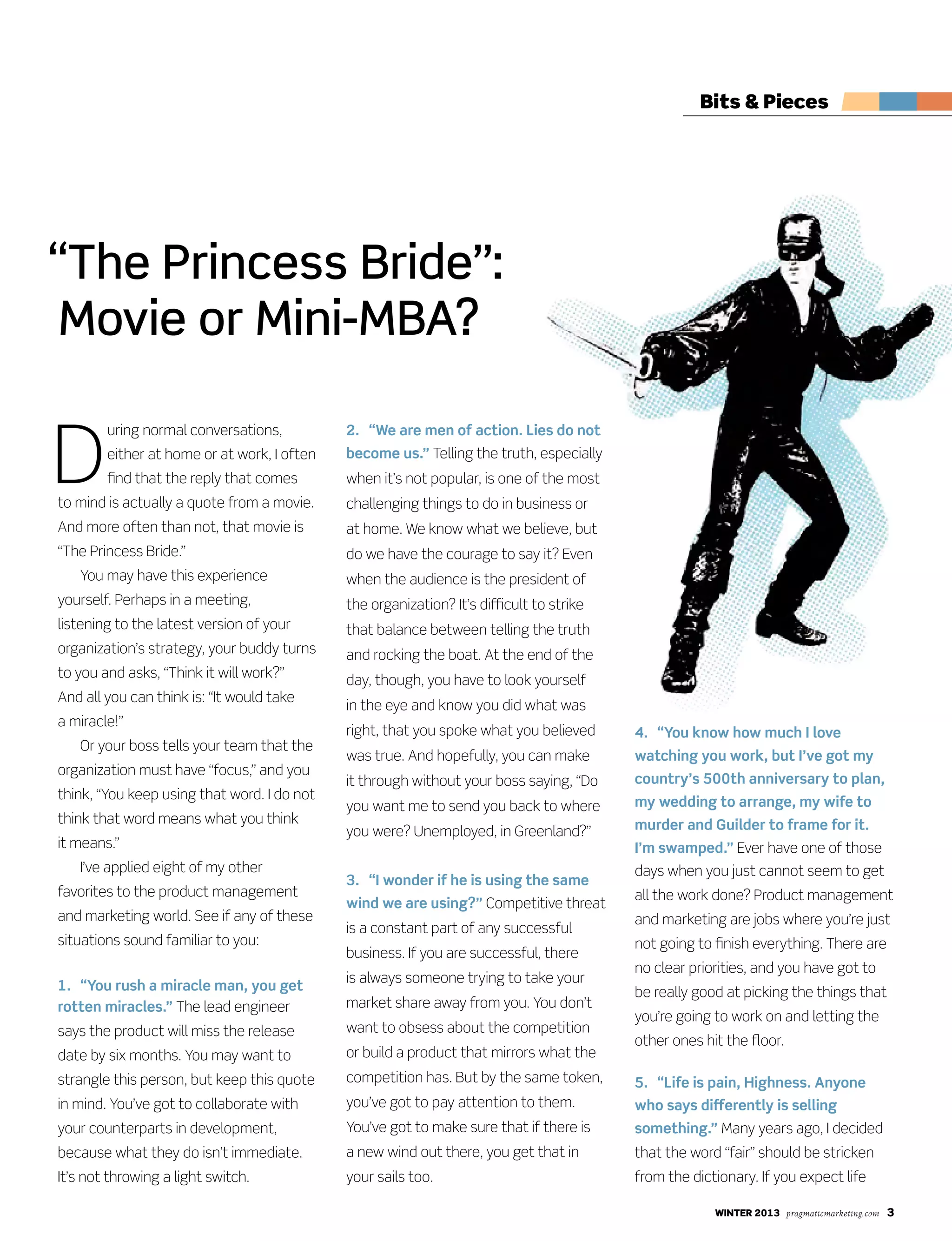
“The Princess Bride”:
Movie or Mini-MBA?
Bits & Pieces
4 pragmaticmarketing.com winter 2013
to treat you fairly, you are only setting
yourself up for disappointment. Move
past those “unfair” situations as quickly
as possible, because the longer you cling
to them, the more time you’re wasting.
The lessons you’re learning from what’s
unfair today could be something
you can apply somewhere else—and
that’s okay.
6. “It’s not my fault being the
biggest and the strongest. I don’t
even exercise.” Do you work beside
supermarketer? That’s the fellow
employee who always manages to work
on products that exceed their revenue
goals; who gets invited to every sales
team quota club; and who has the best
hair, the best clothes and the nice car.
There’s always going to be someone else
who knows things that you don’t.
7. “Ha ha! You fool! You fell victim to
one of the classic blunders—the most
famous of which is ‘never get involved
in a land war in Asia’—but only
slightly less well-known is this: ‘Never
go against a Sicilian when death is
on the line!’” Try as you may, there
is always one more business rule, one
more experience that you haven’t had
yet. And it seems as if the rule you need
today is the one you don’t know. There’s
always more to learn. Quotes 6 and 7
together, knowing that there’s always
someone bigger and stronger and that
there’s some classic blunder that I’ll
always commit, keep me humble—and
sometimes you need that.
8. “Sonny, true love is the greatest
thing in the world, except for a nice
MLT—mutton, lettuce and tomato
sandwich—where the mutton is
nice and lean and the tomato is ripe.
They’re so perky! I love that.” At
the end of the day, most stuff doesn’t
matter. When emotions are high, and the
release is late and everyone is screaming
at each other, the successful marketer
keeps perspective. Because life is not
about this release or that customer or
that deal. Life is much more, but is often
as simple as a delicious sandwich.
Thanks for reading to the end. Good
night. Good work. Sleep well. I’ll most
likely kill you in the morning.
–Jim Foxworthy
The Wiener’s Circle
www.wienercircle.net
Not for the faint of heart, the char dog
you order here comes with a side of
verbal abuse from the employees, who
have been described as “putting the
‘cuss’ back in customer service.” The hot
dogs aren’t bad either.
The Field Museum
www.fieldmuseum.org
If you’re traveling with your little ones,
consider “Dozin’ with the Dinos” at
Chicago’s Field Museum. Bring your
own sleeping bag and play games
from around the world while seeing
live insects—all in the shadow of
the 14-foot-tall Sue, the largest,
best-preserved Tyrannosaurus rex
specimen ever found.
Green Mill Cocktail Lounge
www.greenmilljazz.com
Not only is the Green Mill a fun place to
hear jazz and poetry readings, but you
can also check out gangster Al Capone’s
favorite booth there. Rumor has it there’s
an underground network of tunnels
that Capone used to get in and out of
the building.
Cloud Gate at Millennium Park
www.millenniumpark.org
One art-related must is Cloud Gate, a
three-story steel sculpture from artist
Anish Kapoor. It reflects and distorts the
city skyline, and you can walk around
and under it. Plus where else can you
visit a sculpture with such a unique
shape that natives affectionately call it
“the bean”?
Travel Tips
for Road
Warriors
Traveling To ChiCago?
Sure there’s culture, history and
such. But what if you just want to
get yelled at while ordering a hot
dog? Yup, they’ve got that too.
Here are a few odds and ends to
check out in the Windy City.
Bits & Pieces
winter 2013 pragmaticmarketing.com 5
Pragmatic Marketing’s Golden Rules
1. An outside-in approach increases
the likelihood of product success.
2. The answer to most of your
questions is not in the building.
3. We are all pragmatic marketers.
4. If product management doesn’t
do its job, other departments will
fill the void.
5. The building is full of product
experts. Your company needs
market experts.
6. Win/loss should be done by someone
not involved in that sales effort.
7. Your opinion, although interesting,
is irrelevant.
8. Positioning is the first step
of execution.
9. Positioning focuses on the problems
you solve.
10. Create a separate positioning
document whenever the buyer’s
problems are different.
11. Name the product after positioning
is finished.
12. Only build solutions for problems
that are urgent, pervasive and that
the market will pay to solve.
13. Every “product” needs product
management and a business plan.
14. Map your sales process to the
buying process.
15. Marketing moves every deal forward.
Sales moves each deal forward.
We are all
pragmatic
marketers.
Resolutions Roundtable “This year, I will spend more time at both
extremes of the job: more customer face
time—as opposed to phone calls and webinars
to better understand users and buyers—and
more time heads down analyzing data to
better understand and improve the sales
process.”
- Saeed Khan,
founder, www.onproductmanagement.net blog
“Get my company
speaking opportunities
at tradeshows.”
- Jennifer White,
director of marketing, Network IP
“Help my team and
company to
become more Agile.”
- Victor Ortiz,
director of product management,
verticals & commerce, Digital First Media
“Make a greater contribution
to corporate and product
strategy in the coming year.”
- Maya Markovich,
director of product marketing, Daegis
“Get my backlog groomed out and
increase the velocity with which
we knock items off it.”
– Eban Tomlinson, product manager, ShipConstructor
“Make time to use
my data better.”
- Kam Wa Tang,
product marketing specialist, Yesmail Interactive
- Jon Zucker,
senior product marketing manager,
Imperva
“Be curious.”
Pragmatic Marketer asked:
What is your professional
New Year’s resolution?
6 pragmaticmarketing.com winter 2013
88%
86%
85%
79%
75%
52%
41%
54%
69%
Analyst reports
Live events/conferences
Blogs
Corporate websites
Social networking sites
Broadcast news
Twitter
Suggestions
from peers
Newsprint and their
online components
Worldwide enterprise IT spending is forecast to total $2.7 trillion in 2013, according to Gartner Inc. So how do
you plant your stake? influence the influencers. The above were considered valuable sources of information
in determining which vendor to select for large B2B purchases.(Source: Hill & Knowlton Strategies survey)
Know who your customers turn to
grow
your
influence
Bits & Pieces
winter 2013 pragmaticmarketing.com 7
Ask the Experts
Y
ou should always start with Market Problems. You
wouldn’t get in a car and start driving without
knowing where you’re trying to get to. And it’s the
same thing for anyone starting a new product role.
It’s very easy, no matter what your title is, to get
caught up in executing activities and tasks and not
thinking strategically. There’s always somebody standing
in your doorway, saying: When can you get this roadmap
done? Can you help with this sales call? Or can you go to
this event? The people who get into product jobs are can-
do people. They never say no, they just go and respond.
But when it really comes down to it, no matter what
task you want to pursue, you have to start with Market
Problems. First and foremost, you must understand what
problem you’re trying to solve, and then use that context
for all other activities. If you do that, you’re golden.
To get to those Market Problems, one of our favorite
sayings around Pragmatic Marketing is: “Your opinion,
although interesting, is irrelevant.” It means that you have
to leave the building and listen to the market, rather than
just dreaming stuff up. You discover those problems in
the market by interviewing your customers and potential
customers. Then, you dig deeper to find out how common
those problems are in the market.
All of the activities we include in our Pragmatic
Marketing Framework, from strategy through execution,
are important. But in our courses, we drive people to think
about what problems they are trying to solve first. Then
the rest of it is more powerful, and the pieces will tie
together more cleanly. And your execution will be
smoother, because you stopped and thought about it
before getting on the road.
Do you have a question for our experts? Send us an
email at experts@pragmaticmarketing.com.
Ask the Experts:
It seems like
there is so much
to learn in my new
product role. Do
you have any
advice on where
to start?
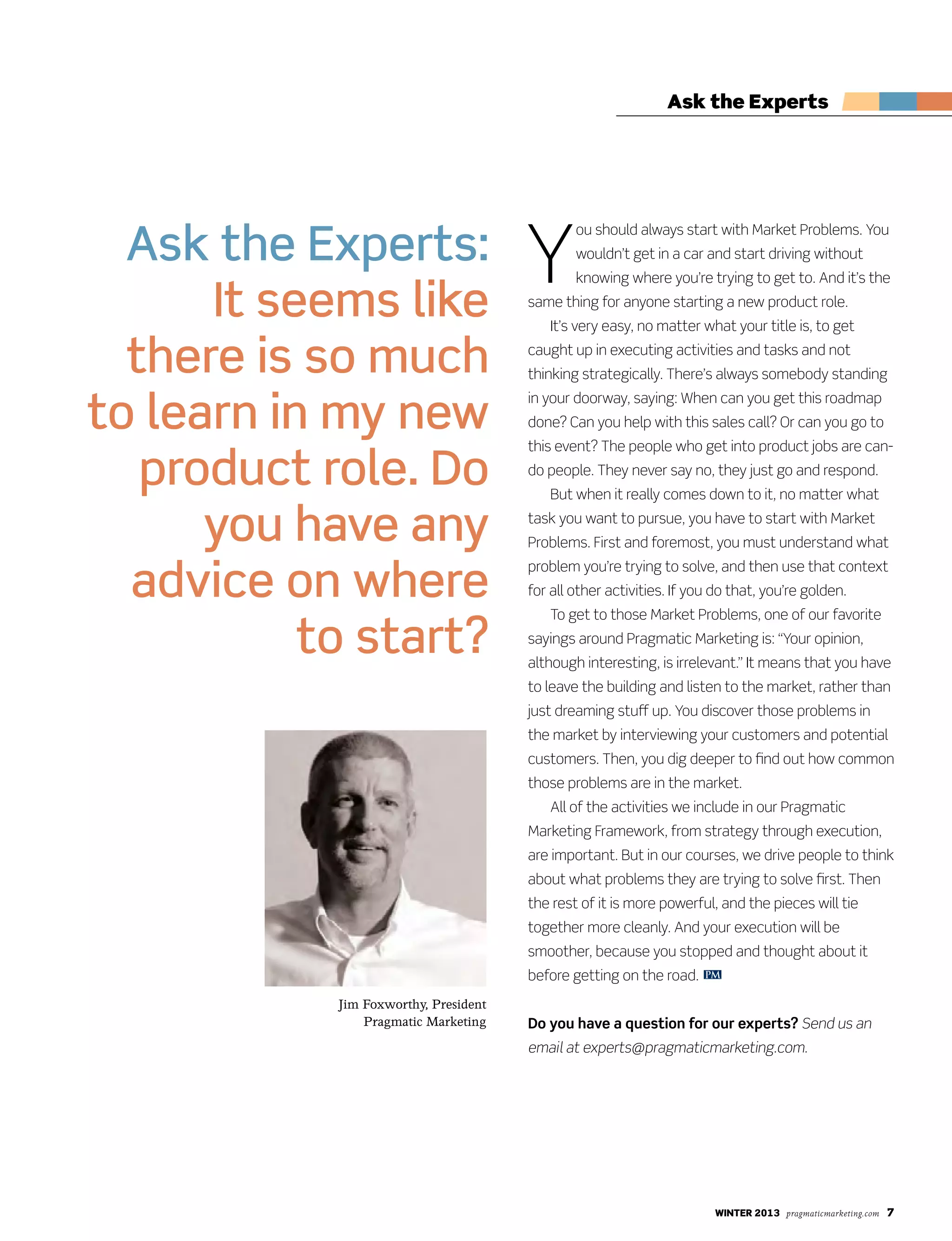
Jim Foxworthy, President
Pragmatic Marketing
PM
Let the market be your guide. At the heart of Pragmatic Marketing’s methodology
is a simple concept: Before you can build and deliver products your market will buy,
you must tune in to the market, the personas and their problems.
Learn to leverage market facts for everything from requirements and roadmaps, to
marketing plans and sales tools, with Pragmatic Marketing’s complete course catalog.
Visit www.pragmaticmarketing.com or call 480.515.1411 today.
Briefing Practical Product Management RequirementsThat Work Effective Product Marketing Product Launch Essentials Action
pragmatic marketer feature section
10
18
21
23
20 Ways to Improve
Customer Communications
Confessions
of a Sales Guy
Communicate by
the Numbers with CFOs
View from the Top
10 pragmaticmarketing.com winter 2013
{ thecommunicationissue }
to improve
Ways
customer
communications
Turn understanding
the customer
into a competitive
advantage.
By Cindy AlvArez
How many times Have you built a product, only
to find out that nobody was interested in the features
you painstakingly included? Even when you asked
your customers what they wanted beforehand?
Ultimately, it’s not just about talking to your
customers that gives you the information you need,
it’s about talking to them the right way. Here are 20
tips to help you communicate with your customers
better, so you can more efficiently deliver the products
they actually want—not just what they say they want.
20 ways
1Have Them Tell You How It Would
Make Their Lives Better
Customer requests are usually just one or
two sentences, devoid of context. How
can you possibly gauge the urgency of a
request without a real conversation?
Which one of these would you place a
higher priority on?
1. “PLEASE add validation checking for
email addresses! If you give people
a text field to type in their email
address, there is nothing stopping
them from entering a bunch of junk!
This is not a good user experience, if
they are expecting us to have their
contact info!”
2. “Would it be possible to offer support
for text versions of your email
notifications? Right now we are
only receiving them in HTML.”
The first person used the phrase “not
a good user experience” with multiple
exclamation points, indicating urgency.
But when I emailed them to ask how
they would benefit from this feature, they
talked about how they might want to use
our product in the future, if they decided
to do a certain marketing campaign. Turns
out the requester was just an exclamation-
point abuser.
The second person, on the other hand,
told me about using our survey product
to ask customers about bugs or feature
improvements and sending responses
directly into their customer support’s
content management system. The HTML
formatting was making the feedback very
hard to read and forcing customer support
folks to retype long passages every time
they wanted to respond. In other words,
they were suffering every time they used
our product.
We made the change within days. And
by learning about how they were using
our product, we were able to suggest that
same use case to other customers.
2Say What Your Product Is For;
Say What Your Product Is Against
When I worked at a banking technology
company, we maintained a fairly active
user forum. There was a handful of users
who were openly critical of various
features. In particular, they kept requesting
very complex power-user features that we
knew would appeal to a limited audience
and incur a big overall usability cost. We
kept not building those features; the users
kept getting angrier.
Finally, I posted a message that said:
Look, we are never going to build this feature,
and here’s why/here’s our product vision. We
hope you’ll stick around as customers, but if
you’re looking for a power-user product, we
may not be the best choice.
I hit “post” and waited for the online
fury to begin. But it didn’t. It actually
made things better. When we didn’t share
our perspective, customers were forced
to assume that we were just ignoring
them because we were too stupid
or incompetent to build the features
AN EXCLAMATION-POINT
ABUSER.”
ThE REqUESTER wAS
TURNS OUT
winter 2013 pragmaticmarketing.com 11
12 pragmaticmarketing.com winter 2013
they wanted. While we still disagreed, the customers
respected that we had a vision (“oh good, you’re not
idiots after all”) and appreciated that we were honest
with them.
3Have Rules, but Don’t
Enforce Them
Placing limits on your product has two big potential
benefits:
1. Simplifies the user interface to help customers
learn it more quickly and thus move to paying
you more quickly
2. Enables you to charge more to the subset
of customers who need to go beyond
those limits
But if you set the wrong limits, it can be a hassle to
change your code, change your policies and communicate
with all of your users. We have used several “unenforced”
limits (how many questions per survey, how many
reports, how many events)—where we stated that certain
limits existed, but did not actually write the code to
enforce them.
If no one breaks your limits, then they are probably too
high or too inclusive. If everyone breaks your limits, then
they are probably too low. Once you have actual usage
data, you can make a much more educated guess on where
to set limits, and then write the code to enforce them.
4Only Build It If You Can Measure It
To put this tip another way, if you can’t think of a
way to prove that having done this was good for your
business, you probably shouldn’t do it. Funnels and
metrics are one thing, but product changes fundamentally
need to be about revenue.
As a person who cares a lot about design, I always
want to redesign/improve bits of whatever product I’m
working on. I have to ask myself:
1. Will more people buy the product if you make
this change?
2. Will fewer people leave us for a competitor product
if you make this change?
And if I can’t really, honestly, confidently say “yes” or
even “probably” to either of those, it usually means I
should suck it up and focus on more important changes.
5Tell Them What They Should Do Instead
Customers will often ask for something that is
actually bad for them—something that will make
your product harder to use or make the results less
valuable. You shouldn’t build it, but you also shouldn’t
ignore them.
The right response is to confirm, acknowledge and
educate:
It sounds like you want to [get specific question answered/
accomplish specific task]. We have seen with other customers
that this doesn’t work well, because [reasons, consequences].
What may work for you is to [alternate suggestion]. This
would help you to do what you’re trying to do without
[consequence]. Here’s how you would get that set up.
Here’s an example:
It sounds like you want to maximize the number of responses
you get to your question about shipping rates. However, we
have seen with our other customers that displaying the same
survey repeatedly does not increase the rate of thoughtful
responses—in fact, they’ve gotten customer complaints about
the intrusiveness of the survey and more non-useful responses
like “make this go away.’”
What may work for you is to ask this question on a more
relevant page, such as the shopping-cart page. You will get
fewer responses, but they are more likely to be thoughtful,
content-rich responses. You’d do this by ...
you probably
shouldn’t do it.”
to prove that having
done this was good,
if you can’t
think of a way
winter 2013 pragmaticmarketing.com 13
6Fake the Functionality
I had this brilliant idea that our survey product
should support automatically recurring surveys—to
run a Net Promoter Score survey automatically every
month, for example. But
building the automation
on the back end and the
user interface on the
front end would have
been quite a bit of effort
for something I wasn’t
positive customers
would use.
Luckily, “automation” lends itself very well to manual
human labor.
I picked two-dozen customers, and sent them
individually composed emails (that looked like “real”
marketing emails), inviting them to try this recurring
survey feature “in beta.” For the four who said okay,
I logged into their accounts as admin and set up the
survey for them. I then waited one month and sent
another email saying that a month had passed, and so
we were about to run their survey again.
From their perspective, it looked like a true
automated recurrence, a feature that they said they
wanted to use. But they all emailed back to say: Never
mind, I don’t really want this. How can I turn it off?
7Send Your Customer to Your Competitor
You know your competition, so you probably know
about tools that your prospective customers haven’t
heard of. Sure it’s great if it’s your product that makes
them happy, but you still get partial credit for being the
nice person who told them where they should go.
I send people who want to write long-form surveys
to a competitor, and a decent number of them have
come back months later because we had a good
interaction and they’re ready to use our services.
A good format:
Thanks for wanting to use [ProductName]. Unfortunately,
we don’t do [feature], but I think you’ll be able to do what
you need with [CompetitorName]. Their product does
[feature], and we’ve talked to people who are happy
with them.
In the future, when you need to do
[feature that ProductName can
handle], we hope you’ll come
back and check us out again!
8Ignore It Until You Can’t
My favorite line: “You will have both
visionaries and nutcases using your product. It’s
very hard to tell them apart.”
In other words, if you
jump on a feature
request the first time
you hear it, you may
be taking advice from
a nutcase.
Here’s what
happens. You get
a request. Wait. If
it’s a good one, you will start hearing other
people request it soon. Or you can be proactive
and casually ask other customers if they have
the same problem. (Note: Do not say, “Would
you use an automatic cat washer?” Instead, say,
“Tell me about how you keep your cat clean.”
Problem, not solution.) If no one else requests
it, and people don’t respond when you ask them
about the problem, you can safely ignore it.
9Offer a Workaround
Useful tip: The people who ask for
complicated features are usually the people
best equipped to handle a long or tedious
workaround. Just recently, a customer asked for
a way to exclude certain data from our metrics—
something we don’t support—but I offered
them two potential workaround solutions.
Neither was perfect, and both required the
customer to write extra code—but they were
completely okay with that.
I’ve heard people say that offering a
workaround is like admitting that your product
is flawed. Yes, it is. But you still want them to be
able to get value out of it. A good format
for this:
Unfortunately, our product doesn’t directly support
[that thing you want to do].
However, if I understand correctly, you may be able
to [briefly describe workaround process] in order to
approximate [that thing you want to do]. Here are
the step-by-step instructions. Please let me know if
this is confusing, or if I am misunderstanding the
task you’re looking to do.
The advantage is that
you can then watch your
14 pragmaticmarketing.com winter 2013
customers using the workaround and get better ideas on
how to eventually build the easier, more “productized”
way of doing the same task because you’re able to
anticipate their needs.
10 Be Less Attractive (to Certain Types
of Customers)
Each type of customer is demanding in a different way:
Corporate/mainstream companies may expect faster
support turnaround and more custom attention; power
users may expect more complex features; and casual
consumers may expect greater ease of use and guided
onboarding. Try to do all three, and you will stretch
yourself too thin and disappoint your customers.
Instead, think of the bright-colored frog whose colors
signal, “Hey snake, I’m poisonous, so don’t eat me.”
11Until We Can Do It, Use Us for Free
As I mentioned, you will have customers who
are visionaries. They can see ahead to things that your
product should do. This makes them impatient. You may
agree with them—but you’ve seen your schedule and
know it’s not going to come in the next month, or the
one after that.
So you say, “You’re right, we should offer Feature X.
In fact, I’m also really eager for us to include that, because
I know that right now you are doing [workaround] and
that’s tedious. Unfortunately, we’re a small team so I can’t
promise that it’s coming in the next month or two. In the
meantime, I’ve comped your account.”
That’s my way of saying that I hope they will stick
around, and that I hope I can ping them again when
we’re actually building Feature X.
12Let Some Fish Get Away
Related to the previous two, sometimes you will
acquire a customer and then realize you’re just not going to
be able to make this customer happy.
Sometimes they want features that we are never,
ever going to build, because they clash with our
product vision or will actually hinder our ability to gain
customers/monetize. Sometimes it’s our fault: We have
some weird bug that really only affects them, and so it’s
not worth devoting a ton of time to fixing it.
In either case, here’s what you say:
Unfortunately, we’re a small team and are not going to be
able to accommodate your request/bug fix. I’m sorry we are
not providing you with the great experience we want our
customers to have. But I’d rather be honest than keep you
waiting, and I’ve refunded your subscription fee. You may
want to check out [Other Site] or [Other Site]; they may be
able to better serve you.
I haven’t had to do this often, but I’ve been quite
surprised by how well customers took the news the few
times I have. I guess the bar for honest communication
is so low that even if you give people bad news, they’re
glad to hear something true vs. something that just
sounds good.
13Build a Simple
Application Program Interface (API)
Here’s the thing about configuration and customization
options: They make power users happy, but they drive
away your mainstream customers by cluttering up your
interface and making it harder for them to make decisions.
Our customers kept asking about configuration that fit
their specific needs. I loved that they were so enthusiastic
about the product as to want to integrate it into their
sites, but knew that adding another dozen options to our
already-crowded interface would be a disaster.
to be able to make
this customer happy.”
you’re just not going
sometimes
you realize
winter 2013 pragmaticmarketing.com 15
I can’t take credit for the solution, though. Our
developer Michael told me, “I got tired of hearing about
these requests so I just wrote a quick API. Here’s how it
works. Customers can write any bit of code around it to
control the triggers.” This has worked tremendously well,
and the customers are more than willing to write the
extra code for the extra control they want.
14Email Us for More Info
Early on, I saw that several of our paying
customers were marketing agencies, using one account
to run surveys for several clients. I hypothesized that we
could charge more money to agencies, since they were
able to get value on multiple sites (and were probably
passing the costs along to their clients).
I tested that hypothesis by adding a single “email us”
line to our pricing page. I figured that would give me the
contacts necessary to do customer development on this
segment. But to date, almost no one has emailed about
agency pricing. No one cares enough. So not only did we
save hours of coding, we even saved hours of customer
development interviews!
15Force Customers to Pick a
Single Priority
I’ve actually used this more as an internal tool. Let’s say
you have a bunch of new features you want to build,
a bunch of bugs that need fixing and some existing
features that should be improved. Your CEO says, “It’s
all important. We should be working on all of this.” (This
has been the case with every CEO I’ve ever worked
with.)
So you say, “Here are five choices. If you could only
have ONE, because all of our engineers were stranded
on a deserted island and could only send us code via
messages in a bottle, which ONE would it be?” (Or make
up your own story, the funnier the better.)
Then that becomes priority No. 1. Repeat with the
remaining items, and thus avoid the “everything is
highest priority” syndrome—at least a little bit.
16Charge a Ridiculous Amount
Usually, if a customer requests something that
you don’t want to build or that doesn’t fit with your
vision, you can simply offer to charge them an insane
amount of money and they will suddenly reevaluate their
priorities and decide it’s not necessary after all.
But if they don’t come to that decision, that’s a signal
you should pay attention.
At one company, we had a customer who demanded
very extensive changes for Americans with Disabilities
Act (ADA) compliance. Saying “no” wasn’t an option
if we wanted to keep the customer, but charging
what seemed like a ridiculous amount of money was.
Surprisingly, they said yes.
Actually making those changes was incredibly painful
and tedious, but it brought to my attention that the
capability was worth way more than we hypothesized.
I worked with other product managers to ensure that
our requirements included ADA specifications in future
releases, and I worked with engineers so they could
Subscribe to
Like what you see in this issue?
Sign up to receive a complimentary subscription to the
product management and marketing authority at
www.pragmaticmarketing.com/subscribe.
16 pragmaticmarketing.com winter 2013
make certain parts of the code more modular for easier
changes in the future. (And we were still able to charge
a boatload of money every time someone requested
these features.)
17+18Ask for Help. And Be Grateful
If people are getting enough
value from your product, they are probably willing to
contribute some effort to make it even better. But let’s
not be totally arrogant here. My customers certainly
aren’t walking around all day thinking, “How can I make
Cindy’s product better?” It doesn’t occur to them, unless
you ask.
When the first person emailed to ask if we could
provide our survey templates in Spanish, I knew our
software would handle the character display. But we
didn’t have the language expertise in-house. And for a
fledgling product, I couldn’t justify hiring contractors.
So I said, “Well, if you’re willing to provide translations,
we’ll make them available.”
The first guy responded with a
three-page document of translated
questions. So I set up a quick web
page with forms that made it easy to
collect line-by-line translations. It also
included these instructions: Please
feel free to rephrase if any of these
questions or answers don’t directly
translate well.
We tweeted about how awesome
it was to get translations and sent
effusive thank-you emails out. This
created a virtuous cycle: More people
volunteering to translate, more thanks,
more volunteers, etc. We now have
surveys available in 14 languages and a significant non-
English-speaking customer base.
19Notify Me When …
The feature doesn’t exist yet. You put up a
checkbox to “notify me when it exists.” This isn’t always
a literal checkbox, but it’s some way of prompting your
audience to respond (or not).
The month before we initially launched, we put up
a “notify me” splash page. When you clicked the “notify
me” checkbox, you were taken to a brief survey. This
confirmed customer interest, gave us a ton of email
addresses and filled in an initial customer profile, so
I could contact people for customer development
interviews. Instead of completely losing that potential
customer, we had another opportunity to win them over
if/when we added the feature.
20Play Nice with Others
Your customers want to solve their problems. If
your product doesn’t do it all, figure out which additional
products you can work with to get the job done.
Customers frequently ask if we’re going to build a
long-form survey platform to complement our current
offering. We’re not, but we found that using our tiny
survey as a hook was a really efficient way to get
people into a long survey. So I wrote up a quick guide
showing people how to use our offering together with
another company’s.
While a formal integration would be nice, a detailed
checklist is a good workaround in the short term. The
rarest currency in most companies is time, and the
biggest risk to time is the uncertainty of having to figure
stuff out. A checklist or screencast doesn’t reduce the
amount of steps, but it dramatically reduces the number
of decisions and “figure-it-outs”—and that makes
customers happy.
Communicate to Win
All of these tips are about communicating with
the market—talking and listening to current or
potential customers.
When your product/company seeks to solve
painful problems for customers through these
communications, you create better relationships.
You’re empowered to ask more questions, and
customers are happy to provide you with information
in the hopes that it will further diminish their pains.
And whether you do it yourself, through offering
competitor info or building partnerships, what you’re
providing is more likely to go beyond what customers
say and addresses what they actually do—and they’ll
turn to you next time as their go-to resource.
About the Author
Cindy Alvarez uses product management, design and
user research to turn user experience into a competitive
advantage. She’s worked with early-stage startups,
medium-sized companies and Fortune 500 companies to
make customer-driven development an ingrained part of
company culture. She’s currently leading product design
and user research for Yammer. She can be reached at
cindy@cindyalvarez.com.
PM
80% of Pragmatic Marketing’s
business comes from alumni referrals.
I’ve built my career on
what I learned from
Pragmatic Marketing.
Find out for yourself what the loyalty is all about.
Visit www.pragmaticmarketing.com or call 480.515.1411 today.
18 pragmaticmarketing.com winter 2013
Confessions
sales Guy
An insider’s look at how
product management can work more
effectively with sales.
of a
By Steve Harper
{ thecommunicationissue }
winter 2013 pragmaticmarketing.com 19
Have you ever wondered (or
complained) about salespeople?
Of course, you have. And at
a ProductCamp recently, I was asked to
address this dynamic. I started by asking the
group of product managers, “What is the
biggest frustration you have with sales?” I
got a laundry list of the ills, character flaws
and foibles of the sales team. Let’s face it, we
are not the easiest people in the world. But
we do a hard job and we keep the lights
on. Here are the top four sales issues that
were mentioned:
	 n Salespeople are only concerned
with commissions.
	 n					Salespeople think that they own
the customers.
	 n					Salespeople always want what the
product doesn’t have.
	 n			Salespeople have short attention spans.
This is a small subset of the overall rant I
got from that group of product professionals.
Frankly, as a sales guy, I think they are fair.
But why are we sales guys (and ladies) like
this? Let me explain the reality of being
a salesperson.
Driven by Commissions
We are intensely concerned with our
commissions, because it makes up between
50 percent and 100 percent of our income
on a monthly basis. Any given month could
be great or lousy, depending on how we
do. We also live under the constant threat
of losing our jobs. Believe me, as sales
professionals, we are generally no more than
one or two quarters away from losing our
jobs if we do not perform. So if salespeople
can sell a bunch of product A, and it is not
hard to get installed and has a shorter sales
cycle, then that is the product that moves.
If a new product comes out and takes
hours of training and has a longer sales
cycle, we may try it a couple of times, but
will likely fall back to what puts money in
our pocket and lets us keep our jobs. If that
product is yours to manage, it will suck to
be you.
I know, if only we would get you in front
of a few customers or prospects, you could
help us. What you don’t know is that we
tried that once. Yep. We took a product guy
in to our best account, and he totally blew
a deal that would have made for a huge
commission check. I know it wasn’t you, but
we won’t take that chance again.
Did this really happen? Maybe. Or maybe
I just heard about it from a friend or it is an
urban legend. But it is a real fear, and you
have to deal with it. After all, salespeople
own the customer relationship, which brings
me to my next point.
Customer Relationship Owners
Yes, sales owns the customer relationship.
Maybe we don’t own the actual customer,
but the salesperson is the face of the
company. That customer may even have
come over from a competitor, simply
because the salesperson joined your
company. In some cases, they are more loyal
to the salesperson than the product. It is that
relationship that is the “value” that got the
salesperson hired.
Features that Aren’t There
In many cases, customers would buy more
or buy now—if only the product had that
one single feature that isn’t there. Sometimes
that is smoke being blown, but it is a
real customer response. Customers want
everything, and they want it at half the price.
Look at any request for proposal. The
customer has taken your specs and those of
your four biggest competitors and put all of
those features into the “required” column.
We are then expected to “sell around” that.
That is what we deal with.
Look, a Squirrel!
Yes, we have short attention spans. But it is
because we have to; it is the only way we
can juggle everything.
We are working numerous deals at any
one time, and these deals may have vastly
different values, products, services and
product managers involved. We have to
keep all of this in our heads, and try to make
sure that we are as expert at what we do
as possible. We go to meetings, learn new
products, attend training and update our
customer relationship management tools.
Meanwhile, we simultaneously deal with
service and support issues, make the forecast
As sales
professionals,
we are generally
no more than
one or two
quarters away
from losing
our jobs.”
20 pragmaticmarketing.com winter 2013
call, defend the pipeline to our boss and to his boss and
attend or dial in to the company meeting. And since many
of us are remote and on sales calls, we don’t get to go to
that ice cream party in the lunch room or play Frisbee golf
at lunch.
You see our relationship building with clients as
“schmoozing,” but it also is a critical part of our job. We
work many more nights and weekends than you think and
play a lot less golf than you imagine. We spend more time
in airports and traffic than any human should have to.
We do all of this because we really do love what we do.
Winning with Sales
Here is advice from a sales guy about how to be an asset to
the sales team.
First, respect our time. When you are introducing a new
product, we want to know four things from you as part of
the training:
1. What problem does this solve?
– This is a big one. If we don’t really see the problem,
how will our prospects and customers? (We love
statistics, such as “72 percent of businesses will be
cyber attacked in 2012.”)
2. Who has the problem?
– Let’s face it, we won’t get too excited about a great
technology that solves a critical problem that only
three people admit to having. Your market research
should be able to provide this information easily.
– We love powerful case studies and success stories.
3. What does it do?
– Hint: It does not shift the paradigm of anything.
– It is either an evolution of what we do, or something
we do not do now but should be doing.
4. How does it do it?
– Provide at a high level, but please, automagic
doesn’t exist.
– We should be able to explain how the product is
different from competitors’.
Keep the training short and conduct it online. You should
also have a complete go-to-market kit ready when the
training takes place. I have attended new product training
for products that are not yet ready for release, then
received the sales enablement stuff weeks later, then
had a launch weeks after that, and then ... What was
that new thing again?
You can record a longer, more-specific training for
podcasts and webinars. Remember, we have windshield and
airport time we can use.
Focus Your Focus Group
Do not use the entire sales team as your market research
arm. When we ask how you came up with pricing, please
have a reason. It is frustrating if the answers are “what
the market will bear” or “we are looking for feedback.”
Of course, the feedback will initially be that the price is
too high. That is what prospects always say. What we
need is the justification for the price. If we are charging
$100 to solve a $1,000 problem, excellent! That is a $900
justification. If we are charging $100,000 for a problem
that can’t be quantified, then we will hit severe roadblocks.
Find three salespeople that you can partner with to do
some field research ahead of time. Don’t go to the No. 1
superstar sales guy and try and get him engaged. You want
the No. 3, 4 and 5 sales guys. They are hitting their numbers,
but are not as maxed or arrogant as the No. 1 guy. (Yes, I
said that.) Work with their boss and use them as your
focus group.
How to Get in Front of Customers
As I said, sales owns the customer relationship. If you let
that focus group you formed help design the training and
sales enablement, they will be more likely to help get you
in front of customers and prospects. You will never please
everyone, but you will get much further this way.
Starting with line managers can also get you in front of
customers and prospects. The vice president or regional
vice president may or may not have direct insight into
the relationships that the reps have. The regional director
(or sales manager) probably will. Once you have some
buy in from the line manager, approach him or her with
five specific accounts (prospects and customers) that you
would like to talk to. Have a brief call or sit down with
the relationship owner to lay out what you would like to
accomplish, then ask how to make that happen.
You will need to know what to talk about and what not
to talk about. Have a good open conversation with the
relationship owner. (Here’s a tip: Buy the salesperson lunch.
We buy all the time, so it’s nice to be taken to lunch for a
change.) Once you have the game plan, make it happen and
don’t screw up the deal. Get your data, move to another
line manager, rinse and repeat.
In addition to getting you in front of more customers,
understanding the sales role and the life we lead will get
you further and more engaged with sales. Sales might even
stop seeing you as a roadblock. Good Luck!
About the Author
Steve Harper is regional sales manager at Corero Network
Security in Hudson, Mass. His 24-year career has spanned
the gamut of sales roles, ranging from salesperson to vice
president of worldwide sales. He also has founded a sales
consulting practice and a software company focusing on
sales effectiveness tools. He can be reached at
steve.harper@corero.com.
PM
winter 2013 pragmaticmarketing.com 21
Three keys to
turning the
“purse holders”
into partners
By Marina Guzik
Communicate
By the Numbers
with CFOs
y friend, a marketing specialist, once
told me how she really feels about
accounting and finance people:
“When I listen to you guys talk, it’s like
you speak in some secret language. I don’t
understand any of it.”
To some extent, she’s right. When we talk
shop, we constantly use very specific jargon:
prepaids, accruals, principles of conservatism
(and we don’t mean politics), return on
investment and so on and so forth. Every
profession has its own terminology, but I
agree that ours may seem a bit peculiar to an
untrained ear. Unfortunately, that and our
affinity for accuracy and details contribute to
the persistent communication barrier between
finance and other corporate functions—
including marketing.
Nevertheless, as Yoda might assert:
Communicate, we must. In the case of
marketing, every program requires fiscal
approval, so that it can become a line in the
budget with sufficient monetary allocation.
You may have the most brilliant idea, but if
you don’t have funding to implement it, it will
remain an ephemeral dream. The interrelation
with finance is unavoidable.
It is, therefore, vitally important to be
aware of the simple fact that, in the eyes of
finance, marketing is a cost center that adds to
the company’s operating costs, while having
an unknown impact on revenues. It also has
a profit-and-loss responsibility that directly
affects the company’s bottom line. As long as
you and your projects are perceived as just
expenses eating away the precious margins,
{ thecommunicationissue }
22 pragmaticmarketing.com winter 2013
there always will be tension in communications and
resistance to your requests.
Turn ItAround
There are three keys to turning around this negative
perception and working more effectively with finance:
1. Treat them as more than purse holders.
Ultimately, there is one fundamental prerequisite for
establishing any successful human connection, finance
or otherwise: Know your audience and understand
people’s motivations and priorities. When dealing with
your colleagues from finance and accounting, you
should be able to gather insights into who they are,
explain reasons behind their conduct
and anticipate their reactions. Only
then can you take full advantage
of the communication process and
successfully realize your intentions.
Instead of treating them as the ones
holding the purse, get them on
your team and make them your
business partners.
2. Speak the same language.
Thankfully, we do have a common
language that can be used to
facilitate mutual understanding:
Both marketing and finance operate
with numbers. Try to spin your
budgetary needs in terms of the net
benefits, emphasizing the end results you expect to
achieve after the allocated funds are put to use.
Most likely, you already have the pitch and the
supporting data ready. You’ve probably studied
the demographics, the attainable market and the
probability of customer/consumer interest—and
you’ve done demand modeling and analyzed the
pricing climate. All of that information can be
translated into the ultimate target: revenue and
profit projections.
Don’t forget that your audience is inclined to
deal with something tangible. You will not succeed
with a vague description of future gains.
3. Cultivate a holistic attitude.
I will share a little secret with you. We finance people
are very receptive to progressiveness. In the past
10 years, the corporate environment has changed
dramatically—and chief financial officers, controllers,
budget managers and financial directors no longer act
as simple bean counters. Today, financial professionals
exercise a holistic approach to their duties. This means
that the company’s healthy growth and development
is as much their primary concern as it is yours.
Always keep in mind that you, your teammates and
colleagues in other organizational functions are all in
the same boat, rowing toward the same goal of your
company’s survival and success.
I talk about the interconnection of organizational
functions to all department heads and team leaders. I
cannot claim that everyone is quick on the uptake, but
some people adapt very fast. One marketing manager, for
example, would preempt every project discussion with the
same opening: “You are going to love this one!” Then he
would proceed with charts and graphs,
showing me the possible market share,
the probability of customer acquisition,
the competitive pricing and so on and
so forth. When he finished with the cost
estimate, I had enough data to assess
whether the investment would yield
continuously positive results.
His enthusiasm and professional
camaraderie always ignited the
cooperative spirit in me. This doesn’t
mean that I blindly signed off on
whatever price tag was attached to each
proposal, but I would immediately spring
into action, jotting down numbers and
calculating cost per acquisition, profit per
unit, rate of return ...
So, next time you face the challenge of having your
expenditures approved, try to be conscious of what
motivates the person on the other side of the table and
remember that a discussion of future monetary benefits is
like a balm for financial ears. Trust me, the control panel
of the communication road is within your reach. You just
need to turn on the green light.
About theAuthor
Marina Guzik has worked in finance and accounting for 24 years,
with the last 17 years in chief financial officer and controller positions
at small and mid-size companies. She has worked in both the public
and private sectors, including manufacturing, global supply chain, e-
commerce, professional services, asset management and consulting.
Her functional expertise spans a broad range of tasks and duties, from
international treasury to mergers and acquisitions—and everything in
between. She is the author of “CFO Techniques: A Hands-on Guide to
Keeping Your Business Solvent and Successful” (Apress, 2011)
and writes The Frustrated CFO blog. She may be reached at
the.frustrated.cfo@gmail.com.
A discussion
of future
monetary
benefits is like
a balm for
financial ears.
PM
winter 2013 pragmaticmarketing.com 23
When I Was runnIng a public company, a
salesperson told me how another software firm had
implemented his solution and, as a result, improved
productivity. It was a pretty standard presentation
about saving time and money, so there was nothing
surprising there. But then he really got my attention
by applying the expected productivity improvements
to my earnings per share and the anticipated uptick
in stock price. What did that salesperson do right?
he connected with me at a meaningful level
(earnings), prepared well for the call (used real
data about my company) and gave me hope for a
better future.
CeOs are almost always pressed for time, and
we need people—both internal and external—to
communicate efficiently with us. In the salesperson
By
Kent
Petzold
from
the topV eWInsights into how to communicate
effectively with CEOs
{ thecommunicationissue }
winter 2013 pragmaticmarketing.com 23
24 pragmaticmarketing.com winter 2013
example, he kept the conversation at a high
level. He presented an effective elevator
pitch about his company and products
and quickly got to the punch line. In other
words, he valued my time and his, and kept
the conversation at a cadence and level that
was effective in light of the limited time
we had together.
Here are a few additional suggestions
on how to effectively communicate
with CEOs:
Talk net. CEOs are accustomed to operating
at a strategic level. We understand that
there are numerous implications and
nuances to any decision—some are
apparent, some are not. Talking net is
part of a bigger theme of “don’t waste my
time.” Avoid going through every little
detail when presenting to a CEO. Keep the
conversation at a high level, unless you’re
invited to take it into the weeds. Give us
the opportunity to probe into the areas
we really want to know more about.
Your ability and choice to talk net will
be appreciated.
Align the conversation with corporate strategy.
Link your discussion to the goals, objectives
and benefits that are strategically important
to my company. This isn’t hard to do,
even if you’re an outsider. That’s because
many company objectives are almost
universally true, and they’re not highly
guarded state secrets. For example, nearly
all organizations have plans to acquire and
retain more customers, increase profits, gain
manufacturing or distribution advantages
or achieve a more defensible market
position. You don’t need access to the
business plan to know that those are key
areas of importance to most CEOs. And
with a little research, you can be even more
knowledgeable and better prepared for a
targeted and meaningful discussion.
Know that being“delegated down”is a good thing.
I don’t want to waste my people’s time any
more than I care to waste my own. Their
time is an important corporate resource.
I’ll only refer you to a vice president or a
director if I think your offering might be
useful to our organization. If I think your
product really affects distribution, finance
or another department, I’m not going to
roll my sleeves up to dig deep into what
you’re saying. Instead, I’m going to send
you to the person that I’ve handpicked
and trust to do those evaluations and
make those recommendations. This is a
good outcome.
Give me bad news early on. I prefer to hear
bad news quickly
and clearly. The
focus isn’t about
attributing blame
or excessive
posturing; it’s about
how to organize
our efforts toward
the best outcome.
Everybody knows
the old adage that
“nobody likes
surprises.” But if
problems fester,
valuable time is
lost and corrective
options become
limited. More lead
time means more options about what can
be done. Don’t procrastinate in bringing
bad news forward.
Present solutions,not just problems. To grow an
organization, you really have to rely on the
judgment of your people. I try to surround
myself with smart, thinking and capable
people. When an issue arises, I expect
them to explore well-thought-out courses
of action. In fact, if an employee routinely
reported problems without possible
solutions, I would wonder whether we’ve
hired the right person.
To summarize, bring me strategically
important information that gives me hope
for a competitive advantage. That will
remind me why we’re meeting in the first
place. Combine that with talking net and
you’ve got a good chance of keeping a
CEO’s attention.
About the Author
Kent Petzold is the CEO of GFS
Technology Inc., an Arizona State
University spin out, developing
enterprise-class security for
mobile devices. Previously, he
led three software companies to
international dominance in their
fields and subsequent success-
ful exits via initial public offering
or strategic acquisition. He was
a partner in a venture capital
fund, a managing director of an
investment bank specializing
in mergers and acquisitions
for technology companies and
has launched more than 25
successful products. He serves
on the boards of public, private,
charitable and faith-based orga-
nizations. He can be reached at
kpetzold@cox.net.
PM
A step-by-step guide:
Cut out framework, avoiding pesky paper cuts.
Post conspicuously throughout office.
Follow framework faithfully with peers.
Reap the benefits of being market driven.
Rinse and repeat.
© 1993-2013 Pragmatic Marketing, Inc.
Strategy
execution
Visit www.pragmaticmarketing.com/framework or call 480.515.1411 to learn
more about how to put the Pragmatic Marketing Framework™ to work for you.
5
4
3
2
1
26 pragmaticmarketing.com winter 2013
Build Better Products
Some Assembly Required 26
Getting the Price Right 31
Sell More Stuff
Crowd Branding 33
Lead Strategically
Earn Better Returns on
Investor Relationships 36
Elevate Your Product Team 38
departments
26 pragmaticmarketing.com winter 2013
winter 2013 pragmaticmarketing.com 27
Some Assembly Required
Tackle the three most feared words in product management and marketing.
By RoB Eddy
W
hy are product instructions so
universally reviled?
On the consumer side, this is not a new
phenomenon. For decades, consumers have viewed
instructions as an obstacle to enjoying a newly
purchased product. They are often tedious, hard to
follow, confusing and laden with legal copy, warnings
and translations.
In fact, a Scandinavian study found that consumers
will labor an average of just 20 minutes before giving
up and returning electronics and high-tech products
that they have a hard time with. These returns aren’t
directly related to specific flaws or defects—the
consumer just can’t figure out how to use it.
On the product side, the development of product
instructions—also known as documentation—adds
cost to the product, eats up precious resources
and tends to slow product development cycles—
sometimes even delaying product launches. This
task often doesn’t have a permanent home, since it
bridges numerous functional areas including research
and development, product management, engineering,
quality, marketing and customer support.
It’s clear that there is lots of negative baggage
associated with product instructions. But what may not
be as clear are the benefits of better instructions. Let’s
take a look at the big three:
1) Improve Consumer Satisfaction
It doesn’t get much more obvious. Still, it’s surprising
how many companies get caught up in what we call
“shallow marketing,” focusing more on development
and launch and less on what happens when the
product moves off the shelf.
More and more of our clients (and big-box
retailers) are shifting their attention to the out-of-
the-box experience—and with good reason. Previous
experiences with products influence new purchases,
so dissatisfaction with a product’s instructions means
consumers are unlikely to buy the same product again.
Here are a few relevant statistics:
	 •				A	survey	conducted	in	the	United	Kingdom	in	
1995	by	a	company	called	Userview	found	that	
68 percent of respondents would not buy a
product again if they had a bad experience with
the instructions.
	 •				A	follow-up	survey	in	2006	found	that	
percentage	had	increased	to	77	percent.	And	
81 percent of respondents who had a bad
experience with instructions said they would not
buy other products from the same manufacturer.
	 •				Research	conducted	by	Aberdeen	Group	in	2010	
found that manufacturers that were classified
as “best in class” for producing high-quality and
usable product instructions saw a 23-percent
increase in consumer satisfaction and an
18-percent increase in revenue.
2) Get Better Reviews
Consumers are finding new avenues for and becoming
less shy about providing purchase experience
feedback. It’s crucial that your instructions lead to a
positive outcome, because as we all know, they are
also considerably more likely to voice their feedback
when they have had a negative experience.
They are also more likely to rely on the feedback of
others.	Surveys	conducted	by	the	Pew	Research	Center	
in 2010 determined that 75 percent of adults between
the ages of 18 and 64 research products online before
Build Better Products
28 pragmaticmarketing.com winter 2013
buying. And with the proliferation of mobile
platforms, research is increasingly taking
place at point of purchase, with shoppers
calling friends for advice about a purchase,
looking up online reviews of a product or
checking the price of a product to see if
they could do better elsewhere. (“The Rise
of In-Store Mobile Commerce,” January 2012).
3) Reduce Product Returns
This is probably the most compelling reason to invest in
better instructions, especially when you look at the numbers.
Accenture Research data shows that within the U.S. consumer
electronics industry, between 11 percent and 20 percent of
products are returned annually. Of those returns, 60 percent to
85 percent are what the industry calls NTF (no trouble found)
returns: The consumer simply didn’t understand the product,
didn’t need the product or couldn’t figure out how to assemble
or use the product. In the consumer electronics industry alone,
somewhere between $11.5 billion and $30 billion worth of
perfectly good products is coming back to the store. Taking a
bite out of numbers like that can be pretty good motivation for
manufacturers and retailers alike.
Turn Fear into a Feature
Clearly, improvements in product packaging and documentation
can have a major impact on the consumer experience and the
bottom line. So how do we convert those three most feared
words, “some assembly required,” into a feature?
Here are some suggestions to improve comprehension
and usability:
Focus on the end user, not on yourself. When working
with clients, we often encounter what we’ve come to call
“product bias.” Engineers and product managers are so fully
engaged in the features, functions and details of a product that
they can no longer see it the way an average consumer will.
They’ve lost their ability to be objective about what a consumer
will and won’t do when working with a product for the first time.
This is why it’s so important to make sure you’ve thought about
who is using the instructions, as well as how and where they will
be used.
Research indicates that 50 percent of Americans read at
an eighth grade level or below. Don’t talk down to consumers,
but be as simple, clear and concise as possible. What’s intuitive
or obvious to you may not be to a consumer. Break things
down into simple steps and use common language, not jargon,
acronyms or overly technical language.
Set expectations. Consumers want to understand what
they’re buying, how it will work, what it will and won’t do, and
Build Better Products
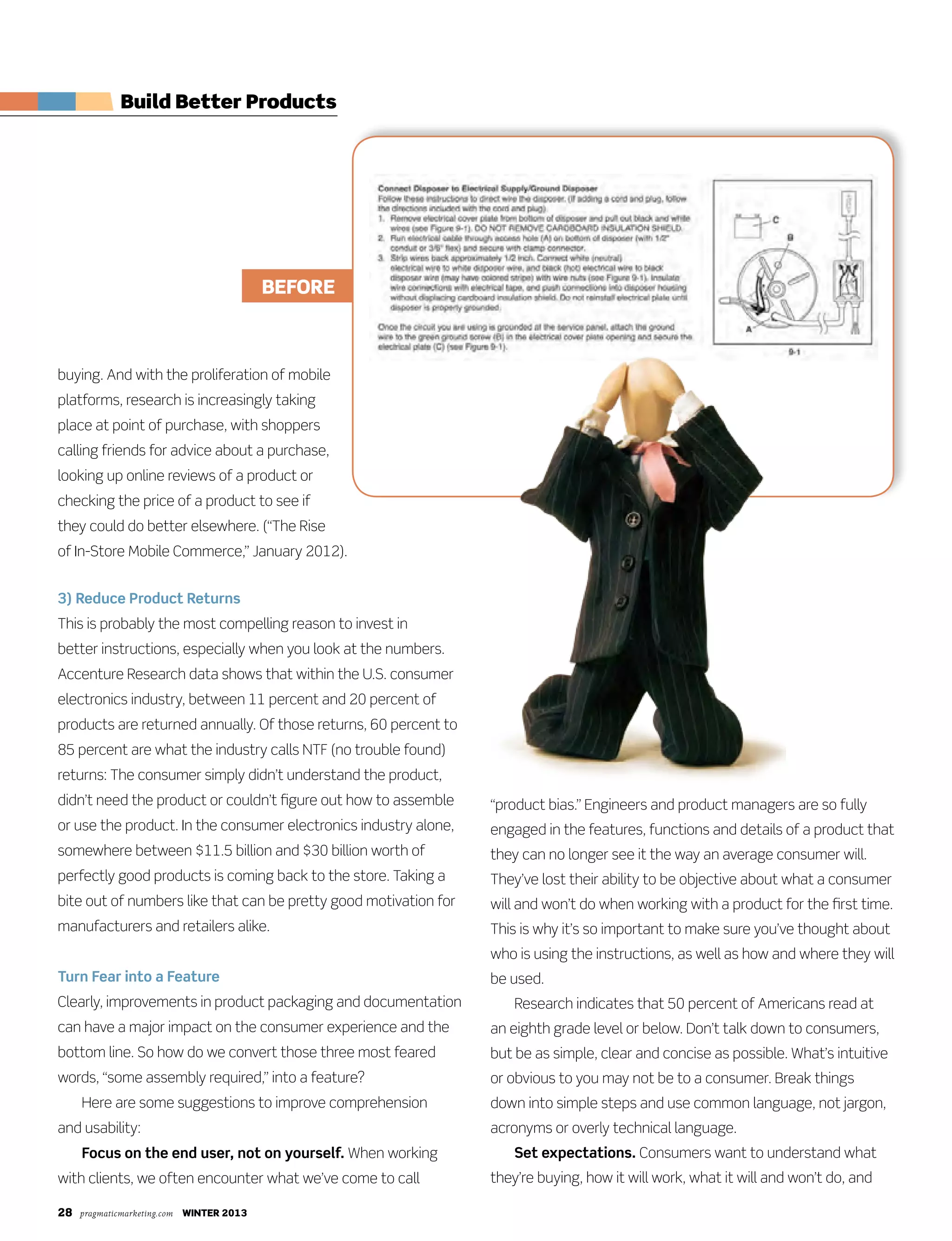
BeFOre
winter 2013 pragmaticmarketing.com 29
after
How do we convert those
three most feared words,
“some assembly required,”
into a feature?
how easy or difficult it will be to install or assemble it. Answer
as many consumer questions as possible up front:
	 •	What’s	in	the	box?	
	 •	What’s	not	in	the	box?
	 •	What	tools	or	additional	hardware/parts	are	needed?	
	 •	How	long	will	it	take?	
	 •	What	do	I	do	if	parts	are	missing?
	 •	Is	there	support	if	I	have	questions?
	 •		Do	I	need	more	than	one	person	to	safely	install
or	assemble?
Consider format and organization carefully. Again,	think	
about	how	and	where	the	instructions	will	be	used.	Safety,	
warranty	and	legal	information	is	extremely	important,	but	it	
can	intimidate	and	put	off	users.	Making	this	information	easy	
to	locate	is	important,	but	you	don’t	want	to	bury	the	assembly	
or	installation	process	in	a	sea	of	legal	copy.	
	 In	considering	format,	keep	in	mind	that	booklets	allow	
you	to	break	information	into	segments	or	sections	that	may	
be	easier	for	users	to	assess,	digest,	understand	and	follow.	
Larger	formats	can	be	used	to	show	a	broader	perspective	
of	the	process	and	are	often	favored	by	goal-oriented	users.
30 pragmaticmarketing.com winter 2013
PM
Build Better Products
Whichever format you choose, ensure you’ve broken the
process down into digestible chunks.
Use more visuals. Studies have consistently shown that
people prefer pictorial instruction to words alone, as they are
easier to understand and remember. Combine clear illustrations
and concise copy, which doesn’t clutter instructions with
ancillary details, to reinforce what’s shown. Some visuals
to include:
	 •			Images	of	what	parts	are	included,	using	consistent
viewing angles throughout
	 •		Clear	labels	on	parts	and	arrows	to	show	how	the
parts move
	 •			Numbers	and	sequencing	to	guide	consumers	through	
the instructions
	 •		Human	forms	demonstrating	actions,	where	needed
for clarity
Wherever possible, also show completed steps to give
users the opportunity to validate that they’ve completed steps
correctly (e.g., here’s what it should look like at this point in
the	process).	Improving	visuals	can	dramatically	improve	user	
satisfaction with instructions.
Consider the entire product lifecycle. If	you’re	going	to	
invest in better product instructions, it makes sense to leverage
that	investment	wherever	possible.	Include	information	that	
the consumer will need throughout all interactions with your
products, including point of sale, packaging, out-of-the-box,
after-sale support, technical service, disposal and recycling.
Everything that improves and enhances the consumer
experience	(and	subsequently	your	brand)	should	be	part	of	
your product development and marketing efforts—including
proper product instructions to give a more positive experience.
Financial gains can also be realized by reducing product returns
and	warranty	and	product	support	costs.	In	a	nutshell,	better	
instructions can help you move product off the shelves, as
well as keep it from coming back—a sure way to improve your
bottom line.
Users of
instrUctions
tend to fall
in one of two
categories:
goal oriented. Skim
instructions and reluc-
tantly reference when and
where needed, but mostly just want to get the
job done. Because of their tendency to skim
instructions, they might benefit from a more
visual approach.
Process oriented. Want to get things done
right, and will meticulously follow instructions
to understand the process. To appeal to their
need for comprehension, provide the reasoning
behind steps in the process that might not
be readily clear.
Users of instructions might have different
orientations, but getting lost in the process or
noticing that information is incorrect or incon-
sistent with what they see or do makes all
of them lose confidence in the validity of the
information. And once they’ve lost confidence,
they are more likely to return a product. Cater
to how people will use your instructions to
avoid that likelihood.
About the Author
Rob Eddy	is	vice	president	of	sales	and	marketing	at	Infograph-
ics, a Knoxville, Tenn.-based graphic design firm that specializes
in technical publications. Prior to that, he held product manage-
ment	and	marketing	roles	at	Haworth	Inc.,	Newell	Rubbermaid,	
Bemis	Manufacturing	and	Novell	Inc.	He	may	be	reached	at	
reddy@infographicsdesign.com.
winter 2013 pragmaticmarketing.com 31
P
ricing is one of the most challenging areas in a company.
It affects so many different departments, making it dif-
ficult to pinpoint exactly who has control.
Often, the product lines set the prices that go on the price
list, but the CEO, CFO or some other executive sets the overall
pricing strategy for the company. And sales negotiates to get
the final price for large customers. It seems like everyone in the
company is involved in pricing.
Changing pricing therefore
takes buy in from many differ-
ent groups who don’t always
have the same beliefs about
what needs fixing. But if you’re
passionate about maximizing
the results of your company’s
pricing strategy, here are a few
tips that can help you spear-
head those efforts.
Engage in one-on-one conversations—a lot of them.
You are not trying to convince anyone of anything, at least at
first. Listen to their issues around pricing and ask questions
like these:
	 •		What	would	you	change	about	the	way	we	price?	
	 •		What	about	our	pricing	is	costing	us	money?	
	 •		How	can	we	quantify	how	much	we	are	losing?	
Many people in the company have similar answers, and this
is	common	ground	you	can	build	on.	Where	you	have	different	
beliefs and assumptions, dig for a deeper understanding. It
often provides new ways to look at the situation.
For example, let’s say you want to start using rebates in
your pricing repertoire. Your finance team adamantly objects,
saying they don’t work. Ask them why. Don’t be challenging,
though; be curious. They have their opinion for a reason—and it
may be right. Perhaps they tried rebates several years ago, and
lost control of the process or were writing checks that weren’t
really deserved. Learning the reasoning can prove useful.
Define common goals. Maximizing shareholder value and
profits are honorable goals, but they aren’t the most helpful
in pushing pricing initiatives. Is there something a level below
that where you can capture the
enthusiasm of all departments
inside	the	company?	For	example,	
in one company we created the
goals of “speed, consistency and
accuracy.” Speed means faster
response time to requests for
quotes. Consistency is making
sure we don’t compete against
ourselves, unintentionally offering
the same customer a lower price. Accuracy means doing sta-
tistical analysis to find the highest price where we are still most
likely to win the business. Speed, consistency and accuracy
made for a clear set of objectives that everyone could support.
Overall, finding high-level goals that are clear, actionable
and non-controversial can help drive change.
Craft the message. Pricing tends to be a quantitative
discipline that looks at win/loss ratios, demand curves and key
performance	indicators.	We	know	statistics,	but	statistics	rarely	
win on their own. Yes, you need to show the size of the prob-
lem, and put a cost on the fix and a dollar value on the return.
But people have a hard time believing these numbers, since
they are so often wrong. You need the numbers, but don’t lead
with them. Instead, lead with a story:
“John Smith had lined up a customer who was buying a million
of	two	different	parts.	We	had	part	A	won	for	sure,	but	we	
Getting the Price Right
Earn organizational buy in on pricing change initiatives.
By Mark Stiving
“you need
the numbers,
but don’t
lead with
them.”
Build Better Products
32 pragmaticmarketing.com winter 2013
weren’t very competitive on part B. The customer kept asking
us to lower the price on B to win the business, but we didn’t
have any more margin to give on that part. John finally con-
vinced the business unit to lower the price on A so the total
price was low enough to win both parts. You probably know
what happened. The customer thanked us for the lower price
on A and still bought B from a competitor. If we had rebates, we
could have locked in both sockets at a nice profit.”
After you have told the story, show the numbers.
It’s good to have several stories; you may need them in
different circumstances. But be aware that executives are not
patient for long stories. Make your stories short and applicable.
Put It All Into Action
Now that you know your message, take a more active approach
and go back to the one-on-one conversations. With any detrac-
tors you’ve found, be nice, tell the story, show the data and
clearly identify your deepest level of disagreement. You won’t
win over everyone, but you may be able to keep them from ada-
mantly opposing your position.
A word of caution: Do not present your story and data in a
large meeting of executives, if you haven’t already talked with
them. Once a disagreement occurs publicly, it becomes more
difficult to change the minds of those who participated. Unfor-
tunately, I’ve done this. Eventually, I won the executive over, but
it would have been much less work had I talked with him one on
one to reach that agreement first.
Finally, here’s a bonus tip:
Don’t take “no” for an answer. If you strongly believe that what
you are doing is best for the company, then “no” simply means
they don’t understand yet. In the world of pricing, if you quit
whenever you hear “no,” you won’t get anything done. Be smart,
be likable and be persistent.
These tips all come from my failures and successes at
getting pricing initiatives moved through companies. But they
PM
Build Better Products
“No” simply means they
don’t understand yet.
aren’t pricing specific. The same methods will likely apply to
any major change program you would like to push through a
company. Remember, the people who can get the hard things
done are the ones that get promoted.
About the Author
Mark Stiving is a respected price strategist with more than 15
years of experience helping companies implement value-based
pricing strategies to increase profits. A speaker, coach and con-
sultant, Stiving has worked with many esteemed companies,
including Cisco, Procter & Gamble, Grimes Aerospace and
Rogers Corporation. His new book, “Impact Pricing: Your Blue-
print for Driving Profits” (Entrepeneur Press, 2011), was written
to further share his expertise. Read more from Stiving on his
blog, www.PragmaticPricing.com. He can be reached at
ms@markstiving.com.
Want to Build Better Products?
Pragmatic Marketing’s Practical Product Management course will help
your entire product organization tune into the market and turn up profits.
Attendees of the course will:
n Discover how to listen to the market to find unsolved problems
n Gain a clearer understanding of product roles and responsibilities
n Learn to filter and prioritize opportunities
Or maybe you would like to improve how you build requirements?
Pragmatic Marketing’s Requirements that Work teaches a universal approach.
Either way, attendees return from class with the tools and templates needed
to get started immediately. Visit www.pragmaticmarketing.com/courses or
call 480-515-1411 for more information.
Learn More!
WINTER 2013 pragmaticmarketing.com 33
D
unkin’ Donuts recently gave
“getting together over coffee”
a whole new meaning with the
launch of its Dunkin’ Coffee Customizer.
The mobile tool let people create their
own coffee drinks and then share those
creations with friends on Facebook. It’s
a great example of how to get folks
interacting, engaging and sharing the
message of your brand.
Marketing communications is now a
two-way street between businesses and
customers, and companies like Dunkin’
Donuts are embracing that. People
engage and interact with the brand,
then share their encounters with 300 to
500 friends. And like that, for free, the
crowd around you has done your brand
marketing for you—and you’ve gone viral.
I call it “crowd branding.”
To be effective, those two-way
communications should make the people
around your brand have a warm, happy
association with it. They shouldn’t see
you as just a broadcast channel on
Twitter, tweeting that you had a summer
cookout at the office or had corporate
news go over the wire today.
Creating a positive association can be
as simple as getting involved with a local
charity and tweeting a message behind
the cause. People who aren’t customers
or would never even be customers might
retweet your message. People live on
their tablets and mobile devices these
days, and you can get nice economy
of scale out of igniting the masses
like that—no matter the size of your
marketing budget.
Another example can be seen in
companies like Groupon or Living Social.
If you broadcast one of their daily deals
and get five people to sign up, they
will give you an incentive of $10 off X
or a free offer. That’s crowd-branding
thinking: Make a small investment in
the crowd around us and give them the
opportunity to broadcast our message.
Crowd branding may be easier for
business-to-consumer companies,
because consumers can be enticed with
a simple deal or monetary incentive. But
while business-to-business companies
don’t have the same opportunity to
give financial incentives, they have the
opportunity to think about other rewards.
At one mobile-application-
management-platform company, we
gave away 20 extra passes we had for
a CIO summit in Boston via a Twitter
contest. We were able to target CIOs
who were not yet customers, and it didn’t
cost us anything. Then, at the event, the
team could meet face to face with the
winners and make the sale. Our contest
winners were awarded free passes to the
event, and we were awarded some of
their business. That’s a win-win.
Crowd branding in the B2B space
might require more steps, but it can be
Crowd Branding
Put your customers to work marketing your products.
BY ZACH SERVIDEO
Sell More Stuff
34 pragmaticmarketing.com winter 2013
more beneficial and often run with much
more success than on the consumer side.
Let’s look at the steps needed to
set up crowd branding and how it might
be used at an online banking company,
which we’ll call Bank X.
Define and align. Set specific
goals at each phase, then verbalize and
hold yourself to those goals—making
sure your efforts align with them. For
example, with the recent hit to the
banking industry’s reputation, our online
banking company wants to generate
publicity and good will about its offering.
It announces that focus internally, so
everyone is dedicated to the same effort
and sets a goal accordingly.
Decide on channels. With so many
channel options available, it’s important
to hone in on what works best for your
initiative. Most importantly, when you
decide on a channel, set an engagement
goal and don’t stop until you achieve
it. Bank X finds it helpful to work in a
space that it is familiar with, and decides
to make the most of its strong Twitter
following. They set a goal to secure 50
new followers and garner 75 original
tweets using the contest hashtag.
Have brainstorming sessions.
Once you know your goal and the
channels to broadcast the messages
through, begin brainstorming. Make sure
it is done in a comfortable environment
where participants don’t fear being
judged. For Bank X, this leads to a one-
week contest where its small-business
customers submit the best ways they’ve
reallocated savings they’ve gotten from
the company’s product. That generates
stories that are beneficial to the brand,
with customers spreading a great
message with examples like “we used
that money we saved to have a summer
outing” or “we went on a harbor cruise.”
Find a partner, if necessary.
Partnering with another company
can give your effort more value in the
industry or the channel. It can also
provide you with resources you don’t
have access to. For example, if your blog
doesn’t carry enough weight, anchor
the effort by partnering with an editorial
entity. Be strategic in how you set your
goals here. Several publications might
Sell More Stuff
winter 2013 pragmaticmarketing.com 35
be interested in this sort of partnership,
but prioritize which publications are
most important to your customers
and hammer out the details with the
reporters, asking, “What would be of
interest to you?” In the case of Bank
X, we have an advantage as media are
always looking for customer stories. We
partner with Online Banking News, where
they love to hear how small businesses
are using Bank X technology to save
money and then reinvesting that money
in their staff for a happier work force.
We also use the editorial partner
to judge the entries, so we’re
not judging our own customers.
Make the most of the
exposure. Strike while the iron
is hot. Once your effort has
launched using the main channel
you have chosen, look at ways
to maximize exposure in other
channels.
For Bank X, to go even more
viral and increase the crowd
branding, it requires participants
to tweet with a specific hashtag
once they submit their case
studies. Once the Online Banking
News editors decide on a top 10
from the entries, they put it to
a public vote. The finalists’ job—
whether on Facebook, Twitter or
however they want to do it—is to
ask people to vote. At the end
of three days, we tally the votes,
and the top five win.
Winners are featured on the Bank X
blog and in Online Banking News. It’s a
great customer story for Online Banking
News, and a way for the top five to get
the word out about their companies.
You’ve created an event that benefits
everyone, and generates nice publicity
and buzz around your brand—as well as
the good will you were seeking. When the
story is live, Bank X also can track which
customer leads came from reading it.
The results of your crowd-branding
effort should tie back to the overall
business goals of the company. If your
crowd-branding initiative doesn’t drive
your business forward, it needs to be
redesigned. Period.
There is a lot involved in the crowd-
branding process to ensure the end goal
is met. But the returns can be huge.
In the case of Dunkin’ Donuts, I
created an iced coffee, and so did my
brother, little sister and about 500
people in the first half hour that post
went up. We were all creating mini ads
and sharing them virally with friends for
Dunkin’ Donuts for free.
It’s brilliant when it works like that,
and it’s a great demonstration of the
constant innovating and reinventing of
the wheel that is such a big part of this
marketing game.
About the Author
Zach Servideo has supported public
relations, marketing and social media
initiatives across a broad spectrum of
private and publicly held companies,
as well as provided strategic business
counsel to a wide range of technology
startups. Having been a successful
part-time media consultant while
working at large public relations
agencies, he established his own tech
media consultancy, Servideo Media
Consulting LLC. He may be reached at
servideo13@gmail.com.
PM
Want to Sell More Stuff?
Pragmatic Marketing’s Effective Product
Marketing course shows you how to gain
a deeper understanding of your buyers to
create marketing plans and tools that work.
Learn how to align your marketing strategy
with your organization’s goals and to
effectively measure and report the impact
of your programs on the bottom line.
Or perhaps you are preparing to launch
a new product? Product Launch Essentials
shows you how to define effective launch
goals, identify and prioritize launch
strategies, assess organizational readiness
and measure results.
Visit www.pragmaticmarketing.com/courses
or call 480-515-1411 for more information.
Learn More!
36 pragmaticmarketing.com winter 2013
B
oard members, investors and other
key stakeholders are not “out to
get you” as product professionals. Yet
sometimes, interactions with them lead
to that perception.
Members of a company’s board or
investors really want the company to
succeed. Your best chance of success
is to communicate with them in their
language and in a way that fosters that
good will. So how do you do that?
Power of Personas
Product managers and marketers
often create personas to represent the
types of people who buy and use their
products. A persona provides insight,
enabling clearer and more targeted
communications.
So why not use the same technique
for board members, investors and
other key stakeholders? As a product
professional communicating to board
members and investors, the intent is
to inform and sell—so a buyer persona
makes sense. To build the persona, ask
the following questions:
	 •				What	are	the	key	initiatives	for	this	
board or these investors?
	 •				How	do	these	individuals	define	
success?
	 •		What	obstacles	do	they	see?
	 •				How	does	my	proposal	address	
perceived barriers for the business?
Developing personas can be the
foundation for better communications
with investors and other stakeholders,
and it ensures they are universally
understood within your company.
Stay Current
Consider what’s happening to them of
late. Think of what environment they are
living	in.	What	are	the	factors	that	they	
would be concerned about? Obviously,
they care about the health and well-
being of the company. But they’re also
concerned about the broader business
landscape, because that affects the
viability of an investment.
Board members usually focus on
more than just one company. So they’re
looking for trends that could be applied
across the portfolio of companies they
interact with.
Keep It Simple
As for the medium for the communica-
tions, the universal tool that glues all
of us together is PowerPoint. It has
become the de facto way that we
communicate ideas.
I believe in adhering to venture
capitalist Guy Kawasaki’s 10/20/30 rule.
Stick to no more than 10 slides, present
for no more than 20 minutes and make
sure you use a font no smaller than
30 point.
	 How	many	drawn-out	presentations	
have you sat in, and wondered why the
presenter was getting down to this level
of detail for this audience?
Investors and board members are
very accomplished and usually attuned
to what’s going on around them. They
hear a lot, see a lot and are asked
to make decisions about a lot of
different things—so they can be
short on time and seem impatient.
Product professionals like to tell
everybody everything about what’s
going on with their products. It’s
difficult for those who don’t live day-
to-day with your products to keep
up. So, know how to communicate
just enough information. Practice
speaking in terms of market
problems and their impact, viable
solutions to those problems and
their potential results. You should
also include the risks of either
addressing those problems or not
addressing them. Your stakeholders
will be better informed about how to
provide support and make decisions.
You Are on the Same Team
Again, it’s important to remember
that the board member/product-
professional relationship is not
adversarial, and these people
Earn Better Returns on
Investor Relationships
By mike smart
Lead strategically
winter 2013 pragmaticmarketing.com 37
truly want to help. Many of them
have operating experience, so they
understand what it means to run a
business. Because they don’t have an
operating role, it can be frustrating for
them to see how something can be
done, but not be in a position to do it.
It’s important to define specific
things that you want from them—not
just their money, but also what you
want their role to be. “Yes, I want you
to approve my proposal or write me a
check, but I’d really like you to help me
identify other resources or network into
other places that might help accelerate
our activities.” They usually know people
who know people.
Engaging board members at
this level is an important part of
communicating more effectively with
them. Help them to help you and your
relationship will be about so much more
than a “go/no go” or writing a check.
About the Author
Mike Smart brings more than 25
years of hi-tech industry experience
in a variety of leadership roles to
the business. He has successfully
consulted with technology companies
such as NetApp, VMware, Autodesk,
BigMachines, MRI Software, P2 Energy
Solutions, MicroEdge, and SirsiDynix.
Prior to founding Egress Solutions Inc.,
he served in leadership and executive
roles at Pragmatic Marketing, Nsite
(now SAP), Go-Remote (now iPass), and
Tandem Computers (now HP). He can be
reached at msmart@egresssolutions.
net. Guy KawasaKi’s
top 10 topics
venture capitalists care about:
Problem
Your solution
Business model
Underlying magic/
technology
Marketing and sales
Competition
Team
Projections and milestones
Status and timeline
Summary and call to action
Source: Guy Kawasaki’s blog,
“How to Change the World.”
PM
38 pragmaticmarketing.com winter 2013
E
arly in his career, a company
president worked for an
organization where product
managers did demos and answered
product questions. He later moved
to a very large European technology
company, where the product
managers owned the profit and
loss, ran a line of business, were
responsible for hundreds of millions
of dollars in revenue and answered
to senior management.
He was surprised by how
vastly different the two were
and wondered how these
could possibly be the same
people. They weren’t. There
are really two models that
are prevalent when we talk
about people in product
roles. One is the profit-and-
loss business leader and
strategic player; the other is the product expert that answers
the questions and supports the field.
Often, general management actually wants product teams
to be strategic, to plot direction and to own the profit and
loss. But it’s difficult to manage the P&L, when they don’t have
control of the “P” or the “L.” They don’t own the channel, are not
approving transactions, are not the revenue generators and
certainly have limited accountability for costs. That’s a difficult
position to be in. It’s easier to simply say your product people
are walking sets of documentation, but that limits
their value.
Clearly, the profit-and-loss business leader role is held with
greater regard as part of the leadership group, but how do you
get your product team into that role?
One answer might come from looking at the sales force.
Why do executives put so much credence into the direction
and advice given from the sales force? One would argue that
sales has a seat at the table, because that’s where revenue
comes from. A look around the business, however, shows that
revenue comes from support, consulting and a lot of other
places too—yet they don’t have the same kind of impact as
our channel organizations.
Elevate Your Product Team
Boost your product team’s credibility by providing them time in the market.
Lead Strategically
By Rich NutiNSky
winter 2013 pragmaticmarketing.com 39
The reason they have the influence is that they are the
ones who:
	 •		have	the	market	data
	 •		face	the	competition	
	 •		hear	from	prospects	and	customers	
	 In	many	organizations,	the	people	that	are	out	there	asking	
questions	are	exclusively	on	the	sales	force.	And	that	market	
interaction	translates	to	credibility	and	to	insight.
	 To	elevate	product	teams	in	the	eyes	of	the	business,	
you	have	to	give	them	access	to	that	same	kind	of	market	
interaction.	It’s	important	to	get	outside	of	the	building	to	
become	the	expert	on	what’s	going	on	in	the	market.	By	having	
that	market	knowledge	and	expertise,	product	teams	have	a	
currency	that	is	very	usable	inside	the	business.	
	 With	that	credibility	and	understanding,	they	can	start	to	
talk	about	business	issues—instead	of	just	product	issues.	
They	can	start	to	talk	about	how	to	do	things	like	grow	revenue,	
increase	market	share,	stave	off	competition,	identify	new	
areas	of	opportunity	and	make	strategic	shifts	in	technology	
or	target	markets—all	of	the	things	that	are	really	required	at	a	
management	level.	
	 When	product	organizations	make	that	leap	from	being	
reactive	support	organizations	to	being	proactive	and	
empowered	by	market	knowledge,	the	entire	role	changes	in	
the	company.
	 For	that	company	president	I	spoke	about,	seeing	how	much	
value	a	business-savvy	product	organization	brought	to	the	
company,	he	vowed	that	he	would	always	empower	his	product	
managers	to	be	business	contributors,	not	just	support	people.	
	 His	story	struck	a	note	with	me	about	how	differently	
companies	treat	the	product	management	role.	Product	
organizations	do	best	by	moving	their	focus	from	being	product	
centric	to	being	market	centric	and	immersing	their	teams	into	
the	market.	And	product	execs	play	a	critical	role	in	making
this	happen.
	 We	must	ensure	that	our	teams	have	the	opportunity,	
the	time	and	the	budget	for	travel,	industry	events,	research	
and	being	engaged	in	blogs	and	discussions.	And	we	must	
incentivize	them	with	metrics	that	drive	compensation	and	
bonuses.	Typically,	companies	give	the	plaque	at	the	annual	
meeting	to	the	best	sales	support	resource	in	the	building	who	
helped	close	the	most	deals.	Where’s	the	plaque	for	the	person	
who	immersed	themselves	in	the	market	and	brought	back	
the	best	market	information	to	drive	the	company	forward?	
Recognition	should	be	based	on	market	interaction,	and	not	just	
internal	support.	
	 Provide	that	kind	of	management	endorsement,	direction	
and	enablement	and	then	measure	it,	review	it	and	give	the	
people	the	tools	and	the	knowledge	they	need	for	continued	
growth.	Then,	hold	them	accountable.	
	 When	I	ran	a	company,	I	wanted	to	elevate	my	product	
teams	beyond	doing	sales	demos.	So	when	my	product	
managers	said	they	were	invited	by	an	industry	group	to	sit	on	
an	expert	panel	at	their	national	convention,	I	thought,	“Now	
we’re	getting	somewhere.”	
	 When	your	people	are	considered	experts	in	the	industry	
like	that,	you	have	developed	a	valuable	asset—one	that	can	
be	leveraged	internally	for	strategic	leadership.	Giving	them	
the	opportunity	to	get	out	into	the	market	helps	them	become	
those	experts.	
About the Author
Rich Nutinsky	is	an	instructor	at	Pragmatic	Marketing,	with	
more	than	20	years	of	experience	in	the	software	industry.	
He	has	launched	several	successful	software	products	using	
the	Pragmatic	Marketing	Framework.	Prior	to	joining	Pragmatic	
Marketing,	Rich	served	in	various	product	management	
positions	for	companies	including	Arasys	Technologies,	
where	he	was	vice	president	of	product	management	and	
development.	He	has	provided	consulting	services	to	market	
leaders	such	as	Microsoft,	AT&T,	DuPont,	NEC,	GE	and	Siemens,	
working	with	senior-level	executives	to	improve	their	product	
strategy,	product	management,	and	marketing	processes.	He	
may	be	reached	at	rnutinsky@pragmaticmarketing.com.
PM
Want to Lead More Strategically?
Pragmatic Marketing’s Executive Briefing course provides executive
teams with an understanding of what it means to be tuned in to the
market and the strategic role that product management and marketing
play in this effort. Learn to increase revenue, implement real change,
prioritize for impact and stop the finger pointing—all in this half-day
interactive course.
With Pragmatic Marketing’s Action Planning Workshop, an experienced
instructor will come to your office and facilitate a working meeting to
help your team implement the Pragmatic Marketing Framework.
Your team will learn to identify an owner for every activity, establish a
baseline and prioritize activities to maximize impact and get a jump
start on being market-driven.
Visit www.pragmaticmarketing.com/courses or call 480-515-1411
for more information.
Learn More!
A PrAgmAtic APProAch
Put this issue’s ideas into action.
Know
Where You’re
Headed,
Before You Go
Discover the market
problems you need
to solve, before
doing anything else.
Jim Foxworthy
Use More
Visuals
Provide picto-
rial instructions for
your products to
increase usage and
lower return rates.
Rob Eddy
Offer a
Workaround
People who ask
for complicated
features are usually
equipped to handle
long or tedious
workarounds.
Don’t be afraid to
provide them.
Cindy Alvarez
Don’t Accept
“No”
Keep pushing for
the pricing strate-
gies you believe in.
Mark Stiving
Empower
Sales with
Knowledge
tell sales what
problems a product
solves and how it
solves them as part
of product training.
Steve Harper
Speak
the Same
Language
with Finance
talk in numbers
and net benefits to
justify marketing
budgetary needs.
Marina Guzik
Talk Net to
CEOs
Don’t go through
every little detail;
give cEos the op-
portunity to delve
deeper as needed.
Kent Petzold
Start Crowd
Branding
Look for ways to
put your audience
to work marketing
your products and
company.
Zach Servideo
Build
Investor
Personas
customer personas
provide insight and
enable clearer and
more targeted
communications;
the same technique
is helpful with
investors.
Mike Smart
Get in the
Market
Empower your
product teams to
be proactive by
providing them time
in the market.
Rich Nutinsky
page7
page30
page13
page32
page20
page33
page22
page36
page24
page39
40 pragmaticmarketing.com winter 2013
Sign up for your free
subscription, delivered quarterly via email, at
pragmaticmarketing.com/subscribe.
Get your entire team on the same page
with our market-driven framework.
You may not actually start holding
hands and singing together after
our training, but you will start
working together more efficiently
and effectively.
Pragmatic Marketing’s courses
provide clarity on roles and
responsibilities, as well as the skills
and tools needed to execute those
roles successfully. So, whether you’re
working with development to build
the next great product, or with sales
and communications to sell it, we
have the course for you.
Your
kumbaya
moment awaits.
Visit www.pragmaticmarketing.com or call 480.515.1411 today.
Practical Training.
Proven Results.
Practical Product Management
Requirements That Work
Effective Product Marketing
Product Launch Essentials
Discover a proven
methodology and
actionable toolset to
tune in to the market
and turn up the profits.
Pragmatic Marketing
courses help technology
companies create and
deliver products people
want to buy. So, whether
you are responsible for
determining what should
be on the shelf or how to
make it fly off the shelf, we
have a course for you.
Use market-focused
prioritization and
streamlined documentation
to deliver the right
products to market.
Design, execute and
measure high impact
go-to-market plans for
your products.
Plan and execute
successful product
launches with our
proven processes
and tools.
For more information about these courses or our executive offerings, visit
www.pragmaticmarketing.com or call 480.515.1411 today.

Pragmatic Marketer Winter 2013

  • 1.
    t h ep r o d u c t m a n a g e m e n t a n d m a r k e t i n g a u t h o r i t y winter 2013 View from the top: how to talk to ceos elevate Your product team confessions of a sales Guy crowd Branding 20ways to improve customer communications
  • 2.
    welcome the product management andmarketing authority Founder / ceo Craig Stull editoriAL director Rebecca Kalogeris editor Linda Zid designer Norman Wong speciAL projects Sarah Mitchell The Pragmatic Marketer™ 8910 E. Raintree Drive, Scottsdale, AZ 85260 Interested in contributing an article? PragmaticMarketing.com/submit No part of this publication may be reproduced, stored in any retrieval system, or transmitted, in any form or by any means, electronic, mechanical photocopying, recording or otherwise, without the prior written permission of the publisher. Other product and/or company names mentioned in this magazine may be trademarks or registered trademarks of their respective companies and are the sole property of their respective owners. The Pragmatic Marketer is a publication of Pragmatic Marketing, Inc., and Pragmatic Marketing, Inc., shall not be liable regardless of the cause, for any errors, inaccuracies, omissions, or other defects in, or untimeliness or unauthenticity of, the information contained within this magazine. Pragmatic Marketing makes no representations, warranties, or guarantees as to the results obtained from the use of this information and shall not be liable for any third-party claims or losses of any kind, including lost profits, and punitive damages. The Pragmatic Marketer is a trademark of Pragmatic Marketing, Inc. Printed in the U.S.A. All rights reserved. ISSN 1938-9752 (Print) ISSN 1938-9760 (Online) Since 1993, Pragmatic Marketing has conducted product management and marketing training for 7,000 companies on 6 continents. Our team of thought leaders produce blogs, webinars, podcasts and publications that product profession- als around the world turn to for industry insights. chief’s letter W elcome to the first issue of the relaunched Pragmatic Marketer magazine. Last year, the number of people who have taken Pragmatic Marketing courses reached a milestone 85,000—demonstrating the growth of product management and marketing as a field in the 20 years we’ve been around. And with that rapid growth and constant evolution, industry professionals need a centralized resource to turn to for best practices, case studies and information about their roles. Our magazine had already built a reputation as an industry resource, and we felt the time was right to invest in relaunching it. Our hope is that this magazine will get important conversations started in the product management and marketing community, so it seems fitting that our inaugural issue focus on the world of communicating. We lead with an article about a challenge everyone faces: how to work more effectively with customers. Cindy Alvarez offers you 20 ways to get the ball rolling. We follow with tips and best practices for communicating with everyone from CEOs and shareholders to finance executives and sales guys. We’ve introduced three new recurring sections—Build Better Products, Sell More Stuff and Lead Strategically—designed to offer best practices to help you in your day-to-day roles and to address the topics that you’ve told us matter most to you. We hope you enjoy our magazine, and please feel free to communicate with us at editor@pragmaticmarketing.com. We welcome feedback, questions or ideas for what you’d like to see in future issues of Pragmatic Marketer. We want to be that trusted resource that you look forward to every quarter. Sincerely, Craig Stull, Founder/CEO
  • 3.
    features departments 20 Ways toImprove Customer Communications by Cindy Alvarez Turn understanding the customer into a competitive advantage Confessions of a Sales Guy by Steve Harper An insider’s look at how product management can work more effectively with sales Communicate by the Numbers with CFOs by Marina Guzik Three keys to turning the “purse holders” into partners View from the Top by Kent Petzold Insights into how to communicate effectively with CEOs Bits & Pieces Grow Your Influence/Resolutions Roundtable/Travel Tips for Road Warriors/Rules for Product Success Ask the Experts How do I start my new product role? Build Better Products Some Assembly Required by Rob Eddy Getting the Price Right by Mark Stiving Sell More Stuff Crowd Branding by Zach Servideo Lead Strategically Earn Better Returns on Investor Relationships by Mike Smart Elevate Your Product Team by Rich Nutinsky A Pragmatic Approach Put this issue’s ideas into action 3 7 26 33 36 40 10 18 21 23COnTEnTS | vOlumE 10 | ISSuE 1 | 2013 Sign up for your free subscription, delivered quarterly via email, at pragmaticmarketing.com/subscribe. WINTEr 2013 pragmaticmarketing.com 1
  • 4.
    Learn to managethe tactical to make time for the strategic. Pragmatic Marketing provides practical, actionable training and a comprehensive toolset for product management and marketing teams. You’ll learn how to use market facts to drive strategic decisions and to minimize the “fires” that can consume your day. All of which means you can start making a bigger impact on your business and your products immediately. Don’t be trapped by tactical demands. Learn how to get free at www.pragmaticmarketing.com or by calling 480.515.1411. BreAk free. Briefing Practical Product Management RequirementsThat Work Effective Product Marketing Product Launch Essentials Action
  • 5.
    winter 2013 pragmaticmarketing.com3 D uring normal conversations, either at home or at work, I often find that the reply that comes to mind is actually a quote from a movie. And more often than not, that movie is “The Princess Bride.” You may have this experience yourself. Perhaps in a meeting, listening to the latest version of your organization’s strategy, your buddy turns to you and asks, “Think it will work?” And all you can think is: “It would take a miracle!” Or your boss tells your team that the organization must have “focus,” and you think, “You keep using that word. I do not think that word means what you think it means.” I’ve applied eight of my other favorites to the product management and marketing world. See if any of these situations sound familiar to you: 1. “You rush a miracle man, you get rotten miracles.” The lead engineer says the product will miss the release date by six months. You may want to strangle this person, but keep this quote in mind. You’ve got to collaborate with your counterparts in development, because what they do isn’t immediate. It’s not throwing a light switch. 2. “We are men of action. Lies do not become us.” Telling the truth, especially when it’s not popular, is one of the most challenging things to do in business or at home. We know what we believe, but do we have the courage to say it? Even when the audience is the president of the organization? It’s difficult to strike that balance between telling the truth and rocking the boat. At the end of the day, though, you have to look yourself in the eye and know you did what was right, that you spoke what you believed was true. And hopefully, you can make it through without your boss saying, “Do you want me to send you back to where you were? Unemployed, in Greenland?” 3. “I wonder if he is using the same wind we are using?” Competitive threat is a constant part of any successful business. If you are successful, there is always someone trying to take your market share away from you. You don’t want to obsess about the competition or build a product that mirrors what the competition has. But by the same token, you’ve got to pay attention to them. You’ve got to make sure that if there is a new wind out there, you get that in your sails too. 4. “You know how much I love watching you work, but I’ve got my country’s 500th anniversary to plan, my wedding to arrange, my wife to murder and Guilder to frame for it. I’m swamped.” Ever have one of those days when you just cannot seem to get all the work done? Product management and marketing are jobs where you’re just not going to finish everything. There are no clear priorities, and you have got to be really good at picking the things that you’re going to work on and letting the other ones hit the floor. 5. “Life is pain, Highness. Anyone who says differently is selling something.” Many years ago, I decided that the word “fair” should be stricken from the dictionary. If you expect life “The Princess Bride”: Movie or Mini-MBA? Bits & Pieces
  • 6.
    4 pragmaticmarketing.com winter2013 to treat you fairly, you are only setting yourself up for disappointment. Move past those “unfair” situations as quickly as possible, because the longer you cling to them, the more time you’re wasting. The lessons you’re learning from what’s unfair today could be something you can apply somewhere else—and that’s okay. 6. “It’s not my fault being the biggest and the strongest. I don’t even exercise.” Do you work beside supermarketer? That’s the fellow employee who always manages to work on products that exceed their revenue goals; who gets invited to every sales team quota club; and who has the best hair, the best clothes and the nice car. There’s always going to be someone else who knows things that you don’t. 7. “Ha ha! You fool! You fell victim to one of the classic blunders—the most famous of which is ‘never get involved in a land war in Asia’—but only slightly less well-known is this: ‘Never go against a Sicilian when death is on the line!’” Try as you may, there is always one more business rule, one more experience that you haven’t had yet. And it seems as if the rule you need today is the one you don’t know. There’s always more to learn. Quotes 6 and 7 together, knowing that there’s always someone bigger and stronger and that there’s some classic blunder that I’ll always commit, keep me humble—and sometimes you need that. 8. “Sonny, true love is the greatest thing in the world, except for a nice MLT—mutton, lettuce and tomato sandwich—where the mutton is nice and lean and the tomato is ripe. They’re so perky! I love that.” At the end of the day, most stuff doesn’t matter. When emotions are high, and the release is late and everyone is screaming at each other, the successful marketer keeps perspective. Because life is not about this release or that customer or that deal. Life is much more, but is often as simple as a delicious sandwich. Thanks for reading to the end. Good night. Good work. Sleep well. I’ll most likely kill you in the morning. –Jim Foxworthy The Wiener’s Circle www.wienercircle.net Not for the faint of heart, the char dog you order here comes with a side of verbal abuse from the employees, who have been described as “putting the ‘cuss’ back in customer service.” The hot dogs aren’t bad either. The Field Museum www.fieldmuseum.org If you’re traveling with your little ones, consider “Dozin’ with the Dinos” at Chicago’s Field Museum. Bring your own sleeping bag and play games from around the world while seeing live insects—all in the shadow of the 14-foot-tall Sue, the largest, best-preserved Tyrannosaurus rex specimen ever found. Green Mill Cocktail Lounge www.greenmilljazz.com Not only is the Green Mill a fun place to hear jazz and poetry readings, but you can also check out gangster Al Capone’s favorite booth there. Rumor has it there’s an underground network of tunnels that Capone used to get in and out of the building. Cloud Gate at Millennium Park www.millenniumpark.org One art-related must is Cloud Gate, a three-story steel sculpture from artist Anish Kapoor. It reflects and distorts the city skyline, and you can walk around and under it. Plus where else can you visit a sculpture with such a unique shape that natives affectionately call it “the bean”? Travel Tips for Road Warriors Traveling To ChiCago? Sure there’s culture, history and such. But what if you just want to get yelled at while ordering a hot dog? Yup, they’ve got that too. Here are a few odds and ends to check out in the Windy City. Bits & Pieces
  • 7.
    winter 2013 pragmaticmarketing.com5 Pragmatic Marketing’s Golden Rules 1. An outside-in approach increases the likelihood of product success. 2. The answer to most of your questions is not in the building. 3. We are all pragmatic marketers. 4. If product management doesn’t do its job, other departments will fill the void. 5. The building is full of product experts. Your company needs market experts. 6. Win/loss should be done by someone not involved in that sales effort. 7. Your opinion, although interesting, is irrelevant. 8. Positioning is the first step of execution. 9. Positioning focuses on the problems you solve. 10. Create a separate positioning document whenever the buyer’s problems are different. 11. Name the product after positioning is finished. 12. Only build solutions for problems that are urgent, pervasive and that the market will pay to solve. 13. Every “product” needs product management and a business plan. 14. Map your sales process to the buying process. 15. Marketing moves every deal forward. Sales moves each deal forward. We are all pragmatic marketers. Resolutions Roundtable “This year, I will spend more time at both extremes of the job: more customer face time—as opposed to phone calls and webinars to better understand users and buyers—and more time heads down analyzing data to better understand and improve the sales process.” - Saeed Khan, founder, www.onproductmanagement.net blog “Get my company speaking opportunities at tradeshows.” - Jennifer White, director of marketing, Network IP “Help my team and company to become more Agile.” - Victor Ortiz, director of product management, verticals & commerce, Digital First Media “Make a greater contribution to corporate and product strategy in the coming year.” - Maya Markovich, director of product marketing, Daegis “Get my backlog groomed out and increase the velocity with which we knock items off it.” – Eban Tomlinson, product manager, ShipConstructor “Make time to use my data better.” - Kam Wa Tang, product marketing specialist, Yesmail Interactive - Jon Zucker, senior product marketing manager, Imperva “Be curious.” Pragmatic Marketer asked: What is your professional New Year’s resolution?
  • 8.
    6 pragmaticmarketing.com winter2013 88% 86% 85% 79% 75% 52% 41% 54% 69% Analyst reports Live events/conferences Blogs Corporate websites Social networking sites Broadcast news Twitter Suggestions from peers Newsprint and their online components Worldwide enterprise IT spending is forecast to total $2.7 trillion in 2013, according to Gartner Inc. So how do you plant your stake? influence the influencers. The above were considered valuable sources of information in determining which vendor to select for large B2B purchases.(Source: Hill & Knowlton Strategies survey) Know who your customers turn to grow your influence Bits & Pieces
  • 9.
    winter 2013 pragmaticmarketing.com7 Ask the Experts Y ou should always start with Market Problems. You wouldn’t get in a car and start driving without knowing where you’re trying to get to. And it’s the same thing for anyone starting a new product role. It’s very easy, no matter what your title is, to get caught up in executing activities and tasks and not thinking strategically. There’s always somebody standing in your doorway, saying: When can you get this roadmap done? Can you help with this sales call? Or can you go to this event? The people who get into product jobs are can- do people. They never say no, they just go and respond. But when it really comes down to it, no matter what task you want to pursue, you have to start with Market Problems. First and foremost, you must understand what problem you’re trying to solve, and then use that context for all other activities. If you do that, you’re golden. To get to those Market Problems, one of our favorite sayings around Pragmatic Marketing is: “Your opinion, although interesting, is irrelevant.” It means that you have to leave the building and listen to the market, rather than just dreaming stuff up. You discover those problems in the market by interviewing your customers and potential customers. Then, you dig deeper to find out how common those problems are in the market. All of the activities we include in our Pragmatic Marketing Framework, from strategy through execution, are important. But in our courses, we drive people to think about what problems they are trying to solve first. Then the rest of it is more powerful, and the pieces will tie together more cleanly. And your execution will be smoother, because you stopped and thought about it before getting on the road. Do you have a question for our experts? Send us an email at experts@pragmaticmarketing.com. Ask the Experts: It seems like there is so much to learn in my new product role. Do you have any advice on where to start? Jim Foxworthy, President Pragmatic Marketing PM
  • 10.
    Let the marketbe your guide. At the heart of Pragmatic Marketing’s methodology is a simple concept: Before you can build and deliver products your market will buy, you must tune in to the market, the personas and their problems. Learn to leverage market facts for everything from requirements and roadmaps, to marketing plans and sales tools, with Pragmatic Marketing’s complete course catalog. Visit www.pragmaticmarketing.com or call 480.515.1411 today. Briefing Practical Product Management RequirementsThat Work Effective Product Marketing Product Launch Essentials Action
  • 11.
    pragmatic marketer featuresection 10 18 21 23 20 Ways to Improve Customer Communications Confessions of a Sales Guy Communicate by the Numbers with CFOs View from the Top
  • 12.
    10 pragmaticmarketing.com winter2013 { thecommunicationissue } to improve Ways customer communications Turn understanding the customer into a competitive advantage. By Cindy AlvArez How many times Have you built a product, only to find out that nobody was interested in the features you painstakingly included? Even when you asked your customers what they wanted beforehand? Ultimately, it’s not just about talking to your customers that gives you the information you need, it’s about talking to them the right way. Here are 20 tips to help you communicate with your customers better, so you can more efficiently deliver the products they actually want—not just what they say they want. 20 ways
  • 13.
    1Have Them TellYou How It Would Make Their Lives Better Customer requests are usually just one or two sentences, devoid of context. How can you possibly gauge the urgency of a request without a real conversation? Which one of these would you place a higher priority on? 1. “PLEASE add validation checking for email addresses! If you give people a text field to type in their email address, there is nothing stopping them from entering a bunch of junk! This is not a good user experience, if they are expecting us to have their contact info!” 2. “Would it be possible to offer support for text versions of your email notifications? Right now we are only receiving them in HTML.” The first person used the phrase “not a good user experience” with multiple exclamation points, indicating urgency. But when I emailed them to ask how they would benefit from this feature, they talked about how they might want to use our product in the future, if they decided to do a certain marketing campaign. Turns out the requester was just an exclamation- point abuser. The second person, on the other hand, told me about using our survey product to ask customers about bugs or feature improvements and sending responses directly into their customer support’s content management system. The HTML formatting was making the feedback very hard to read and forcing customer support folks to retype long passages every time they wanted to respond. In other words, they were suffering every time they used our product. We made the change within days. And by learning about how they were using our product, we were able to suggest that same use case to other customers. 2Say What Your Product Is For; Say What Your Product Is Against When I worked at a banking technology company, we maintained a fairly active user forum. There was a handful of users who were openly critical of various features. In particular, they kept requesting very complex power-user features that we knew would appeal to a limited audience and incur a big overall usability cost. We kept not building those features; the users kept getting angrier. Finally, I posted a message that said: Look, we are never going to build this feature, and here’s why/here’s our product vision. We hope you’ll stick around as customers, but if you’re looking for a power-user product, we may not be the best choice. I hit “post” and waited for the online fury to begin. But it didn’t. It actually made things better. When we didn’t share our perspective, customers were forced to assume that we were just ignoring them because we were too stupid or incompetent to build the features AN EXCLAMATION-POINT ABUSER.” ThE REqUESTER wAS TURNS OUT winter 2013 pragmaticmarketing.com 11
  • 14.
    12 pragmaticmarketing.com winter2013 they wanted. While we still disagreed, the customers respected that we had a vision (“oh good, you’re not idiots after all”) and appreciated that we were honest with them. 3Have Rules, but Don’t Enforce Them Placing limits on your product has two big potential benefits: 1. Simplifies the user interface to help customers learn it more quickly and thus move to paying you more quickly 2. Enables you to charge more to the subset of customers who need to go beyond those limits But if you set the wrong limits, it can be a hassle to change your code, change your policies and communicate with all of your users. We have used several “unenforced” limits (how many questions per survey, how many reports, how many events)—where we stated that certain limits existed, but did not actually write the code to enforce them. If no one breaks your limits, then they are probably too high or too inclusive. If everyone breaks your limits, then they are probably too low. Once you have actual usage data, you can make a much more educated guess on where to set limits, and then write the code to enforce them. 4Only Build It If You Can Measure It To put this tip another way, if you can’t think of a way to prove that having done this was good for your business, you probably shouldn’t do it. Funnels and metrics are one thing, but product changes fundamentally need to be about revenue. As a person who cares a lot about design, I always want to redesign/improve bits of whatever product I’m working on. I have to ask myself: 1. Will more people buy the product if you make this change? 2. Will fewer people leave us for a competitor product if you make this change? And if I can’t really, honestly, confidently say “yes” or even “probably” to either of those, it usually means I should suck it up and focus on more important changes. 5Tell Them What They Should Do Instead Customers will often ask for something that is actually bad for them—something that will make your product harder to use or make the results less valuable. You shouldn’t build it, but you also shouldn’t ignore them. The right response is to confirm, acknowledge and educate: It sounds like you want to [get specific question answered/ accomplish specific task]. We have seen with other customers that this doesn’t work well, because [reasons, consequences]. What may work for you is to [alternate suggestion]. This would help you to do what you’re trying to do without [consequence]. Here’s how you would get that set up. Here’s an example: It sounds like you want to maximize the number of responses you get to your question about shipping rates. However, we have seen with our other customers that displaying the same survey repeatedly does not increase the rate of thoughtful responses—in fact, they’ve gotten customer complaints about the intrusiveness of the survey and more non-useful responses like “make this go away.’” What may work for you is to ask this question on a more relevant page, such as the shopping-cart page. You will get fewer responses, but they are more likely to be thoughtful, content-rich responses. You’d do this by ... you probably shouldn’t do it.” to prove that having done this was good, if you can’t think of a way
  • 15.
    winter 2013 pragmaticmarketing.com13 6Fake the Functionality I had this brilliant idea that our survey product should support automatically recurring surveys—to run a Net Promoter Score survey automatically every month, for example. But building the automation on the back end and the user interface on the front end would have been quite a bit of effort for something I wasn’t positive customers would use. Luckily, “automation” lends itself very well to manual human labor. I picked two-dozen customers, and sent them individually composed emails (that looked like “real” marketing emails), inviting them to try this recurring survey feature “in beta.” For the four who said okay, I logged into their accounts as admin and set up the survey for them. I then waited one month and sent another email saying that a month had passed, and so we were about to run their survey again. From their perspective, it looked like a true automated recurrence, a feature that they said they wanted to use. But they all emailed back to say: Never mind, I don’t really want this. How can I turn it off? 7Send Your Customer to Your Competitor You know your competition, so you probably know about tools that your prospective customers haven’t heard of. Sure it’s great if it’s your product that makes them happy, but you still get partial credit for being the nice person who told them where they should go. I send people who want to write long-form surveys to a competitor, and a decent number of them have come back months later because we had a good interaction and they’re ready to use our services. A good format: Thanks for wanting to use [ProductName]. Unfortunately, we don’t do [feature], but I think you’ll be able to do what you need with [CompetitorName]. Their product does [feature], and we’ve talked to people who are happy with them. In the future, when you need to do [feature that ProductName can handle], we hope you’ll come back and check us out again! 8Ignore It Until You Can’t My favorite line: “You will have both visionaries and nutcases using your product. It’s very hard to tell them apart.” In other words, if you jump on a feature request the first time you hear it, you may be taking advice from a nutcase. Here’s what happens. You get a request. Wait. If it’s a good one, you will start hearing other people request it soon. Or you can be proactive and casually ask other customers if they have the same problem. (Note: Do not say, “Would you use an automatic cat washer?” Instead, say, “Tell me about how you keep your cat clean.” Problem, not solution.) If no one else requests it, and people don’t respond when you ask them about the problem, you can safely ignore it. 9Offer a Workaround Useful tip: The people who ask for complicated features are usually the people best equipped to handle a long or tedious workaround. Just recently, a customer asked for a way to exclude certain data from our metrics— something we don’t support—but I offered them two potential workaround solutions. Neither was perfect, and both required the customer to write extra code—but they were completely okay with that. I’ve heard people say that offering a workaround is like admitting that your product is flawed. Yes, it is. But you still want them to be able to get value out of it. A good format for this: Unfortunately, our product doesn’t directly support [that thing you want to do]. However, if I understand correctly, you may be able to [briefly describe workaround process] in order to approximate [that thing you want to do]. Here are the step-by-step instructions. Please let me know if this is confusing, or if I am misunderstanding the task you’re looking to do. The advantage is that you can then watch your
  • 16.
    14 pragmaticmarketing.com winter2013 customers using the workaround and get better ideas on how to eventually build the easier, more “productized” way of doing the same task because you’re able to anticipate their needs. 10 Be Less Attractive (to Certain Types of Customers) Each type of customer is demanding in a different way: Corporate/mainstream companies may expect faster support turnaround and more custom attention; power users may expect more complex features; and casual consumers may expect greater ease of use and guided onboarding. Try to do all three, and you will stretch yourself too thin and disappoint your customers. Instead, think of the bright-colored frog whose colors signal, “Hey snake, I’m poisonous, so don’t eat me.” 11Until We Can Do It, Use Us for Free As I mentioned, you will have customers who are visionaries. They can see ahead to things that your product should do. This makes them impatient. You may agree with them—but you’ve seen your schedule and know it’s not going to come in the next month, or the one after that. So you say, “You’re right, we should offer Feature X. In fact, I’m also really eager for us to include that, because I know that right now you are doing [workaround] and that’s tedious. Unfortunately, we’re a small team so I can’t promise that it’s coming in the next month or two. In the meantime, I’ve comped your account.” That’s my way of saying that I hope they will stick around, and that I hope I can ping them again when we’re actually building Feature X. 12Let Some Fish Get Away Related to the previous two, sometimes you will acquire a customer and then realize you’re just not going to be able to make this customer happy. Sometimes they want features that we are never, ever going to build, because they clash with our product vision or will actually hinder our ability to gain customers/monetize. Sometimes it’s our fault: We have some weird bug that really only affects them, and so it’s not worth devoting a ton of time to fixing it. In either case, here’s what you say: Unfortunately, we’re a small team and are not going to be able to accommodate your request/bug fix. I’m sorry we are not providing you with the great experience we want our customers to have. But I’d rather be honest than keep you waiting, and I’ve refunded your subscription fee. You may want to check out [Other Site] or [Other Site]; they may be able to better serve you. I haven’t had to do this often, but I’ve been quite surprised by how well customers took the news the few times I have. I guess the bar for honest communication is so low that even if you give people bad news, they’re glad to hear something true vs. something that just sounds good. 13Build a Simple Application Program Interface (API) Here’s the thing about configuration and customization options: They make power users happy, but they drive away your mainstream customers by cluttering up your interface and making it harder for them to make decisions. Our customers kept asking about configuration that fit their specific needs. I loved that they were so enthusiastic about the product as to want to integrate it into their sites, but knew that adding another dozen options to our already-crowded interface would be a disaster. to be able to make this customer happy.” you’re just not going sometimes you realize
  • 17.
    winter 2013 pragmaticmarketing.com15 I can’t take credit for the solution, though. Our developer Michael told me, “I got tired of hearing about these requests so I just wrote a quick API. Here’s how it works. Customers can write any bit of code around it to control the triggers.” This has worked tremendously well, and the customers are more than willing to write the extra code for the extra control they want. 14Email Us for More Info Early on, I saw that several of our paying customers were marketing agencies, using one account to run surveys for several clients. I hypothesized that we could charge more money to agencies, since they were able to get value on multiple sites (and were probably passing the costs along to their clients). I tested that hypothesis by adding a single “email us” line to our pricing page. I figured that would give me the contacts necessary to do customer development on this segment. But to date, almost no one has emailed about agency pricing. No one cares enough. So not only did we save hours of coding, we even saved hours of customer development interviews! 15Force Customers to Pick a Single Priority I’ve actually used this more as an internal tool. Let’s say you have a bunch of new features you want to build, a bunch of bugs that need fixing and some existing features that should be improved. Your CEO says, “It’s all important. We should be working on all of this.” (This has been the case with every CEO I’ve ever worked with.) So you say, “Here are five choices. If you could only have ONE, because all of our engineers were stranded on a deserted island and could only send us code via messages in a bottle, which ONE would it be?” (Or make up your own story, the funnier the better.) Then that becomes priority No. 1. Repeat with the remaining items, and thus avoid the “everything is highest priority” syndrome—at least a little bit. 16Charge a Ridiculous Amount Usually, if a customer requests something that you don’t want to build or that doesn’t fit with your vision, you can simply offer to charge them an insane amount of money and they will suddenly reevaluate their priorities and decide it’s not necessary after all. But if they don’t come to that decision, that’s a signal you should pay attention. At one company, we had a customer who demanded very extensive changes for Americans with Disabilities Act (ADA) compliance. Saying “no” wasn’t an option if we wanted to keep the customer, but charging what seemed like a ridiculous amount of money was. Surprisingly, they said yes. Actually making those changes was incredibly painful and tedious, but it brought to my attention that the capability was worth way more than we hypothesized. I worked with other product managers to ensure that our requirements included ADA specifications in future releases, and I worked with engineers so they could Subscribe to Like what you see in this issue? Sign up to receive a complimentary subscription to the product management and marketing authority at www.pragmaticmarketing.com/subscribe.
  • 18.
    16 pragmaticmarketing.com winter2013 make certain parts of the code more modular for easier changes in the future. (And we were still able to charge a boatload of money every time someone requested these features.) 17+18Ask for Help. And Be Grateful If people are getting enough value from your product, they are probably willing to contribute some effort to make it even better. But let’s not be totally arrogant here. My customers certainly aren’t walking around all day thinking, “How can I make Cindy’s product better?” It doesn’t occur to them, unless you ask. When the first person emailed to ask if we could provide our survey templates in Spanish, I knew our software would handle the character display. But we didn’t have the language expertise in-house. And for a fledgling product, I couldn’t justify hiring contractors. So I said, “Well, if you’re willing to provide translations, we’ll make them available.” The first guy responded with a three-page document of translated questions. So I set up a quick web page with forms that made it easy to collect line-by-line translations. It also included these instructions: Please feel free to rephrase if any of these questions or answers don’t directly translate well. We tweeted about how awesome it was to get translations and sent effusive thank-you emails out. This created a virtuous cycle: More people volunteering to translate, more thanks, more volunteers, etc. We now have surveys available in 14 languages and a significant non- English-speaking customer base. 19Notify Me When … The feature doesn’t exist yet. You put up a checkbox to “notify me when it exists.” This isn’t always a literal checkbox, but it’s some way of prompting your audience to respond (or not). The month before we initially launched, we put up a “notify me” splash page. When you clicked the “notify me” checkbox, you were taken to a brief survey. This confirmed customer interest, gave us a ton of email addresses and filled in an initial customer profile, so I could contact people for customer development interviews. Instead of completely losing that potential customer, we had another opportunity to win them over if/when we added the feature. 20Play Nice with Others Your customers want to solve their problems. If your product doesn’t do it all, figure out which additional products you can work with to get the job done. Customers frequently ask if we’re going to build a long-form survey platform to complement our current offering. We’re not, but we found that using our tiny survey as a hook was a really efficient way to get people into a long survey. So I wrote up a quick guide showing people how to use our offering together with another company’s. While a formal integration would be nice, a detailed checklist is a good workaround in the short term. The rarest currency in most companies is time, and the biggest risk to time is the uncertainty of having to figure stuff out. A checklist or screencast doesn’t reduce the amount of steps, but it dramatically reduces the number of decisions and “figure-it-outs”—and that makes customers happy. Communicate to Win All of these tips are about communicating with the market—talking and listening to current or potential customers. When your product/company seeks to solve painful problems for customers through these communications, you create better relationships. You’re empowered to ask more questions, and customers are happy to provide you with information in the hopes that it will further diminish their pains. And whether you do it yourself, through offering competitor info or building partnerships, what you’re providing is more likely to go beyond what customers say and addresses what they actually do—and they’ll turn to you next time as their go-to resource. About the Author Cindy Alvarez uses product management, design and user research to turn user experience into a competitive advantage. She’s worked with early-stage startups, medium-sized companies and Fortune 500 companies to make customer-driven development an ingrained part of company culture. She’s currently leading product design and user research for Yammer. She can be reached at cindy@cindyalvarez.com. PM
  • 19.
    80% of PragmaticMarketing’s business comes from alumni referrals. I’ve built my career on what I learned from Pragmatic Marketing. Find out for yourself what the loyalty is all about. Visit www.pragmaticmarketing.com or call 480.515.1411 today.
  • 20.
    18 pragmaticmarketing.com winter2013 Confessions sales Guy An insider’s look at how product management can work more effectively with sales. of a By Steve Harper { thecommunicationissue }
  • 21.
    winter 2013 pragmaticmarketing.com19 Have you ever wondered (or complained) about salespeople? Of course, you have. And at a ProductCamp recently, I was asked to address this dynamic. I started by asking the group of product managers, “What is the biggest frustration you have with sales?” I got a laundry list of the ills, character flaws and foibles of the sales team. Let’s face it, we are not the easiest people in the world. But we do a hard job and we keep the lights on. Here are the top four sales issues that were mentioned: n Salespeople are only concerned with commissions. n Salespeople think that they own the customers. n Salespeople always want what the product doesn’t have. n Salespeople have short attention spans. This is a small subset of the overall rant I got from that group of product professionals. Frankly, as a sales guy, I think they are fair. But why are we sales guys (and ladies) like this? Let me explain the reality of being a salesperson. Driven by Commissions We are intensely concerned with our commissions, because it makes up between 50 percent and 100 percent of our income on a monthly basis. Any given month could be great or lousy, depending on how we do. We also live under the constant threat of losing our jobs. Believe me, as sales professionals, we are generally no more than one or two quarters away from losing our jobs if we do not perform. So if salespeople can sell a bunch of product A, and it is not hard to get installed and has a shorter sales cycle, then that is the product that moves. If a new product comes out and takes hours of training and has a longer sales cycle, we may try it a couple of times, but will likely fall back to what puts money in our pocket and lets us keep our jobs. If that product is yours to manage, it will suck to be you. I know, if only we would get you in front of a few customers or prospects, you could help us. What you don’t know is that we tried that once. Yep. We took a product guy in to our best account, and he totally blew a deal that would have made for a huge commission check. I know it wasn’t you, but we won’t take that chance again. Did this really happen? Maybe. Or maybe I just heard about it from a friend or it is an urban legend. But it is a real fear, and you have to deal with it. After all, salespeople own the customer relationship, which brings me to my next point. Customer Relationship Owners Yes, sales owns the customer relationship. Maybe we don’t own the actual customer, but the salesperson is the face of the company. That customer may even have come over from a competitor, simply because the salesperson joined your company. In some cases, they are more loyal to the salesperson than the product. It is that relationship that is the “value” that got the salesperson hired. Features that Aren’t There In many cases, customers would buy more or buy now—if only the product had that one single feature that isn’t there. Sometimes that is smoke being blown, but it is a real customer response. Customers want everything, and they want it at half the price. Look at any request for proposal. The customer has taken your specs and those of your four biggest competitors and put all of those features into the “required” column. We are then expected to “sell around” that. That is what we deal with. Look, a Squirrel! Yes, we have short attention spans. But it is because we have to; it is the only way we can juggle everything. We are working numerous deals at any one time, and these deals may have vastly different values, products, services and product managers involved. We have to keep all of this in our heads, and try to make sure that we are as expert at what we do as possible. We go to meetings, learn new products, attend training and update our customer relationship management tools. Meanwhile, we simultaneously deal with service and support issues, make the forecast As sales professionals, we are generally no more than one or two quarters away from losing our jobs.”
  • 22.
    20 pragmaticmarketing.com winter2013 call, defend the pipeline to our boss and to his boss and attend or dial in to the company meeting. And since many of us are remote and on sales calls, we don’t get to go to that ice cream party in the lunch room or play Frisbee golf at lunch. You see our relationship building with clients as “schmoozing,” but it also is a critical part of our job. We work many more nights and weekends than you think and play a lot less golf than you imagine. We spend more time in airports and traffic than any human should have to. We do all of this because we really do love what we do. Winning with Sales Here is advice from a sales guy about how to be an asset to the sales team. First, respect our time. When you are introducing a new product, we want to know four things from you as part of the training: 1. What problem does this solve? – This is a big one. If we don’t really see the problem, how will our prospects and customers? (We love statistics, such as “72 percent of businesses will be cyber attacked in 2012.”) 2. Who has the problem? – Let’s face it, we won’t get too excited about a great technology that solves a critical problem that only three people admit to having. Your market research should be able to provide this information easily. – We love powerful case studies and success stories. 3. What does it do? – Hint: It does not shift the paradigm of anything. – It is either an evolution of what we do, or something we do not do now but should be doing. 4. How does it do it? – Provide at a high level, but please, automagic doesn’t exist. – We should be able to explain how the product is different from competitors’. Keep the training short and conduct it online. You should also have a complete go-to-market kit ready when the training takes place. I have attended new product training for products that are not yet ready for release, then received the sales enablement stuff weeks later, then had a launch weeks after that, and then ... What was that new thing again? You can record a longer, more-specific training for podcasts and webinars. Remember, we have windshield and airport time we can use. Focus Your Focus Group Do not use the entire sales team as your market research arm. When we ask how you came up with pricing, please have a reason. It is frustrating if the answers are “what the market will bear” or “we are looking for feedback.” Of course, the feedback will initially be that the price is too high. That is what prospects always say. What we need is the justification for the price. If we are charging $100 to solve a $1,000 problem, excellent! That is a $900 justification. If we are charging $100,000 for a problem that can’t be quantified, then we will hit severe roadblocks. Find three salespeople that you can partner with to do some field research ahead of time. Don’t go to the No. 1 superstar sales guy and try and get him engaged. You want the No. 3, 4 and 5 sales guys. They are hitting their numbers, but are not as maxed or arrogant as the No. 1 guy. (Yes, I said that.) Work with their boss and use them as your focus group. How to Get in Front of Customers As I said, sales owns the customer relationship. If you let that focus group you formed help design the training and sales enablement, they will be more likely to help get you in front of customers and prospects. You will never please everyone, but you will get much further this way. Starting with line managers can also get you in front of customers and prospects. The vice president or regional vice president may or may not have direct insight into the relationships that the reps have. The regional director (or sales manager) probably will. Once you have some buy in from the line manager, approach him or her with five specific accounts (prospects and customers) that you would like to talk to. Have a brief call or sit down with the relationship owner to lay out what you would like to accomplish, then ask how to make that happen. You will need to know what to talk about and what not to talk about. Have a good open conversation with the relationship owner. (Here’s a tip: Buy the salesperson lunch. We buy all the time, so it’s nice to be taken to lunch for a change.) Once you have the game plan, make it happen and don’t screw up the deal. Get your data, move to another line manager, rinse and repeat. In addition to getting you in front of more customers, understanding the sales role and the life we lead will get you further and more engaged with sales. Sales might even stop seeing you as a roadblock. Good Luck! About the Author Steve Harper is regional sales manager at Corero Network Security in Hudson, Mass. His 24-year career has spanned the gamut of sales roles, ranging from salesperson to vice president of worldwide sales. He also has founded a sales consulting practice and a software company focusing on sales effectiveness tools. He can be reached at steve.harper@corero.com. PM
  • 23.
    winter 2013 pragmaticmarketing.com21 Three keys to turning the “purse holders” into partners By Marina Guzik Communicate By the Numbers with CFOs y friend, a marketing specialist, once told me how she really feels about accounting and finance people: “When I listen to you guys talk, it’s like you speak in some secret language. I don’t understand any of it.” To some extent, she’s right. When we talk shop, we constantly use very specific jargon: prepaids, accruals, principles of conservatism (and we don’t mean politics), return on investment and so on and so forth. Every profession has its own terminology, but I agree that ours may seem a bit peculiar to an untrained ear. Unfortunately, that and our affinity for accuracy and details contribute to the persistent communication barrier between finance and other corporate functions— including marketing. Nevertheless, as Yoda might assert: Communicate, we must. In the case of marketing, every program requires fiscal approval, so that it can become a line in the budget with sufficient monetary allocation. You may have the most brilliant idea, but if you don’t have funding to implement it, it will remain an ephemeral dream. The interrelation with finance is unavoidable. It is, therefore, vitally important to be aware of the simple fact that, in the eyes of finance, marketing is a cost center that adds to the company’s operating costs, while having an unknown impact on revenues. It also has a profit-and-loss responsibility that directly affects the company’s bottom line. As long as you and your projects are perceived as just expenses eating away the precious margins, { thecommunicationissue }
  • 24.
    22 pragmaticmarketing.com winter2013 there always will be tension in communications and resistance to your requests. Turn ItAround There are three keys to turning around this negative perception and working more effectively with finance: 1. Treat them as more than purse holders. Ultimately, there is one fundamental prerequisite for establishing any successful human connection, finance or otherwise: Know your audience and understand people’s motivations and priorities. When dealing with your colleagues from finance and accounting, you should be able to gather insights into who they are, explain reasons behind their conduct and anticipate their reactions. Only then can you take full advantage of the communication process and successfully realize your intentions. Instead of treating them as the ones holding the purse, get them on your team and make them your business partners. 2. Speak the same language. Thankfully, we do have a common language that can be used to facilitate mutual understanding: Both marketing and finance operate with numbers. Try to spin your budgetary needs in terms of the net benefits, emphasizing the end results you expect to achieve after the allocated funds are put to use. Most likely, you already have the pitch and the supporting data ready. You’ve probably studied the demographics, the attainable market and the probability of customer/consumer interest—and you’ve done demand modeling and analyzed the pricing climate. All of that information can be translated into the ultimate target: revenue and profit projections. Don’t forget that your audience is inclined to deal with something tangible. You will not succeed with a vague description of future gains. 3. Cultivate a holistic attitude. I will share a little secret with you. We finance people are very receptive to progressiveness. In the past 10 years, the corporate environment has changed dramatically—and chief financial officers, controllers, budget managers and financial directors no longer act as simple bean counters. Today, financial professionals exercise a holistic approach to their duties. This means that the company’s healthy growth and development is as much their primary concern as it is yours. Always keep in mind that you, your teammates and colleagues in other organizational functions are all in the same boat, rowing toward the same goal of your company’s survival and success. I talk about the interconnection of organizational functions to all department heads and team leaders. I cannot claim that everyone is quick on the uptake, but some people adapt very fast. One marketing manager, for example, would preempt every project discussion with the same opening: “You are going to love this one!” Then he would proceed with charts and graphs, showing me the possible market share, the probability of customer acquisition, the competitive pricing and so on and so forth. When he finished with the cost estimate, I had enough data to assess whether the investment would yield continuously positive results. His enthusiasm and professional camaraderie always ignited the cooperative spirit in me. This doesn’t mean that I blindly signed off on whatever price tag was attached to each proposal, but I would immediately spring into action, jotting down numbers and calculating cost per acquisition, profit per unit, rate of return ... So, next time you face the challenge of having your expenditures approved, try to be conscious of what motivates the person on the other side of the table and remember that a discussion of future monetary benefits is like a balm for financial ears. Trust me, the control panel of the communication road is within your reach. You just need to turn on the green light. About theAuthor Marina Guzik has worked in finance and accounting for 24 years, with the last 17 years in chief financial officer and controller positions at small and mid-size companies. She has worked in both the public and private sectors, including manufacturing, global supply chain, e- commerce, professional services, asset management and consulting. Her functional expertise spans a broad range of tasks and duties, from international treasury to mergers and acquisitions—and everything in between. She is the author of “CFO Techniques: A Hands-on Guide to Keeping Your Business Solvent and Successful” (Apress, 2011) and writes The Frustrated CFO blog. She may be reached at the.frustrated.cfo@gmail.com. A discussion of future monetary benefits is like a balm for financial ears. PM
  • 25.
    winter 2013 pragmaticmarketing.com23 When I Was runnIng a public company, a salesperson told me how another software firm had implemented his solution and, as a result, improved productivity. It was a pretty standard presentation about saving time and money, so there was nothing surprising there. But then he really got my attention by applying the expected productivity improvements to my earnings per share and the anticipated uptick in stock price. What did that salesperson do right? he connected with me at a meaningful level (earnings), prepared well for the call (used real data about my company) and gave me hope for a better future. CeOs are almost always pressed for time, and we need people—both internal and external—to communicate efficiently with us. In the salesperson By Kent Petzold from the topV eWInsights into how to communicate effectively with CEOs { thecommunicationissue } winter 2013 pragmaticmarketing.com 23
  • 26.
    24 pragmaticmarketing.com winter2013 example, he kept the conversation at a high level. He presented an effective elevator pitch about his company and products and quickly got to the punch line. In other words, he valued my time and his, and kept the conversation at a cadence and level that was effective in light of the limited time we had together. Here are a few additional suggestions on how to effectively communicate with CEOs: Talk net. CEOs are accustomed to operating at a strategic level. We understand that there are numerous implications and nuances to any decision—some are apparent, some are not. Talking net is part of a bigger theme of “don’t waste my time.” Avoid going through every little detail when presenting to a CEO. Keep the conversation at a high level, unless you’re invited to take it into the weeds. Give us the opportunity to probe into the areas we really want to know more about. Your ability and choice to talk net will be appreciated. Align the conversation with corporate strategy. Link your discussion to the goals, objectives and benefits that are strategically important to my company. This isn’t hard to do, even if you’re an outsider. That’s because many company objectives are almost universally true, and they’re not highly guarded state secrets. For example, nearly all organizations have plans to acquire and retain more customers, increase profits, gain manufacturing or distribution advantages or achieve a more defensible market position. You don’t need access to the business plan to know that those are key areas of importance to most CEOs. And with a little research, you can be even more knowledgeable and better prepared for a targeted and meaningful discussion. Know that being“delegated down”is a good thing. I don’t want to waste my people’s time any more than I care to waste my own. Their time is an important corporate resource. I’ll only refer you to a vice president or a director if I think your offering might be useful to our organization. If I think your product really affects distribution, finance or another department, I’m not going to roll my sleeves up to dig deep into what you’re saying. Instead, I’m going to send you to the person that I’ve handpicked and trust to do those evaluations and make those recommendations. This is a good outcome. Give me bad news early on. I prefer to hear bad news quickly and clearly. The focus isn’t about attributing blame or excessive posturing; it’s about how to organize our efforts toward the best outcome. Everybody knows the old adage that “nobody likes surprises.” But if problems fester, valuable time is lost and corrective options become limited. More lead time means more options about what can be done. Don’t procrastinate in bringing bad news forward. Present solutions,not just problems. To grow an organization, you really have to rely on the judgment of your people. I try to surround myself with smart, thinking and capable people. When an issue arises, I expect them to explore well-thought-out courses of action. In fact, if an employee routinely reported problems without possible solutions, I would wonder whether we’ve hired the right person. To summarize, bring me strategically important information that gives me hope for a competitive advantage. That will remind me why we’re meeting in the first place. Combine that with talking net and you’ve got a good chance of keeping a CEO’s attention. About the Author Kent Petzold is the CEO of GFS Technology Inc., an Arizona State University spin out, developing enterprise-class security for mobile devices. Previously, he led three software companies to international dominance in their fields and subsequent success- ful exits via initial public offering or strategic acquisition. He was a partner in a venture capital fund, a managing director of an investment bank specializing in mergers and acquisitions for technology companies and has launched more than 25 successful products. He serves on the boards of public, private, charitable and faith-based orga- nizations. He can be reached at kpetzold@cox.net. PM
  • 27.
    A step-by-step guide: Cutout framework, avoiding pesky paper cuts. Post conspicuously throughout office. Follow framework faithfully with peers. Reap the benefits of being market driven. Rinse and repeat. © 1993-2013 Pragmatic Marketing, Inc. Strategy execution Visit www.pragmaticmarketing.com/framework or call 480.515.1411 to learn more about how to put the Pragmatic Marketing Framework™ to work for you. 5 4 3 2 1
  • 28.
    26 pragmaticmarketing.com winter2013 Build Better Products Some Assembly Required 26 Getting the Price Right 31 Sell More Stuff Crowd Branding 33 Lead Strategically Earn Better Returns on Investor Relationships 36 Elevate Your Product Team 38 departments 26 pragmaticmarketing.com winter 2013
  • 29.
    winter 2013 pragmaticmarketing.com27 Some Assembly Required Tackle the three most feared words in product management and marketing. By RoB Eddy W hy are product instructions so universally reviled? On the consumer side, this is not a new phenomenon. For decades, consumers have viewed instructions as an obstacle to enjoying a newly purchased product. They are often tedious, hard to follow, confusing and laden with legal copy, warnings and translations. In fact, a Scandinavian study found that consumers will labor an average of just 20 minutes before giving up and returning electronics and high-tech products that they have a hard time with. These returns aren’t directly related to specific flaws or defects—the consumer just can’t figure out how to use it. On the product side, the development of product instructions—also known as documentation—adds cost to the product, eats up precious resources and tends to slow product development cycles— sometimes even delaying product launches. This task often doesn’t have a permanent home, since it bridges numerous functional areas including research and development, product management, engineering, quality, marketing and customer support. It’s clear that there is lots of negative baggage associated with product instructions. But what may not be as clear are the benefits of better instructions. Let’s take a look at the big three: 1) Improve Consumer Satisfaction It doesn’t get much more obvious. Still, it’s surprising how many companies get caught up in what we call “shallow marketing,” focusing more on development and launch and less on what happens when the product moves off the shelf. More and more of our clients (and big-box retailers) are shifting their attention to the out-of- the-box experience—and with good reason. Previous experiences with products influence new purchases, so dissatisfaction with a product’s instructions means consumers are unlikely to buy the same product again. Here are a few relevant statistics: • A survey conducted in the United Kingdom in 1995 by a company called Userview found that 68 percent of respondents would not buy a product again if they had a bad experience with the instructions. • A follow-up survey in 2006 found that percentage had increased to 77 percent. And 81 percent of respondents who had a bad experience with instructions said they would not buy other products from the same manufacturer. • Research conducted by Aberdeen Group in 2010 found that manufacturers that were classified as “best in class” for producing high-quality and usable product instructions saw a 23-percent increase in consumer satisfaction and an 18-percent increase in revenue. 2) Get Better Reviews Consumers are finding new avenues for and becoming less shy about providing purchase experience feedback. It’s crucial that your instructions lead to a positive outcome, because as we all know, they are also considerably more likely to voice their feedback when they have had a negative experience. They are also more likely to rely on the feedback of others. Surveys conducted by the Pew Research Center in 2010 determined that 75 percent of adults between the ages of 18 and 64 research products online before Build Better Products
  • 30.
    28 pragmaticmarketing.com winter2013 buying. And with the proliferation of mobile platforms, research is increasingly taking place at point of purchase, with shoppers calling friends for advice about a purchase, looking up online reviews of a product or checking the price of a product to see if they could do better elsewhere. (“The Rise of In-Store Mobile Commerce,” January 2012). 3) Reduce Product Returns This is probably the most compelling reason to invest in better instructions, especially when you look at the numbers. Accenture Research data shows that within the U.S. consumer electronics industry, between 11 percent and 20 percent of products are returned annually. Of those returns, 60 percent to 85 percent are what the industry calls NTF (no trouble found) returns: The consumer simply didn’t understand the product, didn’t need the product or couldn’t figure out how to assemble or use the product. In the consumer electronics industry alone, somewhere between $11.5 billion and $30 billion worth of perfectly good products is coming back to the store. Taking a bite out of numbers like that can be pretty good motivation for manufacturers and retailers alike. Turn Fear into a Feature Clearly, improvements in product packaging and documentation can have a major impact on the consumer experience and the bottom line. So how do we convert those three most feared words, “some assembly required,” into a feature? Here are some suggestions to improve comprehension and usability: Focus on the end user, not on yourself. When working with clients, we often encounter what we’ve come to call “product bias.” Engineers and product managers are so fully engaged in the features, functions and details of a product that they can no longer see it the way an average consumer will. They’ve lost their ability to be objective about what a consumer will and won’t do when working with a product for the first time. This is why it’s so important to make sure you’ve thought about who is using the instructions, as well as how and where they will be used. Research indicates that 50 percent of Americans read at an eighth grade level or below. Don’t talk down to consumers, but be as simple, clear and concise as possible. What’s intuitive or obvious to you may not be to a consumer. Break things down into simple steps and use common language, not jargon, acronyms or overly technical language. Set expectations. Consumers want to understand what they’re buying, how it will work, what it will and won’t do, and Build Better Products BeFOre
  • 31.
    winter 2013 pragmaticmarketing.com29 after How do we convert those three most feared words, “some assembly required,” into a feature? how easy or difficult it will be to install or assemble it. Answer as many consumer questions as possible up front: • What’s in the box? • What’s not in the box? • What tools or additional hardware/parts are needed? • How long will it take? • What do I do if parts are missing? • Is there support if I have questions? • Do I need more than one person to safely install or assemble? Consider format and organization carefully. Again, think about how and where the instructions will be used. Safety, warranty and legal information is extremely important, but it can intimidate and put off users. Making this information easy to locate is important, but you don’t want to bury the assembly or installation process in a sea of legal copy. In considering format, keep in mind that booklets allow you to break information into segments or sections that may be easier for users to assess, digest, understand and follow. Larger formats can be used to show a broader perspective of the process and are often favored by goal-oriented users.
  • 32.
    30 pragmaticmarketing.com winter2013 PM Build Better Products Whichever format you choose, ensure you’ve broken the process down into digestible chunks. Use more visuals. Studies have consistently shown that people prefer pictorial instruction to words alone, as they are easier to understand and remember. Combine clear illustrations and concise copy, which doesn’t clutter instructions with ancillary details, to reinforce what’s shown. Some visuals to include: • Images of what parts are included, using consistent viewing angles throughout • Clear labels on parts and arrows to show how the parts move • Numbers and sequencing to guide consumers through the instructions • Human forms demonstrating actions, where needed for clarity Wherever possible, also show completed steps to give users the opportunity to validate that they’ve completed steps correctly (e.g., here’s what it should look like at this point in the process). Improving visuals can dramatically improve user satisfaction with instructions. Consider the entire product lifecycle. If you’re going to invest in better product instructions, it makes sense to leverage that investment wherever possible. Include information that the consumer will need throughout all interactions with your products, including point of sale, packaging, out-of-the-box, after-sale support, technical service, disposal and recycling. Everything that improves and enhances the consumer experience (and subsequently your brand) should be part of your product development and marketing efforts—including proper product instructions to give a more positive experience. Financial gains can also be realized by reducing product returns and warranty and product support costs. In a nutshell, better instructions can help you move product off the shelves, as well as keep it from coming back—a sure way to improve your bottom line. Users of instrUctions tend to fall in one of two categories: goal oriented. Skim instructions and reluc- tantly reference when and where needed, but mostly just want to get the job done. Because of their tendency to skim instructions, they might benefit from a more visual approach. Process oriented. Want to get things done right, and will meticulously follow instructions to understand the process. To appeal to their need for comprehension, provide the reasoning behind steps in the process that might not be readily clear. Users of instructions might have different orientations, but getting lost in the process or noticing that information is incorrect or incon- sistent with what they see or do makes all of them lose confidence in the validity of the information. And once they’ve lost confidence, they are more likely to return a product. Cater to how people will use your instructions to avoid that likelihood. About the Author Rob Eddy is vice president of sales and marketing at Infograph- ics, a Knoxville, Tenn.-based graphic design firm that specializes in technical publications. Prior to that, he held product manage- ment and marketing roles at Haworth Inc., Newell Rubbermaid, Bemis Manufacturing and Novell Inc. He may be reached at reddy@infographicsdesign.com.
  • 33.
    winter 2013 pragmaticmarketing.com31 P ricing is one of the most challenging areas in a company. It affects so many different departments, making it dif- ficult to pinpoint exactly who has control. Often, the product lines set the prices that go on the price list, but the CEO, CFO or some other executive sets the overall pricing strategy for the company. And sales negotiates to get the final price for large customers. It seems like everyone in the company is involved in pricing. Changing pricing therefore takes buy in from many differ- ent groups who don’t always have the same beliefs about what needs fixing. But if you’re passionate about maximizing the results of your company’s pricing strategy, here are a few tips that can help you spear- head those efforts. Engage in one-on-one conversations—a lot of them. You are not trying to convince anyone of anything, at least at first. Listen to their issues around pricing and ask questions like these: • What would you change about the way we price? • What about our pricing is costing us money? • How can we quantify how much we are losing? Many people in the company have similar answers, and this is common ground you can build on. Where you have different beliefs and assumptions, dig for a deeper understanding. It often provides new ways to look at the situation. For example, let’s say you want to start using rebates in your pricing repertoire. Your finance team adamantly objects, saying they don’t work. Ask them why. Don’t be challenging, though; be curious. They have their opinion for a reason—and it may be right. Perhaps they tried rebates several years ago, and lost control of the process or were writing checks that weren’t really deserved. Learning the reasoning can prove useful. Define common goals. Maximizing shareholder value and profits are honorable goals, but they aren’t the most helpful in pushing pricing initiatives. Is there something a level below that where you can capture the enthusiasm of all departments inside the company? For example, in one company we created the goals of “speed, consistency and accuracy.” Speed means faster response time to requests for quotes. Consistency is making sure we don’t compete against ourselves, unintentionally offering the same customer a lower price. Accuracy means doing sta- tistical analysis to find the highest price where we are still most likely to win the business. Speed, consistency and accuracy made for a clear set of objectives that everyone could support. Overall, finding high-level goals that are clear, actionable and non-controversial can help drive change. Craft the message. Pricing tends to be a quantitative discipline that looks at win/loss ratios, demand curves and key performance indicators. We know statistics, but statistics rarely win on their own. Yes, you need to show the size of the prob- lem, and put a cost on the fix and a dollar value on the return. But people have a hard time believing these numbers, since they are so often wrong. You need the numbers, but don’t lead with them. Instead, lead with a story: “John Smith had lined up a customer who was buying a million of two different parts. We had part A won for sure, but we Getting the Price Right Earn organizational buy in on pricing change initiatives. By Mark Stiving “you need the numbers, but don’t lead with them.” Build Better Products
  • 34.
    32 pragmaticmarketing.com winter2013 weren’t very competitive on part B. The customer kept asking us to lower the price on B to win the business, but we didn’t have any more margin to give on that part. John finally con- vinced the business unit to lower the price on A so the total price was low enough to win both parts. You probably know what happened. The customer thanked us for the lower price on A and still bought B from a competitor. If we had rebates, we could have locked in both sockets at a nice profit.” After you have told the story, show the numbers. It’s good to have several stories; you may need them in different circumstances. But be aware that executives are not patient for long stories. Make your stories short and applicable. Put It All Into Action Now that you know your message, take a more active approach and go back to the one-on-one conversations. With any detrac- tors you’ve found, be nice, tell the story, show the data and clearly identify your deepest level of disagreement. You won’t win over everyone, but you may be able to keep them from ada- mantly opposing your position. A word of caution: Do not present your story and data in a large meeting of executives, if you haven’t already talked with them. Once a disagreement occurs publicly, it becomes more difficult to change the minds of those who participated. Unfor- tunately, I’ve done this. Eventually, I won the executive over, but it would have been much less work had I talked with him one on one to reach that agreement first. Finally, here’s a bonus tip: Don’t take “no” for an answer. If you strongly believe that what you are doing is best for the company, then “no” simply means they don’t understand yet. In the world of pricing, if you quit whenever you hear “no,” you won’t get anything done. Be smart, be likable and be persistent. These tips all come from my failures and successes at getting pricing initiatives moved through companies. But they PM Build Better Products “No” simply means they don’t understand yet. aren’t pricing specific. The same methods will likely apply to any major change program you would like to push through a company. Remember, the people who can get the hard things done are the ones that get promoted. About the Author Mark Stiving is a respected price strategist with more than 15 years of experience helping companies implement value-based pricing strategies to increase profits. A speaker, coach and con- sultant, Stiving has worked with many esteemed companies, including Cisco, Procter & Gamble, Grimes Aerospace and Rogers Corporation. His new book, “Impact Pricing: Your Blue- print for Driving Profits” (Entrepeneur Press, 2011), was written to further share his expertise. Read more from Stiving on his blog, www.PragmaticPricing.com. He can be reached at ms@markstiving.com. Want to Build Better Products? Pragmatic Marketing’s Practical Product Management course will help your entire product organization tune into the market and turn up profits. Attendees of the course will: n Discover how to listen to the market to find unsolved problems n Gain a clearer understanding of product roles and responsibilities n Learn to filter and prioritize opportunities Or maybe you would like to improve how you build requirements? Pragmatic Marketing’s Requirements that Work teaches a universal approach. Either way, attendees return from class with the tools and templates needed to get started immediately. Visit www.pragmaticmarketing.com/courses or call 480-515-1411 for more information. Learn More!
  • 35.
    WINTER 2013 pragmaticmarketing.com33 D unkin’ Donuts recently gave “getting together over coffee” a whole new meaning with the launch of its Dunkin’ Coffee Customizer. The mobile tool let people create their own coffee drinks and then share those creations with friends on Facebook. It’s a great example of how to get folks interacting, engaging and sharing the message of your brand. Marketing communications is now a two-way street between businesses and customers, and companies like Dunkin’ Donuts are embracing that. People engage and interact with the brand, then share their encounters with 300 to 500 friends. And like that, for free, the crowd around you has done your brand marketing for you—and you’ve gone viral. I call it “crowd branding.” To be effective, those two-way communications should make the people around your brand have a warm, happy association with it. They shouldn’t see you as just a broadcast channel on Twitter, tweeting that you had a summer cookout at the office or had corporate news go over the wire today. Creating a positive association can be as simple as getting involved with a local charity and tweeting a message behind the cause. People who aren’t customers or would never even be customers might retweet your message. People live on their tablets and mobile devices these days, and you can get nice economy of scale out of igniting the masses like that—no matter the size of your marketing budget. Another example can be seen in companies like Groupon or Living Social. If you broadcast one of their daily deals and get five people to sign up, they will give you an incentive of $10 off X or a free offer. That’s crowd-branding thinking: Make a small investment in the crowd around us and give them the opportunity to broadcast our message. Crowd branding may be easier for business-to-consumer companies, because consumers can be enticed with a simple deal or monetary incentive. But while business-to-business companies don’t have the same opportunity to give financial incentives, they have the opportunity to think about other rewards. At one mobile-application- management-platform company, we gave away 20 extra passes we had for a CIO summit in Boston via a Twitter contest. We were able to target CIOs who were not yet customers, and it didn’t cost us anything. Then, at the event, the team could meet face to face with the winners and make the sale. Our contest winners were awarded free passes to the event, and we were awarded some of their business. That’s a win-win. Crowd branding in the B2B space might require more steps, but it can be Crowd Branding Put your customers to work marketing your products. BY ZACH SERVIDEO Sell More Stuff
  • 36.
    34 pragmaticmarketing.com winter2013 more beneficial and often run with much more success than on the consumer side. Let’s look at the steps needed to set up crowd branding and how it might be used at an online banking company, which we’ll call Bank X. Define and align. Set specific goals at each phase, then verbalize and hold yourself to those goals—making sure your efforts align with them. For example, with the recent hit to the banking industry’s reputation, our online banking company wants to generate publicity and good will about its offering. It announces that focus internally, so everyone is dedicated to the same effort and sets a goal accordingly. Decide on channels. With so many channel options available, it’s important to hone in on what works best for your initiative. Most importantly, when you decide on a channel, set an engagement goal and don’t stop until you achieve it. Bank X finds it helpful to work in a space that it is familiar with, and decides to make the most of its strong Twitter following. They set a goal to secure 50 new followers and garner 75 original tweets using the contest hashtag. Have brainstorming sessions. Once you know your goal and the channels to broadcast the messages through, begin brainstorming. Make sure it is done in a comfortable environment where participants don’t fear being judged. For Bank X, this leads to a one- week contest where its small-business customers submit the best ways they’ve reallocated savings they’ve gotten from the company’s product. That generates stories that are beneficial to the brand, with customers spreading a great message with examples like “we used that money we saved to have a summer outing” or “we went on a harbor cruise.” Find a partner, if necessary. Partnering with another company can give your effort more value in the industry or the channel. It can also provide you with resources you don’t have access to. For example, if your blog doesn’t carry enough weight, anchor the effort by partnering with an editorial entity. Be strategic in how you set your goals here. Several publications might Sell More Stuff
  • 37.
    winter 2013 pragmaticmarketing.com35 be interested in this sort of partnership, but prioritize which publications are most important to your customers and hammer out the details with the reporters, asking, “What would be of interest to you?” In the case of Bank X, we have an advantage as media are always looking for customer stories. We partner with Online Banking News, where they love to hear how small businesses are using Bank X technology to save money and then reinvesting that money in their staff for a happier work force. We also use the editorial partner to judge the entries, so we’re not judging our own customers. Make the most of the exposure. Strike while the iron is hot. Once your effort has launched using the main channel you have chosen, look at ways to maximize exposure in other channels. For Bank X, to go even more viral and increase the crowd branding, it requires participants to tweet with a specific hashtag once they submit their case studies. Once the Online Banking News editors decide on a top 10 from the entries, they put it to a public vote. The finalists’ job— whether on Facebook, Twitter or however they want to do it—is to ask people to vote. At the end of three days, we tally the votes, and the top five win. Winners are featured on the Bank X blog and in Online Banking News. It’s a great customer story for Online Banking News, and a way for the top five to get the word out about their companies. You’ve created an event that benefits everyone, and generates nice publicity and buzz around your brand—as well as the good will you were seeking. When the story is live, Bank X also can track which customer leads came from reading it. The results of your crowd-branding effort should tie back to the overall business goals of the company. If your crowd-branding initiative doesn’t drive your business forward, it needs to be redesigned. Period. There is a lot involved in the crowd- branding process to ensure the end goal is met. But the returns can be huge. In the case of Dunkin’ Donuts, I created an iced coffee, and so did my brother, little sister and about 500 people in the first half hour that post went up. We were all creating mini ads and sharing them virally with friends for Dunkin’ Donuts for free. It’s brilliant when it works like that, and it’s a great demonstration of the constant innovating and reinventing of the wheel that is such a big part of this marketing game. About the Author Zach Servideo has supported public relations, marketing and social media initiatives across a broad spectrum of private and publicly held companies, as well as provided strategic business counsel to a wide range of technology startups. Having been a successful part-time media consultant while working at large public relations agencies, he established his own tech media consultancy, Servideo Media Consulting LLC. He may be reached at servideo13@gmail.com. PM Want to Sell More Stuff? Pragmatic Marketing’s Effective Product Marketing course shows you how to gain a deeper understanding of your buyers to create marketing plans and tools that work. Learn how to align your marketing strategy with your organization’s goals and to effectively measure and report the impact of your programs on the bottom line. Or perhaps you are preparing to launch a new product? Product Launch Essentials shows you how to define effective launch goals, identify and prioritize launch strategies, assess organizational readiness and measure results. Visit www.pragmaticmarketing.com/courses or call 480-515-1411 for more information. Learn More!
  • 38.
    36 pragmaticmarketing.com winter2013 B oard members, investors and other key stakeholders are not “out to get you” as product professionals. Yet sometimes, interactions with them lead to that perception. Members of a company’s board or investors really want the company to succeed. Your best chance of success is to communicate with them in their language and in a way that fosters that good will. So how do you do that? Power of Personas Product managers and marketers often create personas to represent the types of people who buy and use their products. A persona provides insight, enabling clearer and more targeted communications. So why not use the same technique for board members, investors and other key stakeholders? As a product professional communicating to board members and investors, the intent is to inform and sell—so a buyer persona makes sense. To build the persona, ask the following questions: • What are the key initiatives for this board or these investors? • How do these individuals define success? • What obstacles do they see? • How does my proposal address perceived barriers for the business? Developing personas can be the foundation for better communications with investors and other stakeholders, and it ensures they are universally understood within your company. Stay Current Consider what’s happening to them of late. Think of what environment they are living in. What are the factors that they would be concerned about? Obviously, they care about the health and well- being of the company. But they’re also concerned about the broader business landscape, because that affects the viability of an investment. Board members usually focus on more than just one company. So they’re looking for trends that could be applied across the portfolio of companies they interact with. Keep It Simple As for the medium for the communica- tions, the universal tool that glues all of us together is PowerPoint. It has become the de facto way that we communicate ideas. I believe in adhering to venture capitalist Guy Kawasaki’s 10/20/30 rule. Stick to no more than 10 slides, present for no more than 20 minutes and make sure you use a font no smaller than 30 point. How many drawn-out presentations have you sat in, and wondered why the presenter was getting down to this level of detail for this audience? Investors and board members are very accomplished and usually attuned to what’s going on around them. They hear a lot, see a lot and are asked to make decisions about a lot of different things—so they can be short on time and seem impatient. Product professionals like to tell everybody everything about what’s going on with their products. It’s difficult for those who don’t live day- to-day with your products to keep up. So, know how to communicate just enough information. Practice speaking in terms of market problems and their impact, viable solutions to those problems and their potential results. You should also include the risks of either addressing those problems or not addressing them. Your stakeholders will be better informed about how to provide support and make decisions. You Are on the Same Team Again, it’s important to remember that the board member/product- professional relationship is not adversarial, and these people Earn Better Returns on Investor Relationships By mike smart Lead strategically
  • 39.
    winter 2013 pragmaticmarketing.com37 truly want to help. Many of them have operating experience, so they understand what it means to run a business. Because they don’t have an operating role, it can be frustrating for them to see how something can be done, but not be in a position to do it. It’s important to define specific things that you want from them—not just their money, but also what you want their role to be. “Yes, I want you to approve my proposal or write me a check, but I’d really like you to help me identify other resources or network into other places that might help accelerate our activities.” They usually know people who know people. Engaging board members at this level is an important part of communicating more effectively with them. Help them to help you and your relationship will be about so much more than a “go/no go” or writing a check. About the Author Mike Smart brings more than 25 years of hi-tech industry experience in a variety of leadership roles to the business. He has successfully consulted with technology companies such as NetApp, VMware, Autodesk, BigMachines, MRI Software, P2 Energy Solutions, MicroEdge, and SirsiDynix. Prior to founding Egress Solutions Inc., he served in leadership and executive roles at Pragmatic Marketing, Nsite (now SAP), Go-Remote (now iPass), and Tandem Computers (now HP). He can be reached at msmart@egresssolutions. net. Guy KawasaKi’s top 10 topics venture capitalists care about: Problem Your solution Business model Underlying magic/ technology Marketing and sales Competition Team Projections and milestones Status and timeline Summary and call to action Source: Guy Kawasaki’s blog, “How to Change the World.” PM
  • 40.
    38 pragmaticmarketing.com winter2013 E arly in his career, a company president worked for an organization where product managers did demos and answered product questions. He later moved to a very large European technology company, where the product managers owned the profit and loss, ran a line of business, were responsible for hundreds of millions of dollars in revenue and answered to senior management. He was surprised by how vastly different the two were and wondered how these could possibly be the same people. They weren’t. There are really two models that are prevalent when we talk about people in product roles. One is the profit-and- loss business leader and strategic player; the other is the product expert that answers the questions and supports the field. Often, general management actually wants product teams to be strategic, to plot direction and to own the profit and loss. But it’s difficult to manage the P&L, when they don’t have control of the “P” or the “L.” They don’t own the channel, are not approving transactions, are not the revenue generators and certainly have limited accountability for costs. That’s a difficult position to be in. It’s easier to simply say your product people are walking sets of documentation, but that limits their value. Clearly, the profit-and-loss business leader role is held with greater regard as part of the leadership group, but how do you get your product team into that role? One answer might come from looking at the sales force. Why do executives put so much credence into the direction and advice given from the sales force? One would argue that sales has a seat at the table, because that’s where revenue comes from. A look around the business, however, shows that revenue comes from support, consulting and a lot of other places too—yet they don’t have the same kind of impact as our channel organizations. Elevate Your Product Team Boost your product team’s credibility by providing them time in the market. Lead Strategically By Rich NutiNSky
  • 41.
    winter 2013 pragmaticmarketing.com39 The reason they have the influence is that they are the ones who: • have the market data • face the competition • hear from prospects and customers In many organizations, the people that are out there asking questions are exclusively on the sales force. And that market interaction translates to credibility and to insight. To elevate product teams in the eyes of the business, you have to give them access to that same kind of market interaction. It’s important to get outside of the building to become the expert on what’s going on in the market. By having that market knowledge and expertise, product teams have a currency that is very usable inside the business. With that credibility and understanding, they can start to talk about business issues—instead of just product issues. They can start to talk about how to do things like grow revenue, increase market share, stave off competition, identify new areas of opportunity and make strategic shifts in technology or target markets—all of the things that are really required at a management level. When product organizations make that leap from being reactive support organizations to being proactive and empowered by market knowledge, the entire role changes in the company. For that company president I spoke about, seeing how much value a business-savvy product organization brought to the company, he vowed that he would always empower his product managers to be business contributors, not just support people. His story struck a note with me about how differently companies treat the product management role. Product organizations do best by moving their focus from being product centric to being market centric and immersing their teams into the market. And product execs play a critical role in making this happen. We must ensure that our teams have the opportunity, the time and the budget for travel, industry events, research and being engaged in blogs and discussions. And we must incentivize them with metrics that drive compensation and bonuses. Typically, companies give the plaque at the annual meeting to the best sales support resource in the building who helped close the most deals. Where’s the plaque for the person who immersed themselves in the market and brought back the best market information to drive the company forward? Recognition should be based on market interaction, and not just internal support. Provide that kind of management endorsement, direction and enablement and then measure it, review it and give the people the tools and the knowledge they need for continued growth. Then, hold them accountable. When I ran a company, I wanted to elevate my product teams beyond doing sales demos. So when my product managers said they were invited by an industry group to sit on an expert panel at their national convention, I thought, “Now we’re getting somewhere.” When your people are considered experts in the industry like that, you have developed a valuable asset—one that can be leveraged internally for strategic leadership. Giving them the opportunity to get out into the market helps them become those experts. About the Author Rich Nutinsky is an instructor at Pragmatic Marketing, with more than 20 years of experience in the software industry. He has launched several successful software products using the Pragmatic Marketing Framework. Prior to joining Pragmatic Marketing, Rich served in various product management positions for companies including Arasys Technologies, where he was vice president of product management and development. He has provided consulting services to market leaders such as Microsoft, AT&T, DuPont, NEC, GE and Siemens, working with senior-level executives to improve their product strategy, product management, and marketing processes. He may be reached at rnutinsky@pragmaticmarketing.com. PM Want to Lead More Strategically? Pragmatic Marketing’s Executive Briefing course provides executive teams with an understanding of what it means to be tuned in to the market and the strategic role that product management and marketing play in this effort. Learn to increase revenue, implement real change, prioritize for impact and stop the finger pointing—all in this half-day interactive course. With Pragmatic Marketing’s Action Planning Workshop, an experienced instructor will come to your office and facilitate a working meeting to help your team implement the Pragmatic Marketing Framework. Your team will learn to identify an owner for every activity, establish a baseline and prioritize activities to maximize impact and get a jump start on being market-driven. Visit www.pragmaticmarketing.com/courses or call 480-515-1411 for more information. Learn More!
  • 42.
    A PrAgmAtic APProAch Putthis issue’s ideas into action. Know Where You’re Headed, Before You Go Discover the market problems you need to solve, before doing anything else. Jim Foxworthy Use More Visuals Provide picto- rial instructions for your products to increase usage and lower return rates. Rob Eddy Offer a Workaround People who ask for complicated features are usually equipped to handle long or tedious workarounds. Don’t be afraid to provide them. Cindy Alvarez Don’t Accept “No” Keep pushing for the pricing strate- gies you believe in. Mark Stiving Empower Sales with Knowledge tell sales what problems a product solves and how it solves them as part of product training. Steve Harper Speak the Same Language with Finance talk in numbers and net benefits to justify marketing budgetary needs. Marina Guzik Talk Net to CEOs Don’t go through every little detail; give cEos the op- portunity to delve deeper as needed. Kent Petzold Start Crowd Branding Look for ways to put your audience to work marketing your products and company. Zach Servideo Build Investor Personas customer personas provide insight and enable clearer and more targeted communications; the same technique is helpful with investors. Mike Smart Get in the Market Empower your product teams to be proactive by providing them time in the market. Rich Nutinsky page7 page30 page13 page32 page20 page33 page22 page36 page24 page39 40 pragmaticmarketing.com winter 2013 Sign up for your free subscription, delivered quarterly via email, at pragmaticmarketing.com/subscribe.
  • 43.
    Get your entireteam on the same page with our market-driven framework. You may not actually start holding hands and singing together after our training, but you will start working together more efficiently and effectively. Pragmatic Marketing’s courses provide clarity on roles and responsibilities, as well as the skills and tools needed to execute those roles successfully. So, whether you’re working with development to build the next great product, or with sales and communications to sell it, we have the course for you. Your kumbaya moment awaits. Visit www.pragmaticmarketing.com or call 480.515.1411 today.
  • 44.
    Practical Training. Proven Results. PracticalProduct Management Requirements That Work Effective Product Marketing Product Launch Essentials Discover a proven methodology and actionable toolset to tune in to the market and turn up the profits. Pragmatic Marketing courses help technology companies create and deliver products people want to buy. So, whether you are responsible for determining what should be on the shelf or how to make it fly off the shelf, we have a course for you. Use market-focused prioritization and streamlined documentation to deliver the right products to market. Design, execute and measure high impact go-to-market plans for your products. Plan and execute successful product launches with our proven processes and tools. For more information about these courses or our executive offerings, visit www.pragmaticmarketing.com or call 480.515.1411 today.