WWW in Education
David Mioduser and Rafi Nachmias
Tel Aviv University, Israel
1. Introduction
2. In Education: Precedents and Landmarks
3. Main Educational Functions
4. Models of Implementation
5. Current technological and Pedagogical state
1. Introduction
• A place to learn
• Websites: few dozens in 1990’s to 10 million
servers/sites today
• Text-based to multimedia delivery tool
• Defined population of users to varied
community of users(300 millions)
• Educational agents form the producers and
users of WBLE(Web-based learning
Environment)
2. Precedents and Landmarks
• On October 1995, US Federal Networking Council defined Internet as
Global Information System that is logically linked together by a globally
unique address space based on the Internet Protocol(IP) or its subsequent
extensions/follow-ons
• Assimilation of computer-communication technology into education
• 1st stages: messages exchange(email, bulletin boards) and information
search, retrieval or delivery were implemented in educational projects
• MOOs and MUDs – virtual environments that allowed multiuser
transactions for learning purposes – were other interesting experiences
during those pre-web and text-based times.
• Formation of learning communities was a natural subsequent step
• Creation of the1st graphic browsers and the WWW in the early 90’s –
turning point in the implementation of computer-mediated
communication in education
• The combination of the following was perceived as
new powerful resource for teaching and learning
purposes:
• Multimedia delivery capabilities
• Intuitive visual interfaces
• Support for efficient search
• Retrieval of information
• Embedded allowance for synchronous and
asynchronous communication
• Expansion of cyberspace into a huge hyperlinked
repository of information
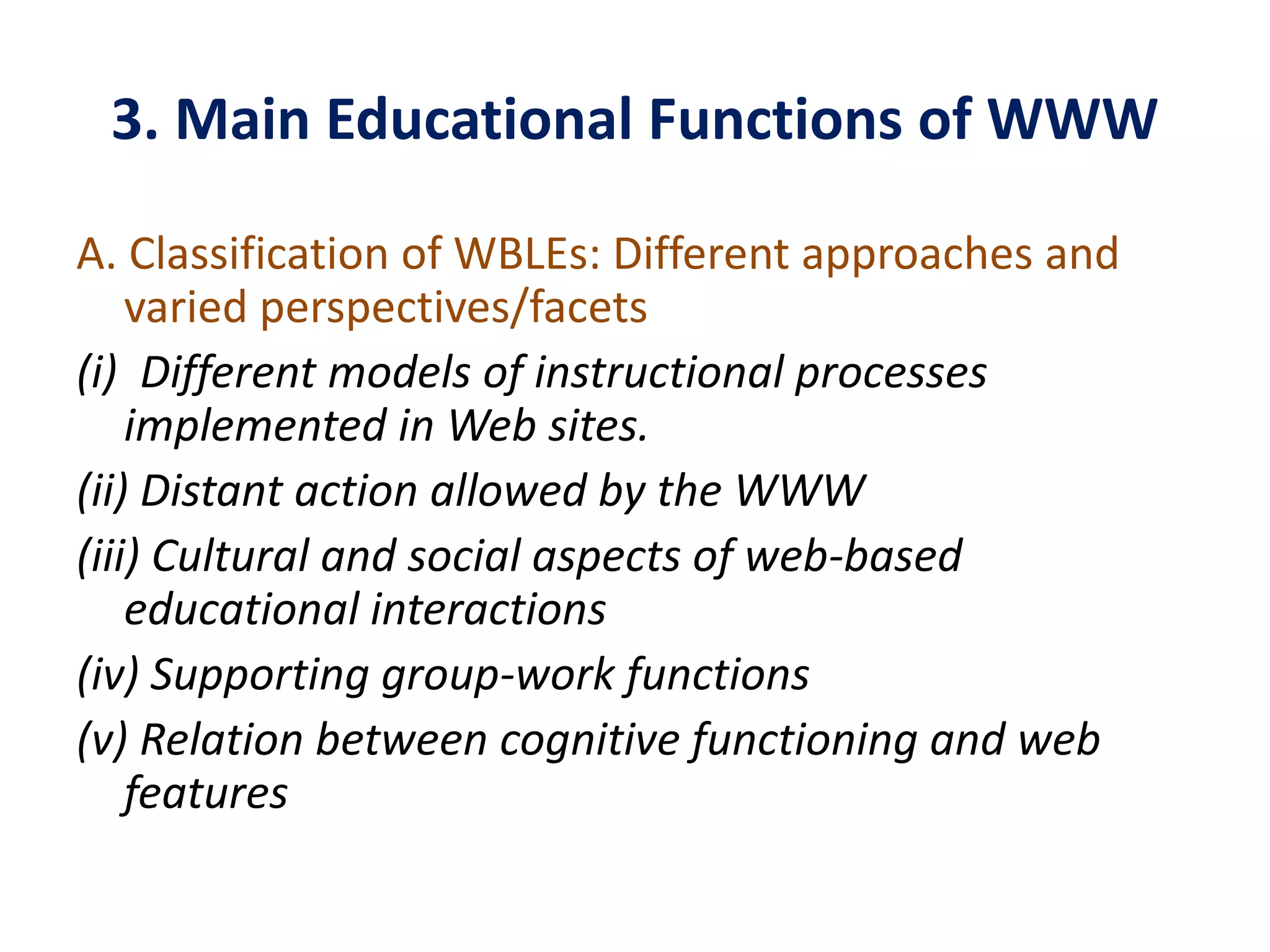
3. Main Educational Functions of WWW
A. Classification of WBLEs: Different approaches and
varied perspectives/facets
(i) Different models of instructional processes
implemented in Web sites.
(ii) Distant action allowed by the WWW
(iii) Cultural and social aspects of web-based
educational interactions
(iv) Supporting group-work functions
(v) Relation between cognitive functioning and web
features
(i). Different models of instructional
processes implemented in Web sites.
Expert-based
• E-lecture
• Ask-an-expert
• Mentorship
• Tutor support
Student-based
• Access to information
• Peer interaction
• Group activity
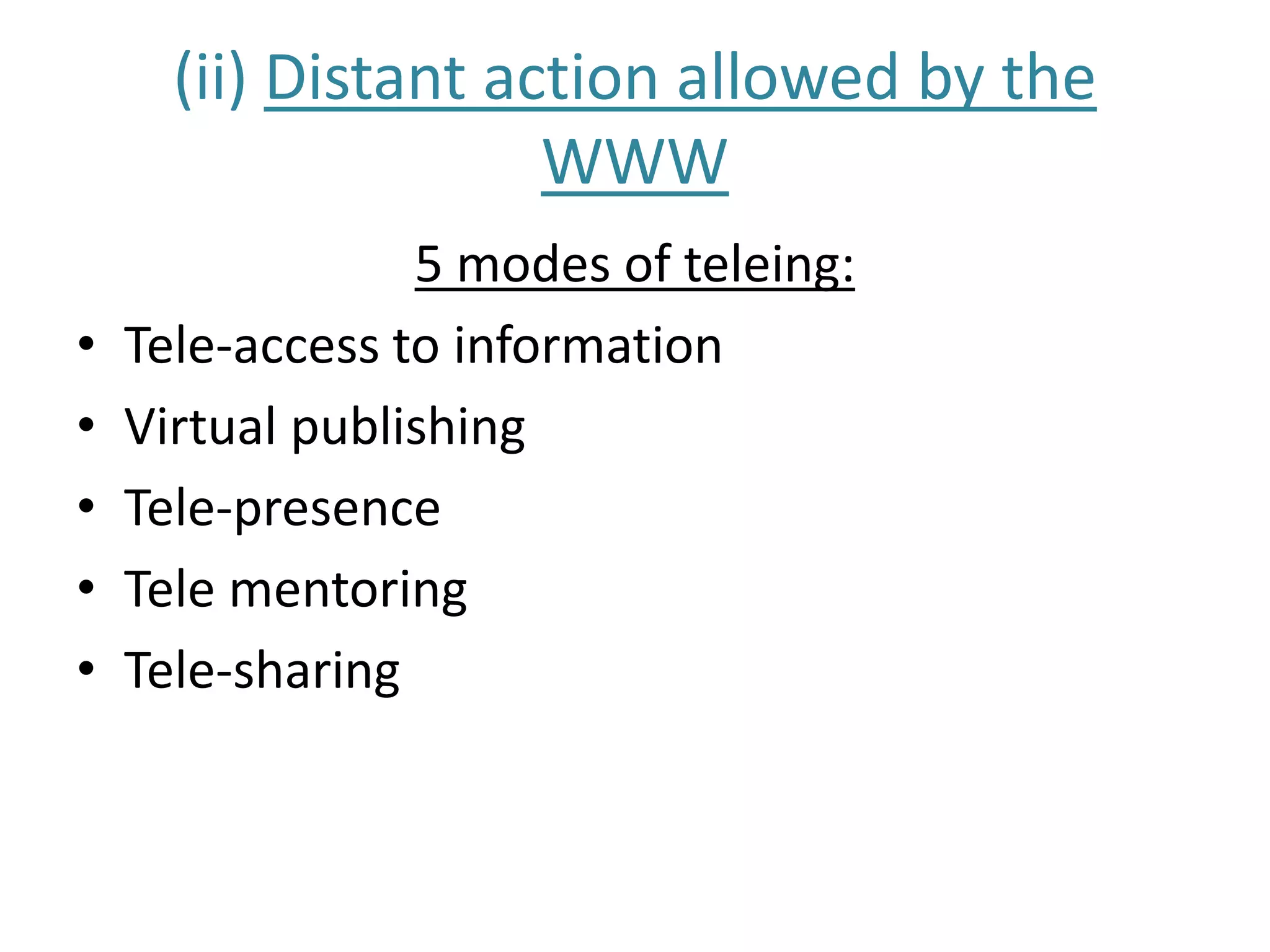
(ii) Distant action allowed by the
WWW
5 modes of teleing:
• Tele-access to information
• Virtual publishing
• Tele-presence
• Tele mentoring
• Tele-sharing
(iii) Cultural and social aspects of web-based educational
interactions:
• Role of WWW in achieving the goals of global education viz.,
to promote multicultural sensitivity and interdependent
systems that operate in today’s world.
(iv) Role of Web-based environments for supporting group-work
functions:
• Examples: Supporting collaboration and communication
• Assisting group evaluation
(v) Relation between cognitive functioning and web features:
• Sequencing
• Scaffolding
• Exploration
• Reflection
B. Classification comprising four main functions
of the WWW in teaching and learning processes:
I. Content delivery
II. Instruction delivery
III. Communication support
IV. Creation support
I. Content delivery
The following qualitatively affect education
• Online libraries
• Databases
• Journals
• Museums
• Public information repositories on the internet
II. Instruction delivery
WWW as a learning environment is instantiated in varied forms
• Distance learning courses
• Collaborative E-learning projects
• Virtual environments for informal education
III. Communication support
• Emails
• Forums
• Group tele-conferencing
• IRC (Internet Relay Chat)
IV. Creation Support
• Web page editors
• Tele-operation environments
• Image processors
4. Models of Implementation of the WWW in
Education
Classified according to the primary function they
support
(i) Content-Oriented Mode
(Information containers)
(ii) Virtual Educational Configurations
(Instruction Delivery)
(iii) Communication-based models
(Communication facilitators)
(i) Content-Oriented Mode(Information containers)
(a) Online Digital Libraries: Govt. & Public institutions initiated large project
aiming to digitize bibliographical materials
(b) Digital Encyclopedias: Offer basic information empowered by the unique
features of improved accessibility, multimedia resources
• Encarta-online
• Britannica online
(c) Topical Megasites and Portals: Information related to specific knowledge
domains
• NASA site – Air & Space related (education.nasa.gov)
• Discovery Channel site – Science & Technology subject (discovery.com)
(d) Topical Educational websites: Focusing on specific curricular topics
developed for educational purposes
• Chickscope (http://chickscope.beckman.uiuc.edu)– includes
information such as day-by-day multimedia journey through the cycle of
a chicken’s embryonic development conducted in University of Illinois
(ii) Virtual Educational Configurations(Instruction Delivery)
(a) Virtual Courses: Revised version of the previous model of distance education
• The World Lecture Hall site (utexas.edu/world/lecture) offers a
comprehensive list of thousands of courses of all kinds delivered in the
WWW.
(b) Virtual Schools : Different from traditional schools. It comes to students
through their computer screens
• Virtual High school (VHS) project – A collaborative venture of high schools
from all over the USA (vhs.concord.org)
(c) Virtual Universities: Universities offer over 6000 accredited courses on the
WWW in the US alone.
(d) Virtual Museums: Designed according to digital rules and not according to
physical rules. Rooms/walls function as graphical indications of objects or
contents classifications. Wandering around is guided by the visitors own
learning interests & goals.
• Science Learning Network site (sln.org) offers linkage to 12 major science &
technology museums worldwide.
(iii) Communication-based models(Communication facilitators)
(a) Online Tutoring and Help(Telemonitoring): Students communicate using
synchronous and/or asynchronous means with online teachers to get assistance in
their learning
• Tutornet.com – online help in Maths
(b) E-lectures : WWW as a mass-communication medium. An expert is available via
communication tools like chat, video conference, forum.
• Writer chat with literature class
• Astronaut chat with space mission
(c) Student Networks: WWW is meeting place for students from different cultures
• Global Student Net, Web66, I*earn
(d) Virtual Learning Communities: A learning community is an educational system
based on the combination of the following three components:
i. Virtual community(social dimension)
ii. Virtual environment(technological dimension)
iii. Pedagogical ideas(educational dimension)
• MATAR site – Israel National Science&Tech virtual-learning community for teachers
(e) MUDs, MOOs and WOOs: Multiuser environments allowing interaction &
collaborative work among students. These are sophisticated environments
comprising 2D & 3D representations of spaces and objects.
5. Current technological and pedagogical state
• Pace of growth, the variability in quality, and the gap between
expectations and realization revealed the need for mapping educational
websites in systematic ways.
• Such a mapping was the goal of a series of studies aiming to unveil
pedagogical approaches within the current landscape of websites.
• The aim was to assess the extent to which educational websites
deliberately developed for educational purposes, realize the potential of
the technology and fulfill the educators expectations.
Three main dimensions
1. PEDAGOGY
2. KNOWLEDGE REPRESENTATION
AND HANDLING
3. COMMUNICATION PROCESSES
Findings
1. Pedagogical characteristics of web-based learning environment
• Inquiry based activities—28.2%
• >three-quarters were highly structured(computer controlled learning activities)
• Eliciting Cognitive processes such as:
• retrieving information—52.5%
• Rote learning—42%
• Analysis and inference processes—32.6%
• Problem solving and decision making—5%
• Collaborative learning—2.8%
• Promoting browsing—76.4%
• Automatic feedback—16.3%human feedback—5.5%
The above information conclusively show that the pedagogical approaches favored by
educators and researchers for the development of valuable learning environments
are still far from being implemented in most educational websites
2. Information Representation and Handling:
• Many sites still based on text—93%
• Sites include atleast one image per page—58%
• Sites don’t include interactive images—96.1%
• Sites don’t include animated images or sound—81.9%
3. Communications:
• The almost sole resource present in the sites is electronic mail(65% of the
sites)
• Discussion groups, chat, distant work forms like telemanipulation are
found only in a few sites.
• Gap between expectations and actual implementation in the
communications domain is more evident and the reason is that
technological resources are being successfully implemented in other areas
of people’s lives(work, shopping, banking).
THANK YOU TO MY CLASSMATES AND OUR
“SOURCE OF INSPIRATION AND KNOWLEDGE”
KSHEMA JOSE MAAM.

Www in-education

  • 1.
    WWW in Education DavidMioduser and Rafi Nachmias Tel Aviv University, Israel
  • 2.
    1. Introduction 2. InEducation: Precedents and Landmarks 3. Main Educational Functions 4. Models of Implementation 5. Current technological and Pedagogical state
  • 3.
    1. Introduction • Aplace to learn • Websites: few dozens in 1990’s to 10 million servers/sites today • Text-based to multimedia delivery tool • Defined population of users to varied community of users(300 millions) • Educational agents form the producers and users of WBLE(Web-based learning Environment)
  • 4.
    2. Precedents andLandmarks • On October 1995, US Federal Networking Council defined Internet as Global Information System that is logically linked together by a globally unique address space based on the Internet Protocol(IP) or its subsequent extensions/follow-ons • Assimilation of computer-communication technology into education • 1st stages: messages exchange(email, bulletin boards) and information search, retrieval or delivery were implemented in educational projects • MOOs and MUDs – virtual environments that allowed multiuser transactions for learning purposes – were other interesting experiences during those pre-web and text-based times. • Formation of learning communities was a natural subsequent step • Creation of the1st graphic browsers and the WWW in the early 90’s – turning point in the implementation of computer-mediated communication in education
  • 5.
    • The combinationof the following was perceived as new powerful resource for teaching and learning purposes: • Multimedia delivery capabilities • Intuitive visual interfaces • Support for efficient search • Retrieval of information • Embedded allowance for synchronous and asynchronous communication • Expansion of cyberspace into a huge hyperlinked repository of information
  • 6.
    3. Main EducationalFunctions of WWW A. Classification of WBLEs: Different approaches and varied perspectives/facets (i) Different models of instructional processes implemented in Web sites. (ii) Distant action allowed by the WWW (iii) Cultural and social aspects of web-based educational interactions (iv) Supporting group-work functions (v) Relation between cognitive functioning and web features
  • 7.
    (i). Different modelsof instructional processes implemented in Web sites. Expert-based • E-lecture • Ask-an-expert • Mentorship • Tutor support Student-based • Access to information • Peer interaction • Group activity
  • 8.
    (ii) Distant actionallowed by the WWW 5 modes of teleing: • Tele-access to information • Virtual publishing • Tele-presence • Tele mentoring • Tele-sharing
  • 9.
    (iii) Cultural andsocial aspects of web-based educational interactions: • Role of WWW in achieving the goals of global education viz., to promote multicultural sensitivity and interdependent systems that operate in today’s world. (iv) Role of Web-based environments for supporting group-work functions: • Examples: Supporting collaboration and communication • Assisting group evaluation (v) Relation between cognitive functioning and web features: • Sequencing • Scaffolding • Exploration • Reflection
  • 10.
    B. Classification comprisingfour main functions of the WWW in teaching and learning processes: I. Content delivery II. Instruction delivery III. Communication support IV. Creation support
  • 11.
    I. Content delivery Thefollowing qualitatively affect education • Online libraries • Databases • Journals • Museums • Public information repositories on the internet II. Instruction delivery WWW as a learning environment is instantiated in varied forms • Distance learning courses • Collaborative E-learning projects • Virtual environments for informal education III. Communication support • Emails • Forums • Group tele-conferencing • IRC (Internet Relay Chat) IV. Creation Support • Web page editors • Tele-operation environments • Image processors
  • 12.
    4. Models ofImplementation of the WWW in Education Classified according to the primary function they support (i) Content-Oriented Mode (Information containers) (ii) Virtual Educational Configurations (Instruction Delivery) (iii) Communication-based models (Communication facilitators)
  • 13.
    (i) Content-Oriented Mode(Informationcontainers) (a) Online Digital Libraries: Govt. & Public institutions initiated large project aiming to digitize bibliographical materials (b) Digital Encyclopedias: Offer basic information empowered by the unique features of improved accessibility, multimedia resources • Encarta-online • Britannica online (c) Topical Megasites and Portals: Information related to specific knowledge domains • NASA site – Air & Space related (education.nasa.gov) • Discovery Channel site – Science & Technology subject (discovery.com) (d) Topical Educational websites: Focusing on specific curricular topics developed for educational purposes • Chickscope (http://chickscope.beckman.uiuc.edu)– includes information such as day-by-day multimedia journey through the cycle of a chicken’s embryonic development conducted in University of Illinois
  • 14.
    (ii) Virtual EducationalConfigurations(Instruction Delivery) (a) Virtual Courses: Revised version of the previous model of distance education • The World Lecture Hall site (utexas.edu/world/lecture) offers a comprehensive list of thousands of courses of all kinds delivered in the WWW. (b) Virtual Schools : Different from traditional schools. It comes to students through their computer screens • Virtual High school (VHS) project – A collaborative venture of high schools from all over the USA (vhs.concord.org) (c) Virtual Universities: Universities offer over 6000 accredited courses on the WWW in the US alone. (d) Virtual Museums: Designed according to digital rules and not according to physical rules. Rooms/walls function as graphical indications of objects or contents classifications. Wandering around is guided by the visitors own learning interests & goals. • Science Learning Network site (sln.org) offers linkage to 12 major science & technology museums worldwide.
  • 15.
    (iii) Communication-based models(Communicationfacilitators) (a) Online Tutoring and Help(Telemonitoring): Students communicate using synchronous and/or asynchronous means with online teachers to get assistance in their learning • Tutornet.com – online help in Maths (b) E-lectures : WWW as a mass-communication medium. An expert is available via communication tools like chat, video conference, forum. • Writer chat with literature class • Astronaut chat with space mission (c) Student Networks: WWW is meeting place for students from different cultures • Global Student Net, Web66, I*earn (d) Virtual Learning Communities: A learning community is an educational system based on the combination of the following three components: i. Virtual community(social dimension) ii. Virtual environment(technological dimension) iii. Pedagogical ideas(educational dimension) • MATAR site – Israel National Science&Tech virtual-learning community for teachers (e) MUDs, MOOs and WOOs: Multiuser environments allowing interaction & collaborative work among students. These are sophisticated environments comprising 2D & 3D representations of spaces and objects.
  • 16.
    5. Current technologicaland pedagogical state • Pace of growth, the variability in quality, and the gap between expectations and realization revealed the need for mapping educational websites in systematic ways. • Such a mapping was the goal of a series of studies aiming to unveil pedagogical approaches within the current landscape of websites. • The aim was to assess the extent to which educational websites deliberately developed for educational purposes, realize the potential of the technology and fulfill the educators expectations.
  • 17.
    Three main dimensions 1.PEDAGOGY 2. KNOWLEDGE REPRESENTATION AND HANDLING 3. COMMUNICATION PROCESSES
  • 18.
    Findings 1. Pedagogical characteristicsof web-based learning environment • Inquiry based activities—28.2% • >three-quarters were highly structured(computer controlled learning activities) • Eliciting Cognitive processes such as: • retrieving information—52.5% • Rote learning—42% • Analysis and inference processes—32.6% • Problem solving and decision making—5% • Collaborative learning—2.8% • Promoting browsing—76.4% • Automatic feedback—16.3%human feedback—5.5% The above information conclusively show that the pedagogical approaches favored by educators and researchers for the development of valuable learning environments are still far from being implemented in most educational websites
  • 19.
    2. Information Representationand Handling: • Many sites still based on text—93% • Sites include atleast one image per page—58% • Sites don’t include interactive images—96.1% • Sites don’t include animated images or sound—81.9% 3. Communications: • The almost sole resource present in the sites is electronic mail(65% of the sites) • Discussion groups, chat, distant work forms like telemanipulation are found only in a few sites. • Gap between expectations and actual implementation in the communications domain is more evident and the reason is that technological resources are being successfully implemented in other areas of people’s lives(work, shopping, banking).
  • 20.
    THANK YOU TOMY CLASSMATES AND OUR “SOURCE OF INSPIRATION AND KNOWLEDGE” KSHEMA JOSE MAAM.