By Andrea Giberna
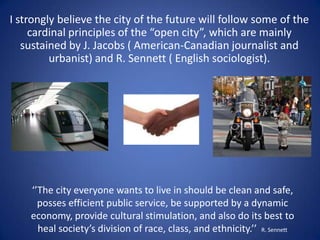
‘’The city everyone wants to live in should be clean and safe,
posses efficient public service, be supported by a dynamic
economy, provide cultural stimulation, and also do its best to
heal society’s division of race, class, and ethnicity.’’ R. Sennett
I strongly believe the city of the future will follow some of the
cardinal principles of the “open city”, which are mainly
sustained by J. Jacobs ( American-Canadian journalist and
urbanist) and R. Sennett ( English sociologist).
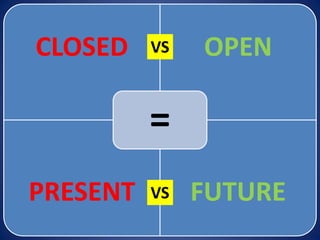
CLOSED OPEN
PRESENT FUTURE
=
VS
VS
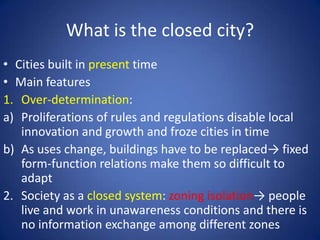
What is the closed city?
• Cities built in present time
• Main features
1. Over-determination:
a) Proliferations of rules and regulations disable local
innovation and growth and froze cities in time
b) As uses change, buildings have to be replaced→ fixed
form-function relations make them so difficult to
adapt
2. Society as a closed system: zoning isolation→ people
live and work in unawareness conditions and there is
no information exchange among different zones
What is the open city? (1)
• The city of the future
• It is based on the principle of the open system: a
process that exchanges material, energy, people,
capital, and information with its environment
• It allows jerry-built adaptations or additions to
existing buildings
• It encourages uses of public spaces which do not fit
neatly together
What is the open city? (2)
3 main features
1. Creating ambiguous edges between parts of the city
2. Contriving incomplete forms in buildings
3. Planning for unsolved path of development
AMBIGUOUS EDGES
BOUNDARY VS BORDER
• Edges where things end
• Edges where different groups interact
Boundaries change into borders because community resources are
located at the edge between communities. This action allows borders to
become porous, so the exchange between different racial, ethnic, or
class communities increase.
What happens?
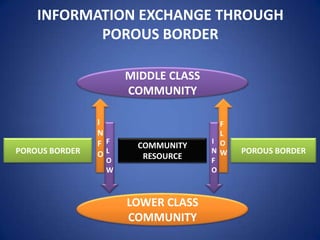
INFORMATION EXCHANGE THROUGH
POROUS BORDER
MIDDLE CLASS
COMMUNITY
COMMUNITY
RESOURCE
POROUS BORDER
LOWER CLASS
COMMUNITY
POROUS BORDER
I
N
F
O
F
L
O
W
F
L
O
W
I
N
F
O
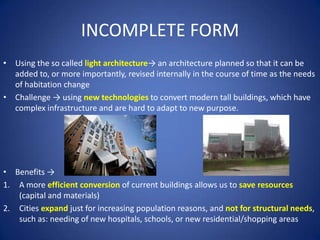
INCOMPLETE FORM
• Using the so called light architecture→ an architecture planned so that it can be
added to, or more importantly, revised internally in the course of time as the needs
of habitation change
• Challenge → using new technologies to convert modern tall buildings, which have
complex infrastructure and are hard to adapt to new purpose.
• Benefits →
1. A more efficient conversion of current buildings allows us to save resources
(capital and materials)
2. Cities expand just for increasing population reasons, and not for structural needs,
such as: needing of new hospitals, schools, or new residential/shopping areas
UNSOLVED PATH
• Planning in the open city is like using open system in mathematics
and the natural world, it embraces non-linear forms of sequence
• The planner looks at conflicts and possibilities which each stage of
the city developing process should open-up
• The city has no more any pre-fixed order, it develops in an irregular
way, which makes each zone of it full of many different resources,
exploitable from people who differ in social class and/or ethnic group
• This kind of evolution stimulate people’s interest. Running always
into something unexpected, they become more aware of their
environments
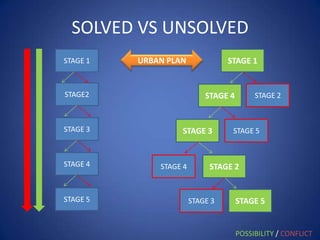
SOLVED VS UNSOLVED
STAGE 1
STAGE 3
STAGE2
STAGE 4
STAGE 5 STAGE 5STAGE 3
STAGE 2
STAGE 5
STAGE 4
STAGE 4
STAGE 3
STAGE 2
STAGE 1
POSSIBILITY / CONFLICT
URBAN PLAN
To sum up…
1. The city of the future will be multi-ethnical
and with a less strict class structure
2. Buildings will have incomplete forms in order
to be converted more easily
3. The development of the city will not be fixed.
It will depend on the conflicts and
possibilities that planners meet at each stage

The open city

  • 1.
  • 2.
    ‘’The city everyonewants to live in should be clean and safe, posses efficient public service, be supported by a dynamic economy, provide cultural stimulation, and also do its best to heal society’s division of race, class, and ethnicity.’’ R. Sennett I strongly believe the city of the future will follow some of the cardinal principles of the “open city”, which are mainly sustained by J. Jacobs ( American-Canadian journalist and urbanist) and R. Sennett ( English sociologist).
  • 3.
  • 4.
    What is theclosed city? • Cities built in present time • Main features 1. Over-determination: a) Proliferations of rules and regulations disable local innovation and growth and froze cities in time b) As uses change, buildings have to be replaced→ fixed form-function relations make them so difficult to adapt 2. Society as a closed system: zoning isolation→ people live and work in unawareness conditions and there is no information exchange among different zones
  • 5.
    What is theopen city? (1) • The city of the future • It is based on the principle of the open system: a process that exchanges material, energy, people, capital, and information with its environment • It allows jerry-built adaptations or additions to existing buildings • It encourages uses of public spaces which do not fit neatly together
  • 6.
    What is theopen city? (2) 3 main features 1. Creating ambiguous edges between parts of the city 2. Contriving incomplete forms in buildings 3. Planning for unsolved path of development
  • 7.
    AMBIGUOUS EDGES BOUNDARY VSBORDER • Edges where things end • Edges where different groups interact Boundaries change into borders because community resources are located at the edge between communities. This action allows borders to become porous, so the exchange between different racial, ethnic, or class communities increase. What happens?
  • 8.
    INFORMATION EXCHANGE THROUGH POROUSBORDER MIDDLE CLASS COMMUNITY COMMUNITY RESOURCE POROUS BORDER LOWER CLASS COMMUNITY POROUS BORDER I N F O F L O W F L O W I N F O
  • 9.
    INCOMPLETE FORM • Usingthe so called light architecture→ an architecture planned so that it can be added to, or more importantly, revised internally in the course of time as the needs of habitation change • Challenge → using new technologies to convert modern tall buildings, which have complex infrastructure and are hard to adapt to new purpose. • Benefits → 1. A more efficient conversion of current buildings allows us to save resources (capital and materials) 2. Cities expand just for increasing population reasons, and not for structural needs, such as: needing of new hospitals, schools, or new residential/shopping areas
  • 10.
    UNSOLVED PATH • Planningin the open city is like using open system in mathematics and the natural world, it embraces non-linear forms of sequence • The planner looks at conflicts and possibilities which each stage of the city developing process should open-up • The city has no more any pre-fixed order, it develops in an irregular way, which makes each zone of it full of many different resources, exploitable from people who differ in social class and/or ethnic group • This kind of evolution stimulate people’s interest. Running always into something unexpected, they become more aware of their environments
  • 11.
    SOLVED VS UNSOLVED STAGE1 STAGE 3 STAGE2 STAGE 4 STAGE 5 STAGE 5STAGE 3 STAGE 2 STAGE 5 STAGE 4 STAGE 4 STAGE 3 STAGE 2 STAGE 1 POSSIBILITY / CONFLICT URBAN PLAN
  • 12.
    To sum up… 1.The city of the future will be multi-ethnical and with a less strict class structure 2. Buildings will have incomplete forms in order to be converted more easily 3. The development of the city will not be fixed. It will depend on the conflicts and possibilities that planners meet at each stage