•
•
•
•
•
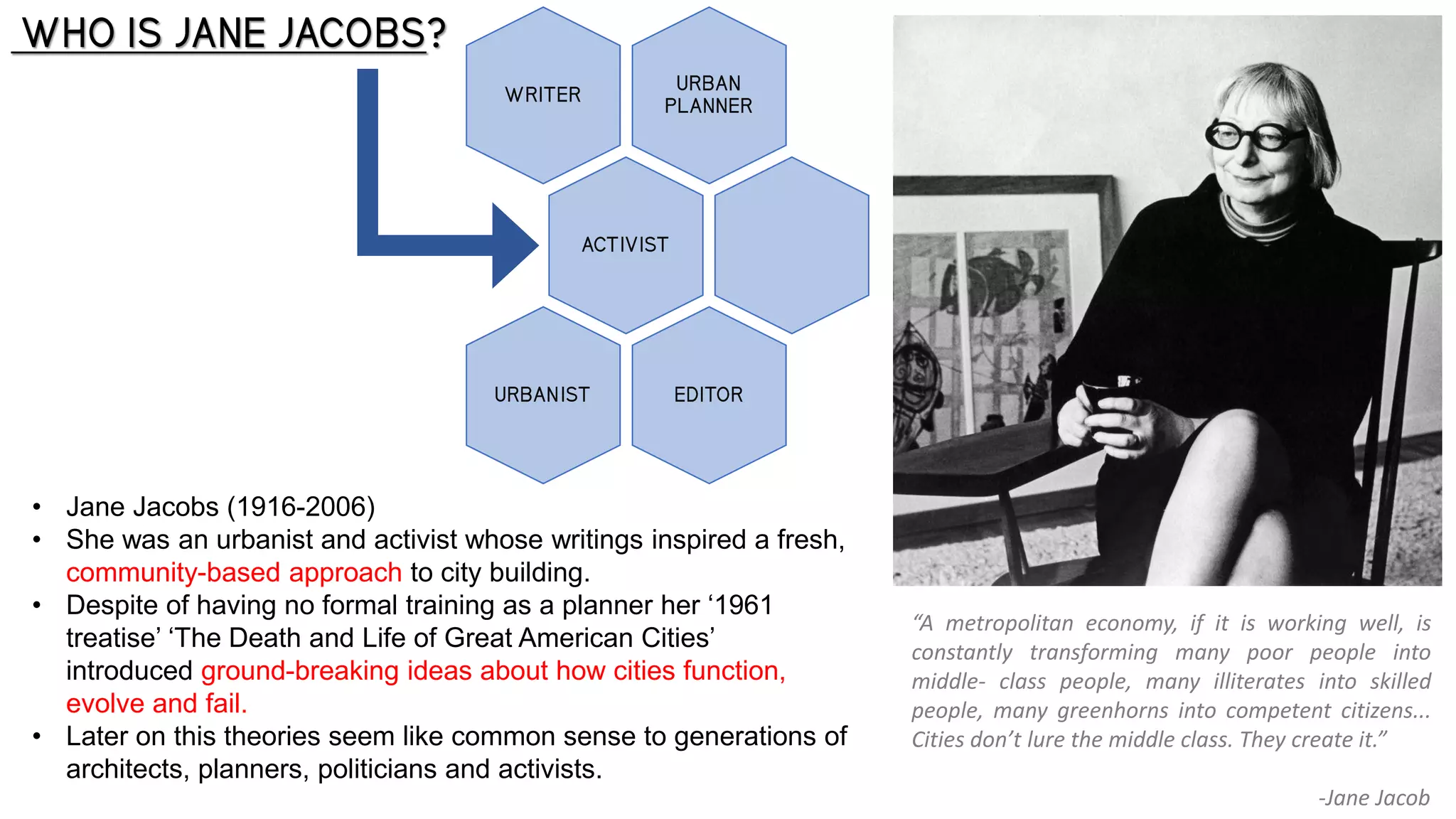
• Jane Jacobs (1916-2006)
• She was an urbanist and activist whose writings inspired a fresh,
community-based approach to city building.
• Despite of having no formal training as a planner her ‘1961
treatise’ ‘The Death and Life of Great American Cities’
introduced ground-breaking ideas about how cities function,
evolve and fail.
• Later on this theories seem like common sense to generations of
architects, planners, politicians and activists.
“A metropolitan economy, if it is working well, is
constantly transforming many poor people into
middle- class people, many illiterates into skilled
people, many greenhorns into competent citizens...
Cities don’t lure the middle class. They create it.”
-Jane Jacob
•Was born in the coal mining town of Pennsylvania, the daughter of a doctor and a former school teacher
and nurse.
•After graduating from high school, took an unpaid position as the assistant to the women's page editor.
•Left for New York City.
•During first several years in the city, held a variety of jobs, as a stenographer and freelance writer
often writing about working districts in the city.
•Married to architect Robert Jacobs
•Became associate editor of Architectural Forum, allowing her to more closely observe the mechanisms of city
planning and urban renewal.
•In the process, she became increasingly critical of conventional planning theory and practice, observing that
many of the city rebuilding projects she wrote about were not safe, interesting, alive, or economically sound.
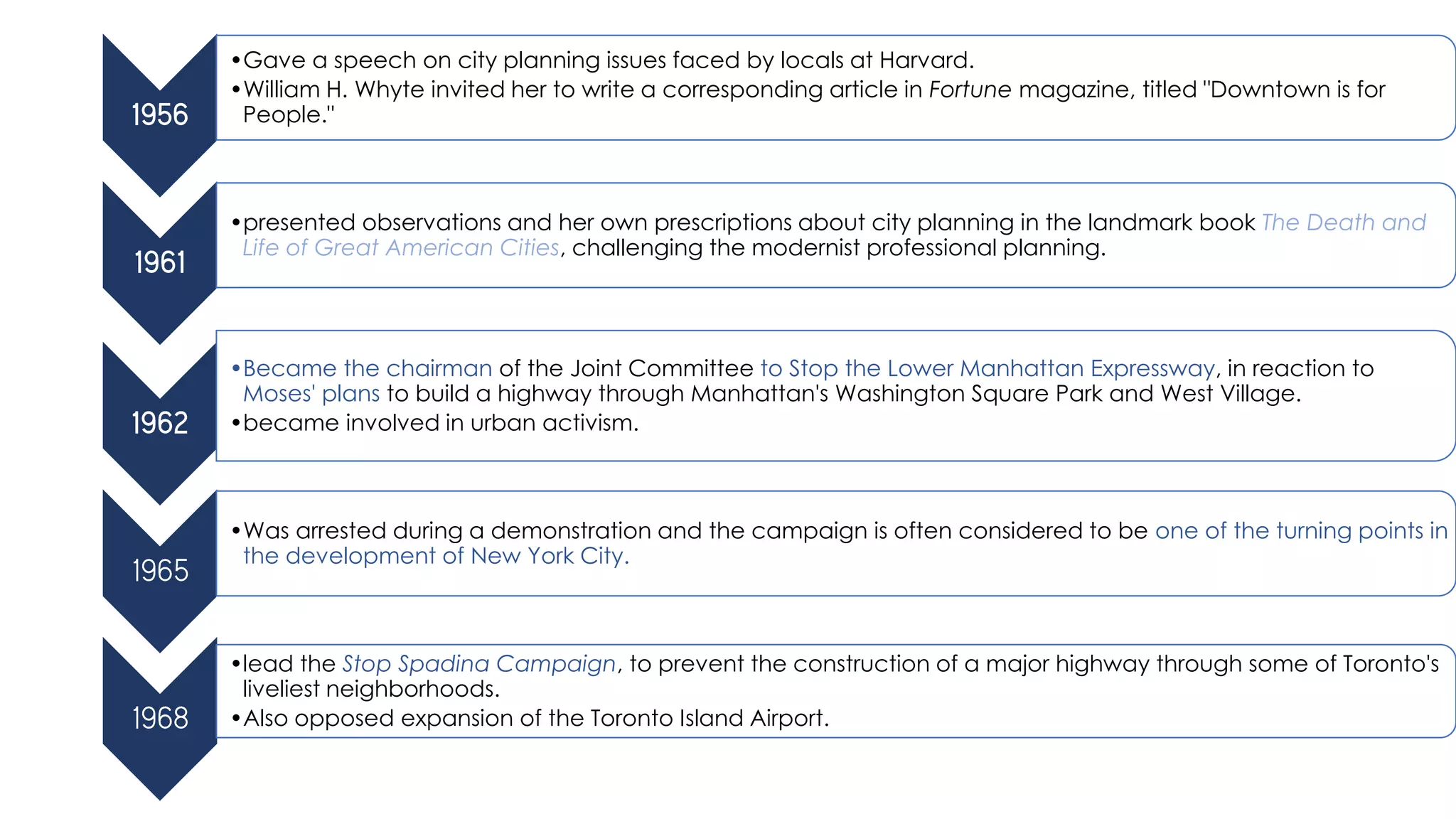
•Gave a speech on city planning issues faced by locals at Harvard.
•William H. Whyte invited her to write a corresponding article in Fortune magazine, titled "Downtown is for
People."
•presented observations and her own prescriptions about city planning in the landmark book The Death and
Life of Great American Cities, challenging the modernist professional planning.
•Became the chairman of the Joint Committee to Stop the Lower Manhattan Expressway, in reaction to
Moses' plans to build a highway through Manhattan's Washington Square Park and West Village.
•became involved in urban activism.
•Was arrested during a demonstration and the campaign is often considered to be one of the turning points in
the development of New York City.
•lead the Stop Spadina Campaign, to prevent the construction of a major highway through some of Toronto's
liveliest neighborhoods.
•Also opposed expansion of the Toronto Island Airport.
•The Economy of Cities
•Became Canadian citizen
•The Question of Separatism
•Cities and the Wealth of Nations
•Systems of Survival
•The Nature of Economies
•Died at the age of 89
• Although orthodox planning theory had blamed high density for crime,
filth, and a host of other problems, Jacobs disproved these assumptions
and demonstrated how a high concentration of people is vital for city
life, economic growth, and prosperity.
• Jacobs cast new light on the nature of local economies and made the
assumptions that cities are a product of agricultural advancement; that
specialized, highly efficient economies fuel long-term growth; and that
large, stable businesses are the best sources of innovation.
•Jane Jacobs approached cities as living beings and ecosystems.
•Suggested that over time, buildings, streets and neighborhoods
function as dynamic organisms, changing in response to how people
interact with them.
•advocated for "mixed-use" urban development - the integration of
different building types and uses, whether residential or commercial,
old or new.
•She saw cities as being "organic, spontaneous, and untidy"
•Jacobs opposed the traditional planning approach that relies on the
judgment of outside experts, instead she proposed to include the
opinions of the local people to guide community development

Jane jacobs

  • 1.
  • 2.
    • Jane Jacobs(1916-2006) • She was an urbanist and activist whose writings inspired a fresh, community-based approach to city building. • Despite of having no formal training as a planner her ‘1961 treatise’ ‘The Death and Life of Great American Cities’ introduced ground-breaking ideas about how cities function, evolve and fail. • Later on this theories seem like common sense to generations of architects, planners, politicians and activists. “A metropolitan economy, if it is working well, is constantly transforming many poor people into middle- class people, many illiterates into skilled people, many greenhorns into competent citizens... Cities don’t lure the middle class. They create it.” -Jane Jacob
  • 3.
    •Was born inthe coal mining town of Pennsylvania, the daughter of a doctor and a former school teacher and nurse. •After graduating from high school, took an unpaid position as the assistant to the women's page editor. •Left for New York City. •During first several years in the city, held a variety of jobs, as a stenographer and freelance writer often writing about working districts in the city. •Married to architect Robert Jacobs •Became associate editor of Architectural Forum, allowing her to more closely observe the mechanisms of city planning and urban renewal. •In the process, she became increasingly critical of conventional planning theory and practice, observing that many of the city rebuilding projects she wrote about were not safe, interesting, alive, or economically sound.
  • 4.
    •Gave a speechon city planning issues faced by locals at Harvard. •William H. Whyte invited her to write a corresponding article in Fortune magazine, titled "Downtown is for People." •presented observations and her own prescriptions about city planning in the landmark book The Death and Life of Great American Cities, challenging the modernist professional planning. •Became the chairman of the Joint Committee to Stop the Lower Manhattan Expressway, in reaction to Moses' plans to build a highway through Manhattan's Washington Square Park and West Village. •became involved in urban activism. •Was arrested during a demonstration and the campaign is often considered to be one of the turning points in the development of New York City. •lead the Stop Spadina Campaign, to prevent the construction of a major highway through some of Toronto's liveliest neighborhoods. •Also opposed expansion of the Toronto Island Airport.
  • 5.
    •The Economy ofCities •Became Canadian citizen •The Question of Separatism •Cities and the Wealth of Nations •Systems of Survival •The Nature of Economies •Died at the age of 89
  • 6.
    • Although orthodoxplanning theory had blamed high density for crime, filth, and a host of other problems, Jacobs disproved these assumptions and demonstrated how a high concentration of people is vital for city life, economic growth, and prosperity. • Jacobs cast new light on the nature of local economies and made the assumptions that cities are a product of agricultural advancement; that specialized, highly efficient economies fuel long-term growth; and that large, stable businesses are the best sources of innovation. •Jane Jacobs approached cities as living beings and ecosystems. •Suggested that over time, buildings, streets and neighborhoods function as dynamic organisms, changing in response to how people interact with them. •advocated for "mixed-use" urban development - the integration of different building types and uses, whether residential or commercial, old or new. •She saw cities as being "organic, spontaneous, and untidy" •Jacobs opposed the traditional planning approach that relies on the judgment of outside experts, instead she proposed to include the opinions of the local people to guide community development