Domains        The Octagon Domain    Abstract Transfer Functions   Analysis Example   Conclusion


                                The Octagon Domain

                                    Bernhard Mallinger


                                    March 6-7th, 2013


Bernhard Mallinger
The Octagon Domain
Domains        The Octagon Domain   Abstract Transfer Functions   Analysis Example   Conclusion


Outline


      1   Domains

      2   The Octagon Domain

      3   Abstract Transfer Functions

      4   Analysis Example

      5   Conclusion


Bernhard Mallinger
The Octagon Domain
Domains        The Octagon Domain   Abstract Transfer Functions   Analysis Example   Conclusion


Outline


      1   Domains

      2   The Octagon Domain

      3   Abstract Transfer Functions

      4   Analysis Example

      5   Conclusion


Bernhard Mallinger
The Octagon Domain
Domains        The Octagon Domain      Abstract Transfer Functions   Analysis Example   Conclusion


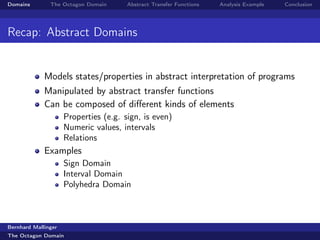
Recap: Abstract Domains


             Models states/properties in abstract interpretation of programs
             Manipulated by abstract transfer functions
             Can be composed of different kinds of elements
                     Properties (e.g. sign, is even)
                     Numeric values, intervals
                     Relations
             Examples
                     Sign Domain
                     Interval Domain
                     Polyhedra Domain


Bernhard Mallinger
The Octagon Domain
Domains        The Octagon Domain   Abstract Transfer Functions   Analysis Example   Conclusion


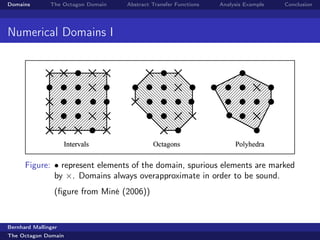
Numerical Domains I


      Figure: • represent elements of the domain, spurious elements are marked
              by ×. Domains always overapproximate in order to be sound.
                 (figure from Miné (2006))


Bernhard Mallinger
The Octagon Domain
Domains        The Octagon Domain        Abstract Transfer Functions   Analysis Example   Conclusion


Numerical Domains II


      Assumption: Numeric means R

      Interval Domain: Xi ∈ [ai , bi ]
      Polyhedra Domain:             i   aij Xi ≤ bj
      Zone Abstract Domain: ±Xi ≤ ci ,                     Xi − Xj ≤ cij     ∀i = j
      Octagon Domain: ±Xi ± Xj ≤ cij                    ∀i, j


Bernhard Mallinger
The Octagon Domain
Domains        The Octagon Domain        Abstract Transfer Functions   Analysis Example   Conclusion


Numerical Domains II


      Assumption: Numeric means R

      Interval Domain: Xi ∈ [ai , bi ]
      Polyhedra Domain:             i   aij Xi ≤ bj
      Zone Abstract Domain: ±Xi ≤ ci ,                     Xi − Xj ≤ cij     ∀i = j
      Octagon Domain: ±Xi ± Xj ≤ cij                    ∀i, j


Bernhard Mallinger
The Octagon Domain
Domains        The Octagon Domain        Abstract Transfer Functions   Analysis Example   Conclusion


Numerical Domains II


      Assumption: Numeric means R

      Interval Domain: Xi ∈ [ai , bi ]
      Polyhedra Domain:             i   aij Xi ≤ bj
      Zone Abstract Domain: ±Xi ≤ ci ,                     Xi − Xj ≤ cij     ∀i = j
      Octagon Domain: ±Xi ± Xj ≤ cij                    ∀i, j


Bernhard Mallinger
The Octagon Domain
Domains        The Octagon Domain        Abstract Transfer Functions   Analysis Example   Conclusion


Numerical Domains II


      Assumption: Numeric means R

      Interval Domain: Xi ∈ [ai , bi ]
      Polyhedra Domain:             i   aij Xi ≤ bj
      Zone Abstract Domain: ±Xi ≤ ci ,                     Xi − Xj ≤ cij     ∀i = j
      Octagon Domain: ±Xi ± Xj ≤ cij                    ∀i, j


Bernhard Mallinger
The Octagon Domain
Domains        The Octagon Domain   Abstract Transfer Functions   Analysis Example   Conclusion


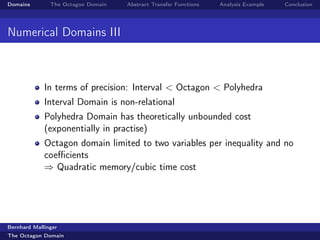
Numerical Domains III


             In terms of precision: Interval < Octagon < Polyhedra
             Interval Domain is non-relational
             Polyhedra Domain has theoretically unbounded cost
             (exponentially in practise)
             Octagon domain limited to two variables per inequality and no
             coefficients
             ⇒ Quadratic memory/cubic time cost


Bernhard Mallinger
The Octagon Domain
Domains        The Octagon Domain   Abstract Transfer Functions   Analysis Example   Conclusion


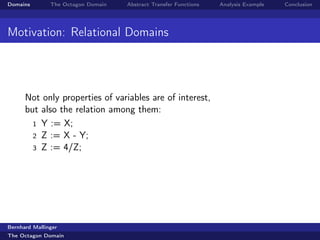
Motivation: Relational Domains


      Not only properties of variables are of interest,
      but also the relation among them:
        1 Y := X;
        2 Z := X - Y;
        3 Z := 4/Z;


Bernhard Mallinger
The Octagon Domain
Domains        The Octagon Domain   Abstract Transfer Functions   Analysis Example   Conclusion


Outline


      1   Domains

      2   The Octagon Domain

      3   Abstract Transfer Functions

      4   Analysis Example

      5   Conclusion


Bernhard Mallinger
The Octagon Domain
Domains        The Octagon Domain    Abstract Transfer Functions   Analysis Example   Conclusion


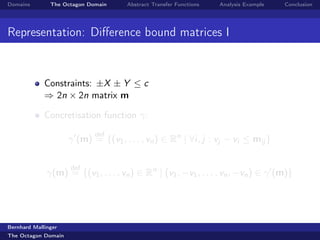
Representation: Difference bound matrices I


             Constraints: ±X ± Y ≤ c
             ⇒ 2n × 2n matrix m

             Concretisation function γ:
                             def
                     γ (m) = {(v1 , . . . , vn ) ∈ Rn | ∀i, j : vj − vi ≤ mij }

                     def
              γ(m) = {(v1 , . . . , vn ) ∈ Rn | (v1 , −v1 , . . . , vn , −vn ) ∈ γ (m)}


Bernhard Mallinger
The Octagon Domain
Domains        The Octagon Domain    Abstract Transfer Functions   Analysis Example   Conclusion


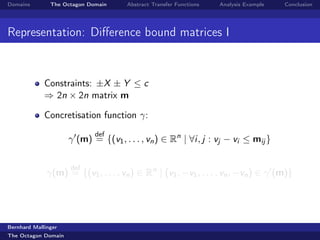
Representation: Difference bound matrices I


             Constraints: ±X ± Y ≤ c
             ⇒ 2n × 2n matrix m

             Concretisation function γ:
                             def
                     γ (m) = {(v1 , . . . , vn ) ∈ Rn | ∀i, j : vj − vi ≤ mij }

                     def
              γ(m) = {(v1 , . . . , vn ) ∈ Rn | (v1 , −v1 , . . . , vn , −vn ) ∈ γ (m)}


Bernhard Mallinger
The Octagon Domain
Domains        The Octagon Domain    Abstract Transfer Functions   Analysis Example   Conclusion


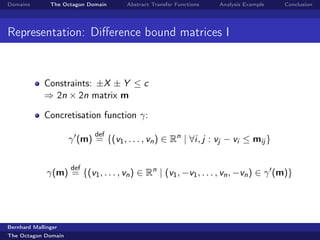
Representation: Difference bound matrices I


             Constraints: ±X ± Y ≤ c
             ⇒ 2n × 2n matrix m

             Concretisation function γ:
                             def
                     γ (m) = {(v1 , . . . , vn ) ∈ Rn | ∀i, j : vj − vi ≤ mij }

                     def
              γ(m) = {(v1 , . . . , vn ) ∈ Rn | (v1 , −v1 , . . . , vn , −vn ) ∈ γ (m)}


Bernhard Mallinger
The Octagon Domain
Domains        The Octagon Domain    Abstract Transfer Functions   Analysis Example   Conclusion


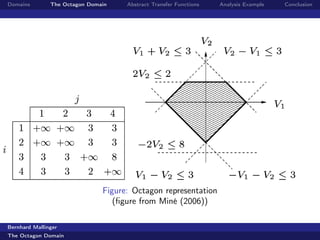
                               Figure: Octagon representation
                                  (figure from Miné (2006))

Bernhard Mallinger
The Octagon Domain
Domains        The Octagon Domain       Abstract Transfer Functions   Analysis Example   Conclusion


Representation: Difference bound matrices II

             Abstraction function α:
             Given concrete values, α computes all entries of m by taking
             the maximal differences for each pair of variables
             A lattice can be defined:
                                               def
                                    m     n ⇐⇒ ∀i, j : mij ≤ nij
                                                     def
                                    (m      n)ij = max(mij , nij )
                                                     def
                                    (m      n)ij = min(mij , nij )

             m       n ⇒ γ(m) ⊆ γ(n)
             (γ, α) form a Galois connection


Bernhard Mallinger
The Octagon Domain
Domains        The Octagon Domain      Abstract Transfer Functions   Analysis Example   Conclusion


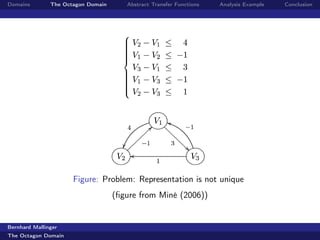
                      Figure: Problem: Representation is not unique
                                    (figure from Miné (2006))


Bernhard Mallinger
The Octagon Domain
Domains        The Octagon Domain      Abstract Transfer Functions   Analysis Example   Conclusion


Shortest Path Closure


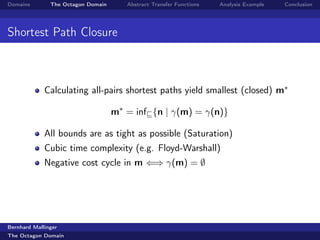
             Calculating all-pairs shortest paths yield smallest (closed) m∗

                                    m∗ = inf {n | γ(m) = γ(n)}

             All bounds are as tight as possible (Saturation)
             Cubic time complexity (e.g. Floyd-Warshall)
             Negative cost cycle in m ⇐⇒ γ(m) = ∅


Bernhard Mallinger
The Octagon Domain
Domains        The Octagon Domain   Abstract Transfer Functions   Analysis Example   Conclusion


Outline


      1   Domains

      2   The Octagon Domain

      3   Abstract Transfer Functions

      4   Analysis Example

      5   Conclusion


Bernhard Mallinger
The Octagon Domain
Domains        The Octagon Domain   Abstract Transfer Functions   Analysis Example   Conclusion


Abstract Transfer Functions


             Abstract transfer functions correspond to semantic operations
             Must be sound, therefore overapproximation
             Some require closed arguments, some return closed ones
      Different kinds:
             Set operations such as Union/Intersection
             Assignment
             Test
             Widening/Narrowing
             Conversions to other domains (e.g. Interval, Polyhedra)


Bernhard Mallinger
The Octagon Domain
Domains        The Octagon Domain   Abstract Transfer Functions   Analysis Example   Conclusion


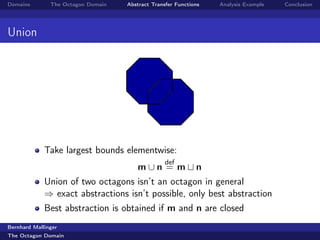
Union


             Take largest bounds elementwise:
                                                  def
                                       m∪n = m               n
             Union of two octagons isn’t an octagon in general
             ⇒ exact abstractions isn’t possible, only best abstraction
             Best abstraction is obtained if m and n are closed
Bernhard Mallinger
The Octagon Domain
Domains        The Octagon Domain   Abstract Transfer Functions   Analysis Example   Conclusion


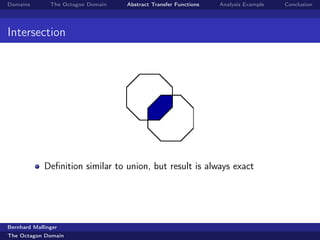
Intersection


             Definition similar to union, but result is always exact


Bernhard Mallinger
The Octagon Domain
Domains        The Octagon Domain   Abstract Transfer Functions   Analysis Example   Conclusion


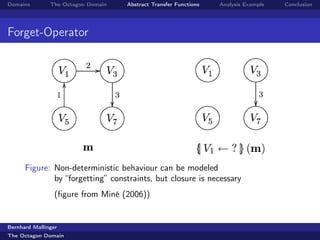
Forget-Operator


      Figure: Non-deterministic behaviour can be modeled
              by “forgetting” constraints, but closure is necessary
                 (figure from Miné (2006))


Bernhard Mallinger
The Octagon Domain
Domains        The Octagon Domain   Abstract Transfer Functions   Analysis Example   Conclusion


Assignment I

             Handling of assignments depends on the type of the expression
             Directly handleable in the octagon domain:

                                           X ← ±[a, b]
                                    X ← ±Y ± [a, b]

             e.g. for X ← Y + [a, b], we get a ≤ X − Y ≤ b:

                        +X − −Y ≤ b                 − X − +Y ≤ −a
                        −Y − +X ≤ b                 + Y − −X ≤ −a

             Constraints for X w.r.t. other variables have to be discarded

Bernhard Mallinger
The Octagon Domain
Domains        The Octagon Domain   Abstract Transfer Functions   Analysis Example   Conclusion


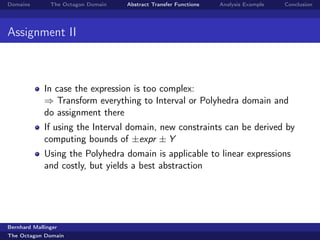
Assignment II


             In case the expression is too complex:
             ⇒ Transform everything to Interval or Polyhedra domain and
             do assignment there
             If using the Interval domain, new constraints can be derived by
             computing bounds of ±expr ± Y
             Using the Polyhedra domain is applicable to linear expressions
             and costly, but yields a best abstraction


Bernhard Mallinger
The Octagon Domain
Domains         The Octagon Domain   Abstract Transfer Functions   Analysis Example   Conclusion


Test


          1   X := [-100, 100]
          2   if X ≥ 0 then
          3       // X ∈ [0, 100]
          4   end if
              All tests can be simplified to expr ≤ 0
              Octagonally shaped tests can directly be applied
              (e.g. X + Y + [a, b] ≤ 0)
              More complex forms can be handled in the Interval or
              Polyhedra domain (cf. Assignment)


Bernhard Mallinger
The Octagon Domain
Domains        The Octagon Domain   Abstract Transfer Functions   Analysis Example   Conclusion


Outline


      1   Domains

      2   The Octagon Domain

      3   Abstract Transfer Functions

      4   Analysis Example

      5   Conclusion


Bernhard Mallinger
The Octagon Domain
Domains         The Octagon Domain   Abstract Transfer Functions   Analysis Example   Conclusion


          1   X := [-100, 100]
          2   Y := X
          3   if Y ≤ 0 then
          4       1 Y := -Y 2
          5   else
          6       3
          7   end if
          8   4
        9     if Y ≤ 69 then 5
       10     end if

      1   −100 ≤ X ≤ 0 ∧ −100 ≤ Y ≤ 0 ∧ X − Y = 0 ∧ −200 ≤ X + Y ≤ 0
      2   −100 ≤ X ≤ 0 ∧ 0 ≤ Y ≤ 100 ∧ −200 ≤ X − Y ≤ 0 ∧ X + Y = 0
      3   0 ≤ X ≤ 100 ∧ 0 ≤ Y ≤ 100 ∧ X − Y = 0 ∧ 0 ≤ X + Y ≤ 200
      4   −100 ≤ X ≤ 100 ∧ 0 ≤ Y ≤ 100 ∧ −200 ≤ X − Y ≤ 0 ∧ 0 ≤ X + Y ≤ 200
      5   −69 ≤ X ≤ 69 ∧ 0 ≤ Y ≤ 69 ∧ −138 ≤ X − Y ≤ 0 ∧ 0 ≤ X + Y ≤ 138


Bernhard Mallinger
The Octagon Domain
Domains         The Octagon Domain   Abstract Transfer Functions   Analysis Example   Conclusion


          1   X := [-100, 100]
          2   Y := X
          3   if Y ≤ 0 then
          4       1 Y := -Y 2
          5   else
          6       3
          7   end if
          8   4
        9     if Y ≤ 69 then 5
       10     end if

      1   −100 ≤ X ≤ 0 ∧ −100 ≤ Y ≤ 0 ∧ X − Y = 0 ∧ −200 ≤ X + Y ≤ 0
      2   −100 ≤ X ≤ 0 ∧ 0 ≤ Y ≤ 100 ∧ −200 ≤ X − Y ≤ 0 ∧ X + Y = 0
      3   0 ≤ X ≤ 100 ∧ 0 ≤ Y ≤ 100 ∧ X − Y = 0 ∧ 0 ≤ X + Y ≤ 200
      4   −100 ≤ X ≤ 100 ∧ 0 ≤ Y ≤ 100 ∧ −200 ≤ X − Y ≤ 0 ∧ 0 ≤ X + Y ≤ 200
      5   −69 ≤ X ≤ 69 ∧ 0 ≤ Y ≤ 69 ∧ −138 ≤ X − Y ≤ 0 ∧ 0 ≤ X + Y ≤ 138


Bernhard Mallinger
The Octagon Domain
Domains         The Octagon Domain   Abstract Transfer Functions   Analysis Example   Conclusion


          1   X := [-100, 100]
          2   Y := X
          3   if Y ≤ 0 then
          4       1 Y := -Y 2
          5   else
          6       3
          7   end if
          8   4
        9     if Y ≤ 69 then 5
       10     end if

      1   −100 ≤ X ≤ 0 ∧ −100 ≤ Y ≤ 0 ∧ X − Y = 0 ∧ −200 ≤ X + Y ≤ 0
      2   −100 ≤ X ≤ 0 ∧ 0 ≤ Y ≤ 100 ∧ −200 ≤ X − Y ≤ 0 ∧ X + Y = 0
      3   0 ≤ X ≤ 100 ∧ 0 ≤ Y ≤ 100 ∧ X − Y = 0 ∧ 0 ≤ X + Y ≤ 200
      4   −100 ≤ X ≤ 100 ∧ 0 ≤ Y ≤ 100 ∧ −200 ≤ X − Y ≤ 0 ∧ 0 ≤ X + Y ≤ 200
      5   −69 ≤ X ≤ 69 ∧ 0 ≤ Y ≤ 69 ∧ −138 ≤ X − Y ≤ 0 ∧ 0 ≤ X + Y ≤ 138


Bernhard Mallinger
The Octagon Domain
Domains         The Octagon Domain   Abstract Transfer Functions   Analysis Example   Conclusion


          1   X := [-100, 100]
          2   Y := X
          3   if Y ≤ 0 then
          4       1 Y := -Y 2
          5   else
          6       3
          7   end if
          8   4
        9     if Y ≤ 69 then 5
       10     end if

      1   −100 ≤ X ≤ 0 ∧ −100 ≤ Y ≤ 0 ∧ X − Y = 0 ∧ −200 ≤ X + Y ≤ 0
      2   −100 ≤ X ≤ 0 ∧ 0 ≤ Y ≤ 100 ∧ −200 ≤ X − Y ≤ 0 ∧ X + Y = 0
      3   0 ≤ X ≤ 100 ∧ 0 ≤ Y ≤ 100 ∧ X − Y = 0 ∧ 0 ≤ X + Y ≤ 200
      4   −100 ≤ X ≤ 100 ∧ 0 ≤ Y ≤ 100 ∧ −200 ≤ X − Y ≤ 0 ∧ 0 ≤ X + Y ≤ 200
      5   −69 ≤ X ≤ 69 ∧ 0 ≤ Y ≤ 69 ∧ −138 ≤ X − Y ≤ 0 ∧ 0 ≤ X + Y ≤ 138


Bernhard Mallinger
The Octagon Domain
Domains         The Octagon Domain   Abstract Transfer Functions   Analysis Example   Conclusion


          1   X := [-100, 100]
          2   Y := X
          3   if Y ≤ 0 then
          4       1 Y := -Y 2
          5   else
          6       3
          7   end if
          8   4
        9     if Y ≤ 69 then 5
       10     end if

      1   −100 ≤ X ≤ 0 ∧ −100 ≤ Y ≤ 0 ∧ X − Y = 0 ∧ −200 ≤ X + Y ≤ 0
      2   −100 ≤ X ≤ 0 ∧ 0 ≤ Y ≤ 100 ∧ −200 ≤ X − Y ≤ 0 ∧ X + Y = 0
      3   0 ≤ X ≤ 100 ∧ 0 ≤ Y ≤ 100 ∧ X − Y = 0 ∧ 0 ≤ X + Y ≤ 200
      4   −100 ≤ X ≤ 100 ∧ 0 ≤ Y ≤ 100 ∧ −200 ≤ X − Y ≤ 0 ∧ 0 ≤ X + Y ≤ 200
      5   −69 ≤ X ≤ 69 ∧ 0 ≤ Y ≤ 69 ∧ −138 ≤ X − Y ≤ 0 ∧ 0 ≤ X + Y ≤ 138


Bernhard Mallinger
The Octagon Domain
Domains         The Octagon Domain   Abstract Transfer Functions   Analysis Example   Conclusion


          1   X := [-100, 100]
          2   Y := X
          3   if Y ≤ 0 then
          4       1 Y := -Y 2
          5   else
          6       3
          7   end if
          8   4
        9     if Y ≤ 69 then 5
       10     end if

      1   −100 ≤ X ≤ 0 ∧ −100 ≤ Y ≤ 0 ∧ X − Y = 0 ∧ −200 ≤ X + Y ≤ 0
      2   −100 ≤ X ≤ 0 ∧ 0 ≤ Y ≤ 100 ∧ −200 ≤ X − Y ≤ 0 ∧ X + Y = 0
      3   0 ≤ X ≤ 100 ∧ 0 ≤ Y ≤ 100 ∧ X − Y = 0 ∧ 0 ≤ X + Y ≤ 200
      4   −100 ≤ X ≤ 100 ∧ 0 ≤ Y ≤ 100 ∧ −200 ≤ X − Y ≤ 0 ∧ 0 ≤ X + Y ≤ 200
      5   −69 ≤ X ≤ 69 ∧ 0 ≤ Y ≤ 69 ∧ −138 ≤ X − Y ≤ 0 ∧ 0 ≤ X + Y ≤ 138


Bernhard Mallinger
The Octagon Domain
Domains        The Octagon Domain   Abstract Transfer Functions   Analysis Example   Conclusion


Outline


      1   Domains

      2   The Octagon Domain

      3   Abstract Transfer Functions

      4   Analysis Example

      5   Conclusion


Bernhard Mallinger
The Octagon Domain
Domains        The Octagon Domain     Abstract Transfer Functions   Analysis Example   Conclusion


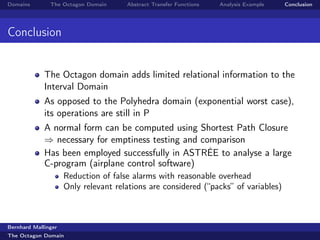
Conclusion


             The Octagon domain adds limited relational information to the
             Interval Domain
             As opposed to the Polyhedra domain (exponential worst case),
             its operations are still in P
             A normal form can be computed using Shortest Path Closure
             ⇒ necessary for emptiness testing and comparison
             Has been employed successfully in ASTRÉE to analyse a large
             C-program (airplane control software)
                     Reduction of false alarms with reasonable overhead
                     Only relevant relations are considered (“packs” of variables)


Bernhard Mallinger
The Octagon Domain

The Octagon Abstract Domain

  • 1.
    Domains The Octagon Domain Abstract Transfer Functions Analysis Example Conclusion The Octagon Domain Bernhard Mallinger March 6-7th, 2013 Bernhard Mallinger The Octagon Domain
  • 2.
    Domains The Octagon Domain Abstract Transfer Functions Analysis Example Conclusion Outline 1 Domains 2 The Octagon Domain 3 Abstract Transfer Functions 4 Analysis Example 5 Conclusion Bernhard Mallinger The Octagon Domain
  • 3.
    Domains The Octagon Domain Abstract Transfer Functions Analysis Example Conclusion Outline 1 Domains 2 The Octagon Domain 3 Abstract Transfer Functions 4 Analysis Example 5 Conclusion Bernhard Mallinger The Octagon Domain
  • 4.
    Domains The Octagon Domain Abstract Transfer Functions Analysis Example Conclusion Recap: Abstract Domains Models states/properties in abstract interpretation of programs Manipulated by abstract transfer functions Can be composed of different kinds of elements Properties (e.g. sign, is even) Numeric values, intervals Relations Examples Sign Domain Interval Domain Polyhedra Domain Bernhard Mallinger The Octagon Domain
  • 5.
    Domains The Octagon Domain Abstract Transfer Functions Analysis Example Conclusion Numerical Domains I Figure: • represent elements of the domain, spurious elements are marked by ×. Domains always overapproximate in order to be sound. (figure from Miné (2006)) Bernhard Mallinger The Octagon Domain
  • 6.
    Domains The Octagon Domain Abstract Transfer Functions Analysis Example Conclusion Numerical Domains II Assumption: Numeric means R Interval Domain: Xi ∈ [ai , bi ] Polyhedra Domain: i aij Xi ≤ bj Zone Abstract Domain: ±Xi ≤ ci , Xi − Xj ≤ cij ∀i = j Octagon Domain: ±Xi ± Xj ≤ cij ∀i, j Bernhard Mallinger The Octagon Domain
  • 7.
    Domains The Octagon Domain Abstract Transfer Functions Analysis Example Conclusion Numerical Domains II Assumption: Numeric means R Interval Domain: Xi ∈ [ai , bi ] Polyhedra Domain: i aij Xi ≤ bj Zone Abstract Domain: ±Xi ≤ ci , Xi − Xj ≤ cij ∀i = j Octagon Domain: ±Xi ± Xj ≤ cij ∀i, j Bernhard Mallinger The Octagon Domain
  • 8.
    Domains The Octagon Domain Abstract Transfer Functions Analysis Example Conclusion Numerical Domains II Assumption: Numeric means R Interval Domain: Xi ∈ [ai , bi ] Polyhedra Domain: i aij Xi ≤ bj Zone Abstract Domain: ±Xi ≤ ci , Xi − Xj ≤ cij ∀i = j Octagon Domain: ±Xi ± Xj ≤ cij ∀i, j Bernhard Mallinger The Octagon Domain
  • 9.
    Domains The Octagon Domain Abstract Transfer Functions Analysis Example Conclusion Numerical Domains II Assumption: Numeric means R Interval Domain: Xi ∈ [ai , bi ] Polyhedra Domain: i aij Xi ≤ bj Zone Abstract Domain: ±Xi ≤ ci , Xi − Xj ≤ cij ∀i = j Octagon Domain: ±Xi ± Xj ≤ cij ∀i, j Bernhard Mallinger The Octagon Domain
  • 10.
    Domains The Octagon Domain Abstract Transfer Functions Analysis Example Conclusion Numerical Domains III In terms of precision: Interval < Octagon < Polyhedra Interval Domain is non-relational Polyhedra Domain has theoretically unbounded cost (exponentially in practise) Octagon domain limited to two variables per inequality and no coefficients ⇒ Quadratic memory/cubic time cost Bernhard Mallinger The Octagon Domain
  • 11.
    Domains The Octagon Domain Abstract Transfer Functions Analysis Example Conclusion Motivation: Relational Domains Not only properties of variables are of interest, but also the relation among them: 1 Y := X; 2 Z := X - Y; 3 Z := 4/Z; Bernhard Mallinger The Octagon Domain
  • 12.
    Domains The Octagon Domain Abstract Transfer Functions Analysis Example Conclusion Outline 1 Domains 2 The Octagon Domain 3 Abstract Transfer Functions 4 Analysis Example 5 Conclusion Bernhard Mallinger The Octagon Domain
  • 13.
    Domains The Octagon Domain Abstract Transfer Functions Analysis Example Conclusion Representation: Difference bound matrices I Constraints: ±X ± Y ≤ c ⇒ 2n × 2n matrix m Concretisation function γ: def γ (m) = {(v1 , . . . , vn ) ∈ Rn | ∀i, j : vj − vi ≤ mij } def γ(m) = {(v1 , . . . , vn ) ∈ Rn | (v1 , −v1 , . . . , vn , −vn ) ∈ γ (m)} Bernhard Mallinger The Octagon Domain
  • 14.
    Domains The Octagon Domain Abstract Transfer Functions Analysis Example Conclusion Representation: Difference bound matrices I Constraints: ±X ± Y ≤ c ⇒ 2n × 2n matrix m Concretisation function γ: def γ (m) = {(v1 , . . . , vn ) ∈ Rn | ∀i, j : vj − vi ≤ mij } def γ(m) = {(v1 , . . . , vn ) ∈ Rn | (v1 , −v1 , . . . , vn , −vn ) ∈ γ (m)} Bernhard Mallinger The Octagon Domain
  • 15.
    Domains The Octagon Domain Abstract Transfer Functions Analysis Example Conclusion Representation: Difference bound matrices I Constraints: ±X ± Y ≤ c ⇒ 2n × 2n matrix m Concretisation function γ: def γ (m) = {(v1 , . . . , vn ) ∈ Rn | ∀i, j : vj − vi ≤ mij } def γ(m) = {(v1 , . . . , vn ) ∈ Rn | (v1 , −v1 , . . . , vn , −vn ) ∈ γ (m)} Bernhard Mallinger The Octagon Domain
  • 16.
    Domains The Octagon Domain Abstract Transfer Functions Analysis Example Conclusion Figure: Octagon representation (figure from Miné (2006)) Bernhard Mallinger The Octagon Domain
  • 17.
    Domains The Octagon Domain Abstract Transfer Functions Analysis Example Conclusion Representation: Difference bound matrices II Abstraction function α: Given concrete values, α computes all entries of m by taking the maximal differences for each pair of variables A lattice can be defined: def m n ⇐⇒ ∀i, j : mij ≤ nij def (m n)ij = max(mij , nij ) def (m n)ij = min(mij , nij ) m n ⇒ γ(m) ⊆ γ(n) (γ, α) form a Galois connection Bernhard Mallinger The Octagon Domain
  • 18.
    Domains The Octagon Domain Abstract Transfer Functions Analysis Example Conclusion Figure: Problem: Representation is not unique (figure from Miné (2006)) Bernhard Mallinger The Octagon Domain
  • 19.
    Domains The Octagon Domain Abstract Transfer Functions Analysis Example Conclusion Shortest Path Closure Calculating all-pairs shortest paths yield smallest (closed) m∗ m∗ = inf {n | γ(m) = γ(n)} All bounds are as tight as possible (Saturation) Cubic time complexity (e.g. Floyd-Warshall) Negative cost cycle in m ⇐⇒ γ(m) = ∅ Bernhard Mallinger The Octagon Domain
  • 20.
    Domains The Octagon Domain Abstract Transfer Functions Analysis Example Conclusion Outline 1 Domains 2 The Octagon Domain 3 Abstract Transfer Functions 4 Analysis Example 5 Conclusion Bernhard Mallinger The Octagon Domain
  • 21.
    Domains The Octagon Domain Abstract Transfer Functions Analysis Example Conclusion Abstract Transfer Functions Abstract transfer functions correspond to semantic operations Must be sound, therefore overapproximation Some require closed arguments, some return closed ones Different kinds: Set operations such as Union/Intersection Assignment Test Widening/Narrowing Conversions to other domains (e.g. Interval, Polyhedra) Bernhard Mallinger The Octagon Domain
  • 22.
    Domains The Octagon Domain Abstract Transfer Functions Analysis Example Conclusion Union Take largest bounds elementwise: def m∪n = m n Union of two octagons isn’t an octagon in general ⇒ exact abstractions isn’t possible, only best abstraction Best abstraction is obtained if m and n are closed Bernhard Mallinger The Octagon Domain
  • 23.
    Domains The Octagon Domain Abstract Transfer Functions Analysis Example Conclusion Intersection Definition similar to union, but result is always exact Bernhard Mallinger The Octagon Domain
  • 24.
    Domains The Octagon Domain Abstract Transfer Functions Analysis Example Conclusion Forget-Operator Figure: Non-deterministic behaviour can be modeled by “forgetting” constraints, but closure is necessary (figure from Miné (2006)) Bernhard Mallinger The Octagon Domain
  • 25.
    Domains The Octagon Domain Abstract Transfer Functions Analysis Example Conclusion Assignment I Handling of assignments depends on the type of the expression Directly handleable in the octagon domain: X ← ±[a, b] X ← ±Y ± [a, b] e.g. for X ← Y + [a, b], we get a ≤ X − Y ≤ b: +X − −Y ≤ b − X − +Y ≤ −a −Y − +X ≤ b + Y − −X ≤ −a Constraints for X w.r.t. other variables have to be discarded Bernhard Mallinger The Octagon Domain
  • 26.
    Domains The Octagon Domain Abstract Transfer Functions Analysis Example Conclusion Assignment II In case the expression is too complex: ⇒ Transform everything to Interval or Polyhedra domain and do assignment there If using the Interval domain, new constraints can be derived by computing bounds of ±expr ± Y Using the Polyhedra domain is applicable to linear expressions and costly, but yields a best abstraction Bernhard Mallinger The Octagon Domain
  • 27.
    Domains The Octagon Domain Abstract Transfer Functions Analysis Example Conclusion Test 1 X := [-100, 100] 2 if X ≥ 0 then 3 // X ∈ [0, 100] 4 end if All tests can be simplified to expr ≤ 0 Octagonally shaped tests can directly be applied (e.g. X + Y + [a, b] ≤ 0) More complex forms can be handled in the Interval or Polyhedra domain (cf. Assignment) Bernhard Mallinger The Octagon Domain
  • 28.
    Domains The Octagon Domain Abstract Transfer Functions Analysis Example Conclusion Outline 1 Domains 2 The Octagon Domain 3 Abstract Transfer Functions 4 Analysis Example 5 Conclusion Bernhard Mallinger The Octagon Domain
  • 29.
    Domains The Octagon Domain Abstract Transfer Functions Analysis Example Conclusion 1 X := [-100, 100] 2 Y := X 3 if Y ≤ 0 then 4 1 Y := -Y 2 5 else 6 3 7 end if 8 4 9 if Y ≤ 69 then 5 10 end if 1 −100 ≤ X ≤ 0 ∧ −100 ≤ Y ≤ 0 ∧ X − Y = 0 ∧ −200 ≤ X + Y ≤ 0 2 −100 ≤ X ≤ 0 ∧ 0 ≤ Y ≤ 100 ∧ −200 ≤ X − Y ≤ 0 ∧ X + Y = 0 3 0 ≤ X ≤ 100 ∧ 0 ≤ Y ≤ 100 ∧ X − Y = 0 ∧ 0 ≤ X + Y ≤ 200 4 −100 ≤ X ≤ 100 ∧ 0 ≤ Y ≤ 100 ∧ −200 ≤ X − Y ≤ 0 ∧ 0 ≤ X + Y ≤ 200 5 −69 ≤ X ≤ 69 ∧ 0 ≤ Y ≤ 69 ∧ −138 ≤ X − Y ≤ 0 ∧ 0 ≤ X + Y ≤ 138 Bernhard Mallinger The Octagon Domain
  • 30.
    Domains The Octagon Domain Abstract Transfer Functions Analysis Example Conclusion 1 X := [-100, 100] 2 Y := X 3 if Y ≤ 0 then 4 1 Y := -Y 2 5 else 6 3 7 end if 8 4 9 if Y ≤ 69 then 5 10 end if 1 −100 ≤ X ≤ 0 ∧ −100 ≤ Y ≤ 0 ∧ X − Y = 0 ∧ −200 ≤ X + Y ≤ 0 2 −100 ≤ X ≤ 0 ∧ 0 ≤ Y ≤ 100 ∧ −200 ≤ X − Y ≤ 0 ∧ X + Y = 0 3 0 ≤ X ≤ 100 ∧ 0 ≤ Y ≤ 100 ∧ X − Y = 0 ∧ 0 ≤ X + Y ≤ 200 4 −100 ≤ X ≤ 100 ∧ 0 ≤ Y ≤ 100 ∧ −200 ≤ X − Y ≤ 0 ∧ 0 ≤ X + Y ≤ 200 5 −69 ≤ X ≤ 69 ∧ 0 ≤ Y ≤ 69 ∧ −138 ≤ X − Y ≤ 0 ∧ 0 ≤ X + Y ≤ 138 Bernhard Mallinger The Octagon Domain
  • 31.
    Domains The Octagon Domain Abstract Transfer Functions Analysis Example Conclusion 1 X := [-100, 100] 2 Y := X 3 if Y ≤ 0 then 4 1 Y := -Y 2 5 else 6 3 7 end if 8 4 9 if Y ≤ 69 then 5 10 end if 1 −100 ≤ X ≤ 0 ∧ −100 ≤ Y ≤ 0 ∧ X − Y = 0 ∧ −200 ≤ X + Y ≤ 0 2 −100 ≤ X ≤ 0 ∧ 0 ≤ Y ≤ 100 ∧ −200 ≤ X − Y ≤ 0 ∧ X + Y = 0 3 0 ≤ X ≤ 100 ∧ 0 ≤ Y ≤ 100 ∧ X − Y = 0 ∧ 0 ≤ X + Y ≤ 200 4 −100 ≤ X ≤ 100 ∧ 0 ≤ Y ≤ 100 ∧ −200 ≤ X − Y ≤ 0 ∧ 0 ≤ X + Y ≤ 200 5 −69 ≤ X ≤ 69 ∧ 0 ≤ Y ≤ 69 ∧ −138 ≤ X − Y ≤ 0 ∧ 0 ≤ X + Y ≤ 138 Bernhard Mallinger The Octagon Domain
  • 32.
    Domains The Octagon Domain Abstract Transfer Functions Analysis Example Conclusion 1 X := [-100, 100] 2 Y := X 3 if Y ≤ 0 then 4 1 Y := -Y 2 5 else 6 3 7 end if 8 4 9 if Y ≤ 69 then 5 10 end if 1 −100 ≤ X ≤ 0 ∧ −100 ≤ Y ≤ 0 ∧ X − Y = 0 ∧ −200 ≤ X + Y ≤ 0 2 −100 ≤ X ≤ 0 ∧ 0 ≤ Y ≤ 100 ∧ −200 ≤ X − Y ≤ 0 ∧ X + Y = 0 3 0 ≤ X ≤ 100 ∧ 0 ≤ Y ≤ 100 ∧ X − Y = 0 ∧ 0 ≤ X + Y ≤ 200 4 −100 ≤ X ≤ 100 ∧ 0 ≤ Y ≤ 100 ∧ −200 ≤ X − Y ≤ 0 ∧ 0 ≤ X + Y ≤ 200 5 −69 ≤ X ≤ 69 ∧ 0 ≤ Y ≤ 69 ∧ −138 ≤ X − Y ≤ 0 ∧ 0 ≤ X + Y ≤ 138 Bernhard Mallinger The Octagon Domain
  • 33.
    Domains The Octagon Domain Abstract Transfer Functions Analysis Example Conclusion 1 X := [-100, 100] 2 Y := X 3 if Y ≤ 0 then 4 1 Y := -Y 2 5 else 6 3 7 end if 8 4 9 if Y ≤ 69 then 5 10 end if 1 −100 ≤ X ≤ 0 ∧ −100 ≤ Y ≤ 0 ∧ X − Y = 0 ∧ −200 ≤ X + Y ≤ 0 2 −100 ≤ X ≤ 0 ∧ 0 ≤ Y ≤ 100 ∧ −200 ≤ X − Y ≤ 0 ∧ X + Y = 0 3 0 ≤ X ≤ 100 ∧ 0 ≤ Y ≤ 100 ∧ X − Y = 0 ∧ 0 ≤ X + Y ≤ 200 4 −100 ≤ X ≤ 100 ∧ 0 ≤ Y ≤ 100 ∧ −200 ≤ X − Y ≤ 0 ∧ 0 ≤ X + Y ≤ 200 5 −69 ≤ X ≤ 69 ∧ 0 ≤ Y ≤ 69 ∧ −138 ≤ X − Y ≤ 0 ∧ 0 ≤ X + Y ≤ 138 Bernhard Mallinger The Octagon Domain
  • 34.
    Domains The Octagon Domain Abstract Transfer Functions Analysis Example Conclusion 1 X := [-100, 100] 2 Y := X 3 if Y ≤ 0 then 4 1 Y := -Y 2 5 else 6 3 7 end if 8 4 9 if Y ≤ 69 then 5 10 end if 1 −100 ≤ X ≤ 0 ∧ −100 ≤ Y ≤ 0 ∧ X − Y = 0 ∧ −200 ≤ X + Y ≤ 0 2 −100 ≤ X ≤ 0 ∧ 0 ≤ Y ≤ 100 ∧ −200 ≤ X − Y ≤ 0 ∧ X + Y = 0 3 0 ≤ X ≤ 100 ∧ 0 ≤ Y ≤ 100 ∧ X − Y = 0 ∧ 0 ≤ X + Y ≤ 200 4 −100 ≤ X ≤ 100 ∧ 0 ≤ Y ≤ 100 ∧ −200 ≤ X − Y ≤ 0 ∧ 0 ≤ X + Y ≤ 200 5 −69 ≤ X ≤ 69 ∧ 0 ≤ Y ≤ 69 ∧ −138 ≤ X − Y ≤ 0 ∧ 0 ≤ X + Y ≤ 138 Bernhard Mallinger The Octagon Domain
  • 35.
    Domains The Octagon Domain Abstract Transfer Functions Analysis Example Conclusion Outline 1 Domains 2 The Octagon Domain 3 Abstract Transfer Functions 4 Analysis Example 5 Conclusion Bernhard Mallinger The Octagon Domain
  • 36.
    Domains The Octagon Domain Abstract Transfer Functions Analysis Example Conclusion Conclusion The Octagon domain adds limited relational information to the Interval Domain As opposed to the Polyhedra domain (exponential worst case), its operations are still in P A normal form can be computed using Shortest Path Closure ⇒ necessary for emptiness testing and comparison Has been employed successfully in ASTRÉE to analyse a large C-program (airplane control software) Reduction of false alarms with reasonable overhead Only relevant relations are considered (“packs” of variables) Bernhard Mallinger The Octagon Domain