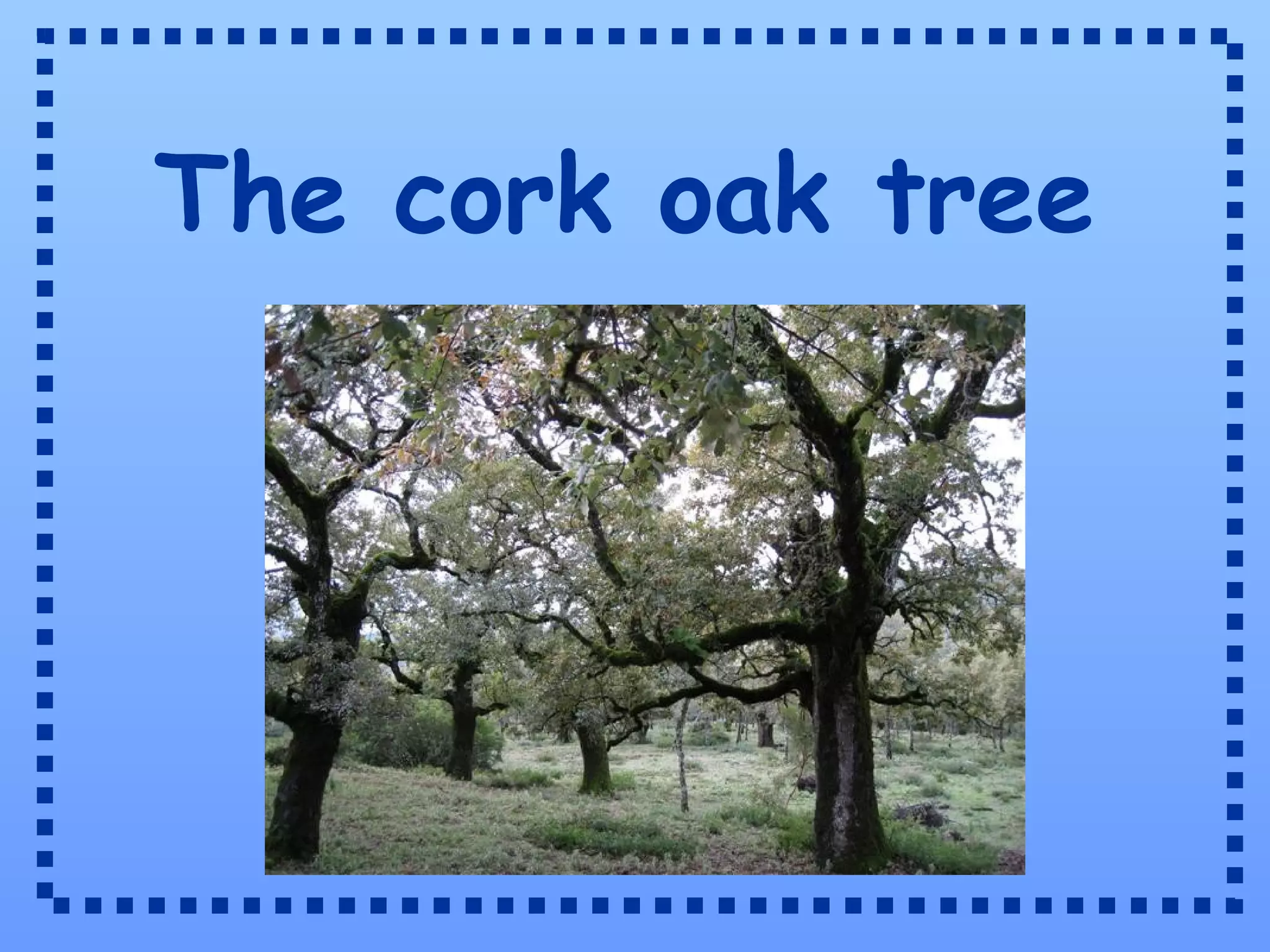
The cork oak tree
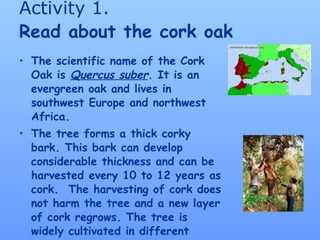
Activity 1. Read about the cork oak The scientific name of the Cork Oak is  Quercus suber .  It is an evergreen oak and lives in southwest Europe and northwest Africa. The tree forms a thick corky bark. This bark can develop considerable thickness and can be harvested every 10 to 12 years as cork.  The harvesting of cork does not harm the tree and a new layer of cork regrows. The tree is widely cultivated in different Mediterranean countries as Spain.
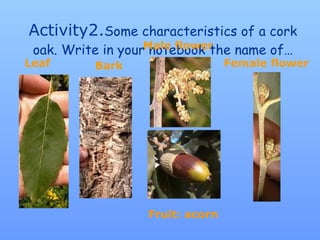
Activity2. Some characteristics of a cork oak. Write in your notebook the name of… Leaf Bark Male flower Female flower Fruit: acorn
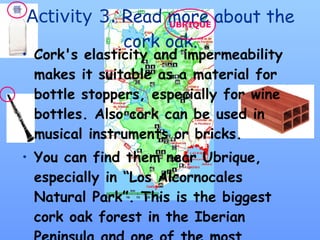
Activity 3.  Read more about the cork oak. Cork's elasticity and impermeability makes it suitable as a material for bottle stoppers, especially for wine bottles. Also cork can be used in musical instruments or bricks. You can find them near Ubrique, especially in “Los Alcornocales Natural Park”. This is the biggest cork oak forest in the Iberian Peninsula and one of the most important around the world. UBRIQUE
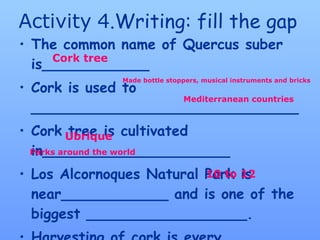
Activity   4 .Writing: fill the gap The common name of Quercus suber  is____________ Cork is used to ______________________________ Cork tree is cultivated in_____________________ Los Alcornoques Natural Park is near____________ and is one of the biggest __________________. Harvesting of cork is every ____________years . Cork tree Made bottle stoppers, musical instruments and bricks Mediterranean countries Ubrique Parks around the world 10 to 12
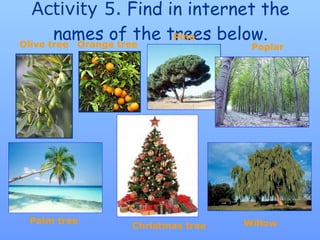
Activity 5.  Find in internet the names of the trees below. Olive  tree Orange  tree Pine Poplar Palm tree Christmas tree Willow
Activity 6 . Listening: description of a cork oak Cork oak’s leaves ___ simple, evergreen and ovate to elliptical. They are ______ inches long and the border is usually with _____. Their color is dark _____ above and whitened below.  _______ appear in early ______. They are ______ and very _____. Its ______ are called acorn which are narrow, oblong and covered by a ___. The bark is light ____ with deep reddish _____ furrows, developing very thick (inches) layers of cork. Is a medium sized ____, up to __ feet ____.
Listening: description of a cork oak Cork oak’s leaves are simple, evergreen and ovate to elliptical. They are 2 to 3 inches long and the border is usually with teeth. Their color is dark green above and whitened below.  Flowers appear in early spring. They are yellow and very small. Its fruits are called acorn which are narrow, oblong and covered by a cap. The bark is light gray with deep reddish brown furrows, developing very thick (inches) layers of cork. Is a medium sized tree, up to 65 feet tall.
Activity   7 .Describe 2 of the trees named before (in activity 5) to your partner. He or she must guess what are you talking about! Some help: Has it got flowers? Is it tall or short tree? Has it got fruits? What is it look like? Are their leaves big or small? Can we eat their fruits? What is the name of its fruits?
Watch the video:  http://www.youtube.com/watch?v=tEHonyNHrIk Activity 8 : write a little story (10 sentences) about what have you seen.

The Oak Tree

  • 1.
  • 2.
    Activity 1. Readabout the cork oak The scientific name of the Cork Oak is Quercus suber . It is an evergreen oak and lives in southwest Europe and northwest Africa. The tree forms a thick corky bark. This bark can develop considerable thickness and can be harvested every 10 to 12 years as cork. The harvesting of cork does not harm the tree and a new layer of cork regrows. The tree is widely cultivated in different Mediterranean countries as Spain.
  • 3.
    Activity2. Some characteristicsof a cork oak. Write in your notebook the name of… Leaf Bark Male flower Female flower Fruit: acorn
  • 4.
    Activity 3. Read more about the cork oak. Cork's elasticity and impermeability makes it suitable as a material for bottle stoppers, especially for wine bottles. Also cork can be used in musical instruments or bricks. You can find them near Ubrique, especially in “Los Alcornocales Natural Park”. This is the biggest cork oak forest in the Iberian Peninsula and one of the most important around the world. UBRIQUE
  • 5.
    Activity 4 .Writing: fill the gap The common name of Quercus suber is____________ Cork is used to ______________________________ Cork tree is cultivated in_____________________ Los Alcornoques Natural Park is near____________ and is one of the biggest __________________. Harvesting of cork is every ____________years . Cork tree Made bottle stoppers, musical instruments and bricks Mediterranean countries Ubrique Parks around the world 10 to 12
  • 6.
    Activity 5. Find in internet the names of the trees below. Olive tree Orange tree Pine Poplar Palm tree Christmas tree Willow
  • 7.
    Activity 6 .Listening: description of a cork oak Cork oak’s leaves ___ simple, evergreen and ovate to elliptical. They are ______ inches long and the border is usually with _____. Their color is dark _____ above and whitened below. _______ appear in early ______. They are ______ and very _____. Its ______ are called acorn which are narrow, oblong and covered by a ___. The bark is light ____ with deep reddish _____ furrows, developing very thick (inches) layers of cork. Is a medium sized ____, up to __ feet ____.
  • 8.
    Listening: description ofa cork oak Cork oak’s leaves are simple, evergreen and ovate to elliptical. They are 2 to 3 inches long and the border is usually with teeth. Their color is dark green above and whitened below. Flowers appear in early spring. They are yellow and very small. Its fruits are called acorn which are narrow, oblong and covered by a cap. The bark is light gray with deep reddish brown furrows, developing very thick (inches) layers of cork. Is a medium sized tree, up to 65 feet tall.
  • 9.
    Activity 7 .Describe 2 of the trees named before (in activity 5) to your partner. He or she must guess what are you talking about! Some help: Has it got flowers? Is it tall or short tree? Has it got fruits? What is it look like? Are their leaves big or small? Can we eat their fruits? What is the name of its fruits?
  • 10.
    Watch the video: http://www.youtube.com/watch?v=tEHonyNHrIk Activity 8 : write a little story (10 sentences) about what have you seen.