THE FOUR SEASONS IN THE MIDDLE AGES Clocks did not exist in the Middle Ages.  The seasons were like a clock for many people as they knew very little about calendars. People thought that time had a double component: Fisical: measured by the sun (sun’s clocks). Spiritual: measured by the bells of the churches. The images in this presentation are taken from the book “Les Très Riches Heures du Duc de Berry”
WINTER Winter is the season when Christ was born and during this time, they celebrated holidays (Christmas). Afterwards, a time of purification began, of both animals (san Anton, January 17th) and people;( la Candelaria, February 2nd;) and even souls: Lent  (to remember the fourty days that Christ spent in the desert  fasting).
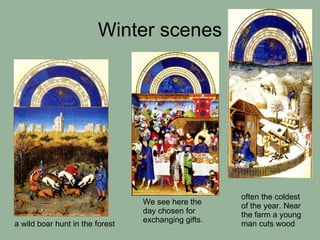
Winter scenes We see here the day chosen for exchanging gifts. often the coldest of the year. Near the farm a young man cuts wood   a wild boar hunt in the forest
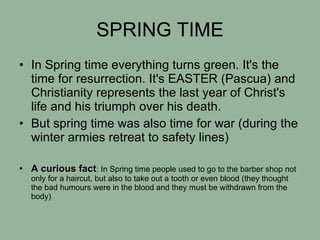
SPRING TIME In Spring time everything turns green. It's the time for resurrection. It's EASTER (Pascua) and Christianity represents the last year of Christ's life and his triumph over his death. But spring time was also time for war (during the winter armies retreat to safety lines) A curious fact : In Spring time people used to go to the barber shop not only for a haircut, but also to take out a tooth or even blood (they thought the bad humours were in the blood and they must be withdrawn from the body)‏
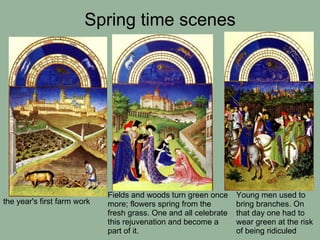
Spring time scenes Fields and woods turn green once more; flowers spring from the fresh grass. One and all celebrate this rejuvenation and become a part of it. the year's first farm work Young men used to bring branches. On that day one had to wear green at the risk of being ridiculed
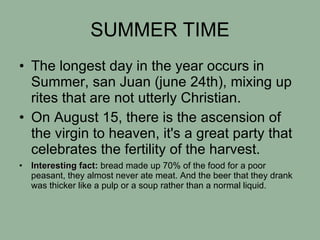
SUMMER TIME The longest day in the year occurs in Summer, san Juan (june 24th), mixing up rites that are not utterly Christian. On August 15, there is the ascension of the virgin to heaven, it's a great party that celebrates the fertility of the harvest.  Interesting fact:  bread made up 70% of the food for a poor peasant, they almost never ate meat. And the beer that they drank was thicker like a pulp or a soup rather than a normal liquid.
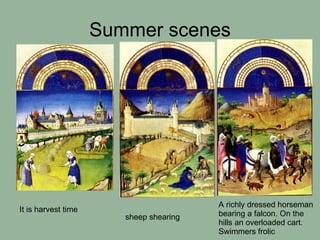
Summer scenes It is harvest time   sheep shearing  A richly dressed horseman bearing a falcon. On the hills an overloaded cart. Swimmers frolic
Autumn Autumn is time for accountability and payments therefore is under the protection of Mateus- september 21 - (the money collector) and  Michel the arcangel in charge of weighing the souls- september 29-  By all the saints, and all dead (november 1, 2) it's the end of the Christian year and also of the activity in the country side. It is time for harvesting the grape, which was important for the church and rich people. Interesting fact: the peasants never tasted wine, it was very very expensive.
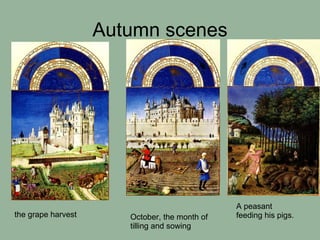
Autumn scenes the grape harvest October, the month of tilling and sowing A peasant feeding his pigs.

Middle Ages

  • 1.
    THE FOUR SEASONSIN THE MIDDLE AGES Clocks did not exist in the Middle Ages. The seasons were like a clock for many people as they knew very little about calendars. People thought that time had a double component: Fisical: measured by the sun (sun’s clocks). Spiritual: measured by the bells of the churches. The images in this presentation are taken from the book “Les Très Riches Heures du Duc de Berry”
  • 2.
    WINTER Winter isthe season when Christ was born and during this time, they celebrated holidays (Christmas). Afterwards, a time of purification began, of both animals (san Anton, January 17th) and people;( la Candelaria, February 2nd;) and even souls: Lent (to remember the fourty days that Christ spent in the desert fasting).
  • 3.
    Winter scenes Wesee here the day chosen for exchanging gifts. often the coldest of the year. Near the farm a young man cuts wood a wild boar hunt in the forest
  • 4.
    SPRING TIME InSpring time everything turns green. It's the time for resurrection. It's EASTER (Pascua) and Christianity represents the last year of Christ's life and his triumph over his death. But spring time was also time for war (during the winter armies retreat to safety lines) A curious fact : In Spring time people used to go to the barber shop not only for a haircut, but also to take out a tooth or even blood (they thought the bad humours were in the blood and they must be withdrawn from the body)‏
  • 5.
    Spring time scenesFields and woods turn green once more; flowers spring from the fresh grass. One and all celebrate this rejuvenation and become a part of it. the year's first farm work Young men used to bring branches. On that day one had to wear green at the risk of being ridiculed
  • 6.
    SUMMER TIME Thelongest day in the year occurs in Summer, san Juan (june 24th), mixing up rites that are not utterly Christian. On August 15, there is the ascension of the virgin to heaven, it's a great party that celebrates the fertility of the harvest. Interesting fact: bread made up 70% of the food for a poor peasant, they almost never ate meat. And the beer that they drank was thicker like a pulp or a soup rather than a normal liquid.
  • 7.
    Summer scenes Itis harvest time sheep shearing A richly dressed horseman bearing a falcon. On the hills an overloaded cart. Swimmers frolic
  • 8.
    Autumn Autumn istime for accountability and payments therefore is under the protection of Mateus- september 21 - (the money collector) and Michel the arcangel in charge of weighing the souls- september 29- By all the saints, and all dead (november 1, 2) it's the end of the Christian year and also of the activity in the country side. It is time for harvesting the grape, which was important for the church and rich people. Interesting fact: the peasants never tasted wine, it was very very expensive.
  • 9.
    Autumn scenes thegrape harvest October, the month of tilling and sowing A peasant feeding his pigs.