The Heart of England Forest, Colletts Farm, Dorsington,
Stratford-upon-Avon, Warwickshire, CV37 8AU
T 01789 778541 E info@heartofenglandforest.org
Registered charity no. 1097110 Company no. 04309564
Planting tomorrow’s great native woodland
Discover more at heartofenglandforest.org
TREE GUIDE
Get to know the native broadleaf trees
that make up the Heart of England Forest.
Hello and welcome to the Heart of England Forest!
As we roll back the loss of England’s native woodland
and the Forest continues to stretch across the heart of
England, we can see an exciting and positive change
on the landscape.
So far, we have planted nearly 1.9 million trees, creating
the largest, new native woodland in the country, right on
the doorstep of large cities like Birmingham and Coventry.
And as we progress towards our goal – a woodland of
13 million trees – we can see how this transformation
is benefiting England’s natural environment. With native
wildlife returning to the area and endangered species
now thriving, the forest is fast becoming a haven for
nature and nature lovers alike.
With your help, we can achieve our vision of creating
and conserving a 30,000 acre Forest for the benefit of
the environment, wildlife and people. A special place
of natural beautyfor our children and grandchildren
to cherish.
Thank you for all your support.
Welcome...
Stephen Coffey
Head Forester,
Heart of England Forest
2
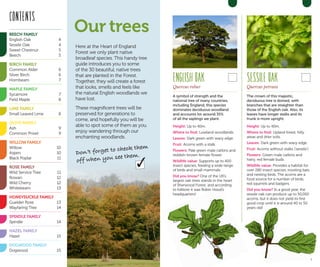
Here at the Heart of England
Forest we only plant native
broadleaf species. This handy tree
guide introduces you to some
of the 30 beautiful, native trees
that are planted in the Forest.
Together, they will create a forest
that looks, smells and feels like
the natural English woodlands we
have lost.
These magnificent trees will be
preserved for generations to
come, and hopefully you will be
able to spot some of them as you
enjoy wandering through our
enchanting woodlands.
Our trees
Don’t forget to check them
off when you see them.
✓
ENGLISHOAK
Quercus robur
A symbol of strength and the
national tree of many countries,
including England, this species
dominates deciduous woodland
and accounts for around 35%
of all the saplings we plant.
Height: Up to 40m.
Where to find: Lowland woodlands.
Leaves: Dark green with wavy edge.
Fruit: Acorns with a stalk.
Flowers: Pale green male catkins and
reddish-brown female flower.
Wildlife value: Supports up to 400
insect species, feeding a wide range
of birds and small mammals.
Did you know? One of the UK’s
largest oak trees stands in the heart
of Sherwood Forest, and according
to folklore it was Robin Hood’s
headquarters!
SESSILEOAK
Quercus petraea
The crown of this majestic,
deciduous tree is domed, with
branches that are straighter than
those of the English oak. Also, its
leaves have longer stalks and its
trunk is more upright.
Height: Up to 40m.
Where to find: Upland forest, hilly
areas and drier soils.
Leaves: Dark green with wavy edge.
Fruit: Acorns without stalks (‘sessile’).
Flowers: Green male catkins and
hairy, red female buds.
Wildlife value: Provides a habitat for
over 280 insect species, roosting bats
and nesting birds. The acorns are a
food source for a number of birds,
red squirrels and badgers.
Did you know? In a good year, the
sessile oak can produce up to 50,000
acorns, but it does not yield its first
good crop until it is around 40 to 50
years old!
CONTENTS
BEECH FAMILY
English Oak 4
Sessile Oak 4
Sweet Chestnut 5
Beech 5
BIRCH FAMILY
Common Alder 6
Silver Birch 6
Hornbeam 7
MAPLE FAMILY
Sycamore 7
Field Maple 8
LIME FAMILY
Small Leaved Lime 8
OLIVE FAMILY
Ash 9
Common Privet 9
WILLOW FAMILY
Willow 10
Aspen 10
Black Poplar 11
ROSE FAMILY
Wild Service Tree 11
Rowan 12
Wild Cherry 12
Whitebeam 13
HONEYSUCKLE FAMILY
Guelder Rose 13
Wayfaring Tree 14
SPINDLE FAMILY
Spindle 14
HAZEL FAMILY
Hazel 15
DOGWOOD FAMILY
Dogwood 15
4
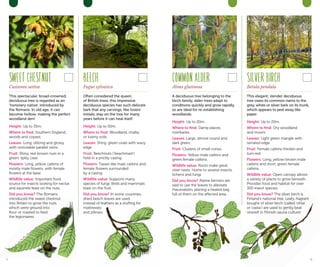
SWEETCHESTNUT
Castanea sativa
This spectacular, broad-crowned,
deciduous tree is regarded as an
‘honorary native’, introduced by
the Romans. In old age, it can
become hollow, making the perfect
woodland den!
Height: Up to 35m.
Where to find: Southern England,
woods and copses.
Leaves: Long, oblong and glossy
with noticeable parallel veins.
Fruit: Shiny, red-brown nuts in a
green, spiky case.
Flowers: Long, yellow catkins of
mostly male flowers, with female
flowers at the base.
Wildlife value: Important food
source for insects looking for nectar,
and squirrels feast on the nuts.
Did you know? The Romans
introduced the sweet chestnut
into Britain to grow the nuts,
which were ground into
flour or roasted to feed
the legionaires.
BEECH
Fagus sylvatica
Often considered the queen
of British trees, this impressive
deciduous species has such delicate
bark that any carvings, like lovers’
initials, stay on the tree for many
years before it can heal itself.
Height: Up to 50m.
Where to find: Woodland, chalky
or loamy soils.
Leaves: Shiny, green ovals with wavy
edge.
Fruit: Beechnuts (‘beachmast’)
held in a prickly casing.
Flowers: Tassel-like male catkins and
female flowers surrounded
by a casing.
Wildlife value: Supports many
species of fungi. Birds and mammals
feast on the fruit.
Did you know? In some countries,
dried beech leaves are used
instead of feathers as a stuffing for
mattresses
and pillows.
COMMONALDER
Alnus glutinosa
A deciduous tree belonging to the
birch family, alder trees adapt to
conditions quickly and grow rapidly,
so are ideal for re-establishing
woodlands.
Height: Up to 20m.
Where to find: Damp places,
riverbanks.
Leaves: Large, almost round and
dark green.
Fruit: Clusters of small cones.
Flowers: Yellow male catkins and
green female catkins.
Wildlife value: Roots make great
otter nests. Home to several insects,
lichens and fungi.
Did you know? Alpine farmers are
said to use the leaves to alleviate
rheumatism, placing a heated bag
full of them on the affected area.
SILVERBIRCH
Betula pendula
This elegant, slender deciduous
tree owes its common name to the
grey, white or silver bark on its trunk,
which appears to peel away like
paper.
Height: Up to 20m.
Where to find: Dry woodland
and moors.
Leaves: Light green triangle with
serrated edge.
Fruit: Female catkins thicken and
turn red.
Flowers: Long, yellow-brown male
catkins and short, green female
catkins.
Wildlife value: Open canopy allows
a variety of plants to grow beneath.
Provides food and habitat for over
300 insect species.
Did you know? The silver birch is
Finland’s national tree. Leafy, fragrant
boughs of silver birch (called ‘vihta’
or ‘vasta’) are used to gently beat
oneself in Finnish sauna culture!
5 6
FIELDMAPLE
Acer campestre
The UK’s only native maple, this
deciduous species is widely planted
as an ornamental tree in gardens and
parks due to its tolerance of pollution
and beautiful, rich autumn colours.
Height: Up to 15m.
Where to find: Woodland, hedgerows.
Leaves: Small, dark green with
five rounded lobes.
Fruit: Reddish-green, winged ‘samara’.
Flowers: Clusters of yellow-green,
cup-shaped flowers.
Wildlife value: Attractive to aphids,
and the flowers provide nectar.
The leaves are a source of food
for several caterpillars.
Did you know? The field maple
was chosen as one of the trees to line
the aisle of Westminster Abbey at the
royal wedding of Kate and William as
it symbolises reserve and humility.
SMALLLEAVEDLIME
Tilia cordata
Depicted in our Heart of England
Forest logo, this deciduous ancient
tree dates back to the end of the
last Ice Age and is becoming an
increasingly rare sight in Britain.
Height: Up to 40m.
Where to find: Well drained, lime
rich soil.
Leaves: Heart shaped with red-brown
hairs on the underside.
Fruit: Small, round, nut-like.
Flowers: Erect clusters of green-
yellow, sweet-smelling flowers.
Wildlife value: Important food source
for insects looking for nectar, and the
leaves are very attractive to aphids.
Did you know? The flowers can be
dried to make a soothing tea (called
‘Linden Tea’ or ‘Tieull’), which was
used during the war to calm nerves.
HORNBEAM
Carpinus betulus
Similar to beech, this deciduous
tree can live for more than 300
years, and yields a very strong timber
that was used to make furniture,
butchers’ chopping blocks and
cogs for windmills.
Height: Up to 25m.
Where to find: Mainly found in South
East England. Associated with oak
woodlands.
Leaves: Green, oval, toothed and
pleated with pointed tip.
Fruit: Papery, oval, winged ‘samaras’.
Flowers: Long, yellow male catkins
and short, green female catkins.
Wildlife value: Important food source
for caterpillars of a number of moth
species.
Did you know? The name ‘hornbeam’
derives from the hardness of the
wood (likened to horn) and the old
English word ‘beam’, meaning ‘tree’.
SYCAMORE
Acer pseudoplatanus
A member of the maple family and
the largest European maple, it is
believed to have been introduced
to the UK in the Middle Ages and
is now a naturalised species. This
deciduous tree is fast growing. When
mature, it provides a grand, domed
outline in the countryside.
Height: Up to 30m.
Where to find: Common throughout
Britain they grow in almost any soil type.
Leaves: Dark green, large with five
lobes and pointed tip.
Fruit: Winged fruit ‘samara’.
Flowers: Yellow-green, dangling
clusters of flowers.
Benefits to wildlife: Flowers
produce abundant nectar, and the
seeds are a food source for birds
and small mammals.
Did you know? Sycamore seeds
are known as ‘helicopters’ because
their wings rotate
similar to a
helicopter’s
propeller.
7 8
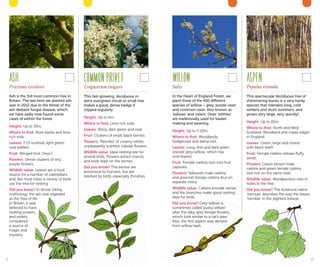
ASH
Fraxinus excelsior
Ash is the 3rd most common tree in
Britain. The last time we planted ash
was in 2012 due to the threat of the
ash dieback fungal disease, which
we have sadly now found some
cases of within the forest.
Height: Up to 35m.
Where to find: River banks and lime
rich soils.
Leaves: 7-13 toothed, light green,
oval leaflets.
Fruit: Winged fruit (‘keys’).
Flowers: Dense clusters of tiny,
purple flowers.
Wildlife value: Leaves are a food
source for a number of caterpillars,
and, like most trees, a variety of birds
use the tree for nesting.
Did you know? In Norse Viking
mythology, the ash was regarded
as the ‘tree of life’.
In Britain, it was
believed to have
healing powers,
and widely
considered
a source of
magic and
mystery.
WILLOW
Salix
In the Heart of England Forest, we
plant three of the 400 different
species of willow – grey, purple osier
and common osier. Also known as
‘sallows’ and ‘osiers’. Osier ‘withies’
are traditionally used for basket
making and weaving.
Height: Up to 7-10m.
Where to find: Woodlands,
hedgerows and damp soil.
Leaves: Long, thin and dark green
(except grey willow, which has
oval leaves).
Fruit: Female catkins turn into fruit
capsules.
Flowers: Yellowish male catkins
and greenish female catkins (but on
separate trees).
Wildlife value: Catkins provide nectar,
and the branches make good nesting
sites for birds.
Did you know? Grey willow is
sometimes called ‘pussy willow’
after the silky, grey female flowers,
which look similar to a cat’s paw.
Also, the first aspirin was derived
from willow bark.
ASPEN
Populus tremula
This spectacular deciduous tree of
shimmering leaves is a very hardy
species that tolerates long, cold
winters and short summers, and
grows very large, very quickly!
Height: Up to 20m.

Where to find: North and West
Scotland. Woodland and copse edges
in England.

Leaves: Green, large and round
with blunt teeth

Fruit: Female catkins release fluffy
seeds.

Flowers: Green-brown male
catkins and green female catkins
(but not on the same tree).

Wildlife value: Woodpeckers nest in
holes in the tree.

Did you know? The botanical name
‘tremula’ describes the way the leaves
‘tremble’ in the slightest breeze.
COMMONPRIVET
Lingustrum vulgare
This fast-growing, deciduous or
semi-evergreen shrub or small tree
makes a good, dense hedge if
clipped regularly.
Height: Up to 4m.
Where to find: Lime rich soils.
Leaves: Shiny, dark green and oval.
Fruit: Clusters of small, black berries.
Flowers: ‘Panciles’ of creamy-white,
unpleasantly scented, tubular flowers.
Wildlife value: Ideal nesting site for
several birds. Flowers attract insects,
and birds feast on the berries.
Did you know? The berries are
poisonous to humans, but are
relished by birds, especially thrushes.
9 10
ROWAN
Sorbus aucuparia
This popular, deciduous tree with
feather-like leaves and bright red
fruits was thought to ward off evil
spirits, so was planted in churchyards
and outside houses as protection.
Height: Up to 15m.
Where to find: Woodland margins
and hedgerows.
Leaves: 5-8 pairs of dark green
oval, toothed leaflets.
Fruit: Small, bright orange to
red ‘pomes’.
Flowers: Clusters of pungent, sweet-
smelling creamy-white flowers.
Wildlife value: Flowers provide
nectar, and the fruit is a rich
source of food for many birds.
Did you know? Rowan is a great
source of vitamin C. It tastes bitter
when fresh, but can be made into
a delicious jelly that goes well with
meat or game dishes.
WILDCHERRY
Prunus avium
Also known as ‘gean’ and ‘sweet
cherry’, this deciduous tree is
perhaps one of the prettiest native
woodland trees, and is a popular
ornamental tree for gardens.
Height: Up to 30m.
Where to find: Woodland margins
and hedgerows.
Leaves: Green, oval and toothed.
Fruit: Shiny, red cherries.
Flowers: Clusters of white,
cup-shaped flowers.
Wildlife value: Flowers provide
nectar, and birds and small mammals
feast on the cherries.
Did you know? The second part
of its botanical name, ‘avium’, refers
to birds, which eat the cherries and
disperse the seed!
WILDSERVICETREE
Sorbus torminalis
Sometimes called the ‘chequer’
or ‘checker’ tree, this deciduous
species is highly valued at the
Heart of England Forest because
of its rarity in England.
Height: Up to 15m.
Where to find: Ancient woodland
and hedgerows.
Leaves: Dark green, unequal lobes,
similar to maple.
Fruit: Tiny, brown ‘pomes’.
Flowers: Clusters of small,
white flowers.
Wildlife value: Flowers provide
nectar, and the fruits feed many
birds. The leaves are a source of
food for several caterpillars.
Did you know? The fruits are
edible when over-ripe (‘bleted ’) and
taste similar to dates, and were once
given as sweets to children and made
into an alcoholic drink.
BLACKPOPLAR
Populus nigra
The black poplar is a large robust tree
that can live for as long as 200 years.
It gets its name from its distinctive,
gnarly bark, which although actually
dark brown, often appears to be black.
Sadly it is the most endangered native
timber tree in Britain.
Height: Up to 30m.
Where to find: Close to streams and
along hedgerows.
Leaves: Finely toothed, smooth and
triangular.
Fruit: Once fertilized, female catkins
develop into fluffy cotton wool like
seeds.
Flowers: Male catkins are red and
hang down. Female catkins are
yellow-green and stand.
Wildlife value: Important food plant
for the caterpillars of many moths.
Their catkins are also an early source
of pollen and nectar for bees
and other insects.
Did you know?
The black
poplar featured
heavily in the
paintings of
John Constable.
11 12
WAYFARINGTREE
Viburnum lantana
The wayfaring tree is often planted
as an ornamental shrub for its lovely,
large flower heads and spectacular
autumn colour. It also makes a good
addition to countryside hedges.
Height: Up to 5m.
Where to find: Woodland edges,
scrub, hedgerows.
Leaves: Large, grey-green oval with
round-toothed edge.
Fruit: Groups of red berries ripening
to black .
Flowers: Small, cream, tubular flowers
form a domed flower
head (‘umbel’).
Wildlife value: Flowers attract insects,
and the berries are an important food
for birds.
Did you know? The wayfaring tree
is so called as it is a common sight
along roadsides and footpaths,
especially on dry, limestone soils.
SPINDLE
Euonymus europaea
The spindle is a very attractive
deciduous woodland shrub with
a magnificent autumn display of
leaf and seed colours.
Height: Up to 7m.
Where to find: Hedgerows,
woodland edges.
Leaves: Green, oval with toothed
edge.
Fruit: Bright pink pods with bright
orange seeds that resemble popcorn
Flowers: Clusters of tiny, greenish-
yellow flowers.
Wildlife value: Flowers are a rich
source of nectar, and the leaves
attract aphids and caterpillars.
Did you know? The creamy-white
wood is very hard and dense, and
was once used for spindles, skewers,
pegs and knitting needles.
GUELDERROSE
Viburnum opulus
This is one of the prettiest deciduous
native shrubs thanks to its large
white flower heads and glistening
red berries in autumn.
Height: Up to 4m.
Where to find: Damp scrub, old
hedgerows and woods.
Leaves: Large, three lobes, with
toothed edge.		
Fruit: Groups of bright red berries.
Flowers: Clusters of small, white
flowers surrounded by larger,
flat, white flowers.
Wildlife value: Flowers attract insects,
and many birds eat the berries.
Did you know? The berries are toxic
if eaten raw, but can be cooked into
a tasty jelly or jam. The bark can be
effective in relieving muscle cramps
when used in a tincture.
WHITEBEAM
Sorbus aria
This deciduous tree is particularly
eye-catching in spring when the
pale underside of its leaves gives
the whole crown a striking silvery
white look.
Height: Up to 15m.
Where to find: Woodland margins
and hedgerows.
Leaves: Thick, dark green, shiny, oval
and toothed edge.
Fruit: Bright red berries.
Flowers: Clusters of creamy-white
flowers.
Wildlife value: Berries are readily
eaten by birds, and the leaves are food
for a number of caterpillars.
Did you know? The common name
is Anglo-Saxon. The German word
for tree is ‘baum’, and the ‘white’
element comes from the appearance
of the tree.
13 14
The Heart of England Forest is an inspiring, ambitious charity
and we are hugely grateful to the support of volunteers,
friends, trusts and companies who play a crucial role in helping
the forest to grow! In particular we’d like to recognise local
company, Leader, who have recently supported our work.
James, Managing Director explains further:
Tree-
mendous
support
Leader, is a Warwickshire
based PR, Design and
Marketing consultancy.
In 2015 we celebrated our
50th anniversary and in
commemoration supported the
planting of ‘Leader Wood’,
a 6.5 acre parcel within the
Heart of England Forest that
is now clothed in native trees.
Leader has also been pleased to
support the production of this
handy ‘Tree Guide’, not only to
foster a better understanding
of the wonderful trees that form
the forest, but also because our
founder, Bryan Holden, is a
keen botanical illustrator
and has provided all the line
drawings of leaves, fruits and
flowers used in this guide.
We hope you enjoy discovering
more about the trees that are
returning to their natural home
in the Heart of England Forest
– an amazing recreation of our
native broadleaf woodland.
“
DOGWOOD
Cornus sanguinea
A popular ornamental plant, this
shrub or small tree is used in gardens
for its rich crimson colour in autumn.
It also forms a good natural barrier
along watersides.
Height: Up to 10m.
Where to find: Prefers damp soil.
Leaves: Bright green, oval with
curving veins.
Fruit: Small, black berries
(‘dogberries’).
Flowers: Clusters of creamy-white
flowers.
Wildlife value: The flowers attract
insects and many birds and mammals
eat the berries.
Did you know? In the past, bark-
free branches of dogwood were
used as toothbrushes, and tea made
from the bark could be used to treat
pain and fever.
HAZEL
Corylus avellana
This attractive, deciduous shrub
or small tree is one of the most
important woody plants for
‘coppicing’, a traditional method
of woodland management.
Height: Up to 12m.
Where to find: Woodland, scrub,
hedgerows.
Leaves: Large, heart-shaped,
mid-green, toothed and hairy.
Fruit: Nut held in woody husk.
Flowers: Yellow male catkins and
short, red female tufts.
Wildlife value: Leaves and nuts
are an important food source for
birds, the dormouse and other small
mammals.
Did you know? In spring, hazel is
so bendy that you can tie it in a knot
without it breaking!
”
www.leader.co.uk
15
The Heart of England Forest is committed to
planting tomorrow’s great native woodland
– right in the heart of the Midlands.
Our goal is to reach 30,000 acres and work has
already begun. Nearly 1.9 million trees have already
been planted. The forest is set to be a haven of
airy glades, shady canopies and safe habitats
for our native wildlife. It will be a rich, joined-up
collection of new and ancient woodlands,
meandering across the heart of England.
This is an ambitious vision and we’d love for you
to come and see it for yourself! Whether you join
our forest team on a Woodland Walk, attend an
event in the forest or use this guide as you explore
our paths and trails, it would be great to see you
out and about in the Heart of England Forest .
For more details about what you can do today,
please go to heartofenglandforest.org
Find out about guided walks, forest events
and new walking routes at:
facebook.com/heartofenglandforest
Thank you, we look forward to seeing you soon.
Will you help
the forest grow?
18

Tree Guide March 2021 .pdf

  • 1.
    The Heart ofEngland Forest, Colletts Farm, Dorsington, Stratford-upon-Avon, Warwickshire, CV37 8AU T 01789 778541 E info@heartofenglandforest.org Registered charity no. 1097110 Company no. 04309564 Planting tomorrow’s great native woodland Discover more at heartofenglandforest.org TREE GUIDE Get to know the native broadleaf trees that make up the Heart of England Forest.
  • 2.
    Hello and welcometo the Heart of England Forest! As we roll back the loss of England’s native woodland and the Forest continues to stretch across the heart of England, we can see an exciting and positive change on the landscape. So far, we have planted nearly 1.9 million trees, creating the largest, new native woodland in the country, right on the doorstep of large cities like Birmingham and Coventry. And as we progress towards our goal – a woodland of 13 million trees – we can see how this transformation is benefiting England’s natural environment. With native wildlife returning to the area and endangered species now thriving, the forest is fast becoming a haven for nature and nature lovers alike. With your help, we can achieve our vision of creating and conserving a 30,000 acre Forest for the benefit of the environment, wildlife and people. A special place of natural beautyfor our children and grandchildren to cherish. Thank you for all your support. Welcome... Stephen Coffey Head Forester, Heart of England Forest 2
  • 3.
    Here at theHeart of England Forest we only plant native broadleaf species. This handy tree guide introduces you to some of the 30 beautiful, native trees that are planted in the Forest. Together, they will create a forest that looks, smells and feels like the natural English woodlands we have lost. These magnificent trees will be preserved for generations to come, and hopefully you will be able to spot some of them as you enjoy wandering through our enchanting woodlands. Our trees Don’t forget to check them off when you see them. ✓ ENGLISHOAK Quercus robur A symbol of strength and the national tree of many countries, including England, this species dominates deciduous woodland and accounts for around 35% of all the saplings we plant. Height: Up to 40m. Where to find: Lowland woodlands. Leaves: Dark green with wavy edge. Fruit: Acorns with a stalk. Flowers: Pale green male catkins and reddish-brown female flower. Wildlife value: Supports up to 400 insect species, feeding a wide range of birds and small mammals. Did you know? One of the UK’s largest oak trees stands in the heart of Sherwood Forest, and according to folklore it was Robin Hood’s headquarters! SESSILEOAK Quercus petraea The crown of this majestic, deciduous tree is domed, with branches that are straighter than those of the English oak. Also, its leaves have longer stalks and its trunk is more upright. Height: Up to 40m. Where to find: Upland forest, hilly areas and drier soils. Leaves: Dark green with wavy edge. Fruit: Acorns without stalks (‘sessile’). Flowers: Green male catkins and hairy, red female buds. Wildlife value: Provides a habitat for over 280 insect species, roosting bats and nesting birds. The acorns are a food source for a number of birds, red squirrels and badgers. Did you know? In a good year, the sessile oak can produce up to 50,000 acorns, but it does not yield its first good crop until it is around 40 to 50 years old! CONTENTS BEECH FAMILY English Oak 4 Sessile Oak 4 Sweet Chestnut 5 Beech 5 BIRCH FAMILY Common Alder 6 Silver Birch 6 Hornbeam 7 MAPLE FAMILY Sycamore 7 Field Maple 8 LIME FAMILY Small Leaved Lime 8 OLIVE FAMILY Ash 9 Common Privet 9 WILLOW FAMILY Willow 10 Aspen 10 Black Poplar 11 ROSE FAMILY Wild Service Tree 11 Rowan 12 Wild Cherry 12 Whitebeam 13 HONEYSUCKLE FAMILY Guelder Rose 13 Wayfaring Tree 14 SPINDLE FAMILY Spindle 14 HAZEL FAMILY Hazel 15 DOGWOOD FAMILY Dogwood 15 4
  • 4.
    SWEETCHESTNUT Castanea sativa This spectacular,broad-crowned, deciduous tree is regarded as an ‘honorary native’, introduced by the Romans. In old age, it can become hollow, making the perfect woodland den! Height: Up to 35m. Where to find: Southern England, woods and copses. Leaves: Long, oblong and glossy with noticeable parallel veins. Fruit: Shiny, red-brown nuts in a green, spiky case. Flowers: Long, yellow catkins of mostly male flowers, with female flowers at the base. Wildlife value: Important food source for insects looking for nectar, and squirrels feast on the nuts. Did you know? The Romans introduced the sweet chestnut into Britain to grow the nuts, which were ground into flour or roasted to feed the legionaires. BEECH Fagus sylvatica Often considered the queen of British trees, this impressive deciduous species has such delicate bark that any carvings, like lovers’ initials, stay on the tree for many years before it can heal itself. Height: Up to 50m. Where to find: Woodland, chalky or loamy soils. Leaves: Shiny, green ovals with wavy edge. Fruit: Beechnuts (‘beachmast’) held in a prickly casing. Flowers: Tassel-like male catkins and female flowers surrounded by a casing. Wildlife value: Supports many species of fungi. Birds and mammals feast on the fruit. Did you know? In some countries, dried beech leaves are used instead of feathers as a stuffing for mattresses and pillows. COMMONALDER Alnus glutinosa A deciduous tree belonging to the birch family, alder trees adapt to conditions quickly and grow rapidly, so are ideal for re-establishing woodlands. Height: Up to 20m. Where to find: Damp places, riverbanks. Leaves: Large, almost round and dark green. Fruit: Clusters of small cones. Flowers: Yellow male catkins and green female catkins. Wildlife value: Roots make great otter nests. Home to several insects, lichens and fungi. Did you know? Alpine farmers are said to use the leaves to alleviate rheumatism, placing a heated bag full of them on the affected area. SILVERBIRCH Betula pendula This elegant, slender deciduous tree owes its common name to the grey, white or silver bark on its trunk, which appears to peel away like paper. Height: Up to 20m. Where to find: Dry woodland and moors. Leaves: Light green triangle with serrated edge. Fruit: Female catkins thicken and turn red. Flowers: Long, yellow-brown male catkins and short, green female catkins. Wildlife value: Open canopy allows a variety of plants to grow beneath. Provides food and habitat for over 300 insect species. Did you know? The silver birch is Finland’s national tree. Leafy, fragrant boughs of silver birch (called ‘vihta’ or ‘vasta’) are used to gently beat oneself in Finnish sauna culture! 5 6
  • 5.
    FIELDMAPLE Acer campestre The UK’sonly native maple, this deciduous species is widely planted as an ornamental tree in gardens and parks due to its tolerance of pollution and beautiful, rich autumn colours. Height: Up to 15m. Where to find: Woodland, hedgerows. Leaves: Small, dark green with five rounded lobes. Fruit: Reddish-green, winged ‘samara’. Flowers: Clusters of yellow-green, cup-shaped flowers. Wildlife value: Attractive to aphids, and the flowers provide nectar. The leaves are a source of food for several caterpillars. Did you know? The field maple was chosen as one of the trees to line the aisle of Westminster Abbey at the royal wedding of Kate and William as it symbolises reserve and humility. SMALLLEAVEDLIME Tilia cordata Depicted in our Heart of England Forest logo, this deciduous ancient tree dates back to the end of the last Ice Age and is becoming an increasingly rare sight in Britain. Height: Up to 40m. Where to find: Well drained, lime rich soil. Leaves: Heart shaped with red-brown hairs on the underside. Fruit: Small, round, nut-like. Flowers: Erect clusters of green- yellow, sweet-smelling flowers. Wildlife value: Important food source for insects looking for nectar, and the leaves are very attractive to aphids. Did you know? The flowers can be dried to make a soothing tea (called ‘Linden Tea’ or ‘Tieull’), which was used during the war to calm nerves. HORNBEAM Carpinus betulus Similar to beech, this deciduous tree can live for more than 300 years, and yields a very strong timber that was used to make furniture, butchers’ chopping blocks and cogs for windmills. Height: Up to 25m. Where to find: Mainly found in South East England. Associated with oak woodlands. Leaves: Green, oval, toothed and pleated with pointed tip. Fruit: Papery, oval, winged ‘samaras’. Flowers: Long, yellow male catkins and short, green female catkins. Wildlife value: Important food source for caterpillars of a number of moth species. Did you know? The name ‘hornbeam’ derives from the hardness of the wood (likened to horn) and the old English word ‘beam’, meaning ‘tree’. SYCAMORE Acer pseudoplatanus A member of the maple family and the largest European maple, it is believed to have been introduced to the UK in the Middle Ages and is now a naturalised species. This deciduous tree is fast growing. When mature, it provides a grand, domed outline in the countryside. Height: Up to 30m. Where to find: Common throughout Britain they grow in almost any soil type. Leaves: Dark green, large with five lobes and pointed tip. Fruit: Winged fruit ‘samara’. Flowers: Yellow-green, dangling clusters of flowers. Benefits to wildlife: Flowers produce abundant nectar, and the seeds are a food source for birds and small mammals. Did you know? Sycamore seeds are known as ‘helicopters’ because their wings rotate similar to a helicopter’s propeller. 7 8
  • 6.
    ASH Fraxinus excelsior Ash isthe 3rd most common tree in Britain. The last time we planted ash was in 2012 due to the threat of the ash dieback fungal disease, which we have sadly now found some cases of within the forest. Height: Up to 35m. Where to find: River banks and lime rich soils. Leaves: 7-13 toothed, light green, oval leaflets. Fruit: Winged fruit (‘keys’). Flowers: Dense clusters of tiny, purple flowers. Wildlife value: Leaves are a food source for a number of caterpillars, and, like most trees, a variety of birds use the tree for nesting. Did you know? In Norse Viking mythology, the ash was regarded as the ‘tree of life’. In Britain, it was believed to have healing powers, and widely considered a source of magic and mystery. WILLOW Salix In the Heart of England Forest, we plant three of the 400 different species of willow – grey, purple osier and common osier. Also known as ‘sallows’ and ‘osiers’. Osier ‘withies’ are traditionally used for basket making and weaving. Height: Up to 7-10m. Where to find: Woodlands, hedgerows and damp soil. Leaves: Long, thin and dark green (except grey willow, which has oval leaves). Fruit: Female catkins turn into fruit capsules. Flowers: Yellowish male catkins and greenish female catkins (but on separate trees). Wildlife value: Catkins provide nectar, and the branches make good nesting sites for birds. Did you know? Grey willow is sometimes called ‘pussy willow’ after the silky, grey female flowers, which look similar to a cat’s paw. Also, the first aspirin was derived from willow bark. ASPEN Populus tremula This spectacular deciduous tree of shimmering leaves is a very hardy species that tolerates long, cold winters and short summers, and grows very large, very quickly! Height: Up to 20m. Where to find: North and West Scotland. Woodland and copse edges in England. Leaves: Green, large and round with blunt teeth Fruit: Female catkins release fluffy seeds. Flowers: Green-brown male catkins and green female catkins (but not on the same tree). Wildlife value: Woodpeckers nest in holes in the tree. Did you know? The botanical name ‘tremula’ describes the way the leaves ‘tremble’ in the slightest breeze. COMMONPRIVET Lingustrum vulgare This fast-growing, deciduous or semi-evergreen shrub or small tree makes a good, dense hedge if clipped regularly. Height: Up to 4m. Where to find: Lime rich soils. Leaves: Shiny, dark green and oval. Fruit: Clusters of small, black berries. Flowers: ‘Panciles’ of creamy-white, unpleasantly scented, tubular flowers. Wildlife value: Ideal nesting site for several birds. Flowers attract insects, and birds feast on the berries. Did you know? The berries are poisonous to humans, but are relished by birds, especially thrushes. 9 10
  • 7.
    ROWAN Sorbus aucuparia This popular,deciduous tree with feather-like leaves and bright red fruits was thought to ward off evil spirits, so was planted in churchyards and outside houses as protection. Height: Up to 15m. Where to find: Woodland margins and hedgerows. Leaves: 5-8 pairs of dark green oval, toothed leaflets. Fruit: Small, bright orange to red ‘pomes’. Flowers: Clusters of pungent, sweet- smelling creamy-white flowers. Wildlife value: Flowers provide nectar, and the fruit is a rich source of food for many birds. Did you know? Rowan is a great source of vitamin C. It tastes bitter when fresh, but can be made into a delicious jelly that goes well with meat or game dishes. WILDCHERRY Prunus avium Also known as ‘gean’ and ‘sweet cherry’, this deciduous tree is perhaps one of the prettiest native woodland trees, and is a popular ornamental tree for gardens. Height: Up to 30m. Where to find: Woodland margins and hedgerows. Leaves: Green, oval and toothed. Fruit: Shiny, red cherries. Flowers: Clusters of white, cup-shaped flowers. Wildlife value: Flowers provide nectar, and birds and small mammals feast on the cherries. Did you know? The second part of its botanical name, ‘avium’, refers to birds, which eat the cherries and disperse the seed! WILDSERVICETREE Sorbus torminalis Sometimes called the ‘chequer’ or ‘checker’ tree, this deciduous species is highly valued at the Heart of England Forest because of its rarity in England. Height: Up to 15m. Where to find: Ancient woodland and hedgerows. Leaves: Dark green, unequal lobes, similar to maple. Fruit: Tiny, brown ‘pomes’. Flowers: Clusters of small, white flowers. Wildlife value: Flowers provide nectar, and the fruits feed many birds. The leaves are a source of food for several caterpillars. Did you know? The fruits are edible when over-ripe (‘bleted ’) and taste similar to dates, and were once given as sweets to children and made into an alcoholic drink. BLACKPOPLAR Populus nigra The black poplar is a large robust tree that can live for as long as 200 years. It gets its name from its distinctive, gnarly bark, which although actually dark brown, often appears to be black. Sadly it is the most endangered native timber tree in Britain. Height: Up to 30m. Where to find: Close to streams and along hedgerows. Leaves: Finely toothed, smooth and triangular. Fruit: Once fertilized, female catkins develop into fluffy cotton wool like seeds. Flowers: Male catkins are red and hang down. Female catkins are yellow-green and stand. Wildlife value: Important food plant for the caterpillars of many moths. Their catkins are also an early source of pollen and nectar for bees and other insects. Did you know? The black poplar featured heavily in the paintings of John Constable. 11 12
  • 8.
    WAYFARINGTREE Viburnum lantana The wayfaringtree is often planted as an ornamental shrub for its lovely, large flower heads and spectacular autumn colour. It also makes a good addition to countryside hedges. Height: Up to 5m. Where to find: Woodland edges, scrub, hedgerows. Leaves: Large, grey-green oval with round-toothed edge. Fruit: Groups of red berries ripening to black . Flowers: Small, cream, tubular flowers form a domed flower head (‘umbel’). Wildlife value: Flowers attract insects, and the berries are an important food for birds. Did you know? The wayfaring tree is so called as it is a common sight along roadsides and footpaths, especially on dry, limestone soils. SPINDLE Euonymus europaea The spindle is a very attractive deciduous woodland shrub with a magnificent autumn display of leaf and seed colours. Height: Up to 7m. Where to find: Hedgerows, woodland edges. Leaves: Green, oval with toothed edge. Fruit: Bright pink pods with bright orange seeds that resemble popcorn Flowers: Clusters of tiny, greenish- yellow flowers. Wildlife value: Flowers are a rich source of nectar, and the leaves attract aphids and caterpillars. Did you know? The creamy-white wood is very hard and dense, and was once used for spindles, skewers, pegs and knitting needles. GUELDERROSE Viburnum opulus This is one of the prettiest deciduous native shrubs thanks to its large white flower heads and glistening red berries in autumn. Height: Up to 4m. Where to find: Damp scrub, old hedgerows and woods. Leaves: Large, three lobes, with toothed edge. Fruit: Groups of bright red berries. Flowers: Clusters of small, white flowers surrounded by larger, flat, white flowers. Wildlife value: Flowers attract insects, and many birds eat the berries. Did you know? The berries are toxic if eaten raw, but can be cooked into a tasty jelly or jam. The bark can be effective in relieving muscle cramps when used in a tincture. WHITEBEAM Sorbus aria This deciduous tree is particularly eye-catching in spring when the pale underside of its leaves gives the whole crown a striking silvery white look. Height: Up to 15m. Where to find: Woodland margins and hedgerows. Leaves: Thick, dark green, shiny, oval and toothed edge. Fruit: Bright red berries. Flowers: Clusters of creamy-white flowers. Wildlife value: Berries are readily eaten by birds, and the leaves are food for a number of caterpillars. Did you know? The common name is Anglo-Saxon. The German word for tree is ‘baum’, and the ‘white’ element comes from the appearance of the tree. 13 14
  • 9.
    The Heart ofEngland Forest is an inspiring, ambitious charity and we are hugely grateful to the support of volunteers, friends, trusts and companies who play a crucial role in helping the forest to grow! In particular we’d like to recognise local company, Leader, who have recently supported our work. James, Managing Director explains further: Tree- mendous support Leader, is a Warwickshire based PR, Design and Marketing consultancy. In 2015 we celebrated our 50th anniversary and in commemoration supported the planting of ‘Leader Wood’, a 6.5 acre parcel within the Heart of England Forest that is now clothed in native trees. Leader has also been pleased to support the production of this handy ‘Tree Guide’, not only to foster a better understanding of the wonderful trees that form the forest, but also because our founder, Bryan Holden, is a keen botanical illustrator and has provided all the line drawings of leaves, fruits and flowers used in this guide. We hope you enjoy discovering more about the trees that are returning to their natural home in the Heart of England Forest – an amazing recreation of our native broadleaf woodland. “ DOGWOOD Cornus sanguinea A popular ornamental plant, this shrub or small tree is used in gardens for its rich crimson colour in autumn. It also forms a good natural barrier along watersides. Height: Up to 10m. Where to find: Prefers damp soil. Leaves: Bright green, oval with curving veins. Fruit: Small, black berries (‘dogberries’). Flowers: Clusters of creamy-white flowers. Wildlife value: The flowers attract insects and many birds and mammals eat the berries. Did you know? In the past, bark- free branches of dogwood were used as toothbrushes, and tea made from the bark could be used to treat pain and fever. HAZEL Corylus avellana This attractive, deciduous shrub or small tree is one of the most important woody plants for ‘coppicing’, a traditional method of woodland management. Height: Up to 12m. Where to find: Woodland, scrub, hedgerows. Leaves: Large, heart-shaped, mid-green, toothed and hairy. Fruit: Nut held in woody husk. Flowers: Yellow male catkins and short, red female tufts. Wildlife value: Leaves and nuts are an important food source for birds, the dormouse and other small mammals. Did you know? In spring, hazel is so bendy that you can tie it in a knot without it breaking! ” www.leader.co.uk 15
  • 10.
    The Heart ofEngland Forest is committed to planting tomorrow’s great native woodland – right in the heart of the Midlands. Our goal is to reach 30,000 acres and work has already begun. Nearly 1.9 million trees have already been planted. The forest is set to be a haven of airy glades, shady canopies and safe habitats for our native wildlife. It will be a rich, joined-up collection of new and ancient woodlands, meandering across the heart of England. This is an ambitious vision and we’d love for you to come and see it for yourself! Whether you join our forest team on a Woodland Walk, attend an event in the forest or use this guide as you explore our paths and trails, it would be great to see you out and about in the Heart of England Forest . For more details about what you can do today, please go to heartofenglandforest.org Find out about guided walks, forest events and new walking routes at: facebook.com/heartofenglandforest Thank you, we look forward to seeing you soon. Will you help the forest grow? 18