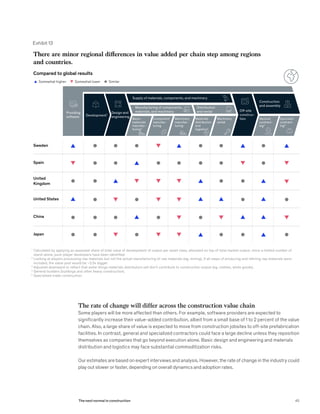
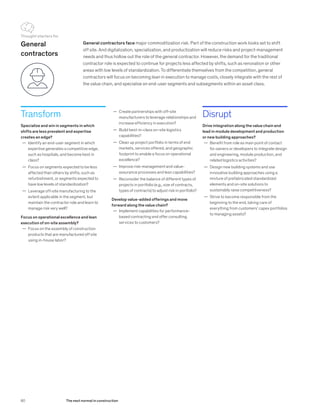
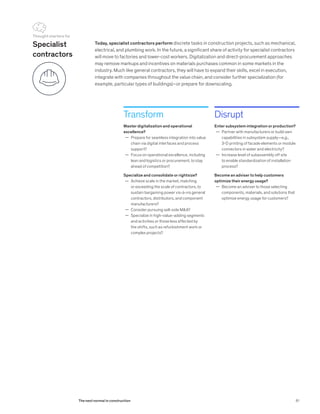
The next normal
in construction
How disruption is reshaping the world’s largest
ecosystem
June 2020
Cover image:
© Dong Wenjie/Getty Images
Copyright © 2020 McKinsey &
Company. All rights reserved.
This publication is not intended to
be used as the basis for trading in
the shares of any company or for
undertaking any other complex or
significant financial transaction
without consulting appropriate
professional advisers.
No part of this publication may be
copied or redistributed in any form
without the prior written consent of
McKinsey & Company.
June 2020
The next normal
in construction
How disruption is reshaping the world’s
largest ecosystem
This article was a collaborative, global effort among
Maria João Ribeirinho, Jan Mischke, Gernot Strube,
Erik Sjödin, Jose Luis Blanco, Rob Palter, Jonas
Biörck, David Rockhill, and Timmy Andersson.
Countervailing factors are reshaping the global
economy, and no industry is immune to their impact.
Grounded in the built, physical world, construction
may seem less vulnerable to the impact of digital
technologies and Silicon Valley disrupters. Indeed, the
cranes accenting fast-rising urban centers and the
workers on commercial and residential projects might
lead some executives to believe that as it has been, so
it shall be.
In truth, construction is just as susceptible to these
disruptions as other industries, but the ways in which
the landscape will be affected are different. In 2017,
the McKinsey Global Institute (MGI) highlighted that
the construction industry needs to evolve and showed
ways in which it can change to improve productivity
by 50 to 60 percent and deliver $1.6 trillion a year in
incremental global value.1
The call to action was heard:
executives we speak to are thinking through how to
prepare for changes ahead—and they increasingly
recognize that it’s no longer a matter of if or when
construction will be affected. Change is already here.
The COVID-19 crisis unfolding at the time of publishing
this report will accelerate disruption and the shift to
a “next normal” in the construction ecosystem. Many
executives are wrestling with the pandemic’s economic
turmoil, the shifts in demand it entails, and operating
restrictions and longer-term safe working procedures.
However, it is also critical for executives to lift their
view to what the future will hold in terms of changes to
business models and industry dynamics. It is in times
of crisis that winners segregate from losers, and those
who take bold moves fast can reap the rewards.
This research analyzes how the entire ecosystem of
construction will change, how much value is at risk
for incumbents, and how companies can move fast to
adapt to and, in fact, create a new industry structure.
We relied on top-down reviews of industry dynamics,
bottom-up analysis of company data, and executive
surveys to offer an unprecedented look at the entire
value chain. In developing the report, we have sought
to address the most pressing longer-term strategic
Preface
questions for executives in the ecosystem: how their
part of the value chain will be affected, by how much,
and what they should consider doing to prepare for a
future that will differ radically from the present.
Our hope is that these insights will help accelerate a
transformation that we believe will and must happen
and provide executives around the world with a map to
help navigate the rough water ahead.
This research was led by Jan Mischke, partner at the
McKinsey Global Institute (MGI) in McKinsey’s Zurich
office; Jonas Biörck, associate partner based in
Stockholm; Gernot Strube, senior partner in Munich
and leader of the Capital Projects and Infrastructure
Practice; Maria João Ribeirinho, partner in Lisbon;
Erik Sjödin, partner in Stockholm; Jose Luis Blanco,
partner in Philadelphia; Rob Palter, senior partner
in Toronto; and David Rockhill, associate partner
in London. We are grateful for the input, guidance,
and support of Oskar Lingqvist, senior partner in
Stockholm and Steffen Fuchs, senior partner in Dallas
and coleader of our Capital Projects and Infrastructure
Practice. The project team was led by Timmy
Andersson and comprised Nadja Bogdanova, Isak
Söderberg, and Richard Karlsson. Many McKinsey
partners and colleagues offered helpful expert input,
including Alex Abdelnour, Piotr Pikul, Nick Bertram,
Subbu Narayanswamy, Marcel Brinkman, Matthew
Hill, Gerard Kuperfarb, Priyanka Kamra, Niklas
Berglind, Patrick Schulze, Nicklas Garemo, Koen
Vermeltfoort, Fredrik Hansson, Ymed Rahmania,
Frank Wiesner, Francesco Cuomo, Eric Bartels, and
Kathleen Martens. Further, we wish to thank Gunnar
Malm and Mats Williamson for their contributions to
this report.
This report was edited by Scott Leff and David Peak
and designed by Leff. Daphne Luchtenberg, Suzanne
Counsell, and Lukasz Kowalik helped disseminate
the report.
Maria João Ribeirinho
Jan Mischke
Gernot Strube
Erik Sjödin
Jose Luis Blanco
Rob Palter
Jonas Biörck
David Rockhill
Timmy Andersson
June 2020
Contents
In brief	
Executive summary
Related reading
Endnotes
1 2Historically, the
construction industry has
underperformed	
16 A changing market
environment, technological
progress, and disruptive
new entrants will trigger
industry overhaul
24
3 4Almost half of incumbent
value added is at stake
41 Transformation will take
time, but the COVID-19 crisis
will accelerate change
55
5All players must prepare
now for a fundamentally
different next normal
65
2
4
83
84
1
The construction industry, and its broader ecosystem, erects buildings, infrastructure, and
industrial structures that are the foundation of our economies and are essential to our daily lives. It
has successfully delivered ever more challenging projects, from undersea tunnels to skyscrapers.
However, the industry also has performed unsatisfactorily in many regards for an extended period
of time. The COVID-19 pandemic may be yet another crisis that wreaks havoc on an industry that
tends to be particularly vulnerable to economic cycles.
External market factors, combined with fragmented and complex industry dynamics and an
overall aversion to risk, have made change both difficult and slow. The COVID-19 crisis looks set
to dramatically accelerate the ecosystem’s disruption that started well before the crisis. In such
times, it is more important than ever for actors to find a guiding star for what the next normal will
look like in the aftermath and make the bold, strategic decisions to emerge as a winner.
Many studies have examined individual trends such as modular construction and sustainability.
This report provides an assessment of how the full array of disruptive trends will combine to
reshape the industry in earnest. Our research builds future scenarios based on more than 100
conversations with experts and executives, firsthand experience serving clients throughout the
ecosystem, and reviews of other industries and their transformation journeys. We confirmed the
trends and scenarios that surfaced by conducting a survey of 400 global industry leaders. Finally,
we quantitatively modeled value and profit pools across the value chain, based on company data
today, and formulated future scenarios. We found overwhelming evidence that disruption will touch
all parts of the industry and that it has already begun at scale.
Among our findings are the following:
	— Construction is the biggest industry in the world, and yet, even outside of crises, it is not
performing well. The ecosystem represents 13 percent of global GDP, but construction has
seen a meager productivity growth of 1 percent annually for the past two decades. Time and
cost overruns are the norm, and overall earnings before interest and taxes (EBIT) are only
around 5 percent despite the presence of significant risk in the industry.
	— Nine shifts will radically change the way construction projects are delivered—and similar
industries have already undergone many of the shifts. A combination of sustainability
requirements, cost pressure, skills scarcity, new materials, industrial approaches, digitalization,
and a new breed of player looks set to transform the value chain. The shifts ahead include
productization and specialization, increased value-chain control, and greater customer-
centricity and branding. Consolidation and internationalization will create the scale needed to
allow higher levels of investment in digitalization, R&D and equipment, and sustainability as well
as human capital.
In brief
2 The next normal in construction
— The COVID-19 crisis will accelerate change that has already started to occur at scale. Our
research suggests that the industry will look radically different five to ten years from now.
More than 75 percent of respondents to our executive survey agreed that the nine shifts are
likely to occur, and more than 60 percent believe they are likely to occur at scale in the next
five years. We already see concrete signs of change: for example, the permanent modular-
construction market share of new North American real-estate construction projects has grown
by 50 percent from 2015 to 2018, R&D spending among the top 2,500 construction companies
globally has risen by approximately 77 percent since 2013, and a new breed of player has
emerged to lead the change. Two-thirds of survey respondents believe that COVID-19 will lead
to an acceleration of the transformation, and half have already raised investment in that regard.
	— A $265 billion annual profit pool awaits disrupters. A value chain delivering approximately $11
trillion of global value added and $1.5 trillion of global profit pools looks set for overhaul. In a
scenario based on analysis and expert interviews by asset class, strongly affected segments
could have a staggering 40 to 45 percent of incumbent value added at risk, even when the
economic fallout from COVID-19 abates—value that could shift to new activities such as off-
site manufacturing, to customer surplus, or to new sources of profit. If the value at stake is
captured by players in the construction ecosystem, total profit pools could nearly double, from
the current 5 to 10 percent.2
The scale and pace of change and the appropriate response will
differ greatly among real-estate, infrastructure, and industrial construction—but all of them will
be affected. Players that move fast and manage to radically outperform their competitors could
grab the lion’s share of the $265 billion in new and shifting profits and see valuations more akin
to those of Silicon Valley start-ups than traditional construction firms.
	— To survive and thrive, incumbents must respond. All of the players in the construction
value chain will need to develop their strategies for dealing with or leading disruption. This
is especially true for engineering and design, materials distribution and logistics, general
contracting, and specialized subcontracting, all of which are likely to face commoditization
and declining shares of value for parts of their activities. Companies can try to defend their
positions and adjust to the changing environment, or reinvent themselves to take advantage of
changes in the industry. All will need to invest in enablers like agile organizations.
	— Investors are well advised to use foresight on the respective shifts in their investment activity
and will have ample opportunity to generate alpha. Policy makers should help the industry
become more productive and achieve better housing and infrastructure outcomes for citizens.
And owners stand to benefit from better structures at lower cost if they play their part in
making the shifts happen.
3The next normal in construction
Construction, which encompasses real estate, infrastructure, and industrial structures, is the largest
industry in the global economy, accounting for 13 percent of the world’s GDP. A closer look at its underlying
performance highlights the industry’s challenges in good economic times, let alone in times of crisis. We
expect a set of nine shifts to radically change the way construction is done. Companies that can adjust their
business models stand to benefit handsomely, while others may struggle to survive.
Historically, the construction industry has underperformed
Construction is responsible for a wide range of impressive accomplishments, from stunning cityscapes
and foundational infrastructure on a massive scale to sustained innovation. However, in the past couple of
decades, it also has been plagued by dismal performance.
Annual productivity growth over the past 20 years was only a third of total economy averages. Risk aversion
and fragmentation as well as difficulties in attracting digital talent slow down innovation. Digitalization is
lower than in nearly any other industry. Profitability is low, at around 5 percent EBIT margin, despite high
risks and many insolvencies. Customer satisfaction is hampered by regular time and budget overruns and
lengthy claims procedures.
The industry will feel the economic impact of the COVID-19 strongly, as will the wider construction
ecosystem—which includes construction companies’ component and basic-materials suppliers, developers
Executive summary
4 The next normal in construction
@Getty Images/Mel Melcon
and owners, distributors, and machinery and software providers. At the time of writing, high levels of
economic uncertainty prevail worldwide, and the construction industry tends to be significantly more volatile
than the overall economy. MGI scenarios suggest that if things go well, construction activity could be back to
pre-crisis levels by early 2021. But longer-term lockdowns could mean that it takes until 2024 or even later.
In the past, crises have had an accelerative effect on trends, and this crisis is also expected to trigger lasting
change impacting use of the built environment, like online channel usage or remote-working practices.
The lagging performance of the construction industry is a direct result of the fundamental rules and
characteristics of the construction market and the industry dynamics that occur in response to them.
Cyclical demand leads to low capital investment, and bespoke requirements limit standardization.
Construction projects are complex, and increasingly so, and logistics need to deal with heavy weight and
many different parts. The share of manual labor is high, and the industry has a significant shortage of skilled
workers in several markets. Low barriers to entry in segments with lower project complexity and a significant
share of informal labor allow small and unproductive companies to compete. The construction industry is
extensively regulated, subject to everything from permits and approvals to safety and work-site controls,
and lowest-price rules in tenders make competition based on quality, reliability, or alternative design
offerings more complicated.
In response to these market characteristics, today’s construction industry must grapple with several
dynamics that impede productivity and make change more difficult. Bespoke projects with unique features
and varying topology have a limited degree of repeatability and standardization. Local market structures
and ease of entry have resulted in a fragmented landscape (both vertically and horizontally) of mostly small
companies with limited economies of scale. Moreover, every project involves many steps and companies
in every project with scattered accountability, which complicates the coordination. Contractual structures
and incentives are misaligned. Risks are often passed to other areas of the value chain instead of being
addressed, and players make money from claims rather than from good delivery. High unpredictability
and cyclicality have led construction firms to rely on temporary staff and subcontractors, which hampers
productivity, limits economies of scale, and reduces output quality and customer satisfaction.
A changing market environment, technological progress, and disruptive new
entrants will trigger industry overhaul
The construction industry was already starting to experience an unprecedented rate of disruption before the
COVID-19 pandemic. In the coming years, fundamental change is likely to be catalyzed by changes in market
characteristics, such as scarcity of skilled labor, persistent cost pressure from infrastructure and affordable
housing, stricter regulations on work-site sustainability and safety, and evolving sophistication and needs of
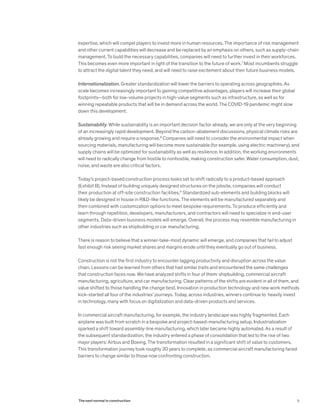
customers and owners. Emerging disruptions, including industrialization and new materials, the digitalization
of products and processes, and new entrants, will shape future dynamics in the industry (Exhibit A).
Sources of disruption
Rising customer sophistication and total-cost-of-ownership (TCO) pressure. Customers and owners are
increasingly sophisticated, and the industry has seen an influx of capital from more savvy customers. From
2014 to 2019, for example, private-equity firms raised more than $388 billion to fund infrastructure projects,
including $100 billion in 2019 alone, a 24 percent increase from 2018. Client demands are also evolving
regarding performance, TCO, and sustainability: smart buildings, energy and operational efficiency, and
flexibility and adaptability of structures will become higher priorities. Expectations are also rising among
customers, who want simple, digital interactions as well as more adaptable structures.
5The next normal in construction
The industry is facing persistent cost pressure because of tight public budgets and housing-affordability
issues. McKinsey analysis found that $69.4 trillion in global infrastructure investment would be needed
through 20353
to support expected GDP growth and that every third global urban household cannot afford
a decent place to live at market prices.4
The economic fallout of the COVID-19 crisis magnifies the cost and
affordability issues.
Persistent scarcity of skilled labor and changing logistics equations. Skilled-labor shortages have become
a major issue in several markets, and retirements will drain talent. For example, about 41 percent of the
current US construction workforce is expected to retire by 2031. The impact the COVID-19 crisis will have on
this dynamic in the long term is unclear at the time of writing.
Exhibit A
Changing characteristics and emerging disruptions will drive change in the industry and
transform ways of working.
Changes in market characteristics Emerging disruptionsFuture industry dynamics
Customer
demand
Construction
inputs and
characteristics
Market rules
and regulations
Product-based approach1
Specialization
Value-chain control and
integration with
industrial-grade supply chains
Consolidation
Customer-centricity and
branding
Investment in technology
and facilities
Investment in human resources
Internationalization
Sustainability
Industrialization
Persistent cost pressure from
tight public budgets and housing-
affordability concerns
Increasing need for adaptable structures
Increasing owner and customer
sophistication
Evolving customer needs and greater
focus on total cost of ownership
Increasing complexity of projects
Higher demand for simplified and digital
interactions
Increasing sustainability requirements
and demands for safety performance
Persistent scarcity of skilled labor
Changing logistics equation resulting
from new materials and modules
Stricter regulation on safety and
sustainability
Changing regulations and incentives
for modern methods of construction,
enabling more standardization
New production technology—
enabling industrialization and
shift toward off-site production
New materials
New-material technology—
new, lighter-weight materials
enabling improved logistics
2
3
4
5
6
7
8
9
New entrants
New breed of players—
disrupting current business
models
Digitalization of
products and processes
Digitalization of processes and
products and shift toward more
data-driven decision making—
digital will impact:
• Operations—smart
buildings and infrastructure
• Design—BIM,¹ BIM objects
• Construction and
production—BIM, project
management, Industry 4.0
• Channels—digital sales
channels and distribution/
logistics
1
Building-information modeling.
6 The next normal in construction
Safety and sustainability regulations and possible standardization of building codes. Requirements
for sustainability and work-site safety are increasing. In the wake of COVID-19, new health and safety
procedures will be required. The global conversation about climate change puts increasing pressure on the
industry to reduce carbon emissions.
At the same time, in some markets, governments are recognizing the need to standardize building codes
or provide type certificates and approvals for factory-built products rather than reviews of each site. The
process, however, is still slow.
Industrialization. Modularization, off-site production automation, and on-site assembly automation will
enable industrialization and an off-site, product-based approach. The shift toward a more controlled
environment will be even more valuable as the COVID-19 pandemic further unfolds. The next step in
the transition to efficient off-site manufacturing involves integrating automated production systems—
essentially making construction more like automotive manufacturing.
New materials. Innovations in traditional basic materials like cement enable a reduction of carbon footprints.
Emerging lighter-weight materials, such as light-gauge steel frames and cross-laminated timber, can enable
simpler factory production of modules. They will also change the logistics equation and allow longer-haul
transport of materials and greater centralization.
Digitalization of products and processes. Digital technologies can enable better collaboration, greater
control of the value chain, and a shift toward more data-driven decision making. These innovations will
change the way companies approach operations, design, and construction as well as engage with partners.
Smart buildings and infrastructure that integrate the Internet of Things (IoT) will increase data availability
and enable more efficient operations as well as new business models, such as performance-based and
collaborative contracting. Companies can improve efficiency and integrate the design phase with the rest
of the value chain by using building-information modeling (BIM) to create a full three-dimensional model
(a “digital twin”)—and add further layers like schedule and cost—early in the project rather than finishing
design while construction is already underway. This will materially change risks and the sequence of
decision making in construction projects and put traditional engineering, procurement, and construction
(EPC) models into question. Automated parametric design and object libraries will transform engineering.
Using digital tools can significantly improve on-site collaboration. And digital channels are spreading to
construction, with the potential to transform interactions for buying and selling goods across the value
chain. As in other industries, the COVID-19 pandemic is accelerating the integration of digital tools.
New entrants. Start-ups, incumbent players making new bets, and new funding from venture capital and
private equity are accelerating disruption of current business models. As the COVID-19-propelled economic
crisis unfolds, we also expect an increase in corporate restructuring and M&A activity.
The nine resulting industry shifts
In response, we expect nine shifts to fundamentally change the construction industry. According to our
executive survey, more than 75 percent of respondents agree that these shifts are likely to occur, and more
than 60 percent believe that they are likely to occur within the next five years. The economic fallout from the
COVID-19 pandemic looks set to accelerate them.
Product-based approach. In the future, an increasing share of structures and surrounding services will be
delivered and marketed as standardized “products.” This includes developers promoting branded offerings,
7The next normal in construction
with standardized but customizable designs that can improve from one product generation to the next, and
delivery using modularized elements and standardized components produced in off-site factories. The
modules and elements will be shipped and assembled on site. Production will consist of assembly line–like
processes in safe, nonhostile environments with a large degree of repeatability.5
Specialization. To improve their margins and levels of differentiation, companies will start to specialize in
target niches and segments (such as luxury single-family housing, multistory residential buildings, hospitals,
or processing plants) in which they can build competitive advantages. And they will specialize in using
different materials, subsegments, or methods of construction. The shift toward specialization will also require
companies to develop and retain knowledge and capabilities to maintain their competitive advantages.
Obviously, players will need to weigh carefully the effectiveness, efficiency, and brand positioning that greater
specialization enables against the potential risk or cyclicality benefits of a more diversified portfolio.
Value-chain control and integration with industrial-grade supply chains. Companies will move to own
or control important activities along the value chain, such as design and engineering, select-component
manufacturing, supply-chain management, and on-site assembly. Companies will be able to achieve this
goal through vertical integration or strategic alliances and partnerships by using collaborative contracting
and more closely aligned incentives. Digital technology will change the interaction model: BIM models will
lead to more decision making early on in the process, distribution will move toward online platforms and
advanced logistics management, and end-to-end software platforms will allow companies to better control
and integrate value and supply chains. Value-chain control or integration will reduce interface frictions and
make innovation more agile.
Consolidation. Growing needs for specialization and investments in innovation—including the use of new
materials, digitalization, technology and facilities, and human resources—will require significantly larger
scale than is common today. As product-based approaches, with higher standardization and repeatability,
further increase the importance of gaining scale, the industry is likely to increasingly see a significant
degree of consolidation, both within specific parts of the value chain and across the value chain.
Customer-centricity and branding. With productization—that is, turning development, engineering, or
construction services into easy-to-market products or solutions6
—and specialization in the industry,
having a compelling brand that represents an organization’s distinctive attributes and values will take on
added importance. As in traditional consumer industries, a strong brand can tie customers more closely
to the construction company’s or supplier’s products and help to build and maintain relationships and
attract new customers. Similar to brands in other manufacturing industries, such construction brands will
encompass, among other aspects, product and service quality, value, timing of delivery, reliability, service
offerings, and warranties.
Investment in technology and facilities. Productization implies a need to build off-site factories, which
requires investments in plants, manufacturing machinery and equipment (such as robotics to automate
manufacturing), and technology. Where modular is not used, the construction site also will likely become
more capital intensive, using advanced automation equipment and drones, among other technologies. R&D
investment will become more important for specialized or more productized companies, so companies are
likely to increase spending to develop new, innovative products and technologies.
Investment in human resources. Innovation, digitalization, value-chain control, technology use, and
specialization in end-use segments all increase the importance of developing and retaining in-house
8 The next normal in construction
expertise, which will compel players to invest more in human resources. The importance of risk management
and other current capabilities will decrease and be replaced by an emphasis on others, such as supply-chain
management. To build the necessary capabilities, companies will need to further invest in their workforces.
This becomes even more important in light of the transition to the future of work.7
Most incumbents struggle
to attract the digital talent they need, and will need to raise excitement about their future business models.
Internationalization. Greater standardization will lower the barriers to operating across geographies. As
scale becomes increasingly important to gaining competitive advantages, players will increase their global
footprints—both for low-volume projects in high-value segments such as infrastructure, as well as for
winning repeatable products that will be in demand across the world. The COVID-19 pandemic might slow
down this development.
Sustainability. While sustainability is an important decision factor already, we are only at the very beginning
of an increasingly rapid development. Beyond the carbon-abatement discussions, physical climate risks are
already growing and require a response.8
Companies will need to consider the environmental impact when
sourcing materials, manufacturing will become more sustainable (for example, using electric machinery), and
supply chains will be optimized for sustainability as well as resilience. In addition, the working environments
will need to radically change from hostile to nonhostile, making construction safer. Water consumption, dust,
noise, and waste are also critical factors.
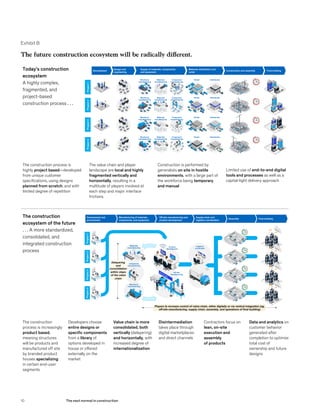
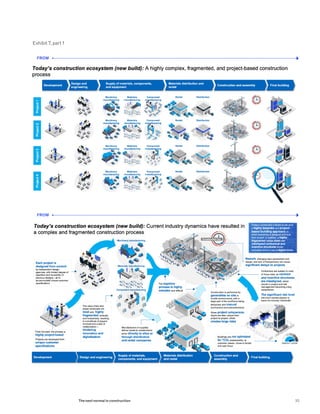
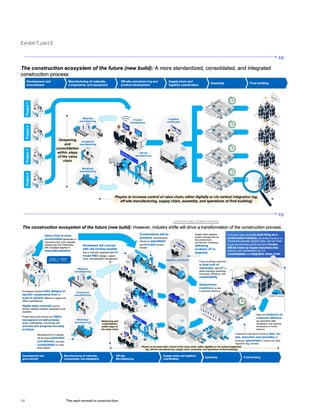
Today’s project-based construction process looks set to shift radically to a product-based approach
(Exhibit B). Instead of building uniquely designed structures on the jobsite, companies will conduct
their production at off-site construction facilities.9
Standardized sub-elements and building blocks will
likely be designed in house in R&D-like functions. The elements will be manufactured separately and
then combined with customization options to meet bespoke requirements. To produce efficiently and
learn through repetition, developers, manufacturers, and contractors will need to specialize in end-user
segments. Data-driven business models will emerge. Overall, the process may resemble manufacturing in
other industries such as shipbuilding or car manufacturing.
There is reason to believe that a winner-take-most dynamic will emerge, and companies that fail to adjust
fast enough risk seeing market shares and margins erode until they eventually go out of business.
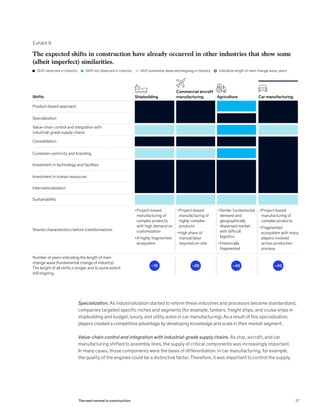
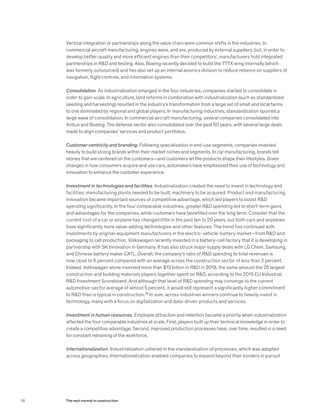
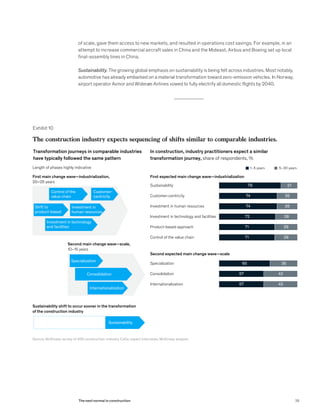
Construction is not the first industry to encounter lagging productivity and disruption across the value
chain. Lessons can be learned from others that had similar traits and encountered the same challenges
that construction faces now. We have analyzed shifts in four of them: shipbuilding, commercial aircraft
manufacturing, agriculture, and car manufacturing. Clear patterns of the shifts are evident in all of them, and
value shifted to those handling the change best. Innovation in production technology and new work methods
kick-started all four of the industries’ journeys. Today, across industries, winners continue to heavily invest
in technology, many with focus on digitalization and data-driven products and services.
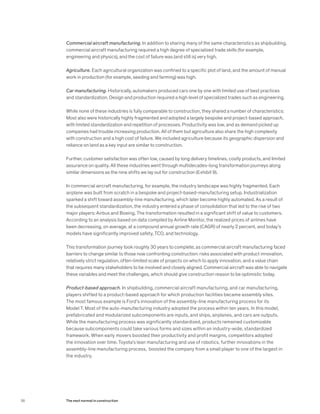
In commercial aircraft manufacturing, for example, the industry landscape was highly fragmented. Each
airplane was built from scratch in a bespoke and project-based-manufacturing setup. Industrialization
sparked a shift toward assembly-line manufacturing, which later became highly automated. As a result of
the subsequent standardization, the industry entered a phase of consolidation that led to the rise of two
major players: Airbus and Boeing. The transformation resulted in a significant shift of value to customers.
This transformation journey took roughly 30 years to complete, as commercial aircraft manufacturing faced
barriers to change similar to those now confronting construction.
9The next normal in construction
Exhibit B
!"#$%&'()*)+(%,-..-/0/0%/1//%2&%3+4$5"6%78+5)9"%:$"4("5(%;)8+25)4$+(%.0-..-/0.<%=1,>%7&%?@%AB5'C+%:$"4("5(%;)8+
!"##$%&'(&)*+,-.*$/0&1')#'2,2+/0&
*23&,4".#),2+
5'2/+-"1+.'2&*23&*//,)6$% 7.2*$&6".$3.28
9*+,-.*$/&3./+-.6"+.'2&*23&
-,2+*$
!"#$%&'()!"#$%&'(*!"#$%&'(+
:,;,$'#),2+
!"#$%&'(,
!"#$%"&'$"()*+)$,-
!"#$%"&'$"()*+)$,-
!"#$%"&'$"()*+)$,-
!"#$%"&'$"()*+)$,-
:,/.82&*23&
,28.2,,-.28
.,$+%",-#/
0,)'1,2$'%")3
.,24")+%5/
0,)'1,2$'%")3
6(07()+)$/
0,)'1,2$'%")3
.,$+%",-#/
0,)'1,2$'%")3
.,24")+%5/
0,)'1,2$'%")3
6(07()+)$/
0,)'1,2$'%")3
.,$+%",-#/
0,)'1,2$'%")3
.,24")+%5/
0,)'1,2$'%")3
6(07()+)$/
0,)'1,2$'%")3
.,$+%",-#/
0,)'1,2$'%")3
.,24")+%5/
0,)'1,2$'%")3
6(07()+)$/
0,)'1,2$'%")3
The future construction ecosystem will be radically different.
Today’s construction
ecosystem
A highly complex,
fragmented, and
project-based
construction process . . .
The construction
ecosystem of the future
. . . A more standardized,
consolidated, and
integrated construction
process
The construction process is
highly project based—developed
from unique customer
specifications, using designs
planned from scratch, and with
limited degree of repetition
The value chain and player
landscape are local and highly
fragmented vertically and
horizontally, resulting in a
multitude of players involved at
each step and major interface
frictions
Construction is performed by
generalists on site in hostile
environments, with a large part of
the workforce being temporary
and manual
Limited use of end-to-end digital
tools and processes as well as a
capital-light delivery approach
The construction
process is increasingly
product based,
meaning structures
will be products and
manufactured off site
by branded product
houses specializing
in certain end-user
segments
Developers choose
entire designs or
specific components
from a library of
options developed in
house or offered
externally on the
market
Value chain is more
consolidated, both
vertically (delayering)
and horizontally, with
increased degree of
internationalization
Disintermediation
takes place through
digital marketplaces
and direct channels
Contractors focus on
lean, on-site
execution and
assembly
of products
Data and analytics on
customer behavior
generated after
completion to optimize
total cost of
ownership and future
designs
!"#$%&'()*)+(%,-..-/0/0%/1//%2&%3+4$5"6%78+5)9"%:$"4("5(%;)8+25)4$+(%.0-..-/0.<%=1,>%7&%?@%AB5'C+%:$"4("5(%;)8+
;(3"#$"2#/
2((%<"),$(%
.,24")+%5/
0,)'1,2$'%")3
6(07()+)$/
0,)'1,2$'%")3
.,$+%",-#/
0,)'1,2$'%")3
!7/()"*'+,-)+."*(/)"'%'+/0("8(+7/(8-+-,/(1*/2(3-.4#56(7'-2#$'*&,%),#)(8$)9'.2%*21(),&$)9',%)'(%&$6#,&$)'
.2%*&#".&(2%'3#2.$**
:,;,$'#),2+&*23&
#-'1"-,),2+
9*2"(*1+"-.28&'(&)*+,-.*$/0&
1')#'2,2+/0&*23&,4".#),2+
!"##$%>1<*.2&*23&
$'8./+.1/&1''-3.2*+.'2
G//,)6$%
A((>/.+,&)*2"(*1+"-.28&*23&
#-'3"1+&3,;,$'#),2+
7.2*$&6".$3.28
!"#$%&'()*(+,-&%#'%(-*,)&*"(*.(/#"0%(-1#+,2(%+)1%&(3+4+)#""$(*&(/+#(/%&)+-#"(+,)%4&#)+*,(5%42(
*..6'+)%(7#,0.#-)0&+,42('088"$(-1#+,2(#''%79"$2(#,3(*8%&#)+*,'(*.(.+,#"(90+"3+,4:
;%"#$%&+,4(
#,3(
-*,'*"+3#)+*,(
<+)1+,(')%8'(
*.()1%(/#"0%(
-1#+,
=%(<'2$/
!+>+-(70+)$
?11@#"$+/
0,)'1,2$'%")3
!"#$%&'()!"#$%&'(*!"#$%&'(+!"#$%&'(,
10 The next normal in construction
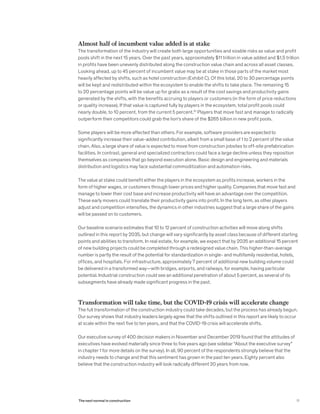
Almost half of incumbent value added is at stake
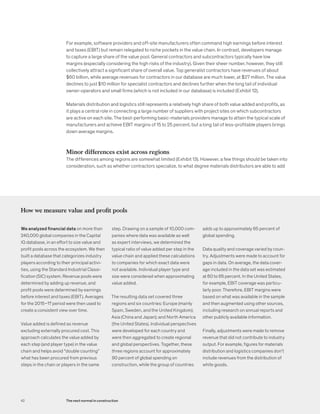
The transformation of the industry will create both large opportunities and sizable risks as value and profit
pools shift in the next 15 years. Over the past years, approximately $11 trillion in value added and $1.5 trillion
in profits have been unevenly distributed along the construction value chain and across all asset classes.
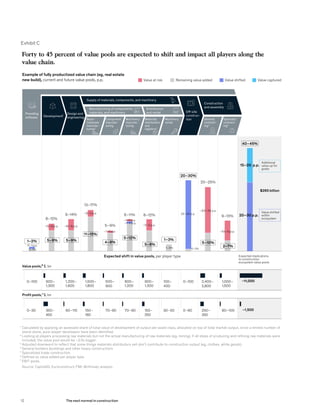
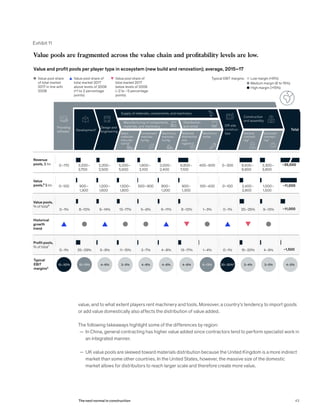
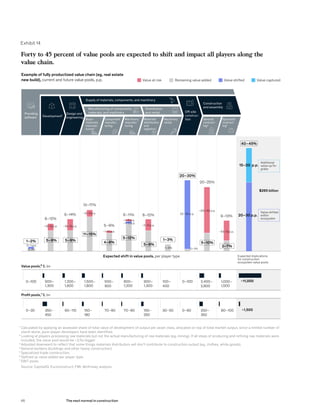
Looking ahead, up to 45 percent of incumbent value may be at stake in those parts of the market most
heavily affected by shifts, such as hotel construction (Exhibit C). Of this total, 20 to 30 percentage points
will be kept and redistributed within the ecosystem to enable the shifts to take place. The remaining 15
to 20 percentage points will be value up for grabs as a result of the cost savings and productivity gains
generated by the shifts, with the benefits accruing to players or customers (in the form of price reductions
or quality increase). If that value is captured fully by players in the ecosystem, total profit pools could
nearly double, to 10 percent, from the current 5 percent.10
Players that move fast and manage to radically
outperform their competitors could grab the lion’s share of the $265 billion in new profit pools.
Some players will be more affected than others. For example, software providers are expected to
significantly increase their value-added contribution, albeit from a small base of 1 to 2 percent of the value
chain. Also, a large share of value is expected to move from construction jobsites to off-site prefabrication
facilities. In contrast, general and specialized contractors could face a large decline unless they reposition
themselves as companies that go beyond execution alone. Basic design and engineering and materials
distribution and logistics may face substantial commoditization and automation risks.
The value at stake could benefit either the players in the ecosystem as profits increase, workers in the
form of higher wages, or customers through lower prices and higher quality. Companies that move fast and
manage to lower their cost base and increase productivity will have an advantage over the competition.
These early movers could translate their productivity gains into profit. In the long term, as other players
adjust and competition intensifies, the dynamics in other industries suggest that a large share of the gains
will be passed on to customers.
Our baseline scenario estimates that 10 to 12 percent of construction activities will move along shifts
outlined in this report by 2035, but change will vary significantly by asset class because of different starting
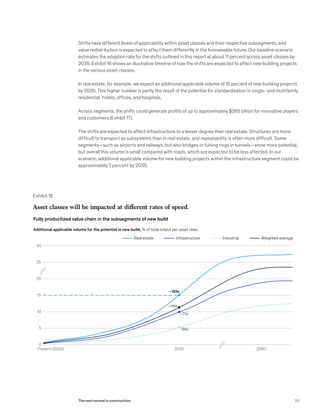
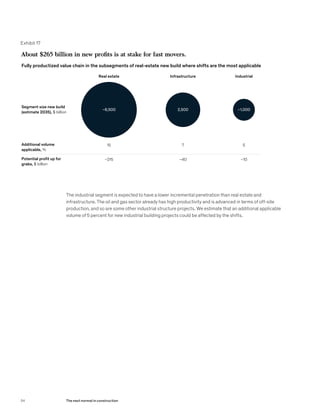
points and abilities to transform. In real estate, for example, we expect that by 2035 an additional 15 percent
of new building projects could be completed through a redesigned value chain. This higher-than-average
number is partly the result of the potential for standardization in single- and multifamily residential, hotels,
offices, and hospitals. For infrastructure, approximately 7 percent of additional new building volume could
be delivered in a transformed way—with bridges, airports, and railways, for example, having particular
potential. Industrial construction could see an additional penetration of about 5 percent, as several of its
subsegments have already made significant progress in the past.
Transformation will take time, but the COVID-19 crisis will accelerate change
The full transformation of the construction industry could take decades, but the process has already begun.
Our survey shows that industry leaders largely agree that the shifts outlined in this report are likely to occur
at scale within the next five to ten years, and that the COVID-19 crisis will accelerate shifts.
Our executive survey of 400 decision makers in November and December 2019 found that the attitudes of
executives have evolved materially since three to five years ago (see sidebar “About the executive survey”
in chapter 1 for more details on the survey). In all, 90 percent of the respondents strongly believe that the
industry needs to change and that this sentiment has grown in the past ten years. Eighty percent also
believe that the construction industry will look radically different 20 years from now.
11The next normal in construction
Exhibit C
Forty to 45 percent of value pools are expected to shift and impact all players along the
value chain.
Example of fully productized value chain (eg, real estate
new build), current and future value pools, p.p.
Source: CapitalIQ; Euroconstruct; FMI; McKinsey analysis
40–45%
Expected shift in value pools, per player type
1–2%
8–12%
9–14%
13–17%
5–9%
6–11% 8–12%
1–3%
20–30%
20–25%
Remaining value added Value shifted Value capturedValue at risk
9–13%
Basic-
materials
manufac-
turing2
Component
manufac-
turing
Machinery
manufac-
turing
Materials
distribution
and
logistics3
Machinery
rental
Providing
software
Design and
engineeringDevelopment1
Construction
and assembly
Supply of materials, components, and machinery
Off-site
construc-
tion
Distribution
and rental
General
contract-
ing4
Specialist
contract-
ing5
Manufacturing of components,
materials, and machinery
1
Calculated by applying an assessed share of total value of development of output per asset class, allocated on top of total market output, since a limited number of
stand-alone, pure-player developers have been identified.
2
Looking at players processing raw materials but not the actual manufacturing of raw materials (eg, mining). If all steps of producing and refining raw materials were
included, the value pool would be ~2.5x bigger.
3
Adjusted downward to reflect that some things materials distributors sell don’t contribute to construction output (eg, clothes, white goods).
4
General builders (buildings and other heavy construction).
5
Specialized trade construction.
6
Defined as value added per player type.
7
EBIT pools.
0–1 p.p.
0–1%
–5(–2) p.p.
5–9%
–8(–3) p.p.
5–9%
–2(–1) p.p.
11–15%
–1–0 p.p.
4–8%
–1–0 p.p.
5–12%
–1–0 p.p.
–5–0 p.p.
5–9%
1–3%
20–30 p.p.
0–1%
–20(–10) p.p.
5–10%
–10(–5) p.p.
2–7%
15–20 p.p.
20–30 p.p.
Expected implications
to construction
ecosystem value pools
Additional
value up for
grabs
Value shifted
within
ecosystem
~11,000
$265 billion
Profit pools,7
$, bn
Value pools,⁶ $, bn
0–30 350–
450
150–
180
70–90 70–90 150–
250
30–50 250–
350
80–10090–110 0–60
500–
900
800–
1,200
900–
1,300
100–
400
0–100 2,400–
2,800
1,000–
1,500
0–100 900–
1,300
1,500–
1,800
1,200–
1,600
~1,500
12 The next normal in construction
Beyond our analysis and the overwhelming beliefs of the surveyed executives, we see signs today that
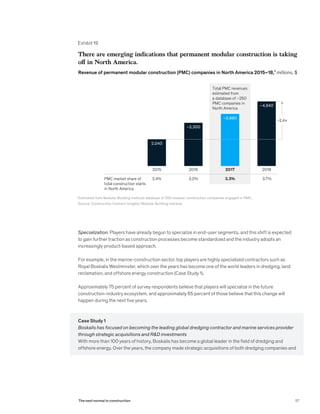
the industry had already started to change before the COVID-19 crisis began. For instance, adoption of
product-based approaches is increasing. In North America, the permanent modular-construction market
share of new real-estate construction projects grew by approximately 51 percent from 2015 to 2018,
and revenues for the segment grew (from a small base of $2 billion) by a factor of 2.4 over the same
period. Also, emerging players as well as incumbents are already seeking to control a larger part of the
value chain; Katerra, for instance, used new technology to control the value chain, including design
and engineering and off-site manufacturing. Indicators suggest the construction industry is increasing
its emphasis on R&D, and companies that have invested in construction technology and facilities are
gaining traction. Global R&D spending by the top 2,500 construction companies grew by 77 percent from
2013 to 2017.
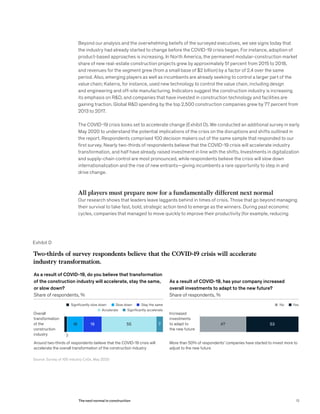
The COVID-19 crisis looks set to accelerate change (Exhibit D). We conducted an additional survey in early
May 2020 to understand the potential implications of the crisis on the disruptions and shifts outlined in
the report. Respondents comprised 100 decision makers out of the same sample that responded to our
first survey. Nearly two-thirds of respondents believe that the COVID-19 crisis will accelerate industry
transformation, and half have already raised investment in line with the shifts. Investments in digitalization
and supply-chain control are most pronounced, while respondents believe the crisis will slow down
internationalization and the rise of new entrants—giving incumbents a rare opportunity to step in and
drive change.
All players must prepare now for a fundamentally different next normal
Our research shows that leaders leave laggards behind in times of crisis. Those that go beyond managing
their survival to take fast, bold, strategic action tend to emerge as the winners. During past economic
cycles, companies that managed to move quickly to improve their productivity (for example, reducing
Exhibit D
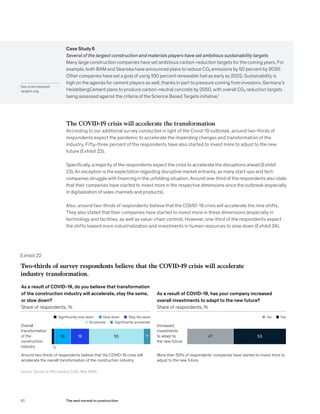
Two-thirds of survey respondents believe that the COVID-19 crisis will accelerate
industry transformation.
As a result of COVID-19, do you believe that transformation
of the construction industry will accelerate, stay the same,
or slow down?
Share of respondents, %
As a result of COVID-19, has your company increased
overall investments to adapt to the new future?
Share of respondents, %
Around two-thirds of respondents believe that the COVID-19 crisis will
accelerate the overall transformation of the construction industry
Source: Survey of 100 industry CxOs, May 2020
More than 50% of respondents’ companies have started to invest more to
adjust to the new future
Overall
transformation
of the
construction
industry
Increased
investments
to adapt to
the new future
YesNo
Significantly accelerateAccelerate
Stay the sameSlow downSignificantly slow down
47 5316
3
55 719
13The next normal in construction
their cost of goods sold through operational efficiency), divest earlier and are more acquisitive during the
recovery. They cleaned up their balance sheets ahead of a downturn and outperformed competition in
both revenues and earnings before interest, depreciation, taxes, and amortization (EBITDA).
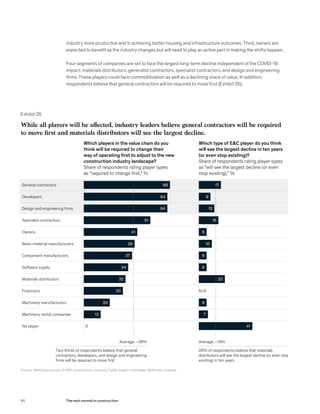
Players in the ecosystem will need to develop strategies to deal with the disruption ahead. Our survey
respondents identified four types of players set to face the largest long-term decline: design and
engineering firms, materials distributors, general contractors, and specialist contractors. Furthermore,
respondents believe that general contractors will be required to move first, as they could experience
commoditization and a declining share of value.
In the face of this transformation, companies all along the value chain need to review where they want
to play: which asset classes, segments, geographies, and value-chain steps. They will need to assess
the impact of each of the disruptions and the nine shifts, decide how they want to act on them, and
define new-business models and operating models in line with those decisions. This process is critical
whether they aim to defend their core business and adjust to the new environment or fundamentally
reinvent themselves and attack. For success, it will be critical for companies to invest in a set of enablers,
such as agile organizations. Finally, companies can choose how to implement the new strategy and
transformation, whether it’s trying to evolve incumbent operations to work within the new setup, starting
up new divisions or arm’s-length operations, or applying targeted M&A.
In the materials-distribution and logistics segment, for instance, off-site manufacturing facilities will
shift demand for shipments to factory hubs, the main logistics nodes, which will increase customer
expectations for just-in-time delivery. The segment will be further reshaped by online and direct sales
channels (including new competition from online-distribution behemoths), rising customer expectations,
and increased use of technologies such as advanced analytics or automated warehouses. A shift in
procurement activity, from small specialized trades firms to larger contractors, will affect companies’
bargaining power, and internationalization will enable companies to source more from low-cost countries.
In response, companies could try to defend their core by, for instance, focusing on the refurbishment
market, becoming leaner, and undertaking category reviews. They could adjust to the changing
In the face of this transformation,
companies all along the value
chain need to review where they
want to play.
14 The next normal in construction
environment by, for example, strengthening customer relationships, offering new business solutions
to avoid disintermediation, consolidating to gain scale, and developing industrial-grade supply-chain
capabilities. Reinvention would entail becoming the logistics hub of the future construction landscape.
Strategies could include partnering closely with off-site manufacturers and materials suppliers to
optimize logistics and inventory according to their needs, helping with international sourcing, or offering
credit financing.11
Companies that familiarize themselves with the next normal and move quickly will be best positioned to both
create value and maintain their competitive edge.
Organizations that are adjacent to the construction ecosystem should look to facilitate—and benefit
from—the coming changes. Investors are well advised to use foresight to anticipate the respective shifts
and generate above-market returns. Insurance companies are already factoring use of modern methods
of construction into their terms. Policy makers should help the industry become more productive and
thereby attain better housing and infrastructure for citizens. And building owners stand to benefit from
better structures at lower costs if they play their part in making the shifts happen.
Construction is already in the perfect storm. Industrialization, globalization, and digitalization have been
key drivers of change in all industries. While this change happened in sequential waves—for example, in
auto industrialization in the 1970s and 1980s, globalization in the 1990s and 2000s, and digitalization in
the 2010s and ongoing—all of these drivers are hitting construction simultaneously. It is a daunting task
and will require bold and agile moves to maneuver, but the size of the prize is enormous.
15The next normal in construction
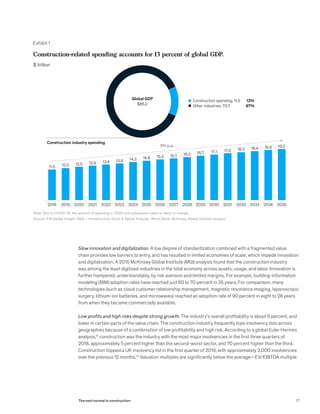
The construction industry, which encompasses real estate, infrastructure, and industrial structures, is the
largest industry in the global economy, accounting for 13 percent of the world’s GDP (Exhibit 1). A closer look
at its underlying performance highlights the industry’s challenges in good economic times, let alone in times
of crisis. We expect a set of nine shifts to radically change the way construction is done. Companies that can
adjust their business models stand to benefit handsomely, while others may struggle to survive.
Poor long-term performance stems from unfavorable market characteristics and
industry dynamics
Construction is responsible for a wide range of impressive accomplishments, from stunning cityscapes
and foundational infrastructure on a massive scale to sustained innovation. However, in the past couple
of decades, it has been plagued by dismal performance, characterized by lagging productivity growth,
limited digitalization, frequent insolvencies, and low levels of customer satisfaction. The industry will feel the
economic impact of COVID-19 strongly, as will the wider construction ecosystem—which includes construction
companies’ suppliers, distributors, customers, and competitors, as well as government regulators.
Lagging productivity growth. The industry’s global annual labor productivity growth over the past 20 years
was less than 1 percent, which is significantly less than the productivity growth of the global economy,
approximately 2.8 percent a year.12
Historically, the construction
industry has underperformed
1
16 The next normal in construction
@Getty Images/Jung Getty
Slow innovation and digitalization. A low degree of standardization combined with a fragmented value
chain provides low barriers to entry, and has resulted in limited economies of scale, which impede innovation
and digitalization. A 2015 McKinsey Global Institute (MGI) analysis found that the construction industry
was among the least digitized industries in the total economy across assets, usage, and labor. Innovation is
further hampered, understandably, by risk aversion and limited margins. For example, building-information
modeling (BIM) adoption rates have reached just 60 to 70 percent in 35 years. For comparison, many
technologies (such as cloud customer relationship management, magnetic resonance imaging, laparoscopic
surgery, lithium-ion batteries, and microwaves) reached an adoption rate of 90 percent in eight to 28 years
from when they became commercially available.
Low profits and high risks despite strong growth. The industry’s overall profitability is about 5 percent, and
lower in certain parts of the value chain. The construction industry frequently tops insolvency lists across
geographies because of a combination of low profitability and high risk. According to a global Euler Hermes
analysis,13
construction was the industry with the most major insolvencies in the first three quarters of
2018, approximately 5 percent higher than the second-worst sector, and 70 percent higher than the third.
Construction topped a UK insolvency list in the first quarter of 2019, with approximately 3,000 insolvencies
over the previous 12 months.14
Valuation multiples are significantly below the average—EV/EBITDA multiple
Exhibit 1
Note: Due to COVID-19, the amount of spending in 2020 and subsequent years is likely to change.
Source: IHS Global Insight; ISSA – Infrastructure Stock & Spend Analyzer; World Bank; McKinsey Global Institute analysis
Construction industry spending
Construction-related spending accounts for 13 percent of global GDP.
$ trillion
3% p.a.
2018 20352019 2020 2021 2022 2023 2024 2025 2026 2027 2028 2029 2030 2031 2032 2033 2034
11.5 12.0 12.5 12.9 13.4 13.8 14.3 14.8 15.3 15.7 16.2 16.7 17.1 17.6 18.0 18.4 18.8 19.2
Global GDP
$85.2
Construction spending, 11.5 13%
Other industries, 73.7 87%
17The next normal in construction
for the engineering and construction sector has averaged 5.8 over the past ten years, compared with 12.4
for the S&P 500.
Low customer satisfaction and regular time and budget overruns. A 2016 McKinsey analysis found that
construction projects typically take 20 percent longer to finish than scheduled and are up to 80 percent
over budget, frequently resulting in litigation.15
That often leaves customers dissatisfied, resulting in complex
and time-consuming claims processes.
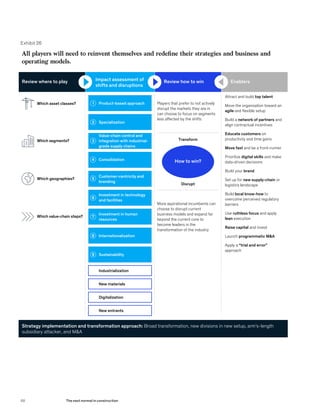
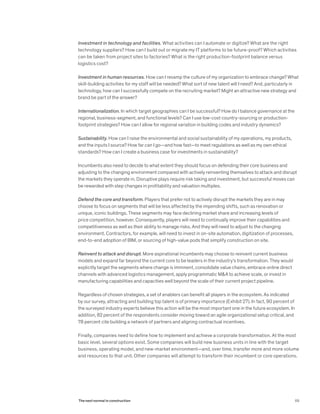
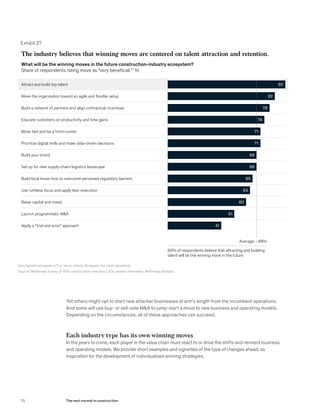
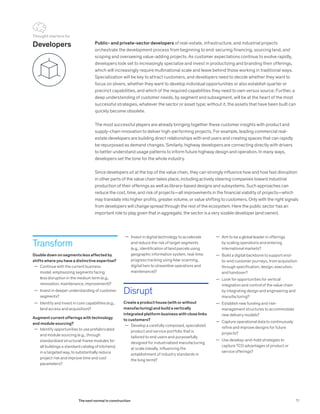
For these reasons, awareness was growing even before the COVID-19 crisis struck that the ecosystem must
transform to meet the challenges ahead. Our industry survey found that the attitudes of CxOs have evolved
materially since three to five years ago (see sidebar “About the executive survey”). In all, 90 percent of
executives strongly believe that the industry needs to change and that this sentiment has grown in the past
ten years. Eighty percent also believe that the construction industry will look radically different 20 years
from now.
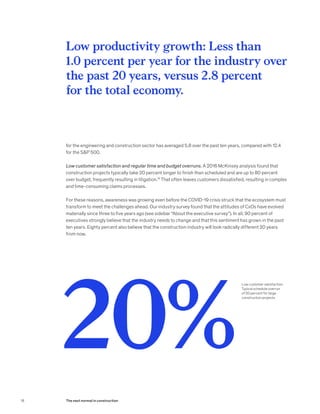
Low productivity growth: Less than
1.0 percent per year for the industry over
the past 20 years, versus 2.8 percent
for the total economy.
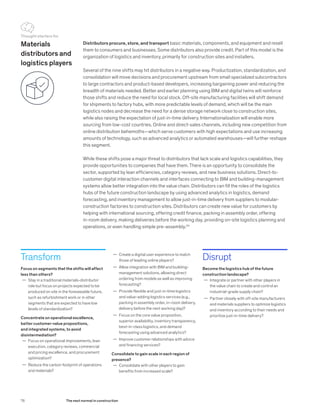
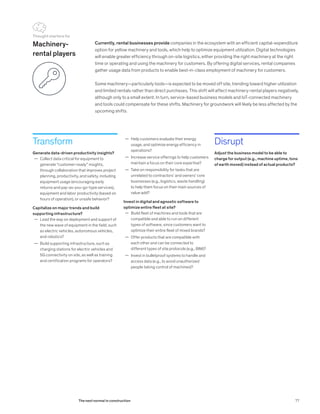
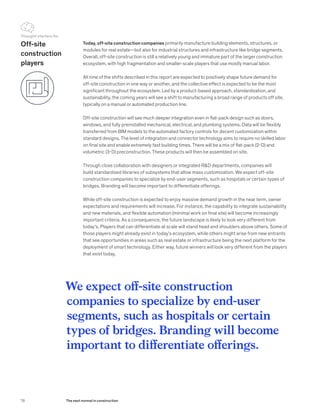
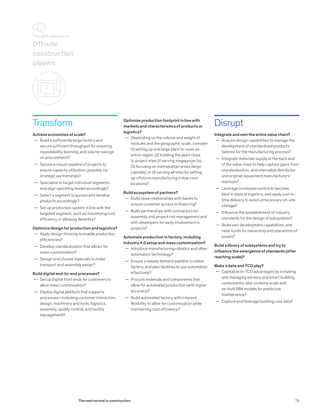
Low customer satisfaction:
Typical schedule overrun
of 20 percent for large
construction projects
20%
18 The next normal in construction
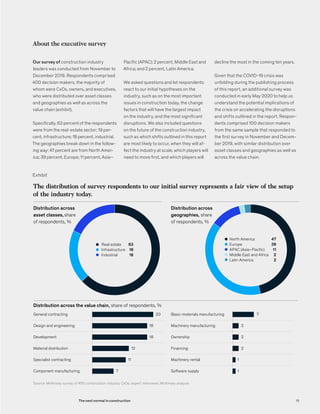
About the executive survey
Our survey of construction industry
leaders was conducted from November to
December 2019. Respondents comprised
400 decision makers, the majority of
whom were CxOs, owners, and executives,
who were distributed over asset classes
and geographies as well as across the
value chain (exhibit).
Specifically, 63 percent of the respondents
were from the real-estate sector; 19 per-
cent, infrastructure; 18 percent, industrial.
The geographies break down in the follow-
ing way: 47 percent are from North Amer-
ica; 39 percent, Europe; 11 percent, Asia–
Pacific (APAC); 2 percent, Middle East and
Africa; and 2 percent, Latin America.
We asked questions and let respondents
react to our initial hypotheses on the
industry, such as on the most important
issues in construction today, the change
factors that will have the largest impact
on the industry, and the most significant
disruptions. We also included questions
on the future of the construction industry,
such as which shifts outlined in this report
are most likely to occur, when they will af-
fect the industry at scale, which players will
need to move first, and which players will
decline the most in the coming ten years.
Given that the COVID-19 crisis was
unfolding during the publishing process
of this report, an additional survey was
conducted in early May 2020 to help us
understand the potential implications of
the crisis on accelerating the disruptions
and shifts outlined in the report. Respon-
dents comprised 100 decision makers
from the same sample that responded to
the first survey in November and Decem-
ber 2019, with similar distribution over
asset classes and geographies as well as
across the value chain.
Exhibit
Source: McKinsey survey of 400 construction-industry CxOs; expert interviews; McKinsey analysis
The distribution of survey respondents to our initial survey represents a fair view of the setup
of the industry today.
Distribution across
asset classes,share
of respondents, %
Distribution across
geographies, share
of respondents, %
Distribution across the value chain, share of respondents, %
General contracting Basic-materials manufacturing
Design and engineering Machinery manufacturing
Development Ownership
Material distribution Financing
Machinery rentalSpecialist contracting
Software supplyComponent manufacturing
 20
 18
 18
 12
 11
7
7
2
2
2
1
1
Real estate
Infrastructure
Industrial
63
19
18
North America
Europe
APAC (Asia–Pacific)
Middle East and Africa
Latin America
47
39
11
2
2
19The next normal in construction
Rough seas lie ahead for the construction ecosystem. Beyond the economic downturn that will reduce
construction demand, the COVID-19 crisis has also shocked supply chains and may lead to lasting shifts
in investment patterns (see sidebar “The impact of the COVID-19 crisis on the construction industry’s
outlook”).
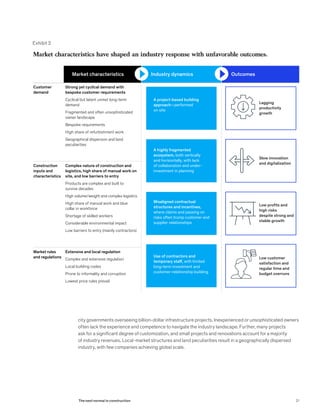
How companies respond determines industry dynamics and outcomes
The lagging performance of the construction industry is a direct result of the fundamental rules and
characteristics of the construction market and the industry dynamics that occur in response to them
(Exhibit 2). Our analysis identified the following three broad market characteristics that are now influencing
the external environment:
Cyclical demand with bespoke customer requirements
The industry benefits from robust long-term demand, thanks to economic and population growth and rising
urbanization around the world. That demand is highly sensitive to economic cycles, however, leading to low
capital investment that slows productivity growth. A fragmented market includes customers ranging from
individual single-family homeowners making once-in-a-lifetime purchasing decisions to administrators in
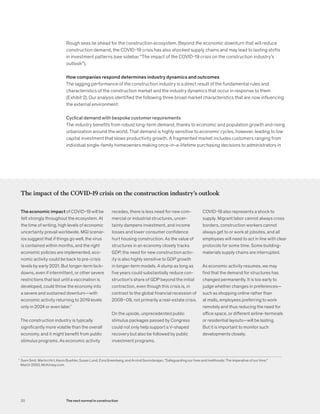
The impact of the COVID-19 crisis on the construction industry’s outlook
The economic impact of COVID-19 will be
felt strongly throughout the ecosystem. At
the time of writing, high levels of economic
uncertainty prevail worldwide. MGI scenar-
ios suggest that if things go well, the virus
is contained within months, and the right
economic policies are implemented, eco-
nomic activity could be back to pre-crisis
levels by early 2021. But longer-term lock-
downs, even if intermittent, or other severe
restrictions that last until a vaccination is
developed, could throw the economy into
a severe and sustained downturn—with
economic activity returning to 2019 levels
only in 2024 or even later.1
The construction industry is typically
significantly more volatile than the overall
economy, and it might benefit from public
stimulus programs. As economic activity
recedes, there is less need for new com-
mercial or industrial structures, uncer-
tainty dampens investment, and income
losses and lower consumer confidence
hurt housing construction. As the value of
structures in an economy closely tracks
GDP, the need for new construction activ-
ity is also highly sensitive to GDP growth
in longer-term models. A slump as long as
five years could substantially reduce con-
struction’s share of GDP beyond the initial
contraction, even though this crisis is, in
contrast to the global financial recession of
2008–09, not primarily a real-estate crisis.
On the upside, unprecedented public
stimulus packages passed by Congress
could not only help support a V-shaped
recovery but also be followed by public
investment programs.
COVID-19 also represents a shock to
supply. Migrant labor cannot always cross
borders, construction workers cannot
always get to or work at jobsites, and all
employees will need to act in line with clear
protocols for some time. Some building-
materials supply chains are interrupted.
As economic activity resumes, we may
find that the demand for structures has
changed permanently. It is too early to
judge whether changes in preferences—
such as shopping online rather than
at malls, employees preferring to work
remotely and thus reducing the need for
office space, or different airline-terminals
or residential layouts—will be lasting.
But it is important to monitor such
developments closely.
1
Sven Smit, Martin Hirt, Kevin Buehler, Susan Lund, Ezra Greenberg, and Arvind Govindarajan, "Safeguarding our lives and livelihoods: The imperative of our time,"
March 2020, McKinsey.com.
20 The next normal in construction
city governments overseeing billion-dollar infrastructure projects. Inexperienced or unsophisticated owners
often lack the experience and competence to navigate the industry landscape. Further, many projects
ask for a significant degree of customization, and small projects and renovations account for a majority
of industry revenues. Local-market structures and land peculiarities result in a geographically dispersed
industry, with few companies achieving global scale.
Exhibit 2
Market characteristics have shaped an industry response with unfavorable outcomes.
Market characteristics OutcomesIndustry dynamics
Customer
demand
Construction
inputs and
characteristics
Market rules
and regulations
A project-based building
approach—performed
on site
A highly fragmented
ecosystem, both vertically
and horizontally, with lack
of collaboration and under-
investment in planning
Use of contractors and
temporary staff, with limited
long-term investment and
customer-relationship building
Misaligned contractual
structures and incentives,
where claims and passing on
risks often trump customer and
supplier relationships
Lagging
productivity
growth
Slow innovation
and digitalization
Low customer
satisfaction and
regular time and
budget overruns
Low profits and
high risks
despite strong and
stable growth
Strong yet cyclical demand with
bespoke customer requirements
Cyclical but latent unmet long-term
demand
Fragmented and often unsophisticated
owner landscape
Bespoke requirements
High share of refurbishment work
Geographical dispersion and land
peculiarities
Complex nature of construction and
logistics, high share of manual work on
site, and low barriers to entry
Products are complex and built to
survive decades
High volume/weight and complex logistics
High share of manual work and blue
collar in workforce
Shortage of skilled workers
Considerable environmental impact
Low barriers to entry (mainly contractors)
Extensive and local regulation
Complex and extensive regulation
Local building codes
Prone to informality and corruption
Lowest price rules prevail
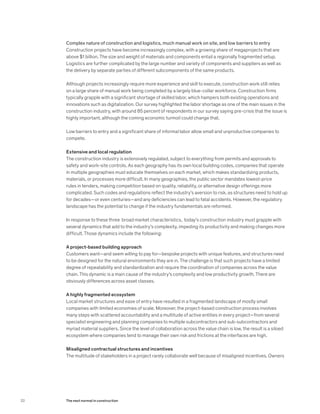
21The next normal in construction
Complex nature of construction and logistics, much manual work on site, and low barriers to entry
Construction projects have become increasingly complex, with a growing share of megaprojects that are
above $1 billion. The size and weight of materials and components entail a regionally fragmented setup.
Logistics are further complicated by the large number and variety of components and suppliers as well as
the delivery by separate parties of different subcomponents of the same products.
Although projects increasingly require more experience and skill to execute, construction work still relies
on a large share of manual work being completed by a largely blue-collar workforce. Construction firms
typically grapple with a significant shortage of skilled labor, which hampers both existing operations and
innovations such as digitalization. Our survey highlighted the labor shortage as one of the main issues in the
construction industry, with around 85 percent of respondents in our survey saying pre-crisis that the issue is
highly important, although the coming economic turmoil could change that.
Low barriers to entry and a significant share of informal labor allow small and unproductive companies to
compete.
Extensive and local regulation
The construction industry is extensively regulated, subject to everything from permits and approvals to
safety and work-site controls. As each geography has its own local building codes, companies that operate
in multiple geographies must educate themselves on each market, which makes standardizing products,
materials, or processes more difficult. In many geographies, the public sector mandates lowest-price
rules in tenders, making competition based on quality, reliability, or alternative design offerings more
complicated. Such codes and regulations reflect the industry’s aversion to risk, as structures need to hold up
for decades—or even centuries—and any deficiencies can lead to fatal accidents. However, the regulatory
landscape has the potential to change if the industry fundamentals are reformed.
In response to these three broad market characteristics, today’s construction industry must grapple with
several dynamics that add to the industry’s complexity, impeding its productivity and making changes more
difficult. Those dynamics include the following:
A project-based building approach
Customers want—and seem willing to pay for—bespoke projects with unique features, and structures need
to be designed for the natural environments they are in. The challenge is that such projects have a limited
degree of repeatability and standardization and require the coordination of companies across the value
chain. This dynamic is a main cause of the industry’s complexity and low productivity growth. There are
obviously differences across asset classes.
A highly fragmented ecosystem
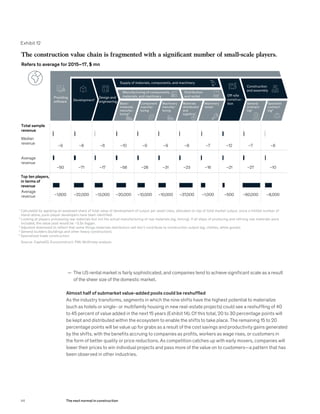
Local market structures and ease of entry have resulted in a fragmented landscape of mostly small
companies with limited economies of scale. Moreover, the project-based construction process involves
many steps with scattered accountability and a multitude of active entities in every project—from several
specialist engineering and planning companies to multiple subcontractors and sub-subcontractors and
myriad material suppliers. Since the level of collaboration across the value chain is low, the result is a siloed
ecosystem where companies tend to manage their own risk and frictions at the interfaces are high.
Misaligned contractual structures and incentives
The multitude of stakeholders in a project rarely collaborate well because of misaligned incentives. Owners
22 The next normal in construction
often tender projects at the lowest cost and pass on risks such as soil properties or rising prices for
materials that they might better handle or absorb themselves. Engineers are often paid as a percentage
of total construction cost, limiting their desire to apply design-to-cost and design-to-constructability
practices. General contractors are often only able to make profits via claims, so rather than highlighting
design issues early in a project they often prefer charging for change orders later. Incentives and discounts
from distributors and material suppliers to subcontractors obscure material prices.
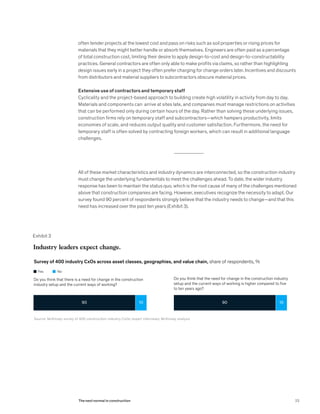
Extensive use of contractors and temporary staff
Cyclicality and the project-based approach to building create high volatility in activity from day to day.
Materials and components can arrive at sites late, and companies must manage restrictions on activities
that can be performed only during certain hours of the day. Rather than solving these underlying issues,
construction firms rely on temporary staff and subcontractors—which hampers productivity, limits
economies of scale, and reduces output quality and customer satisfaction. Furthermore, the need for
temporary staff is often solved by contracting foreign workers, which can result in additional language
challenges.
All of these market characteristics and industry dynamics are interconnected, so the construction industry
must change the underlying fundamentals to meet the challenges ahead. To date, the wider industry
response has been to maintain the status quo, which is the root cause of many of the challenges mentioned
above that construction companies are facing. However, executives recognize the necessity to adapt. Our
survey found 90 percent of respondents strongly believe that the industry needs to change—and that this
need has increased over the past ten years (Exhibit 3).
Exhibit 3
90 10 90 10
Industry leaders expect change.
Survey of 400 industry CxOs across asset classes, geographies, and value chain, share of respondents, %
Do you think that there is a need for change in the construction
industry setup and the current ways of working?
Do you think that the need for change in the construction industry
setup and the current ways of working is higher compared to five
to ten years ago?
Yes No
Source: McKinsey survey of 400 construction-industry CxOs; expert interviews; McKinsey analysis
23The next normal in construction
A changing market environment,
technological progress, and
disruptive new entrants will
trigger industry overhaul
2
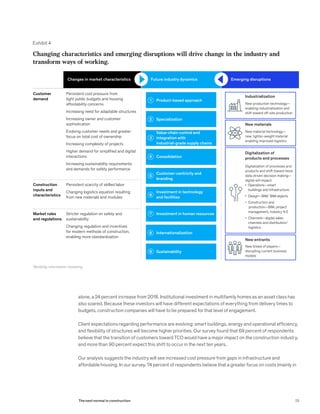
The construction industry was starting to experience an unprecedented rate of disruption before the
COVID-19 pandemic. In the coming years, fundamental change is likely to be catalyzed by changes in market
characteristics, and emerging disruptions will shape the future dynamics of the industry (Exhibit 4). The
COVID-19 crisis amplifies these dynamics.
Evolving market characteristics will be a catalyst for change
Throughout the industry, several evolving market characteristics—including the following—will challenge
construction companies to highlight both the heightened need for change and the pace at which it must occur.
1. Rising customer sophistication and total-cost-of-ownership (TCO) pressure
The industry has seen an influx of capital from more savvy customers. From 2014 to 2019, for example,
private-equity firms raised more than $388 billion for infrastructure projects, including $100 billion in 2019
24 The next normal in construction
@Getty Images/SerhiiBobyk
alone, a 24 percent increase from 2018. Institutional investment in multifamily homes as an asset class has
also soared. Because these investors will have different expectations of everything from delivery times to
budgets, construction companies will have to be prepared for that level of engagement.
Client expectations regarding performance are evolving: smart buildings, energy and operational efficiency,
and flexibility of structures will become higher priorities. Our survey found that 69 percent of respondents
believe that the transition of customers toward TCO would have a major impact on the construction industry,
and more than 90 percent expect this shift to occur in the next ten years.
Our analysis suggests the industry will see increased cost pressure from gaps in infrastructure and
affordable housing. In our survey, 74 percent of respondents believe that a greater focus on costs (mainly in
Exhibit 4
Changing characteristics and emerging disruptions will drive change in the industry and
transform ways of working.
Changes in market characteristics Emerging disruptionsFuture industry dynamics
Customer
demand
Construction
inputs and
characteristics
Market rules
and regulations
Product-based approach1
Specialization
Value-chain control and
integration with
industrial-grade supply chains
Consolidation
Customer-centricity and
branding
Investment in technology
and facilities
Investment in human resources
Internationalization
Sustainability
Industrialization
Persistent cost pressure from
tight public budgets and housing
affordability concerns
Increasing need for adaptable structures
Increasing owner and customer
sophistication
Evolving customer needs and greater
focus on total cost of ownership
Increasing complexity of projects
Higher demand for simplified and digital
interactions
Increasing sustainability requirements
and demands for safety performance
Persistent scarcity of skilled labor
Changing logistics equation resulting
from new materials and modules
Stricter regulation on safety and
sustainability
Changing regulation and incentives
for modern methods of construction,
enabling more standardization
New production technology—
enabling industrialization and
shift toward off-site production
New materials
New material technology—
new, lighter-weight material
enabling improved logistics
2
3
4
5
6
7
8
9
New entrants
New breed of players—
disrupting current business
models
Digitalization of
products and processes
Digitalization of processes and
products and shift toward more
data-driven decision making—
digital will impact:
• Operations—smart
buildings and infrastructure
• Design—BIM,¹ BIM objects
• Construction and
production—BIM, project
management, Industry 4.0
• Channels—digital sales
channels and distribution/
logistics
1
Building-information modeling.
25The next normal in construction
infrastructure and affordable housing) would have a large impact on the industry. This trend will be felt in the
near term: more than 90 percent expect to feel its influence within the next ten years.
McKinsey analysis found that $69.4 trillion in infrastructure investment (at 2018 prices) will be required
by 2035 to support expected GDP growth.16
Investment will need to increase from current levels by
0.3 percentage points of GDP, or an average of approximately $300 billion a year. Government budgets
are tight, however, as debt levels have soared during the pandemic. In real estate, our research found
that about a third of the global urban population cannot afford a decent place to live.17
The supply
of housing will need to increase—at lower price points. The COVID-19 crisis magnifies cost and
affordability issues.
2. Persistent scarcity of skilled labor and changing logistics equations
The shortage of qualified workers has become a major issue in several markets. Our survey, which was
conducted before the COVID-19 outbreak, shows that 87 percent of respondents believe that skilled-labor
scarcity will have a high impact on the industry, and almost 50 percent of respondents expect that it will
become even more of an issue at scale over the next two decades (Exhibit 5). For example, about 41 percent
of the current US construction workforce is expected to retire by 2031. The impact the COVID-19 crisis will
have on this dynamic in the long term is unclear at the time of writing.
New, lighter-weight materials and structurally stronger modules will change the logistics equation and allow
longer-haul transport of materials and modules, and hence greater centralization.
3. Sustainability and safety regulation and possible standardization of building codes
Our survey revealed that 69 percent of the respondents believe that stricter regulation on work-site
sustainability and safety would affect the industry. While 90 percent expect sustainability and safety to make
a significant impact in the next ten years, 19 percent believe the shift will occur far more rapidly—potentially
within the next year. Because of COVID-19, new health and safety procedures will be required for some time.
The global conversation about climate change, exemplified by the implementation of UN sustainability
targets, will compel construction companies and materials suppliers to factor sustainability into their
products, construction processes, and designs. The current pace of urbanization will require significant
investment in infrastructure and housing to accommodate regional population shifts, highlighting the need
for urban sustainability. A 2015 McKinsey analysis found that green districts (densely populated areas
located in a city that use technologies and design elements to reduce resource use and pollution) can
reduce energy consumption by 20 to 40 percent and freshwater consumption and wastewater production
by up to 65 percent.18
The physical impact of climate change will shape demand (through mass migration and physical mitigation
such as flood defense), while construction will come under pressure to mitigate carbon emissions. For
example, cement production currently accounts for 8 percent of global carbon emissions, according to the
Royal Institute of International Affairs.19
The rate of new regulations could also accelerate in line with the
perceived threat.
Indications are emerging that regulations and incentives are changing to accommodate modern methods
of construction, enabling more standardization across the building process. One such method is modular
construction. Type certificates can replace individual on-site approvals to alleviate the shift, or governments
can actively mandate modern methods of construction. For example, all government housing projects in
Singapore must use prefinished volumetric modules.
26 The next normal in construction
Emerging disruptions will fuel the transformation of the value chain
The demands put on the construction ecosystem have continued to change, but the fundamental business
models and approaches of most players have not. The result has been instability in the ecosystem and
difficulty meeting growing demand efficiently. In addition, the compounding effects of new production
technologies and materials, digitalization of processes and products, and new breeds of players across the
value chain have the potential to radically transform the construction industry.
Industrialization
Advancements in technology have enabled industrialization and a shift toward an off-site, product-based
approach. A more controlled environment will be even more valuable for the duration of the COVID-19
Exhibit 5
McKinsey 2020
Construction ecossystem
Exhibit 5 of X
1
High impact equals a 7 or higher (where 10 is highest impact). Figures may not sum to 100%, because of rounding.
Source: McKinsey survey of 400 construction-industry CxOs; expert interviews; McKinsey analysis
Which of [these changes in market characteristics] do you
think will have the highest impact on the construction industry?
Share of respondents rating changes in characteristics “high impact,”1
%
The industry believes that market characteristics will change at scale.
When do you think [the changes in
market characteristics] will impact at
scale? Share of respondents, %
Skilled labor is becoming increasingly scarce
and expensive
Within one year 1–10 years 10–20 years
There is an increasing focus on costs, notably due
to infrastructure and affordable-housing gaps
Regulations on work-site safety and sustainability
are becoming increasingly strict
Customers are valuing digitally enabled “smart” buildings
(eg, using IoT), better energy and operational efficiency,
and more flexibility in structures for changing future use
There is a higher emphasis from customers on
sustainability in the industry today
There is an increasing share of larger and “smarter”
investors entering construction today, with higher
requirements on project delivery and scale
Regulations and building codes are changing and
becoming harmonized within or across countries to
enable a standardized construction approach
Almost 90% of the industry believe that a further shortage of skilled labor
would have a high impact on construction ...
... and almost half of respondents think that
this will happen within the coming year
87
69
69
67
57
55
Average: ~68%
19 76 6
14 77 9
8 85 7
9 80 11
4649 5
15 81 4
11 781
74
27The next normal in construction
pandemic. Elements include a production system that uses increasingly modular components, automated
manufacturing, and robotics-supported on-site execution.
Modularization has the potential to enable standardization and drastically improve productivity in
construction. Prefabrication and off-site manufacturing have been around for a long time in construction,
but the combination of lighter-weight materials and digital planning and production technologies could
enable the industry to attain new levels of quality, variability, and efficiency. A 2018 survey of UK home
builders found that 40 percent of the respondents were already investing in manufacturing facilities or
intended to do so in the near future. In Scandinavia, 45 percent of housing is currently built using off-site
manufacturing.20
The next step in the transition to efficient off-site manufacturing involves integrating automated production
systems—essentially making construction more like automotive manufacturing. Parts of the industry are
already moving in this direction. Modular construction firm Lindbäcks uses Randek’s industrial construction
machinery to perform manufacturing tasks such as nailing, milling of openings, sheet cutting, and gluing.
On-site execution that uses automation technology could become significantly more efficient. Construction
has already started to explore automation in three areas: additive construction (3-D printing), autonomous
navigation technology for construction machinery enabled by light detection and ranging (LiDAR, a remote-
sensing method for examining the Earth’s surface), and robotics and drone technology.
New materials
Increased use of lighter-weight materials, such as light-gauge steel frames and cross-laminated timber, is
reducing costs and allowing longer-haul logistics and more centralization in production and distribution.
New types of versatile, lighter-weight, and flexible concrete are self-compacting and have a higher viscosity
that eliminates vibration and finishing while enabling single-point pouring and more intricate formwork.
Other varieties materially reduce carbon footprint. Alternative materials (both structural and nonstructural)
are also being developed: for example, ethylene tetrafluoroethylene (ETFE) is 99 percent lighter, stronger,
more eco-friendly, better at transmitting light, and more flexible than glass.
Digitalization of products, design, processes, and channels
Digital technologies are enabling better collaboration, greater control of the value chain, and a shift toward
more data-driven decision making. In turn, companies are adopting 5-D building-information modeling (BIM),
advanced analytics, and digital-procurement and supply-chain management throughout their organizations.
Smart products and operations. Smart buildings and infrastructure that integrate the Internet of Things
(IoT) will increase data availability and enable more efficient operations as well as new business models,
such as performance-based contracting. IoT sensors and communication technology give companies the
ability to track and monitor utilization, energy efficiency, and maintenance needs. By using BIM, owners and
operators can create a virtual 3-D model with precise transparency on all components used in a completed
building, which can increase efficiency as well as reduce maintenance costs.
Design. BIM has been used in construction for many years now. Over time, additional features and
components (such as scheduling and budgeting) have been added to create a full-scale project-
management software solution. However, the industry has struggled to adopt and successfully integrate
BIM in operations. By using BIM to create a full 3-D model (a “digital twin”) early in the project rather than
finishing design once the project is already initiated, companies can improve efficiency and integrate the
28 The next normal in construction
design phase with the rest of the value chain. This capability improves coordination and communication with
materials and component suppliers and allows early clash detection and design and planning improvements.
In a 2017 McKinsey survey, contractors indicated that their expected use of BIM could increase by 50
percent and that they were planning significant investment to expand their BIM programs until 2020.21
Such capabilities will materially change risks in construction projects and put traditional engineering,
procurement, and construction (EPC) models into question.
Construction and production processes. Using digital tools can significantly improve on-site collaboration.
These solutions include mobile project-management apps and cloud-based project control towers that
integrate communication among teams on site and sync with sensors, wearable devices, and desktop
machines to constantly track progress and utilization. Advanced analytics can help to further enhance
construction efficiency. Industry 4.022
approaches allow greater flexibility in factories and thus more
customization of modules. As in other industries, the COVID-19 pandemic is accelerating the integration of
digital tools.
Channels. Digital channels are spreading to construction, with the potential to transform interactions
for buying and selling goods across the value chain. Online marketplaces, which have optimized supply
chains in other industries, could significantly improve the efficiency of buying and selling goods along
the construction value chain and improve interactions—both between customers and suppliers of whole
projects as well as among industry participants along the value chain during projects. Digital channels can
also radically disrupt distribution and reshape construction logistics. Across the value chain, start-ups
have emerged to establish online marketplaces for buying and selling goods such as heavy equipment,
construction materials, and professional services. Over the past two years, these marketplaces have
received 27 venture-capital funding rounds. This activity represents about 40 percent of the total
venture-capital funding rounds to online marketplaces. As in other industries, the COVID-19 pandemic is
accelerating the integration of digital tools.
New entrants
Start-ups, incumbent players making new bets, and new funding from venture capital and private equity are
disrupting current business models. In addition, a new breed of player, backed by capital from investment
funds, is entering the construction industry. Indeed, the number of annual venture-capital funding rounds
grew about 30 percent a year from 2012 to 2018. Katerra, for example, raised $1.2 billion to develop a
business model based on new technology to control the value chain, including design and engineering
and off-site manufacturing. As the economic crisis unfolds, we also expect an increase in corporate
restructuring and M&A activity.
In our survey of industry leaders, a majority of the respondents believe that the disruptions outlined in this
report would have a large impact on the industry (Exhibit 6). A significant majority expect the shifts to occur
in the next five years and to fuel the industry’s transformation journey in the near term. As the COVID-19-
propelled economic crisis unfolds, we also expect an increase in corporate restructuring and M&A activity.
Nine shifts will disrupt the construction industry ecosystem
We expect nine shifts to fundamentally change the entire construction ecosystem. According to our
executive survey, more than 75 percent of respondents agree that these shifts are likely to occur, and more
than 60 percent believe that they are likely to occur within the next five years. The economic fallout from the
COVID-19 pandemic looks set to accelerate them.
29The next normal in construction
A refusal to adapt to this upheaval will only worsen performance, while developing new business and
operating models could allow companies to generate more value and profit. The new characteristics will
combine to erect higher barriers to entry, which will be positive for companies that manage to strengthen
their market position and to invest.
Product-based approach. In the future, a large share of construction projects will be built using
customizable, modularized elements and components produced using standardized processes in off-site
factories. The modules and elements will be shipped and assembled on site. Production will consist of
assembly line–like processes in safe, nonhostile environments with a large degree of repeatability.23
In
addition, common, industry-wide standards for elements and components may emerge. There will likely be
a balance between simple elements and components (manufactured according to common, industry-wide
standards) and tailored, customizable ones (such as exteriors) to fit bespoke customer needs.
Each player will develop its own design library of elements and components that can be assembled
according to customer requirements. A portion of the market might be composed of prefinished volumetric
modules, and customizable, LEGO-like, modularized elements and components could become the industry
standard. With this shift, the creativity in designing bespoke products will remain—developers and product
manufacturers will collaborate, possibly through strategic alliances, to design products according to
unique circumstances.24
Exhibit 6
1
High impact equals a 7 or higher, where 10 is highest impact.
Source: McKinsey survey of 400 construction-industry CxOs; expert interviews; McKinsey analysis
Which [of these emerging disruptions] do you think will have
highest impact on the construction industry? Share of respondents
rating that emerging disruptions will have “high impact,”1
%
When do you think the emerging disruptions
will impact construction at scale? Share of
respondents, %
More than two-thirds of respondents think that industrialization and digitalization
will have the highest impact of the emerging disruptions
More than two-thirds of respondents expect disruptions to
impact construction in the near term
1–5 years 5–20 years
New production technology 68 79 21
Digitalization of products  67 78 22
New-materials technology 63 76 24
Average: ~63%
Digitalization of sales channels 72 28
Disruptive market entrants 67 33
60
57
Industry leaders expect disruption to occur.
30 The next normal in construction
The product-based approach will not be confined to construction: developers and owners are also likely to
increasingly develop and market branded “products” comprising a standardized structure and contractual
terms with integrated service offerings.
Digital technologies will be a critical factor in the shift to a product-based approach. Therefore, companies
that own the digital model will be able to control the process without actually owning any factories and to
price products based on TCO rather than using today’s simple cost-plus approach.
Specialization. To improve their margins and levels of differentiation, companies will likely increasingly
specialize in target niches and segments (such as luxury single-family housing, multistory residential
buildings, hospitals, or processing plants) in which they can build a competitive advantage. And they
will specialize in using different materials, subsegments, or methods of construction. The shift toward
specialization will also require companies to develop and retain knowledge and capabilities to maintain their
competitive advantages. Obviously, players will need to carefully weigh the effectiveness, efficiency, and
brand positioning that greater specialization enables against the potential risk and cycle-hedging benefits
of a more diversified portfolio.
Value-chain control and integration with industrial-grade supply chains. Companies will move to own
or control important activities along the value chain, such as design and engineering, select-component
manufacturing, supply-chain management, and on-site assembly. Companies will be able to achieve this
goal through vertical integration or strategic alliances and partnerships by using collaborative contracting
and more closely aligned incentives. Similar to other manufacturing industries, controlling the supply of key
components will be critical to securing just-in-time delivery of right-sized inputs to manufacturing as well as
the supply of goods to on-site assembly. Digital technology will change the interaction model: BIM models
will lead to more decision making early on in the process, distribution will move toward online platforms
and logistics management, and end-to-end software platforms will allow companies to better control and
integrate value and supply chains. By successfully integrating a five-dimensional BIM model with the value
chain, for example, companies will be able to link activities from formulating the initial concept to producing
the finished product. Value-chain control or integration will reduce interface frictions and make innovation
more agile.
Consolidation. Growing needs for specialization and investments in innovation—including the use of new
materials, digitalization, technology and facilities, and human resources—will require significantly larger
scale than is common today. In addition, larger and more professional investors will seek more sizable, more
sophisticated companies to be their counterparties. As product-based approaches, with a greater amount
of standardization and repeatability, further increase the importance of gaining scale, the industry is likely
to increasingly see a significant degree of consolidation, both within specific parts of the value chain and
across the value chain. Globalization will further increase scale effects as future winning products will be
fashionable and in demand across the world.
Customer-centricity and branding. With productization—that is, turning development, engineering, or
construction services into easy-to-market products or solutions25
—and specialization in the industry, having
a compelling brand that represents an organization’s distinctive attributes and values will take on added
importance. As in traditional consumer or B2B industries, a strong brand can tie customers more closely to
the construction company’s or supplier’s products and help to build and maintain relationships and attract
new customers. Similar to brands in other sectors, such a brand will encompass, among other aspects,
product and service quality, value, timing of delivery, reliability, service offerings, and warranties.
31The next normal in construction
Investment in technology and facilities. Productization implies a need to build off-site factories, which
requires investments in plants, manufacturing machinery and equipment (such as robotics to automate
manufacturing), and technology. Where modular is not used, the construction site also will likely become
more capital intensive, using advanced automation equipment and drones, among other technologies. R&D
investment will become more important for specialized or more productized organizations, so companies are
likely to increase spending to develop new, innovative products and technologies. All across the value chain,
investment in digitalization will continue to rise.
Investment in human resources. Innovation, digitalization, value-chain control, technology use, and
specialization in end-use segments all increase the importance of developing and retaining in-house
expertise, which will compel players to invest more in human resources. In addition, the shifts outlined
in this report will likely require companies to reskill their workforce. The importance of risk management
and some other current capabilities will decrease and be replaced by an emphasis on others, such as
supply-chain management. To build the necessary capabilities, companies will need to invest further in
their workforces. This becomes even more important in light of the transition to the future of work.26
Most
incumbents struggle to attract the digital talent they need and will need to raise excitement about their
future business models.
Internationalization. Greater standardization will lower the barriers to operating across geographies. As
scale becomes increasingly important to gaining competitive advantages, players will increase their global
footprints—especially for low-volume projects in high-value segments such as infrastructure—although the
COVID-19 pandemic might slow down this development.
Sustainability. While sustainability is an important decision factor already, we are only at the very beginning
of an increasingly rapid development. Beyond the carbon-abatement discussions, physical climate risks
grow as the scale increases.27
Companies will need to consider the environmental impact when sourcing
materials, manufacturing will become more sustainable (for example, using electric machinery), and supply
chains will be optimized for sustainability as well as resilience. In addition, working environments will need to
radically change from hostile to nonhostile, making construction safer. Water consumption, dust, noise, and
waste are also critical factors.
The construction process is expected to undertake a radical shift toward an industrialized setup by moving
from a project- to a product-based approach (Exhibit 7). The current complex and fragmented construction
ecosystem will transition to a more standardized, consolidated, and integrated construction process. Not all
parts of the construction industry will be equally affected by the shifts. A large proportion of projects will still
be unique, low-volume builds carried out in a conventional manner.
According to our survey, more than 75 percent of respondents believe that each of the nine shifts outlined
in this section is likely to occur (Exhibit 8), and a majority of those respondents believe that each of
the shifts is likely to make an impact on the industry at scale in the next five years. While 75 percent of
respondents indicated that the industrialization shifts (product-based approach, technology and facility,
human resources, control of the value chain, and customer-centricity) will occur within the next five years,
around 40 percent believe shifts around scale (consolidation, internationalization, and specialization) will
occur over the next five to 20 years.
32 The next normal in construction
Exhibit 7, part 1
FROM
FROM
33The next normal in construction
Exhibit 7, part 2
TO
TO
34 The next normal in construction
Construction can draw lessons from other industries that have faced disruption
Construction is not the first industry to encounter low productivity and disruption across the value chain.
Lessons can be learned from others that had similar traits and encountered the same challenges. We have
analyzed shifts in four industries with similar attributes: shipbuilding, commercial aircraft manufacturing,
agriculture, and car manufacturing. By studying these industries, clear patterns emerge regarding shifts
and changes to the industry value pools. In each case, an eventual transformation was preceded by a set of
underlying industry issues (such as low productivity and dissatisfied customers). Innovation in production
technology and new best-practice work methods kick-started the journey.
Shipbuilding. A geographically fragmented market structure meant that local shipyards covered the full
process. Ships were manually produced in a bespoke and project-based setup over long periods of time and
with a limited degree of repetition and standardization.
Exhibit 8
Note: N = 400 - whereof 63% real estate, 19% infrastructure, 18% industrial; 47% North America, 39% Europe, 11% APAC, 2% Middle East and
Africa, 2% Latin America
1
Probable equals a 5 or higher, where 10 equals the highest certainty that the shift will occur.
Source: McKinsey survey of 400 construction-industry CxOs; expert interviews; McKinsey analysis
More than 75% of respondents believe that the shifts will probably
occur—sustainability shift seen as most likely
More than 70% of the respondents who believe that
shifts will occur also believe that industrialization will
occur in the short term
How probable do you think [the listed shifts] are to occur?
Share of respondents rating shifts as “probable,”1
%, n = 400
When do you think the shifts will impact at
scale? Share of respondents who rated shifts as
“probable,”1
%, n = 370
Sustainability 90 79 21
Investment in technology and facilities 86 2872
Control of the value chain  85 2971
Customer-centricity 83 2674
Consolidation 82 57 43
Product-based approach  71 29
Specialization 65 35
Internationalization  57 43
Investment in human resources 74 26
Average: ~81%
77
75
75
74
1–5 years 5–20 years
Industry leaders expect shifts to occur in the short term.
35The next normal in construction
Commercial aircraft manufacturing. In addition to sharing many of the same characteristics as shipbuilding,
commercial aircraft manufacturing required a high degree of specialized trade skills (for example,
engineering and physics), and the cost of failure was (and still is) very high.
Agriculture. Each agricultural organization was confined to a specific plot of land, and the amount of manual
work in production (for example, seeding and farming) was high.
Car manufacturing. Historically, automakers produced cars one by one with limited use of best practices
and standardization. Design and production required a high level of specialized trades such as engineering.
While none of these industries is fully comparable to construction, they shared a number of characteristics:
Most also were historically highly fragmented and adopted a largely bespoke and project-based approach,
with limited standardization and repetition of processes. Productivity was low, and as demand picked up
companies had trouble increasing production. All of them but agriculture also share the high complexity
with construction and a high cost of failure. We included agriculture because its geographic dispersion and
reliance on land as a key input are similar to construction.
Further, customer satisfaction was often low, caused by long delivery timelines, costly products, and limited
assurance on quality. All these industries went through multidecades-long transformation journeys along
similar dimensions as the nine shifts we lay out for construction (Exhibit 9).
In commercial aircraft manufacturing, for example, the industry landscape was highly fragmented. Each
airplane was built from scratch in a bespoke and project-based-manufacturing setup. Industrialization
sparked a shift toward assembly-line manufacturing, which later become highly automated. As a result of
the subsequent standardization, the industry entered a phase of consolidation that led to the rise of two
major players: Airbus and Boeing. The transformation resulted in a significant shift of value to customers.
According to an analysis based on data compiled by Airline Monitor, the realized prices of airlines have
been decreasing, on average, at a compound annual growth rate (CAGR) of nearly 2 percent, and today’s
models have significantly improved safety, TCO, and technology.
This transformation journey took roughly 30 years to complete, as commercial aircraft manufacturing faced
barriers to change similar to those now confronting construction: risks associated with product innovation,
relatively strict regulation, often-limited scale of projects on which to apply innovation, and a value chain
that requires many stakeholders to be involved and closely aligned. Commercial aircraft was able to navigate
these variables and meet the challenges, which should give construction reason to be optimistic today.
Product-based approach. In shipbuilding, commercial aircraft manufacturing, and car manufacturing,
players shifted to a product-based approach for which production facilities became assembly sites.
The most famous example is Ford’s innovation of the assembly-line manufacturing process for its
Model T. Most of the auto-manufacturing industry adopted the process within ten years. In this model,
prefabricated and modularized subcomponents are inputs, and ships, airplanes, and cars are outputs.
While the manufacturing process was significantly standardized, products remained customizable
because subcomponents could take various forms and sizes within an industry-wide, standardized
framework. When early movers boosted their productivity and profit margins, competitors adopted
the innovation over time. Toyota’s lean manufacturing and use of robotics, further innovations in the
assembly-line manufacturing process, boosted the company from a small player to one of the largest in
the industry.
36 The next normal in construction
Specialization. As industrialization started to reform these industries and processes became standardized,
companies targeted specific niches and segments (for example, tankers, freight ships, and cruise ships in
shipbuilding and budget, luxury, and utility autos in car manufacturing). As a result of this specialization,
players created a competitive advantage by developing knowledge and scale in their market segment.
Value-chain control and integration with industrial-grade supply chains. As ship, aircraft, and car
manufacturing shifted to assembly lines, the supply of critical components was increasingly important.
In many cases, those components were the basis of differentiation: in car manufacturing, for example,
the quality of the engines could be a distinctive factor. Therefore, it was important to control the supply.
Exhibit 9
The expected shifts in construction have already occurred in other industries that show some
(albeit imperfect) similarities.
Shifts
Shift observed in industry Shift not observed in industry Shift somewhat observed/ongoing in industry Indicative length of main change wave, years
Shipbuilding
Commercial aircraft
manufacturing Agriculture Car manufacturing
Product-based approach
Investment in technology and facilities
Value-chain control and integration with
industrial-grade supply chains
Internationalization
Specialization
Investment in human resources
Customer-centricity and branding
Sustainability
Consolidation
Shared characteristics before transformations
Number of years indicating the length of main
change wave (fundamental change of industry).
The length of all shifts is longer and to some extent
still ongoing.
•Project-based
manufacturing of
complex products
with high demand on
customization
•A highly fragmented
ecosystem
•Project-based
manufacturing of
highly complex
products
•High share of
manual labor
required on-site
•Similar fundamental
demand and
geographically
dispersed market
with difficult
logistics
•Historically
fragmented
•Project-based
manufacturing of
complex products
•Fragmented
ecosystem with many
players involved
across production
process
~40~40~25~15
x
37The next normal in construction
Vertical integration or partnerships along the value chain were common shifts in the industries. In
commercial aircraft manufacturing, engines were, and are, produced by external suppliers, but, in order to
develop better-quality and more efficient engines than their competitors’, manufacturers hold integrated
partnerships in R&D and testing. Also, Boeing recently decided to build the 777X wing internally (which
was formerly outsourced) and has also set up an internal avionics division to reduce reliance on suppliers of
navigation, flight controls, and information systems.
Consolidation. As industrialization emerged in the four industries, companies started to consolidate in
order to gain scale. In agriculture, land reforms in combination with industrialization (such as standardized
seeding and harvesting) resulted in the industry’s transformation from a large set of small and local farms
to one dominated by regional and global players. In manufacturing industries, standardization spurred a
large wave of consolidation. In commercial aircraft manufacturing, several companies consolidated into
Airbus and Boeing. The defense sector also consolidated over the past 50 years, with several large deals
made to align companies’ services and product portfolios.
Customer-centricity and branding. Following specialization in end-use segments, companies invested
heavily to build strong brands within their market niches and segments. In car manufacturing, brands tell
stories that are centered on the customers—and customers let the products shape their lifestyles. Given
changes in how consumers acquire and use cars, automakers have emphasized their use of technology and
innovation to enhance the customer experience.
Investment in technologies and facilities. Industrialization created the need to invest in technology and
facilities: manufacturing plants needed to be built, machinery to be acquired. Product and manufacturing
innovation became important sources of competitive advantage, which led players to boost R&D
spending significantly. In the four comparable industries, greater R&D spending led to short-term gains
and advantages for the companies, while customers have benefited over the long term. Consider that the
current cost of a car or airplane has changed little in the past ten to 20 years, but both cars and airplanes
have significantly more value-adding technologies and other features. The trend has continued with
investments by original-equipment manufacturers in the electric-vehicle-battery market—from R&D and
packaging to cell production. Volkswagen recently invested in a battery-cell factory that it is developing in
partnership with SK Innovation in Germany. It has also struck major supply deals with LG Chem, Samsung,
and Chinese battery maker CATL. Overall, the company’s ratio of R&D spending to total revenues is
now close to 6 percent compared with an average across the construction sector of less than 2 percent.
Indeed, Volkswagen alone invested more than $13 billion in R&D in 2019, the same amount the 25 largest
construction and building materials players together spent on R&D, according to the 2019 EU Industrial
R&D Investment Scoreboard. And although that level of R&D spending may converge to the current
automotive-sector average of almost 5 percent, it would still represent a significantly higher commitment
to R&D than is typical in construction.28
In sum, across industries winners continue to heavily invest in
technology, many with a focus on digitalization and data-driven products and services.
Investment in human resources. Employee attraction and retention became a priority when industrialization
affected the four comparable industries at scale. First, players built up their technical knowledge in order to
create a competitive advantage. Second, improved production processes have, over time, resulted in a need
for constant retraining of the workforce.
Internationalization. Industrialization ushered in the standardization of processes, which was adopted
across geographies. Internationalization enabled companies to expand beyond their borders in pursuit
38 The next normal in construction
of scale, gave them access to new markets, and resulted in operations cost savings. For example, in an
attempt to increase commercial aircraft sales in China and the Mideast, Airbus and Boeing set up local
final-assembly lines in China.
Sustainability. The growing global emphasis on sustainability is being felt across industries. Most notably,
automotive has already embarked on a material transformation toward zero-emission vehicles. In Norway,
airport operator Avinor and Widerøe Airlines vowed to fully electrify all domestic flights by 2040.
Exhibit 10
The construction industry expects sequencing of shifts similar to comparable industries.
Transformation journeys in comparable industries
have typically followed the same pattern
In construction, industry practitioners expect a similar
transformation journey, share of respondents, %
1–5 years 5–20 yearsLength of phases highly indicative
First main change wave—industrialization,
20–25 years
Sustainability shift to occur sooner in the transformation
of the construction industry
Second main change wave—scale,
10–15 years
Sustainability
Control of the
value chain
Customer-
centricity
Shift to
product-based
Investment in
human resources
Investment in technology
and facilities
Specialization
Consolidation
Internationalization
First expected main change wave—industrialization
Second expected main change wave—scale
Sustainability 79 21
Customer-centricity 74 26
Investment in human resources 74 26
Investment in technology and facilities 72 28
Product-based approach 71 29
Control of the value chain 71 29
Specialization 65 35
Consolidation 57 43
Internationalization 57 43
Source: McKinsey survey of 400 construction-industry CxOs; expert interviews; McKinsey analysis
39The next normal in construction
The transformation journeys of the comparable industries took decades to complete (Exhibit 10). Survey
respondents indicate that shifts in construction will occur in two main waves, similar to the transformation
journey observed in those industries. In the first wave, industrialization will standardize processes and
increase sector productivity. The second wave will focus on scale, where players will specialize in end-use
segments, consolidate vertically in the value chain, and also expand internationally. By drawing on these
lessons, construction companies can begin to position themselves for the coming upheaval.
Across industries, winners continue to
heavily invest in technology, many with
a focus on digitalization and data-driven
products and services.
40 The next normal in construction
The transformation of the industry will create both large opportunities and sizable risks as value and profit
pools shift in the next 15 years. Over the past years, approximately $11 trillion in value added and $1.5 trillion
in profits have been unevenly distributed along the construction value chain and across all asset classes.
Looking ahead, up to 45 percent of incumbent value may be at stake in those parts of the market most
heavily affected by shifts, such as hotel construction. Of this total, 20 to 30 percentage points will be kept
and redistributed within the ecosystem to enable the shifts to take place. The remaining 15 to 20 percentage
points will be value up for grabs as a result of the cost savings and productivity gains generated by the shifts,
with the benefits accruing to players or customers (in the form of price reductions or quality increase). If
that value is captured fully by players in the ecosystem, profitability could nearly double, to 10 percent of
revenues, from the current 5 percent.29
Players that move fast and manage to radically outperform their
competitors could grab the lion’s share of the $265 billion in new profit pools. (For more on our methodology,
see sidebar “How we measure value and profit pools.”)
Value is distributed unevenly along the construction value chain
Value and profit pools have remained stable, with only minor changes, for a long period, as the overall
industry has maintained its status quo. While a multitude of players are active within and across the
construction value chain, few manage to grab significant shares of value—not to mention profits (Exhibit 11).
Almost half of incumbent
value added is at stake
3
41The next normal in construction
@Getty Images/SJasmin Merdan
How we measure value and profit pools
We analyzed financial data on more than
240,000 global companies in the Capital
IQ database, in an effort to size value and
profit pools across the ecosystem. We then
built a database that categorizes industry
players according to their principal activi-
ties, using the Standard Industrial Classi-
fication (SIC) system. Revenue pools were
determined by adding up revenue, and
profit pools were determined by earnings
before interest and taxes (EBIT). Averages
for the 2015–17 period were then used to
create a consistent view over time.
Value added is defined as revenue
excluding externally procured cost. This
approach calculates the value added by
each step (and player type) in the value
chain and helps avoid “double counting”
what has been procured from previous
steps in the chain or players in the same
step. Drawing on a sample of 10,000 com-
panies where data was available as well
as expert interviews, we determined the
typical ratio of value added per step in the
value chain and applied these calculations
to companies for which exact data were
not available. Individual player type and
size were considered when approximating
value added.
The resulting data set covered three
regions and six countries: Europe (mainly
Spain, Sweden, and the United Kingdom);
Asia (China and Japan); and North America
(the United States). Individual perspectives
were developed for each country and
were then aggregated to create regional
and global perspectives. Together, these
three regions account for approximately
90 percent of global spending on
construction, while the group of countries
adds up to approximately 65 percent of
global spending.
Data quality and coverage varied by coun-
try. Adjustments were made to account for
gaps in data. On average, the data cover-
age included in the data set was estimated
at 60 to 65 percent. In the United States,
for example, EBIT coverage was particu-
larly poor. Therefore, EBIT margins were
based on what was available in the sample
and then augmented using other sources,
including research on annual reports and
other publicly available information.
Finally, adjustments were made to remove
revenue that did not contribute to industry
output. For example, figures for materials
distribution and logistics companies don’t
include revenues from the distribution of
white goods.
For example, software providers and off-site manufacturers often command high earnings before interest
and taxes (EBIT) but remain relegated to niche pockets in the value chain. In contrast, developers manage
to capture a large share of the value pool. General contractors and subcontractors typically have low
margins (especially considering the high risks of the industry). Given their sheer number, however, they still
collectively attract a significant share of overall value. Top generalist contractors have revenues of about
$60 billion, while average revenues for contractors in our database are much lower, at $27 million. The value
declines to just $10 million for specialist contractors and declines further when the long tail of individual
owner-operators and small firms (which is not included in our database) is included (Exhibit 12).
Materials distribution and logistics still represents a relatively high share of both value added and profits, as
it plays a central role in connecting a large number of suppliers with project sites on which subcontractors
are active on each site. The best-performing basic-materials providers manage to attain the typical scale of
manufacturers and achieve EBIT margins of 15 to 25 percent, but a long tail of less-profitable players brings
down average margins.
Minor differences exist across regions
The differences among regions are somewhat limited (Exhibit 13). However, a few things should be taken into
consideration, such as whether contractors specialize, to what degree materials distributors are able to add
42 The next normal in construction
value, and to what extent players rent machinery and tools. Moreover, a country’s tendency to import goods
or add value domestically also affects the distribution of value added.
The following takeaways highlight some of the differences by region:
	— In China, general contracting has higher value added since contractors tend to perform specialist work in
an integrated manner.
	— UK value pools are skewed toward materials distribution because the United Kingdom is a more indirect
market than some other countries. In the United States, however, the massive size of the domestic
market allows for distributors to reach larger scale and therefore create more value.
Exhibit 11
Note: CAGR view of players and market based on European view due to data availability
1
Calculated by applying an assessed share of total value of development of output per asset class, allocated on top of total market output, since a limited number of
stand-alone, pure-player developers have been identified.
2
Looking at players processing raw materials but not the actual manufacturing of raw materials (eg, mining). If all steps of producing and refining raw materials were
included, the value pool would be ~2.5x bigger.
3
Adjusted downward to reflect that some things material distributors sell don’t contribute to construction output (eg, clothes, white goods).
4
General builders (buildings and other heavy construction).
5
Specialized trade construction.
6
Defined as Value added per player type.
7
EBIT pools.
8
EBIT margins calculated on revenues, not value pools. We see large variances in EBIT margins in this segment between players—some segments and regions have
considerably higher profitability.
9
Selected players in Germany and Sweden.
Value pools are fragmented across the value chain and profitability levels are low.
Value and profit pools per player type in ecosystem (new build and renovation); average, 2015–17
Revenue
pools, $ bn
~11,000
~35,000
Profit pools,
% of total7
~1,500
Value
pools,⁶ $ bn
Typical
EBIT
margins8
10–30% 10–15% 3–5% 4–6% 4–6% 4–6% 9–13% 2–4% 3–5% 4–5%4–6% 20–30%9
Basic-
materials
manufac-
turing2
Component
manufac-
turing
Machinery
manufac-
turing
Materials
distribution
and
logistics3
Machinery
rental
Providing
software
Design and
engineeringDevelopment1
Construction
and assembly
Supply of materials, components, and machinery
Off-site
construc-
tion
Distribution
and rental
General
contract-
ing4
Specialist
contract-
ing5
Total
Historical
growth
trend
Value pool share
of total market
2017 in line with
2008
Value pool share of
total market 2017
above levels of 2008
(+1 to 2 percentage
points)
Value pool share of
total market 2017
below levels of 2008
(–2 to –1) percentage
points)
Manufacturing of components,
materials, and machinery
0–170 3,200–
3,700
5,200–
5,500
1,800–
2,100
2,000–
2,400
6,800–
7,100
400–600 8,400–
8,800
3,300–
3,800
2,200–
2,500
0–300
0–1% 25–29% 11–15% 3–7% 4–8% 13–17% 1–4% 15–20% 4–9%5–9% 0–1%
500–900 800–
1,200
900–
1,300
100–400 0–100 2,400–
2,800
1,000–
1,500
0–100 900–
1,300
1,500–
1,800
1,200–
1,600
Value pools,
% of total⁶
~11,0000–1% 8–12% 13–17% 5–9% 6–11% 8–12% 1–3% 20–25% 9–13%9–14% 0–1%
Typical EBIT margins: Low margin (<6%)
Medium margin (6 to 15%)
High margin (>15%)
43The next normal in construction
— The US rental market is fairly sophisticated, and companies tend to achieve significant scale as a result
of the sheer size of the domestic market.
Almost half of submarket value-added pools could be reshuffled
As the industry transforms, segments in which the nine shifts have the highest potential to materialize
(such as hotels or single- or multifamily housing in new real-estate projects) could see a reshuffling of 40
to 45 percent of value added in the next 15 years (Exhibit 14). Of this total, 20 to 30 percentage points will
be kept and distributed within the ecosystem to enable the shifts to take place. The remaining 15 to 20
percentage points will be value up for grabs as a result of the cost savings and productivity gains generated
by the shifts, with the benefits accruing to companies as profits, workers as wage rises, or customers in
the form of better quality or price reductions. As competition catches up with early movers, companies will
lower their prices to win individual projects and pass more of the value on to customers—a pattern that has
been observed in other industries.
Exhibit 12
The construction value chain is fragmented with a significant number of small-scale players.
Refers to average for 2015–17, $ mn
Total sample
revenue
Median
revenue
Average
revenue
Average
revenue
~9
~50
~12
~21
~8
~71
~6
~17
~10
~58
~9
~28
~9
~31
~8
~23
~7
~16
~7
~27
~6
~10
~1,600 ~500~22,000 ~13,000 ~20,000 ~10,000 ~10,000 ~37,000 ~1,000 ~60,000 ~8,000
Source: CapitalIQ; Euroconstruct; FMI; McKinsey analysis
1
Calculated by applying an assessed share of total value of development of output per asset class, allocated on top of total market output, since a limited number of
stand-alone, pure-player developers have been identified.
2
Looking at players processing raw materials but not the actual manufacturing of raw materials (eg, mining). If all steps of producing and refining raw materials were
included, the value pool would be ~2.5x bigger.
3
Adjusted downward to reflect that some things materials distributors sell don’t contribute to construction output (eg, clothes, white goods).
4
General builders (buildings and other heavy construction).
5
Specialized trade construction.
Basic-
materials
manufac-
turing2
Component
manufac-
turing
Machinery
manufac-
turing
Materials
distribution
and
logistics3
Machinery
rental
Providing
software
Design and
engineeringDevelopment1
Construction
and assembly
Supply of materials, components, and machinery
Off-site
construc-
tion
Distribution
and rental
General
contract-
ing4
Specialist
contract-
ing5
Manufacturing of components,
materials, and machinery
Top ten players,
in terms of
revenue
44 The next normal in construction
The rate of change will differ across the construction value chain
Some players will be more affected than others. For example, software providers are expected to
significantly increase their value-added contribution, albeit from a small base of 1 to 2 percent of the value
chain. Also, a large share of value is expected to move from construction jobsites to off-site prefabrication
facilities. In contrast, general and specialized contractors could face a large decline unless they reposition
themselves as companies that go beyond execution alone. Basic design and engineering and materials
distribution and logistics may face substantial commoditization risks.
Our estimates are based on expert interviews and analysis. However, the rate of change in the industry could
play out slower or faster, depending on overall dynamics and adoption rates.
Exhibit 13
There are minor regional differences in value added per chain step among regions
and countries.
SimilarSomewhat higher Somewhat lower
Source: CapitalIQ; Euroconstruct; FMI; McKinsey analysis
Compared to global results
Sweden
Spain
United
Kingdom
United States
China
Japan
Basic-
materials
manufac-
turing2
Component
manufac-
turing
Machinery
manufac-
turing
Materials
distribution
and
logistics3
Machinery
rental
Providing
software
Design and
engineeringDevelopment1
Construction
and assembly
Supply of materials, components, and machinery
Off-site
construc-
tion
Distribution
and rental
General
contract-
ing4
Specialist
contract-
ing5
Manufacturing of components,
materials, and machinery
1
Calculated by applying an assessed share of total value of development of output per asset class, allocated on top of total market output, since a limited number of
stand-alone, pure-player developers have been identified.
2
Looking at players processing raw materials but not the actual manufacturing of raw materials (eg, mining). If all steps of producing and refining raw materials were
included, the value pool would be ~2.5x bigger.
3
Adjusted downward to reflect that some things materials distributors sell don’t contribute to construction output (eg, clothes, white goods).
4
General builders (buildings and other heavy construction).
5
Specialized trade construction.
45The next normal in construction
Exhibit 14
Forty to 45 percent of value pools are expected to shift and impact all players along the
value chain.
Example of fully productized value chain (eg, real estate
new build), current and future value pools, p.p.
Source: CapitalIQ; Euroconstruct; FMI; McKinsey analysis
40–45%
Expected shift in value pools, per player type
1–2%
8–12%
9–14%
13–17%
5–9%
6–11% 8–12%
1–3%
20–30%
20–25%
Remaining value added Value shifted Value capturedValue at risk
9–13%
Basic-
materials
manufac-
turing2
Component
manufac-
turing
Machinery
manufac-
turing
Materials
distribution
and
logistics3
Machinery
rental
Providing
software
Design and
engineeringDevelopment1
Construction
and assembly
Supply of materials, components, and machinery
Off-site
construc-
tion
Distribution
and rental
General
contract-
ing4
Specialist
contract-
ing5
Manufacturing of components,
materials, and machinery
1
Calculated by applying an assessed share of total value of development of output per asset class, allocated on top of total market output, since a limited number of
stand-alone, pure-player developers have been identified.
2
Looking at players processing raw materials but not the actual manufacturing of raw materials (eg, mining). If all steps of producing and refining raw materials were
included, the value pool would be ~2.5x bigger.
3
Adjusted downward to reflect that some things materials distributors sell don’t contribute to construction output (eg, clothes, white goods).
4
General builders (buildings and other heavy construction).
5
Specialized trade construction.
6
Defined as value added per player type.
7
EBIT pools.
0–1 p.p.
0–1%
–5(–2) p.p.
5–9%
–8(–3) p.p.
5–9%
–2(–1) p.p.
11–15%
–1–0 p.p.
4–8%
–1–0 p.p.
5–12%
–1–0 p.p.
–5–0 p.p.
5–9%
1–3%
20–30 p.p.
0–1%
–20(–10) p.p.
5–10%
–10(–5) p.p.
2–7%
15–20 p.p.
20–30 p.p.
Expected implications
for construction
ecosystem value pools
Additional
value up for
grabs
Value shifted
within
ecosystem
~11,000
$265 billion
Profit pools,7
$, bn
Value pools,⁶ $, bn
0–30 350–
450
150–
180
70–90 70–90 150–
250
30–50 250–
350
80–10090–110 0–60
500–
900
800–
1,200
900–
1,300
100–
400
0–100 2,400–
2,800
1,000–
1,500
0–100 900–
1,300
1,500–
1,800
1,200–
1,600
~1,500
46 The next normal in construction
Providing software. Software and platforms increasingly will be built to integrate and serve companies
throughout the ecosystem. The industry will see the launch of analytics services and software, while online
marketplaces will offer entire designs or specific components from a suite of options. Emerging digital sales
channels will become the primary interface between builders and suppliers.
Software providers are expected to be strongly affected by changes in the ecosystem, and their value
added will increase accordingly. Software will enable cost savings across the value chain—and grab
significant share of the gains as a result. Overall software usage is expected to increase as technology
advances—for example, through more sophisticated data analysis and increased IoT connectivity. According
to IDC, IT-related software and infrastructure will grow 5.3 percent and 1.7 percent, respectively, despite the
COVID-19 impact. Some estimates indicate it could even double as the construction industry starts to catch
up with the manufacturing industry in terms of IT spending as a share of revenue, which is currently at two to
three percentage points.30
Therefore, the associated value pools should rise considerably as well.
When taking into account the doubling of spending on software, the value-pool increase of software
providers could rise by one percentage point.
Development. Public- and private-sector developers of real-estate, infrastructure, and industrial projects
orchestrate the development process from beginning to end: securing financing, sourcing land, and scoping
and overseeing value-adding projects. As customer expectations continue to evolve rapidly, developers look
set to increasingly specialize and invest in productizing and branding their offerings, which will increasingly
require multinational scale, leaving behind those working in traditional ways. A deep understanding of
customer needs, by segment and subsegment, will be increasingly important.
The most successful players are already bringing together these customer insights with product and
supply-chain innovation to deliver high-performing projects. For example, leading commercial real-estate
developers are already building direct relationships with end users and creating spaces that can be rapidly
repurposed as demand changes. Similarly, highway developers are connecting directly with drivers to better
understand usage patterns to inform future highway design and operation. In many ways, developers set the
tone for the whole industry.
Since developers sit at the top of the value chain, they can strongly influence how and how fast disruption
in other parts of the value chain takes place, including actively embracing industrial production of their
offerings as well as library-based designs and subsystems.
Such approaches can reduce the cost, time, and riskiness of projects—all improvements in the financial
viability of projects—which may translate into higher profits, greater volume, or value shifting to customers.
Specifically, significantly shortened project duration will be the key driver for cost reduction in development
as all indirect and financing costs will be reduced. We expect two to five percentage points of value added to
be at stake.
Design and engineering. Disruption could fundamentally change what it means to be an engineer or an
architect in construction. Historically, these professionals have applied their considerable expertise to
create designs and specifications for individual projects: each design optimized to meet the project’s unique
requirements. The coming years will see these stand-alone professional-services firms closely collaborating
with productized and branded developers, off-site construction firms, and highly specialized contractors
as an integrated R&D-like function. These firms will increasingly add value through the standardization
47The next normal in construction
of structure and subsystem designs and develop standardized design libraries of products in their target
segments. This modular design will be reused across a large set of construction projects. In this way, design
and engineering firms could influence industry standards. As the industry shifts to a more product-based
approach, the challenge for engineering and architecture firms will be to retrain their existing workforces
and hire the right talent.
Of course, modularization and automation will not apply to all projects: highly architectural or complex
projects will have limited amounts of standardization. Similarly, renovation-maintenance-improvement
(RMI) projects are likely to continue to follow more traditional design approaches for some time. In affected
segments, however, design and engineering firms are likely to improve their efficiency by using standardized
products and libraries as well as software-based design automation—though the extent will depend on how
the transformation plays out. The best performers will still stand to gain. There will often be a premium for
modular or customizable product design, as only a few firms have the required capabilities and experience.
But as the industry adjusts to designs that can be replicated and adapted multiple times, the volume of work
is likely to decrease in the affected segments. The need for redesign is also expected to decrease drastically
with more specialized and productized approaches, generating significant cost savings for design and
engineering and putting the respective value of activities at stake.
Currently, design and redesign account for 14 percent of total value added. The developments discussed
here could lower cost by three to eight percentage points—and shift it to the best performers or other parts
of the value chain.
Basic-materials manufacturing. A large share of the inputs used in construction projects involve processing
raw materials such as cement, steel, wood, or glass. Many players in this sector are already large, global
firms with slower-moving shifts in value-chain dynamics. The most pronounced impact might arise from
a transition to new, lighter-weight materials, as well as satisfying a growing number of sustainability
requirements including less waste and more recycling. While the industry should benefit from long-term
(post-cycle) growth of the construction market, the volume of traditional materials per structure, such as the
amount of cement per building, looks set to decline. Digitization and consolidation of the distribution and
contracting landscape may alter logistics and customer interfaces.
Overall, we expect that about one to two percentage points in value generated in this sector might be
at stake.
Component manufacturing. Today, components such as elevators, HVAC equipment, and pipes are often
produced using a silo-like approach, which limits the ability to integrate the components once they have
been installed in buildings. Installers tend to have strong affinities for specific suppliers—due to either
personal experience or suppliers’ incentive schemes—while the brand affiliation of end customers is not
as strong.
Several of the nine shifts will most strongly affect component manufacturers: productization and
standardization (including through BIM object libraries), as well as online channels, will increase price
transparency and lead to commoditization. Consolidation will improve the bargaining power of large
contractors or modular construction firms, and internationalization will lead to low-cost-country sourcing. In
turn, the best companies will achieve further economies of scale and offer solutions with a TCO advantage
and value-adding digital services. The companies might also shift from manufacturing components to entire
subsystems and taking direct-sales approaches.
48 The next normal in construction
Overall, we expect that about one percentage point of value added from component manufacturing will be
grabbed by other parts for the value chain or the best-performing players.
Machinery manufacturing. Over the next two decades, manufacturers will transition from producing
traditional heavy machinery and tools used in the construction process to highly automated, connected
products used in the ecosystem. The new equipment will be integrated with robotics that could be used
in the ecosystem’s manufacturing processes—for example, in plants for building materials, components,
and buildings. Rather than simply selling products, manufacturers will offer services that are completed
with their products. This will increase the value added of machinery, and increasing automation will support
greater volume. In addition, demand for machinery used in off-site fabrication is expected to rise.
In turn, improved efficiency and reduced time requirements for on-site work are expected to have a negative
impact on the volume of machines sold.
Overall, we estimate a range of an increase or decrease by one percentage point in value added for
machinery manufacturing.
Materials distribution and logistics. Distributors procure, store, and transport basic materials, components,
and equipment and resell them to consumers and businesses. Some distributors also provide credit. Part of
this model is the organization of logistics and inventory, primarily for construction sites and installers.
Several of the nine shifts may hit distributors in a negative way. Productization, standardization, and
consolidation will move decisions and procurement upstream from small specialized subcontractors to
large contractors and product-based developers, increasing bargaining power and reducing the breadth
of materials needed. Better and earlier planning using BIM and digital twins will reinforce those shifts and
reduce the need for local stock. Off-site manufacturing facilities will shift demand for shipments to factory
hubs, with more predictable levels of demand, which will be the main logistics nodes and decrease the need
for a dense storage network close to construction sites, while also raising the expectation of just-in-time
delivery. Internationalization will enable more sourcing from low-cost countries. Online and direct-sales
Since developers sit at the top of the
value chain, they can strongly influence
how and how fast disruption in other
parts of the value chain takes place.
49The next normal in construction
channels, including new competition from online distribution behemoths—which serve customers with
high expectations and use increasing amounts of technology, such as advanced analytics or automated
warehouses—will further reshape this segment.
While these shifts pose a major threat to distributors that lack scale and logistics capabilities, they provide
opportunities to companies that have them. There is an opportunity to consolidate the sector, supported
by lean efficiencies, category reviews, and new business solutions. Direct-to-customer digital interaction
channels and interfaces connecting to BIM and building-management systems allow better integration into
the value chain. Distributors can fill the roles of the logistics hubs of the future construction landscape by
using advanced analytics in logistics, demand forecasting, and inventory management to allow just-in-time
delivery from suppliers to modular-construction factories to construction sites. Distributors can create new
value for customers by helping with international sourcing, by offering credit finance, packing in assembly
order, offering in-room delivery, making deliveries before the working day, providing on-site logistics
planning and operations, or even handling simple pre-assembly.31
Overall, we expect zero to five percentage points of value added could be at stake and could move to other
parts of the value chain or to the best-performing companies that are fastest to adjust to the new world.
Machinery rental. Currently, rental businesses provide companies in the ecosystem with an efficient
capital-expenditure option for yellow machinery and tools, which help to optimize equipment utilization.
Digital technologies will enable greater efficiency through on-site logistics, either providing the right
machinery at the right time or operating and using the machinery for customers. By offering digital
services, rental companies gather usage data from products to enable best-in-class employment of
machinery for customers.
Some machinery—particularly tools—is expected to be moved off site, trending toward higher utilization
and limited rentals rather than direct purchases. This shift will affect machinery-rental players negatively,
although only to a small extent. In turn, service-based business models and IoT-connected machinery
and tools could compensate for these shifts. Machinery for groundwork will likely be less affected by the
upcoming shifts.
Overall, we do not expect a significant net change in value into or out of the machinery-rental sector.
Off-site construction. Today, off-site construction companies primarily manufacture building elements,
structures, or modules for real estate—but also for industrial structures and infrastructure like bridge
segments. Overall, off-site construction is still a relatively young and immature part of the larger
construction ecosystem, with high fragmentation and smaller-scale players that use mostly manual labor.
All nine of the shifts described in this report are expected to positively shape future demand for off-
site construction in one way or another, and the collective effect is expected to be the most significant
throughout the ecosystem. Led by a product-based approach, standardization, and sustainability, the
coming years will see a shift to manufacturing a broad range of products off site, typically on a manual or
automated production line.
Off-site construction will see much deeper integration even in flat-pack design such as doors, windows, and
fully preinstalled mechanical, electrical, and plumbing systems. Data will be flexibly transferred from BIM
models to the automated factory controls for customization within standard designs. The level of integration
50 The next normal in construction
and connector technology aims to require no skilled labor on the final site and enable extremely fast building
times. There will be a mix of flat-pack (2-D) and volumetric (3-D) preconstruction.
Through close collaboration with designers or integrated R&D departments, companies will build
standardized libraries of subsystems that allow mass customization. We expect off-site construction
companies to specialize by end-user segments, such as hospitals or certain types of bridges. Branding will
also become important to differentiate offerings.
While off-site construction is expected to enjoy strong demand growth, owner expectations and requirements
will increase. As a consequence, the future landscape is likely to look very different from today’s. Players that
can differentiate at scale will stand head and shoulders above others. Some of those players might already
exist in today’s ecosystem, while others might arise from new entrants that see opportunities in areas such
as real estate or infrastructure being the next platform for the deployment of smart technology. Either way,
future winners will look very different from the fragmented players that exist today.
Our analysis suggests that, as a direct result of the shift to an industrialized approach, the off-site
construction sector could gain a share in value added of 20 to 30 percentage points in the most affected
segments. This amount represents the cost of off-site labor (typically 10 to 15 percent of a modular project)
and the cost of investing in and operating the factory. Recently constructed facilities suggest an initial
capital outlay of $50 million to $100 million.
General and specialist contracting. With a focus on managing overall construction projects, general
contractors perform construction work, coordinate subcontractors and suppliers, and handle risk. Many
of them currently have a limited degree of specialization. Specialist contractors perform specialized tasks
in a construction project, such as mechanical, electrical, and plumbing work—but often do so for a broad
spectrum of projects.
The generalist and specialist contracting sector faces some of the most imminent threats to their business
model as work shifts from jobsites to off-site facilities. Up to 80 percent of the traditional labor activity in a
modular building project can be moved off site to the manufacturing facility. Some of the most skill-intensive
and expensive types of work, such as mechanical, electrical, and plumbing, can be handled by lower-cost
manufacturing workers.
Better and earlier specification with BIM and other digital tools, as well as specialization and productization,
will further reduce risks and project-management needs and simplify supply-chain management.
Overall, in the most affected segments, we expect ten to 20 percentage points of value added in general
contracting and an additional five to ten percentage points of value added in specialized contracting to be at
stake. Competitors include module manufacturers and the developers that employ them or the contractors
that are best able to adjust their business models in line with the shifts ahead.
Companies that move fast may reap disproportionate rewards
Whether the share of value at stake benefits players in the larger construction ecosystem or their customers
depends on industry dynamics and conduct. Drawing on expert interviews and industry analysis, we created
a scenario for overall industry profitability. In the short term, profit pools in some segments of the industry
could double if the value of the shifts benefits the ecosystem as whole. Profits could even increase for
51The next normal in construction
companies that make fast and radical changes to outperform their competition and that capture a majority
of value shifts in the value chain (Exhibit 15). In the long term, as competition intensifies, we expect gains
from cost savings to benefit customers through price reductions and quality improvements.
The impact of these shifts will differ significantly by asset class and project type
Across segments, shifts in the industry are expected to affect new building projects more than renovation
projects. Therefore, our estimates have focused on new projects, though renovation could certainly still have
some potential (see sidebar “The potential of renovation”).
That said, emerging evidence in the market indicates that the renovation segment is subject to shifts that
are similar to those of new projects and has significant potential for change. The next 15 years could bring
considerable improvements.
Exhibit 15
McKinsey 2020
Construction ecosystem
Exhibit 17 of X
Profit margins could increase for players that move fast and capture value that is up for grabs.
Fully productized value chain in the subsegments of real-estate new build where shifts are the most applicable
Value grabbed by
players in ecosystem
(vs customers), %
Implications for total
construction profit, %
Long-term likely
scenario Short-term likely scenario
Current total profitability
Up to ~2x total profits
15–20%0 20 40 60 80 100
5 5.5 6.5 7.5 8.0 9.0
The potential of renovation
In this report, we focus on new building
projects because we believe this is the
category for which change will occur most
quickly. In fact, many shifts in new projects
have already begun and are moving partic-
ularly fast in this segment.
The renovation segment will likely trans-
form at a later time. First, renovation
projects are more frequently carried out
by fragmented small and medium-size
enterprises, which tend to have limited
funding available for pursuing innovation.
Subsystems manufactured off site could
also be more difficult to integrate into
renovation projects than new building
projects, as a greater degree of customiza-
tion would be expected. The reason is that
customized building projects often do not
follow cogent standards of measurement
or setup.
52 The next normal in construction
Shifts have different levels of applicability within asset classes and their respective subsegments, and
value redistribution is expected to affect them differently in the foreseeable future. Our baseline scenario
estimates the adoption rate for the shifts outlined in this report at about 11 percent across asset classes by
2035. Exhibit 16 shows an illustrative timeline of how the shifts are expected to affect new building projects
in the various asset classes.
In real estate, for example, we expect an additional applicable volume of 15 percent of new building projects
by 2035. This higher number is partly the result of the potential for standardization in single- and multifamily
residential, hotels, offices, and hospitals.
Across segments, the shifts could generate profits of up to approximately $265 billion for innovative players
and customers (Exhibit 17).
The shifts are expected to affect infrastructure to a lesser degree than real estate. Structures are more
difficult to transport as subsystems than in real estate, and repeatability is often more difficult. Some
segments—such as airports and railways, but also bridges or tubing rings in tunnels—show more potential,
but overall this volume is small compared with roads, which are expected to be less affected. In our
scenario, additional applicable volume for new building projects within the infrastructure segment could be
approximately 7 percent by 2035.
Exhibit 16
Asset classes will be impacted at different rates of speed.
Fully productized value chain in the subsegments of new build
Additional applicable volume for the potential in new build, % of total output per asset class
25
30
20
15
10
5
0
Present (2020) 2035 2060
Real estate Infrastructure Industrial Weighted average
~5%
~7%
~15%
~11%
53The next normal in construction
Exhibit 17
About $265 billion in new profits is at stake for fast movers.
Fully productized value chain in the subsegments of real-estate new build where shifts are the most applicable
Segment size new build
(estimate 2035), $ billion
15 7 5Additional volume
applicable, %
Potential profit up for
grabs, $ billion
~215 ~40 ~10
Real estate Infrastructure Industrial
~6,500 2,500 ~1,000
The industrial segment is expected to have a lower incremental penetration than real estate and
infrastructure. The oil and gas sector already has high productivity and is advanced in terms of off-site
production, and so are some other industrial structure projects. We estimate that an additional applicable
volume of 5 percent for new industrial building projects could be affected by the shifts.
54 The next normal in construction
The full transformation of the construction industry will take time. However, the process has already
begun. The industry leaders who responded to our survey largely agree that the shifts outlined in this report
are likely to occur at scale within the next five to ten years. The COVID-19 pandemic is likely to accelerate the
impending changes.
Industry leaders emphasize that the need for drastic change is greater today than it was five to ten years
ago. In fact, approximately 80 percent of the survey respondents believe that the industry will look radically
different in 20 years (Exhibit 18). In addition, more than 75 percent of respondents believe that the shifts
outlined in this report are likely to occur, while a majority expect them to materialize in the next five years.
Disruption has started to occur at scale
Both incumbent players and emerging start-ups have been pushing for changes in the industry. While similar
transformation journeys have taken decades in other industries (as described in Section 3), construction
could harness new digital technologies to speed up its process. In addition, the construction industry has
attracted a significant amount of capital in the past few years from private equity and venture capital.
Transformation will take
time, but the COVID-19 crisis
will accelerate change
4
55The next normal in construction
@Getty Images/Morsa Images
Tomorrow’s construction industry will be radically different from today’s. Beyond our analysis of the next
normal, and the overwhelming belief of the surveyed executives, we see signs today that the industry had
already started to change before the COVID-19 crisis began. There has been activity by both new and
existing players against each of our nine shifts.
Product-based approach. While prefabrication and modularization have been present in construction for
a long time, they have only recently started to regain traction with new materials, better quality, and more
design flexibility. Modular construction offers several advantages over traditional methods: it reduces
the need for labor (a particularly appealing benefit in markets facing labor shortages), reduces costs, and
decreases construction timelines by 30 to 50 percent.
The product-based approach is gaining traction. In North America, for example, growth in the total market
share for permanent modular-construction real-estate projects was 51 percent during the period of
2015–18, and total revenue growth for the segment increased by a factor of 2.4 (Exhibit 19). In the United
Kingdom and the United States, modular construction accounts for approximately 20 percent of total hotel
construction projects.
Seventy-seven percent of our survey respondents believe that a shift to a product-based construction
approach is likely to occur at scale, and around 71 percent of those believe such a shift will take place in the
next five years.
Exhibit 18
Source: McKinsey survey of 400 construction-industry CxOs; expert interviews; McKinsey analysis
Many players believe that the construction industry is ripe for disruption.
Do you think that the construction industry will
change radically in the coming 20 years?
Selected quotes from respondents who
answered ‘yes’
Share of respondents, %
“We’ve been building the same way for 200 years … but now
assumptions are changing that will drive demand for
automation, ownership, scalability, speed, and the need for zero
carbon emissions—all of these drivers are unprecedented
in the construction industry.”
— Real-estate architect in US
“The industry is ripe for disruption. . . . Think Kodak resisting the move
from film to digital. The extrinsic risk for traditional contractors doing
things tomorrow the way they do them today is extremely high.”
— COO for a real-estate general contractor in US
“All resources (raw material as well as qualified labour) are limited. At the
same time, there is increasing demand for [housing with sufficient
living standards]—which drives a gap that needs to be filled. There must
be new methods of construction [to be able to fill the gap]—there is
no other way.”
— CEO for an infrastructure general contractor in Switzerland
Yes 78
22No
56 The next normal in construction
Specialization. Players have already begun to specialize in end-user segments, and this shift is expected
to gain further traction as construction processes become standardized and the industry adopts an
increasingly product-based approach.
For example, in the marine-construction sector, top players are highly specialized contractors such as
Royal Boskalis Westminster, which over the years has become one of the world leaders in dredging, land
reclamation, and offshore energy construction (Case Study 1).
Approximately 75 percent of survey respondents believe that players will specialize in the future
construction-industry ecosystem, and approximately 65 percent of those believe that this change will
happen during the next five years.
Case Study 1
Boskalis has focused on becoming the leading global dredging contractor and marine services provider
through strategic acquisitions and R&D investments
With more than 100 years of history, Boskalis has become a global leader in the field of dredging and
offshore energy. Over the years, the company made strategic acquisitions of both dredging companies and
Exhibit 19
There are emerging indications that permanent modular construction is taking
off in North America.
1
Estimated from Modular Building Institute database of 250 modular construction companies engaged in PMC.
Source: Construction Connect Insights; Modular Building Institute
Revenue of permanent modular construction (PMC) companies in North America 2015–18,¹ millions, $
PMC market share of
total construction starts
in North America
Total PMC revenues
estimated from
a database of ~250
PMC companies in
North America
~2.4×
2,040
2015
2.4%
~3,300
2016
3.2%
~3,980
2017
3.3%
~4,940
2018
3.7%
57The next normal in construction
marine-services providers to maintain leading positions in specific markets as well as to expand its fleet
for optimal deployment across projects. Investment in R&D have been essential to Boskalis as a way of
increasing both efficiency and effectiveness of operations. The company has dedicated in-house research
team and test facilities, and it also collaborates with peer companies and academia. With its multipurpose
vessels, Boskalis won the Innovation Award in the category “Dredging Support Vessel” in 2016.
Value-chain control and integration with industrial-grade supply chains. Emerging players as well as
incumbents are already seeking to control a larger part of the value chain, particularly those currently
moving to adopt a product-based construction approach.
For example, Katerra used new technology to productize and to control the value chain, including design and
engineering and off-site manufacturing (Case Study 2).
Nearly 85 percent of the survey respondents believe that it is likely that players will move to control the value
chain in the future construction industry, and around 71 percent of those believe that this will take place
within the next five years.
Case Study 2
Katerra aims to control the construction value chain by leveraging technology
US-based off-site construction company Katerra has raised $1.2 billion to integrate and control the
construction value chain. To harness technology, the company integrates activities throughout the
construction process, including design and engineering, components supply, and off-site manufacturing.
A Katerra-designed and -developed, end-to-end integrated digital platform serves as the backbone from
project initiation to delivery. As a result, Katerra’s modular component factories can work in tandem with the
company’s automated precast-concrete factories.
Consolidation. The construction industry has already started to consolidate, particularly in specific
segments and certain parts of the value chain. Specifically, M&A activity in the engineering and construction
industry increased approximately 9 percent a year from 2011 to 2017, reaching approximately $180 billion,
while its growth in global M&A volume has been nearly 7 percent a year, reaching $3.2 trillion (see Case
Study 3 for an example of consolidation in the equipment-rental industry).
From 2014 to 2017, the industry experienced an average of nearly 100 more M&A transactions a year than it
did from 2009 to 2014.
Approximately 82 percent of survey respondents believe that the industry is likely to consolidate, and
approximately 57 percent believe that consolidation will occur in the next five years.
Case Study 3
Equipment rental has been significantly consolidated in Europe and North America
As equipment-rental companies seek scale, this industry segment has experienced substantial
consolidation. In Europe, for example, Loxam and Boels began in 2015 to apply buy-and-build strategies—
58 The next normal in construction
and recently bid to acquire the two foremost equipment-rental companies in northern Europe. Similar
movements have been observed in North America, especially in the United States. These moves affect
several asset classes, including real estate, infrastructure, and industrial.
Customer-centricity and branding. While greater focus on customers and branding is likely to gain scale
after the shift to a product-based approach, companies are already intensifying their customer focus.
Companies that have incorporated the voice of the customer into their product design have seen an uptick
in occupancy rates and satisfaction. For example, the European office developer HB Reavis developed a
customer-centric and branded approach for its building projects. The company has earned more than 60
awards since 2015 (Case Study 4).
Eighty-three percent of survey respondents believe that players in the future construction industry will shift
their focus toward customers, and approximately 74 percent believe that this shift is likely to take place in
the next five years.
Case Study 4
HB Reavis is pursuing a customer-centric and branded business model
The office market has evolved dramatically over the past decade. Technological advancements accelerated
shifts in employees’ work patterns, leading organizations to seek greater flexibility in their office-space
arrangements. European real-estate-office developer HB Reavis sought to take advantage of this
opportunity by adopting a people-centric approach to the design and construction of flexible work-space
solutions. The company used design thinking, ethnographic research, and video prototyping to identify
the features and amenities most important to workers. This process produced detailed design briefs that
informed project development and construction.
The new brand was named Qubes, and its offices were 95 percent booked before opening. Standardized
contract terms for an office package helped to streamline the process for prospective tenants. As important,
the extensive user testing resulted in no additional investment in remodeling. Further, 100 percent of HB
Reavis buildings under development are expected to become certified by the International WELL Building
Institute, a global certification of health and wellness for buildings and interior spaces.
Investment in new technology and facilities. R&D spending in construction, at around 1.4 percent of
net sales (based on a sample of the 2,500 companies), still lags behind other industries, which spend
approximately 4.1 percent. However, indicators suggest the construction industry is increasing its emphasis
on R&D, and companies that have invested in construction technology and facilities are gaining traction. In
fact, R&D spending in construction has increased by 35 percent since 2013 compared with 25 percent for
the total industry (Exhibit 20).
From 2012 to 2018, funding for construction-technology companies increased at a compound annual growth
rate (CAGR) of nearly 40 percent versus nearly 27 percent for other companies throughout the total economy.32
Nearly 86 percent of respondents believe that a shift toward more investment in new technologies and
facilities is likely to occur, and nearly 72 percent believe that this is likely to happen at scale within the next
five years.
59The next normal in construction
Investment in human resources. Players have started to implement more robust HR activities aimed at
attracting and retaining employees. Seventy-five percent of engineering and construction players in the
United States have made changes to training and development programs in the past two years, to better
enable employee retraining and ensure continuous learning of their workforces (Case Study 5).
Approximately 74 percent of our survey respondents believe that the industry will invest more in HR going
forward, and 74 percent believe that it is likely to take place at scale in the next five years.
Case Study 5
Bechtel has launched a learning and development academy to support continuous development
A leading engineering, construction, and project-management company, US-based Bechtel focuses
on serving both industries and the government. As part of the company’s in-house virtual learning and
development program, Bechtel University provides more than 1,000 instructor-led and online courses on
leadership, professional development, technical skills, sustainability, languages, safety, and ethics. For its
efforts, the academy was awarded two Brandon Hall Awards for technology and innovation in 2016.
Internationalization. This shift has already started to show signs of traction in the construction industry, with
larger players moving internationally to gain scale. Our analysis of the top ten contractors by revenue found
that their international revenues increased by a CAGR of 2.3 percent from 2013 to 2018, while domestic
revenues decreased by a CAGR of 0.7 percent during the same period (Exhibit 21). International revenues
accounted for almost 70 percent of their total in 2018.
Nearly 75 percent of our survey respondents believe that players will expand internationally, and 57 percent
believe that this is likely to take place at scale in the next five years.
Exhibit 20
R&D spending in the construction industry has increased faster than the rest
of the economy.
Benchmark of R&D spend of top 2,500 companies globally, R&D spend as % of net sales
+35%
+25%
3.3
1.0
3.5
1.1
4.1
1.3
4.3
1.4
4.1
1.4
2015 2016 201720142013
Total economy (excluding construction and materials) Construction and materials
60 The next normal in construction
Exhibit 21
Among the top ten contractors globally, international revenues have increased faster
than domestic revenues.
Domestic vs international average revenue breakdown for top 10 contractors,1
%
Domestic revenue
International revenue
100% =
2015 2016 2017 20182014
100 100 100 100100
2.3%
–0.7%
CAGR
2013–18
1
Balfour Beatty, Boutgeus Construction, Grupo ACS, Hochtief, Royal BAM, Skanska, Strabag, Vinci, Bechtel, Laing O’Rourke.
Source: CapitalIQ
66
34
66
34
68
32 33
67
32
68 69
31
2013
100
Sustainability. There has been a major change in attitudes toward reducing carbon emissions across
industries—and construction is one of them. Green building activity continues to rise, driven by both client
demands and environmental regulations, as well as a push to create ”healthier” buildings and improve
occupants’ health. According to the World Green Building Council, building and construction are together
responsible for 39 percent of all carbon emissions in the world. Operational emissions (from energy used
to heat, cool, and light buildings) account for 28 percent, while the remaining 11 percent comes from
embodied carbon emissions associated with materials and construction processes throughout the whole
building life cycle.
The United Nations has announced several ambitious targets for sustainability in construction. For
example, the target reduction rate for energy intensity per square meter in buildings will be approximately
30 percent by 2030, as defined by the Paris Agreement. Furthermore, several of the largest players
have already established ambitious carbon-reduction targets for the future (Case Study 6). However,
the fragmented and project-based nature of the construction sector creates additional challenges for
the adoption of the sustainable practices, often coupled with the lack of educated green-construction
professionals.
Nearly 90 percent of respondents believe that sustainability in construction will be important at scale going
forward, and 79 percent believe that the shift will take place in the next five years.
61The next normal in construction
Case Study 6
Several of the largest construction and materials players have set ambitious sustainability targets
Many large construction companies have set ambitious carbon-reduction targets for the coming years. For
example, both BAM and Skanska have announced plans to reduce CO₂ emissions by 50 percent by 2030.
Other companies have set a goal of using 100 percent renewable fuel as early as 2022. Sustainability is
high on the agenda for cement players as well, thanks in part to pressure coming from investors. Germany’s
HeidelbergCement plans to produce carbon-neutral concrete by 2050, with overall CO₂ reduction targets
being assessed against the criteria of the Science Based Targets initiative.1
The COVID-19 crisis will accelerate the transformation
According to our additional survey conducted in light of the Covid-19 outbreak, around two-thirds of
respondents expect the pandemic to accelerate the impending changes and transformation of the
industry. Fifty-three percent of the respondents have also started to invest more to adjust to the new
future (Exhibit 22).
Specifically, a majority of the respondents expect the crisis to accelerate the disruptions ahead (Exhibit
23). An exception is the expectation regarding disruptive market entrants, as many start-ups and tech
companies struggle with financing in the unfolding situation. Around one-third of the respondents also state
that their companies have started to invest more in the respective dimensions since the outbreak (especially
in digitalization of sales channels and products).
Also, around two-thirds of respondents believe that the COVID-19 crisis will accelerate the nine shifts.
They also stated that their companies have started to invest more in these dimensions (especially in
technology and facilities, as well as value-chain control). However, one-third of the respondents expect
the shifts toward more industrialization and investments in human resources to slow down (Exhibit 24).
1
See sciencebased-
targets.org.
Exhibit 22
Two-thirds of survey respondents believe that the COVID-19 crisis will accelerate
industry transformation.
As a result of COVID-19, do you believe that transformation
of the construction industry will accelerate, stay the same,
or slow down?
Share of respondents, %
As a result of COVID-19, has your company increased
overall investments to adapt to the new future?
Share of respondents, %
Around two-thirds of respondents believe that the COVID-19 crisis will
accelerate the overall transformation of the construction industry
Source: Survey of 100 industry CxOs, May 2020
More than 50% of respondents’ companies have started to invest more to
adjust to the new future
Overall
transformation
of the
construction
industry
Increased
investments
to adapt to
the new future
YesNo
Significantly accelerateAccelerate
Stay the sameSlow downSignificantly slow down
47 5316
3
55 719
62 The next normal in construction
Owners and financial institutions need to support change
The industry cannot change in isolation. Rather, change must be a joint effort by both players in the
ecosystem and those they interact with. In particular, both customers that commission construction projects
and the institutions that finance them must adapt in order to enable change. Demand must exist for players
to invest in the capabilities that are required to enable the shifts, and that may require stakeholders to alter
how they define value as well as to whom it accrues.
Historically, owners have opted for customized solutions, but some level of standardization is necessary for
the efficiency gains outlined in the future ecosystem to be viable. Owners must embrace new, more modular
approaches to design to create demand for it in the marketplace. Such a shift would not be altruistic. Indeed,
owners should expect to reap multiple benefits in the future ecosystem. Long-term-efficiency gains are
expected to materialize as customer surplus, which would result in the generation of additional output by
customers’ spending. Moreover, the future ecosystem is expected to focus on and improve TCO, thus further
benefiting owners. Last, shifts could result in greater overall transparency, which owners could use to
improve performance per dollar spent as well as reap other benefits.
The future of construction also requires new financing solutions as well as a willingness to change the risk
profile of investments. A shift to a product-based approach would affect project schedules and the total
Exhibit 23
Source: Survey of 100 industry CxOs, May 2020
As a result of COVID-19, which [of these emerging disruptions] do you
believe will accelerate, stay the same, or slow down?
Share of respondents, %
As a result of COVID-19, has your company
increased investments in the respective
disruptions? Share of respondents, %
Around two-thirds of respondents believe that the COVID-19 crisis will accelerate virtually
all emerging disruptions (disruptive market entrants being the exception)
Around one-third of respondents’ companies have
invested more in disruptions (except in market
entrants), especially in the digitalization of sales
channels and products
No Yes
New production technology
Digitalization of products 
New-materials technology
Digitalization of sales channels
Disruptive market entrants
Significantly accelerateAccelerate
Stay the sameSlow downSignificantly slow down
A majority of survey respondents believe that the COVID-19 crisis will accelerate
disruptions—and have increased investments accordingly.
3070719 55163
2217 519
1
1230 506
2
3214 467
1
1033 3520
2
4555
3664
5743
1486
63The next normal in construction
time required for financing. The required overall construction period would be shorter, thus decreasing the
overall amount of time for which financing is required. However, a larger share of financing could also be
required up front. To create incentives for players to embrace change, financial institutions must therefore
develop products tailored to the new demands. However, since market risk and project complexity are also
expected to decline, financial institutions will need to reexamine how they price risk into their products
to ensure an attractive return. This also holds true for other closely linked institutions such as insurance
companies, where some are already factoring use of modern methods of construction into their terms.
Exhibit 24
As a result of COVID-19, which [of these shifts] do you believe
will accelerate, stay the same, or slow down?
Share of respondents rating shifts, %
As a result of COVID-19, has your company
increased investments in the respective
shifts? Share of respondents, %
Around two-thirds of respondents believe that most industry shifts will accelerate as a result
of the COVID-19 crisis, although internationalization and investment in people are expected to
slow down.
Source: Survey of 100 industry CxOs, May 2020
Around two-thirds of respondents believe that the COVID-19 crisis will accelerate virtually
all emerging disruptions (disruptive market entrants being the exception)
Around one-third of respondents’ companies have
invested more in most shifts, especially in technology
and value-chain control
No Yes
Product-based approach 
Specialization
Value-chain control and
integration with industrial-grade
supply chains
Consolidation
Customer-centricity and
branding
Investment in technology
and facilities
Investment in human
resources
Internationalization 
Sustainability
Significantly accelerateAccelerate
Stay the sameSlow downSignificantly slow down
2773
3565
5248
3268
4654
6040
3466
1783
4456
749 35103
1337 35123
1220 589
1
1423 575
1
1335 446
2
1519 5484
332 34283
531 18379
1232 4196
64 The next normal in construction
To effectively manage industry disruption, companies throughout the construction ecosystem must
change their strategies, business models, and operating models. They will need to put the enablers in place
to survive in the new world and choose their own transformation approach. Some segments will be more
affected than others, but each will have its own winning moves.
COVID-19 makes bold strategic action yet more important. During crises, companies that take fast,
bold strategic action beyond managing survival tend to emerge as the winners. Looking at the past
economic cycles, companies that managed to move fast on productivity (such as reducing cost of goods
sold through operational efficiency), divested earlier and pursued more acquisitions in the recovery, and
cleaned up their balance sheets ahead of the downturn outperformed competition in both revenues
and EBITDA.33
Players adjacent to the construction ecosystem should react to the changes in various ways, to both facilitate
and benefit from change. First, investors are advised to use foresight on the respective changes when
evaluating opportunities. Second, policy makers should have a high level of interest in making the entire
All players must prepare
now for a fundamentally
different next normal
5
65The next normal in construction
@Getty Images/Bloomberg 
industry more productive and in achieving better housing and infrastructure outcomes. Third, owners are
expected to benefit as the industry changes but will need to play an active part in making the shifts happen.
Four segments of companies are set to face the largest long-term decline independent of the COVID-19
impact: materials distributors, generalist contractors, specialist contractors, and design and engineering
firms. These players could face commoditization as well as a declining share of value. In addition,
respondents believe that general contractors will be required to move first (Exhibit 25).
Exhibit 25
While all players will be affected, industry leaders believe general contractors will be required
to move first and materials distributors will see the largest decline.
Which players in the value chain do you
think will be required to change their
way of operating first to adjust to the new
construction industry landscape?
Share of respondents rating player types
as “required to change first,” %
Which type of E&C player do you think
will see the largest decline in ten years
(or even stop existing)?
Share of respondents rating player types
as “will see the largest decline (or even
stop existing),” %
General contractors
Developers
Design and engineering firms
Specialist contractors
Owners
Basic-material manufacturers
Component manufacturers
Software supply
Materials distributors
Financiers
Machinery rental companies
Machinery manufacturers
No player
Average: ~38% Average: ~13%
51
66
64
64
34
39
37
32
13
0
30
20
9
12
6
6
6
6
10
20
7
41
N/A
41
15
Two-thirds of respondents believe that general
contractors, developers, and design and engineering
firms will be required to move first
20% of respondents believe that materials
distributors will see the largest decline (or even stop
existing) in ten years
17
Source: McKinsey survey of 400 construction-industry CxOs; expert interviews; McKinsey analysis
66 The next normal in construction
All players will need to act on the nine shifts that are ahead
In response to the industry transformation detailed throughout this report, companies will need to reinvent
themselves and redefine their strategies and business and operating models (Exhibit 26). A typical journey
might start with an initial strategy-resetting effort including a review of where to play and how to win, and
include an assessment of how—and how strongly—the nine shifts will affect focus markets, and what
requirements are put on future winning business and operating models. Companies will also need to put
in place a set of enablers to make them successful for the future and choose how they want to implement
the new strategy. Given the highly dynamic of the changing construction industry, successful strategy
formulation and direction setting need to be approached as a constant reiterative process.
The strategy (resetting) effort needs to determine “where to play.” Which asset classes, segments,
geographies, and value-chain steps are large, growing, profitable, and at acceptable levels of risk? In which
ones can a company build a sustained competitive advantage and barriers to entry? The spectrum may
range from global development of high-end office towers through the regional provision of precision cross-
laminated timber for residential prefab to continent-wide steel bridge construction or owner-operation of
logistics facilities.
Following the question of “where to play,” companies must assess the impact of the nine shifts on “how
to win”; that is, the implications for future winning business and operating models. The answer will greatly
differ between segments—for example, small residential refurb projects compared with multibillion-dollar
oil and gas projects or between basic-materials supply versus machinery rental. Executives in all sectors,
however, will need to answer questions related to the expected impact of each of the nine shifts. Following
are a few thought starters:
Product-based approach. How far can I productize and standardize my product and service offering? Which
target customer groups do I want to address? What kind of customization will be necessary and economical
to offer to them? Should I try to follow current customer demands or attempt to act as a market maker? Do I
want to explicitly avoid productization and focus on high-end, individual projects?
Specialization. How much do I want to specialize in niches in the markets I’ve chosen to play in? What is the
right balance between creating competitive advantage and experience versus balancing the order pipeline
and market cyclicality? Can I be a regional leader across many segments?
Value-chain control and integration with industrial-grade supply chains. What interface complexities do I
have today, and to what extent do they constrain innovation and efficiency improvements? Can and should
I enter—or disintermediate—adjacent value-chain steps? Do I need M&A to do that? Can I achieve end-to-
end control of the value chain through strategic alliances and partnerships? Do my chosen partners share
the same vision of how to innovate value delivery and business models?
Customer-centricity and branding. If I aim to be a recognized leader in my chosen markets, how can I build
brands to support that goal—and what values should those brands convey? How can I balance branding at
the corporate level with products or services and by region? How can I shift my business model to create
a better outcome and experience for my business partners as well as eventual customers, even if the
current ecosystem’s incentive structure might be set up to benefit from overengineering to increase project
volumes, change orders and claims, fudging market transparency, or unjustifiably passing on risks?
Consolidation. What scale do I need to enable the required massive increase in investment in technology,
facilities, and human resources and to build critical scale in all target markets? Can I achieve that scale
organically, or do I need M&A? Would sell-side M&A be an option for me?
67The next normal in construction
Exhibit 26
All players will need to reinvent themselves and redefine their strategies and business and
operating models.
Review where to play EnablersImpact assessment of
shifts and disruptions
Review how to win
Players that prefer to not actively
disrupt the markets they are in
can choose to focus on segments
less affected by the shifts
Attract and build top talent
Move the organization toward an
agile and flexible setup
Build a network of partners and
align contractual incentives
Educate customers on
productivity and time gains
Move fast and be a front-runner
Prioritize digital skills and make
data-driven decisions
Build your brand
Set up for new supply-chain or
logistics landscape
Build local know-how to
overcome perceived regulatory
barriers
Use ruthless focus and apply
lean execution
Raise capital and invest
Launch programmatic M&A
Apply a “trial and error”
approach
Transform
Disrupt
More aspirational incumbents can
choose to disrupt current
business models and expand far
beyond the current core to
become leaders in the
transformation of the industry
Which asset classes?
Which segments?
Which geographies?
Which value-chain steps?
Product-based approach1
Specialization
Value-chain control and
integration with industrial-
grade supply chains
Consolidation
Customer-centricity and
branding
Investment in technology
and facilities
Investment in human
resources
Internationalization
Sustainability
2
3
4
5
6
7
8
9
Industrialization
New materials
Digitalization
New entrants
How to win?
Strategy implementation and transformation approach: Broad transformation, new divisions in new setup, arm’s-length
subsidiary attacker, and M&A
68 The next normal in construction
Investment in technology and facilities. What activities can I automate or digitize? What are the right
technology suppliers? How can I build out or migrate my IT platforms to be future-proof? Which activities
can be taken from project sites to factories? What is the right production-footprint balance versus
logistics cost?
Investment in human resources. How can I revamp the culture of my organization to embrace change? What
skill-building activities for my staff will be needed? What sort of new talent will I need? And, particularly in
technology, how can I successfully compete on the recruiting market? Might an attractive new strategy and
brand be part of the answer?
Internationalization. In which target geographies can I be successful? How do I balance governance at the
regional, business-segment, and functional levels? Can I use low-cost country-sourcing or production-
footprint strategies? How can I allow for regional variation in building codes and industry dynamics?
Sustainability. How can I raise the environmental and social sustainability of my operations, my products,
and the inputs I source? How far can I go—and how fast—to meet regulations as well as my own ethical
standards? How can I create a business case for investments in sustainability?
Incumbents also need to decide to what extent they should focus on defending their core business and
adjusting to the changing environment compared with actively reinventing themselves to attack and disrupt
the markets they operate in. Disruptive plays require risk taking and investment, but successful moves can
be rewarded with step changes in profitability and valuation multiples.
Defend the core and transform. Players that prefer not to actively disrupt the markets they are in may
choose to focus on segments that will be less affected by the impending shifts, such as renovation or
unique, iconic buildings. These segments may face declining market share and increasing levels of
price competition, however. Consequently, players will need to continually improve their capabilities and
competitiveness as well as their ability to manage risks. And they will need to adjust to the changing
environment. Contractors, for example, will need to invest in on-site automation, digitization of processes,
end-to-end adoption of BIM, or sourcing of high-value pods that simplify construction on site.
Reinvent to attack and disrupt. More aspirational incumbents may choose to reinvent current business
models and expand far beyond the current core to be leaders in the industry’s transformation. They would
explicitly target the segments where change is imminent, consolidate value chains, embrace online direct
channels with advanced logistics management, apply programmatic M&A to achieve scale, or invest in
manufacturing capabilities and capacities well beyond the scale of their current project pipeline.
Regardless of chosen strategies, a set of enablers can benefit all players in the ecosystem. As indicated
by our survey, attracting and building top talent is of primary importance (Exhibit 27). In fact, 90 percent of
the surveyed industry experts believe this action will be the most important one in the future ecosystem. In
addition, 82 percent of the respondents consider moving toward an agile organizational setup critical, and
78 percent cite building a network of partners and aligning contractual incentives.
Finally, companies need to define how to implement and achieve a corporate transformation. At the most
basic level, several options exist. Some companies will build new business units in line with the target
business, operating model, and new-market environment—and, over time, transfer more and more volume
and resources to that unit. Other companies will attempt to transform their incumbent or core operations.
69The next normal in construction
Yet others might opt to start new attacker businesses at arm’s length from the incumbent operations.
And some will use buy- or sell-side M&A to jump-start a move to new business and operating models.
Depending on the circumstances, all of these approaches can succeed.
Each industry type has its own winning moves
In the years to come, each player in the value chain must react to or drive the shifts and reinvent business
and operating models. We provide short examples and vignettes of the type of changes ahead, as
inspiration for the development of individualized winning strategies.
Exhibit 27
The industry believes that winning moves are centered on talent attraction and retention.
What will be the winning moves in the future construction-industry ecosystem?
Share of respondents rating move as “very beneficial,”1
%
1
Very beneficial equals a 7 or more, where 10 equals the most beneficial.
Source: McKinsey survey of 400 construction-industry CxOs; expert interviews; McKinsey analysis
Attract and build top talent
Move the organization toward an agile and flexible setup
Build a network of partners and align contractual incentives
Educate customers on productivity and time gains
Move fast and be a front-runner
Prioritize digital skills and make data-driven decisions
Build your brand
Set up for new supply-chain/logistics landscape
Build local know-how to overcome perceived regulatory barriers
Use ruthless focus and apply lean execution
Launch programmatic M&A
Raise capital and invest
Apply a “trial and error” approach
Average: ~68%
74
90
82
78
68
68
65
51
63
60
41
71
90% of respondents believe that attracting and building
talent will be the winning move in the future
71
70 The next normal in construction
Developers Public- and private-sector developers of real-estate, infrastructure, and industrial projects
orchestrate the development process from beginning to end: securing financing, sourcing land, and
scoping and overseeing value-adding projects. As customer expectations continue to evolve rapidly,
developers look set to increasingly specialize and invest in productizing and branding their offerings,
which will increasingly require multinational scale and leave behind those working in traditional ways.
Specialization will be key to attract customers, and developers need to decide whether they want to
focus on slivers, whether they want to develop individual opportunities or also establish quarter or
precinct capabilities, and which of the required capabilities they need to own versus source. Further, a
deep understanding of customer needs, by segment and subsegment, will be at the heart of the most
successful strategies, whatever the sector or asset type; without it, the assets that have been built can
quickly become obsolete.
The most successful players are already bringing together these customer insights with product and
supply-chain innovation to deliver high-performing projects. For example, leading commercial real-
estate developers are building direct relationships with end users and creating spaces that can rapidly
be repurposed as demand changes. Similarly, highway developers are connecting directly with drivers
to better understand usage patterns to inform future highway design and operation. In many ways,
developers set the tone for the whole industry.
Since developers sit at the top of the value chain, they can strongly influence how and how fast disruption
in other parts of the value chain takes place, including actively steering companies toward industrial
production of their offerings as well as library-based designs and subsystems. Such approaches can
reduce the cost, time, and risk of projects—all improvements in the financial viability of projects—which
may translate into higher profits, greater volume, or value shifting to customers. Only with the right signals
from developers will change spread through the rest of the ecosystem. Here the public sector has an
important role to play given that in aggregate, the sector is a very sizable developer (and owner).
Transform
Double down on segments less affected by
shifts where you have a distinctive expertise?
	— Continue with the current business
model, emphasizing segments facing
less disruption in the medium term (e.g.,
renovation, maintenance, improvement)?
	— Invest in deeper understanding of customer
segments?
	— Identify and invest in core capabilities (e.g.,
land access and acquisition)?
Augment current offerings with technology
and module sourcing?
	— Identify opportunities to use prefabricated
and module sourcing (e.g., through
standardized structural-frame modules for
all buildings a standard catalog of kitchens)
in a targeted way, to substantially reduce
project risk and improve time and cost
parameters?
	— Aim to be a global leader in offerings
by scaling operations and entering
international markets?
	— Build a digital backbone to support end-
to-end customer journeys, from acquisition
through specification, design, execution,
and handover?
	— Look for opportunities for vertical
integration and control of the value chain
by integrating design and engineering and
manufacturing?
	— Establish new funding and risk-
management structures to accommodate
new delivery models?
	— Capture operational data to continuously
refine and improve designs for future
projects?
	— Use develop-and-hold strategies to
capture TCO advantages of product or
service offerings?
	— Invest in digital technology to accelerate
and reduce the risk of target segments
(e.g., identification of land parcels using
geographic information system, real-time
progress tracking using lidar scanning,
digital twin to streamline operations and
maintenance)?
Disrupt
Create a product house (with or without
manufacturing) and build a vertically
integrated platform business with close links
to customers?
	— Develop a carefully composed, specialized
product and service portfolio that is
tailored to end users and purposefully
designed for industrialized manufacturing
at scale (ideally, influencing the
establishment of industry standards in
the long term)?
Thought starters for
71The next normal in construction
Designers and
engineers
Transform
Continue to focus on traditional approaches
in core segments?
	— Concentrate on projects such as renovation,
maintenance, and improvement that are
not expected to face disruption in the short
term?
	— Double down in segments with strong
demand or where the company has the
competitive advantages of strong customer
relationships or a deep understanding of
customer requirements?
Invest in technology to streamline parts of the
design process?
	— Partner with a software company to
automate simple parts of the design
processes by using parametric and
generative design software and BIM
workflows; retrain existing employees and
seek out new talent?
	— Invest in building (or buying) object libraries
and standardized design elements to be
used both off and on site?
Disruption could fundamentally change what it means to be an engineer or an architect in the
construction industry. Historically, these professionals have applied their considerable expertise to
create designs and specifications for individual projects: each design optimized to meet the project’s
unique requirements. The coming years will see these stand-alone professional-services firms closely
collaborating with productized and branded developers, off-site construction firms, and highly specialized
contractors as an integrated R&D-like function. The firms will increasingly add value through the
standardization of structure and subsystem designs, by developing standardized design libraries of
products in their target segment that are highly integrable to allow for a customizable whole. This modular
design will be reused for a large set of construction projects. In this way, design and engineering firms could
influence industry standards. As the industry shifts to a more product-based approach, the challenge for
engineering and architecture firms will be to reskill their workforces and hire the right talent to design in this
new world.
Of course, modularization and automation will not apply to all projects: highly architectural or complex
projects will have limited degrees of standardization. Similarly, refurbishment-maintenance-improvement
(RMI) projects are likely to continue to follow more traditional design approaches for some time. In
affected segments, however, design and engineering firms are likely to improve their efficiency by using
standardized products and libraries, as well as more software-based automation and parametric design—
though the extent will depend on how the transformation plays out. The best performers will still stand to
gain. Large owners may pay a premium for modular or customizable product design, as only a few firms
have the required capabilities and experience. But as the industry adjusts to designs that can be replicated
and adapted multiple times, the volume of work is likely to decrease in the affected segments. The need
for redesign is also expected to decrease drastically with more specialized and productized approaches,
generating significant cost savings for design and engineering and putting their respective value at stake.
gain benefits from increased scale and to
gain access to the largest projects?
	— Aggressively target international markets?
Disrupt
Become the design arm of an integrated
manufacturer or product house including via
mergers, acquisitions and alliances (MA&A)?
	— Integrate with a modular manufacturer
and/or developer to become an in-house
engineering arm that optimizes design for
manufacture?
	— Integrate with a software house to build
engineering capability?
Build business around data?
	— Support clients in quickly defining the most
adequate concept and then delivering it, and
support operations and maintenance (O&M)
through advanced analytics (AA)?
Change the commercial model and charge for
advisory services and outcomes—not hours or
percentages of cost?
	— Invest in getting closer to customers to
better understand what determines value,
and adjust offerings to suit (e.g., design
a facade panel optimized for speed of
insulation, create a valve optimized for
minimal service intervals)?
	— Calculate and articulate the value add from
services and switch the business model
from charges per hour to an outcome-based
model?
Become the go-to partner for design-to-
manufacture?
	— Build capabilities in design-to-
manufacture?
	— Invest heavily in manufacturing talent, R&D,
and design software?
	— Build relationships with off-site
manufacturers?
Consolidate to gain scale and internationalize
the company footprint?
	— Consolidate with other players and
internationalize the company’s presence to
Thought starters for
72 The next normal in construction
Transform
Double down on operational excellence by,
among other actions, digitalizing processes
and plants, adopting agile and lean principles,
and using advanced analytics in the core
business?
	— Raise the level of customer intimacy,
understanding better how to address
customers’ primary challenges and
improving (digital) interactions?
Invest in sustainability and higher pace of
innovation?
	— Develop, brand, and advocate for products
that are sustainable or made from zero-
carbon materials?
	— Invest in materials recycling, and find a
strong position vis-à-vis contractors?
	— Increase use of alternative fuels?
	— Invest in new types of talent with
backgrounds in product development,
construction, and digital—and avoid the
A large share of inputs used in construction projects involve processing raw materials such as cement,
steel, wood, or glass. Many players in this sector are already large, global firms with slower-moving shifts
in value-chain dynamics. The most pronounced impact might arise from a transition to new, lighter-
weight materials, as well as higher requirements on sustainability, recycling, and waste reduction. While
the industry should benefit from long-term (post-cycle) growth of the construction market, the volume of
traditional materials, such as the amount of cement, looks set to decline on a per-building basis (including
due to a rise of lighter-weight off-site module production and, consequently, less strong foundations).
Digitalization and consolidation of the distribution and contracting landscape may alter logistics and
customer interfaces. It will be critical for the industry to stay ahead of those developments, raising the
pace of innovation and the level of customer intimacy.
and building systems that include
engineering or BIM modules, construction
solutions, precast modules, etc?
Proactively disrupt company’s footprint?
	— Disrupt your own production footprint with
advanced digital and carbon-neutral plants?
	— Plan downscaling and exit road maps for
outdated facilities?
	— Create further regional consolidation,
including through distressed assets and
corporate failures?
Integrate in value chain by developing own
solutions?
	— Create modular-construction business
units; for instance in infrastructure like
bridges?
	— Become the one-stop shop for building
materials?
Basic-
materials
manufacturers
pure-cost-cutting culture that prevails in the
industry?
	— Manufacture materials that enable lower
TCO through energy efficiency?
	— Carefully monitor materials choices in
module production, and build a presence or
alternative?
Disrupt
Invest in a portfolio of products and
technologies that will eventually cannibalize
your core business?
	— In cement, replace Portland cement with
zero-carbon binders like ultra-sulfated
cement, as slower processes are less
problematic in prefabrication?
	— Invest in carbon capture and storage/
carbon capture, and use technologies such
as lightweight aggregates?
	— Move from “reactive” precast facilities to the
development of entire prefab construction
Thought starters for
73The next normal in construction
Transform
Gain scale and standardize across borders?
	— Consolidate with other players and
internationalize presence to gain benefits
from increased scale?
	— Standardize production across borders?
Invest in sustainable solutions and optimize
energy efficiency for customers?
	— Develop products and solutions that help
customers optimize their operations in
terms of energy usage throughout the entire
system?
	— Offer services to help customers evaluate
energy usage and improve efficiency where
possible?
Invest in digital channels while avoiding
commoditization?
	— Invest in digital and BIM object libraries and
shift go-to-market strategies to influence
Today, components such as elevators, HVAC equipment, and pipes are often produced using a silo-like
approach, which limits the ability to integrate the components once they have been installed in buildings.
Installers tend to have strong affinities for specific suppliers—due to either personal experience or
suppliers’ incentive schemes—while the brand affiliation of end customers is usually not as strong.
Several of the nine shifts will most strongly affect component manufacturers: productization and
standardization (including through BIM object libraries) and online channels will increase price
transparency and lead to commoditization. Consolidation will improve the bargaining power of large
contractors or modular-construction firms, and internationalization can lead to low-cost-country
sourcing. In turn, the best companies can push consolidation and market share gains themselves to
achieve further economies of scale, and offer solutions with a TCO advantage and value-adding digital
services. They might also shift from manufacturing components to entire modules or subsystems, direct-
sales approaches, and orchestrating just-in-time logistics to prefabrication or eventual construction sites.
Disrupt
Adjust the business model to be able to
charge for output instead of actual products?
	— Change business and pricing models to
charge for the actual savings or benefits
that are generated (e.g., optimized energy
systems for heating, ventilation, lighting, etc)
instead of charging for the actual products?
	— Take shared responsibility for optimizing
customer costs and benefits (e.g., energy
usage) in the entire system?
	— Move forward along the value chain to
producing modules?
Component
manufacturers
component choices earlier in the value chain?
	— Build direct channels to emerging product
houses, module suppliers, and consolidated
contractors?
	— Invest in R&D, brand, and differentiation
to decrease the potential effects
of standardization and increased
transparency, including value-adding
features and services and value-based
pricing models?
	— Build or integrate into industrial-grade
digital supply chains from factory to site?
Modularize products and service offerings
to enable standardization and reduce
variances?
	— Seek to modularize product offerings to be
able to provide standardized submodules
that can be combined into entire systems
and solutions?
Thought starters for
74 The next normal in construction
Transform
Consolidate and internationalize the
company footprint as products become more
standardized?
	— Focus on internationalizing as preferences
and the way machines are used become
more harmonized across regions?
	— Engage in M&A activity and identify
attractive targets for acquisition?
Future-proof the product portfolio in line
with trends and general development of
the market—for example, IoT or vehicle
electrification?
	— Develop a product portfolio that seamlessly
integrates into an end-to-end, controlled,
industrial-grade supply chain (requiring IoT
connectivity)?
	— Adopt an electric fleet and product portfolio
to prepare for lower carbon-emission
requirements?
	— Build supporting infrastructure, such as
charging stations for electric vehicles and
5G connectivity on site as well as training
and certification programs for operators?
	— Help customers to evaluate their energy
usage and optimize energy efficiency in
operations?
Over the next two decades, manufacturers will transition from producing traditional heavy machinery
and tools used in the construction process to highly automated, connected products used in the
ecosystem. The new equipment will be integrated with robotics that could be used in the ecosystem’s
manufacturing processes—for example, in plants for building materials, components, and buildings.
Rather than simply selling products, manufacturers will offer services that are completed with their
products. This will increase the value added of machinery, and increasing automation will support greater
volume. In addition, the demand for machinery used in off-site fabrication is expected to rise. In turn,
improved efficiency and reduced time requirements for on-site work are expected to have a negative
impact on the volume of machines sold.
Disrupt
Build automated machinery for use in future
off-site manufacturing facilities?
Develop robotics and autonomous vehicles
used on site for select, repetitive tasks (e.g.,
bricklaying)?
Adjust the business model to be able to
charge for output (e.g., machine uptime, tons
of earth moved) instead of actual products?
Machinery
manufacturers
Right-size areas expected to be negatively
affected by shifts to a product-based
approach?
	— Identify the areas in the business that
could be negatively affected by the various
shifts (for example, tower cranes used in
residential real estate, as project timelines
are expected to get shorter)?
	— Divest or “milk” different areas of the
business, and invest the generated cash in
other parts of the business?
	— Shift the product portfolio toward the tools
and machinery used in off-site construction
facilities?
Invest in digital and develop agnostic
software to optimize the entire fleet on site?
	— Develop machines and tools that are
compatible with each other and able to
run on different types of software, since
customers want to optimize their entire
fleets of mixed brands?
	— Develop products that are compatible and
can be connected to different types of site
protocols (e.g., BIM)?
	— Invest in bulletproof systems to handle and
access data (e.g., to avoid unauthorized
people taking control of machines)?
Thought starters for
75The next normal in construction
Transform
Focus on segments that the shifts will affect
less than others?
	— Stay in a traditional materials-distributor
role but focus on projects expected to be
produced on site in the foreseeable future,
such as refurbishment work or in other
segments that are expected to have low
levels of standardization?
Concentrate on operational excellence,
better customer-value propositions,
and integrated systems, to avoid
disintermediation?
	— Focus on operational improvements, lean
execution, category reviews, commercial
and pricing excellence, and procurement
optimization?
	— Reduce the carbon footprint of operations
and materials?
Distributors procure, store, and transport basic materials, components, and equipment and resell
them to consumers and businesses. Some distributors also provide credit. Part of this model is the
organization of logistics and inventory, primarily for construction sites and installers.
Several of the nine shifts may hit distributors in a negative way. Productization, standardization, and
consolidation will move decisions and procurement upstream from small specialized subcontractors
to large contractors and product-based developers, increasing bargaining power and reducing the
breadth of materials needed. Better and earlier planning using BIM and digital twins will reinforce
those shifts and reduce the need for local stock. Off-site manufacturing facilities will shift demand
for shipments to factory hubs, with more predictable levels of demand, which will be the main
logistics nodes and decrease the need for a dense storage network close to construction sites,
while also raising the expectation of just-in-time delivery. Internationalization will enable more
sourcing from low-cost countries. Online and direct-sales channels, including new competition from
online distribution behemoths—which serve customers with high expectations and use increasing
amounts of technology, such as advanced analytics or automated warehouses—will further reshape
this segment.
While these shifts pose a major threat to distributors that lack scale and logistics capabilities, they
provide opportunities to companies that have them. There is an opportunity to consolidate the
sector, supported by lean efficiencies, category reviews, and new business solutions. Direct-to-
customer digital interaction channels and interfaces connecting to BIM and building-management
systems allow better integration into the value chain. Distributors can fill the roles of the logistics
hubs of the future construction landscape by using advanced analytics in logistics, demand
forecasting, and inventory management to allow just-in-time delivery from suppliers to modular-
construction factories to construction sites. Distributors can create new value for customers by
helping with international sourcing, offering credit finance, packing in assembly order, offering
in-room delivery, making deliveries before the working day, providing on-site logistics planning and
operations, or even handling simple pre-assembly.34
Disrupt
Become the logistics hub of the future
construction landscape?
	— Integrate or partner with other players in
the value chain to create and control an
industrial-grade supply chain?
	— Partner closely with off-site manufacturers
and materials suppliers to optimize logistics
and inventory according to their needs and
prioritize just-in-time delivery?
	— Create a digital user experience to match
those of leading online players?
	— Allow integration with BIM and building-
management solutions, allowing direct
ordering from models as well as improving
forecasting?
	— Provide flexible and just-in-time logistics
and value-adding logistics services (e.g.,
packing in assembly order, in-room delivery,
delivery before the next working day)?
	— Focus on the core value proposition,
superior availability, inventory transparency,
best-in-class logistics, and demand
forecasting using advanced analytics?
	— Improve customer relationships with advice
and financing services?
Consolidate to gain scale in each region of
presence?
	— Consolidate with other players to gain
benefits from increased scale?
Materials
distributors and
logistics players
Thought starters for
76 The next normal in construction
Transform
Generate data-driven productivity insights?
	— Collect data critical for equipment to
generate “customer-ready” insights,
through collaboration that improves project
planning, productivity, and safety, including
equipment usage (encouraging early
returns and pay-as-you-go-type services),
equipment and labor productivity (based on
hours of operation), or unsafe behavior?
Capitalize on major trends and build
supporting infrastructure?
	— Lead the way on deployment and support of
the new wave of equipment in the field, such
as electric vehicles, autonomous vehicles,
and robotics?
	— Build supporting infrastructure, such as
charging stations for electric vehicles and
5G connectivity on site, as well as training
and certification programs for operators?
Currently, rental businesses provide companies in the ecosystem with an efficient capital-expenditure
option for yellow machinery and tools, which help to optimize equipment utilization. Digital technologies
will enable greater efficiency through on-site logistics, either providing the right machinery at the right
time or operating and using the machinery for customers. By offering digital services, rental companies
gather usage data from products to enable best-in-class employment of machinery for customers.
Some machinery—particularly tools—is expected to be moved off site, trending toward higher utilization
and limited rentals rather than direct purchases. This shift will affect machinery-rental players negatively,
although only to a small extent. In turn, service-based business models and IoT-connected machinery
and tools could compensate for these shifts. Machinery for groundwork will likely be less affected by the
upcoming shifts.
Disrupt
Adjust the business model to be able to
charge for output (e.g., machine uptime, tons
of earth moved) instead of actual products?
Machinery-
rental players
	— Help customers evaluate their energy
usage, and optimize energy efficiency in
operations?
	— Increase service offerings to help customers
maintain a focus on their core expertise?
	— Take on responsibility for tasks that are
unrelated to contractors’ and owners’ core
businesses (e.g., logistics, waste handling)
to help them focus on their main sources of
value add?
Invest in digital and agnostic software to
optimize entire fleet at site?
	— Build fleet of machines and tools that are
compatible and able to run on different
types of software, since customers want to
optimize their entire fleet of mixed brands?
	— Offer products that are compatible with
each other and can be connected to
different types of site protocols (e.g., BIM)?
	— Invest in bulletproof systems to handle and
access data (e.g., to avoid unauthorized
people taking control of machines)?
Thought starters for
77The next normal in construction
Today, off-site construction companies primarily manufacture building elements, structures, or
modules for real estate—but also for industrial structures and infrastructure like bridge segments.
Overall, off-site construction is still a relatively young and immature part of the larger construction
ecosystem, with high fragmentation and smaller-scale players that use mostly manual labor.
All nine of the shifts described in this report are expected to positively shape future demand for
off-site construction in one way or another, and the collective effect is expected to be the most
significant throughout the ecosystem. Led by a product-based approach, standardization, and
sustainability, the coming years will see a shift to manufacturing a broad range of products off site,
typically on a manual or automated production line.
Off-site construction will see much deeper integration even in flat-pack design such as doors,
windows, and fully preinstalled mechanical, electrical, and plumbing systems. Data will be flexibly
transferred from BIM models to the automated factory controls for decent customization within
standard designs. The level of integration and connector technology aims to require no skilled labor
on final site and enable extremely fast building times. There will be a mix of flat-pack (2-D) and
volumetric (3-D) preconstruction. These products will then be assembled on site.
Through close collaboration with designers or integrated R&D departments, companies will
build standardized libraries of subsystems that allow mass customization. We expect off-site
construction companies to specialize by end-user segments, such as hospitals or certain types of
bridges. Branding will become important to differentiate offerings.
While off-site construction is expected to enjoy massive demand growth in the near term, owner
expectations and requirements will increase. For instance, the capability to integrate sustainability
and new materials, and flexible automation (minimal work on final site) will become increasingly
important criteria. As a consequence, the future landscape is likely to look very different from
today’s. Players that can differentiate at scale will stand head and shoulders above others. Some of
those players might already exist in today’s ecosystem, while others might arise from new entrants
that see opportunities in areas such as real estate or infrastructure being the next platform for the
deployment of smart technology. Either way, future winners will look very different from the players
that exist today.
We expect off-site construction
companies to specialize by end-user
segments, such as hospitals or certain
types of bridges. Branding will become
important to differentiate offerings.
Off-site
construction
players
Thought starters for
78 The next normal in construction
Transform
Achieve economies of scale?
	— Build a sufficiently large factory and
secure sufficient throughput for ensuring
repeatability, learning, and volume savings
on procurement?
	— Secure a robust pipeline of projects to
ensure capacity utilization, possibly via
strategic partnerships?
	— Specialize to target individual segments
and align operating model accordingly?
	— Select a segment to pursue and develop
products accordingly?
	— Set up production system in line with the
targeted segment, such as maximizing cost
efficiency or allowing flexibility?
Optimize design for production and logistics?
	— Apply design thinking to enable production
efficiencies?
	— Develop standardization that allows for
mass customization?
	— Design and choose materials to make
transport and assembly easier?
Build digital end-to-end processes?
	— Set up digital front ends for customers to
allow mass customization?
	— Deploy digital platform that supports
processes—including customer interaction,
design, machinery and tools, logistics,
assembly, quality control, and facility
management?
Disrupt
Integrate and own the entire value chain?
	— Acquire design capabilities to manage the
development of standardized products
tailored for the manufacturing process?
	— Integrate materials supply at the back end
of the value chain to help capture gains from
standardization, and internalize distributor
and original-equipment manufacturers’
markups?
	— Leverage increased control to become
best in class at logistics, and apply just-in-
time delivery to avoid unnecessary on-site
storage?
	— Influence the establishment of industry
standards for the design of subsystems?
	— Build own development capabilities, and
raise funds for ownership and operations of
assets?
Build a library of subsystems and try to
influence the emergence of standards (after
reaching scale)?
Make a data and TCO play?
	— Capitalize on TCO advantages by including
and managing sensors and smart building
components; also combine scale and
as-built BIM models for predictive
maintenance?
	— Capture and leverage building-use data?
Optimize production footprint in line with
markets and characteristics of products or
logistics?
	— Depending on the volume and weight of
modules and the geographic scale, consider
(1) setting up one large plant to cover an
entire region; (2) building the plant close
to project sites (if serving megaprojects);
(3) focusing on metropolitan areas (large
capitals); or (4) serving all sites by setting
up offshore manufacturing in low-cost
locations?
Build ecosystem of partners?
	— Build close relationships with banks to
ensure customer access to financing?
	— Build partnerships with contractors for
assembly and project risk management and
with developers for early involvement in
projects?
Automate production in factory, including
Industry 4.0 setup and mass customization?
	— Introduce manufacturing robotics and other
automation technology?
	— Ensure a steady demand pipeline to utilize
factory, and plan facilities to use automation
effectively?
	— Procure materials and components that
allow for automated production (with higher
accuracy)?
	— Build automated factory with inherent
flexibility to allow for customization while
maintaining cost efficiency?
Off-site
construction
players
Thought starters for
79The next normal in construction
Transform
Specialize and win in segments in which
shifts are less prevalent and expertise
creates an edge?
	— Identify an end-user segment in which
expertise generates a competitive edge,
such as hospitals, and become best in
class?
	— Focus on segments expected to be less
affected than others by shifts, such as
refurbishment, or segments expected to
have low levels of standardization?
	— Leverage off-site manufacturing to the
extent applicable in the segment, but
maintain the contractor role and learn to
manage risk very well?
Focus on operational excellence and lean
execution of on-site assembly?
	— Focus on the assembly of construction
products that are manufactured off site
using in-house labor?
General contractors face major commoditization risk. Part of the construction work looks set to shift
off site. And digitalization, specialization, and productization will reduce risks and project-management
needs and thus hollow out the role of the general contractor. However, the demand for the traditional
contractor role is expected to continue for projects less affected by shifts, such as renovation or other
areas with low levels of standardization. To differentiate themselves from the competition, general
contractors will focus on becoming lean in execution to manage costs, closely integrate with the rest of
the value chain, and specialize on end-user segments and subsegments within an asset class.
Disrupt
Drive integration along the value chain and
lead in module development and production
or new building approaches?
	— Benefit from role as main point of contact
for owners or developers to integrate design
and engineering, module production, and
related logistics activities?
	— Design new building systems and use
innovative building approaches using a
mixture of prefabricated standardized
elements and on-site solutions to
sustainably raise competitiveness?
	— Strive to become responsible from the
beginning to the end, taking care of
everything from customers’ capex portfolios
to managing assets?
General
contractors
	— Create partnerships with off-site
manufacturers to leverage relationships and
increase efficiency in execution?
	— Build best-in-class on-site logistics
capabilities?
	— Clean up project portfolio in terms of end
markets, services offered, and geographic
footprint to enable a focus on operational
excellence?
	— Improve risk-management and value-
assurance processes and lean capabilities?
	— Reconsider the balance of different types of
projects in portfolio (e.g., size of contracts,
types of contracts) to adjust risk in portfolio?
Develop value-added offerings and move
forward along the value chain?
	— Implement capabilities for performance-
based contracting and offer consulting
services to customers?
Thought starters for
80 The next normal in construction
Transform
Master digitalization and operational
excellence?
	— Prepare for seamless integration into value
chain via digital interfaces and process
support?
	— Focus on operational excellence, including
lean and logistics or procurement, to stay
ahead of competition?
Specialize and consolidate or rightsize?
	— Achieve scale in the market, matching
or exceeding the scale of contractors, to
sustain bargaining power vis-à-vis general
contractors, distributors, and component
manufacturers?
	— Consider pursuing sell-side M&A?
	— Specialize in high-value-adding segments
and activities or those less affected by
the shifts, such as refurbishment work or
complex projects?
Today, specialist contractors perform discrete tasks in construction projects, such as mechanical,
electrical, and plumbing work. In the future, a significant share of activity for specialist contractors
will move to factories and lower-cost workers. Digitalization and direct-procurement approaches
may remove markups and incentives on materials purchases common in some markets in the
industry. Much like general contractors, they will have to expand their skills, excel in execution,
integrate with companies throughout the value chain, and consider further specialization (for
example, particular types of buildings)–or prepare for downscaling.
Disrupt
Enter subsystem integration or production?
	— Partner with manufacturers or build own
capabilities in subsystem supply—e.g.,
3-D printing of facade elements or module
connectors in water and electricity?
	— Increase level of subassembly off site
to enable standardization of installation
process?
Become an adviser to help customers
optimize their energy usage?
	— Become an adviser to those selecting
components, materials, and solutions that
optimize energy usage for customers?
Specialist
contractors
Thought starters for
81The next normal in construction
Disruptive change is coming to the construction industry, and it will affect every segment of
the value chain. Revenues and value added will be redistributed, in some cases dramatically.
Disruption has already begun and will only accelerate in the coming years, and the COVID-19 crisis
has created an overriding urgency to act—and act decisively. Executives, investors, and policy
makers alike will need to step up the scale and pace of their responses and make sure they stand
on the right side of a transformation that will create new winners but also leave many behind.
82 The next normal in construction
Related reading
How construction can emerge
stronger after coronavirus
The impact and opportunities of
automation in construction
Further insights
McKinsey publishes on issues of interest to industry executives. Our recent articles include:
Collaborative contracting: Moving
from pilot to scale-up
Decoding digital transformation in
construction
How analytics can drive smarter
engineering and construction decisions
Fine-tuning the growth engine: M&A
in engineering and construction
Seizing opportunity in today’s
construction technology ecosystem
Artificial intelligence: Construction
technology’s next frontier
Bridging infrastructure gaps: Has the
world made progress?
83The next normal in construction
Endnotes
1
“Reinventing construction through a productivity revolution,”
McKinsey Global Institute, February 2017.
2
	 EBIT margins are calculated on revenues, not value pools.
We see large variances in EBIT margins among players; the
profitability of some segments and regions is considerably
higher than that of others..
3
“Bridging infrastructure gaps: Has the world made prog-
ress?” McKinsey Global Institute, October 2017.
4
“Tackling the world’s affordable housing challenge,”
McKinsey Global Institute, October 2014.
5
	 Hostile environments include outdoor construction sites,
places where weather conditions vary, and dangerous set-
tings such as high-rise buildings. Nonhostile environments
are typically indoors, on the ground, and measurably safer.
6
	An example would be a student residency “product,” with
a standardized design and service package, built from
modules produced in factories.
7
“Skill shift: Automation and the future of the workforce,”
McKinsey Global Institute, May 2018.
8
“Climate risk and response: Physical hazards and socioeco-
nomic impacts,” McKinsey Global Institute, January 2020.
9
	Nick Bertram, Steffen Fuchs, Jan Mischke, Robert
Palter, Gernot Strube, and Jonathan Woetzel, "Modular
construction: From projects to products," June 18, 2019,
McKinsey.com.
10
	EBIT margins are calculated on revenues, not value pools.
We see large variances in EBIT margins among players; the
profitability of some segments and regions is considerably
higher than that of others.
11
	Alex Abdelnour, Amna Hussein, Nick Malik, Steve Reis, Nick
Santhanam, and Sri Swaminathan, “The coming shakeout in
industrial distribution: And five keys to outperformance in
the years ahead,” McKinsey, May 2019, on McKinsey.com.
12
“Reinventing construction through a productivity
revolution,” February 2017.
13
“The view: Insolvency outlook,” Euler Hermes, January 2019.
14
“Insolvencies soar as business confidence dwindles,”
Financial Times, July 30, 2019.
15
	Rajat Agarwal, Shankar Chandrasekaran, and Mukund
Sridhar, “Imagining construction’s digital future,” June 2016,
McKinsey.com.
16
	“Bridging infrastructure gaps,” October 2017.
17
	“Tackling the world's affordable housing challenge,”
October 2014.
18
	Shannon Bouton, David Newsome, and Jonathan Woetzel,
“Building the cities of the future with green districts,”
May 2015, McKinsey.com.
19
	Joanna Lehne and Felix Preston, “Making concrete change:
Innovation in low-carbon cement and concrete,” Chatham
House, June 13, 2018, chathamhouse.org.
20
“Housing in Sweden: An overview,” Turner Center for
Housing Innovation, UC Berkeley, November 2017.
21
	Filipe Barbosa, Jan Mischke, and Matthew Parsons,
“Improving construction productivity,” July 2017,
McKinsey.com.
22
	Andreas Behrendt, Nicolai Müller, Peter Odenwälder, and
Christoph Schmitz, “Industry 4.0 demystified—lean’s next
level,” March 30, 2017, McKinsey.com.
23
	Hostile environments include outdoor construction sites,
places where weather conditions vary, and dangerous set-
tings such as high-rise buildings. Nonhostile environments
are typically indoors, on the ground, and measurably safer.
24
“Modular construction,” June 2019.
25
	An example would be a student residency “product,” with
a standardized design and service package, built from
modules produced in factories.
26
“Skill shift,” May 2018.
27
“Climate risk and response: Physical hazards and socioeco-
nomic impacts,” McKinsey Global Institute, January 2020.
28
	EU Industrial R&D Investment Scoreboard,
December 2019.
29
	EBIT margins are calculated on revenues, not value pools.
We see large variances in EBIT margins among players; the
profitability of some segments and regions is considerably
higher than that of others.
30
	Gartner IT Key Metrics Data Summary report,
December 2019.
31
“The coming shakeout in industrial distribution,” May 2019.
32
	Includes funding from venture-capital firms, private-equity
firms, and investment banks but does not include Chinese
companies.
33
	Chris Bradley, Martin Hirt, and Sven Smit, “Strategy to
beat the odds,” McKinsey Quarterly, February 13, 2018,
McKinsey.com.
34
“The coming shakeout in industrial distribution,” May 2019.
84 The next normal in construction
Copyright © McKinsey & Company. All rights reserved.
McKinsey.com

The Next Normal in Construction

  • 1.
    The next normal inconstruction How disruption is reshaping the world’s largest ecosystem June 2020
  • 2.
    Cover image: © DongWenjie/Getty Images Copyright © 2020 McKinsey & Company. All rights reserved. This publication is not intended to be used as the basis for trading in the shares of any company or for undertaking any other complex or significant financial transaction without consulting appropriate professional advisers. No part of this publication may be copied or redistributed in any form without the prior written consent of McKinsey & Company.
  • 3.
    June 2020 The nextnormal in construction How disruption is reshaping the world’s largest ecosystem This article was a collaborative, global effort among Maria João Ribeirinho, Jan Mischke, Gernot Strube, Erik Sjödin, Jose Luis Blanco, Rob Palter, Jonas Biörck, David Rockhill, and Timmy Andersson.
  • 4.
    Countervailing factors arereshaping the global economy, and no industry is immune to their impact. Grounded in the built, physical world, construction may seem less vulnerable to the impact of digital technologies and Silicon Valley disrupters. Indeed, the cranes accenting fast-rising urban centers and the workers on commercial and residential projects might lead some executives to believe that as it has been, so it shall be. In truth, construction is just as susceptible to these disruptions as other industries, but the ways in which the landscape will be affected are different. In 2017, the McKinsey Global Institute (MGI) highlighted that the construction industry needs to evolve and showed ways in which it can change to improve productivity by 50 to 60 percent and deliver $1.6 trillion a year in incremental global value.1 The call to action was heard: executives we speak to are thinking through how to prepare for changes ahead—and they increasingly recognize that it’s no longer a matter of if or when construction will be affected. Change is already here. The COVID-19 crisis unfolding at the time of publishing this report will accelerate disruption and the shift to a “next normal” in the construction ecosystem. Many executives are wrestling with the pandemic’s economic turmoil, the shifts in demand it entails, and operating restrictions and longer-term safe working procedures. However, it is also critical for executives to lift their view to what the future will hold in terms of changes to business models and industry dynamics. It is in times of crisis that winners segregate from losers, and those who take bold moves fast can reap the rewards. This research analyzes how the entire ecosystem of construction will change, how much value is at risk for incumbents, and how companies can move fast to adapt to and, in fact, create a new industry structure. We relied on top-down reviews of industry dynamics, bottom-up analysis of company data, and executive surveys to offer an unprecedented look at the entire value chain. In developing the report, we have sought to address the most pressing longer-term strategic Preface questions for executives in the ecosystem: how their part of the value chain will be affected, by how much, and what they should consider doing to prepare for a future that will differ radically from the present. Our hope is that these insights will help accelerate a transformation that we believe will and must happen and provide executives around the world with a map to help navigate the rough water ahead. This research was led by Jan Mischke, partner at the McKinsey Global Institute (MGI) in McKinsey’s Zurich office; Jonas Biörck, associate partner based in Stockholm; Gernot Strube, senior partner in Munich and leader of the Capital Projects and Infrastructure Practice; Maria João Ribeirinho, partner in Lisbon; Erik Sjödin, partner in Stockholm; Jose Luis Blanco, partner in Philadelphia; Rob Palter, senior partner in Toronto; and David Rockhill, associate partner in London. We are grateful for the input, guidance, and support of Oskar Lingqvist, senior partner in Stockholm and Steffen Fuchs, senior partner in Dallas and coleader of our Capital Projects and Infrastructure Practice. The project team was led by Timmy Andersson and comprised Nadja Bogdanova, Isak Söderberg, and Richard Karlsson. Many McKinsey partners and colleagues offered helpful expert input, including Alex Abdelnour, Piotr Pikul, Nick Bertram, Subbu Narayanswamy, Marcel Brinkman, Matthew Hill, Gerard Kuperfarb, Priyanka Kamra, Niklas Berglind, Patrick Schulze, Nicklas Garemo, Koen Vermeltfoort, Fredrik Hansson, Ymed Rahmania, Frank Wiesner, Francesco Cuomo, Eric Bartels, and Kathleen Martens. Further, we wish to thank Gunnar Malm and Mats Williamson for their contributions to this report. This report was edited by Scott Leff and David Peak and designed by Leff. Daphne Luchtenberg, Suzanne Counsell, and Lukasz Kowalik helped disseminate the report. Maria João Ribeirinho Jan Mischke Gernot Strube Erik Sjödin Jose Luis Blanco Rob Palter Jonas Biörck David Rockhill Timmy Andersson June 2020
  • 5.
    Contents In brief Executive summary Relatedreading Endnotes 1 2Historically, the construction industry has underperformed 16 A changing market environment, technological progress, and disruptive new entrants will trigger industry overhaul 24 3 4Almost half of incumbent value added is at stake 41 Transformation will take time, but the COVID-19 crisis will accelerate change 55 5All players must prepare now for a fundamentally different next normal 65 2 4 83 84 1
  • 6.
    The construction industry,and its broader ecosystem, erects buildings, infrastructure, and industrial structures that are the foundation of our economies and are essential to our daily lives. It has successfully delivered ever more challenging projects, from undersea tunnels to skyscrapers. However, the industry also has performed unsatisfactorily in many regards for an extended period of time. The COVID-19 pandemic may be yet another crisis that wreaks havoc on an industry that tends to be particularly vulnerable to economic cycles. External market factors, combined with fragmented and complex industry dynamics and an overall aversion to risk, have made change both difficult and slow. The COVID-19 crisis looks set to dramatically accelerate the ecosystem’s disruption that started well before the crisis. In such times, it is more important than ever for actors to find a guiding star for what the next normal will look like in the aftermath and make the bold, strategic decisions to emerge as a winner. Many studies have examined individual trends such as modular construction and sustainability. This report provides an assessment of how the full array of disruptive trends will combine to reshape the industry in earnest. Our research builds future scenarios based on more than 100 conversations with experts and executives, firsthand experience serving clients throughout the ecosystem, and reviews of other industries and their transformation journeys. We confirmed the trends and scenarios that surfaced by conducting a survey of 400 global industry leaders. Finally, we quantitatively modeled value and profit pools across the value chain, based on company data today, and formulated future scenarios. We found overwhelming evidence that disruption will touch all parts of the industry and that it has already begun at scale. Among our findings are the following: — Construction is the biggest industry in the world, and yet, even outside of crises, it is not performing well. The ecosystem represents 13 percent of global GDP, but construction has seen a meager productivity growth of 1 percent annually for the past two decades. Time and cost overruns are the norm, and overall earnings before interest and taxes (EBIT) are only around 5 percent despite the presence of significant risk in the industry. — Nine shifts will radically change the way construction projects are delivered—and similar industries have already undergone many of the shifts. A combination of sustainability requirements, cost pressure, skills scarcity, new materials, industrial approaches, digitalization, and a new breed of player looks set to transform the value chain. The shifts ahead include productization and specialization, increased value-chain control, and greater customer- centricity and branding. Consolidation and internationalization will create the scale needed to allow higher levels of investment in digitalization, R&D and equipment, and sustainability as well as human capital. In brief 2 The next normal in construction
  • 7.
    — The COVID-19crisis will accelerate change that has already started to occur at scale. Our research suggests that the industry will look radically different five to ten years from now. More than 75 percent of respondents to our executive survey agreed that the nine shifts are likely to occur, and more than 60 percent believe they are likely to occur at scale in the next five years. We already see concrete signs of change: for example, the permanent modular- construction market share of new North American real-estate construction projects has grown by 50 percent from 2015 to 2018, R&D spending among the top 2,500 construction companies globally has risen by approximately 77 percent since 2013, and a new breed of player has emerged to lead the change. Two-thirds of survey respondents believe that COVID-19 will lead to an acceleration of the transformation, and half have already raised investment in that regard. — A $265 billion annual profit pool awaits disrupters. A value chain delivering approximately $11 trillion of global value added and $1.5 trillion of global profit pools looks set for overhaul. In a scenario based on analysis and expert interviews by asset class, strongly affected segments could have a staggering 40 to 45 percent of incumbent value added at risk, even when the economic fallout from COVID-19 abates—value that could shift to new activities such as off- site manufacturing, to customer surplus, or to new sources of profit. If the value at stake is captured by players in the construction ecosystem, total profit pools could nearly double, from the current 5 to 10 percent.2 The scale and pace of change and the appropriate response will differ greatly among real-estate, infrastructure, and industrial construction—but all of them will be affected. Players that move fast and manage to radically outperform their competitors could grab the lion’s share of the $265 billion in new and shifting profits and see valuations more akin to those of Silicon Valley start-ups than traditional construction firms. — To survive and thrive, incumbents must respond. All of the players in the construction value chain will need to develop their strategies for dealing with or leading disruption. This is especially true for engineering and design, materials distribution and logistics, general contracting, and specialized subcontracting, all of which are likely to face commoditization and declining shares of value for parts of their activities. Companies can try to defend their positions and adjust to the changing environment, or reinvent themselves to take advantage of changes in the industry. All will need to invest in enablers like agile organizations. — Investors are well advised to use foresight on the respective shifts in their investment activity and will have ample opportunity to generate alpha. Policy makers should help the industry become more productive and achieve better housing and infrastructure outcomes for citizens. And owners stand to benefit from better structures at lower cost if they play their part in making the shifts happen. 3The next normal in construction
  • 8.
    Construction, which encompassesreal estate, infrastructure, and industrial structures, is the largest industry in the global economy, accounting for 13 percent of the world’s GDP. A closer look at its underlying performance highlights the industry’s challenges in good economic times, let alone in times of crisis. We expect a set of nine shifts to radically change the way construction is done. Companies that can adjust their business models stand to benefit handsomely, while others may struggle to survive. Historically, the construction industry has underperformed Construction is responsible for a wide range of impressive accomplishments, from stunning cityscapes and foundational infrastructure on a massive scale to sustained innovation. However, in the past couple of decades, it also has been plagued by dismal performance. Annual productivity growth over the past 20 years was only a third of total economy averages. Risk aversion and fragmentation as well as difficulties in attracting digital talent slow down innovation. Digitalization is lower than in nearly any other industry. Profitability is low, at around 5 percent EBIT margin, despite high risks and many insolvencies. Customer satisfaction is hampered by regular time and budget overruns and lengthy claims procedures. The industry will feel the economic impact of the COVID-19 strongly, as will the wider construction ecosystem—which includes construction companies’ component and basic-materials suppliers, developers Executive summary 4 The next normal in construction @Getty Images/Mel Melcon
  • 9.
    and owners, distributors,and machinery and software providers. At the time of writing, high levels of economic uncertainty prevail worldwide, and the construction industry tends to be significantly more volatile than the overall economy. MGI scenarios suggest that if things go well, construction activity could be back to pre-crisis levels by early 2021. But longer-term lockdowns could mean that it takes until 2024 or even later. In the past, crises have had an accelerative effect on trends, and this crisis is also expected to trigger lasting change impacting use of the built environment, like online channel usage or remote-working practices. The lagging performance of the construction industry is a direct result of the fundamental rules and characteristics of the construction market and the industry dynamics that occur in response to them. Cyclical demand leads to low capital investment, and bespoke requirements limit standardization. Construction projects are complex, and increasingly so, and logistics need to deal with heavy weight and many different parts. The share of manual labor is high, and the industry has a significant shortage of skilled workers in several markets. Low barriers to entry in segments with lower project complexity and a significant share of informal labor allow small and unproductive companies to compete. The construction industry is extensively regulated, subject to everything from permits and approvals to safety and work-site controls, and lowest-price rules in tenders make competition based on quality, reliability, or alternative design offerings more complicated. In response to these market characteristics, today’s construction industry must grapple with several dynamics that impede productivity and make change more difficult. Bespoke projects with unique features and varying topology have a limited degree of repeatability and standardization. Local market structures and ease of entry have resulted in a fragmented landscape (both vertically and horizontally) of mostly small companies with limited economies of scale. Moreover, every project involves many steps and companies in every project with scattered accountability, which complicates the coordination. Contractual structures and incentives are misaligned. Risks are often passed to other areas of the value chain instead of being addressed, and players make money from claims rather than from good delivery. High unpredictability and cyclicality have led construction firms to rely on temporary staff and subcontractors, which hampers productivity, limits economies of scale, and reduces output quality and customer satisfaction. A changing market environment, technological progress, and disruptive new entrants will trigger industry overhaul The construction industry was already starting to experience an unprecedented rate of disruption before the COVID-19 pandemic. In the coming years, fundamental change is likely to be catalyzed by changes in market characteristics, such as scarcity of skilled labor, persistent cost pressure from infrastructure and affordable housing, stricter regulations on work-site sustainability and safety, and evolving sophistication and needs of customers and owners. Emerging disruptions, including industrialization and new materials, the digitalization of products and processes, and new entrants, will shape future dynamics in the industry (Exhibit A). Sources of disruption Rising customer sophistication and total-cost-of-ownership (TCO) pressure. Customers and owners are increasingly sophisticated, and the industry has seen an influx of capital from more savvy customers. From 2014 to 2019, for example, private-equity firms raised more than $388 billion to fund infrastructure projects, including $100 billion in 2019 alone, a 24 percent increase from 2018. Client demands are also evolving regarding performance, TCO, and sustainability: smart buildings, energy and operational efficiency, and flexibility and adaptability of structures will become higher priorities. Expectations are also rising among customers, who want simple, digital interactions as well as more adaptable structures. 5The next normal in construction
  • 10.
    The industry isfacing persistent cost pressure because of tight public budgets and housing-affordability issues. McKinsey analysis found that $69.4 trillion in global infrastructure investment would be needed through 20353 to support expected GDP growth and that every third global urban household cannot afford a decent place to live at market prices.4 The economic fallout of the COVID-19 crisis magnifies the cost and affordability issues. Persistent scarcity of skilled labor and changing logistics equations. Skilled-labor shortages have become a major issue in several markets, and retirements will drain talent. For example, about 41 percent of the current US construction workforce is expected to retire by 2031. The impact the COVID-19 crisis will have on this dynamic in the long term is unclear at the time of writing. Exhibit A Changing characteristics and emerging disruptions will drive change in the industry and transform ways of working. Changes in market characteristics Emerging disruptionsFuture industry dynamics Customer demand Construction inputs and characteristics Market rules and regulations Product-based approach1 Specialization Value-chain control and integration with industrial-grade supply chains Consolidation Customer-centricity and branding Investment in technology and facilities Investment in human resources Internationalization Sustainability Industrialization Persistent cost pressure from tight public budgets and housing- affordability concerns Increasing need for adaptable structures Increasing owner and customer sophistication Evolving customer needs and greater focus on total cost of ownership Increasing complexity of projects Higher demand for simplified and digital interactions Increasing sustainability requirements and demands for safety performance Persistent scarcity of skilled labor Changing logistics equation resulting from new materials and modules Stricter regulation on safety and sustainability Changing regulations and incentives for modern methods of construction, enabling more standardization New production technology— enabling industrialization and shift toward off-site production New materials New-material technology— new, lighter-weight materials enabling improved logistics 2 3 4 5 6 7 8 9 New entrants New breed of players— disrupting current business models Digitalization of products and processes Digitalization of processes and products and shift toward more data-driven decision making— digital will impact: • Operations—smart buildings and infrastructure • Design—BIM,¹ BIM objects • Construction and production—BIM, project management, Industry 4.0 • Channels—digital sales channels and distribution/ logistics 1 Building-information modeling. 6 The next normal in construction
  • 11.
    Safety and sustainabilityregulations and possible standardization of building codes. Requirements for sustainability and work-site safety are increasing. In the wake of COVID-19, new health and safety procedures will be required. The global conversation about climate change puts increasing pressure on the industry to reduce carbon emissions. At the same time, in some markets, governments are recognizing the need to standardize building codes or provide type certificates and approvals for factory-built products rather than reviews of each site. The process, however, is still slow. Industrialization. Modularization, off-site production automation, and on-site assembly automation will enable industrialization and an off-site, product-based approach. The shift toward a more controlled environment will be even more valuable as the COVID-19 pandemic further unfolds. The next step in the transition to efficient off-site manufacturing involves integrating automated production systems— essentially making construction more like automotive manufacturing. New materials. Innovations in traditional basic materials like cement enable a reduction of carbon footprints. Emerging lighter-weight materials, such as light-gauge steel frames and cross-laminated timber, can enable simpler factory production of modules. They will also change the logistics equation and allow longer-haul transport of materials and greater centralization. Digitalization of products and processes. Digital technologies can enable better collaboration, greater control of the value chain, and a shift toward more data-driven decision making. These innovations will change the way companies approach operations, design, and construction as well as engage with partners. Smart buildings and infrastructure that integrate the Internet of Things (IoT) will increase data availability and enable more efficient operations as well as new business models, such as performance-based and collaborative contracting. Companies can improve efficiency and integrate the design phase with the rest of the value chain by using building-information modeling (BIM) to create a full three-dimensional model (a “digital twin”)—and add further layers like schedule and cost—early in the project rather than finishing design while construction is already underway. This will materially change risks and the sequence of decision making in construction projects and put traditional engineering, procurement, and construction (EPC) models into question. Automated parametric design and object libraries will transform engineering. Using digital tools can significantly improve on-site collaboration. And digital channels are spreading to construction, with the potential to transform interactions for buying and selling goods across the value chain. As in other industries, the COVID-19 pandemic is accelerating the integration of digital tools. New entrants. Start-ups, incumbent players making new bets, and new funding from venture capital and private equity are accelerating disruption of current business models. As the COVID-19-propelled economic crisis unfolds, we also expect an increase in corporate restructuring and M&A activity. The nine resulting industry shifts In response, we expect nine shifts to fundamentally change the construction industry. According to our executive survey, more than 75 percent of respondents agree that these shifts are likely to occur, and more than 60 percent believe that they are likely to occur within the next five years. The economic fallout from the COVID-19 pandemic looks set to accelerate them. Product-based approach. In the future, an increasing share of structures and surrounding services will be delivered and marketed as standardized “products.” This includes developers promoting branded offerings, 7The next normal in construction
  • 12.
    with standardized butcustomizable designs that can improve from one product generation to the next, and delivery using modularized elements and standardized components produced in off-site factories. The modules and elements will be shipped and assembled on site. Production will consist of assembly line–like processes in safe, nonhostile environments with a large degree of repeatability.5 Specialization. To improve their margins and levels of differentiation, companies will start to specialize in target niches and segments (such as luxury single-family housing, multistory residential buildings, hospitals, or processing plants) in which they can build competitive advantages. And they will specialize in using different materials, subsegments, or methods of construction. The shift toward specialization will also require companies to develop and retain knowledge and capabilities to maintain their competitive advantages. Obviously, players will need to weigh carefully the effectiveness, efficiency, and brand positioning that greater specialization enables against the potential risk or cyclicality benefits of a more diversified portfolio. Value-chain control and integration with industrial-grade supply chains. Companies will move to own or control important activities along the value chain, such as design and engineering, select-component manufacturing, supply-chain management, and on-site assembly. Companies will be able to achieve this goal through vertical integration or strategic alliances and partnerships by using collaborative contracting and more closely aligned incentives. Digital technology will change the interaction model: BIM models will lead to more decision making early on in the process, distribution will move toward online platforms and advanced logistics management, and end-to-end software platforms will allow companies to better control and integrate value and supply chains. Value-chain control or integration will reduce interface frictions and make innovation more agile. Consolidation. Growing needs for specialization and investments in innovation—including the use of new materials, digitalization, technology and facilities, and human resources—will require significantly larger scale than is common today. As product-based approaches, with higher standardization and repeatability, further increase the importance of gaining scale, the industry is likely to increasingly see a significant degree of consolidation, both within specific parts of the value chain and across the value chain. Customer-centricity and branding. With productization—that is, turning development, engineering, or construction services into easy-to-market products or solutions6 —and specialization in the industry, having a compelling brand that represents an organization’s distinctive attributes and values will take on added importance. As in traditional consumer industries, a strong brand can tie customers more closely to the construction company’s or supplier’s products and help to build and maintain relationships and attract new customers. Similar to brands in other manufacturing industries, such construction brands will encompass, among other aspects, product and service quality, value, timing of delivery, reliability, service offerings, and warranties. Investment in technology and facilities. Productization implies a need to build off-site factories, which requires investments in plants, manufacturing machinery and equipment (such as robotics to automate manufacturing), and technology. Where modular is not used, the construction site also will likely become more capital intensive, using advanced automation equipment and drones, among other technologies. R&D investment will become more important for specialized or more productized companies, so companies are likely to increase spending to develop new, innovative products and technologies. Investment in human resources. Innovation, digitalization, value-chain control, technology use, and specialization in end-use segments all increase the importance of developing and retaining in-house 8 The next normal in construction
  • 13.
    expertise, which willcompel players to invest more in human resources. The importance of risk management and other current capabilities will decrease and be replaced by an emphasis on others, such as supply-chain management. To build the necessary capabilities, companies will need to further invest in their workforces. This becomes even more important in light of the transition to the future of work.7 Most incumbents struggle to attract the digital talent they need, and will need to raise excitement about their future business models. Internationalization. Greater standardization will lower the barriers to operating across geographies. As scale becomes increasingly important to gaining competitive advantages, players will increase their global footprints—both for low-volume projects in high-value segments such as infrastructure, as well as for winning repeatable products that will be in demand across the world. The COVID-19 pandemic might slow down this development. Sustainability. While sustainability is an important decision factor already, we are only at the very beginning of an increasingly rapid development. Beyond the carbon-abatement discussions, physical climate risks are already growing and require a response.8 Companies will need to consider the environmental impact when sourcing materials, manufacturing will become more sustainable (for example, using electric machinery), and supply chains will be optimized for sustainability as well as resilience. In addition, the working environments will need to radically change from hostile to nonhostile, making construction safer. Water consumption, dust, noise, and waste are also critical factors. Today’s project-based construction process looks set to shift radically to a product-based approach (Exhibit B). Instead of building uniquely designed structures on the jobsite, companies will conduct their production at off-site construction facilities.9 Standardized sub-elements and building blocks will likely be designed in house in R&D-like functions. The elements will be manufactured separately and then combined with customization options to meet bespoke requirements. To produce efficiently and learn through repetition, developers, manufacturers, and contractors will need to specialize in end-user segments. Data-driven business models will emerge. Overall, the process may resemble manufacturing in other industries such as shipbuilding or car manufacturing. There is reason to believe that a winner-take-most dynamic will emerge, and companies that fail to adjust fast enough risk seeing market shares and margins erode until they eventually go out of business. Construction is not the first industry to encounter lagging productivity and disruption across the value chain. Lessons can be learned from others that had similar traits and encountered the same challenges that construction faces now. We have analyzed shifts in four of them: shipbuilding, commercial aircraft manufacturing, agriculture, and car manufacturing. Clear patterns of the shifts are evident in all of them, and value shifted to those handling the change best. Innovation in production technology and new work methods kick-started all four of the industries’ journeys. Today, across industries, winners continue to heavily invest in technology, many with focus on digitalization and data-driven products and services. In commercial aircraft manufacturing, for example, the industry landscape was highly fragmented. Each airplane was built from scratch in a bespoke and project-based-manufacturing setup. Industrialization sparked a shift toward assembly-line manufacturing, which later became highly automated. As a result of the subsequent standardization, the industry entered a phase of consolidation that led to the rise of two major players: Airbus and Boeing. The transformation resulted in a significant shift of value to customers. This transformation journey took roughly 30 years to complete, as commercial aircraft manufacturing faced barriers to change similar to those now confronting construction. 9The next normal in construction
  • 14.
    Exhibit B !"#$%&'()*)+(%,-..-/0/0%/1//%2&%3+4$5"6%78+5)9"%:$"4("5(%;)8+25)4$+(%.0-..-/0.<%=1,>%7&%?@%AB5'C+%:$"4("5(%;)8+ !"##$%&'(&)*+,-.*$/0&1')#'2,2+/0& *23&,4".#),2+ 5'2/+-"1+.'2&*23&*//,)6$% 7.2*$&6".$3.28 9*+,-.*$/&3./+-.6"+.'2&*23& -,2+*$ !"#$%&'()!"#$%&'(*!"#$%&'(+ :,;,$'#),2+ !"#$%&'(, !"#$%"&'$"()*+)$,- !"#$%"&'$"()*+)$,- !"#$%"&'$"()*+)$,- !"#$%"&'$"()*+)$,- :,/.82&*23& ,28.2,,-.28 .,$+%",-#/ 0,)'1,2$'%")3 .,24")+%5/ 0,)'1,2$'%")3 6(07()+)$/ 0,)'1,2$'%")3 .,$+%",-#/ 0,)'1,2$'%")3 .,24")+%5/ 0,)'1,2$'%")3 6(07()+)$/ 0,)'1,2$'%")3 .,$+%",-#/ 0,)'1,2$'%")3 .,24")+%5/ 0,)'1,2$'%")3 6(07()+)$/ 0,)'1,2$'%")3 .,$+%",-#/ 0,)'1,2$'%")3 .,24")+%5/ 0,)'1,2$'%")3 6(07()+)$/ 0,)'1,2$'%")3 Thefuture construction ecosystem will be radically different. Today’s construction ecosystem A highly complex, fragmented, and project-based construction process . . . The construction ecosystem of the future . . . A more standardized, consolidated, and integrated construction process The construction process is highly project based—developed from unique customer specifications, using designs planned from scratch, and with limited degree of repetition The value chain and player landscape are local and highly fragmented vertically and horizontally, resulting in a multitude of players involved at each step and major interface frictions Construction is performed by generalists on site in hostile environments, with a large part of the workforce being temporary and manual Limited use of end-to-end digital tools and processes as well as a capital-light delivery approach The construction process is increasingly product based, meaning structures will be products and manufactured off site by branded product houses specializing in certain end-user segments Developers choose entire designs or specific components from a library of options developed in house or offered externally on the market Value chain is more consolidated, both vertically (delayering) and horizontally, with increased degree of internationalization Disintermediation takes place through digital marketplaces and direct channels Contractors focus on lean, on-site execution and assembly of products Data and analytics on customer behavior generated after completion to optimize total cost of ownership and future designs !"#$%&'()*)+(%,-..-/0/0%/1//%2&%3+4$5"6%78+5)9"%:$"4("5(%;)8+25)4$+(%.0-..-/0.<%=1,>%7&%?@%AB5'C+%:$"4("5(%;)8+ ;(3"#$"2#/ 2((%<"),$(% .,24")+%5/ 0,)'1,2$'%")3 6(07()+)$/ 0,)'1,2$'%")3 .,$+%",-#/ 0,)'1,2$'%")3 !7/()"*'+,-)+."*(/)"'%'+/0("8(+7/(8-+-,/(1*/2(3-.4#56(7'-2#$'*&,%),#)(8$)9'.2%*21(),&$)9',%)'(%&$6#,&$)' .2%*&#".&(2%'3#2.$** :,;,$'#),2+&*23& #-'1"-,),2+ 9*2"(*1+"-.28&'(&)*+,-.*$/0& 1')#'2,2+/0&*23&,4".#),2+ !"##$%>1<*.2&*23& $'8./+.1/&1''-3.2*+.'2 G//,)6$% A((>/.+,&)*2"(*1+"-.28&*23& #-'3"1+&3,;,$'#),2+ 7.2*$&6".$3.28 !"#$%&'()*(+,-&%#'%(-*,)&*"(*.(/#"0%(-1#+,2(%+)1%&(3+4+)#""$(*&(/+#(/%&)+-#"(+,)%4&#)+*,(5%42( *..6'+)%(7#,0.#-)0&+,42('088"$(-1#+,2(#''%79"$2(#,3(*8%&#)+*,'(*.(.+,#"(90+"3+,4: ;%"#$%&+,4( #,3( -*,'*"+3#)+*,( <+)1+,(')%8'( *.()1%(/#"0%( -1#+, =%(<'2$/ !+>+-(70+)$ ?11@#"$+/ 0,)'1,2$'%")3 !"#$%&'()!"#$%&'(*!"#$%&'(+!"#$%&'(, 10 The next normal in construction
  • 15.
    Almost half ofincumbent value added is at stake The transformation of the industry will create both large opportunities and sizable risks as value and profit pools shift in the next 15 years. Over the past years, approximately $11 trillion in value added and $1.5 trillion in profits have been unevenly distributed along the construction value chain and across all asset classes. Looking ahead, up to 45 percent of incumbent value may be at stake in those parts of the market most heavily affected by shifts, such as hotel construction (Exhibit C). Of this total, 20 to 30 percentage points will be kept and redistributed within the ecosystem to enable the shifts to take place. The remaining 15 to 20 percentage points will be value up for grabs as a result of the cost savings and productivity gains generated by the shifts, with the benefits accruing to players or customers (in the form of price reductions or quality increase). If that value is captured fully by players in the ecosystem, total profit pools could nearly double, to 10 percent, from the current 5 percent.10 Players that move fast and manage to radically outperform their competitors could grab the lion’s share of the $265 billion in new profit pools. Some players will be more affected than others. For example, software providers are expected to significantly increase their value-added contribution, albeit from a small base of 1 to 2 percent of the value chain. Also, a large share of value is expected to move from construction jobsites to off-site prefabrication facilities. In contrast, general and specialized contractors could face a large decline unless they reposition themselves as companies that go beyond execution alone. Basic design and engineering and materials distribution and logistics may face substantial commoditization and automation risks. The value at stake could benefit either the players in the ecosystem as profits increase, workers in the form of higher wages, or customers through lower prices and higher quality. Companies that move fast and manage to lower their cost base and increase productivity will have an advantage over the competition. These early movers could translate their productivity gains into profit. In the long term, as other players adjust and competition intensifies, the dynamics in other industries suggest that a large share of the gains will be passed on to customers. Our baseline scenario estimates that 10 to 12 percent of construction activities will move along shifts outlined in this report by 2035, but change will vary significantly by asset class because of different starting points and abilities to transform. In real estate, for example, we expect that by 2035 an additional 15 percent of new building projects could be completed through a redesigned value chain. This higher-than-average number is partly the result of the potential for standardization in single- and multifamily residential, hotels, offices, and hospitals. For infrastructure, approximately 7 percent of additional new building volume could be delivered in a transformed way—with bridges, airports, and railways, for example, having particular potential. Industrial construction could see an additional penetration of about 5 percent, as several of its subsegments have already made significant progress in the past. Transformation will take time, but the COVID-19 crisis will accelerate change The full transformation of the construction industry could take decades, but the process has already begun. Our survey shows that industry leaders largely agree that the shifts outlined in this report are likely to occur at scale within the next five to ten years, and that the COVID-19 crisis will accelerate shifts. Our executive survey of 400 decision makers in November and December 2019 found that the attitudes of executives have evolved materially since three to five years ago (see sidebar “About the executive survey” in chapter 1 for more details on the survey). In all, 90 percent of the respondents strongly believe that the industry needs to change and that this sentiment has grown in the past ten years. Eighty percent also believe that the construction industry will look radically different 20 years from now. 11The next normal in construction
  • 16.
    Exhibit C Forty to45 percent of value pools are expected to shift and impact all players along the value chain. Example of fully productized value chain (eg, real estate new build), current and future value pools, p.p. Source: CapitalIQ; Euroconstruct; FMI; McKinsey analysis 40–45% Expected shift in value pools, per player type 1–2% 8–12% 9–14% 13–17% 5–9% 6–11% 8–12% 1–3% 20–30% 20–25% Remaining value added Value shifted Value capturedValue at risk 9–13% Basic- materials manufac- turing2 Component manufac- turing Machinery manufac- turing Materials distribution and logistics3 Machinery rental Providing software Design and engineeringDevelopment1 Construction and assembly Supply of materials, components, and machinery Off-site construc- tion Distribution and rental General contract- ing4 Specialist contract- ing5 Manufacturing of components, materials, and machinery 1 Calculated by applying an assessed share of total value of development of output per asset class, allocated on top of total market output, since a limited number of stand-alone, pure-player developers have been identified. 2 Looking at players processing raw materials but not the actual manufacturing of raw materials (eg, mining). If all steps of producing and refining raw materials were included, the value pool would be ~2.5x bigger. 3 Adjusted downward to reflect that some things materials distributors sell don’t contribute to construction output (eg, clothes, white goods). 4 General builders (buildings and other heavy construction). 5 Specialized trade construction. 6 Defined as value added per player type. 7 EBIT pools. 0–1 p.p. 0–1% –5(–2) p.p. 5–9% –8(–3) p.p. 5–9% –2(–1) p.p. 11–15% –1–0 p.p. 4–8% –1–0 p.p. 5–12% –1–0 p.p. –5–0 p.p. 5–9% 1–3% 20–30 p.p. 0–1% –20(–10) p.p. 5–10% –10(–5) p.p. 2–7% 15–20 p.p. 20–30 p.p. Expected implications to construction ecosystem value pools Additional value up for grabs Value shifted within ecosystem ~11,000 $265 billion Profit pools,7 $, bn Value pools,⁶ $, bn 0–30 350– 450 150– 180 70–90 70–90 150– 250 30–50 250– 350 80–10090–110 0–60 500– 900 800– 1,200 900– 1,300 100– 400 0–100 2,400– 2,800 1,000– 1,500 0–100 900– 1,300 1,500– 1,800 1,200– 1,600 ~1,500 12 The next normal in construction
  • 17.
    Beyond our analysisand the overwhelming beliefs of the surveyed executives, we see signs today that the industry had already started to change before the COVID-19 crisis began. For instance, adoption of product-based approaches is increasing. In North America, the permanent modular-construction market share of new real-estate construction projects grew by approximately 51 percent from 2015 to 2018, and revenues for the segment grew (from a small base of $2 billion) by a factor of 2.4 over the same period. Also, emerging players as well as incumbents are already seeking to control a larger part of the value chain; Katerra, for instance, used new technology to control the value chain, including design and engineering and off-site manufacturing. Indicators suggest the construction industry is increasing its emphasis on R&D, and companies that have invested in construction technology and facilities are gaining traction. Global R&D spending by the top 2,500 construction companies grew by 77 percent from 2013 to 2017. The COVID-19 crisis looks set to accelerate change (Exhibit D). We conducted an additional survey in early May 2020 to understand the potential implications of the crisis on the disruptions and shifts outlined in the report. Respondents comprised 100 decision makers out of the same sample that responded to our first survey. Nearly two-thirds of respondents believe that the COVID-19 crisis will accelerate industry transformation, and half have already raised investment in line with the shifts. Investments in digitalization and supply-chain control are most pronounced, while respondents believe the crisis will slow down internationalization and the rise of new entrants—giving incumbents a rare opportunity to step in and drive change. All players must prepare now for a fundamentally different next normal Our research shows that leaders leave laggards behind in times of crisis. Those that go beyond managing their survival to take fast, bold, strategic action tend to emerge as the winners. During past economic cycles, companies that managed to move quickly to improve their productivity (for example, reducing Exhibit D Two-thirds of survey respondents believe that the COVID-19 crisis will accelerate industry transformation. As a result of COVID-19, do you believe that transformation of the construction industry will accelerate, stay the same, or slow down? Share of respondents, % As a result of COVID-19, has your company increased overall investments to adapt to the new future? Share of respondents, % Around two-thirds of respondents believe that the COVID-19 crisis will accelerate the overall transformation of the construction industry Source: Survey of 100 industry CxOs, May 2020 More than 50% of respondents’ companies have started to invest more to adjust to the new future Overall transformation of the construction industry Increased investments to adapt to the new future YesNo Significantly accelerateAccelerate Stay the sameSlow downSignificantly slow down 47 5316 3 55 719 13The next normal in construction
  • 18.
    their cost ofgoods sold through operational efficiency), divest earlier and are more acquisitive during the recovery. They cleaned up their balance sheets ahead of a downturn and outperformed competition in both revenues and earnings before interest, depreciation, taxes, and amortization (EBITDA). Players in the ecosystem will need to develop strategies to deal with the disruption ahead. Our survey respondents identified four types of players set to face the largest long-term decline: design and engineering firms, materials distributors, general contractors, and specialist contractors. Furthermore, respondents believe that general contractors will be required to move first, as they could experience commoditization and a declining share of value. In the face of this transformation, companies all along the value chain need to review where they want to play: which asset classes, segments, geographies, and value-chain steps. They will need to assess the impact of each of the disruptions and the nine shifts, decide how they want to act on them, and define new-business models and operating models in line with those decisions. This process is critical whether they aim to defend their core business and adjust to the new environment or fundamentally reinvent themselves and attack. For success, it will be critical for companies to invest in a set of enablers, such as agile organizations. Finally, companies can choose how to implement the new strategy and transformation, whether it’s trying to evolve incumbent operations to work within the new setup, starting up new divisions or arm’s-length operations, or applying targeted M&A. In the materials-distribution and logistics segment, for instance, off-site manufacturing facilities will shift demand for shipments to factory hubs, the main logistics nodes, which will increase customer expectations for just-in-time delivery. The segment will be further reshaped by online and direct sales channels (including new competition from online-distribution behemoths), rising customer expectations, and increased use of technologies such as advanced analytics or automated warehouses. A shift in procurement activity, from small specialized trades firms to larger contractors, will affect companies’ bargaining power, and internationalization will enable companies to source more from low-cost countries. In response, companies could try to defend their core by, for instance, focusing on the refurbishment market, becoming leaner, and undertaking category reviews. They could adjust to the changing In the face of this transformation, companies all along the value chain need to review where they want to play. 14 The next normal in construction
  • 19.
    environment by, forexample, strengthening customer relationships, offering new business solutions to avoid disintermediation, consolidating to gain scale, and developing industrial-grade supply-chain capabilities. Reinvention would entail becoming the logistics hub of the future construction landscape. Strategies could include partnering closely with off-site manufacturers and materials suppliers to optimize logistics and inventory according to their needs, helping with international sourcing, or offering credit financing.11 Companies that familiarize themselves with the next normal and move quickly will be best positioned to both create value and maintain their competitive edge. Organizations that are adjacent to the construction ecosystem should look to facilitate—and benefit from—the coming changes. Investors are well advised to use foresight to anticipate the respective shifts and generate above-market returns. Insurance companies are already factoring use of modern methods of construction into their terms. Policy makers should help the industry become more productive and thereby attain better housing and infrastructure for citizens. And building owners stand to benefit from better structures at lower costs if they play their part in making the shifts happen. Construction is already in the perfect storm. Industrialization, globalization, and digitalization have been key drivers of change in all industries. While this change happened in sequential waves—for example, in auto industrialization in the 1970s and 1980s, globalization in the 1990s and 2000s, and digitalization in the 2010s and ongoing—all of these drivers are hitting construction simultaneously. It is a daunting task and will require bold and agile moves to maneuver, but the size of the prize is enormous. 15The next normal in construction
  • 20.
    The construction industry,which encompasses real estate, infrastructure, and industrial structures, is the largest industry in the global economy, accounting for 13 percent of the world’s GDP (Exhibit 1). A closer look at its underlying performance highlights the industry’s challenges in good economic times, let alone in times of crisis. We expect a set of nine shifts to radically change the way construction is done. Companies that can adjust their business models stand to benefit handsomely, while others may struggle to survive. Poor long-term performance stems from unfavorable market characteristics and industry dynamics Construction is responsible for a wide range of impressive accomplishments, from stunning cityscapes and foundational infrastructure on a massive scale to sustained innovation. However, in the past couple of decades, it has been plagued by dismal performance, characterized by lagging productivity growth, limited digitalization, frequent insolvencies, and low levels of customer satisfaction. The industry will feel the economic impact of COVID-19 strongly, as will the wider construction ecosystem—which includes construction companies’ suppliers, distributors, customers, and competitors, as well as government regulators. Lagging productivity growth. The industry’s global annual labor productivity growth over the past 20 years was less than 1 percent, which is significantly less than the productivity growth of the global economy, approximately 2.8 percent a year.12 Historically, the construction industry has underperformed 1 16 The next normal in construction @Getty Images/Jung Getty
  • 21.
    Slow innovation anddigitalization. A low degree of standardization combined with a fragmented value chain provides low barriers to entry, and has resulted in limited economies of scale, which impede innovation and digitalization. A 2015 McKinsey Global Institute (MGI) analysis found that the construction industry was among the least digitized industries in the total economy across assets, usage, and labor. Innovation is further hampered, understandably, by risk aversion and limited margins. For example, building-information modeling (BIM) adoption rates have reached just 60 to 70 percent in 35 years. For comparison, many technologies (such as cloud customer relationship management, magnetic resonance imaging, laparoscopic surgery, lithium-ion batteries, and microwaves) reached an adoption rate of 90 percent in eight to 28 years from when they became commercially available. Low profits and high risks despite strong growth. The industry’s overall profitability is about 5 percent, and lower in certain parts of the value chain. The construction industry frequently tops insolvency lists across geographies because of a combination of low profitability and high risk. According to a global Euler Hermes analysis,13 construction was the industry with the most major insolvencies in the first three quarters of 2018, approximately 5 percent higher than the second-worst sector, and 70 percent higher than the third. Construction topped a UK insolvency list in the first quarter of 2019, with approximately 3,000 insolvencies over the previous 12 months.14 Valuation multiples are significantly below the average—EV/EBITDA multiple Exhibit 1 Note: Due to COVID-19, the amount of spending in 2020 and subsequent years is likely to change. Source: IHS Global Insight; ISSA – Infrastructure Stock & Spend Analyzer; World Bank; McKinsey Global Institute analysis Construction industry spending Construction-related spending accounts for 13 percent of global GDP. $ trillion 3% p.a. 2018 20352019 2020 2021 2022 2023 2024 2025 2026 2027 2028 2029 2030 2031 2032 2033 2034 11.5 12.0 12.5 12.9 13.4 13.8 14.3 14.8 15.3 15.7 16.2 16.7 17.1 17.6 18.0 18.4 18.8 19.2 Global GDP $85.2 Construction spending, 11.5 13% Other industries, 73.7 87% 17The next normal in construction
  • 22.
    for the engineeringand construction sector has averaged 5.8 over the past ten years, compared with 12.4 for the S&P 500. Low customer satisfaction and regular time and budget overruns. A 2016 McKinsey analysis found that construction projects typically take 20 percent longer to finish than scheduled and are up to 80 percent over budget, frequently resulting in litigation.15 That often leaves customers dissatisfied, resulting in complex and time-consuming claims processes. For these reasons, awareness was growing even before the COVID-19 crisis struck that the ecosystem must transform to meet the challenges ahead. Our industry survey found that the attitudes of CxOs have evolved materially since three to five years ago (see sidebar “About the executive survey”). In all, 90 percent of executives strongly believe that the industry needs to change and that this sentiment has grown in the past ten years. Eighty percent also believe that the construction industry will look radically different 20 years from now. Low productivity growth: Less than 1.0 percent per year for the industry over the past 20 years, versus 2.8 percent for the total economy. Low customer satisfaction: Typical schedule overrun of 20 percent for large construction projects 20% 18 The next normal in construction
  • 23.
    About the executivesurvey Our survey of construction industry leaders was conducted from November to December 2019. Respondents comprised 400 decision makers, the majority of whom were CxOs, owners, and executives, who were distributed over asset classes and geographies as well as across the value chain (exhibit). Specifically, 63 percent of the respondents were from the real-estate sector; 19 per- cent, infrastructure; 18 percent, industrial. The geographies break down in the follow- ing way: 47 percent are from North Amer- ica; 39 percent, Europe; 11 percent, Asia– Pacific (APAC); 2 percent, Middle East and Africa; and 2 percent, Latin America. We asked questions and let respondents react to our initial hypotheses on the industry, such as on the most important issues in construction today, the change factors that will have the largest impact on the industry, and the most significant disruptions. We also included questions on the future of the construction industry, such as which shifts outlined in this report are most likely to occur, when they will af- fect the industry at scale, which players will need to move first, and which players will decline the most in the coming ten years. Given that the COVID-19 crisis was unfolding during the publishing process of this report, an additional survey was conducted in early May 2020 to help us understand the potential implications of the crisis on accelerating the disruptions and shifts outlined in the report. Respon- dents comprised 100 decision makers from the same sample that responded to the first survey in November and Decem- ber 2019, with similar distribution over asset classes and geographies as well as across the value chain. Exhibit Source: McKinsey survey of 400 construction-industry CxOs; expert interviews; McKinsey analysis The distribution of survey respondents to our initial survey represents a fair view of the setup of the industry today. Distribution across asset classes,share of respondents, % Distribution across geographies, share of respondents, % Distribution across the value chain, share of respondents, % General contracting Basic-materials manufacturing Design and engineering Machinery manufacturing Development Ownership Material distribution Financing Machinery rentalSpecialist contracting Software supplyComponent manufacturing  20  18  18  12  11 7 7 2 2 2 1 1 Real estate Infrastructure Industrial 63 19 18 North America Europe APAC (Asia–Pacific) Middle East and Africa Latin America 47 39 11 2 2 19The next normal in construction
  • 24.
    Rough seas lieahead for the construction ecosystem. Beyond the economic downturn that will reduce construction demand, the COVID-19 crisis has also shocked supply chains and may lead to lasting shifts in investment patterns (see sidebar “The impact of the COVID-19 crisis on the construction industry’s outlook”). How companies respond determines industry dynamics and outcomes The lagging performance of the construction industry is a direct result of the fundamental rules and characteristics of the construction market and the industry dynamics that occur in response to them (Exhibit 2). Our analysis identified the following three broad market characteristics that are now influencing the external environment: Cyclical demand with bespoke customer requirements The industry benefits from robust long-term demand, thanks to economic and population growth and rising urbanization around the world. That demand is highly sensitive to economic cycles, however, leading to low capital investment that slows productivity growth. A fragmented market includes customers ranging from individual single-family homeowners making once-in-a-lifetime purchasing decisions to administrators in The impact of the COVID-19 crisis on the construction industry’s outlook The economic impact of COVID-19 will be felt strongly throughout the ecosystem. At the time of writing, high levels of economic uncertainty prevail worldwide. MGI scenar- ios suggest that if things go well, the virus is contained within months, and the right economic policies are implemented, eco- nomic activity could be back to pre-crisis levels by early 2021. But longer-term lock- downs, even if intermittent, or other severe restrictions that last until a vaccination is developed, could throw the economy into a severe and sustained downturn—with economic activity returning to 2019 levels only in 2024 or even later.1 The construction industry is typically significantly more volatile than the overall economy, and it might benefit from public stimulus programs. As economic activity recedes, there is less need for new com- mercial or industrial structures, uncer- tainty dampens investment, and income losses and lower consumer confidence hurt housing construction. As the value of structures in an economy closely tracks GDP, the need for new construction activ- ity is also highly sensitive to GDP growth in longer-term models. A slump as long as five years could substantially reduce con- struction’s share of GDP beyond the initial contraction, even though this crisis is, in contrast to the global financial recession of 2008–09, not primarily a real-estate crisis. On the upside, unprecedented public stimulus packages passed by Congress could not only help support a V-shaped recovery but also be followed by public investment programs. COVID-19 also represents a shock to supply. Migrant labor cannot always cross borders, construction workers cannot always get to or work at jobsites, and all employees will need to act in line with clear protocols for some time. Some building- materials supply chains are interrupted. As economic activity resumes, we may find that the demand for structures has changed permanently. It is too early to judge whether changes in preferences— such as shopping online rather than at malls, employees preferring to work remotely and thus reducing the need for office space, or different airline-terminals or residential layouts—will be lasting. But it is important to monitor such developments closely. 1 Sven Smit, Martin Hirt, Kevin Buehler, Susan Lund, Ezra Greenberg, and Arvind Govindarajan, "Safeguarding our lives and livelihoods: The imperative of our time," March 2020, McKinsey.com. 20 The next normal in construction
  • 25.
    city governments overseeingbillion-dollar infrastructure projects. Inexperienced or unsophisticated owners often lack the experience and competence to navigate the industry landscape. Further, many projects ask for a significant degree of customization, and small projects and renovations account for a majority of industry revenues. Local-market structures and land peculiarities result in a geographically dispersed industry, with few companies achieving global scale. Exhibit 2 Market characteristics have shaped an industry response with unfavorable outcomes. Market characteristics OutcomesIndustry dynamics Customer demand Construction inputs and characteristics Market rules and regulations A project-based building approach—performed on site A highly fragmented ecosystem, both vertically and horizontally, with lack of collaboration and under- investment in planning Use of contractors and temporary staff, with limited long-term investment and customer-relationship building Misaligned contractual structures and incentives, where claims and passing on risks often trump customer and supplier relationships Lagging productivity growth Slow innovation and digitalization Low customer satisfaction and regular time and budget overruns Low profits and high risks despite strong and stable growth Strong yet cyclical demand with bespoke customer requirements Cyclical but latent unmet long-term demand Fragmented and often unsophisticated owner landscape Bespoke requirements High share of refurbishment work Geographical dispersion and land peculiarities Complex nature of construction and logistics, high share of manual work on site, and low barriers to entry Products are complex and built to survive decades High volume/weight and complex logistics High share of manual work and blue collar in workforce Shortage of skilled workers Considerable environmental impact Low barriers to entry (mainly contractors) Extensive and local regulation Complex and extensive regulation Local building codes Prone to informality and corruption Lowest price rules prevail 21The next normal in construction
  • 26.
    Complex nature ofconstruction and logistics, much manual work on site, and low barriers to entry Construction projects have become increasingly complex, with a growing share of megaprojects that are above $1 billion. The size and weight of materials and components entail a regionally fragmented setup. Logistics are further complicated by the large number and variety of components and suppliers as well as the delivery by separate parties of different subcomponents of the same products. Although projects increasingly require more experience and skill to execute, construction work still relies on a large share of manual work being completed by a largely blue-collar workforce. Construction firms typically grapple with a significant shortage of skilled labor, which hampers both existing operations and innovations such as digitalization. Our survey highlighted the labor shortage as one of the main issues in the construction industry, with around 85 percent of respondents in our survey saying pre-crisis that the issue is highly important, although the coming economic turmoil could change that. Low barriers to entry and a significant share of informal labor allow small and unproductive companies to compete. Extensive and local regulation The construction industry is extensively regulated, subject to everything from permits and approvals to safety and work-site controls. As each geography has its own local building codes, companies that operate in multiple geographies must educate themselves on each market, which makes standardizing products, materials, or processes more difficult. In many geographies, the public sector mandates lowest-price rules in tenders, making competition based on quality, reliability, or alternative design offerings more complicated. Such codes and regulations reflect the industry’s aversion to risk, as structures need to hold up for decades—or even centuries—and any deficiencies can lead to fatal accidents. However, the regulatory landscape has the potential to change if the industry fundamentals are reformed. In response to these three broad market characteristics, today’s construction industry must grapple with several dynamics that add to the industry’s complexity, impeding its productivity and making changes more difficult. Those dynamics include the following: A project-based building approach Customers want—and seem willing to pay for—bespoke projects with unique features, and structures need to be designed for the natural environments they are in. The challenge is that such projects have a limited degree of repeatability and standardization and require the coordination of companies across the value chain. This dynamic is a main cause of the industry’s complexity and low productivity growth. There are obviously differences across asset classes. A highly fragmented ecosystem Local market structures and ease of entry have resulted in a fragmented landscape of mostly small companies with limited economies of scale. Moreover, the project-based construction process involves many steps with scattered accountability and a multitude of active entities in every project—from several specialist engineering and planning companies to multiple subcontractors and sub-subcontractors and myriad material suppliers. Since the level of collaboration across the value chain is low, the result is a siloed ecosystem where companies tend to manage their own risk and frictions at the interfaces are high. Misaligned contractual structures and incentives The multitude of stakeholders in a project rarely collaborate well because of misaligned incentives. Owners 22 The next normal in construction
  • 27.
    often tender projectsat the lowest cost and pass on risks such as soil properties or rising prices for materials that they might better handle or absorb themselves. Engineers are often paid as a percentage of total construction cost, limiting their desire to apply design-to-cost and design-to-constructability practices. General contractors are often only able to make profits via claims, so rather than highlighting design issues early in a project they often prefer charging for change orders later. Incentives and discounts from distributors and material suppliers to subcontractors obscure material prices. Extensive use of contractors and temporary staff Cyclicality and the project-based approach to building create high volatility in activity from day to day. Materials and components can arrive at sites late, and companies must manage restrictions on activities that can be performed only during certain hours of the day. Rather than solving these underlying issues, construction firms rely on temporary staff and subcontractors—which hampers productivity, limits economies of scale, and reduces output quality and customer satisfaction. Furthermore, the need for temporary staff is often solved by contracting foreign workers, which can result in additional language challenges. All of these market characteristics and industry dynamics are interconnected, so the construction industry must change the underlying fundamentals to meet the challenges ahead. To date, the wider industry response has been to maintain the status quo, which is the root cause of many of the challenges mentioned above that construction companies are facing. However, executives recognize the necessity to adapt. Our survey found 90 percent of respondents strongly believe that the industry needs to change—and that this need has increased over the past ten years (Exhibit 3). Exhibit 3 90 10 90 10 Industry leaders expect change. Survey of 400 industry CxOs across asset classes, geographies, and value chain, share of respondents, % Do you think that there is a need for change in the construction industry setup and the current ways of working? Do you think that the need for change in the construction industry setup and the current ways of working is higher compared to five to ten years ago? Yes No Source: McKinsey survey of 400 construction-industry CxOs; expert interviews; McKinsey analysis 23The next normal in construction
  • 28.
    A changing marketenvironment, technological progress, and disruptive new entrants will trigger industry overhaul 2 The construction industry was starting to experience an unprecedented rate of disruption before the COVID-19 pandemic. In the coming years, fundamental change is likely to be catalyzed by changes in market characteristics, and emerging disruptions will shape the future dynamics of the industry (Exhibit 4). The COVID-19 crisis amplifies these dynamics. Evolving market characteristics will be a catalyst for change Throughout the industry, several evolving market characteristics—including the following—will challenge construction companies to highlight both the heightened need for change and the pace at which it must occur. 1. Rising customer sophistication and total-cost-of-ownership (TCO) pressure The industry has seen an influx of capital from more savvy customers. From 2014 to 2019, for example, private-equity firms raised more than $388 billion for infrastructure projects, including $100 billion in 2019 24 The next normal in construction @Getty Images/SerhiiBobyk
  • 29.
    alone, a 24percent increase from 2018. Institutional investment in multifamily homes as an asset class has also soared. Because these investors will have different expectations of everything from delivery times to budgets, construction companies will have to be prepared for that level of engagement. Client expectations regarding performance are evolving: smart buildings, energy and operational efficiency, and flexibility of structures will become higher priorities. Our survey found that 69 percent of respondents believe that the transition of customers toward TCO would have a major impact on the construction industry, and more than 90 percent expect this shift to occur in the next ten years. Our analysis suggests the industry will see increased cost pressure from gaps in infrastructure and affordable housing. In our survey, 74 percent of respondents believe that a greater focus on costs (mainly in Exhibit 4 Changing characteristics and emerging disruptions will drive change in the industry and transform ways of working. Changes in market characteristics Emerging disruptionsFuture industry dynamics Customer demand Construction inputs and characteristics Market rules and regulations Product-based approach1 Specialization Value-chain control and integration with industrial-grade supply chains Consolidation Customer-centricity and branding Investment in technology and facilities Investment in human resources Internationalization Sustainability Industrialization Persistent cost pressure from tight public budgets and housing affordability concerns Increasing need for adaptable structures Increasing owner and customer sophistication Evolving customer needs and greater focus on total cost of ownership Increasing complexity of projects Higher demand for simplified and digital interactions Increasing sustainability requirements and demands for safety performance Persistent scarcity of skilled labor Changing logistics equation resulting from new materials and modules Stricter regulation on safety and sustainability Changing regulation and incentives for modern methods of construction, enabling more standardization New production technology— enabling industrialization and shift toward off-site production New materials New material technology— new, lighter-weight material enabling improved logistics 2 3 4 5 6 7 8 9 New entrants New breed of players— disrupting current business models Digitalization of products and processes Digitalization of processes and products and shift toward more data-driven decision making— digital will impact: • Operations—smart buildings and infrastructure • Design—BIM,¹ BIM objects • Construction and production—BIM, project management, Industry 4.0 • Channels—digital sales channels and distribution/ logistics 1 Building-information modeling. 25The next normal in construction
  • 30.
    infrastructure and affordablehousing) would have a large impact on the industry. This trend will be felt in the near term: more than 90 percent expect to feel its influence within the next ten years. McKinsey analysis found that $69.4 trillion in infrastructure investment (at 2018 prices) will be required by 2035 to support expected GDP growth.16 Investment will need to increase from current levels by 0.3 percentage points of GDP, or an average of approximately $300 billion a year. Government budgets are tight, however, as debt levels have soared during the pandemic. In real estate, our research found that about a third of the global urban population cannot afford a decent place to live.17 The supply of housing will need to increase—at lower price points. The COVID-19 crisis magnifies cost and affordability issues. 2. Persistent scarcity of skilled labor and changing logistics equations The shortage of qualified workers has become a major issue in several markets. Our survey, which was conducted before the COVID-19 outbreak, shows that 87 percent of respondents believe that skilled-labor scarcity will have a high impact on the industry, and almost 50 percent of respondents expect that it will become even more of an issue at scale over the next two decades (Exhibit 5). For example, about 41 percent of the current US construction workforce is expected to retire by 2031. The impact the COVID-19 crisis will have on this dynamic in the long term is unclear at the time of writing. New, lighter-weight materials and structurally stronger modules will change the logistics equation and allow longer-haul transport of materials and modules, and hence greater centralization. 3. Sustainability and safety regulation and possible standardization of building codes Our survey revealed that 69 percent of the respondents believe that stricter regulation on work-site sustainability and safety would affect the industry. While 90 percent expect sustainability and safety to make a significant impact in the next ten years, 19 percent believe the shift will occur far more rapidly—potentially within the next year. Because of COVID-19, new health and safety procedures will be required for some time. The global conversation about climate change, exemplified by the implementation of UN sustainability targets, will compel construction companies and materials suppliers to factor sustainability into their products, construction processes, and designs. The current pace of urbanization will require significant investment in infrastructure and housing to accommodate regional population shifts, highlighting the need for urban sustainability. A 2015 McKinsey analysis found that green districts (densely populated areas located in a city that use technologies and design elements to reduce resource use and pollution) can reduce energy consumption by 20 to 40 percent and freshwater consumption and wastewater production by up to 65 percent.18 The physical impact of climate change will shape demand (through mass migration and physical mitigation such as flood defense), while construction will come under pressure to mitigate carbon emissions. For example, cement production currently accounts for 8 percent of global carbon emissions, according to the Royal Institute of International Affairs.19 The rate of new regulations could also accelerate in line with the perceived threat. Indications are emerging that regulations and incentives are changing to accommodate modern methods of construction, enabling more standardization across the building process. One such method is modular construction. Type certificates can replace individual on-site approvals to alleviate the shift, or governments can actively mandate modern methods of construction. For example, all government housing projects in Singapore must use prefinished volumetric modules. 26 The next normal in construction
  • 31.
    Emerging disruptions willfuel the transformation of the value chain The demands put on the construction ecosystem have continued to change, but the fundamental business models and approaches of most players have not. The result has been instability in the ecosystem and difficulty meeting growing demand efficiently. In addition, the compounding effects of new production technologies and materials, digitalization of processes and products, and new breeds of players across the value chain have the potential to radically transform the construction industry. Industrialization Advancements in technology have enabled industrialization and a shift toward an off-site, product-based approach. A more controlled environment will be even more valuable for the duration of the COVID-19 Exhibit 5 McKinsey 2020 Construction ecossystem Exhibit 5 of X 1 High impact equals a 7 or higher (where 10 is highest impact). Figures may not sum to 100%, because of rounding. Source: McKinsey survey of 400 construction-industry CxOs; expert interviews; McKinsey analysis Which of [these changes in market characteristics] do you think will have the highest impact on the construction industry? Share of respondents rating changes in characteristics “high impact,”1 % The industry believes that market characteristics will change at scale. When do you think [the changes in market characteristics] will impact at scale? Share of respondents, % Skilled labor is becoming increasingly scarce and expensive Within one year 1–10 years 10–20 years There is an increasing focus on costs, notably due to infrastructure and affordable-housing gaps Regulations on work-site safety and sustainability are becoming increasingly strict Customers are valuing digitally enabled “smart” buildings (eg, using IoT), better energy and operational efficiency, and more flexibility in structures for changing future use There is a higher emphasis from customers on sustainability in the industry today There is an increasing share of larger and “smarter” investors entering construction today, with higher requirements on project delivery and scale Regulations and building codes are changing and becoming harmonized within or across countries to enable a standardized construction approach Almost 90% of the industry believe that a further shortage of skilled labor would have a high impact on construction ... ... and almost half of respondents think that this will happen within the coming year 87 69 69 67 57 55 Average: ~68% 19 76 6 14 77 9 8 85 7 9 80 11 4649 5 15 81 4 11 781 74 27The next normal in construction
  • 32.
    pandemic. Elements includea production system that uses increasingly modular components, automated manufacturing, and robotics-supported on-site execution. Modularization has the potential to enable standardization and drastically improve productivity in construction. Prefabrication and off-site manufacturing have been around for a long time in construction, but the combination of lighter-weight materials and digital planning and production technologies could enable the industry to attain new levels of quality, variability, and efficiency. A 2018 survey of UK home builders found that 40 percent of the respondents were already investing in manufacturing facilities or intended to do so in the near future. In Scandinavia, 45 percent of housing is currently built using off-site manufacturing.20 The next step in the transition to efficient off-site manufacturing involves integrating automated production systems—essentially making construction more like automotive manufacturing. Parts of the industry are already moving in this direction. Modular construction firm Lindbäcks uses Randek’s industrial construction machinery to perform manufacturing tasks such as nailing, milling of openings, sheet cutting, and gluing. On-site execution that uses automation technology could become significantly more efficient. Construction has already started to explore automation in three areas: additive construction (3-D printing), autonomous navigation technology for construction machinery enabled by light detection and ranging (LiDAR, a remote- sensing method for examining the Earth’s surface), and robotics and drone technology. New materials Increased use of lighter-weight materials, such as light-gauge steel frames and cross-laminated timber, is reducing costs and allowing longer-haul logistics and more centralization in production and distribution. New types of versatile, lighter-weight, and flexible concrete are self-compacting and have a higher viscosity that eliminates vibration and finishing while enabling single-point pouring and more intricate formwork. Other varieties materially reduce carbon footprint. Alternative materials (both structural and nonstructural) are also being developed: for example, ethylene tetrafluoroethylene (ETFE) is 99 percent lighter, stronger, more eco-friendly, better at transmitting light, and more flexible than glass. Digitalization of products, design, processes, and channels Digital technologies are enabling better collaboration, greater control of the value chain, and a shift toward more data-driven decision making. In turn, companies are adopting 5-D building-information modeling (BIM), advanced analytics, and digital-procurement and supply-chain management throughout their organizations. Smart products and operations. Smart buildings and infrastructure that integrate the Internet of Things (IoT) will increase data availability and enable more efficient operations as well as new business models, such as performance-based contracting. IoT sensors and communication technology give companies the ability to track and monitor utilization, energy efficiency, and maintenance needs. By using BIM, owners and operators can create a virtual 3-D model with precise transparency on all components used in a completed building, which can increase efficiency as well as reduce maintenance costs. Design. BIM has been used in construction for many years now. Over time, additional features and components (such as scheduling and budgeting) have been added to create a full-scale project- management software solution. However, the industry has struggled to adopt and successfully integrate BIM in operations. By using BIM to create a full 3-D model (a “digital twin”) early in the project rather than finishing design once the project is already initiated, companies can improve efficiency and integrate the 28 The next normal in construction
  • 33.
    design phase withthe rest of the value chain. This capability improves coordination and communication with materials and component suppliers and allows early clash detection and design and planning improvements. In a 2017 McKinsey survey, contractors indicated that their expected use of BIM could increase by 50 percent and that they were planning significant investment to expand their BIM programs until 2020.21 Such capabilities will materially change risks in construction projects and put traditional engineering, procurement, and construction (EPC) models into question. Construction and production processes. Using digital tools can significantly improve on-site collaboration. These solutions include mobile project-management apps and cloud-based project control towers that integrate communication among teams on site and sync with sensors, wearable devices, and desktop machines to constantly track progress and utilization. Advanced analytics can help to further enhance construction efficiency. Industry 4.022 approaches allow greater flexibility in factories and thus more customization of modules. As in other industries, the COVID-19 pandemic is accelerating the integration of digital tools. Channels. Digital channels are spreading to construction, with the potential to transform interactions for buying and selling goods across the value chain. Online marketplaces, which have optimized supply chains in other industries, could significantly improve the efficiency of buying and selling goods along the construction value chain and improve interactions—both between customers and suppliers of whole projects as well as among industry participants along the value chain during projects. Digital channels can also radically disrupt distribution and reshape construction logistics. Across the value chain, start-ups have emerged to establish online marketplaces for buying and selling goods such as heavy equipment, construction materials, and professional services. Over the past two years, these marketplaces have received 27 venture-capital funding rounds. This activity represents about 40 percent of the total venture-capital funding rounds to online marketplaces. As in other industries, the COVID-19 pandemic is accelerating the integration of digital tools. New entrants Start-ups, incumbent players making new bets, and new funding from venture capital and private equity are disrupting current business models. In addition, a new breed of player, backed by capital from investment funds, is entering the construction industry. Indeed, the number of annual venture-capital funding rounds grew about 30 percent a year from 2012 to 2018. Katerra, for example, raised $1.2 billion to develop a business model based on new technology to control the value chain, including design and engineering and off-site manufacturing. As the economic crisis unfolds, we also expect an increase in corporate restructuring and M&A activity. In our survey of industry leaders, a majority of the respondents believe that the disruptions outlined in this report would have a large impact on the industry (Exhibit 6). A significant majority expect the shifts to occur in the next five years and to fuel the industry’s transformation journey in the near term. As the COVID-19- propelled economic crisis unfolds, we also expect an increase in corporate restructuring and M&A activity. Nine shifts will disrupt the construction industry ecosystem We expect nine shifts to fundamentally change the entire construction ecosystem. According to our executive survey, more than 75 percent of respondents agree that these shifts are likely to occur, and more than 60 percent believe that they are likely to occur within the next five years. The economic fallout from the COVID-19 pandemic looks set to accelerate them. 29The next normal in construction
  • 34.
    A refusal toadapt to this upheaval will only worsen performance, while developing new business and operating models could allow companies to generate more value and profit. The new characteristics will combine to erect higher barriers to entry, which will be positive for companies that manage to strengthen their market position and to invest. Product-based approach. In the future, a large share of construction projects will be built using customizable, modularized elements and components produced using standardized processes in off-site factories. The modules and elements will be shipped and assembled on site. Production will consist of assembly line–like processes in safe, nonhostile environments with a large degree of repeatability.23 In addition, common, industry-wide standards for elements and components may emerge. There will likely be a balance between simple elements and components (manufactured according to common, industry-wide standards) and tailored, customizable ones (such as exteriors) to fit bespoke customer needs. Each player will develop its own design library of elements and components that can be assembled according to customer requirements. A portion of the market might be composed of prefinished volumetric modules, and customizable, LEGO-like, modularized elements and components could become the industry standard. With this shift, the creativity in designing bespoke products will remain—developers and product manufacturers will collaborate, possibly through strategic alliances, to design products according to unique circumstances.24 Exhibit 6 1 High impact equals a 7 or higher, where 10 is highest impact. Source: McKinsey survey of 400 construction-industry CxOs; expert interviews; McKinsey analysis Which [of these emerging disruptions] do you think will have highest impact on the construction industry? Share of respondents rating that emerging disruptions will have “high impact,”1 % When do you think the emerging disruptions will impact construction at scale? Share of respondents, % More than two-thirds of respondents think that industrialization and digitalization will have the highest impact of the emerging disruptions More than two-thirds of respondents expect disruptions to impact construction in the near term 1–5 years 5–20 years New production technology 68 79 21 Digitalization of products  67 78 22 New-materials technology 63 76 24 Average: ~63% Digitalization of sales channels 72 28 Disruptive market entrants 67 33 60 57 Industry leaders expect disruption to occur. 30 The next normal in construction
  • 35.
    The product-based approachwill not be confined to construction: developers and owners are also likely to increasingly develop and market branded “products” comprising a standardized structure and contractual terms with integrated service offerings. Digital technologies will be a critical factor in the shift to a product-based approach. Therefore, companies that own the digital model will be able to control the process without actually owning any factories and to price products based on TCO rather than using today’s simple cost-plus approach. Specialization. To improve their margins and levels of differentiation, companies will likely increasingly specialize in target niches and segments (such as luxury single-family housing, multistory residential buildings, hospitals, or processing plants) in which they can build a competitive advantage. And they will specialize in using different materials, subsegments, or methods of construction. The shift toward specialization will also require companies to develop and retain knowledge and capabilities to maintain their competitive advantages. Obviously, players will need to carefully weigh the effectiveness, efficiency, and brand positioning that greater specialization enables against the potential risk and cycle-hedging benefits of a more diversified portfolio. Value-chain control and integration with industrial-grade supply chains. Companies will move to own or control important activities along the value chain, such as design and engineering, select-component manufacturing, supply-chain management, and on-site assembly. Companies will be able to achieve this goal through vertical integration or strategic alliances and partnerships by using collaborative contracting and more closely aligned incentives. Similar to other manufacturing industries, controlling the supply of key components will be critical to securing just-in-time delivery of right-sized inputs to manufacturing as well as the supply of goods to on-site assembly. Digital technology will change the interaction model: BIM models will lead to more decision making early on in the process, distribution will move toward online platforms and logistics management, and end-to-end software platforms will allow companies to better control and integrate value and supply chains. By successfully integrating a five-dimensional BIM model with the value chain, for example, companies will be able to link activities from formulating the initial concept to producing the finished product. Value-chain control or integration will reduce interface frictions and make innovation more agile. Consolidation. Growing needs for specialization and investments in innovation—including the use of new materials, digitalization, technology and facilities, and human resources—will require significantly larger scale than is common today. In addition, larger and more professional investors will seek more sizable, more sophisticated companies to be their counterparties. As product-based approaches, with a greater amount of standardization and repeatability, further increase the importance of gaining scale, the industry is likely to increasingly see a significant degree of consolidation, both within specific parts of the value chain and across the value chain. Globalization will further increase scale effects as future winning products will be fashionable and in demand across the world. Customer-centricity and branding. With productization—that is, turning development, engineering, or construction services into easy-to-market products or solutions25 —and specialization in the industry, having a compelling brand that represents an organization’s distinctive attributes and values will take on added importance. As in traditional consumer or B2B industries, a strong brand can tie customers more closely to the construction company’s or supplier’s products and help to build and maintain relationships and attract new customers. Similar to brands in other sectors, such a brand will encompass, among other aspects, product and service quality, value, timing of delivery, reliability, service offerings, and warranties. 31The next normal in construction
  • 36.
    Investment in technologyand facilities. Productization implies a need to build off-site factories, which requires investments in plants, manufacturing machinery and equipment (such as robotics to automate manufacturing), and technology. Where modular is not used, the construction site also will likely become more capital intensive, using advanced automation equipment and drones, among other technologies. R&D investment will become more important for specialized or more productized organizations, so companies are likely to increase spending to develop new, innovative products and technologies. All across the value chain, investment in digitalization will continue to rise. Investment in human resources. Innovation, digitalization, value-chain control, technology use, and specialization in end-use segments all increase the importance of developing and retaining in-house expertise, which will compel players to invest more in human resources. In addition, the shifts outlined in this report will likely require companies to reskill their workforce. The importance of risk management and some other current capabilities will decrease and be replaced by an emphasis on others, such as supply-chain management. To build the necessary capabilities, companies will need to invest further in their workforces. This becomes even more important in light of the transition to the future of work.26 Most incumbents struggle to attract the digital talent they need and will need to raise excitement about their future business models. Internationalization. Greater standardization will lower the barriers to operating across geographies. As scale becomes increasingly important to gaining competitive advantages, players will increase their global footprints—especially for low-volume projects in high-value segments such as infrastructure—although the COVID-19 pandemic might slow down this development. Sustainability. While sustainability is an important decision factor already, we are only at the very beginning of an increasingly rapid development. Beyond the carbon-abatement discussions, physical climate risks grow as the scale increases.27 Companies will need to consider the environmental impact when sourcing materials, manufacturing will become more sustainable (for example, using electric machinery), and supply chains will be optimized for sustainability as well as resilience. In addition, working environments will need to radically change from hostile to nonhostile, making construction safer. Water consumption, dust, noise, and waste are also critical factors. The construction process is expected to undertake a radical shift toward an industrialized setup by moving from a project- to a product-based approach (Exhibit 7). The current complex and fragmented construction ecosystem will transition to a more standardized, consolidated, and integrated construction process. Not all parts of the construction industry will be equally affected by the shifts. A large proportion of projects will still be unique, low-volume builds carried out in a conventional manner. According to our survey, more than 75 percent of respondents believe that each of the nine shifts outlined in this section is likely to occur (Exhibit 8), and a majority of those respondents believe that each of the shifts is likely to make an impact on the industry at scale in the next five years. While 75 percent of respondents indicated that the industrialization shifts (product-based approach, technology and facility, human resources, control of the value chain, and customer-centricity) will occur within the next five years, around 40 percent believe shifts around scale (consolidation, internationalization, and specialization) will occur over the next five to 20 years. 32 The next normal in construction
  • 37.
    Exhibit 7, part1 FROM FROM 33The next normal in construction
  • 38.
    Exhibit 7, part2 TO TO 34 The next normal in construction
  • 39.
    Construction can drawlessons from other industries that have faced disruption Construction is not the first industry to encounter low productivity and disruption across the value chain. Lessons can be learned from others that had similar traits and encountered the same challenges. We have analyzed shifts in four industries with similar attributes: shipbuilding, commercial aircraft manufacturing, agriculture, and car manufacturing. By studying these industries, clear patterns emerge regarding shifts and changes to the industry value pools. In each case, an eventual transformation was preceded by a set of underlying industry issues (such as low productivity and dissatisfied customers). Innovation in production technology and new best-practice work methods kick-started the journey. Shipbuilding. A geographically fragmented market structure meant that local shipyards covered the full process. Ships were manually produced in a bespoke and project-based setup over long periods of time and with a limited degree of repetition and standardization. Exhibit 8 Note: N = 400 - whereof 63% real estate, 19% infrastructure, 18% industrial; 47% North America, 39% Europe, 11% APAC, 2% Middle East and Africa, 2% Latin America 1 Probable equals a 5 or higher, where 10 equals the highest certainty that the shift will occur. Source: McKinsey survey of 400 construction-industry CxOs; expert interviews; McKinsey analysis More than 75% of respondents believe that the shifts will probably occur—sustainability shift seen as most likely More than 70% of the respondents who believe that shifts will occur also believe that industrialization will occur in the short term How probable do you think [the listed shifts] are to occur? Share of respondents rating shifts as “probable,”1 %, n = 400 When do you think the shifts will impact at scale? Share of respondents who rated shifts as “probable,”1 %, n = 370 Sustainability 90 79 21 Investment in technology and facilities 86 2872 Control of the value chain  85 2971 Customer-centricity 83 2674 Consolidation 82 57 43 Product-based approach  71 29 Specialization 65 35 Internationalization  57 43 Investment in human resources 74 26 Average: ~81% 77 75 75 74 1–5 years 5–20 years Industry leaders expect shifts to occur in the short term. 35The next normal in construction
  • 40.
    Commercial aircraft manufacturing.In addition to sharing many of the same characteristics as shipbuilding, commercial aircraft manufacturing required a high degree of specialized trade skills (for example, engineering and physics), and the cost of failure was (and still is) very high. Agriculture. Each agricultural organization was confined to a specific plot of land, and the amount of manual work in production (for example, seeding and farming) was high. Car manufacturing. Historically, automakers produced cars one by one with limited use of best practices and standardization. Design and production required a high level of specialized trades such as engineering. While none of these industries is fully comparable to construction, they shared a number of characteristics: Most also were historically highly fragmented and adopted a largely bespoke and project-based approach, with limited standardization and repetition of processes. Productivity was low, and as demand picked up companies had trouble increasing production. All of them but agriculture also share the high complexity with construction and a high cost of failure. We included agriculture because its geographic dispersion and reliance on land as a key input are similar to construction. Further, customer satisfaction was often low, caused by long delivery timelines, costly products, and limited assurance on quality. All these industries went through multidecades-long transformation journeys along similar dimensions as the nine shifts we lay out for construction (Exhibit 9). In commercial aircraft manufacturing, for example, the industry landscape was highly fragmented. Each airplane was built from scratch in a bespoke and project-based-manufacturing setup. Industrialization sparked a shift toward assembly-line manufacturing, which later become highly automated. As a result of the subsequent standardization, the industry entered a phase of consolidation that led to the rise of two major players: Airbus and Boeing. The transformation resulted in a significant shift of value to customers. According to an analysis based on data compiled by Airline Monitor, the realized prices of airlines have been decreasing, on average, at a compound annual growth rate (CAGR) of nearly 2 percent, and today’s models have significantly improved safety, TCO, and technology. This transformation journey took roughly 30 years to complete, as commercial aircraft manufacturing faced barriers to change similar to those now confronting construction: risks associated with product innovation, relatively strict regulation, often-limited scale of projects on which to apply innovation, and a value chain that requires many stakeholders to be involved and closely aligned. Commercial aircraft was able to navigate these variables and meet the challenges, which should give construction reason to be optimistic today. Product-based approach. In shipbuilding, commercial aircraft manufacturing, and car manufacturing, players shifted to a product-based approach for which production facilities became assembly sites. The most famous example is Ford’s innovation of the assembly-line manufacturing process for its Model T. Most of the auto-manufacturing industry adopted the process within ten years. In this model, prefabricated and modularized subcomponents are inputs, and ships, airplanes, and cars are outputs. While the manufacturing process was significantly standardized, products remained customizable because subcomponents could take various forms and sizes within an industry-wide, standardized framework. When early movers boosted their productivity and profit margins, competitors adopted the innovation over time. Toyota’s lean manufacturing and use of robotics, further innovations in the assembly-line manufacturing process, boosted the company from a small player to one of the largest in the industry. 36 The next normal in construction
  • 41.
    Specialization. As industrializationstarted to reform these industries and processes became standardized, companies targeted specific niches and segments (for example, tankers, freight ships, and cruise ships in shipbuilding and budget, luxury, and utility autos in car manufacturing). As a result of this specialization, players created a competitive advantage by developing knowledge and scale in their market segment. Value-chain control and integration with industrial-grade supply chains. As ship, aircraft, and car manufacturing shifted to assembly lines, the supply of critical components was increasingly important. In many cases, those components were the basis of differentiation: in car manufacturing, for example, the quality of the engines could be a distinctive factor. Therefore, it was important to control the supply. Exhibit 9 The expected shifts in construction have already occurred in other industries that show some (albeit imperfect) similarities. Shifts Shift observed in industry Shift not observed in industry Shift somewhat observed/ongoing in industry Indicative length of main change wave, years Shipbuilding Commercial aircraft manufacturing Agriculture Car manufacturing Product-based approach Investment in technology and facilities Value-chain control and integration with industrial-grade supply chains Internationalization Specialization Investment in human resources Customer-centricity and branding Sustainability Consolidation Shared characteristics before transformations Number of years indicating the length of main change wave (fundamental change of industry). The length of all shifts is longer and to some extent still ongoing. •Project-based manufacturing of complex products with high demand on customization •A highly fragmented ecosystem •Project-based manufacturing of highly complex products •High share of manual labor required on-site •Similar fundamental demand and geographically dispersed market with difficult logistics •Historically fragmented •Project-based manufacturing of complex products •Fragmented ecosystem with many players involved across production process ~40~40~25~15 x 37The next normal in construction
  • 42.
    Vertical integration orpartnerships along the value chain were common shifts in the industries. In commercial aircraft manufacturing, engines were, and are, produced by external suppliers, but, in order to develop better-quality and more efficient engines than their competitors’, manufacturers hold integrated partnerships in R&D and testing. Also, Boeing recently decided to build the 777X wing internally (which was formerly outsourced) and has also set up an internal avionics division to reduce reliance on suppliers of navigation, flight controls, and information systems. Consolidation. As industrialization emerged in the four industries, companies started to consolidate in order to gain scale. In agriculture, land reforms in combination with industrialization (such as standardized seeding and harvesting) resulted in the industry’s transformation from a large set of small and local farms to one dominated by regional and global players. In manufacturing industries, standardization spurred a large wave of consolidation. In commercial aircraft manufacturing, several companies consolidated into Airbus and Boeing. The defense sector also consolidated over the past 50 years, with several large deals made to align companies’ services and product portfolios. Customer-centricity and branding. Following specialization in end-use segments, companies invested heavily to build strong brands within their market niches and segments. In car manufacturing, brands tell stories that are centered on the customers—and customers let the products shape their lifestyles. Given changes in how consumers acquire and use cars, automakers have emphasized their use of technology and innovation to enhance the customer experience. Investment in technologies and facilities. Industrialization created the need to invest in technology and facilities: manufacturing plants needed to be built, machinery to be acquired. Product and manufacturing innovation became important sources of competitive advantage, which led players to boost R&D spending significantly. In the four comparable industries, greater R&D spending led to short-term gains and advantages for the companies, while customers have benefited over the long term. Consider that the current cost of a car or airplane has changed little in the past ten to 20 years, but both cars and airplanes have significantly more value-adding technologies and other features. The trend has continued with investments by original-equipment manufacturers in the electric-vehicle-battery market—from R&D and packaging to cell production. Volkswagen recently invested in a battery-cell factory that it is developing in partnership with SK Innovation in Germany. It has also struck major supply deals with LG Chem, Samsung, and Chinese battery maker CATL. Overall, the company’s ratio of R&D spending to total revenues is now close to 6 percent compared with an average across the construction sector of less than 2 percent. Indeed, Volkswagen alone invested more than $13 billion in R&D in 2019, the same amount the 25 largest construction and building materials players together spent on R&D, according to the 2019 EU Industrial R&D Investment Scoreboard. And although that level of R&D spending may converge to the current automotive-sector average of almost 5 percent, it would still represent a significantly higher commitment to R&D than is typical in construction.28 In sum, across industries winners continue to heavily invest in technology, many with a focus on digitalization and data-driven products and services. Investment in human resources. Employee attraction and retention became a priority when industrialization affected the four comparable industries at scale. First, players built up their technical knowledge in order to create a competitive advantage. Second, improved production processes have, over time, resulted in a need for constant retraining of the workforce. Internationalization. Industrialization ushered in the standardization of processes, which was adopted across geographies. Internationalization enabled companies to expand beyond their borders in pursuit 38 The next normal in construction
  • 43.
    of scale, gavethem access to new markets, and resulted in operations cost savings. For example, in an attempt to increase commercial aircraft sales in China and the Mideast, Airbus and Boeing set up local final-assembly lines in China. Sustainability. The growing global emphasis on sustainability is being felt across industries. Most notably, automotive has already embarked on a material transformation toward zero-emission vehicles. In Norway, airport operator Avinor and Widerøe Airlines vowed to fully electrify all domestic flights by 2040. Exhibit 10 The construction industry expects sequencing of shifts similar to comparable industries. Transformation journeys in comparable industries have typically followed the same pattern In construction, industry practitioners expect a similar transformation journey, share of respondents, % 1–5 years 5–20 yearsLength of phases highly indicative First main change wave—industrialization, 20–25 years Sustainability shift to occur sooner in the transformation of the construction industry Second main change wave—scale, 10–15 years Sustainability Control of the value chain Customer- centricity Shift to product-based Investment in human resources Investment in technology and facilities Specialization Consolidation Internationalization First expected main change wave—industrialization Second expected main change wave—scale Sustainability 79 21 Customer-centricity 74 26 Investment in human resources 74 26 Investment in technology and facilities 72 28 Product-based approach 71 29 Control of the value chain 71 29 Specialization 65 35 Consolidation 57 43 Internationalization 57 43 Source: McKinsey survey of 400 construction-industry CxOs; expert interviews; McKinsey analysis 39The next normal in construction
  • 44.
    The transformation journeysof the comparable industries took decades to complete (Exhibit 10). Survey respondents indicate that shifts in construction will occur in two main waves, similar to the transformation journey observed in those industries. In the first wave, industrialization will standardize processes and increase sector productivity. The second wave will focus on scale, where players will specialize in end-use segments, consolidate vertically in the value chain, and also expand internationally. By drawing on these lessons, construction companies can begin to position themselves for the coming upheaval. Across industries, winners continue to heavily invest in technology, many with a focus on digitalization and data-driven products and services. 40 The next normal in construction
  • 45.
    The transformation ofthe industry will create both large opportunities and sizable risks as value and profit pools shift in the next 15 years. Over the past years, approximately $11 trillion in value added and $1.5 trillion in profits have been unevenly distributed along the construction value chain and across all asset classes. Looking ahead, up to 45 percent of incumbent value may be at stake in those parts of the market most heavily affected by shifts, such as hotel construction. Of this total, 20 to 30 percentage points will be kept and redistributed within the ecosystem to enable the shifts to take place. The remaining 15 to 20 percentage points will be value up for grabs as a result of the cost savings and productivity gains generated by the shifts, with the benefits accruing to players or customers (in the form of price reductions or quality increase). If that value is captured fully by players in the ecosystem, profitability could nearly double, to 10 percent of revenues, from the current 5 percent.29 Players that move fast and manage to radically outperform their competitors could grab the lion’s share of the $265 billion in new profit pools. (For more on our methodology, see sidebar “How we measure value and profit pools.”) Value is distributed unevenly along the construction value chain Value and profit pools have remained stable, with only minor changes, for a long period, as the overall industry has maintained its status quo. While a multitude of players are active within and across the construction value chain, few manage to grab significant shares of value—not to mention profits (Exhibit 11). Almost half of incumbent value added is at stake 3 41The next normal in construction @Getty Images/SJasmin Merdan
  • 46.
    How we measurevalue and profit pools We analyzed financial data on more than 240,000 global companies in the Capital IQ database, in an effort to size value and profit pools across the ecosystem. We then built a database that categorizes industry players according to their principal activi- ties, using the Standard Industrial Classi- fication (SIC) system. Revenue pools were determined by adding up revenue, and profit pools were determined by earnings before interest and taxes (EBIT). Averages for the 2015–17 period were then used to create a consistent view over time. Value added is defined as revenue excluding externally procured cost. This approach calculates the value added by each step (and player type) in the value chain and helps avoid “double counting” what has been procured from previous steps in the chain or players in the same step. Drawing on a sample of 10,000 com- panies where data was available as well as expert interviews, we determined the typical ratio of value added per step in the value chain and applied these calculations to companies for which exact data were not available. Individual player type and size were considered when approximating value added. The resulting data set covered three regions and six countries: Europe (mainly Spain, Sweden, and the United Kingdom); Asia (China and Japan); and North America (the United States). Individual perspectives were developed for each country and were then aggregated to create regional and global perspectives. Together, these three regions account for approximately 90 percent of global spending on construction, while the group of countries adds up to approximately 65 percent of global spending. Data quality and coverage varied by coun- try. Adjustments were made to account for gaps in data. On average, the data cover- age included in the data set was estimated at 60 to 65 percent. In the United States, for example, EBIT coverage was particu- larly poor. Therefore, EBIT margins were based on what was available in the sample and then augmented using other sources, including research on annual reports and other publicly available information. Finally, adjustments were made to remove revenue that did not contribute to industry output. For example, figures for materials distribution and logistics companies don’t include revenues from the distribution of white goods. For example, software providers and off-site manufacturers often command high earnings before interest and taxes (EBIT) but remain relegated to niche pockets in the value chain. In contrast, developers manage to capture a large share of the value pool. General contractors and subcontractors typically have low margins (especially considering the high risks of the industry). Given their sheer number, however, they still collectively attract a significant share of overall value. Top generalist contractors have revenues of about $60 billion, while average revenues for contractors in our database are much lower, at $27 million. The value declines to just $10 million for specialist contractors and declines further when the long tail of individual owner-operators and small firms (which is not included in our database) is included (Exhibit 12). Materials distribution and logistics still represents a relatively high share of both value added and profits, as it plays a central role in connecting a large number of suppliers with project sites on which subcontractors are active on each site. The best-performing basic-materials providers manage to attain the typical scale of manufacturers and achieve EBIT margins of 15 to 25 percent, but a long tail of less-profitable players brings down average margins. Minor differences exist across regions The differences among regions are somewhat limited (Exhibit 13). However, a few things should be taken into consideration, such as whether contractors specialize, to what degree materials distributors are able to add 42 The next normal in construction
  • 47.
    value, and towhat extent players rent machinery and tools. Moreover, a country’s tendency to import goods or add value domestically also affects the distribution of value added. The following takeaways highlight some of the differences by region: — In China, general contracting has higher value added since contractors tend to perform specialist work in an integrated manner. — UK value pools are skewed toward materials distribution because the United Kingdom is a more indirect market than some other countries. In the United States, however, the massive size of the domestic market allows for distributors to reach larger scale and therefore create more value. Exhibit 11 Note: CAGR view of players and market based on European view due to data availability 1 Calculated by applying an assessed share of total value of development of output per asset class, allocated on top of total market output, since a limited number of stand-alone, pure-player developers have been identified. 2 Looking at players processing raw materials but not the actual manufacturing of raw materials (eg, mining). If all steps of producing and refining raw materials were included, the value pool would be ~2.5x bigger. 3 Adjusted downward to reflect that some things material distributors sell don’t contribute to construction output (eg, clothes, white goods). 4 General builders (buildings and other heavy construction). 5 Specialized trade construction. 6 Defined as Value added per player type. 7 EBIT pools. 8 EBIT margins calculated on revenues, not value pools. We see large variances in EBIT margins in this segment between players—some segments and regions have considerably higher profitability. 9 Selected players in Germany and Sweden. Value pools are fragmented across the value chain and profitability levels are low. Value and profit pools per player type in ecosystem (new build and renovation); average, 2015–17 Revenue pools, $ bn ~11,000 ~35,000 Profit pools, % of total7 ~1,500 Value pools,⁶ $ bn Typical EBIT margins8 10–30% 10–15% 3–5% 4–6% 4–6% 4–6% 9–13% 2–4% 3–5% 4–5%4–6% 20–30%9 Basic- materials manufac- turing2 Component manufac- turing Machinery manufac- turing Materials distribution and logistics3 Machinery rental Providing software Design and engineeringDevelopment1 Construction and assembly Supply of materials, components, and machinery Off-site construc- tion Distribution and rental General contract- ing4 Specialist contract- ing5 Total Historical growth trend Value pool share of total market 2017 in line with 2008 Value pool share of total market 2017 above levels of 2008 (+1 to 2 percentage points) Value pool share of total market 2017 below levels of 2008 (–2 to –1) percentage points) Manufacturing of components, materials, and machinery 0–170 3,200– 3,700 5,200– 5,500 1,800– 2,100 2,000– 2,400 6,800– 7,100 400–600 8,400– 8,800 3,300– 3,800 2,200– 2,500 0–300 0–1% 25–29% 11–15% 3–7% 4–8% 13–17% 1–4% 15–20% 4–9%5–9% 0–1% 500–900 800– 1,200 900– 1,300 100–400 0–100 2,400– 2,800 1,000– 1,500 0–100 900– 1,300 1,500– 1,800 1,200– 1,600 Value pools, % of total⁶ ~11,0000–1% 8–12% 13–17% 5–9% 6–11% 8–12% 1–3% 20–25% 9–13%9–14% 0–1% Typical EBIT margins: Low margin (<6%) Medium margin (6 to 15%) High margin (>15%) 43The next normal in construction
  • 48.
    — The USrental market is fairly sophisticated, and companies tend to achieve significant scale as a result of the sheer size of the domestic market. Almost half of submarket value-added pools could be reshuffled As the industry transforms, segments in which the nine shifts have the highest potential to materialize (such as hotels or single- or multifamily housing in new real-estate projects) could see a reshuffling of 40 to 45 percent of value added in the next 15 years (Exhibit 14). Of this total, 20 to 30 percentage points will be kept and distributed within the ecosystem to enable the shifts to take place. The remaining 15 to 20 percentage points will be value up for grabs as a result of the cost savings and productivity gains generated by the shifts, with the benefits accruing to companies as profits, workers as wage rises, or customers in the form of better quality or price reductions. As competition catches up with early movers, companies will lower their prices to win individual projects and pass more of the value on to customers—a pattern that has been observed in other industries. Exhibit 12 The construction value chain is fragmented with a significant number of small-scale players. Refers to average for 2015–17, $ mn Total sample revenue Median revenue Average revenue Average revenue ~9 ~50 ~12 ~21 ~8 ~71 ~6 ~17 ~10 ~58 ~9 ~28 ~9 ~31 ~8 ~23 ~7 ~16 ~7 ~27 ~6 ~10 ~1,600 ~500~22,000 ~13,000 ~20,000 ~10,000 ~10,000 ~37,000 ~1,000 ~60,000 ~8,000 Source: CapitalIQ; Euroconstruct; FMI; McKinsey analysis 1 Calculated by applying an assessed share of total value of development of output per asset class, allocated on top of total market output, since a limited number of stand-alone, pure-player developers have been identified. 2 Looking at players processing raw materials but not the actual manufacturing of raw materials (eg, mining). If all steps of producing and refining raw materials were included, the value pool would be ~2.5x bigger. 3 Adjusted downward to reflect that some things materials distributors sell don’t contribute to construction output (eg, clothes, white goods). 4 General builders (buildings and other heavy construction). 5 Specialized trade construction. Basic- materials manufac- turing2 Component manufac- turing Machinery manufac- turing Materials distribution and logistics3 Machinery rental Providing software Design and engineeringDevelopment1 Construction and assembly Supply of materials, components, and machinery Off-site construc- tion Distribution and rental General contract- ing4 Specialist contract- ing5 Manufacturing of components, materials, and machinery Top ten players, in terms of revenue 44 The next normal in construction
  • 49.
    The rate ofchange will differ across the construction value chain Some players will be more affected than others. For example, software providers are expected to significantly increase their value-added contribution, albeit from a small base of 1 to 2 percent of the value chain. Also, a large share of value is expected to move from construction jobsites to off-site prefabrication facilities. In contrast, general and specialized contractors could face a large decline unless they reposition themselves as companies that go beyond execution alone. Basic design and engineering and materials distribution and logistics may face substantial commoditization risks. Our estimates are based on expert interviews and analysis. However, the rate of change in the industry could play out slower or faster, depending on overall dynamics and adoption rates. Exhibit 13 There are minor regional differences in value added per chain step among regions and countries. SimilarSomewhat higher Somewhat lower Source: CapitalIQ; Euroconstruct; FMI; McKinsey analysis Compared to global results Sweden Spain United Kingdom United States China Japan Basic- materials manufac- turing2 Component manufac- turing Machinery manufac- turing Materials distribution and logistics3 Machinery rental Providing software Design and engineeringDevelopment1 Construction and assembly Supply of materials, components, and machinery Off-site construc- tion Distribution and rental General contract- ing4 Specialist contract- ing5 Manufacturing of components, materials, and machinery 1 Calculated by applying an assessed share of total value of development of output per asset class, allocated on top of total market output, since a limited number of stand-alone, pure-player developers have been identified. 2 Looking at players processing raw materials but not the actual manufacturing of raw materials (eg, mining). If all steps of producing and refining raw materials were included, the value pool would be ~2.5x bigger. 3 Adjusted downward to reflect that some things materials distributors sell don’t contribute to construction output (eg, clothes, white goods). 4 General builders (buildings and other heavy construction). 5 Specialized trade construction. 45The next normal in construction
  • 50.
    Exhibit 14 Forty to45 percent of value pools are expected to shift and impact all players along the value chain. Example of fully productized value chain (eg, real estate new build), current and future value pools, p.p. Source: CapitalIQ; Euroconstruct; FMI; McKinsey analysis 40–45% Expected shift in value pools, per player type 1–2% 8–12% 9–14% 13–17% 5–9% 6–11% 8–12% 1–3% 20–30% 20–25% Remaining value added Value shifted Value capturedValue at risk 9–13% Basic- materials manufac- turing2 Component manufac- turing Machinery manufac- turing Materials distribution and logistics3 Machinery rental Providing software Design and engineeringDevelopment1 Construction and assembly Supply of materials, components, and machinery Off-site construc- tion Distribution and rental General contract- ing4 Specialist contract- ing5 Manufacturing of components, materials, and machinery 1 Calculated by applying an assessed share of total value of development of output per asset class, allocated on top of total market output, since a limited number of stand-alone, pure-player developers have been identified. 2 Looking at players processing raw materials but not the actual manufacturing of raw materials (eg, mining). If all steps of producing and refining raw materials were included, the value pool would be ~2.5x bigger. 3 Adjusted downward to reflect that some things materials distributors sell don’t contribute to construction output (eg, clothes, white goods). 4 General builders (buildings and other heavy construction). 5 Specialized trade construction. 6 Defined as value added per player type. 7 EBIT pools. 0–1 p.p. 0–1% –5(–2) p.p. 5–9% –8(–3) p.p. 5–9% –2(–1) p.p. 11–15% –1–0 p.p. 4–8% –1–0 p.p. 5–12% –1–0 p.p. –5–0 p.p. 5–9% 1–3% 20–30 p.p. 0–1% –20(–10) p.p. 5–10% –10(–5) p.p. 2–7% 15–20 p.p. 20–30 p.p. Expected implications for construction ecosystem value pools Additional value up for grabs Value shifted within ecosystem ~11,000 $265 billion Profit pools,7 $, bn Value pools,⁶ $, bn 0–30 350– 450 150– 180 70–90 70–90 150– 250 30–50 250– 350 80–10090–110 0–60 500– 900 800– 1,200 900– 1,300 100– 400 0–100 2,400– 2,800 1,000– 1,500 0–100 900– 1,300 1,500– 1,800 1,200– 1,600 ~1,500 46 The next normal in construction
  • 51.
    Providing software. Softwareand platforms increasingly will be built to integrate and serve companies throughout the ecosystem. The industry will see the launch of analytics services and software, while online marketplaces will offer entire designs or specific components from a suite of options. Emerging digital sales channels will become the primary interface between builders and suppliers. Software providers are expected to be strongly affected by changes in the ecosystem, and their value added will increase accordingly. Software will enable cost savings across the value chain—and grab significant share of the gains as a result. Overall software usage is expected to increase as technology advances—for example, through more sophisticated data analysis and increased IoT connectivity. According to IDC, IT-related software and infrastructure will grow 5.3 percent and 1.7 percent, respectively, despite the COVID-19 impact. Some estimates indicate it could even double as the construction industry starts to catch up with the manufacturing industry in terms of IT spending as a share of revenue, which is currently at two to three percentage points.30 Therefore, the associated value pools should rise considerably as well. When taking into account the doubling of spending on software, the value-pool increase of software providers could rise by one percentage point. Development. Public- and private-sector developers of real-estate, infrastructure, and industrial projects orchestrate the development process from beginning to end: securing financing, sourcing land, and scoping and overseeing value-adding projects. As customer expectations continue to evolve rapidly, developers look set to increasingly specialize and invest in productizing and branding their offerings, which will increasingly require multinational scale, leaving behind those working in traditional ways. A deep understanding of customer needs, by segment and subsegment, will be increasingly important. The most successful players are already bringing together these customer insights with product and supply-chain innovation to deliver high-performing projects. For example, leading commercial real-estate developers are already building direct relationships with end users and creating spaces that can be rapidly repurposed as demand changes. Similarly, highway developers are connecting directly with drivers to better understand usage patterns to inform future highway design and operation. In many ways, developers set the tone for the whole industry. Since developers sit at the top of the value chain, they can strongly influence how and how fast disruption in other parts of the value chain takes place, including actively embracing industrial production of their offerings as well as library-based designs and subsystems. Such approaches can reduce the cost, time, and riskiness of projects—all improvements in the financial viability of projects—which may translate into higher profits, greater volume, or value shifting to customers. Specifically, significantly shortened project duration will be the key driver for cost reduction in development as all indirect and financing costs will be reduced. We expect two to five percentage points of value added to be at stake. Design and engineering. Disruption could fundamentally change what it means to be an engineer or an architect in construction. Historically, these professionals have applied their considerable expertise to create designs and specifications for individual projects: each design optimized to meet the project’s unique requirements. The coming years will see these stand-alone professional-services firms closely collaborating with productized and branded developers, off-site construction firms, and highly specialized contractors as an integrated R&D-like function. These firms will increasingly add value through the standardization 47The next normal in construction
  • 52.
    of structure andsubsystem designs and develop standardized design libraries of products in their target segments. This modular design will be reused across a large set of construction projects. In this way, design and engineering firms could influence industry standards. As the industry shifts to a more product-based approach, the challenge for engineering and architecture firms will be to retrain their existing workforces and hire the right talent. Of course, modularization and automation will not apply to all projects: highly architectural or complex projects will have limited amounts of standardization. Similarly, renovation-maintenance-improvement (RMI) projects are likely to continue to follow more traditional design approaches for some time. In affected segments, however, design and engineering firms are likely to improve their efficiency by using standardized products and libraries as well as software-based design automation—though the extent will depend on how the transformation plays out. The best performers will still stand to gain. There will often be a premium for modular or customizable product design, as only a few firms have the required capabilities and experience. But as the industry adjusts to designs that can be replicated and adapted multiple times, the volume of work is likely to decrease in the affected segments. The need for redesign is also expected to decrease drastically with more specialized and productized approaches, generating significant cost savings for design and engineering and putting the respective value of activities at stake. Currently, design and redesign account for 14 percent of total value added. The developments discussed here could lower cost by three to eight percentage points—and shift it to the best performers or other parts of the value chain. Basic-materials manufacturing. A large share of the inputs used in construction projects involve processing raw materials such as cement, steel, wood, or glass. Many players in this sector are already large, global firms with slower-moving shifts in value-chain dynamics. The most pronounced impact might arise from a transition to new, lighter-weight materials, as well as satisfying a growing number of sustainability requirements including less waste and more recycling. While the industry should benefit from long-term (post-cycle) growth of the construction market, the volume of traditional materials per structure, such as the amount of cement per building, looks set to decline. Digitization and consolidation of the distribution and contracting landscape may alter logistics and customer interfaces. Overall, we expect that about one to two percentage points in value generated in this sector might be at stake. Component manufacturing. Today, components such as elevators, HVAC equipment, and pipes are often produced using a silo-like approach, which limits the ability to integrate the components once they have been installed in buildings. Installers tend to have strong affinities for specific suppliers—due to either personal experience or suppliers’ incentive schemes—while the brand affiliation of end customers is not as strong. Several of the nine shifts will most strongly affect component manufacturers: productization and standardization (including through BIM object libraries), as well as online channels, will increase price transparency and lead to commoditization. Consolidation will improve the bargaining power of large contractors or modular construction firms, and internationalization will lead to low-cost-country sourcing. In turn, the best companies will achieve further economies of scale and offer solutions with a TCO advantage and value-adding digital services. The companies might also shift from manufacturing components to entire subsystems and taking direct-sales approaches. 48 The next normal in construction
  • 53.
    Overall, we expectthat about one percentage point of value added from component manufacturing will be grabbed by other parts for the value chain or the best-performing players. Machinery manufacturing. Over the next two decades, manufacturers will transition from producing traditional heavy machinery and tools used in the construction process to highly automated, connected products used in the ecosystem. The new equipment will be integrated with robotics that could be used in the ecosystem’s manufacturing processes—for example, in plants for building materials, components, and buildings. Rather than simply selling products, manufacturers will offer services that are completed with their products. This will increase the value added of machinery, and increasing automation will support greater volume. In addition, demand for machinery used in off-site fabrication is expected to rise. In turn, improved efficiency and reduced time requirements for on-site work are expected to have a negative impact on the volume of machines sold. Overall, we estimate a range of an increase or decrease by one percentage point in value added for machinery manufacturing. Materials distribution and logistics. Distributors procure, store, and transport basic materials, components, and equipment and resell them to consumers and businesses. Some distributors also provide credit. Part of this model is the organization of logistics and inventory, primarily for construction sites and installers. Several of the nine shifts may hit distributors in a negative way. Productization, standardization, and consolidation will move decisions and procurement upstream from small specialized subcontractors to large contractors and product-based developers, increasing bargaining power and reducing the breadth of materials needed. Better and earlier planning using BIM and digital twins will reinforce those shifts and reduce the need for local stock. Off-site manufacturing facilities will shift demand for shipments to factory hubs, with more predictable levels of demand, which will be the main logistics nodes and decrease the need for a dense storage network close to construction sites, while also raising the expectation of just-in-time delivery. Internationalization will enable more sourcing from low-cost countries. Online and direct-sales Since developers sit at the top of the value chain, they can strongly influence how and how fast disruption in other parts of the value chain takes place. 49The next normal in construction
  • 54.
    channels, including newcompetition from online distribution behemoths—which serve customers with high expectations and use increasing amounts of technology, such as advanced analytics or automated warehouses—will further reshape this segment. While these shifts pose a major threat to distributors that lack scale and logistics capabilities, they provide opportunities to companies that have them. There is an opportunity to consolidate the sector, supported by lean efficiencies, category reviews, and new business solutions. Direct-to-customer digital interaction channels and interfaces connecting to BIM and building-management systems allow better integration into the value chain. Distributors can fill the roles of the logistics hubs of the future construction landscape by using advanced analytics in logistics, demand forecasting, and inventory management to allow just-in-time delivery from suppliers to modular-construction factories to construction sites. Distributors can create new value for customers by helping with international sourcing, by offering credit finance, packing in assembly order, offering in-room delivery, making deliveries before the working day, providing on-site logistics planning and operations, or even handling simple pre-assembly.31 Overall, we expect zero to five percentage points of value added could be at stake and could move to other parts of the value chain or to the best-performing companies that are fastest to adjust to the new world. Machinery rental. Currently, rental businesses provide companies in the ecosystem with an efficient capital-expenditure option for yellow machinery and tools, which help to optimize equipment utilization. Digital technologies will enable greater efficiency through on-site logistics, either providing the right machinery at the right time or operating and using the machinery for customers. By offering digital services, rental companies gather usage data from products to enable best-in-class employment of machinery for customers. Some machinery—particularly tools—is expected to be moved off site, trending toward higher utilization and limited rentals rather than direct purchases. This shift will affect machinery-rental players negatively, although only to a small extent. In turn, service-based business models and IoT-connected machinery and tools could compensate for these shifts. Machinery for groundwork will likely be less affected by the upcoming shifts. Overall, we do not expect a significant net change in value into or out of the machinery-rental sector. Off-site construction. Today, off-site construction companies primarily manufacture building elements, structures, or modules for real estate—but also for industrial structures and infrastructure like bridge segments. Overall, off-site construction is still a relatively young and immature part of the larger construction ecosystem, with high fragmentation and smaller-scale players that use mostly manual labor. All nine of the shifts described in this report are expected to positively shape future demand for off- site construction in one way or another, and the collective effect is expected to be the most significant throughout the ecosystem. Led by a product-based approach, standardization, and sustainability, the coming years will see a shift to manufacturing a broad range of products off site, typically on a manual or automated production line. Off-site construction will see much deeper integration even in flat-pack design such as doors, windows, and fully preinstalled mechanical, electrical, and plumbing systems. Data will be flexibly transferred from BIM models to the automated factory controls for customization within standard designs. The level of integration 50 The next normal in construction
  • 55.
    and connector technologyaims to require no skilled labor on the final site and enable extremely fast building times. There will be a mix of flat-pack (2-D) and volumetric (3-D) preconstruction. Through close collaboration with designers or integrated R&D departments, companies will build standardized libraries of subsystems that allow mass customization. We expect off-site construction companies to specialize by end-user segments, such as hospitals or certain types of bridges. Branding will also become important to differentiate offerings. While off-site construction is expected to enjoy strong demand growth, owner expectations and requirements will increase. As a consequence, the future landscape is likely to look very different from today’s. Players that can differentiate at scale will stand head and shoulders above others. Some of those players might already exist in today’s ecosystem, while others might arise from new entrants that see opportunities in areas such as real estate or infrastructure being the next platform for the deployment of smart technology. Either way, future winners will look very different from the fragmented players that exist today. Our analysis suggests that, as a direct result of the shift to an industrialized approach, the off-site construction sector could gain a share in value added of 20 to 30 percentage points in the most affected segments. This amount represents the cost of off-site labor (typically 10 to 15 percent of a modular project) and the cost of investing in and operating the factory. Recently constructed facilities suggest an initial capital outlay of $50 million to $100 million. General and specialist contracting. With a focus on managing overall construction projects, general contractors perform construction work, coordinate subcontractors and suppliers, and handle risk. Many of them currently have a limited degree of specialization. Specialist contractors perform specialized tasks in a construction project, such as mechanical, electrical, and plumbing work—but often do so for a broad spectrum of projects. The generalist and specialist contracting sector faces some of the most imminent threats to their business model as work shifts from jobsites to off-site facilities. Up to 80 percent of the traditional labor activity in a modular building project can be moved off site to the manufacturing facility. Some of the most skill-intensive and expensive types of work, such as mechanical, electrical, and plumbing, can be handled by lower-cost manufacturing workers. Better and earlier specification with BIM and other digital tools, as well as specialization and productization, will further reduce risks and project-management needs and simplify supply-chain management. Overall, in the most affected segments, we expect ten to 20 percentage points of value added in general contracting and an additional five to ten percentage points of value added in specialized contracting to be at stake. Competitors include module manufacturers and the developers that employ them or the contractors that are best able to adjust their business models in line with the shifts ahead. Companies that move fast may reap disproportionate rewards Whether the share of value at stake benefits players in the larger construction ecosystem or their customers depends on industry dynamics and conduct. Drawing on expert interviews and industry analysis, we created a scenario for overall industry profitability. In the short term, profit pools in some segments of the industry could double if the value of the shifts benefits the ecosystem as whole. Profits could even increase for 51The next normal in construction
  • 56.
    companies that makefast and radical changes to outperform their competition and that capture a majority of value shifts in the value chain (Exhibit 15). In the long term, as competition intensifies, we expect gains from cost savings to benefit customers through price reductions and quality improvements. The impact of these shifts will differ significantly by asset class and project type Across segments, shifts in the industry are expected to affect new building projects more than renovation projects. Therefore, our estimates have focused on new projects, though renovation could certainly still have some potential (see sidebar “The potential of renovation”). That said, emerging evidence in the market indicates that the renovation segment is subject to shifts that are similar to those of new projects and has significant potential for change. The next 15 years could bring considerable improvements. Exhibit 15 McKinsey 2020 Construction ecosystem Exhibit 17 of X Profit margins could increase for players that move fast and capture value that is up for grabs. Fully productized value chain in the subsegments of real-estate new build where shifts are the most applicable Value grabbed by players in ecosystem (vs customers), % Implications for total construction profit, % Long-term likely scenario Short-term likely scenario Current total profitability Up to ~2x total profits 15–20%0 20 40 60 80 100 5 5.5 6.5 7.5 8.0 9.0 The potential of renovation In this report, we focus on new building projects because we believe this is the category for which change will occur most quickly. In fact, many shifts in new projects have already begun and are moving partic- ularly fast in this segment. The renovation segment will likely trans- form at a later time. First, renovation projects are more frequently carried out by fragmented small and medium-size enterprises, which tend to have limited funding available for pursuing innovation. Subsystems manufactured off site could also be more difficult to integrate into renovation projects than new building projects, as a greater degree of customiza- tion would be expected. The reason is that customized building projects often do not follow cogent standards of measurement or setup. 52 The next normal in construction
  • 57.
    Shifts have differentlevels of applicability within asset classes and their respective subsegments, and value redistribution is expected to affect them differently in the foreseeable future. Our baseline scenario estimates the adoption rate for the shifts outlined in this report at about 11 percent across asset classes by 2035. Exhibit 16 shows an illustrative timeline of how the shifts are expected to affect new building projects in the various asset classes. In real estate, for example, we expect an additional applicable volume of 15 percent of new building projects by 2035. This higher number is partly the result of the potential for standardization in single- and multifamily residential, hotels, offices, and hospitals. Across segments, the shifts could generate profits of up to approximately $265 billion for innovative players and customers (Exhibit 17). The shifts are expected to affect infrastructure to a lesser degree than real estate. Structures are more difficult to transport as subsystems than in real estate, and repeatability is often more difficult. Some segments—such as airports and railways, but also bridges or tubing rings in tunnels—show more potential, but overall this volume is small compared with roads, which are expected to be less affected. In our scenario, additional applicable volume for new building projects within the infrastructure segment could be approximately 7 percent by 2035. Exhibit 16 Asset classes will be impacted at different rates of speed. Fully productized value chain in the subsegments of new build Additional applicable volume for the potential in new build, % of total output per asset class 25 30 20 15 10 5 0 Present (2020) 2035 2060 Real estate Infrastructure Industrial Weighted average ~5% ~7% ~15% ~11% 53The next normal in construction
  • 58.
    Exhibit 17 About $265billion in new profits is at stake for fast movers. Fully productized value chain in the subsegments of real-estate new build where shifts are the most applicable Segment size new build (estimate 2035), $ billion 15 7 5Additional volume applicable, % Potential profit up for grabs, $ billion ~215 ~40 ~10 Real estate Infrastructure Industrial ~6,500 2,500 ~1,000 The industrial segment is expected to have a lower incremental penetration than real estate and infrastructure. The oil and gas sector already has high productivity and is advanced in terms of off-site production, and so are some other industrial structure projects. We estimate that an additional applicable volume of 5 percent for new industrial building projects could be affected by the shifts. 54 The next normal in construction
  • 59.
    The full transformationof the construction industry will take time. However, the process has already begun. The industry leaders who responded to our survey largely agree that the shifts outlined in this report are likely to occur at scale within the next five to ten years. The COVID-19 pandemic is likely to accelerate the impending changes. Industry leaders emphasize that the need for drastic change is greater today than it was five to ten years ago. In fact, approximately 80 percent of the survey respondents believe that the industry will look radically different in 20 years (Exhibit 18). In addition, more than 75 percent of respondents believe that the shifts outlined in this report are likely to occur, while a majority expect them to materialize in the next five years. Disruption has started to occur at scale Both incumbent players and emerging start-ups have been pushing for changes in the industry. While similar transformation journeys have taken decades in other industries (as described in Section 3), construction could harness new digital technologies to speed up its process. In addition, the construction industry has attracted a significant amount of capital in the past few years from private equity and venture capital. Transformation will take time, but the COVID-19 crisis will accelerate change 4 55The next normal in construction @Getty Images/Morsa Images
  • 60.
    Tomorrow’s construction industrywill be radically different from today’s. Beyond our analysis of the next normal, and the overwhelming belief of the surveyed executives, we see signs today that the industry had already started to change before the COVID-19 crisis began. There has been activity by both new and existing players against each of our nine shifts. Product-based approach. While prefabrication and modularization have been present in construction for a long time, they have only recently started to regain traction with new materials, better quality, and more design flexibility. Modular construction offers several advantages over traditional methods: it reduces the need for labor (a particularly appealing benefit in markets facing labor shortages), reduces costs, and decreases construction timelines by 30 to 50 percent. The product-based approach is gaining traction. In North America, for example, growth in the total market share for permanent modular-construction real-estate projects was 51 percent during the period of 2015–18, and total revenue growth for the segment increased by a factor of 2.4 (Exhibit 19). In the United Kingdom and the United States, modular construction accounts for approximately 20 percent of total hotel construction projects. Seventy-seven percent of our survey respondents believe that a shift to a product-based construction approach is likely to occur at scale, and around 71 percent of those believe such a shift will take place in the next five years. Exhibit 18 Source: McKinsey survey of 400 construction-industry CxOs; expert interviews; McKinsey analysis Many players believe that the construction industry is ripe for disruption. Do you think that the construction industry will change radically in the coming 20 years? Selected quotes from respondents who answered ‘yes’ Share of respondents, % “We’ve been building the same way for 200 years … but now assumptions are changing that will drive demand for automation, ownership, scalability, speed, and the need for zero carbon emissions—all of these drivers are unprecedented in the construction industry.” — Real-estate architect in US “The industry is ripe for disruption. . . . Think Kodak resisting the move from film to digital. The extrinsic risk for traditional contractors doing things tomorrow the way they do them today is extremely high.” — COO for a real-estate general contractor in US “All resources (raw material as well as qualified labour) are limited. At the same time, there is increasing demand for [housing with sufficient living standards]—which drives a gap that needs to be filled. There must be new methods of construction [to be able to fill the gap]—there is no other way.” — CEO for an infrastructure general contractor in Switzerland Yes 78 22No 56 The next normal in construction
  • 61.
    Specialization. Players havealready begun to specialize in end-user segments, and this shift is expected to gain further traction as construction processes become standardized and the industry adopts an increasingly product-based approach. For example, in the marine-construction sector, top players are highly specialized contractors such as Royal Boskalis Westminster, which over the years has become one of the world leaders in dredging, land reclamation, and offshore energy construction (Case Study 1). Approximately 75 percent of survey respondents believe that players will specialize in the future construction-industry ecosystem, and approximately 65 percent of those believe that this change will happen during the next five years. Case Study 1 Boskalis has focused on becoming the leading global dredging contractor and marine services provider through strategic acquisitions and R&D investments With more than 100 years of history, Boskalis has become a global leader in the field of dredging and offshore energy. Over the years, the company made strategic acquisitions of both dredging companies and Exhibit 19 There are emerging indications that permanent modular construction is taking off in North America. 1 Estimated from Modular Building Institute database of 250 modular construction companies engaged in PMC. Source: Construction Connect Insights; Modular Building Institute Revenue of permanent modular construction (PMC) companies in North America 2015–18,¹ millions, $ PMC market share of total construction starts in North America Total PMC revenues estimated from a database of ~250 PMC companies in North America ~2.4× 2,040 2015 2.4% ~3,300 2016 3.2% ~3,980 2017 3.3% ~4,940 2018 3.7% 57The next normal in construction
  • 62.
    marine-services providers tomaintain leading positions in specific markets as well as to expand its fleet for optimal deployment across projects. Investment in R&D have been essential to Boskalis as a way of increasing both efficiency and effectiveness of operations. The company has dedicated in-house research team and test facilities, and it also collaborates with peer companies and academia. With its multipurpose vessels, Boskalis won the Innovation Award in the category “Dredging Support Vessel” in 2016. Value-chain control and integration with industrial-grade supply chains. Emerging players as well as incumbents are already seeking to control a larger part of the value chain, particularly those currently moving to adopt a product-based construction approach. For example, Katerra used new technology to productize and to control the value chain, including design and engineering and off-site manufacturing (Case Study 2). Nearly 85 percent of the survey respondents believe that it is likely that players will move to control the value chain in the future construction industry, and around 71 percent of those believe that this will take place within the next five years. Case Study 2 Katerra aims to control the construction value chain by leveraging technology US-based off-site construction company Katerra has raised $1.2 billion to integrate and control the construction value chain. To harness technology, the company integrates activities throughout the construction process, including design and engineering, components supply, and off-site manufacturing. A Katerra-designed and -developed, end-to-end integrated digital platform serves as the backbone from project initiation to delivery. As a result, Katerra’s modular component factories can work in tandem with the company’s automated precast-concrete factories. Consolidation. The construction industry has already started to consolidate, particularly in specific segments and certain parts of the value chain. Specifically, M&A activity in the engineering and construction industry increased approximately 9 percent a year from 2011 to 2017, reaching approximately $180 billion, while its growth in global M&A volume has been nearly 7 percent a year, reaching $3.2 trillion (see Case Study 3 for an example of consolidation in the equipment-rental industry). From 2014 to 2017, the industry experienced an average of nearly 100 more M&A transactions a year than it did from 2009 to 2014. Approximately 82 percent of survey respondents believe that the industry is likely to consolidate, and approximately 57 percent believe that consolidation will occur in the next five years. Case Study 3 Equipment rental has been significantly consolidated in Europe and North America As equipment-rental companies seek scale, this industry segment has experienced substantial consolidation. In Europe, for example, Loxam and Boels began in 2015 to apply buy-and-build strategies— 58 The next normal in construction
  • 63.
    and recently bidto acquire the two foremost equipment-rental companies in northern Europe. Similar movements have been observed in North America, especially in the United States. These moves affect several asset classes, including real estate, infrastructure, and industrial. Customer-centricity and branding. While greater focus on customers and branding is likely to gain scale after the shift to a product-based approach, companies are already intensifying their customer focus. Companies that have incorporated the voice of the customer into their product design have seen an uptick in occupancy rates and satisfaction. For example, the European office developer HB Reavis developed a customer-centric and branded approach for its building projects. The company has earned more than 60 awards since 2015 (Case Study 4). Eighty-three percent of survey respondents believe that players in the future construction industry will shift their focus toward customers, and approximately 74 percent believe that this shift is likely to take place in the next five years. Case Study 4 HB Reavis is pursuing a customer-centric and branded business model The office market has evolved dramatically over the past decade. Technological advancements accelerated shifts in employees’ work patterns, leading organizations to seek greater flexibility in their office-space arrangements. European real-estate-office developer HB Reavis sought to take advantage of this opportunity by adopting a people-centric approach to the design and construction of flexible work-space solutions. The company used design thinking, ethnographic research, and video prototyping to identify the features and amenities most important to workers. This process produced detailed design briefs that informed project development and construction. The new brand was named Qubes, and its offices were 95 percent booked before opening. Standardized contract terms for an office package helped to streamline the process for prospective tenants. As important, the extensive user testing resulted in no additional investment in remodeling. Further, 100 percent of HB Reavis buildings under development are expected to become certified by the International WELL Building Institute, a global certification of health and wellness for buildings and interior spaces. Investment in new technology and facilities. R&D spending in construction, at around 1.4 percent of net sales (based on a sample of the 2,500 companies), still lags behind other industries, which spend approximately 4.1 percent. However, indicators suggest the construction industry is increasing its emphasis on R&D, and companies that have invested in construction technology and facilities are gaining traction. In fact, R&D spending in construction has increased by 35 percent since 2013 compared with 25 percent for the total industry (Exhibit 20). From 2012 to 2018, funding for construction-technology companies increased at a compound annual growth rate (CAGR) of nearly 40 percent versus nearly 27 percent for other companies throughout the total economy.32 Nearly 86 percent of respondents believe that a shift toward more investment in new technologies and facilities is likely to occur, and nearly 72 percent believe that this is likely to happen at scale within the next five years. 59The next normal in construction
  • 64.
    Investment in humanresources. Players have started to implement more robust HR activities aimed at attracting and retaining employees. Seventy-five percent of engineering and construction players in the United States have made changes to training and development programs in the past two years, to better enable employee retraining and ensure continuous learning of their workforces (Case Study 5). Approximately 74 percent of our survey respondents believe that the industry will invest more in HR going forward, and 74 percent believe that it is likely to take place at scale in the next five years. Case Study 5 Bechtel has launched a learning and development academy to support continuous development A leading engineering, construction, and project-management company, US-based Bechtel focuses on serving both industries and the government. As part of the company’s in-house virtual learning and development program, Bechtel University provides more than 1,000 instructor-led and online courses on leadership, professional development, technical skills, sustainability, languages, safety, and ethics. For its efforts, the academy was awarded two Brandon Hall Awards for technology and innovation in 2016. Internationalization. This shift has already started to show signs of traction in the construction industry, with larger players moving internationally to gain scale. Our analysis of the top ten contractors by revenue found that their international revenues increased by a CAGR of 2.3 percent from 2013 to 2018, while domestic revenues decreased by a CAGR of 0.7 percent during the same period (Exhibit 21). International revenues accounted for almost 70 percent of their total in 2018. Nearly 75 percent of our survey respondents believe that players will expand internationally, and 57 percent believe that this is likely to take place at scale in the next five years. Exhibit 20 R&D spending in the construction industry has increased faster than the rest of the economy. Benchmark of R&D spend of top 2,500 companies globally, R&D spend as % of net sales +35% +25% 3.3 1.0 3.5 1.1 4.1 1.3 4.3 1.4 4.1 1.4 2015 2016 201720142013 Total economy (excluding construction and materials) Construction and materials 60 The next normal in construction
  • 65.
    Exhibit 21 Among thetop ten contractors globally, international revenues have increased faster than domestic revenues. Domestic vs international average revenue breakdown for top 10 contractors,1 % Domestic revenue International revenue 100% = 2015 2016 2017 20182014 100 100 100 100100 2.3% –0.7% CAGR 2013–18 1 Balfour Beatty, Boutgeus Construction, Grupo ACS, Hochtief, Royal BAM, Skanska, Strabag, Vinci, Bechtel, Laing O’Rourke. Source: CapitalIQ 66 34 66 34 68 32 33 67 32 68 69 31 2013 100 Sustainability. There has been a major change in attitudes toward reducing carbon emissions across industries—and construction is one of them. Green building activity continues to rise, driven by both client demands and environmental regulations, as well as a push to create ”healthier” buildings and improve occupants’ health. According to the World Green Building Council, building and construction are together responsible for 39 percent of all carbon emissions in the world. Operational emissions (from energy used to heat, cool, and light buildings) account for 28 percent, while the remaining 11 percent comes from embodied carbon emissions associated with materials and construction processes throughout the whole building life cycle. The United Nations has announced several ambitious targets for sustainability in construction. For example, the target reduction rate for energy intensity per square meter in buildings will be approximately 30 percent by 2030, as defined by the Paris Agreement. Furthermore, several of the largest players have already established ambitious carbon-reduction targets for the future (Case Study 6). However, the fragmented and project-based nature of the construction sector creates additional challenges for the adoption of the sustainable practices, often coupled with the lack of educated green-construction professionals. Nearly 90 percent of respondents believe that sustainability in construction will be important at scale going forward, and 79 percent believe that the shift will take place in the next five years. 61The next normal in construction
  • 66.
    Case Study 6 Severalof the largest construction and materials players have set ambitious sustainability targets Many large construction companies have set ambitious carbon-reduction targets for the coming years. For example, both BAM and Skanska have announced plans to reduce CO₂ emissions by 50 percent by 2030. Other companies have set a goal of using 100 percent renewable fuel as early as 2022. Sustainability is high on the agenda for cement players as well, thanks in part to pressure coming from investors. Germany’s HeidelbergCement plans to produce carbon-neutral concrete by 2050, with overall CO₂ reduction targets being assessed against the criteria of the Science Based Targets initiative.1 The COVID-19 crisis will accelerate the transformation According to our additional survey conducted in light of the Covid-19 outbreak, around two-thirds of respondents expect the pandemic to accelerate the impending changes and transformation of the industry. Fifty-three percent of the respondents have also started to invest more to adjust to the new future (Exhibit 22). Specifically, a majority of the respondents expect the crisis to accelerate the disruptions ahead (Exhibit 23). An exception is the expectation regarding disruptive market entrants, as many start-ups and tech companies struggle with financing in the unfolding situation. Around one-third of the respondents also state that their companies have started to invest more in the respective dimensions since the outbreak (especially in digitalization of sales channels and products). Also, around two-thirds of respondents believe that the COVID-19 crisis will accelerate the nine shifts. They also stated that their companies have started to invest more in these dimensions (especially in technology and facilities, as well as value-chain control). However, one-third of the respondents expect the shifts toward more industrialization and investments in human resources to slow down (Exhibit 24). 1 See sciencebased- targets.org. Exhibit 22 Two-thirds of survey respondents believe that the COVID-19 crisis will accelerate industry transformation. As a result of COVID-19, do you believe that transformation of the construction industry will accelerate, stay the same, or slow down? Share of respondents, % As a result of COVID-19, has your company increased overall investments to adapt to the new future? Share of respondents, % Around two-thirds of respondents believe that the COVID-19 crisis will accelerate the overall transformation of the construction industry Source: Survey of 100 industry CxOs, May 2020 More than 50% of respondents’ companies have started to invest more to adjust to the new future Overall transformation of the construction industry Increased investments to adapt to the new future YesNo Significantly accelerateAccelerate Stay the sameSlow downSignificantly slow down 47 5316 3 55 719 62 The next normal in construction
  • 67.
    Owners and financialinstitutions need to support change The industry cannot change in isolation. Rather, change must be a joint effort by both players in the ecosystem and those they interact with. In particular, both customers that commission construction projects and the institutions that finance them must adapt in order to enable change. Demand must exist for players to invest in the capabilities that are required to enable the shifts, and that may require stakeholders to alter how they define value as well as to whom it accrues. Historically, owners have opted for customized solutions, but some level of standardization is necessary for the efficiency gains outlined in the future ecosystem to be viable. Owners must embrace new, more modular approaches to design to create demand for it in the marketplace. Such a shift would not be altruistic. Indeed, owners should expect to reap multiple benefits in the future ecosystem. Long-term-efficiency gains are expected to materialize as customer surplus, which would result in the generation of additional output by customers’ spending. Moreover, the future ecosystem is expected to focus on and improve TCO, thus further benefiting owners. Last, shifts could result in greater overall transparency, which owners could use to improve performance per dollar spent as well as reap other benefits. The future of construction also requires new financing solutions as well as a willingness to change the risk profile of investments. A shift to a product-based approach would affect project schedules and the total Exhibit 23 Source: Survey of 100 industry CxOs, May 2020 As a result of COVID-19, which [of these emerging disruptions] do you believe will accelerate, stay the same, or slow down? Share of respondents, % As a result of COVID-19, has your company increased investments in the respective disruptions? Share of respondents, % Around two-thirds of respondents believe that the COVID-19 crisis will accelerate virtually all emerging disruptions (disruptive market entrants being the exception) Around one-third of respondents’ companies have invested more in disruptions (except in market entrants), especially in the digitalization of sales channels and products No Yes New production technology Digitalization of products  New-materials technology Digitalization of sales channels Disruptive market entrants Significantly accelerateAccelerate Stay the sameSlow downSignificantly slow down A majority of survey respondents believe that the COVID-19 crisis will accelerate disruptions—and have increased investments accordingly. 3070719 55163 2217 519 1 1230 506 2 3214 467 1 1033 3520 2 4555 3664 5743 1486 63The next normal in construction
  • 68.
    time required forfinancing. The required overall construction period would be shorter, thus decreasing the overall amount of time for which financing is required. However, a larger share of financing could also be required up front. To create incentives for players to embrace change, financial institutions must therefore develop products tailored to the new demands. However, since market risk and project complexity are also expected to decline, financial institutions will need to reexamine how they price risk into their products to ensure an attractive return. This also holds true for other closely linked institutions such as insurance companies, where some are already factoring use of modern methods of construction into their terms. Exhibit 24 As a result of COVID-19, which [of these shifts] do you believe will accelerate, stay the same, or slow down? Share of respondents rating shifts, % As a result of COVID-19, has your company increased investments in the respective shifts? Share of respondents, % Around two-thirds of respondents believe that most industry shifts will accelerate as a result of the COVID-19 crisis, although internationalization and investment in people are expected to slow down. Source: Survey of 100 industry CxOs, May 2020 Around two-thirds of respondents believe that the COVID-19 crisis will accelerate virtually all emerging disruptions (disruptive market entrants being the exception) Around one-third of respondents’ companies have invested more in most shifts, especially in technology and value-chain control No Yes Product-based approach  Specialization Value-chain control and integration with industrial-grade supply chains Consolidation Customer-centricity and branding Investment in technology and facilities Investment in human resources Internationalization  Sustainability Significantly accelerateAccelerate Stay the sameSlow downSignificantly slow down 2773 3565 5248 3268 4654 6040 3466 1783 4456 749 35103 1337 35123 1220 589 1 1423 575 1 1335 446 2 1519 5484 332 34283 531 18379 1232 4196 64 The next normal in construction
  • 69.
    To effectively manageindustry disruption, companies throughout the construction ecosystem must change their strategies, business models, and operating models. They will need to put the enablers in place to survive in the new world and choose their own transformation approach. Some segments will be more affected than others, but each will have its own winning moves. COVID-19 makes bold strategic action yet more important. During crises, companies that take fast, bold strategic action beyond managing survival tend to emerge as the winners. Looking at the past economic cycles, companies that managed to move fast on productivity (such as reducing cost of goods sold through operational efficiency), divested earlier and pursued more acquisitions in the recovery, and cleaned up their balance sheets ahead of the downturn outperformed competition in both revenues and EBITDA.33 Players adjacent to the construction ecosystem should react to the changes in various ways, to both facilitate and benefit from change. First, investors are advised to use foresight on the respective changes when evaluating opportunities. Second, policy makers should have a high level of interest in making the entire All players must prepare now for a fundamentally different next normal 5 65The next normal in construction @Getty Images/Bloomberg 
  • 70.
    industry more productiveand in achieving better housing and infrastructure outcomes. Third, owners are expected to benefit as the industry changes but will need to play an active part in making the shifts happen. Four segments of companies are set to face the largest long-term decline independent of the COVID-19 impact: materials distributors, generalist contractors, specialist contractors, and design and engineering firms. These players could face commoditization as well as a declining share of value. In addition, respondents believe that general contractors will be required to move first (Exhibit 25). Exhibit 25 While all players will be affected, industry leaders believe general contractors will be required to move first and materials distributors will see the largest decline. Which players in the value chain do you think will be required to change their way of operating first to adjust to the new construction industry landscape? Share of respondents rating player types as “required to change first,” % Which type of E&C player do you think will see the largest decline in ten years (or even stop existing)? Share of respondents rating player types as “will see the largest decline (or even stop existing),” % General contractors Developers Design and engineering firms Specialist contractors Owners Basic-material manufacturers Component manufacturers Software supply Materials distributors Financiers Machinery rental companies Machinery manufacturers No player Average: ~38% Average: ~13% 51 66 64 64 34 39 37 32 13 0 30 20 9 12 6 6 6 6 10 20 7 41 N/A 41 15 Two-thirds of respondents believe that general contractors, developers, and design and engineering firms will be required to move first 20% of respondents believe that materials distributors will see the largest decline (or even stop existing) in ten years 17 Source: McKinsey survey of 400 construction-industry CxOs; expert interviews; McKinsey analysis 66 The next normal in construction
  • 71.
    All players willneed to act on the nine shifts that are ahead In response to the industry transformation detailed throughout this report, companies will need to reinvent themselves and redefine their strategies and business and operating models (Exhibit 26). A typical journey might start with an initial strategy-resetting effort including a review of where to play and how to win, and include an assessment of how—and how strongly—the nine shifts will affect focus markets, and what requirements are put on future winning business and operating models. Companies will also need to put in place a set of enablers to make them successful for the future and choose how they want to implement the new strategy. Given the highly dynamic of the changing construction industry, successful strategy formulation and direction setting need to be approached as a constant reiterative process. The strategy (resetting) effort needs to determine “where to play.” Which asset classes, segments, geographies, and value-chain steps are large, growing, profitable, and at acceptable levels of risk? In which ones can a company build a sustained competitive advantage and barriers to entry? The spectrum may range from global development of high-end office towers through the regional provision of precision cross- laminated timber for residential prefab to continent-wide steel bridge construction or owner-operation of logistics facilities. Following the question of “where to play,” companies must assess the impact of the nine shifts on “how to win”; that is, the implications for future winning business and operating models. The answer will greatly differ between segments—for example, small residential refurb projects compared with multibillion-dollar oil and gas projects or between basic-materials supply versus machinery rental. Executives in all sectors, however, will need to answer questions related to the expected impact of each of the nine shifts. Following are a few thought starters: Product-based approach. How far can I productize and standardize my product and service offering? Which target customer groups do I want to address? What kind of customization will be necessary and economical to offer to them? Should I try to follow current customer demands or attempt to act as a market maker? Do I want to explicitly avoid productization and focus on high-end, individual projects? Specialization. How much do I want to specialize in niches in the markets I’ve chosen to play in? What is the right balance between creating competitive advantage and experience versus balancing the order pipeline and market cyclicality? Can I be a regional leader across many segments? Value-chain control and integration with industrial-grade supply chains. What interface complexities do I have today, and to what extent do they constrain innovation and efficiency improvements? Can and should I enter—or disintermediate—adjacent value-chain steps? Do I need M&A to do that? Can I achieve end-to- end control of the value chain through strategic alliances and partnerships? Do my chosen partners share the same vision of how to innovate value delivery and business models? Customer-centricity and branding. If I aim to be a recognized leader in my chosen markets, how can I build brands to support that goal—and what values should those brands convey? How can I balance branding at the corporate level with products or services and by region? How can I shift my business model to create a better outcome and experience for my business partners as well as eventual customers, even if the current ecosystem’s incentive structure might be set up to benefit from overengineering to increase project volumes, change orders and claims, fudging market transparency, or unjustifiably passing on risks? Consolidation. What scale do I need to enable the required massive increase in investment in technology, facilities, and human resources and to build critical scale in all target markets? Can I achieve that scale organically, or do I need M&A? Would sell-side M&A be an option for me? 67The next normal in construction
  • 72.
    Exhibit 26 All playerswill need to reinvent themselves and redefine their strategies and business and operating models. Review where to play EnablersImpact assessment of shifts and disruptions Review how to win Players that prefer to not actively disrupt the markets they are in can choose to focus on segments less affected by the shifts Attract and build top talent Move the organization toward an agile and flexible setup Build a network of partners and align contractual incentives Educate customers on productivity and time gains Move fast and be a front-runner Prioritize digital skills and make data-driven decisions Build your brand Set up for new supply-chain or logistics landscape Build local know-how to overcome perceived regulatory barriers Use ruthless focus and apply lean execution Raise capital and invest Launch programmatic M&A Apply a “trial and error” approach Transform Disrupt More aspirational incumbents can choose to disrupt current business models and expand far beyond the current core to become leaders in the transformation of the industry Which asset classes? Which segments? Which geographies? Which value-chain steps? Product-based approach1 Specialization Value-chain control and integration with industrial- grade supply chains Consolidation Customer-centricity and branding Investment in technology and facilities Investment in human resources Internationalization Sustainability 2 3 4 5 6 7 8 9 Industrialization New materials Digitalization New entrants How to win? Strategy implementation and transformation approach: Broad transformation, new divisions in new setup, arm’s-length subsidiary attacker, and M&A 68 The next normal in construction
  • 73.
    Investment in technologyand facilities. What activities can I automate or digitize? What are the right technology suppliers? How can I build out or migrate my IT platforms to be future-proof? Which activities can be taken from project sites to factories? What is the right production-footprint balance versus logistics cost? Investment in human resources. How can I revamp the culture of my organization to embrace change? What skill-building activities for my staff will be needed? What sort of new talent will I need? And, particularly in technology, how can I successfully compete on the recruiting market? Might an attractive new strategy and brand be part of the answer? Internationalization. In which target geographies can I be successful? How do I balance governance at the regional, business-segment, and functional levels? Can I use low-cost country-sourcing or production- footprint strategies? How can I allow for regional variation in building codes and industry dynamics? Sustainability. How can I raise the environmental and social sustainability of my operations, my products, and the inputs I source? How far can I go—and how fast—to meet regulations as well as my own ethical standards? How can I create a business case for investments in sustainability? Incumbents also need to decide to what extent they should focus on defending their core business and adjusting to the changing environment compared with actively reinventing themselves to attack and disrupt the markets they operate in. Disruptive plays require risk taking and investment, but successful moves can be rewarded with step changes in profitability and valuation multiples. Defend the core and transform. Players that prefer not to actively disrupt the markets they are in may choose to focus on segments that will be less affected by the impending shifts, such as renovation or unique, iconic buildings. These segments may face declining market share and increasing levels of price competition, however. Consequently, players will need to continually improve their capabilities and competitiveness as well as their ability to manage risks. And they will need to adjust to the changing environment. Contractors, for example, will need to invest in on-site automation, digitization of processes, end-to-end adoption of BIM, or sourcing of high-value pods that simplify construction on site. Reinvent to attack and disrupt. More aspirational incumbents may choose to reinvent current business models and expand far beyond the current core to be leaders in the industry’s transformation. They would explicitly target the segments where change is imminent, consolidate value chains, embrace online direct channels with advanced logistics management, apply programmatic M&A to achieve scale, or invest in manufacturing capabilities and capacities well beyond the scale of their current project pipeline. Regardless of chosen strategies, a set of enablers can benefit all players in the ecosystem. As indicated by our survey, attracting and building top talent is of primary importance (Exhibit 27). In fact, 90 percent of the surveyed industry experts believe this action will be the most important one in the future ecosystem. In addition, 82 percent of the respondents consider moving toward an agile organizational setup critical, and 78 percent cite building a network of partners and aligning contractual incentives. Finally, companies need to define how to implement and achieve a corporate transformation. At the most basic level, several options exist. Some companies will build new business units in line with the target business, operating model, and new-market environment—and, over time, transfer more and more volume and resources to that unit. Other companies will attempt to transform their incumbent or core operations. 69The next normal in construction
  • 74.
    Yet others mightopt to start new attacker businesses at arm’s length from the incumbent operations. And some will use buy- or sell-side M&A to jump-start a move to new business and operating models. Depending on the circumstances, all of these approaches can succeed. Each industry type has its own winning moves In the years to come, each player in the value chain must react to or drive the shifts and reinvent business and operating models. We provide short examples and vignettes of the type of changes ahead, as inspiration for the development of individualized winning strategies. Exhibit 27 The industry believes that winning moves are centered on talent attraction and retention. What will be the winning moves in the future construction-industry ecosystem? Share of respondents rating move as “very beneficial,”1 % 1 Very beneficial equals a 7 or more, where 10 equals the most beneficial. Source: McKinsey survey of 400 construction-industry CxOs; expert interviews; McKinsey analysis Attract and build top talent Move the organization toward an agile and flexible setup Build a network of partners and align contractual incentives Educate customers on productivity and time gains Move fast and be a front-runner Prioritize digital skills and make data-driven decisions Build your brand Set up for new supply-chain/logistics landscape Build local know-how to overcome perceived regulatory barriers Use ruthless focus and apply lean execution Launch programmatic M&A Raise capital and invest Apply a “trial and error” approach Average: ~68% 74 90 82 78 68 68 65 51 63 60 41 71 90% of respondents believe that attracting and building talent will be the winning move in the future 71 70 The next normal in construction
  • 75.
    Developers Public- andprivate-sector developers of real-estate, infrastructure, and industrial projects orchestrate the development process from beginning to end: securing financing, sourcing land, and scoping and overseeing value-adding projects. As customer expectations continue to evolve rapidly, developers look set to increasingly specialize and invest in productizing and branding their offerings, which will increasingly require multinational scale and leave behind those working in traditional ways. Specialization will be key to attract customers, and developers need to decide whether they want to focus on slivers, whether they want to develop individual opportunities or also establish quarter or precinct capabilities, and which of the required capabilities they need to own versus source. Further, a deep understanding of customer needs, by segment and subsegment, will be at the heart of the most successful strategies, whatever the sector or asset type; without it, the assets that have been built can quickly become obsolete. The most successful players are already bringing together these customer insights with product and supply-chain innovation to deliver high-performing projects. For example, leading commercial real- estate developers are building direct relationships with end users and creating spaces that can rapidly be repurposed as demand changes. Similarly, highway developers are connecting directly with drivers to better understand usage patterns to inform future highway design and operation. In many ways, developers set the tone for the whole industry. Since developers sit at the top of the value chain, they can strongly influence how and how fast disruption in other parts of the value chain takes place, including actively steering companies toward industrial production of their offerings as well as library-based designs and subsystems. Such approaches can reduce the cost, time, and risk of projects—all improvements in the financial viability of projects—which may translate into higher profits, greater volume, or value shifting to customers. Only with the right signals from developers will change spread through the rest of the ecosystem. Here the public sector has an important role to play given that in aggregate, the sector is a very sizable developer (and owner). Transform Double down on segments less affected by shifts where you have a distinctive expertise? — Continue with the current business model, emphasizing segments facing less disruption in the medium term (e.g., renovation, maintenance, improvement)? — Invest in deeper understanding of customer segments? — Identify and invest in core capabilities (e.g., land access and acquisition)? Augment current offerings with technology and module sourcing? — Identify opportunities to use prefabricated and module sourcing (e.g., through standardized structural-frame modules for all buildings a standard catalog of kitchens) in a targeted way, to substantially reduce project risk and improve time and cost parameters? — Aim to be a global leader in offerings by scaling operations and entering international markets? — Build a digital backbone to support end- to-end customer journeys, from acquisition through specification, design, execution, and handover? — Look for opportunities for vertical integration and control of the value chain by integrating design and engineering and manufacturing? — Establish new funding and risk- management structures to accommodate new delivery models? — Capture operational data to continuously refine and improve designs for future projects? — Use develop-and-hold strategies to capture TCO advantages of product or service offerings? — Invest in digital technology to accelerate and reduce the risk of target segments (e.g., identification of land parcels using geographic information system, real-time progress tracking using lidar scanning, digital twin to streamline operations and maintenance)? Disrupt Create a product house (with or without manufacturing) and build a vertically integrated platform business with close links to customers? — Develop a carefully composed, specialized product and service portfolio that is tailored to end users and purposefully designed for industrialized manufacturing at scale (ideally, influencing the establishment of industry standards in the long term)? Thought starters for 71The next normal in construction
  • 76.
    Designers and engineers Transform Continue tofocus on traditional approaches in core segments? — Concentrate on projects such as renovation, maintenance, and improvement that are not expected to face disruption in the short term? — Double down in segments with strong demand or where the company has the competitive advantages of strong customer relationships or a deep understanding of customer requirements? Invest in technology to streamline parts of the design process? — Partner with a software company to automate simple parts of the design processes by using parametric and generative design software and BIM workflows; retrain existing employees and seek out new talent? — Invest in building (or buying) object libraries and standardized design elements to be used both off and on site? Disruption could fundamentally change what it means to be an engineer or an architect in the construction industry. Historically, these professionals have applied their considerable expertise to create designs and specifications for individual projects: each design optimized to meet the project’s unique requirements. The coming years will see these stand-alone professional-services firms closely collaborating with productized and branded developers, off-site construction firms, and highly specialized contractors as an integrated R&D-like function. The firms will increasingly add value through the standardization of structure and subsystem designs, by developing standardized design libraries of products in their target segment that are highly integrable to allow for a customizable whole. This modular design will be reused for a large set of construction projects. In this way, design and engineering firms could influence industry standards. As the industry shifts to a more product-based approach, the challenge for engineering and architecture firms will be to reskill their workforces and hire the right talent to design in this new world. Of course, modularization and automation will not apply to all projects: highly architectural or complex projects will have limited degrees of standardization. Similarly, refurbishment-maintenance-improvement (RMI) projects are likely to continue to follow more traditional design approaches for some time. In affected segments, however, design and engineering firms are likely to improve their efficiency by using standardized products and libraries, as well as more software-based automation and parametric design— though the extent will depend on how the transformation plays out. The best performers will still stand to gain. Large owners may pay a premium for modular or customizable product design, as only a few firms have the required capabilities and experience. But as the industry adjusts to designs that can be replicated and adapted multiple times, the volume of work is likely to decrease in the affected segments. The need for redesign is also expected to decrease drastically with more specialized and productized approaches, generating significant cost savings for design and engineering and putting their respective value at stake. gain benefits from increased scale and to gain access to the largest projects? — Aggressively target international markets? Disrupt Become the design arm of an integrated manufacturer or product house including via mergers, acquisitions and alliances (MA&A)? — Integrate with a modular manufacturer and/or developer to become an in-house engineering arm that optimizes design for manufacture? — Integrate with a software house to build engineering capability? Build business around data? — Support clients in quickly defining the most adequate concept and then delivering it, and support operations and maintenance (O&M) through advanced analytics (AA)? Change the commercial model and charge for advisory services and outcomes—not hours or percentages of cost? — Invest in getting closer to customers to better understand what determines value, and adjust offerings to suit (e.g., design a facade panel optimized for speed of insulation, create a valve optimized for minimal service intervals)? — Calculate and articulate the value add from services and switch the business model from charges per hour to an outcome-based model? Become the go-to partner for design-to- manufacture? — Build capabilities in design-to- manufacture? — Invest heavily in manufacturing talent, R&D, and design software? — Build relationships with off-site manufacturers? Consolidate to gain scale and internationalize the company footprint? — Consolidate with other players and internationalize the company’s presence to Thought starters for 72 The next normal in construction
  • 77.
    Transform Double down onoperational excellence by, among other actions, digitalizing processes and plants, adopting agile and lean principles, and using advanced analytics in the core business? — Raise the level of customer intimacy, understanding better how to address customers’ primary challenges and improving (digital) interactions? Invest in sustainability and higher pace of innovation? — Develop, brand, and advocate for products that are sustainable or made from zero- carbon materials? — Invest in materials recycling, and find a strong position vis-à-vis contractors? — Increase use of alternative fuels? — Invest in new types of talent with backgrounds in product development, construction, and digital—and avoid the A large share of inputs used in construction projects involve processing raw materials such as cement, steel, wood, or glass. Many players in this sector are already large, global firms with slower-moving shifts in value-chain dynamics. The most pronounced impact might arise from a transition to new, lighter- weight materials, as well as higher requirements on sustainability, recycling, and waste reduction. While the industry should benefit from long-term (post-cycle) growth of the construction market, the volume of traditional materials, such as the amount of cement, looks set to decline on a per-building basis (including due to a rise of lighter-weight off-site module production and, consequently, less strong foundations). Digitalization and consolidation of the distribution and contracting landscape may alter logistics and customer interfaces. It will be critical for the industry to stay ahead of those developments, raising the pace of innovation and the level of customer intimacy. and building systems that include engineering or BIM modules, construction solutions, precast modules, etc? Proactively disrupt company’s footprint? — Disrupt your own production footprint with advanced digital and carbon-neutral plants? — Plan downscaling and exit road maps for outdated facilities? — Create further regional consolidation, including through distressed assets and corporate failures? Integrate in value chain by developing own solutions? — Create modular-construction business units; for instance in infrastructure like bridges? — Become the one-stop shop for building materials? Basic- materials manufacturers pure-cost-cutting culture that prevails in the industry? — Manufacture materials that enable lower TCO through energy efficiency? — Carefully monitor materials choices in module production, and build a presence or alternative? Disrupt Invest in a portfolio of products and technologies that will eventually cannibalize your core business? — In cement, replace Portland cement with zero-carbon binders like ultra-sulfated cement, as slower processes are less problematic in prefabrication? — Invest in carbon capture and storage/ carbon capture, and use technologies such as lightweight aggregates? — Move from “reactive” precast facilities to the development of entire prefab construction Thought starters for 73The next normal in construction
  • 78.
    Transform Gain scale andstandardize across borders? — Consolidate with other players and internationalize presence to gain benefits from increased scale? — Standardize production across borders? Invest in sustainable solutions and optimize energy efficiency for customers? — Develop products and solutions that help customers optimize their operations in terms of energy usage throughout the entire system? — Offer services to help customers evaluate energy usage and improve efficiency where possible? Invest in digital channels while avoiding commoditization? — Invest in digital and BIM object libraries and shift go-to-market strategies to influence Today, components such as elevators, HVAC equipment, and pipes are often produced using a silo-like approach, which limits the ability to integrate the components once they have been installed in buildings. Installers tend to have strong affinities for specific suppliers—due to either personal experience or suppliers’ incentive schemes—while the brand affiliation of end customers is usually not as strong. Several of the nine shifts will most strongly affect component manufacturers: productization and standardization (including through BIM object libraries) and online channels will increase price transparency and lead to commoditization. Consolidation will improve the bargaining power of large contractors or modular-construction firms, and internationalization can lead to low-cost-country sourcing. In turn, the best companies can push consolidation and market share gains themselves to achieve further economies of scale, and offer solutions with a TCO advantage and value-adding digital services. They might also shift from manufacturing components to entire modules or subsystems, direct- sales approaches, and orchestrating just-in-time logistics to prefabrication or eventual construction sites. Disrupt Adjust the business model to be able to charge for output instead of actual products? — Change business and pricing models to charge for the actual savings or benefits that are generated (e.g., optimized energy systems for heating, ventilation, lighting, etc) instead of charging for the actual products? — Take shared responsibility for optimizing customer costs and benefits (e.g., energy usage) in the entire system? — Move forward along the value chain to producing modules? Component manufacturers component choices earlier in the value chain? — Build direct channels to emerging product houses, module suppliers, and consolidated contractors? — Invest in R&D, brand, and differentiation to decrease the potential effects of standardization and increased transparency, including value-adding features and services and value-based pricing models? — Build or integrate into industrial-grade digital supply chains from factory to site? Modularize products and service offerings to enable standardization and reduce variances? — Seek to modularize product offerings to be able to provide standardized submodules that can be combined into entire systems and solutions? Thought starters for 74 The next normal in construction
  • 79.
    Transform Consolidate and internationalizethe company footprint as products become more standardized? — Focus on internationalizing as preferences and the way machines are used become more harmonized across regions? — Engage in M&A activity and identify attractive targets for acquisition? Future-proof the product portfolio in line with trends and general development of the market—for example, IoT or vehicle electrification? — Develop a product portfolio that seamlessly integrates into an end-to-end, controlled, industrial-grade supply chain (requiring IoT connectivity)? — Adopt an electric fleet and product portfolio to prepare for lower carbon-emission requirements? — Build supporting infrastructure, such as charging stations for electric vehicles and 5G connectivity on site as well as training and certification programs for operators? — Help customers to evaluate their energy usage and optimize energy efficiency in operations? Over the next two decades, manufacturers will transition from producing traditional heavy machinery and tools used in the construction process to highly automated, connected products used in the ecosystem. The new equipment will be integrated with robotics that could be used in the ecosystem’s manufacturing processes—for example, in plants for building materials, components, and buildings. Rather than simply selling products, manufacturers will offer services that are completed with their products. This will increase the value added of machinery, and increasing automation will support greater volume. In addition, the demand for machinery used in off-site fabrication is expected to rise. In turn, improved efficiency and reduced time requirements for on-site work are expected to have a negative impact on the volume of machines sold. Disrupt Build automated machinery for use in future off-site manufacturing facilities? Develop robotics and autonomous vehicles used on site for select, repetitive tasks (e.g., bricklaying)? Adjust the business model to be able to charge for output (e.g., machine uptime, tons of earth moved) instead of actual products? Machinery manufacturers Right-size areas expected to be negatively affected by shifts to a product-based approach? — Identify the areas in the business that could be negatively affected by the various shifts (for example, tower cranes used in residential real estate, as project timelines are expected to get shorter)? — Divest or “milk” different areas of the business, and invest the generated cash in other parts of the business? — Shift the product portfolio toward the tools and machinery used in off-site construction facilities? Invest in digital and develop agnostic software to optimize the entire fleet on site? — Develop machines and tools that are compatible with each other and able to run on different types of software, since customers want to optimize their entire fleets of mixed brands? — Develop products that are compatible and can be connected to different types of site protocols (e.g., BIM)? — Invest in bulletproof systems to handle and access data (e.g., to avoid unauthorized people taking control of machines)? Thought starters for 75The next normal in construction
  • 80.
    Transform Focus on segmentsthat the shifts will affect less than others? — Stay in a traditional materials-distributor role but focus on projects expected to be produced on site in the foreseeable future, such as refurbishment work or in other segments that are expected to have low levels of standardization? Concentrate on operational excellence, better customer-value propositions, and integrated systems, to avoid disintermediation? — Focus on operational improvements, lean execution, category reviews, commercial and pricing excellence, and procurement optimization? — Reduce the carbon footprint of operations and materials? Distributors procure, store, and transport basic materials, components, and equipment and resell them to consumers and businesses. Some distributors also provide credit. Part of this model is the organization of logistics and inventory, primarily for construction sites and installers. Several of the nine shifts may hit distributors in a negative way. Productization, standardization, and consolidation will move decisions and procurement upstream from small specialized subcontractors to large contractors and product-based developers, increasing bargaining power and reducing the breadth of materials needed. Better and earlier planning using BIM and digital twins will reinforce those shifts and reduce the need for local stock. Off-site manufacturing facilities will shift demand for shipments to factory hubs, with more predictable levels of demand, which will be the main logistics nodes and decrease the need for a dense storage network close to construction sites, while also raising the expectation of just-in-time delivery. Internationalization will enable more sourcing from low-cost countries. Online and direct-sales channels, including new competition from online distribution behemoths—which serve customers with high expectations and use increasing amounts of technology, such as advanced analytics or automated warehouses—will further reshape this segment. While these shifts pose a major threat to distributors that lack scale and logistics capabilities, they provide opportunities to companies that have them. There is an opportunity to consolidate the sector, supported by lean efficiencies, category reviews, and new business solutions. Direct-to- customer digital interaction channels and interfaces connecting to BIM and building-management systems allow better integration into the value chain. Distributors can fill the roles of the logistics hubs of the future construction landscape by using advanced analytics in logistics, demand forecasting, and inventory management to allow just-in-time delivery from suppliers to modular- construction factories to construction sites. Distributors can create new value for customers by helping with international sourcing, offering credit finance, packing in assembly order, offering in-room delivery, making deliveries before the working day, providing on-site logistics planning and operations, or even handling simple pre-assembly.34 Disrupt Become the logistics hub of the future construction landscape? — Integrate or partner with other players in the value chain to create and control an industrial-grade supply chain? — Partner closely with off-site manufacturers and materials suppliers to optimize logistics and inventory according to their needs and prioritize just-in-time delivery? — Create a digital user experience to match those of leading online players? — Allow integration with BIM and building- management solutions, allowing direct ordering from models as well as improving forecasting? — Provide flexible and just-in-time logistics and value-adding logistics services (e.g., packing in assembly order, in-room delivery, delivery before the next working day)? — Focus on the core value proposition, superior availability, inventory transparency, best-in-class logistics, and demand forecasting using advanced analytics? — Improve customer relationships with advice and financing services? Consolidate to gain scale in each region of presence? — Consolidate with other players to gain benefits from increased scale? Materials distributors and logistics players Thought starters for 76 The next normal in construction
  • 81.
    Transform Generate data-driven productivityinsights? — Collect data critical for equipment to generate “customer-ready” insights, through collaboration that improves project planning, productivity, and safety, including equipment usage (encouraging early returns and pay-as-you-go-type services), equipment and labor productivity (based on hours of operation), or unsafe behavior? Capitalize on major trends and build supporting infrastructure? — Lead the way on deployment and support of the new wave of equipment in the field, such as electric vehicles, autonomous vehicles, and robotics? — Build supporting infrastructure, such as charging stations for electric vehicles and 5G connectivity on site, as well as training and certification programs for operators? Currently, rental businesses provide companies in the ecosystem with an efficient capital-expenditure option for yellow machinery and tools, which help to optimize equipment utilization. Digital technologies will enable greater efficiency through on-site logistics, either providing the right machinery at the right time or operating and using the machinery for customers. By offering digital services, rental companies gather usage data from products to enable best-in-class employment of machinery for customers. Some machinery—particularly tools—is expected to be moved off site, trending toward higher utilization and limited rentals rather than direct purchases. This shift will affect machinery-rental players negatively, although only to a small extent. In turn, service-based business models and IoT-connected machinery and tools could compensate for these shifts. Machinery for groundwork will likely be less affected by the upcoming shifts. Disrupt Adjust the business model to be able to charge for output (e.g., machine uptime, tons of earth moved) instead of actual products? Machinery- rental players — Help customers evaluate their energy usage, and optimize energy efficiency in operations? — Increase service offerings to help customers maintain a focus on their core expertise? — Take on responsibility for tasks that are unrelated to contractors’ and owners’ core businesses (e.g., logistics, waste handling) to help them focus on their main sources of value add? Invest in digital and agnostic software to optimize entire fleet at site? — Build fleet of machines and tools that are compatible and able to run on different types of software, since customers want to optimize their entire fleet of mixed brands? — Offer products that are compatible with each other and can be connected to different types of site protocols (e.g., BIM)? — Invest in bulletproof systems to handle and access data (e.g., to avoid unauthorized people taking control of machines)? Thought starters for 77The next normal in construction
  • 82.
    Today, off-site constructioncompanies primarily manufacture building elements, structures, or modules for real estate—but also for industrial structures and infrastructure like bridge segments. Overall, off-site construction is still a relatively young and immature part of the larger construction ecosystem, with high fragmentation and smaller-scale players that use mostly manual labor. All nine of the shifts described in this report are expected to positively shape future demand for off-site construction in one way or another, and the collective effect is expected to be the most significant throughout the ecosystem. Led by a product-based approach, standardization, and sustainability, the coming years will see a shift to manufacturing a broad range of products off site, typically on a manual or automated production line. Off-site construction will see much deeper integration even in flat-pack design such as doors, windows, and fully preinstalled mechanical, electrical, and plumbing systems. Data will be flexibly transferred from BIM models to the automated factory controls for decent customization within standard designs. The level of integration and connector technology aims to require no skilled labor on final site and enable extremely fast building times. There will be a mix of flat-pack (2-D) and volumetric (3-D) preconstruction. These products will then be assembled on site. Through close collaboration with designers or integrated R&D departments, companies will build standardized libraries of subsystems that allow mass customization. We expect off-site construction companies to specialize by end-user segments, such as hospitals or certain types of bridges. Branding will become important to differentiate offerings. While off-site construction is expected to enjoy massive demand growth in the near term, owner expectations and requirements will increase. For instance, the capability to integrate sustainability and new materials, and flexible automation (minimal work on final site) will become increasingly important criteria. As a consequence, the future landscape is likely to look very different from today’s. Players that can differentiate at scale will stand head and shoulders above others. Some of those players might already exist in today’s ecosystem, while others might arise from new entrants that see opportunities in areas such as real estate or infrastructure being the next platform for the deployment of smart technology. Either way, future winners will look very different from the players that exist today. We expect off-site construction companies to specialize by end-user segments, such as hospitals or certain types of bridges. Branding will become important to differentiate offerings. Off-site construction players Thought starters for 78 The next normal in construction
  • 83.
    Transform Achieve economies ofscale? — Build a sufficiently large factory and secure sufficient throughput for ensuring repeatability, learning, and volume savings on procurement? — Secure a robust pipeline of projects to ensure capacity utilization, possibly via strategic partnerships? — Specialize to target individual segments and align operating model accordingly? — Select a segment to pursue and develop products accordingly? — Set up production system in line with the targeted segment, such as maximizing cost efficiency or allowing flexibility? Optimize design for production and logistics? — Apply design thinking to enable production efficiencies? — Develop standardization that allows for mass customization? — Design and choose materials to make transport and assembly easier? Build digital end-to-end processes? — Set up digital front ends for customers to allow mass customization? — Deploy digital platform that supports processes—including customer interaction, design, machinery and tools, logistics, assembly, quality control, and facility management? Disrupt Integrate and own the entire value chain? — Acquire design capabilities to manage the development of standardized products tailored for the manufacturing process? — Integrate materials supply at the back end of the value chain to help capture gains from standardization, and internalize distributor and original-equipment manufacturers’ markups? — Leverage increased control to become best in class at logistics, and apply just-in- time delivery to avoid unnecessary on-site storage? — Influence the establishment of industry standards for the design of subsystems? — Build own development capabilities, and raise funds for ownership and operations of assets? Build a library of subsystems and try to influence the emergence of standards (after reaching scale)? Make a data and TCO play? — Capitalize on TCO advantages by including and managing sensors and smart building components; also combine scale and as-built BIM models for predictive maintenance? — Capture and leverage building-use data? Optimize production footprint in line with markets and characteristics of products or logistics? — Depending on the volume and weight of modules and the geographic scale, consider (1) setting up one large plant to cover an entire region; (2) building the plant close to project sites (if serving megaprojects); (3) focusing on metropolitan areas (large capitals); or (4) serving all sites by setting up offshore manufacturing in low-cost locations? Build ecosystem of partners? — Build close relationships with banks to ensure customer access to financing? — Build partnerships with contractors for assembly and project risk management and with developers for early involvement in projects? Automate production in factory, including Industry 4.0 setup and mass customization? — Introduce manufacturing robotics and other automation technology? — Ensure a steady demand pipeline to utilize factory, and plan facilities to use automation effectively? — Procure materials and components that allow for automated production (with higher accuracy)? — Build automated factory with inherent flexibility to allow for customization while maintaining cost efficiency? Off-site construction players Thought starters for 79The next normal in construction
  • 84.
    Transform Specialize and winin segments in which shifts are less prevalent and expertise creates an edge? — Identify an end-user segment in which expertise generates a competitive edge, such as hospitals, and become best in class? — Focus on segments expected to be less affected than others by shifts, such as refurbishment, or segments expected to have low levels of standardization? — Leverage off-site manufacturing to the extent applicable in the segment, but maintain the contractor role and learn to manage risk very well? Focus on operational excellence and lean execution of on-site assembly? — Focus on the assembly of construction products that are manufactured off site using in-house labor? General contractors face major commoditization risk. Part of the construction work looks set to shift off site. And digitalization, specialization, and productization will reduce risks and project-management needs and thus hollow out the role of the general contractor. However, the demand for the traditional contractor role is expected to continue for projects less affected by shifts, such as renovation or other areas with low levels of standardization. To differentiate themselves from the competition, general contractors will focus on becoming lean in execution to manage costs, closely integrate with the rest of the value chain, and specialize on end-user segments and subsegments within an asset class. Disrupt Drive integration along the value chain and lead in module development and production or new building approaches? — Benefit from role as main point of contact for owners or developers to integrate design and engineering, module production, and related logistics activities? — Design new building systems and use innovative building approaches using a mixture of prefabricated standardized elements and on-site solutions to sustainably raise competitiveness? — Strive to become responsible from the beginning to the end, taking care of everything from customers’ capex portfolios to managing assets? General contractors — Create partnerships with off-site manufacturers to leverage relationships and increase efficiency in execution? — Build best-in-class on-site logistics capabilities? — Clean up project portfolio in terms of end markets, services offered, and geographic footprint to enable a focus on operational excellence? — Improve risk-management and value- assurance processes and lean capabilities? — Reconsider the balance of different types of projects in portfolio (e.g., size of contracts, types of contracts) to adjust risk in portfolio? Develop value-added offerings and move forward along the value chain? — Implement capabilities for performance- based contracting and offer consulting services to customers? Thought starters for 80 The next normal in construction
  • 85.
    Transform Master digitalization andoperational excellence? — Prepare for seamless integration into value chain via digital interfaces and process support? — Focus on operational excellence, including lean and logistics or procurement, to stay ahead of competition? Specialize and consolidate or rightsize? — Achieve scale in the market, matching or exceeding the scale of contractors, to sustain bargaining power vis-à-vis general contractors, distributors, and component manufacturers? — Consider pursuing sell-side M&A? — Specialize in high-value-adding segments and activities or those less affected by the shifts, such as refurbishment work or complex projects? Today, specialist contractors perform discrete tasks in construction projects, such as mechanical, electrical, and plumbing work. In the future, a significant share of activity for specialist contractors will move to factories and lower-cost workers. Digitalization and direct-procurement approaches may remove markups and incentives on materials purchases common in some markets in the industry. Much like general contractors, they will have to expand their skills, excel in execution, integrate with companies throughout the value chain, and consider further specialization (for example, particular types of buildings)–or prepare for downscaling. Disrupt Enter subsystem integration or production? — Partner with manufacturers or build own capabilities in subsystem supply—e.g., 3-D printing of facade elements or module connectors in water and electricity? — Increase level of subassembly off site to enable standardization of installation process? Become an adviser to help customers optimize their energy usage? — Become an adviser to those selecting components, materials, and solutions that optimize energy usage for customers? Specialist contractors Thought starters for 81The next normal in construction
  • 86.
    Disruptive change iscoming to the construction industry, and it will affect every segment of the value chain. Revenues and value added will be redistributed, in some cases dramatically. Disruption has already begun and will only accelerate in the coming years, and the COVID-19 crisis has created an overriding urgency to act—and act decisively. Executives, investors, and policy makers alike will need to step up the scale and pace of their responses and make sure they stand on the right side of a transformation that will create new winners but also leave many behind. 82 The next normal in construction
  • 87.
    Related reading How constructioncan emerge stronger after coronavirus The impact and opportunities of automation in construction Further insights McKinsey publishes on issues of interest to industry executives. Our recent articles include: Collaborative contracting: Moving from pilot to scale-up Decoding digital transformation in construction How analytics can drive smarter engineering and construction decisions Fine-tuning the growth engine: M&A in engineering and construction Seizing opportunity in today’s construction technology ecosystem Artificial intelligence: Construction technology’s next frontier Bridging infrastructure gaps: Has the world made progress? 83The next normal in construction
  • 88.
    Endnotes 1 “Reinventing construction througha productivity revolution,” McKinsey Global Institute, February 2017. 2 EBIT margins are calculated on revenues, not value pools. We see large variances in EBIT margins among players; the profitability of some segments and regions is considerably higher than that of others.. 3 “Bridging infrastructure gaps: Has the world made prog- ress?” McKinsey Global Institute, October 2017. 4 “Tackling the world’s affordable housing challenge,” McKinsey Global Institute, October 2014. 5 Hostile environments include outdoor construction sites, places where weather conditions vary, and dangerous set- tings such as high-rise buildings. Nonhostile environments are typically indoors, on the ground, and measurably safer. 6 An example would be a student residency “product,” with a standardized design and service package, built from modules produced in factories. 7 “Skill shift: Automation and the future of the workforce,” McKinsey Global Institute, May 2018. 8 “Climate risk and response: Physical hazards and socioeco- nomic impacts,” McKinsey Global Institute, January 2020. 9 Nick Bertram, Steffen Fuchs, Jan Mischke, Robert Palter, Gernot Strube, and Jonathan Woetzel, "Modular construction: From projects to products," June 18, 2019, McKinsey.com. 10 EBIT margins are calculated on revenues, not value pools. We see large variances in EBIT margins among players; the profitability of some segments and regions is considerably higher than that of others. 11 Alex Abdelnour, Amna Hussein, Nick Malik, Steve Reis, Nick Santhanam, and Sri Swaminathan, “The coming shakeout in industrial distribution: And five keys to outperformance in the years ahead,” McKinsey, May 2019, on McKinsey.com. 12 “Reinventing construction through a productivity revolution,” February 2017. 13 “The view: Insolvency outlook,” Euler Hermes, January 2019. 14 “Insolvencies soar as business confidence dwindles,” Financial Times, July 30, 2019. 15 Rajat Agarwal, Shankar Chandrasekaran, and Mukund Sridhar, “Imagining construction’s digital future,” June 2016, McKinsey.com. 16 “Bridging infrastructure gaps,” October 2017. 17 “Tackling the world's affordable housing challenge,” October 2014. 18 Shannon Bouton, David Newsome, and Jonathan Woetzel, “Building the cities of the future with green districts,” May 2015, McKinsey.com. 19 Joanna Lehne and Felix Preston, “Making concrete change: Innovation in low-carbon cement and concrete,” Chatham House, June 13, 2018, chathamhouse.org. 20 “Housing in Sweden: An overview,” Turner Center for Housing Innovation, UC Berkeley, November 2017. 21 Filipe Barbosa, Jan Mischke, and Matthew Parsons, “Improving construction productivity,” July 2017, McKinsey.com. 22 Andreas Behrendt, Nicolai Müller, Peter Odenwälder, and Christoph Schmitz, “Industry 4.0 demystified—lean’s next level,” March 30, 2017, McKinsey.com. 23 Hostile environments include outdoor construction sites, places where weather conditions vary, and dangerous set- tings such as high-rise buildings. Nonhostile environments are typically indoors, on the ground, and measurably safer. 24 “Modular construction,” June 2019. 25 An example would be a student residency “product,” with a standardized design and service package, built from modules produced in factories. 26 “Skill shift,” May 2018. 27 “Climate risk and response: Physical hazards and socioeco- nomic impacts,” McKinsey Global Institute, January 2020. 28 EU Industrial R&D Investment Scoreboard, December 2019. 29 EBIT margins are calculated on revenues, not value pools. We see large variances in EBIT margins among players; the profitability of some segments and regions is considerably higher than that of others. 30 Gartner IT Key Metrics Data Summary report, December 2019. 31 “The coming shakeout in industrial distribution,” May 2019. 32 Includes funding from venture-capital firms, private-equity firms, and investment banks but does not include Chinese companies. 33 Chris Bradley, Martin Hirt, and Sven Smit, “Strategy to beat the odds,” McKinsey Quarterly, February 13, 2018, McKinsey.com. 34 “The coming shakeout in industrial distribution,” May 2019. 84 The next normal in construction
  • 90.
    Copyright © McKinsey& Company. All rights reserved. McKinsey.com