Bringing embodied
carbon upfront
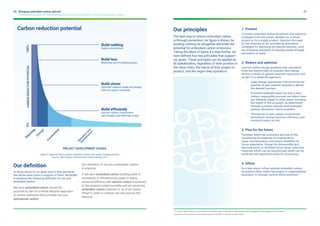
Coordinated action for the building
and construction sector to tackle
embodied carbon
32 Bringing embodied carbon upfront
Coordinated action for the building and construction sector to tackle embodied carbon
World Green Building Council
The World Green Building Council (WorldGBC) is a global network leading the transformation of the built
environment, to make it healthier and more sustainable. Collectively, with our Green Building Councils (GBCs)
in around 70 countries, we accelerate action to deliver on the ambition of the Paris Agreement, by eliminating
the buildings and construction sector´s emissions by 2050.
We are committed to green buildings for everyone, everywhere to build a better future.
Contact information
Web www.worldgbc.org
Twitter @worldgbc
Email office@worldgbc.org
Toronto, Canada office
Attention: World Green Building Council
401 Richmond Street West, Suite 236
Toronto, Ontario
M5V 3A8
Canada
London, United Kingdom office
c/o UK Green Building Council
The Building Centre
26 Store Street
London
WC1E 7BT
United Kingdom
Our approach to this report
The research for this report has been conducted in three phases. In the first phase, a detailed literature
review and expert interviews were carried out. These were followed in the second phase by a series of
stakeholder workshops that applied visioning and backcasting methods to identify possible pathways to
achieving net zero embodied carbon. Finally, in the third phase, the drafting of the report has been reviewed
and consulted on by hundreds of experts and stakeholders from across the value chain in order to refine
and strengthen our proposals.
Disclaimer
This report is written by staff from WorldGBC, with support from C40 Cities and Ramboll,
and contributions from the Green Building Councils and other organisations listed. The views
expressed in this report are those of WorldGBC and do not necessarily reflect the view of all
other parties named.
Acknowledgements
© World Green Building Council, September 2019
Report team
World Green Building Council						 Ramboll
Author: Matthew Adams, Project Coordinator, Advancing Net Zero	 Christine Collin
Author: Victoria Burrows, Director, Advancing Net Zero			 Xavier Le Den
Author: Stephen Richardson, Head of Projects, Europe Regional Network Lars Ostenfeld Riemann
James Drinkwater, Director, Europe Regional Network			 Samy Porteron	
Cristina Gamboa, CEO							 Andreas Qvist Secher
Report funders
European Climate
Foundation (ECF)
Children's Investment
Fund Foundation (CIFF)
Report contributors
We Mean Business (WMB)
WorldGBC European
Regional Network
Technical partner
Ramboll
Delivery partner
C40 Cities
Advancing Net Zero
Green Building
Council (GBC)
Steering Committee
Alliance HQE-GBC (France)
GBCA (Australia)
GBC Brasil
Canada GBC
China Acandemy of Building
Research (CABR)
Croatia GBC
DGNB (Germany)
Dutch GBC
Emirates GBC
GBC España
GBC Finland
Guatemala GBC
Hong Kong GBC
Indian GBC
GBC Indonesia
Irish GBC
GBC Italia
Jordan GBC
New Zealand GBC
Norwegian GBC
Singapore GBC
GBC South Africa
Sweden GBC
UKGBC
USGBC
Other contributors
to the report
We would also like to acknowledge the contributions made by
the people and organisations who provided expert interviews,
participated in our workshops and provided feedback during
consultation and report drafting.
A full list of contributors can be found at our website:
www.worldgbc.org/embodied-carbon
5
Glossary....................................................................................... 5
Executive summary ..................................................................... 7
Background and context – the climate emergency........................................................................7
Bringing embodied carbon ‘upfront’................................................................................................7
Our vision – going further and faster to decarbonise across the whole lifecycle........................7
Our goals – the purpose of this report.............................................................................................8
Achieving our vision – collaboration, market demand, and what it means for you.....................8
Current global leadership – a catalyst for market transformation...............................................9
Net zero embodied carbon – definition and principles.................................................................9
Converting barriers into opportunities – key steps towards net zero embodied carbon............11
Taking action now – how you can respond to the climate emergency.........................................11
Figure 2: Summary of all stakeholder specific goals......................................................................12
Endorsements.............................................................................. 14
Our vision..................................................................................... 16
Driving the shift towards whole value chain collaboration............................................................16
Our goals ...........................................................................................................................................17
Time value of carbon and the importance of upfront emissions..................................................17
Opportunities for reducing embodied carbon.................................................................................19
Our definition......................................................................................................................................20
Carbon reduction potential...............................................................................................................20
Our principles.....................................................................................................................................21
State of the market....................................................................... 22
Understanding embodied carbon today..........................................................................................22
Rising demand for construction materials and the case for action .............................................22
Key sources of embodied carbon – construction elements and materials..................................22
Assessment methods, low carbon design tools and data.............................................................27
Current leadership on embodied carbon.........................................................................................31
Barriers and opportunities............................................................ 35
Key areas where solutions are needed............................................................................................35
Awareness and demand....................................................................................................................35
Theory of change......................................................................... 37
How change in our sector will happen.............................................................................................37
Enabling change – the key drivers...................................................................................................38
Calls to action .............................................................................. 39
Stakeholder specific pathways for tackling embodied carbon......................................................39
Civil society – NGOs, networks and researchers ...........................................................................41
Cities...................................................................................................................................................48
Business – investors in manufacturing and property, asset owners and occupiers ..................52
Business – developers & contractors..............................................................................................55
Business – designers ......................................................................................................................58
Business – manufacturers ..............................................................................................................62
Join us......................................................................................... 67
A variety of different terms and definitions are used in connection with greenhouse gas
emissions from different stages of the lifecycle of products, buildings and infrastructure. Each
term may include different interpretations and meanings across different sectors of the market
and across countries and regions. This glossary defines what is meant by certain key terms
used within this report. In the following definitions we make reference to the lifecycle stages or
modules defined in the widely-adopted European standard EN 15978 shown in figure 1.
Carbon emissions Used in this report to refer to all
emissions of greenhouse gases. Their global warming
potential (GWP) is quantified in units of carbon dioxide
equivalence. A kilogram of carbon dioxide therefore
has a GWP of 1 kgCO2e.
•	 Beyond the lifecycle Carbon emissions or
emissions savings incurred due to reuse or
recycling of materials or emissions avoided
due to using waste as a fuel source for
another process (module D). Consideration
of module D is key for maximising resource
efficient uses of materials at the end of life.
Under forthcoming updates to European
standards, it will be mandatory for product
EPDs to report module D alongside other
lifecycle stages in most cases, and will also
be required for building assessments.
•	 Embodied carbon Carbon emissions
associated with materials and construction
processes throughout the whole lifecycle
of a building or infrastructure. Embodied
carbon therefore includes: material
extraction (module A1), transport to
manufacturer (A2), manufacturing (A3),
transport to site (A4), construction (A5),
use phase (B1, eg concrete carbonation
but excluding operational carbon),
maintenance (B2), repair (B3), replacement
(B4), refurbishment (B5), deconstruction
(C1), transport to end of life facilities (C2),
processing (C3), disposal (C4). Benefits
beyond the system boundary (D) should also
be reported separately to modules A-C.
	 In the report we refer to the embodied
carbon of both buildings and infrastructure
Glossary
A1-3
A1 A2 A3 A4
Rawmaterialsupply
Transport
Manufacturing
Transport
Use
Maintenance
Repair
Refurbishment
Replacement
Construction-
installationprocess
De-construction
demolition
Transport
Wasteprocessing
Disposal
A5
PRODUCT
stage
Wholelifecarbon*
Embodiedcarbon*
A4-5 B1-7 C1-4
CONSTRUCTION
PROCESS stage
USE stage
*Terms used in this report and
defined in the glossary below
B6 Operational energy use
END OF LIFE
stage
B3 B4 B5B2B1
C2 C3 C4C1
D
Benefits and loads
beyond the
building life cycle
Supplementary
information beyond
the building life cycle
Reuse
Recovery
Recycle
Upfront carbon* Operational carbon*
Use stage embodied carbon*
Beyond the lifecycle*End of life carbon*
B7 Operational water use
Out of scope
Figure 1: Terminology used in this report cross-referenced to terms and lifecycle stages defined in EN 15978
76 Bringing embodied carbon upfront
Coordinated action for the building and construction sector to tackle embodied carbon
as well as the embodied carbon of individual
materials.
•	 End of life carbon The carbon emissions
associated with deconstruction/demolition
(C1), transport from site (C2), waste
processing (C3) and disposal (C4) phases of
a building or infrastructure's lifecycle which
occur after its use.
•	 Operational carbon The emissions
associated with energy used (B6) to
operate the building or in the operation
of infrastructure.
•	 Upfront carbon The emissions caused in
the materials production and construction
phases (A1-5) of the lifecycle before the
building or infrastructure begins to be used.
In contrast to other categories of emissions
listed here, these emissions have already
been released into the atmosphere before
the building is occupied or the infrastructure
begins operation.
•	 Use stage embodied carbon Emissions
associated with materials and processes
needed to maintain the building or
infrastructure during use such as for
refurbishments. These are additional to
operational carbon emitted due to heating,
cooling and power etc.
•	 Whole life carbon Emissions from all
lifecycle phases, encompassing both
embodied and operational carbon together
(ie modules A1 to C4, with module D
reported separately).
Carbon footprint Used occasionally in the report to
denote the carbon emissions caused directly and
indirectly by a person, organisation or event.
Heavy industries Carbon intensive industries which
manufacture materials and products. These include
aluminium, cement and concrete, glass, gypsum,
chemicals (eg in plastics), steel, ceramics, mineral
fibres, clay, lime and asphalt.
Lifecycle assessment (LCA) LCA is a systematic
set of procedures for compiling and examining the
inputs and outputs of materials and energy, and the
associated environmental impacts directly attributable
to a building, infrastructure, product or material
throughout its lifecycle (ISO 14040: 2006).
Material passport Holds data attributes relating to
the characteristics of a material or product. They
are valuable for end of life planning to evaluate the
potential for reuse, recovery and recycling. In some
cases they may be combined at building level as
a bank that encompasses all materials/products
contained within the building.
Performance-based approaches Where the
consideration and selection of embodied carbon
reduction measures are guided by LCA-based
calculations of the outcomes.
Prescriptive approaches Where the selection of
embodied carbon reduction measures is based on a
set of standard approaches that are defined using best
practice principles of low carbon design and material
selection, without conducting bespoke embodied
carbon calculations.
Executive
summary
Background and context –
the climate emergency
We are now in a climate emergency. The landmark
2018 special report from the UN Intergovernmental
Panel on Climate Change (IPCC 2018 report), Global
Warming of 1.5ºC, presented a stark picture of the
dramatically different world we will inhabit if global
average temperatures rise by 2ºC compared to a
1.5ºC scenario. The catastrophic breakdown of
climate associated with the difference between
these two scenarios is likely to result in entire
eco-systems being destroyed. And the negative
economic impact globally of additional heating and
cooling demand is expected to increase fourfold
by the end of the century. The consequences will
be long lasting and, in some cases, irreversible.
This emergency calls for urgent action now to
radically transform current unsustainable models of
consumption.
The built environment sector has a vital role to
play in responding to the climate emergency. With
buildings currently responsible for 39% of global
carbon emissions, decarbonising the sector is one
of the most cost effective ways to mitigate the
worst effects of climate breakdown.
In 2018, in line with the ambitions of the Paris
Agreement and to accelerate the built environment
sector towards a 1.5ºC pathway, World Green
Building Council (WorldGBC) launched the Net Zero
Carbon Buildings Commitment. Our aim was to
inspire and promote advanced climate leadership
focused on achieving net zero operational carbon
at individual building level and at mass scale from
businesses and government. Yet operational carbon
emissions are only part of the story.
Bringing embodied
carbon ‘upfront’
As the world’s population approaches 10 billion,
the global building stock is expected to double in
size. Without drastic changes to the way our sector
operates, this growth will consume vast amounts
of natural resources, contributing to an expected
doubling of the total global consumption of raw
materials by around the middle of the century,
significantly increasing the sector’s emissions and
climate impact.
Carbon emissions are released not only during
operational life but also during the manufacturing,
transportation, construction and end of life phases
of all built assets – buildings and infrastructure.
These emissions, commonly referred to as
embodied carbon, have largely been overlooked
historically but contribute around 11% of all global
carbon emissions. Carbon emissions released
before the building or infrastructure begins
to be used, sometimes called upfront carbon,
will be responsible for half of the entire carbon
footprint of new construction between now and
2050, threatening to consume a large part of our
remaining carbon budget.
As operational carbon is reduced, embodied carbon
will continue to grow in importance as a proportion
of total emissions. While we must continue to focus
on addressing operational carbon we must now
rapidly increase efforts to tackle embodied carbon
emissions at a global scale, too.
Our vision – going further
and faster to decarbonise
across the whole lifecycle
The urgent need to go further and faster requires a
new response and a new vision for our sector. This
vision sees a highly connected value chain radically
reducing both embodied and operational carbon,
improving wider lifecycle environmental impacts,
and contributing as effectively as possible to the
UN Sustainable Development Goals. To achieve our
vision, we must take urgent action to tackle upfront
carbon while designing with whole life carbon in
mind. We have set timeframes for our vision in
response to global climate goals and demonstrating
the level of ambition needed.
98 Bringing embodied carbon upfront
Coordinated action for the building and construction sector to tackle embodied carbon
Our vision:
By 2030, all new buildings, infrastructure
and renovations will have at least 40% less
embodied carbon with significant upfront
carbon reduction, and all new buildings
must be net zero operational carbon.
By 2050, new buildings, infrastructure and
renovations will have net zero embodied
carbon, and all buildings, including existing
buildings, must be net zero operational
carbon.
Our goals – the purpose
of this report
To support and promote our vision this report
issues an urgent call to action designed to bring
the whole building and construction value chain
together. We aim to:
•	 Spark a global conversation around the
value and importance of reaching net
zero embodied carbon; adopt a common
language, definition, principles, milestones
and feasible actions that can be used by all
parts of the value chain.
•	 Communicate the urgency of, and set
deadlines for, goals and milestones to
achieve net zero embodied carbon globally;
support the development of regional, national
and sectoral roadmaps.
•	 Stimulate market demand and facilitate
radical whole value chain collaboration;
highlight current, realistic leadership actions
that can rapidly reduce embodied carbon and
demonstrate how full decarbonisation can be
achieved by working together.
•	 Advocate for policy and regulation on
net zero embodied carbon; demonstrate
support for action from industry and highlight
leading regulation and policy globally to
demonstrate feasibility.
Achieving our vision –
collaboration, market
demand, and what it
means for you
To date, very few buildings or infrastructure assets
can claim to be fully net zero embodied carbon
and in line with our vision. Our sector is highly
dispersed and relies on a wide range of materials
with long and complex supply chains. Many of the
most widely used construction materials are from
carbon-intensive heavy industries.
Many leading organisations within these industries
and indeed in the wider sector have taken bold
action on embodied carbon already. Our research
into the state of the market has shown that many of
the actions that will help lead the transition can, and
indeed must, be taken now.
Achieving net zero embodied carbon for the
entire sector will require far greater collaboration
along the whole value chain to support efforts
to decarbonise industry and to develop and
deploy more low embodied carbon alternatives.
Such collaboration allows businesses and
organisations to identify and have confidence in
the environmental, social and financial benefits of
taking a leadership position in the transition to a
decarbonised built environment.
This is a radical transition – driving it will require
much greater demand from the market as well
as rapid scaling of solutions by the supply chain.
Large amounts of additional renewable energy
are needed, and some of the solutions we will
rely on are currently only at demonstration stage,
including carbon capture for utilisation and storage.
By stimulating market demand we will accelerate
investment in actions that will lead to increased
competitiveness, improved access to solutions and
a wider range of strategies for achieving net zero
embodied carbon.
Demand-side actors within the value chain,
including investors, developers and designers,
must work together with those on the supply side –
the contractors and materials manufacturers. They
will need strong policy and regulatory support and
access to finance.
Current global leadership
– a catalyst for market
transformation
Although embodied carbon may be a new challenge
for many in the sector, leading businesses,
researchers and organisations around the world
have been working on this topic for over a decade.
It is thanks to their leadership and innovation that
tools and data for calculating embodied carbon are
becoming increasingly available and accessible.
More and more low embodied carbon products
and solutions are entering the market, and flagship
projects are having significant impacts using
technology available today. Green Building Councils
(GBCs) around the world, from Asia Pacific to
Europe and North America, are already driving
change in their markets by incorporating criteria
for embodied carbon into their sustainability
certifications. And leading city, state and national
governments are implementing policy and regulation
initiatives for meeting ambitious embodied carbon
reduction targets.
Net zero embodied carbon
– definition and principles
As a way of bringing greater clarity to our aims and
objectives, WorldGBC has worked with our member
GBCs and other valued partners to define net zero
embodied carbon.
Net zero embodied carbon should be
pursued as part of a whole lifecycle approach
to carbon reduction that includes net zero
operational carbon.
Our definition of net zero embodied carbon
in practice:
A net zero embodied carbon building (new or
renovated) or infrastructure asset is highly
resource efficient with upfront carbon minimised
to the greatest extent possible and all remaining
embodied carbon reduced or, as a last resort,
offset in order to achieve net zero across the
lifecycle.
1110 Bringing embodied carbon upfront
Coordinated action for the building and construction sector to tackle embodied carbon
This new definition makes clear that net zero
embodied carbon should be pursued as part of
a strategy to decarbonise the whole lifecycle.
It also recognises the urgency of addressing
upfront emissions, which are being released into
the atmosphere now, as we continue to extract
and manufacture materials and products for
construction. The definition builds on internationally
accepted standards for lifecycle assessment of
buildings and infrastructure and the terms in bold
are further defined in the glossary section on page
5 of the report.
The following foundational principles can be
followed by both demand-side and supply-side
organisations in line with our vision, goals and
definitions.
1.	 Prevent – avoid embodied carbon from the
outset by considering alternative strategies to
deliver the desired function
2.	 Reduce and optimise – evaluate each design
choice in terms of the upfront carbon reductions
and as part of a whole lifecycle approach
3.	 Plan for the future – take steps to avoid future
embodied carbon during and at end of life
4.	 Offset – as a last resort, offset residual
embodied carbon emissions within the project
or organisational boundary where possible or if
necessary through verified offset schemes
Converting barriers into
opportunities – key
steps towards net zero
embodied carbon
We believe our vision of a completely decarbonised
sector, including net zero embodied carbon, can be
achieved through concerted and coordinated action.
For such a radical transition to happen, business,
government and civil society must all assume
leadership roles, with each contributing to the
following enabling actions:
•	 Collaboration across the whole value chain,
including both public and private sectors, so
as to create a common vision and establish
regional, national and sectoral roadmaps
•	 Communication raising awareness about the
importance of embodied carbon and sharing
best practice strategies and leadership
examples of progress towards achieving
our vision
•	 Education addressing foundational gaps in skills,
data and benchmarks globally through knowledge
sharing, training and transparency for both
prescriptive and performance-based pathways
•	 Innovation creating space for new business
models, new technologies and circular patterns
to evolve and thrive in response to financial and
policy incentives
•	 Acceleration fostering and leveraging proven
industry-wide demand drivers and market forces
including voluntary, financial and policy measures
•	 Regulation mandating reductions in embodied
carbon that are aligned with 1.5ºC compliant
decarbonisation pathways
Taking action now – how
you can respond to the
climate emergency
This report sets out ambitious high-level pathways
for business, government and civil society to
follow in order to reduce embodied emissions
associated with our sector. A summary of goals
and target dates for key actors in the value chain is
given in Figure 2. A vital first step – one that some
leading countries and sectors have already taken
– is to develop detailed roadmaps for complete
decarbonisation of both embodied and operational
carbon by 2050. We are committed to supporting
our network of nearly 70 GBCs and their 37,000
members around the world in achieving this over
the coming years.
We call on you, and all actors across the whole
value chain, to help transform our sector from a
major cause into a major solution to the climate
emergency, securing a safe future for this
generation and generations to come.
Join us and act now!
1312 Bringing embodied carbon upfront
Coordinated action for the building and construction sector to tackle embodied carbon
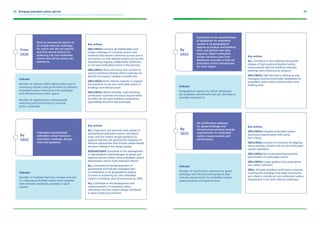
Figure 2: Summary of all stakeholder specific goals
2020
Non-government
organisations,
networks and
researchers
Policymakers
Governments Cities
Investors Developers Designers Material
manufacturers
2025
2030
2035
2040
2045
2050
Common vision goal in 2050
2025
All GBCs and relevant
NGOs/networks convene all
sectors to co-create national
roadmaps to net zero
Implement standardised embodied
carbon calculation methods, design
tools and guidance
Contribute to establishment of
databases and help set benchmarks
All GBCs/NGOs certification
schemes include embodied
carbon requirements
Cities start the process
of developing a strategy
to achieve net zero
embodied carbon
All investors commit to
relevant industry
roadmaps targeting
embodied carbon
All developers commit to relevant
industry roadmaps and require
disclosure of supply chain data for
structural elements
All designers commit to relevant
industry roadmaps and have
integrated low embodied carbon
design at conceptual design stage
All manufacturers and suppliers
commit to relevant industry
roadmaps and have developed
carbon reduction targets and with
timelines set to achieve net zero
embodied carbon by 2050
Cities have implemented policies
that set progressive embodied
carbon reduction targets and
specify when net zero embodied
carbon will become mandatory
Cities adopt a set of embodied
carbon reduction targets with a
clear trajectory towards net zero
standards
Investors only finance new projects
incl. buildings, large renovations,
infrastructure and manufacturing
plants that are compliant with
carbon reduction targets
All developers set embodied carbon
reduction targets and require
mandatory disclosure of supply
chain data and track construction
site emissions
All design companies publicly share
lifecycle assessment data
Design companies propose best
practice embodied carbon
reduction targets and implement
circularity principles
All manufacturers have declared
the embodied carbon of the top
40% of their standard product
portfolio by carbon footprint via
EPDs
All construction sites
are highly resource and
energy efficient and,
along with site-related
transport processes,
are powered by
renewable energy
All manufacturers have
declared their entire
standard product
portfolios via EPDs
All forms of energy used are
from renewable or low carbon
sources and all process carbon
emissions are mitigated
Roadmaps Policy
Tools
Data
Finance
Certification
Disclosure
Target setting/
benchmarks
Renewable energy
Build/ develop
Design
Leadership actionEPD
All electricity is from
renewable or low carbon
sources (manufacturing
and transport)
Developers only build
projects that have net
zero embodied carbon
Design companies
propose requirements
for all projects to be
100% net zero
embodied carbon
Investors only finance new projects
incl. buildings, large renovations,
infrastructure and manufacturing
plants that are net zero embodied
carbon
All levels of government
start to develop a
strategy to achieve net
zero embodied carbon
All governments have implemented
policies that set progressive
embodied carbon reduction targets
and specify when net zero embodied
carbon will become mandatory in
line with national roadmaps
All governments implement
embodied carbon targets for new
public buildings, large public
renovations and infrastructure
1514 Bringing embodied carbon upfront
Coordinated action for the building and construction sector to tackle embodied carbon
Endorsements
•	 Aalto University, Department
of Architecture
•	 ABN AMRO Bank
•	 AECOM
•	 AESG
•	 AkzoNobel
•	 Atelier Ten
•	 Australian Sustainable Built
Environment Council
•	 Avison Young
•	 B+H Architects
•	 Barratt Developments PLC
•	 Bennetts Associates
•	 Building Research Establishment
(BRE)
•	 C40 Cities Climate Leadership Group
•	 Canary Wharf Group
•	 Carbon Leadership Forum
•	 CEI-Bois
•	 CEN/TC350, Sustainability
of Construction Works
•	 City Developments Limited
•	 City of Melbourne
•	 City of Sydney
•	 City of Vancouver
•	 Climate Agency, City of Oslo
•	 Climate Bonds Initiative
•	 Cundall
•	 Dalmia Cement (Bharat) Limited
•	 Danish Building Research Institute,
Aalborg University
•	 EDGE ENVIRONMENT
•	 EllisDon
•	 Energy Research Institute @ Nanyang
Technological University
•	 Energy Transitions Commission
•	 Entra ASA
•	 European Bank for Reconstruction
and Development
•	 Frasers Property Australia
•	 GECA: Sustainability  Environmental
Certification Program
•	 Global GreenTag International Pty Ltd
•	 Global Infrastructure Basel
Foundation
•	 Google
•	 Grosvenor
•	 HeidelbergCement
•	 Infrastructure Sustainability
Council of Australia 
•	 Integral Group
•	 Interface
•	 International Living Future Institute
The following organisations endorse the vision and ambition of this report,
recognising the need for coordinated action across the whole value chain to achieve
this. Their endorsement is a call to others to join them and work together to fully
decarbonise buildings and infrastructure by 2050.
•	 JLL
•	 Knauf Insulation
•	 LafargeHolcim
•	 Landsec
•	 Lemay
•	 Majid Al Futtaim Holding
•	 Mantle
•	 Microsoft
•	 Ministry of the Environment, Finland
•	 Morgan Sindall Group
•	 Morrison Hershfield
•	 Multiplex Global
•	 New York City Mayor's Office of
Sustainability
•	 One Click LCA / Bionova Ltd
•	 Pan-United Concrete Pty Ltd
•	 Ramboll
•	 RDT Pacific
•	 RICS
•	 Royal BAM Group
•	 Royal Institute of British Architects
•	 Ruukki Construction Oy
•	 Saint-Gobain
•	 Schneider Electric
•	 SEGRO
•	 Shaw Contract
•	 Signify
•	 Skanska Group 
•	 Skidmore, Owings  Merrill LLP
•	 SSAB AB
•	 Stanhope PLC
•	 Statsbygg (Norwegian Directorate of
Public Construction and Property)
•	 Stora Enso
•	 Surbana Jurong Consultants Pte Ltd
•	 The Carbon Trust
•	 The Climate Group
•	 thinkstep ANZ
•	 Uponor Corporation
•	 Urban Green Council
•	 Volvo Construction Equipment
•	 We Mean Business
•	 Willmott Dixon
•	 World Business Council for
Sustainable Development
•	 WSP
1716 Bringing embodied carbon upfront
Coordinated action for the building and construction sector to tackle embodied carbon
To deliver the ambitions of the Paris Agreement and
keep global average temperature rise well below
2ºC, all sectors of the economy must decarbonise1
.
Currently, buildings account for 39% of energy-
related global CO2 emissions2
, demonstrating
the importance of the building and construction
sector in fulfilling these ambitions. Of this sector
contribution, 28% comes from operational carbon
with 11%3
arising from the energy used to produce
building and construction materials, usually referred
to as embodied carbon.
The IPCC 2018 report paints a stark picture of how
the difference between 1.5°C and 2°C of global
warming greatly increases the risks of catastrophic
climate breakdown. The difference between
these two scenarios is likely to result in entire
eco-systems being destroyed. And the negative
economic impact globally of additional heating and
cooling demand is expected to increase fourfold by
the end of the century. The consequences will be
long lasting and, in some cases, irreversible. The
report calls for ‘rapid and far-reaching’4
economic
transitions to limit global warming to 1.5°C
We must radically increase the pace and scope of
decarbonisation efforts, collaborating across the
whole construction value chain to achieve the scale
of change needed. That is why we have created a
vision for our sector to become fully decarbonised
and to contribute as effectively as possible to the
UN Sustainable Development Goals.
While our vision is ambitious, we are already taking
significant steps towards achieving it by addressing
net zero operational carbon. In May 2017, WorldGBC
launched the call to action report From Thousands
to Billions, outlining the action that business,
government and NGOs must take to accelerate
the market towards net zero carbon buildings. The
report called for all buildings to operate at net zero
carbon by 2050, and all new buildings from 2030.
In order to facilitate this shift, GBCs and WorldGBC
have been developing tools and resources,
including certification schemes and the Net Zero
Carbon Buildings Commitment. The Commitment
formalises initial calls to action in order to
promote and inspire advanced climate leadership
in decarbonising the operational emissions of
the built environment at individual building and
mass scale from businesses and government. It
sets a level of ambition intended to create mass
demand, stimulating the market to deliver net zero
operational carbon solutions at scale.
We will continue to address the 28% of emissions
attributed to operational carbon, together with
our GBC network, and, as shown in our Advancing
Net Zero Status Report 2019, we have been able
to shift the market significantly towards net zero
Our vision
Driving the shift towards whole
value chain collaboration
1
Climate Change 2013: The Physical Science Basis – Contribution of Working Group I to the Fifth Assessment Report of the Intergovernmental Panel on Climate Change.
2
Data from Global Status Report 2018, Global Alliance for Buildings and Construction  International Energy Agency.
3
These figures may be higher as they do not include transport to site and chemical conversion process emissions released during the manufacture of a number of key construction
materials.
4
IPCC, 2018: Strengthening and Implementing the Global Response. In Global Warming of 1.5°C.
Our vision:
By 2030, all new buildings, infrastructure
and renovations will have at least 40% less
embodied carbon with significant upfront
carbon reduction, and all new buildings
must be net zero operational carbon.
By 2050, new buildings, infrastructure and
renovations will have net zero embodied
carbon, and all buildings, including existing
buildings, must be net zero operational
carbon.
operational carbon. In the light of the IPCC report’s
urgency, and the need for full decarbonisation
of the sector, we now believe the time is right to
move to a whole life approach. This will address
the remaining 11%5
of emissions from building
embodied carbon and rapidly transform the industry
so that both net zero embodied carbon and net zero
operational carbon become globally achievable.
Embodied carbon has typically been overlooked in
the past, but as operational carbon emissions are
reduced, embodied carbon will continue to grow in
importance as a proportion of total emissions.
Our goals
To achieve our vision of catalysing market action,
we have set out four key goals:
•	 Spark a global conversation around the
value and importance of reaching net
zero embodied carbon; adopt a common
language, definition, principles, milestones
and feasible actions that can be used by all
parts of the value chain.
•	 Communicate the urgency of, and set
deadlines for, goals and milestones for
achieving net zero embodied carbon
globally; support the development of
regional, national and sectoral roadmaps.
•	 Stimulate market demand and facilitate
radical whole value chain collaboration;
highlight current, realistic leadership actions
that can rapidly reduce embodied carbon,
and demonstrate how full decarbonisation
can be achieved by working together.
•	 Advocate for policy and regulation on net
zero embodied carbon; demonstrate support
for action from industry and highlight leading
regulation and policy globally to demonstrate
feasibility.
Time value of carbon and
the importance of upfront
emissions
Our vision for 2050 is for the whole lifecycle of all
buildings and infrastructure to be net zero carbon
(ie net zero whole life carbon). This means net
zero during operation and for all embodied carbon
emitted during the whole lifecycle. The scale of this
task is considerable, and we are already at a critical
point in time.
The IPCC report highlights the urgent need to
achieve radical emissions reductions in the next
decade to avoid catastrophic climate breakdown.
With operational carbon still the major portion
of our sector’s impact, we must not accept low
operational performance levels now, that will need
costly upgrades in the future – indeed, we should
scale up decarbonisation efforts for operational
carbon (eg via energy efficiency technologies,
grid decarbonisation). While embodied carbon
currently accounts for 11% of emissions globally,
as operational carbon is reduced and development
accelerates in parts of the world including China and
Africa; it is estimated that more than half of total
carbon emissions from all global new construction
between 2020 and 2050 will be due to upfront
emissions6
from new building construction and, to a
lesser degree, from building renovations in Europe in
particular.
5
Data from Global Status Report 2018, Global Alliance for Buildings and Construction  International Energy Agency
6
Architecture 2030, Total Carbon Emissions of Global New Construction every year from 2020 - 2050
1918 Bringing embodied carbon upfront
Coordinated action for the building and construction sector to tackle embodied carbon
Deconstruction
Processing
Transport
Disposal
Use
Maintenance
Energyuse
Refurbishment
Repair
Replacement
Manufacturing
Construction
Rawmaterial
supply
Transport
Transport
Operational
carbon
Beyond the
lifecycle
Carbon emissions or emissions
savings incurred due to reuse
or recycling of materials or
emissions avoided due to
exporting renewable energy
or using waste as a fuel
source for another
process
Use stage
embodied
carbon
Carbon emissions associated
with materials and processes
required for the upkeep of the
built asset throughout its
lifecycle
End of life
carbon
The carbon emitted during
demolition or deconstruction
and processing of materials
for reuse, recycling or final
disposal
Upfront
carbon
The emissions caused in
the materials production
and construction phases
of the lifecycle before the
building or infrastructure
begins to be used
Embodied
carbon
Carbon emissions associated
with materials and
construction processes
throughout the whole
lifecycle of a building or
infrastructure
Figure 3: Project lifecycle showing both the scope of the definition and need for whole life consideration.
It is therefore imperative that we rapidly increase
actions that achieve early emissions savings in the
building lifecycle because these are using up our
carbon budget now. This is sometimes referred to
as the time value of carbon7
– it provides a stark
and compelling reason to address embodied carbon
in addition to operational carbon and to prioritise
upfront emissions from materials and construction
urgently. Once a building or infrastructure enters
operation, nothing more can be done about its
upfront emissions.
While minimising upfront carbon is vitally important,
we must not risk creating adverse or negative
outcomes for both operational carbon and whole
life carbon. We therefore need to be conscious
of the impacts that our upfront carbon decisions
will have on whole life carbon. This is especially
true for material selection where each material
represents impacts and reduction opportunities
throughout the whole lifecycle, and we must design
with these in mind. A low embodied carbon building
that performs poorly in operation creates adverse
financial, environmental and social implications. To
achieve our vision, we cannot address one without
the other and so must take urgent action to tackle
upfront carbon while designing with whole life
carbon in mind.
By taking a holistic approach, we must maintain
a concerted focus on transformational pathways
for both net zero embodied carbon and net zero
operational carbon. An explicit focus on embodied
carbon is essential to accelerate and scale up
rapid action needed through targeted policy tools,
instruments and methodologies. Only then can we
achieve the large scale design and manufacturing
transformations needed over the next three
decades.
There are many inspiring examples of existing
leadership in this area from across the sector.
Organisations right across the value chain are
taking important steps towards net zero embodied
carbon by drastically reducing upfront emissions
and implementing whole life carbon thinking. In
this report we build on these examples, setting
out ambitious yet achievable actions to highlight
the value and importance of achieving net
zero embodied carbon. By communicating the
urgent need and associated deadlines for these
actions we hope to accelerate the development
of regional, national and sectoral roadmaps for
use by the public, private and non-profit sectors.
Our aim is to foster the right conditions for deep
collaboration across the value chain and to promote
integrated strategies for embodied and operational
decarbonisation.
Opportunities for reducing
embodied carbon
Embodied carbon emissions are affected by many
factors. These range from the type and volume of
structure installed, the materials used and their
associated carbon intensity of manufacturing
processes to the modes and distances by which
materials are transported and the processes by
which these materials are constructed, maintained
and finally removed and treated at the end of life.
Some materials also absorb or sequester carbon
at different lifecycle stages, which can offset
emissions from other lifecycle stages. Opportunities
for reducing or eliminating embodied carbon
are equally varied and will differ between types
of projects as well as by region. In general, the
greatest savings can usually be realised at the
earliest stages of a project. As a project progresses,
it becomes more challenging and more costly to
make design changes in order to reduce embodied
carbon (see figure 4).
7
Carbon Leadership Forum (2017): Time value of carbon.
2120 Bringing embodied carbon upfront
Coordinated action for the building and construction sector to tackle embodied carbon
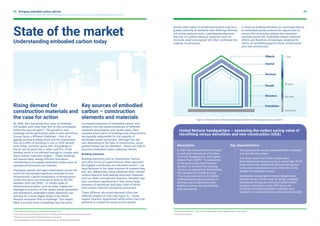
Build nothing
Explore alternatives
Build less
Maximise use of existing assets
Build clever
Optimise material usage and design
with low carbon materials
Build efficiently
Use low carbon construction
technologies and eliminate waste
100%0%CARBONREDUCTIONPOTENTIAL
PROJECT DEVELOPMENT STAGES
Planning
Design
Construction
Operation
and
m
aintenance
Carbon reduction potential
Our definition
To bring clarity to our goals and to help galvanise
the whole value chain in support of them, WorldGBC
is adopting the following definition for net zero
embodied carbon.
Net zero embodied carbon should be
pursued as part of a whole lifecycle approach
to carbon reduction that includes net zero
operational carbon.
Our definition of net zero embodied carbon
in practice:
A net zero embodied carbon building (new or
renovated) or infrastructure asset is highly
resource efficient with upfront carbon minimised
to the greatest extent possible and all remaining
embodied carbon reduced or, as a last resort,
offset in order to achieve net zero across the
lifecycle.
Figure 4: Opportunities to reduce embodied carbon from stage of design process.
Source: HM Treasury: Infrastructure Carbon Review, 2013
Our principles
The best way to reduce embodied carbon
is through prevention. As figure 4 shows, by
building nothing we altogether eliminate the
potential for embodied carbon emissions.
Taking the ideas of figure 4 a step further, we
have defined four key principles that support
our goals. These principles can be applied by
all stakeholders, regardless of their position in
the value chain, the nature of their project or
product, and the region they operate in.
1. Prevent
Consider embodied carbon emissions and reduction
strategies from the outset, whether for a whole
project or for a single product. Question the need
to use materials at all, considering alternative
strategies for delivering the desired function, such
as increasing utilisation of existing assets through
renovation or reuse.
2. Reduce and optimise
Use low carbon design guidance and calculation
tools and benchmarks to evaluate each design
choice in terms of upfront emission reductions and
as part of a whole life approach.
•	 Apply design approaches that minimise the
quantity of new material required to deliver
the desired function
•	 Prioritise materials which are low or zero
carbon, responsibly sourced, and which have
low lifecycle impact in other areas, including
the health of the occupant, as determined
through a product specific environmental
product declaration where available
•	 Choose low or zero carbon construction
techniques having maximum efficiency and
minimum waste on site
3. Plan for the future
Consider future use scenarios and end of life,
maximising the potential for maintenance,
repair and renovation, and ensure flexibility for
future adaptation. Design for disassembly and
deconstruction to facilitate future reuse, selecting
materials which can be recycled and which can be
extracted and separated easily for processing.
4. Offset
As a last resort, offset residual embodied carbon
emissions either within the project or organisational
boundary8
or through verified offset schemes9
.
8
For hard to abate sectors, consult sector decarbonisation roadmaps for appropriate carbon mitigation technologies and processes.
9
Approved offset schemes to be determined by local GBC or relevant industry body.
2322 Bringing embodied carbon upfront
Coordinated action for the building and construction sector to tackle embodied carbon
Rising demand for
construction materials and
the case for action
By 2060, the total global floor area of buildings
will double, with more than 50% of this anticipated
within the next 20 years10
. The growth in new
buildings will be particularly rapid in Asia and Africa.
Europe faces a different challenge – that of an
ageing existing building stock and the expectation
that up to 80% of buildings in use in 2050 already
exist today. Currently about 35% of buildings in
the EU are 50 years old or older, and 97% of the
building stock is not efficient enough to comply with
future carbon reduction targets11
. These buildings
will require deep, energy efficient renovation,
contributing to increased embodied carbon even as
operational emissions are reduced.
Population growth and rapid urbanisation across the
world will necessitate significant amounts of new
infrastructure. Capital investments in infrastructure
across the sector are forecast to grow by 40-70%
between 2020 and 204012
. In certain types of
infrastructure projects, such as water supply and
drainage or provision of low carbon power generation
and distribution, embodied carbon emissions can
account for a much higher share of the whole
lifecycle emissions than in buildings. This means
there is an even more compelling case for action.
Key sources of embodied
carbon – construction
elements and materials
Increased awareness of embodied carbon, and
research into the carbon emissions of different
materials and projects over recent years, have
revealed which parts of buildings and infrastructure
are typically responsible for the majority of
embodied carbon emissions. Although this will
vary depending on the type of construction, some
general trends can be identified – these can help to
prioritise embodied carbon reduction efforts.
Building elements
Building elements such as foundations, frames
and other forms of superstructure often represent
the biggest contribution to embodied carbon13
, not
least because of the large volumes of material they
use. But, additionally, these elements often contain
carbon intensive load bearing structural materials
such as steel, concrete and masonry. Facades may
also contribute significantly if they utilise large
amounts of aluminium and glass, both of which
have carbon intensive production processes.
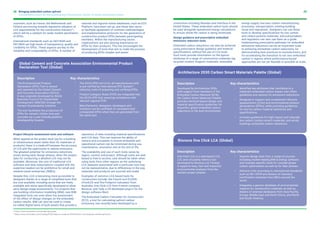
These different structural elements often last
different lengths of time (see figure 5) – some
require frequent replacement while others have the
potential to outlast the asset and be reused.
State of the market
Understanding embodied carbon today
10
International Energy Agency, Global Status Report 2017.
11
http://bpie.eu/wp-content/uploads/2017/12/State-of-the-building-stock-briefing_Dic6.pdf
12
Oxford economics (2017) Global Infrastructure Outlook.
13
UK Green Building Council (2017) Embodied Carbon: Developing a Client Brief.
United Nations headquarters – assessing the carbon‐saving value of
retrofitting versus demolition and new construction (USA)
Description
In 2007 the United Nations initiated
a multi‐year renovation of its New
York City headquarters, the Capital
Master Plan (CMP)15
. Fundamental
to the project approach was the
decision to renovate the existing
campus as opposed to demolishing
the complex and building anew.
This study advocates for a better
understanding and accounting of
the true cost of demolition and
makes a strong case for retrofits
and renovations.
Key characteristics
•	 The comparative study considered both embodied
and operational carbon.
•	 The study noted that if the campus were
demolished and reconstructed, it would take 35-70
years before the operational efficiencies gained
by the new construction would offset the initial
outlays of embodied carbon.
•	 Sustainable design performance targets were
defined across a wide range of areas, including
operational energy use and associated carbon
emission reductions, water efficiency, use
of environmentally preferable materials, and
measures to improve indoor environmental quality.
Across other types of infrastructure there may be a
greater diversity of elements with differing lifetimes,
but similar patterns exist. Load-bearing elements
that rely on carbon intensive materials such as
concrete, steel and asphalt will often contribute the
majority of emissions.
A focus on building elements as a principal source
of embodied carbon presents an opportunity to
ensure that structures achieve the maximum
possible useful life. Embodied carbon reduction
efforts are therefore increasingly weighing the
merits of retrofitting against those of demolition
and new construction.
Facade
Structure
Services
Interior
Objects
Foundation
Everlasting
1 Year
100 Years
50 Years
Figure 5: Elements of a building and their typical lifetime, before replacement is needed14
.
14
Adapted from Brand, S., 1994, How Buildings Learn: What Happens After They’re Built
15
Urban Green Council
2524 Bringing embodied carbon upfront
Coordinated action for the building and construction sector to tackle embodied carbon
ResponsibleSteel standard development (Global)
Description
ResponsibleSteel, in partnership
with both steel producers and
users, is developing a standard
to identify and reward companies
that are committed to creating
a ‘responsible’ steel value chain.
This will cover everything from the
sourcing of raw materials through to
the sale of their final products.
Key characteristics22
•	 ResponsibleSteel operating companies are
committed to 12 principles for the responsible
sourcing and production of steel, including
corporate leadership, climate change and
greenhouse gas (GHG) emissions mitigation, and
water stewardship.
•	 Principle 8: Climate Change and Greenhouse
Gas Emissions requires operating companies to
commit to reducing GHG emissions in line with the
global goals of the Paris Agreement and to take
necessary actions to achieve this. The specific
criteria of this principle include:
•	 corporate commitment to achieve the goals of
the Paris Agreement
•	 corporate climate-related financial disclosure
•	 site-level GHG emissions measurement and
intensity calculation
•	 site-level GHG emissions reporting and
disclosure covering:
•	 site-level GHG reduction targets and
planning
•	 GHG emissions performance
Building materials
The upfront emissions from materials and products
used to construct buildings and infrastructure,
and those installed later during maintenance and
renovation, usually represent a significantly greater
source of embodied carbon than all other stages in
the lifecycle.
Globally, cement and steel are two of the most
important sources of material-related emissions in
construction. Cement manufacture is responsible
for around 7% of global carbon emissions16
, with
steel also contributing 7-9% of the global total17
, of
which around half can be attributed to buildings
and construction.
Both cement and steel require very high
temperatures during production, making them
energy intensive and, in both cases, the chemical
reactions that take place during manufacture also
release carbon dioxide directly. For this reason,
emissions from these sectors have been considered
‘hard to abate’18
.
Other common construction materials that require
high temperatures during manufacture include
aluminium and glass.
Globally, much of the energy for industrial heat
is still supplied by fossil fuels such as oil and
gas, though waste and biofuels are increasingly
used in some industries and in some parts of the
world. Recent research shows that it is feasible to
decarbonise these sectors19
.
Global cement consumption is projected to increase
by 12-23% by 205020
, while global steel production is
forecast to grow by 30% over the same period, with
recycled secondary steel growing faster than the
primary production21
. It is important to recognise
the crucial role that these materials have played and
will continue to play in human society even as we
point to the need for radical decarbonisation.
16
International Energy Agency (2018) Technology Roadmap: Low-Carbon Transition in the Cement Industry.
17
Stockholm Environment Institute (2018): Low-emission steel production – decarbonising heavy industry.
18
Material Economics (2019) Industrial Transformation 2050: Pathways to Net-Zero Emissions from EU Heavy Industry.
19
Energy Transitions Commission (2018) Mission Possible - Reaching Net-Zero Carbon Emissions from Harder-to-Abate Sectors by Mid-Century
Concrete Sustainability Council (Global)
Description
The Concrete Sustainability Council
(CSC) is committed to implementing
a global responsible sourcing
certification system for concrete
and its supply chain.
CSC certified concrete23
, cement
and aggregate producers are
committed to a broad range of
responsible sourcing principles,
including:
•	 Respect for human rights
•	 Respect for the needs
of employees and local
communities
•	 Minimising environmental
footprint in relation to the
production of concrete,
cement and aggregates
Key characteristics
•	 CSC certified members are implementing, among
other things, dedicated measures to minimise:
•	 land use
•	 CO2 and other emissions
•	 energy and water consumption
•	 Members are also working to increase the use of
secondary materials and fuels, and to promote
biodiversity
•	 CSC certification promotes the responsible use of
energy and the reduction of greenhouse gas (GHG)
emissions. Specific evaluation criteria for plants
undergoing certification include:
•	 implementing an energy and climate policy
•	 monitoring and public reporting of GHG
emissions
•	 setting a publicly available CO2 reduction
target
•	 identifying and applying energy reduction
measures
•	 creating energy saving awareness
•	 Promoting the use of secondary materials to
reduce CO2 emissions and move towards a
more circular economy
•	 conducting third party audits of target setting
and achievement
20
https://www.iea.org/newsroom/news/2018/april/cement-technology-roadmap-plots-path-to-cutting-co2-emissions-24-by-2050.html
21
Energy Transitions Commission (2018): Reaching zero carbon emissions from steel – consultation paper.
22
ResponsibleSteel (2019) ResponsibleSteel Draft Standard Version 3.0
23
Concrete Sustainability Council (2019) Technical Manual 2.0.
2726 Bringing embodied carbon upfront
Coordinated action for the building and construction sector to tackle embodied carbon
Many other materials such as gypsum, glass,
aluminium and plastics also contribute to total
embodied carbon. These materials perform
important functions in the same way concrete
and steel do. While there may be lower carbon
alternatives, these are not always available at
scale, and achieving net zero embodied carbon
will require significant decarbonisation efforts
within all these sectors. Encouragingly, for these
and other heavy industries, significant emissions
reduction opportunities already exist, both in their
production and in how they are specified and used.
In some parts of the world, sectoral decarbonisation
roadmaps have already been established24
.
In developed markets, manufacturers have typically
already invested in maximising plant efficiencies
and in many cases have started to switch to
alternative energy sources such as biofuels, energy-
from-waste or other renewable sources. Further
significant emissions reductions will require more
fundamental changes, such as switching raw
material feedstocks, investing in new production
methods, or applying carbon capture technologies25
.
In the global south where many countries are newly
industrialised or still becoming industrialised,
manufacturing plants may use older, less efficient
technology and production techniques. It is
critical that manufacturers operating in these
regions have the technology and the finance
available to ‘leapfrog’ directly to low and zero
carbon manufacturing approaches with their next
investment cycles.
Dealing with sequestration, carbonation
and recycling
Some materials absorb carbon from the atmosphere
during certain stages of their lifecycle. Timber
products and other biomaterials like bamboo and
hemp present possibilities for capturing and storing
carbon sequestered during growth – known as
biogenic carbon. Managed harvesting of mature
timber for use in construction – making space
for new growth – has the potential to make a
significant contribution to decarbonisation efforts26
.
Deforestation is still a major source of global
carbon emissions and forests must be replanted
and responsibly managed to ensure sequestered
carbon is effectively offsetting other sources of
embodied carbon. Using timber from certified
sustainable sources, where best practice forest
management is applied, is key to preventing this.
Treatment of timber at end of life can have
a significant effect on its embodied carbon,
particularly if it is sent to landfill. Sending timber
to landfill is banned or restricted in many countries
and methane capture technologies at landfill sites
can also mitigate the effects. However, timber reuse
or recycling should be always be promoted as this
extends the time period over which biogenic carbon
is stored.
Concrete also absorbs atmospheric carbon when it
is exposed to air. This process offsets some of the
upfront carbon emitted during manufacture. The
amount offset will depend on its application and
treatment at end of life, when the exposed surface
can be significantly increased by crushing.
Metals like steel are recycled, often without any loss
in physical qualities. Recycling and re-use contribute
to the reduction of embodied carbon. These
benefits can be credited upfront as recycled content
or at the end of life in terms of future recyclability.
Alternatively, in a full lifecycle approach, the net
balance of recycled content and end of life credits
can be calculated (thus avoiding double counting).
These effects are captured in module D, which will
be mandatory to declare under forthcoming updates
to EN 15978 and 15804.
There are differing industry views on the best way
to deal with each of these aspects when calculating
embodied carbon. These issues are complex and
it is vital that we find ways to move beyond these
challenges and focus on the radical collaboration
needed to realise net zero embodied carbon.
24
eg SNIC (2019) Brazilian Cement Technology Roadmap 2050, Norwegian GBC (2016) Property Sector’s Roadmap to 2050, International Energy Agency
(2018) Technology Roadmap: Low-Carbon Transition in the Cement Industry.
25
Material Economics (2019) Industrial Transformation 2050: Pathways to Net-Zero Emissions from EU Heavy Industry.
26
UK Government Committee on Climate Change (2016) UK climate action following the Paris Agreement.
Lendlease mass timber design and construction (Australia)
Description
Lendlease is a leading international
investment and infrastructure group
headquartered in Sydney, Australia,
with operations in Europe, Asia,
Australia and the Americas.
Lendlease’s in-house design and
construction capabilities have
evolved from the company’s forward
looking work in the Australian
market leading to iconic Green Star
rated projects including Forte Living,
International House Sydney, and 25
King Street.
Key characteristics
•	 Lendlease believes that using engineered timber in
projects can provide:
•	 safer solutions for workers
•	 sustainable solutions for community
developments
•	 improved quality for clients
•	 25 King Street is the tallest engineered timber
office building in Australia – a 10-storey
engineered timber project that was able to reduce
on site construction time waste through off-site
material processing and pre-fabrication.
•	 International House Sydney was the first modern
commercial engineered timber building of its size
and type in Australia.
Assessment methods,
low carbon design tools
and data
Industry’s understanding of the importance of
embodied carbon has been enabled by our ability to
quantify emissions across the whole lifecycle using
lifecycle assessment (LCA). Data and results from
these assessments are vital for guiding our efforts
to decarbonise buildings and infrastructure.
Lifecycle assessment
LCA allows us to calculate a wide range of
environmental impacts of a material, a product or
a whole construction project. Its use allows more
informed decisions to be taken not only in terms of
reducing carbon emissions, but also in relation to
other aspects of the project’s performance such as
material, water and energy needs across the whole
lifecycle.
LCA has become a globally accepted method for
evaluating and communicating these environmental
impacts. International standards27
have been
developed which aim to ensure consistency and
comparability of outcomes. Guidance on the use
of LCA for the construction sector28
has been
developed by organisations including the German
Sustainable Building Council (DGNB) and the Royal
Institute of Chartered Surveyors (RICS) in the UK29
.
LCA relies on robust raw data and tools, expertise
to interpret the results, and transparency in data
sources and methodology to ensure the outputs
support decision making that minimises negative
environmental impacts.
Product lifecycle assessment and environmental
product declarations
The results of LCA for a product or material
are increasingly communicated in the form of
environmental product declarations (EPDs). There
are international standards that underpin EPDs –
these include the use of standard product category
rules that aim to ensure all EPDs for a given material
are based on the same calculation methods, though
comparability between materials is still subject to
some disparities. EPDs are used by specifiers to
compare the performance of different materials,
or by manufacturers to certify the carbon and
environmental impact of their products. They are
an important data source for conducting LCAs of
buildings and infrastructure.
The creation of EPDs for construction products and
their use in design is voluntary in most regions and
countries. However, the emphasis on environmental
impacts from building and infrastructure materials
is a growing trend, and some countries and regions
have seen exponential growth in recent years in
the number of new EPDs released. Some European
27
EN15978, ISO14040.
28
DGNB (2018) Life Cycle Assessment: A guide to using the LCA.
29
RICS (2017) Professional Statement: Whole life carbon assessment for the built environment
2928 Bringing embodied carbon upfront
Coordinated action for the building and construction sector to tackle embodied carbon
countries, such as France, the Netherlands and
Finland are moving towards legislative adoption of
LCA requirements for the construction industry30
,
which will be a catalyst for wider market penetration
of EPDs.
International standards such as ISO14044 and
EN15804 set high levels of transparency, quality and
credibility for EPDs. These aspects are key to the
reliability and comparability of EPDs. A number of
national and regional online databases, such as ECO
Platform, have been set up, and these also serve
to facilitate agreement of common methodologies
and implementation protocols for the generation of
construction product EPDs between participating
members. Within the manufacturing sector,
organisations are also placing importance on
EPDs for their products. This has encouraged the
development of tools that aim to make the process
of producing EPDs simpler and easier.
Global Cement and Concrete Association Environmental Product
Declaration Tool (Global)
Description
The Environmental Product
Declaration (EPD) Tool is owned
and operated by the Global Cement
and Concrete Association (GCCA).
It was originally developed by World
Business Council for Sustainable
Development (WBCSD) through the
Cement Sustainability Initiative.
The tool facilitates the production of
EPDs for cement, clinker, lime and
concrete via a user-friendly platform
developed by Quantis.
Key characteristics
•	 The GCCA EPD tool is for all manufacturers and
is pre-verified by International EPD System31
,
reducing costs of preparing and verifying EPDs.
•	 Product Category Rules (PCR) are integrated into
the GCCA EPD tool, ensuring compliance with
relevant regional PCR.
•	 Manufacturers, designers, developers and
investors can be confident of consistent and
comparable EPDs when they are generated from
the same tool.
Project lifecycle assessment tools and software
When applied at the project level (eg for a building
or infrastructure asset rather than for materials or
products) there is a trade-off between the accuracy
of LCA and the opportunity to reduce emissions.
The greatest potential for emissions reductions
arises during early design phases, when the project
data for conducting a detailed LCA may not be
available. Moreover, the cost of traditional LCA
software and data subscriptions coupled with the
expertise needed can be prohibitive for small and
medium-sized enterprises (SMEs).
Despite this, LCA is becoming more accessible to
designers thanks to a range of simplified tools that
are now available, including some that are freely
available and some specifically developed to allow
early design-stage assessments. For projects that
use building information modelling (BIM), new BIM-
integrated tools can even allow live assessment
of the effect of design changes on the embodied
carbon results. BIM can also be used to create
so-called digital twins of built assets that provide a
repository of data including material specifications
and LCA data. This can improve the ability of
owners and occupants to ensure embodied and
operational carbon can be minimised during use,
maintenance, renovation and at the end of life.
The availability and use of such tools varies by
region, country and project. Although some are web
based or free to access, care should be taken when
using tools from other regions as the underlying
LCA datasets associated with a particular tool may
not be representative, due to differences in the way
materials and products are sourced and made.
Examples of common LCA based tools for
construction include: the French tool ELODIE;
eToolLCD and The Footprint Calculator from
Australia; One Click LCA from Finnish company
Bionova: and Tally, a US developed plug-in for the
design software Revit.
The Embodied Carbon Calculator for Construction
(EC3), a tool for calculating upfront carbon
emissions, has recently been developed by a
30
https://www.oneclicklca.com/simple-epd-guide/
31
https://www.environdec.com/Creating-EPDs/Steps-to-create-an-EPD/Perform-LCA-study/pre-verified-epd-tools/
consortium including Skanska and Interface in the
United States. These embodied carbon tools should
be used alongside operational energy calculations
to ensure whole life carbon is being minimised.
Design guidance and prescriptive embodied
emissions reduction tools
Embodied carbon reductions can also be achieved
using prescriptive design guidance and material
specifications, without the use of LCA tools.
Such tools provide information on the typical
attributes of a range of construction materials (eg
recycled content, biogenic materials, renewable
energy supply, low/zero carbon manufacturing
processes, transportation, existing building
reuse and repurpose). Designers can use these
tools to develop specifications for low carbon
and carbon-positive materials, and policymakers
and regulators can also use them as a guide.
Implementing prescriptive pathways for embodied
emissions reductions can be an important route
to achieving immediate carbon reductions, for
demonstrating best practices to manufacturers, and
for accelerating the transition to net zero embodied
carbon in regions where performance-based
approaches are not yet feasible or possible at scale.
Architecture 2030 Carbon Smart Materials Palette (Global)
Description
Developed by Architecture 2030,
with support from members of the
Embodied Carbon Network (ECN),
the Carbon Smart Materials Palette
provides attribute-based design and
material specification guidelines for
impactful, global embodied carbon
reductions in the built environment.
Key characteristics
•	 Identifies key attributes that contribute to a
material’s embodied carbon impact and offers
guidelines and options for emissions reductions.
•	 Designed to support and complement lifecycle
assessments (LCAs) and environmental product
declarations (EPDs), while providing guidelines
for low/no carbon material selections and
specifications.
•	 Includes guidelines for high impact and naturally
low carbon (carbon smart) materials, and whole
buildings embodied carbon reductions.
Bionova One Click LCA (Global)
Description
One Click LCA is a web-based LCA,
LCC and circularity metrics tool
developed by Bionova Ltd, Finland.
It supports easy, fast and impactful
environmental analyses from the
earliest project phases.
Key characteristics
•	 Imports design data from a range of sources
including market leading BIM  energy software
and includes specific tools for concept phase
carbon optimisation as well as for later phases.
•	 Delivers LCAs according to international standards
such as EN 15978 and dozens of voluntary
certification schemes from GBCs around the
world.
•	 Integrates a generic database of environmental
impacts for construction materials as well as
dozens of external databases from Asia Pacific,
Europe, Middle East and North Africa, and North
and South America.
3130 Bringing embodied carbon upfront
Coordinated action for the building and construction sector to tackle embodied carbon
Voluntary green building certification schemes
Green building certification schemes, also known
as rating tools, are used to assess and recognise
buildings that meet certain sustainability
requirements or standards. They can provide
targets for LCA conducted during design, including
limits on the amount of embodied carbon per
unit of floor area or as a percentage reduction
against a baseline. These schemes promote
performance beyond local regulatory compliance
and so serve as a useful indicator of market
maturity and adoption of embodied carbon
approaches. A recent report by Bionova identified
105 sustainability certifications and regulations
that include direct measures for embodied carbon,
with national systems in 26 countries32
.
LCA of buildings and infrastructure has been a
part of some green building certification schemes
for over a decade, notably in Germany and the
USA, and has been a key driver in promoting and
supporting development of LCA methodology
and tools. Some schemes reward improvements
against a benchmark or from a reference design.
Under some schemes, such as DGNB, the scheme
run by the German Sustainable Building Council,
and Green Star, run by the Green Building Council
of Australia, credits can be gained by conducting
LCA to identify alternative solutions during early
project development, since its use in these
strategic planning stages is still low.
Green Building Councils’ certifications targeting embodied carbon
32
Bionova: The Embodied Carbon Review, 2018.
Description
GBCs in several countries
have been developing green
building certifications that
include requirements or
voluntary approaches to
conducting LCA in order
to calculate embodied
carbon emissions. Despite
some challenges, these
efforts show positive
trends in adoption of the
methodology.
Key characteristics
•	 Some certifications are progressively moving
towards addressing operational and embodied
carbon emissions equally by capping the number
or percentage of points that can be gained from
operational energy efficiency and introducing
requirements for LCA of building materials.
•	 Several certification programmes grant points to
projects that conduct an LCA to help facilitate the
uptake of the method. LCA methods range from full to
simplified scope where only certain building elements
are included (eg building structures and envelopes).
USA's LEED and Germany's DGNB go further and
reward points for percentage improvements against
a benchmark. Australia's Green Star will be setting a
target for upfront carbon in 2020.
•	 Several certification schemes, including Norway
GBC’s BREEAM-NOR, DGNB, LEED and Green Star,
have contributed to industry interest and uptake of
EPDs. Norway, Australia and USA do so by giving
additional points to projects which demonstrate that
a percentage of the products or materials used in
the building or fit-out have an environmental product
declaration (EPD) that is publicly available. In Norway
and Germany, a project also achieves additional
points by choosing low carbon building products and
by making carbon calculations including embodied
energy, showing material reductions.
•	 Overall, certifications have been shown to increase
the value of buildings and reduce vacancy.
Current leadership on
embodied carbon
The emergence of embodied carbon as a key
consideration in sectoral decarbonisation strategies
has been, and is being, facilitated by market leaders
across the globe. These actors are increasing
awareness of the associated challenges, identifying
solutions such as carbon measurement tools,
databases and benchmarks, and developing new
business models that embrace lifecycle approaches
and the circular economy.
NGOs and cross-sectoral networks
Think tanks and collaborative forums from Europe
and the Americas, such as the Energy Transition
Commission and the Carbon Leadership Forum,
have been leading the way in bringing low carbon
solutions into mainstream decision making.
In some sectors, industry networks have developed
decarbonisation roadmaps at various scales (global,
regional, national) – these set out a vision, goals
and milestones alongside agreed solutions and
initiatives for advancing incrementally towards
sectoral decarbonisation in alignment with global
climate goals. Examples include the Swedish
construction and engineering sector, the Norwegian
property sector, the European cement and concrete
industry (CEMBUREAU)33
, and the Carbon Positive
Roadmap developed by the Green Building Council
of Australia.
GBCs, too, have spearheaded efforts to address
embodied carbon. For example, WorldGBC’s Europe
Regional Network worked successfully with the
European Commission to develop Level(s), a new
common approach to evaluating the sustainability
of buildings that promotes the use of LCA. Several
of WorldGBC’s European regional partners are
supporting efforts to pilot the new tool.
European Commission’s Level(s) initiative (Europe)
Description
In 2017 the European
Commission released the
first version of its Level(s)
framework34
. Level(s) aims to
create a common language
for sustainability in buildings
in Europe and to mainstream
lifecycle approaches. Level(s)
is a key tool of the EU’s
Circular Economy Package,
and WorldGBC is working with
GBCs and partners to develop
a roadmap that will outline the
actions needed to turn this
from a voluntary to a regulatory
framework.
For example, GBC Finland, Stora
Enso, a partner of WorldGBC’s
Europe Regional Network, and
WorldGBC, in cooperation with
the European Commission,
hosted a workshop in Helsinki
to explore how Level(s) might
be implemented in Finland.
Key characteristics
•	 Level(s) includes a step-by-step approach to
conducting LCA in line with European policy objectives
and existing national approaches.
•	 At its core, the framework aims to provide an
easy starting point for introducing sustainability
and lifecycle thinking into projects, focusing on a
manageable number of concepts and indicators.
•	 The framework addresses assessment of buildings’
greenhouse gas emissions and circularity performance
across two of its six ‘macro-objectives’:
•	 Macro-objective 1: Greenhouse gas emissions
along a building’s lifecycle
•	 Macro-objective 2: Resource-efficient and circular
material lifecycles
•	 Level(s) is being piloted in a range of projects around
Europe. For example, Stora Enso helped the project team
of the 14 storey Lighthouse Joensuu, Finland’s tallest
timber building project, use Level(s) to promote a lifecycle
approach. Level(s) was essential in demonstrating the
performance of massive wood structures over their
lifecycle in terms of reduced embodied carbon and
resources. Stora Enso used automated Level(s) indicator
calculations from material and EPD information to
demonstrate that, in total, the wood products used to
construct the building store over 1,600 tonnes of CO2.
33
Fossil Free Sweden (2018) Roadmap for Fossil-Free Competitiveness Construction and Engineering Sector; Norwegian GBC (2016) Property Sector's
Roadmap Towards 2050; The European Cement Association (2013) The role of CEMENT in the 2050 LOW CARBON ECONOMY.
34
Level(s) – A common EU framework of core sustainability indicators for office and residential buildings
3332 Bringing embodied carbon upfront
Coordinated action for the building and construction sector to tackle embodied carbon
Governments, states and cities
Bold policy initiatives incorporating embodied
carbon have been set at a national level in
France, the Netherlands, Sweden and Finland,
and in the State of California, as well as in cities
like Vancouver and Oslo. These initiatives are
already driving private sector action by providing
progressive and predictable policy frameworks that
set ambitious but feasible requirements for industry.
Nevertheless, greater ambition is needed to drive
change. For example, voluntary policies must
become mandatory and must be enforced.
Approaches differ depending on the level of
control and responsibility and typically national
governments have greater powers than cities and
regions. Some policy approaches focus on public
buildings, while others involve introducing voluntary
measures for the whole sector. By setting reporting
requirements that allow benchmarks and targets
to be formulated it is possible, ultimately, to move
to enforcing more stringent building requirements.
This approach to policy implementation allows
businesses to prepare for upcoming legislation,
encourages developing skills ahead of enforcement
and creates regulatory and investment certainty,
which in turn helps to create a market for low
carbon products and approaches. Nevertheless,
greater ambition is needed to drive change.
E+C- voluntary labelling scheme (France)
Description
France’s National Low Carbon
Strategy (2015) aims to achieve
nationwide roll-out of positive
energy buildings and to reduce GHG
emissions from the building sector
by 50% in 2030 relative to 2015
and by 87% in 2050. For buildings,
France launched the E+C- voluntary
labelling scheme, which adopts a
collective and shared approach to
ensuring that buildings of the future
will be energy-positive and low-
carbon throughout their entire
lifecycle.
The first stage in this approach
is to carry out a trial phase,
commissioning firms to construct
buildings with higher performance
ratings than those stipulated
in current legislation, and then
gathering feedback from the
experience.
The scheme represents an
expansion of focus from solely
energy to all environmental impacts
and from solely the use phase to all
lifecycle phases.
Key characteristics
•	 Environmental performance of buildings is
determined by an LCA of the building. Objectives
are to:
1.	 reduce GHG emissions and other negative
environmental impacts
2.	 encourage systematic assessment of
buildings’ environmental footprint
3.	 promote the use of bio and waste-based
materials
4.	 provide a density bonus to high performers
meeting the carbon performance requirement
by granting additional gross floor area rights35
.
•	 The second goal is supported by Ademe’s Energy-
Carbon Building Objective36
, a financing support
instrument for building competencies in the area
of LCA, refining a national LCA methodology, and
collecting data on projects.
•	 LCA results from E+C- pilot projects will inform
performance based requirement levels to be
included in the new environmental regulation
of 2020.
35
Decarbonising construction in France: the E+C- scheme.
36
Programme Objectif bâtiment énergie-carbone.
City of Vancouver Zero Emissions Building Plan (Canada)
Description
In 2016, the City of Vancouver
published its Zero Emissions
Building Plan, establishing
specific targets and actions
for achieving zero emissions
in all new buildings by 2030.
In April 2019, the City of
Vancouver approved the
Climate Emergency Response
report which amplifies and
builds on past progress to
reduce carbon pollution, to
improve energy efficiency,
and to help transition to
renewable energy.
Key characteristics
•	 Zero Emissions Building Plan sets out four strategies for
its zero emissions new buildings target for 2030:
•	 Limits – establish GHG and thermal energy limits
•	 Leadership – city-led building projects to lead from the
front where viable
•	 Catalyse – develop tools to spur leading private
builders and developers
•	 Capacity building – build industry capacity through
information sharing tools, sharing of knowledge, and
development of skills
•	 Set a target of reducing embodied emissions by 40% by
2030, as part of the city council’s declaration of a climate
emergency. The council believes the ambitious target will
encourage innovation in construction materials, design and
engineering while helping to position local industries as
leaders in low carbon construction.
•	 The City of Vancouver’s green building policy for rezoning
requires projects to conduct a Whole Building Lifecycle
Assessment (WBLCA) and to disclose the LCA results as
part of their rezoning submission.
State of California Buy Clean Act (USA)
Description
The Buy Clean California Act was
developed to address climate
change through the power of
procurement. It targets the
embodied carbon of construction
materials used in infrastructure
projects such as roads, bridges,
and public buildings. The Buy Clean
California Act is the first in the
nation to be signed into law.
Key characteristics
•	 Eligible construction materials are structural steel,
rebar, flat glass and mineral wool board insulation.
•	 Environmental product declarations will be used to
identify the GWP to produce the material.
•	 Beginning 1 July 2021, contracts will require
eligible construction materials to have a GWP
equal to or lower than a level established by
state standards.
3534 Bringing embodied carbon upfront
Coordinated action for the building and construction sector to tackle embodied carbon
Businesses and industry
There are many examples from right across the
building and construction value chain of companies
that have taken a leadership role on tackling
embodied carbon. They range from investors and
developers who have incorporated embodied
carbon assessment and reduction targets into their
project briefs to contractors investing in fossil free
construction sites and materials manufacturers
making strategic investments in EPDs and data
disclosure as well as in research and development
to find new carbon free production processes and
carbon capture techniques. Further support is
needed to enable business to fully transition to net
zero embodied carbon in construction. But leaders
in the field have demonstrated that by taking action
and collaborating across the sector they can help
drive change beyond their own organisations.
Skanska Group's sustainability direction and involvement in Sweden’s
construction and civil engineering sector roadmap (Europe and USA)
Description
Skanska is a global development
and construction group active
in Europe, the Nordics, and the
United States. Skanska’s purpose
is to build for a better society, with
commitments to safety, ethics,
green principles, and community
Investment as well as diversity
and inclusion.
In 2017, Skanska committed to
reducing its carbon footprint
significantly and reports its
greenhouse gas emissions
across all business units37
.
As a contractor and developer,
Skanska is acting to mobilise
engagement across the whole
value chain through its operations.
Key characteristics
•	 In 2018 Skanska engaged with policymakers
in developing a sector approach to embodied
carbon. Under Skanska’s leadership, Fossil Free
Sweden published a Roadmap for Fossil-Free
Competitiveness for the Construction and Civil
Engineering Sector. The roadmap was co-signed
by multiple Swedish organisations committed to
reducing greenhouse gas emissions to net zero
by 2045.
•	 In partnership with the Carbon Leadership
Forum, Interface and C-Change Labs, Skanska
led the development of the Embodied Carbon in
Construction Calculator (EC3), an open source
tool for calculating material volumes and their
associated embodied carbon while allowing for the
inclusion of a carbon price (internal, or based on
an existing carbon tax).
•	 Skanska has also been actively including
embodied carbon in its project proposals to clients
and informing them of possible alternative project
designs entailing variable carbon emissions,
with success.
37
Skanska – Sustainability.
Awareness and demand
Embodied carbon and the tools and methods
needed to calculate it are relatively complex and
new to many and the methods for addressing it
are generally not well understood. By contrast,
operational carbon and energy efficiency are more
well established concepts with clear drivers and
incentives for addressing them. Moreover, the
false perception that embodied carbon is relatively
insignificant compared to operational emissions
over the lifecycle persists.
All this results in a lack of market demand for
low embodied carbon materials and construction
methods and affects the perceived value of
conducting LCA, meaning it may not be pursued at
all due to cost and resourcing implications.
Stimulating demand will require a major shift in
awareness across all parts of the value chain
combined with concerted action to create market,
fiscal policy and regulatory demand drivers and
incentives.
Skills and capacities
Low demand contributes to low investment in
skills and capacity building across the value chain.
Without the necessary knowledge and tools there is
very limited scope to implement carbon reduction
strategies successfully, whether for a material or an
entire project.
Building capacity at the pace we need to reach our
goals will require new approaches to knowledge
transfer. Our whole sector must become far more
open and transparent, sharing solutions and best
practice collaboratively through networks such as
WorldGBC’s Green Building Councils.
Barriers and
opportunities
Key areas where solutions are needed
For many in our sector, tackling embodied carbon
may seem like a new challenge. Yet there are
leading organisations that have been working on
this topic for a decade or more. Understanding
why progress has been slow will help us identify
actions that best remove barriers and promote
opportunities, thus accelerating market demand.
Given the number of sectors involved and the
market differences between regions, a complete
analysis of all barriers to take-up is beyond
the scope of this report. But our research and
consultation shows that some of the main reasons
for limited engagement with the issue revolve
around the following key areas.
3736 Bringing embodied carbon upfront
Coordinated action for the building and construction sector to tackle embodied carbon
Policy and regulation
Most existing policy measures that address
embodied carbon emissions in the built environment
do so indirectly from the supply side. They include
energy efficiency standards for industry, taxes on
energy consumption and landfill waste, and carbon
trading schemes such as the Emissions Trading
Scheme (ETS) in Europe. But further supply-side
supportive policy measures are still needed for
manufacturers to drive the necessary investment
in technologies and processes. This includes
innovativon funding and incentives for reuse
and recyclability.
By contrast, demand-side levers for decarbonising
the built environment, such as building codes, focus
primarily on operational energy and carbon. Barriers
to wider inclusion of embodied carbon in demand-
side policy include lack of awareness and demand
but also aspects of the political framework such as
policy cycles and changing political priorities.
Some leading regulatory bodies have introduced
embodied carbon into building codes and material
specifications with varying levels of ambition or
have supported voluntary incentive systems for
further improvement. There are opportunities
to learn from these examples and it will be very
important to evaluate outcomes thoroughly in order
to select the most effective policy measures. This
could also inform the development of model policy
toolkits that support accelerated action so that
less advanced regions can replicate the success of
policies and criteria from developed markets.
Technical considerations
On the demand side, a lack of high quality, robust
data from LCAs and EPDs in some regions makes
it difficult to set benchmarks and targets. This may
be compounded by a lack of affordable technical
solutions to help plan and implement embodied
carbon reduction strategies.
On the supply side, the full range of technological
solutions needed to achieve net zero embodied
carbon globally is not yet available at scale.
Technologies like carbon capture, utilisation and
storage, or hydrogen-based production of iron for
steel making, have been demonstrated but are
not yet commercialised. Decarbonising industry
will also require significant additional amounts of
renewable energy capacity.
Finance and the
challenges of making
the business case
The business case for reducing embodied carbon
is often poorly understood, making the resourcing
needed to conduct LCA and implement reduction
measures difficult to justify. Financial incentives
and products such as green loans, grants and
subsidies are almost exclusively targeted at
reducing operational carbon through energy
efficiency improvements and renewables.
For manufacturers, the cost of investing in new,
low carbon technology and processes is likely to be
a major barrier. Estimates suggest the necessary
capital investments for heavy industry such as
steel and cement could be up to 60% higher than
current levels38
. And those looking to innovate with
circular business models may also face barriers in
accessing finance because they may be assessed
as ‘higher risk’ by lenders and investors using
traditional risk criteria39
.
A further barrier that particularly affects the
global south is the lack of financial institutions
that specifically support climate change
mitigation efforts40
.
To meet sectoral decarbonisation goals, the
financing sector will need to play a key role
by developing financial products and services
targeted at low embodied carbon projects from the
buildings and infrastructure sector, or by supporting
decarbonisation processes within industry.
Supporting finance will be needed from the public
sector via policies such as carbon pricing and
financing instruments like loans and guarantees.
Carbon pricing41
and carbon markets can allow
low carbon products and services to compete with
their conventional equivalents, provided they are
well designed. In 2014 the Climate Policy Info Hub
noted that ‘globally, 39 national and 23 sub-national
jurisdictions have implemented, or are scheduled
to implement, carbon pricing’. To be most effective,
these mechanisms must be inclusive and flexible
enough to account for ongoing technological
advancements, particularly in respect of heavy
industries.
Further research into the social cost of embodied
carbon could strengthen the business case and help
inform practice and trade-offs between lifecycle
stages over time.
38
Material Economics (2019) Industrial Transformation 2050: Pathways to Net-Zero Emissions from EU Heavy Industry.
39
European Commission (2019) Accelerating the transition to the circular economy: Improving access to finance for circular economy projects.
40
Energy Transitions Commission (2018) Mission Possible: Reaching Net-zero Carbon Emissions From Harder-to-abate Sectors By Mid-century.
41
Carbon Pricing Leadership Coalition  International Finance Corporation (2019) Greening Construction: The Role of Carbon Pricing
Led by business, government and civil society
action, the process of enabling bold change
within our sector will be supported and shaped by
addressing prominent market barriers through our
theory of change (see Figure 6), which fully enables:
•	 Collaboration – enabling collaboration
across the whole value chain, including both
public and private sectors, so as to create
a common vision and establish regional,
national or sectoral roadmaps
•	 Communication – raising awareness about
the importance of tackling embodied carbon
and sharing best practice strategies and
leadership examples of progress towards
achieving our vision
•	 Education – addressing foundational gaps
in skills, data and benchmarks globally
through knowledge sharing, training and
transparency for both prescriptive and
performance-based pathways
•	 Innovation – creating an innovative space
for new business models, new technologies
and circular patterns to evolve and thrive in
response to financial and policy incentives
•	 Acceleration – fostering and leveraging
proven industry-wide demand drivers and
market forces including voluntary, financial,
policy and regulatory measures
•	 Regulation – mandating reductions in
embodied carbon that are aligned with 1.5ºC
compliant decarbonisation pathways and
creating fiscal and policy incentives that
drive innovation.
These actions are interrelated – together they
represent an iterative process that must begin
immediately. By placing emphasis on a collaborative
and supportive relationship between supply- and
demand-side actors, each action will create benefits
across the entire value chain, forming positive
feedback loops that stimulate market demand and
uptake of net zero embodied carbon.
Theory of change
How change in our sector will happen
Accelerate
Collaboration
Establishing roadmaps to
form a common vision
Communication
Raising awareness and
building capacity
Education
Addressing foundational gaps
in skills, data and benchmarks
Innovation
Creating new business models, new
technologies and circular patterns
Regulation
Mandating reductions in embodied
carbon that are aligned with 1.5ºC
compliant decarbonisation pathways
Harness the power of voluntary,
financial, policy and regulatory
market forces
Figure 6: Making change happen in our sector
3938 Bringing embodied carbon upfront
Coordinated action for the building and construction sector to tackle embodied carbon
Enabling change
– the key drivers
Increasing awareness and demand – Establishing
roadmaps must be a priority to raise awareness
and to inspire collaboration across sectors and
with government. Roadmaps can create a common
vision with converging pathways. Over the medium
to long term they can help remove technical
barriers by supporting standardisation through the
integration of tools and metrics.
Honing skills and building capacity – Educate
through knowledge sharing, best practice
guidance, transparency and training focused on the
importance of tackling upfront carbon during this
critical decade. Enhance early stage building and
infrastructure decision making among designers,
architects, developers, construction companies and
other relevant actors in the value chain.
Scaling for global uptake – Utilise both prescriptive
and performance-based pathways to ensure impact
can be scaled across different regions of the
world with varying political, social and economic
environments. Market leaders working successfully
with performance-based approaches should help to
develop prescriptive pathways focused on tangible
and feasible actions – these are likely to meet with
greater initial traction in markets currently struggling
to address net zero operational carbon. In the long
term, our ambition should be to build the capacity in
all regions for performance-based approaches.
Data, benchmarks and toolkits – Leverage
increasing market maturity to facilitate the
development of common tools, databases
and more standardised approaches including
benchmarks, prescriptive design guidance and
model policy toolkits in order to generate more
publicly available data and to support performance-
based assessments of materials, buildings and
infrastructure.
New ways of doing business – Innovate in order
to deploy new business models, practices and
policies that will redefine the value of products in
terms of their optimised longevity, incentivising
low and zero carbon solutions as well as improving
benchmarking and best practice ambition.
Tying economic growth to embodied carbon – Clear
benchmarks, high quality data and high market
demand will encourage and enable providers of
financial products and incentives to convert to
rewarding practices that address both operational
and embodied carbon. Financial services providers
will also need to support the adoption of circular
business models42
to reduce embodied carbon
during the lifecycle of buildings and infrastructure.
Building momentum through collaboration –
Accelerating meaningful collaboration between
private and public sectors is crucial to building
and maintaining momentum for change – such
collaboration is needed urgently. Public sector
action helps create a level playing field for low
and zero carbon materials and technologies.
Progressive and predictable policy frameworks,
meanwhile, provide the long term confidence
needed for business to invest in action towards
net zero embodied carbon. Public procurement
can set a leading example, raising awareness and
understanding of low embodied carbon solutions.
Equally, strong private sector action can give policy
makers the confidence to issue clear signals that
incentivise market maturity.
42
https://ec.europa.eu/growth/industry/sustainability/circular-economy_en
Reaching net zero embodied carbon by
2050 requires immediate action, with far
deeper cross-sector collaboration. We have
identified key groups throughout the value
chain that must act now in order to catalyse
this radical transition as part of a whole life
approach to decarbonisation – an approach
that focuses on upfront carbon and whole
life thinking.
Our calls to action address government,
business and civil society, recognising that
within these broad stakeholder categories
different groups have control over different
levers for change and that some actions
must reach scale to enable others. A list
summarising the goals for all sector specific
actors appears in figure 2 of the executive
summary on page 12.
This first section calls for actions that
should begin immediately and that all
stakeholders must take responsibility
for, both individually and collectively as
organisations and as a sector.
Act Now!
Immediately, all stakeholders must:
COLLABORATE to create action
roadmaps Work with other public and
private sector organisations to set
clear strategies at national or sectoral
level; develop timelines and targets
against current baselines; establish
disclosure processes; identify and
address skills needed and plan for
the possible impact on existing jobs;
consider the greatest embodied
carbon reduction opportunities and
risks.
COMMUNICATE ambitions, successes
and research In order to build
momentum and show evidence of
the possible, all actors should share
information on their strategies and
experiences of working towards
net zero embodied carbon to share
knowledge, skills and solutions. In
particular, communicating technical
concepts in accessible language to
facilitate wider societal engagement
from other sectors (ie finance).
ADVOCATE for embodied carbon
reduction policies at regional, national
and international level Convince
governments and legislators that
there is both urgent need and market
demand for embodied carbon to be
addressed in relevant policies.
EDUCATE all relevant members of
the value chain Raise awareness of
embodied carbon and lifecycle thinking,
and how to implement these calls to
action. Transfer internal knowledge and
skills along the rest of the value chain.
Calls to
action
Stakeholder specific
pathways for tackling
embodied carbon
4140 Bringing embodied carbon upfront
Coordinated action for the building and construction sector to tackle embodied carbon
The Embodied Carbon Network (Global)
Description
The Embodied Carbon Network
(ECN) is a collective of individuals
from industry and academia but
also from wider society hosted by
the Carbon Leadership Forum. It is
open to all interested individuals
committed to engaging with others
working toward similar goals of a
carbon neutral built environment
The network provides a mechanism
for individuals to connect and
promote awareness of embodied
carbon in the built environment
across nine different focus groups.
Focus groups collaborate to create
educational webinars and identify
opportunities for collective action.
Key characteristics
•	 A community of individuals committed to
designing embodied and operational carbon out
of our new and renovated buildings to achieve a
carbon neutral built environment by 2050.
•	 The ECN has over 500 different members from
over 100 different cities hosted on a digital
based community platform that facilitates and
encourages communication across members and
focus groups.
•	 An in-person ECN Vancouver chapter has formed
and other regional chapters are in development.
•	 Has four core goals:
•	 Foster ongoing communication between
individuals focused on embodied carbon
reduction
•	 Drive alignment between similar research and
work efforts
•	 Facilitate resource sharing and collaboration
•	 Support increased efficiency of the building
sector in moving toward emissions reduction
goals
Civil society – NGOs,
networks and researchers
The role of NGOs, networks and researchers is
central to the transition towards net zero embodied
carbon. These organisations often work together
to drive market transformation and play a key role
in communicating the importance and feasibility
of taking action to government and wider industry.
The building and construction sector is currently
fragmented in its approach to embodied carbon – it
needs NGOs and networks to foster radical whole
value chain collaboration to drive collective action.
The research and academic communities have a
crucial role to play in accelerating this collective
action by developing new technologies, tools and
methodologies, and by making improvements to
existing ones where needed.
Green Building Councils (GBCs) are at the forefront
when it comes to driving down embodied carbon
emissions from buildings and in some cases
infrastructure. As well as playing a key role in
educating industry on the need for embodied carbon
reductions (described elsewhere in this section),
GBCs are best placed to gauge the readiness of
markets in which they operate to make the transition
to net zero embodied carbon and to use this insight
as a basis for setting out nationally specific action
roadmaps for getting there. Market leaders must
work alongside GBCs to effect transformation
across the whole of their market.
NGOs, networks and
researchers – together
they are catalysts for
the radical whole value
chain collaboration
needed to drive market
transformation towards
net zero embodied
carbon.
4342 Bringing embodied carbon upfront
Coordinated action for the building and construction sector to tackle embodied carbon
From
2020
By
2025
Start to convene all sectors to
co-create national roadmaps
for action and set out specific
and time-bound actions for
achieving net zero embodied
carbon that all key actors can
commit to.
Implement standardised
embodied carbon emission
calculation methods, design
tools and guidance.
Indicator
Number of national GBCs taking active part in
convening industry and government to address
embodied carbon emissions from buildings
and infrastructure in their region.
Number of organisations subsequently
endorsing and committing to national
action roadmaps.
Indicator
Number of markets that have at least one tool
for reducing embodied carbon that complies
with relevant standards available in each
market.
Key actions
GBCs/NGOs Convene all stakeholders and
create roadmaps of concrete actions and
timelines that ensure coherence across actors
and sectors so that defined targets can be met,
establishing ongoing collaboration platforms
on net zero embodied carbon in the process.
GBCs/NGOs Work with those who commit to
actions/timelines/targets within roadmaps to
identify the support needed to enable this.
GBCs/NGOs Build internal capacity to support
the transition to net zero embodied carbon in
buildings and infrastructure.
GBCs/NGOs Where possible, major building
certification schemes introduce requirements
for EPDs for all major building components
(eg building structure and envelope)
Key actions
ALL Implement and promote wide uptake of
standardised embodied carbon calculation
tools, and low carbon design guidance, to
support industry and government adoption of
lifecycle approaches that include carbon-based
decision making at the design phase.
RESEARCHERS Contribute to the development
of standardised methodologies at global and
regional level to further refine embodied carbon
benchmarks and to scale reduction efforts.
ALL Contribute to the development of
government and industry strategies and
commitments in all geographical regions
focused on achieving net zero embodied
carbon in buildings and infrastructure by 2050.
ALL Contribute to the development and
implementation of embodied carbon
calculation and low carbon design standards
in green public procurement.
By
2025
By
2025
Contribute to the establishment
of databases for embodied
carbon in all geographical
regions at product and building
level, and publish new data
regularly. Report embodied
carbon emission data from
databases annually to help set
embodied carbon benchmarks
for each region.
All certification schemes
for green buildings and
infrastructure projects include
requirements for embodied
carbon measurements and
performance.
Indicator
Geographical regions for which databases
are available, benchmarks are set, and data is
annually reported on.
Indicator
Number of certification schemes for green
buildings and infrastructure projects that
include requirements for embodied carbon
measurements and performance.
Key actions
ALL Contribute to the collection and public
release of high quality embodied carbon
measurement data for building materials,
buildings and infrastructure projects.
GBCs/NGOs Take the lead in setting up and
managing national level public databases for
embodied carbon data at both product and
building level.
Key actions
GBCs/NGOs Integrate embodied carbon
disclosure requirements with rating
tool criteria.
GBCs/NGOs Commit to a timeline for aligning
rating awards or levels with net zero embodied
carbon standards.
GBCs/NGOs Set incremental best practice
benchmarks for embodied carbon.
GBCs/NGOs Create guidance for prescriptive
low carbon solutions.
GBCs: All green building certification schemes
covering new buildings and large renovations
set a date to include net zero embodied carbon
requirement in line with national roadmaps.
4544 Bringing embodied carbon upfront
Coordinated action for the building and construction sector to tackle embodied carbon
Description
The Carbon Leadership Forum
(CLF) is an industry supported
collaboration hosted at the University
of Washington. Supporters include
product manufacturers, building
owners, general contractors,
architects, engineers and
policymakers. Members of the CLF
work together to understand and
reduce embodied carbon: leading
by testing methods, developing
standards, sharing results and
motivating each other to improve.
Key characteristics
•	 Leading the data methodology and administering
the development of the Embodied Carbon in
Construction Calculator (EC3), an EPD database
and building planner conceived of by Skanska, and
C-Change Labs. EC3 is still in development, but
early versions already allow calculation of material
volumes and their associated embodied carbon.
This open source project will be released publicly in
autumn 2019.
•	 Offers resources including the Embodied Carbon
Resources Database, listing tools, resources and
initiatives on embodied carbon, an LCA Practice
Guide, and several publications.
•	 Conducts foundational lifecycle
assessment research and disseminates
to professional audiences.
•	 Hosts the Embodied Carbon Network.
•	 Researchers from the CLF are contributing their
knowledge and research to the development of
public policy, such as the Buy Clean Washington
Study43
and the Low Carbon Concrete Code Project.
The Carbon Leadership Forum (USA)
International Energy Agency Energy in Buildings and Communities
Programme Annex 72 (Global)
Description
The International Energy Agency (IEA)
Energy in Buildings and Communities
programme (EBC) project, Annex 72,
aims to foster the harmonisation of
LCA methodology guidelines, the use
of environmental information at early
design stage, and the development
of national databases. Annex 72
will provide case studies answering
research issues, and develop
empirical benchmarks.
Key characteristics
•	 Annex 72 will promote best practice associated
with the environmental lifecycle assessment of
buildings through deliverables44
including:
•	 A report on harmonised guidelines for the
environmental lifecycle assessment of
buildings
•	 A report on establishing environmental
benchmarks for buildings, including case
study examples
•	 A report on how to establish national/regional
LCA databases targeting the construction
sector, including recommendations for data
exchange
43
Simonen, K., Dilegge, T., Huang, M., and Ditto, J. (2018). Buy Clean Washinton Study.
44
IEA EBC Annex 72 Newsletter no. 1
All levels of governments including city, state,
regional and national must lead by example,
implementing ambitious embodied carbon reduction
targets as part of a whole life carbon approach
in building and infrastructure projects. While
having varying degrees of power and applicable
actions, all governments have a vital role to play
in stimulating and enabling market actors. Early
and carefully designed policy and fiscal measures
by governments are needed to remove market
barriers, allow industry to prepare and ensure low
and zero carbon products and projects can compete
successfully in the market.
National, state and
regional governments
National, state and regional governments are
uniquely positioned to spark action from industry
towards net zero embodied carbon as they have
greatest powers to set standards and targets,
implement legislation on materials and planning
policies, invest in research and development, and to
deploy financial and fiscal measures that can shift
the market. In particular, national governments
may have the widest reach to facilitate value
chain collaboration, stimulate market demand and
integrate new holistic approaches such as circular
principles in buildings and infrastructure.
Governments –
lead from the front,
upholding ambitious
embodied carbon
reduction targets and
enabling the market
to act.
4746 Bringing embodied carbon upfront
Coordinated action for the building and construction sector to tackle embodied carbon
From
2020
By
2025
All governments start to develop
a strategy to achieve net zero
embodied carbon, including:
•	 Targets and timelines for low
carbon public procurement
•	 Timelines for introducing
mandatory LCA of buildings
and infrastructure
•	 Disclosure of environmental
data for products and
materials in accepted forms
(eg EPDs)
•	 Where appropriate,
commitments to support
research and development
into net zero embodied
carbon solutions
All governments implement
embodied carbon targets
(using appropriate benchmarks)
for new public buildings,
large public renovations and
infrastructure with a clear
trajectory towards net
zero standards.
Indicator
Number (and scope) of government
roadmaps and policy paths created and made
operational.
Indicator
Percentage of buildings above a certain floor
area or new infrastructure above a certain cost
which comply with embodied carbon emission
limits.
Key actions
Engage with all stakeholders to define a clear
strategy and policy path for government.
A strategy should include the following
elements: baseline at jurisdiction level;
timeline of climate objectives with building
and infrastructure sector targets including,
where possible, adherence to carbon budgets;
embodied carbon disclosure requirements
for large public projects; policy incentives and
legislation to require and support embodied
carbon reductions via best practice means;
and consideration of the greatest embodied
carbon reduction opportunities and risks for
the state, region or country related to available
resources (energy supply and materials).
Collaborate to create joint commitments,
share knowledge and experiences with
other governments at the same level (eg via
intergovernmental networks, organisations and
partnerships) and with other stakeholders.
Support industrial research and development
Projects in early stages of technological
development tend to need grant support
due to lack of income. By contrast, pilot
projects aiming at testing close-to-market
technologies, or scaling-up/replicating
market-ready technologies may be supported
with financial instruments.
Key actions
Disclose lifecycle carbon measurements
for public buildings and infrastructure and
contribute to the collection of high quality data
for benchmarking and target setting purposes.
Procure buildings and infrastructure projects
which comply with embodied carbon emission
targets, based on established methodologies
such as carbon budgets, material screening
and LCAs – simplified or full.
By
2030
All governments have
implemented policies that set
progressive reduction targets for
the embodied carbon of all new
buildings, large renovations and
infrastructure and that specify
when net zero embodied carbon
will become mandatory in line
with national roadmaps.
Indicator
Number of national and city regulations
that set limits on the embodied carbon of
new projects.
Key actions
ALL GOVERNMENTS: enforce embodied
carbon disclosure requirements for buildings
over a certain size, or infrastructure above
a certain cost, as part of the construction
permitting process and building codes. For
private sector construction, implementation
can be progressive (eg Finland’s national
roadmap) – first voluntary, and then as part
of regulation which makes embodied carbon
disclosure compulsory.
Implement carbon pricing and cooperate
with other countries and regions in order
to ensure full carbon price pass-through.
Effective carbon pricing can play a role both
in decarbonising primary material production
and increasing the recycling and reuse of
materials. This should be done without
putting economies of the global south at a
disadvantage.
4948 Bringing embodied carbon upfront
Coordinated action for the building and construction sector to tackle embodied carbon
Cities
Globally, cities have a critical role to play in leading
and enabling the transition towards net zero
embodied carbon buildings and infrastructure
while also responding to the challenge of rapid
global urbanisation. Depending on powers available
to them, cities may be able to use planning and
spatial strategies to influence the way assets are
constructed to tackle embodied carbon emissions.
Cities can be leading examples of policy action,
boosting industry confidence by setting stringent
criteria in their planning authorisations and
integrating whole life approaches to buildings
and infrastructure through zoning, municipal
procurement, incentivisation schemes, industry
dialogues and local policies and targets.
From
2020
Cities start the process of
developing a strategy to
achieve net zero embodied
carbon to be adopted by 2024,
which includes as a minimum:
•	 Embodied carbon
reduction targets
•	 Mandatory LCA
of buildings45
•	 Targets and timelines
for low carbon public
procurement
Indicator
Number (and scope) of city strategies and
policy paths created
Key actions
Collaborate to create joint commitments,
share knowledge and experiences with
other cities, governmental levels and other
stakeholders.
Disclose lifecycle carbon measurements for
all public buildings and infrastructure and
contribute to the collection of high quality data
for benchmarking and target setting purposes.
Define a clear strategy and policy path, by
engaging with all locally relevant stakeholders
that seeks to create equity for broad
implementation, accessibility and affordability
of low carbon solutions towards net zero
embodied carbon
45
where possible within the city's power and authority
By
2030
Cities have implemented
policies that set progressive
embodied carbon reduction
targets and specify when net
zero embodied carbon will
become mandatory for all new
buildings, renovations and
retrofits, and where possible
all infrastructure.
Indicator
Percentage of relevant projects that comply
with mandatory embodied carbon targets
Key actions
Embed requirements and strategies for
embodied carbon emission reductions in
new or existing policies such as climate
mitigation policy, urban planning rules,
building permits and rezoning. Such
policies should aim to maximise use of
existing assets through promoting building
renovation, deconstruction and reuse and
recycling over demolition and disposal.
Incentives should also be considered such
as permit prioritisation schemes and/or
density bonuses attached to embodied
carbon reduction requirements.
Facilitate circular buildings and
infrastructure approaches, through new
designs allowing for greater reuse of
materials from existing assets that reach
the end of life, for instance by contributing to
databases mapping the materials which can
be extracted from public and other assets at
end of life (eg using material passports and
treating buildings as material banks).
By
2025
Cities adopt a set of targets
with a clear trajectory towards
net zero standards (using
appropriate benchmarks) for
new public buildings and large
public renovation.
Indicator
Number (and scope) of embodied carbon
targets set
Key actions
Enforce embodied carbon disclosure
requirements for all new municipal buildings
and, where possible, for other buildings
over a certain size or infrastructure above
a certain cost as part of the construction
permitting process and building codes.
Procure buildings and infrastructure
projects which comply with embodied
carbon emission budgets, based on
established methodologies such as carbon
budgets, material screening and LCAs –
simplified or full.
5150 Bringing embodied carbon upfront
Coordinated action for the building and construction sector to tackle embodied carbon
The Netherlands’ building decree (Bouwbesluit) (Netherlands)
City of Oslo 2030 strategy (Norway)
Description
In 1992, the Netherlands
implemented the first Bouwbesluit46
,
a decree affecting a wide range
of issues related to construction,
including environmental impacts,
health and safety. In 2018, this
legislation was the first in the world
to impose limits on embodied
carbon emissions from buildings.
Key characteristics47
•	 All new residential and office buildings must
account for embodied carbon emissions and 10
other impact categories (including health impacts)
using an LCA based on the national methodology
since 2013.
•	 The LCA calculation is reduced to a single metric,
pricing all impact categories of the LCA. The final
figure is thus expressed in euro/m2
. For carbon, a
price of €50 per tonne is applied.
•	 Since January 2018, the mandatory environmental
impact cap for offices and residential buildings
has been set at 1 euro/m2
/year.
Description
The City of Oslo works towards
reducing its greenhouse gas
emissions in a dialogue with
construction contractors with the
goal of defining a zero emissions
standard for tender specifications
for public projects, thereby fostering
increased supply of technologies
and services from market actors.
Key characteristics
•	 By 2030, Oslo intends to reduce carbon emissions
by 95% from the 1990 baseline and become
completely fossil fuel free48
.
•	 This includes zero emission construction sites,
which are one focus of the city’s ‘Climate and
Energy Strategy for Oslo’. Sites currently use
biodiesel, or electric machinery, and are almost
fossil fuel free already.
•	 A first step will be to implement standardised
procurement criteria across different city agencies
in charge of construction.
•	 A quantitative embodied carbon target will be
defined after sufficient data has been collected.
46
Rijksoverheid, https://rijksoverheid.bouwbesluit.com
47
Embodied Carbon Review – Bionova.
48
Climate and Energy Strategy for Oslo.
Finnish Ministry of Environment’s Low Carbon
Construction Roadmap (Finland)
Description
The Ministry of Environment in
Finland announced the creation
of a low carbon road map for the
construction industry.
Key characteristics
•	 The roadmap was published in June 2017 and
details how to reduce the carbon footprint of
building materials and the construction industry
in general, with the goal of regulating buildings’
emissions via legislation by mid 2020s.
•	 Alongside the roadmap, the Ministry of
Environment is writing a set of guidelines for
public construction projects to pave the way for
the low carbon procedures in the industry.
•	 The Ministry of Environment launched a public
consultation in late 2018, regarding the approach
to be taken in whole life carbon footprinting,
that will be mandatory for new buildings under
construction regulations by 2025.
5352 Bringing embodied carbon upfront
Coordinated action for the building and construction sector to tackle embodied carbon
Business – investors
in manufacturing and
property
The decarbonisation of the manufacturing industry
and new resource-efficient and circular business
models needed to achieve net zero embodied
carbon for our sector will require significant capital
investments. Manufacturers will only undertake
significant investment if there are clear demand
signals coming from designers, clients and real
estate investors. The financial sector will need to
be engaged on both the supply and demand sides
to enable complete decarbonisation. Through their
work, investors play a key role in advocating for
stronger public policy and more ambitious action
from the private sector.
In recent years there has been significant growth
in demand for sustainable investments, with
market leaders driven partly by the desire to
divest from assets that they expect will devalue
in the low carbon transition. We must capitalise
on this by calling for divestment from those
businesses and corporations that do not commit,
and by incorporating embodied carbon metrics into
sustainable investment criteria, to ensure finance
flows where it is needed. Many pilot projects have
demonstrated that targeting lower embodied carbon
can also lead to capital cost savings due to a
reduction in materials used.
While having limited influence in the early stage of
a buildings lifecycle, asset owners, occupiers and
managers play an important role as small-scale
investors during use and end of life stages. Often,
they decide when to renovate or how to maintain
the asset to ensure longevity. A list of actions that
should be taken by these actors appears on
page 52.
Investors – scale up
investments in support
of net zero embodied
carbon and trigger
market demand.
From
2020
By
2025
All investors commit to
relevant industry roadmaps,
targeting embodied carbon,
when available.
Investors only finance new
projects (buildings, large
renovations, infrastructure and
manufacturing plants) that are
compliant with carbon reduction
targets set out in sectoral
decarbonisation roadmaps.
Indicator
Number of investors committed to sectoral
decarbonisation roadmaps.
Indicator
Percentage of new financed buildings and
infrastructure projects with publicly disclosed
embodied carbon emissions that align with a
relevant sector decarbonisation roadmap.
Key actions
Collaborate with other public and private
organisations to create joint commitments,
share knowledge and experience, and define
clear strategies for investors and developers.
Require embodied carbon assessments or LCA
to be undertaken on all new investments.
Disclose portfolio and/or asset-level embodied
carbon emissions.
Key actions
Require all investments to meet
decarbonisation targets set against
appropriate benchmarks.
Provide sustainable financial products
targeting different parts of the value chain (eg
building owners and tenants, contractors, and
manufacturers) that incentivise low or zero
carbon products and projects and circular
business models.
By
2035
Investors only finance new
projects (buildings, large
renovations, infrastructure and
manufacturing plants) that are
net zero embodied carbon.
Indicator
Percentage of new projects that are net zero
embodied carbon.
5554 Bringing embodied carbon upfront
Coordinated action for the building and construction sector to tackle embodied carbon
ABN AMRO (Netherlands)
Description
ABN AMRO has a number of
ambitious targets for the carbon
emissions associated with its loan
portfolio including an ambition
to finance only properties with
an A-rated energy performance
certificate. In relation to embodied
carbon, the bank has also invested in
innovations in the circular economy,
including commissioning one of
its own buildings, known as Circl,
according to circular principles.
Key characteristics
•	 ABN AMRO’s Circl building was designed to have
the smallest possible environmental footprint.
The insulation material in the ceiling is made from
16,000 pairs of used jeans, the window frames
come from old office buildings and the furniture is
reclaimed. Other materials – including the wooden
frame and aluminium of the facade panel – can be
fully reused in the future.
•	 The bank has financed initiatives to promote reuse
of materials including the Urban Mining Collective
and the online platform ‘Madaster’, which provides
a database of materials that are available for reuse.
Calls to action – asset owners and
occupiers
In many cases, the original asset investor
is not the same individual or entity that
takes key decisions throughout the
lifecycle such as when to renovate or
how to maintain the asset to ensure
long life. These later decisions may be
taken by new owners, tenants or facilities
managers, often many years after
initial construction.
Such decisions can have important
impacts on use stage and end of life
carbon emissions as well as emissions
beyond the lifecycle. To minimise these
emissions it is important that relevant
organisations and individuals are
equipped to act in the following ways:
•	 By applying our principles for
reducing embodied carbon as
part of a whole life approach,
ensuring maximum utilisation
of existing assets.
•	 By pursuing circularity – ie
extending the life of the building
or infrastructure asset and its
components through regular
maintenance, and reducing end
of life emissions through reuse
and recycling.
•	 Through prescriptive design
guidance that allows them to
specify low and zero carbon
products for all maintenance,
renovations and upgrades.
From
2020
By
2025
All developers commit to
relevant industry roadmaps
when available and require
disclosure of supply chain LCA
data for structural elements.
All developers set embodied
carbon reduction targets
and benchmarks for all
new construction and large
renovation projects and require
mandatory disclosure of
supply chain data and track
construction site emissions.
Indicator
Percentage of projects that require 100%
disclosure of structural elements.
Indicator
Percentage of projects that achieve best
practice embodied carbon reduction targets
Key actions
Collaborate with other public and private
organisations to create joint commitments and
shared knowledge and experience, and define
clear strategies for the supply chain.
Set prescriptive and performance-based
procurement requirements for materials using
available public procurement guidelines,
specifications, or databases.
Create new contractual obligations that require
transparency in the disclosure of embodied carbon
data from the supply chain (such as EPDs).
Key actions
Use a whole lifecycle approach in building and
infrastructure development and construction.
Require low carbon or carbon positive materials
and promote circular principles that meet
defined performance requirements.
Monitor and disclose material and energy
related carbon emissions for all new
construction and for large renovation projects.
Develop new business and collaboration models
such as building or product leasing services or
alliances between client and key suppliers.
Use financial incentives, contractual obligations
or carbon commitments to set performance-
based requirements for best practice embodied
carbon targets or benchmarks.
Business – developers
 contractors
Ambitious real estate and infrastructure developers are
crucial to our carbon reduction goals – they often stand
in between and interact with stakeholders right across the
value chain. Developers have the knowledge and ability
to influence the demand for embodied carbon emission
reductions as part of a whole life approach. Digitalisation,
new technologies and growing circular material markets
will support developers, and subsequently their appointed
contractors and designers operating under time and
budgetary constraints, in delivering net zero embodied
carbon buildings and infrastructure49
. The net zero
embodied carbon transition presents opportunities for
new business models that maximise building and product
use, and therefore extend their financial value.
Developers – influence
and accelerate supply
chain action by
embracing the new
business opportunity
of net zero embodied
carbon.
49
Hobbs, G., Adams, K. (2017). Reuse of building products and materials – barriers and opportunities. International HISER Conference on Advances in
Recycling and Management of Construction and Demolition Waste 21-23 June 2017, Delft University of Technology, Delft, The Netherlands.
5756 Bringing embodied carbon upfront
Coordinated action for the building and construction sector to tackle embodied carbon
Calls to action – contractors
Contractors can play an important role as
influencers in realising and even raising
the ambition of requirements set out by
the developer and the design team, even
though they have limited direct control
over decision making or opportunity to
affect the embodied carbon reduction
strategies for a project.
They are a central hub of knowledge for
their subcontractors and downstream
suppliers and provide a source of quality
control for the developer regarding progress
against requirements. Drawing on real life
experience of delivering embodied carbon
requirements across multiple projects,
contractors can be a valuable source of
education both upstream and downstream
and help to deliver construction site related
actions such as:
•	 Minimising the impact of
construction processes on the natural
environment.
•	 Explaining trade specific procurement
requirements for low carbon
or carbon positive materials to
subcontractors.
•	 	Acting as a gatekeeper for disclosure
of embodied carbon data for
materials used on site (through EPDs
etc).
•	 	Promoting circular principles through
demolition and construction waste
work flows where possible.
•	 	Sourcing plant and equipment that
operates on carbon-neutral biofuels
or renewable electricity.
By
2030
By
2035
All construction sites are
highly resource and energy
efficient and, along with site-
related transport processes, are
powered by renewable energy.
Developers only build projects
that have net zero embodied
carbon.
Indicator
Percentage of construction sites with 100% of
demand met from renewable energy sources
Indicator
Percentage of projects that achieve net zero
embodied carbon.
Key actions
Convert all plant and equipment to operate on
carbon neutral biofuels or renewable electricity.
Adopt best available technologies and
processes to replace those with higher carbon
emissions.
Increase the energy efficiency of construction
processes.
Minimise the impact of construction processes
on the natural environment.
Masdar City building procurement policies (United Arab Emirates)
Norwegian real estate sector roadmap towards 2050 (Norway)
Description
In response to the prime minister’s
call for sectoral decarbonisation
roadmaps, Norway Green Building
Council (NGBC) together with
Norweigan Property Federation
prepared the property sector’s
roadmap towards 2050. 40%
of the Norwegian real estate
sector (by floor area) is owned or
managed by members of NGBC.
The roadmap was launched in
2016 and the majority of NGBC’s
real estate sector members have
now committed to implement 10
immediate measures, including a
commitment to always prioritise
low carbon materials and to request
fossil free building sites.
Key characteristics
•	 The roadmap sets a vision for the industry to have
reduced its carbon emissions by 40% in 2030 and
to be carbon neutral by 2050. It also calls for closed
material loops and zero emissions of hazardous
substances by 2050.
•	 The 10 immediate actions set out in the roadmap
address both operational and embodied carbon, and
include commitments to:
•	 avoid building products with hazardous
substances
•	 reward innovative solutions
•	 require flexible plans and ask for a plan for
disassembly
•	 request and prioritise building products with low
greenhouse gas emissions (documented by EPD)
•	 request fossil fuel free construction sites
Description
The vision for the Masdar City
development is to ‘create a
commercially viable sustainable
city providing the highest quality of
life with the smallest environmental
footprint’. To achieve this vision,
Masdar has established measurable
goals in the areas of carbon
footprint, energy usage, water
usage, waste generation, social
impact and economic viability.
Masdar City is an example of
innovative city planning and
development. Its location in a desert
environment gives rise to particular
challenges that will provide
invaluable guidance to future
development projects in the region.
Key characteristics
•	 ‘Sustainability Action Plan’ core principles
include sourcing 'regional, high-recycled content
/ low carbon materials' to encourage the use of
construction materials that are locally available,
reclaimed, renewable, recycled and have the
smallest environmental impact.
•	 Aim is to reduce embodied carbon of building
materials by 30% and achieve a target of
550kgCO2/ m2
for building construction embodied
carbon.
•	 Procurement policy aims to ensure that embodied
carbon targets are met by developers and contractors,
with a benchmark for embodied carbon from cradle
to site.
•	 In order to ensure compliance with the requirements,
Masdar teams (including procurement and delivery
teams) work closely with contractors, through Life
Cycle Costing (LCC) and by providing supply chain
information regarding the Masdar requirements.
5958 Bringing embodied carbon upfront
Coordinated action for the building and construction sector to tackle embodied carbon
Business – designers
Designers of buildings and infrastructure are well
placed to challenge conventional approaches and
unleash forward-looking designs that will lead
to net zero embodied carbon by 2050. They have
high potential for reducing upfront emissions of
a building or infrastructure project by undertaking
whole life carbon thinking at an early design stage,
and evaluating emissions reduction strategies
based not only on potential savings but also on how
quickly those savings can be achieved. Furthermore,
designers have a large impact at project level
where they can facilitate awareness, improve
skills and capacity, and propose cost effective and
innovative technical solutions targeting net zero
embodied carbon when their clients share the same
vision. Designers, working with developers and
contractors, are able to influence their supply chain
by requesting EPDs and product/material data,
specifying materials with low embodied carbon
attributes, and setting organisational targets.
Designers are also well placed to lead on developing
whole life carbon thinking and promoting circular
material use.
Designers – challenge
convention and unleash
tomorrow’s designs
that incorporate whole
life carbon thinking
and greatly reduce
embodied carbon from
the outset.
From
2020
By
2025
All designers commit to
relevant industry roadmaps
when available and have
integrated low embodied
carbon material selection
and lifecycle assessment at
conceptual design stage for
all new construction and large
renovation projects.
All design companies publicly
share lifecycle assessment
data for all new construction
and large renovation projects
where possible.
Indicator
Percentage of projects where embodied carbon
assessment has been completed at conceptual
design stage.
Indicator
Percentage of projects that have publicly
shared their embodied carbon material
specifications and lifecycle assessment data.
Key actions
Commit to decarbonisation pathways that
include net zero building and infrastructure
by 2050.
Use the best available tools (prescriptive
design guidance and specifications, or LCA
and performance-based approaches where
available) to adopt a whole life approach to
carbon reduction in building and infrastructure
design, applying our principles in order to
identify cost effective low and, ultimately, net
zero carbon designs while prioritising early
emissions savings. Present clients with design
proposals for reducing the embodied carbon in
a project at concept stages and design review.
Integrate whole life carbon thinking into
design processes through existing digital and
prescriptive solutions.
Commit to raising awareness and increasing
capacity for clients and contractors on
embodied carbon.
Key actions
Contribute to the collection of high quality
embodied carbon data of building materials,
buildings and infrastructure projects.
Disclose third party verified embodied carbon
data for all new buildings and infrastructure
projects with client's consent. Store in a
public database.
Disclose supply chain specific data for building
materials and products via EPDs or other third
party reviewed data methods.
6160 Bringing embodied carbon upfront
Coordinated action for the building and construction sector to tackle embodied carbon
By
2025
By
2035
Design companies propose
best practice embodied carbon
reduction targets and implement
circular principles across
lifecycle stages of the project.
Design companies propose
requirements for all projects to be
100% net zero embodied carbon.
Indicator
Percentage of projects that have embodied
carbon requirements.
Percentage of projects with a digital twin
containing material passports.
Percentage of projects that achieve best
practice embodied carbon reduction targets.
Indicator
Percentage of projects that achieve net zero
embodied carbon.
Key actions
Propose embodied carbon targets for all new
construction and large renovation projects.
Require low carbon or carbon positive
materials and promote circular principles.
Develop, adopt and use digital twins for all new
construction and large renovation projects
– ie a digital model of the building that can
be updated over the lifecycle – containing
material passports (data on the material
specification and its environmental impacts,
such as an EPD).
Develop digital logbooks of building and
infrastructure projects that facilitate access to
structured information about building design,
renovation, maintenance and performance
service levels.
Bayswater level crossing removal project (Australia)
Description
The Victorian Government’s Level
Crossing Removal Project (LXRP)
is eliminating 75 level crossings
across metropolitan Melbourne by
2025, in addition to upgrading or
constructing more than 27 train
stations, laying many kilometres of
new track and making associated
rail improvements.
In 2017, LXRP removed a dangerous
and congested level crossing
in the Melbourne suburb of
Bayswater and built a brand new
train station. As part of the project,
the team incorporated a range of
sustainability initiatives into the
station design and construction
programme, significantly reducing
the project’s overall carbon
footprint.
Key characteristics
•	 The project has reduced carbon emissions by 30%
during construction and a projected 43% over the
operational life of the new train station, based on a
50-year life cycle, compared to a business-as-usual
approach.
•	 One way the project reduced carbon emissions
was to change the rail track alignment, as this
requires less electricity to power the trains.
•	 The project reduced embodied energy in several
ways, including using recycled waste products in
the concrete mix and designing the new station in
a way that required fewer materials. For example,
by raising the alignment of the station platform,
fewer piles were needed and therefore less
concrete.
•	 The project achieved an Infrastructure
Sustainability Council of Australia rating of
86, exceeding the government’s mandated
sustainability target of 65. The project also
received a 4-Star Green Star rating50
.
Ramboll’s GreenBIM tool (Global)
Description
Ramboll is an engineering and
consulting company active in the
building and infrastructure sector
globally. It is currently developing a
GreenBIM methodology supported
by a tool that will increase
sustainability in the design of
buildings. The aim of GreenBIM is to
integrate carbon calculations within
the modelling of buildings and to
allow the continuous assessment of
building sustainability using multiple
criteria across all phases of the
building process.
Key characteristics
•	 GreenBIM will provide a structured methodology
for evaluating sustainability criteria on a
continuous basis throughout a project.
•	 It will facilitate interdisciplinary collaboration,
thereby ensuring that solutions can be fully
optimised and clients’ sustainability ambitions
are realised.
•	 In addition, GreenBIM will provide clients with a
documented and certified level of sustainability
while also helping to achieve cost savings.
•	 The tool will allow a smooth interaction with
existing tools used by discipline specialists
throughout Ramboll and across nationalities,
including daylight simulation, energy and
structural calculations.
50
Bayswater Level Crossing Removal Project Sustainability Report.
6362 Bringing embodied carbon upfront
Coordinated action for the building and construction sector to tackle embodied carbon
Business – manufacturers
Materials are the main contributors of embodied
carbon emissions from buildings and infrastructure,
particularly the upfront carbon that is being emitted
now. Arguably it is materials manufacturers that
will be most profoundly affected by mass uptake
of net zero embodied carbon in buildings and
infrastructure. Winning their support and creating
the right conditions for them to take radical action is
crucial. Through disclosure of the embodied carbon
emissions in their products, manufacturers also
have an important enabling role to play in respect of
other actors in the value chain who rely on this data.
Many solutions for substantially reducing
carbon emissions in building materials are
already known and need to be rapidly scaled. Yet
manufacturers will not be able to achieve the levels
of decarbonisation required to achieve net zero
embodied carbon for the whole sector acting on
their own. They will require finance, supportive
policy frameworks, and adequate demand for their
low carbon products, meaning coordination of the
actions listed here with those of other stakeholders
is an urgent priority.
Manufacturers –
the engines of the
embodied carbon
transition, leading
industry in delivering
products that support
the vision and goals
of net zero embodied
carbon.
From
2020
By
2025
By
2030
All manufacturers and suppliers
start to develop company level
carbon reduction targets, with
timelines set to achieve net zero
embodied carbon by 2050, and
are reporting against these.
All manufacturers have product
specific EPDs covering the top
40% (in terms of embodied
carbon impact) of their standard
product portfolio
All manufacturers have declared
the environmental impact of
their entire product portfolios
via product specific EPDs
Indicator
Number of companies with published carbon
targets and progress reporting.
Indicator
Percentage of manufacturers’ standard
products subject to EPDs.
Indicator
Percentage of manufacturers’ standard
products subject to EPDs.
Key actions
Commit to decarbonisation pathways that include
net zero building and infrastructure by 2050.
Collaborate with other public and private
organisations to create joint commitments and
shared knowledge and experience, and define
clear strategies and timelines for the supply
chain.
Fully implement all currently available carbon
reduction strategies immediately, including:
maximising process energy efficiency;
switching to low carbon and renewable energy
sources; minimising use of virgin materials
through design optimisation; use of recycled
materials and the avoidance of production
waste; exploring and implementing circularity
principles such as maximising design life,
product-to-service switching and product take-
back schemes; and design for deconstruction
and reuse. Explore carbon capture with storage
or utilisation where relevant.
Announce all planned major investments
in technology for delivering low and zero
carbon products.
Key actions
Develop representative product specific
EPDs to allow designers and buyers to make
informed choices.
Publish EPDs via online platforms in relevant
markets, ensuring alignment with agreed
product category rules and transparency about
assumptions and data quality.
Use EPDs and LCA data internally to identify
carbon reduction opportunities that meet
agreed sectoral decarbonisation timelines.
6564 Bringing embodied carbon upfront
Coordinated action for the building and construction sector to tackle embodied carbon
By
2035
By
2045
All electricity for manufacturing
and transport processes is
from renewable or low carbon
sources.
All forms of energy used in
manufacture and transportation
are renewable or low carbon and
and strategies to mitigate all
process carbon emissions are
enacted.
Indicator
Percentage of electricity input originating from
renewable or low carbon energy sources.
Indicator
Percentage of total energy input originating
from renewable or low carbon energy sources.
Key actions
Use electricity produced from renewable
sources where possible, or use biomass and
waste materials for highly energy demanding
processes that cannot be achieved with
renewably sourced electricity (eg for certain
heat processes).
Pilot and demonstrate novel low and zero
carbon technologies, processes and products,
collaborating with researchers and the entire
supply chain. Depending on the sector,
technologies may include carbon capture
and storage (CCS), electrolysis, hydrogen
ironmaking technology, 3D printing, and new
materials using bio-based inputs.
Key actions
Use electricity and/or fuels produced from
renewable or low carbon sources for all energy
consumed in production and transportation.
Scale and deploy low and zero carbon
technologies, processes and products
including measures to fully address process
carbon emissions such as through carbon
capture with storage and utilisation.
HeidelbergCement Group: Carbon reduction strategy aligned to Paris
Agreement (Global)
Description
The fourth largest cement company
globally with operations in 60
countries.
Heidelberg is the first company in
the sector to set a carbon reduction
strategy that is certified to be in line
with the Paris Agreement.
Key characteristics
•	 HeidelbergCement has announced its vision to
produce carbon-neutral concrete by 2050, a global
first for the sector.
•	 Based on its Sustainability Commitments 2030,
the overall target is a reduction of 30% of the
carbon footprint in 2030 compared to 1990.
•	 HeidelbergCement’s carbon reduction strategy
for 2030 has been reviewed and certified by
the Science Based Targets Initiative as being
compliant with sectoral decarbonisation
pathways needed to achieve the goals of the Paris
Agreement.
ArcelorMittal carbon neutrality commitment (Global)
Description
ArcelorMittal has committed to
achieving carbon neutrality in
Europe by 2050 in line with the
objectives of the Paris Agreement
and the science-based trajectory for
the steel sector.
Key characteristics
•	 Primary steel production from iron ore currently
relies on high temperature carbon monoxide from
fossil fuels.
•	 To reduce emissions within the timeframe needed,
ArcelorMittal is exploring opportunities for
combining different innovative technologies that:
•	 use more clean power
•	 involve circular sources of carbon
•	 prioritise carbon capture, utilisation and
storage
•	 ArcelorMittal is investing €250m in order to
research and demonstrate these technologies.
•	 The company has also set out clear policy
recommendations, at both global and European
level, that it believes will create the market
conditions needed to support its transition.
6766 Bringing embodied carbon upfront
Coordinated action for the building and construction sector to tackle embodied carbon
Dalmia Cement (Bharat) Limited to become carbon negative cement
group by 2040 (Global)
Description
Dalmia Cement is one of India’s
leading cement manufacturers.
The company currently has the
smallest carbon footprint in the
global cement sector and, in 2018,
was ranked number 1 by CDP on
business readiness for a low
carbon transition in the global
cement sector.
Dalmia Cement was the first company
globally to sign up to both RE100 and
EP100 commitments. The company
was the first from heavy industry
sector to announce a commitment to
become a carbon negative cement
group by 204051
during the Global
Climate Action Summit (GCAS) and at
COP-24 in 2018.
The company is a five times water
positive cement group. It has further
increased the ambition to become
10 times water positive by 2030.
Key characteristics
•	 Produces one of the lowest carbon intensive
cements in the world52
, with a group average
intensity of 526kg/t compared to the global
average of 643kg/t53
.
•	 Developed a carbon negative roadmap 2040 which
includes the following levers:
•	 switch to 100% biofuels (agri-waste, bamboo,
other biomass waste, compressed biogas) and
alternative fuels (industrial wastes) by 2035
•	 100% fossil free electricity use by 2030
through deployment of solar/renewable
energy and green energy generation from the
heat from exit gases
•	 reducing clinker factor in incremental stages
and optimising clinker heat consumption
•	 switching to solar drying for relevant raw
materials
•	 developing a new range of low-carbon
cements
•	 Carbon capture and utilisation (CCU) for
process related emissions and carbon
sequestration to reach negative carbon
footprint by 2040
•	 Committed to procuring 100% renewable electricity
and double energy productivity by 2030 through
RE100 and EP100 respectively.
51
Envisioning a carbon negative footprint: A Dalmia Bharat perspective.
52
Greenbiz: 6 leading companies raising climate ambition.
53
GNR (Getting the Numbers Right), 2017, https://gccassociation.org/gnr/
WorldGBC’s Advancing Net Zero project was launched in 2016 to ensure that we and our member GBCs work
towards a global net zero carbon building stock, to help win the battle against climate change by keeping
global temperature rise in line with the goals of the Paris Agreement.
As set out in this report, decarbonising the whole lifecycle of buildings and infrastructure by 2050 is possible if
all stakeholders across the value chain work together, with multiple and significant benefits to the market.
But we must start today. Our vision relies on business, government and NGOs, including GBCs, working
collaboratively together to move net zero carbon buildings from exceptional market-leading projects to the new
business-as-usual.
We invite you to join us.
WorldGBC invites everyone along the building and infrastructure value chain, whether an investor, developer,
designer, contractor, manufacturer or representatives of national government, states and cities, to work
with us, our local GBCs, us and our partners to ensure that all our buildings, everywhere, are net zero carbon
– operational and embodied – before 2050. We are committed to working for sustained change towards
achieving the targets set out in this report.
Contact your local GBC or WorldGBC to join us on this important journey.
Join us
www.worldgbc.org

Bringing Embodied Carbon Upfront

  • 1.
    Bringing embodied carbon upfront Coordinatedaction for the building and construction sector to tackle embodied carbon
  • 2.
    32 Bringing embodiedcarbon upfront Coordinated action for the building and construction sector to tackle embodied carbon World Green Building Council The World Green Building Council (WorldGBC) is a global network leading the transformation of the built environment, to make it healthier and more sustainable. Collectively, with our Green Building Councils (GBCs) in around 70 countries, we accelerate action to deliver on the ambition of the Paris Agreement, by eliminating the buildings and construction sector´s emissions by 2050. We are committed to green buildings for everyone, everywhere to build a better future. Contact information Web www.worldgbc.org Twitter @worldgbc Email office@worldgbc.org Toronto, Canada office Attention: World Green Building Council 401 Richmond Street West, Suite 236 Toronto, Ontario M5V 3A8 Canada London, United Kingdom office c/o UK Green Building Council The Building Centre 26 Store Street London WC1E 7BT United Kingdom Our approach to this report The research for this report has been conducted in three phases. In the first phase, a detailed literature review and expert interviews were carried out. These were followed in the second phase by a series of stakeholder workshops that applied visioning and backcasting methods to identify possible pathways to achieving net zero embodied carbon. Finally, in the third phase, the drafting of the report has been reviewed and consulted on by hundreds of experts and stakeholders from across the value chain in order to refine and strengthen our proposals. Disclaimer This report is written by staff from WorldGBC, with support from C40 Cities and Ramboll, and contributions from the Green Building Councils and other organisations listed. The views expressed in this report are those of WorldGBC and do not necessarily reflect the view of all other parties named. Acknowledgements © World Green Building Council, September 2019 Report team World Green Building Council Ramboll Author: Matthew Adams, Project Coordinator, Advancing Net Zero Christine Collin Author: Victoria Burrows, Director, Advancing Net Zero Xavier Le Den Author: Stephen Richardson, Head of Projects, Europe Regional Network Lars Ostenfeld Riemann James Drinkwater, Director, Europe Regional Network Samy Porteron Cristina Gamboa, CEO Andreas Qvist Secher Report funders European Climate Foundation (ECF) Children's Investment Fund Foundation (CIFF) Report contributors We Mean Business (WMB) WorldGBC European Regional Network Technical partner Ramboll Delivery partner C40 Cities Advancing Net Zero Green Building Council (GBC) Steering Committee Alliance HQE-GBC (France) GBCA (Australia) GBC Brasil Canada GBC China Acandemy of Building Research (CABR) Croatia GBC DGNB (Germany) Dutch GBC Emirates GBC GBC España GBC Finland Guatemala GBC Hong Kong GBC Indian GBC GBC Indonesia Irish GBC GBC Italia Jordan GBC New Zealand GBC Norwegian GBC Singapore GBC GBC South Africa Sweden GBC UKGBC USGBC Other contributors to the report We would also like to acknowledge the contributions made by the people and organisations who provided expert interviews, participated in our workshops and provided feedback during consultation and report drafting. A full list of contributors can be found at our website: www.worldgbc.org/embodied-carbon
  • 3.
    5 Glossary....................................................................................... 5 Executive summary..................................................................... 7 Background and context – the climate emergency........................................................................7 Bringing embodied carbon ‘upfront’................................................................................................7 Our vision – going further and faster to decarbonise across the whole lifecycle........................7 Our goals – the purpose of this report.............................................................................................8 Achieving our vision – collaboration, market demand, and what it means for you.....................8 Current global leadership – a catalyst for market transformation...............................................9 Net zero embodied carbon – definition and principles.................................................................9 Converting barriers into opportunities – key steps towards net zero embodied carbon............11 Taking action now – how you can respond to the climate emergency.........................................11 Figure 2: Summary of all stakeholder specific goals......................................................................12 Endorsements.............................................................................. 14 Our vision..................................................................................... 16 Driving the shift towards whole value chain collaboration............................................................16 Our goals ...........................................................................................................................................17 Time value of carbon and the importance of upfront emissions..................................................17 Opportunities for reducing embodied carbon.................................................................................19 Our definition......................................................................................................................................20 Carbon reduction potential...............................................................................................................20 Our principles.....................................................................................................................................21 State of the market....................................................................... 22 Understanding embodied carbon today..........................................................................................22 Rising demand for construction materials and the case for action .............................................22 Key sources of embodied carbon – construction elements and materials..................................22 Assessment methods, low carbon design tools and data.............................................................27 Current leadership on embodied carbon.........................................................................................31 Barriers and opportunities............................................................ 35 Key areas where solutions are needed............................................................................................35 Awareness and demand....................................................................................................................35 Theory of change......................................................................... 37 How change in our sector will happen.............................................................................................37 Enabling change – the key drivers...................................................................................................38 Calls to action .............................................................................. 39 Stakeholder specific pathways for tackling embodied carbon......................................................39 Civil society – NGOs, networks and researchers ...........................................................................41 Cities...................................................................................................................................................48 Business – investors in manufacturing and property, asset owners and occupiers ..................52 Business – developers & contractors..............................................................................................55 Business – designers ......................................................................................................................58 Business – manufacturers ..............................................................................................................62 Join us......................................................................................... 67 A variety of different terms and definitions are used in connection with greenhouse gas emissions from different stages of the lifecycle of products, buildings and infrastructure. Each term may include different interpretations and meanings across different sectors of the market and across countries and regions. This glossary defines what is meant by certain key terms used within this report. In the following definitions we make reference to the lifecycle stages or modules defined in the widely-adopted European standard EN 15978 shown in figure 1. Carbon emissions Used in this report to refer to all emissions of greenhouse gases. Their global warming potential (GWP) is quantified in units of carbon dioxide equivalence. A kilogram of carbon dioxide therefore has a GWP of 1 kgCO2e. • Beyond the lifecycle Carbon emissions or emissions savings incurred due to reuse or recycling of materials or emissions avoided due to using waste as a fuel source for another process (module D). Consideration of module D is key for maximising resource efficient uses of materials at the end of life. Under forthcoming updates to European standards, it will be mandatory for product EPDs to report module D alongside other lifecycle stages in most cases, and will also be required for building assessments. • Embodied carbon Carbon emissions associated with materials and construction processes throughout the whole lifecycle of a building or infrastructure. Embodied carbon therefore includes: material extraction (module A1), transport to manufacturer (A2), manufacturing (A3), transport to site (A4), construction (A5), use phase (B1, eg concrete carbonation but excluding operational carbon), maintenance (B2), repair (B3), replacement (B4), refurbishment (B5), deconstruction (C1), transport to end of life facilities (C2), processing (C3), disposal (C4). Benefits beyond the system boundary (D) should also be reported separately to modules A-C. In the report we refer to the embodied carbon of both buildings and infrastructure Glossary A1-3 A1 A2 A3 A4 Rawmaterialsupply Transport Manufacturing Transport Use Maintenance Repair Refurbishment Replacement Construction- installationprocess De-construction demolition Transport Wasteprocessing Disposal A5 PRODUCT stage Wholelifecarbon* Embodiedcarbon* A4-5 B1-7 C1-4 CONSTRUCTION PROCESS stage USE stage *Terms used in this report and defined in the glossary below B6 Operational energy use END OF LIFE stage B3 B4 B5B2B1 C2 C3 C4C1 D Benefits and loads beyond the building life cycle Supplementary information beyond the building life cycle Reuse Recovery Recycle Upfront carbon* Operational carbon* Use stage embodied carbon* Beyond the lifecycle*End of life carbon* B7 Operational water use Out of scope Figure 1: Terminology used in this report cross-referenced to terms and lifecycle stages defined in EN 15978
  • 4.
    76 Bringing embodiedcarbon upfront Coordinated action for the building and construction sector to tackle embodied carbon as well as the embodied carbon of individual materials. • End of life carbon The carbon emissions associated with deconstruction/demolition (C1), transport from site (C2), waste processing (C3) and disposal (C4) phases of a building or infrastructure's lifecycle which occur after its use. • Operational carbon The emissions associated with energy used (B6) to operate the building or in the operation of infrastructure. • Upfront carbon The emissions caused in the materials production and construction phases (A1-5) of the lifecycle before the building or infrastructure begins to be used. In contrast to other categories of emissions listed here, these emissions have already been released into the atmosphere before the building is occupied or the infrastructure begins operation. • Use stage embodied carbon Emissions associated with materials and processes needed to maintain the building or infrastructure during use such as for refurbishments. These are additional to operational carbon emitted due to heating, cooling and power etc. • Whole life carbon Emissions from all lifecycle phases, encompassing both embodied and operational carbon together (ie modules A1 to C4, with module D reported separately). Carbon footprint Used occasionally in the report to denote the carbon emissions caused directly and indirectly by a person, organisation or event. Heavy industries Carbon intensive industries which manufacture materials and products. These include aluminium, cement and concrete, glass, gypsum, chemicals (eg in plastics), steel, ceramics, mineral fibres, clay, lime and asphalt. Lifecycle assessment (LCA) LCA is a systematic set of procedures for compiling and examining the inputs and outputs of materials and energy, and the associated environmental impacts directly attributable to a building, infrastructure, product or material throughout its lifecycle (ISO 14040: 2006). Material passport Holds data attributes relating to the characteristics of a material or product. They are valuable for end of life planning to evaluate the potential for reuse, recovery and recycling. In some cases they may be combined at building level as a bank that encompasses all materials/products contained within the building. Performance-based approaches Where the consideration and selection of embodied carbon reduction measures are guided by LCA-based calculations of the outcomes. Prescriptive approaches Where the selection of embodied carbon reduction measures is based on a set of standard approaches that are defined using best practice principles of low carbon design and material selection, without conducting bespoke embodied carbon calculations. Executive summary Background and context – the climate emergency We are now in a climate emergency. The landmark 2018 special report from the UN Intergovernmental Panel on Climate Change (IPCC 2018 report), Global Warming of 1.5ºC, presented a stark picture of the dramatically different world we will inhabit if global average temperatures rise by 2ºC compared to a 1.5ºC scenario. The catastrophic breakdown of climate associated with the difference between these two scenarios is likely to result in entire eco-systems being destroyed. And the negative economic impact globally of additional heating and cooling demand is expected to increase fourfold by the end of the century. The consequences will be long lasting and, in some cases, irreversible. This emergency calls for urgent action now to radically transform current unsustainable models of consumption. The built environment sector has a vital role to play in responding to the climate emergency. With buildings currently responsible for 39% of global carbon emissions, decarbonising the sector is one of the most cost effective ways to mitigate the worst effects of climate breakdown. In 2018, in line with the ambitions of the Paris Agreement and to accelerate the built environment sector towards a 1.5ºC pathway, World Green Building Council (WorldGBC) launched the Net Zero Carbon Buildings Commitment. Our aim was to inspire and promote advanced climate leadership focused on achieving net zero operational carbon at individual building level and at mass scale from businesses and government. Yet operational carbon emissions are only part of the story. Bringing embodied carbon ‘upfront’ As the world’s population approaches 10 billion, the global building stock is expected to double in size. Without drastic changes to the way our sector operates, this growth will consume vast amounts of natural resources, contributing to an expected doubling of the total global consumption of raw materials by around the middle of the century, significantly increasing the sector’s emissions and climate impact. Carbon emissions are released not only during operational life but also during the manufacturing, transportation, construction and end of life phases of all built assets – buildings and infrastructure. These emissions, commonly referred to as embodied carbon, have largely been overlooked historically but contribute around 11% of all global carbon emissions. Carbon emissions released before the building or infrastructure begins to be used, sometimes called upfront carbon, will be responsible for half of the entire carbon footprint of new construction between now and 2050, threatening to consume a large part of our remaining carbon budget. As operational carbon is reduced, embodied carbon will continue to grow in importance as a proportion of total emissions. While we must continue to focus on addressing operational carbon we must now rapidly increase efforts to tackle embodied carbon emissions at a global scale, too. Our vision – going further and faster to decarbonise across the whole lifecycle The urgent need to go further and faster requires a new response and a new vision for our sector. This vision sees a highly connected value chain radically reducing both embodied and operational carbon, improving wider lifecycle environmental impacts, and contributing as effectively as possible to the UN Sustainable Development Goals. To achieve our vision, we must take urgent action to tackle upfront carbon while designing with whole life carbon in mind. We have set timeframes for our vision in response to global climate goals and demonstrating the level of ambition needed.
  • 5.
    98 Bringing embodiedcarbon upfront Coordinated action for the building and construction sector to tackle embodied carbon Our vision: By 2030, all new buildings, infrastructure and renovations will have at least 40% less embodied carbon with significant upfront carbon reduction, and all new buildings must be net zero operational carbon. By 2050, new buildings, infrastructure and renovations will have net zero embodied carbon, and all buildings, including existing buildings, must be net zero operational carbon. Our goals – the purpose of this report To support and promote our vision this report issues an urgent call to action designed to bring the whole building and construction value chain together. We aim to: • Spark a global conversation around the value and importance of reaching net zero embodied carbon; adopt a common language, definition, principles, milestones and feasible actions that can be used by all parts of the value chain. • Communicate the urgency of, and set deadlines for, goals and milestones to achieve net zero embodied carbon globally; support the development of regional, national and sectoral roadmaps. • Stimulate market demand and facilitate radical whole value chain collaboration; highlight current, realistic leadership actions that can rapidly reduce embodied carbon and demonstrate how full decarbonisation can be achieved by working together. • Advocate for policy and regulation on net zero embodied carbon; demonstrate support for action from industry and highlight leading regulation and policy globally to demonstrate feasibility. Achieving our vision – collaboration, market demand, and what it means for you To date, very few buildings or infrastructure assets can claim to be fully net zero embodied carbon and in line with our vision. Our sector is highly dispersed and relies on a wide range of materials with long and complex supply chains. Many of the most widely used construction materials are from carbon-intensive heavy industries. Many leading organisations within these industries and indeed in the wider sector have taken bold action on embodied carbon already. Our research into the state of the market has shown that many of the actions that will help lead the transition can, and indeed must, be taken now. Achieving net zero embodied carbon for the entire sector will require far greater collaboration along the whole value chain to support efforts to decarbonise industry and to develop and deploy more low embodied carbon alternatives. Such collaboration allows businesses and organisations to identify and have confidence in the environmental, social and financial benefits of taking a leadership position in the transition to a decarbonised built environment. This is a radical transition – driving it will require much greater demand from the market as well as rapid scaling of solutions by the supply chain. Large amounts of additional renewable energy are needed, and some of the solutions we will rely on are currently only at demonstration stage, including carbon capture for utilisation and storage. By stimulating market demand we will accelerate investment in actions that will lead to increased competitiveness, improved access to solutions and a wider range of strategies for achieving net zero embodied carbon. Demand-side actors within the value chain, including investors, developers and designers, must work together with those on the supply side – the contractors and materials manufacturers. They will need strong policy and regulatory support and access to finance. Current global leadership – a catalyst for market transformation Although embodied carbon may be a new challenge for many in the sector, leading businesses, researchers and organisations around the world have been working on this topic for over a decade. It is thanks to their leadership and innovation that tools and data for calculating embodied carbon are becoming increasingly available and accessible. More and more low embodied carbon products and solutions are entering the market, and flagship projects are having significant impacts using technology available today. Green Building Councils (GBCs) around the world, from Asia Pacific to Europe and North America, are already driving change in their markets by incorporating criteria for embodied carbon into their sustainability certifications. And leading city, state and national governments are implementing policy and regulation initiatives for meeting ambitious embodied carbon reduction targets. Net zero embodied carbon – definition and principles As a way of bringing greater clarity to our aims and objectives, WorldGBC has worked with our member GBCs and other valued partners to define net zero embodied carbon. Net zero embodied carbon should be pursued as part of a whole lifecycle approach to carbon reduction that includes net zero operational carbon. Our definition of net zero embodied carbon in practice: A net zero embodied carbon building (new or renovated) or infrastructure asset is highly resource efficient with upfront carbon minimised to the greatest extent possible and all remaining embodied carbon reduced or, as a last resort, offset in order to achieve net zero across the lifecycle.
  • 6.
    1110 Bringing embodiedcarbon upfront Coordinated action for the building and construction sector to tackle embodied carbon This new definition makes clear that net zero embodied carbon should be pursued as part of a strategy to decarbonise the whole lifecycle. It also recognises the urgency of addressing upfront emissions, which are being released into the atmosphere now, as we continue to extract and manufacture materials and products for construction. The definition builds on internationally accepted standards for lifecycle assessment of buildings and infrastructure and the terms in bold are further defined in the glossary section on page 5 of the report. The following foundational principles can be followed by both demand-side and supply-side organisations in line with our vision, goals and definitions. 1. Prevent – avoid embodied carbon from the outset by considering alternative strategies to deliver the desired function 2. Reduce and optimise – evaluate each design choice in terms of the upfront carbon reductions and as part of a whole lifecycle approach 3. Plan for the future – take steps to avoid future embodied carbon during and at end of life 4. Offset – as a last resort, offset residual embodied carbon emissions within the project or organisational boundary where possible or if necessary through verified offset schemes Converting barriers into opportunities – key steps towards net zero embodied carbon We believe our vision of a completely decarbonised sector, including net zero embodied carbon, can be achieved through concerted and coordinated action. For such a radical transition to happen, business, government and civil society must all assume leadership roles, with each contributing to the following enabling actions: • Collaboration across the whole value chain, including both public and private sectors, so as to create a common vision and establish regional, national and sectoral roadmaps • Communication raising awareness about the importance of embodied carbon and sharing best practice strategies and leadership examples of progress towards achieving our vision • Education addressing foundational gaps in skills, data and benchmarks globally through knowledge sharing, training and transparency for both prescriptive and performance-based pathways • Innovation creating space for new business models, new technologies and circular patterns to evolve and thrive in response to financial and policy incentives • Acceleration fostering and leveraging proven industry-wide demand drivers and market forces including voluntary, financial and policy measures • Regulation mandating reductions in embodied carbon that are aligned with 1.5ºC compliant decarbonisation pathways Taking action now – how you can respond to the climate emergency This report sets out ambitious high-level pathways for business, government and civil society to follow in order to reduce embodied emissions associated with our sector. A summary of goals and target dates for key actors in the value chain is given in Figure 2. A vital first step – one that some leading countries and sectors have already taken – is to develop detailed roadmaps for complete decarbonisation of both embodied and operational carbon by 2050. We are committed to supporting our network of nearly 70 GBCs and their 37,000 members around the world in achieving this over the coming years. We call on you, and all actors across the whole value chain, to help transform our sector from a major cause into a major solution to the climate emergency, securing a safe future for this generation and generations to come. Join us and act now!
  • 7.
    1312 Bringing embodiedcarbon upfront Coordinated action for the building and construction sector to tackle embodied carbon Figure 2: Summary of all stakeholder specific goals 2020 Non-government organisations, networks and researchers Policymakers Governments Cities Investors Developers Designers Material manufacturers 2025 2030 2035 2040 2045 2050 Common vision goal in 2050 2025 All GBCs and relevant NGOs/networks convene all sectors to co-create national roadmaps to net zero Implement standardised embodied carbon calculation methods, design tools and guidance Contribute to establishment of databases and help set benchmarks All GBCs/NGOs certification schemes include embodied carbon requirements Cities start the process of developing a strategy to achieve net zero embodied carbon All investors commit to relevant industry roadmaps targeting embodied carbon All developers commit to relevant industry roadmaps and require disclosure of supply chain data for structural elements All designers commit to relevant industry roadmaps and have integrated low embodied carbon design at conceptual design stage All manufacturers and suppliers commit to relevant industry roadmaps and have developed carbon reduction targets and with timelines set to achieve net zero embodied carbon by 2050 Cities have implemented policies that set progressive embodied carbon reduction targets and specify when net zero embodied carbon will become mandatory Cities adopt a set of embodied carbon reduction targets with a clear trajectory towards net zero standards Investors only finance new projects incl. buildings, large renovations, infrastructure and manufacturing plants that are compliant with carbon reduction targets All developers set embodied carbon reduction targets and require mandatory disclosure of supply chain data and track construction site emissions All design companies publicly share lifecycle assessment data Design companies propose best practice embodied carbon reduction targets and implement circularity principles All manufacturers have declared the embodied carbon of the top 40% of their standard product portfolio by carbon footprint via EPDs All construction sites are highly resource and energy efficient and, along with site-related transport processes, are powered by renewable energy All manufacturers have declared their entire standard product portfolios via EPDs All forms of energy used are from renewable or low carbon sources and all process carbon emissions are mitigated Roadmaps Policy Tools Data Finance Certification Disclosure Target setting/ benchmarks Renewable energy Build/ develop Design Leadership actionEPD All electricity is from renewable or low carbon sources (manufacturing and transport) Developers only build projects that have net zero embodied carbon Design companies propose requirements for all projects to be 100% net zero embodied carbon Investors only finance new projects incl. buildings, large renovations, infrastructure and manufacturing plants that are net zero embodied carbon All levels of government start to develop a strategy to achieve net zero embodied carbon All governments have implemented policies that set progressive embodied carbon reduction targets and specify when net zero embodied carbon will become mandatory in line with national roadmaps All governments implement embodied carbon targets for new public buildings, large public renovations and infrastructure
  • 8.
    1514 Bringing embodiedcarbon upfront Coordinated action for the building and construction sector to tackle embodied carbon Endorsements • Aalto University, Department of Architecture • ABN AMRO Bank • AECOM • AESG • AkzoNobel • Atelier Ten • Australian Sustainable Built Environment Council • Avison Young • B+H Architects • Barratt Developments PLC • Bennetts Associates • Building Research Establishment (BRE) • C40 Cities Climate Leadership Group • Canary Wharf Group • Carbon Leadership Forum • CEI-Bois • CEN/TC350, Sustainability of Construction Works • City Developments Limited • City of Melbourne • City of Sydney • City of Vancouver • Climate Agency, City of Oslo • Climate Bonds Initiative • Cundall • Dalmia Cement (Bharat) Limited • Danish Building Research Institute, Aalborg University • EDGE ENVIRONMENT • EllisDon • Energy Research Institute @ Nanyang Technological University • Energy Transitions Commission • Entra ASA • European Bank for Reconstruction and Development • Frasers Property Australia • GECA: Sustainability Environmental Certification Program • Global GreenTag International Pty Ltd • Global Infrastructure Basel Foundation • Google • Grosvenor • HeidelbergCement • Infrastructure Sustainability Council of Australia  • Integral Group • Interface • International Living Future Institute The following organisations endorse the vision and ambition of this report, recognising the need for coordinated action across the whole value chain to achieve this. Their endorsement is a call to others to join them and work together to fully decarbonise buildings and infrastructure by 2050. • JLL • Knauf Insulation • LafargeHolcim • Landsec • Lemay • Majid Al Futtaim Holding • Mantle • Microsoft • Ministry of the Environment, Finland • Morgan Sindall Group • Morrison Hershfield • Multiplex Global • New York City Mayor's Office of Sustainability • One Click LCA / Bionova Ltd • Pan-United Concrete Pty Ltd • Ramboll • RDT Pacific • RICS • Royal BAM Group • Royal Institute of British Architects • Ruukki Construction Oy • Saint-Gobain • Schneider Electric • SEGRO • Shaw Contract • Signify • Skanska Group  • Skidmore, Owings Merrill LLP • SSAB AB • Stanhope PLC • Statsbygg (Norwegian Directorate of Public Construction and Property) • Stora Enso • Surbana Jurong Consultants Pte Ltd • The Carbon Trust • The Climate Group • thinkstep ANZ • Uponor Corporation • Urban Green Council • Volvo Construction Equipment • We Mean Business • Willmott Dixon • World Business Council for Sustainable Development • WSP
  • 9.
    1716 Bringing embodiedcarbon upfront Coordinated action for the building and construction sector to tackle embodied carbon To deliver the ambitions of the Paris Agreement and keep global average temperature rise well below 2ºC, all sectors of the economy must decarbonise1 . Currently, buildings account for 39% of energy- related global CO2 emissions2 , demonstrating the importance of the building and construction sector in fulfilling these ambitions. Of this sector contribution, 28% comes from operational carbon with 11%3 arising from the energy used to produce building and construction materials, usually referred to as embodied carbon. The IPCC 2018 report paints a stark picture of how the difference between 1.5°C and 2°C of global warming greatly increases the risks of catastrophic climate breakdown. The difference between these two scenarios is likely to result in entire eco-systems being destroyed. And the negative economic impact globally of additional heating and cooling demand is expected to increase fourfold by the end of the century. The consequences will be long lasting and, in some cases, irreversible. The report calls for ‘rapid and far-reaching’4 economic transitions to limit global warming to 1.5°C We must radically increase the pace and scope of decarbonisation efforts, collaborating across the whole construction value chain to achieve the scale of change needed. That is why we have created a vision for our sector to become fully decarbonised and to contribute as effectively as possible to the UN Sustainable Development Goals. While our vision is ambitious, we are already taking significant steps towards achieving it by addressing net zero operational carbon. In May 2017, WorldGBC launched the call to action report From Thousands to Billions, outlining the action that business, government and NGOs must take to accelerate the market towards net zero carbon buildings. The report called for all buildings to operate at net zero carbon by 2050, and all new buildings from 2030. In order to facilitate this shift, GBCs and WorldGBC have been developing tools and resources, including certification schemes and the Net Zero Carbon Buildings Commitment. The Commitment formalises initial calls to action in order to promote and inspire advanced climate leadership in decarbonising the operational emissions of the built environment at individual building and mass scale from businesses and government. It sets a level of ambition intended to create mass demand, stimulating the market to deliver net zero operational carbon solutions at scale. We will continue to address the 28% of emissions attributed to operational carbon, together with our GBC network, and, as shown in our Advancing Net Zero Status Report 2019, we have been able to shift the market significantly towards net zero Our vision Driving the shift towards whole value chain collaboration 1 Climate Change 2013: The Physical Science Basis – Contribution of Working Group I to the Fifth Assessment Report of the Intergovernmental Panel on Climate Change. 2 Data from Global Status Report 2018, Global Alliance for Buildings and Construction International Energy Agency. 3 These figures may be higher as they do not include transport to site and chemical conversion process emissions released during the manufacture of a number of key construction materials. 4 IPCC, 2018: Strengthening and Implementing the Global Response. In Global Warming of 1.5°C. Our vision: By 2030, all new buildings, infrastructure and renovations will have at least 40% less embodied carbon with significant upfront carbon reduction, and all new buildings must be net zero operational carbon. By 2050, new buildings, infrastructure and renovations will have net zero embodied carbon, and all buildings, including existing buildings, must be net zero operational carbon. operational carbon. In the light of the IPCC report’s urgency, and the need for full decarbonisation of the sector, we now believe the time is right to move to a whole life approach. This will address the remaining 11%5 of emissions from building embodied carbon and rapidly transform the industry so that both net zero embodied carbon and net zero operational carbon become globally achievable. Embodied carbon has typically been overlooked in the past, but as operational carbon emissions are reduced, embodied carbon will continue to grow in importance as a proportion of total emissions. Our goals To achieve our vision of catalysing market action, we have set out four key goals: • Spark a global conversation around the value and importance of reaching net zero embodied carbon; adopt a common language, definition, principles, milestones and feasible actions that can be used by all parts of the value chain. • Communicate the urgency of, and set deadlines for, goals and milestones for achieving net zero embodied carbon globally; support the development of regional, national and sectoral roadmaps. • Stimulate market demand and facilitate radical whole value chain collaboration; highlight current, realistic leadership actions that can rapidly reduce embodied carbon, and demonstrate how full decarbonisation can be achieved by working together. • Advocate for policy and regulation on net zero embodied carbon; demonstrate support for action from industry and highlight leading regulation and policy globally to demonstrate feasibility. Time value of carbon and the importance of upfront emissions Our vision for 2050 is for the whole lifecycle of all buildings and infrastructure to be net zero carbon (ie net zero whole life carbon). This means net zero during operation and for all embodied carbon emitted during the whole lifecycle. The scale of this task is considerable, and we are already at a critical point in time. The IPCC report highlights the urgent need to achieve radical emissions reductions in the next decade to avoid catastrophic climate breakdown. With operational carbon still the major portion of our sector’s impact, we must not accept low operational performance levels now, that will need costly upgrades in the future – indeed, we should scale up decarbonisation efforts for operational carbon (eg via energy efficiency technologies, grid decarbonisation). While embodied carbon currently accounts for 11% of emissions globally, as operational carbon is reduced and development accelerates in parts of the world including China and Africa; it is estimated that more than half of total carbon emissions from all global new construction between 2020 and 2050 will be due to upfront emissions6 from new building construction and, to a lesser degree, from building renovations in Europe in particular. 5 Data from Global Status Report 2018, Global Alliance for Buildings and Construction International Energy Agency 6 Architecture 2030, Total Carbon Emissions of Global New Construction every year from 2020 - 2050
  • 10.
    1918 Bringing embodiedcarbon upfront Coordinated action for the building and construction sector to tackle embodied carbon Deconstruction Processing Transport Disposal Use Maintenance Energyuse Refurbishment Repair Replacement Manufacturing Construction Rawmaterial supply Transport Transport Operational carbon Beyond the lifecycle Carbon emissions or emissions savings incurred due to reuse or recycling of materials or emissions avoided due to exporting renewable energy or using waste as a fuel source for another process Use stage embodied carbon Carbon emissions associated with materials and processes required for the upkeep of the built asset throughout its lifecycle End of life carbon The carbon emitted during demolition or deconstruction and processing of materials for reuse, recycling or final disposal Upfront carbon The emissions caused in the materials production and construction phases of the lifecycle before the building or infrastructure begins to be used Embodied carbon Carbon emissions associated with materials and construction processes throughout the whole lifecycle of a building or infrastructure Figure 3: Project lifecycle showing both the scope of the definition and need for whole life consideration. It is therefore imperative that we rapidly increase actions that achieve early emissions savings in the building lifecycle because these are using up our carbon budget now. This is sometimes referred to as the time value of carbon7 – it provides a stark and compelling reason to address embodied carbon in addition to operational carbon and to prioritise upfront emissions from materials and construction urgently. Once a building or infrastructure enters operation, nothing more can be done about its upfront emissions. While minimising upfront carbon is vitally important, we must not risk creating adverse or negative outcomes for both operational carbon and whole life carbon. We therefore need to be conscious of the impacts that our upfront carbon decisions will have on whole life carbon. This is especially true for material selection where each material represents impacts and reduction opportunities throughout the whole lifecycle, and we must design with these in mind. A low embodied carbon building that performs poorly in operation creates adverse financial, environmental and social implications. To achieve our vision, we cannot address one without the other and so must take urgent action to tackle upfront carbon while designing with whole life carbon in mind. By taking a holistic approach, we must maintain a concerted focus on transformational pathways for both net zero embodied carbon and net zero operational carbon. An explicit focus on embodied carbon is essential to accelerate and scale up rapid action needed through targeted policy tools, instruments and methodologies. Only then can we achieve the large scale design and manufacturing transformations needed over the next three decades. There are many inspiring examples of existing leadership in this area from across the sector. Organisations right across the value chain are taking important steps towards net zero embodied carbon by drastically reducing upfront emissions and implementing whole life carbon thinking. In this report we build on these examples, setting out ambitious yet achievable actions to highlight the value and importance of achieving net zero embodied carbon. By communicating the urgent need and associated deadlines for these actions we hope to accelerate the development of regional, national and sectoral roadmaps for use by the public, private and non-profit sectors. Our aim is to foster the right conditions for deep collaboration across the value chain and to promote integrated strategies for embodied and operational decarbonisation. Opportunities for reducing embodied carbon Embodied carbon emissions are affected by many factors. These range from the type and volume of structure installed, the materials used and their associated carbon intensity of manufacturing processes to the modes and distances by which materials are transported and the processes by which these materials are constructed, maintained and finally removed and treated at the end of life. Some materials also absorb or sequester carbon at different lifecycle stages, which can offset emissions from other lifecycle stages. Opportunities for reducing or eliminating embodied carbon are equally varied and will differ between types of projects as well as by region. In general, the greatest savings can usually be realised at the earliest stages of a project. As a project progresses, it becomes more challenging and more costly to make design changes in order to reduce embodied carbon (see figure 4). 7 Carbon Leadership Forum (2017): Time value of carbon.
  • 11.
    2120 Bringing embodiedcarbon upfront Coordinated action for the building and construction sector to tackle embodied carbon Build nothing Explore alternatives Build less Maximise use of existing assets Build clever Optimise material usage and design with low carbon materials Build efficiently Use low carbon construction technologies and eliminate waste 100%0%CARBONREDUCTIONPOTENTIAL PROJECT DEVELOPMENT STAGES Planning Design Construction Operation and m aintenance Carbon reduction potential Our definition To bring clarity to our goals and to help galvanise the whole value chain in support of them, WorldGBC is adopting the following definition for net zero embodied carbon. Net zero embodied carbon should be pursued as part of a whole lifecycle approach to carbon reduction that includes net zero operational carbon. Our definition of net zero embodied carbon in practice: A net zero embodied carbon building (new or renovated) or infrastructure asset is highly resource efficient with upfront carbon minimised to the greatest extent possible and all remaining embodied carbon reduced or, as a last resort, offset in order to achieve net zero across the lifecycle. Figure 4: Opportunities to reduce embodied carbon from stage of design process. Source: HM Treasury: Infrastructure Carbon Review, 2013 Our principles The best way to reduce embodied carbon is through prevention. As figure 4 shows, by building nothing we altogether eliminate the potential for embodied carbon emissions. Taking the ideas of figure 4 a step further, we have defined four key principles that support our goals. These principles can be applied by all stakeholders, regardless of their position in the value chain, the nature of their project or product, and the region they operate in. 1. Prevent Consider embodied carbon emissions and reduction strategies from the outset, whether for a whole project or for a single product. Question the need to use materials at all, considering alternative strategies for delivering the desired function, such as increasing utilisation of existing assets through renovation or reuse. 2. Reduce and optimise Use low carbon design guidance and calculation tools and benchmarks to evaluate each design choice in terms of upfront emission reductions and as part of a whole life approach. • Apply design approaches that minimise the quantity of new material required to deliver the desired function • Prioritise materials which are low or zero carbon, responsibly sourced, and which have low lifecycle impact in other areas, including the health of the occupant, as determined through a product specific environmental product declaration where available • Choose low or zero carbon construction techniques having maximum efficiency and minimum waste on site 3. Plan for the future Consider future use scenarios and end of life, maximising the potential for maintenance, repair and renovation, and ensure flexibility for future adaptation. Design for disassembly and deconstruction to facilitate future reuse, selecting materials which can be recycled and which can be extracted and separated easily for processing. 4. Offset As a last resort, offset residual embodied carbon emissions either within the project or organisational boundary8 or through verified offset schemes9 . 8 For hard to abate sectors, consult sector decarbonisation roadmaps for appropriate carbon mitigation technologies and processes. 9 Approved offset schemes to be determined by local GBC or relevant industry body.
  • 12.
    2322 Bringing embodiedcarbon upfront Coordinated action for the building and construction sector to tackle embodied carbon Rising demand for construction materials and the case for action By 2060, the total global floor area of buildings will double, with more than 50% of this anticipated within the next 20 years10 . The growth in new buildings will be particularly rapid in Asia and Africa. Europe faces a different challenge – that of an ageing existing building stock and the expectation that up to 80% of buildings in use in 2050 already exist today. Currently about 35% of buildings in the EU are 50 years old or older, and 97% of the building stock is not efficient enough to comply with future carbon reduction targets11 . These buildings will require deep, energy efficient renovation, contributing to increased embodied carbon even as operational emissions are reduced. Population growth and rapid urbanisation across the world will necessitate significant amounts of new infrastructure. Capital investments in infrastructure across the sector are forecast to grow by 40-70% between 2020 and 204012 . In certain types of infrastructure projects, such as water supply and drainage or provision of low carbon power generation and distribution, embodied carbon emissions can account for a much higher share of the whole lifecycle emissions than in buildings. This means there is an even more compelling case for action. Key sources of embodied carbon – construction elements and materials Increased awareness of embodied carbon, and research into the carbon emissions of different materials and projects over recent years, have revealed which parts of buildings and infrastructure are typically responsible for the majority of embodied carbon emissions. Although this will vary depending on the type of construction, some general trends can be identified – these can help to prioritise embodied carbon reduction efforts. Building elements Building elements such as foundations, frames and other forms of superstructure often represent the biggest contribution to embodied carbon13 , not least because of the large volumes of material they use. But, additionally, these elements often contain carbon intensive load bearing structural materials such as steel, concrete and masonry. Facades may also contribute significantly if they utilise large amounts of aluminium and glass, both of which have carbon intensive production processes. These different structural elements often last different lengths of time (see figure 5) – some require frequent replacement while others have the potential to outlast the asset and be reused. State of the market Understanding embodied carbon today 10 International Energy Agency, Global Status Report 2017. 11 http://bpie.eu/wp-content/uploads/2017/12/State-of-the-building-stock-briefing_Dic6.pdf 12 Oxford economics (2017) Global Infrastructure Outlook. 13 UK Green Building Council (2017) Embodied Carbon: Developing a Client Brief. United Nations headquarters – assessing the carbon‐saving value of retrofitting versus demolition and new construction (USA) Description In 2007 the United Nations initiated a multi‐year renovation of its New York City headquarters, the Capital Master Plan (CMP)15 . Fundamental to the project approach was the decision to renovate the existing campus as opposed to demolishing the complex and building anew. This study advocates for a better understanding and accounting of the true cost of demolition and makes a strong case for retrofits and renovations. Key characteristics • The comparative study considered both embodied and operational carbon. • The study noted that if the campus were demolished and reconstructed, it would take 35-70 years before the operational efficiencies gained by the new construction would offset the initial outlays of embodied carbon. • Sustainable design performance targets were defined across a wide range of areas, including operational energy use and associated carbon emission reductions, water efficiency, use of environmentally preferable materials, and measures to improve indoor environmental quality. Across other types of infrastructure there may be a greater diversity of elements with differing lifetimes, but similar patterns exist. Load-bearing elements that rely on carbon intensive materials such as concrete, steel and asphalt will often contribute the majority of emissions. A focus on building elements as a principal source of embodied carbon presents an opportunity to ensure that structures achieve the maximum possible useful life. Embodied carbon reduction efforts are therefore increasingly weighing the merits of retrofitting against those of demolition and new construction. Facade Structure Services Interior Objects Foundation Everlasting 1 Year 100 Years 50 Years Figure 5: Elements of a building and their typical lifetime, before replacement is needed14 . 14 Adapted from Brand, S., 1994, How Buildings Learn: What Happens After They’re Built 15 Urban Green Council
  • 13.
    2524 Bringing embodiedcarbon upfront Coordinated action for the building and construction sector to tackle embodied carbon ResponsibleSteel standard development (Global) Description ResponsibleSteel, in partnership with both steel producers and users, is developing a standard to identify and reward companies that are committed to creating a ‘responsible’ steel value chain. This will cover everything from the sourcing of raw materials through to the sale of their final products. Key characteristics22 • ResponsibleSteel operating companies are committed to 12 principles for the responsible sourcing and production of steel, including corporate leadership, climate change and greenhouse gas (GHG) emissions mitigation, and water stewardship. • Principle 8: Climate Change and Greenhouse Gas Emissions requires operating companies to commit to reducing GHG emissions in line with the global goals of the Paris Agreement and to take necessary actions to achieve this. The specific criteria of this principle include: • corporate commitment to achieve the goals of the Paris Agreement • corporate climate-related financial disclosure • site-level GHG emissions measurement and intensity calculation • site-level GHG emissions reporting and disclosure covering: • site-level GHG reduction targets and planning • GHG emissions performance Building materials The upfront emissions from materials and products used to construct buildings and infrastructure, and those installed later during maintenance and renovation, usually represent a significantly greater source of embodied carbon than all other stages in the lifecycle. Globally, cement and steel are two of the most important sources of material-related emissions in construction. Cement manufacture is responsible for around 7% of global carbon emissions16 , with steel also contributing 7-9% of the global total17 , of which around half can be attributed to buildings and construction. Both cement and steel require very high temperatures during production, making them energy intensive and, in both cases, the chemical reactions that take place during manufacture also release carbon dioxide directly. For this reason, emissions from these sectors have been considered ‘hard to abate’18 . Other common construction materials that require high temperatures during manufacture include aluminium and glass. Globally, much of the energy for industrial heat is still supplied by fossil fuels such as oil and gas, though waste and biofuels are increasingly used in some industries and in some parts of the world. Recent research shows that it is feasible to decarbonise these sectors19 . Global cement consumption is projected to increase by 12-23% by 205020 , while global steel production is forecast to grow by 30% over the same period, with recycled secondary steel growing faster than the primary production21 . It is important to recognise the crucial role that these materials have played and will continue to play in human society even as we point to the need for radical decarbonisation. 16 International Energy Agency (2018) Technology Roadmap: Low-Carbon Transition in the Cement Industry. 17 Stockholm Environment Institute (2018): Low-emission steel production – decarbonising heavy industry. 18 Material Economics (2019) Industrial Transformation 2050: Pathways to Net-Zero Emissions from EU Heavy Industry. 19 Energy Transitions Commission (2018) Mission Possible - Reaching Net-Zero Carbon Emissions from Harder-to-Abate Sectors by Mid-Century Concrete Sustainability Council (Global) Description The Concrete Sustainability Council (CSC) is committed to implementing a global responsible sourcing certification system for concrete and its supply chain. CSC certified concrete23 , cement and aggregate producers are committed to a broad range of responsible sourcing principles, including: • Respect for human rights • Respect for the needs of employees and local communities • Minimising environmental footprint in relation to the production of concrete, cement and aggregates Key characteristics • CSC certified members are implementing, among other things, dedicated measures to minimise: • land use • CO2 and other emissions • energy and water consumption • Members are also working to increase the use of secondary materials and fuels, and to promote biodiversity • CSC certification promotes the responsible use of energy and the reduction of greenhouse gas (GHG) emissions. Specific evaluation criteria for plants undergoing certification include: • implementing an energy and climate policy • monitoring and public reporting of GHG emissions • setting a publicly available CO2 reduction target • identifying and applying energy reduction measures • creating energy saving awareness • Promoting the use of secondary materials to reduce CO2 emissions and move towards a more circular economy • conducting third party audits of target setting and achievement 20 https://www.iea.org/newsroom/news/2018/april/cement-technology-roadmap-plots-path-to-cutting-co2-emissions-24-by-2050.html 21 Energy Transitions Commission (2018): Reaching zero carbon emissions from steel – consultation paper. 22 ResponsibleSteel (2019) ResponsibleSteel Draft Standard Version 3.0 23 Concrete Sustainability Council (2019) Technical Manual 2.0.
  • 14.
    2726 Bringing embodiedcarbon upfront Coordinated action for the building and construction sector to tackle embodied carbon Many other materials such as gypsum, glass, aluminium and plastics also contribute to total embodied carbon. These materials perform important functions in the same way concrete and steel do. While there may be lower carbon alternatives, these are not always available at scale, and achieving net zero embodied carbon will require significant decarbonisation efforts within all these sectors. Encouragingly, for these and other heavy industries, significant emissions reduction opportunities already exist, both in their production and in how they are specified and used. In some parts of the world, sectoral decarbonisation roadmaps have already been established24 . In developed markets, manufacturers have typically already invested in maximising plant efficiencies and in many cases have started to switch to alternative energy sources such as biofuels, energy- from-waste or other renewable sources. Further significant emissions reductions will require more fundamental changes, such as switching raw material feedstocks, investing in new production methods, or applying carbon capture technologies25 . In the global south where many countries are newly industrialised or still becoming industrialised, manufacturing plants may use older, less efficient technology and production techniques. It is critical that manufacturers operating in these regions have the technology and the finance available to ‘leapfrog’ directly to low and zero carbon manufacturing approaches with their next investment cycles. Dealing with sequestration, carbonation and recycling Some materials absorb carbon from the atmosphere during certain stages of their lifecycle. Timber products and other biomaterials like bamboo and hemp present possibilities for capturing and storing carbon sequestered during growth – known as biogenic carbon. Managed harvesting of mature timber for use in construction – making space for new growth – has the potential to make a significant contribution to decarbonisation efforts26 . Deforestation is still a major source of global carbon emissions and forests must be replanted and responsibly managed to ensure sequestered carbon is effectively offsetting other sources of embodied carbon. Using timber from certified sustainable sources, where best practice forest management is applied, is key to preventing this. Treatment of timber at end of life can have a significant effect on its embodied carbon, particularly if it is sent to landfill. Sending timber to landfill is banned or restricted in many countries and methane capture technologies at landfill sites can also mitigate the effects. However, timber reuse or recycling should be always be promoted as this extends the time period over which biogenic carbon is stored. Concrete also absorbs atmospheric carbon when it is exposed to air. This process offsets some of the upfront carbon emitted during manufacture. The amount offset will depend on its application and treatment at end of life, when the exposed surface can be significantly increased by crushing. Metals like steel are recycled, often without any loss in physical qualities. Recycling and re-use contribute to the reduction of embodied carbon. These benefits can be credited upfront as recycled content or at the end of life in terms of future recyclability. Alternatively, in a full lifecycle approach, the net balance of recycled content and end of life credits can be calculated (thus avoiding double counting). These effects are captured in module D, which will be mandatory to declare under forthcoming updates to EN 15978 and 15804. There are differing industry views on the best way to deal with each of these aspects when calculating embodied carbon. These issues are complex and it is vital that we find ways to move beyond these challenges and focus on the radical collaboration needed to realise net zero embodied carbon. 24 eg SNIC (2019) Brazilian Cement Technology Roadmap 2050, Norwegian GBC (2016) Property Sector’s Roadmap to 2050, International Energy Agency (2018) Technology Roadmap: Low-Carbon Transition in the Cement Industry. 25 Material Economics (2019) Industrial Transformation 2050: Pathways to Net-Zero Emissions from EU Heavy Industry. 26 UK Government Committee on Climate Change (2016) UK climate action following the Paris Agreement. Lendlease mass timber design and construction (Australia) Description Lendlease is a leading international investment and infrastructure group headquartered in Sydney, Australia, with operations in Europe, Asia, Australia and the Americas. Lendlease’s in-house design and construction capabilities have evolved from the company’s forward looking work in the Australian market leading to iconic Green Star rated projects including Forte Living, International House Sydney, and 25 King Street. Key characteristics • Lendlease believes that using engineered timber in projects can provide: • safer solutions for workers • sustainable solutions for community developments • improved quality for clients • 25 King Street is the tallest engineered timber office building in Australia – a 10-storey engineered timber project that was able to reduce on site construction time waste through off-site material processing and pre-fabrication. • International House Sydney was the first modern commercial engineered timber building of its size and type in Australia. Assessment methods, low carbon design tools and data Industry’s understanding of the importance of embodied carbon has been enabled by our ability to quantify emissions across the whole lifecycle using lifecycle assessment (LCA). Data and results from these assessments are vital for guiding our efforts to decarbonise buildings and infrastructure. Lifecycle assessment LCA allows us to calculate a wide range of environmental impacts of a material, a product or a whole construction project. Its use allows more informed decisions to be taken not only in terms of reducing carbon emissions, but also in relation to other aspects of the project’s performance such as material, water and energy needs across the whole lifecycle. LCA has become a globally accepted method for evaluating and communicating these environmental impacts. International standards27 have been developed which aim to ensure consistency and comparability of outcomes. Guidance on the use of LCA for the construction sector28 has been developed by organisations including the German Sustainable Building Council (DGNB) and the Royal Institute of Chartered Surveyors (RICS) in the UK29 . LCA relies on robust raw data and tools, expertise to interpret the results, and transparency in data sources and methodology to ensure the outputs support decision making that minimises negative environmental impacts. Product lifecycle assessment and environmental product declarations The results of LCA for a product or material are increasingly communicated in the form of environmental product declarations (EPDs). There are international standards that underpin EPDs – these include the use of standard product category rules that aim to ensure all EPDs for a given material are based on the same calculation methods, though comparability between materials is still subject to some disparities. EPDs are used by specifiers to compare the performance of different materials, or by manufacturers to certify the carbon and environmental impact of their products. They are an important data source for conducting LCAs of buildings and infrastructure. The creation of EPDs for construction products and their use in design is voluntary in most regions and countries. However, the emphasis on environmental impacts from building and infrastructure materials is a growing trend, and some countries and regions have seen exponential growth in recent years in the number of new EPDs released. Some European 27 EN15978, ISO14040. 28 DGNB (2018) Life Cycle Assessment: A guide to using the LCA. 29 RICS (2017) Professional Statement: Whole life carbon assessment for the built environment
  • 15.
    2928 Bringing embodiedcarbon upfront Coordinated action for the building and construction sector to tackle embodied carbon countries, such as France, the Netherlands and Finland are moving towards legislative adoption of LCA requirements for the construction industry30 , which will be a catalyst for wider market penetration of EPDs. International standards such as ISO14044 and EN15804 set high levels of transparency, quality and credibility for EPDs. These aspects are key to the reliability and comparability of EPDs. A number of national and regional online databases, such as ECO Platform, have been set up, and these also serve to facilitate agreement of common methodologies and implementation protocols for the generation of construction product EPDs between participating members. Within the manufacturing sector, organisations are also placing importance on EPDs for their products. This has encouraged the development of tools that aim to make the process of producing EPDs simpler and easier. Global Cement and Concrete Association Environmental Product Declaration Tool (Global) Description The Environmental Product Declaration (EPD) Tool is owned and operated by the Global Cement and Concrete Association (GCCA). It was originally developed by World Business Council for Sustainable Development (WBCSD) through the Cement Sustainability Initiative. The tool facilitates the production of EPDs for cement, clinker, lime and concrete via a user-friendly platform developed by Quantis. Key characteristics • The GCCA EPD tool is for all manufacturers and is pre-verified by International EPD System31 , reducing costs of preparing and verifying EPDs. • Product Category Rules (PCR) are integrated into the GCCA EPD tool, ensuring compliance with relevant regional PCR. • Manufacturers, designers, developers and investors can be confident of consistent and comparable EPDs when they are generated from the same tool. Project lifecycle assessment tools and software When applied at the project level (eg for a building or infrastructure asset rather than for materials or products) there is a trade-off between the accuracy of LCA and the opportunity to reduce emissions. The greatest potential for emissions reductions arises during early design phases, when the project data for conducting a detailed LCA may not be available. Moreover, the cost of traditional LCA software and data subscriptions coupled with the expertise needed can be prohibitive for small and medium-sized enterprises (SMEs). Despite this, LCA is becoming more accessible to designers thanks to a range of simplified tools that are now available, including some that are freely available and some specifically developed to allow early design-stage assessments. For projects that use building information modelling (BIM), new BIM- integrated tools can even allow live assessment of the effect of design changes on the embodied carbon results. BIM can also be used to create so-called digital twins of built assets that provide a repository of data including material specifications and LCA data. This can improve the ability of owners and occupants to ensure embodied and operational carbon can be minimised during use, maintenance, renovation and at the end of life. The availability and use of such tools varies by region, country and project. Although some are web based or free to access, care should be taken when using tools from other regions as the underlying LCA datasets associated with a particular tool may not be representative, due to differences in the way materials and products are sourced and made. Examples of common LCA based tools for construction include: the French tool ELODIE; eToolLCD and The Footprint Calculator from Australia; One Click LCA from Finnish company Bionova: and Tally, a US developed plug-in for the design software Revit. The Embodied Carbon Calculator for Construction (EC3), a tool for calculating upfront carbon emissions, has recently been developed by a 30 https://www.oneclicklca.com/simple-epd-guide/ 31 https://www.environdec.com/Creating-EPDs/Steps-to-create-an-EPD/Perform-LCA-study/pre-verified-epd-tools/ consortium including Skanska and Interface in the United States. These embodied carbon tools should be used alongside operational energy calculations to ensure whole life carbon is being minimised. Design guidance and prescriptive embodied emissions reduction tools Embodied carbon reductions can also be achieved using prescriptive design guidance and material specifications, without the use of LCA tools. Such tools provide information on the typical attributes of a range of construction materials (eg recycled content, biogenic materials, renewable energy supply, low/zero carbon manufacturing processes, transportation, existing building reuse and repurpose). Designers can use these tools to develop specifications for low carbon and carbon-positive materials, and policymakers and regulators can also use them as a guide. Implementing prescriptive pathways for embodied emissions reductions can be an important route to achieving immediate carbon reductions, for demonstrating best practices to manufacturers, and for accelerating the transition to net zero embodied carbon in regions where performance-based approaches are not yet feasible or possible at scale. Architecture 2030 Carbon Smart Materials Palette (Global) Description Developed by Architecture 2030, with support from members of the Embodied Carbon Network (ECN), the Carbon Smart Materials Palette provides attribute-based design and material specification guidelines for impactful, global embodied carbon reductions in the built environment. Key characteristics • Identifies key attributes that contribute to a material’s embodied carbon impact and offers guidelines and options for emissions reductions. • Designed to support and complement lifecycle assessments (LCAs) and environmental product declarations (EPDs), while providing guidelines for low/no carbon material selections and specifications. • Includes guidelines for high impact and naturally low carbon (carbon smart) materials, and whole buildings embodied carbon reductions. Bionova One Click LCA (Global) Description One Click LCA is a web-based LCA, LCC and circularity metrics tool developed by Bionova Ltd, Finland. It supports easy, fast and impactful environmental analyses from the earliest project phases. Key characteristics • Imports design data from a range of sources including market leading BIM energy software and includes specific tools for concept phase carbon optimisation as well as for later phases. • Delivers LCAs according to international standards such as EN 15978 and dozens of voluntary certification schemes from GBCs around the world. • Integrates a generic database of environmental impacts for construction materials as well as dozens of external databases from Asia Pacific, Europe, Middle East and North Africa, and North and South America.
  • 16.
    3130 Bringing embodiedcarbon upfront Coordinated action for the building and construction sector to tackle embodied carbon Voluntary green building certification schemes Green building certification schemes, also known as rating tools, are used to assess and recognise buildings that meet certain sustainability requirements or standards. They can provide targets for LCA conducted during design, including limits on the amount of embodied carbon per unit of floor area or as a percentage reduction against a baseline. These schemes promote performance beyond local regulatory compliance and so serve as a useful indicator of market maturity and adoption of embodied carbon approaches. A recent report by Bionova identified 105 sustainability certifications and regulations that include direct measures for embodied carbon, with national systems in 26 countries32 . LCA of buildings and infrastructure has been a part of some green building certification schemes for over a decade, notably in Germany and the USA, and has been a key driver in promoting and supporting development of LCA methodology and tools. Some schemes reward improvements against a benchmark or from a reference design. Under some schemes, such as DGNB, the scheme run by the German Sustainable Building Council, and Green Star, run by the Green Building Council of Australia, credits can be gained by conducting LCA to identify alternative solutions during early project development, since its use in these strategic planning stages is still low. Green Building Councils’ certifications targeting embodied carbon 32 Bionova: The Embodied Carbon Review, 2018. Description GBCs in several countries have been developing green building certifications that include requirements or voluntary approaches to conducting LCA in order to calculate embodied carbon emissions. Despite some challenges, these efforts show positive trends in adoption of the methodology. Key characteristics • Some certifications are progressively moving towards addressing operational and embodied carbon emissions equally by capping the number or percentage of points that can be gained from operational energy efficiency and introducing requirements for LCA of building materials. • Several certification programmes grant points to projects that conduct an LCA to help facilitate the uptake of the method. LCA methods range from full to simplified scope where only certain building elements are included (eg building structures and envelopes). USA's LEED and Germany's DGNB go further and reward points for percentage improvements against a benchmark. Australia's Green Star will be setting a target for upfront carbon in 2020. • Several certification schemes, including Norway GBC’s BREEAM-NOR, DGNB, LEED and Green Star, have contributed to industry interest and uptake of EPDs. Norway, Australia and USA do so by giving additional points to projects which demonstrate that a percentage of the products or materials used in the building or fit-out have an environmental product declaration (EPD) that is publicly available. In Norway and Germany, a project also achieves additional points by choosing low carbon building products and by making carbon calculations including embodied energy, showing material reductions. • Overall, certifications have been shown to increase the value of buildings and reduce vacancy. Current leadership on embodied carbon The emergence of embodied carbon as a key consideration in sectoral decarbonisation strategies has been, and is being, facilitated by market leaders across the globe. These actors are increasing awareness of the associated challenges, identifying solutions such as carbon measurement tools, databases and benchmarks, and developing new business models that embrace lifecycle approaches and the circular economy. NGOs and cross-sectoral networks Think tanks and collaborative forums from Europe and the Americas, such as the Energy Transition Commission and the Carbon Leadership Forum, have been leading the way in bringing low carbon solutions into mainstream decision making. In some sectors, industry networks have developed decarbonisation roadmaps at various scales (global, regional, national) – these set out a vision, goals and milestones alongside agreed solutions and initiatives for advancing incrementally towards sectoral decarbonisation in alignment with global climate goals. Examples include the Swedish construction and engineering sector, the Norwegian property sector, the European cement and concrete industry (CEMBUREAU)33 , and the Carbon Positive Roadmap developed by the Green Building Council of Australia. GBCs, too, have spearheaded efforts to address embodied carbon. For example, WorldGBC’s Europe Regional Network worked successfully with the European Commission to develop Level(s), a new common approach to evaluating the sustainability of buildings that promotes the use of LCA. Several of WorldGBC’s European regional partners are supporting efforts to pilot the new tool. European Commission’s Level(s) initiative (Europe) Description In 2017 the European Commission released the first version of its Level(s) framework34 . Level(s) aims to create a common language for sustainability in buildings in Europe and to mainstream lifecycle approaches. Level(s) is a key tool of the EU’s Circular Economy Package, and WorldGBC is working with GBCs and partners to develop a roadmap that will outline the actions needed to turn this from a voluntary to a regulatory framework. For example, GBC Finland, Stora Enso, a partner of WorldGBC’s Europe Regional Network, and WorldGBC, in cooperation with the European Commission, hosted a workshop in Helsinki to explore how Level(s) might be implemented in Finland. Key characteristics • Level(s) includes a step-by-step approach to conducting LCA in line with European policy objectives and existing national approaches. • At its core, the framework aims to provide an easy starting point for introducing sustainability and lifecycle thinking into projects, focusing on a manageable number of concepts and indicators. • The framework addresses assessment of buildings’ greenhouse gas emissions and circularity performance across two of its six ‘macro-objectives’: • Macro-objective 1: Greenhouse gas emissions along a building’s lifecycle • Macro-objective 2: Resource-efficient and circular material lifecycles • Level(s) is being piloted in a range of projects around Europe. For example, Stora Enso helped the project team of the 14 storey Lighthouse Joensuu, Finland’s tallest timber building project, use Level(s) to promote a lifecycle approach. Level(s) was essential in demonstrating the performance of massive wood structures over their lifecycle in terms of reduced embodied carbon and resources. Stora Enso used automated Level(s) indicator calculations from material and EPD information to demonstrate that, in total, the wood products used to construct the building store over 1,600 tonnes of CO2. 33 Fossil Free Sweden (2018) Roadmap for Fossil-Free Competitiveness Construction and Engineering Sector; Norwegian GBC (2016) Property Sector's Roadmap Towards 2050; The European Cement Association (2013) The role of CEMENT in the 2050 LOW CARBON ECONOMY. 34 Level(s) – A common EU framework of core sustainability indicators for office and residential buildings
  • 17.
    3332 Bringing embodiedcarbon upfront Coordinated action for the building and construction sector to tackle embodied carbon Governments, states and cities Bold policy initiatives incorporating embodied carbon have been set at a national level in France, the Netherlands, Sweden and Finland, and in the State of California, as well as in cities like Vancouver and Oslo. These initiatives are already driving private sector action by providing progressive and predictable policy frameworks that set ambitious but feasible requirements for industry. Nevertheless, greater ambition is needed to drive change. For example, voluntary policies must become mandatory and must be enforced. Approaches differ depending on the level of control and responsibility and typically national governments have greater powers than cities and regions. Some policy approaches focus on public buildings, while others involve introducing voluntary measures for the whole sector. By setting reporting requirements that allow benchmarks and targets to be formulated it is possible, ultimately, to move to enforcing more stringent building requirements. This approach to policy implementation allows businesses to prepare for upcoming legislation, encourages developing skills ahead of enforcement and creates regulatory and investment certainty, which in turn helps to create a market for low carbon products and approaches. Nevertheless, greater ambition is needed to drive change. E+C- voluntary labelling scheme (France) Description France’s National Low Carbon Strategy (2015) aims to achieve nationwide roll-out of positive energy buildings and to reduce GHG emissions from the building sector by 50% in 2030 relative to 2015 and by 87% in 2050. For buildings, France launched the E+C- voluntary labelling scheme, which adopts a collective and shared approach to ensuring that buildings of the future will be energy-positive and low- carbon throughout their entire lifecycle. The first stage in this approach is to carry out a trial phase, commissioning firms to construct buildings with higher performance ratings than those stipulated in current legislation, and then gathering feedback from the experience. The scheme represents an expansion of focus from solely energy to all environmental impacts and from solely the use phase to all lifecycle phases. Key characteristics • Environmental performance of buildings is determined by an LCA of the building. Objectives are to: 1. reduce GHG emissions and other negative environmental impacts 2. encourage systematic assessment of buildings’ environmental footprint 3. promote the use of bio and waste-based materials 4. provide a density bonus to high performers meeting the carbon performance requirement by granting additional gross floor area rights35 . • The second goal is supported by Ademe’s Energy- Carbon Building Objective36 , a financing support instrument for building competencies in the area of LCA, refining a national LCA methodology, and collecting data on projects. • LCA results from E+C- pilot projects will inform performance based requirement levels to be included in the new environmental regulation of 2020. 35 Decarbonising construction in France: the E+C- scheme. 36 Programme Objectif bâtiment énergie-carbone. City of Vancouver Zero Emissions Building Plan (Canada) Description In 2016, the City of Vancouver published its Zero Emissions Building Plan, establishing specific targets and actions for achieving zero emissions in all new buildings by 2030. In April 2019, the City of Vancouver approved the Climate Emergency Response report which amplifies and builds on past progress to reduce carbon pollution, to improve energy efficiency, and to help transition to renewable energy. Key characteristics • Zero Emissions Building Plan sets out four strategies for its zero emissions new buildings target for 2030: • Limits – establish GHG and thermal energy limits • Leadership – city-led building projects to lead from the front where viable • Catalyse – develop tools to spur leading private builders and developers • Capacity building – build industry capacity through information sharing tools, sharing of knowledge, and development of skills • Set a target of reducing embodied emissions by 40% by 2030, as part of the city council’s declaration of a climate emergency. The council believes the ambitious target will encourage innovation in construction materials, design and engineering while helping to position local industries as leaders in low carbon construction. • The City of Vancouver’s green building policy for rezoning requires projects to conduct a Whole Building Lifecycle Assessment (WBLCA) and to disclose the LCA results as part of their rezoning submission. State of California Buy Clean Act (USA) Description The Buy Clean California Act was developed to address climate change through the power of procurement. It targets the embodied carbon of construction materials used in infrastructure projects such as roads, bridges, and public buildings. The Buy Clean California Act is the first in the nation to be signed into law. Key characteristics • Eligible construction materials are structural steel, rebar, flat glass and mineral wool board insulation. • Environmental product declarations will be used to identify the GWP to produce the material. • Beginning 1 July 2021, contracts will require eligible construction materials to have a GWP equal to or lower than a level established by state standards.
  • 18.
    3534 Bringing embodiedcarbon upfront Coordinated action for the building and construction sector to tackle embodied carbon Businesses and industry There are many examples from right across the building and construction value chain of companies that have taken a leadership role on tackling embodied carbon. They range from investors and developers who have incorporated embodied carbon assessment and reduction targets into their project briefs to contractors investing in fossil free construction sites and materials manufacturers making strategic investments in EPDs and data disclosure as well as in research and development to find new carbon free production processes and carbon capture techniques. Further support is needed to enable business to fully transition to net zero embodied carbon in construction. But leaders in the field have demonstrated that by taking action and collaborating across the sector they can help drive change beyond their own organisations. Skanska Group's sustainability direction and involvement in Sweden’s construction and civil engineering sector roadmap (Europe and USA) Description Skanska is a global development and construction group active in Europe, the Nordics, and the United States. Skanska’s purpose is to build for a better society, with commitments to safety, ethics, green principles, and community Investment as well as diversity and inclusion. In 2017, Skanska committed to reducing its carbon footprint significantly and reports its greenhouse gas emissions across all business units37 . As a contractor and developer, Skanska is acting to mobilise engagement across the whole value chain through its operations. Key characteristics • In 2018 Skanska engaged with policymakers in developing a sector approach to embodied carbon. Under Skanska’s leadership, Fossil Free Sweden published a Roadmap for Fossil-Free Competitiveness for the Construction and Civil Engineering Sector. The roadmap was co-signed by multiple Swedish organisations committed to reducing greenhouse gas emissions to net zero by 2045. • In partnership with the Carbon Leadership Forum, Interface and C-Change Labs, Skanska led the development of the Embodied Carbon in Construction Calculator (EC3), an open source tool for calculating material volumes and their associated embodied carbon while allowing for the inclusion of a carbon price (internal, or based on an existing carbon tax). • Skanska has also been actively including embodied carbon in its project proposals to clients and informing them of possible alternative project designs entailing variable carbon emissions, with success. 37 Skanska – Sustainability. Awareness and demand Embodied carbon and the tools and methods needed to calculate it are relatively complex and new to many and the methods for addressing it are generally not well understood. By contrast, operational carbon and energy efficiency are more well established concepts with clear drivers and incentives for addressing them. Moreover, the false perception that embodied carbon is relatively insignificant compared to operational emissions over the lifecycle persists. All this results in a lack of market demand for low embodied carbon materials and construction methods and affects the perceived value of conducting LCA, meaning it may not be pursued at all due to cost and resourcing implications. Stimulating demand will require a major shift in awareness across all parts of the value chain combined with concerted action to create market, fiscal policy and regulatory demand drivers and incentives. Skills and capacities Low demand contributes to low investment in skills and capacity building across the value chain. Without the necessary knowledge and tools there is very limited scope to implement carbon reduction strategies successfully, whether for a material or an entire project. Building capacity at the pace we need to reach our goals will require new approaches to knowledge transfer. Our whole sector must become far more open and transparent, sharing solutions and best practice collaboratively through networks such as WorldGBC’s Green Building Councils. Barriers and opportunities Key areas where solutions are needed For many in our sector, tackling embodied carbon may seem like a new challenge. Yet there are leading organisations that have been working on this topic for a decade or more. Understanding why progress has been slow will help us identify actions that best remove barriers and promote opportunities, thus accelerating market demand. Given the number of sectors involved and the market differences between regions, a complete analysis of all barriers to take-up is beyond the scope of this report. But our research and consultation shows that some of the main reasons for limited engagement with the issue revolve around the following key areas.
  • 19.
    3736 Bringing embodiedcarbon upfront Coordinated action for the building and construction sector to tackle embodied carbon Policy and regulation Most existing policy measures that address embodied carbon emissions in the built environment do so indirectly from the supply side. They include energy efficiency standards for industry, taxes on energy consumption and landfill waste, and carbon trading schemes such as the Emissions Trading Scheme (ETS) in Europe. But further supply-side supportive policy measures are still needed for manufacturers to drive the necessary investment in technologies and processes. This includes innovativon funding and incentives for reuse and recyclability. By contrast, demand-side levers for decarbonising the built environment, such as building codes, focus primarily on operational energy and carbon. Barriers to wider inclusion of embodied carbon in demand- side policy include lack of awareness and demand but also aspects of the political framework such as policy cycles and changing political priorities. Some leading regulatory bodies have introduced embodied carbon into building codes and material specifications with varying levels of ambition or have supported voluntary incentive systems for further improvement. There are opportunities to learn from these examples and it will be very important to evaluate outcomes thoroughly in order to select the most effective policy measures. This could also inform the development of model policy toolkits that support accelerated action so that less advanced regions can replicate the success of policies and criteria from developed markets. Technical considerations On the demand side, a lack of high quality, robust data from LCAs and EPDs in some regions makes it difficult to set benchmarks and targets. This may be compounded by a lack of affordable technical solutions to help plan and implement embodied carbon reduction strategies. On the supply side, the full range of technological solutions needed to achieve net zero embodied carbon globally is not yet available at scale. Technologies like carbon capture, utilisation and storage, or hydrogen-based production of iron for steel making, have been demonstrated but are not yet commercialised. Decarbonising industry will also require significant additional amounts of renewable energy capacity. Finance and the challenges of making the business case The business case for reducing embodied carbon is often poorly understood, making the resourcing needed to conduct LCA and implement reduction measures difficult to justify. Financial incentives and products such as green loans, grants and subsidies are almost exclusively targeted at reducing operational carbon through energy efficiency improvements and renewables. For manufacturers, the cost of investing in new, low carbon technology and processes is likely to be a major barrier. Estimates suggest the necessary capital investments for heavy industry such as steel and cement could be up to 60% higher than current levels38 . And those looking to innovate with circular business models may also face barriers in accessing finance because they may be assessed as ‘higher risk’ by lenders and investors using traditional risk criteria39 . A further barrier that particularly affects the global south is the lack of financial institutions that specifically support climate change mitigation efforts40 . To meet sectoral decarbonisation goals, the financing sector will need to play a key role by developing financial products and services targeted at low embodied carbon projects from the buildings and infrastructure sector, or by supporting decarbonisation processes within industry. Supporting finance will be needed from the public sector via policies such as carbon pricing and financing instruments like loans and guarantees. Carbon pricing41 and carbon markets can allow low carbon products and services to compete with their conventional equivalents, provided they are well designed. In 2014 the Climate Policy Info Hub noted that ‘globally, 39 national and 23 sub-national jurisdictions have implemented, or are scheduled to implement, carbon pricing’. To be most effective, these mechanisms must be inclusive and flexible enough to account for ongoing technological advancements, particularly in respect of heavy industries. Further research into the social cost of embodied carbon could strengthen the business case and help inform practice and trade-offs between lifecycle stages over time. 38 Material Economics (2019) Industrial Transformation 2050: Pathways to Net-Zero Emissions from EU Heavy Industry. 39 European Commission (2019) Accelerating the transition to the circular economy: Improving access to finance for circular economy projects. 40 Energy Transitions Commission (2018) Mission Possible: Reaching Net-zero Carbon Emissions From Harder-to-abate Sectors By Mid-century. 41 Carbon Pricing Leadership Coalition International Finance Corporation (2019) Greening Construction: The Role of Carbon Pricing Led by business, government and civil society action, the process of enabling bold change within our sector will be supported and shaped by addressing prominent market barriers through our theory of change (see Figure 6), which fully enables: • Collaboration – enabling collaboration across the whole value chain, including both public and private sectors, so as to create a common vision and establish regional, national or sectoral roadmaps • Communication – raising awareness about the importance of tackling embodied carbon and sharing best practice strategies and leadership examples of progress towards achieving our vision • Education – addressing foundational gaps in skills, data and benchmarks globally through knowledge sharing, training and transparency for both prescriptive and performance-based pathways • Innovation – creating an innovative space for new business models, new technologies and circular patterns to evolve and thrive in response to financial and policy incentives • Acceleration – fostering and leveraging proven industry-wide demand drivers and market forces including voluntary, financial, policy and regulatory measures • Regulation – mandating reductions in embodied carbon that are aligned with 1.5ºC compliant decarbonisation pathways and creating fiscal and policy incentives that drive innovation. These actions are interrelated – together they represent an iterative process that must begin immediately. By placing emphasis on a collaborative and supportive relationship between supply- and demand-side actors, each action will create benefits across the entire value chain, forming positive feedback loops that stimulate market demand and uptake of net zero embodied carbon. Theory of change How change in our sector will happen Accelerate Collaboration Establishing roadmaps to form a common vision Communication Raising awareness and building capacity Education Addressing foundational gaps in skills, data and benchmarks Innovation Creating new business models, new technologies and circular patterns Regulation Mandating reductions in embodied carbon that are aligned with 1.5ºC compliant decarbonisation pathways Harness the power of voluntary, financial, policy and regulatory market forces Figure 6: Making change happen in our sector
  • 20.
    3938 Bringing embodiedcarbon upfront Coordinated action for the building and construction sector to tackle embodied carbon Enabling change – the key drivers Increasing awareness and demand – Establishing roadmaps must be a priority to raise awareness and to inspire collaboration across sectors and with government. Roadmaps can create a common vision with converging pathways. Over the medium to long term they can help remove technical barriers by supporting standardisation through the integration of tools and metrics. Honing skills and building capacity – Educate through knowledge sharing, best practice guidance, transparency and training focused on the importance of tackling upfront carbon during this critical decade. Enhance early stage building and infrastructure decision making among designers, architects, developers, construction companies and other relevant actors in the value chain. Scaling for global uptake – Utilise both prescriptive and performance-based pathways to ensure impact can be scaled across different regions of the world with varying political, social and economic environments. Market leaders working successfully with performance-based approaches should help to develop prescriptive pathways focused on tangible and feasible actions – these are likely to meet with greater initial traction in markets currently struggling to address net zero operational carbon. In the long term, our ambition should be to build the capacity in all regions for performance-based approaches. Data, benchmarks and toolkits – Leverage increasing market maturity to facilitate the development of common tools, databases and more standardised approaches including benchmarks, prescriptive design guidance and model policy toolkits in order to generate more publicly available data and to support performance- based assessments of materials, buildings and infrastructure. New ways of doing business – Innovate in order to deploy new business models, practices and policies that will redefine the value of products in terms of their optimised longevity, incentivising low and zero carbon solutions as well as improving benchmarking and best practice ambition. Tying economic growth to embodied carbon – Clear benchmarks, high quality data and high market demand will encourage and enable providers of financial products and incentives to convert to rewarding practices that address both operational and embodied carbon. Financial services providers will also need to support the adoption of circular business models42 to reduce embodied carbon during the lifecycle of buildings and infrastructure. Building momentum through collaboration – Accelerating meaningful collaboration between private and public sectors is crucial to building and maintaining momentum for change – such collaboration is needed urgently. Public sector action helps create a level playing field for low and zero carbon materials and technologies. Progressive and predictable policy frameworks, meanwhile, provide the long term confidence needed for business to invest in action towards net zero embodied carbon. Public procurement can set a leading example, raising awareness and understanding of low embodied carbon solutions. Equally, strong private sector action can give policy makers the confidence to issue clear signals that incentivise market maturity. 42 https://ec.europa.eu/growth/industry/sustainability/circular-economy_en Reaching net zero embodied carbon by 2050 requires immediate action, with far deeper cross-sector collaboration. We have identified key groups throughout the value chain that must act now in order to catalyse this radical transition as part of a whole life approach to decarbonisation – an approach that focuses on upfront carbon and whole life thinking. Our calls to action address government, business and civil society, recognising that within these broad stakeholder categories different groups have control over different levers for change and that some actions must reach scale to enable others. A list summarising the goals for all sector specific actors appears in figure 2 of the executive summary on page 12. This first section calls for actions that should begin immediately and that all stakeholders must take responsibility for, both individually and collectively as organisations and as a sector. Act Now! Immediately, all stakeholders must: COLLABORATE to create action roadmaps Work with other public and private sector organisations to set clear strategies at national or sectoral level; develop timelines and targets against current baselines; establish disclosure processes; identify and address skills needed and plan for the possible impact on existing jobs; consider the greatest embodied carbon reduction opportunities and risks. COMMUNICATE ambitions, successes and research In order to build momentum and show evidence of the possible, all actors should share information on their strategies and experiences of working towards net zero embodied carbon to share knowledge, skills and solutions. In particular, communicating technical concepts in accessible language to facilitate wider societal engagement from other sectors (ie finance). ADVOCATE for embodied carbon reduction policies at regional, national and international level Convince governments and legislators that there is both urgent need and market demand for embodied carbon to be addressed in relevant policies. EDUCATE all relevant members of the value chain Raise awareness of embodied carbon and lifecycle thinking, and how to implement these calls to action. Transfer internal knowledge and skills along the rest of the value chain. Calls to action Stakeholder specific pathways for tackling embodied carbon
  • 21.
    4140 Bringing embodiedcarbon upfront Coordinated action for the building and construction sector to tackle embodied carbon The Embodied Carbon Network (Global) Description The Embodied Carbon Network (ECN) is a collective of individuals from industry and academia but also from wider society hosted by the Carbon Leadership Forum. It is open to all interested individuals committed to engaging with others working toward similar goals of a carbon neutral built environment The network provides a mechanism for individuals to connect and promote awareness of embodied carbon in the built environment across nine different focus groups. Focus groups collaborate to create educational webinars and identify opportunities for collective action. Key characteristics • A community of individuals committed to designing embodied and operational carbon out of our new and renovated buildings to achieve a carbon neutral built environment by 2050. • The ECN has over 500 different members from over 100 different cities hosted on a digital based community platform that facilitates and encourages communication across members and focus groups. • An in-person ECN Vancouver chapter has formed and other regional chapters are in development. • Has four core goals: • Foster ongoing communication between individuals focused on embodied carbon reduction • Drive alignment between similar research and work efforts • Facilitate resource sharing and collaboration • Support increased efficiency of the building sector in moving toward emissions reduction goals Civil society – NGOs, networks and researchers The role of NGOs, networks and researchers is central to the transition towards net zero embodied carbon. These organisations often work together to drive market transformation and play a key role in communicating the importance and feasibility of taking action to government and wider industry. The building and construction sector is currently fragmented in its approach to embodied carbon – it needs NGOs and networks to foster radical whole value chain collaboration to drive collective action. The research and academic communities have a crucial role to play in accelerating this collective action by developing new technologies, tools and methodologies, and by making improvements to existing ones where needed. Green Building Councils (GBCs) are at the forefront when it comes to driving down embodied carbon emissions from buildings and in some cases infrastructure. As well as playing a key role in educating industry on the need for embodied carbon reductions (described elsewhere in this section), GBCs are best placed to gauge the readiness of markets in which they operate to make the transition to net zero embodied carbon and to use this insight as a basis for setting out nationally specific action roadmaps for getting there. Market leaders must work alongside GBCs to effect transformation across the whole of their market. NGOs, networks and researchers – together they are catalysts for the radical whole value chain collaboration needed to drive market transformation towards net zero embodied carbon.
  • 22.
    4342 Bringing embodiedcarbon upfront Coordinated action for the building and construction sector to tackle embodied carbon From 2020 By 2025 Start to convene all sectors to co-create national roadmaps for action and set out specific and time-bound actions for achieving net zero embodied carbon that all key actors can commit to. Implement standardised embodied carbon emission calculation methods, design tools and guidance. Indicator Number of national GBCs taking active part in convening industry and government to address embodied carbon emissions from buildings and infrastructure in their region. Number of organisations subsequently endorsing and committing to national action roadmaps. Indicator Number of markets that have at least one tool for reducing embodied carbon that complies with relevant standards available in each market. Key actions GBCs/NGOs Convene all stakeholders and create roadmaps of concrete actions and timelines that ensure coherence across actors and sectors so that defined targets can be met, establishing ongoing collaboration platforms on net zero embodied carbon in the process. GBCs/NGOs Work with those who commit to actions/timelines/targets within roadmaps to identify the support needed to enable this. GBCs/NGOs Build internal capacity to support the transition to net zero embodied carbon in buildings and infrastructure. GBCs/NGOs Where possible, major building certification schemes introduce requirements for EPDs for all major building components (eg building structure and envelope) Key actions ALL Implement and promote wide uptake of standardised embodied carbon calculation tools, and low carbon design guidance, to support industry and government adoption of lifecycle approaches that include carbon-based decision making at the design phase. RESEARCHERS Contribute to the development of standardised methodologies at global and regional level to further refine embodied carbon benchmarks and to scale reduction efforts. ALL Contribute to the development of government and industry strategies and commitments in all geographical regions focused on achieving net zero embodied carbon in buildings and infrastructure by 2050. ALL Contribute to the development and implementation of embodied carbon calculation and low carbon design standards in green public procurement. By 2025 By 2025 Contribute to the establishment of databases for embodied carbon in all geographical regions at product and building level, and publish new data regularly. Report embodied carbon emission data from databases annually to help set embodied carbon benchmarks for each region. All certification schemes for green buildings and infrastructure projects include requirements for embodied carbon measurements and performance. Indicator Geographical regions for which databases are available, benchmarks are set, and data is annually reported on. Indicator Number of certification schemes for green buildings and infrastructure projects that include requirements for embodied carbon measurements and performance. Key actions ALL Contribute to the collection and public release of high quality embodied carbon measurement data for building materials, buildings and infrastructure projects. GBCs/NGOs Take the lead in setting up and managing national level public databases for embodied carbon data at both product and building level. Key actions GBCs/NGOs Integrate embodied carbon disclosure requirements with rating tool criteria. GBCs/NGOs Commit to a timeline for aligning rating awards or levels with net zero embodied carbon standards. GBCs/NGOs Set incremental best practice benchmarks for embodied carbon. GBCs/NGOs Create guidance for prescriptive low carbon solutions. GBCs: All green building certification schemes covering new buildings and large renovations set a date to include net zero embodied carbon requirement in line with national roadmaps.
  • 23.
    4544 Bringing embodiedcarbon upfront Coordinated action for the building and construction sector to tackle embodied carbon Description The Carbon Leadership Forum (CLF) is an industry supported collaboration hosted at the University of Washington. Supporters include product manufacturers, building owners, general contractors, architects, engineers and policymakers. Members of the CLF work together to understand and reduce embodied carbon: leading by testing methods, developing standards, sharing results and motivating each other to improve. Key characteristics • Leading the data methodology and administering the development of the Embodied Carbon in Construction Calculator (EC3), an EPD database and building planner conceived of by Skanska, and C-Change Labs. EC3 is still in development, but early versions already allow calculation of material volumes and their associated embodied carbon. This open source project will be released publicly in autumn 2019. • Offers resources including the Embodied Carbon Resources Database, listing tools, resources and initiatives on embodied carbon, an LCA Practice Guide, and several publications. • Conducts foundational lifecycle assessment research and disseminates to professional audiences. • Hosts the Embodied Carbon Network. • Researchers from the CLF are contributing their knowledge and research to the development of public policy, such as the Buy Clean Washington Study43 and the Low Carbon Concrete Code Project. The Carbon Leadership Forum (USA) International Energy Agency Energy in Buildings and Communities Programme Annex 72 (Global) Description The International Energy Agency (IEA) Energy in Buildings and Communities programme (EBC) project, Annex 72, aims to foster the harmonisation of LCA methodology guidelines, the use of environmental information at early design stage, and the development of national databases. Annex 72 will provide case studies answering research issues, and develop empirical benchmarks. Key characteristics • Annex 72 will promote best practice associated with the environmental lifecycle assessment of buildings through deliverables44 including: • A report on harmonised guidelines for the environmental lifecycle assessment of buildings • A report on establishing environmental benchmarks for buildings, including case study examples • A report on how to establish national/regional LCA databases targeting the construction sector, including recommendations for data exchange 43 Simonen, K., Dilegge, T., Huang, M., and Ditto, J. (2018). Buy Clean Washinton Study. 44 IEA EBC Annex 72 Newsletter no. 1 All levels of governments including city, state, regional and national must lead by example, implementing ambitious embodied carbon reduction targets as part of a whole life carbon approach in building and infrastructure projects. While having varying degrees of power and applicable actions, all governments have a vital role to play in stimulating and enabling market actors. Early and carefully designed policy and fiscal measures by governments are needed to remove market barriers, allow industry to prepare and ensure low and zero carbon products and projects can compete successfully in the market. National, state and regional governments National, state and regional governments are uniquely positioned to spark action from industry towards net zero embodied carbon as they have greatest powers to set standards and targets, implement legislation on materials and planning policies, invest in research and development, and to deploy financial and fiscal measures that can shift the market. In particular, national governments may have the widest reach to facilitate value chain collaboration, stimulate market demand and integrate new holistic approaches such as circular principles in buildings and infrastructure. Governments – lead from the front, upholding ambitious embodied carbon reduction targets and enabling the market to act.
  • 24.
    4746 Bringing embodiedcarbon upfront Coordinated action for the building and construction sector to tackle embodied carbon From 2020 By 2025 All governments start to develop a strategy to achieve net zero embodied carbon, including: • Targets and timelines for low carbon public procurement • Timelines for introducing mandatory LCA of buildings and infrastructure • Disclosure of environmental data for products and materials in accepted forms (eg EPDs) • Where appropriate, commitments to support research and development into net zero embodied carbon solutions All governments implement embodied carbon targets (using appropriate benchmarks) for new public buildings, large public renovations and infrastructure with a clear trajectory towards net zero standards. Indicator Number (and scope) of government roadmaps and policy paths created and made operational. Indicator Percentage of buildings above a certain floor area or new infrastructure above a certain cost which comply with embodied carbon emission limits. Key actions Engage with all stakeholders to define a clear strategy and policy path for government. A strategy should include the following elements: baseline at jurisdiction level; timeline of climate objectives with building and infrastructure sector targets including, where possible, adherence to carbon budgets; embodied carbon disclosure requirements for large public projects; policy incentives and legislation to require and support embodied carbon reductions via best practice means; and consideration of the greatest embodied carbon reduction opportunities and risks for the state, region or country related to available resources (energy supply and materials). Collaborate to create joint commitments, share knowledge and experiences with other governments at the same level (eg via intergovernmental networks, organisations and partnerships) and with other stakeholders. Support industrial research and development Projects in early stages of technological development tend to need grant support due to lack of income. By contrast, pilot projects aiming at testing close-to-market technologies, or scaling-up/replicating market-ready technologies may be supported with financial instruments. Key actions Disclose lifecycle carbon measurements for public buildings and infrastructure and contribute to the collection of high quality data for benchmarking and target setting purposes. Procure buildings and infrastructure projects which comply with embodied carbon emission targets, based on established methodologies such as carbon budgets, material screening and LCAs – simplified or full. By 2030 All governments have implemented policies that set progressive reduction targets for the embodied carbon of all new buildings, large renovations and infrastructure and that specify when net zero embodied carbon will become mandatory in line with national roadmaps. Indicator Number of national and city regulations that set limits on the embodied carbon of new projects. Key actions ALL GOVERNMENTS: enforce embodied carbon disclosure requirements for buildings over a certain size, or infrastructure above a certain cost, as part of the construction permitting process and building codes. For private sector construction, implementation can be progressive (eg Finland’s national roadmap) – first voluntary, and then as part of regulation which makes embodied carbon disclosure compulsory. Implement carbon pricing and cooperate with other countries and regions in order to ensure full carbon price pass-through. Effective carbon pricing can play a role both in decarbonising primary material production and increasing the recycling and reuse of materials. This should be done without putting economies of the global south at a disadvantage.
  • 25.
    4948 Bringing embodiedcarbon upfront Coordinated action for the building and construction sector to tackle embodied carbon Cities Globally, cities have a critical role to play in leading and enabling the transition towards net zero embodied carbon buildings and infrastructure while also responding to the challenge of rapid global urbanisation. Depending on powers available to them, cities may be able to use planning and spatial strategies to influence the way assets are constructed to tackle embodied carbon emissions. Cities can be leading examples of policy action, boosting industry confidence by setting stringent criteria in their planning authorisations and integrating whole life approaches to buildings and infrastructure through zoning, municipal procurement, incentivisation schemes, industry dialogues and local policies and targets. From 2020 Cities start the process of developing a strategy to achieve net zero embodied carbon to be adopted by 2024, which includes as a minimum: • Embodied carbon reduction targets • Mandatory LCA of buildings45 • Targets and timelines for low carbon public procurement Indicator Number (and scope) of city strategies and policy paths created Key actions Collaborate to create joint commitments, share knowledge and experiences with other cities, governmental levels and other stakeholders. Disclose lifecycle carbon measurements for all public buildings and infrastructure and contribute to the collection of high quality data for benchmarking and target setting purposes. Define a clear strategy and policy path, by engaging with all locally relevant stakeholders that seeks to create equity for broad implementation, accessibility and affordability of low carbon solutions towards net zero embodied carbon 45 where possible within the city's power and authority By 2030 Cities have implemented policies that set progressive embodied carbon reduction targets and specify when net zero embodied carbon will become mandatory for all new buildings, renovations and retrofits, and where possible all infrastructure. Indicator Percentage of relevant projects that comply with mandatory embodied carbon targets Key actions Embed requirements and strategies for embodied carbon emission reductions in new or existing policies such as climate mitigation policy, urban planning rules, building permits and rezoning. Such policies should aim to maximise use of existing assets through promoting building renovation, deconstruction and reuse and recycling over demolition and disposal. Incentives should also be considered such as permit prioritisation schemes and/or density bonuses attached to embodied carbon reduction requirements. Facilitate circular buildings and infrastructure approaches, through new designs allowing for greater reuse of materials from existing assets that reach the end of life, for instance by contributing to databases mapping the materials which can be extracted from public and other assets at end of life (eg using material passports and treating buildings as material banks). By 2025 Cities adopt a set of targets with a clear trajectory towards net zero standards (using appropriate benchmarks) for new public buildings and large public renovation. Indicator Number (and scope) of embodied carbon targets set Key actions Enforce embodied carbon disclosure requirements for all new municipal buildings and, where possible, for other buildings over a certain size or infrastructure above a certain cost as part of the construction permitting process and building codes. Procure buildings and infrastructure projects which comply with embodied carbon emission budgets, based on established methodologies such as carbon budgets, material screening and LCAs – simplified or full.
  • 26.
    5150 Bringing embodiedcarbon upfront Coordinated action for the building and construction sector to tackle embodied carbon The Netherlands’ building decree (Bouwbesluit) (Netherlands) City of Oslo 2030 strategy (Norway) Description In 1992, the Netherlands implemented the first Bouwbesluit46 , a decree affecting a wide range of issues related to construction, including environmental impacts, health and safety. In 2018, this legislation was the first in the world to impose limits on embodied carbon emissions from buildings. Key characteristics47 • All new residential and office buildings must account for embodied carbon emissions and 10 other impact categories (including health impacts) using an LCA based on the national methodology since 2013. • The LCA calculation is reduced to a single metric, pricing all impact categories of the LCA. The final figure is thus expressed in euro/m2 . For carbon, a price of €50 per tonne is applied. • Since January 2018, the mandatory environmental impact cap for offices and residential buildings has been set at 1 euro/m2 /year. Description The City of Oslo works towards reducing its greenhouse gas emissions in a dialogue with construction contractors with the goal of defining a zero emissions standard for tender specifications for public projects, thereby fostering increased supply of technologies and services from market actors. Key characteristics • By 2030, Oslo intends to reduce carbon emissions by 95% from the 1990 baseline and become completely fossil fuel free48 . • This includes zero emission construction sites, which are one focus of the city’s ‘Climate and Energy Strategy for Oslo’. Sites currently use biodiesel, or electric machinery, and are almost fossil fuel free already. • A first step will be to implement standardised procurement criteria across different city agencies in charge of construction. • A quantitative embodied carbon target will be defined after sufficient data has been collected. 46 Rijksoverheid, https://rijksoverheid.bouwbesluit.com 47 Embodied Carbon Review – Bionova. 48 Climate and Energy Strategy for Oslo. Finnish Ministry of Environment’s Low Carbon Construction Roadmap (Finland) Description The Ministry of Environment in Finland announced the creation of a low carbon road map for the construction industry. Key characteristics • The roadmap was published in June 2017 and details how to reduce the carbon footprint of building materials and the construction industry in general, with the goal of regulating buildings’ emissions via legislation by mid 2020s. • Alongside the roadmap, the Ministry of Environment is writing a set of guidelines for public construction projects to pave the way for the low carbon procedures in the industry. • The Ministry of Environment launched a public consultation in late 2018, regarding the approach to be taken in whole life carbon footprinting, that will be mandatory for new buildings under construction regulations by 2025.
  • 27.
    5352 Bringing embodiedcarbon upfront Coordinated action for the building and construction sector to tackle embodied carbon Business – investors in manufacturing and property The decarbonisation of the manufacturing industry and new resource-efficient and circular business models needed to achieve net zero embodied carbon for our sector will require significant capital investments. Manufacturers will only undertake significant investment if there are clear demand signals coming from designers, clients and real estate investors. The financial sector will need to be engaged on both the supply and demand sides to enable complete decarbonisation. Through their work, investors play a key role in advocating for stronger public policy and more ambitious action from the private sector. In recent years there has been significant growth in demand for sustainable investments, with market leaders driven partly by the desire to divest from assets that they expect will devalue in the low carbon transition. We must capitalise on this by calling for divestment from those businesses and corporations that do not commit, and by incorporating embodied carbon metrics into sustainable investment criteria, to ensure finance flows where it is needed. Many pilot projects have demonstrated that targeting lower embodied carbon can also lead to capital cost savings due to a reduction in materials used. While having limited influence in the early stage of a buildings lifecycle, asset owners, occupiers and managers play an important role as small-scale investors during use and end of life stages. Often, they decide when to renovate or how to maintain the asset to ensure longevity. A list of actions that should be taken by these actors appears on page 52. Investors – scale up investments in support of net zero embodied carbon and trigger market demand. From 2020 By 2025 All investors commit to relevant industry roadmaps, targeting embodied carbon, when available. Investors only finance new projects (buildings, large renovations, infrastructure and manufacturing plants) that are compliant with carbon reduction targets set out in sectoral decarbonisation roadmaps. Indicator Number of investors committed to sectoral decarbonisation roadmaps. Indicator Percentage of new financed buildings and infrastructure projects with publicly disclosed embodied carbon emissions that align with a relevant sector decarbonisation roadmap. Key actions Collaborate with other public and private organisations to create joint commitments, share knowledge and experience, and define clear strategies for investors and developers. Require embodied carbon assessments or LCA to be undertaken on all new investments. Disclose portfolio and/or asset-level embodied carbon emissions. Key actions Require all investments to meet decarbonisation targets set against appropriate benchmarks. Provide sustainable financial products targeting different parts of the value chain (eg building owners and tenants, contractors, and manufacturers) that incentivise low or zero carbon products and projects and circular business models. By 2035 Investors only finance new projects (buildings, large renovations, infrastructure and manufacturing plants) that are net zero embodied carbon. Indicator Percentage of new projects that are net zero embodied carbon.
  • 28.
    5554 Bringing embodiedcarbon upfront Coordinated action for the building and construction sector to tackle embodied carbon ABN AMRO (Netherlands) Description ABN AMRO has a number of ambitious targets for the carbon emissions associated with its loan portfolio including an ambition to finance only properties with an A-rated energy performance certificate. In relation to embodied carbon, the bank has also invested in innovations in the circular economy, including commissioning one of its own buildings, known as Circl, according to circular principles. Key characteristics • ABN AMRO’s Circl building was designed to have the smallest possible environmental footprint. The insulation material in the ceiling is made from 16,000 pairs of used jeans, the window frames come from old office buildings and the furniture is reclaimed. Other materials – including the wooden frame and aluminium of the facade panel – can be fully reused in the future. • The bank has financed initiatives to promote reuse of materials including the Urban Mining Collective and the online platform ‘Madaster’, which provides a database of materials that are available for reuse. Calls to action – asset owners and occupiers In many cases, the original asset investor is not the same individual or entity that takes key decisions throughout the lifecycle such as when to renovate or how to maintain the asset to ensure long life. These later decisions may be taken by new owners, tenants or facilities managers, often many years after initial construction. Such decisions can have important impacts on use stage and end of life carbon emissions as well as emissions beyond the lifecycle. To minimise these emissions it is important that relevant organisations and individuals are equipped to act in the following ways: • By applying our principles for reducing embodied carbon as part of a whole life approach, ensuring maximum utilisation of existing assets. • By pursuing circularity – ie extending the life of the building or infrastructure asset and its components through regular maintenance, and reducing end of life emissions through reuse and recycling. • Through prescriptive design guidance that allows them to specify low and zero carbon products for all maintenance, renovations and upgrades. From 2020 By 2025 All developers commit to relevant industry roadmaps when available and require disclosure of supply chain LCA data for structural elements. All developers set embodied carbon reduction targets and benchmarks for all new construction and large renovation projects and require mandatory disclosure of supply chain data and track construction site emissions. Indicator Percentage of projects that require 100% disclosure of structural elements. Indicator Percentage of projects that achieve best practice embodied carbon reduction targets Key actions Collaborate with other public and private organisations to create joint commitments and shared knowledge and experience, and define clear strategies for the supply chain. Set prescriptive and performance-based procurement requirements for materials using available public procurement guidelines, specifications, or databases. Create new contractual obligations that require transparency in the disclosure of embodied carbon data from the supply chain (such as EPDs). Key actions Use a whole lifecycle approach in building and infrastructure development and construction. Require low carbon or carbon positive materials and promote circular principles that meet defined performance requirements. Monitor and disclose material and energy related carbon emissions for all new construction and for large renovation projects. Develop new business and collaboration models such as building or product leasing services or alliances between client and key suppliers. Use financial incentives, contractual obligations or carbon commitments to set performance- based requirements for best practice embodied carbon targets or benchmarks. Business – developers contractors Ambitious real estate and infrastructure developers are crucial to our carbon reduction goals – they often stand in between and interact with stakeholders right across the value chain. Developers have the knowledge and ability to influence the demand for embodied carbon emission reductions as part of a whole life approach. Digitalisation, new technologies and growing circular material markets will support developers, and subsequently their appointed contractors and designers operating under time and budgetary constraints, in delivering net zero embodied carbon buildings and infrastructure49 . The net zero embodied carbon transition presents opportunities for new business models that maximise building and product use, and therefore extend their financial value. Developers – influence and accelerate supply chain action by embracing the new business opportunity of net zero embodied carbon. 49 Hobbs, G., Adams, K. (2017). Reuse of building products and materials – barriers and opportunities. International HISER Conference on Advances in Recycling and Management of Construction and Demolition Waste 21-23 June 2017, Delft University of Technology, Delft, The Netherlands.
  • 29.
    5756 Bringing embodiedcarbon upfront Coordinated action for the building and construction sector to tackle embodied carbon Calls to action – contractors Contractors can play an important role as influencers in realising and even raising the ambition of requirements set out by the developer and the design team, even though they have limited direct control over decision making or opportunity to affect the embodied carbon reduction strategies for a project. They are a central hub of knowledge for their subcontractors and downstream suppliers and provide a source of quality control for the developer regarding progress against requirements. Drawing on real life experience of delivering embodied carbon requirements across multiple projects, contractors can be a valuable source of education both upstream and downstream and help to deliver construction site related actions such as: • Minimising the impact of construction processes on the natural environment. • Explaining trade specific procurement requirements for low carbon or carbon positive materials to subcontractors. • Acting as a gatekeeper for disclosure of embodied carbon data for materials used on site (through EPDs etc). • Promoting circular principles through demolition and construction waste work flows where possible. • Sourcing plant and equipment that operates on carbon-neutral biofuels or renewable electricity. By 2030 By 2035 All construction sites are highly resource and energy efficient and, along with site- related transport processes, are powered by renewable energy. Developers only build projects that have net zero embodied carbon. Indicator Percentage of construction sites with 100% of demand met from renewable energy sources Indicator Percentage of projects that achieve net zero embodied carbon. Key actions Convert all plant and equipment to operate on carbon neutral biofuels or renewable electricity. Adopt best available technologies and processes to replace those with higher carbon emissions. Increase the energy efficiency of construction processes. Minimise the impact of construction processes on the natural environment. Masdar City building procurement policies (United Arab Emirates) Norwegian real estate sector roadmap towards 2050 (Norway) Description In response to the prime minister’s call for sectoral decarbonisation roadmaps, Norway Green Building Council (NGBC) together with Norweigan Property Federation prepared the property sector’s roadmap towards 2050. 40% of the Norwegian real estate sector (by floor area) is owned or managed by members of NGBC. The roadmap was launched in 2016 and the majority of NGBC’s real estate sector members have now committed to implement 10 immediate measures, including a commitment to always prioritise low carbon materials and to request fossil free building sites. Key characteristics • The roadmap sets a vision for the industry to have reduced its carbon emissions by 40% in 2030 and to be carbon neutral by 2050. It also calls for closed material loops and zero emissions of hazardous substances by 2050. • The 10 immediate actions set out in the roadmap address both operational and embodied carbon, and include commitments to: • avoid building products with hazardous substances • reward innovative solutions • require flexible plans and ask for a plan for disassembly • request and prioritise building products with low greenhouse gas emissions (documented by EPD) • request fossil fuel free construction sites Description The vision for the Masdar City development is to ‘create a commercially viable sustainable city providing the highest quality of life with the smallest environmental footprint’. To achieve this vision, Masdar has established measurable goals in the areas of carbon footprint, energy usage, water usage, waste generation, social impact and economic viability. Masdar City is an example of innovative city planning and development. Its location in a desert environment gives rise to particular challenges that will provide invaluable guidance to future development projects in the region. Key characteristics • ‘Sustainability Action Plan’ core principles include sourcing 'regional, high-recycled content / low carbon materials' to encourage the use of construction materials that are locally available, reclaimed, renewable, recycled and have the smallest environmental impact. • Aim is to reduce embodied carbon of building materials by 30% and achieve a target of 550kgCO2/ m2 for building construction embodied carbon. • Procurement policy aims to ensure that embodied carbon targets are met by developers and contractors, with a benchmark for embodied carbon from cradle to site. • In order to ensure compliance with the requirements, Masdar teams (including procurement and delivery teams) work closely with contractors, through Life Cycle Costing (LCC) and by providing supply chain information regarding the Masdar requirements.
  • 30.
    5958 Bringing embodiedcarbon upfront Coordinated action for the building and construction sector to tackle embodied carbon Business – designers Designers of buildings and infrastructure are well placed to challenge conventional approaches and unleash forward-looking designs that will lead to net zero embodied carbon by 2050. They have high potential for reducing upfront emissions of a building or infrastructure project by undertaking whole life carbon thinking at an early design stage, and evaluating emissions reduction strategies based not only on potential savings but also on how quickly those savings can be achieved. Furthermore, designers have a large impact at project level where they can facilitate awareness, improve skills and capacity, and propose cost effective and innovative technical solutions targeting net zero embodied carbon when their clients share the same vision. Designers, working with developers and contractors, are able to influence their supply chain by requesting EPDs and product/material data, specifying materials with low embodied carbon attributes, and setting organisational targets. Designers are also well placed to lead on developing whole life carbon thinking and promoting circular material use. Designers – challenge convention and unleash tomorrow’s designs that incorporate whole life carbon thinking and greatly reduce embodied carbon from the outset. From 2020 By 2025 All designers commit to relevant industry roadmaps when available and have integrated low embodied carbon material selection and lifecycle assessment at conceptual design stage for all new construction and large renovation projects. All design companies publicly share lifecycle assessment data for all new construction and large renovation projects where possible. Indicator Percentage of projects where embodied carbon assessment has been completed at conceptual design stage. Indicator Percentage of projects that have publicly shared their embodied carbon material specifications and lifecycle assessment data. Key actions Commit to decarbonisation pathways that include net zero building and infrastructure by 2050. Use the best available tools (prescriptive design guidance and specifications, or LCA and performance-based approaches where available) to adopt a whole life approach to carbon reduction in building and infrastructure design, applying our principles in order to identify cost effective low and, ultimately, net zero carbon designs while prioritising early emissions savings. Present clients with design proposals for reducing the embodied carbon in a project at concept stages and design review. Integrate whole life carbon thinking into design processes through existing digital and prescriptive solutions. Commit to raising awareness and increasing capacity for clients and contractors on embodied carbon. Key actions Contribute to the collection of high quality embodied carbon data of building materials, buildings and infrastructure projects. Disclose third party verified embodied carbon data for all new buildings and infrastructure projects with client's consent. Store in a public database. Disclose supply chain specific data for building materials and products via EPDs or other third party reviewed data methods.
  • 31.
    6160 Bringing embodiedcarbon upfront Coordinated action for the building and construction sector to tackle embodied carbon By 2025 By 2035 Design companies propose best practice embodied carbon reduction targets and implement circular principles across lifecycle stages of the project. Design companies propose requirements for all projects to be 100% net zero embodied carbon. Indicator Percentage of projects that have embodied carbon requirements. Percentage of projects with a digital twin containing material passports. Percentage of projects that achieve best practice embodied carbon reduction targets. Indicator Percentage of projects that achieve net zero embodied carbon. Key actions Propose embodied carbon targets for all new construction and large renovation projects. Require low carbon or carbon positive materials and promote circular principles. Develop, adopt and use digital twins for all new construction and large renovation projects – ie a digital model of the building that can be updated over the lifecycle – containing material passports (data on the material specification and its environmental impacts, such as an EPD). Develop digital logbooks of building and infrastructure projects that facilitate access to structured information about building design, renovation, maintenance and performance service levels. Bayswater level crossing removal project (Australia) Description The Victorian Government’s Level Crossing Removal Project (LXRP) is eliminating 75 level crossings across metropolitan Melbourne by 2025, in addition to upgrading or constructing more than 27 train stations, laying many kilometres of new track and making associated rail improvements. In 2017, LXRP removed a dangerous and congested level crossing in the Melbourne suburb of Bayswater and built a brand new train station. As part of the project, the team incorporated a range of sustainability initiatives into the station design and construction programme, significantly reducing the project’s overall carbon footprint. Key characteristics • The project has reduced carbon emissions by 30% during construction and a projected 43% over the operational life of the new train station, based on a 50-year life cycle, compared to a business-as-usual approach. • One way the project reduced carbon emissions was to change the rail track alignment, as this requires less electricity to power the trains. • The project reduced embodied energy in several ways, including using recycled waste products in the concrete mix and designing the new station in a way that required fewer materials. For example, by raising the alignment of the station platform, fewer piles were needed and therefore less concrete. • The project achieved an Infrastructure Sustainability Council of Australia rating of 86, exceeding the government’s mandated sustainability target of 65. The project also received a 4-Star Green Star rating50 . Ramboll’s GreenBIM tool (Global) Description Ramboll is an engineering and consulting company active in the building and infrastructure sector globally. It is currently developing a GreenBIM methodology supported by a tool that will increase sustainability in the design of buildings. The aim of GreenBIM is to integrate carbon calculations within the modelling of buildings and to allow the continuous assessment of building sustainability using multiple criteria across all phases of the building process. Key characteristics • GreenBIM will provide a structured methodology for evaluating sustainability criteria on a continuous basis throughout a project. • It will facilitate interdisciplinary collaboration, thereby ensuring that solutions can be fully optimised and clients’ sustainability ambitions are realised. • In addition, GreenBIM will provide clients with a documented and certified level of sustainability while also helping to achieve cost savings. • The tool will allow a smooth interaction with existing tools used by discipline specialists throughout Ramboll and across nationalities, including daylight simulation, energy and structural calculations. 50 Bayswater Level Crossing Removal Project Sustainability Report.
  • 32.
    6362 Bringing embodiedcarbon upfront Coordinated action for the building and construction sector to tackle embodied carbon Business – manufacturers Materials are the main contributors of embodied carbon emissions from buildings and infrastructure, particularly the upfront carbon that is being emitted now. Arguably it is materials manufacturers that will be most profoundly affected by mass uptake of net zero embodied carbon in buildings and infrastructure. Winning their support and creating the right conditions for them to take radical action is crucial. Through disclosure of the embodied carbon emissions in their products, manufacturers also have an important enabling role to play in respect of other actors in the value chain who rely on this data. Many solutions for substantially reducing carbon emissions in building materials are already known and need to be rapidly scaled. Yet manufacturers will not be able to achieve the levels of decarbonisation required to achieve net zero embodied carbon for the whole sector acting on their own. They will require finance, supportive policy frameworks, and adequate demand for their low carbon products, meaning coordination of the actions listed here with those of other stakeholders is an urgent priority. Manufacturers – the engines of the embodied carbon transition, leading industry in delivering products that support the vision and goals of net zero embodied carbon. From 2020 By 2025 By 2030 All manufacturers and suppliers start to develop company level carbon reduction targets, with timelines set to achieve net zero embodied carbon by 2050, and are reporting against these. All manufacturers have product specific EPDs covering the top 40% (in terms of embodied carbon impact) of their standard product portfolio All manufacturers have declared the environmental impact of their entire product portfolios via product specific EPDs Indicator Number of companies with published carbon targets and progress reporting. Indicator Percentage of manufacturers’ standard products subject to EPDs. Indicator Percentage of manufacturers’ standard products subject to EPDs. Key actions Commit to decarbonisation pathways that include net zero building and infrastructure by 2050. Collaborate with other public and private organisations to create joint commitments and shared knowledge and experience, and define clear strategies and timelines for the supply chain. Fully implement all currently available carbon reduction strategies immediately, including: maximising process energy efficiency; switching to low carbon and renewable energy sources; minimising use of virgin materials through design optimisation; use of recycled materials and the avoidance of production waste; exploring and implementing circularity principles such as maximising design life, product-to-service switching and product take- back schemes; and design for deconstruction and reuse. Explore carbon capture with storage or utilisation where relevant. Announce all planned major investments in technology for delivering low and zero carbon products. Key actions Develop representative product specific EPDs to allow designers and buyers to make informed choices. Publish EPDs via online platforms in relevant markets, ensuring alignment with agreed product category rules and transparency about assumptions and data quality. Use EPDs and LCA data internally to identify carbon reduction opportunities that meet agreed sectoral decarbonisation timelines.
  • 33.
    6564 Bringing embodiedcarbon upfront Coordinated action for the building and construction sector to tackle embodied carbon By 2035 By 2045 All electricity for manufacturing and transport processes is from renewable or low carbon sources. All forms of energy used in manufacture and transportation are renewable or low carbon and and strategies to mitigate all process carbon emissions are enacted. Indicator Percentage of electricity input originating from renewable or low carbon energy sources. Indicator Percentage of total energy input originating from renewable or low carbon energy sources. Key actions Use electricity produced from renewable sources where possible, or use biomass and waste materials for highly energy demanding processes that cannot be achieved with renewably sourced electricity (eg for certain heat processes). Pilot and demonstrate novel low and zero carbon technologies, processes and products, collaborating with researchers and the entire supply chain. Depending on the sector, technologies may include carbon capture and storage (CCS), electrolysis, hydrogen ironmaking technology, 3D printing, and new materials using bio-based inputs. Key actions Use electricity and/or fuels produced from renewable or low carbon sources for all energy consumed in production and transportation. Scale and deploy low and zero carbon technologies, processes and products including measures to fully address process carbon emissions such as through carbon capture with storage and utilisation. HeidelbergCement Group: Carbon reduction strategy aligned to Paris Agreement (Global) Description The fourth largest cement company globally with operations in 60 countries. Heidelberg is the first company in the sector to set a carbon reduction strategy that is certified to be in line with the Paris Agreement. Key characteristics • HeidelbergCement has announced its vision to produce carbon-neutral concrete by 2050, a global first for the sector. • Based on its Sustainability Commitments 2030, the overall target is a reduction of 30% of the carbon footprint in 2030 compared to 1990. • HeidelbergCement’s carbon reduction strategy for 2030 has been reviewed and certified by the Science Based Targets Initiative as being compliant with sectoral decarbonisation pathways needed to achieve the goals of the Paris Agreement. ArcelorMittal carbon neutrality commitment (Global) Description ArcelorMittal has committed to achieving carbon neutrality in Europe by 2050 in line with the objectives of the Paris Agreement and the science-based trajectory for the steel sector. Key characteristics • Primary steel production from iron ore currently relies on high temperature carbon monoxide from fossil fuels. • To reduce emissions within the timeframe needed, ArcelorMittal is exploring opportunities for combining different innovative technologies that: • use more clean power • involve circular sources of carbon • prioritise carbon capture, utilisation and storage • ArcelorMittal is investing €250m in order to research and demonstrate these technologies. • The company has also set out clear policy recommendations, at both global and European level, that it believes will create the market conditions needed to support its transition.
  • 34.
    6766 Bringing embodiedcarbon upfront Coordinated action for the building and construction sector to tackle embodied carbon Dalmia Cement (Bharat) Limited to become carbon negative cement group by 2040 (Global) Description Dalmia Cement is one of India’s leading cement manufacturers. The company currently has the smallest carbon footprint in the global cement sector and, in 2018, was ranked number 1 by CDP on business readiness for a low carbon transition in the global cement sector. Dalmia Cement was the first company globally to sign up to both RE100 and EP100 commitments. The company was the first from heavy industry sector to announce a commitment to become a carbon negative cement group by 204051 during the Global Climate Action Summit (GCAS) and at COP-24 in 2018. The company is a five times water positive cement group. It has further increased the ambition to become 10 times water positive by 2030. Key characteristics • Produces one of the lowest carbon intensive cements in the world52 , with a group average intensity of 526kg/t compared to the global average of 643kg/t53 . • Developed a carbon negative roadmap 2040 which includes the following levers: • switch to 100% biofuels (agri-waste, bamboo, other biomass waste, compressed biogas) and alternative fuels (industrial wastes) by 2035 • 100% fossil free electricity use by 2030 through deployment of solar/renewable energy and green energy generation from the heat from exit gases • reducing clinker factor in incremental stages and optimising clinker heat consumption • switching to solar drying for relevant raw materials • developing a new range of low-carbon cements • Carbon capture and utilisation (CCU) for process related emissions and carbon sequestration to reach negative carbon footprint by 2040 • Committed to procuring 100% renewable electricity and double energy productivity by 2030 through RE100 and EP100 respectively. 51 Envisioning a carbon negative footprint: A Dalmia Bharat perspective. 52 Greenbiz: 6 leading companies raising climate ambition. 53 GNR (Getting the Numbers Right), 2017, https://gccassociation.org/gnr/ WorldGBC’s Advancing Net Zero project was launched in 2016 to ensure that we and our member GBCs work towards a global net zero carbon building stock, to help win the battle against climate change by keeping global temperature rise in line with the goals of the Paris Agreement. As set out in this report, decarbonising the whole lifecycle of buildings and infrastructure by 2050 is possible if all stakeholders across the value chain work together, with multiple and significant benefits to the market. But we must start today. Our vision relies on business, government and NGOs, including GBCs, working collaboratively together to move net zero carbon buildings from exceptional market-leading projects to the new business-as-usual. We invite you to join us. WorldGBC invites everyone along the building and infrastructure value chain, whether an investor, developer, designer, contractor, manufacturer or representatives of national government, states and cities, to work with us, our local GBCs, us and our partners to ensure that all our buildings, everywhere, are net zero carbon – operational and embodied – before 2050. We are committed to working for sustained change towards achieving the targets set out in this report. Contact your local GBC or WorldGBC to join us on this important journey. Join us
  • 35.