The New ICT Ecosystem :
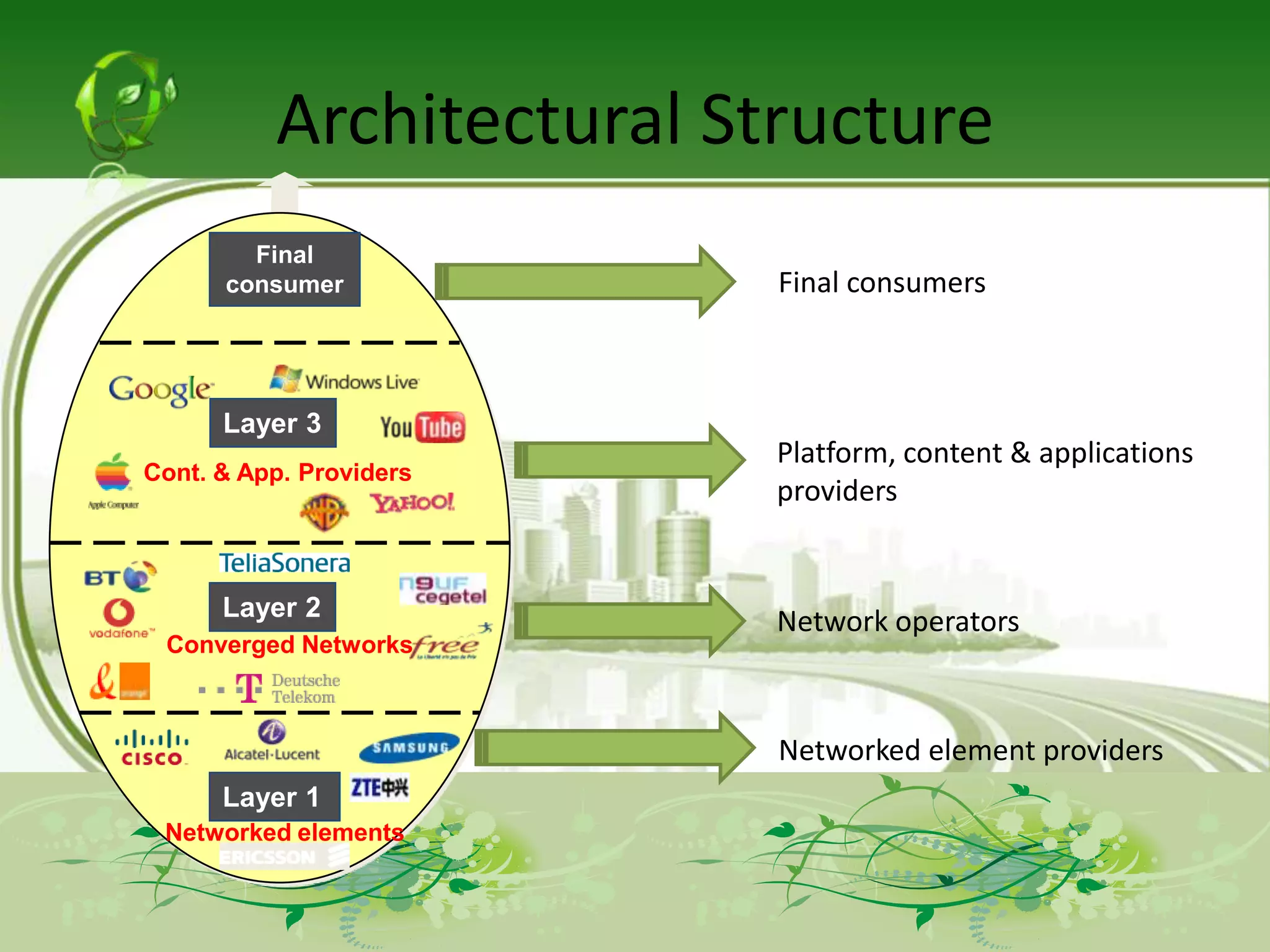
                  Architectural Structure


                               SPRING 2012
                               Team Members :
                               1. Ganbat T
                               2. Riri K
                               3. Teshome W
                               4. Tri A


ITTP750:ICT Economics & Management , Professor
Content


Introduction
Basic ICT Ecosystem (The Six Layer)
New ICT Ecosystem (The Four Layer)
Conclusion
Introduction

                An Ecological community interacting or aggregating together with
    Ecosystem   its environment functioning as a unit


                The sector of economic activity operated based on
                Information and Communication Technologies(ICT)
ICT industry
                The interaction of different units or systems of the
                technology, business, service etc, in an ICT industry
                interacting within one unit of working environment
The ICT Ecosystem Layer Model (ELM)

    Model of the global ICT sector that is developed in order to
    assist the analyses of the sector, and to help inform the
    development of appropriate corporate strategies and
    government policies.


    A Qualitative model that views the entire ICT sector as a
    system
Basic ICT Ecosystem


A layer of ICT Ecosystem consists of 6 layers
(The Six Layer of ELM)
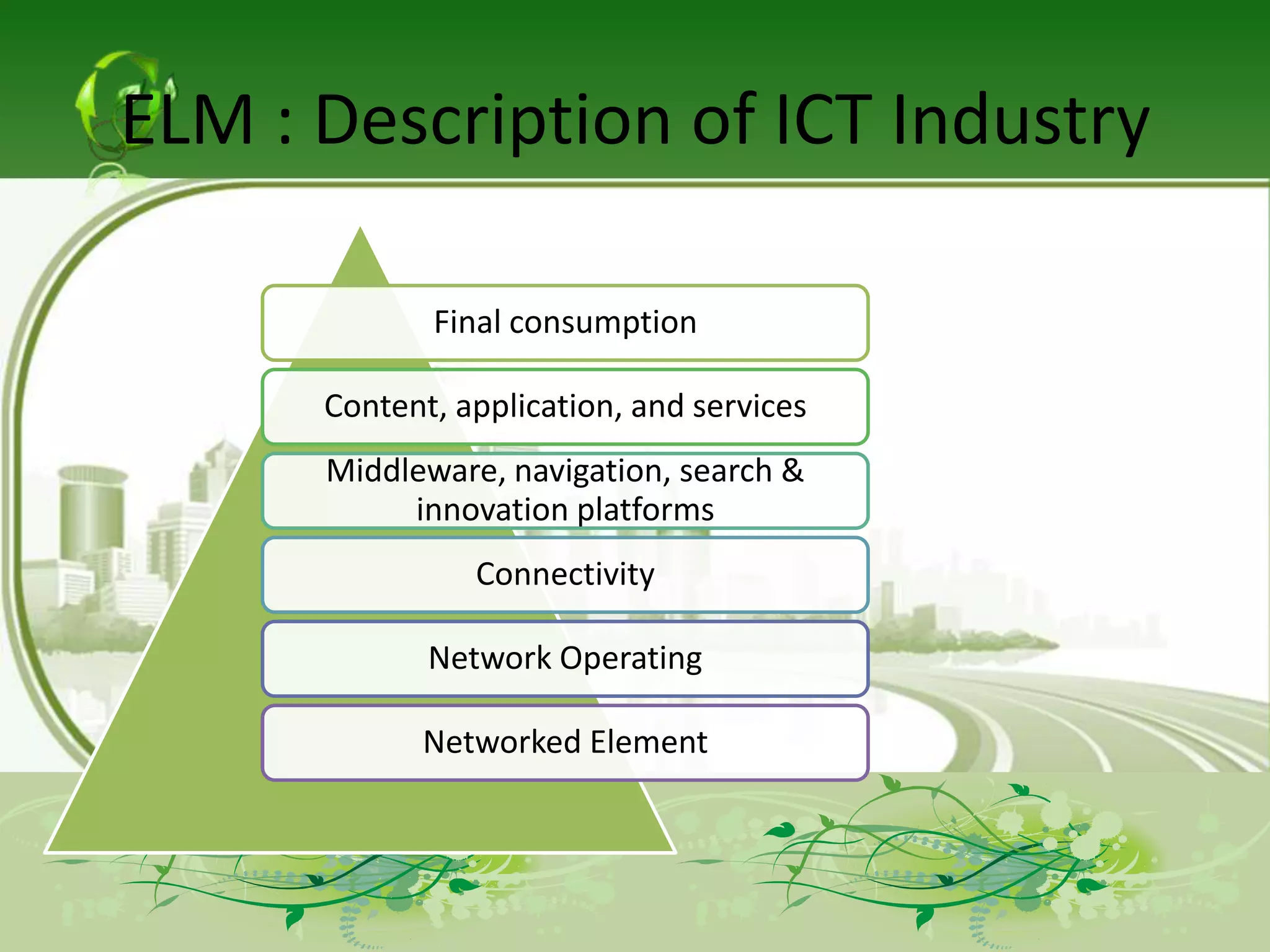
ELM : Description of ICT Industry

             Final consumption

      Content, application, and services
      Middleware, navigation, search &
           innovation platforms
                Connectivity

             Network Operating

            Networked Element
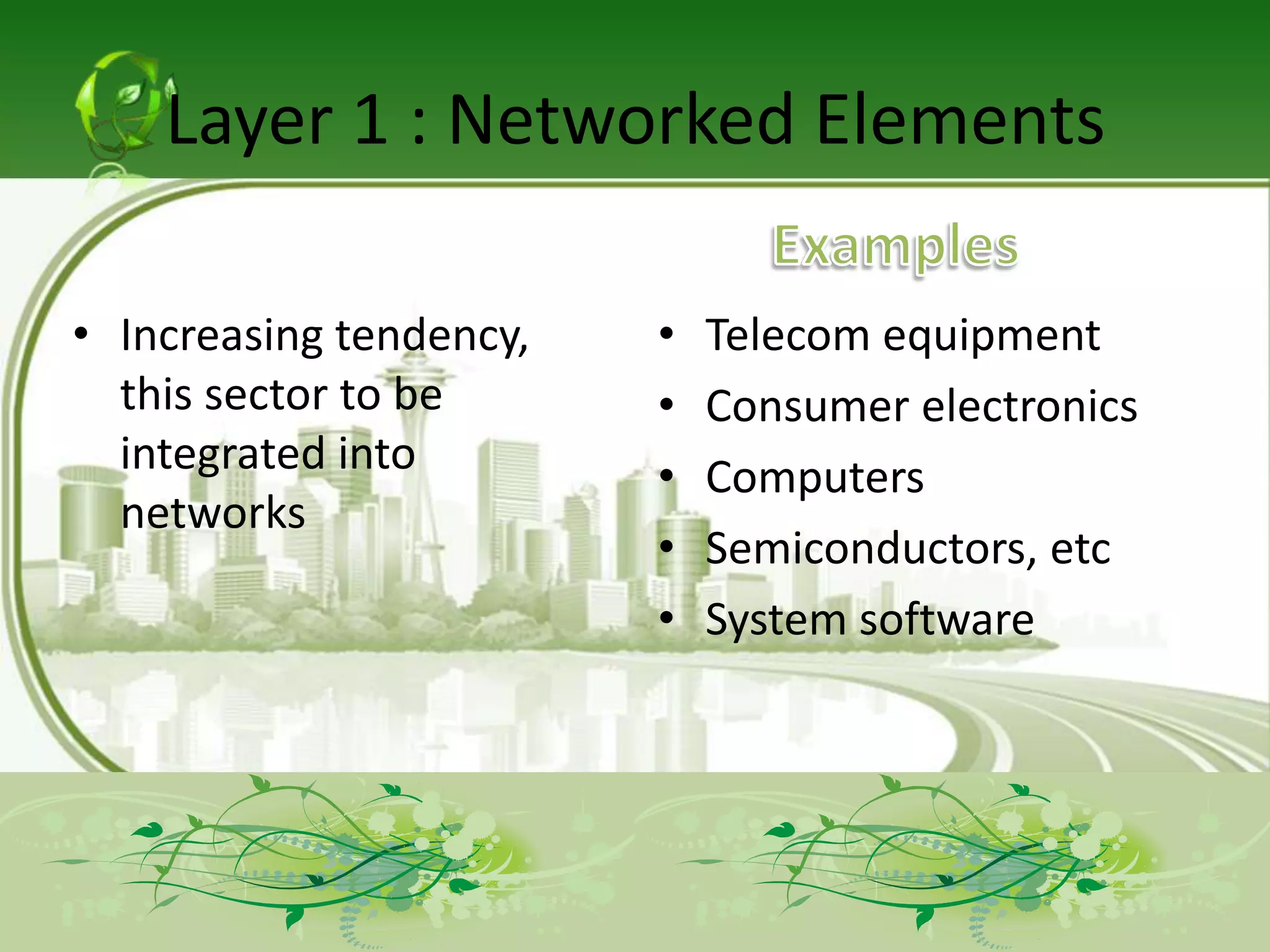
Layer 1 : Networked Elements

• Increasing tendency,   •   Telecom equipment
  this sector to be      •   Consumer electronics
  integrated into        •   Computers
  networks
                         •   Semiconductors, etc
                         •   System software
Layer 2 : Network Operating
• Integrating elements in
  Layer 1 to Information    •   Telecom operators
  & Communication           •   Cable TV Operators
  Networks
                            •   Satellite operators
• These integrated
                            •   Broadcasting operators
  elements run by
  network operator
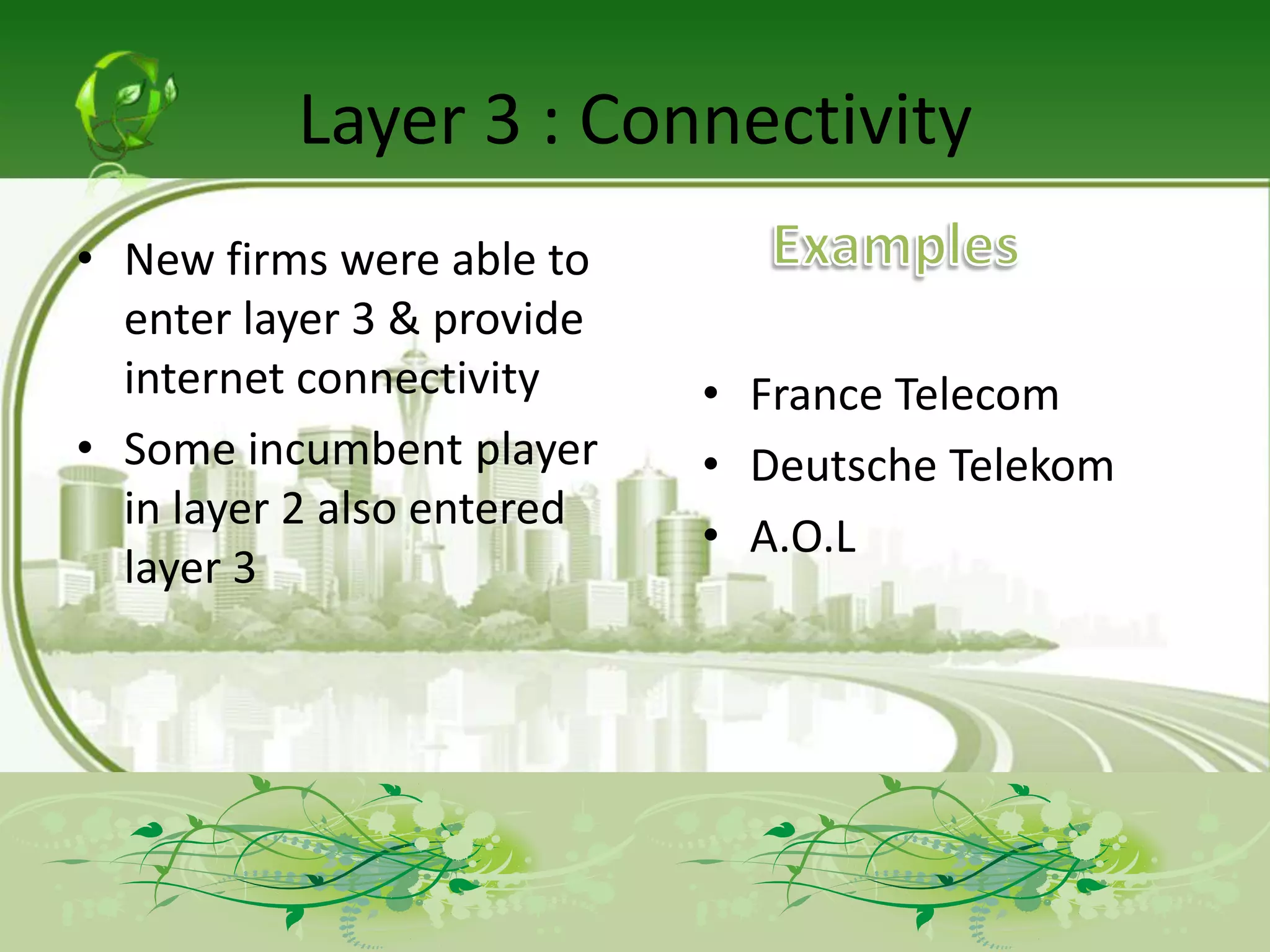
Layer 3 : Connectivity
• New firms were able to
  enter layer 3 & provide
  internet connectivity     • France Telecom
• Some incumbent player     • Deutsche Telekom
  in layer 2 also entered
                            • A.O.L
  layer 3
Layer 4 : Middleware, Navigation,
   Search and Innovation Platforms
• The demand for search
  function                • Browsers
• Function to navigate    • Search engines
  through many hosts on
                          • Security software
  the WWW
Layer 5 : Content,
        Application, and Services
• Content :
  – A commonly used term regarding to the Internet
    and other electronic media (e.g. television and
    DVDs),
  or :
  – A Material, which is inserted to users, such as
    textual information, images, music, and movies.
Layer 5 : Content,
         Application, and Services
• Application : program or group of programs
  designed for end-users.

• It could be software programs in case of
  applications software.

>>> In this course, the term ‘application’ is also
  used to include functionalities, such as electronic
  commerce provided by new Internet companies
  such as eBay and Amazon.com.
Layer 6 : Final Consumption


• The Consuming from layers 1 – 5.
• Drawing attention to the importance of the
  intermediate demand and intermediate
  markets that exist between layer 1-5.
Interaction Between Layers
• The services referred to in layer 5 refer to services for
  final consumers/users not for intermediate
  consumers/users.

• Example :
   – New entrant telecom companies purchasing local loop
     access services from incumbent telecoms operators under
     LLU regulations are conceived of as making an intra-layer 2
     transaction in the access market located in layer 2.
   – However, in using local loop access to provide Internet
     access to final users (such as households) they are
     conceived of as making a market transaction involving
     layers 2 and 6.
Interaction Between Layers Con’t…
• Intermediate demand and supply relationships
  (and therefore markets) exist both within and
  between layers.

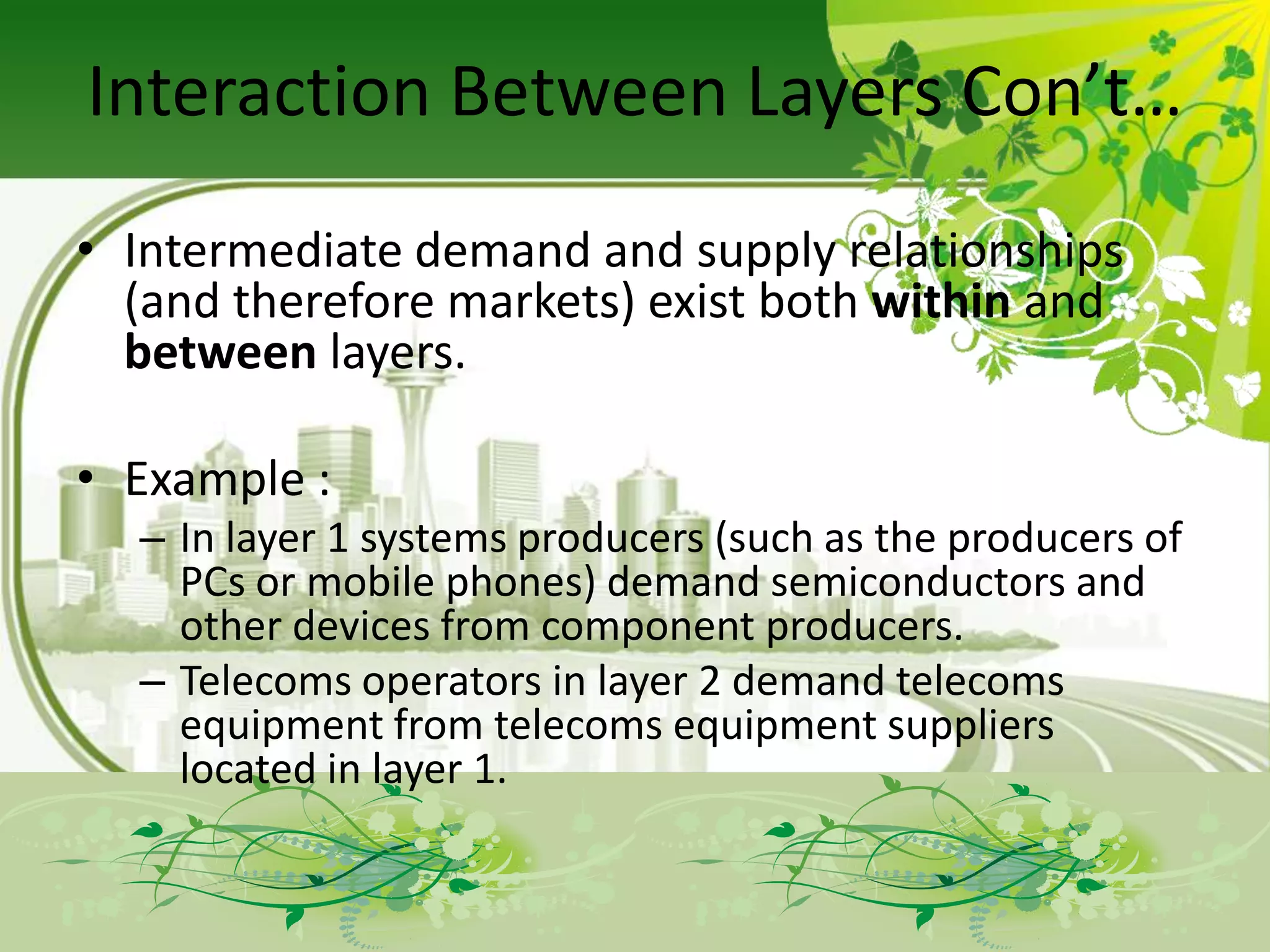
• Example :
  – In layer 1 systems producers (such as the producers of
    PCs or mobile phones) demand semiconductors and
    other devices from component producers.
  – Telecoms operators in layer 2 demand telecoms
    equipment from telecoms equipment suppliers
    located in layer 1.
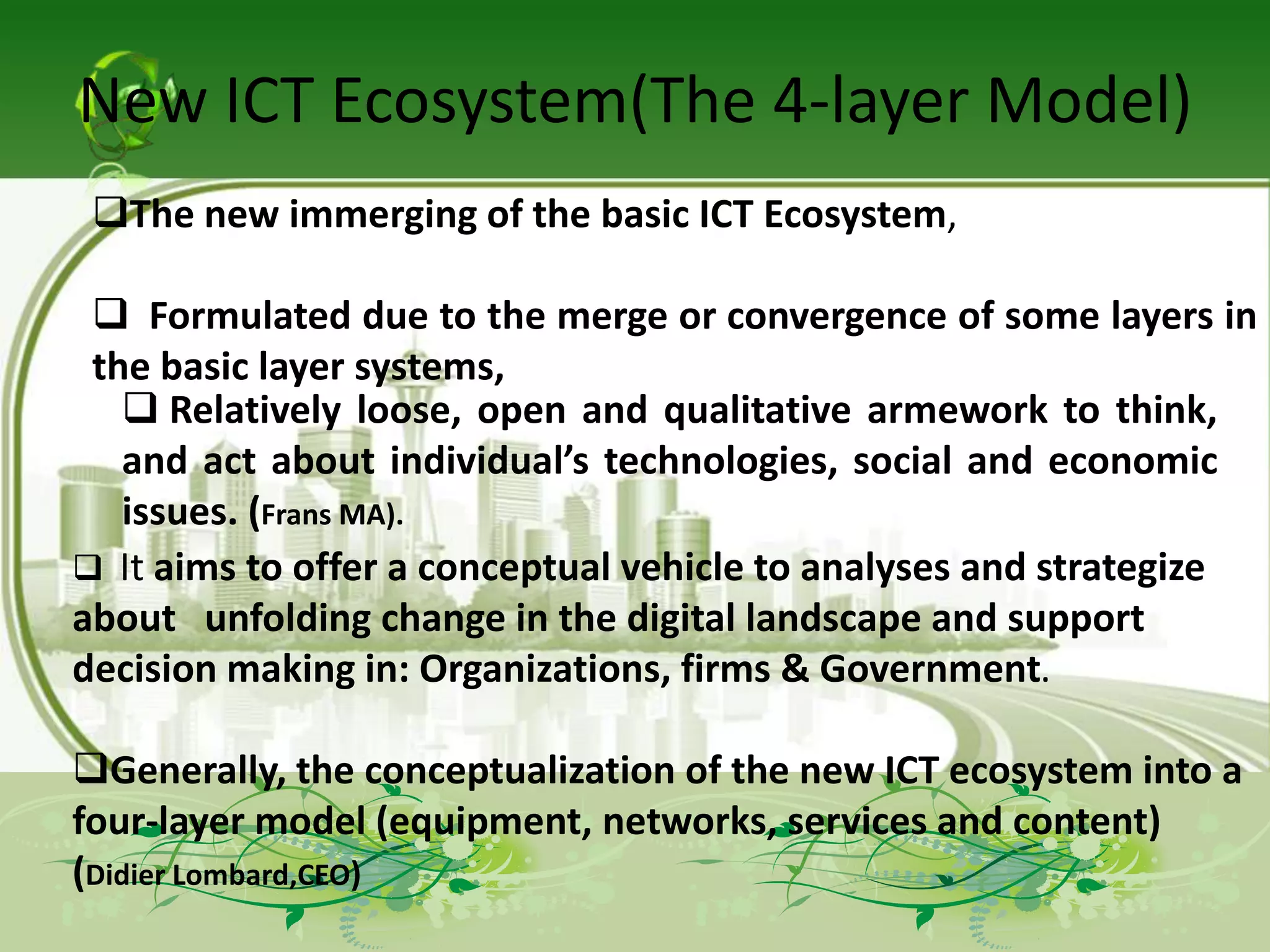
New ICT Ecosystem(The 4-layer Model)
 The new immerging of the basic ICT Ecosystem,

  Formulated due to the merge or convergence of some layers in
 the basic layer systems,
    Relatively loose, open and qualitative armework to think,
   and act about individual’s technologies, social and economic
   issues. (Frans MA).
 It aims to offer a conceptual vehicle to analyses and strategize
about unfolding change in the digital landscape and support
decision making in: Organizations, firms & Government.

Generally, the conceptualization of the new ICT ecosystem into a
four-layer model (equipment, networks, services and content)
(Didier Lombard,CEO)
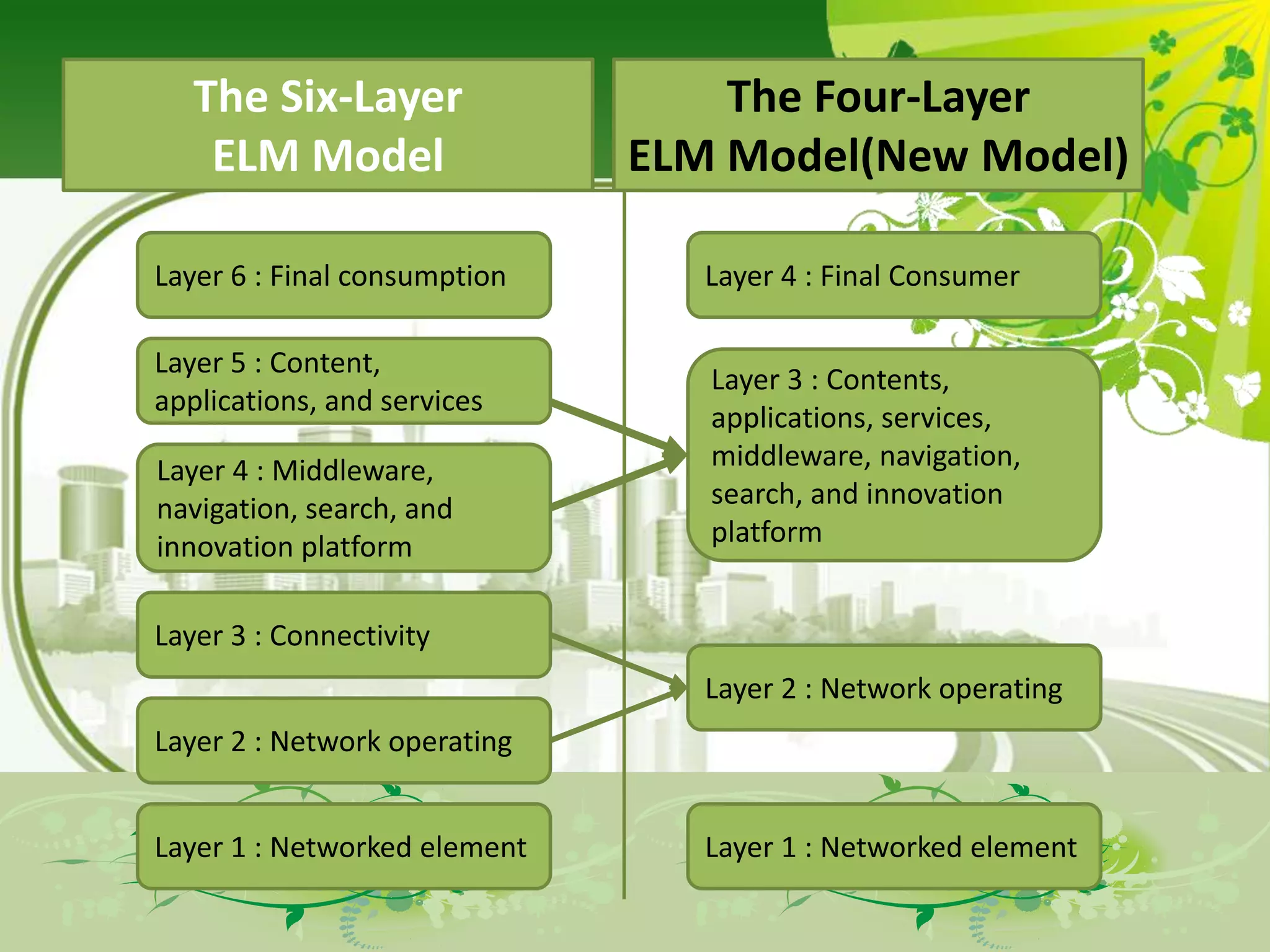
The Six-Layer                  The Four-Layer
    ELM Model                 ELM Model(New Model)

Layer 6 : Final consumption      Layer 4 : Final Consumer

Layer 5 : Content,
                                 Layer 3 : Contents,
applications, and services
                                 applications, services,
Layer 4 : Middleware,            middleware, navigation,
navigation, search, and          search, and innovation
innovation platform              platform


Layer 3 : Connectivity
                                 Layer 2 : Network operating
Layer 2 : Network operating


Layer 1 : Networked element      Layer 1 : Networked element
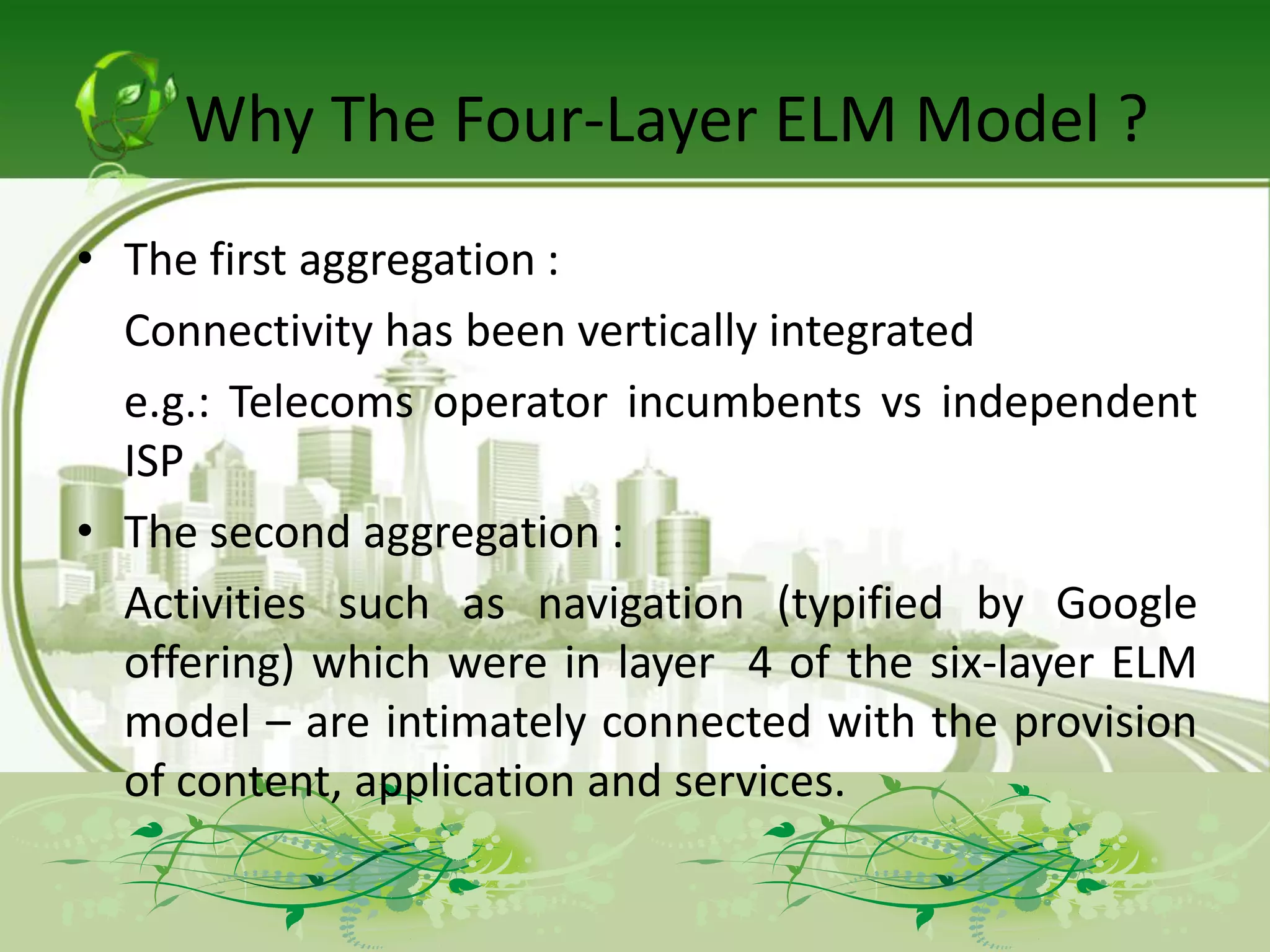
Why The Four-Layer ELM Model ?
• The first aggregation :
  Connectivity has been vertically integrated
  e.g.: Telecoms operator incumbents vs independent
  ISP
• The second aggregation :
  Activities such as navigation (typified by Google
  offering) which were in layer 4 of the six-layer ELM
  model – are intimately connected with the provision
  of content, application and services.
Architectural Structure
        Final
      consumer            Final consumers


      Layer 3
                          Platform, content & applications
Cont. & App. Providers
                          providers


      Layer 2
                          Network operators
 Converged Networks


                          Networked element providers
      Layer 1
 Networked elements
Key Points considered for the
        emergance of new Ecosystem,
   Emergence of new Technologies  some layers become complimentary
   The term convergence is often used for this phenomenon.
    For example, layer 1&2 in the basic ICT Ecosystem were separated
    functionally, but with the new system, they become interconnected, and
    their service is getting to be substituted.
   This brought vertical integration, or merger.
   The advent of internet had contributed for the impact on the structure of
    the new Ecosystem.
   TCP/IP facilities the movement of packets of information across different
    networks, allowing them to become interoperable, and sometimes
    substituted.
Key Points Con’t……..
   This has facilitated the emergence of the process of convergence.
   Different firms give the same service, this may bring on the firms to merge
    or compete.
   TCP/IP has another equally profound effect facilitated the emergence of
    new layers consisting of new functionalities (Layer 3-5).
   It has allowed the technical separation of layer 1&2 from the upper layers
   This brings the entry of new players into the new ICT ecosystem, providing
    new functionalities.
   The aggregation of layer 4(Middle ware, navigation, search & innovation
    platform) & 5(Content, Application & Service in the 6 model to get layer 3 in
    the 4-layer model.
   The reason for this aggregation is that: Middle ware products are
    increasingly being provided by firms involved in navigation, content,
    application & services.
Conclusion
New ICT Layer Model
System & Devices substituted each other,

Convergence from Heterogonous System to simplified (single )system

Allowing firms to vertically integrated (merged),


Competition between firms  increase QoS for buyers,


A step forward for Anywhere & Anytime service,
THANK YOU 

The New ICT Ecosystem : The New Architecture

  • 1.
    The New ICTEcosystem : Architectural Structure SPRING 2012 Team Members : 1. Ganbat T 2. Riri K 3. Teshome W 4. Tri A ITTP750:ICT Economics & Management , Professor
  • 2.
    Content Introduction Basic ICT Ecosystem(The Six Layer) New ICT Ecosystem (The Four Layer) Conclusion
  • 3.
    Introduction An Ecological community interacting or aggregating together with Ecosystem its environment functioning as a unit The sector of economic activity operated based on Information and Communication Technologies(ICT) ICT industry The interaction of different units or systems of the technology, business, service etc, in an ICT industry interacting within one unit of working environment
  • 4.
    The ICT EcosystemLayer Model (ELM) Model of the global ICT sector that is developed in order to assist the analyses of the sector, and to help inform the development of appropriate corporate strategies and government policies. A Qualitative model that views the entire ICT sector as a system
  • 5.
    Basic ICT Ecosystem Alayer of ICT Ecosystem consists of 6 layers (The Six Layer of ELM)
  • 6.
    ELM : Descriptionof ICT Industry Final consumption Content, application, and services Middleware, navigation, search & innovation platforms Connectivity Network Operating Networked Element
  • 7.
    Layer 1 :Networked Elements • Increasing tendency, • Telecom equipment this sector to be • Consumer electronics integrated into • Computers networks • Semiconductors, etc • System software
  • 8.
    Layer 2 :Network Operating • Integrating elements in Layer 1 to Information • Telecom operators & Communication • Cable TV Operators Networks • Satellite operators • These integrated • Broadcasting operators elements run by network operator
  • 9.
    Layer 3 :Connectivity • New firms were able to enter layer 3 & provide internet connectivity • France Telecom • Some incumbent player • Deutsche Telekom in layer 2 also entered • A.O.L layer 3
  • 10.
    Layer 4 :Middleware, Navigation, Search and Innovation Platforms • The demand for search function • Browsers • Function to navigate • Search engines through many hosts on • Security software the WWW
  • 11.
    Layer 5 :Content, Application, and Services • Content : – A commonly used term regarding to the Internet and other electronic media (e.g. television and DVDs), or : – A Material, which is inserted to users, such as textual information, images, music, and movies.
  • 12.
    Layer 5 :Content, Application, and Services • Application : program or group of programs designed for end-users. • It could be software programs in case of applications software. >>> In this course, the term ‘application’ is also used to include functionalities, such as electronic commerce provided by new Internet companies such as eBay and Amazon.com.
  • 13.
    Layer 6 :Final Consumption • The Consuming from layers 1 – 5. • Drawing attention to the importance of the intermediate demand and intermediate markets that exist between layer 1-5.
  • 14.
    Interaction Between Layers •The services referred to in layer 5 refer to services for final consumers/users not for intermediate consumers/users. • Example : – New entrant telecom companies purchasing local loop access services from incumbent telecoms operators under LLU regulations are conceived of as making an intra-layer 2 transaction in the access market located in layer 2. – However, in using local loop access to provide Internet access to final users (such as households) they are conceived of as making a market transaction involving layers 2 and 6.
  • 15.
    Interaction Between LayersCon’t… • Intermediate demand and supply relationships (and therefore markets) exist both within and between layers. • Example : – In layer 1 systems producers (such as the producers of PCs or mobile phones) demand semiconductors and other devices from component producers. – Telecoms operators in layer 2 demand telecoms equipment from telecoms equipment suppliers located in layer 1.
  • 16.
    New ICT Ecosystem(The4-layer Model) The new immerging of the basic ICT Ecosystem,  Formulated due to the merge or convergence of some layers in the basic layer systems,  Relatively loose, open and qualitative armework to think, and act about individual’s technologies, social and economic issues. (Frans MA).  It aims to offer a conceptual vehicle to analyses and strategize about unfolding change in the digital landscape and support decision making in: Organizations, firms & Government. Generally, the conceptualization of the new ICT ecosystem into a four-layer model (equipment, networks, services and content) (Didier Lombard,CEO)
  • 17.
    The Six-Layer The Four-Layer ELM Model ELM Model(New Model) Layer 6 : Final consumption Layer 4 : Final Consumer Layer 5 : Content, Layer 3 : Contents, applications, and services applications, services, Layer 4 : Middleware, middleware, navigation, navigation, search, and search, and innovation innovation platform platform Layer 3 : Connectivity Layer 2 : Network operating Layer 2 : Network operating Layer 1 : Networked element Layer 1 : Networked element
  • 18.
    Why The Four-LayerELM Model ? • The first aggregation : Connectivity has been vertically integrated e.g.: Telecoms operator incumbents vs independent ISP • The second aggregation : Activities such as navigation (typified by Google offering) which were in layer 4 of the six-layer ELM model – are intimately connected with the provision of content, application and services.
  • 19.
    Architectural Structure Final consumer Final consumers Layer 3 Platform, content & applications Cont. & App. Providers providers Layer 2 Network operators Converged Networks Networked element providers Layer 1 Networked elements
  • 20.
    Key Points consideredfor the emergance of new Ecosystem,  Emergence of new Technologies  some layers become complimentary  The term convergence is often used for this phenomenon. For example, layer 1&2 in the basic ICT Ecosystem were separated functionally, but with the new system, they become interconnected, and their service is getting to be substituted.  This brought vertical integration, or merger.  The advent of internet had contributed for the impact on the structure of the new Ecosystem.  TCP/IP facilities the movement of packets of information across different networks, allowing them to become interoperable, and sometimes substituted.
  • 21.
    Key Points Con’t……..  This has facilitated the emergence of the process of convergence.  Different firms give the same service, this may bring on the firms to merge or compete.  TCP/IP has another equally profound effect facilitated the emergence of new layers consisting of new functionalities (Layer 3-5).  It has allowed the technical separation of layer 1&2 from the upper layers  This brings the entry of new players into the new ICT ecosystem, providing new functionalities.  The aggregation of layer 4(Middle ware, navigation, search & innovation platform) & 5(Content, Application & Service in the 6 model to get layer 3 in the 4-layer model.  The reason for this aggregation is that: Middle ware products are increasingly being provided by firms involved in navigation, content, application & services.
  • 22.
    Conclusion New ICT LayerModel System & Devices substituted each other, Convergence from Heterogonous System to simplified (single )system Allowing firms to vertically integrated (merged), Competition between firms  increase QoS for buyers, A step forward for Anywhere & Anytime service,
  • 23.