Divided by Age: A look at senior technology use  Connection Rates, Access, and Online Habits
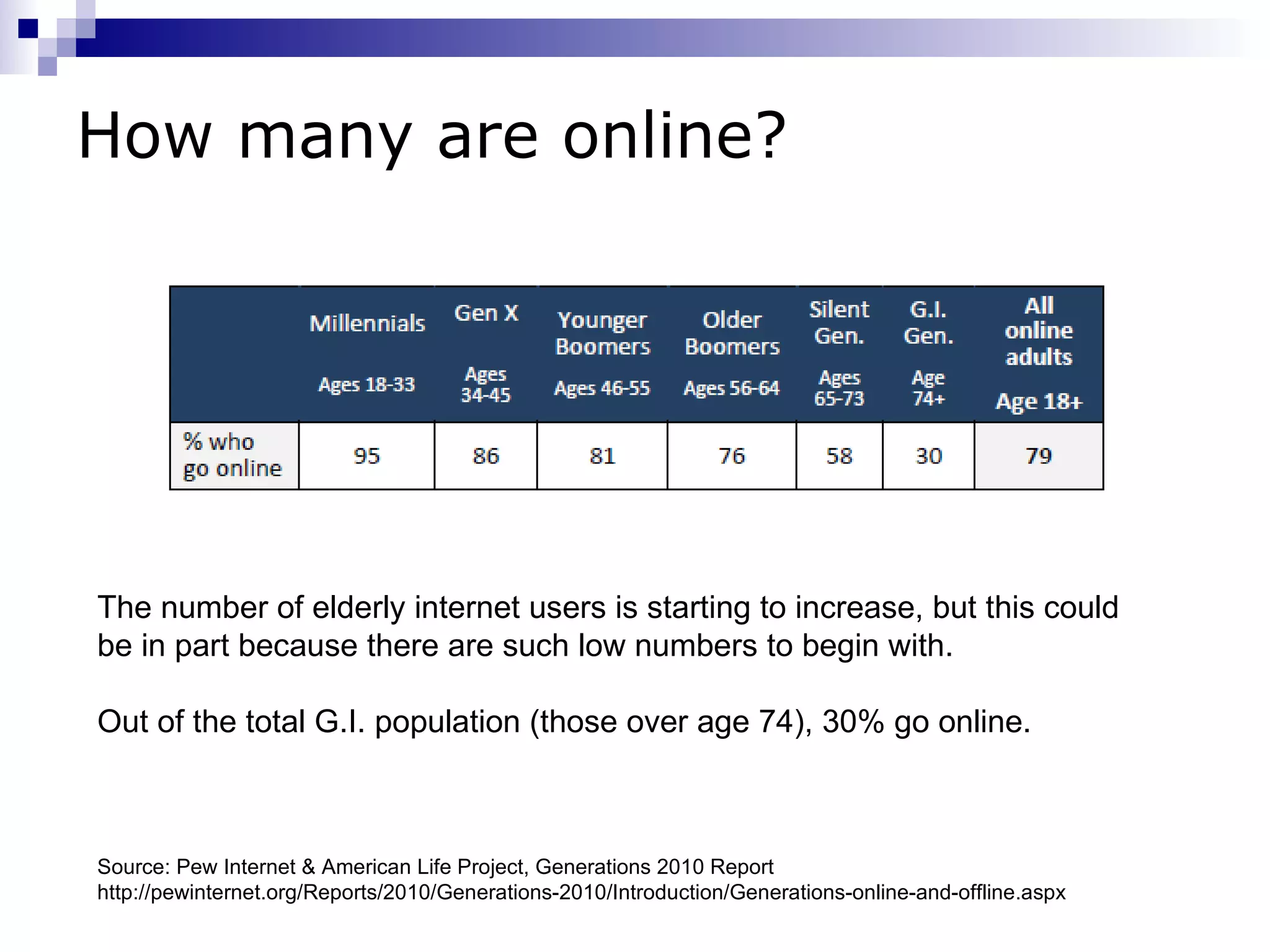
How many are online? The number of elderly internet users is starting to increase, but this could be in part because there are such low numbers to begin with.  Out of the total G.I. population (those over age 74), 30% go online.  Source: Pew Internet & American Life Project, Generations 2010 Report http://pewinternet.org/Reports/2010/Generations-2010/Introduction/Generations-online-and-offline.aspx
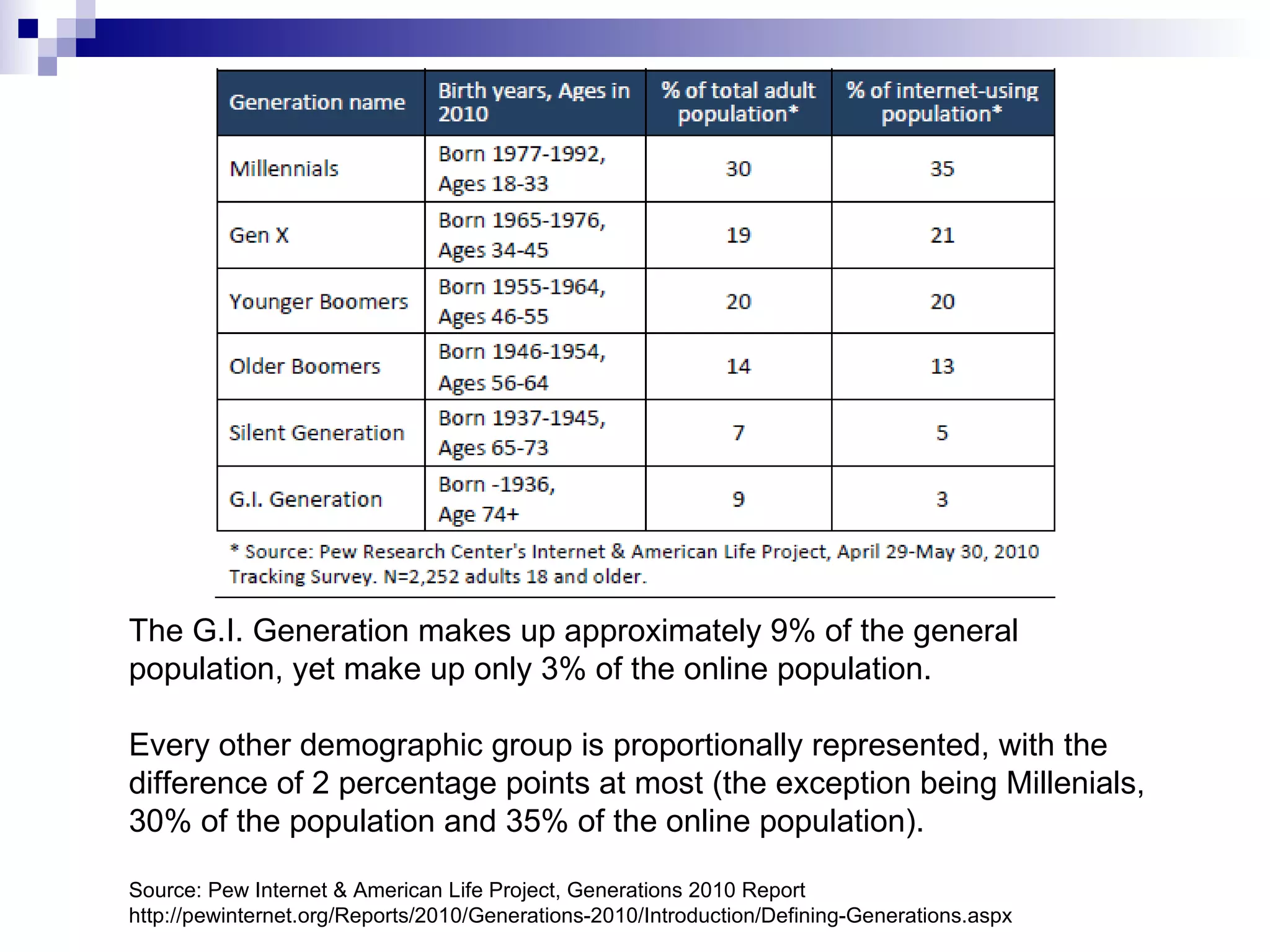
The G.I. Generation makes up approximately 9% of the general population, yet make up only 3% of the online population. Every other demographic group is proportionally represented, with the difference of 2 percentage points at most (the exception being Millenials, 30% of the population and 35% of the online population).  Source: Pew Internet & American Life Project, Generations 2010 Report http://pewinternet.org/Reports/2010/Generations-2010/Introduction/Defining-Generations.aspx
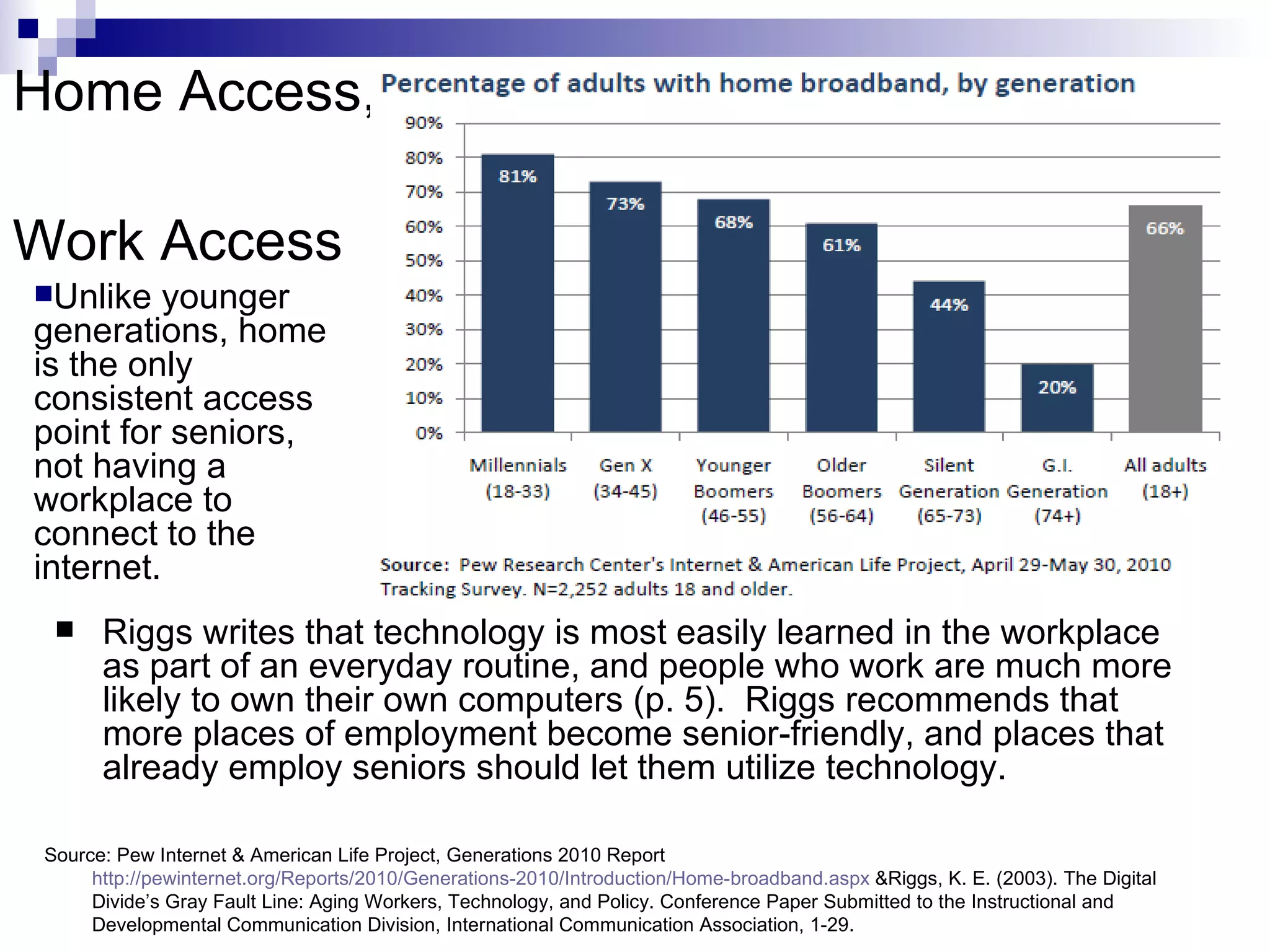
Home Access,  Work Access   Riggs writes that technology is most easily learned in the workplace as part of an everyday routine, and people who work are much more likely to own their own computers (p. 5).  Riggs recommends that more places of employment become senior-friendly, and places that already employ seniors should let them utilize technology.  Unlike younger generations, home is the only consistent access point for seniors, not having a workplace to connect to the internet.   Source: Pew Internet & American Life Project, Generations 2010 Report  http://pewinternet.org/Reports/2010/Generations-2010/Introduction/Home-broadband.aspx  &Riggs, K. E. (2003). The Digital Divide’s Gray Fault Line: Aging Workers, Technology, and Policy. Conference Paper Submitted to the Instructional and Developmental Communication Division, International Communication Association, 1-29.
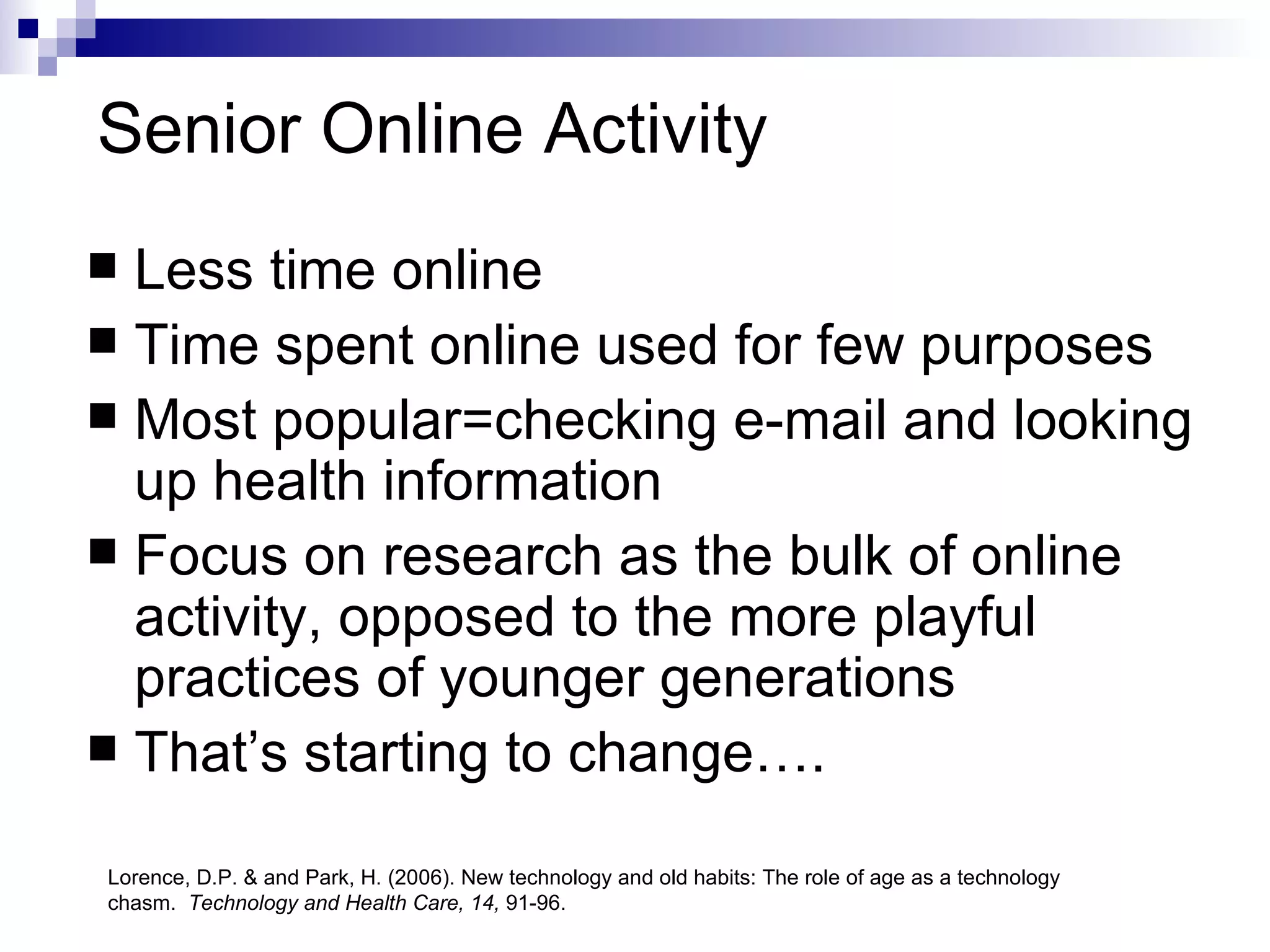
Senior Online Activity   Less time online Time spent online used for few purposes Most popular=checking e-mail and looking up health information Focus on research as the bulk of online activity, opposed to the more playful practices of younger generations That’s starting to change….  Lorence, D.P. & and Park, H. (2006). New technology and old habits: The role of age as a technology chasm.  Technology and Health Care, 14,  91-96.
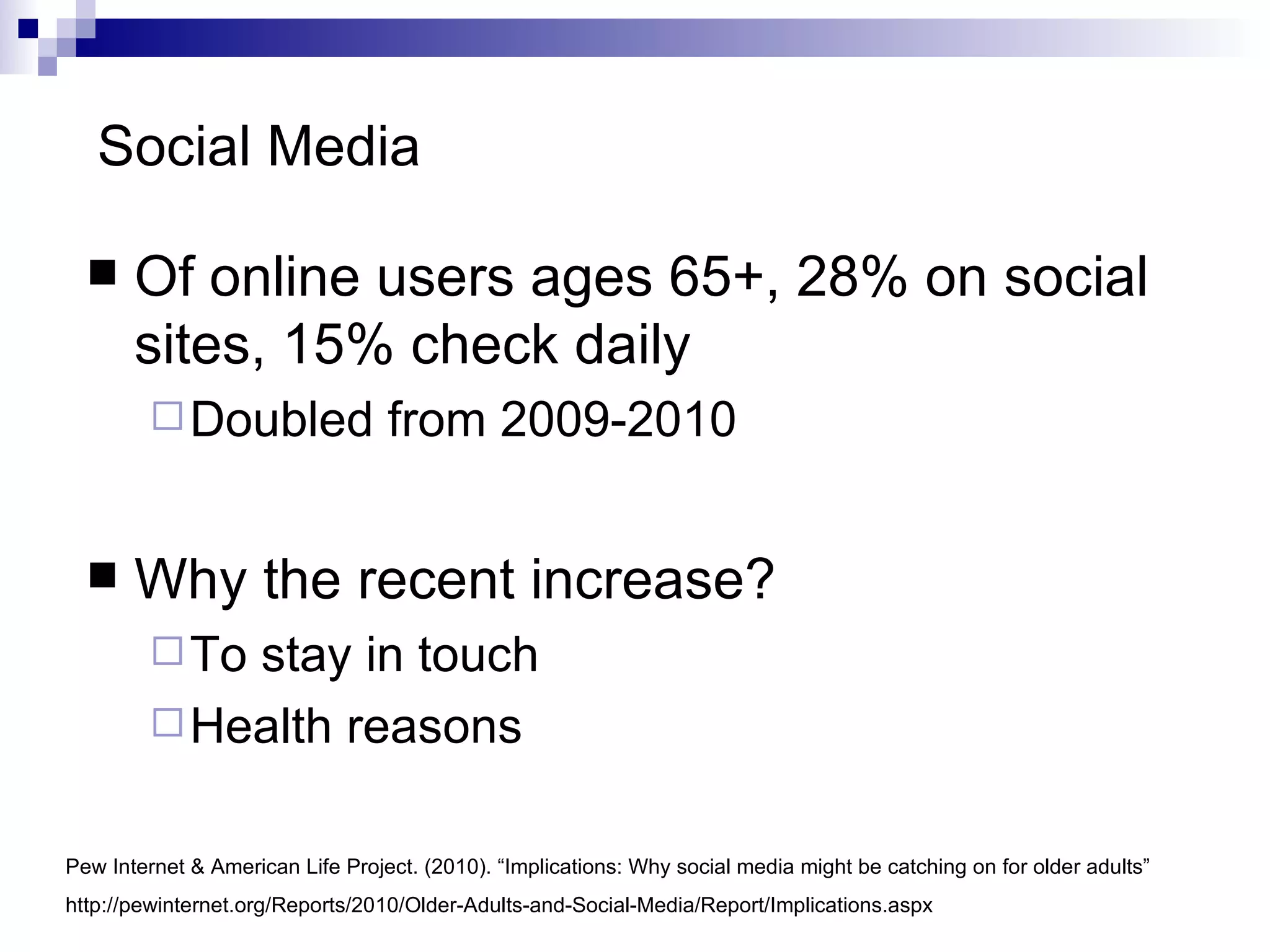
Social Media  Of online users ages 65+, 28% on social sites, 15% check daily Doubled from 2009-2010 Why the recent increase?  To stay in touch Health reasons Pew Internet & American Life Project. (2010). “Implications: Why social media might be catching on for older adults” http://pewinternet.org/Reports/2010/Older-Adults-and-Social-Media/Report/Implications.aspx
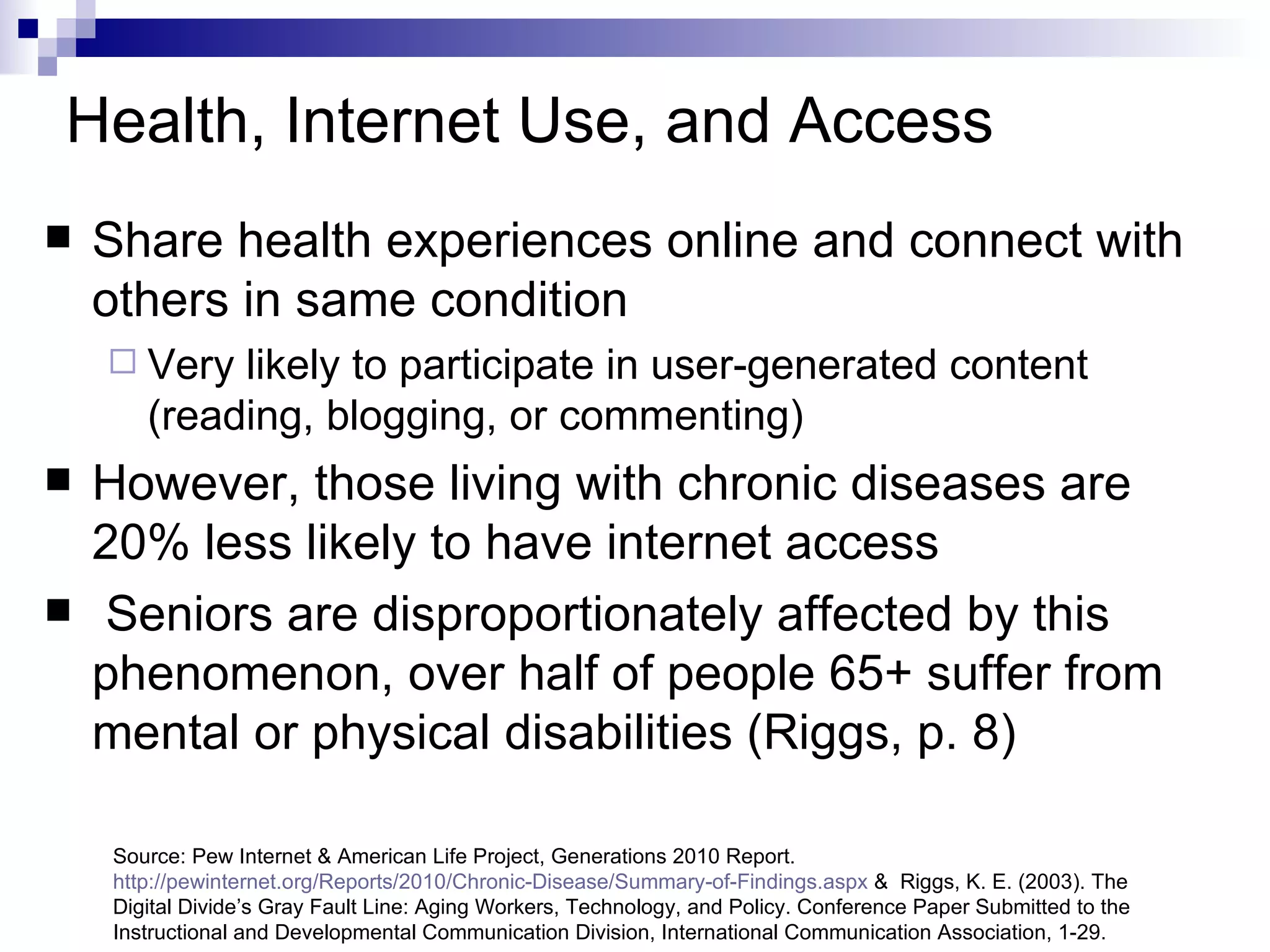
Health, Internet Use, and Access   Share health experiences online and connect with others in same condition Very likely to participate in user-generated content (reading, blogging, or commenting) However, those living with chronic diseases are 20% less likely to have internet access Seniors are disproportionately affected by this phenomenon, over half of people 65+ suffer from mental or physical disabilities (Riggs, p. 8)  Source: Pew Internet & American Life Project, Generations 2010 Report.  http://pewinternet.org/Reports/2010/Chronic-Disease/Summary-of-Findings.aspx  &  Riggs, K. E. (2003). The Digital Divide’s Gray Fault Line: Aging Workers, Technology, and Policy. Conference Paper Submitted to the Instructional and Developmental Communication Division, International Communication Association, 1-29.

Age divide

  • 1.
    Divided by Age:A look at senior technology use Connection Rates, Access, and Online Habits
  • 2.
    How many areonline? The number of elderly internet users is starting to increase, but this could be in part because there are such low numbers to begin with. Out of the total G.I. population (those over age 74), 30% go online. Source: Pew Internet & American Life Project, Generations 2010 Report http://pewinternet.org/Reports/2010/Generations-2010/Introduction/Generations-online-and-offline.aspx
  • 3.
    The G.I. Generationmakes up approximately 9% of the general population, yet make up only 3% of the online population. Every other demographic group is proportionally represented, with the difference of 2 percentage points at most (the exception being Millenials, 30% of the population and 35% of the online population). Source: Pew Internet & American Life Project, Generations 2010 Report http://pewinternet.org/Reports/2010/Generations-2010/Introduction/Defining-Generations.aspx
  • 4.
    Home Access, Work Access Riggs writes that technology is most easily learned in the workplace as part of an everyday routine, and people who work are much more likely to own their own computers (p. 5). Riggs recommends that more places of employment become senior-friendly, and places that already employ seniors should let them utilize technology. Unlike younger generations, home is the only consistent access point for seniors, not having a workplace to connect to the internet. Source: Pew Internet & American Life Project, Generations 2010 Report http://pewinternet.org/Reports/2010/Generations-2010/Introduction/Home-broadband.aspx &Riggs, K. E. (2003). The Digital Divide’s Gray Fault Line: Aging Workers, Technology, and Policy. Conference Paper Submitted to the Instructional and Developmental Communication Division, International Communication Association, 1-29.
  • 5.
    Senior Online Activity Less time online Time spent online used for few purposes Most popular=checking e-mail and looking up health information Focus on research as the bulk of online activity, opposed to the more playful practices of younger generations That’s starting to change…. Lorence, D.P. & and Park, H. (2006). New technology and old habits: The role of age as a technology chasm. Technology and Health Care, 14, 91-96.
  • 6.
    Social Media Of online users ages 65+, 28% on social sites, 15% check daily Doubled from 2009-2010 Why the recent increase? To stay in touch Health reasons Pew Internet & American Life Project. (2010). “Implications: Why social media might be catching on for older adults” http://pewinternet.org/Reports/2010/Older-Adults-and-Social-Media/Report/Implications.aspx
  • 7.
    Health, Internet Use,and Access Share health experiences online and connect with others in same condition Very likely to participate in user-generated content (reading, blogging, or commenting) However, those living with chronic diseases are 20% less likely to have internet access Seniors are disproportionately affected by this phenomenon, over half of people 65+ suffer from mental or physical disabilities (Riggs, p. 8) Source: Pew Internet & American Life Project, Generations 2010 Report. http://pewinternet.org/Reports/2010/Chronic-Disease/Summary-of-Findings.aspx & Riggs, K. E. (2003). The Digital Divide’s Gray Fault Line: Aging Workers, Technology, and Policy. Conference Paper Submitted to the Instructional and Developmental Communication Division, International Communication Association, 1-29.