Jenny Dewsnap
Business and Marketing Manager Age UK Sheffield
The Aging Internet:
digital choice and exclusion among the elderly
CONTEXT
2014 was the 25th anniversary of the World Wide Web.
Today, the web has 2.5 billion users worldwide.
Radio took 38 years to reach 50 million users
Television took 13 years
Internet took 4 years
Facebook took just 10 months
WHAT IS THE ISSUE?
•There's always been a divide
•Isn't it just an issue of age (patience)
•Longer life expectancy = lower rate of demographic change so is age a red
herring?
•Not all older people are ICT illiterate, just as not all young people are ICT
literate – 11% of 16 to 24 year olds are in fact digitally excluded
•Time and market forces will close the divide – not so. The use of IT and mobile
technology has grown and levelled out.
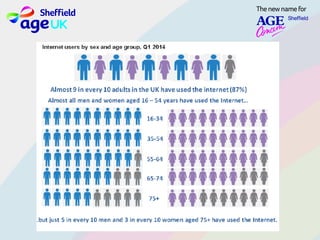
Digital exclusion isn’t going away and isn't a simple question of age.
WRONG SIDE OF THE DIVIDE – SO WHAT?
Those left on the wrong side of the divide today are more deeply excluded,
harder to reach and further away from inclusion than ever before.
Not a one dimensional problem…..
Digital inequality matters because those without the right combination of
access, skill, motivation or knowledge to make digital decisions are missing
out in all areas of life.
DIGITAL EXCLUSION - SOCIAL EXCLUSION
‘CATCH 22’ OR OPPORTUNITY?
Three quarters of those socially excluded are ALSO digitally excluded
So, people already at a disadvantage and arguably with most to gain
from ICT are the least likely to be making use of it and most likely to be
further disadvantaged by their non-use.
If digital and social exclusion are inter-related, positive action on one
front can affect the other, and greater equity be the result.
So in terms of the entire population but more interestingly for today
and Age UK strategic thinking around holistic and inclusive service
packages the issue of digital exclusion is NOT a red herring but a big
fish!
TACKLING THE DIGITAL DIVIDE
Digital inequalities follow lines of social disadvantage.
The main groups most at risk of digital exclusion are:
•those in lower socioeconomic status groups
•those with lower levels of education
•those with a disability or in poor health
•older people (who are likely to have lower incomes, lower levels of education
and one or more disabilities or health conditions)
There are multiple and interrelated reasons for not using the internet
•Cost, access, motivation and skills
•Choice
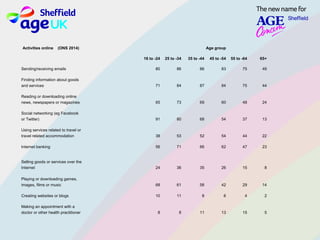
Activities online (ONS 2014)     Age group   
             
  16 to ­24 25 to ­34 35 to ­44 45 to ­54 55 to ­64 65+
             
Sending/receiving emails 80 86 86 83 75 49
             
Finding information about goods            
and services 71 84 87 84 75 44
             
Reading or downloading online            
news, newspapers or magazines 65 73 69 60 48 24
             
Social networking (eg Facebook            
or Twitter) 91 80 68 54 37 13
             
Using services related to travel or            
travel related accommodation 38 53 52 54 44 22
             
Internet banking 56 71 66 62 47 23
             
Selling goods or services over the            
Internet 24 36 35 26 15 8
             
Playing or downloading games,            
images, films or music 68 61 58 42 29 14
             
Creating websites or blogs 10 11 8 6 4 2
             
Making an appointment with a            
doctor or other health practitioner 8 8 11 13 15 5
             
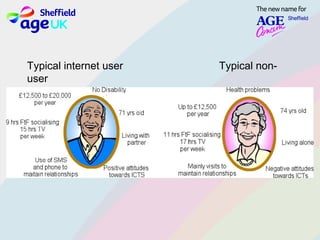
Typical internet user Typical non-
user
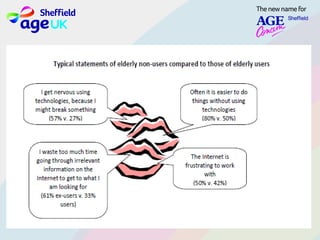
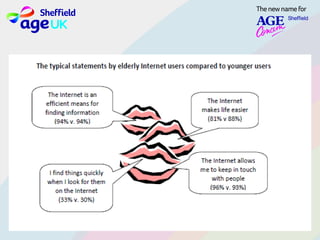
In comparison to their peers, older people who do not use the Internet are:
• Older old
• socially isolated
• living alone
• on lower income
• female
• with health problems
• negative about ICTs
So we know more about who – but why?
BUILDING THE PICTURE
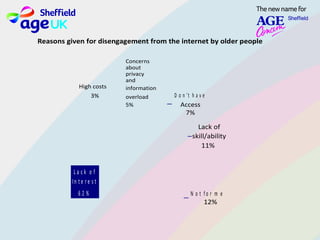
Reasons given for disengagement from the internet by older people
Concerns
about
privacy
and
High costs information
3% overload D o n 't h a v e
5% Access
7%
Lack of
skill/ability
11%
L a c k o f
In t e r e s t
6 2 % N o t f o r m e
12%
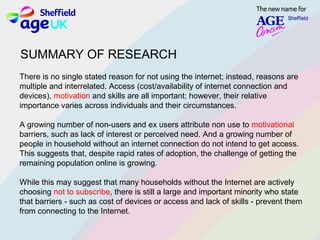
There is no single stated reason for not using the internet; instead, reasons are
multiple and interrelated. Access (cost/availability of internet connection and
devices), motivation and skills are all important; however, their relative
importance varies across individuals and their circumstances.
A growing number of non­users and ex users attribute non use to motivational
barriers, such as lack of interest or perceived need. And a growing number of​
people in household without an internet connection do not intend to get access.
This suggests that, despite rapid rates of adoption, the challenge of getting the​
remaining population online is growing.
While this may suggest that many households without the Internet are actively
choosing not to subscribe, there is still a large and important minority who state
that barriers ­ such as cost of devices or access and lack of skills ­ prevent them
from connecting to the Internet.
SUMMARY OF RESEARCH
MOTIVATION (CHOICE)
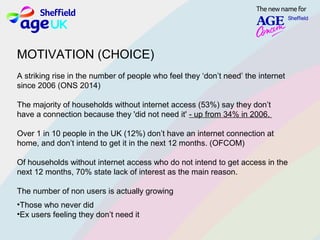
A striking rise in the number of people who feel they ‘don’t need’ the internet
since 2006 (ONS 2014)
The majority of households without internet access (53%) say they don’t
have a connection because they 'did not need it' ­ up from 34% in 2006.
Over 1 in 10 people in the UK (12%) don’t have an internet connection at
home, and don’t intend to get it in the next 12 months. (OFCOM)
Of households without internet access who do not intend to get access in the
next 12 months, 70% state lack of interest as the main reason.
The number of non users is actually growing
•Those who never did
•Ex users feeling they don’t need it
CONCLUSIONS
• Digital and social exclusion are linked
• Older people have multiple/complex barriers to access including
• Cost
• Access
• Education/skill level
• Health
• Perception –security, need, “not for me”
• Failed or bad experience leading to falling figures
• Choice
ACTIONS AND RECOMMENDATIONS
•Issues of social and digital isolation must be looked at together
•Opportunities must be sought to address the key reasons preventing inclusion
particularly need and choice
•Agencies and service providers, GP’s and local authorities need to be aware
of the existing and growing divide when developing largely IT accessed
services
•Innovation needs to be employed to change the mindset of those who feel IT
isn't for them
•Multi agency approaches to the issue WILL work
•Digital exclusion MUST be seen as a real and growing issue amongst the
elderly
•The age “issue” will not go away in time
•Strategies must take account of the lapsed user with now more reason to feel
it’s “not for me” a second time around
•Confidence and fear of failure are real issue
WHAT IS AGE UK SHEFFIELD DOING?
•The Club
•IT sessions
•Lending library
•Digital Champions
•Links to Tinder Foundation
•Links to community organisations/libraries
•Co­production/design
•“The IT Club” – Peer led support
Making access possible and desirable and being there to provide first
time and every time support.
Thank You
Jenny Dewsnap
Age UK Sheffield
jenny.dewsnap@ageuksheffield.org.uk
0114 250 2850

Jenny dewsnap

  • 1.
    Jenny Dewsnap Business andMarketing Manager Age UK Sheffield The Aging Internet: digital choice and exclusion among the elderly
  • 2.
    CONTEXT 2014 was the25th anniversary of the World Wide Web. Today, the web has 2.5 billion users worldwide. Radio took 38 years to reach 50 million users Television took 13 years Internet took 4 years Facebook took just 10 months
  • 3.
    WHAT IS THEISSUE? •There's always been a divide •Isn't it just an issue of age (patience) •Longer life expectancy = lower rate of demographic change so is age a red herring? •Not all older people are ICT illiterate, just as not all young people are ICT literate – 11% of 16 to 24 year olds are in fact digitally excluded •Time and market forces will close the divide – not so. The use of IT and mobile technology has grown and levelled out. Digital exclusion isn’t going away and isn't a simple question of age.
  • 4.
    WRONG SIDE OFTHE DIVIDE – SO WHAT? Those left on the wrong side of the divide today are more deeply excluded, harder to reach and further away from inclusion than ever before. Not a one dimensional problem….. Digital inequality matters because those without the right combination of access, skill, motivation or knowledge to make digital decisions are missing out in all areas of life. DIGITAL EXCLUSION - SOCIAL EXCLUSION
  • 5.
    ‘CATCH 22’ OROPPORTUNITY? Three quarters of those socially excluded are ALSO digitally excluded So, people already at a disadvantage and arguably with most to gain from ICT are the least likely to be making use of it and most likely to be further disadvantaged by their non-use. If digital and social exclusion are inter-related, positive action on one front can affect the other, and greater equity be the result. So in terms of the entire population but more interestingly for today and Age UK strategic thinking around holistic and inclusive service packages the issue of digital exclusion is NOT a red herring but a big fish!
  • 7.
    TACKLING THE DIGITALDIVIDE Digital inequalities follow lines of social disadvantage. The main groups most at risk of digital exclusion are: •those in lower socioeconomic status groups •those with lower levels of education •those with a disability or in poor health •older people (who are likely to have lower incomes, lower levels of education and one or more disabilities or health conditions) There are multiple and interrelated reasons for not using the internet •Cost, access, motivation and skills •Choice
  • 8.
    Activities online (ONS2014)     Age group                    16 to ­24 25 to ­34 35 to ­44 45 to ­54 55 to ­64 65+               Sending/receiving emails 80 86 86 83 75 49               Finding information about goods             and services 71 84 87 84 75 44               Reading or downloading online             news, newspapers or magazines 65 73 69 60 48 24               Social networking (eg Facebook             or Twitter) 91 80 68 54 37 13               Using services related to travel or             travel related accommodation 38 53 52 54 44 22               Internet banking 56 71 66 62 47 23               Selling goods or services over the             Internet 24 36 35 26 15 8               Playing or downloading games,             images, films or music 68 61 58 42 29 14               Creating websites or blogs 10 11 8 6 4 2               Making an appointment with a             doctor or other health practitioner 8 8 11 13 15 5              
  • 10.
    Typical internet userTypical non- user
  • 11.
    In comparison totheir peers, older people who do not use the Internet are: • Older old • socially isolated • living alone • on lower income • female • with health problems • negative about ICTs So we know more about who – but why? BUILDING THE PICTURE
  • 12.
    Reasons given fordisengagement from the internet by older people Concerns about privacy and High costs information 3% overload D o n 't h a v e 5% Access 7% Lack of skill/ability 11% L a c k o f In t e r e s t 6 2 % N o t f o r m e 12%
  • 15.
    There is nosingle stated reason for not using the internet; instead, reasons are multiple and interrelated. Access (cost/availability of internet connection and devices), motivation and skills are all important; however, their relative importance varies across individuals and their circumstances. A growing number of non­users and ex users attribute non use to motivational barriers, such as lack of interest or perceived need. And a growing number of​ people in household without an internet connection do not intend to get access. This suggests that, despite rapid rates of adoption, the challenge of getting the​ remaining population online is growing. While this may suggest that many households without the Internet are actively choosing not to subscribe, there is still a large and important minority who state that barriers ­ such as cost of devices or access and lack of skills ­ prevent them from connecting to the Internet. SUMMARY OF RESEARCH
  • 16.
    MOTIVATION (CHOICE) A strikingrise in the number of people who feel they ‘don’t need’ the internet since 2006 (ONS 2014) The majority of households without internet access (53%) say they don’t have a connection because they 'did not need it' ­ up from 34% in 2006. Over 1 in 10 people in the UK (12%) don’t have an internet connection at home, and don’t intend to get it in the next 12 months. (OFCOM) Of households without internet access who do not intend to get access in the next 12 months, 70% state lack of interest as the main reason. The number of non users is actually growing •Those who never did •Ex users feeling they don’t need it
  • 17.
    CONCLUSIONS • Digital andsocial exclusion are linked • Older people have multiple/complex barriers to access including • Cost • Access • Education/skill level • Health • Perception –security, need, “not for me” • Failed or bad experience leading to falling figures • Choice
  • 18.
    ACTIONS AND RECOMMENDATIONS •Issuesof social and digital isolation must be looked at together •Opportunities must be sought to address the key reasons preventing inclusion particularly need and choice •Agencies and service providers, GP’s and local authorities need to be aware of the existing and growing divide when developing largely IT accessed services •Innovation needs to be employed to change the mindset of those who feel IT isn't for them •Multi agency approaches to the issue WILL work •Digital exclusion MUST be seen as a real and growing issue amongst the elderly •The age “issue” will not go away in time •Strategies must take account of the lapsed user with now more reason to feel it’s “not for me” a second time around •Confidence and fear of failure are real issue
  • 19.
    WHAT IS AGEUK SHEFFIELD DOING? •The Club •IT sessions •Lending library •Digital Champions •Links to Tinder Foundation •Links to community organisations/libraries •Co­production/design •“The IT Club” – Peer led support Making access possible and desirable and being there to provide first time and every time support.
  • 20.
    Thank You Jenny Dewsnap AgeUK Sheffield jenny.dewsnap@ageuksheffield.org.uk 0114 250 2850

Editor's Notes

  • #5 Just one of a number of factors affecting isolation in the elderly – leading to further isolation and all the issues this brings More and more services online Council services – health (doctor bookings) finding providers of service locally, whats going on locally, transport, buses, trains…. Paying for services Tv and access to wider technologies Email, SKYPE, sharing family photographs of family members more widely geographically dispersed.
  • #14 73% felt the internet is “addictive”
  • #15 The differences between younger and older Internet users in their attitudes towards ICTs are small. This illustrates that when older (or younger) people have had experience with the Internet they are less likely to have negative perceptions of ICTs