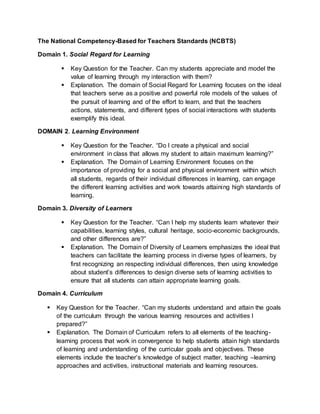
The National Competency-Based for Teachers Standards (NCBTS)
Domain 1. Social Regard for Learning
 Key Question for the Teacher. Can my students appreciate and model the
value of learning through my interaction with them?
 Explanation. The domain of Social Regard for Learning focuses on the ideal
that teachers serve as a positive and powerful role models of the values of
the pursuit of learning and of the effort to learn, and that the teachers
actions, statements, and different types of social interactions with students
exemplify this ideal.
DOMAIN 2. Learning Environment
 Key Question for the Teacher. “Do I create a physical and social
environment in class that allows my student to attain maximum learning?”
 Explanation. The Domain of Learning Environment focuses on the
importance of providing for a social and physical environment within which
all students, regards of their individual differences in learning, can engage
the different learning activities and work towards attaining high standards of
learning.
Domain 3. Diversity of Learners
 Key Question for the Teacher. “Can I help my students learn whatever their
capabilities, learning styles, cultural heritage, socio-economic backgrounds,
and other differences are?”
 Explanation. The Domain of Diversity of Learners emphasizes the ideal that
teachers can facilitate the learning process in diverse types of learners, by
first recognizing an respecting individual differences, then using knowledge
about student’s differences to design diverse sets of learning activities to
ensure that all students can attain appropriate learning goals.
Domain 4. Curriculum
 Key Question for the Teacher. “Can my students understand and attain the goals
of the curriculum through the various learning resources and activities I
prepared?”
 Explanation. The Domain of Curriculum refers to all elements of the teaching-
learning process that work in convergence to help students attain high standards
of learning and understanding of the curricular goals and objectives. These
elements include the teacher’s knowledge of subject matter, teaching –learning
approaches and activities, instructional materials and learning resources.
Domain 5. Planning, Assessing and Reporting
 Key Question for the Teacher. “Do I assess my students’ learning and
knowledge using appropriate educational assessment procedures, and do I use
the information from these assessment procedures in planning my teaching-
learning activities for the students?”
 Explanation. The Domain of Planning, Assessing and Reporting refers to the
aligned use of assessment and planning activities to ensure that the teaching-
learning activities are maximally appropriate to the students’ current knowledge
and learning levels. In particular, the domain focuses on the use of assessment
data to plan and revise teaching-learning plans, as well as the integration of
formative assessment procedures in the plan and implementation of teaching-
learning activities.
Domain 6. Community Linkages
 Key Question for the Teacher. “Are the goals and characteristics of the
teaching-learning activities I implement relevant to the experiences, values and
aspirations in my students’ communities?”
 Explanation. The Domain of community Linkages focuses on the ideal that
school activities are meaningful linked to the experiences and aspirations of the
students in their homes and communities. Thus the domain focuses on
teachers’ effort directed at strengthening the links between school and
community activities, particularly as these links help in the attainment of the
curricular objectives.
Domain 7. Personal Growth and Professional Development
 Key Question for the Teacher. “Do my actions and statements indicate a high
regard for the teaching profession and for my continuous development as a
professional teacher?”
 Explanation. The Domain of Personal Growth and Professionalism
Development emphasizes the ideal that teacher value having a high personal
regard, concern for professional development, and continuous improvement as
teachers.

The national competency based for teachers standards (ncbts)

  • 1.
    The National Competency-Basedfor Teachers Standards (NCBTS) Domain 1. Social Regard for Learning  Key Question for the Teacher. Can my students appreciate and model the value of learning through my interaction with them?  Explanation. The domain of Social Regard for Learning focuses on the ideal that teachers serve as a positive and powerful role models of the values of the pursuit of learning and of the effort to learn, and that the teachers actions, statements, and different types of social interactions with students exemplify this ideal. DOMAIN 2. Learning Environment  Key Question for the Teacher. “Do I create a physical and social environment in class that allows my student to attain maximum learning?”  Explanation. The Domain of Learning Environment focuses on the importance of providing for a social and physical environment within which all students, regards of their individual differences in learning, can engage the different learning activities and work towards attaining high standards of learning. Domain 3. Diversity of Learners  Key Question for the Teacher. “Can I help my students learn whatever their capabilities, learning styles, cultural heritage, socio-economic backgrounds, and other differences are?”  Explanation. The Domain of Diversity of Learners emphasizes the ideal that teachers can facilitate the learning process in diverse types of learners, by first recognizing an respecting individual differences, then using knowledge about student’s differences to design diverse sets of learning activities to ensure that all students can attain appropriate learning goals. Domain 4. Curriculum  Key Question for the Teacher. “Can my students understand and attain the goals of the curriculum through the various learning resources and activities I prepared?”  Explanation. The Domain of Curriculum refers to all elements of the teaching- learning process that work in convergence to help students attain high standards of learning and understanding of the curricular goals and objectives. These elements include the teacher’s knowledge of subject matter, teaching –learning approaches and activities, instructional materials and learning resources.
  • 2.
    Domain 5. Planning,Assessing and Reporting  Key Question for the Teacher. “Do I assess my students’ learning and knowledge using appropriate educational assessment procedures, and do I use the information from these assessment procedures in planning my teaching- learning activities for the students?”  Explanation. The Domain of Planning, Assessing and Reporting refers to the aligned use of assessment and planning activities to ensure that the teaching- learning activities are maximally appropriate to the students’ current knowledge and learning levels. In particular, the domain focuses on the use of assessment data to plan and revise teaching-learning plans, as well as the integration of formative assessment procedures in the plan and implementation of teaching- learning activities. Domain 6. Community Linkages  Key Question for the Teacher. “Are the goals and characteristics of the teaching-learning activities I implement relevant to the experiences, values and aspirations in my students’ communities?”  Explanation. The Domain of community Linkages focuses on the ideal that school activities are meaningful linked to the experiences and aspirations of the students in their homes and communities. Thus the domain focuses on teachers’ effort directed at strengthening the links between school and community activities, particularly as these links help in the attainment of the curricular objectives. Domain 7. Personal Growth and Professional Development  Key Question for the Teacher. “Do my actions and statements indicate a high regard for the teaching profession and for my continuous development as a professional teacher?”  Explanation. The Domain of Personal Growth and Professionalism Development emphasizes the ideal that teacher value having a high personal regard, concern for professional development, and continuous improvement as teachers.